November 15: 1 Corinthians 4:1-2

1 Corinthians 4:1-2

“So a man should count us as under-rowers of (the) Anointed and house-portioners of (the) secrets of God.” (4:1)

In the next two sections of Paul’s exposition (4:1-5, 6-13), he applies the points made in chapter 3 (esp. verses 5-15) to the situation regarding he and Apollos as ministers (and apostolic missionaries) to the Corinthians. He begins with himself here in vv. 1-5, and then includes Apollos in vv. 6ff. The statement in verse 1 relates back to the driving issue of sectarian/partisan divisions in the Corinthian Community, and how this disrupts—and is fundamentally contrary to—the ideal of unity that should prevail among believers in Christ. According to 1:11ff and 3:3-4, these divisions were centered on prominent and influential ministers (such as Paul and Apollos), with believers identifying (and aligning) with a particular ministerial affiliation (“I am of Paul”, etc). In the previous section (3:18-23, cf. the previous note), Paul argued vigorously against such a tendency, pointing out that Christian ministers belong to the Community of believers as a whole, and are subservient to the Community. The unity of believers in Christ takes priority over anything a particular minister can offer.

Paul had applied this line of argument to himself, and does so again here in vv. 1-5. In so doing, he presents a definition and explanation of the nature of the Christian ministry. The entire matter at issue is how, through reliance upon human wisdom, many Christians have come to think about certain ministers or leaders. Here, Paul states how ministers should be thought of in truth; he uses the verb logi/zomai in its basic (cognitive) sense of “(ac)count”, i.e., reckon, consider, perhaps also touching upon the related nuance of “estimate, value”.

How, then, should ministers be considered or “counted”? Two idiomatic Greek expressions are used. The first involves the noun u(pere/th$, which literally means “under-rower”, drawn from a naval or seafaring context, referring to the common sailors (rowers) who work together under a head boatman or ship’s captain, etc. The term came to be used in a more general sense for any subordinate official or servant-worker, which is how it is used here (and throughout the New Testament). Even a leading apostolic missionary such as Paul is merely an “under-rower” —that is, a subordinate servant (working together with others)—of Jesus Christ. Interestingly, this is the only use of the noun u(pere/th$ in Paul’s letters (but note the occurrence in Acts 13:5 and 26:6). Typically, Paul expresses this idea, viz., of the minister as a servant-worker, using the nouns dou=lo$ (“slave, servant”) and dia/kono$ (“attendant”).

The second expression involves the noun oi)kono/mo$, which means something like “house-portioner”, i.e., one who “portions out” (vb ne/mw) or distributes things in a house(hold). It technically refers to a servant who manages the affairs of a household or estate, etc (cf. Gal 4:2, and note in the parables of Jesus, Lk 12:42; 16:1ff). In the application here (cf. also Titus 1:7), the ‘household’ is that which belongs to God, and the ‘house-manager’ handles the “things of God”. This thematic motif was introduced in 2:6-16. Believers have been entrusted with the “things of God”, given to us through the Spirit; those who are “of the Spirit”, i.e., who regularly think and act in a spiritual manner (guided by the Spirit), are able to act as teachers and ministers who can further communicate these “things of the Spirit” among other believers. This process of ministry begins with the proclamation of the Gospel, but does not end there; it entails the opportunity of further (Spirit-guided) instruction in the things of God.

Paul here makes use of the same word (musth/rion, “secret”) that he did in 2:7. These things of the Spirit, which include the “deep things” of God (v. 10), represent a Divine Wisdom that has been “hidden away” from the world (i.e., from humanity at large), all throughout the Ages. It has only been revealed now, at the end of the current Age, to believers in Christ. Paul thus refers to ministers (such as himself) as “house-managers of the secrets of God”, believers who are able to “portion out” and communicate something of this Divine Wisdom, these “things of the Spirit”. While all believers have access to this Wisdom, not all are (yet) able to understand it and communicate it to others. This requires a believer who is “complete”, one who regularly (and consistently) thinks and acts according to the Spirit (“of the Spirit”). Moreover, believers are gifted in unique and different ways, as Paul discusses in detail in chapters 12-14.

“Here, (for the) rest, it is sought among the house-portioners that one be found trustworthy.” (v. 2)

The main quality that is required of the Christian minister (as ‘house-manager’, oi)kono/mo$) is that he/she be trustworthy, worthy of trust (pisto/$). The idiomatic introduction to verse 2, w!de loipo/n, is difficult to translate—something like, “Here, for the rest…”, “Here the remainder (is)…”; perhaps a fair approximation would be, “Here, it remains (to point out)…”, i.e., “it follows, then, that…”. Because a minister handles and communicates the “secrets of God”, it follows that he/she must be trustworthy. The passive of verb zhte/w (“seek, search”) indicates that such faithfulness and trustworthiness is a quality that is to be “sought out” by other believers. Here, the adjective pisto/$ is related to the earlier use of te/leio$ (“complete”) in 2:6. If we are to inquire as to what this completeness of the believer means, it certainly entails being “worthy of trust”. This alludes to the broader characteristic of being “of the Spirit” (pneumatiko/$); thematically, based on the context of Paul’s earlier discussion in 1:18-2:16, this involves two aspects: (1) faithfulness to the Gospel, and (2) a willingness to be guided by the Spirit (rather than by fleshly/worldly ways of thinking and acting, i.e., human wisdom).

In verses 3-5 (to be examined in the next daily note), Paul goes on to explain what this “trustworthiness” involves, applying it to his own situation as a Christian minister.

November 8: 1 Corinthians 3:14-15

1 Corinthians 3:14-15

“If one’s work remains, that which he built upon (the foundation), (then) he will receive (his) wage; (but,) if one’s work is burned down, he will suffer loss—he himself will be saved, but (only) so as through fire.” (vv. 14-15)

In verses 12-13 (see the previous note), Paul continues his building-work illustration, describing Christian ministers as those who ‘build’ upon a foundation—that of Jesus Christ and the Gospel (as proclaimed through the apostolic preaching). Some build with solid, durable materials (gold, silver, precious stone), which are able to survive a fire, while others build with perishable materials (wood, grass, straw) that will simply burn up (here, “burn down”, vb katakai/w) in fire. The ‘fire’ is the sun/light that comes with the “day of the Lord” —viz., the end-time Judgment that will be ushered in by the return of the Lord (i.e., the exalted Jesus) from heaven.

If the work has been solidly ‘built’, and thus survives the ‘fire’ of the Judgment, then the worker will receive his/her “wage” (misqo/$) from God (cf. verse 8), to be understood in traditional (beatific) terms as the Divine blessing/reward which the righteous will receive in the afterlife. By contrast, if the work has been ‘built’ flimsily, with perishable materials, and is burned down in the ‘fire’, then the minister will experience loss (v. 15). This is expressed by the verb zhmio/w, meaning to “suffer loss/damage [zhmi/a]”; it can be used in a legal-judicial context, indicating a fine, penalty, or other form of punishment.

Paul is quick to qualify what this “loss” entails. The minister him/herself will be saved from the Judgment, being, after all a true believer (who builds upon the true foundation, v. 12a); and yet this person will vividly (and perhaps painfully) experience the sense of loss (and punishment) as he/she passes through the fire of Judgment. The person’s salvation comes only “as through fire” (w($ dia\ puro/$). This qualifying phrase has been used to support the Catholic doctrine of purgatory; it goes without saying, however, that the doctrine itself (as it came to be developed) is far removed from Paul’s thought here. The basic image is traditional, and may be derived from the Scriptural motif of the burning stick that is snatched out of the fire (Amos 4:11; Zech 3:2); for more on the possible background, cf. Conzelmann, p. 77.

As mentioned in the previous note, the overall context of 1:18-2:16ff indicates that the ‘perishable materials’ (which are burnt up in the Judgment) symbolize Christian ministry-work that is influenced by, or reliant upon, human wisdom rather than the Wisdom of God. Paul further expounds and explains the connection in chapter 4; but, first, he brings the current section to a close with an apparent digression (vv. 16-17)—an exhortation with a strong ethical-moral emphasis that, at first glance, seems unrelated to Paul’s line of argument in chaps. 1-3. In the next daily note, we shall explore the reasons for including this climactic exhortation, as Paul does, in verses 16-17.

References above (and throughout these notes) marked “Conzelmann” are to Hans Conzelmann, 1 Corinthians, Hermeneia Commentary series (Fortress Press: 1975), translated by James W. Leitch from the German Der erste Brief an die Korinther (1st edition), Kritisch-Exegetischer Kommentar über das Neue Testament (begründet von H. A. W. Meyer), Fünfte Abteilung—11. Auflage (Vandenhoeck & Ruprecht: 1969).

November 7: 1 Corinthians 3:12-13

1 Corinthians 3:12-13

“But, (even) if one builds upon th(is) foundation—(with) gold, silver, valuable stones, wood, grass, (or) stalk (of straw)—the work of each (person) will come to be shining (forth), for the day will make (it) clear, (in) that it will be uncovered by fire, even of what sort the work of each (person) is, (indeed) the fire will show if [it] is acceptable.” (vv. 12-13)

In verse 11 (see the previous note), Paul describes the possible situation whereby a worker (i.e., minister) might lay down a foundation alongside (and separate from) the foundation that was initially laid down (i.e., through the proclamation of the Gospel). This implies proclamation of a different Gospel—which would be an impossibility (in Paul’s eyes), since there is only one true Gospel (cf. Gal 1:6ff; 2 Cor 11:4). Only false Christian ministers, working in opposition to the true Gospel, would attempt to lay down a different foundation, or would put their trust in something other than the true Gospel. This does not seem to be the kind of situation that Paul is primarily addressing in 1 Corinthians. Instead, his development of the building-construction illustration, in verses 12-13ff, is much more applicable.

In this extension of the illustration, workers are building upon the correct foundation. This is implied by Paul’s initial language in verse 12: “But if anyone builds on the foundation”. The majority of manuscripts make the point clear with the inclusion of a demonstrative pronoun—qeme/lion tou/ton (“this foundation”). This is the correct meaning (as I indicate in the glossed translation above), but it is far from certain that the actual pronoun is original; it is absent from a significant range of textual witnesses (Ë46 a* B C* 6 81, also the Coptic [Sahidic] and Ethiopic versions). However, Paul is indeed illustrating the situation where ministers are ‘building’ upon the true foundation (of Christ and the Gospel, faithfully proclaimed).

Even so, believers engaged in the ministry-work can ‘build’ upon the foundation in a variety of ways, not all of which are equal in quality or value. He expresses this through different sorts of building materials, beginning with precious metals and stone (“gold, silver, valuable stones”) which tend to be more durable, followed by the less durable materials of “wood, grass, (and) stalk(s) [i.e. of reed/straw]”. The quality of the work will be ‘tested’ and ‘proven’ through fire. This is significant, as, in the case of the durable materials (esp. the precious metals), the fire will tend to purify them, whereas, with the less durable materials (wood, grass, straw), it will simply burn them up.

This aspect of the illustration, of course, is eschatological, referring to the great day of Judgment (“the day”), when the “works” of all people (even believers) will be put to the test. The construction-work may appear grand and solid, to the ordinary (untrained) human eye, but the fire will “uncover” (i.e., reveal) whether this is so. The verb a)pokalu/ptw (“remove the cover from, uncover”) is, to be sure, a key eschatological term among early Christians. With similar eschatological significance (in relation to the end-time Judgment) is the verb dokima/zw, as it is used here. It is derived from the adjective do/kimo$ (verbal root de/xomai), meaning “received” (i.e., accepted, acceptable). The verb dokima/zw denotes the demonstration (showing/proving) that something is acceptable—or, whether it is not. Paul often uses the verb in a practical, ethical sense, but without the eschatological emphasis we find here. Indeed, the closest parallel to this particular usage is found elsewhere, in 1 Peter 1:7.

The illustration thus provides a clear, if implicit, warning (see verse 10b), in light of the coming (and impending) day of Judgment. Given the context of Paul’s line of argument in chaps. 1:18-2:16ff, it is fair to interpret the perishable work (viz., of ‘wood, grass, [and] straw’) in terms of the Corinthians’ affinity for (and reliance upon) human wisdom—i.e., worldly/fleshly ways of thinking and acting. Any building (i.e., ministry) work that is predicated upon human wisdom, rather than the Wisdom of God (i.e., the Gospel and the presence/activity of the Spirit), will not survive the fire and the light of Judgment-day. Paul further expounds upon this point in verses 14-15, to be discussed in the next daily note.

November 6: 1 Corinthians 3:10-11

1 Corinthians 3:9b-11

Verse 9 (see the previous note) begins with the essential predicative statement: “we are (servant)s of God working together…”. The expression “(servant)s…working together” translates the noun sunergoi/. The “we”, in this instance, refers primarily to the apostolic missionaries and ministers, such as Peter, Apollos, and Paul himself. The remainder of the verse contains a parallel declaration, referring to the Corinthian believers as a whole (“you”):

“you are a land being worked of God, a (house) being built of God”

A pair of descriptive expressions are used. The first is gew/rgion qeou=. The noun gew/rgion (from georgo/$) denotes a piece of land (or ‘earth’, gh=) that is being worked (e&rgon, vb e&rgw). This relates to the illustration Paul has been using in vv. 6-8, of agricultural workers, describing Christian ministers as servant-laborers at work in the field, each performing different tasks. The believers are the ‘field’ of God, much as we still use the expression “mission field” today, people who are living in a particular region (i.e., piece of land/earth). This tends to ignore the broader portrait in 1 Corinthians—viz., of all believers functioning as Spirit-gifted ministers; however, Paul is referring primarily to the initial work of proclaiming the Gospel (‘planting’), and the subsequent preaching and teaching (‘watering’) done during the formative period of the Corinthian congregations.

The parallel expression, oi)kodomh/ qeou= (“building of God”), introduces a new (but comparable) illustration, which Paul continues in vv. 10-12ff—namely, that of a house (or other edifice) that is being built. The ministers are depicted as workers on the building-construction, just as they were workers in the field in the prior illustration. Again, the separation, between leading minister and the rest of the believers, here is perhaps unfortunate on Paul’s part, as it would seem (inadvertently) to play into the very sectarian designations (“I am of Paul”, etc) that he is combating. However, to be fair, Paul addresses the matter from the aspect of the congregation as a whole (i.e., all believers) later on in the letter (esp. in chapters 12-14).

These illustrations are intended to buttress Paul’s line of argument in 3:1-4ff, by emphasizing again that the leading (apostolic) ministers are merely servants of God, equal co-workers laboring together for the same cause. No particular minister (e.g., Paul, Apollos) should be singled out for allegiance over another. Paul does, however, appear to give himself a special distinction that could be seen as running counter to the logic of his own argument:

“According to the favor of God (hav)ing been given to me, as a wise first-producer [a)rxite/ktwn], I set down a foundation, and another builds upon (it)—” (v. 10)

Paul refers to himself as a “wise chief-producer”, a designation which could be misleading (in a negative sense), especially if the unfortunate translation “master-builder” is used for a)rxite/ktwn. The base noun te/ktwn denotes a person who “produces”; here the context, of course, refers to the work of building (a house, etc), i.e., of producing the constructed edifice. The noun a)rxite/ktwn (architéktœn) has come down into English transliterated as architect; however, Paul is not referring to himself particularly as an “architect”. Rather, the prefix a)rxi– (cf. the noun a)rxh/) refers primarily to Paul as being “first”, in the sense of time—i.e., he was the first to do work on the building. I have translated a)rxite/ktwn (“chief-producer”) in just this way (i.e., “first-producer”) above. Through his groundbreaking missionary work of preaching the Gospel at Corinth, he “set down (the) foundation” of the building; then, other missionaries, such as Apollos, performed further construction work, “building upon” this foundation.

This building work continues with the current ministers and leading figures of the Corinthian churches. In this regard, Paul offers a warning to them at the close of verse 10:

“but let each (one) look (out) how he builds upon (it)!”

Some commentators have suggested that Paul may be directing this warning specifically at Apollos. While this is possible, a general warning, aimed at the current leaders in the congregations, is more likely. The explanation and clarification of the warning is given in verse 11:

“For no one is able to set down another foundation alongside the (one already) being laid out—which is Yeshua (the) Anointed.”

This continues the thrust of Paul’s argument thus far, running from 1:18 up to this point, in which he has contrasted the wisdom of God with the wisdom of the world. The Gospel represents a fundamental expression of God’s Wisdom, being the proclamation of Jesus Christ (and his atoning death), who himself has become the very Wisdom of God (1:24, 30). Thus Jesus Christ, and the good message (Gospel) of him, is the “foundation” laid for the Corinthian believers as a “building of God”. No other foundation is possible, just as there is no other Gospel that can rightly be proclaimed (Gal 1:6ff; 2 Cor 11:4). Paul does not seem to be accusing the Corinthians of proclaiming a ‘different’ Gospel; his rebuke in these chapters is, rather, that they have become influenced by, and reliant on, mere human wisdom—on worldly ways of thinking and acting. In so doing, they have, at the very least, failed to understand the full significance of the Gospel, and have not allowed themselves to be guided and taught rightly by the Spirit.

The Corinthian situation is perhaps better represented by Paul’s exposition of his building-illustration in verses 11-15 (to be examined in the next daily note). However, the fundamental contrast he presents here in verse 10—of a true and false ‘foundation’ —should not be glossed over. It is an extension of the broader dualistic contrast that runs through 1:18-4:21: Divine vs. human wisdom, Spirit vs. flesh, etc. Insofar as Paul has been faithful in proclaiming the Gospel message, without relying upon human wisdom (learning, eloquence, techniques of persuasion), he has acted as a “wise” (sofo/$) worker, communicating and manifesting the Wisdom of God. The minister who trusts in human wisdom, rather than the Wisdom of God, can be said to work against the Gospel. Paul alluded to this in 1:17, with the idea that the Gospel of Christ (and esp. of his death) could thus be “made empty”. It is a warning that all believers who are engaged in the Christian ministry must take seriously.

November 5: 1 Corinthians 3:8-9

1 Corinthians 3:8-9

“Now, the (person) planting and the (person) watering are one, and (yet) each will receive a wage according to (his) own labor. For we are (servant)s of God working together…” (vv. 8-9a)

Paul’s description of the Christian (and apostolic) ministry in vv. 5-7 (see the previous note) is expounded upon here, bringing out the main point from his agricultural illustration—namely, the unity of Christian ministers, a unity that reflects the common bond of believers as a whole. This is the principal theme of the letter, as is clear from the central proposition (propositio) stated in 1:10. The sectarian divisions that had come to exist among the Corinthian congregations (1:11-17, and see here in vv. 3-4) were not in accord with the unity that should characterize believers in Christ. The focus on the ministers here is, of course, due to the fact that the divisions Paul mentions are tied to the person (and personality) of particular ministers (most notably Paul himself, and Apollos).

The unity of the ministry is expressed two ways. First, in verse 8, Paul uses the neuter adjective (or numeral), e%n, meaning simply “one”. Here it reflects the attribute and characteristic of unity—that is, of spirit, will, and purpose—rather than a numeric unity. Elsewhere, Paul uses the neuter e%n specifically in the context of the unity of believers, much as he does here, both as an ideal to be achieved, and as a fundamental aspect of believers’ identity in Christ. In Romans 12:5-6 (cf. also 15:6) it is tied to the motif of believers as the body of Christ. This is also a key motif and theme in 1 Corinthians—see 10:17, and especially throughout chapter 12 (vv. 9-20ff). As is clear from the context of 12:9ff, the unity among believers is a spiritual unity (i.e., of the Spirit); on this emphasis, cf. also Phil 1:27; 2:2. Paul’s references to this spiritual unity have a dual-aspect. First, it is rooted in the unifying presence and activity of the Spirit; but, secondly, it means that the hearts and minds of believers (their ‘spirit’) must be united. This second aspect (unity of spirit) is meant to correspond with the unity believers possess in the Spirit.

The second way Paul references this unity, with regard to the ministry, in our passage, is by the noun sunergo/$ in verse 9a. It denotes one who does work (e&rgon) together with (su/n) another—i.e., a co-worker. This reflects an ideal of equality—viz., ministers are all common servant-laborers (vv. 5ff), working together for the same cause and goal. The specific roles and tasks may differ (the illustration of planting, irrigating, etc), but the work is fundamentally the same. This noun sunergo/$ is virtually limited to Paul’s letters (12 out of 13 NT occurrences), and is a key word for both his theology and view of the Christian ministry—cf. 1 Thess 3:2; 2 Cor 1:24; 8:23; Rom 16:3, 9, 21; Phil 2:25; 4:3; Col 4:11; Philem 1, 24.

In verse 8b, Paul does add the qualification that, in spite of the unity (and equality) of ministers, there will be distinction in terms of the “wage” (misqo/$) that they receive (from God) for their work. The orientation of this use of the term misqo/$, as in most of the New Testament, is eschatological (or referring to the afterlife), and thus is typically translated as “reward”. Jesus’ comparable use of this motif, in the Gospel Tradition, is intriguing. In some parables (e.g., Matt 25:14-30 [par]), it is indicated that there will be differences in the reward given to the disciples/believers (based on their faithfulness, etc); however, in the parable of Matt 20:1-16, the setting and imagery of which is precisely that of Paul’s illustration here, each worker receives the same wage (i.e., reward).

Paul’s view in v. 8b is certainly that each worker will receive a wage commensurate with the work that he/she did, and these will not all be the same; in vv. 10-15 he explains further what he has in mind. We shall look at this in the next daily note. It is important to emphasize that the theme of unity is in focus here, not the distinction of work/reward among ministers. In these verses, Paul is dealing primarily with the apostolic ministry—viz., that of the leading/founding preachers and teachers in a particular city (or region); however, the same principle applies to all Christian ministry, to every believer in every congregation. As noted above, the apostolic ministers are particularly in view because they have become a key source of the partisan/sectarian divisions at Corinth.

November 1: 1 Corinthians 3:5-7

1 Corinthians 3:5-7

The divisions that Paul speaks of in vv. 3-4 (see the previous note), as also in 1:10-17, involve allegiance to a particular minister. It was natural that the person (and personality) of leading ministers (such as Paul or Apollos) would come to be the basis of sectarian divisions. Subsequent Church history is littered with scores of examples where separatists and other sectarian groups came to be named after prominent individuals. Many of the major denominations and movements—Lutheranism, Calvinism, Wesleyanism, Mennonites, et al—which still exist and are thriving today, are named after a leading minister. It should thus come as no surprise that believers at Corinth were identifying themselves (“I am of…”) with apostolic ministers such as Peter (Cephas/Kefa), Paul, and Apollos.

By all accounts, Apollos was a gifted and charismatic individual, learned and eloquent (cf. Acts 18:24-28); he made for a powerful and persuasive speaker, who naturally would have gathered a devoted following. He must have possessed a good deal of the very sort of human wisdom (and eloquence) that Paul downgrades throughout 1:18-2:16ff. And yet, Paul too, for all his occasional self-effacing comments (cf. 2:1ff), was most gifted and adept in this same human wisdom, employing it often (and effectively) throughout his letters. It would be easy for talented ministers such as Paul and Apollos to rely on their human skill and learning, rather than the power of the Spirit working through them.

Paul was well-aware of the perils of this ‘double-edged sword’. The mission of the minister is to draw people to the truth of the Gospel; and yet, the more successful the minister is, the more prone people are to identify with the man, rather than the message. Throughout these opening chapters of 1 Corinthians, Paul seeks to turn the focus away from the minister, and to put it back squarely upon the Gospel and the Spirit of God. See how he begins in verse 5:

“What, then, is Apollos? and what is Paulus? (Only) servants [dia/konoi] through whom you trusted—to each (one) as the Lord gave.”

A few manuscripts, along with the majority of minuscules, read “Who [ti$]…?” rather than “What [ti]…?”; but the meaning is essentially the same. The minister/missionary is no lofty figure, as judged in human terms, but merely a dia/kono$. This term, basically meaning “servant” or “attendant”, refers to someone who goes around busily performing (menial) tasks. The preaching (i.e. proclamation of the Gospel) by the minister is the practical means through which (di’ w!n) believers first came to trust in Jesus.

The final phrase of verse 5 is an abbreviated statement, indicating that the minister was simply making use of what God (“the Lord”) gave to them. The power of the Gospel, and the success of the preaching, is not due to the skill and personal ability of the minister, but to the Spirit of God working through the minister. The statement also refers to the fact that each minister has a specific role, a part to play in the process (vv. 6-7), which God has assigned to him/her.

The menial work of the minister—viz., as a servant-laborer—is further emphasized by the illustrative language in verse 6:

“I planted, (and) Apollos watered [lit. gave drink], but God made (it) grow!”

As the principal apostolic missionary to the Corinthians, Paul first ‘planted’ the seed—that is, the seed of faith, through the initial preaching of the Gospel—while Apollos then came along and ‘watered’ it, through subsequent ministerial work (preaching and teaching, etc). All through the process, the actual growth, the life-giving power, comes from God.

Paul then restates his declaration from verse 5 in terms of this illustration in v. 6:

“So then, the (one) planting is not any(thing), nor (is) the (one) watering, but (only) the (One) making (it) grow—God.” (v. 7)

In the next daily note, on verses 8-9ff, we shall see how Paul further develops this illustration.

October 4: 1 Corinthians 2:3-5

1 Corinthians 2:3-5

“And (indeed), in a lack of strength, and in fear and much trembling, I came toward you…” (v. 3)

Here in verses 3ff, Paul builds upon his statement in vv. 1-2 (discussed in the previous note), emphasizing that his focus, in proclaiming the Gospel, was not on presenting it with great learning and oratorical skill, but rather on emphasizing the content of the message. His goal was to let the account of Jesus Christ (esp. of his death) speak for itself. He continues in a even more self-effacing (and somewhat exaggerated) manner, describing how he, as a minister, came to his field of mission (i.e., Corinth) with “a lack of strength” (a)sqe/neia, i.e., weakness), and in “fear” (fo/bo$) and “much trembling [tro/mo$]”. One might well apply the adjective (polu/$, “much”) to all three nouns, rather than only the last one. His “lack of strength” could be taken literally, implying that he suffered from some physical ailment or weakness; however, in the context of the point Paul is making, it is better to understand the noun in terms of an ideal—viz., the attitude and mindset that the minister/missionary should exhibit when proclaiming the Gospel. One should rely upon the power of God (and His Gospel), rather than upon one’s own strength and ability.

An attitude of fear—that is, of reverence toward God and His Word—should also characterize the faithful minister of the Gospel. Such an attitude leads naturally to humility and the subordination of one’s human gifts and abilities to the message that is proclaimed. This emphasis on weakness (a)sqe/neia) carries considerable theological and spiritual importance for Paul, as one can see from this passage; he develops the theme even more boldly and vividly in 2 Corinthians 11-12.

“…and (moreover) my account [lo/go$] and my proclamation [kh/rugma] (was) not (made) in persuasive [word]s of wisdom, but in a showing forth of (the) Spirit and of power” (v. 4)

Throughout this section, Paul has been using the common noun lo/go$ (“account, word”) two ways—(i) referring to ordinary (human) speech/speaking, and (ii) in the specific sense of the Gospel (i.e., the word/account of God). Here, both meanings are present, the latter being indicated by the pairing of lo/go$ with kh/rugma (kerygma, “proclamation” [of the Gospel]). In terms of the contrast he has been making, both lo/go$ and kh/rugma connote the manner of speaking/preaching. He thus reiterates here his ongoing point—viz., that the preaching of the Gospel must not rely upon the speaker’s intellectual ability or rhetorical skill (“persuasive [word]s of wisdom”), but, rather, on the power of the message itself.

Some readers might be inclined to understand the reference to “(the) Spirit and power” in terms of miracles that accompany the preaching of the Gospel. While the idea of miracles should not be excluded, it does not seem to be at all what Paul is emphasizing here. Rather, “power” refers primarily to the effect that the Gospel has on the called/chosen hearer. This is unquestionably the significance of the term du/nami$ (“power”) at the beginning of the section (1:18), and cf. the more famous declaration in Romans 1:16. In verse 24, Jesus Christ himself is identified as the “power of God”, but the message of Christ (i.e., the Gospel) embodies and manifests the same power. This “power” may further be identified with the Spirit (of God), as the pairing of the nouns pneu=ma and du/nami$ here indicate. Throughout the early Christian writings (and in the contemporary Jewish Tradition), there is a strong association between the Spirit of God and the Power of God; of the many New Testament references that can be cited, see esp. Luke 1:35; 4:14; Acts 1:8; 10:38; Rom 1:4; 15:13, 19; 1 Thess 1:5. The Spirit/Power of God is present in, and becomes manifest through, the preaching of the Gospel.

“…(so) that your trust should not be in (the) wisdom of men, but in (the) power of God!” (v. 5)

Here again, in this climactic declaration, Paul contrasts ordinary human wisdom with the Wisdom of God. Earlier, Paul used the expressions “wisdom of (the) world” (1:20), and “wise according to (the) flesh” (1:26); here he uses “wisdom of men”, filling out an expression that occurred in shorthand form in 1:25. The same idea is expressed in all of these instances, and also the same contrast—viz., human/worldly wisdom vs. the Wisdom of God that is manifest in the Gospel. The term du/nami$ (“power”) is used rather than sofi/a (“wisdom”); however, from a theological standpoint, they are closely related (if not synonymous) here. The pairing of the nouns in 1:24 (cf. the earlier note) makes this quite clear, as does the juxtaposition here in v. 5.

Paul shows his ministerial concern that those hearing his preaching (or that of any other minister) should not be trusting in the persuasiveness of the speaker, but, rather, they must respond (in trust) to the power of the message itself. As noted above, it is a spiritual power, manifesting the Spirit of God.

Verse 4 contains Paul’s only use of the word pneu=ma (“spirit”) in this section; however, the concept and theme of the Spirit pervades it—particularly in the concluding unit of vv. 6-16. Paul proceeds to the expound the nature and character of the true wisdom, and, throughout, there is an implicit identification of this wisdom with the Spirit. In the next daily note, we will explore this point, as we begin our study of verses 6ff.

“Gnosis” in the NT: 2 Cor 2:14

2 Corinthians 2:14

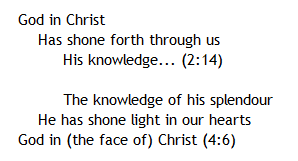
In treating the subject of knowledge (gnw=si$, gnœsis) in the New Testament, two related verses in 2 Corinthians are especially important—2 Cor 2:14 and 4:6—expressing Paul’s view of the matter quite succinctly and effectively. These two verses happen to form an inclusio, framing the section 2:14-4:6, being the first and last sentences, respectively. This can be seen clearly by an outline of the section:

    • 2:14-17: Paul and his fellow ministers who proclaim the Gospel—the knowledge of God in Christ
      • 3:1-6: Contrast between the old covenant (on tablets of stone) and new covenant (in the heart)—the letter vs. the Spirit
        —vv. 4-6: Ministers of the New Covenant
      • 3:7-18: Contrast between the veiled face of Moses and the unveiled face of believers in the Spirit
        —vv. 12-18: Ministers of the New Covenant (par. with Moses)
    • 4:1-6: The ministry of proclaiming the Gospel—the knowledge of God in Christ

The chiastic structure of this section becomes even more obvious when comparing 2:14-17 with 4:1-6:

Thus these two verses perfectly enclose the section, and should be studied together. I begin in today’s note with 2:14. Interestingly, this verse itself has a chiastic symmetry. The opening phrase is: “To God be thanks for (his) favor… [tw=| de\ qew=| xa/ri$ tw=|…]”. The second definite article defines (and explains) the favor (xa/ri$) which God has shown. This, in the remainder of the verse, may be presented as a chiasm:

    • every time [pa/ntote, i.e. always]
      • leading us in procession [qriambeu/onti h(ma=$]
        • in Christ [e)n Xristw=|]
        • the smell of the knowledge of Him [th\n o)smh\n th=$ gnw/sew$ au)tou=]
      • shining forth [i.e. making manifest] through us [fanerou=nti di’ h(mw=n]
    • in every place [e)n panti\ to/pw=]

These elements—the words and phrases—require some closer examination. First, the expressions using forms of pa=$ (“all, every”), which occur frequently in Paul’s letters:

(a) pa/ntote, “every [pa=$] (time) when [to/te]”, “always, whenever, etc.”—27 of 41 NT occurrences
(b) e)n panti\ to/pw|, “in every [pa=$] place, in all place(s)”, “everywhere”—cf. also in 1 Cor 1:2; 1 Thess 1:8; and 1 Tim 2:8

These expressions encapsulate the completeness and universal reach of God’s action—temporal and spatial—covering every aspect of human existence. Specifically, here it relates to every aspect of the ministry of Paul and his fellow missionaries. The second pair of phrases are governed by two participles with predicate pronoun (“us”). The two verbs involved are:

    • qriambeu/w (thriambeúœ), which refers primarily to a military triumph (as by the Roman forces), and often in the specific sense of a triumphal procession following victory, in which captives and the spoils of battle would be displayed. There is some uncertainty as to the precise sense of Paul’s image here; it could be (a) that God leads Paul and other ministers in triumph, with the spread of the Gospel, etc. For similar military imagery along these lines, see e.g. 10:4-5. The other possibility is (b) that God leads Paul and the other ministers in procession as captives—i.e. they themselves have been made captive to the Gospel. Paul occasionally uses the term “slave” (dou=lo$) to refer to himself (and others) as ministers of Christ and the Gospel (Rom 1:1; Gal 1:10; Phil 1:1, etc), and it is probably this latter sense that is meant in context here. The only other occurrence in the New Testament is Col 2:15, where a military victory, performed by God through the death (crucifixion) of Jesus, is properly meant.
    • fanero/w (phaneróœ), related to fw=$ (phœ¡s), “light” and the principal verbs fa/w [obs.], fai/nw (“shine [as] light”), meaning “shine forth”, often in the figurative sense of “appear, make apparent, (make) manifest”. It is found frequently in the Pauline letters (22 of 49 occurrences), and also in the Gospel and First letter of John (18 times). This verb will be discussed further in Part 3 of the series “Gnosis and the New Testament”, dealing with the topic of revelation.

Finally the words in the third (inner) pair of expressions:

    • “in Christ” (e)n Xristw=|)—a well known expression, found frequently in Paul’s writings, and almost exclusive to him in the New Testament. Typically it refers to the general status of believers, reflecting (a) our faith/trust in Christ, and (b) our union with him, through the Spirit, and symbolized in the rite of Baptism. However, here there is the specific sense of the status of Paul and his fellow apostles and missionaries as ministers of Christ and the Gospel. God leads them in procession in Christ—which, based on the interpretation given above, could be clarified as in captivity to Christ. For something of this sense, cf. also Rom 16:3, 9; Philem 23, etc. As captives, they are specifically required to speak (i.e. proclaim the Gospel)—cf. further in verse 17, and 12:19.
    • “the smell of the knowledge of Him” (h( o)smh\ th=$ gnw/sew$ au)tou=)—a genitive chain with three terms, each of which are treated below; a parallel genitive chain, even more extended, is used at a similar point in 4:6 (cf. the next study):
      • o)smh/ (osm¢¡), “smell”, either pleasant or foul. Here a pleasing aroma or fragrance is meant, as indicated by the use of eu)wdi/a (“good scent”) in verse 15. The combination of o)smh/ and eu)wdi/a strongly suggests the fragrance of the sacrificial offerings (cf. Lev 1:9, 13, 17; 2:2, etc. [LXX]). Here the “sacrifice” as such is the proclamation of the Gospel, and the role of Paul and his fellow ministers in this activity—for the parallel between Christian ministers and Moses (and the Priesthood), cf. the illustration in chapter 3. Paul plays again on the ambiguity of o)smh/ is verse 16—a good smell of life to the ones being saved (through the Gospel), but a stench of death for the ones perishing. The otherwise mixed metaphor of sight and smell indicates that the verb fanero/w is used more or less in the general sense of “appear, make manifest”.
      • gnw=si$ (gnœ¡sis), “knowledge”. For Paul’s use of gnw=si$, cf. Part 1 of the series “Gnosis and the New Testament”. The genitive construct makes clear that the smell is “the smell of knowledge“. If the sacrificial allusion is accepted (cf. above), then the orientation has shifted notably—instead of being directed toward God, the sacrifice is intended for human beings, to bring the knowledge of God to them. This is important when considering possible gnostic elements in the New Testament, and will be discussed further in that series.
      • au)tou=, “of him, his”—I have rendered the genitive relationship literally (“knowledge of him [i.e. God]”), though itself it is ambiguous; it could be subjective (God’s own knowledge) or objective (knowledge about/regarding God). Certainly the latter is meant here, though the two aspects can never be separated entirely, especially with regard to God’s (fore)knowledge of believers.

What is particularly significant about this pair of expressions is the way they must be taken to inform each other: the sacrificial “smell of the knowledge of (God)” comes about entirely “in Christ”.