Jesus and the Gospel Tradition: The Galilean Period, Pt 2 (Lk 4:16-30)

In the previous note I looked at the tradition of Jesus’ visit to his hometown (Nazareth) in Mark 6:1-6a. Matthew’s version (13:53-58) differs only slightly from that of Mark. Luke’s account, as I have already mentioned, has a number of details unique to his version, though it almost certainly is describing the same (historical) event and tradition. These differences I will be discussing today. Before proceeding, it is worth pointing out that neither Mark nor Matthew actually mentioned the name of the town, simply referring to it as Jesus’ patri/$ (patrís), “father(‘s) land”, i.e. the territory of his home town. We may assume that the Gospel writers both understood it to be Nazareth, based on earlier data they recorded (Mk 1:9; Matt 2:13; 4:13), but, in all likelihood, the original tradition as passed down did not include the name of the town. Luke specifically refers to it by name (4:16), and he has good reasons for doing so, as we shall see.

Luke 4:16-30

(See also my earlier study on this passage)

Let us first note the elements and details which are unique to Luke’s version of the episode, and which he most likely has added to the core Synoptic narrative. We may take these to be (authentic) historical traditions, and, if so, they would be considered part of the so-called “L” material (traditions found only in Luke). The significant additions are as follows:

    • A different narrative introduction (v. 16)
    • The detail of Jesus standing up to read a passage from the Prophets (v. 17)
    • The quotation of Isaiah 61:1, with Jesus’ explanation (vv. 18-21)
    • The proverb cited by Jesus in v. 23
    • The Scriptural examples involving the Prophets Elijah and Elisha (vv. 25-27)
    • The violent reaction by the people, with intent to do harm to Jesus (vv. 28-29f)

The core Synoptic tradition, as found in Mk 6:1-6a (cf. the previous note), can still be glimpsed by combining together vv. 14-15 (with 16), 22, 24, and (very loosely) 28, 30. Beyond the added details listed above, consider how the author has (apparently) modified the core tradition:

    • The details emphasized in verse 16 (cp. Mk 6:1-2a par):
      (a) The name of the town (Nazareth)
      (b) That it was the place where Jesus was nourished (i.e. raised, brought up)
      (c) That he was used to attending local Synagogues on the Sabbath (and teaching there)
    • A different formulation of the people’s reaction—that is, the summary of their words/thoughts (v. 22 / Mk 6:2-3 par)
    • A different version of Jesus’ saying (v. 24 / Mk 6:4)
    • The episode apparently ends with a rather different (more violent) result to Jesus’ visit (vv. 28-30)

Each of these will be examined briefly, going verse by verse.

Verse 16—The Lukan details mentioned above all relate to the distinctive purpose of the episode within the context of the Gospel narrative. Two major literary and thematic elements are clearly at work:

    • The reference to Nazareth as the place where Jesus was brought up (as a child) points back to the Infancy Narrative of chapters 1-2, especially 2:40-52, which share certain motifs and language with 4:16ff. I have discussed these in an earlier note on this passage.
    • This episode illustrates the summary of Jesus’ (Galilean) ministry in verses 14-15—in particular, that of his teaching in the synagogues. The Synoptic tradition introduces the ministry of Jesus with a different episode (cf. Mark 1:21-28 par [this follows in Lk 4:31-37]). Note the way that both the initial Markan and Lukan episodes illustrate the two aspects of Jesus’ ministry:
      (1) Teaching/preaching (with a synagogue setting)—Mk 1:21-22, 27; Lk 4:14-16, 22
      (2) Working miracles—Mk 1:23-27; Lk 4:14a, 23-27

Verses 17-21—The quotation of Isaiah 61:1 is a tradition unique to Luke’s account. In verse 21, Jesus states that this prophecy has been fulfilled at the moment of his reading it. In other words, Jesus identifies himself with the Anointed herald/prophet figure of Isa 61:1ff, just as he does elsewhere, in the traditional “Q” material (Lk 7:22 / Matt 11:5). Luke’s inclusion of this reference probably offers the best explanation for his location of the Nazareth episode, set at the very beginning of Jesus’ ministry. This can be explained on three levels:

    • A connection with the Baptism scene, with the descent of the Spirit upon Jesus (3:22). This is to be understood as the moment when the Spirit came upon him and he was anointed by God (Isa 61:1 / 4:18).
    • A connection with the preceding Temptation scene (4:1-13) which is framed by important references to the presence/activity of the Spirit (vv. 1, 14). In other words, this also shows how Jesus has been ‘anointed’ by the Spirit of God.
    • Jesus’ identity as the Anointed One (Messiah), which serves as a principal theme of the Lukan account of Jesus’ Galilean ministry (4:1–9:20). However, in this period he is not identified as the royal Messiah from the line of David, but as the Anointed herald/prophet of Isaiah 61. Matthew (4:12-17) introduces Jesus’ Galilean ministry with a different Messianic prophecy (Isa 9:1-2), one more in keeping with the Davidic figure-type.

Verse 22—Here it is worth comparing Luke’s account of the crowds reaction with that of Mark. Consider first the initial description of their reaction:

“and many hearing (him) were laid out (flat) [i.e. amazed], saying ‘From where (did) these things (come) to this (man), and what (is) th(is) wisdom…’?” (Mk 6:2)

“and all witnessed (about) him and wondered upon [i.e. at] the words of favor traveling out of his mouth” (Lk 4:22a)

The idea is roughly the same, but with a different emphasis. In Mark, the people recognize the two aspects of Jesus’ ministry—the wisdom (of his teaching) and his powerful deeds (miracles). In Luke’s account, it seems that they are responding to his gifts as a speaker, fulfilling a traditional religious role—that of reading the Scripture and offering a (pleasant) word of exhortation. It would seem that, while they may have recognized the Messianic significance of Isa 61:1ff, they certainly did not understand the implication of Jesus’ declaration in v. 21—that he was the Anointed One of the prophecy. Mark’s version may contain something of this idea as well, in the statement that the people of Nazareth were “tripped up” (the vb. skandali/zw) by Jesus (v. 3, cf. Lk 7:23 par)

The second part of the people’s reaction is even more significant. In Mark (6:3) the people find it hard to explain Jesus’ words and deeds, since they know all of his family—his mother, brothers, and sisters—as ‘ordinary’ people in the area. Luke has simplified this statement greatly, highlighting just one family member of Jesus:

“Is this not the son of Yoseph {Joseph}?”

This is reasonably close to the words in Matt 13:55: “Is this not the son of the craftsman [i.e. carpenter]?”, as well as being virtually identical to those in Jn 6:42. However, for Luke the reference to Joseph (as Jesus’ human father) has special importance, as can be seen clearly from two earlier passages:

    • The episode of the child Jesus in the Temple, in which Joseph as Jesus’ (human/legal) father is contrasted with God as his (true) Father (2:48-49)
    • The genealogy of Jesus (3:23-38), which begins “the son, as it was thought, of Joseph…” (v. 23), and ends “…the (son) of God” (v. 38). The implication, again, is that God is Jesus’ true Father (1:32, 35; 3:22b).

With these allusions in mind, it becomes apparent what the author is emphasizing here in this scene. The people of Nazareth are still thinking of Jesus as the ordinary, human/legal son of Joseph, and do not at all recognize him as the Anointed One and Son of God.

Verses 23-24—In Luke’s version, the Synoptic saying is preceded by an additional proverb (in v. 23). It functions as a provocative challenge to the townspeople. At this point, Luke does not mention the people taking offense at Jesus (cp. Mark 6:3); rather, Jesus seems to be taking the initiative in provoking them. The proverb brings to light the miracles performed by Jesus and plays upon the Synoptic tradition in Mk 6:5 par—that he was unable to perform many miracles in his home town (because of the people’s lack of faith). The proverb itself is relatively common, with parallels known from the Greco-Roman and Near Eastern world. However, in Luke, joined as it is with the saying of v. 24, it effectively creates a dual contrasting statement (physician/prophet). This, in fact, is how the saying has been preserved in at least one line of tradition, as recorded in the Oxyrhynchus Papyrus 1 and the Gospel of Thomas (§31)—i.e. “a prophet is not… and a physician does not…”. The Lukan form of the saying in v. 24 also differs from the version in Mark/Matthew:

“A foreteller [i.e. prophet] is not without honor, if not [i.e. except] in his father(‘s) land and among his relatives and in his (own) house” (Mk 6:4)

“Not one foreteller [i.e. prophet] is accepted in his father(‘s) land” (Lk 4:24)

Most likely, Luke’s version represents an abridgment and/or simplification of the Synoptic tradition. Again, it serves a distinct purpose in the Lukan context—it makes more direct the identification of Jesus as a prophet.

Verses 25-27—The prophetic association becomes even clearer with the references to Elijah and Elisha (1 Kings 17:8-16; 2 Kings 5:1-19) and the miracles they worked. Jesus effectively is identifying himself with a prophet like Elijah/Elisha, a connection which appears a number of times in the Gospel tradition. For more on this, see parts 2 and 3 of my earlier series “Yeshua the Anointed”.

Verses 28-30—Luke, quite in contrast with the narrative in Mark/Matthew, records an openly hostile, violent reaction to Jesus, provoked, it would seem, by Jesus’ own words in vv. 23-27. There is nothing quite like this in the core synoptic narrative, which ends rather uneventfully, with a laconic statement that Jesus was unable to perform many miracles in his home town, and that he marveled at the people’s lack of faith (Mk 6:5-6a). This is the only point at which the Lukan account really does not fit the Synoptic outline of the episode in Mark/Matthew. It does, however, fulfill two important themes within the narrative context of Luke’s Gospel:

    • It prefigures the opposition/violence that Jesus, as the Anointed One and Son of God, would face from the people, and serves as a parallel to the close of the Galilean period, and the Passion references which follow (9:21-22, 31, 43b-45, 51).
    • It also looks back to the Infancy Narrative, and the oracle by Simeon in 2:34-35, illustrating the opposition predicted by him most vividly.

Quite possibly, the original (historical) tradition contained more of this element of opposition to Jesus, but that it was not preserved in the Synoptic account of Mark/Matthew, retained (if at all) only in the statement at the end of Mk 6:3. If so, then Luke has developed and enhanced this aspect of the tradition.

John 6:42

Finally, it is worth noting, that, although the Gospel of John does not have anything corresponding to the Nazareth episode of the Synoptics, it does include at least one similar tradition—Jn 6:42, forming part of the great Bread of Life discourse in 6:22-59. As in the Synoptic episode under discussion, verse 42 reflects the people’s reaction to statements by Jesus regarding his identity. In Luke 4:16-30, he identifies himself with the Anointed (Messianic) herald/prophet of Isaiah 61:1ff (v. 21), and, by implication, as also being the Son of God (vv. 22ff, cf. above). In the discourse of John 6:22-59, Jesus draws upon different Scriptures—the Exodus traditions, especially that of the manna (as “bread from heaven”)—and identifies himself as the true Bread that comes down from heaven. This is expressed in verse 42 by one of the famous “I Am” declarations in John—”I am the bread th(at is) coming down [lit. stepping down] out of Heaven” (cf. also vv. 32-33, 35, 38, 48, 50-51, 58). In the Johannine context, this certainly refers to Jesus as the eternal (pre-existent) Son of God who has come (down) into the world to bring Life to those who would believe. Here Jesus’ sonship (in relation to God the Father) is understood at a much deeper level than in the Gospel of Luke. However, the basic contrast expressed is the same. The people recognize Jesus only at the ordinary, human level, and are troubled/offended by his words:

“Is this not Yeshua, the son of Yoseph, of whom we have seen [i.e. known] his father and (his) mother? (So) now how (can) he say that ‘I have stepped down out of heaven?'”

The italicized portion is quite similar to the words of the people of Nazareth in Mark 6:3 par; indeed, the first phrase—”is this not…the son of Joseph?”—is virtually identical with Luke 4:22b. And, to be sure, John expresses the same aspect of opposition and misunderstanding among the people as Luke does. They view Jesus merely as the son of Joseph, when, in fact, his true identity is as the (eternal) Son of God the Father (Jn 6:27, 32, 37, 40, 44, 46, 57, etc).
Jesus and the Gospel Tradition: The Galilean Period, Pt 2 (Mk 6:1-6)

The second primary tradition in the Gospels related to Jesus’ family and relatives is the episode at Nazareth, recorded in all three of the Synoptic Gospels—Mark 6:1-6a, Matthew 13:53-58, and Luke 4:16-30. There are a number of unique elements in Luke’s account, and it occurs in a different location—at the very beginning of Jesus’ ministry. These differences have led some traditional-conservative commentators to posit two separate events—that is, two visits to Nazareth, harmonizing the chronology of Luke with Mark/Matthew. However, there is no real basis in the text for such a harmonization; the Gospel writers each know of only one such visit by Jesus to his home town. The basic similarity of the episode makes it all but certain that the Synoptic accounts derive from a single historical tradition. Even though, at the historical level, Jesus conceivably could have made any number of trips back to Nazareth, the Synoptic Gospels record just one visit. I begin by looking at the core (Synoptic) narrative regarding this episode, as found in the Gospel of Mark.

Mark 6:1-6a

The episode recorded in Mk 6:1-6a is rather straightforward:

  • V. 1—Narrative introduction, with two important details:
    (a) “he comes into his father(‘s) land” (i.e. his home territory and village)
    (b) “his learners [i.e. disciples] (are) follow(ing) him”
  • V. 2a—Jesus begins to teach in the Synagogue, and the people who hear him are amazed (lit. “laid out [flat]”)
  • Vv. 2b-3—A summary of the people’s reaction(s), presented as their words, in two parts:
    (1) “From where (did) these things (come) to this (man)?”—”these things” are clarified:
    —”What (is) th(is) wisdom given to this (man)?”
    —”(How is it) these (kind)s of powerful deeds come to be through his hands?”
    (2) “Isn’t this the craftsman [i.e. carpenter], the son of Maryam…?”
    With the concluding narrative statement, “And they were tripped up in [i.e. by] him”
  • V. 4—Saying by Jesus: “A foreteller [i.e. prophet] is not without honor, if not [i.e. except] in his father(‘s) land…”
  • Vv. 5-6a—Narrative conclusion emphasizing two points:
    (a) Jesus was only able to perform a few healing miracles there, and
    (b) “and he wondered through [i.e. at, because of] their lack of trust”

We see referenced here the two main components of Jesus’ ministry—teaching/preaching and performing healing miracles—which are described and narrated throughout the Galilean period in the Synoptic Tradition. This was depicted, in seminal form, in the early episode of Mk 1:21-28 par, which also happens to take place at a local Synagogue (sunagwgh/, lit. a place where people “are brought [or come] together”). These same two aspects are also central to the townspeople’s initial reaction of amazement—the wisdom (i.e. of his teaching, v. 2a) and his powerful deeds (miracles).

The second part of the people’s reaction is significant as it mentions the names of Jesus’ family:

    • his mother Maryam (i.e. Mary)—”is this not the son of Maryam?”
    • four of his brothers—”the brother of…”—listed by name:
      (1) Ya’aqob (Jacob/James), (2) Yoseph (Joseph/Joses), (3) Yehuda (Juda[s]), and (4) Shim’on (Simon)
    • his sisters, mentioned generally—”are not his sisters here toward [i.e. with] us?”

Apart from Mary and Jacob/James (to be discussed in an upcoming note), very little is known of Jesus’ family. There has been much (rather idle) speculation and debate regarding whether Jesus’ “brothers” (and sisters) were full blood brothers, half-brothers, or perhaps even cousins. Much of this has been due to traditional doctrine(s) related to the veneration of Mary and a belief in her perpetual virginity (virginitas post partum, after giving birth [to Jesus]). Most Protestants have little problem with the idea that Joseph and Mary had other children together. Joseph himself is not mentioned here, but Jesus is referred to as “the craftsman/carpenter” (some witnesses read “the son of the craftsman/carpenter”, as in Matt 13:55), and, according to early Christian tradition, Joseph was a carpenter. In the Lukan version of this scene (4:22, cf. the next note), Jesus is called son of Joseph, as also in Jn 6:42. Here, Mk 6:3 (with the Matthean parallel) is the only mention of Mary by name in the Synoptic Gospels outside of the Infancy narratives. It is the people of Nazareth in general, rather than Jesus’ relatives specifically, who exhibit lack of belief/trust in him. We do not know the attitude of his family toward him from this particular account (cp. Mark 3:20-35 par, discussed in an earlier note).

What of the significance of this episode within the narrative context of the Markan Gospel? Its proximity to the subsequent mission of the Twelve (vv. 6b-13) is surely important. The two scenes are juxtaposed with one another, just as the episode(s) in 3:20-35 are with the calling of the Twelve in 3:13-19. The lack of faith/trust exhibited by Jesus’ relatives and hometown acquaintances is contrasted with that of his chosen (and close/faithful) followers. Consider the structure:

  • Calling of the Twelve—with authority to proclaim (the coming Kingdom) and work healing (exorcism) miracles (3:13-19)
    • The response of his relatives/acquaintances to his miracles, etc (3:20-35)
      —Jesus’ Galilean ministry: teaching (4:1-34) and miracles (4:35-5:43)
    • The response of his hometown to his miracles, etc (6:1-6a)
  • Mission of the Twelve—authority to preach and work healing (exorcism) miracles (6:6b-13)

When we turn to the (proverbial) saying of Jesus in verse 4—

“A foreteller [i.e. prophet] is not without honor, if not [i.e. except] in his father(‘s) land and among his relatives [lit. those b(orn) together with (him)] and in his (own) house!”

a significant point to note is that he refers to himself as a prophet. This association, in the context of his ministry activity—as one who proclaims the Kingdom and works miracles—will be developed further in Luke’s version of this scene. Jesus as a prophet, in connection with his identity the Anointed One (Messiah) of God, will feature prominently in two of the scenes (the first and last) which make up the remainder of the Galilean ministry period in Mark’s narrative—Mk 6:14-15ff and 8:27-30.

Matthew 13:53-58

Matthew’s account follows that of Mark very closely. The differences are slight, and there is no evidence of any “Q” material being included—i.e. no sayings or details shared by Luke but not found in Mark. Overall the narrative is a bit simpler and smoother compared with Mark’s version. Here, then, we have a dual presentation of what I would call the core Synoptic tradition. Luke’s version of the scene, on the other hand, differs considerably at several points, which I will be discussing in the next note.

Jesus and the Gospel Tradition: The Baptism, Pt 4 (Lk 9:28-36 etc)

This note follows up on the prior discussion, regarding the Transfiguration scene (Mk 9:2-13 par), and its parallels with the Baptism of Jesus. Here I will be focusing on the meaning and significance of the episode, especially as presented in the Gospel of Luke. This will include a comparison of the variant readings in Lk 9:35, compared with those in John 1:34.

Interpretation of the Transfiguration scene

As I mentioned in the prior note, the Transfiguration begins the second half of the Synoptic narrative, much as the Baptism scene begins the first. The Baptism of Jesus marks the start of his ministry (in Galilee), while the Transfiguration marks the beginning of his Passion (i.e. in Judea/Jerusalem) and precedes his journey to Jerusalem. The parallels between the Baptism and Transfiguration (cf. the list in previous note) have to be understood in terms of these differing contexts within the narrative. Consider the following points:

1. The connection with John the Baptist and questions regarding the identity of the Messiah

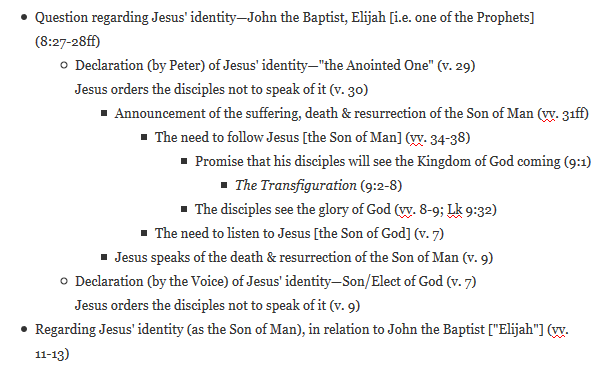
This has been a central theme in our study of the Baptism of Jesus in the Gospel tradition (discussed in detail in the prior notes). John the Baptist, of course, features prominently in the Baptism narrative, which opens with a description of John and his ministry, including the central association with the Isaiah 40:3ff prophecy (Mark 1:2-6 par). His presence in the Transfiguration scene is limited to the (separate?) tradition which appears at the end (Mk 9:11-13). It is generally assumed that Jesus is speaking of John in his reference to “Elijah” (cp. Matt 11:14), drawing a parallel between the Baptist’s mistreatment/arrest and his own (i.e. of the “Son of Man”, 8:31; 9:12, etc). Note the framing structure surrounding 8:27-9:13, forming an inclusio:

The question regarding the identity of “the Anointed One” (i.e. Messiah) is given more prominence and clarity in Luke’s account of the Baptism (3:15; cp. John 1:19-27).

2. The heavenly declaration corrects/clarifies the Messianic identification

This is implicit by the phenomena attending Jesus at his baptism, especially the descent of the Spirit upon him; Luke brings out the Messianic association more directly, in the subsequent scene at Nazareth, where Jesus identifies himself with the “Anointed” figure of Isa 61:1ff (Lk 4:17-21, cf. also 7:22). This makes clear in what sense Jesus is the Messiah (3:15) and the “one [who is] coming” (3:16; 7:19 par). The heavenly declaration at the Baptism adds to this by identifying Jesus as God’s Son (3:22 par), drawing upon the image of the king (i.e. the Davidic ruler) as “Son of God” (the variant reading in Lk quotes [the Messianic] Psalm 2:7). Similarly, prior to the Transfiguration, Peter declares Jesus to be “the Anointed One (Messiah) [of God]” (Mk 8:27 / Lk 9:2). The exchange between Peter and Jesus which follows (Mk 8:31-33 par, but omitted by Luke) suggests that Peter had in mind the Messianic figure-type of the Davidic ruler (cf. Parts 6–8 of the series “Yeshua the Anointed”), which would not have been compatible with the idea that Jesus must suffer and be put to death. It was Peter who also responds to the Transfiguration, without truly understanding the significance of what he sees (Mk 9:5-6 par, cf. below). Again, as at the Baptism, the heavenly voice declares Jesus to be the “Son of God”—but here, it would seem, not in the traditional Messianic sense, but hinting at something greater, tied to the death and resurrection of Jesus (Mk 8:31; 9:9, 12-13 par), which will lead to his exaltation to the right hand of God (Mk 14:62 par; Acts 2:32-35; 13:30-35 [citing Ps 2:7], etc).

3. The presence of Moses and Elijah—Jesus as a Prophet figure, specially chosen/anointed by God

That Jesus was seen as a Messiah of the Prophet figure-type seems clear enough from the Baptism scene, attested by different strands of tradition (Mk 1:7-8 par; Lk 3:15ff; 4:14-30; Jn 1:19-27), as well as the entirety of the period of his Galilean ministry, as recorded in the Synoptic narrative. Principally, he fulfilled the role of Spirit-endowed, miracle working Prophet (like Elijah), identified more specifically with the anointed herald of Isa 61:1ff. It has been popular to interpret the presence of Moses and Elijah in the Transfiguration scene as representing “the Law and the Prophets” which Jesus was fulfilling (Matt 5:17; Lk 16:16; 24:27, 44; Jn 1:45, etc). However, this does not seem to be correct. To begin with, Elijah is an odd choice to represent the Prophetic Scriptures (Isaiah would make more sense, cf. Jn 12:39-41). More importantly, Moses and Elijah each represent distinct Prophet-figures; and, in the original context of the Gospels, it is almost certain that Jesus, in the period of his Galilean ministry especially, was also seen as an Anointed Prophet. I would suggest that in the Transfiguration scene the significance of Moses and Elijah is two-fold:

    1. It identifies Jesus as a Messianic Prophet (like Moses and Elijah), marking the conclusion of his Galilean ministry in which this role was primarily being fulfilled, but also pointing to his eschatological role inaugurating a new era for the people of God. It is no coincidence that, in Jewish tradition by the time of Jesus, Moses and Elijah were seen as prophetic figures who would appear at the end-time, as a fulfillment of specific prophecies (Deut 18:15-20; Mal 3:1ff; 4:5-6).
    2. Moses and Elijah each experienced a theophany—manifestation of God’s presence—upon the holy mountain (Sinai/Horeb); similarly, Jesus (and his disciples) on this mountain experience the appearance of the cloud of God’s presence and the divine Voice from heaven. This theophany, in relation to Jesus, is of a different sort, reflecting his divine Sonship. For more on this, cf. below.
4. The Transfiguration scene prefigures the coming Passion—the death and resurrection of the Son of Man

This is clear from the position of the Transfiguration scene in the Synoptic narrative, as noted above. It marks the conclusion of Jesus’ Galilean ministry, and the beginning of his Passion—the upcoming journey to Jerusalem (Mk 10; Lk 9:51–18:34), and the events which would take place there. Luke’s account of the Transfiguration brings out this aspect more clearly (cf. below).

The Transfiguration in Luke 9:28-36

Note the following details or characteristics of the Lukan version, and its place in the specific context of the Gospel narrative:

  • Luke has given special prominence to Jesus’ role as a Messianic, Spirit-endowed Prophet in the period of his Galilean ministry (4:14–9:22); this gives greater significance to the presence of Moses and Elijah in the Transfiguration scene (see above).
  • Peter’s confession in Luke (9:20) reads “You are the Anointed One of God” which is parallel to the unique form of the heavenly declaration in the Lukan version of the Transfiguration “This is the Son of God, the Elect/Chosen (One)“. On this, see below.
  • Luke’s version of the Transfiguration brings out more clearly the association with Moses and the Exodus—especially the traditions regarding the cloud of God’s presence (9:29, 31a, 34-35, cf. Exod 13:21-22; 19:9, 16ff; 24:15-16ff; 33:9-10; 34:5; 40:34-38). In particular, note v. 34 which alludes to Moses entering the cloud (Exod 24:18, cf. also 33:9).
  • This also enhances the idea of the Transfiguration as a theophany, in which Jesus and his disciples experience the presence of God and see his glory/splendor (vv. 31-32, cf. also v. 27). In this context, the altered appearance of Jesus (v. 29) probably is meant to echo the tradition regarding Moses changed appearance in Exod 34:29-35.
  • Luke ties the Transfiguration more directly to the coming death and resurrection of Jesus in Jerusalem, in two respects:
    (1) by the detail he includes in v. 31, using the word e&codo$ (exodos, “way out”, i.e. “exodus”), and
    (2) its relation to the journey to Jerusalem which follows, and which features so prominently in the structure of the Lukan narrative (9:51-18:34)

The textual question in Luke 9:35 and John 1:34

Finally, mention should be made again of the textual variants for the heavenly declaration in Luke 9:35. The majority text (including A C* W 33, etc) follows the version in Mark (9:7):

“This is my Son, the (one who is) loved”
ou!to/$ e)stin o( ui(o/$ mou o( a)gaphto/$

However, many of the earliest/best manuscripts (Ë45,75 a B L, etc) instead read:

“This is my Son, the (one) gathered out [i.e. elect/chosen]”
ou!to/$ e)stin o( ui(o/$ mou o( e)klelegme/no$

Most commentators prefer this as the original reading, considering it much more likely, considering scribal tendencies, that the passage would be harmonized with Mark than the other way around. As it happens, there is a similar textual variant related to the declaration of Jesus’ identity at the Baptism, in John 1:34. The Baptist’s statement, in the vast majority of manuscripts and witnesses (including Ë66) reads—

“…this is the Son of God”
ou!to/$ e)stin o( ui(o\$ tou= qeou=

which, of course, is quite similar to the voice at the Transfiguration in the Synoptic tradition (cf. also the Matthean version of the Baptism, Matt 3:17). However, in a number of witnesses (Ë5,106vid a* b e ff2* etc) the reading is:

“…this is the (One) gathered out [i.e. Elect/Chosen] of [i.e. by] God”
ou!to/$ e)stin o( e)klekto/$ tou= qeou=

A few MSS have the longer (conflate) reading “…the elect/chosen Son of God”, which is surprisingly close to the heavenly voice in the Lukan version of the Transfiguration (according to many of the best MSS, cf. above). The adjective e)klekto/$ is closely related to the participle e)klelegme/no$ (both from the verb e)kle/gomai, “gather out of/from”), and has essentially the same meaning (“selected, elect, chosen”, etc). The adjective normally refers (in the plural) to believers (as the elect/chosen ones) in the New Testament, but the singular is used of Jesus (also as a title) in Luke 23:35; a few manuscripts likewise read the adjective, instead of the participle, in Lk 9:35. In the two Lukan references, and in Jn 1:34 v.l., the title “Elect/Chosen One” almost certainly must be understood in a Messianic context. The Lukan usage in 9:35, if original, suggests a parallel with the adjective a)gaphto/$ (“[the one] loved [i.e by God]”)—the one chosen by God is loved by God, and vice versa. It also indicates that the title “Son of God” should not be understood here in terms of later orthodox Christology (nor even the developed Christology of the Fourth Gospel). The immediate narrative context of the Gospel has rather a different, two-fold emphasis:

    • Jesus is the Son of God in a Messianic sense, according to the interpretation of Psalm 2:7 etc in Jewish and early Christian tradition (cf. Lk 1:32, 35, etc), and
    • The declaration points to the death, resurrection (and exaltation) of Jesus, by which he is considered to be God’s Son (and Anointed One) in a very special sense (Acts 13:33, etc). The Johannine idea of Jesus’ Sonship—i.e. as the pre-existent, eternal Son of the Father, plays little (if any) role in the Synoptic narrative, and represents a somewhat later development in the Gospel tradition.
The title “Elect/Chosen One of God” (ah*l*a$ ryj!B=) is found in an Aramaic text from Qumran (4Q534). It survives only as a fragmentary piece, so it is nearly impossible to determine the precise context, but it appears to be related in some way to the ancient Enoch traditions, most familiar as expressed in the work known as 1 Enoch. Column 1 lines 10-11 reads: “in that [i.e. because] he is the chosen (one) of God, his being born [i.e. his birth] and the spirit [jwr] of his life-breath [<vn] {…} his thinking/reckoning [pl. i.e., plans] will be to the distant age (to come) [i.e. for ever]…”. It may perhaps be debated to what extent the title “Elect/Chosen One” is Messianic (cp. Isa 42:1; Ps 89:3; 106:23); however, in the so-called Similitudes of Enoch (chap. 37-71), often dated roughly to the time of Jesus (early-mid 1st cent. A.D.), we find a heavenly figure (much like Jesus) who is variously given the titles “Son of Man”, “Anointed One” and “Elect/Chosen One”. All three of these titles appear together, in the context of the Transfiguration scene, in Luke 9 (vv. 20, 22, 26, 35 v.l., 44).

Yeshua the Anointed: Supplemental Note (“The One Coming”)

In examining the relationship between John the Baptist and Jesus in Gospel tradition, special attention needs to be given to the expression o( e)rxo/meno$ (“the Coming [One]”, or “the [One who is] Coming”). This is a verbal noun from e&rxomai, a middle/deponent verb with the basic meaning “come, go”. It is used frequently in the New Testament, especially throughout the narratives of the Gospels and Acts. It plays a most important role in the message of John the Baptist, as recorded in the Gospels. The core declaration by John is firmly placed in the very earliest strands of (historical) Gospel tradition, being attested in at least five different places within the Gospels and Acts.

The Declaration by John the Baptist (Mk 1:7-8; Lk 3:16-17; Matt 3:11; John 1:27)

In the Gospel of Mark (Mk 1:7-8) it is as follows:

“The (one) stronger than me comes [e&rxetai] in back of [i.e. behind/after] me… I dunked you in water, but he will dunk you in the holy Spirit”

Luke’s version (Lk 3:16) corresponds closely and reads:

“(On the one hand) I dunk you in water, but (on the other hand) the (one) stronger than me comes [e&rxetai]… he will dunk you in the holy Spirit and fire”

In Matthew 3:11 we have:

“(On the one hand) I dunk you in water into a change-of-mind [i.e. repentance], but (on the other hand) the (one) coming [o( e)rxo/meno$] is stronger than me… he will dunk you in the holy Spirit and fire.”

Interestingly, Luke and Matthew agree with each other (against) Mark on several details: (1) both omit “in back of me” [o)pi/sw mou], (2) both use a me\n…de/ construction [i.e. “on the one hand…on the other”], and (3) both add “and fire” [kai\ puri/]. Matthew differs from Mark/Luke, however, in the key phrase: “the one coming is stronger” vs. “the one stronger…comes”.

The truncated version in Acts 13:25, which may well be independent of Lk 3:16, is: “See! (one) comes [e&rxetai] after [met’] me…”

Finally we have the saying as recorded in Johannine tradition (John 1:26-27):

“I dunk you in water, (but one) has been stand(ing) in the midst of you whom you have not seen [i.e. known], the (one) coming [o( e)rxo/meno$] in back of me [o)pi/sw mou]…”

John’s version (independently) agrees with Mark in the inclusion of o)pi/sw mou (“in back of [i.e. behind/after] me”), and with Matthew in the verbal substantive (participle) o( e)rxo/meno$ (“the [one] coming”). It also contains detail not found in the Synoptic tradition, such as the idea that “the one coming” had been standing in the midst of the crowd (among those coming to be baptized by John), undetected by them. Keep in mind that the Johannine Gospel does not narrate Jesus’ baptism as such, but has John the Baptist describe it after it had occurred (Jn 1:29-34). It would seem that a common (historical) tradition has been preserved in various forms.

Malachi 3:1

In the context of the Baptist’s message, this use of the verb e&rxomai almost certainly has eschatological significance, and is probably derived from Malachi 3:1, the last clause—”the Messenger of the covenant, whom you take pleasure in, see! he will come“. In the Greek [LXX] version, the form is e&rxetai, as in Mark/Luke (cf. above). In other words, “the one coming” [o( e)rxo/meno$] likely refers to the Messenger of Mal 3:1. Now, both the Hebrew Ea*l=m^ and Greek a&ggelo$ can mean either a human or divine/heavenly messenger—i.e. a prophet/herald or an Angel—depending on the context. Based on a comparison with Exodus 23:20, it seems most probable that the original reference in Mal 3:1 was to a heavenly Messenger (Angel), perhaps the “Messenger of YHWH” (virtually a personification of God Himself); note (the parallel elements being italicized)—

Exod 23:20: “See! I am sending a Messenger before you to guard you in the way, and to make you come [i.e. bring you] to the place which I have established”

Malachi 3:1: “See! I am sending my Messenger and he will (turn and) face [i.e. look at, examine] the way before me; and straightly [i.e. suddenly] he will come to his temple…”

Admittedly, the syntax of Mal 3:1 makes interpretation difficult, since there are two references to a Messenger. It is, I believe, best to view the structure of this verse chiastically, as follows:

    • See! I am sending my Messenger…and suddenly he will come (to his temple)
      —the Lord whom you are seeking
      —the Messenger of the covenant (in) whom you have pleasure
    • See! he is coming

We seem to be dealing with a single figure, a single Messenger (of the covenant), who is to be identified as “the Lord” [/doa*h*]. Now in the Old Testament and Israelite religious belief, God (YHWH) himself was represented by the Angel/Messenger of YHWH, and the appearance or manifestation of this “Messenger” signified the very appearance of YHWH. Here the appearance of the Messenger in Jerusalem, in the Temple, ushers in the great and terrible “Day of YHWH” (verse 2), whereby the people will be judged with fire. The righteous will be purified and refined (vv. 2-4), while the wicked will be consumed (vv. 5-6). This very clearly fits what John the Baptist describes of “the one coming” in Matt 3:11-12 / Lk 3:16-17.

However, by the time the book of Malachi was completed, an ‘appendix’ was added, which seems to identify the Messenger of Mal 3:1 with “Elijah” who will appear before the Day of YHWH (Mal 4:5-6 [Hebrew 3:23-24]). From this interpretation developed the Messianic/eschatological Elijah-tradition—at the end-time, just prior to the Last Judgment, Elijah (himself or a Prophet like him) will appear in order to bring people to repentance. For more on this tradition, cf. the current article. In drawing, it would seem, upon Mal 3:1ff, did John have in mind a heavenly/divine Messenger (representing God himself) or an end-time Prophet-like-Elijah? There is perhaps a clue to be found in Luke’s account (Lk 3:15), where it is narrated that John’s declaration in vv. 16-17 is in response to speculation that he might be “the Anointed” (i.e. the ‘Messiah’), as we see also in Jn 1:20ff. Based on what we know of the Baptist’s appearance and his ministry, it is unlikely that anyone would have imagined him to be a Messiah of the Davidic-King type, whereas he easily could have been thought to be a Messianic Prophet according to the Elijah-tradition. As in Jn 1:20ff, he eschews such an identification, reserving it for another (Jesus).

Development in the Gospel of John (Jn 1:15, 30 etc)

In the Fourth Gospel, we find that the declaration of the Baptist has undergone an important theological/Christological development, which is expressed in the parallel statement in Jn 1:15, 30 (see my earlier note and study for a detailed exposition of these verses). This is part of an intentional effort by the author (and/or the tradition[s] he inherited) to subordinate John the Baptist to Jesus more completely and profoundly than we see in the Synoptic Gospels. We may note: (1) the references to John in the Prologue (Jn 1:1-18, vv. 6ff, 15), (2) his explicit testimony in three consecutive episodes (Jn 1:19-28, 29-34, 35ff), and (3) the juxtaposition of John and Jesus in Jn 3:22-30. Throughout the Gospel of John, the verb e&rxomai (“come, go”) often carries a special significance, related to the idea of Jesus (the Son) coming from God (the Father), and going back (returning) to Him. Particularly, in this respect, e&rxomai relates to what we would call the incarnation of the pre-existent Son. Many examples could be cited, but I will limit them here to instances where the participle [o(] e)rxo/meno$ (“[the one] coming”) is used—Jn 1:9, 15, 27; 3:31 (twice); 6:14; 11:27, also 12:13. The occurrences in Jn 3:31 are especially noteworthy since they follow right after the Baptist’s (final) statement, and are thought by some scholars to be a continuation of his words. It is also interesting that the parallel formulations of Jn 1:15, 30 vary between the participle (o( e)rxo/meno$ “the one coming”) and indicative (e&rxetai, “[he] comes”), just as we see the Baptist’s declaration in the Synoptic tradition (cf. above).

Psalm 118:26

There is an entirely different strand of Gospel tradition associating Jesus with “the one coming in the name of YHWH” of Psalm 118:26 (cf. Mark 11:9 [par Matt 21:9; Lk 19:38]; Matt 23:39 / Lk 13:35). Jesus is also connected with the king who comes in Zech 9:9ff—with both Zech 9:9 and Ps 118:26 being combined in the triumphal entry scene, most clearly in John 12:13, 15:

“…the (one) coming [o( erxo/meno$] in the name of the Lord, the king of Israel”
“…see! your king comes [e&rxetai]…”

In early Christian belief, and the developed Gospel tradition, Jesus’ identification as “the one coming in the name of the Lord” means more than that of the traditional Anointed King or Prophet. This is perhaps best seen by comparing Luke 13:34-35 (citing Psalm 118:26) with Luke 19:41-44 (a similar lament for Jerusalem, following his entry into the city, vv. 36-40). Here the appearance of God himself to his people is identified as taking place in the person of Jesus (v. 44). This brings us back to the language and symbolism of Malachi 3:1, as I understand its meaning and significance in the context of the original oracle.

Yeshua the Anointed, Part 3: The Prophet to Come (Moses & Elijah)

In the previous article, I looked at the concept of an eschatological/Messianic Prophet in Jewish thought, and of evidence in the New Testament identifying Jesus as a Prophet. In this article I will examine the main (Messianic) Prophet figure-types that apply to Jesus; there are two main traditions involving: (1) Moses and (2) Elijah.

The Moses Tradition (Deut 18:15-20)

In the Old Testament, especially in Deuteronomic tradition, Moses is viewed as a Prophet—indeed as the ideal and greatest Prophet (Deut 34:10-12). In Deuteronomy 18:15ff we find the famous prediction that another Prophet will (eventually) arise who is like Moses and who will take his place. In the same manner, Elisha took the place of Elijah, being anointed by his predecessor (1 Kings 19:16) and possessing his spirit and character (2 Kings 2:9, 15). Eventually, this prediction was given a future, eschatological interpretation—at the end-time, a Prophet-like-Moses would arise to instruct the faithful of Israel. This expectation probably underlies the notice in 1 Maccabees 14:41 (“…until a trustworthy Prophet should arise”), as well as the reference to “the unique Prophet” in Testament of Benjamin 9:2. In the Qumran texts, Moses was clearly regarded as a Prophet, as in the “Apocryphon of Moses/Pentateuch” writings—cf. especially 4Q375 column 1 (in line 7 the phrase “trustworthy prophet” appears); in 4Q377 column 2, line 5, Moses is referred to as God’s “Anointed (One)” [jyvm]. Deut 18:18-19 is cited in 4QTestimonia [4Q175] lines 5-8, in what is likely an eschatological/Messianic context. The expected Prophet of 1QS 9:11 (“…until the coming of the Prophet and the Anointed [Ones] of Aaron and Israel”) presumably draws upon this Moses tradition as well.

The same may be said of passages in the New Testament which contain a reference to “the Prophet” (Jn 1:21, 25; 6:14; 7:40; Luke 7:16, 36 v.l. etc); in Jn 1:21-25, “the Prophet” seems to be understood as a separate figure from “Elijah”, possibly an indication that the Moses-tradition is involved. John the Baptist explicitly denies being “the Prophet” (Jn 1:21), but that Jesus was thought to be so by people on numerous occasions is indicated by several of the references above. In Acts 3:18-24 (sermon-speech of Peter), Jesus is identified specifically with the coming “Prophet like Moses” of Deut 18:15ff (cf. also Acts 7:37). Within early Christian tradition, Jesus is identified or associated with Moses in a number of ways:

    • Parallels with the birth of Moses (and the Exodus) in the Matthean Infancy narrative (Matt 2:1-21)
    • Jesus’ 40 days in the wilderness (Matt 4:2 par) just as Moses was on Sinai for 40 days (Exod 24:18); in the arrangement of Matthew’s narrative, Jesus likewise returns to deliver/expound the Law/Torah (Matt 5:17ff)
    • The association with Moses in the Transfiguration scene (on this, cf. below)
    • In various ways, Jesus words and actions followed the type/pattern of Moses:
      • Cf. the detailed summary of Moses’ life in Stephen’s speech (Acts 7:17-44) and its parallel to Jesus (7:45-53)—cp. “this Moses” (7:35, 37, 40) with the frequent use of “this Jesus” in Acts (1:11; 2:23, 32, 36; 4:11; 6:14 etc)
      • Moses and the ‘bronze serpent’ as a pattern of Jesus’ death (and exaltation), Jn 3:14
      • Moses and the manna (Jesus as the “bread from heaven”), Jn 6:32ff
      • Moses and the rock in the wilderness (Christ as the rock), 1 Cor 10:2-5

Elsewhere in the New Testament, we also find a juxtaposition contrasting Jesus and Moses—e.g., John 1:17; 5:45-46 (cf. Lk 16:29-31); 9:28-29; 2 Cor 3:13ff; Heb 3:2-5. Interestingly, these points of contrast are still based on a similarity between Jesus and Moses, the emphasis being on Jesus’ superiority or on how he fulfills/completes the “Old Covenant” represented by Moses.

The Elijah Tradition (Mal 3:1; 4:5-6)

This Messianic tradition derives from Malachi 3:1, combined with the explanatory interpretation of Mal 4:5-6 [Hebrew 3:23-24] which many scholars consider to be a (later) editorial gloss (see my supplementary note on the original context of Mal 3:1). In any case, already by the time of the completion of Malachi (and, presumably, the collection of the Twelve Prophets [Hosea–Malachi] as a whole), the “Messenger” [Ea*l=m^] of Mal 3:1 was identified as Elijah, who will (re)appear just prior to the “Day of YHWH” to bring repentance to people before the Judgment. Over time, this belief was given greater eschatological emphasis—”Elijah” would appear at the end-time, prior to the last Judgment—expressed already in Sirach 48:10 (early-mid 2nd century B.C.). Somewhat surprisingly, perhaps, evidence for this belief at Qumran is rather slight, though it is attested in the fragmentary 4Q558 (fragment 1), but is perhaps reflected more prominently in a text such as 4Q521 (cf. below). Evidence for this tradition is found specifically in Mark 9:11-13 (Matt 17:10-12), the citations and allusions to Mal 3:1; 4:5-6 in Mark 1:2; Luke 7:27; Matt 11:10-14, and may be inferred from other references listed below. Also worth noting is Sibylline Oracles 2:187ff (Christian expansion/adaptation of earlier Jewish material).

An important question within the earliest (historical) strands of Gospel tradition was whether John the Baptist or Jesus was Elijah (and/or the Anointed Prophet) to Come. After Jesus’ death and resurrection, and, even more so as Christianity spread into the Greco-Roman (Gentile) world, this issue ceased to have any meaning, and disappeared almost entirely from Christian thought. At the same time, early tradition had more or less fixed the relationship between John and Jesus, reflected in the Gospels (c. 60-90 A.D.) as we have them. However, the situation is somewhat different when we examine the earliest Gospel tradition.

First, John the Baptist as Elijah—

    • John’s appearance seems to echo the description of Elijah in 2 Kings 1:8
    • During his lifetime (and after his death), he was believed to be a great Prophet (Mk 11:32 par; Matt 14:5; and cf. 11:11 par)
    • The messengers (priests and Levites) who come to him in Jn 1:19ff ask him directly if he is Elijah (v. 21); however—
    • John explicitly denies that he is Elijah (Jn 1:21, 25)
    • By contrast, Jesus explicitly affirms John as the Elijah-to-Come in Matthew 11:10, 14 (cf. Luke 7:27) [citing Mal 3:1], with a similar identification recorded in Mark 9:11-13 (Matt 17:10-12)
    • The identification, by way of Mal 3:1 and 4:5-6, is also found in Mark 1:2 and the Lukan Infancy narrative (Luke 1:17, 76ff); in Lk 1:17 it is specifically stated (by the Angel) that John would have “the spirit and power of Elijah” (cf. 2 Kings 2:9, 15)

According to the belief ultimately expressed in the Gospels, Mal 3:1; 4:5-6 was given a specific interpretation: John was the Messenger (“Elijah”) who would prepare the way (by his preaching and ministry of baptism) before the coming of the Lord (Jesus). However, elsewhere in the tradition, there is some evidence that Jesus himself might be identified as Elijah.

Jesus as Elijah—

    • In Jn 1:21, 25, John the Baptist denies being Elijah—the implication, then, is that this is reserved for someone else (Jesus).
    • John identifies himself primarily as the voice/herald of Isa 40:3-5 (Jn 1:23)—this is also the core tradition recorded at the start of the Synoptic Gospel narrative (Mark 1:3; Matt 3:3; Lk 3:4-6)—though a possible identification with the Messenger of Mal 3:1 may be found in Jn 3:28.
    • John’s own testimony in Mark 1:7-8 (par Matt 3:11-12/Lk 3:15-17) seems to suggest that Jesus is the Messenger to Come of Mal 3:1, as does his question to Jesus in Matt 11:3/Lk 7:19.
    • As with John, people apparently thought that Jesus might be Elijah—Mark 6:15 (Lk 9:8); Mark 8:28 (Matt 16:14; Lk 9:19).
    • In the Lukan version of the scene at Nazareth, where Jesus identifies himself as a Prophet (Lk 4:24), in the illustrations which follow (vv. 25-26) he effectively compares himself with Elijah and Elisha. The “Anointed” Prophet of Isa 61:1ff, with whom Jesus identifies himself (vv. 18-21), could also be understood in connection with Elijah (on this, cf. below).
    • Jesus is associated with Elijah in the Transfiguration scene (see below).
    • The episode(s) of the feeding of the multitude (Mark 6:30-44 / 8:1-9 pars) seem to echo a similar miracle(?) performed by Elisha (who possessed the spirit of Elijah) in 2 Kings 4:42-44.
    • The mocking response by observers while Jesus was on the cross (Mark 15:35-36 / Matt 27:47, 49) may reflect a belief that Jesus was (supposed to be) Elijah.

For more on this issue, see the accompanying supplementary note.

Moses and Elijah: The Transfiguration Scene (Mark 9:2-8; Matt 17:1-8; Luke 9:28-36)

In one especially important passage—the Transfiguration episode in the Synoptic Gospels (also mentioned in 2 Peter 1:16-18)—Jesus is associated directly (and at the same time) with both Moses and Elijah. It is customary and popular for Christians to interpret Moses and Elijah here as representing “the Law and the Prophets”—that is, Jesus as the fulfillment of Scripture. However, this does not seem to be correct. For one thing, Elijah is not an especially appropriate figure to represent the written books of the Prophets, since he apparently wrote nothing, and did not utter any ‘Messianic’ prophecies that might be fulfilled by Jesus. At the same time, Moses, in addition to his connection with the Law (Torah), was viewed as perhaps the greatest of Prophets (cf. above)—indeed, Moses and Elijah together represent: (a) the two great Prophet figures of Israel’s history, and (b) each served as the type of a end-time Prophet-to-Come. Secondarily, perhaps, one might note that Moses and Elijah each experienced a special manifestation of God (theophany) on Mt. Sinai/Horeb, and that there are clear echoes and allusions to the Sinai theophany in the Gospel narrative of the Transfiguration (esp. in Luke’s version).

Therefore, I would suggest that, if there is any definite symbolism in the presence of Moses and Elijah with Jesus here, it is to confirm Jesus’ role as Anointed Prophet of God. We might say that Jesus is the true fulfillment of the two strands of tradition (cf. above), and, in turn, far exceeds and transcends them both. Ultimately, Jesus is a different kind of Prophet: not simply a herald of God’s message, a teacher/preacher and miracle-worker in the manner of Moses and Elijah, but the Elect/Chosen One of God (as well as God’s Son), Luke 9:35 par. Indeed, it is Luke’s version of the Transfiguration scene which sets it most clearly in the context of Jesus’ impending death and exaltation—cf. especially verse 31, and the parallel between v. 35 and 23:35.

The Anointed Prophet of Isaiah 61

If we really wish to understand Jesus as the Anointed Prophet, we must turn to Isaiah 61:1-3, the passage which, according to Luke’s account, was read by Jesus on his visit to the Synagogue of Nazareth (Lk 4:16-30, vv. 17-20). The passage begins (rendering the Greek of Lk/LXX):

“(The) Spirit of the Lord is upon me, because of which he (has) anointed me to bring a good message…”

The presence of the Spirit precedes, and is the reason for, the person being anointed. In the case of Jesus, Luke narrates this very thing, stating that, upon his return to Galilee, Jesus was “in the power of the Spirit” (Lk 4:14). This phrase is probably meant to indicate Jesus’ own Prophetic status (cf. Lk 1:17; Acts 10:38)—specifically as an Anointed Prophet. Even though the noun jyv!m* [m¹šîaµ] / xristo/$ [christós], is not used in Isa 61:1 (rather it is the verb jv^m* / e&xrisen), this verse does seem to have been extremely influential toward the idea of a Messianic Prophet. The figure in Isa 61:1ff certainly does not appear to be a king or ruler of the Davidic mold, nor a priest, but rather a prophet like Isaiah himself. It describes a herald who announces a message of good tidings (in Hebrew, literally “fresh” tidings) to the poor and oppressed. By the time of Jesus’ ministry, there is evidence that Isa 61:1ff was already being understood in an eschatological sense, with the anointed figure of verse 1 identified as a Prophet-Messiah. This is seen most clearly in the Qumran text 4Q521, where in fragment 2 (column ii, line 1) we read: “…[the heav]ens and the earth will listen to [i.e. obey] his Anointed (One)”. What follows in lines 2-14 etc is a blending of Isa 61:1ff and Psalm 146; but the idea of heaven and earth obeying God’s Anointed is suggestive of a Prophet in the manner of Elijah who “shut up the heavens” so that it would not rain and brought down fire from heaven (1 Kings 17:1ff; Sirach 48:2-3; James 5:17); Jesus of course exhibited a similar authority over the elements (Mark 5:35-41; 8:45-52 pars). Moreover, in column iii of fragment there is an allusion to Mal 4:5-6 and the (end-time) role of Elijah in bringing people to repentance.

Thus, when Jesus identifies himself with the Anointed figure of Isa 61:1, it is almost certainly not to a Messianic King in the manner of David, but to a Prophet like Elijah. In Luke 4:24, Jesus specifically identifies himself as a Prophet, and the illustrations in vv. 25-26 further connect him with Elijah (and Elisha). Along the same lines, when we see references to “the Anointed” (o( xristo/$) in the early chapters of the Gospels (during the period of John and Jesus’ ministries), it is very probably an Anointed Prophet, and not a Davidic “Messiah”, that is in view. Similarly, when John (and others) speak of “the Coming One” [o( e)rxo/meno$] or “one who comes [e&rxetai]” (Mark 1:7; Matt 3:11; 11:3; Jn 1:15, 27 etc, cf. also Mark 11:9 par [citing Psalm 118:26]), this likely refers to a Prophetic Messiah. In this regard, it is important to note the Baptist’s question sent to Jesus (Matt 11:3 / Lk 7:20):

“Are you the Coming (One) [o( e)rxo/meno$], or should we look toward receiving [i.e. expect] another?”

Jesus, in his response (Matt 11:4-6 / Lk 7:21-23), again identifies himself with the Anointed (Prophet) of Isa 61:1-3, alluding to that passage, combined with elements of Isa 26:19; 29:20; 35:5. The blending of miracle-working with Isa 61:1ff, brings Jesus’ response more closely in line with 4Q521 frag. 2 col. ii (cited above); interestingly, both passages, right before the proclaiming of good news to the poor, specifically mention raising the dead (line 12, Matt 11:5b par), which, in Jewish tradition, came to be associated particularly with Elijah (cf. 1 Kings 17:17-24; Sirach 48:5, [11]; m. Sota 9; j. Sheqalim 3:3; Pesikta de R. Kahana 76a). By the end of the 1st century A.D., resurrection came to be connected with the appearance of the Messiah generally (2 Baruch 30:2; 2/4 Esdras 7) [cf. Collins, pp. 119-20]. For more on the relationship between John the Baptist and Jesus, cf. my supplementary note.

Based on Jesus’ own words and actions during the period of his ministry (in Galilee), he is to be identified primarily, if not exclusively, as an Anointed Prophet. There is little evidence, especially in the Synoptic Gospels, that he saw himself as a Davidic King-Messiah, nor did others who observed him seem to view him this way. The turning point, as recorded in Synoptic tradition, can be seen in two episodes:

    1. The Transfiguration, during which the Prophet-figures Moses and Elijah appear alongside Jesus, conversing with him, and, in so doing, confirm his role as the ultimate Anointed Prophet of God. The voice from the cloud, echoing the Divine voice at Jesus’ baptism, declares Jesus to be the Son of God (and, in the Lukan version, the Elect/Chosen One of God).
    2. Peter’s confession of Jesus as “the Anointed (One)”, an identification here set implicitly in contrast to a Prophet such as Elijah; the special status of this Anointed figure is further indicated by the formulations in Luke (“the Anointed One of God”, similar to “the Chosen One of God”) and in Matthew (“the Anointed One, the Son of the living God”, i.e. “Son of God”)

Beginning with the (final) journey to Jerusalem a new understanding of Jesus as the Anointed One (Messiah/Christ) emerges in the Synoptic tradition, that of Anointed King and “Son of David”, which dominates the episodes in Jerusalem, through to Jesus’ death and resurrection. This particular Messianic role will be discussed in upcoming articles.

Citations marked “Collins” above are to J. Collins, The Scepter and the Star: The Messiahs of the Dead Sea Scrolls and Other Ancient Literature (Anchor Bible Reference Library [ABRL]) 1995.

This series is also available for use in Biblesoft’s PC Study Bible program (Version 5 or OneTouch) [find out more]

Yeshua the Anointed, Part 2: The Prophet to Come

In the previous Introduction to this series (“Yeshua the Anointed”), I discussed how the expression or title “Anointed (One)”—Heb. j^yv!m* (m¹šîaµ, “Messiah”) and Grk. xristo/$ (christós, “Christ”)—did not have a single predefined meaning in Jewish thought in the 1st-century B.C./A.D. Rather, several different concepts emerged, drawn from certain key Scripture passages, some of which had a decided eschatological emphasis—a future/end-time figure, appointed by God, and through whom God would bring about the restoration of Israel. In my introductory article, I outlined five distinct ‘Messianic’ figure-types or roles which are relevant to an understanding of Jesus (Yeshua) as the Anointed One (Messiah) in early Christian belief and tradition. Of these five types, it is that of Prophet which I will be examining first, since it seems to fit Jesus best during the time of his ministry on earth.

To begin with, the word “prophet” is simply an anglicized transliteration of the Greek profh/th$ (proph¢¡t¢s), and refers to telling or declaring something (verbal stem fh-) before (pro/). The prefix pro (pro) can be understood two different ways: (1) declaring something beforehand (i.e. before it takes place), or (2) declaring something before (i.e. in front of) an audience. The noun (and its derived verb) are used in the former sense throughout the New Testament, and, in literal translation, I always render profh/th$ as “foreteller”. However, the latter sense better fits the basic meaning of the corresponding word ayb!n` (n¹»î°) in Hebrew. A ayb!n` is essentially a spokesperson—one who announces or declares the message (of God) to the people. If related to Akkadian nabû, then the word would also indicate someone called or appointed (by God), i.e. as an authoritative representative. In other words, in terms of ancient Near Eastern religion and society, the ayb!n` represented God before the community and made known His word to them. This role could be filled at any level of society, all the way up to the royal court. Contrary to popular tradition, prophets could be highly educated, literate people (such as Isaiah), and might possess considerable prestige and influence in the community.

Prophets as “Anointed”

In the Old Testament, we find very little evidence for prophets being ceremonially anointed (as were kings and priests). The only clear example is in 1 Kings 19:16, where Elijah is commanded by God to anoint [jv^m* m¹šaµ] Elisha as prophet in his place (cf. also 2 Kings 2:9, 15), just as he was to anoint Hazael as king of Syria (similarly the prophet Samuel anointed Saul and David as king, and Nathan did for Solomon). In Psalm 105:15 / 1 Chron 16:22, “my anointed one(s)” [yjyvm] is set parallel with “my prophets“, where the Prophets of God are referred to collectively. A similar usage may be found in the later Qumran texts (c. 1st century B.C.), where the plural “anointed ones” [<yjyvm] seems to refer to the historical Prophets—cf. 1QM 11:7-8; 4Q270 2 ii 13-14; 4Q287 10 13; 4Q521 8 9; also CD 5:21-6:1 (= 4Q267 2 6 | 6Q15 3 4); and the singular in 1Q30 1 2 probably also refers to a Prophet. In this regard, Moses also appears to have been viewed as an anointed Prophet (4Q377 2 ii 4-5, cf. CD 5:21-6:1). The important text 4Q521 will be discussed in the next article.

Jesus as a Prophet

Christians are not accustomed to thinking of Jesus as a Prophet, but in the Gospel tradition—at least in terms of his time of ministry (prior to the final journey to Jerusalem)—this is the ‘Messianic’ designation that best applies to him. In the Synoptic narrative, which divides neatly between Jesus’ ministry [in Galilee and the surrounding regions] (Mark 1-9 par) and the time in Jerusalem (Mark 11-16 par), there are virtually no references to Jesus as a Davidic ruler or ‘Messianic’ king (cf. Matt 9:27) during the period of ministry. Even references to “the Anointed One” [o( xristo/$] are quite rare, and almost non-existent prior to Peter’s confession (“you are the Anointed One…”, Mk 8:29 par). There are considerably more references to Jesus as “the Anointed One” in the Gospel of John (Jn 1:41; 3:28; 4:25, 29; 7:26-27, 31, 41-42; 10:24; 11:27), but, apart from the explicit identification in Jn 7:42, it is by no means clear that “Anointed One” in these passages always refers to a ‘Messiah’ of the Davidic-ruler type. There is actually better evidence for Jesus as a Messianic Prophet, though it takes a bit of detective work to see the extent of this.

Additional evidence for Jesus as a Prophetic figure in the type/pattern of Moses and Elijah will be discussed in detail in the next article. In passing, it should be noted that the idea of Jesus as a Prophet is entirely based on early Gospel tradition, and is really only found in the Gospel narratives themselves. Apart from Acts 3:18-24 (cf. also 7:37), it does not occur anywhere else in the New Testament, and is virtually non-existent in early Christian doctrine and theology as well. All of this is strong evidence for the historical veracity of the Gospel references, on entirely objective grounds—the identification of Jesus as a Prophet is not something the early Church would have invented. In spite of the fact that Prophet is one of the customary “offices of Christ” in standard theological terms, it has played very little role in Christian thought since the first century.

The Coming Prophet

As noted in the previous article, I define a “Messiah” as: a ruler or leader, specially appointed by God, and through whom God will bring about the restoration of Israel, in a political and/or religious sense. According to this definition one may properly speak of a Messianic Prophet. The roots of this idea go back to the exile and post-exilic period, during which time the role and office of Prophet [Hebrew ayb!n`, cf. above] had begun to fade out of importance, to the point that a general belief developed regarding the “cessation of prophecy” in what we would call the Intertestamental period. Just as Israelites and Jews expected the future appearance of a king like David, it is not surprising that they would also hope for a Prophet like the great Prophets of old. It is hard to say just how widespread this expectation was—the evidence for it in Jewish writings prior to, or contemporary with, the time of Jesus is relatively slight, but clear enough for us to detect several strands of tradition. Three in particular will be discussed, all of which stem from specific Scripture passages:

  • The Elijah-Tradition—either Elijah himself, or another Prophet in his mold, will appear at the time of the Last Judgment (or just prior to it); through his preaching and signs (miracles) he will bring people to repentance. This is derived from Malachi 3:1 and the concluding verses 4:5-6 [Hebrew 3:23-24].
  • The Moses-Tradition—similarly, at the end-time a “Prophet like Moses” will appear, who will instruct the faithful just as Moses did. This tradition clearly comes from Deuteronomy 18:15-20 (cf. also Deut 34:10-12).
  • The Isaiah-Tradition—this refers specifically to the “Anointed” Prophet of Isaiah 61:1ff, a passage which, I believe, was highly influential on the idea of a Prophet as “Messiah”.

All three of these traditions were current, to varying degrees, in Judaism during the 1st centuries B.C./A.D., and each is important in understanding how Jesus was viewed in the earliest Gospel tradition. They will be discussed in the next article. First, let us look at passages which indicate belief in a coming (future or end-time) Prophet:

  • 1 Maccabees 14:41, part of an official record of thanksgiving (vv. 27-45), in honor of the high priest Simon; verse 41 reads (in conventional translation): “…the Jews and the(ir) priests thought it good (for) Simon to be their leader and chief priest into the Age [i.e. forever], until a trust(worthy) Prophet should arise“.
  • Testament of Benjamin 9:2 refers to the coming of “the unique Prophet”. The Testaments (of the Twelve Patriarchs) are difficult to date, as they represent Christian expansions/adaptation of earlier Jewish material, ranging from the mid-2nd century B.C. to the early-mid 2nd century A.D. For example, here verse 3 is a clear Christian addition (drawing upon Mal 3:1).
  • There are two passages in the Qumran texts (both to be dated sometime in the 1st cent B.C.):
    • The so-called ‘Community Rule’ 1QS 9:11, which has the famous phrase “…until the coming of the Prophet and the Anointed (One)s of Aaron and Israel”.
    • 4QTestimonia [4Q175] lines 5-8, citing Deut 18:18-19 (cf. above); for more on the Moses-type of Prophet, cf. also 4Q375 and 377 (the “Apocryphon of Moses” B, C).
  • It is likely that 4Q521 describes a Messianic Prophet, combining elements of the Elijah- and Isaiah-traditions (see the next article for more on this text). A combination of elements is also found in the Messianic figure of 11QMelchizedek, including that of an anointed herald (or Prophet).
  • The tradition of Elijah’s appearance at the end time is attested by Sirach 48:10f (alluding to Mal 4:5-6), and also in the “Sibylline Oracles” 2:187ff (Christian, but drawing upon earlier Jewish material).

Several passages in the New Testament demonstrate a similar belief in the appearance of an end-time (Messianic) Prophet, indicated by references to “the Prophet”—John 1:21, 25, and with whom Jesus is identified in John 6:14; 7:40; Luke 7:16, 39 v.l., and (possibly) also Matt 14:5; 21:11. Probably “the Prophet” here refers to the expected “Prophet like Moses” of Deut 18:18ff, as likely also for the “trustworthy” or “unique” Prophet in 1 Macc 14:41; Test. Benj. 9:2 (above). Jesus is specifically identified as the Prophet of Deut 18 in Acts 3:18-24 (cf. also Acts 7:37), and is associated with Moses in various ways throughout early Christian tradition.

As for the eschatological appearance of Elijah, this belief (derived from Mal 3:1; 4:5-6) is expressed several places in the Gospels—Mark 1:2; 6:15; 8:28 pars; 9:11-13 par; Matt 11:14; John 1:21, 25; Luke 1:17, 76ff. In all likelihood the Elijah-tradition also underlies the expression o( e)rxo/meno$ (“the [One who is] Coming”) which occurs at several important points in the Gospels. It is closely related to the vital early question as to whether John the Baptist or Jesus was “Elijah” and/or the Anointed Prophet (to Come). This specific issue will be discussed in detail in a supplementary note. Regarding the Elijah/Moses-traditions in relation to Jesus, this is the subject of the next article.

This series is also available for use in Biblesoft’s PC Study Bible program (Version 5 or OneTouch) [find out more]