“…Spirit and Life”: John 4:21-24

John 4:21-24

In discussing the “living water” (u%dwr zw=n) which Jesus gives (4:10-14, cf. the previous note), I mentioned that it is to be identified with the giving of the Spirit. This can be inferred from a number of passages in the Gospel (beginning with the earlier statement in 3:34), but it also is confirmed if we continue on in the discourse of chapter 4. Following the Samaritan woman’s (second) reaction in verse 15, there is a second exposition by Jesus in vv. 16-26, which takes the form of a mini-dialogue, and which may be characterized as a “Messianic dialogue”. The woman’s reaction continues the motif of misunderstanding, common to all of the Johannine discourses; she continues to think of this “water” in an ordinary (physical) sense, though perhaps now with a glimmer of its deeper meaning:

“(My) lord, give to me this water, (so) that I might not thirst, and would not (have to) come through (here) in (this place) to take up (water).”

The dialogue-exposition by Jesus, in response, may be outlined as follows:

  • Miracle—demonstration of Jesus’ (divine) foreknowledge (vv. 16-18)
    • Declaration by the woman:
      “I look (on and perceive) that you are (the) Foreteller” (v. 19)
      and statement relating to the role of the Messiah (v. 20)
      • Exposition by Jesus (vv. 21-24)
    • Declaration by the woman:
      “I see [i.e. know] that the Mashiaµ {Messiah} comes” (v. 25a)
      and statement regarding the role of the Messiah (v. 25b)
  • I Am saying—identification of Jesus as the Anointed One of God (v. 26)

As with several other episodes (and discourses) in the Gospel, a miracle, demonstrating Jesus’ God-given power, leads to an “I am” statement by which Jesus effectively declares his special status (and nature) in relation to God the Father. This is the framework for the dialogue in vv. 16-26, within which the portion spanning vv. 19-25 is, as I have already indicated, a kind of “Messianic dialogue”—with a central exposition by Jesus (vv. 21-24) flanked by two declarations by the woman. Each of these declarations has a Messianic significance.

There is some ambiguity regarding the first of these, as the word profh/th$ (“Foreteller”, i.e. Prophet), without the article, could mean either “a Prophet” or “the Prophet”. Jesus’ demonstration of foreknowledge in vv. 16-18 certainly would mark him as a prophet (lit. “foreteller”); yet the woman’s entire statement in vv. 19-20, taken as a whole (and in context) suggests that she believes that he might be the Prophet to Come—i.e. the end-time (Messianic) Prophet expected by the Samaritans. This Prophet-figure is derived from Deut 18:15-19, and the expectation of a “Prophet like Moses”, who would appear at the end time, was shared by many Israelites and Jews (cf. Part 3 of the series “Yeshua the Anointed”). A number of references to “the Anointed One” (Xristo/$, Christ/Messiah) in the Gospels may refer to such a Prophet-figure, rather than the more familiar Davidic Ruler figure-type. Similarly, there are specific references to “the Prophet”, especially in the Gospel of John (1:21, 25; 6:14; 7:40), which would seem to confirm this. Jesus is specifically identified as the Prophet of Deut 18:15ff in Acts 3:22-23.

In the second declaration (v. 25), the woman apparently uses the term M¹šîaµ (j^yv!m*), transliterated in Greek as Messi/a$ (and translated by the Gospel writer as Xristo/$, “Anointed One”). There is some question whether, at the historical level, a Samaritan would have used this title. According to (later) sources, the Samaritan “Messiah” had the title Taheb, presumably related to the root bWv (šû», Aramaic bWT, tû»), “turn (back), return”, and thus meaning either “the Returning One”, or “the One who returns/restores (things)”. For the Samaritans, this figure would have been related to the Messianic Prophet figure-type (from Deut 18:15ff), and not the Davidic Ruler type with its origins in Judean (Jewish) royal tradition. There is some thought that the Taheb was expected to restore true/proper religion for humankind, and this would seem to be reflected by the woman’s statements in vv. 20 and 25b. The sharp divisions between Israelites/Jews and Samaritans were both ethnic and religious in nature, most particularly, with regard to the central sacred location—Mt. Gerizim vs. Jerusalem (i.e. Mt. Zion). The woman brings out this religious difference in v. 20, perhaps expecting Jesus (if he is the Prophet) to arbitrate or judge the question. Her statement is worth citing in full:

“Our fathers kissed toward [i.e. worshiped] (God) in/on this mountain, and (yet) you [i.e. Jews] say that the place where it is necessary to kiss toward [i.e. worship] (God) (is) in Yerushalaim {Jerusalem}.”

This serves as the immediate basis for the exposition by Jesus in vv. 21-24. If she expects Jesus (as the Prophet) to explain/resolve this religious difference, it may be parallel to her statement in v. 25b regarding the role of the “Messiah” (Samaritan Taheb): “…when that (One) should come, he will offer up a message to us (about) all (thing)s”.

Let us now turn to the central exposition by Jesus, examining briefly, but carefully, the main statements. His initial statement in verse 21 is a direct response to the religious differences (between Samaritans and Jews) mentioned by the woman:

“Trust me, (my dear) woman, that an hour comes when (it will) not (be) in/on this mountain, and not in Yerushalaim {Jerusalem} (either), that you will kiss toward [i.e. worship] the Father”.

This declaration essentially abrogates and removes the religious-cultural differences between Samaritans and Jews, as represented by the central difference regarding the place for worship. It is presented from an eschatological point of view—”an hour comes”, i.e. in the future. At that time, worship will transcend specific (sacred) places, etc, rooted in ancient ethnic and religious traditions. For the present—that is, at the moment when he is speaking with the woman—it would seem that Jesus recognizes (and even affirms!) the religious differences (v. 22). He appears to speak from the Israelite/Jewish standpoint, which represents the “correct” religious tradition, expressed in the Johannine (dualistic) vocabulary of “knowing” vs. “not knowing”—i.e., worship done in ignorance, without true knowledge. He even goes so far as to state that “salvation” comes “out of the Jews”—that is, out of the Jewish milieu and religious heritage (in which Jesus was born).

If Jesus seems to confirm the religious-cultural distinctions in v. 22, he eliminates them again, repeating (even more forcefully) his statement in v. 21:

“But an hour comes, and now is, when the true kissers toward (God) [i.e. worshipers] will kiss toward [i.e. worship] the Father in (the) Spirit and (the) Truth—for (it is) even (that) the Father seeks these (very sorts of people) kissing toward him.” (v. 23)

I have translated the verb proskune/w literally, according to its probable fundamental meaning—to kiss (kune/w) toward (pro/$) someone, i.e. as a gesture of adoration, homage or respect. The ancient symbolism of the expression came to be used in the more general and abstract sense of “worship, adoration”, etc. However, I think it is worth preserving the sense of the action underlying the idiom. At any rate, what Jesus characterizes as true (a)lh/qino$) worship is said to occur, not in a specific place, but, rather, “in (the) Spirit and Truth” (e)n pneu/mati kai\ a)lhqei/a|).

Yet when and how will this true worship take place? Jesus has modified the eschatological orientation of v. 21; instead of saying “an hour comes”, he states: “an hour comes, and now is [kai\ nu=n e)stin]”—that is to say, it is here now, in the present. This is another example of the “realized” eschatology expressed numerous times in the Johannine discourses of Jesus. Believers experience now, in the present, what traditionally would be experienced by the righteous at the end time (in the Age to Come). The basis for this realized eschatology is trust in the person and work of Jesus. The Johannine Christological theme of Jesus (the Son) making God the Father known to believers is very much central to this passage. Worship in the Spirit, which is the only true worship (“in the Spirit and Truth”), can only be realized through the gift of the Spirit. Jesus (the Son) gives the Spirit, which is given to him by the Father (3:34-35)—the ultimate source of the Spirit is God the Father. Jesus expresses this clearly enough in the concluding verse 24:

“God (is) Spirit, and the (one)s kissing toward [i.e. worshiping] him, it is necessary (for them) to kiss toward [i.e. worship] (him) in (the) Spirit and Truth.”

We cannot truly worship God, who is Spirit, unless we are in the Spirit. This is not a temporary, charismatic phenomenon, but an essential and permanent condition—it is the very Life (eternal, divine Life) given to us by Jesus (the Son) from the Father.
“…Spirit and Life”: John 4:10-14

John 4:10-14

Having discussed the use of zwh/ (“life”) in the discourses of chapter 3, we now turn to the discourse of Jesus with the Samaritan woman in chapter 4. This draws upon an encounter episode (or tradition), like that involving Nicodemus in 3:1-21. The dialogue format of the chapter 4 discourse is more complex, with considerably more interaction between Jesus and the Samaritan woman. We may outline the passage as follows:

    • Narrative setting (vv. 1-6a, with vv. 1-3 providing the transition from 3:22-36)
    • Historical tradition—encounter episode (vv. 6b-9) established between Jesus and the Samaritans (esp. the Samaritan woman at the well)
    • Discourse #1—Jesus and the Woman
      • Central saying by Jesus (v. 10)
      • Reaction by the Woman (vv. 11-12)
      • Exposition by Jesus (vv. 13-14)
      • Reaction by the Woman (v. 15)
      • Exposition by Jesus—Messianic dialogue (vv. 16-26)
    • Historical tradition (continued)—encounter episode developed between Jesus and the Samaritans (vv. 27-30)
    • Discourse #2—Jesus and the Disciples
      • Central saying by Jesus (v. 32)
      • Reaction by the Disciples (v. 33)
      • Exposition by Jesus (vv. 34-38)
    • Narrative conclusion (vv. 39-42)

Thus we may say that there are two (parallel) mini-discourses which comprise the larger narrative. The parallelism is obvious enough from the opening verses:

    • Jesus asks the woman for something to drink (v. 7)
      • He states that he has “living water” (v. 10)
    • The disciples ask Jesus to eat something (v. 31)
      • He states that he has “food to eat which you have not seen” (v. 32)

Today, we are interested in the first discourse (with the Samaritan woman)—the main saying by Jesus (v. 10), the woman’s reaction (vv. 11-12), and exposition by Jesus (vv. 13-14). Here is the central saying, following upon Jesus’ initial request for something to drink (“Give me to drink”, v. 7):

“If you had seen [i.e. known] the gift of God, and who is the (one) saying to you, ‘Give me to drink’, you would (have) asked him, and he would (have) given to you living water [u%dwr zw=n].” (v. 10)

Twice the verb di/dwmi (“give”) is used, along with the related noun dwrea/[n] (“gift”). This is important to keep in mind, with reference to the repeated use of the same verb (di/dwmi) in chapter 3 (vv. 16, 27, 34-35, cf. the previous note). Comparison with 3:34-35 is helpful for an understanding of the saying in v. 10:

    • (God) the Father “has given” into the Son’s hand (3:35)
      — “the gift of God” (4:10a)
    • The Son “gives the Spirit” (3:34)
      — “he would give you living water” (4:10b)

This strongly indicates an association between the Spirit and “living water”. However, the reaction of the woman in vv. 11-12 makes it clear that she has not understood this, but rather takes the idiom “living water” in its traditional sense—i.e. as running water (from a river or spring), contrasted to the water stored in a well or pond (Hebrew <yY]j^ <y]m^, Lev 14:5-6, 50-52; 15:13; Num 19:17; Song 4:15). Already in Jer 17:13, this idiom has been applied in a symbolic sense, referring to the life which comes from God, who is the source of life. Moreover, flowing (i.e. “living”) water was used frequently, in an ethical (and spiritual) sense, in Wisdom literature, and/or in relation to the Torah within Jewish tradition—cf. Prov 13:14; 18:4; Sirach 24:21-29; CD 19:34, etc. There are reasonably close parallels to Jesus’ language and imagery e.g., in Isa 55:3 and Sir 24:21.

The Samaritan woman’s reaction, and the misunderstanding which marks it (a typical element of the Johannine discourses), is expressed in verse 11:

“(My) lord, you hold no (pail for) taking up (water), and the well is deep—(from) where, then, (would) you hold this ‘living water’?”

In verse 6a, the word phgh/ was used, referring to a (flowing) spring or fountain of water; by contrast, here in verse 11, the word is fre/ar, a pit or cistern dug into the ground. The idea is certainly that of a well dug deep into the ground which taps into the spring/fountain of water. From the woman’s standpoint, she knows only of the well (fre/ar); if there is a spring of flowing (i.e. “living”) water, it lies deep below, and she has no way of accessing it. This is the basis of her question to Jesus, wondering how he, from were he is sitting (at the well), could possibly have access to “living water”. The question in verse 12 may have been intended in a light-hearted or joking manner, asking whether Jesus was “greater than our father Ya’qob {Jacob} who gave us th(is) well”. For the Gospel writer, however, it is a prescient question, forshadowing the exposition of Jesus which follows, beginning with verses 13-14:

“Every one drinking out of this water [i.e. from the well] will thirst again; but whoever should drink out of the water which I will give him will not (ever) thirst into the Age, but (rather) the water which I will give him will come to be in him a spring/fountain [phgh/] of water leaping (up) into (the) Life of the Age.”

We find again the use of the word phgh/ (also in v. 6, cf. above), referring to a spring/fountain which is the source of flowing (i.e. “living”) water. Only now it has been internalized, given a spiritual interpretation (and application). For the person (believer) to whom Jesus gives this water, it comes to be in [e)n] him—that is, inside or within—as a perennial spring (phgh/) constantly providing water. It is no longer a question of drinking water to quench thirst, but of having no thirst at all, because of the living water coming up from within. This “leaping” up (vb. a%llomai) of the living water begins now, in the present, and continues on into the Age to Come (ei)$ to\n ai)w=na); moreover, it is identified with the expression “Life of the Age” (ei)$ zwh\n ai)w/nion) which we encountered in chapter 3 (cf. the previous note), and which is typically translated as “eternal life”.

As discussed above, the “living water” which Jesus gives is to be identified with the Spirit. The statement in 3:34, along with other passages in the Gospel, allows us to assume this. But it also is confirmed by what follows in this very discourse, within the dialogue-exposition of vv. 16-26—especially the central exposition by Jesus in vv. 21-24. I will be discussing this in the next note.

“…Spirit and Life”: John 3:15-16, 34-36

John 3:15-16, 34-36

The explanation by Jesus in Jn 3:5-8 (of the central saying in verse 3) is followed by a second, more detailed exposition in verses 10-21. It is introduced by a second question from Nicodemus, again indicating his lack of understanding: “How are these (thing)s able to come to be?” (v. 9). Thus the exposition which follows builds upon the previous discussion in vv. 3-8, dealing with idea of being born “from above” (i.e. from God, “out of the Spirit”). This setting of vv. 10-21 in the context of the discourse is vital to any proper interpretation. The exposition is divided into two parts:

    • Vv. 10-15—The testimony of the Son of Man
    • Vv. 16-21—The witness and work of the Son of God

Two important motifs are introduced in the first section, appearing together in verse 12:

“If I said to you th(ing)s upon [i.e. about] (the) earth and you do not trust, how will you trust if I say to you th(ing)s upon [i.e. about] Heaven?”

The two motifs are: (1) the idea of trusting (vb. pisteu/w) and (2) the contrast between heaven and earth, i.e. above vs. below. This latter motif relates back to the central saying (and theme) from verse 3—of being born from above (a&nwqen). Verses 13-15 introduce the figure of the “Son of Man”, as used by Jesus in the Gospel Tradition, according to two important aspects:

    • The Son of Man as a heavenly/divine figure who will appear on earth (at the end time) to attend/oversee the Judgment
    • “Son of Man” as a self-designation by Jesus

Both aspects are combined together here, and are related to the two key motifs identified above. There is a definite progression to the line of thought in vv. 13-15:

  • The Son of Man (Jesus) is the one who has come down out of heaven (i.e. from above) [v. 13]
    • He will be “lifted high” [v. 14]—an expression of ascent (i.e. back to heaven), parallel to his descent (from heaven), understood as a comprehensive symbol entailing three aspects:
      (a) Jesus’ death—lifted up on the cross (the immediate reference to Num 21:9)
      (b) His resurrection, rising from the dead
      (c) His return to God (in Heaven)
      • Trust in him, in the entire context of his person and work (vv. 13-14), leads to Life [v. 15]—i.e. being born from above (v. 3)

As indicated above, there is a shift from Jesus as “Son of Man” to his identity as the “Son of God” (vv. 16-21)—a title which encapsulates two concepts: (1) Jesus’ relationship to the Father (as an only Son), and (2) Jesus as the one sent by the Father as His perfect representative (i.e. a “Son”). Verses 15-16 serve as the hinge joining the two sections (vv. 10-15, 16-21)—”Son of Man” and “Son of God”. The verses contain parallel statements involving the motifs of “trust” and “life” (zwh/). This parallelism can be seen by comparing the formula used in vv. 15 and 16b respectively:

    • “(so) that every one trusting in him might hold (the) Life of the Age” (v. 15)
      “(so) that every one trusting him should not (come to) ruin, but might hold (the) Life of the Age” (v. 16b)

Centered in between these statements is the famous declaration of v. 16a:

“For God loved the world this (way)—so (that) he even gave his only (born) Son…”

I discussed the background of the expression “Life of the Age” (zwh\ ai)w/nio$) in the earlier notes on Jn 11:20-27. It is an eschatological idiom, referring to the blessed (divine) life which the righteous will inherit at the end-time, in the Age to Come. However, this eschatological meaning was transformed in Christianity—and in the Gospel of John, especially—so that it also refers to the life which believers possess in the present, through union with Christ. This is often described as “realized” eschatology. It should be pointed out, however, that the use of the subjunctive in 3:15-16 (“might hold, should [come to] hold”) retains much of the original eschatological (future) orientation of the expression. The end-time Judgment features prominently in vv. 16-21, but it has been reinterpreted entirely in terms of faith (trust) in Jesus. The “realized” aspect of this eschatological theme is clear enough:

“The one trusting in him is not judged; but the one not trusting has already been judged, (in) that he has not trusted in the name of the only (born) Son of God” (v. 18)

More nuanced (but equally clear) is the concluding exposition beginning in verse 19:

“And this is the Judgment: that the Light has come into the world and the men [i.e. all those in the world] loved the darkness rather (than) the Light…”

In other words, Judgment is realized already (in the present) when a person comes to the Light (Jesus) and/or does not come to it (because he/she prefers darkness).

John 3:34-36

The motifs of “Spirit” (pneu=ma) and “Life” (zwh/) occur together in the closing verses of chapter 3—part of a separate discourse (vv. 22-36) involving John the Baptist (rather than Jesus), but one which has a number of features in common with that of vv. 1-21. In particular, the exposition by Jesus in vv. 10-21 runs parallel, in certain respects, with the exposition (by the Baptist [?]) in vv. 31-36. I have outlined the common elements in an earlier (Saturday Series) discussion. For the purposes of this particular series of notes, the following parallels are of special importance:

    • V. 34: Jesus, as the one sent by God, speaks the words of God—this word/speaking is connected with the giving of the Spirit
      —In vv. 5-8ff, being born “out of the Spirit” is related to trust in the testimony of Jesus, as the one sent by God (vv. 11-12ff, 16ff)
    • V. 36: Trust in the Son (Jesus) results in the believer possessing Life; by contrast, the one failing to trust (lit. being unpersuaded) will not see Life, but will endure the Judgment (“the anger of God remains on him”)
      —Vv. 15-16 is a precise parallel to v. 36a; while vv. 18ff more properly relates to v. 36 as a whole.

In particular, verses 35 and 36a, taken together, result in a formulation close to that of v. 16 (common words/expressions in italics):

    • “The Father loves the Son and has given all [pa=$]… the one trusting in the Son holds Life of the Age…” (vv. 35-36a)
    • “God loved…he gave his only Son, so that every [pa=$] one trusting in him…should hold Life of the Age” (v. 16)

It is interesting to consider the different ways that the verb give (di/dwmi) is used in these two discourses of chapter 3:

    • God (the Father) has given all things/people [spec. the Elect/Believers] to the Son (v. 35, cf. also v. 27)
    • God gave his Son to the world [i.e. humankind, spec. the Elect/Believers] (v. 16)
    • The Son (Jesus) gives the Spirit [to Believers] (v. 34)

The idea of Jesus giving the Spirit to believers will take on greater prominence later in the Gospel, in the Last Discourse (and following). I discussed the interesting expression “not out of measure” (ou) e)k me/trou)—i.e., “for (it is) not out of measure (that) he gives the Spirit”—in the previously mentioned discussion on v. 34.

“…Spirit and Life”: John 3:7-8

John 3:7-8

Today’s note continues with the second half of Jesus’ exposition in Jn 3:5-8, part of the discourse covering verses 1-21. The first half (vv. 5-6) was discussed in the previous daily note. Both portions are meant to explain the central saying of Jesus in verse 3. If we consider each verse, or statement, of the exposition in its place, we see the following outline:

    • Verse 5—Re-statement of the central saying, explaining “from above” (a&nwqen) as “out of [i.e. from] the Spirit” (e)k pneu/mato$)
    • Verse 6—Contrast between being born “out of the flesh” (ordinary human birth) with being born “out of the Spirit” (birth from above)
    • Verse 7—Identification of “(born) out of the Spirit” back again with “(born) from above”
    • Verse 8—Illustration from the natural world, helping to explain “born out of the Spirit”

There is a certain parallelism between the two portions of this exposition:

    • Identification “from above” = “out of the Spirit” (v. 5)
      • Contrast between ordinary human birth and spiritual birth (v. 6)
    • Identification “out of the Spirit” = “from above” (v. 7)
      • Example illustrating how spiritual birth differs from ordinary birth, etc (v. 8)

The entire tone of vv. 7-8 is parabolic, beginning with the statement in verse 7:

“Do not wonder that I said to you (that) it is necessary (for) you to come to be (born) from above”

This sets the stage for the illustration in verse 8. As in the many parables of Jesus recorded in the Synoptic Tradition, simple illustrations from the natural world and daily life are used to convey deeper spiritual truth. Jesus himself makes this especially clear in Mark 4:11 par (addressed to his close followers): “To you has been given the secret [musth/rion] of the kingdom of God; but to those th(at are) outside, these (thing)s come to be (for them) in parables [lit. (saying)s cast alongside]”. A similar sort of example, taken from observation of the natural world, is given to Nicodemus:

“The blowing [i.e. of the wind] blows where it wishes and you hear its voice, but (yet) you have not seen where it comes (from) and where it leads (itself back) under—so (it) is (for) every one having come to be born out of the blowing (of God)”

This illustration involves a bit of wordplay in the Greek which is virtually impossible to capture in English translation. I have tried to preserve it here by translating pneu=ma in its fundamental sense of “(something) blowing” (i.e. wind, breath). In the first half of the saying, pneu=ma refers essentially to the wind, and the verb pne/w to the blowing of the wind. As mentioned previously, in ancient thought, the wind was often described as the breath of God, so the wind naturally serves as a correlative image for describing the Spirit of God. The main point of the illustration, often obscured in translation, is between hearing and seeing:

    • “you hear [a)kou/ei$] the voice [i.e. sound]” of the wind, but
    • “you have not seen [ou)k oi@da$] where it comes from”, etc

This contrast is precisely parallel to the ancient theophany experienced by Israel, whereby the people did not see God (YHWH) himself, but only heard his Voice (cf. Deut 4:12, 33ff). The expressions po/qen e&rxetai (“where it comes [from]”) and pou= u(pa/gei (“where it leads [itself] under [i.e. goes back]”) both refer to the source of the wind—i.e. coming and going back. In terms of the Spirit, obviously the source is God (the Father = YHWH). The upshot of the illustration is made explicit in the conclusion of the verse—”so it is (for) every one coming to be (born) out of the Spirit”. The emphasis is not so much on the mysterious (invisible) manner of the birth, but on the source of it—from God (i.e. “from above”). This same emphasis was made already in the Prologue, when the Gospel writer refers to the (spiritual) birth of believers:

“…to them he gave the authority to come to be (the) offspring [i.e. children] of God, to the ones trusting in his name, th(e one)s who, not out of blood and not out of the will of (the) flesh and not out of the will of man—but out of God—came to be (born)” (1:12-13)

Even though God the Father is the source of the Spirit, it comes to believers through the Son (Jesus)—he is the subject of vv. 12-13. The same idea, drawing upon the ancient Sinai theophany, is expressed at the conclusion of the Prologue (v. 18):

“No one has seen God, at any time, (but) the only (born) Son, the (one) being [i.e. who is] in the lap of the Father—that (one) has led Him out (to us)”

The Son’s revelation of the Father is closely tied to the giving/coming of the Spirit to believers—a connection which begins to become clear in the Last Discourse (chapters 14-17).

There is perhaps a special significance to the idea of hearing the voice of the wind (i.e. the Spirit of God). In Exodus 20:19, we have the tradition that the people were unable to bear hearing the voice of God (sounding like terrifying thunder). This, too, is referenced several times in the Johannine discourses, most notably in 5:37:

“And the Father (hav)ing sent me—that (One) has given witness about me; and his voice you have not heard at any time, and you have not seen his visible (form)…”

This lack of hearing/seeing God the Father, while drawing upon the Old Testament tradition, in the context of the discourse actually refers to the disbelief of the people—their failure (or unwillingness) to trust in Jesus:

“…and his Word you do not hold remaining in you, (in) that [i.e. because] the (one) whom that (One) [i.e. God the Father] se(n)t forth—in that (one) you do not trust!” (v. 38)

These same motifs of hearing and seeing run through the Gospel of John. We will encounter them again during the upcoming notes in this series.

“…Spirit and Life”: John 3:5-6

The first occurrences of the noun pneu=ma (“Spirit”) in the Gospel of John are in 1:32-33, part of the testimony of John the Baptist (vv. 19-34). The specific testimony in vv. 29-34 involves the Baptism of Jesus, presented in the Fourth Gospel only indirectly, by way of a description/narration by the Baptist. The references to the Spirit in vv. 32-33 draw upon early Gospel traditions shared generally by the Synoptic Gospels. While the introduction to the Spirit is important (including use of the expression “Holy Spirit” in v. 33), these references should little specific development or uniquely Johannine thought regarding the Spirit. I will not be discussing them here in these notes, but would direct the interested reader to the earlier series “Jesus and the Gospel Tradition”, in which the Baptism of Jesus is discussed in considerable detail. Instead, I will turn to the next passage using the word pneu=ma—Jn 3:5-8, part of the famous discourse with Nicodemus in chapter 3.

John 3:5-8

The Jesus’ discourse (with Nicodemus) in chap. 3 is the first of the great Johannine Discourses, which follow a basic format:

    • Narrative setting/introduction, which is based upon a specific (historical) tradition, such as an encounter episode (chs. 3–4) or miracle story (chs. 5–6).
    • A central saying or statement by Jesus
    • Reaction to this saying by those around him, reflecting some degree of misunderstanding
    • Response by Jesus, in which he explains/expounds the true, deeper meaning of his words

The structure of saying-reaction-exposition is sometimes developed or expanded into a more elaborate dialogue-discourse format. All of the great Discourses in the Gospel are developed in different ways. The discourse of Jn 3:1-21 may be divided as follows:

    • Narrative setting/introduction (vv. 1-2), establishing the encounter between Nicodemus and Jesus
    • Central Saying by Jesus (v. 3)
    • Question (misunderstanding) by Nicodemus (v. 4)
    • Initial Exposition by Jesus (vv. 5-8)
    • Second Question by Nicodemus (v. 9)
    • Exposition by Jesus, divided into two parts:
      • Witness of Jesus as the Son of Man (vv. 10-15)
      • Jesus as the Son of God (vv. 16-21)

The references to the Spirit are found in the initial exposition of vv. 5-8 and are central to it. This exposition may be divided into two pieces:

    • The Saying about coming to be born of the Spirit (vv. 5-6)
    • An explanatory illustration regarding the Spirit (vv. 7-8)
John 3:5-6

The saying in vv. 5-6 cannot be understood apart from the context of the discourse, where it is intended to explain and clarify the central saying in v. 3:

“Amen, amen, I say to you, if any(one) should not come to be (born) from above, he is not able to see the kingdom of God”

Nicodemus’ misunderstanding (v. 4) involves the Greek word a&nwqen (“from above”), which can be understood as in the English idiom “from the top”, “again”—that is, in a temporal, rather than spatial, sense. Nicodemus apparently thinks Jesus is saying that a human being must be born (physically) a second time, whereas Jesus is actually speaking of a kind of heavenly/spiritual birth “from above” (i.e. from God). This is what he clarifies in verse 5, a saying that is almost exactly parallel with that of v. 3 (differences in italics):

“Amen, amen, I say to you, if any(one) should not come to be (born) out of water and (the) Spirit, he is not able to come into the kingdom of God”

Clearly “out of water and (the) Spirit” (e)k u%dato$ kai\ pneu/mato$) is parallel to “from above” (a&nwqen). The main interpretive question involves the relationship between “water” and “(the) Spirit”. There are three possibilities:

    1. “Water and Spirit” is a hendiadys (two words representing one thing)
    2. The expression is a parallel image—utilizing water as a symbol of the Spirit
    3. There is a developmental contrast between water and Spirit—i.e. the Spirit in addition to water.

1. The first option is preferred by those who see here primarily a reference to (Christian) baptism. This might be called the sacramental interpretation, in which water and the Spirit represent two aspects of the same ritual. The close connection between Baptism and the Spirit is certainly found in many New Testament passages, going all the way back to early Gospel tradition (Mark 1:8ff par). It is also a distinctly Christian view of baptism (Acts 2:38; 18:25; 19:2ff; 22:16, etc), which Paul, in particular, expresses most vividly in reference to its spiritual aspect (1 Cor 12:13, cf. also Rom 6:3-4; Gal 3:27; Col 2:12). However, while early Christians might naturally read Jn 3:5 in terms of Christian baptism, this would have been essentially unintelligible to someone like Nicodemus. If we accept the authenticity of Jesus’ saying here, in any meaningful sense, it is hard to see how anything like a Christian view of Baptism could be the primary meaning.

2. The second option above is more plausible in this regard. For one thing, water (as a visible symbol) is used to represent the invisible Spirit (of God) frequently in ancient religious thought. This imagery is found a number of times in the Old Testament, both with a specific reference to “water”, as well as the idea of the Spirit being “poured out”—cf. Prov 1:23; Isa 32:5; 44:3; Ezek 39:29; Joel 2:28-29, also Neh 9:20; Zech 12:10. The association the Spirit of God with cleansing can relate to water as well as fire—on the former, see e.g., Ezek 36:25-27, and passages from subsequent Jewish writings, closer in time to the Gospels, such as Jubilees 1:23-25 and the Qumran 1QS 4:19-21. The motif of God creating a new heart/spirit in the believer begins to approximate the idea of being born. The reference from Jubilees makes this more or less explicit: “I will create in them a holy spirit… I will be their Father and they will be my children”. In Ezek 36:25ff, this “new spirit” in humankind is identified with (or is the result of) God’s own Spirit that is placed within.

The fact that both “water” and “Spirit” are governed under the same preposition (e)k, “out of”) suggests that the terms should be understood as parallel images or expressions of some sort.

3. There is, however, much to be said for the third option above, in which there is a contrast between Spirit and water. The contrast is best viewed as supplemental or developmental—i.e. born out of the Spirit in addition to being born out of water. The context of vv. 3-8, taken as a whole, would argue in favor of this view. I note the following points:

    • The sayings in vv. 3 and 5 both indicate that human beings must undergo a different kind of birth from that of one’s ordinary physical birth.
    • The use of the term a&nwqen (“from above”) suggests a dualistic contrast—above vs. below—found elsewhere in the Gospel (3:31; 8:23; 19:11, etc).
    • The discourse in chapter 4 plays on the contrast between ordinary water and “living water” which is associated with the Spirit. This will be discussed further in an upcoming note.

Perhaps the strongest argument is to be found in the continuation of Jesus’ exposition in verse 6:

“the (thing) having come to be (born) out of the flesh is flesh, and the (thing) having come to be (born) out of the Spirit is spirit”

It is hard to imagine a more direct and emphatic contrast, which, taken together with verse 5, suggests the following parallelism:

“born out of water” = “born out of flesh”
(i.e. ordinary human birth)
vs.
“born out of (the) Spirit”

A final, difficult point of interpretation involves the two occurrences of pneu=ma in verse 6: “the (thing)…born out of the Spirit [e)k tou= pneu/mato$] is spirit [pneu=ma/ e)stin]”. Propriety requires that the second pneu=ma be translated in lower-case (“spirit”), to avoid the confusing (and impious sounding) idea that it is God’s own Spirit that is being born. Yet, in a sense, that is what is intended here. Use of the lower-case “spirit” can create the even more misleading impression that it is simply the normal life-force (“spirit/soul”) in a human being that is involved. Nowhere else in the Gospel of John is the noun used this way, except, to some extent, in 11:33, 13:21, and 19:30; but these (especially the last) are special cases, involving the person of Jesus, which must be examined separately. There can be no doubt that both occurrences of pneu=ma in verse 6 essentially refer to the Spirit of God.

The second part of Jesus’ exposition, in verses 7-8, with the illustration involving the Spirit (and the meaning of the word pneu=ma) in v. 8, will be discussed in the next note.

Believers and the World (Jn 17:20-23, continued)

As a continuation (and conclusion) to the recently posted article, on the statements regarding believers and “the world” (o( ko/smo$) in John 17:20-23, I mentioned three specific questions which I felt still needed to be addressed:

    • How does the unity of believers relate to the world trusting/knowing Jesus?
    • What is the significance of this for the use of the verb teleio/w (“make complete”) in verse 23?
    • How does the final clause of verse 23, with its motif of love, fit into the structure of the section?

I will briefly discuss each of these in turn.

1. How does the unity of believers relate to the world trusting/knowing Jesus?

The principal theme of verses 20-23 is Jesus’ request for the unity of his disciples (believers). This is expressed two ways:

    • With the neuter singular adjective e%n (“one”): “that they would (all) be one“
    • Using the preposition e)n (“in”): believers in the Son (and the Father), and the Son in believers, just as the Father and Son are in one another.

The use of the comparative particle kaqw/$ (“just as”), and the relation of believers to the union between Father and Son, makes clear that believers share in the same (not just similar) unity that Father and Son share. This is a powerful theological (and spiritual) proposition, which may seem quite shocking to religious sensibilities, but it is not to be explained away or mitigated. The language used by Jesus (and the Gospel writer) must be allowed to stand. And yet, how does this unity relate to “the world”? In the main part of this article, I discussed how the concluding i%na-clauses, mentioning “the world”, are best understood as subordinate result clauses. Let us consider again how these fit in the parallel strophes of verses 20-23:

First strophe, verses 20-21:

    • “…(I ask) about the (one)s trusting in me through their word,
      • that [i%na] (they) all would be one [e%n]
      • just as [kaqw/$] you, Father, (are) in me and I in you,
      • that [i%na] they also would be in us,
        • (so) that [i%na] the world would trust that you se(n)t me forth.”

Second strophe, vv. 22-23:

    • “And the honor [do/ca] which you have given to me, I have given to them,
      • that [i%na] they would be one [e%n]
      • just as [kaqw/$] we (are) one [e%n]—I in them and you in me—
      • that [i%na] they would be completed into one [e%n]
        • (so) that [i%na] the world would know that you se(n)t me forth
          and (that) you loved them even as you loved me.”

For ease of reference, here are the two clauses in context, with the immediate statement regarding unity in bold:

“…that they…would be in us, (so) that the world would trust that you se(n)t me forth”
“…that they would be completed into one, (so) that the world would know that you se(n)t me forth”

How does the unity of believers lead the world (i.e. others in the world who are not yet believers) to trust and know (i.e. recognize) Jesus’ divine origin as Messiah and Son of God? Some would cite the example of Christian unity as something which might convince people of the truth of the Gospel. While this is a noble sentiment, it is not at all what is in view here in the Prayer. Rather, the unity of which Jesus speaks is fundamental and essential—the very identity of believers is defined by their/our union with God the Father and Jesus the Son. This union, indicated primarily by the preposition e)n (“in”, i.e. “in us”), is further defined three distinct ways in the Gospel of John; the divine Presence in believers is described in terms of: (1) Word [lo/go$], (2) Love [a)ga/ph], and (3) Spirit [pneu=ma]. It is the Word-Love-Spirit of God (and Christ), dwelling in and with believers, which brings others to trust and knowledge of the truth. This will be further discussed in the following two sections.

2. What is the significance of this for the use of the verb teleio/w (“make complete”) in verse 23?

In the earlier notes on verses 20-23, I pointed out how the use of the verb teleio/w (“[make] complete”), in the passive, with believers as the subject, occurs only here in the Gospel of John, but that four similar instances are found in the First Letter (2:5; 4:12, 17-18). The passages in 1 John share much of the same thought, language, and vocabulary as the Prayer-Discourse of Jn 17. There, too, the unity believers share with Father and Son is defined in terms of love (cf. section 3 below). However, I believe there is one aspect of the use of the verb here in verse 23 which has not yet been explored, and it relates specifically to the statement regarding the world trusting/knowing. The unity of believers is only realized collectively, not individually—but as a universal Community, bound together by the living Word-Love-Spirit of God. To that extent, unity is not realized until all believers are included—that is, when all the Elect/Chosen ones, living throughout the world, in all times and places, come to trust in Jesus, becoming true believers in Christ. This is wonderfully expressed, though using different imagery, in the “Good Shepherd” discourse:

“And I hold other sheep, which are not out of [i.e. from] this yard, and it is necessary for me to bring them also, and they (too) will hear my voice, and they will be a single herd [poimnh/], (with) one herder [poimh/n].” (10:16)

It must be emphasized that, though believers may gather (physically) into local communities, the unity spoken of by Jesus in the Gospel of John is entirely spiritual—it is truly a universal Community, realized and possible only by and through the presence of the Spirit. It is no coincidence that the giving of the Spirit follows almost directly after the death and resurrection of Jesus (20:21ff), and that this is indicated symbolically in the narrative at the moment of Jesus’ death (19:30):

    • His dying word on the cross: tete/lestai (“it is completed“, vb. tele/w closely related to teleio/w), after which
    • “…he gave along the Spirit” (pare/dwken to\ pneu=ma)

3. How does the final clause of verse 23, with its motif of love, fit into the structure of the section?

Verses 20-23 conclude with a statement that defines unity in terms of love (a)ga/ph)—that is to say, divine love, the love of God, which believers share by way of our union with Christ. This divine love cannot be separated (as an attribute) from the very Presence of God Himself, which believers are joined with by way of the Person of Jesus, through the Spirit. As mentioned above, from the standpoint of Johannine theology, Word, Love and Spirit, are largely synonymous, all three representing the living presence of God the Father and Jesus (the Son). This special meaning of a)ga/ph is seen throughout the Gospel, but especially in the Last Discourse (5:42; 8:42; 13:34-35; 14:15, 21ff; 15:9-13, 17, 19). It is even more prominent in the Letters (42 times, including 36 in 1 John). In 4:8, God Himself is identified as Love, and I mentioned above how believers being “made complete” is understood in terms of this love (2:5; 4:12, 17-18). In many ways, the First Letter takes up where the Last Discourse leaves off, both serving as detailed expositions of the “love commandment” in 13:34-35. The wording in 17:23 summarizes this exposition, but from the standpoint of the Father’s relationship to believers: “you loved them just as you loved me”.

However, according to the syntax of vv. 22-23, this statement is part of the i%na-clause which mentions the world knowing:

“…that they would be completed into one, (so) that the world would know that you se(n)t me forth, and (that) you loved them even as you loved me.”

The statement of God’s love is part of what the world comes to know:

    • “(so) that the world would know
      • that you sent me forth
      • and (that) you loved them even as you loved me”

Some commentators have struggled with the pronoun “them”, pointing out that, in context, it must refer to the believers (“the ones trusting in me…”) of v. 20, rather than to the immediate subject “the world”. However, according to the interpretation I set forth (cf. the main discussion), here “the world” refers ostensibly to believers—i.e. the Elect/Chosen ones, in the world, who have not yet become believers. This renders the immediate syntax more intelligible: those “in the world” who come to be believers realize the love God the Father has for them, a love that is identified in the person of his Son (Jesus). The wonderful reciprocity that defines both the unity and love which we share, as believers, and expressed here, is supplemented by Jesus’ earlier statement in 14:31:

“…(so) that the world would know that I love the Father, and even as the Father placed (a duty) on me to complete, so I do (it).”

Here the idea of believers “in the world” is less in view; the focus is rather on Jesus’ impending sacrificial death, and the time of darkness which accompanies it. The statement in v. 31 is preceded by an ominous declaration that “the chief/ruler of the world comes”, along with a message of encouragement that “he holds nothing on/in me”. That last phrase could mean “he has no part in me”, or “he holds nothing on me” in the sense of having “no power over me”; probably the latter is intended. In any event, the wording of v. 31a is quite similar to that of the closing words of 17:23—the former mentions Jesus’ love for the Father, the latter the Father’s love for Jesus. The world—everyone in it, not just the elect/believers—can recognize in Jesus’ death his great love for God.

It is the “love commandment” in 13:34-35 which relates more directly to the statement in 17:23:

“A new duty I give to you to complete: that you love each another—just as I loved you, that also you would love each other. In this, all people will know that you are my learners [i.e. disciples], if you hold love among [lit. in/on, e)n] each other.”

There is a similar matrix of thought and language, including the idea that people in the world will know as a result of the unifying love which believers share. Here the sense of believers as an example to the world is more plausible; yet, the emphasis is still squarely on believers and their relationship to Jesus.

If we consider the statements in 13:34-35, 14:31, and 17:23 in sequence, representing a kind of development of thought, it seems to parallel Christian ministry itself:

  • 13:34-35—Believers as ministers, representatives of Christ, in the world
    • Love—We are to love each other according to the example of Jesus (“just as” [kaqw/$] he loved us); his sacrificial death is implicit and fundamental to this love.
    • World’s Response—”All people” recognize this love as a sign that believers are disciples of Jesus, i.e. that they are Christians
  • 14:31—The Gospel message believers proclaim in the world is centered on the sacrificial death of Jesus, which frees us from the power of the world (“ruler of the world”, v. 30)
    • Love—Jesus’ love is embodied in his sacrificial death, and demonstrates his love for God the Father
    • World’s Response—Those in the world, both the Elect and non-elect, can recognize Jesus’ love for God in his sacrificial death
  • 17:23—Believers proclaim the Gospel (the Word), being guided and empowered by the living Word (the Spirit) which unites us with God the Father and Jesus (the Son)
    • Love—As believers we share (“even as” [kaqw/$]) in the same Love which God the Father has for Jesus (the Son); it is not just an attribute of God, but the Presence of God Himself.
    • World’s Response—The Elect/Chosen ones in the world come to know that Jesus is the Son sent by God the Father, and recognize the love which God has for them, uniting them with all other believers.

Believers and the World (John 17:20-23)

This is a follow-up article to the discussion on verses 20-23 of the Prayer-Discourse of Jesus in John 17 (part of a Monday Notes on Prayer series). It is necessary to examine the use of the word ko/smo$ (“world”) in the concluding phrase of the two (parallel) strophes that make up this section:

“(so) that the world would trust that you se(n)t me forth”
i%na o( ko/smo$ pisteu/h| o%ti su/ me a)pe/steila$ (v. 21d)
“(so) that the world would know that you se(n)t me forth…”
i%na ginw/skh| o( ko/smo$ o%ti su/ me a)pe/steila$
“…(and) that you loved them just as you loved me.” (v. 23c-d)

Jesus has been praying on behalf of believers, but now suddenly he shifts to the response of the “world”. There is some question as to the syntactical place of these two i%na-clauses, whether they are parallel to the prior i%na-clauses in each strophe (see the earlier discussion), or represent a subordinate result clause. In the first view, the world’s trusting/knowing would be part of the unity of believers in Jesus’ request; according to the second view, it is the result of the unity shared by believers. I consider the latter to be more likely, and more in keeping with the thought of the Prayer, and have rendered the conjunctive particle i%na to reflect this (i.e., “so that…”).

However, this reference to the “world” (ko/smo$) raises a problem. All throughout the Prayer, as well as the Last Discourse, and, indeed, the Gospel of John as a whole (with but few exceptions), the expression “the world” (o( ko/smo$) designates a realm of sin and darkness which is opposed to God and hostile to Christ; moreover, Jesus warns his disciples (and future believers), that, as long as they are living in the world, it will remain hostile to them (cf. 14:17, 22, 30; 15:18-25; 16:33; 17:9ff). This has been discussed repeatedly in the previous notes on chapter 17. Now, suddenly, Jesus speaks of the world trusting and knowing. How are we to understand this? There are several possible answers to this question:

1. It refers to a different kind (or level) of trust and knowledge, one which shows awareness of Jesus’ divine origins, but does not indicate true trust and knowledge. In traditional religious terms, we might refer to this as faith (of sorts), but not saving faith. There is some precedence for this in the Gospel of John. On several occasions, the populace at large (including Jesus’ opponents) are said to “trust” or “know”, but without any definite indication that they are true, committed believers (7:28ff; 8:30-31 [compare with the discourse that follows]; 11:45ff; 12:43-44). However, throughout the Gospel, the verbs pisteu/w (“trust”) and ginw/skw (“know”) are overwhelmingly used to characterize true believers, being used almost interchangeably. Even more to the point, the emphasis on Jesus as one “sent forth” (vb. a)poste/llw) by the Father serves as a shorthand for (true) trust/belief in Jesus as the Messiah and Son of God (see esp. verse 3 of the Prayer).

2. An interpretation more in keeping with the portrait of “the world” as hostile to God and unable to accept the truth, is to read the subjunctive verb forms (“might trust”, “might know”) as indicating a possibility which, for the most part, will not be realized. In this view, the missionary work of the disciples serves as a challenge to the world which leads, not to true faith, but to judgment for their inability (and/or unwillingness) to accept the truth. This preserves the contrast between believers and the world, which Jesus states unequivocally again in verse 25. The theme of Judgment is certainly present in the Last Discourse (14:30 [cf. 12:31]; 15:22ff; 16:8-11, 33), but is generally absent from the Prayer-Discourse of chap. 17, and, it must be said, is quite foreign to the thought of verses 20-23.

3. A simple reading of the phrases, taking the words at face value, might suggest that Jesus is speaking of the wicked/sinners in the world being converted to faith by the witness of believers. This is a common enough Christian outlook which continues to inform missionary work and evangelistic preaching today. It is certainly present in the New Testament, especially in the Gospel context of Luke-Acts, where an emphasis on repentance and forgiveness of sin is an essential component of the Apostolic message (Lk 24:47; Acts 2:38; 3:19; 5:31; 11:18; 17:30, etc). However, it is almost entirely absent from the Johannine writings. Apart from the episode in 7:53-8:11 (which likely was not part of the original Gospel), it is hard to find any examples referring to the conversion of sinners (5:14 is a rare instance, perhaps drawn from the wider Gospel tradition). Admittedly, some key passages in the Gospels have been understood this way (most notably 3:16-17), but only when taken somewhat out of context from the rest of the Gospel of John.

4. An interpretation closer to the mark would again be to understand the subjunctives as “might trust” / “might know”, but in the sense of “might be able to trust”, etc. In other words, through the work and Gospel of Jesus, the world is freed from the power of sin, and has the ability to accept Christ. This does not mean that all in the world will accept—indeed many (perhaps most) will not—however, they are no longer prevented from doing so by the power of evil (and the Evil One) at work in the world. As appealing as this view might be, it reflects a universalism that, I would maintain, is foreign to the Gospel of John. By “universalism” I do not mean it in an absolute or final sense (i.e. “everyone will be saved”), but in a qualified sense related to the human will (i.e. “everyone is able to be saved”). In classical theological terms, the contrast is between a universal and limited application of the atoning work of Jesus. It would be anachronistic to use either label in the case of the Johannine writings; however, it seems abundantly clear that the Gospel, in particular, evinces a strong view of what we would call Election/Predestination—i.e. believers come to Christ because they already belong to God, being “born” of God and “chosen” by Him beforehand (1:12-13; 3:21; 6:37ff, 44-45, 64-65ff; 8:42-47; 10:3-5, 14ff, 27-29; 18:37, etc). To be sure, through Christ’s work, believers are freed from the power of sin and darkness in the world (1:5; 8:12, 31-32; 12:35-36, 46; 14:30; 16:33, etc); however, from the standpoint of Johannine theology, they never really belonged to the world in the first place—they were “in” the world, but not “of” it. This is a central theme in the Prayer-Discourse of chapter 17 (vv. 2, 6, 9, 11ff).

In my view, a proper understanding of the phrases in question requires a close examination of the usage of the expression o( ko/smo$ (“the world”), beginning here in chapter 17, and widening out to the Last Discourse, the Gospel as a whole, and, finally to the Letters of John for comparison. Such a study is beyond the scope of this article; however, let us at least summarize the language and usage in the Last Discourse and the Prayer. Overall, in spite of some wordplay, o( ko/smo$ is part of a dualistic contrast—i.e. Jesus/Spirit/Believers vs. the World. A few points of detail:

    • The world is unable to receive the Spirit, and also unable to receive the Truth (“Spirit of Truth”) (14:17; 17:25); similarly, the world cannot “see” (i.e. recognize, accept) Jesus (14:19ff; 16:28)
    • The Spirit will judge/convict the world of its sin, this sin being that it does not trust in Jesus (16:8-11)
    • The world is contrasted with Jesus in the person of its chief/ruler (presumably to be identified with the Satan/Devil), a person (and/or personification) embodying evil. This “Ruler of the World”, and, the world itself, has no power over Jesus (14:30; 16:11, 33), who, in turn, has the power to remove believers from the world, i.e. freeing and protecting them from sin and evil (15:19; 17:15)
    • The world hates both Jesus and his disciples (believers), being hostile to them and persecuting them, etc (15:19; 16:20, 33)
    • Believers are not “of” (lit. “out of”, i.e. “from”) the world; rather, they are “of” God, belonging to the Father (14:19ff; 17:6ff, 16), and this is the reason for the world’s hatred of them (15:19; 17:14-15). The Father has given believers to Jesus, who, in turn, sends the Spirit to protect them in his place (14:26; 15:26; 16:7ff; 17:6, 9)
    • There is a clear contrast between the realm of the world (below) and that of the Father (above) (14:27; 16:28; 17:16ff)

Now let us look specifically at the way believers are contrasted with “the world” in chapter 17. In particular, there is an interplay of two expressions: “out of the world” (e)k tou= ko/smou) and “in the world” (e)n tw=| ko/smw|):

    • Believers are “out of [e)k] the world” in the sense that they/we do not belong to it; rather, they/we belong to God (vv. 6, 9). If believers, like Jesus, are “out of” the world, then it means that they/we are truly not “in [e)n]” it (v. 11).
      • In a secondary, but related, sense, God gave the disciples (believers) to Jesus “out of” the world (v. 6); this refers specifically to their/our coming to be believers in Christ.
    • The exact same point can be made, saying that believers are not “out of [e)k] the world”, meaning that they/we do not come from it—their/our true origins are from God (vv. 14, 16)
    • Yet it is also said that believers are not “out of [e)k] the world” in the sense they/we are still living on earth and, more importantly, must face the evil and hostility that dominates the world; in this sense, believers are “in [e)n] the world” (vv. 11, 13, 15)
      • Jesus’ ministry on behalf of believers relates to their being “in the world”: he speaks to them, giving them his word, “in the world” (v. 13), and sends them, as his representatives, out “in(to) the world” (v. 18)

Now, let us consider how this relates to the wording in vv. 21, 23. If we piece together the evidence in the Prayer, we can discern three key points:

    • Believers (the Elect) do not belong to the world (i.e. are not “of” it), but come from God
    • Yet believers remain living “in” the world, in the face of its darkness and evil
    • When believers are “given” by the Father to Jesus (the Son), they/we are taken “out of” the world and come to be believers in Christ

Thus, it would seem, when Jesus speaks of “the world” trusting and knowing as a result of the disciples’ (believers’) ministry, etc, it must be understood in light of the three points outlined above. In other words, here “the world” signifies the Elect/Chosen ones living in the world who have not yet come to be believers in Jesus. The same situation is described, though in different terms, in 10:16, where Jesus speaks of “other sheep”; of them he says that “it is necessary for me to bring/lead (them)”. And, from where does he, the herdsman, bring them? The answer is given here—from out of the world. The call, the sending out of the shepherd’s voice, is done through the work of other believers (“…trusting in me through their word”, v. 20), led and directed by the Spirit. I should say that the other universal-sounding statements in the Gospels, referring to the saving/salvation of “the world”, are best understood in this light as well (cf. 1:7, 29; 3:16-17; 6:33, 51; 12:32, 47).

If the above interpretation is indeed correct, there still remain three questions which I feel need to be addressed:

    • How does the unity of believers relate to the world trusting/knowing Jesus?
    • What is the significance of this for the use of the verb teleio/w (“make complete”) in verse 23?
    • How does the final clause of verse 23, with its motif of love, fit in to the structure of the section?

I will look at each of these briefly in the continuation of this article.

Notes on Prayer: John 17:20-23

John 17:20-23

As discussed previously in these notes on the Prayer-Discourse of Jesus in John 17, verses 12-26 provide an exposition of the central petition of vv. 9-11. As in the Discourses proper, Jesus explains the true meaning of his words; in this regard, the situation is much like that of the prayer at the tomb of the Lazarus in 11:41-42—it is intended as much or more for the benefit of those around him (the disciples/believers) than it is for God the Father whom he addresses. Verses 12-19, discussed in the prior studies, comprise the first section of the exposition, verse 20-26 the second. The petition in vv. 9ff is for the needs of believers; in vv. 12-19, the focus is on Jesus’ immediate disciples (the Twelve, etc), while in vv. 20-26 the viewpoint widens out to encompass all believers everywhere. This is clear from the way the language in verse 9 is repeated, essentially restating the petition:

“And (yet) I do not ask about these only, but also about the (one)s trusting in me through their word [lo/go$]…”

The wording sharpens an important theme running through the Last Discourse: that of the disciples serving as witnesses of Jesus after he has departed to the Father. Verse 18, with its reference to the disciples as apostles—i.e. ones sent out from Jesus into the world—anticipates the post-resurrection commission in 20:21-23. Yet here, the emphasis is not on the work of the disciples, but on those who come to trust in Jesus through their work. In this regard, verses 20-23 serve as an expository refrain to the Prayer, moving from Jesus’ circle of disciples to the wider sphere of believers the world over. The parallelism in these verses is striking, and must be examined carefully; indeed, we have here two strophes that are nearly identical, following a precise pattern:

    • Initial statement regarding believers
      • i%na clause—that they (all) may be one
      • comparative kaqw/$ clause, relating their unity to that shared by Father and Son
      • i%na clause—that they may share the same (kind of) unity
        • concluding i%na (result) clause—believers’ witness to the world

Let us consider each strophe—first, vv. 20-21:

    • “…(I ask) about the (one)s trusting in me through their word,
      • that [i%na] (they) all would be one [e%n]
      • just as [kaqw/$] you, Father, (are) in me and I in you,
      • that [i%na] they also would be in us,
        • (so) that [i%na] the world would trust that you se(n)t me forth.”

Second, the following vv. 22-23:

    • “And the honor [do/ca] which you have given to me, I have given to them,
      • that [i%na] they would be one [e%n]
      • just as [kaqw/$] we (are) one [e%n]—I in them and you in me—
      • that [i%na] they would be completed into one [e%n]
        • (so) that [i%na] the world would know that you se(n)t me forth
          and (that) you loved them even as you loved me.”

It will be most useful, I think, to take each corresponding pair of lines, from each strophe, and examine them together in turn.

With regard to the initial statement regarding believers, the first (v. 20) identifies believers as those trusting in Jesus through the intermediary work of the disciples (i.e. other believers) proclaiming the Gospel message about him. The second statement (v. 22a), I would suggest, characterizes the essential identity of the believer: one who shares in the honor/glory (do/ca) of God the Father and Jesus Christ (the Son). This divine honor/glory is not realized individually, but collectively, for believers as a whole. This will be discussed further when we come to verse 24. The Prayer-Discourse began with this idea of honor/glory (do/ca), in vv. 1ff, and has continued as a theme throughout (vv. 10, 17-18, 22ff). There can be little doubt that Jesus is here speaking of the same divine/eternal do/ca mentioned in vv. 5 and 10, however shocking that might seem to religious sensibilities. He states unequivocally that he has given this same do/ca to believers; and, it must be understood as the sign and basis of the unity we have with Father and Son (and with each other). This point will be expounded further by Jesus in vv. 24-26.

Now, for each of the i%na/kaqw/$ clause pairs:

  1. “that (they) all would be one” [i%na pa/nte$ e^n w@sin] (v. 21a)
    “that they would be one” [i%na w@sin e^n] (v. 22b)

These two statements are virtually identical, really only differing by the inclusion of “all” (pa/nte$) in the first statement, a distinction which certainly applies to the second as well. It emphasizes that Jesus’ prayer relates to all believers, everywhere. At other points in the Gospel we find a definite awareness of this universal outlook (1:12-13; 3:14-15ff; 6:44-45ff; 10:16; 11:25-26; 12:32, 46ff; 18:37; 20:29, 31, etc). The repeated use of the neuter e%n (“one”) emphasizes that believers should be understood collectively—i.e. as a universal community. It is similar in meaning to the Hebrew word dh^y~, used as an identifying self-designation by the Community of the Qumran texts; the same language was almost certainly applied by early Hebrew/Aramaic-speaking Christians as well (cf. Acts 2:42, etc).

  1. “just as you, Father, (are) in me and I in you” [kaqw\$ su/ path/r e)n e)moi\ ka)gw\ e)n soi/] (v. 21b)
    “just as we are one—I in them and you in me” [kaqw\$ h(mei=$ e%n: e)gw\ e)n au)toi=$ kai\ su\ e)n emoi/] (v. 22c-23a)

These are two distinct, but closely related statements; in several important respects the meaning is the same:

    • The unity of believers is patterned after the unity shared by God (the Father) and Jesus (the Son); this is the force of the particle kaqw/$ (“just as, even as”)
    • However, this unity is not just similar to the divine unity, it is fundamentally the same—it is based upon the unity of Father and Son and derives from it
    • The basis of this divine unity, in which believers share, is the joint/reciprocal relationship of being “in” (e)n) one another.

This unity is presented here in two aspects:

    • Horizontal (reciprocal)—equally between Father and Son (and, in turn, with believers): “you in me, and I in you”
    • Vertical (hierarchical)—from Father to Son to believers: “I in them and you in me”

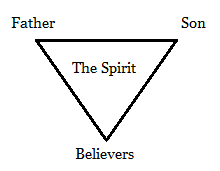
Ultimately, for believers, the first aspect is dependent upon the second; that is to say, we share in the unity between Father and Son through our relationship to the Son. Though it is not stated here, this relationship with the Son is realized through the presence of the Spirit.

  1. “that they also would be in us” [i%na kai\ au)toi\ e)n h(mi=n w@sin] (v. 21c)
    “that they would be completed into one” [i%na w@sin teteleiwme/noi ei)$ e%n] (v. 23b)

Here the point made above—that unity is based on being “in” the Father and Son—is beautifully set in parallel: “in us” and “completed into one” are synonymous. For the sake of simplicity, my translation of the second phrase, though generally literal in rendering, has somewhat obscured the force of the perfect participle teteleiwme/noi. This would more accurately be translated “(one)s having been completed” or “(one)s having been made complete”. In other words, the participle characterizes believers. This verb (teleio/w, “[make] complete”) is closely related to tele/w (“complete”), and both verbs together have a special theological significance in the Johannine writings. In the Gospel, they refer to Jesus (the Son) completing the work, or mission, for which the Father sent him to earth (4:34; 5:36). We saw that Jesus used the verb teleio/w earlier in the Prayer (v. 4); the Passion setting makes clear that this completed work is to culminate with his sacrificial death (19:28), being fulfilled in his final word on the cross: “it is completed” [tete/lestai, vb tele/w] (v. 30).

However, here the verb teleio/w, in the passive, is used of believers. The parallel for this usage is found in the First Letter of John, and these references must be consulted to understand its meaning here:

“but, whoever would keep watch (over) his word [lo/go$], in this (person) the love of God has been made complete [tetelei/wtai], (and) in this we know that we are in him [e)n au)tw=| e)smen]” (2:5)

“No one has ever looked (upon) God. (But) if we love (each) other, (then) God remains [i.e. dwells] in us, and his love is made complete [teteleiwme/nh] in us.” (4:12)
“In this [e)n tou/tw|], love has been completed [tetelei/wtai] with us…that just as [kaqw/$] that (one) [i.e. the Son/Jesus] is [e)stin], (so) also we are [e)smen] in this world. There is no fear in love, but the love (that is) complete [telei/a] throws fear (out)…and the (one) fearing has not been made complete [tetelei/wtai] in love.” (4:17-18)

Even a casual reading, in translation, should make clear how similar the thought and language is to that of the Prayer-Discourse of Jesus. Here the completion/completeness of believers is marked by the presence of God’s love (a)ga/ph) in them. That is certainly an important motif in the Gospel Discourses as well; in fact, it is one of the key themes that opens the Last Discourse (13:34-35), running all the way through it, to the end of the Prayer-Discourse (vv. 24-26, to be discussed in next week’s study). There is, in these passages from 1 John, a close connection between the verb teleio/w and the idea of the unity of believers that is based on the presence of God (and Christ) in us. This is precisely what we find here in vv. 21, 23 of the Prayer. Believers are made complete through their/our union with the Son, the presence of whom is variously defined in terms of (a) Word [lo/go$], (b) Love, but ultimately as (c) the Spirit.

However, this is not the full extent of the meaning of the verb teleio/w in this passage; there is an important aspect yet to be addressed, which requires study of the final (concluding) phrases of each strophe.

  1. “(so) that the world would trust that you se(n)t me forth” [i%na o( ko/smo$ pisteu/h| o%ti su/ me a)pe/steila$] (v. 21d)
    “(so) that the world would know that you se(n)t me forth…” [i%na ginw/skh| o( ko/smo$ o%ti su/ me a)pe/steila$]
    “…(and) that you loved them just as you loved me.” (v. 23c-d)

The references here to the “world” (ko/smo$) are complex and carry a special significance within the theological setting of the Johannine Discourses of Jesus. A proper understanding of it requires an extended discussion, which I will be giving in a supplemental article.

Notes on Prayer: John 17:16-19

John 17:16-19

Verses 16-19 close the first Expository section of the Prayer-Discourse (vv. 12-19, cf. the outline in the previous study). A curious detail to note is the way that verse 16 repeats, almost verbatim, the second half of v. 14. This apparently led a number of scribes to omit the verse, but there a number of such repetitions throughout the Johannine Discourses of Jesus (and the Last Discourse, in particular), and text here is secure. As a result, we ought to regard the repetition as intentional, in terms of the structure of this section. It gives to the triadic structure a chiastic outline:

    • Expository narration—the work of the Son (vv. 12-14a)
      • Unity of Believers with Jesus—”not out of the world” (v. 14b)
        • Petition to the Father—protection from the evil in the world
      • Unity of Believers with Jesus—”not out of the world” (v. 16)
    • Exposition—the work and presence of the Son in believers (vv. 17-19)

According to this detailed outline, verses 17-19 are parallel to 12-14a, both representing the core exposition in the section. How do these two passages relate? The first deals with the time of Jesus’ ministry on earth (“When I was with them…”); the second focuses on the time after Jesus’ departure back to the Father. It must be admitted that the latter emphasis is not explicit or immediately apparent on a reading of the text; however, with a little study, I believe it come through quite clear. There are three statements in this exposition:

    1. A request that his disciples be “made holy” by the Father (v. 17)
    2. A declaration similar in formula to Jesus’ words to his disciples after the resurrection, sending them into the world as apostles/missionaries (20:21)
    3. A statement explaining that the disciples are “made holy” even as Jesus himself is made holy, using reciprocal language and hearkening back to the invocation (v. 1, cf. also 13:31)

Let us examine each of these in turn.

Verse 17

This is another petition by Jesus to the Father, and must be understood in relation to the central petition of vv. 9-11, as well as the further request in v. 15 (cf. the previous study). The motif of protection has been defined in terms of holiness—which, from a religious standpoint, essentially refers to separation from evil (and the world) and protection from it. Here is the request:

“Make them (to be) holy in the truth—your word is truth.”

We may isolate three key components to this petition:

    • The verb (a(gia/zw, “make holy, treat as holy”)
    • Emphasis on truth (a)lh/qeia), and
    • The identification of truth with the word (lo/go$) of God the Father

The second and third of these are important theological key words in the Johannine Writings (both Gospel and Letters), and occur far more frequently than the first. In this regard, they serve to expound and explain the primary petition comprised of the initial words: a(gi/ason au)tou\$, “(May you) make them (to be) holy”. The verb a(gia/zw (hagiázœ, “make holy, treat as holy”) is relatively rare in the New Testament, occurring just 28 times, compared with the much more common adjective a%gio$ (hágios, “holy”). In the Synoptic Gospels, in the words of Jesus, its usage is almost entirely limited to the opening petition of the Lord’s Prayer (Matt 6:9; Lk 11:2), a context similar to that in John 17 (with the emphasis on the name of God the Father and His holiness, vv. 1, 6ff):

Pa/ter […] a(giasqh/tw to\ o&noma/ sou
“Father […], may your name be made holy”

Pa/ter… (“Father…”, v. 1)
e)fane/rwsa/ sou to\ o&noma (“I made your name shine forth…”, v. 6)
Pa/ter a%gie th/rhson au)tou\$ e)n tw=| o)no/mati/ sou
(“Holy Father, keep watch [over] them in your name…”, v. 11)

Paul uses the verb 6 times in the undisputed letters (1 Thess 5:23; Rom 15:16; 1 Cor 1:2; 6:11; 7:14 [twice]); it occurs three more times in Eph 5:26; 2 Tim 2:21; 1 Tim 4:5. It is used 7 times in Hebrews (2:11 [twice]; 9:13; 10:10, 14, 29; 13:12), in the context of the Israelite priesthood—a point to be discussed on v. 19 below.

It is important to emphasize again that the following phrase “in the truth” and the statement “your word is truth” both qualify and explain the meaning of the petition. First, we have the full form of the petition: “Make them (to be) holy in the truth”. The noun a)lh/qeia (“truth”) occurs 25 times in the Gospel of John, and another 20 times in the Letters (9 in 1 John). It has a special theological (and Christological) meaning, going far beyond the simple idea of factual truth, or even moral and religious truth. Rather, it is a fundamental characteristic of God the Father Himself, and of Jesus as the Son (of God). Moreover, it does not refer primarily to Jesus’ teaching and the proclamation of God’s word (as a message), but is embodied in the person of Jesus himself. Cf. John 1:14, 17; 8:32ff, 44-46; 14:6; 18:37-38; 1 Jn 1:6, 8; 2:21, etc. Distinctive of the Johannine theology, including that expressed by Jesus in the Discourses, is the special association (and identification) of the Spirit with this Truth (4:23-24; 14:17; 15:26; 16:7, 13; 1 John 4:6). The declaration in 1 John 5:6 makes this identification explicit and unqualified, and provides the answer to Pilate’s provocative question (Jn 18:38, “What is [the] truth?”):

“The Spirit is the Truth”
to\ pneu=ma/ e)stin h( a)lh/qeia

This declaration also informs the statement in 17:17b (cp. Psalm 119:142b Greek v.l.), which has similar wording (the only real difference being the emphatic position of the verb):

“Your Word is (the) Truth”
o( lo/go$ o( so$ a)lh/qeia/ e)stin

Taking these statements together, we have the fundamental identification of God’s Word (lo/go$) with the Spirit. Again, this does not refer to any particular message or set of words spoken by Jesus (though these are included, Jn 6:63, etc), but to the essential identity of Jesus (the Son) as the living embodiment of God’s Word on earth (Jn 1:1ff, 14, etc). Jesus’ manifest presence with the disciples cleanses them (Jn 13:10-11; 15:3), culminating in his sacrificial death (1 Jn 1:7-9) that protects believers and makes them clean (i.e. holy) from sin. This cleansing power again is identified with the Spirit (“water and blood”, Jn 19:34; 1 Jn 5:6-8)—the living and indwelling presence of Jesus (and God the Father) in believers. The Spirit is given following Jesus’ death (19:30, 34, understood symbolically) and resurrection (20:22).

Thus we may see here in verse 17 an implicit reference to the Holy Spirit as the means by which the disciples (believers) are made holy.

Verse 18

This is confirmed by what follows in verse 18, a reciprocal statement similar to the ‘commission’ of the disciples in 20:21:

“Even as you se(n)t me forth into the world, I also se(n)t them forth into the world” (17:18)
“Even as the Father se(n)t me forth, I also send [pe/mpw] you” (20:21b)

In 17:18, the aorist is used (indicating a past occurrence), while in 20:21, in addressing the disciples, Jesus uses the present tense (and a different verb [pe/mpw]). It is possible that the aorist assumes a tradition such as in the Synoptics (Mk 3:14-15; 6:6b-13 par; Lk 10:1ff), where Jesus is to have sent the disciples out on preaching assignments. The Gospel writer is certainly familiar with such traditions (3:34-38; 6:67-71), though he makes little of them in the narrative. However, a better explanation is at hand in the context of the Last Discourse. An important point of emphasis (discussed in the prior studies) is that Jesus was able to sanctify his disciples by his presence with them on earth (i.e., in the past, up to this point). Now that he is about to return to the Father, he is no longer able to “make them holy” the same way—thus the need (in the present) for the Father to send the Spirit as the Divine Presence (and Power) to fill this role in Jesus’ place. The words of commission in 20:21 are followed directly by the disciples receiving the Spirit from Jesus (who, in turn, had received it from the Father). The Spirit’s presence cleanses the disciples and makes them holy.

In this regard, the disciples are to function in the manner of priests in ancient religious tradition. Through a proscribed ceremonial ritual, Israelite priests were consecrated (made holy) for service in the sacred place(s), handling of sacrifices and sacred objects, etc—e.g., Exod 40:13; Lev 8:30; 2 Chron 5:11. Jesus’ disciples (believers) are compared or described as priests at numerous points in early Christian tradition, part of a wider religious phenomenon whereby devotion to Jesus takes the place of (or fulfills) the earlier cultic ritual practiced by the priesthood. Of the passages in the New Testament indicating this, cf. Matt 12:1-8; Rom 12:1-2; 15:16; 2 Cor 3:6ff; 1 Pet 2:5ff; Rev 1:6; 5:10; 20:6.

Verse 19

The imagery of priesthood is even more prominent in verse 19. Indeed, it is due almost entirely to the influence of verses 17-19 that the Prayer-Discourse in chapter 17 is sometimes called the “High Priestly” Prayer of Jesus. However, this label is quite inappropriate for the Prayer as a whole, since it is only in these three verses that there is any real indication of priestly language or emphasis. Nevertheless, it remains a small, but important, element of the Prayer, and follows the overall theology of the Gospel, in which it is not believers, but Jesus himself, who is described in priestly terms. The emphasis is on the sacrifice (esp. the Passover sacrifice) rather than the one administering it; however, as in the Letter to the Hebrews, Jesus would certainly be seen as fulfilling both roles. This is expressed here in verse 19, where the Passion setting of the Prayer again comes to the fore:

“And (it is) over them [i.e. the disciples] (that) I make myself holy, (so) that they (also) would be made holy in the truth.”

Jesus functions as a priest, consecrating himself for service (symbolized by his actions in 13:4-12)—the primary service being his impending sacrificial death on the cross, which represents the completion of his ministry on earth (19:30). The only other occurrence of the verb a(gia/zw is in 10:36, which comes at the end of the “Good Shepherd” Discourse. The central motif of this Discourse is the idea that Jesus, as the excellent or exemplary (kalo/$) herdsman, lays down his life for the sake of the sheep. God the Father has given him the authority (and the command) to lay down his life (death) and take it up again (resurrection), cf. 10:11, 15, 17-18. The preposition is u(pe/r (lit. “over”), essentially the same idiom as we see here in 17:19, and also in the Last Supper scene in the Synoptics; let us compare these (and the general parallel in Jn 6:51):

    • “This is my blood of the covenant th(at is) being poured out over [u(pe/r] many” (Mk 14:24 par)
    • “the bread which I will give is my flesh over [u(pe/r] the life of the world” (Jn 6:51)
    • “…I set (down) my soul [i.e. life] over [u(pe/r] the sheep” (Jn 10:15, cf. also vv. 11, 17-18)
    • “I make myself holy over [u(per/] them…” (17:19)

There can thus be no real doubt that there is a direct allusion to sacrificial death of Jesus. The idiom in Mk 14:24 par is more concrete, drawing upon the ritual image of blood actually being poured (or sprinkled) over the people at the covenant ceremony (Exodus 24:6-8). In the Johannine references, it is more symbolic, dealing the sacrificial nature and character of Jesus’ death, much as we see in the Letter to the Hebrews (esp. throughout chapters 5-10). From the Johannine (theological) standpoint, it is the sacrificial death (and resurrection) of Jesus which releases the Spirit to believers, both symbolically (19:30, 34) and literally (20:22). The Spirit remains essentially connected with the cleansing power of Jesus’ blood (1 John 1:7-9; 5:6-8), transmitting its live-giving (and protecting) efficacy to the believer.

A point should be made about the reflexive use of a(gia/zw in verse 19, whereby Jesus says: “I make myself holy” (a(gia/zw e)mauto/n). We might have expected him to ask the Father to make him holy, or at least to emphasize the Father as the source of holiness (v. 11). The key to understanding this lies in the Johannine theological-christological framework, perhaps best expressed by Jesus in 5:26:

“as the Father holds life in himself, so also he gave life to the Son to hold in himself”

There is a parallel to this in 13:31-32, using the idea of honor/glory (do/ca) rather than life (zwh/). Moreover, the context of 17:19 is elucidated in this regard by turning back to the use of the verb a(gia/zw in 10:36:

“…the (one) whom the Father made holy [h(gi/asen] and se(n)t forth into the world”

This expresses the same chain of relation as in 5:26, both reciprocal and hierarchical:

The Son alongside the Father—made holy by the Father’s Life and Power
|
Sent into the world by the Father
|
The Son (on earth) has the Life and Power given to him by the Father
|
Prepares to finish his work in the world
|
The Son about to return to the Father—makes himself holy

This dynamic continues as the Son makes his disciples (believers) holy in turn, through his work, and, ultimately, through the presence of the Spirit. Indeed, the Spirit represents the presence of both Father and Son (together) in and among believers, and this theme of unity becomes dominant in the remainder of the Prayer (vv. 20-26), as we will begin to explore in next week’s study.

May 28: John 14:16-17, 26; 15:26; 16:7, 13

John 14:16-17, 26; 15:26; 16:7, 13

In the previous daily note, I surveyed the passages in the Gospel of John which mention the (Holy) Spirit; today I will focus in a bit more detail on the so-called “Paraclete” passages in chapters 14–16 (Jn 14:16, 26; 15:26; 16:7; cf. also 1 Jn 2:1). Of all the references to the Holy Spirit in the Gospels (and Acts), it is here that we perhaps come closest to the idea of the Spirit as a distinct person. This will be addressed further below, at the end of the note.

The Greek noun para/klhto$ (parákl¢tos) is derived from the verb parakale/w (parakaléœ, “call alongside”). Literally, the noun means “one (who is) called alongside” (passive) or “one (who) calls alongside” (active). The “calling alongside” normally implies the sense of giving help—i.e. aid, comfort, encouragement, etc. Sometimes it carries the technical meaning of a legal advocate. This semantic range has made interpretation and translation of para/klhto$ somewhat difficult in these passages, being rendered variously as “Comforter”, “Counselor”, “Advocate”, or simply transliterated as “Paraclete”. In ordinary English, the word is probably best translated as “Helper”.

A number of (critical) commentators have felt that, in the underlying Gospel tradition, this Paraclete/Helper originally referred to a being or figure separate from the Holy Spirit (as understood by early Christians). This is rather questionable, though it must be admitted that, in all three passages, the Paraclete is identified by the title “the Spirit of Truth”, and only once as “the Holy Spirit”. The expression “Spirit of Truth” is not found elsewhere in the New Testament outside of the Johannine tradition (1 Jn 4:6; cf. 5:6; Jn 4:23-24), but it does appear several times in the Qumran texts (Dead Sea Scrolls), especially in the so-called Community Rule [1QS] 3:18-19; 4:21, 23, the portion sometimes referred to as the “Treatise of the Two Spirits” (cf. also 4Q177 12-13 i 5; 4Q542 1 i 10, and note in 1QM 13:10). These “Spirits”—one of Truth, and one of Falsehood/Deceit—correspond to heavenly beings, i.e. Angels (cf. 1QS 3:24), opposed to one another, according to the dualistic worldview expressed in the Qumran texts (as also in the Testament of Judah ch. 20). Thus, at the time of Jesus (and early Gospel tradition), the expression “Spirit of Truth” as referring to a guarding/helping Angel, would have been current and familiar to some. It is also thought that the Paraclete idea in Jn 14-16 may have been influenced by Jewish Wisdom tradition, in which Divine Wisdom, personified or described as a person, gives help and guidance to the righteous. For a convenient survey and discussion of these topics, cf. R. E. Brown, The Gospel According to John XIII-XXI, Anchor Bible [AB] vol. 29A, pp. 1135-43 (Appendix V).

There are three basic Paraclete passages in John 14-16:

1. John 14:15-24 (& v. 26)—the Spirit in the disciples.

Here the emphasis is on the abiding presence of Jesus (the Son)—and, by extension, God the Father—in believers. Jesus is going away (back) to the Father, but will come again and be seen by his followers:

    • The world will no longer see (physically)
      —but believers will see (through the Spirit), v. 19 (cf. 9:39; 20:29, etc)
    • The world cannot receive the Spirit, v. 17; only those who trust in the Son can/will do so

The Paraclete/Helper is called:

    • “The Spirit of Truth“—whom the Father sends, at Jesus’ request (v. 17), and also
      “The Holy Spirit“—whom the Father will send in Jesus’ name (v. 26)

The last reference gives specific emphasis on the Spirit/Paraclete teaching the disciples, so that Jesus’ words will remain/abide in them.

2. John 15:18-16:4a—the disciples speaking by the Spirit.

In this passage, the emphasis is on the Divine presence, i.e. of the Son (and the Father), for believers in the face of persecution (hatred by the world), so that they may testify on Jesus’ behalf—i.e., believers as Jesus’ representatives (cf. Mark 13:9-13 par; Matt 10:16-23; Luke 12:10-12). The disciples (indeed, all believers) are chosen out of the world, and do not belong to the world (v. 19).

The Paraclete/Helper is called:

    • “The Spirit of Truth“—whom Jesus will send from the Father (v. 26)
3. John 16:4b-15—the Spirit speaking through the disciples.

Here, in this third section, the emphasis is on the witness by the Spirit (against the world), through the testimony of believers. It is Jesus (the Son), and, by extension, the Father, who is speaking by way of the Paraclete (Matt 10:20; Lk 21:15). This is a profound reflection of the relationship between Father and Son (vv. 12-15), which, through the Spirit/Paraclete, results in the triadic unity: Father—Son—Believers (cf. 14:20-21, 23; 15:9-10; 17:20-26).

The Paraclete/Helper is called:

    • “The Spirit of Truth“—who will come, from the Father and Son together (implied) (v. 13)
Reference to the Trinity?

Commentators and readers are often anxious to find expression of the orthodox formulation of the Trinity in the pages of the New Testament. In all fairness, it must be admitted that is really only present in a very rudimentary, seminal form—e.g., in passages such as 1 Cor 12:4-6; 2 Cor 13:14; 1 Pet 1:2; and Matt 28:19 (on this last, cf. my earlier notes). The basis for the orthodox belief, however, is found in the various statements which relate Jesus to the Father and/or the Spirit. There are two main sources in the New Testament which would shape the development of Christological and Trinitarian thought—(1) the letters of Paul, and (2) the Gospel (and First letter) of John, i.e. Pauline and Johannine theology. The Paraclete passages in the Discourses of Jn 13-17 are central to the Johannine view, which, I believe, may be summarized as follows:

    • The Spirit/Paraclete essentially represents the abiding (spiritual) presence of Jesus in believers, while he himself remains in heaven with the Father. Elsewhere in the New Testament, the expression “Spirit of Jesus” or “Spirit of Christ” is effectively synonymous with the “Spirit of God” or the Holy Spirit (cf. Acts 16:7; Rom 8:9; Phil 1:19; 1 Pet 1:11; and note also “Spirit of the Lord” in Acts 5:9; 8:39; 2 Cor 3:17).
    • The Son (Jesus) was sent by the Father; once he returns to the Father, he, in turn, will send the Spirit/Paraclete to his disciples in his place. The Son will continue to act and work alongside the Father (in Heaven), but will, at the same time, be present with believers through the Spirit. This is described at several points within the Discourses (cf. above), and in the narrative context of Gospel is referenced (briefly) in Jn 20:17, 22.
    • The (reciprocal) relationship between Father and Son is such that the Son, in turn, does what the Father is doing (or has done). This is expressed throughout the Discourses in the Gospel, and is emphasized all the more in the context of the Son returning to a position alongside the Father in chs. 14-17. An interesting effect of this is that the sending of the Spirit can alternately be said to take place: (a) by the Father, in Jesus’ name (or at his request), or (b) by Jesus, from the Father.
    • This same relationship is extended to believers, in a two-fold manner:
      (1) The Father comes to abide in believers, just as the Son (Jesus) does—the presence of both (together) is realized for believers through the Spirit
      (2) The Son ‘prepares a place’ with the Father in Heaven for believers—he is the way to the Father and believers, insofar as they are faithful, will follow the Son to abide in union with the Father. This is marked by the other side of the Spirit’s presence—just as the Son abides in believers, so also believers abide in the Son.

Thus, we do not see a Trinitarian formula, properly speaking; but rather a triadic unity marked by the Spirit, which one might diagram (however imperfectly) in the following manner: