Believers and the World (Jn 17:20-23, continued)

As a continuation (and conclusion) to the recently posted article, on the statements regarding believers and “the world” (o( ko/smo$) in John 17:20-23, I mentioned three specific questions which I felt still needed to be addressed:

    • How does the unity of believers relate to the world trusting/knowing Jesus?
    • What is the significance of this for the use of the verb teleio/w (“make complete”) in verse 23?
    • How does the final clause of verse 23, with its motif of love, fit into the structure of the section?

I will briefly discuss each of these in turn.

1. How does the unity of believers relate to the world trusting/knowing Jesus?

The principal theme of verses 20-23 is Jesus’ request for the unity of his disciples (believers). This is expressed two ways:

    • With the neuter singular adjective e%n (“one”): “that they would (all) be one“
    • Using the preposition e)n (“in”): believers in the Son (and the Father), and the Son in believers, just as the Father and Son are in one another.

The use of the comparative particle kaqw/$ (“just as”), and the relation of believers to the union between Father and Son, makes clear that believers share in the same (not just similar) unity that Father and Son share. This is a powerful theological (and spiritual) proposition, which may seem quite shocking to religious sensibilities, but it is not to be explained away or mitigated. The language used by Jesus (and the Gospel writer) must be allowed to stand. And yet, how does this unity relate to “the world”? In the main part of this article, I discussed how the concluding i%na-clauses, mentioning “the world”, are best understood as subordinate result clauses. Let us consider again how these fit in the parallel strophes of verses 20-23:

First strophe, verses 20-21:

    • “…(I ask) about the (one)s trusting in me through their word,
      • that [i%na] (they) all would be one [e%n]
      • just as [kaqw/$] you, Father, (are) in me and I in you,
      • that [i%na] they also would be in us,
        • (so) that [i%na] the world would trust that you se(n)t me forth.”

Second strophe, vv. 22-23:

    • “And the honor [do/ca] which you have given to me, I have given to them,
      • that [i%na] they would be one [e%n]
      • just as [kaqw/$] we (are) one [e%n]—I in them and you in me—
      • that [i%na] they would be completed into one [e%n]
        • (so) that [i%na] the world would know that you se(n)t me forth
          and (that) you loved them even as you loved me.”

For ease of reference, here are the two clauses in context, with the immediate statement regarding unity in bold:

“…that they…would be in us, (so) that the world would trust that you se(n)t me forth”
“…that they would be completed into one, (so) that the world would know that you se(n)t me forth”

How does the unity of believers lead the world (i.e. others in the world who are not yet believers) to trust and know (i.e. recognize) Jesus’ divine origin as Messiah and Son of God? Some would cite the example of Christian unity as something which might convince people of the truth of the Gospel. While this is a noble sentiment, it is not at all what is in view here in the Prayer. Rather, the unity of which Jesus speaks is fundamental and essential—the very identity of believers is defined by their/our union with God the Father and Jesus the Son. This union, indicated primarily by the preposition e)n (“in”, i.e. “in us”), is further defined three distinct ways in the Gospel of John; the divine Presence in believers is described in terms of: (1) Word [lo/go$], (2) Love [a)ga/ph], and (3) Spirit [pneu=ma]. It is the Word-Love-Spirit of God (and Christ), dwelling in and with believers, which brings others to trust and knowledge of the truth. This will be further discussed in the following two sections.

2. What is the significance of this for the use of the verb teleio/w (“make complete”) in verse 23?

In the earlier notes on verses 20-23, I pointed out how the use of the verb teleio/w (“[make] complete”), in the passive, with believers as the subject, occurs only here in the Gospel of John, but that four similar instances are found in the First Letter (2:5; 4:12, 17-18). The passages in 1 John share much of the same thought, language, and vocabulary as the Prayer-Discourse of Jn 17. There, too, the unity believers share with Father and Son is defined in terms of love (cf. section 3 below). However, I believe there is one aspect of the use of the verb here in verse 23 which has not yet been explored, and it relates specifically to the statement regarding the world trusting/knowing. The unity of believers is only realized collectively, not individually—but as a universal Community, bound together by the living Word-Love-Spirit of God. To that extent, unity is not realized until all believers are included—that is, when all the Elect/Chosen ones, living throughout the world, in all times and places, come to trust in Jesus, becoming true believers in Christ. This is wonderfully expressed, though using different imagery, in the “Good Shepherd” discourse:

“And I hold other sheep, which are not out of [i.e. from] this yard, and it is necessary for me to bring them also, and they (too) will hear my voice, and they will be a single herd [poimnh/], (with) one herder [poimh/n].” (10:16)

It must be emphasized that, though believers may gather (physically) into local communities, the unity spoken of by Jesus in the Gospel of John is entirely spiritual—it is truly a universal Community, realized and possible only by and through the presence of the Spirit. It is no coincidence that the giving of the Spirit follows almost directly after the death and resurrection of Jesus (20:21ff), and that this is indicated symbolically in the narrative at the moment of Jesus’ death (19:30):

    • His dying word on the cross: tete/lestai (“it is completed“, vb. tele/w closely related to teleio/w), after which
    • “…he gave along the Spirit” (pare/dwken to\ pneu=ma)

3. How does the final clause of verse 23, with its motif of love, fit into the structure of the section?

Verses 20-23 conclude with a statement that defines unity in terms of love (a)ga/ph)—that is to say, divine love, the love of God, which believers share by way of our union with Christ. This divine love cannot be separated (as an attribute) from the very Presence of God Himself, which believers are joined with by way of the Person of Jesus, through the Spirit. As mentioned above, from the standpoint of Johannine theology, Word, Love and Spirit, are largely synonymous, all three representing the living presence of God the Father and Jesus (the Son). This special meaning of a)ga/ph is seen throughout the Gospel, but especially in the Last Discourse (5:42; 8:42; 13:34-35; 14:15, 21ff; 15:9-13, 17, 19). It is even more prominent in the Letters (42 times, including 36 in 1 John). In 4:8, God Himself is identified as Love, and I mentioned above how believers being “made complete” is understood in terms of this love (2:5; 4:12, 17-18). In many ways, the First Letter takes up where the Last Discourse leaves off, both serving as detailed expositions of the “love commandment” in 13:34-35. The wording in 17:23 summarizes this exposition, but from the standpoint of the Father’s relationship to believers: “you loved them just as you loved me”.

However, according to the syntax of vv. 22-23, this statement is part of the i%na-clause which mentions the world knowing:

“…that they would be completed into one, (so) that the world would know that you se(n)t me forth, and (that) you loved them even as you loved me.”

The statement of God’s love is part of what the world comes to know:

    • “(so) that the world would know
      • that you sent me forth
      • and (that) you loved them even as you loved me”

Some commentators have struggled with the pronoun “them”, pointing out that, in context, it must refer to the believers (“the ones trusting in me…”) of v. 20, rather than to the immediate subject “the world”. However, according to the interpretation I set forth (cf. the main discussion), here “the world” refers ostensibly to believers—i.e. the Elect/Chosen ones, in the world, who have not yet become believers. This renders the immediate syntax more intelligible: those “in the world” who come to be believers realize the love God the Father has for them, a love that is identified in the person of his Son (Jesus). The wonderful reciprocity that defines both the unity and love which we share, as believers, and expressed here, is supplemented by Jesus’ earlier statement in 14:31:

“…(so) that the world would know that I love the Father, and even as the Father placed (a duty) on me to complete, so I do (it).”

Here the idea of believers “in the world” is less in view; the focus is rather on Jesus’ impending sacrificial death, and the time of darkness which accompanies it. The statement in v. 31 is preceded by an ominous declaration that “the chief/ruler of the world comes”, along with a message of encouragement that “he holds nothing on/in me”. That last phrase could mean “he has no part in me”, or “he holds nothing on me” in the sense of having “no power over me”; probably the latter is intended. In any event, the wording of v. 31a is quite similar to that of the closing words of 17:23—the former mentions Jesus’ love for the Father, the latter the Father’s love for Jesus. The world—everyone in it, not just the elect/believers—can recognize in Jesus’ death his great love for God.

It is the “love commandment” in 13:34-35 which relates more directly to the statement in 17:23:

“A new duty I give to you to complete: that you love each another—just as I loved you, that also you would love each other. In this, all people will know that you are my learners [i.e. disciples], if you hold love among [lit. in/on, e)n] each other.”

There is a similar matrix of thought and language, including the idea that people in the world will know as a result of the unifying love which believers share. Here the sense of believers as an example to the world is more plausible; yet, the emphasis is still squarely on believers and their relationship to Jesus.

If we consider the statements in 13:34-35, 14:31, and 17:23 in sequence, representing a kind of development of thought, it seems to parallel Christian ministry itself:

  • 13:34-35—Believers as ministers, representatives of Christ, in the world
    • Love—We are to love each other according to the example of Jesus (“just as” [kaqw/$] he loved us); his sacrificial death is implicit and fundamental to this love.
    • World’s Response—”All people” recognize this love as a sign that believers are disciples of Jesus, i.e. that they are Christians
  • 14:31—The Gospel message believers proclaim in the world is centered on the sacrificial death of Jesus, which frees us from the power of the world (“ruler of the world”, v. 30)
    • Love—Jesus’ love is embodied in his sacrificial death, and demonstrates his love for God the Father
    • World’s Response—Those in the world, both the Elect and non-elect, can recognize Jesus’ love for God in his sacrificial death
  • 17:23—Believers proclaim the Gospel (the Word), being guided and empowered by the living Word (the Spirit) which unites us with God the Father and Jesus (the Son)
    • Love—As believers we share (“even as” [kaqw/$]) in the same Love which God the Father has for Jesus (the Son); it is not just an attribute of God, but the Presence of God Himself.
    • World’s Response—The Elect/Chosen ones in the world come to know that Jesus is the Son sent by God the Father, and recognize the love which God has for them, uniting them with all other believers.

June 9: Acts 2:36

This is the third of three daily notes, covering three Christological phrases in Peter’s Pentecost speech-sermon (Acts 2:14-41). The first note examined the phrase in verse 22, the second note the dual clause in verse 33; today I will look at the statement in verse 36. Verses 22-24 represent a kerygmatic formulation which precedes the citation/exposition of Psalm 16:8-11; a second kerygmatic statement follows in verses 32-33, along with a secondary citation from Psalm 110:1 in vv. 34-35. Verse 36 represents, in turn, the climactic statement of the speech, the importance of which is indicated by the solemn manner it is introduced—

“Therefore (let) all the house of Yisrael safely/surely know…”

Then comes the climactic statement:

“…that God (has) made him (both) Lord and Anointed—this Yeshua whom you put to the stake!”

Here is again, the central clause:

kai\ ku/rion au)to\n kai\ xristo\n e)poi/hsen o( qeo/$
“God made him (both) Lord and Anointed”

Believers are so accustomed to thinking of Jesus as Lord (that is, God/Divine) and Anointed (i.e. the Messiah), that the context of this declaration in Peter’s speech is easy to overlook. Indeed, it may be somewhat shocking to realize that Jesus’ identity/status as Lord (ku/rio$) is specifically tied to his exaltation/glorification following the resurrection. That is certainly the sense of Psalm 110:1 here (cited in v. 34-35), juxtaposed with Psalm 16:8-11—the statement in Ps 110:1 follows (and, one may say, is a result of) Jesus’ being raised and ascending (v. 34a) into Heaven. Contrast this with the citation of Psalm 110:1 in Hebrews 1:13, where there is a relatively clear sense of Jesus’ eternal, pre-existent status as God’s Son (cf. Heb 1:3ff).

Here, too, in Acts the use of the verb poie/w (poiéœ, prim. “do, make”) is problematic, especially from the standpoint of post-Nicene orthodoxy. This verb is that which is used in reference to God’s act of creation, and yet the Nicene creed explicitly states that Jesus was “begotten, not made” (gennhqe/nta, ou) poihqe/nta). And, although the statement in Acts 2:36 does not say that Jesus was metaphysically made (as a creature), how can he be said to have been “made” Lord after the resurrection? Was he not already Lord in eternal pre-existent union with the Father, and all throughout his incarnate life on earth? Certainly, later theologians and commentators would be extremely reluctant to use such language as we find here in Peter’s speech.

It is somewhat easier to speak of Jesus being “made” the Anointed (i.e. the Messiah) since this term applies primarily to an Israelite/Jewish religious concept—that of the king or priest who is anointed (ritually/symbolically) as God’s chosen representative among the people. By the time of the New Testament, following centuries of reflection and response to both the Scriptures (prim. the Prophets and prophetic Psalms) and historical circumstances, the Anointed/Messiah had come to be associated with a very definite sort of eschatological figure (Davidic ruler and/or Priest and/or Prophet) who would oversee (in whole or part) the restoration of Israel and God’s end-time judgment. In several Jewish writings likely contemporary with the New Testament—the Similitudes of Enoch (1 Enoch 37-71) and 4 Ezra (2/4 Esdras)—this “Messiah” is more or less identified with an apparently separate figure, that of a heavenly/pre-existent “Son of Man” (certainly influenced by Dan 7:13). While there is some precedence for the idea of the Messiah as a divine/heavenly figure, more often he was understood to be a real human being. It is primarily the role he serves which is divinely ordained and empowered. One could, then, speak of Jesus as being “made” the Messiah, in the sense that, as a human being, he was divinely empowered to fulfill the Messianic role(s). In traditional Christological terms, Priest, Prophet and King, are understood as the three “offices” of Christ.

(For more on this, see the series “Yeshua the Anointed”, and esp. Part 12 on the Messiah as “Son of God”.)

Yet, how exactly should one understand the idea of Jesus’ being “made” Lord here in Acts 2:36? The Greek word ku/rio$, in a Jewish and early Christian religious context, is used primarily as a reference to YHWH, the one God. Even in the earliest period of the New Testament writings and traditions, to refer to Jesus as ku/rio$ was tantamount to affirming his divine nature/status. There are of course passages in the Gospels where ku/rio$ is applied to Jesus in the narrative in a diplomatic or honorific sense, such as the use of “Sir” in English, but this is hardly the case in passages reflecting actual early Christian belief. More difficult to interpret are those sayings of Jesus where he appears to use the word applied to himself; perhaps most tantalizing of all is his citation of Psalm 110:1 (Mark 12:36-37 par), which might provide a decisive interpretation to the verse (see above), however the exact meaning and thrust of Jesus’ question remains a matter of considerable debate among commentators. The most explicit statement of Christian belief in this regard (identifying Jesus as Lord in the sense that God/YHWH is Lord), within the Gospel narrative, is certainly the declaration by Thomas in Jn 20:28 (“my Lord and my God!”). But if ku/rio$ is meant to indicate Jesus’ divine nature or status—identifying him in some meaningful way with God/YHWH—in Acts 2:36, how can he be said to have been “made” ku/rio$? I would suggest three main possibilities for interpretation, none of which are without difficulty:

  1. The statement fundamentally reflects an “adoptionistic” view of Christ—that is to say, he was only elevated to divine status (at the right hand of God, v. 33) upon his being raised by God from the dead and glorified/exalted. Prior to this, Jesus was simply a human being, though one specially appointed/gifted by God (v. 22ff). This would be the most straightforward reading of the statements in Peter’s speech, though of course, it contradicts much of the overall New Testament witness, and would be flatly rejected by (later) orthodox Christology. For more on this, see my article on Adoptionism.
  2. The statement—whether understood as being strictly from Peter, the author of Acts (trad. Luke), or some combination—shows a limited awareness of Jesus’ true nature. In other words, what was known for certain (at the moment) involved Jesus’ resurrection and exaltation to heaven (at the right hand of God) and the sending of the Spirit (from God the Father), and was expressed within a traditional Jewish conceptual framework. Only subsequently, in the following years, would an understanding of Jesus’ eternal and pre-existent divine nature develop, to be expressed within the Gospels and Epistles, etc. This view of the matter reflects the principle of progressive revelation—that only gradually, did the New Testament writers, the apostles, and other believers come to a full realization of Jesus’ nature (in the orthodox sense). This view is somewhat easier to accept if Acts 2:14-36ff represents the actual words of Peter (c. 30-35 A.D.) rather than that of the author of Acts (c. 70-80?); it would be a strong argument that, at the very least, 2:14ff records early apostolic kerygma.
  3. The statement reflects a kenotic view of Christ. By this is meant that Jesus Christ, in some meaningful (though admittedly mysterious) way, forsook his pre-existent divine nature/status, and “emptied” himself to become a human being (the so-called kenosis, from Grk. keno/w kenóœ, “[make] empty”). Upon his death and resurrection, Jesus was then elevated and restored to (an even greater?) divine status, now united with humanity, at God’s right hand. While generally attractive, there are two main difficulties with such a view: (a) it is largely dependent on a single passage (the “Christ hymn” of Philippians 2:6-11), and (b) there are several other passages (such as Col 1:19, cf. also 2:9) which have been taken as confirmation of the orthodox belief that Jesus was in some sense “fully God” even during his earthly life. Applying this view to Acts 2:14-36 also requires reading much into Peter’s speech, which as it stands, better fits an adoptionistic, rather than kenotic, viewpoint.

Clearly there are significant critical and interpretive questions involved in this verse which admit of no easy solution. On the one hand, we should guard ourselves against reading developed (orthodox) Christology back into the New Testament; on the other hand, we must be cautious about reading too much into a single passage. Peter’s speech must first be understood and interpreted in its historical and literary context:

  • The historical context—this is the first public sermon delivered by believers following the resurrection of Christ (and the sending of the Spirit); one should expect just what we find here: rough, simple, dramatic kerygmatic statements (focusing on the immediate message of the resurrection and promise of salvation), rather than a developed and systematic Christology. Throughout the Gospels and here in Acts (cf. 1:6f), there are numerous examples where even Jesus’ closest disciples (Peter and the Twelve) demonstrated that they possessed a limited awareness of exactly who he was.
  • The literary context—this is also the first major Christian speech-sermon recorded in Luke-Acts; it follows directly after the resurrection, ascension and the sending of the Spirit on Pentecost: the events which Peter makes reference to in his speech. Even if the author had wished to express the deity of Christ more clearly, it would have been rather out of place in context here. The overall portrait of Christ will be expanded in the subsequent speech-sermons in Acts.

Both of these observations would tend to support the “progressive revelation” view (#2) above, as well as being the most compatible with orthodox Christology.

June 8: Acts 2:33

This is the second of three daily notes on the Pentecost speech-sermon of Peter in Acts 2:14-41 in which I am examining three Christological statements or expressions—the first (a&ndra a)podedeigme/non a)po\ tou= qeou=, see the previous day’s note) was found in verse 22; today I will be looking at verse 33. The first kerygmatic statement in vv. 22-24 precedes the quotation from Psalm 16; a second kerygmatic statement follows it in vv. 32-33, which is framed by two main clauses (with parenthetic declarations):

This Yeshua {Jesus} God made stand up (again)
—of which we all are witnesses…

…he has poured this out
—which you [also] see and hear

Note the structure of this frame:

    • Act of God (the Father)—raised Jesus from the dead
      • We all (i.e. the disciples/speaker[s]) are witnesses (i.e. have seen)
    • Act of Jesus—poured out the (gift of the) Spirit
      • You (i.e. the crowd/hearers) are witnesses (see and hear)

It is the inner clauses that are central to the Christological statement, for they provide the bridge between the act of God (resurrection) and the act of Jesus (sending the Spirit); they are as follows:

th=| decia=| ou@n tou= qeou= u(ywqei\$,
th\n te e)paggeli/an tou= pneu/mato$ tou= a(gi/ou labw\n para\ tou= patro/$

(and) therefore being lifted high (to) the giving [i.e. right] (hand) side of God
(and) receiving the e)paggeli/a of the holy Spirit (from) alongside the Father

The first clause refers to Jesus’ exaltation to the special honored position of the “right hand” side of God. This is a popular expression in the New Testament, and one of the most common (and probably earliest) descriptions of the exalted “divine” status of Jesus (Mk 14:62 par; Acts 5:31; 7:55-56; Rom 8:34; Eph 1:20; Col 3:1; Heb 1:3ff; 8:1; 10:12; 12:2; 1 Pet 3:22), certainly influenced greatly by Psalm 110:1, cited already by Jesus in the Synoptic tradition (Mark 12:36; Matt 22:44; Luke 20:42), here in Acts 2:34, and in Hebrews 1:13. This idea of Jesus being raised to divine status/position proved somewhat problematic for subsequent Christology, for it could indeed be taken to suggest that Jesus was not “fully divine” prior to the resurrection/exaltation. I will discuss the “adoptionistic” interpretation of such expressions at the conclusion of the third note.

The second clause describes Jesus’ reception of the Holy Spirit from the Father. This idea is less common in the New Testament, best known from the Gospel of John—see the discourses of Jesus in Jn 13-17 (esp. 14:26; 15:26; 16:7) and the episode in Jn 20:19-23 (v. 22). However, something similar had already been mentioned in the Gospel of Luke 24:49:

“and [see!] I set forth from (God/Myself) the e)paggeli/a of my Father upon you; but you—sit (down) in the city until the (time in) which you should be sunk into [i.e. have put on] power (from) out of (the) height”

The same expression “e)paggeli/a of the Father” also occurs in Acts 1:4 in reference to the coming of the Spirit upon the disciples. Previously above, I left the word e)paggeli/a untranslated since it is somewhat difficult to render literally in English. Fundamentally, it would be defined as a message or announcement (a)ggeli/a angelía) on (e)pi epi) a particular matter, primarily in the sense of a public declaration. A specialized, but common, nuance to the word is a declaration that a person intends (or is about) to do something—i.e., a promise—and so the word is used almost exclusively in the New Testament. The context tends to be the covenantal promise(s) God made to Israel, even though the word e)paggeli/a (and the verb e)pagge/llw) hardly occur in the Greek version (LXX) of the Old Testament; it becomes much more common in the deutero-canonical and similar Jewish writings of the intertestamental period (e.g., 2 Macc 2:17; 3 Macc 2:10; Ps Sol 12:8; 2 Bar 57:2; 59:2; Jos Ant 2.219), often expressed in terms of the “promises of God” or the “promises of/to the fathers”—promises to be inherited/fulfilled to faithful believers among Israel. The word, in this sense (and with these related expressions), is used fairly frequently by Paul (in Romans and Galatians), as well as in Hebrews—in particular, Paul invests the word with great significance, indicating the salvation and (eternal) life to be inherited (the parallel word klhronomi/a “lot, inheritance”) by believers through Christ (apart from the Law). This is realized through the presence and power of the Holy Spirit, as Paul states in Gal 3:14; note the expression “promise of the Spirit” (e)paggeli/a tou= pneu/mato$)—parallel with the “blessing (eu)logi/a) of Abraham”—and cf. also Eph 1:13 (“the holy Spirit of the promise”).

Apart from 23:21, all of the subsequent instances of e)paggeli/a in the book of Acts refer primarily to the idea of God’s promise(s) to Abraham/Israel:

  • Acts 2:39, juxtaposed with the promise of the Spirit (v. 33), as in Galatians 3:14
  • Acts 7:17—promise to Abraham, in the context of the Exodus and journey to the Promised Land
  • Acts 13:32, juxtaposed with Christ (as Savior) from the seed of David “according to the promise” in v. 23 (cf. Galatians 3-4 for Christ [and believers] as the seed of Abraham according to the promise)
  • Acts 26:6, again with an implied connection (or fulfillment) of the promise in Jesus Christ (and the gift of the Spirit)

As mentioned previously, in Acts 1:4, here in 2:33, and earlier in Luke 24:49 (the only instance of the word in the Gospels), the Spirit is specifically referred to as the e)paggeli/a (“promise”) of God.

From whom/whence does Jesus send (a)postellw, lit. “set [forth] from…”) the Spirit, as in Lk 24:49 (see above)? In the history of Doctrine, this is the notorious question of the “procession of the Holy Spirit”, as represented by the so-called Filioque controversy. The latin filioque reflects an expression “and the Son” which was added to the Nicene-Constantinopolitan creed, to indicate that the Holy Spirit proceeds from both the Father and the Son (technically referred to as the “double/dual procession of the Holy Spirit”). This addition was rejected by the Eastern Church and has proven a divisive issue between East and West through the centuries, the precise reasons for which are somewhat hard to appreciate today. The idea of a shared “sending” of the Spirit, in some meaningful sense, is suggested strongly by the Gospel of John, where, in the discourses, Jesus refers to the Spirit/Paraclete as one who: (1) “the Father will send in my name” [Jn 14:26], (2) “I will send (from) alongside the Father” [Jn 15:26], (3) “I will send”, having first gone away to the Father [Jn 16:7]. The phrasing in Lk 24:49 and Acts 2:33 is closest to Jn 15:26. Conceptually, in the Gospel of John, the idea is that the Spirit is sent (travels/proceeds out of the Father, cf. Jn 15:26) to the Son, and the Son, in turn, sends it/him to believers (portrayed in Jn 20:22 as Jesus breathing the Spirit into the believers).

June 7: Acts 2:22ff

This Sunday marks the octave of Pentecost, traditionally known as Trinity Sunday—commemorating the doctrine of the Trinity. Both historically and theologically, the orthodox Trinitarian doctrine—as formulated in the Apostles’, Nicene, Constantinopolitan and Athanasian Creeds—is derived primarily from questions about the person of Jesus Christ. The principal question is two-fold: (1) in what sense is Jesus to be understood or regarded as the “Son of God”, and (2) in what sense, or to what extent, is Jesus to be considered both divine and human? It is interesting to note the gulf that exists between the orthodox Christological formulae and much of the New Testament language used in reference to Jesus—language which could be, and has been, interpreted in a heterodox manner (see the note on Orthodoxy and Heterodoxy).

Consider, for example, the sermon-speeches in the book of Acts. According to the traditional-conservative view, these reflect the actual words (allowing for a modicum of translation and/or editing) of early believers such as Peter, Stephen, James, and Paul. Many critical scholars, on the other hand, see them as largely the creation of the author (trad. Luke), which may, to a greater or lesser extent, preserve earlier (oral) tradition as well. Either way, they represent some of the earliest kerygmatic statements (i.e. Gospel proclamations) regarding the person of Christ.

In light of the recent commemoration of the day of Pentecost (as narrated in Acts 2:1-13), it is worth looking at the great Pentecost speech/sermon of Peter in Acts 2:14-41. I will be discussing this in detail as part of a series of the “Speeches in the Book of Acts”, but for the moment allow me to isolate three Christological phrases:

    1. In verse 22—a&ndra a)podedeigme/non a)po\ tou= qeou=
    2. In verse 33, a dual phrase—th=| decia=| ou@n tou= qeou= u(ywqei\$, th\n te e)paggeli/an tou= pneu/mato$ tou= a(gi/ou labw\n para\ tou= patro/$
    3. In verse 36—kai\ ku/rion au)to\n kai\ xristo\n e)poi/hsen o( qeo/$

Each of these will be examined briefly over a series of three daily notes, beginning with the first today.

Acts 2:22: a&ndra a)podedeigme/non a)po\ tou= qeou=

This phrase is part of the key kerygmatic statement in 2:22-24, which begins as follows:

 &Andre$  )Israhli=tai, a)kou/sate tou\$ lo/gou$ tou/tou$:  )Ihsou=n to\n Nazwrai=on a&ndra a)podedeigme/non a)po\ tou= qeou= ei)$ u(ma=$…
“Men, Israelites! hear these words/things—(of this) Jesus the Nazarean, a man a)podedeigm/enon a)po\ tou= qeou= unto you…”

The participial phrase in Greek is the central concern, and is to be translated with care:

a)podedeigme/non (apodedeigménon) is a participle form of the verb a)podei/knumi (apodeíknymi), a compound of the preposition a)po (apo, prim. “from”) and dei/knumi/deiknu/w (deíknymi/deiknúœ, “show, display, present”). The prefixed particle a)po is primarily an intensive, though here it is repeated as a preposition in the phrase. The entire expression a&ndra a)podedeigm/enon a)po\ tou= qeou= could be rendered literally “a man presented from God…” However, the compound verb a)podei/knumi often carries a more specialized meaning, such as: (1) “present (someone) in an office or position” (i.e., designate, appoint, etc) and (2) “present by evidence or argument” (i.e. demonstrate, prove, etc). Here the sense would seem to be that the special status of Jesus was demonstrated or legitimated publicly by God (a)po can indicate agency, better rendered in English as “by”), with the added nuance that Jesus was also from (a)po) God. With this in mind, verse 22 can be translated as follows:

“Men, Israelites! hear these words/things—(of this) Jesus the Nazarean, a man presented from/by God unto you (with) works of power and wonders and signs which God did/made through him in your midst, even as (you your)selves know”

Verses 23 and 24 continue with clauses (modifying “[this] Jesus the Nazarean…”):

“23this (one), by the marked-out will [i.e. purpose] and foreknowledge of God, given out through (the) hands of lawless ones, fastening (him) toward (the stake) you took him up/away [i.e. put to death]
24whom God made stand up (again), having loosed the pains/anguish of death, according to (the fact) that [i.e. because] there was no power to firmly hold him under it”

This leads into the exposition of Psalm 16 in verses 25ff. The language and syntax of vv. 22-24 is colorful and rather awkward (as I hope the literal rendering above makes clear); later theologians and commentators certainly would use more consistent and systematic phrasing. For one thing, there is little in vv. 22-24 to distinguish Jesus from, for example, other prophets and chosen figures (such as Elijah), who, by the power of God, worked miracles (and even raised the dead). Consider again the phrase particularly in focus here, which states that Jesus was:

“a man presented by God [or from God] unto you (with) works… which God did through him…”

There is no suggestion of any “divine” status (in the orthodox sense of Jesus’ deity) prior to his death. Such language could be read in an adoptionistic sense. Adoptionism is a label applied to a range of early Christian beliefs and opinions whereby Jesus was an “ordinary” human being who was only “deified” (or, elevated to a divine status) after the resurrection. Another strand of thought held that Jesus was actually appointed/anointed/gifted as God’s Son at his baptism (cf. for example the variant reading [citing Psalm 2] in Lk 3:22). The view emphasizing the exaltation of Jesus upon his resurrection appears to have been more widespread and better accords with the depiction of Jesus in the Synoptic Gospels and Acts (cf. also, for example, in Romans 1:3-4). What then of the orthodox view of the Deity of Christ, in the more absolute, ontological, existential, or metaphysical sense? This will be addressed specifically following a discussion of the second and third kerygmatic phrases (from Acts 2:33, 36) in the next two notes.

Adoptionism

I am currently in the midst of a series on the Speeches in the Book of Acts; and, as several of these sermon-speeches contain language regarding the person of Christ which does not entirely fit the standard orthodox terminology, it may be helpful to define and explain the specific label Adoptionism. This label denotes the view that Jesus was only God’s Son “by adoption” and not “by nature“—in this respect it is somewhat inaccurate, since it is not at all clear that those who held “adoptionistic” views specifically thought of Jesus as being adopted. The term is also anachronistic, in a sense, as being understood from the standpoint of Nicene Orthodoxy—with the clear idea that Jesus Christ is by nature (and in substance) identical with God, being eternally generated (or “begotten” [gennhqe/nta]) by God the Father, as enshrined in the Nicene Creed. The Nicene formulation was the product of nearly three centuries of Christological reflection, interpretation, and debate; there are serious difficulties when one tries to read this orthodoxy back into the sub-apostolic and New Testament periods. Be that as it may, when one speaks of “adoptionism” in the early Church, there are two main viewpoints which ought to be distinguished:

    1. That Jesus (a human being) was in some way chosen or designated by God as the Messiah (and/or Son of God), most commonly at the Baptism. This ‘appointment’ was accompanied by miracles and powerful (salvific) actions performed by God (through Jesus), culminating in the death and resurrection.
    2. That Jesus (a human being) was exalted by God following the resurrection, being given a divine status and position in Heaven (at the right hand of God the Father)

The first view better fits the label “adoption[ism]”; the second is closer to the actual language used in the New Testament (on this, see below). Some scholars would apply the label “Adoptionism” more narrowly, to specific ‘heretics’ from the second- and third-centuries, such as Theodotus, Artemon, and so forth (cf. below). On the other hand, for many [proto-]orthodox Church leaders and writers of the time, the issue was drawn in simpler, general terms—of Jesus as God incarnate vs. being a “mere man” (yilo\$ a&nqrwpo$). Interestingly, while I do not know that this stark juxtaposition actually fits the reality of early Christological disputes, it does fit the situation today! In the twentieth (and early twenty-first) century, there appears to be little interest or inclination toward Christological thought and expression beyond the simple question of whether Jesus was “divine” or “just a human being”.

Unfortunately, we have little reliable information as to what supposed “Adoptionists” in the early Church genuinely believed or taught; there is little, if any, first-hand information, and what is recorded by ‘orthodox’ authors such as Irenaeus, Tertullian, Hippolytus, Eusebius and Epiphanius, is of varying degrees of reliability. Certain Jewish Christians (such as the so-called Ebionites, or “Poor Ones”) are indicated as holding viewpoint #1 above. In the late-2nd and early 3d centuries, there were “Adoptionists” in Rome, associated with Theodotus [the cobbler]; apparently several bishops of Rome at this time were influenced by these views. In the mid/late-third century, Paul of Samosata (condemned at a Church council in Antioch in 268) gained a notorious reputation as a prime “Adoptionist”, but this association is highly questionable. Not surprisingly, heretical Adoptionists were accused of manipulating (altering) Scripture to accomodate their views (cf. Eusebius’ Church History V.28.13ff). While little evidence of this survives, there is actually indication of the opposite—that ‘orthodox’ scribes may have introduced changes to combat such heretical views. For a detailed discussion of the issue, specifically related to Adoptionism, see B. Ehrman, The Orthodox Corruption of Scripture (Oxford: 1993), pp. 47-118; some of the examples he gives are more convincing than others as instances of possible intentional changes. Such modifications were not so much for the purpose of altering the text of Scripture, as to clarify the text and avoid misunderstanding/misinterpretation of key passages, such as we might find done in translations today. An obvious example would be changes meant to safeguard the idea of the Virgin Birth in verses where Joseph is referred to as Jesus’ “father” (or Joseph and Mary together as his “parents”).

The text of Scripture certainly was central to early Christological disputes, and it raises the highly controversial question as to whether there is any manner of “adoptionistic” Christology present in the New Testament itself. Upon any careful and objective study, it must be admitted that there are certainly passages, and language, which could be interpreted that way, and Adoptionists in the early Church presumably would have done so. If we consider the main question—”in what sense can Jesus be understood as God’s Son?”—and recall the two main strands of “adoptionistic” thought isolated above (#1 and 2), it becomes clear that the principal point of controversy centers on the eternal pre-existence of Jesus. Adoptionists presumably denied this point; for the [proto-]Orthdox, it was vital to the reality of both the Incarnation and the salvation brought about by God in Christ (cf. for example, Irenaeus Against Heresies IV.33.[4ff]). And, while the pre-existent divine status of Jesus is assumed in orthodox Christology, it is important to note that relatively few passages in the New Testament state or affirm this with clarity. It is attested primarily in the Gospel of John (and other Johannine writings), several places in the Pauline and Petrine Epistles, and in Hebrews; but it is hard to find, for example, in the Synoptic Gospels or Acts. In fact, one could read the Synoptic Gospels from an “adoptionist” viewpoint without much difficulty; even the Matthean/Lukan Infancy narratives, which affirm the Virgin Birth, do not necessarily indicate a belief in pre-existence.

When we examine examples of (what appears to be) some of the earliest kerygma (Gospel proclamation) in the New Testament, one is struck by a certain ambiguity of expression, judged by later ‘orthodox’ standards—it is vivid and concise (often hymnic/poetic), full of dynamic immediacy, but lacking the kind of systematic clarity so eagerly sought after in later formulae. Note the following examples, which I believe, preserve early kerygmatic formula:

    • References where it is indicated that Jesus was “presented/designated/appointed” to special/divine status—cf. the use of the verbs o(ri/zw (“mark [out], limit, determine”, sometimes in the sense of “declare, decree, appoint”, etc) in Acts 10:42; 17:31; Romans 1:4, and a)podei/knumi (“show forth, present”, often in the sense of “demonstrate” or “designate, appoint”) in  Acts 2:22. The latter reference especially could be taken in the sense of Adoptionist view #1 above.
    • In Romans 1:3-4; Acts 2:33ff; 13:32-33, and other key passages, Jesus’ designation to divine status is connected with and follows (or is a result of) the resurrection. This could be seen as corresponding to Adoptionist view #2 above. In even more striking language, note Acts 2:36, where it is stated that God “made [e)poi/hsen] him Lord and Anointed [i.e. Messiah]”, as the climactic statement in Peter’s Pentecost speech. Later Christology would be most reluctant to suggest that in any way Jesus had been made Lord [ku/rio$].

Similarly, consider the manner in which Psalm 2 [verse 7b] was used in the early Church. In Greek the key portion reads:

ui(o/$ mou ei@ su/ e)gw\ sh/meron gege/nnhka/ se
“You are my Son, today I have begotten you [lit. caused you to be {born}]“

Orthodox Christology would apply this to Jesus in terms of his pre-existent Deity, of being eternally born/begotten by the Father (as the use of genna/w in the Nicene Creed); and it is presumably meant in more or less the same way in Hebrews 1:5 (and 5:5?). However, note that:

    • In Acts 13:32-33, Paul applies it to Jesus explicitly in the context of the resurrection. In a similar way, Hebrews 1:13 cites Psalm 110:1 (apparently) in the “orthodox” sense of Jesus’ pre-existent divine status (cf. Heb 1:2-3), but in Acts 2:33ff, it is cited in the context of Jesus’ resurrection and exaltation to the right hand of God. This could be taken to imply that Jesus was ‘born/begotten’ as God’s Son only after the resurrection [Adoptionist view #2 above].
    • In several Western MSS, in Luke 3:22, the heavenly voice at Jesus’ baptism cites Ps 2:7b; a few scholars have argued that this is the original reading, and may have been altered (to the Synoptic parallel in Mark/Matthew) because of the possibility of misunderstanding. After all, the Western variant could be taken to mean that Jesus was (only) appointed as God’s ‘Son’ at the Baptism [Adoptionist view #1 above].

That passages such as these had an Adoptionistic ‘ring’ to them is demonstrated by the fact that a number of important variant readings can be found in the surviving manuscripts (see examples in Ehrman, pp. 54ff). How are they to be reconciled with orthodox belief affirming the (pre-existent) Deity of Christ? The best (and soundest) solution lies in the concept of progressive revelation—the idea that God only reveals truth to believers by a gradual process. This means that even the early Apostles did not necessarily have a full and complete understanding of the nature and person of Jesus Christ. The immediate emphasis in early Gospel preaching and proclamation was not a clear and consistent picture of Jesus’ mysterious nature, but rather the salvific impact of his sacrificial death, the reality of the resurrection, and his exaltation to heaven at the right hand of God (from whence he will come again to judge the World). By the time we come to the Epistles of John (c. 80-90?), for example, there is a much stronger emphasis on the need for a correct confessional formula regarding the person of Christ.

There are two other, somewhat related, terms which are perhaps worth mentioning here (I may address them in more detail in upcoming articles):

  • Subordinationism—by this is meant that Jesus Christ, in his divine person (as Son of God), is in some way—whether in terms of divine nature, power, or position—subordinate (and/or “lesser”) than God the Father. The term could also be applied to the person of the Holy Spirit, and is sometimes addressed as a proper theological, rather than Christological, question—related to the Christian view of the Godhead and the doctrine of the Trinity.
  • Kenosis/Kenotic Theory—this view is derived primarily from the “Christ hymn” of Philippians 2:6-11, and would hold (with some variation) that: (a) Jesus Christ was eternally pre-existent with God the Father, but that (b) in some mysterious way, he emptied himself of deity in his Incarnation as a human being, becoming totally dependent on the Father and the power of the Spirit, only to (c) receive the divine nature/status again (with greater glory) following the resurrection and exaltation.

May 28: John 14:16-17, 26; 15:26; 16:7, 13

John 14:16-17, 26; 15:26; 16:7, 13

In the previous daily note, I surveyed the passages in the Gospel of John which mention the (Holy) Spirit; today I will focus in a bit more detail on the so-called “Paraclete” passages in chapters 14–16 (Jn 14:16, 26; 15:26; 16:7; cf. also 1 Jn 2:1). Of all the references to the Holy Spirit in the Gospels (and Acts), it is here that we perhaps come closest to the idea of the Spirit as a distinct person. This will be addressed further below, at the end of the note.

The Greek noun para/klhto$ (parákl¢tos) is derived from the verb parakale/w (parakaléœ, “call alongside”). Literally, the noun means “one (who is) called alongside” (passive) or “one (who) calls alongside” (active). The “calling alongside” normally implies the sense of giving help—i.e. aid, comfort, encouragement, etc. Sometimes it carries the technical meaning of a legal advocate. This semantic range has made interpretation and translation of para/klhto$ somewhat difficult in these passages, being rendered variously as “Comforter”, “Counselor”, “Advocate”, or simply transliterated as “Paraclete”. In ordinary English, the word is probably best translated as “Helper”.

A number of (critical) commentators have felt that, in the underlying Gospel tradition, this Paraclete/Helper originally referred to a being or figure separate from the Holy Spirit (as understood by early Christians). This is rather questionable, though it must be admitted that, in all three passages, the Paraclete is identified by the title “the Spirit of Truth”, and only once as “the Holy Spirit”. The expression “Spirit of Truth” is not found elsewhere in the New Testament outside of the Johannine tradition (1 Jn 4:6; cf. 5:6; Jn 4:23-24), but it does appear several times in the Qumran texts (Dead Sea Scrolls), especially in the so-called Community Rule [1QS] 3:18-19; 4:21, 23, the portion sometimes referred to as the “Treatise of the Two Spirits” (cf. also 4Q177 12-13 i 5; 4Q542 1 i 10, and note in 1QM 13:10). These “Spirits”—one of Truth, and one of Falsehood/Deceit—correspond to heavenly beings, i.e. Angels (cf. 1QS 3:24), opposed to one another, according to the dualistic worldview expressed in the Qumran texts (as also in the Testament of Judah ch. 20). Thus, at the time of Jesus (and early Gospel tradition), the expression “Spirit of Truth” as referring to a guarding/helping Angel, would have been current and familiar to some. It is also thought that the Paraclete idea in Jn 14-16 may have been influenced by Jewish Wisdom tradition, in which Divine Wisdom, personified or described as a person, gives help and guidance to the righteous. For a convenient survey and discussion of these topics, cf. R. E. Brown, The Gospel According to John XIII-XXI, Anchor Bible [AB] vol. 29A, pp. 1135-43 (Appendix V).

There are three basic Paraclete passages in John 14-16:

1. John 14:15-24 (& v. 26)—the Spirit in the disciples.

Here the emphasis is on the abiding presence of Jesus (the Son)—and, by extension, God the Father—in believers. Jesus is going away (back) to the Father, but will come again and be seen by his followers:

    • The world will no longer see (physically)
      —but believers will see (through the Spirit), v. 19 (cf. 9:39; 20:29, etc)
    • The world cannot receive the Spirit, v. 17; only those who trust in the Son can/will do so

The Paraclete/Helper is called:

    • “The Spirit of Truth“—whom the Father sends, at Jesus’ request (v. 17), and also
      “The Holy Spirit“—whom the Father will send in Jesus’ name (v. 26)

The last reference gives specific emphasis on the Spirit/Paraclete teaching the disciples, so that Jesus’ words will remain/abide in them.

2. John 15:18-16:4a—the disciples speaking by the Spirit.

In this passage, the emphasis is on the Divine presence, i.e. of the Son (and the Father), for believers in the face of persecution (hatred by the world), so that they may testify on Jesus’ behalf—i.e., believers as Jesus’ representatives (cf. Mark 13:9-13 par; Matt 10:16-23; Luke 12:10-12). The disciples (indeed, all believers) are chosen out of the world, and do not belong to the world (v. 19).

The Paraclete/Helper is called:

    • “The Spirit of Truth“—whom Jesus will send from the Father (v. 26)
3. John 16:4b-15—the Spirit speaking through the disciples.

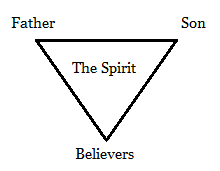
Here, in this third section, the emphasis is on the witness by the Spirit (against the world), through the testimony of believers. It is Jesus (the Son), and, by extension, the Father, who is speaking by way of the Paraclete (Matt 10:20; Lk 21:15). This is a profound reflection of the relationship between Father and Son (vv. 12-15), which, through the Spirit/Paraclete, results in the triadic unity: Father—Son—Believers (cf. 14:20-21, 23; 15:9-10; 17:20-26).

The Paraclete/Helper is called:

    • “The Spirit of Truth“—who will come, from the Father and Son together (implied) (v. 13)
Reference to the Trinity?

Commentators and readers are often anxious to find expression of the orthodox formulation of the Trinity in the pages of the New Testament. In all fairness, it must be admitted that is really only present in a very rudimentary, seminal form—e.g., in passages such as 1 Cor 12:4-6; 2 Cor 13:14; 1 Pet 1:2; and Matt 28:19 (on this last, cf. my earlier notes). The basis for the orthodox belief, however, is found in the various statements which relate Jesus to the Father and/or the Spirit. There are two main sources in the New Testament which would shape the development of Christological and Trinitarian thought—(1) the letters of Paul, and (2) the Gospel (and First letter) of John, i.e. Pauline and Johannine theology. The Paraclete passages in the Discourses of Jn 13-17 are central to the Johannine view, which, I believe, may be summarized as follows:

    • The Spirit/Paraclete essentially represents the abiding (spiritual) presence of Jesus in believers, while he himself remains in heaven with the Father. Elsewhere in the New Testament, the expression “Spirit of Jesus” or “Spirit of Christ” is effectively synonymous with the “Spirit of God” or the Holy Spirit (cf. Acts 16:7; Rom 8:9; Phil 1:19; 1 Pet 1:11; and note also “Spirit of the Lord” in Acts 5:9; 8:39; 2 Cor 3:17).
    • The Son (Jesus) was sent by the Father; once he returns to the Father, he, in turn, will send the Spirit/Paraclete to his disciples in his place. The Son will continue to act and work alongside the Father (in Heaven), but will, at the same time, be present with believers through the Spirit. This is described at several points within the Discourses (cf. above), and in the narrative context of Gospel is referenced (briefly) in Jn 20:17, 22.
    • The (reciprocal) relationship between Father and Son is such that the Son, in turn, does what the Father is doing (or has done). This is expressed throughout the Discourses in the Gospel, and is emphasized all the more in the context of the Son returning to a position alongside the Father in chs. 14-17. An interesting effect of this is that the sending of the Spirit can alternately be said to take place: (a) by the Father, in Jesus’ name (or at his request), or (b) by Jesus, from the Father.
    • This same relationship is extended to believers, in a two-fold manner:
      (1) The Father comes to abide in believers, just as the Son (Jesus) does—the presence of both (together) is realized for believers through the Spirit
      (2) The Son ‘prepares a place’ with the Father in Heaven for believers—he is the way to the Father and believers, insofar as they are faithful, will follow the Son to abide in union with the Father. This is marked by the other side of the Spirit’s presence—just as the Son abides in believers, so also believers abide in the Son.

Thus, we do not see a Trinitarian formula, properly speaking; but rather a triadic unity marked by the Spirit, which one might diagram (however imperfectly) in the following manner:

Notes on Prayer: John 17:9-12

John 17:9-12

We are continuing to explore the great Prayer-Discourse of Jesus in John 17 during these Monday Notes on Prayer. In verse 9, the focus shifts toward Jesus’ disciples, though in a manner that builds seamlessly upon the themes and language used previously in the prayer. We may observe something similar to the pattern used by Jesus in the Lord’s Prayer (discussed previously in these Notes on Prayer). In the first portion of the Prayer (Matt 6:9-10 par), the believer is to address God, focusing on His honor and work; while in the second portion (6:11-13), the focus shifts to the needs of believers, making request to God the Father regarding them. This pattern generally holds, though with a decided difference in perspective, in the Prayer-Discourse:

    • Vv. 1-8: Addressing God, focusing on His honor (do/ca) and work (e&rgon)—based on the intimate relationship between Father and Son, the Father’s honor and work both belong to the (faithful) Son as well
    • Vv. 9-23: Addressing the needs of believers—not for ordinary daily needs (as in the Lord’s Prayer), but in light of their/our relationship to both Father and Son

The petitions of the second part (for the needs of believers) are made entirely with the statements of the first part (regarding the honor and work of God) in mind. The Lord’s Prayer begins with a statement involving the name of God the Father (“Father […], may your name be made holy”); and the Father’s name is likewise central to the Prayer-Discourse, beginning with verse 6 which opens the main section (discussed last week):

“I made your name shine forth to the men whom you gave me out of the world”

This statement provides four distinct elements or components which run through the entire Prayer-Discourse:

    1. The name (o&noma) of God the Father
    2. The focus on Jesus’ followers (believers)—”the men whom…”
    3. The Father giving to the Son, using the key verb di/dwmi
    4. The contrast between believers and the world (ko/smo$, the [current] world-order)

All of these are present and feature prominently in verses 9-12 as Jesus begins addressing the needs of believers to God the Father. In verse 9 we find the first occurrence in the Prayer-Discourse of the verb e)rwta/w, “ask (about)”, used again at key points in vv. 15 and 20. Jesus uses this verb when he speaks of his making a request to the Father (16:26), whereas elsewhere in the Last Discourse, when instructing his disciples on their making requests to the Father, he uses the verb ai)te/w (14:13-14; 15:7, 16; 16:23-24, and see both verbs used together in 16:26). The verb e)rwta/w fundamentally refers to a person seeking information about something (i.e. a point of discussion or interrogation), while ai)te/w properly refers to a specific request (or, more forcefully, a demand). When e)rwta/w is used in the Last Discourse, it is in the sense of the disciples asking questions of Jesus (to find out information). Here, in the Prayer-Discourse, the point is not the request itself, but what Jesus is asking about. This is expressed by the preposition peri/ (“around, about”), with the object being the disciples (believers): “I ask about them…” (e)gw\ peri\ au)tw=n e)rwtw=). A contrast with the “world” (ko/smo$) follows immediately:

“I ask about them—(it is) not about the world (that) I ask, but about the (ones) whom you have given [de/dwka$] to me…”

In verse 6 (cf. above), Jesus specifically refers to his disciples (believers) as the ones God gave to him “out of the world” (e)k tou= ko/smou). There is a two-fold significance to this phrase in the context of the Johannine Discourses of Jesus, playing on the semantic range of the preposition e)k (“out of, from”):

    • Jesus chose people who were in the world, so as to take them out of the world—i.e. as his followers, taking them (with him) to God the Father.
    • Believers respond to Jesus because they ultimate come from God the Father, belonging to him—they do not belong the world

This latter sense, generally corresponding to the idea of divine election, is primarily in view here in the Prayer-Discourse, as the final words of the verse make clear:

“…(in) that [i.e. because] they are [i.e. belong] to you” (o%ti soi/ ei)sin)

Much the same was already stated in verse 6:

“They were [i.e. belong] to you” (soi\ h@san)

This idea, that believers come from (e)k) God—even as Jesus himself does—is expressed at many points in the Gospel and First Letter of John. One of the clearest statements in this regard is in Jesus’ great declaration to Pilate in 18:37, which serves virtually as a summary of Johannine theology (and Christology):

“I have come to be (born) unto this [i.e. for this purpose], and unto this I have come into the world: that I might give witness to the truth; every (one) being out of [e)k, i.e. from, belonging to] the truth hears my voice.”

The message is clear: the person who hears and responds in faith to Jesus does so because he/she already belongs to God, coming from Him. Here in the Prayer this is expressed in terms of God the Father giving believers to Jesus (the Son). The verb di/dwmi occurs numerous times in chapter 17, as a key term summarizing the relationship between Father and Son (and the believer): the Father gives to the Son, who, in turn, gives to his followers (believers), who, as it happens, are among the very things given to the Son by the Father. The wonderfully elliptical logic does create some confusion in the text, since Jesus refers to two different primary objects the Father gives to him: (a) believers, and (b) His name. It is not always immediately clear which is being referred to, and several textual variants have arisen in the manuscript tradition as a result. Let us survey the use of di/dwmi in the Prayer up to this point:

    • “you gave [e&dwka$] to him [i.e. the Son] authority o(ver) all flesh” (v. 2)
    • “so that every [pa=$] (one) that you have given [de/dwka$] to him, he might give [dw/sh|] to them [pl.] the Life of the Age” (v.2)
    • “I honored you upon the earth, completing the work that you have given [de/dwka$] me (to do), that I should do it” (v. 4)
    • “…the men whom you gave [e&dwka$] to me out of the world” (v. 6a)
    • “they were [i.e. belong] to you and you gave [e&dwka$] them to me” (v. 6b)
    • “all (thing)s [pa/nta], as (many) as you have given [de/dwka$] to me, are (from) alongside of you” (v. 7)
    • “the words [lit. utterances] which you gave [e&dwka$] to me, I have given [de/dwka] to them” (v. 8)

The comprehensiveness of this language, using the verb di/dwmi, is confirmed by the declaration which follows in verse 10:

“and all the (thing)s (that are) mine are yours, and the (thing)s (that are) yours (are) mine”

The reciprocal relationship between Father and Son is stated here concisely, more than English translation allows; in Greek it is:

kai\ ta\ e)ma\ pa/nta sa/ e)stin kai\ ta\ sa\ e)ma/

We find the same basic idea expressed elsewhere in the Gospel, perhaps most notably in 3:35:

“The Father loves the Son, and has given all (thing)s [pa/nta de/dwken] in(to) his hand.”

The concluding words of verse 10 state this in a slightly different manner, according to the theme of the Prayer: “all the (thing)s (that are) mine are yours, and the (thing)s (that are) yours (are) mine, and I have been given honor in them [kai\ dedo/casmai e)n au)toi=$].” For more on the important verb doca/zw in chapter 17, see the discussion in the earlier note on vv. 1-5. At the start of the Prayer, Jesus asks the Father to given him honor, and yet here he declares that he has already been given honor (cp. with 12:28 and 13:31-32). This is a declaration of his fundamental identity as God’s Son; the request in vv. 1ff refers to the return of the Son to the Father following the completion of his work on earth, as is clear from v. 5b.

This powerful theological and Christological background is vital to a proper understanding of what follows in the Prayer, beginning with Jesus’ petition on behalf of his disciples (believers) in verse 11, which he expounds in verse 12. Let us consider this petition as a whole, before examining the individual parts of it:

“And (now) I am no longer in the world, and (yet) they are in the world, and I come toward you. Holy Father, keep watch (over) them in your name which you have given to me, (so) that they may be one even as we (are).” (v. 11)

Anyone familiar with the Prayer-Discourse of chapter 17 will recognize how the content and language of this primary petition is woven through the remainder of the text. It will aid our understanding greatly if we examine it carefully here, which we will do in next week’s study.

Notes on Prayer: John 17:6-8

John 17:6-8

The current Monday Notes on Prayer feature is examining what is perhaps the second most famous prayer in the New Testament—the great Prayer-Discourse of Jesus in John 17. The first two studies focused on verses 1-5; today I will be discussing verses 6-8. These verses follow upon Jesus’ parallel statements in vv. 2 and 4, emphasizing his completion of the mission given to him by the Father, which is the means by which he (as the Son) gives honor (vb. doca/zw) to God the Father.

In discussing verses 4 and 5 last week, I noted that the use of the verb teleio/w (“complete”) must be understood in the context of the Passion setting. The sacrificial death of Jesus represents the climax and culmination of his work on earth, as indicated clearly in his final word on the cross in 19:30 (tete/lestai, “it is completed”). However, it must be stressed again that, in spite of this, the death of Jesus is not what is primarily in view in chapter 17 (nor in the Last Discourse, 13:31-16:33 as a whole). Rather, the main point is the relationship of Jesus (the Son) to God the Father, and how the Son’s mission has been to make the Father known to people (believers) on earth. This aspect of his work is stressed and expounded in verses 6-8, a passage which may be viewed thematically as two parallel statements, each made up of three parts or components:

    • Jesus’ work involving that which God has given to him (vb. di/dwmi, “you gave” [e&dwka$])
      • Believers accepted the word[s] Jesus gave to them, as a witness to the Father, and, as a result
        • They now know (vb. ginw/skw) that Jesus has come from the Father

The first such statement following this pattern is in verses 6-7:

    • “I made your name shine forth to the men whom you gave [e&dwka$] to me out of the world” (v. 6a)
      • “They were (belonging) to you and you gave them to me, and they have kept watch (over) your Word [lo/go$]” (v. 6b)
        • “Now they have known [e&gnwkan] that all (thing)s as (many) as you have given to me are (from) alongside of you” (v. 7)

The vocabulary throughout is thoroughly Johannine, and is distinctive, both of the discourses of Jesus in the Gospel, and the fabric of the Johannine writings (Gospel and Letters) as a whole. A striking example is the first word, a form of the verb fanero/w, “shine forth”. It occurs only once in the Synoptic Gospels (Mk 4:22), but is used 9 times in the Gospel of John (1:31; 2:11; 3:21; 7:4; 9:3; here in 17:6, and again in the ‘appendix’, 21:1 [twice], 14). In all 6 occurrences in the Gospel proper, the verb has definite theological (and Christological) significance, as it also does in 1 John where it occurs another 9 times (1:2 [twice]; 2:19, 28; 3:2 [twice], 5, 8; 4:9). It is a key term which refers to both Jesus’ identity (in relation to the Father), and, in turn, the identity of the believer (in relation to both Father and Son). Here the verb summarizes the purpose and result of the Son’s mission on earth—to reveal the Father, defined in terms of making known the Father’s name. This involves much more than simple knowledge of the name Yahweh (the tetragrammaton hwhy, YHWH). According to the ancient Near Eastern mindset, a person’s name represents and embodies (in a quasi-magical way) the character and essence of the person. Thus, to reveal God’s name (lit. to make it “shine forth”) means revealing the person of God Himself. This point, which is fundamental to the Johannine theology (and Christology), is discussed in greater detail in the Christmas series “And you shall call His Name…” (especially the articles on the Names of God).

The name of God and the name of Jesus, together, are fundamental to the thought-world of early Christians, and take on an even deeper significance in the Discourses of Jesus in the Gospel of John. References become more frequent in the second half of the book, beginning with 12:28 (note the parallel with 17:1ff), and continuing on through the Last Discourse sequence (14:13-14, 26; 15:16, 21; 16:23-24, 26) and the Prayer Discourse of chap. 17 (vv. 6, 11-12, 26). Jesus’ final statement in verse 26 repeats that of v. 6:

“and I made known to them your name, and I will make (it) known…”

The Father’s name plays an important role in vv. 11-12, which will be discussed in turn. Other examples of key Johannine vocabulary in vv. 6-7 are:

    • The verb di/dwmi (“give”) as a way of expressing the close hierarchical and reciprocal relationship between Father and Son—the Father gives to the Son who, in turn, gives to believers, and then, in turn, gives/returns back to the Father. Cf. 3:27, 34-35; 5:22, 26-27, 36; 6:27, 31-39; 10:28-29; 12:49; 13:34; 14:16, 27; 15:16; 16:23; and especially in chapter 17, where it occurs 17 times.
    • The word ko/smo$, “(world) order, world”, which occurs 78 times in the Gospel, and another 24 in the Letters (23 in 1 John, and once in 2 John), more than half of all the occurrences in the New Testament (186). In nearly every such instance in the Gospel and Letters, ko/smo$ is used in a negative, dualistic sense—i.e. the current world-order as opposed to God, governed and controlled by darkness and wickedness. Especially important is the contrast between the “world” and Christ, who came into the world, but does not belong to it. Likewise, believers, in their true identity, do not belong to the world, expressed by the preposition e)k (“out of, from”), as here in v. 6—they come from God, not the world. Again, ko/smo$ is especially frequent in the Prayer-Discourse of chapter 17, occurring 18 times.
    • The noun lo/go$, “account, word, etc” likewise has a special meaning in the Gospel of John, as is clear from its important use in the Prologue (1:1 [3 times], 14). Overall, it occurs 40 times, and 6 more times in the First Letter. In most of these instances there is a layered significance. On the one hand, it is used in the customary sense of “words, speech, thing[s] said”, more or less synonymous with r(h=ma (“utterance, word”); but on the other hand, it expresses the relationship between Father and Son—the Son speaks what he sees and hears the Father doing and saying. Thus the “word” (lo/go$) Jesus gives to his disciples goes beyond any specific teachings; it refers to the revelation of the Father Himself in the person and work of the Son.
    • The verb thre/w (“watch, keep watch over, guard”) is another important Johannine term, occurring 18 times in the Gospel and 7 times in the First Letter. A superficial reading of its use by Jesus might suggest that he is simply referring to a person “keeping” (i.e. following, obeying) his teaching; but clearly there is much more to it than that. The “word” or “command” which one keeps and guards, like the “name”, reflects the very presence of the person himself. This becomes especially apparent throughout the Last Discourse, as the discussion shifts to the promise of the Holy Spirit (the one “called alongside”). The verb thre/w occurs 12 times in the Last Discourse and the Prayer of chap. 17.
    • The verb ginw/skw (“know”, interchangable with ei&dw, “see, know”, etc) occurs 57 times in the Gospel and another 26 in the Letters (about a third of all NT occurrences). In nearly every instance, something more than ordinary knowledge is involved—the emphasis is on recognition of Jesus’ true identity (as Messiah and Son of God) and his relationship to the Father. The verb is used by Jesus 7 times in chapter 17 and another 12 times in the Last Discourse itself.
    • The use of the preposition para/ (“alongside”) in the specific sense of Jesus being (and coming from) alongside of the Father (cf. the prior discussion on v. 5).
    • The verb of being (ei)mi) is used explicitly (and emphatically) quite often in the Gospel of John, as here at the end of v. 7. It frequently carries the specific meaning of true Being and Life which belongs to (and comes from) God the Father.

When we turn to the second statement by Jesus (v. 8), the same three-part conceptual pattern holds, as was outlined above:

    • “the utterances [i.e. words] which you gave [e&dwka$] to me I have given [de/dwka] to them”
      • “and they received (them) [i.e. my words]”
        • “and they knew [e&gnwsan] truly that I came out (from) alongside you,
          and they trusted [e)pi/steusan] that you se(n)t me (forth) from (you)”

The twin statements that close verse 8 emphasize the point made above: knowing (vb. ginw/skw) in the Gospel of John does not involve ordinary knowledge, but is synonymous with trust in Jesus. This verse also makes clear that the verb thre/w does not refer primarily to legal obedience (of Jesus’ commands, etc), but to trust and acceptance of who he is: the Son come from the Father. Receiving his words is essentially the same thing as receiving him (1:12, etc).

This second statement in verse 8 may be viewed as epexegetical, further explaining and building upon that in vv. 6-7. The joining point is the (subordinating) conjunctive particle (o%ti) at the start of v. 8, which is best understood as causal—”in that”, i.e. “because”, “for”, providing the reason for the conclusion in v. 7. The disciples have come to know the truth about Jesus’ relationship to the Father because they have received what Jesus (the Son) received from the Father. The chain of giving is: Father => Son => Believers. Each point in this chain is a point of revelation (‘shining forth’, v. 6a), by which God the Father is ultimately made known to human beings (believers).

In verse 9, Jesus begins a new direction in his prayer, speaking to the Father on behalf of his disciples (believers). We will begin examining this next section (vv. 9-12) in next week’s notes.

Notes on Prayer: John 17:1-5 (continued)

John 17:1-5, continued

Last week, I began a discussion on the great Prayer-Discourse of Jesus in John 17, looking at verse 1 in some detail. Today I wish to continue on with an examination of the remainder of verses 1-5.

Of particular importance is the use of the verb doca/zw, both in verse 1 and again in vv. 4-5 (and v. 10); the related noun do/ca also occurs several times in the chapter (at the beginning and end, vv. 5, 22, 24). Both words are an important part of the vocabulary of the Johannine Discourses of Jesus, especially the verb which is used 23 times (out of 61 total in the New Testament)—7:39; 8:54 (2); 11:4; 12:16, 23, 28 (3); 13:31 (2), 32 (3); 14:13; 15:8; 16:14; 17:1 (2), 4, 5, 10; 21:19. There are also 19 occurrences of the noun do/ca—1:14 (2); 2:11; 5:41, 44 (2); 7:18 (2); 8:50, 54; 9:24; 11:4, 40; 12:41, 43 (2); 17:5, 22, 24. Unfortunately, it is not easy to give a (consistent) literal translation in English for either verb or noun, as they can differ in meaning and nuance depending on the context, and, in particular, whether the subject/object involves human beings or God (or Christ). While do/ca is typically translated “glory”, in many instances a much better rendering is “esteem”, which more closely captures the fundamental meaning of the word. When used in a religious context, the predominant idea tends to be that human beings are to give to God the esteem and honor which He is due. However, when applied as a divine attribute or characteristic it is better understood in terms of the “splendor” which God possesses, and which surrounds him. In order to capture both aspects, in the special way that the words are used in the Gospel of John, I prefer to translate the verb doca/zw as “give honor (to)”.

There are several key Johannine passages (in the Discourses of Jesus) where the verb is used, sometimes together with the noun, and these need to be considered in order to gain a proper understanding of their usage in chapter 17.

1. Jn 8:50ff. The words are part of the conceptual vocabulary that frames the great Discourse of chapters 7-8 set during the Sukkoth (Booths/Tabernacles) festival in Jerusalem. Thematically, there is a clear symmetric (and chiastic) structure to the discourse-sequence, with the concluding discourse (8:31-59) serving as a parallel to the opening episode (7:14-24). In particular, we may note how the exchange in 8:48-51ff refers back to Jesus’ declaration in 7:18:

“The (one) speaking from himself seeks his own honor/esteem [do/ca]; but the (one) seeking the honor/esteem [do/ca] of the (One) having sent him, this (one) is true and there is not (any) injustice in him.”

The long and increasingly hostile exchange in 8:31-59, sharpens and comes to a climax as Jesus makes the following statement in verse 49, in response to the attack from his opponents that he “has [lit. holds] a daimon“:

“I do not hold a(ny) daimon, but (rather) I honor [timw=] my Father and you treat me without honor [a)tima/zete/ me]!”

This use of the verbs tima/w & a)tima/zw demonstrate how close in meaning the noun timh/ (“value, worth”, often in the sense of “honor”) is to do/ca (“esteem/honor”), especially in this context. Jesus follows in verse 50 with the language of 7:18, using the noun do/ca:

“And I do not seek my own esteem/honor [do/ca]—(but) there is there is the (One) seeking (it)…”

Here we find the same reciprocity (between Father and Son) as we have in 17:1ff—Jesus (the Son) seeks the honor of God the Father, and the Father seeks the Son’s honor. This raises an interesting point regarding the syntax of verses 1-5 and the use of the particle i%na (discussed below).

2. Jn 11:4, 40. In the Lazarus scene, the entire episode—the death of Lazarus and his subsequent resurrection—is for the declared purpose of giving honor/esteem (do/ca) to Jesus; and this, not simply due to the fact that he works a great miracle, but for what it indicates (as a sign) regarding Jesus’ true identity. The purpose is stated by Jesus, to his disciples (and to the readers as well) in the opening portion of the narrative (verse 4):

“This lack of strength [i.e. weakness/illness] is not toward death, but (instead it is) under the honor/splendor [do/ca] of God, so (that) the Son of God might be given honor [docasqh=|] through it.”

In other words, the illness (and death) of Lazarus is under the control of the do/ca of God and serves that divine purpose. The association of do/ca/doca/zw with resurrection here emphasizes again the difference between Jesus’ prayer in 17:1ff and the similar prayer-language used during the Synoptic garden scene (discussed in last week’s study). The “hour” in 17:1 is not that of Jesus’ Passion (his suffering and death) alone, but instead points more directly toward his subsequent resurrection and return to the Father, just as Lazarus’ moment of suffering does not point toward physical death alone, but to the resurrection power possessed by Jesus as God’s Son. The moment of Lazarus’ own resurrection confirms the point (11:40): “Yeshua says to her [i.e. Martha], ‘Did I not say to you that, if you would trust, you will see the honor/splendor [do/ca] of God?'”.

3. Jn 12:23, 28, 41, 43. The portion of the Gospel of John spanning chapters 2-12 forms a clear division in the narrative (sometimes referred to as the “Book of Signs”), covering the period of Jesus’ public ministry, and comprised of a combination of miracles by Jesus (and other “signs”) and related discourses in which the signs (together with their true meaning) are explained. The words do/ca/doca/zw feature prominently in the concluding scenes of the “Book of Signs” in chapter 12. We already looked at verses 23 and 28 in last week’s study, as they fit so closely with the language used by Jesus in 17:1ff. To these may be added the important, but often neglected, words of the Gospel writer in verses 41-43. As in the Synoptics, Isaiah 6:10 is cited to explain why many of Jesus’ contemporaries were unwilling (or unable) to accept him as the Messiah. The Gospel writer further states that Isaiah “saw his honor/splendor [do/ca]”, by which the original context (the do/ca of YHWH) is interpreted in terms of Jesus’ divine status as God’s Son. There is a clear echo of 8:56-58 in these words (cf. above on the use of do/ca in 8:50, 54). The failure of people to recognize Jesus’ divine do/ca, is further explained, through a bit of ironic wordplay, by the author in verse 43:

“For they loved the honor/esteem [do/ca] of men more than the honor/esteem [do/ca] of God.”

We must keep this Johannine usage of do/ca & doca/zw in mind as we return to examine 17:1-5. The reciprocal language used by Jesus, indicating the intimate relationship between Father and Son, creates certain ambiguities and tensions in the fabric of the text. This is part of the immense beauty and power of the Johannine discourses of Jesus, but it also creates points of difficulty for the commentator. One example is the use of the conjunctive particle i%na to join together the phrases and clauses of vv. 1-2 into a structure and chain of relation. There are actually three connective particles; let us consider them and how the phrases fit together:

    • “The hour has come—may you give honor to your Son
      • (so) that [i%na] the Son may give honor to you
        • even as [kaqw\$] you gave him e)cousi/a over all flesh
          • (so) that [i%na] (for) all which you have given to him, he might give to them (the) Life of the Age [i.e. eternal life].”

There are two i%na-clauses, both of which are best understood as indicating a purpose or result (i.e. “so that…”). However, the precise relationship between them is not entirely certain. It is possible to view them in more parallel terms, as representing two related results of the Father giving honor to the Son; one might even view this as a chiastic structure:

    • “The hour has come—may you give honor to your Son
      • (so) that [i%na] the Son may give honor to you
        • even as [kaqw\$] you gave him e)cousia over all flesh
      • (so) that [i%na] for all that you have given to him
    • he might give to them—(the) Life of the Age [i.e. eternal life].”

The sense of reciprocity is perhaps better illustrated in the second (chiastic) structure, and is to be developed by Jesus throughout the Prayer-Discourse. A powerful inter-relationship is established: Father—Son—Believers. As indicated above, the particle i%na in verse 1 is best understood as indicating purpose or result—the Son giving honor to the Father is the result (and end purpose or goal) of the Father giving honor to the Son. However, it is interesting to note that, in the parallel verses 4-5, we find the opposite—that the Father honors the Son as the result of the Son’s work which give honor to the Father. This would allow for the reading of the i%na clause in verse 1 in a causal sense (“in that…”, i.e., “because”). I would maintain that it is, indeed, better to keep to the more natural grammatical sense of i%na indicating purpose/result in verse 1, and to see verses 4-5 as reflecting a reciprocal parallelism with vv. 1-2. This fits with the overall chiastic structure of vv. 1-5, as I noted already last week:

    • The Father gives honor to the Son
      • (so that) the Son may give honor to the Father (v. 1)
        • through the (work) given him by the Father (to complete) (v. 2)
        • the Son has completed the work by him by the Father (v. 4)
      • (and so) the Son has given honor to the Father
    • (thus) the Father will give honor to the Son (v. 5)

It is in vv. 4-5 that we have a clearer indication of the coming death of Jesus, with the use of the verb teleio/w (“[make] complete”). Earlier in the Gospel (4:34; 5:36) the verb seems to refer more generally to Jesus’ ministry work (teaching, healing miracles, etc); but here, in the Johannine context, there can be no doubt that the verb, when used by Jesus in the Discourses, must be understood in a comprehensive sense—Jesus’ work on earth (as the Son), culminating in his sacrificial death. This is confirmed by Jesus’ dying words on the cross (19:28), actually a single word in the Greek: tete/lestai (“it is completed”). The verb takes on a somewhat deeper significance later in the Prayer-Discourse (v. 23), when Jesus uses it to refer to the unity that his work achieves for believers, uniting them/us together with Father and Son through the presence of the Spirit. This will be discussed later in these notes on John 17.

Looking at verses 1-5 as a whole, again, it  must be stated that the death of Jesus is not what is primarily in view, despite the general Passion setting and the use of the verb teleio/w in verse 4 (see above). His sacrificial death certainly represents the climax and completion of his work on earth; however, it is this work, taken as a whole, and as a reflection of the relationship between Father and Son, which is the main emphasis in chapter 17 (and, one may say, in the Last Discourse itself). If there were any doubt on this point, we would simply turn to the declaration in verse 3, which stands at the heart of verses 1-5. Many commentators regard this statement, not as the words of Jesus, but as an explanatory aside (comment) by the Gospel writer. This seems likely given the particular formulation, which sounds very much like an early Christian creedal formula, and, indeed, is similar in many ways to the concluding declaration in 20:31. While the objective statement in verse 3 may be, theologically speaking, a bit too precise to fit the historical context of the narrative, it is vital for what it reveals about the identity of Jesus. I discuss this verse in considerable detail in a separate series on the use of the words “Spirit” (pneu=ma) and “Life” (zwh/) in the Gospel of John (soon to be posted on this site), and will not reproduce that here. The expression “life of the Age” (here h( ai)w/nio$ zwh/), typically translated as “eternal life”, is a key Johannine term, appearing many times in the Discourses of Jesus, but also elsewhere in the Gospel and Letters. Here it is given a precise definition:

“And this is the Life of the Age [i.e. eternal life]—that they would know you the only true God, and the (one) whom you se(n)t forth, Yeshua (the) Anointed.”

If verse 3 is indeed an explanatory statement by the author, it was triggered by the use of the expression zwh/ ai)w/nio$ at the end of verse 2. The parallel with verse 4 makes clear that the “work” which the Son (Jesus) completes may be understood as the giving of (eternal) Life to all those (believers) whom God the Father has given to him. This point will be discussed in more detail in next week’s study (on verses 6-10).

Finally, it is worth noting the temporal-keyed statement that concludes verse 5; it should be understood as parallel to the initial declaration of v. 1: “the hour has come”. Again, we must make clear that here, in contrast to the Passion-context of the similar Synoptic saying (cf. last week’s study), this “hour” goes beyond the moment of Jesus’ impending suffering and death, to the completion of the Son’s work on earth, which includes his resurrection and return to the Father. This is confirmed by the statement in v. 5b which further describes the honor/splendor (do/ca) the Son is to receive from the Father: “…the honor [do/ca] which I held alongside you before the (coming) to be of the world”. Note again the parallelism:

    • The hour has come
      • May you give honor the Son (v. 1)
      • Now may you give honor to me, Father… (v. 5a)
    • (in the time) before the world (came) to be (v. 5b)

This coming “hour” marks a return to the beginning (1:1ff)—the Son’s return to the Father in Heaven. As Christians, we are so accustomed to thinking, in orthodox terms, of Jesus’ divine pre-existence, that it is easy to forget (or ignore) how rare this idea actually is in the New Testament. It is not to be found at all in the Synoptic Gospels, nor in the early Gospel preaching recorded in the book of Acts; it is also quite rare in the Pauline letters (though Paul himself accepted some basic version of the idea), and in the other New Testament letters as well (with the exception of Hebrews). The first generation of Christians appears to have come to a realization of this belief only gradually. While the idea that Jesus, after the resurrection, was exalted to a divine position and status at the right hand of God in Heaven, was widespread, there does not seem to be clear evidence for a belief in Jesus’ pre-existent Deity prior to about 60 A.D. The ‘Christ hymn’ in Philippians 2:6-11 has a descent/ascent conceptual formulation which is generally similar to what we find throughout the Gospel of John. The traditions underlying the Johannine Prologue (1:1-18), and reflected all through the Gospel, probably date from around the same time as the ‘Christ hymn’. One may surmise that it was during the period c. 50-60 A.D. that a distinct belief in Jesus’ pre-existence began to take shape. If it were more widespread by or before this time we would expect to see greater evidence for it throughout the New Testament. In any event, there is no doubt of this belief in the Gospel of John; the pre-existent deity of Jesus is expressed in unmistakable terms, including by Jesus himself in the Discourses. However, the idea is, perhaps, not stated so precisely by Jesus as we find it here in the Prayer-Discourse. The wording in v. 5b seems to hearken back to the opening words of the Gospel (1:1ff). What is unique about the setting in the Prayer-Discourse is the added dimension, developed by Jesus during the Last Discourse (13:31-16:33), involving the promise that believers will share in this same glory (do/ca) that the Son has alongside the Father. This will be discussed further in the coming weeks’ studies.

April 25: John 11:27 (continued)

John 11:27, continued

o( ui(o\$ tou= qeou= (“the Son of God”)

The second of the titles in Martha’s confession (see the previous note) is “Son of God” ([o(] ui(o\$ [tou=] qeou=). This, of course, came to be a regular title applied to Jesus by early Christians (Acts 9:20; Rom 1:4, etc), but its precise meaning in this period remains somewhat uncertain. The association with the title “Anointed One” (i.e. Messiah) in the Gospel tradition strongly suggests that the Messianic figure of the Davidic Ruler type is in view. The (Davidic) king as the “Son” of God, in a symbolic sense, is expressed most clearly in 2 Sam 7:14ff and Psalm 2:7. The latter verse came to be associated with Jesus, both from the standpoint of his resurrection/exaltation (Acts 13:33; Heb 1:5; 5:5, cf. also Rom 1:4, and note the context of Acts 4:25-28), but also in the Baptism and Transfiguration scenes in the Gospels (Mk 1:11 par [esp. Lk 3:22 v.l.]; 9:7 par). In this respect, it was unquestionably understood as a Messianic title that was applied to Jesus. It is part of the Matthean version of Peter’s confession (“Son of the living God”, Matt 16:16, cf. also 26:63 par), and is used of Jesus a number of times in the Synoptics, but never by Jesus himself.

The title takes on added theological and Christological significance in the Gospel of John, where Jesus repeatedly refers to himself as “the Son” (o( ui(o/$). This is analogous to his use of “Son of Man” as a self-reference in the Synoptic tradition, which also occurs in John (1:51; 3:13-14; 5:27; 6:27, etc). However, in the Fourth Gospel, the title “Son” is always used to express Jesus’ relationship to God the Father, and, in a number of passages, clearly indicates Jesus’ divine/eternal status. Thus it is essentially synonymous with the title “Son of God”, which Jesus also uses in 3:18; 5:25; 10:36; 11:4. The idea that, in using the title “the Son (of God)”, Jesus was claiming deity—or even some kind of equality with God (Yahweh)—comes through in the hostile reaction to him (5:18; 8:58-59; 10:29-39; 19:7ff). I would point out three important occurrences of the title—at the beginning, middle, and end of the Gospel, respectively—which, I believe, show a progression or development of meaning:

    1. Jn 1:49—(Nathanael speaking to Jesus) “You are the Son of God, you are the king of Israel”
      Most likely, the title here was meant (by Nathanael) in a traditional Messianic sense, identifying Jesus as the coming Davidic Ruler.
    2. Jn 11:27—(Martha speaking to Jesus)
    3. Jn 20:31—the conclusion of the Gospel proper (cf. below)
o( e)rxo/meno$ (“the [one] coming”)

English translations here may obscure the fact that this is a descriptive title. It is also a specific Messianic title, but one which, at the traditional-historical level, relates not to the Davidic Ruler figure-type, but to that of a coming Prophet figure (for more on this, cf. Parts 2-3 of the series “Yeshua the Anointed”, as well as the supplemental note on “the one coming”). The title was important with regard to the identity of both Jesus and John the Baptist in the early Gospel tradition (Matt 3:11; 11:3 pars; Jn 1:27), but eventually its significance was lost for Christians, virtually disappearing from the later strands of the New Testament. This particular Messianic expectation is stated clearly in John 6:14:

“Truly this (man) is the Foreteller [i.e. Prophet], the (one) coming into the world!”

The italicized portion is nearly identical with the phrase in 11:27 (only the word order differs). Martha thus would seem to be declaring also that Jesus is this coming (Messianic) Prophet, just as Nathanael (cf. above) declared him to be the Davidic Ruler. In each instance, the distinct Messianic figure-type is associated with the title “Son of God”.

However, from the standpoint of the Johannine Gospel, the verb e&rxomai (“come”) has special theological (and Christological) significance, as does the expression ei)$ to\n ko/smon (“into the world”). We see this clearly enough at several points in the Prologue:

    • “…(this/he) is the true Light, which gives light to every man, coming into the world [e)rxo/menon ei)$ to\n ko/smon]” (v. 9)
    • “he came unto (his) own…” (v. 11)
    • “the one coming in back of me…” (v. 15, also vv. 27, 30)

This use of e&rxomai refers to what we would call the incarnation—according to three aspects:

    1. Jesus as the divine/eternal Son (and Word, Light, etc) of God who is sent forth from the Father, coming to earth
    2. Jesus taking on human form, being born a human being—i.e. his coming into the world
    3. His coming into the presence of his fellow human beings in the world—reflecting his work and ministry in the world

All three conceptual strands are wrapped up in the idea of Jesus coming into the world. The specific expression ei)$ to\n ko/smon (“into the world”) occurs numerous times in the Gospel:

    • “God se(n)t forth (his) Son into the world…” (3:17)
    • “the Light has come into the world…” (3:19)
    • “the (One) sending me is true, and the (thing)s which I heard (from) alongside of Him these I speak into/unto the world” (8:26)
    • “I have come (as) Light into the world…” (12:46)
    • “and (just) as you se(n)t me forth into the world, I also se(n)t them forth into the world” (17:18)
    • “unto this I have come to be (born), and unto this I have come into the world…” (18:37)

Thus, even if, at the historical level, Martha identifies Jesus as a Messianic figure (in the traditional sense), from the standpoint of the Gospel, occurring as it does at a central mid-point of the book, her confession must be understood as expressing something much deeper with regard to Jesus’ identity. This is confirmed when we consider that the confession of 11:27 is essentially echoed at the conclusion of the Gospel proper (20:31)—a summary declaration by the Gospel writer which expresses his very purpose in writing:

“…these (thing)s have been written, (so) that you might trust that Yeshua is the Anointed One, the Son of God, and (that) in trusting you might hold life in his name.”