September 4: John 20:31

John 20:31

In the closing words of the Gospel of John—that is, the Gospel narrative proper—the author gives his reason for writing:

“I have written these (things) that you might/should trust that Yeshua {Jesus} is the Anointed (One), the Son of God, and that, trusting (him), you would hold life in his name.”

The two key points of doctrine are central to the Gospel and early Christian tradition—that Jesus is (1) the Anointed One (Messiah/Christ), and (2) the Son of God. On the centrality of this two-fold statement of belief, see e.g., Mark 1:1 v.l. and the Matthean version of Peter’s confession (Matt 16:16, cp. Lk 9:20). There can be little doubt as to the author’s own belief, though the specific expression “Son of God” may reflect the unique understanding of the relationship between the Son (Jesus) and God the Father as presented in the Gospel of John. That a specific and definite Christology is intended, would seem clear from corresponding statements in 1 John (1:1-4; 2:22-24; 3:23; 4:1-6, 15; 5:1-5, 6-11, 13, 20, etc), assuming that the letter stems from the same author and/or community as the Gospel. What is perhaps of greater interest for the commentator is the specific verb forms used in the verse. The four verbs reflect a step-parallel structure used at a number of points in the Gospel:

    • I have written [ge/graptai]…that you might/should trust…
      • and that trusting…you should hold [e&xete] life…

In this “step” format, the first element of the line or phrase, picks up from the last element of one prior. In this instance, we have two forms of the verb pisteu/w (“trust”, i.e. “have faith [in], believe”), which occurs frequently in the Johannine writings—98 times in the Gospel, 9 in the letters (nearly half of all NT occurrences). The first form is a subjunctive, indicating an intended purpose (and/or result)—”so that, in order that”. The second form is a present participle, suggesting a continual (present) action or condition—believers are trusting, ones who trust. There is an interesting variant with regard to the first (subjunctive) form, which is significant and relevant, in terms of the author’s purpose:

    • Aorist subjunctive (pisteu/sete)—which here is generally taken to mean that the author is writing so that people will come to trust in Christ; in other words, it is aimed primarily at non-believers, or those who are not yet Christian.
    • Present subjunctive (pisteu/ete)—in this case, the present tense would perhaps best be understood as “you would continue to trust”; that is, the purpose being to strengthen the (current) faith of believers.

In modern Christian terms, we might say that the first reading indicates an evangelistic purpose, the second a spiritual purpose. The textual evidence is fairly divided, with the majority supporting the first (aorist subjunctive), including a2 A C D L W Y f1,13 33; on the other hand, a number of key early manuscripts (Ë66vid a* B Q) read the present subjunctive. The same variants occur in 19:35 as well, and it is possible that both verses were changed together. In my view, internal considerations tilt things slightly in favor of the latter reading (present subjunctive). The entire thrust of the Gospel, especially in the discourses of Jesus, appears aimed at presenting (to believers) the deeper, true meaning of Jesus’ words. The very pattern of the discourses utilizes the motif of misunderstanding—Jesus’ hearers (including his own disciples) typically fail to understand the real import of his words, latching onto the apparent or superficial meaning. The question or response of his audience (based on this misunderstanding) prompts Jesus to present a more in-depth explanation and exposition of his initial saying. In this light, I am inclined to interpret 20:31 as follows:

“I have written these (thing)s, (so) that you would (truly) trust that Jesus is the Anointed One, the Son of God, and that, trusting (in him), you would (indeed) hold life in his name.”

This interpretation would seem to be confirmed by the parallel statement in 1 John 5:13:

“I have written to you (so) that you would have seen [i.e. known] that you hold life of-the-Age [i.e. eternal life], to the ones trusting in the name of the Son of God.”

Here there is no doubt that the author is writing to believers; his purpose is indicated by the used of a perfect subjunctive (a past condition continuing into the present)—i.e., believers have seen/known, but he wishes that they will continue to know, and know more fully. It is almost as though he is writing specifically to those believers addressed in Jn 20:31, but that his purpose now is for an even deeper level of (spiritual) awareness. Again, this awareness is Christological—tied to the correct understanding of the person and work of Jesus (the Son). More importantly, the author is concerned that his audience recognize their real identity as believers in Christ, and to think and act more consistently (and faithfully) in this light. From the standpoint of the Christian Community, this is expressed primarily in terms of the principle of love for one another (i.e. the “love command”) in Christ. Another important aspect of Johannine thought (and theology) is the believer’s identity as being of/from [lit. “out of”] God—that is, belonging to Him, coming from or being born of Him. I have discussed this a number of times in recent notes and articles (cf. especially Part 5 of the current series “Gnosis and the New Testament”, on the theme of Election/Predestination). It is possible that something of this understanding is expressed in 1 Jn 5:13, and also in John 20:31, especially if the reading with present subjunctive is correct (cf. above). From the standpoint of predestination, there is a sense in which believers, over the course of their lifetime, gradually gain a deeper understanding of just who we are—and, indeed, who we have always been—in Christ. I think that the specific expression in John of the believer “holding” (eternal) life, along with the image of “remaining/abiding” in Christ (and Christ in the believer), expresses this profound aspect of our Christian identity. It is not simply a question of gaining or finding life through faith in Christ, but of “holding” it—i.e., truly having it in and with oneself. According to the discourses of Jesus in the Gospel of John, God gave the disciples (believers) to Jesus beforehand, into his care, and so we remain through the presence of the Spirit.

September 3 (2): John 1:12-13

John 1:12-13

This is the second of two daily notes on John 1:12-13, 16-17. The previous note looked at vv. 12 and 16-17 in the use of the verbs di/dwmi and lamba/nw—”give” and “receive”—to express the divine revelation granted to believers in the person of Jesus (the Son). Today I will be focusing on verse 12-13 for the description of what is given to believers, utilizing the image of birth and sonship. In part, this discussion is related to the article (Part 5) on Election in the current series “Gnosis and the New Testament”. I have already discussed these verses in prior notes, and will refer to these at several points.

Verses 12-13 follow the statements in vv. 10-11, of the Son (the Word [lo/go$] and Light [fw=$]) coming into the world (v. 9):

    • “He was in the world…and the world did not know him” (v. 10)
    • “He came to his own, and his own (people) did not receive him alongside” (v. 11)

Here are vv. 12-13 in translation:

” But as (many) as received [i.e. did receive] him, he gave to them (the) authority [e)cousi/a] to become (the) offspring of God—to the (one)s trusting in his name, the (one)s who, not out of blood, and not out of (the) will of (the) flesh, and not out of the will of man, but out of God have come to be (born).”

I have tried to retain the Greek syntax here, as far as possible, to illustrate the important structure of the first half of the sentence (v. 12) in particular. There are two parallels at work, which can be shown in outline form:

    • They received him
      —he gave to them…
      —to become the offspring of God
    • The ones trusting in his name

According to the outer pairing, to “receive” the Son (Jesus) means to “trust” (i.e. believe, have faith) in his name. I discussed this identification in the previous note; for the significance of the name, cf. the recent note on the “name of the Father”. The second, inner pairing connects Jesus’ giving with the believers’ becoming. This same association (using the verbs di/dwmi and gi/nomai) is found in vv. 16-17, as I also discuss in the prior note; consider:

“The Law was given [e)do/qh] through Moses, but favor and truth came to be [e)ge/neto] through Jesus Christ”

The contrast here is one of fullness and completeness—Moses/Christ, the “favor” shown by God in the Law compared with the “favor and truth” manifest in the person of Christ. The common verb gi/nomai (“come to be, become”) has special theological (and Christological) significance in the Gospel of John, and is used very carefully, both in the Prologue and throughout, along with the verb of being (ei)mi) and the verb e&rxomai (“come”), etc. Note the precise way these are used together in the Baptist’s declaration (1:15, 30). Within the prologue, the verb gi/nomai refers literally to creation—coming into existence, coming to be (vv. 3, 10), especially of a human being born into the world (v. 6). It is thus of great moment when it is used of the pre-existent Word and Light: “and the Word became [e)ge/neto] flesh and camped/dwelt among us…”. There can be little doubt that this same sense of incarnation is meant in both verse 15 and here in v. 17. It thus also informs the use in v. 12 as well; note the formal parallelism:

    • God gave favor (the Law) through Moses
      • Favor came to be through Christ (i.e. the Word coming to be flesh)
    • Christ gave believers this favor (authority)
      • Believers come to be children of God

The Word “came to be flesh” means came to be born, i.e. as a human being. It is something of the reverse process for believers—human beings are born as sons/children of God. I have discussed this aspect of vv. 12-13 in a note from a prior Christmas season series. On the textual issue and variants in verse 13, these are also addressed in an earlier note. Jesus refers to this spiritual birth (i.e. born from above, born again) in the famous discourse with Nicodemus (3:3-8), and the image of believers as “born of God” is found often in 1 John (2:29; 3:9; 4:7; 5:1, 4, 18). In these passages, it is the related verb genna/w, referring more precisely to one coming to be born, which is used. Literally, believers are born “out of” (e)k) God, and this idiom informs the shorter expression, frequent in the Gospel and First Letter, of being (or coming) e)k tou= qeou=, “out of [i.e. from] God”. Cf. especially 1 Jn 3:10, where being “out of God” (e)k tou= qeou=) is synonymous with being “offspring/children of God” (te/kna tou= qeou=). The word te/kna is more or less interchangeable with ui(oi/ (“sons”) and “sons of God” has essentially the same meaning as “offspring of God”. Both expressions are found in the New Testament—for “sons of God”, cf. Matt 5:9; Luke 20:36; Rom 8:14, 19; Gal 3:26 (cf. also Matt 5:45; Lk 6:35; Rom 9:26); “children of God” is the typical expression in John (11:52; 1 Jn 3:1, 10; 5:2), but also occurs in Paul (Rom 9:8; Phil 2:15), being equivalent to “sons of God” (Rom 8:16, 21, cp. verses 14, 19). The expression “sons/children of light” has a similar meaning, being applied to believers, usually in an ethical context (cf. Lk 16:8; 1 Thess 5:5; Eph 5:8). The noun te/kna is more appropriate for the Johannine idea of being born from or “out of” God, since its fundamental meaning is something “brought forth, produced” (cf. the verb ti/ktw).

What Christ gives to the believer, according to verse 12, is the e)cousi/a (exousía) to become the offspring of God. This word is difficult to translate in English; derived from the verb e&cestin (e)k + the verb of being ei)mi), it has the basic meaning of something which comes from (lit. out of) a person, and, as such, is in the control or ability of a person to handle or accomplish. It may properly convey the sense of ability/capability, but also of permission—that is, something permitted, or over which permission is granted. The noun e)cousi/a is usually translated as “power” or “authority”. In the Gospel of John, it refers primarily to what God the Father has given to Jesus (the Son)—i.e., placed in his charge and control (5:27; 17:2), including control over his own life and death (10:18). This latter point is especially emphasized in the brief dialogue with Pilate (19:10-11). To understand the precise significance of the word here in 1:12, it is important to look at the use in 17:2:

“…even as you [i.e. the Father] gave to him [i.e. the Son] e)cousi/a o(ver) all flesh, (so) that, (for) every (one) that you have given to him, you should give to them (the) life of-the-Age [i.e. eternal life]”

The verb di/dwmi (“give”) occurs three times in this verse:

    • The Father gives (aorist indicative, “gave”) to the Son power/control over all human beings (“all flesh”)
    • The Father gives (perfect, “have given”) specific human beings (the elect, believers) to the Son
    • The Father gives (aorist subjunctive, “should give”) them (believers) eternal life

Believers (the Elect) are in the care/control of the Son; the eternal life which we receive is given only in that context—i.e., our relationship/connection with the Son. For a good description of the dynamic that is involved, we should compare Jesus’ statements in 5:26 and 6:57:

“For, just as the Father holds life in Himself, so also He gave the Son life to hold in himself”
“Even as the living Father sent me forth, and I live through the Father, (so) also…that one [i.e. the believer] will live through me”

The theological chain is clear and straightforward:

    • The Father gives the Son life to hold in himself (through the Father)
    • The Son gives believers life to have in themselves (through the Son)

This is the sense of the power/control/authority with believers now have, to become children (“sons”) of God through Christ (the Son). This giving and becoming occurs in connection with our trust (pi/sti$) in Christ, which we first experience at a particular moment in time—that is, when we come to him, come to faith. However, there is also a sense in which believers are already (born) of God, even before coming to faith. Consider Jesus’ words to Pilate in Jn 18:37, where he states that he was born and came into the world

“…that I should (bear) witness to the truth—every (one) being [i.e. who is] out of [e)k] the truth hears my voice”

That is to say, only the person who comes (i.e. is ‘born’) out of the truth, will be able to hear the voice of truth. I would suggest that the same idea is present in vv. 12-13 as well. I point again to the Greek syntax preserved in translation (cf. above):

    • Believers receive Christ (i.e. trust in him)
      —He gives to them authority/ability to become children of God (i.e. born of God)
    • The ones trusting in his name (i.e. believers) are those who
      —were born out of God (i.e. are children of God)

Verse 13 also clearly expresses the point, given threefold emphasis, that this birth—and, indeed, our very receiving Christ—is not the result of our own (human) will and choice, but comes directly from God. This represents a somewhat different aspect of our Christian identity which we are not accustomed to recognizing or considering. It is also the point at which the early Christian (Johannine) sense of religious identity corresponds most closely with gnostic thought. You will find this addressed further in the article (Part 5) on Election.

Gnosis and the New Testament: Knowledge and Revelation in John

Because of the very distinctive—and extensive—use of terms related to knowledge and revelation in the Johannine writings, it has been necessary to devote a separate supplemental article to this topic. The vocabulary, language and imagery used in the discourses of Jesus in Gospel are so close, at many points, to that in the letters, that most scholars ascribe them to a single Christian community or “school” of authorship. Tradition establishes the apostle John as the author of the Gospel and letters both, though, strictly speaking, they are all anonymous works. Regardless of how one theorizes the actual authorship of the writings, there is strong evidence that, in the discourses of Jesus, the actual words of Jesus—i.e. the historical sayings/teachings—have been edited and given an added interpretative layer within a literary dialogue (and homiletic) format.

I have previously discussed the specific vocabulary related to knowledge and revelation (cf. Parts 1, 2 and 3 of this series). The extent to which they occur in the Gospel and letters of John is striking:

    • The verb ginw/skw (ginœ¡skœ, “know”) occurs 56 times in the Gospel, and 26 in the letters—more than a third of all occurrences in the NT (222). Interestingly, the related noun gnw=si$ (gnœ¡sis, “knowledge”), is not used (on this, cf. the following special note).
    • The verb ei&dw (oi@da) (“see”), which is essentially interchangeable with ginw/skw in Greek at the time of the New Testament, occurs 85 times in the Gospel, and another 16 in the letters—again, more than a third of all occurrences in the NT.
    • Other verbs for seeing are used frequently in the Gospel and letters:
      o(ra/w (“see, perceive”, 31/8); ble/pw (“look [at], see”, 17/1); qewre/w and qea/omai (“look with wonder, look [carefully] at, behold”, 24/1 & 6/3)
    • The noun fw=$ (“light”), 23 times in the Gospel, 6 in the letters (29 out of 73 in the NT); in addition, we have the related verbs for giving/shining light: fai/nw (3), emfani/zw (2), fanero/w (15).

Knowing and Seeing (& Hearing)

Fundamentally, the references involving knowing and seeing (taken together) can be divided into several categories:

    1. Jesus (the Son) knows the Father, and makes Him (his word, his truth, etc) known to his disciples
    2. Disciples/believers know him (the Son), and the Father through him; by contrast, the “world” does not know
    3. Jesus knows his disciples (believers), who are also known by the Father

1. The Son knows/sees the Father

The main passages expressing this knowledge of the Father are: Jn 5:32; 7:29; 8:14, 19, 55; 10:15; 12:50; 13:3; 15:15; 17:25. Frequent in the discourses of Jesus is the idea that the Son has seen and heard the Father, and does/says what he sees/hears the Father doing/saying. This is expressed in Jn 3:32; 5:19ff; 6:46; 8:26, 38, 40; 12:49-50; 15:15 (cf. also 10:18, 37; 14:10; 17:6-8). The basic image derives from daily life—the dutiful son, as a pupil or apprentice, imitates his father, following the pattern and example of behavior. In 16:13, it is extended to the Spirit, who, like the Son (and as the abiding presence of the Son in the believer), will speak (only) the things he hears from the Father.

In turn, the Son makes known the Father to humankind, especially to his followers (believers). It is for this purpose that he was sent into the world by the Father (cf. below). The specific verb gnwri/zw (“make known”) occurs in Jn 15:15:

“…all the (thing)s that I heard (from) alongside my Father I (have) made known [e)gnw/risa] to you”

It is also found (twice) in the prayer-discourse of Jesus in chapter 17 (v. 26):

“and I made known [e)gnw/risa] to them Your name, and will make (it) known [gnwri/sw], (so) that the love with which you loved me might be in them, and I (also) in them”

An interesting example is Jn 1:18, where the verb e)chge/omai (“lead/bring out”) is used. The statement (by the author) emphasizes that no one has ever seen God, but that Jesus, the unique Son (of God) “…the (one) being [i.e. who is/dwells] in the lap of the Father, this (one) has brought (Him) out”—i.e. brought God out in the sense of declaring and making Him known.

More common is the verb fanero/w (“make/cause [to] shine [forth]”), where it refers to Jesus making God known (17:6)—especially His work and power (through miracles, etc), as in 2:11; 9:3; the same is expressed by the verb deiknu/w in 10:32; 14:8. It is also used in reference to Jesus’ appearing to his disciples—1:31; 14:21f; cf. also 7:4. In 1 John, it occurs in the more traditional sense of Jesus’ appearance (and future appearance) on earth (1:2; 2:28; 3:2, 5, 8, also 4:9).

Closely related is the key motif of Jesus as light (fw=$)—Jn 1:5-9; 3:19ff; 8:12; 9:5; 11:9; 12:35-36, 46; and cf. also 1 Jn 1:5-7; 2:8-11. John the Baptist is also a light (5:35) , but only insofar as he reflects and reveals the true light (1:5ff). The verb fai/nw (“shine light”) occurs in 1:5; 5:35; 1 John 2:8; while e)mfani/zw (“make [light] shine in”) is used in Jn 14:21-22 associated with the personal (abiding) presence of Jesus in the believer.

2. Believers know/see the Son

It is specifically Jesus’ disciples (believers) who come to know him (the Son). The main references are Jn 6:69; 8:28; 10:4-5, 14-15, 27, 38; 14:9, 17, 20; 17:3, 7-8, 23; cf. also 3:11; 18:21. People see the signs (miracles, etc) which Jesus does (2:23; 4:19, 48; 6:2, 14, 26; 11:45), and also come to see him (on this narrative motif, cf. below). They also hear his voice—cf. 3:29; 5:25, 28, 37; 12:29f; 18:37, and note 4:42; 11:43f; 20:16. Through the Son, believers see and hear the Father—this motif is frequent (cf. above), but emphasized particularly in Jn 14:7-8ff; 17:3.

By contrast, the “world”—that is, unbelievers—do not know him. Even Jesus’ own disciples have difficulty understanding, and are unable to know completely. This is a theme which runs throughout the narrative; of the many references, cf. 1:10, 26, 31, 33; 4:32; 7:27-28; 8:14, 19, 55; 9:29; 12:35; 14:9, 17; 15:15, 21; 16:3; 17:25; 20:14. The contrast is part of the dualism in the Johannine writings (to be discussed in Part 6). It is also expressed through the contrast of seeing vs. not-seeing (i.e. blindness)—chapter 9; 12:40; 1 Jn 2:11.

In the letters of John, knowing Christ essentially functions as a central point of religious identification, marked especially by the presence and manifestation of Christian love—cf. 1 Jn 2:3ff, 13-14; 4:2, 6-8, 16; 5:19-20; it also includes the same dualistic contrast found in the Gospel (1 Jn 2:11; 3:1, 6, etc). Likewise, the twin motif of seeing/hearing occurs (1 Jn 1:1-3; 3:11; 4:14; 2 Jn 6), as well as the specific idea of knowing the Father by way of the Son (4:8ff, 12, 14; cf. also 2:23; 5:9; 2 Jn 9).

3. Believers known by Jesus (and the Father)

Jesus’ knowledge of his disciples (believers), as those chosen and given to him by God (cf. below), is emphasized in Jn 2:25; 6:64; 10:14, 27; 13:11, 18. Within the narrative, the various references of Jesus coming to his disciples (cf. below) and, specifically, seeing them (1:42, 48; 11:33; 19:26, etc), take on added meaning. A reciprocal relationship is expressed—Jesus sees (and comes to) believers, who also see (and come to) him. Ultimately, these passages are tied to an overriding sense of Christian identity, for believers as those who come from (or out of) God, just as Jesus himself comes from God. This motif will be discussed next.

Other concepts and expressions

The rich treasury of Johannine language and imagery can only be surveyed partially here. I will endeavor to point out a few of the most relevant ideas and expressions used in the Gospel and letters.

Coming from God

This often involves the specific preposition e)k (lit. “out of”). Frequently Jesus speaks of himself (the Son) as coming from, or “out of”, God—Jn 7:17; 8:42; 16:28ff, and cf. also 1:14; 3:2; 17:5; 1 Jn 1:2. More or less synonymous is the idea of his coming out of heaven (or “above”), as in Jn 3:13, 27, 31; 6:32-33ff; 8:23. The (spatial) dualism of above/below, heaven/earth, etc., is related to the conceptual dualism of Jesus “stepping down” and “stepping (back) up”, using the related verbs katabai/nw and a)nabai/nw. As Jesus came down out of heaven (from God), so he will be returning back into heaven (to the Father). At the same time, those who believe in him, are also said to be “(out) of God”, especially under the image of being born from Him—Jn 1:12-13; 3:3ff; 8:47; 18:37. This will be discussed further in Part 5 (on Election/Predestination). Being “of God” is important in the Johannine letters as signifying Christian identity—cf. 2:16, 29; 3:9-10, 19; 4:2-3ff; 5:1, 4, 18-19; 3 Jn 11.

Coming into the world

Related to the concept of Jesus coming from God, out of heaven, is the specific motif of his coming into the world. This is expressed most clearly in Jn 1:9, 11; 3:31; 5:43; 8:14; 9:39; 11:27; 12:46-47; 18:37. For the closely connected use of the verb fanero/w (“make to shine, make manifest, cause to appear”) to describe this appearance of Jesus on earth, cf. above. Coming into the world also means coming to the people—to human beings generally, but also to the people Israel, and, more specifically, to the people (believers) chosen by God.

Coming to the disciples / Disciples coming to Jesus

This twin motif occurs frequently in the Gospel narrative, but the “coming” carries a deeper significance in John, due to the previously mentioned concepts, as well as to the added motif of seeing. The references here which include the element of sight/seeing are marked with an asterisk:

Two other, related, concepts should be mentioned:

Sending

In the Gospel, Jesus is identified as (the Son) who was sent by God the Father, using both verbs a)poste/llw and pe/mpw: the references are too numerous to mention them all—3:17, 34; 4:34; 5:23-24, 30, 36ff; 6:38-39, 44, 57; 7:16, 18, 28-29, et al. The Spirit is also sent by the Father (and the Son) to believers, 14:26; 15:26; 16:7; and Jesus sends forth his disciples (believers), just as the Father sent him (4:38; 17:18; 20:21).

Abiding/remaining in

As in the Pauline letters, the Johannine writings frequently refer to believers being “in” (e)n) Christ, just as Christ is “in” the believer. Sometimes this is specified in terms of truth, love, or the word(s) (logo$, r(hma) of Jesus. Most frequently, it involves the verb me/nw (“remain, abide”), which becomes a distinctly Johannine theme and unique for an understanding of both revelation and the believer’s religious identity (in Christ). For more on this latter point, cf. the discussion in Part 4.

The frequency with which both aspects are mentioned together, side-by-side, is striking.

Giving & Receiving

One other way revelation is expressed in the Gospel of John is with the verbs di/dwmi (“give”) and lamba/nw (“take [hold of], receive”). These two verbs occur together at the beginning of the Gospel, in 1:12, 16-17 (cf. the note on these), and again at several points throughout. God the Father gives to the Son, who, in turn, gives to his followers (believers). At the same time, believers themselves are among the things given by God to Christ (17:2ff). Those who trust in Christ and come to him also receive him. In 17:8, the verbs lamba/nw and di/dwmi are used together, along with ginw/skw (“know”); I discuss this verse in a separate daily note. For more on the prayer-discourse of chapter 17, cf. my earlier note on 17:3.

Glory/Splendor

Finally, we should mention the numerous occurrences of the term do/ca (“esteem, honor”, i.e. “glory, splendor”, esp. when used of God), along with the related verb doca/zw. While do/ca is related to the idea of divine revelation throughout the New Testament, it carries special significance in the Gospel of John, as it is distinctly tied to the person of Christ, and his identity with God the Father. This glory/splendor is at the center of the two-sided presentation of Christ in the Gospel—his descent (stepping down) from God the Father, and his ascent (stepping up) back to the Father. The death and resurrection/exaltation of Jesus stands between these two points, much as the vision described in Jn 1:51, which is offered as a vision of glory of God/Christ promised to believers (cf. also 3:3, 36). For the key passages referring to do/ca, cf. Jn 1:14; 2:11; 5:44; 7:18; 8:50, 54; 11:4; 12:23, 28, 41, 43; 13:31-32; 14:13; 15:8; 16:14; 17:1ff, 22ff. These cover virtually the entire range of meaning connected with the idea of revelation in John.

September 1 (2): John 14:4-7 (v. 6)

John 14:4-7 (continued, v. 6)

In response to the disciples’ question in verse 5 regarding where Jesus is going (v. 4, cf. the previous note), he answers with the declaration of verse 6, one of the most famous statements in the New Testament:

“Yeshua says [le/gei] to him {Thomas}, ‘I am [e)gw\ ei)mi] the way, and the truth and the life—no one comes toward the Father if not [i.e. except] through me.”

Both the statement in v. 4, and the question of v. 5, use the word o(do/$ (“way”) with an adverb/particle (of place) derived from the pronoun po/$ (“who/what/which”):

    • “the (place) which/where [o%pou] I am going…you have seen/known the way [o(do/$]” (v. 4)
    • “we have not seen/known what(ever place where) [pou=] you are going…how can we see/know the way [o(do/$]?” (v. 5)

It seems to suggest a specific location with a distinct path that leads to it (cf. Jesus’ illustration in Matt 7:13-14 par). However, Jesus’ response in verse 6 makes clear that he himself (emphatic pronoun e)gw/, “I”) is the path or way (o(do/$). This point of emphasis is all the more solemn in its use of the pronoun + verb of being (e)gw\ ei)mi, “I am”), with its Johannine connotation of identifying Jesus with God the Father (YHWH). For other “I am” sayings of Jesus in John, cf. 6:35, 41, 48, 51; 8:12, 24; 9:5; 10:7, 9, 11; 11:25; 13:19; 15:1, 5; 18:5; and note also the foreshadowing of the expression in 1:20ff; 3:28, and the distinctive use of the verb of being (ei)mi) in 1:1-15. Especially worth noting, is the parallel with 14:4-5 in 7:33ff, where Jesus says:

“(It is only) a little time yet (that) I am [ei)mi] with you, and I go away [u(pa/gw] toward the (one who) sent me. You will seek (for) me and you will not find [me], and the (place) where [o%pou] I am [ei)mi] you are not able to come (there).” (vv. 33-34)

There is an interesting parallelism within this saying:

    • ei)mi (“I am”)—Jesus’ presence with the people (i.e. his disciples)
      —u(pa/gw (“I go under/away”)—his departure back to the Father
      —o%pou (“the [place] where”)—where he is, with the Father
    • ei)mi (“I am”)—His presence with God the Father (1:1ff)

The statement that Jesus goes “toward” (pro/$) the Father is important, and the basic expression occurs numerous times in Gospel of John. In the prologue, the orientation of the eternal Word (Lo/go$) is toward (pro/$) God the Father (1:1-2), and the Son ultimately goes back toward Him (13:1, and throughout the Last Discourse). Similarly, the preposition is used for people (believers) who come to Jesus—toward him, toward the light, etc., as in 3:20-21; 5:40; 6:35, 37, 44-45, et al. It is only in coming toward the Son (Jesus), that is, by believing/trusting in him, that one is able to come toward the Father. This dynamic is not spelled out in detail, but the basic image in the Last Discourse is that Jesus will return (future eschatology) to bring believers with him to the Father (14:3; 17:24, etc). However, at the same time, in a different sense (‘realized’ eschatology), the Father (with the Son) is already present with believers, residing in them (14:23, etc). Both aspects are found in chapter 14, and both should be understood as relating to the idea of Jesus as the way to the Father. That he is the only way was expressed already in the parable/illustration of the shepherd and sheep-fold in chapter 10 (vv. 1-5)—Jesus is both the door leading into the sheepfold (vv. 7-9) and the shepherd who guides the sheep into the fold (vv. 11-16). Something of the same image of the door is certainly implied in 14:6, since Jesus speaks of believers as coming to the Father through (dia/) him.

The motif of the way (o(do/$) was extremely important in the earliest Christian tradition, though, without the book of Acts, this fact would have been almost completely lost to us. One of the earliest names or labels for Christians and Christianity was, collectively, “the Way” (o( o(do/$)—cf. Acts 9:2; 19:9, 23; 22:4; 24:14, 22. This is perhaps the most distinctive and precise parallel between early Christians and the Community of the Qumran texts (Dead Sea Scrolls), since both referred to themselves this way. Both traditions would seem to derive from an interpretation of (and identification with) Isaiah 40:3ff, which, in combination with Mal 3:1ff, would be associated with the early Gospel traditions regarding John the Baptist and the beginning of Jesus’ ministry—cf. Matt 3:3; Mark 1:3; Luke 1:16-17, 76ff; 3:4; Jn 1:23. For Isa 40:3 and the religious identity of the Qumran Community, cf. especially the ‘Community Rule’ [1QS] 8:12-16.

Jesus’ declaration in Jn 14:6 expands upon the identification of Jesus with “the way”:

“I am the way, and the truth [a)lh/qeia] and the life [zwh/]…”

Both words are important and occur frequently in the Gospel (and First Letter) of John. Probably here they are best understood as epexegetical, qualifying and characterizing Jesus as the Way—i.e., the “way of truth“, “way of life“—though certainly they can also be viewed as separate (related) “I am” declarations. For the idea of a way leading to life, see Gen 3:24; Psalm 16:11; Prov 6:23; 15:24; 16:17, as well as Jer 21:8 (also Ezek 3:18; 13:22) which prefigures Matt 7:14 and the “Two Ways” religious-ethical tradition that developed in early Christianity (Didache 1-6; Barnabas 18-21). Similarly, the “way of truth” has its background in the Old Testament and Jewish tradition—cf. Psalm 86:11; 119:30; Tob 1:3; Wisdom 5:6; 1QS 4:15-16, etc.; the expression is found in 2 Pet 2:2 (cf. also v. 15). The Gospel message is called the “way of salvation” in Acts 16:17; cf. also 18:25-26. There is an echo of Jn 14:6 in the Gnostic text known as the Gospel of Truth (mid-2nd century?):

“This is the gospel of the one who is searched for, which was revealed to the ones who are perfect through the mercies of the Father—the hidden mystery, Jesus, the Christ. Through it he enlightened those who were in darkness. Out of oblivion he enlightened them, he showed (them) a way. And the way is the truth which he taught them.” (translation G. W. MacRae in the Nag Hammadi Library [NHL], ed. James M. Robinson)

Here we see one of the clearest differences between the Gospel of John and the Gnosticism of the 2nd century A.D. In the Johannine Gospel, Jesus himself (i.e. the person of Christ, the Son) is the way. By contrast, in the ‘Gospel of Truth’, the way is the gospel (message), the revelation of truth which Jesus brings to the Elect (believers). This is a seemingly small, but very significant difference, and it thoroughly colors how one understands “knowledge” (gnw=si$) from a Christian (and Christological standpoint). The emphasis on knowledge will be addressed in relation to the final verse (14:7) to be discussed here, in the next note.

“Gnosis” in the NT: Col 2:2-3 (continued)

Colossians 2:2-3 (continued)

In the previous study, I explored the context and setting of Col 2:2-3 in the letter, examining the structure, language and imagery being employed. Today, I will look more closely at these specific verses.

“…being lifted [i.e. brought/joined] together in love and into all (the) rich(ness) of th(at which) is fully carried (out and) put together (in the mind), into the (full) knowledge about the secret of God—(the) Anointed (One), in whom all the treasures of wisdom and knowledge are hidden away.”

As I discussed previously, the language used here echoes and repeats that of the exordium (introduction), especially in the first sentence (spanning vv. 9-20), which is sometimes referred to as the “Christ hymn” of Colossians. Let us begin by comparing 2:2-3 with 1:9.

Col 1:9 opens with an expression of Paul’s wish (and prayer) for the Colossians, and similarly in 2:1:

    • “Through this [i.e. for this reason] we…do not cease speaking out toward (God) [i.e. praying]…over you” (1:9)
    • “For I wish you (could) have seen [i.e. could know]…” (2:1)

His wish is expressed through the subjunctive, involving the word “fill, fullness”:

    • “that [i%na] you might be filled [plhrwqh=te]…” (1:9)
    • “that [i%na] their [i.e. your] hearts might be called alongside [i.e. helped/comforted]…into…the full [plhro-]…” (2:2)

In 2:2, he uses the word plhrofori/a, which is somewhat difficult to translate. Literally, it indicates something which is carried or brought out fully, often in the sense of something being demonstrated convincingly; it thus connotes the idea of confidence or assurance i.e., that something is true or will be accomplished, etc. This “fullness” Paul wishes for the Colossians is defined and qualified with prepositional phrases and genitive chains using the key words gnw=si$/e)pi/gnwsi$ (“knowledge”), su/nesi$ (‘comprehension’) and sofi/a (“wisdom”).

    • “{filled} (with) the knowledge [e)pi/gnwsi$] of His will in all wisdom [sofi/a] and spiritual comprehension [su/nesi$]” (1:9)
    • “{into…full} understanding [su/nesi$], into knowledge [e)pi/gwsi$] of the secret of God—(the) Anointed (One)” (2:2)
      “in whom are all the treasures of wisdom [sofi/a] and knowledge [gnw=si$] hidden away” (2:3)

The word su/nesi$, which I here translate as “comprehension” and “understanding”, literally means the putting together of things, i.e. in the mind. In 2:2 the use of this noun together with plhrofori/a (cf. above), functions as a kind of hendiadys (two words for a single concept). They form a genitive chain modifying the noun plou=to$ (“rich[ness], riches, wealth”)—plou=to$ th=$ plhrofori/a$ th=$ sune/sew$. My attempt to capture something of the literal meaning (cf. the translation at the top of this note) is:

“(the) rich(ness) of th(at which) is fully carried (out and) put together (in the mind)”

As always, the parentheses indicate glosses which make the translation more readable. From the standpoint of the Greek syntax, a better rendering would be:

“(the) rich(ness) of the full conviction and understanding (given to us)”

In terms of hendiadys, the translation might be:

“(the) rich(ness) of the full understanding (we have)”

I would suggest that each of these translations captures aspects of what the author (Paul) is genuinely saying. Another important point of syntax in 2:2 is the use of parallel prepositional phrases governed by ei)$ (“into/unto”), indicating the goal for believers as they are “lifted/joined together in love”:

    • “into [ei)$] all (the) rich(ness) of th(at which) is fully carried (out and) put together (in the mind)”
    • “into [ei)$] (true/complete) knowledge of the secret of God”

These two phrases are parallel and apposite (placed side-by-side), the second explaining the first—that which is fully brought together in the mind of believers is the knowledge of the secret of God. This begins with the hearing of the Gospel, but continues through the Christian life, through the work of the Spirit. The Holy Spirit is not specifically mentioned here in 2:2-3, but it may be inferred from the wording of 1:9 where the comprehension/understanding (su/nesi$) is characterized as pneumatiko/$ (“spiritual, of the Spirit”). In 2:2 (as in 1:9-10) the word translated “knowledge” is e)pi/gnwsi$ rather than the simpler gnw=si$ (which is used in 2:3). The compound form often signifies a more thorough, complete, or intimate knowledge about something (or someone). It can also carry the sense of recognition or acknowledgment. The distinction and range of meaning can be difficult to translate effectively in English without losing the etymological connection.

Of special importance is the expression “secret [musth/rion] of God”. Often in Paul’s letters this secret is identified with the Gospel; here, however, it is more properly identified with Christ himself. The syntax and word order caused some difficulty for scribes copying Colossians, as there are a number of variant readings at this point among the manuscripts, which attempt to clarify the (presumed) meaning. Along with most commentators and textual critics, I assume the reading of Ë46 B as original. The words “God” and “Christ” follow after each other, both in the genitive case (qeou= xristou=). There being no punctuation in the earliest manuscripts, the syntax was somewhat ambiguous; we can approximate this in English translation as “the secret of God of Christ”. The word xristou= (“of [the] Anointed”, “of Christ”) is best understood as being apposite the expression “of the secret of God”, with “Christ” related to “the secret” rather than “God”. In other words, Christ is the secret, hidden away from the ages and generations past, but now revealed through the proclamation of the Gospel (1:26-27). Verse 3 provides an interesting parallel use of the verb a)pokrup/tw (“hide [away] from”)—while Christ is the secret hidden away, at the same time, God has hidden away in him “all the treasures of wisdom and knowledge”. The parallel expressions in vv. 2 and 3 are clear enough:

    • “all [pa=$] the riches [sing.]…of understanding…knowledge of the secret” (v. 2)
    • “all [pa/nte$] the treasures [plur.] of wisdom and knowledge hidden away” (v. 3)

For another parallel to the syntax of verse 3, we must turn again to the exordium (introduction), to 1:14, where the Son (Christ) is described with the following phrase: “…in whom we hold the loosing from (bondage), the release of sins”. Note the formal similarity:

    • “in whom [e)n w!|] we hold [e&xomen]…” (1:14)
    • “in whom [e)n w!|] are [ei)sin]…” (2:3)

If we press the parallel further, it is possible to tie the verses together conceptually. In other words, the things that are in Christ are those things which we have/hold in him (and vice versa). This would mean that the “treasures of wisdom and knowledge” can, and perhaps should, be identified with the saving work of Christ referenced in 1:14, which is again described by two phrases set in tandem:

    • “loosing from (bondage)” (a)polu/trwsi$)
    • “release [i.e. forgiveness] of sins” (a&fesi$ tw=n a(martiw=n)

This association would tend to negate any sort of markedly gnostic interpretation of the Christian message, by connecting knowledge with the sacrificial death of Christ. Though this particular soteriological aspect is not brought out in Colossians until the main portion of the letter (see vv. 8-15), it is central to Paul’s own understanding of the Gospel. One need only consult the discussion and line of argument in 1 Cor 1:18-2:16 to find this expressed most vividly—that it is in the Gospel as the “word of the cross” that God’s wisdom is most perfectly conveyed, destroying the empty and inferior “wisdom” and “knowledge” of the world.

“Gnosis” in the NT: Colossians 2:2-3

Colossians 2:2-3

“…being lifted [i.e. brought/joined] together in love and into all (the) rich(ness) of th(at which) is fully carried (out and) put together (in the mind), into the (full) knowledge about the secret of God—(the) Anointed (One), in whom all the treasures of wisdom and knowledge are hidden away.”

Col 2:1-3 concludes with a powerful Christological statement that uses both the noun gnw=si$ (gnœ¡sis, “knowledge”) and the compound e)pi/gnwsi$ (epígnœsis, “knowledge upon/about”); as such, it is an important reference related to the idea of knowledge in the New Testament. It also contains the words musth/rion (“secret”) and the adjective a)po/krufo$ (from a)pokru/ptw, “hide [away] from”), which connotes the aspect of revelation tied to the verb a)pokalu/ptw (“take the cover [away] from”, “uncover”). All of this is centered in the person of Christ, making it one of the strongest Christological statements regarding knowledge and revelation in the New Testament. For more on these points, cf. Part 3 of the series “Gnosis and the New Testament”.

In order to understand better the context of this reference, it will help to summarize the structure of Colossians, from a rhetorical and epistolary standpoint. After the opening prescript (greeting) in 1:1-2, and the exordium (introduction) of 1:3-23, we have the narratio (narration) in which the author (Paul) presents a personal, autobiographical address to his readers, emphasizing his labor and concern as a minister of the Gospel. It may be divided into two parts—a statement of his work (1:24-29), and its application for the believers of Colosse (2:1-5); the statement of 2:1-3 belongs to this latter portion. The central proposition (propositio) of the letter occurs in 2:6-7, followed by the main probatio (2:8-3:4), utilizing three arguments or illustrations meant to convince and encourage his readers. Then comes the exhortatio (3:5-4:6), with ethical and practical instruction, presented in three parts, and the final conclusion or postscript (4:7-18).

Let us consider the narratio more closely. The first part (1:24-29), describes the work of Paul as minister of the Gospel, written as a single sentence in Greek. Two themes or aspects of the Gospel ministry are brought forward:

    • Paul’s suffering for the sake of the church—”I rejoice in the sufferings over you…over his [i.e. Christ’s] body…” (vv. 24-25); the goal and purpose of this suffering and labor is two-fold:
      (1) to “fill up” (i.e. complete) the affliction which Christ experienced in the flesh (i.e. in his body), and
      (2) to “(ful)fill” the account (lo/go$) of God (i.e. the Gospel) which was given to him as a servant of Christ and of Christ’s “body” (the Church)
    • The Gospel of Christ as a secret (musth/rion) which is now being revealed by ministers such as Paul (vv. 26-29)

Note the important wording in vv. 25-27:

“…to fulfill the account of God, the secret th(at) has been hidden away from the Ages and from the (generation)s coming-to-be, but now is made to shine (forth) [e)fanerw/qh] to His holy (one)s, to whom God wished to make known [gnwri/sai] among the nations what (is) the rich(ness) of the splendor of this secret, which is—(the) Anointed in you, the (very) hope of splendor…”
On the verbs fanero/w and gnwri/zw, and the two different aspects of revelation conveyed by them, cf. Part 3 of “Gnosis and the New Testament”.

There is considerable similarity of vocabulary and phrasing here with 2:2-3, which is understandable, since in the second part of the narratio (2:1-5), Paul’s work as minister of the Gospel is applied to the believers he addresses. Here is how this portion begins:

“For I wish you (could) have seen (what a) big struggle/fight I hold over you, and (over) the (one)s in Laodicea, and as (many) as have not looked (on) my face in the flesh, (so) that their hearts might be called alongside [i.e. helped/comforted], being lifted together in love…” (2:1-2a)

Paul’s labor and suffering (i.e. his struggle) is related specifically to the believers in Colosse, Laodicea, and elsewhere in Asia Minor. Before examining 2:2-3 again a bit more closely, it will be helpful to consider the structure of the preceding exordium (1:3-23), since it establishes the key themes of the letter, and leads into the narration (cf. especially the transitus [transition] in v. 23). After the thanksgiving in vv. 3-8, the remainder of the introduction functions as a statement (and exposition) of the causa, or reason/purpose of the letter (vv. 9-23). It is comprised of two sentences in Greek, the first of which is extremely long and developed, spanning 12 verses (vv. 9-20). The theme of knowledge again is central to the purpose of the letter: “…that you might be filled (with) the (true) knowledge of His will, in all wisdom and spiritual comprehension” (v. 9b). This first sentence emphasizes the person of Christ, as the chain of (relative) pronouns and prepositional phrases makes clear in impressive fashion. This complex syntax is generally lost in translation, but it is important to be aware of how it functions. The knowledge (e)pi/gnwsi$) mentioned in verse 9 is clarified in v. 10 as “the knowledge of God“, that is, of an intimate knowledge and awareness of Him. In verse 12, the character and work of God is applied more closely to believers with the use of the term “Father”, which is the reference point for the syntactical chain that follows in vv. 13ff:

  • “…to the Father…”
    • “who [o%$] rescued us out of the authority of darkness and making us stand together (away from there and) into the kingdom of the Son of His love”
      • “in whom [e)n w!|] we hold the loosing from (bondage), the release [i.e. forgiveness] of sins”
      • “who [o%$] is the image of the invisible God…”

This chain continues on, emphasizing: (a) the Son as head/first of all creation [vv. 15b-17], (b) the head of the Church [v. 18], and finally (c) embodying the fullness of all [v. 19]. Verse 20 summarizes the saving work of Christ, which is the theme of the second sentence (vv. 21-23). When looking at the specific wording and structure of 2:2-3, there are two verses from the first sentence of the exordium which ought to be examined especially for comparison—v. 9 and 14. This I will do in the next study.

“Secret” in Paul’s Letters: 1 Tim 3:9, 16

The next two occurrences of the word musth/rion (“secret”) to be discussed are found in 1 Timothy 3:9 and 16. The Pastoral Epistles (especially 1 Timothy), like Ephesians, are considered by many critical commentators to be pseudonymous. This issue is complex and much debated, and I will not attempt to address it here. However, it certainly may be argued that 1 Timothy evinces a more developed sense of what we would call Christian tradition—a distinct, and relatively fixed, body of (‘orthodox’) beliefs and teachings which is to be preserved and carefully guarded against false teachers and other ‘heterodox’ outsiders. This, at least, suggests a relatively late date (sometime after 60 A.D.); those who regard 1 Timothy as pseudonymous would probably date it c. 90 A.D. It is not possible in the space here to offer a complete list of relevant passages, but a couple will be mentioned in passing.

1 Timothy 3:9, 16

These two references come from the end of the first half of the letter (cf. my outline of 1 Timothy below). The first is part of the instruction regarding ministers (lit. “servants”, diakonoi) in the congregation (3:8-13). The main criteria given for persons to serve in this ministerial role are outlined in two parts: (a) ethical/moral qualifications (vv. 8-10), and (b) head of a proper and well-run household (vv. 11-12).

NOTE: The possibility that verse 11 refers to female ministers, rather than simply to the wives of (male) ministers, is dealt with in a note in the series Women in the Church.

The following phrase is included within the moral qualifications of vv. 8-10:

“…holding the secret of the faith in a clean/pure sunei/dhsi$” (v. 9)

Normally, in early Christian language, pi/sti$ is to be rendered “trust”, i.e. trust in Christ, as also throughout the Pauline letters. However, gradually, the term came to have the semi-technical meaning “the (Christian) Faith”—Christianity itself as a religious designation. Something of this latter sense appears here in 1 Tim 3:9. As is clear from what follows in 3:14-16 and 4:1-5ff, the “secret of the faith” (to\ musth/rion th=$ pi/stew$) involves all of the core traditions and teachings which the minister must pass along and preserve/protect from corrupting influences. The word sunei/dhsi$ literally means “seeing (things) together”, i.e. a complete perception and understanding, often with a moral aspect, such as would correspond generally to the English word “conscience”. The moral/ethical sense is clear from vv. 8, 10, but it certainly also relates to a proper understanding of the Christian faith.

The first half concludes with vv. 14-16, and a Christological declaration (v. 16) that is the central point of the letter. It runs parallel to the exhortation to preserve correct teaching in 4:1-5 (and 6-10). Verses 14-15 relate to the (apparent) context of the letter—Paul is writing to Timothy, the written instruction serving an apostolic role in place of Paul’s appearance in person. The purpose of the writing is summed up with these words: “so that you might see [i.e. know] how it is necessary to turn (yourself) up (again) in the house of God”. The subjunctive perfect form ei)dh=|$ (eid¢¡s, “you might/should have seen”) could relate back to sunei/dhsi$ (suneíd¢sis, “see [things] together”) in v. 9 (cf. above). Also, in 3:11-12, it is said that the minister should be able to manage his own household, as a kind of prerequisite to serving in the house(hold) of God (i.e. the congregation), as stated here in v. 15. The verb a)nastre/fw (“turn up [again]”) in this context has the basic meaning of “return, go back (again)”, i.e. to show up repeatedly and work continually in “God’s house”. This “house of God” (originally used of the Temple) is specifically defined as the “congregation/assembly [e)kklhsi/a] of the living God”, and further characterized as “the pillar [stu=lo$] and base/ground [e)drai/wma] of the truth”. Again this truth relates back to the expression “secret of the faith” in v. 9, and, in verse 16, is centered in the core truth of the Gospel (regarding the person of Christ).

1 Timothy 3:16

This is one of the principal early Christian statements summarizing the Gospel message. In all likelihood, Paul (or the author) is drawing upon an earlier hymn or creedal formula. It is introduced this way:

“And account being given (all)together [i.e. according to us all] (we may say that) great (indeed) is the secret of good reverence [eu)se/beia]…”

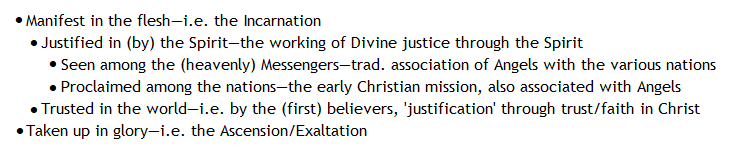
The word eu)se/beia has no good translation in English; often it is rendered “religion, piety, godliness”, or something similar, but none of these are especially accurate. The related root verb se/bomai has to do with showing fear or reverence, esp. before God; and the compound verb eu)sebe/w essentially means showing good (that is, proper) reverence toward God. The eu)seb- word group is not used at all in the undisputed letters of Paul, but occurs more than a dozen times in the three Pastoral letters (1 Tim 2:2; 3:16; 4:7-8; 5:4; 6:3, 5-6, 11; 2 Tim 3:5, 12; Tit 1:1; 2:12)—one of the differences in vocabulary which leads many commentators to doubt Pauline authorship. Apart from the Pastorals, the word group is found only in 2 Peter (1:3, 6-7; 2:9; 3:11) and the book of Acts (3:12; 10:2, 7; and 17:23 [spoken by Paul in the narrative]). It suggests the beginning of an understanding which regards (early) Christianity as a distinct religion. Here in 1 Timothy, the expression “secret of good reverence” (musth/rion th=$ eu)sebei/a$) is generally synonymous with the “secret of the faith” (musth/rion th=$ pi/stew$) from 3:9. The fundamental declaration of this “secret” in v. 16 is expressed in a hymnic statement, beginning with a relative pronoun (o%$, “who”) and consisting of six parallel lines:

o^$
“…[i.e. Jesus Christ] who
e)fanerw/qh e)n sarki/
was made to shine (forth) in (the) flesh
e)dikaiw/qh e)n pneu/mati
was made right/just in (the) Spirit
w&fqh a&gge/loi$
was seen (among the) Messengers
e)khru/xqh e)n e&qnesin
was proclaimed among (the) nations
e)pisteu/qh e)n ko/smw|
was trusted in (the) world
a)nelh/mfqh e)n do/ch|
was taken up in honor/glory

Each line contains an aorist passive verb followed by the preposition e)n (“in, among”) + dative; the preposition is missing in the third line, but probably should be assumed there as well. This simple, rhythmic structure would allow for easy memorization and use as a hymn or confessional formula. It consists of a set of three related pairs:

    • In the Flesh / Spirit
    • Among the Messengers (Angels) / Nations
    • In the World / Glory

It is also possible to read it as a chiasm:

Clearly these lines narrate the basic facts and elements of the Gospel, but not according to a chronological arrangement, as we might expect.

Perhaps most difficult is the use of the verb dikai/ow in the first line. It literally means “make right/just”, and is often used in the sense of a person being made (or declared) right/just before God, a sense which would not seem entirely appropriate applied to the person of Jesus. However, the verb may also be understood in the more general sense of “making (things) right”. An important aspect of the early Christian view of Jesus was that his death on the cross took place even though he was righteous and innocent of any crime; as such, on a basic level, his death was a terrible miscarriage of justice, one which God “made right” through the resurrection and exaltation of Jesus to His right hand in heaven. This working-out of justice was done through the Spirit of God—the same (Holy) Spirit which makes believers right before God through trust in Christ.

Mention should be made of the important textual variant in 1 Tim 3:16. At the start of the hymn-formula, the majority of manuscripts read qeo/$ (“God”) instead of the relative pronoun o%$ (“who”). In spite of some opposition, most commentators (correctly) recognize that the relative pronoun is almost certainly original. It is appropriate to the hymnic/confessional form, and transcriptional probability overwhelming supports the alteration from o%$ to qeo/$, rather than the other way around. In the uncial Greek letters, o%$ would appear as os, which was then mistaken for qs, an abbreviated form of qeo$ (qeos). This “sacred name” abbreviation would be marked by an overline (+q+s), making it extremely unlikely that it would have been mistaken for the relative pronoun os. The change is probably also to be explained by the difficulty of syntax with the relative pronoun: “the secret of good reverence…who was…”; this difficulty is alleviated somewhat if we read the remainer of v. 16 essentially as a quotation: “…the secret of good reverence: (of Jesus Christ) ‘who was etc etc…'” On the other hand, if the majority reading turned out to be correct, then the “secret” would be localized specifically (primarily) in the incarnation of Christ (“God manifest in the flesh”).

Outline of 1 Timothy
    • Greeting (1:1-2)
    • Exhortation to Timothy (1:3-20), regarding
      —Preservation of correct teaching and tradition (vv. 3-11)
      —Paul’s own example as minister of the Gospel (vv. 12-20)
    • Guidelines for the Churches (2:1-3:13)
      —General instruction on Prayer and Worship (2:1-8)
      —continuation, emphasizing the role and position of Women (2:9-15)
      —Regarding “Overseers” (3:1-7)
      —Regarding “Servants/Ministers” (3:8-13)
    • Central declaration (3:14-16)
    • Exhortation to Timothy (4:1-16), regarding
      —False teaching (4:1-5)
      —Preservation of correct teaching and (ethical) conduct (4:6-10)
      —Example of Timothy as minister and apostolic representative (4:11-16)
    • Guidelines for the Churches (5:1-6:2)
      —General instruction related to the handling of men and women (5:1-2)
      —Regarding (female) “Widows” (5:3-16)
      —Regarding (male) “Elders” (5:17-20)
      —[Miscellaneous/personal instruction] (5:21-25)
      —Regarding those in the churches who are Slaves (6:1-2)
    • Exhortation to Timothy (6:1-19), regarding
      —False teaching and ethical conduct (vv. 1-10)
      —Example/encouragement for Timothy as minister of the Gospel (vv. 11-16)
      —The use of riches (vv. 17-19)
    • Conclusion (final instruction) and benediction (6:20-21)

August 1: Romans 8:3-4

This is the second of two notes on 2 Cor 5:21 and Rom 8:3-4; the passage in 2 Corinthians was discussed in the previous day’s note.

Romans 8:3-4

“For the powerless (thing) of the Law [i.e. what the Law lacked power to do], in which [i.e. in that] it was weak through the flesh, God (has done), sending his own Son in (the) likeness of flesh of sin [i.e. sinful flesh] and about [i.e. for the sake of] sin, judged against sin in the flesh, (so) that the just/right (thing) of the Law should be filled up [i.e. fulfilled] in us—the (one)s not walking about according to (the) flesh, but according to (the) Spirit.”

The relevant portion parallel to 2 Cor 5:21 is indicated by italics above; here it is extracted out, along with the Greek text:

“…sending his own Son in (the) likeness of flesh of sin [i.e. sinful flesh] and about [i.e. for the sake of] sin, judged against sin in the flesh, (so) that the just/right (thing) of the Law should be filled up [i.e. fulfilled] in us”
pe/mya$ e)n o(moiw/mati sarko\$ a(marti/a$ kai\ peri\ a(marti/a$ kate/krinen th\n a(marti/an e)n th=| sarki/, i%na to\ dikai/wma tou= no/mou plhrwqh=| e)n h(mi=n

Here are 2 Cor 5:21 and Rom 8:3b-4a in translation side-by-side:

2 Cor 5:21

“the (one) not knowing sin, He [i.e. God] made (to be) sin over us [i.e. for our sake], (so) that we might come to be (the) justice/righteousness of God in him”

Rom 8:3b-4a

“…sending his own Son in (the) likeness of flesh of sin [i.e. sinful flesh] and about [i.e. for the sake of] sin, … (so) that the just/right (thing) of the Law should be filled up [i.e. fulfilled] in us”

I feel it is best to proceed here by comparing the key words and phrases between the two passages:

“the one not knowing sin”
(to\ mh\ gno/nta a(marti/an)
“his own Son”
(to\n e(autou= ui(o/n)

It is interesting to consider these expressions as complementary: in Corinthians, the emphasis is on Jesus’ lack of familiarity with sin; in Romans, it is on Christ as the (beloved) son and heir (cf. Rom 4:13ff; 5:10; 8:12-17), highlighting the importance and preciousness of the sacrifice God makes. Based on Rom 4:13ff (cf. also throughout Gal 3-4), there is probably here an allusion to Abraham’s willingness to sacrifice Isaac, which may already have been present in Christian thought prior to Paul.

“He made (to be) sin”
(a(marti/an e)poi/hsen)
“sending in the likeness of flesh of sin”
(pe/mya$ e)n o(moiw/mati sarko\$ a(marti/a$)

Does Romans here explain the phrase in Corinthians? This is certainly possible, though it raises some interesting questions regarding the traditional view of Christ’s sinlessness. Was sin dwelling in his flesh just as it is for other human beings (cf. Rom 7:13-20)? In order for the expression to have its full significance, this would seem to be the case. It certainly could be affirmed without admitting that Christ committed any sin. On the other hand, the expression “in the likeness of flesh of sin” could be taken to mean that it was not actually “flesh of sin”; but, then, in what way was it like sinful human flesh? If all that Paul meant to say was that Jesus had a “human nature”, without sin, this is a curious way to state it. Needless to say, the entire matter is extremely sensitive from an orthodox Christological standpoint.

“over us” (u(pe\r h(mw=n) “about sin” (peri\ a(marti/a$)

The preposition u(pe/r fundamentally means “over”, while peri/ means “around, about”; however, both can be understood as “on behalf of, for the sake of, because of”, depending on the context. In Corinthians, Paul uses traditional early Christian language for the atoning, sacrificial work of Christ, which takes place “over us”, that is, for our sake. In Romans, the focus is more what is done about (and to) sin—i.e. the power of Sin, especially that which dwells (“houses”) in the flesh (Rom 7:17-18, 20). This is clear from the clause which follows: “he (God, through Christ) judged against sin in the flesh”. Does this mean Christ himself took on sinful flesh—that sin dwelt in his flesh, in common with humankind? There would seem to be three main possibilities:

    • There was no sin in his flesh; he was human, but it was not “flesh of sin”. To say that God “judged against sin in the flesh” means that it was judged through the suffering (and death) of the sinless flesh of Christ.
    • The “curse” or effect of sin was in his flesh, but not the power of sin itself. God judged against what sin had done to human beings in the flesh.
    • Sin did “dwell” in his flesh, and it was this that God judged against. Christ himself knew no sin (2 Cor 5:21) in the sense that: (a) he did not commit sin, and (b) was not enslaved by the power of sin; however God made him to be sin, in order to deal with sin.

The first of these accords with orthodox Christology, especially the blunt declaration in 1 John 3:5; however, the last of these, in my view, seems closer to Paul’s thought in Romans, though perhaps not without further qualification. Ultimately, the most important point is that the power of sin was destroyed and made inactive through the death (and resurrection) of Christ, allowing believers to be set free from bondage to sin and death (Rom 6:6-11).

“so that we…” (i%na h(mei=$) “so that… in us” (i%na…e)n h(mi=n)

Both passages conclude with a i%na purpose-/result-clause (“so that…”), indicating primarily the purpose, but also the result, of God’s work in Christ. The difference of focus or location in terms of the believer (“we/us”) is relatively slight, and complementary—in Corinthians, the emphasis is on what happens to us, in Romans, on what takes place in us.

“we might come to be”
(genw/meqa)
“might be (ful)filled (in us)”
(plhrwqh=|)

Both verbs are aorist subjunctive forms, indicating the possibility or potential of what God can (and) will accomplish in the person of the believer, based on what he has already done (past action). The aorist subjunctive often carries an imperitival force, i.e., “we should/shall become…” In Corinthians, indeed, it is a matter of what the believer will become; in Romans, on the other hand, something is completed or fulfilled (“filled [up]”) in (and among) believers.

“(the) justice/righteousness of God”
(dikaiosu/nh qeou=)
“the just/right (thing) of the Law”
(to\ dikai/wma tou= no/mou)

These expressions reflect what it is that we as believers will become, or what will be fulfilled in us, respectively. In 2 Corinthians, it is the “justice/righteousness (dikaiosu/nh) of God”, an expression which Paul uses in Romans (Rom 1:17; 3:5, 21-22; 10:3, cf. also 3:25-26; 6:13). It is best, I think, to consider this as an attribute of God Himself (subjective genitive), which he demonstrates primarily and fundamentally in the person and work of Jesus Christ. An important emphasis in Romans is that this justice/righteousness has been manifested in Christ altogether separate and apart from the Old Testament Law (cf.  Rom 3:21ff, etc), so it is interesting that the parallel passage in 2 Cor 5:21 specifically mentions the Law (no/mo$). The fact is, that Romans very much builds upon the idea, already discussed in Galatians, that Christ, by his sacrificial death, fulfills the Law for human beings. In Gal 3:10-13, this takes place by Jesus becoming the curse of the Law himself (par. to the idea of being “made sin”). The curse came into effect (pronounced as judgment) when the Law, representing the terms of the covenant between God and his people, was violated. According to Paul’s view, human beings, held in bondage under the power of sin, are incapable of fulfilling the Law (i.e. the Law of God, as expressed in the Torah). In Rom 8:3-4, God judges against sin itself in the flesh, removing its enslaving power over those who trust in Christ.

What about the specific expression in 2 Cor 5:21? how exactly do believers “become” or “come to be” the justice/righteousness of God. According to what Paul teaching and relates in his letters (especially in Galatians and Romans), I would suggest three aspects of this process:

    1. Justification—this is essentially what is described in Rom 8:3-4: (a) Christ is made sin and, through his death, becomes the curse, (b) this sacrificial acts fulfills and completes the requirement of the Law, (c) through Christ God judges sin itself, removing its enslaving power, (d) believers in Christ are thus made right before God, and (e) now have the freedom and ability to fulfill the Law, through the Spirit, no longer by observing the Torah itself.
    2. Union with Christ (“in Christ”)—believers are united with Christ, and thus participate in the very justice/righteousness of God which he himself manifests and embodies. It is communicated in the believer through the power of the Spirit, which is also the Spirit of Christ.
    3. Resurrection/Glorification—Experience of God’s justice/righteousness is also eschatological, with the completion of salvation in the end-time judgment. Ultimately it is the body (“flesh” in the strict sense) which remains to be redeemed and loosed from bondage. Paul never loses sight of this future aspect of salvation.

July 31: 2 Corinthians 5:21

In today’s note I will be looking at Romans 8:3-4 in comparison with 2 Corinthians 5:21. These two passages connect the incarnation of Christ with God’s work of salvation for humankind. From the beginning, Christians understood the sacrificial and salvific character of Jesus’ death, and that he was God’s unique representative; but here, in these two letters, perhaps for the first time, we find a developed doctrine blending soteriology with Christology. As 2 Corinthians was likely written before Romans, I will begin with 2 Cor 5:21.

2 Corinthians 5:21

“the (one) not knowing sin, He [i.e. God] made (to be) sin over us [i.e. for our sake], (so) that we might come to be (the) justice/righteousness of God in him”

The context of this passage (2 Cor 5:11-21) is similar to that of Phil 2:1-11—an appeal for peace and unity among believers is connected with the example of God’s sacrificial and saving work in Christ. Here in 2 Corinthians, the emphasis is on reconciliation—katallagh/, vb. katalla/ssw, to make things different, mutually, between two parties. In vv. 18-19, Paul makes two statements:

    • God is “the (One) making (things) different [katalla/canto$] (for) us with Himself through [dia/] (the) Anointed” (v. 18)
    • God “was [h@n] in [e)n] (the) Anointed, making (things) different [katalla/sswn] (for the) world with Himself” (v. 19)

In both instances, a participial form of the verb is used: the first in the aorist (indicating a past action), the second in the present. In verse 18, it is “us” (believers) for whom the situation has been changed with God; in verse 19, it is the entire world. This particular work of reconciliation is glossed and interpreted by Paul as “not counting for them (the instances of) their falling alongside [paraptw/mata]”, i.e., not reckoning their sins and failures, understood as violations/transgressions of the Law, especially in its moral/ethical aspect. We also see, in each statement regarding God’s work of reconciliation in/through Christ, a corresponding declaration of the work of reconciliation God intends for believers (focused primarily in the apostolic ministry):

    • “…and (also) giving to us the service [diakoni/a] of making (things) different [i.e. reconciliation, katallagh/]” (v. 18)
    • “…and (also) placing in us the word/account [lo/go$] of making (things) different [i.e. reconciliation]” (v. 19)

It may be helpful to examine each element of verse 21:

to\n mh\ gno/nta (“the [one] not knowing”)—i.e. Jesus Christ; here the verb know (ginw/skw) probably should be understood in the sense of familiarity.

a(marti/an (“sin”)—The expression mh\ gno/nta a(marti/an is sometimes translated as “knowing no sin“; but the negative particle relates primarily to the verb, and thus the emphasis is on “not knowing sin”. Paul doubtless would affirm something corresponding to the later orthodox belief regarding the sinlessness of Christ; however, when referring to specific sins or misdeeds, he typically uses the words para/ptwma (cf. in v. 19), para/basi$, or a(marti/a in the plural. The use of the singular here could indicate the idea of sin in the more general, abstract sense; or, as often in Romans especially, of sin as a power. To describe Jesus as “the one not knowing sin” probably means, for Paul, that he was the only person who was not enslaved under the power of sin, i.e. did not know Sin has his master. The word a(marti/a fundamentally means a failure—in the conventional Israelite/Jewish religious sense, this would be a failure to observe the commands and regulations of the Law (Torah), and, in particular, moral failure. In English, the word is normally rendered as “sin”; it is generally synonymous with the corresponding afj in Hebrew.

u(pe\r u(ma=$ (“over us”)—The preposition u(pe/r literally means “over”, but often in the metaphorical sense of “on behalf of, for the sake of”, etc. What God did through Christ was done “over us”, covering us, and it was done for our sake.

e)poi/hsen (“he made”)—God is the implied subject, with “the one not knowing sin” (Christ) as the object, i.e. God made Christ to be (like/as) sin. How should we understand this “making”? I have previously suggested three possibilities:

    • he was made into the form of (sinful) human “flesh” (Rom 8:3, cf. below); the idea of incarnation, cf. Gal 4:4; Phil 2:7
    • he was made like unto the (enslaving) power of sin, in order to conquer and destroy it (cf. Rom 8:2-3; Gal 3:13-14)
    • he was made into a sin-offering; note the similar double meaning of afj in Hebrew, which can be used both for sin and the offering made on behalf of sin

i%na (“that”)—the particle here introduces a final clause, indicating either purpose or result (or both), i.e. “so that…”

genw/meqa (“we might come to be”)—the common existential verb indicating becoming, i.e. the purpose and result of God’s work is that we (believers) will come to be something new. The aorist subjunctive form could here could also be rendered: “that we should come to be…”

dikaiosu/nh qeou= (“[the] justice/righteousness of God”)—Paul’s use of this expression is familiar from Romans, where it appears numerous times (Rom 1:17; 3:5, 21-22; 10:3, also 3:25-26; 6:13, etc). More than half of the instances of the noun dikaiosu/nh come from the undisputed Pauline letters (34 times in Romans). I have discussed dikaiosu/nh (and the dikaio- word-group) extensively in the articles on “Paul’s View of the Law” (note also the article on Justification). Where this particular expression is used in Romans, it should be taken fundamentally as a characteristic or attribute of God Himself, but which is expressed primarily in the person and work of Christ.

e)n au)tw=| (“in him”)—that is, “in Christ”, e)n Xristw=| being a favorite Pauline expression, indicating the union (and unity) of believers with Christ (and with God through Christ). Here it should also be understood as the focus of our becoming the “justice/righteousness of God”—it takes place in Christ. Elsewhere, Paul refers to Jesus as the very embodiment of justice/righteousness. The parallel in 1 Cor 1:30 is especially noteworthy:

1 Cor 1:30: he came to be the justice/righteousness from God for us
2 Cor 5:21: we come to be the justice/righteousness of God in him

The interplay reflected in these two verses is fascinating indeed!

What does it mean precisely, that believers should “become” or “come to be” the justice/righteousness of God? I will leave this question until I have discussed Romans 8:3-4, which I will do in the next daily note.

Notes on Prayer: John 17:24-26

John 17:24-26

With verses 24-26 we come to the end of our study of the great Prayer-Discourse of Jesus in John 17. These verses conclude the exposition section that makes up the body of the Prayer (in relation to the Discourse-format), as well as the Prayer itself. It contains most of the key words and ideas found throughout the chapter, serving as a summary of the theology expressed therein. It also forms an inclusio with the first portion of the Prayer, with the dual address to God the Father; note the parallel:

    • “Father” / “Holy Father” (vv. 1, 11)
    • “Father” / “Just/Righteous Father” (vv. 24-25)

In particular, the address in verse 11b (“Holy Father… [pa/ter a%gie]”) marks the beginning of the exposition, which is bracketed here in vv. 24ff. There is a formal parallel between v. 11b and verse 24 (note the italicized portion):

“Holy Father, may you keep watch (over) them in your name which you have given to me, that they would be one just as we (are).” (v. 11b)

“Father, (that) which you have given to me, I wish that, where(ever) I am, they also would be with me…” (v. 24a)

A principal theme in the Prayer is the idea that God the Father has given (vb. di/dwmi, in the perfect). This verbal expression has two points of reference, and there is a play between them:

    • The Father has given his (own Divine) name, glory, etc, to the Son
    • The Father has given the disciples (i.e. believers, the Elect) to the Son

Verse 24 again contains both aspects:

“Father, (that) which you have given [de/dwka$] to me, I wish that, where(ever) I am, they also would be with me, (so) that they would look (upon) my honor which you have given [de/dwka$] to me, (in) that you loved me before the casting-down of the world.”

The parallel is precise, differing only in the gender of the relative pronoun:

    • “which [neut.] you have given to me” (o^ de/dwka/$ moi)
    • “which [fem.] you have given to me” (h^n de/dwka/$ moi)

The use of the neuter pronoun seems to have caused some difficulty for early copyists, as it was widely changed to the masculine plural ou%$, so as to agree with the subject “they” (i.e. disciples/believers). The neuter actually refers back to the beginning of the Prayer, in verse 2:

“…just as you gave him [i.e. the Son] authority over all flesh, (so) that, (for) all which you have given to him, he would give to them (the) Life of the Age [i.e. eternal life]”

Compare the italicized phrase with that in v. 24:

    • “all which you have given to him” (pa=n o^ de/dwka/$ au)tw=|)
    • “which you have given to me” (o^ de/dwka/$ au)tw=|)

Clearly, the neuter pronoun refers to neuter substantive pa=n (“all”)—that is, the disciples (believers) considered as a collective whole, or unity; given the emphasis in vv. 20-23 (cf. the previous study), this is unquestionably the focus here as well. The following phrases in vv. 2 and 24 also match, and are more or less synonymous:

    • “(that) he [i.e. the Son] would give to them (the) Life of the Age”
    • “that where I am, they also would be with me”

In other words, to be with Jesus (the Son) is the same as possessing eternal life. More to the point, this is expressed in verse 24 by a subjunctive form (w@sin) of the verb of being (ei)mi); this is obscured somewhat in English translation, but is clear and vivid if we examine the conditional clause in the Greek:

i%na o%pou ei)mi e)gw\ ka)kei=noi w@sin met’ e)mou=
“that where I am, they also would be with me”

Note the structure, presented as concentric pairs:

    • o%pou (“where [I am]”)
      • ei)mi (“I am”)
        • e)gw/ (“I”)
        • ka)kei=noi (“they also”)
      • w@sin (“they would be”)
    • met’ e)mou= (“with me”)

The indicative statement by Jesus (e)gw\ ei)mi, “I am”) has special significance in the Gospel of John, being used (by Jesus) repeatedly to express his identity (as the Son) and relationship to God (the Father). Here, in the closing portions of the Prayer, Jesus’ desire is that all believers would share in the same divine identity/relationship which he has with the Father; this is the very point made throughout vv. 20-23 (and again in vv. 25-26, cf. below), and gives equal significance to the subjunctive w@sin (“they would be”, used also in vv. 19, 21-23): that believers “would be” what Jesus “is”. In this regard, a point should be made on the coordinating particle o%pou, which itself functions as a relative pronoun; though difficult to render exactly in English, it is something like “a certain (place) in which”, and may be translated fairly as “where” or “wherever”. It is an ordinary enough word, but it comes to have a special theological (and Christological) meaning in the Gospel of John, taking on this significance in the second half of the book. This “where” or “place in which” refers consistently to Jesus’ return back to the Father, and, as such, effectively confirms his identity as the (pre-existent) Son of God. The first occurrence of this usage is in the great Sukkoth discourse of chapters 7-8, where it appears in two related declarations by Jesus (each of which is repeated):

    • “where I am [o%pou ei)mi e)gw\], you are not able to come (there)” (7:34, 36)
    • “where I go under [o%pou e)gw\ u(pa/gw], you are not able to come (there)” (8:21-22)

These statements are given to the public at large (and to Jesus’ opponents), but in the Last Discourse, he essentially re-states them for his disciples:

    • “where I go under [o%pou e)gw\ u(pa/gw], you are not able to come (there)” (13:33, 36)

Jesus’ departure (vb. u(pa/gw, “lead/go under”, i.e. go away, withdraw, go back) encompasses both his death and final return to the Father. In 13:33, 36, the former is in view, while it is the latter in 14:3-4:

    • “…that where I am [o%pou ei)mi e)gw\], you also may be.
      And where I go under [o%pou e)gw\ u(pa/gw], you see [i.e. know] the way (there).”

Before the Last Discourse, the disciples (represented by Peter, 13:36ff) are unable to come to the place where Jesus is (with the Father), but the promise is that they will be able to, and much of the Last Discourse is centered on this revelatory point. The declaration in 14:4, that the disciples “see/know the way (there)”, leads to the revelation that Jesus himself is the way (o(do/$) to the Father (v. 6). In this light, let us compare three key statements where the particle o%pou is used:

    • 12:26: “If any (one) would serve me, he must follow me, and (then) where I am [o%pou ei)mi e)gw\] my servant also will be.”
    • 14:3: “If I travel (away) and make ready a place for you, I will…take you along toward me (myself), (so) that where I am [o%pou ei)mi e)gw\] you also may be.”
    • 17:24: “Father…I wish [i.e. it is my will] that, where I am [o%pou ei)mi e)gw\] they also would be with me”

The statements are similar, both in form and meaning, but they reflect a development of thought within the (narrative) context of the Gospel:

    • 12:26—Believers (the Elect) coming to be disciples of Jesus
    • 14:3—The Departure of Jesus (the Son), which allows his disciples (believers) to come along (with him) to the Father
    • 17:24—The essential identity (and unity) of Believers (all Believers), that they/we will ultimately be with Jesus, together with the Father

We move from (1) being/becoming disciples, to (2) the eschatological promise of our presence (with Jesus) in heaven, and finally (3) of our fundamental union with Christ. The purpose of our being with Jesus is expressed in the second half of verse 24:

“…that they would look (upon) [qewrw=sin] my honor [do/ca] which you have given to me”

The verb qewre/w, which can have the sense of “look with wonder (at), behold” (sometimes in a religious setting), is relatively frequent in the Gospel of John, occurring 24 times, and often in the context of believers trusting in Jesus and coming to knowledge of the truth (6:40, 62; 12:45), which involves a recognition of who Jesus truly is. It is especially important in the Last Discourse (14:17, 19; 16:10, 16-17, 19), where it expresses two themes of contrast:

    • The disciples soon will not see Jesus any more (on earth), but will soon see him again; this theme has two primary aspects:
      (1) they will see him again after his death (resurrection appearances)
      (2) they will see him again after his departure to the Father (presence of the Spirit/Paraclete)
    • The disciples can see/recognize Jesus, but the world cannot

Both of these themes continue on, in various ways, within the chapter 17 Prayer-Discourse, especially the contrast between believers and the world. The ability to “see” or “look upon” Jesus, from the standpoint of Johannine theology, means to recognize (and trust in) his identity as Son of God, as the one sent by the Father. This identity includes the idea of divine pre-existence, indicated earlier in verse 5, and again here. Evidence for belief in Jesus’ pre-existence is actually quite rare in the New Testament, in spite of its importance for orthodox Christology. The belief, however, is clear and unmistakable in the Gospel of John, being affirmed (in majestic terms) in the Prologue (1:1ff), and again at various points throughout the Gospel. Jesus’ departure means a return to the Father, back the place where he was in the beginning, before the world was created. Note this point made, at both the start and end of the Prayer, in terms of (1) the do/ca (“honor, splendor”) Jesus shares with the Father, and (2) in relation to the world (ko/smo$):

    • “the honor/splendor which I held alongside of you before the (com)ing to be of the world” (v. 5)
    • “my honor/splendor which you have given to me, (in) that you loved me before the casting-down [katabolh=$, i.e. founding] of the world” (v. 24)

The (dualistic) contrast between Jesus and the world is fundamentally based on his pre-existence, his eternal identity as God’s Son—he comes from above, sent by the Father to the world below. It is for this reason that the world is unable to see (recognize) or hear (accept) him; only the Elect/Chosen ones (believers) are able to see and hear. They recognize his identity as Son (and thus see the Father), but remain unable to perceive this divine honor/splendor in its fullness; it will only become manifest when they/we are finally with Jesus (in heaven) with God the Father.

Verses 25-26, even more than v. 24, bring together all of themes and motifs of the Prayer—and, indeed, the Discourses of Jesus as a whole—and deserve an extended discussion in their own right. I will be posting this, as a supplement, later this week.