January 18: John 1:29-51

In a previous note, I offered a basic outline for John 1:19-51; however, there is an alternative way to outline 1:29-51:

The Three Days of John 1:29-51

One can demarcate three sections, each of which begins with the phrase th=| e)pau/rion, “upon the (morning) air” (i.e. “upon the morrow”, in conventional English, “the next day, next morning”):

Th=| e)pau/rion (vv. 29-34)—

  • Witness of John the Baptist—Jesus coming toward [e)rxo/menon pro/$] him (“See, the Lamb of God…”), v. 29
    • Statement of John the Baptist concerning the true nature and superiority of Jesus (v. 30); his baptizing reveals Jesus to Israel (v. 31)
    • Statement of John the Baptist (v. 32); Jesus’ true nature (and superiority) revealed in John’s baptizing (v. 33)—descent of the Spirit & Divine announcement (baptism of Jesus implied)
  • Witness of John the Baptist—”This (one) is the Son of God”, v. 34

Th=| e)pau/rion (vv. 35-42)—

  • Witness of John the Baptist (with his followers)—Jesus traveling alongside (“See, the Lamb of God…”), v. 35-36
  • The Baptist’s disciples leave to follow Jesus; their exchange with Jesus—they remained [e&meinen] with him, vv. 37-39
  • Jesus’ followers witness to others (Andrew to Simon), including—(1) a confession of Jesus’ identity (“Messiah”) and (2) a statement by Jesus to the new disciple (Simon), vv. 40-42

Th=| e)pau/rion (vv. 43-50)—

  • (Short prefatory narrative introducing Philip, vv. 43-44)
  • Jesus’ follower witnesses to another (Philip to Nathanael), with a confession of Jesus’ identity (“the one of whom Moses… and the prophets wrote”), vv. 45-46
  • Nathanael leaves to find Jesus; his exchange with Jesus, vv. 47-48
  • Witness of Jesus’ follower—(1) a confession of Jesus’ identity (“Son of God”, “King of Israel”) and (2) a statement by Jesus to the new disciple, vv. 49-50

While not completely symmetrical, there are clear points of parallelism between the three sections. One can even detect a trace of “staircase” parallelism (a Johannine technique), whereby the first element of a line or section picks up and builds on the last element of the prior one. Note also that each section contains at least two separate titles for Jesus, each given as a revelatory declaration by the speaker:

    • “Lamb of God” (v. 29) / “Son of God” (or “Elect of God”) (v. 34)
    • “Lamb of God” (v. 35) / “Messiah” (v. 41)
    • “The One of whom Moses… and the Prophets wrote” (v. 45) / “Son of God” and “King of Israel” (v. 49)

The “Three Days” culminate with the statement in verse 50:

“Because I said to you that I saw you underneath the fig-tree, you trust (in me)?
Greater than these (things) you will see.”

Nathanael had responded to a miraculous (but apparently mundane) bit of foreknowledge by Jesus (what Jesus saw); Jesus responds in turn by emphasizing what the disciple will see. This sort of simple but powerful wordplay occurs over and over again throughout the Gospel of John. It also stresses the important Johannine theme of seeing.

John 1:51

Verse 51 may well be a separate (detached) saying of Jesus that has been appended here by the Gospel writer. The saying on its own:

“Amen, amen, I say to you: ‘You will see the heaven opened up and the Messengers of God stepping up and stepping down [i.e. ascending and descending] upon the Son of Man'”

At the narrative level, it is hard to explain just how it relates to the preceding section. A precise or definite interpretation of the saying itself is also extremely difficult; many pages of possible explanation could be offered. However, I would suggest three primary avenues for interpretation:

1. Jacob’s Ladder. The central image of Messengers (Angels) of God “ascending and descending” almost certainly reflects Jacob’s dream vision at Bethel (Genesis 28:12ff):

And he dreamed and see!—a ‘ladder’ being made to stand up (from) the earth, and its head was touching (to) the heavens; and see!—Messengers of the Mightiest One [i.e. God/Elohim] were going up and coming down on it. 13And see!—YHWH stood himself upon it [i.e. over it] and said…

The Septuagint (LXX) phrase is nearly identical to that of Jn 1:51—oi( a&ggeloi qeou= a)ne/bainon kai\ kate/bainon e)p’ au)th=$ (“the Messengers of God stepped up and stepped down [i.e. ascended and descended] upon it”). The early Rabbis offered various interpretations of the ladder and the vision as a whole (see in Midrash Rabbah on Genesis 68-69); interestingly, they explored the possibility that the suffixed preposition oB in v. 12 might be read “on him” instead of “on it“—in other words, the Angels were ascending/descending on Jacob rather than the ladder. Similarly for the preposition wyl*u* in v. 13: YHWH was standing over/upon him [Jacob] instead of it [the ladder]. It is impossible to know just how old this interpretation is, but it would provide a close parallel with Jn 1:51. Significantly, it is not only the angels, but YHWH himself who is over/upon the ladder (or Jacob); and, while this is not specified in Jn 1:51, the fulness of this Heavenly/Divine glory may be implied. The Aramaic Targums typically substitute the Memra/Shekinah (personified Word/Glory) for YHWH himself in such anthropomoprhic appearances, and so in Gen 28:13 (cf. Onkelos). This is certainly part of the Jewish background to the Word (Lo/go$) concept in the Gospel of John (and note here the interpretation of Jn 1:51 in Justin Martyr, Dialogue with Trypho 86:2). One other bit of Christological detail: in the alternative Rabbic interpretation of Gen 28:12-13 mentioned above, the angels ascending and descending represent the exaltation and humiliation of Jacob, respectively (cf. Genesis Rabbah 68.12)—comparable to the “two states” of the incarnate Christ in classical theology.

2. The Baptism of Jesus. A number of words and images in the Jn 1:51 saying are closely related to the Baptism of Jesus:

  • Seeing the heavens opened (o&yesqe to\n ou)rano\n a)new|go/ta, “you will see the heaven opened up”). In Mark 1:4, it is said that “he [Jesus] saw [ei@den]” the heavens split and the Spirit/dove descending; also in Matt 3:16 he [Jesus] saw [ei@den] the Spirit/dove, while the heaven opening is a narrative declaration (“see! [i)dou/]”). In John, while the Baptism is not narrated as such, there are numerous references to seeing—the Baptist sees [ble/pei] Jesus (v. 29, 36, “See [i&de], the Lamb of God…”); twice John states that he did not know/see [h&|dein] Jesus (v. 31, 33); he beheld [teqe/amai] the Spirit descending (v. 32, also v. 33 “you will see [i&dh|$] the Spirit…”); and he testifies “I have seen [e(w/raka] and witnessed…” (v. 34); cf. also v. 39, 46, 50. The verb o)pta/nomai (also used in v. 39 and 50), emphasizes looking “with (open) eyes”, i.e. gazing, perceiving (similar to qea/omai), and occurs in John almost exclusively in terms of perceiving Jesus and beholding his glory (Jn 3:36; 11:40; 16:16-17, 19, 22; 19:37; 1 Jn 3:2). The fact that this verb ends verse 50 may be one reason that v. 51 (if originally a separate saying) was added here, by way of “catchword-bonding”.
    The verb a)noi/gw (“open up”) is used in the Matthean and Lukan accounts of the Baptism (Matt 3:16; Luke 3:21). Even though the Gospel of John has no comparable account, it is clear enough from 1:29-34 that the author was familiar with the same underlying tradition preserved in the Synoptics, which had a reference to the heavens “opening”. Otherwise, this verb is used in John almost exclusively for “opening the eyes” of the blind (in Jn 9; 10:21; 11:37), and occurs frequently in the Johannine book of Revelation.
  • Use of the verb a)nabai/nw (lit. “step up”). In the Mark and Matthean accounts of the Baptism (Mark 1:10; Matt 3:16), this verb is used to describe Jesus’ “coming up” out of (or from) the water. The verb occurs somewhat frequently in John, in a related two-fold sense—(1) to describe Jesus’ “going up” to Jerusalem (Jn 2:13; 5:1; 7:8, 10, 14), and (2) for Jesus’ “ascension” to Heaven to the Father (Jn 3:13; 6:62; 20:17; note esp. reference to the “Son of Man” in 6:62).
  • Use of the verb katabai/nw (lit. “step down”). In all three Synoptic accounts of the Baptism, and in Jn 1:32-33, the verb is used to describe the Spirit coming down “as a dove”. In Matt 3:16; Lk 3:22, as in Jn 1:32-33 and 51, we find the expression “coming down upon him [e)p’ au)to/n]”. Parallel to the related verb a)nabai/nw, in the Gospel of John katabai/nw is used in reference to Jesus’ “coming down” (out of heaven [e)c ou)ranou=])—cf. Jn 3:13; 6:33, 38, 41-42, 50-51, 58.
  • Even though it does not occur in the canonical accounts, mention perhaps should be made of the early tradition whereby a great light (i.e. fire/glory) shone from the water at Jesus’ baptism. This is actually narrated in Latin MSS of Matthew 3:15-16 (a vgms), was apparently mentioned in the Diatessaron (Gospel Harmony) of Tatian (2nd century), and is cited by Justin Martyr (Dialogue with Trypho 88). The motif was especially emphasized in the Eastern churches, and became a prominent part of the Baptismal liturgies. For more on the relation of this theme to Baptism (and the Baptism of Jesus), see my earlier Epiphany note.

3. The Son of Man. Of the many sayings of Jesus involving the Son of Man, a number relate to his (eschatological) coming in judgment and glory (see esp. Mark 13:26; 14:62 par.; Matt 24:27, 30, 37, 39; Lk 12:40; 17:22-30; 18:8). The Son of Man is specifically associated with angels in Mark 13:26-27 par.; Matt 13:41. In the Gospel of John, the “Son of Man” is mentioned primarily in the context of being glorified, lifted up, ascending, etc.—Jn 3:13-14; 6:62; 8:28; 12:23, 34; 13:31. In Jn 3:13, Jesus speaks of the Son of Man having ascended (a)nabai/nw) and descended (katabai/nw), a significant parallel to the saying in Jn 1:51. There are also quite a few references, in the Synoptics at least, to the suffering of the Son of Man (Mark 8:28; 9:12, 31; 10:33; 14:21, 41, et al. and par.); it may be worth considering in this regard the Rabbinic interpretation of Gen 28:12 (see above), whereby the angels ascending and descending (upon Jacob) refer to his exaltation and humiliation.

Saturday Series: John 1:51 (continued)

John 1:51 (continued)

Last week we looked at the enigmatic statement by Jesus in John 1:51:

“Amen, amen, I say to you (that) you [pl.] will see the heaven opened up and the Messengers of God stepping up and stepping down upon the Son of Man.”

A proper study of such difficult passages requires a careful two-step approach: (1) analysis of the Greek words/phrases and how they are used, and (2) the context of the passage within the book. Last week we dealt with the first of these, today we will explore the second—that is, the context of the verse within the Gospel of John. Much of the difficulty surrounding this saying has been in trying to identify it with an actual event which the disciples experienced (or would experience). I mentioned three possibilities: (a) an otherwise unrecorded event during Jesus’ ministry, such as the Transfiguration scene in the Synoptic Gospels; (b) a post-resurrection vision or encounter; or (c) an eschatological vision. None of these really seem to fit the narrative setting of this saying—at the very beginning of Jesus’ ministry, just after the Baptism and the call of the first disciples. It seems more likely that it is meant by the author (trad. John the Apostle) as a symbolic picture, and that its fundamental meaning is Christological. I believe that a study of the Greek (last Saturday) already points rather clearly in this direction. But let us examine things a bit further.

1. The Location of the Saying

After the hymnic prologue of Jn 1:1-18, the first main section of the Gospel is Jn 1:19-51, which has, as its primary theme, the testimony of John the Baptist regarding Jesus. The section is divided into four “days”, and with each “day” the witness of Jesus’ identity is developed:

  • vv. 19-28—the Baptist’s testimony regarding himself (“I am not…”)
  • vv. 29-34—the Baptist’s testimony regarding Jesus
    • account of the Baptism (vv. 31-33)
  • vv. 35-42—disciples respond to the Baptist’s testimony and follow Jesus
    • a disciple (Peter)’s encounter with Jesus (vv. 41-42)
    • saying of Jesus (v. 42)
  • vv. 43-51—disciples respond to the testimony of other (disciple)s and follow Jesus
    • a disciple (Nathanael)’s encounter with Jesus (vv. 47-51)
    • saying of Jesus (v. 51)

Each of the last three days follows a basic pattern, which includes a pair of declarations regarding Jesus, using a range of significant titles or descriptions:

  • Day 2: “Lamb of God” (v. 29) / “Son of God” (or “Elect/Chosen One of God”) (v. 34)
  • Day 3: “Lamb of God” (v. 36) / “Messiah” (“Anointed One [Christ]”) (v. 41)
  • Day 4: “the one of whom Moses and the Prophets wrote” (v. 45) /
    “Son of God” | “King of Israel” (v. 49)

The saying in Jn 1:51 thus concludes this opening section of the Gospel, which fundamentally has a Christological orientation, in two respects:

  1. The focus moves from John the Baptist to Jesus (see vv. 8, 15, 30; 3:28-30)
  2. John and the disciples witness (see) Jesus—that is, they begin to recognize who he is, and testify as to his identity.

The account of Jesus’ Baptism (vv. 31-34) is central to this section. Moreover, its close proximity to verse 51 makes it extremely likely that some sort of allusion to it is intended. Last week I mentioned several words in verse 51 which echo the baptism:

  • The Holy Spirit, in the form/shape of a dove, descends [lit. “steps down”] upon Jesus, using the same verb (katabainœ) as in Jn 1:51. Also, the versions in Matthew/Luke specifically use the preposition epi (“upon”) and narrate the episode as something observable by all the people.
  • In the descent of the Spirit, the heavens are said to separate; in Matthew/Luke (Matt 3:16; Lk 3:21), the verb used is anoigœ (“open up”) as in Jn 1:51.

The Baptism is not narrated as something that people observe directly—it is only “seen” through the verbal account (or word) of the Baptist. Similarly, throughout this section “seeing” Jesus is intimately connected with hearing and responding to the message of the Baptist and the first disciples (vv. 34, 36, 39, 46). In Nathanael’s encounter with Jesus (vv. 47ff), he also “sees” based on what Jesus says to him; note, in particular, the wording:

“Jesus responded and said to him, ‘(In) that [i.e. because] I said to you that I saw you underneath the fig-tree, you trust (in me)? (Thing)s greater than these you will see!” (v. 50)

This interplay between “seeing” and “saying” should caution us against the simple assumption that a concrete visible event is intended in v. 51.

Consider also that, while the saying in v. 51 concludes the first section (1:19-51), it also marks the beginning of the next—that is to say, the beginning of Jesus’ ministry. In terms of the Gospel of John, this means the core narrative of the Gospel spanning chapters 2-20. Commentators typically divide this into two main parts:

  1. Chapters 2-12, sometimes referred to as the “Book of Signs”, in which the narrative alternates between accounts of miracles and teaching (discourses) by Jesus—the miracle (sign) often serving as the basis and starting point for the discourse which follows (see especially in chapters 5, 6, and 9). All but the first and last of the Son of Man sayings are found in these chapters.
  2. Chapters 13-20, which narrate the Passion (and Resurrection) of Jesus—chapter 13 (a Last Supper scene similar to that in the Synoptic tradition) leads into the great Discourses in 13:31-16:33, concluding with the remarkable Prayer-Discourse of chapter 17.

The last Son of Man saying in John (13:31) opens the Discourses which are set at the beginning of the last major section of the Gospel (chs 13-20). It seems likely that the first Son of Man saying (1:51) is meant to have a similar transitional role in the structure of the Gospel narrative.

2. The other Son of Man Sayings

There are numerous Son of Man sayings in the Gospel of John. As mentioned above, all but the first and last sayings occur in chapters 2-12, which is significant for two reasons:

  • They are part of the Discourses of Jesus in these chapters, marked by a unique style of teaching. A statement or action by Jesus is misunderstood by the audience, leading to a pointed question, and the subsequent response (and exposition) by Jesus, answering the question at a deeper level of meaning. This process of redirection and reformulation always involves Jesus’ identity—his Person and Teaching—the Son in relation to God the Father. Where they occur, the Son of Man sayings (esp. 3:13-14; 6:27, 53, 62; 8:28; 12:23, 32, 34) are central to the Discourse.
  • They point toward the death and exaltation (resurrection, return to the Father) of Jesus described in chapters 13-20. Indeed, the principal sayings all have a dual-meaning, centered on Jesus’ death and resurrection. The sayings which refer to the Son of Man being “lifted high” (Jn 3:14; 8:28; 12:32, 34) or being “glorified” (Jn 12:23; also 13:31) have both aspects in mind.

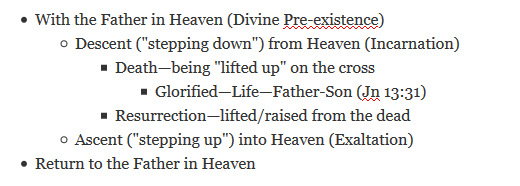
The dualism of these sayings is best demonstrated by the use of the verbs katabainœ and anabainœ (“step down”, “step up”), as in Jn 1:51. The saying in 3:13 is followed by that of v. 14 (which speaks of the Son of Man “lifted high”); the sayings in Jn 6:27, 53, 62 have a more complex reference matrix, as part of the great Bread of Life discourse (6:25-66). In schematic form, we might outline the dualism as follows:

According to this outline, the last Son of Man saying (Jn 13:31) reflects the central, inner dynamic of the Father-Son relationship and identity, governed by the verb doxazœ (“give honor/esteem/glory”, i.e. “glorify”). If this is correct, then it is not unreasonable to assume that the first of the Son of Man sayings (Jn 1:51) is parallel to this in some way, and may reflect the outer dynamic—the ascent/descent. Again, this would seem to be correct considering the use of the verbs katabainœ and anabainœ in 1:51. However, in that first saying, it is not the Son of Man descending/ascending, but rather of Angels (“Messengers of God”) ascending/descending on the Son of Man.

3. An allusion to Genesis 28:12

As mentioned last week, in Jesus’ saying there is almost certainly an allusion to Genesis 28:12. In Jacob’s dream-vision at Bethel, he sees Angels ascending and descending on the ladder; in the Greek Version (Septuagint) “ascending and descending” uses the same verbs (anabainœ and katabainœ) as Jn 1:51. Note also:

  • There is a traditional Jewish interpretation which understands the Angels ascending/descending on him (Jacob). In one reference (Genesis Rabbah 68:12) Jacob is seen as being simultaneously in heaven.
  • The Targums (Aramaic translations) express the idea that the shekinah—the visible manifestation and/or personification of God’s glory—was on the ladder. In Justin Martyr’s Dialogue with Trypho (mid-2nd century A.D.), we find the earliest evidence for the interpretation that Christ was on the ladder (86:2).
  • Bethel as the “House of God”, i.e. the rock/stone which symbolizes the Temple and its foundation. In ancient and traditional religious thinking, the Temple served as the meeting place between God and human beings, a point of contact between Heaven and Earth. Moreover, in John 2:19ff (not long after the saying in 1:51), the Temple is identified with Jesus’ own person (and body), specifically in connection with his death and resurrection.

4. A Comprehensive Symbol?

Returning to the specific context of John’s Gospel, there is still more evidence to suggest that the saying of Jesus John 1:51, in its particular position within the structure of the narrative, is intended primarily as a symbolic picture that effectively encompasses the entire Gospel—a framing device representing beginning and end, much like the “Alpha and Omega” (A and W) of Revelation 1:8; 21:6; 22:13 (another Johannine work, with definite parallels in thought and language to the Gospel). Here are some points I would cite in favor of this interpretation:

  • The clear parallels with the Baptism (see above, and the discussion last week), which marks the beginning of Jesus’ earthly ministry (descent/incarnation). Again, the location of Jn 1:51 strongly suggests an allusion to the Baptism.
  • Similar parallels with the Resurrection (ascension), which effectively marks the end of Jesus’ earthly existence.
  • Similarities to descriptions of the Son of Man coming in glory at the end-time (especially in the Synoptic Gospels, Mk 13:26; Matt 16:27-28, etc). However, the Gospel of John understands the Son to have had this position and glory prior to his incarnation/birth as a human being (that is, divine pre-existence). This means, in the Johannine context, that such images cannot refer only to Jesus’ exaltation and future return, but to a reality that encompasses and transcends the entire process of descent/ascent.
  • The saying in Jn 1:51 is part of a parallel, between the beginning and end of the Gospel. This expressed by the encounter of two disciples (Nathanael and Thomas) with Jesus, and involve parallel confessions:
    • Jn 1:49: “You are the Son of God | you are the King of Israel!”
    • Jn 20:28: “My Lord | my God!”
      It is possible that these confessions themselves as bracketing the entire narrative of chapters 2-20:
      • “Son of God” (in a Messianic context)
        —”King of Israel” (i.e. Anointed Davidic Ruler)
        —”My Lord” (Jesus as Messiah/Lord, cf. Ps 110:1)
      • “My God” (Deity)
    • Each of the confessions also includes a response by Jesus (Jn 1:50-51; 20:29) related to disciples/believers seeing him.
  • In the Gospel of John, “seeing” often signifies a level of spiritual perception (or of faith/trust) that is different from visual observation (Jn 1:14, 18; 3:3; 6:36, 46; 9:37-41; 11:9, 40; 12:45; 14:7, 9, 17, 19; 17:24; 20:29, etc). It is likely that the declaration “you will see” (opsesthe) does not refer to a concrete, visible event, but rather to the recognition and realization of Jesus’ true identity—as the Son who reveals and leads the way to the Father. This, of course, is also related to “seeing” the Son in terms of being with him, in his presence, as other instances of the verb optanomai, optomai/opsomai would indicate (Jn 16:16-17, 19, 22).
  • As a concluding observation that “seeing” in Jn 1:51 signifies something more than a concrete vision, note the parallel with 20:29:
    • “because I said to you that I saw [eidon] you… you trust?
      you will see [opsesthe] the heaven opened up and the Messengers of God… upon the Son of Man” (1:51)
    • “because you have seen [heœrakas] me you trust?
      Happy/blessed are the ones not seeing [idontes] and (yet) trusting!” (20:29)

In both Jn 1:51 and 20:29, the eventual seeing by the believer is contrasted with the disciple believing on the basis of an extraordinary or miraculous experience. Even the concrete evidence for Jesus’ resurrection (in the case of Thomas) should not be relied upon as the basis for faith and trust in Christ, but rather the word that bears witness to him and the Spirit that draws us to him.

It is a great wonder that, wherever you turn in the Gospel of John, there appears to be an almost limitless depth to the passage. Even a careful, objective treatment of individual words inevitably leads down into a wide expanse of meaning and spiritual significance. I hope that I have been able to offer some help in demonstrating how a study of both the words and context of the passage can serve as a reliable guide to exploration. For next week, I would exhort you to continue on in a similar manner, reading and studying the next two chapters of the Gospel as carefully and thoughtfully as you are able. It will prepare you for a discussion on one of the most familiar verses in all the New Testament, but one which is often cited without much consideration for its context in the Gospel. As you may have guessed, this is the world-famous John 3:16—and we will be looking at its context most carefully…next Saturday.

Birth of the Son of God: Philippians 2:6-11

“God sent His Son”

An important aspect of the Birth of the Son of God (the theme of these Christmas season notes) is the idea of God (the Father) sending Jesus. For a key reference in early Christian preaching, see Acts 3:26 (v. 20 apparently being to Jesus’ future appearance). It also appears numerous times related to Jesus’ earthly ministry (in his own words, as preserved in Gospel tradition)—Mark 9:37 par; Matt 15:24; Luke 4:18 (citing Isa 61:1), 43; 10:16—often in the specific context of salvation (cf. Acts 13:26). In the sayings of Jesus, there is a (reciprocal) parallel to his sending of the disciples (Mark 9:37 par; Lk 10:16; John 13:20; 17:18ff; 20:21, also Matt 10:16; Lk 10:3; 22:35; Jn 4:38). In the Gospel of John, there are dozens of instances where Jesus refers to himself (or “the Son”) being sent by the Father (several of which have already been mentioned):

Jn 4:34; 5:23-24, 30, 36-37; 6:38-39, 44, 57; 7:16, 18, 28-29, 33; 8:16, 18, 26, 29, 42; 9:4; 10:36; 11:42; 12:42-45, 49; 13:16, 30; 14:24; 15:21; 17:3, 8, 18, 21, 23, 25; 20:21

A number of these strongly suggest divine pre-existence of the Son (cf. Jn 1:1ff; 8:58), while others indicate, at the very least, being sent prior to his (human) birth.

Among the most important references to Jesus (as God’s Son) being sent are Galatians 4:4 and Romans 8:3, both of which have been discussed in detail in prior notes (cf. in Advent season and on “Paul’s view of the Law in Romans” [soon to be posted here]):

o%te de\ h@lqen to\ plh/rwma tou= xro/nou e)cape/steilen o( qeo\$ to\n ui(o\n au)tou= geno/menon e)k gunaiko/$ geno/menon u(po\ no/mon
“but when the fullness of time came, God set forth out from (him) his Son, coming to be out of a woman, coming to be under the Law…” (Gal 4:4)

o( qeo\$ to\n e(autou= ui(o\n pe/mya$ e)n o(moiw/mati sarko\$ a(marti/a$ kai\ peri\ a(marti/a$ kate/krinen th\n a(marti/an e)n th=| sarki/, i%na to\ dikai/wma tou= no/mou plhrwqh=| e)n h(mi=n
“…God, sending his own Son in (the) likeness of flesh of sin [i.e. sinful flesh] and about [i.e. for the sake of] sin, judged against sin in the flesh, (so) that the just/right (thing) of the Law should be filled up [i.e. fulfilled] in us” (Rom 8:3b-4a)

 There is a similar passage in John 3:16-17 and the parallel 1 John 4:9-10 (v. 14) which also emphasize Jesus’ sacrificial (and salvific) death—God sends his Son as Savior, through his death and resurrection. Indeed, according to at least one strand of early Gospel preaching (as preserved in the book of Acts), it is specifically through his resurrection (and exaltation) that Jesus was understood to be ‘born’ as Son of God (see esp. the use of Psalm 2:7 in Acts 13:32-33). These two aspects—his death and resurrection—provide the defining structure to the so-called “Christ hymn” of Philippians 2:6-11.

Philippians 2:6-11

This famous passage, which, according to the view of many scholars, is part of an earlier hymn that Paul makes use of in his letter, begins with Jesus’ divine status/position/nature in verse 6—”beginning under [i.e. being/subsisting] in the form of God [e)n morfh=| qeou=]”. It is not possible to examine this difficult phrase in detail, but it certainly indicates some manner of pre-existence. The second phrase of the verse is even more problematic (and controversial), but I interpret the basic idea to be that Jesus did not take the opportunity of seizing equality (lit. “did not lead seizure [for himself] to be equal”) to God—which can be understood several different ways (cf. my earlier note on this passage). More important in terms of Paul’s purpose is the fact that Jesus willingly “emptied [e)ke/nwsen] himself”—a kind of self-sacrifice, referred to in theology as kenosis (from Greek ke/no$, “empty”). This is connected to the doctrine of incarnation—the divine Christ/Son taking on human form, which, of course, cannot be separated from the reality of his (human) birth. Note the phrases which follow in vv. 7-8:

  • morfh\n dou/lou la/bwn “taking the form of a slave” (par. to “the form of God” in v. 6)
  • e)n o(moiw/mati a)nqrw/pwn geno/meno$ “coming to be in the likeness of men” (note the similar use of gi/nomai as in Jn 1:14; Gal 4:4; Rom 1:3, and of “likeness [o(moi/wma]” in Rom 8:3)
    —kai\ sxh/mati eu(reqei\$ w($ a&nqrwpo$ “and being found having (the) shape/appearance as a man”
  • geno/meno$ u(ph/koo$ me/xri qana/tou “coming to be obedient [lit. hearing under] until death…” (v. 8)

The clause “he lowered himself” (e)tapei/nwsen e(auto\n) beginning verse 8 is parallel to “he emptied himself” (e(auto\n e)ke/nwsen) at the start of verse 7. In traditional theological/christological language, this emptying/lowering is referred to as the humiliation of Christ—the first of two so-called “states of Christ”. It is followed by the second state—his exaltation—in vv. 9-11:

  • V. 9a: “God lifted/raised him high” (o( qeo\$ au)to\n u(peru/ywsen)
    —V. 9b: “and showed favor [e)xari/sato] to him (with) the name th(at is) over every name”
  • V. 10-11: this powerful compound clause depicts Jesus’ exalted status in heaven—as ruler/judge

There is a clear Christological chiasm expressed in these verses—moving from divine/heavenly (pre-)existence, and back to an exalted status (as God/Lord) in heaven:

  • God sends his Son from him (i.e. from heaven)
    • to be born (lit. come to be) of a woman (Gal 4:4)
      • into the suffering/slavery of the human condition (v. 7a)
      • suffering/death on the cross (v. 8)
    • through the resurrection, Jesus is “born” (i.e. firstborn of the dead)
  • God exalts him to heaven, at his right hand, as Son of God (cf. Ps 2:7 / Acts 13:32-33) and Lord

This same sequence is indicated, in simpler form, by the four main aorist verbs that guide the syntax of the passage:

  • e)ke/nwsen (“he [Jesus] emptied [himself]”)—his ‘departure’ from heaven and birth/incarnation as a human being
  • e)tapei/nwsen (“he lowered [himself]”)—his suffering and death
  • u(peru/ywsen (“[God] lifted [him] high”)—Jesus’ resurrection and ascension/exaltation
  • e)xari/sato (“[God himself] showed favor [to him]”)—”with the name over every name”, as Lord and (Son of) God in heaven

Phil 2:9-11 shows the importance of Jesus’ name and titles—which, according to the ancient/traditional mindset, indicate and represent his essential identity. In this regard, the name and titles used in the Lukan Infancy narratives are especially significant:

  • Jesus/Yeshua ( )Ihsou=$)—v. 10; Luke 1:31; 2:21 (cf. Matt 1:21 for the traditional etymological association with salvation)
  • Lord (ku/rio$)—traditionally used to render YHWH, and almost certainly the “name” granted to Jesus in vv. 9-10; cf. Luke 1:43, 76; 2:11
  • Son of God (o( ui(o\$ qeou=)—Luke 1:32, 35; not used in Phil 2:6-11, but note the parallel to Gal 4:4; Rom 1:3-4 and the general context of vv. 6, 9
  • Anointed (xristo/$)—Luke 2:11 (also v. 26); note the traditional juxtaposition of “Anointed” and Jesus/Yeshua at the end of v. 5, right before vv. 6-11 (the relative pronoun o%$ [“who”] at the start of v. 6 refers specifically to “[the] Anointed Yeshua”)

Finally, it is worth noting the association of the expression “coming to be (born) of a woman” (Gal 4:4; cf. similar use of gi/nomai [“come to be”] in Rom 1:3; Jn 1:14 and here in Phil 2:7) in terms of the suffering of the human condition, including a specific connection with sin. This is a most sensitive point, to be discussed in upcoming notes. In Phil 2:6-11, this is referred to under the common Pauline motive of slavery (“taking the form of a slave“, v. 7). Consider the parallel (and at least partly synonymous) expressions:

  • “under the Law” (Gal 4:4)—”God sent forth his Son, coming to be… under the Law”
  • “in the likeness of flesh of sin” (Rom 8:3)—”…sending His own Son in the likeness of flesh of sin” (cf. also 2 Cor 5:21)

However we may interpret these difficult passages—i.e. in terms of the connection between Jesus’ incarnate human nature and sin—they must be understood primarily from the standpoint of Jesus’ sacrificial and atoning death. This is also the context of the occurrence of genna/w (“come to be born”, cognate with gi/nomai) in John 18:37, in his dialogue with Pilate prior to the crucifixion (cf. the recent discussion): “unto this have I come to be (born), and unto this have I come into the world.” Here, as in several other passages which we have looked at in these Christmas season notes, the birth and death of the Son of God come together—two sides of the same Gospel message.