September 1 (2): John 14:4-7 (v. 6)

John 14:4-7 (continued, v. 6)

In response to the disciples’ question in verse 5 regarding where Jesus is going (v. 4, cf. the previous note), he answers with the declaration of verse 6, one of the most famous statements in the New Testament:

“Yeshua says [le/gei] to him {Thomas}, ‘I am [e)gw\ ei)mi] the way, and the truth and the life—no one comes toward the Father if not [i.e. except] through me.”

Both the statement in v. 4, and the question of v. 5, use the word o(do/$ (“way”) with an adverb/particle (of place) derived from the pronoun po/$ (“who/what/which”):

    • “the (place) which/where [o%pou] I am going…you have seen/known the way [o(do/$]” (v. 4)
    • “we have not seen/known what(ever place where) [pou=] you are going…how can we see/know the way [o(do/$]?” (v. 5)

It seems to suggest a specific location with a distinct path that leads to it (cf. Jesus’ illustration in Matt 7:13-14 par). However, Jesus’ response in verse 6 makes clear that he himself (emphatic pronoun e)gw/, “I”) is the path or way (o(do/$). This point of emphasis is all the more solemn in its use of the pronoun + verb of being (e)gw\ ei)mi, “I am”), with its Johannine connotation of identifying Jesus with God the Father (YHWH). For other “I am” sayings of Jesus in John, cf. 6:35, 41, 48, 51; 8:12, 24; 9:5; 10:7, 9, 11; 11:25; 13:19; 15:1, 5; 18:5; and note also the foreshadowing of the expression in 1:20ff; 3:28, and the distinctive use of the verb of being (ei)mi) in 1:1-15. Especially worth noting, is the parallel with 14:4-5 in 7:33ff, where Jesus says:

“(It is only) a little time yet (that) I am [ei)mi] with you, and I go away [u(pa/gw] toward the (one who) sent me. You will seek (for) me and you will not find [me], and the (place) where [o%pou] I am [ei)mi] you are not able to come (there).” (vv. 33-34)

There is an interesting parallelism within this saying:

    • ei)mi (“I am”)—Jesus’ presence with the people (i.e. his disciples)
      —u(pa/gw (“I go under/away”)—his departure back to the Father
      —o%pou (“the [place] where”)—where he is, with the Father
    • ei)mi (“I am”)—His presence with God the Father (1:1ff)

The statement that Jesus goes “toward” (pro/$) the Father is important, and the basic expression occurs numerous times in Gospel of John. In the prologue, the orientation of the eternal Word (Lo/go$) is toward (pro/$) God the Father (1:1-2), and the Son ultimately goes back toward Him (13:1, and throughout the Last Discourse). Similarly, the preposition is used for people (believers) who come to Jesus—toward him, toward the light, etc., as in 3:20-21; 5:40; 6:35, 37, 44-45, et al. It is only in coming toward the Son (Jesus), that is, by believing/trusting in him, that one is able to come toward the Father. This dynamic is not spelled out in detail, but the basic image in the Last Discourse is that Jesus will return (future eschatology) to bring believers with him to the Father (14:3; 17:24, etc). However, at the same time, in a different sense (‘realized’ eschatology), the Father (with the Son) is already present with believers, residing in them (14:23, etc). Both aspects are found in chapter 14, and both should be understood as relating to the idea of Jesus as the way to the Father. That he is the only way was expressed already in the parable/illustration of the shepherd and sheep-fold in chapter 10 (vv. 1-5)—Jesus is both the door leading into the sheepfold (vv. 7-9) and the shepherd who guides the sheep into the fold (vv. 11-16). Something of the same image of the door is certainly implied in 14:6, since Jesus speaks of believers as coming to the Father through (dia/) him.

The motif of the way (o(do/$) was extremely important in the earliest Christian tradition, though, without the book of Acts, this fact would have been almost completely lost to us. One of the earliest names or labels for Christians and Christianity was, collectively, “the Way” (o( o(do/$)—cf. Acts 9:2; 19:9, 23; 22:4; 24:14, 22. This is perhaps the most distinctive and precise parallel between early Christians and the Community of the Qumran texts (Dead Sea Scrolls), since both referred to themselves this way. Both traditions would seem to derive from an interpretation of (and identification with) Isaiah 40:3ff, which, in combination with Mal 3:1ff, would be associated with the early Gospel traditions regarding John the Baptist and the beginning of Jesus’ ministry—cf. Matt 3:3; Mark 1:3; Luke 1:16-17, 76ff; 3:4; Jn 1:23. For Isa 40:3 and the religious identity of the Qumran Community, cf. especially the ‘Community Rule’ [1QS] 8:12-16.

Jesus’ declaration in Jn 14:6 expands upon the identification of Jesus with “the way”:

“I am the way, and the truth [a)lh/qeia] and the life [zwh/]…”

Both words are important and occur frequently in the Gospel (and First Letter) of John. Probably here they are best understood as epexegetical, qualifying and characterizing Jesus as the Way—i.e., the “way of truth“, “way of life“—though certainly they can also be viewed as separate (related) “I am” declarations. For the idea of a way leading to life, see Gen 3:24; Psalm 16:11; Prov 6:23; 15:24; 16:17, as well as Jer 21:8 (also Ezek 3:18; 13:22) which prefigures Matt 7:14 and the “Two Ways” religious-ethical tradition that developed in early Christianity (Didache 1-6; Barnabas 18-21). Similarly, the “way of truth” has its background in the Old Testament and Jewish tradition—cf. Psalm 86:11; 119:30; Tob 1:3; Wisdom 5:6; 1QS 4:15-16, etc.; the expression is found in 2 Pet 2:2 (cf. also v. 15). The Gospel message is called the “way of salvation” in Acts 16:17; cf. also 18:25-26. There is an echo of Jn 14:6 in the Gnostic text known as the Gospel of Truth (mid-2nd century?):

“This is the gospel of the one who is searched for, which was revealed to the ones who are perfect through the mercies of the Father—the hidden mystery, Jesus, the Christ. Through it he enlightened those who were in darkness. Out of oblivion he enlightened them, he showed (them) a way. And the way is the truth which he taught them.” (translation G. W. MacRae in the Nag Hammadi Library [NHL], ed. James M. Robinson)

Here we see one of the clearest differences between the Gospel of John and the Gnosticism of the 2nd century A.D. In the Johannine Gospel, Jesus himself (i.e. the person of Christ, the Son) is the way. By contrast, in the ‘Gospel of Truth’, the way is the gospel (message), the revelation of truth which Jesus brings to the Elect (believers). This is a seemingly small, but very significant difference, and it thoroughly colors how one understands “knowledge” (gnw=si$) from a Christian (and Christological standpoint). The emphasis on knowledge will be addressed in relation to the final verse (14:7) to be discussed here, in the next note.

“Gnosis” in the NT: John 17:3 (cont.)

John 17:3 (continued)

In the previous study, I looked at the statement of John 17:3 in the context of the prayer-discourse of chapter 17. Today, I will be examining the statement itself in a bit more detail.

“And this is the Life of-the-Age [i.e. eternal life]—that they should know you the only true God, and the (one) whom you se(n)t forth, Yeshua (the) Anointed.”

This is clearly connected with Jesus’ words in verse 2, though the precise relationship is not absolutely certain (cf. the discussion in the prior note):

“Even as you [i.e. the Father] have given to him [i.e. the Son] authority o(ver) all flesh, (so) that (for) every (one) that you have given him, he should give to them life of-the-Age [i.e. eternal life].”

Verse 3 explains and defines what this “eternal life” is. The word zwh/ (“life”) appears frequently in the Gospel of John, and usually denotes eternal life—that is, the divine or spiritual life which God the Father possesses (with the Son) and which is, and will be, granted to faithful believers in Christ. The specific expression “life of the Age[s]” makes the meaning clear (Jn 3:15-16, 36; 4:14, 36; 5:24, 39; 6:27, 40, 47, 68; 10:28; 12:25, 50); the very expression has a definite eschatological orientation—the life believers will enter/inherit at the end, in the “Age to Come”. Life (zwh/) appears most frequently, as a key-word, in the discourse of 5:17-47 (esp. vv. 24-29, 39-40) and in the “Bread of Life” discourse of chapter 6 (11 times). In the language of the Johannine discourses, to have or receive life is a primary idiom for salvation, since the specific words “save, saving, salvation” (sw|/zw and related words) are not commonly used in the Gospel and letters of John. This means that there is a definite soteriological significance to Jn 17:3. Eternal life—i.e. salvation—is defined specifically in terms of knowledge: “that they should know [ginw/skwsin]…”

While knowledge and salvation are often connected in various ways in the New Testament, as I have discussed in the series “Gnosis and the New Testament”, such a direct and explicit association is extremely rare. It sounds extremely “gnostic” in orientation—salvation in terms of knowledge (gnw=si$). Let us first consider the precise object of this knowledge in verse 3, which is two-fold:

    • “you”, i.e. God the Father—YHWH the Creator, according to the Old Testament Scriptures and Israelite religious tradition, specifically that He is:
      —”the on(ly) [mo/no$] true [a)lhqino/$] God”, which is, of course, a central tenet of Yahwist/Israelite monotheism (cf. Exod 34:6; Isa 37:20, etc)
    • “Yeshua (the) Anointed”—that is, Jesus identified by the title “Anointed (One)” (Messiah, Christ); for more on this title as applied to Jesus, cf. the articles of my earlier series “Yeshua the Anointed”. Here, too, something specific is involved:
      —”the (one) whom you se(n)t forth”; the verb a)poste/llw (“set forth from”) appears frequently in John, used of Jesus, including 7 times within chapter 17

Thus, in addition to (correct) knowledge of the true God of (Israelite) monotheism, believers are given knowledge of Jesus as the Anointed One who has come from God. While there is certainly a tinge of orthodoxy to this statement, it should not be limited to that sense. Indeed, in terms of the actual words (and thrust) of Jesus’ prayer, we are better informed by the terminology of vv. 6, 11-12, 26, where there are four important references to the name (o&noma) of God the Father; there is a clear symmetry present in the passage:

    • “I have shone forth [e)fane/rwsa] your name to the men whom you gave me out of the world” (v. 6)
      —”keep/guard them in your name which you have given to me” (v. 11)
      ——”that they might be one, even as we (are)”
      —”I kept/guarded them in your name which you have given to me” (v. 12)
    • “I made known [gnwri/zw] your name to them…” (v. 26)

(On the use of these two verbs fanero/w and gnwri/zw to signify divine revelation, cf. Part 3 of the series “Gnosis and the New Testament”)

Now, the name of God in the Old Testament and Israelite religion, strictly speaking, is the name represented by the four letters (tetragrammaton) hwhy [YHWH], originally vocalized something like Yahweh (cf. my earlier article on this name). However, Jesus is not referring here to giving his followers the simple factual information about this name, such as one might read in a Semitics textbook, or even as presented in Exod 3:13-14. In the ancient world, a person’s name was thought to reflect and encapsulate the essence, nature and character of that person, in a manner quite foreign to our way of thinking today. To “know” a person’s name meant effectively the same thing as knowing the person. There was a quasi-magical aspect to the name—speaking it allowed one to access the reality and the person behind the name. In Old Testament/Israelite religious tradition, this underlies the expression of “calling” on the name of YHWH (cf. Acts 2:21 & Rom 10:13, citing Joel 2:32). In order to speak a name, one must first know it, and what it represents. Jesus makes known to his followers the name (o&noma) of God the Father, which means making the Father (Himself) known to them. In Gospel tradition, Jesus is associated with Psalm 118:26 as the one who comes to the people “in the name of the Lord (YHWH)” (cf. John 12:13 par)—from the standpoint of Jesus in the Gospel of John, this means one who comes from the Father, the “Son” who reflects the character of his Father and who reproduces His words and actions. In early Christian tradition, the “name of the Lord (YHWH)” merged and became transformed into “the name of the Lord (Jesus)”; the declaration in Joel 2:32 thus carries a double-meaning (cf. Acts 8:16; 9:28; 19:5; 1 Cor 5:4; 6:11; Col 3:17; James 5:14, etc).

In John 17:11-12, this name is described by Jesus as “the name which you have given to me”. This can be understood two ways—first, in the sense that God the Father has given it to him (as the word/lo/go$) so that Jesus can make it known to his followers. However, as part of Jesus’ exaltation to heaven following the resurrection—expressed in Gospel tradition in terms of his coming to be seated at the “right hand” of God—Jesus himself was identified as the Lord, as indicated above. In Philippians 2:9, we have the famous declaration (a kind of credal statement):

“Therefore God even/also lifted him high over (all) and granted to him the name (that is) over every name…”

Almost certainly this name given to Jesus is not “Jesus” but the very name of God (YHWH), probably understood and expressed by the title Ku/rio$ (“Lord”) which was often used to render hwhy (YHWH) in Greek. This is significant due to the close relationship, and unity, between Father and Son presented in the Gospel of John—a theme which runs through all of chapter 17. The Son kept watch over his followers, the believers, guarding them in the name which the Father gave to him (v. 12). Now, as Jesus is about to depart from earth (and return to the Father), he asks the Father Himself to guard believers in that name. According to the Johannine context of chapters 14-16, this should be understood in terms of the (coming) presence of the Spirit. This idea of keeping close watch reflects the sense of intimacy and unity which is unquestionably an aspect of “knowledge” in the Gospel of John.

“Gnosis” in the NT: John 17:3

John 17:3

Today’s note, supplemental to the current series “Gnosis and the New Testament” will examine the statement in John 17:3, perhaps the most explicitly “gnostic”-sounding declaration in the entire New Testament:

“And this is the Life of-the-Age [i.e. eternal life]—that they should know you the only true God, and the (one) whom you se(n)t forth, Yeshua (the) Anointed.”

A question to be addressed right away is whether this statement is part of the actual words of Jesus in his prayer-discourse of chapter 17 or is an explanatory statement by the author of the Gospel (and/or his source). The specific reference to “Yeshua (the) Anointed” (Jesus Christ) strongly suggests the latter. If so, then the author/editor is specifically clarifying Jesus’ words in verse 2:

“Even as you [i.e. the Father] have given to him [i.e. the Son] authority o(ver) all flesh, (so) that (for) every (one) that you have given him, he should give to them life of-the-Age [i.e. eternal life].”

However, it is often difficult to know for certain where or when an author/editor’s comment could be interrupting the words of Jesus. This is especially true for the discourses of Jesus in John, which demonstrate an intricate blending of Jesus’ own words with an interpretive layer which gives added meaning and significance to his words. The discourse in 3:1-21 is another good example; commentators continue to debate whether Jesus’ words as such end with verse 15 or continue on through 21 (note also the wording in v. 11); similarly, whether John the Baptist’s word end at verse 30 or continue through v. 36. I see little (if any) substantial difference with regard to the meaning of 17:3, whether it represents the actual words of Jesus or a comment by the author, since, as noted above, the discourses of Jesus in John consistently seem to blend these two components throughout, so that Jesus’ own words are enhanced by a level of interpretation.

In the prior study on John 8:32, I mentioned the format or pattern which makes up the discourses of Jesus in John. This applies also to the great chain of discourses in chapters 13-17, with the exception of chapter 17, which is uniquely a kind of monologue, which I would qualify as a prayer-discourse. Here, Jesus is addressing God (the Father) in the presence of his followers, much as we see in 11:41-42. It serves as a perfect and exalted climax to the discourse(s) of chs. 13-17. It is so deep and rich in its structure and language, that no single outline will be entirely satisfactory; here, I have followed, with some modification, the outline offered by R. E. Brown (in his Anchor Bible [AB] commentary [Vol. 29A, p. 749], based on the earlier work of A. Laurentin):

    • Narrative setting (v. 1a)
    • Prologue—saying/statement (vv. 1b-3)
      —”Response” (v. 3)
    • Refrain:
      (a) Jesus’ relationship with the Father: the pre-existent glory (vv. 4-5)
      (b) Jesus has shone forth (manifest) the Father’s name (v. 6)
    • Part 1—Prayer/petition (vv. 7-12)
    • Part 2—Prayer/petition (vv. 13-23)
    • Refrain:
      (a) Jesus’ relationship with the Father: the pre-existent glory (vv. 24)
      (b) Jesus has shone forth (manifest) the Father’s name (vv. 25-26)

(Cf. also my study on chapter 17 in the Monday “Notes on Prayer” series)

The initial prayer statement in vv. 1-2 functions in a manner similar to the saying of Jesus with opens the great discourses (cf. 8:31-32 and the prior study). The statement in verse 3 (cf. above) could be said to function like the response by Jesus’ hearers in the discourses, except that here it reflects the understanding and faith of believers, rather than the misunderstanding (and unbelief) of those hearing his words. The “refrain” of vv. 4-6 (followed again in vv. 24-26), contains two great themes (and keywords) of chapter 17: (1) do/ca (“honor, splendor, glory”) and (2) fanero/w (“shine [forth], cause to appear, [make] manifest”). Another important word is the verb di/dwmi (“give”) which occurs 17 times in the chapter. It has a two-fold meaning—(a) that which the Father has given to the Son, and (b) what the Son has given to believers. Interestingly it is the believers who are at the heart of what God the Father has given to the Son, creating a reciprocal relationship—Father-Son-Believers—involving an intricate and repetitive language. The central portion of the prayer-discourse I also divide here into two parts (vv. 7-12, 13-23), each with a similar structure (cf. Brown, p. 749); each part:

    • begins with the particle nu=n (“now…”), and then contains, in turn:
    • a pronouncement (7-8, 13-14)
    • a main petition (9, 15ff)
    • reference to glory (10, 22)
    • reference to unity (11, 21-23)

There is a kind of logical chain running through the prayer:

    • The pre-existent glory (do/ca) which the Son and Father shared
    • –Believers were given to the Son
    • ––The Son came into the world from the Father
    • –––The Son shines forth the Father’s name (making it known) to believers
    • ––––The Son glorifies the Father in this work
    • –––––The death/resurrection/exaltation of the Son
    • ––––The Father glorifies the Son
    • –––Believers will make the Son and Father (His name) known to others
    • ––Believers remain in the world
    • –Believers are one (united) with the Son
    • Believers will inherit the glory shared by Father and Son, and so be one (united) with them both

It is important to read the statement in verse 3 in light of the overall context and structure of the prayer-discourse. The Son gives to the chosen ones (believers) the life-of-the-Age, i.e. life of the Age-to-Come, which ultimately means eternal life with God and Christ in Heaven. How is this life given to believers? This is expressed in various ways, with different images, throughout the Gospel, but here, as in 8:31ff, it is perhaps best understood in terms of the word(s) (logo$, r(hma[ta]) which Jesus “speaks”—cf. especially the statements in Jn 5:24 and 6:63 (also v. 68). The expression “word(s) of life”, along with the same underlying association, in relation to the Gospel message (of Christ), is also found elsewhere in the New Testament (e.g., Acts 5:20; 13:46, 48; Phil 2:16; 1 John 1:1). It is clear from the discourses of Jesus in John that this “word” does not simply represent the sayings and teachings of Jesus, but the presence of Christ himself, as the Son (of God) and living Word who reveals and manifests the Father (his name). Further, it is certainly to be identified also with the (Holy) Spirit, as indicated specifically in Jn 6:63. In chapters 14-16, the Spirit (Paraclete) is said to function effectively as the abiding presence of Christ in and with the believer (14:16-17, 26; 15:26; 16:13ff; cf. also 20:22).

It is now time to look a bit more closely at the statement in 17:3, which I will do in the next study.

“Gnosis” in the NT: John 8:32 (cont.)

John 8:32 (continued)

In the previous study, I examined the context and setting of the saying of Jesus in Jn 8:31-32; today, I will be giving attention to several key points regarding the saying:

    • The conditional relationship between the first and last clauses
    • The use of the terms “truth” and “free(dom)”, and
    • What it means to know the truth

“If you remain in my word [lo/go$], you are truly [a)lhqw=$] my learners [i.e. disciples], and you will know the truth [a)lh/qeia] and the truth will make/set you free.”

This saying is a conditional sentence, made up of two parts—the second (apodosis) is based on the condition established in the former (protasis):

Protasis—”If [e)a/n] you remain in my word [logo/$]”
Apodosis—”(then) you are truly my learners [i.e. disciples]…”

The apodosis actually has three components—that is, three things which will occur if the condition is met; note how each component involves the word truth (cf. below):

    1. you are truly my disciples
    2. you will know the truth
    3. the truth will make/set you free

It is significant that Jesus does not say “you will be my disciples”, but rather “you are my disciples”—that is, remaining in Jesus’ word demonstrates what these believers (already) are, namely, his true disciples. The verb me/nw (“remain”) is especially important, and is part of the key Johannine vocabulary—more than half of the NT occurrences are in the Gospel (40) and letters (27) of John. It occurs most notably in the famous illustration of the vine and the branches in chapter 15 (vv. 4-7, 9-10, 16). The orientation is eschatological: believers will continue in faith, united with Christ, until the end. This is all the more clear here, by Jesus’ use of the verb in 8:35:

“the slave does not remain [me/nei] into the Age, but the Son (does) remain into the Age”

The expression “into the Age”, often obscured in translation as “forever, eternal(ly)”, etc, specially means into the Age to Come, which in an early Christian context, refers to the return of Christ, the last Judgment, the resurrection and the entry of believers into eternal life. We could paraphrase here as: “the slave (to sin) does not enter into eternal life…”; only the Son possesses this life (5:26, etc), and he gives it to those who trust in him. This is expressed by the phrase “remain in my word“. In the discourses and sayings of Jesus in John, the reference can be: (1) to believers being in Christ (his word, light, etc) [5:35; 8:12; 12:46; 15:9-10; 16:33], and also (2) to his word, etc, being in believers [4:14; 5:38; 6:53; 11:10; 14:17; 15:2ff, 11; 17:10, 13]—for the two mentioned together, cf. Jn 6:56; 14:20; 15:4ff; 17:20-26. Paul has the same two-fold aspect of being “in Christ” and Christ being “in you”. With regard to the term lo/go$ (usually translated “word”), the more common idiom is of the lo/go$ being or remaining in the believer (5:38), and Jesus uses this in our passage as well (8:37, cf. also v. 44)—so both aspects are present in the discourse. Primarily, the lo/go$ refers to the “account”, i.e. the things Jesus said, the substance of his teaching, and so forth; but clearly, in the context of the use of this word in John (1:1ff, etc), it also refers to the presence and power of Christ (the Son) himself.

A key term in 8:31-32, and also the discourse of vv. 31-59, is a)lhqei/a (“truth”), which is likewise a common Johannine word—of the 100+ occurrences in the NT, nearly half are in the Gospel (25) and letters (20) of John. Key references elsewhere in the Gospel are 1:14, 17; 3:21; 4:23-24; 5:33; 14:6, 17; 15:26; 16:7, 13; 17:17, 19. It occurs five more times in this discourse:

    • v. 40: Jesus speaks the truth he has heard from God (the Father)
    • v. 44: the people (Jews) who oppose Jesus are actually children of the devil, of whom Jesus says that from the beginning “he has not stood in the truth” and “the truth is not in him” (note the two aspects)
    • v. 45: Jesus states, “because I give account of [le/gw, rel. to lo/go$] the truth, you do not trust [i.e. believe, have faith in] me”
    • v. 46: again, “if I give account of the truth, through what [i.e. for what reason] do you not trust (in) me?”

The use of the verb e)leuqero/w (“make/set free”) in v. 32 (and 36) is actually quite rare in the New Testament, occurring only in Paul (Rom 6:18, 22; 8:2, 21; Gal 5:1); similarly the adjective e)leu/qero$ (“free”) in vv. 33, 36 is primarily found in the Pauline letters. Indeed, Paul frequently makes use of the idea that God, through Christ, has freed human beings from bondage to sin, delivering (or ransoming, i.e. purchasing) them from the control and dominion of sin and darkness. The dualistic imagery is common in the Gospel of John, connecting Christ’s death with salvation from the dark and evil “world”, but not with this specific language of redemption, which is essentially unique to this passage in John.

What does it mean to know the truth? First, in the context of the discourse, the truth is something which Jesus has heard from the Father and speaks to the people (vv. 40ff). Thus it is intimately connected to the relationship between the Son and God the Father, which is expressed (by Jesus) in the Gospel of John, and which is formulated at the very beginning (1:1ff, using the term lo/go$, “word”). It is not so much the specific content of his teaching, but that his teaching reflects the very word ‘spoken’ by the Father. Elsewhere in the Gospel, knowledge (that is, knowing, ginw/skw/oi@da) means knowledge of the Son (Christ) who reveals the Father. This will be discussed further in the next study (on John 17:3). Here, 8:47 effectively summarizes Jesus’ (and the Johannine) meaning:

“The one being out of [i.e. from] God hears the words/utterances [r(h/mata] of God; through [i.e. because of] this, you [i.e. the Jewish opponents] do not hear, in that [i.e. because] you are not out of [i.e. from] God”

This saying is vital for a proper understanding of the “gnostic” aspect of Jesus’ teaching in John, as it conveys a very distinctive sense of salvation—the person who hears (that is, receives/accepts) Jesus’ words, which are the words of God the Father, does so because he/she actually comes from [lit. out of, e)k] God. In other words, the believer who is “born” as a child of God through faith (1:12-13) has ‘already’ come (i.e. been born) out of God. There is a paradoxical sense to this understanding, which will be explored further in the article in the series “Gnosis and the New Testament” dealing with election and predestination. Jesus says virtually the same thing in his famous dialogue with Pilate in Jn 18:37:

“…unto this [i.e. for this purpose] I have come to be (born) and unto this I have come into the world: that I might (bear) witness to the truth—every one being out of [e)k, i.e. from] the truth hears my voice.”

If we compare the parallel statement in 8:47 and 18:37, we see that the “truth” is essentially equivalent with God Himself. It is no wonder that Pilate, like the Jews of the discourse, responds with a lack of understanding: “What is (the) truth?”

“Gnosis” in the NT: Luke 10:22 par

This is the first in a set of notes that are supplemental to the current series “Gnosis and the New Testament”. These notes, to begin with, will treat select verses where the words gnw=si$, ginw/skw, and other related terms, are used.

Luke 10:22 (par Matt 11:27)

The saying of Jesus in Luke 10:22 (with its parallel in Matt 11:27) is unique, and especially significant as being one of the few Synoptic sayings which appears to be closely aligned with the language used by Jesus in the Gospel of John. Here is verse 22 in translation:

“All things were given along to me under my Father, and no one knows who the Son is if not [i.e. except] the Father, and who the Father is if not [i.e. except] the Son, and the (one) to whom the Son should wish to uncover [i.e. reveal] (it)”.

As mentioned above, this sort of reciprocal relationship between Father and Son (and believer) is common in the Gospel of John, but rare by comparison in the Synoptics. The section Lk 10:21-24 represents a sequence of three (or four) sayings by Jesus which are also found in Matthew (but not Mark); as such, they are part of the so-called “Q” material. That they were originally separate sayings is indicated by the fact that vv. 23-24 occur in a different location in Matthew (13:16-17). However, it is possible that vv. 21 and 22 also reflect distinct sayings which were joined together at the earliest levels of Gospel tradition (by thematic “catchword” bonding). The sayings of Lk 10:21-24 all share the common theme of God (the Father) revealing things (and Himself) specially to the followers of Jesus:

    • v. 21: The Father has hidden things away from the wise and learned (of the world) and uncovered (i.e. revealed) them for the “infants”—that is, to Jesus’ followers, many of whom come from the lower (and relatively uneducated) segments of society.
    • v. 22: Only the “Son” knows the Father, and uncovers (reveals) the Father to those whom he wished (i.e. the followers of Jesus).
    • v. 23: The followers of Jesus are happy/blessed (maka/rio$) to have seen these things.
    • v. 24: The mighty/great persons of the world (“kings and prophets”) were not able to see/hear these things, however much they may have wished to do so.

In Luke, this unit is structured carefully enough to function as a chiasm:

    • Hidden away from the wise/learned of the world (v. 21)
      —Uncovered/revealed by the Son to those whom he wishes/chooses (v. 22)
      —Jesus’ followers see and hear, and so are greatly blessed (v. 23)
    • Kept away from the mighty of the world, who had longed to experience such a blessing (v. 24)

The two parts each have a common keyword:

    • Vv. 21-22: The verb a)pokalu/ptw (apokalúptœ)—lit. “remove the cover from”, i.e. “uncover, reveal”
    • Vv. 23-24: The verb(s) ble/pw/ei&dw—”see, look, perceive,” etc

Within the wider Lukan context, these verses also contain two basic themes which run through the section spanning 9:51–18:34, set during Jesus’ journey to Jerusalem:

    • The nature and requirements of discipleship, of following Jesus, and
    • The revelation of Jesus (the Son [of Man]) as the Anointed One and Chosen (Son) of God, which will occur following his death and resurrection

The two themes blend together neatly in 10:21-24. If we consider the Matthean form of the saying in v. 22 (Matt 11:27), there are two small but significant differences worth noting: (a) the use of the compound verb e)piginw/skw instead of ginw/skw, and (b) an apparently simpler form of the saying without the repeated element ti/$ e)stin (“who…is”) found in Luke:

“All things were given along to me under my Father, and no one has knowledge about the Son if not [i.e. except] the Father, and n(either does) any (one) have knowledge about the Father if not [i.e. except] the Son, and the (one) to whom the Son should wish to uncover [i.e. reveal] (it)”

The compound verb e)piginw/skw (epiginœ¡skœ) literally means “to know (or have knowledge) upon [e)pi/] something”, in the fundamental sense of “looking upon” it (and understanding), i.e., perceiving, recognizing, gaining knowledge, etc. The preposition can also serve as an intensive element—i.e. to know something (or someone) completely, thoroughly, intimately, etc. It is possible to interpret the verb here in three ways: (i) the intimate knowledge the Father and Son have of each other; (ii) an emphasis on recognition, especially that of the disciples recognizing the Father in the Son (Jesus); and (iii) and emphasis on gaining knowledge, particularly that of the disciples coming to know the Father (through Jesus). Luke uses the simpler verb ginw/skw (ginœ¡skœ), and this version of the saying also makes clear the nature of the knowledge: “who (the Son/Father) is” (ti/$ e)stin). In this regard, the version of the saying in Matthew is presumably closer to an original (Aramaic) form, which would not have included a specific verb of being corresponding to Greek e)stin (ei)mi). Interestingly, Matthew still has one occurrence of the indefinite pronoun (ti/$), but used rather differently, in the sense of “whoever, any (person) who”.

There has been some question among commentators as to whether the historical Jesus would have used the (absolute) expression “the Son” (o( ui(o/$). While this occurs rather frequently in the Gospel of John (some 15 times) it is hardly found at all the Synoptic Gospels; apart from the passage under discussion, it occurs only in Mark 13:32 (par Matt 24:36) and the baptismal formula in Matt 28:19. In the Synoptics, Jesus almost always refers to himself as “(the) Son of Man” (o( ui(o\$ tou= a)nqrw/pou). The title “Son of God” is applied to Jesus, but by others (Mk 3:11; 5:7; 14:61; 15:39 and pars; Matt 4:3, 6 par; 14:33; 16:16; 27:40, 43; Lk 1:32, 35), never by Jesus himself (but note Matt 27:43). Though admittedly rare in the Synoptics, the fact that the expression “the Son” occurs in two distinct sayings, transmitted, apparently, through different lines of tradition—the Synoptic (Markan) tradition (Mk 13:32 par), and the double tradition of Matthew-Luke (“Q”)—argues for its historicity. Indeed, this is strengthened by the Johannine usage (a third line of tradition), and its similarities with the very saying under discussion here (cf. below).

It is significant that use of “the Son” in the Gospels virtually always occurs in direct connect to a reference to God as “the Father”, both in John (Jn 3:35-36; 5:19-27; 8:36ff; 14:13; 17:1ff) and the rare Synoptic sayings. I think it likely that the idea (and idiom) behind the usage is the general illustration of a son (“the son“) and his relationship to his father (“the father“), especially in the sense of a dutiful son who learns (as a pupil or apprentice, etc) by following the example of his father, imitating what he says and does. This is certainly the case in the Gospel of John, where Jesus states repeatedly that he (the Son) is only doing and saying what he sees/hears his Father doing and saying. Almost certainly, this is also the background of the illustrative language in Luke 10:22 par. The verb paradi/dwmi (“give along[side]”) is often used for the transmission of traditional teaching and instruction, etc, from one generation to the next; it occurs frequently in this sense in early Christianity (Luke 1:2; Acts 16:4; Rom 6:17; 1 Cor 11:2, 23a; 15:3; 2 Pet 2:21; Jude 3), along with the related noun para/dosi$ (1 Cor 11:2; 2 Thess 2:15; 3:6, etc).

If this line of interpretation is correct, then it also helps to clarify the meaning of the pronouns pa/nta (“all [thing]s”) and tau=ta (“these [thing]s”) in vv. 21-22—they are (all) the things which the Son (Jesus) has learned from the Father, including the working of miracles, but especially in respect to the Father’s revelation of Himself (i.e. who He is). Through the Son (Jesus), the Father has now revealed these to the chosen ones (believers, followers of Jesus) as well—”all things” is a comprehensive term, but it is centered specifically in the knowledge of God. The saying in Mark 13:32 par is noteworthy in that Jesus emphasizes that there is at least one thing (the time of the end and the Last Judgment) which the Son has not learned from the Father, i.e. which the Father has not (yet) revealed to him.

The similarity of language and idiom between Luke 10:22 par and the Gospel of John has been noted several times above. The main passages to consider in a comparative study are: John 3:35; 6:65; 7:29; 10:15; 13:3; 14:7-11; 17:2ff, 25; and also 20:21 (cf. Mark 9:37 par). The common wording/phrases and concepts can be seen by a literal translation of several of these passages (note the italicized portions):

    • Jn 3:35: “The Father loves the Son, and all things [pa/nta] have been given in(to) his hand”
    • Jn 7:29: “I see/know Him [i.e. the Father], (in) that I am (from) alongside [para/] (of) Him, and that One has se(n)t me forth from (Him)”
    • Jn 10:15: “Even as the Father knows [ginw/skei] me, (so) I also know [ginw/skw] the Father…”
    • Jn 14:7: “If you have/had known me, you would/will [have] know[n] the Father also; but from now (on) you know him and have seen him”
    • Jn 17:2: “Even as You [i.e. the Father] gave [e&dwka$] him [i.e. the Son] (the) authority/ability o(ver) all flesh, (so) that (for) every (one) th(at) You have given [de/dwka$] to him [i.e. the Son], he might give [dw/sh|] to them Life of-the-Ages [i.e. eternal life]”
    • Jn 17:25: “O just/righteous Father, (indeed) the world did not know you, but I knew you, and these [i.e. Jesus’ followers] have (come to) know that you se(n)t me forth from (you)”

Jn 10:15 and 17:2 are the closest to the Synoptic saying.

Saturday Series: Deuteronomy 32:4-6ff

In the previous Saturday Series study, we looked at the opening verses (vv. 1-3) of Deuteronomy 32 (the “Song of Moses”), in light of the earlier critical analysis, to see how the various areas and aspects of Biblical criticism relate to the overall interpretation of a passage. This week we will proceed to the next section of the poem (vv. 4-18), based on the following outline:

    • 1-3: Opening (exordium)—Call to Creation (heaven and earth)
    • 4-18: God’s covenant with His people Israel, and their violation of the covenant
      —The Creator God (YHWH) as their Father (vv. 4-6)
      —His choice of Israel as His people, becoming their God (vv. 7-9)
      —His protection and guidance during the Exodus and wilderness travels (vv. 10-14)
      —His people turned away from Him, worshiping foreign gods (vv. 15-18)
    • 19-42: God’s punishment of His people, and their subsequent deliverance
      —Punishment for violation of the covenant (vv. 19-25)
      —Concern for how this will be perceived by Israel’s enemies (vv. 26-31)
      —Plans to bring punishment on Israel’s enemies in turn (vv. 32-35)
      —Ultimate justice/deliverance for His people, and judgment on His enemies (vv. 36-41)
    • 43: Conclusion—Call to the Nations

We begin with the first portion (vv. 4-6), which establishes the principal theme of the Creator God (YHWH) as the Father of the people Israel.

Deuteronomy 32:4-6

Here is my translation of this section:

4The Rock—His work(s are) complete,
indeed, all His ways (are with) justice,
a Mighty (One) firm with no deviation—
He (is the One ever) true and straight!
5(Yet) His sons <ruined their loyalty to Him>,
an Age (now) crooked and (all) twisted!
6Would you deal this (way) with YHWH,
(as) a foolish people (with) no wisdom?
Is He not your Father who created you?
(Didn’t) He make you and cause you to be?

After the exordium (vv. 1-3), these lines establish the fundamental theme of the poem. However one views the origin and composition of the Song itself, it must be read in the context of its position in the book of Deuteronomy. The entire thrust of the historical narration, presented as a speech (or speeches) by Moses, is as an exhortation (and warning) to the people to follow the terms of the binding agreement (covenant) established by YHWH. In the initial sections of the Epilogue (chapter 31), it is foretold that Israel would, in large measure, violate the covenant (vv. 16-18, 20-22) in the years to come. For critical scholars, who view the book of Deuteronomy as a product of the kingdom period (e.g. the reign of Josiah, and thereafter), the actual historical situation has been retrojected and presented as ex eventu prophecy (i.e. prophecy written after the fact). Many traditional-conservative commentators, of course, accept the book as recording Moses’ actual words, at least in substance, in which case it represents authentic prophecy announced by God. Either way, its purpose (and power) as a warning to Israel, to remain faithful to the covenant and its Torah, comes through loud and clear. We see this especially in verses 26-29:

“26Take this account of the Instruction {Torah}, and you shall set it alongside the box of [i.e. containing] the binding (agreement) of YHWH your Mighty (One) {Elohim}, and it shall be there among you for a witness (always). 27For (indeed) I know your defiance and the hard (back of) your neck! see—in my (be)ing yet alive with you th(is) day, you have been (act)ing defiant with YHWH, and so (then) how (much more will you) following my death! 28Gather to me all the elders of your staffs [i.e. tribes] and (the one)s administering (for you), and I will speak these words in their ears, and I will make [i.e. call on] heaven and earth (to) give witness a(gainst) them. 29For I know that, following my death, you will go (completely) to ruin, and you will turn (aside) from the path which I have charged you (to walk), and the evil shall meet you in the days following, (in) that [i.e. because] you did the (thing that is) evil in the eyes of YHWH, and provoked Him with the (thing)s your hands (have) done.”

There is a strong parallelism at work in these verses:

    • Instruction/exhortation as a witness (of the covenant)—written, i.e. the book of Deuteronomy itself as a record of Moses’ words (v. 26)
      • Prophecy of future disobedience: “For I know (that)…” (v. 27)
    • Instruction/exhortation as a witness (of the covenant)—oral, Moses’ words given directly to the leaders of Israel (v. 28)
      • Prophecy of future disobedience: “For I know (that)…” (v. 29)

All of this sets the stage for Moses’ reciting the poem of chap. 32 (the Song) to the entire assembly of the Israelite people (v. 30). Thus, central to the poem is the idea of the binding agreement (b®rî¾, ‘covenant’) God made with Israel, and their need to remain faithful to it. There is a strong echo of the covenant-treaty formula in the opening words of the Song, as discussed previously. Now, in the first main section (vv. 4-18) the basis of the covenant is established and confirmed, through poetic narrative. The relationship between the two parties—YHWH and Israel—begins with YHWH’s position as Creator (of all humankind), and special role as Father of Israel. As such, verses 4-6 are fundamentally theological—presenting and describing the character and attributes of YHWH; and the primary characteristic is the faithfulness and loyalty He possesses, which informs His side of the binding agreement. This is expressed several ways in the first lines (2 bicola) of verse 4 (a-d):

    • V. 4a (1): The word ƒûr (“rock”) as a title (Haƒƒûr, “The Rock”), used repeatedly in the Song (vv. 15, 18, 30-31, 37); a rock by nature is strong and sure, while a hill or cliff is a natural position of refuge and protection; thus, the title indicates the reliability, security, and protection which God provides.
    • V. 4a (2-3): It is further said that His actions (pœ±al pl., root p¹±al) are complete (t¹mîm)—that is, there is nothing lacking or amiss in anything He does; for His part, He is utterly faithful and reliable. The call for the people of Israel, likewise, to be complete (t¹mîm) in 18:13 is reminiscent of Jesus’ words in Matt 5:48: “Then [i.e. if you follow my teachings] you will be complete, as your heavenly Father is complete”.
    • V. 4b: Similarly, it is declared that “all His ways/paths” (k¹l-d®r¹k¹yw) are “justice”. Here, the noun mišp¹‰ may be used in an adjectival sense (“just, right”); however, one can also understand it in a predicate sense—i.e., “all His paths (are in/with) justice”. Everywhere that YHWH walks and acts, there is justice, and nothing that is not just or right; clearly the thought in this half line (colon) is parallel to the one previous.
    • V. 4c: Here His faithfulness and loyalty is stated more directly, with two declarations:
      (i) He is a firm Mighty One (“God”)—that is, He is firm and true in everything He does, using the noun °§mûnâ, parallel to the noun mišp¹‰ (“justice”) in the previous line. He is also the only true Mighty One (°E~l, “God”); all other supposed “Mighty Ones” (whether “gods” or Rulers) are false and unreliable. This lays the groundwork for the contrast between YHWH and the deities of the surrounding nations later in the poem.
      (ii) There is no deviation (or corruption) in what He does; it is specifically stated that “there is no (°ên) deviation (±¹wel)”; moreover, such “deviation” is characteristic of idolatry, and likewise introduces the dualistic theme than runs through the remainder of the poem.
    • V. 4d: YHWH (“He”, hû°) is characterized by two fundamental attributes:
      (i) ƒadîq, often translated “faithful”, but, in the context of the covenant-setting, perhaps better understood as “true”, “loyal”; it is parallel with the noun °§mûnâ in the prior half-line.
      (ii) y¹š¹r, “straight”, clearly parallel with “there is no deviation”.

If YHWH is a completely faithful and reliable partner in the covenant, the same can not be said of the people (Israel). Their lack of faithfulness (to the covenant) is described in vivid, even difficult, terms, reflecting both past (i.e. the Golden Calf incident) and future violations. Despite the harsh language used, it does not necessarily mean that Israel was responsible for flagrant immorality, and the like; any violation of the covenant, however slight, could be described in this manner.

It is just here, in the bicolon of verse 5, that the force of the language used gives way to a significant textual difficulty, as I discussed in a prior study. Many commentators suggest that the text in the first half line, as it has come down to us in the Masoretic text, requires emendation. For the purposes of this study, I have tentatively adopted a reading along the lines of “His sons ruined their loyalty to Him” (see the translation above). The verb š¹µa¾ (“[go to] ruin, destroy, corrupt”) was used earlier in the section preceding the poem (31:29, see above), in Moses’ foretelling the people’s violation of the covenant. This lack of loyalty—to be understood primarily in terms of “idolatry”, as in the Golden Calf episode—characterizes an entire Age or generation (Heb. dôr) of the people. In the second half-line of verse 5, they are characterized as: “an Age crooked and (all) twisted (up)”. This crooked/twisted character of the people is in marked contrast with the “straightness” of YHWH.

In the two lines of verse 6, the contrast—between YHWH and Israel—is developed further, with a pair of questions (each beginning with the interrogative particle h¦-); the question in the first line is:

“Would you deal this (way) with YHWH, (as) a foolish people (with) no wisdom?”

In Torah scrolls, the initial h¦- particle is especially large, perhaps to emphasize the enormity of the question, i.e. “Would you really treat YHWH this way?”. The contrast between one who is foolish (n¹»¹l) and wise (µ¹k¹m) is an essential element of Hebrew Wisdom literature, with ancient roots. The second question builds upon the first, and continues the contrast between YHWH and the people:

    • Character of the People:
      “Would you deal this (way) with YHWH, (as) a foolish people (with) no wisdom?”
    • Character of YHWH:
      “Is He not your Father who created you? (Didn’t) He make you and cause you to be?”

If the people acts as faithless, defiant sons (v. 4), YHWH, by contrast remains a faithful/loyal Father to them. His role as Father begins with his more primary function as Creator of all things (and of humankind). Three verbs are used which mark YHWH-El as Creator God:

    • q¹nâ—a primitive root with the basic meaning “create”, sometimes confused/conflated with a similar root with the meaning “buy, purchase, acquire”. Its ancient Semitic religious use is attested in the famous formula of Gen 14:19, 22.
    • ±¹´â—a common verb indicating basic action or work, “make, do”.
    • A causative form of a primitive kn root (kûn, k¹nâ, k¹nan), with the basic meaning here of “cause to be” (see the parallel in Psalm 119:73)

This vital contrast in vv. 4-6 prepares the way for the narration in vv. 7-18, in which the contrast in played out through a colorful description of Israel’s early history. I would ask that you read through this section carefully, noting how the contrast is expressed and the various themes or motifs that are introduced within the fabric of the poem. Consider also the specific textual question in verse 8 (discussed in a previous study)—how does the overall sense and thrust of the passage differ depending on which reading is adopted? We will continue moving through this marvelous poem when we meet again here, next Saturday.

“…Spirit and Life”: John 17:3-4

John 17:2-3

Today’s note comes from the great prayer-discourse (chap. 17) which concludes the “Last Discourse” (for more on this passage, cf. the current “Prayer Notes” series). At the beginning of this section (vv. 2-3), we find the most precise definition of the expression “Life of the Age [zwh/ ai)w/nio$]” (i.e. eternal life) in the Gospel. It also happens to be one of the most “gnostic”-sounding statements in the New Testament; indeed, I discus this aspect of the passage at length in the series “Gnosis and the New Testament” (soon to be posted here. Here are verses 1b-2 in translation:

“Father, the hour has come—give honor to your Son (so) that your Son might give honor to you, even as you gave him authority [e)cousi/a] o(ver) all flesh, (so) that, (for) all (person)s, whom(ever) you have given to him, he should give to them (the) Life of the Age.”

This repeats the idea, expressed at numerous points in the earlier discourses, that the Father gives Life to the Son, and the Son, in turn, gives Life to believers. For the background of the specific expression “Life of the Age”, cf. the earlier notes in this series, as well as the notes on Jn 11:20-27. Verse 2 also expresses the idea that believers (elect/chosen ones) have been given to the Son by the Father (vv. 6ff). The definition of “Life of the Age” comes in verse 3:

“And this is the Life of the Age: that they should know you, the only true God, and the (one) whom you se(n)t forth, Yeshua (the) Anointed.”

This formulation, specifically referring to “Yeshua the Anointed [i.e. Jesus Christ]”, sounds very much like an early Christian credal statement; and, in fact, many critical commentators view it as a product of the Gospel writer, rather than a self-referential statement by Jesus himself. It is certainly possible to view verse 3 as a parenthetical comment by the writer—indeed, one can read verse 4 directly after v. 2 without any real disruption or loss of meaning. However one views the composition of verse 3, the value and significance of it as a definition of “the Life of the Age” is clear—and it is defined in terms of knowledge:

    1. of the only true God (i.e., God the Father, YHWH):
      “they should know you, the only true God”
    2. of the one sent forth by God (Jesus–Yeshua the Anointed):
      “(they should know) the (one) whom you sent forth…”

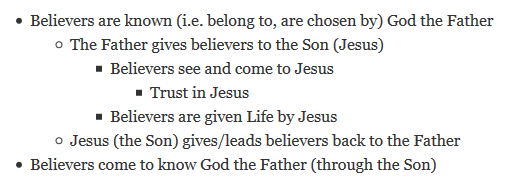
In terms of obtaining this knowledge, and thus possessing (“holding”) eternal Life, the order has to be reversed (cf. 1:18; 14:6-11, etc):

    1. One sees/knows Jesus (the Son)—i.e. recognizes and trusts in him
    2. One sees/knows God the Father through the Son

The theological framework of the Gospel of John can be outlined in more detail:

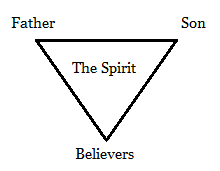
Thus the emphasis on knowledge in 17:3 can be misleading, if we think of it in terms of ordinary human knowledge and perception. Rather, in the Gospel of John, and much of the New Testament elsewhere, a deeper kind of theological and spiritual understanding is meant—centered on trust in Jesus and the presence of both the Son (Jesus) and the Father through the Holy Spirit. The Spirit is not mentioned directly in the prayer-discourse of chapter 17, but it can be inferred from the theme of unity (esp. verses 20-24) and the triadic relationship of Father-Son-Believer(s):

Mention should be made of the specific title xristo/$ (“Anointed [One]”). Though the Johannine portrait of Jesus goes far beyond the traditional Jewish conception(s) of the Anointed One (Messiah), it retains the title and the fundamental identification of Jesus with the Messianic figure-types—Prophet, Davidic Ruler, and also “Son of Man” (on these, cf. the series “Yeshua the Anointed”). The association of the titles “Anointed One” and “Son of God” goes back to the early Gospel traditions (in the Baptism and Passion/crucifixion scenes, etc), and, while the latter title (i.e. Jesus as God’s Son) dominates the Gospel of John, the former is certainly not forgotten. True knowledge of Jesus—the knowledge which is the same as Life—includes recognition that he is the Anointed One of God. The closing words of the Gospel proper give unmistakable expression to this fact:

“These (thing)s have been written (so) that you might trust that Yeshua is the Anointed One, the Son of God, and that, trusting, you would hold Life in his name.” (20:31)

“…Spirit and Life”: John 12:50

John 12:50

Today’s note involves the final, concluding verse to the first half of the Gospel of John (1:19-12:50). It belongs to the last discourse of Jesus in this section. The discourse, properly speaking, spans verses 20-36a of chapter 12. Verses 36b-43 serve as the narrative conclusion, both to the discourse-scene of chap. 12, as well as chapters 2-12 as a whole. In verse 36 it is stated that Jesus “…going away, hid (himself) from them”. In the narrative context, this means that Jesus has left the public scene in Jerusalem, away from the people. Though some did come to believe in him, the majority did not, as vv. 37-43 make clear. With Jesus having thus departed, the words in vv. 44-50 are lacking any definite historical-narrative setting. They are detached, and function in the narrative as a climactic statement (and summary) of Jesus’ teaching, with a number of themes and motifs from the earlier discourses (chaps. 3-10) being reprised and restated. Verses 44-50 may be divided into two portions, which I outline here as a chiasm:

    • Trusting in Jesus = trusting the One who sent him (v. 44)
      —Seeing Jesus, who is the Light (vv. 45-46)
      —Hearing Jesus’ words, which brings salvation from Judgment (vv. 47-48)
    • God the Father sent Jesus—trusting in him is Life (vv. 49-50)

The motifs of seeing and hearing, both frequent in the Gospel, serve as two different ways of expressing the idea of trusting in Jesus. In reference to hearing Jesus—that is, hearing his words or voice—the noun e)ntolh/ is introduced in verse 49. This word is often translated as “commandment”, which can be somewhat misleading. However, it does preserve the basic association with the Old Testament Law (Torah). The language Jesus uses relates back to the covenantal language of the Torah, especially in the book of Deuteronomy (e.g., 31:19ff; 32:46-47)—”If any (one) should hear my utterances [i.e. words] and would not guard/keep them…” (v. 47a). The failure to keep/guard Jesus’ words is effectively the same as failure (by Israel) to keep the commands and precepts of the Torah, thus violating the covenant (agreement) with God. Such failure is presented as evidence against the person in the time of Judgment:

“The one setting me aside [i.e. rejecting me] and not receiving my utterances [i.e. words] has the one judging him: the word/account [lo/go$] which I have spoken—that will judge him in the last day.” (v. 48)

This brings us to verse 49, where Jesus gives us more detail about the word[s] which he speaks:

“(For it is) that I did not speak out of myself, but the (one) sending me, the Father, he has given me an e)ntolh/—what I should say and what I should speak.”

The closing words in verse 50 repeat this statement: “Therefore the (thing)s which I spoke, even as the Father has said to me, so I spoke”. It is important to consider the syntax and context here carefully, to avoid misunderstanding about the meaning and significance of the word e)ntolh/. Jesus says, “the Father…has given me an e)ntolh/—what I should say and what I should speak”. The Greek noun e)ntolh/ (entol¢¡) is derived from the verb e)nte/llomai (entéllomai), and fundamentally refers to something (a duty, etc) given (placed on) a person to complete, sometimes in the technical sense of a “commission”. When we use the word commandment this tends to be understood as a religious or ethical injunction, but that is not really the meaning here; rather, we should render e)ntolh/ in its basic meaning: “the Father has given me a (charge/duty) laid on (me) to complete…”. This relates to the mission and purpose for which Jesus was sent (into the world) by the Father. As the Son, Jesus imitates and repeats what he sees and hears the Father saying and doing—a theme which runs throughout the Johannine discourses. Ultimately the task given by Jesus to accomplish is his sacrificial death, as is strikingly clear in his final words on the cross: “it has been completed [tete/lestai]” (19:30, cf. also v. 28).

Here in 12:47-50, however, the emphasis is on Jesus’ words—using both the plural r(h/mata (“utterances”, i.e. spoken words, vv. 47-48) and the singular lo/go$ (“account”, i.e. his gathered words, v. 48b). Both terms appear frequently (and more or less interchangeably) in the Gospel. Jesus himself is identified with the Living and eternal Word (Lo/go$) of God in the Prologue (vv. 1-4ff), and we must always keep this theological/Christological aspect in mind when reading about Jesus’ “words” elsewhere in the Gospel. A person’s response to Jesus’ words is essentially a response to Jesus himself (and to God the Father who sent him). This is expressed two ways in vv. 47-48, as we have seen:

    • hearing (vb. a)kou/w) him and keeping/guarding (vb. fula/ssw) his words (v. 47)
    • receiving (lamba/nwn) his words (v. 48)

The motifs of hearing and receiving are essentially parallel:

    • hearing—i.e. both listening and responding (obeying/accepting)
      —keeping (watch) over / guarding
    • receiving—i.e. taking in and accepting

This does not refer simply to obeying something Jesus tells his disciples to do, but involves the broader (and deeper) sense of accepting who Jesus is and what he says. I mentioned the allusions to the book of Deuteronomy in 12:44-50, and this includes the famous passage in 18:15-19, which relates to a coming Prophet (cf. Jn 1:21, 25; 6:14; 7:40) who will essentially fill Moses’ role. The words of this Prophet hold the same authority and weight as the Instruction (Torah) given by God through Moses (vv. 18-19). It is said that God will raise up this Prophet, and early Christians saw Jesus as filling the divinely appointed (and anointed, i.e. Messianic) role (Acts 3:22-23). This also reflects the fundamental meaning of the word e)ntolh/, as I discussed above.

Finally, we must consider Jesus’ statement in verse 50a:

“And I have seen [i.e. known] that His e)ntolh/ is (the) Life of the Age.”

The precise meaning of this statement requires special examination, which I will do in the next note.

Notes on Prayer: John 17:24-26

John 17:24-26

With verses 24-26 we come to the end of our study of the great Prayer-Discourse of Jesus in John 17. These verses conclude the exposition section that makes up the body of the Prayer (in relation to the Discourse-format), as well as the Prayer itself. It contains most of the key words and ideas found throughout the chapter, serving as a summary of the theology expressed therein. It also forms an inclusio with the first portion of the Prayer, with the dual address to God the Father; note the parallel:

    • “Father” / “Holy Father” (vv. 1, 11)
    • “Father” / “Just/Righteous Father” (vv. 24-25)

In particular, the address in verse 11b (“Holy Father… [pa/ter a%gie]”) marks the beginning of the exposition, which is bracketed here in vv. 24ff. There is a formal parallel between v. 11b and verse 24 (note the italicized portion):

“Holy Father, may you keep watch (over) them in your name which you have given to me, that they would be one just as we (are).” (v. 11b)

“Father, (that) which you have given to me, I wish that, where(ever) I am, they also would be with me…” (v. 24a)

A principal theme in the Prayer is the idea that God the Father has given (vb. di/dwmi, in the perfect). This verbal expression has two points of reference, and there is a play between them:

    • The Father has given his (own Divine) name, glory, etc, to the Son
    • The Father has given the disciples (i.e. believers, the Elect) to the Son

Verse 24 again contains both aspects:

“Father, (that) which you have given [de/dwka$] to me, I wish that, where(ever) I am, they also would be with me, (so) that they would look (upon) my honor which you have given [de/dwka$] to me, (in) that you loved me before the casting-down of the world.”

The parallel is precise, differing only in the gender of the relative pronoun:

    • “which [neut.] you have given to me” (o^ de/dwka/$ moi)
    • “which [fem.] you have given to me” (h^n de/dwka/$ moi)

The use of the neuter pronoun seems to have caused some difficulty for early copyists, as it was widely changed to the masculine plural ou%$, so as to agree with the subject “they” (i.e. disciples/believers). The neuter actually refers back to the beginning of the Prayer, in verse 2:

“…just as you gave him [i.e. the Son] authority over all flesh, (so) that, (for) all which you have given to him, he would give to them (the) Life of the Age [i.e. eternal life]”

Compare the italicized phrase with that in v. 24:

    • “all which you have given to him” (pa=n o^ de/dwka/$ au)tw=|)
    • “which you have given to me” (o^ de/dwka/$ au)tw=|)

Clearly, the neuter pronoun refers to neuter substantive pa=n (“all”)—that is, the disciples (believers) considered as a collective whole, or unity; given the emphasis in vv. 20-23 (cf. the previous study), this is unquestionably the focus here as well. The following phrases in vv. 2 and 24 also match, and are more or less synonymous:

    • “(that) he [i.e. the Son] would give to them (the) Life of the Age”
    • “that where I am, they also would be with me”

In other words, to be with Jesus (the Son) is the same as possessing eternal life. More to the point, this is expressed in verse 24 by a subjunctive form (w@sin) of the verb of being (ei)mi); this is obscured somewhat in English translation, but is clear and vivid if we examine the conditional clause in the Greek:

i%na o%pou ei)mi e)gw\ ka)kei=noi w@sin met’ e)mou=
“that where I am, they also would be with me”

Note the structure, presented as concentric pairs:

    • o%pou (“where [I am]”)
      • ei)mi (“I am”)
        • e)gw/ (“I”)
        • ka)kei=noi (“they also”)
      • w@sin (“they would be”)
    • met’ e)mou= (“with me”)

The indicative statement by Jesus (e)gw\ ei)mi, “I am”) has special significance in the Gospel of John, being used (by Jesus) repeatedly to express his identity (as the Son) and relationship to God (the Father). Here, in the closing portions of the Prayer, Jesus’ desire is that all believers would share in the same divine identity/relationship which he has with the Father; this is the very point made throughout vv. 20-23 (and again in vv. 25-26, cf. below), and gives equal significance to the subjunctive w@sin (“they would be”, used also in vv. 19, 21-23): that believers “would be” what Jesus “is”. In this regard, a point should be made on the coordinating particle o%pou, which itself functions as a relative pronoun; though difficult to render exactly in English, it is something like “a certain (place) in which”, and may be translated fairly as “where” or “wherever”. It is an ordinary enough word, but it comes to have a special theological (and Christological) meaning in the Gospel of John, taking on this significance in the second half of the book. This “where” or “place in which” refers consistently to Jesus’ return back to the Father, and, as such, effectively confirms his identity as the (pre-existent) Son of God. The first occurrence of this usage is in the great Sukkoth discourse of chapters 7-8, where it appears in two related declarations by Jesus (each of which is repeated):

    • “where I am [o%pou ei)mi e)gw\], you are not able to come (there)” (7:34, 36)
    • “where I go under [o%pou e)gw\ u(pa/gw], you are not able to come (there)” (8:21-22)

These statements are given to the public at large (and to Jesus’ opponents), but in the Last Discourse, he essentially re-states them for his disciples:

    • “where I go under [o%pou e)gw\ u(pa/gw], you are not able to come (there)” (13:33, 36)

Jesus’ departure (vb. u(pa/gw, “lead/go under”, i.e. go away, withdraw, go back) encompasses both his death and final return to the Father. In 13:33, 36, the former is in view, while it is the latter in 14:3-4:

    • “…that where I am [o%pou ei)mi e)gw\], you also may be.
      And where I go under [o%pou e)gw\ u(pa/gw], you see [i.e. know] the way (there).”

Before the Last Discourse, the disciples (represented by Peter, 13:36ff) are unable to come to the place where Jesus is (with the Father), but the promise is that they will be able to, and much of the Last Discourse is centered on this revelatory point. The declaration in 14:4, that the disciples “see/know the way (there)”, leads to the revelation that Jesus himself is the way (o(do/$) to the Father (v. 6). In this light, let us compare three key statements where the particle o%pou is used:

    • 12:26: “If any (one) would serve me, he must follow me, and (then) where I am [o%pou ei)mi e)gw\] my servant also will be.”
    • 14:3: “If I travel (away) and make ready a place for you, I will…take you along toward me (myself), (so) that where I am [o%pou ei)mi e)gw\] you also may be.”
    • 17:24: “Father…I wish [i.e. it is my will] that, where I am [o%pou ei)mi e)gw\] they also would be with me”

The statements are similar, both in form and meaning, but they reflect a development of thought within the (narrative) context of the Gospel:

    • 12:26—Believers (the Elect) coming to be disciples of Jesus
    • 14:3—The Departure of Jesus (the Son), which allows his disciples (believers) to come along (with him) to the Father
    • 17:24—The essential identity (and unity) of Believers (all Believers), that they/we will ultimately be with Jesus, together with the Father

We move from (1) being/becoming disciples, to (2) the eschatological promise of our presence (with Jesus) in heaven, and finally (3) of our fundamental union with Christ. The purpose of our being with Jesus is expressed in the second half of verse 24:

“…that they would look (upon) [qewrw=sin] my honor [do/ca] which you have given to me”

The verb qewre/w, which can have the sense of “look with wonder (at), behold” (sometimes in a religious setting), is relatively frequent in the Gospel of John, occurring 24 times, and often in the context of believers trusting in Jesus and coming to knowledge of the truth (6:40, 62; 12:45), which involves a recognition of who Jesus truly is. It is especially important in the Last Discourse (14:17, 19; 16:10, 16-17, 19), where it expresses two themes of contrast:

    • The disciples soon will not see Jesus any more (on earth), but will soon see him again; this theme has two primary aspects:
      (1) they will see him again after his death (resurrection appearances)
      (2) they will see him again after his departure to the Father (presence of the Spirit/Paraclete)
    • The disciples can see/recognize Jesus, but the world cannot

Both of these themes continue on, in various ways, within the chapter 17 Prayer-Discourse, especially the contrast between believers and the world. The ability to “see” or “look upon” Jesus, from the standpoint of Johannine theology, means to recognize (and trust in) his identity as Son of God, as the one sent by the Father. This identity includes the idea of divine pre-existence, indicated earlier in verse 5, and again here. Evidence for belief in Jesus’ pre-existence is actually quite rare in the New Testament, in spite of its importance for orthodox Christology. The belief, however, is clear and unmistakable in the Gospel of John, being affirmed (in majestic terms) in the Prologue (1:1ff), and again at various points throughout the Gospel. Jesus’ departure means a return to the Father, back the place where he was in the beginning, before the world was created. Note this point made, at both the start and end of the Prayer, in terms of (1) the do/ca (“honor, splendor”) Jesus shares with the Father, and (2) in relation to the world (ko/smo$):

    • “the honor/splendor which I held alongside of you before the (com)ing to be of the world” (v. 5)
    • “my honor/splendor which you have given to me, (in) that you loved me before the casting-down [katabolh=$, i.e. founding] of the world” (v. 24)

The (dualistic) contrast between Jesus and the world is fundamentally based on his pre-existence, his eternal identity as God’s Son—he comes from above, sent by the Father to the world below. It is for this reason that the world is unable to see (recognize) or hear (accept) him; only the Elect/Chosen ones (believers) are able to see and hear. They recognize his identity as Son (and thus see the Father), but remain unable to perceive this divine honor/splendor in its fullness; it will only become manifest when they/we are finally with Jesus (in heaven) with God the Father.

Verses 25-26, even more than v. 24, bring together all of themes and motifs of the Prayer—and, indeed, the Discourses of Jesus as a whole—and deserve an extended discussion in their own right. I will be posting this, as a supplement, later this week.

May 20: Matthew 28:18-20 (concluded)

Matthew 28:18-20 (concluded)

In yesterday’s note I looked at the specific phrase “baptizing them into the name of [ei)$ to\ o&noma tou=]…”; today, I will proceed to examine the trinitarian phrase which follows: “…of the Father and of the Son and of the holy Spirit“. Given the emphasis on baptism in the name of Jesus in the earliest Christian period (cf. the previous note), and based on the other sayings preserved in the Gospels, we might expect Jesus to have said simply, “…baptizing them into my name“. Many critical commentators consider the apparent trinitarian construct here to be a somewhat later formula retrojected into the words of the historical Jesus. This possibility will be addressed briefly after an examination of each portion of the three-fold phrase.

“of the Father” [tou= patro\$]

That Jesus would reference the Father in his final words to his disciples is hardly unusual, since God as Father was a central element of his teaching, as recorded throughout the Gospel Tradition. The idea, of course, is ancient, going back to Old Testament and Israelite tradition (Ex 4:22; Deut 32:6; Ps 89:26; Isa 1:2; 63:16; 64:8; Hos 11:1; Jer 3:19; 31:9; Mal 2:10, etc), and even earlier—virtually a universal religious concept. Jesus makes frequent use of the title “Father”—both in his own address to God, and in instruction to his followers—too many to list here, there being nearly 200 occurrences in the Gospels. Perhaps the most famous and well-known instance is to found in the Lord’s Prayer (Matt 6:9 / Lk 11:2), a passage which specifically refers to the Father’s name. There are an especially high number of references to the Father in Matthew—notably in the Sermon on the Mount (Matt 5-7, cf. 5:16, 45, 48; 6:1, etc), but elsewhere through the Gospel as well (Matt 10:20, 29, 33; 12:50; 13:43; 15:13; 16:17, 27, et al). An even more distinctive (and frequent) use of “(my) Father” is found in the Discourses of Jesus in the Gospel of John (more than 100 references), including several sayings which specifically relate to the name of the Father:

    • John 5:43; 10:3, 25—Jesus claims to have come in the Father’s name, working (miracles, etc) in His name; cf. also Jn 12:13 par
    • John 12:28—Jesus asks the Father to make His name honored/esteemed (i.e. glorified) through the Son
    • John 17—In the great prayer that concludes the Discourses of chaps. 13-17, Jesus declares that he has manifested and made known the Father’s name to his disciples (vv. 6, 26), and prays that they continue to be kept/guarded in His name (vv. 11-12)

There are also sayings which express the other side of the reciprocal relationship between Father and Son, where Jesus instructs his followers that, when they pray and bring petition to the Father, they should specifically make the request “in my name”—cf. John 14:13-14; 15:16; 16:23—the idea being that Jesus will be working/acting on their behalf with the Father. For indication of a similar relationship between Father and Son (Jesus) in the Synoptic Gospels, cf. Matt 11:25-27 par; Mark 13:32 par; 14:36. Especially significant are the sayings which connect Father, Son and Holy Spirit in the Gospel of John (cf. below).

References to God as Father are rather less frequent in the remainder of the New Testament. Paul often sets “God the Father” parallel with “the Lord Jesus Christ” in a basic creedal construction (Rom 1:7; 15:6; 1 Cor 1:3; 8:6; 2 Cor 1:2-3; 11:31; Gal 1:3f; Phil 1:2; 1 Thess 1:1; 3:11, 13; 2 Thess 1:1-2; 2:16; Philem 3; Col 1:3; 3:17; also Eph 1:2-3, 17; 5:20; 6:23, etc); and there are several other passages which reflect basic theological or Christological formulae (e.g., 1 Pet 1:2-3; Jude 1; Rev 1:6; and cf. throughout 1 John). However, with regard to the baptism formula in Matt 28:19, it is worth noting that: (a) there is virtually no reference to the name of the Father in the New Testament outside of the sayings by Jesus referenced above, and (b) there is no evidence that early believers were ever baptized “in the name of the Father”.

On the first point, from the traditional Israelite/Jewish point of view, the name of God the Father was YHWH/Yahweh, which, as Christianity spread among Greek-speakers, was typically expressed by the title “Lord” (Ku/rio$). Gradually, this title was applied more and more to Jesus, and its distinctive association with YHWH was largely lost to believers in the Greco-Roman world. As we have already seen, it was the name of Jesus that was of primary importance for early believers.

“of the Son” [tou= ui(ou=]

Every relevant passage in the New Testament refers to baptism in the name of Jesus (cf. the discussion in the previous note). Now, early Christians would automatically understand that being baptized into Jesus (or into his name) meant the same as being baptized into the Son; however, if we accept the authenticity of Matt 28:19, it is worth considering precisely what Jesus would have meant here by “Son”.

In the (Synoptic) Gospels, Jesus never uses the title “Son of God” of himself (only in Jn 3:18; 5:25; 9:35 v.l.; 10:36; 11:4)—it is applied to him by others (also Jn 1:34, 49; 11:27; 19:7), though there is no indication that he ever denied or contradicted its use (cf. Mark 14:62 for a relatively clear affirmation; but cp. Matt 26:64; Lk 22:67-70). In the sayings of the Synoptic Tradition, Jesus typically refers to himself by the Semitic expression “Son of Man”, which at times may be partially synonymous with “Anointed One” (Messiah), and, in certain passages, serves to identify Jesus as God’s heavenly representative (cf. Dan 7:13-14) who will appear at the end-time; but it always has a distinct range of meaning from “Son of God”. At best, there is an association between Jesus as “Son of Man” and “Son of God” in the juxtaposition of Mk 14:61-62a and 14:62b (par); which can also be inferred in the vision of Stephen in Acts 7:56. The “Son of Man” sayings in the Gospel of John are unique in that they express (or assume) the idea of Jesus’ pre-existent deity—i.e., he is the Son who has come down from the Father (as the Son of Man); following his death and exaltation (glorification), he will return to the Father in heaven (Jn 1:51; 3:13-14; 6:27, 62; 8:28; 12:23, 34; 13:31). Elsewhere in John, Jesus simply refers to himself as “the Son”, usually in the context of his relationship to the Father (cf. above)—Jn 3:16-17, 35-36; 5:19-27; 6:40; 8:36-38; 14:13; 17:1; note also 1:14.

If Matt 28:19 is interpreted as a Christian formula, then it need not mean anything more than that the specific words “in the name of the Son”, etc, are to be recited in the performance of baptism (cf. below). Even so, it is worth noting, that this formula is never used elsewhere in the New Testament—believers are baptized “in the name of Jesus”, but never “in the name of the Son“. Indeed the very expression “name of the Son” is extremely rare, occurring only in the Johannine tradition—Jn 3:18; 1 Jn 3:23; 5:13, and cf. also Jn 20:31—where the emphasis is entirely on faith/trust in the name of the Son.

“of the holy Spirit” [tou= a(gi/ou pneu/mato$]

There is a clear association of the Spirit with the rite of baptism in early Christian tradition, as indicated in the book of Acts (cf. Acts 2:38-41; 8:12-17; 9:17-18; 10:44-48; 11:15-17; 19:2-6), where believers receive the Holy Spirit as an event parallel to, and coordinate with, the symbolic act of baptism. This clearly is understood as a fulfillment of the prediction uttered by John the Baptist (and/or Jesus himself) that, just as John baptized in water, so Jesus would baptize believers in the Holy Spirit (cf. the earlier note on Mark 1:8 par; Jn 1:26, 31, 33; Acts 1:5; 11:16). According to this parallel, the Spirit is symbolized by water, which is a relatively common motif in the Old Testament (cf. Joel 2:28ff, cited in Acts 2:17-18, 33—the Spirit “poured out” like water). Elsewhere in the New Testament (in Paul’s letters), the regular idiom is baptism into Christ—his death, his body, his name, etc. Paul generally does not associate the Spirit specifically with baptism, though the idea is certainly implied (cf. Rom 6:4; Gal 3:27); only in 1 Cor 12:13 is this made explicit—”for in one Spirit we are all dunked [i.e. baptized] into one Body”. Note the chiastic parallel in the syntax of the phrase:

    • in [e)n] one Spirit (i.e. the Holy Spirit)
      —we are all dunked/baptized
    • into [ei)$] one Body (i.e. the person of Jesus Christ, symbolized by the Community)

This effectively results in a two-fold baptismal ‘formula’, which could easily be supplemented by the (proto-)Trinitarian syntax in the earlier verses 4-6:

    • the same Spirit (v. 4)
    • the same Lord [i.e. Jesus, the Son] (v. 5)
    • the same God [i.e. the Father] (v. 6)

Again, as in the case of “the Father” and “the Son” (cf. above), believers in the New Testament are never baptized “in the name of the Holy Spirit”; indeed, the expression “name of the (holy) Spirit” never occurs outside of Matt 28:19. At best, there are several passages in which the Spirit is associated specifically with “the name of Jesus“—Acts 2:38; 1 Cor 6:11; 1 Pet 4:14; and, most notably, John 14:26. Of these, only Acts 2:38 has the context of baptism, but Jn 14:26 is certainly more relevant to a ‘trinitarian’ formulation: “…the holy Spirit, whom the Father will send in my [i.e. the Son’s] name“. This verse will be discussed, along with the other Spirit/Paraclete references (Jn 14:16; 15:26; 16:7), in an upcoming note.

The Didache 7

A study of Matt 28:19 cannot be complete without consideration of the similar formula in Didache 7:1, part of a brief instruction in chapter 7 regarding baptism. Verse 1 reads:

“…having said all these things before(hand) [i.e. informed/instructed the believer], ‘dunk [i.e. baptize] into the name of the Father and of the Son and of the holy Spirit’ in living [i.e. fresh, running] water”

The portion in single quotes is virtually identical with the formula in Matthew; only the form of the verb is different, as befitting the context. The main critical question is: Does the Didache simply quote Matthew 28:19, or does it preserve a separate version of the instruction, transmitted independently? If the latter, does this come down as an authentic saying from Jesus, or as an (apostolic) tradition? Unfortunately, the writings of the so-called Apostolic Fathers (c. 90-150) often do not give specific citations, so it can be difficult to know for certain if the authors are citing from a written Gospel (e.g. Matthew) or have preserved sayings of Jesus and Gospel traditions independently. The date assigned for the Didache (“Teaching [of the Twelve Apostles]”) has ranged from very early (1st century) to very late (3rd-4th century); most (critical) commentators today would place it in the first half of the 2nd century, with the possibility that it preserves teaching and tradition from the late 1st century (c. 70-100 A.D.). What is important to note, is that already by this time (c. 80-110 A.D.?), the passage corresponding to Matt 28:19 has come to be treated as a fixed formula. The Didache indicates that it would be recited as part of the baptism ritual, as the three-fold act mentioned in 7:3 demonstrates. A similar practice is attested in the second and third centuries (Justin, First Apology 61; Tertullian, Against Praxeas 26; Apostolic Constitutions 8:47 [canon 50]). As we have noted above, this contrasts with early Christian tradition recorded in the New Testament, where believers were, it would seem, only baptized “in the name of Jesus”. The traditions recorded in the book of Acts, if authentic, date from c. 30-60 (with the book itself completed some time after 70 A.D.), making them considerably earlier than the earliest date usually given for the Didache.

A final comment on the authenticity of Matt 28:19 must wait until we have considered the other post-resurrection Commission passages in the Gospels, especially that in Luke 24:45-49, which I will do in the next daily note.