September 15: Revelation 2:8-11

Revelation 2:8-11

Today’s note deals with the second of the letters in chapters 2-3—to the believers in Smyrna, “(city of) myrrh [smu/rna] (?)”, modern Izmir, one of the major cities in Roman Asia (approx. 40 miles N. of Ephesus). The epistolary format used in these letters was discussed in a previous note; here I will be discussing only those details which are distinctive of the second letter.

Rev 2:8b

“These (things are) said (by) the (one who is) the first and the last, who came to be dead and was (made) alive”

The introduction (to Jesus) in each letter includes titles and phrases characteristic of the risen/exalted Jesus, reflecting attributes of deity. They are drawn from the vision in 1:11-16ff—here the titles repeat the declaration in vv. 17b-18a (cf. the note on these).

Rev 2:9

The body of the main address (from the risen Jesus) here is found in vv. 9-10. Unlike most of the other letters, it is not a mixed message (praise and blame), but is entirely one of praise and exhortation. This seems to reflect a degree of persecution faced by the congregations in Smyrna, which was not faced, to the same extent, by believers in the other cities. This is presented dramatically by the first statement (in verse 9):

“I have seen your (di)stress and poverty—but you are (in fact) rich!—and the insult(s) [blasfhmi/a] (coming) out of the (one)s counting themselves to be Yehudeans [i.e. Jews], and (yet) are not, but (are actually) a gathering together [sunagwgh/] of the Satan.”

The suffering of the believers in Smyrna is due to two factors: (1) distress/pressure (qli/yi$), i.e. from outside forces, and (2) poverty (ptwxei/a). This latter term means that they are poor in a material (and/or socio-cultural) sense, while actually being rich (plou/sio$) in the eyes of God (i.e. in a spiritual sense). Both factors are relevant, since believers with a higher socio-economic status generally are less likely to endure suffering and persecution.

While the difficulties for the congregations in Ephesus are described as coming from ‘false’ Christians, the suffering in Smyrna is the result of attacks from the Jewish communities in the city. This, of course, is familiar from the accounts of Paul’s missionary work in the book of Acts (9:23-25; 13:45ff; 14:5, 19; 17:5-8, etc), and confirmed at several points in his letters (e.g., 1 Thess 2:14-16). For Christians today, especially those in the Western nations, the descriptions in the New Testament of Jewish/Christian hostility, with corresponding anti-Jewish statements, can be most troubling, in light of the long and tragic history of ‘Christian’ persecution against Jews. However, this should not cause us to ignore or gloss over the historical reality of another time and place. There were genuine conflicts between early Christians (many of whom were Jewish) and certain segments within Judaism.

Here the Jewish attacks are described as blasfhmi/a (“insult”), a word which often is used in a religious context (i.e. insult against God), as preserved in English by the transliterated form “blasphemy”. There can be no doubt that the religious connotation is intended here; any attack against believers in Christ is effectively an insult (i.e. blasphemy) against God. The grim irony is that Jews who attack believers, perhaps fueled by a sense of religious devotion, are actually committing “blasphemy” and insulting God Himself. We do not know the specific details related to this “insult”, but it may have involved the denouncing of Christians to the provincial (imperial) authorities, which could then lead to interrogation, imprisonment, etc. The context of verse 10 suggests that this is likely the case.

The Jews who insult/blaspheme in this way are considered to be false Jews, just like the would-be apostles in vv. 2-3. The same sort of derisive language is used: “the (one)s counting themselves to be Jews, and (yet) are not”, i.e. they are not truly Jews (cf. Rom 2:17ff, 28-29). There is no real reason to doubt that such persons were genuinely Jews from a religious-cultural standpoint. The basic idea being expressed, almost certainly, is that those who attack believers in Christ, rejecting Jesus as the Anointed One and Son of God, have departed from the true Israelite/Jewish religion. This would be all the more likely if the “insult” involved denouncing believers to the Roman authorities. The question of religious identity, for both Jews and Christians of the period, was complex and difficult. Most of the earliest Christians came out of a Jewish religious-cultural background, and yet lines of conflict and separation were present almost immediately. We know of this conflict best from the account of the Jerusalem Council in Acts 15 (cf. also chaps. 10-11 and 21:17-26), and from many passages in Paul’s letters (esp. throughout Romans, and most of Galatians). The declaration in v. 9b is sharped with the concluding words, that these ‘false’ Jews are actually “a gathering together of the Satan”. The word sunagwgh/ (lit. “leading/bringing together”) is, of course, the typical term for a Jewish religious gathering and/or place of worship, transliterated in English as “synogogue”. Parallels for this expression are found in the Qumran texts, such as 1QH X.22 (“assembly of Belial”); 1QM 15:9; 1QH XIV.5; XV.34 (“assembly of wickedness”, etc). Cf. Koester, pp. 274-6.

This language is repeated in 3:9, which will be discussed in turn.

Rev 2:10

The statement(s) in this verse function as a prophecy (foretelling) of what believers in Smyrna will soon experience:

“Fear none of the (thing)s which you are about to suffer. See, the one casting (evil) throughout [dia/bolo$, i.e. the Devil] is about to cast [ba/llein] you into a (prison) guard (so) that you might be tested, and you will have ten days of (di)stress.”

This clearly indicates that believers will be put in prison, probably for the purposes of interrogation rather than as a term of punishment. The delimitation of “ten days” is most likely a figurative approximation, symbolizing a definite (though relatively short) period of time (Gen 24:55; Num 11:19, etc). A motif of ten days of “testing” is found in Daniel 1:12ff (Koester, p. 277). In light of this impending suffering, Jesus, in his message, provides a special word of exhortation:

“You must come to be trust(worthy) [i.e. faithful] until death, and I will give you the Crown of Life.”

A special honor is given to the one who endures suffering for Jesus’ sake to the point of death. The “crown” (ste/fano$), or wreath, typically woven out of laurel leaves, etc, in the context of Greco-Roman culture, is given as an honor to one who is victorious in competition (i.e., athletics, military battle) or who has given distinguished service to the people. The word (and concept) appears seven more times in the book of Revelation (3:11, etc), and is used occasionally by Paul (1 Cor 9:25; Phil 4:1; 1 Thess 2:19), and elsewhere in the New Testament (e.g., 1 Peter 5:4, “crown of honor/glory”).

Rev 2:11

The concluding exhortation/promise in the letters always begins: “[To] the (one) being [i.e. who is] victorious…”, followed by a description of the (heavenly) reward the believer will receive, after death, or at the end-time following the Judgment. Here the promise is related to the idea that some believers in Smyrna (and elsewhere in Asia Minor) will face death for Christ’s sake in this life:

“The (one) being victorious would not suffer injustice [i.e. injury] out of the second death.”

Being put to death as a Christian involves a terrible injustice (a)diki/a, lit. without justice); yet, the believer in Christ has the comfort and security of knowing that he/she will not be harmed in any way (i.e. suffer no injury [a)diki/a]) by the “second death”. This expression is eschatological, conveying the idea that there is final death for the entire person (the soul, etc), which follows the physical death (of the body). According to a traditional line of Jewish thought (fairly common, it would seem, at the time), at the end, those who are dead (righteous and wicked both) will be raised and enter into God’s Judgment. The righteous would enter into the blessed (heavenly/divine) or “eternal” Life, while the wicked would experience the opposite. The latter is depicted most dramatically in Rev 20:11-15; 21:7-8.

September 14: Revelation 2:1-7, cont.

Revelation 2:1-7 (continued)

The letter to the Christians of Ephesus was discussed in the previous note, along with a summary of the basic format used in each of the seven letters. Today, we will be looking at the elements and details which are distinct to the first letter, found in the main address (vv. 2-6) and the concluding exhortation (v. 7b).

Rev 2:2-3

The “works” (e&rga) of the Ephesian believers which are praised by Jesus are characterized as: (a) sharp pain (ko/po$) from work/labor, etc, and (b) endurance (lit. “remaining under”, u(pomonh/). Both terms indicate a degree of suffering on behalf of Jesus Christ (and the word of God, etc). This is repeated, with a bit of wordplay, in verse 3:

“…and you hold (yourself) remaining under [i.e. with endurance], and have borne/carried (this) through my name and you have not been pained [kekopi/ake$] (by it).”

Their suffering and enduring is “through the name” of Jesus—that is, for his sake. The nature (and cause) of this suffering is explained in verse 2:

“you are not able to bear bad (men), and (indeed) you tested the (one)s counting themselves (as) ones sent forth [i.e. apostles], but are not, and found them (to be) false”

The issue here involves persons claiming to be apostles. For early believers, before there was a set of Christian Scriptures at hand in every congregation, authoritative instruction, etc, was done by local teachers and prophets, as well as by missionaries and other traveling ministers. The latter proved especially problematic for many of the early congregations. At a time when all communication had to be done by personal visits and letters delivered by messengers, it could be difficult to validate the claims (and pedigree/legitimacy, etc) of traveling ministers. The work known as the Didache (late-1st/early-2nd century?) offers some practical guidance on how to handle this (chaps. 11-13). A different approach is taken in the Letters of John, where the Spirit is the main source of teaching. The conflict in 1 and 2 John is related primarily to specific views regarding the person and work of Jesus. The “spirits” of ministers (i.e. by which they speak) are to be tested against the voice of the Spirit which corresponds to established truth/belief regarding Jesus (1 Jn 2:18-24; 4:1-6; 2 Jn 7-11; cf. also 5:6-10). In particular, 2 Jn 8-11 warns congregations against taking in ministers who hold this ‘false’ view of Jesus, persons characterized as “antichrist” (1 Jn 2:18; 2 Jn 7). Paul, too, in his letters, struggles against ‘opponents’ who are regarded as apostles, or who consider themselves to be apostles (esp. in 2 Cor 10-13 [11:13; 12:12]).

Here the text declares that the Ephesian believers tested certain would-be apostles. We do not know precisely what was involved in this “testing”, but presumably it occurred over a period of time, and would seem to have involved considerable challenge and difficulty for the congregations in the city. Nor do we really have any knowledge as to what these would-be apostles taught or said, other than their claim to be apostles. It is possible that they may be connected with the Nikolaitans (cf. below). The only detail we have in the text is that the Ephesian Christians “found them to be false [yeudh/$]”. We can assume this means that the believers in Ephesus (most of them, at any rate), ultimately did not accept the claims and teachings of these ministers.

Rev 2:4-5

If the Ephesian churches proved to sound in doctrine (i.e. testing the claims/teachings of ‘false’ apostles), the mark against them involves their love. This seems to reflect the two-fold “commandment”, or duty of believers, which defines (true) Christian identity—(1) trust in Jesus Christ, and (2) love for one another—and which is a distinctive emphasis in the Johannine writings (1 Jn 3:23-24, etc). Here it is stated regarding the believers in Ephesus:

“you (have) left [a)fh/ke$] your love th(at you had at) first”

The expression h( a)ga/ph sou h( prw/th may be translated “your first love”, but is better understood as “the love you had at first”. Within the Johannine tradition, love is defined primarily as sacrificial love expressed on behalf of fellow believers, following the example of Jesus (Jn 13:1, 34-35; 15:12-13ff, etc). This may entail specific acts of care and provision (1 Jn 3:16-18), but ultimately must be understood in the broader sense of our unity with one another in Christ (1 Jn 2:7-10; 3:10-11ff, 23-24; 4:20-21; 5:1-3). Division and sectarian interest disrupts this unity and is effectively a sign of a lack of love (1 Jn 2:19; 4:3-6ff). It is not entirely clear, however, whether (or to what extent) the statement in Rev 2:4 reflects this line of tradition. If it does refer to a lack of proper love being shown to other believers (in whatever way this is manifested), it is treated as a most serious flaw or sin, as the warning in verse 5 makes clear:

“You must remember, then, from where you have fallen and change (your) mind(set) [i.e. repent] and do (again) the words (you did at) first; but if not, (then) I (will) come to you and move your lamp(stand) out of its place, if you (do) not change (your) mind(set).”

How should we understand the threat of the Ephesian’s lampstand being moved (vb. kine/w)? There are several possibilities:

    • That the believers in Ephesus would suffer some severe disruption or disaster (perhaps as the result of a loss of Angelic protection?)
    • The congregations in Ephesus (the leading city of Roman Asia) would suffer a loss of status
    • The congregations would be broken up and reconstituted in some manner (i.e. ‘moved’ to a different place)

It does not say that Ephesus would lose its lampstand, only that it would be moved “out of its place”. The seriousness of the warning could entail eschatological consequences, but this is not spelled out clearly.

Rev 2:6

Verse 6 shifts from blame/rebuke back to praise:

“But you hold this (in your favor): you hate the works of the Nikolaitans, which I also hate.”

It is not clear whether the Nikolaitans are related to the ‘false’ apostles (cf. above), but the parallelism between verses 2-3 and 6 makes this a distinct possibility. In point of fact, however, we have very little reliable information about the Nikolaitans, other than a presumed association with someone named Nikolaos (Nikolao$, “victor[ious] over the people”). They appear to have been influential, to some extent, among Christians in Asia Minor, since they are mentioned again in v. 15 (and will be discussed further there). The information provided by writers in the 2nd and 3rd centuries (Irenaeus Against Heresies 1.26.3; Hippolytus Refutation of Heresies 7.24; Clement Stromata 2.20; 3.4; Tertullian Prescription Against Heretics 33; Eusebius Church History 3.29.1) varies considerably, and cannot be relied upon. The combination of vv. 2-3 and 6, however, certainly indicates that believers in Ephesus (and Asia Minor) faced the challenges of differing (heterodox) sources of authority and belief. The practical impact of such challenges, in terms of showing hospitality, etc, to traveling ministers, is clearly indicated in 2 Jn 7-11 and 3 Jn 5-10ff, where the issue is seen from two distinct sides of the coin.

Rev 2:7b

In the final exhortation, which, according to the formula in the letters, includes the promise of heavenly reward, we read:

“To the (one) being victorious, I will give to him to eat out of the Tree of Life, which is in the Paradise of God.”

Though the opening words are found in all seven letters, there may be a bit of wordplay here:

    • The Nikolaitans, according to the meaning of the name, are “victorious [ni=ko$] over the people”
    • The promise of reward is given to those who “are victorious” (vb. nika/w), i.e. over the Nikolaitans and other sources of evil and testing, etc.

The promise is eschatological, referring to the divine/heavenly reward that the righteous (believers) will receive at the end-time, following death and/or the final Judgment. The motif of the “tree of life” (cu/lon th=$ zwh=$), and of eating from it, of course, goes back to the traditions in the Creation narrative (Gen 2:9; 3:22ff). Here it represents the Eternal Life which believers possess, in the sense of traditional (future) eschatology, rather than that of the present (‘realized’ eschatology). The image appears again in the final scenes of the book (chap. 22 [vv. 2, 14, 19]). The Greek para/deiso$, transliterated in English as Paradise, is itself a transliterated (Persian) loanword, referring primarily to an enclosed park or garden. From the standpoint of Jewish (eschatological) thought, it refers back to ancient traditions of the “garden of God” (Gen 2-3; 13:10; Ezek 28:13ff; 31:8-9), which, in turn, have many parallels in ancient Near Eastern mythology and religious language. In the New Testament, it is a term for the heavenly realm of God (Luke 23:43; 2 Cor 12:4) to which the righteous have access (after death).

September 13: Revelation 2:1-7

Revelation 2:1-7

The words of the risen Jesus to John in verses 17-20 continue with the seven “letters” of chapters 2-3. Since the book of Revelation itself has an epistolary format, at least in part, the inclusion of these separate “letters” is somewhat unusual. They certainly should be regarded as something more than simple letters written to believers (along the line of Paul’s letters, etc); instead, their function and purpose is literary and rhetorical, personalizing the message of the book to seven groups of believers, which represent the Christians in Roman Asia, and, in a secondary sense, believers everywhere. Given the frequent and repeated use of seven (as a symbolic number) in the book, it seems most likely that its use here is primarily symbolic as well. This is not to say that the selection of cities is merely a literary artifice; it is possible that the author had particular knowledge and familiarity with them (as a minister in Asia Minor), but that limiting the address to seven in particular is in keeping with the character of the visions, and the book, as a whole.

Each of these letters follow a distinctive pattern, consisting of:

    • A formula of address: “To the Messenger of the congregation [e)kklhsi/a] in {city} you must write”. The address to the heavenly Messenger (Angel) assigned to the believers in the city is somewhat peculiar. Technically, John is commanded to write to this Messenger, who, one must assume, would then deliver the message to the believers. At the same time, the book is already being written to these very believers (1:4). Thus, it appears essentially to be a literary device, designed to “mediate” the message.
    • Introduction to the risen Jesus: “These (things are) said (by) the one (who…)” (Ta/de le/ge o(…). The identity of the speaker is described through phrases and titles, reflecting the special (divine) status of the risen/exalted Jesus, drawn primarily from the vision in 1:11-16 (cf. the note on these verses).
    • The address by Jesus. This functions in the manner of a royal decree, emphasizing the kingship of the risen Jesus (1:5, etc), presumably in contrast to the imperial Roman authority in Asia Minor, etc. From a rhetorical standpoint this is a “mixed” message, alternating between praise and blame.
      It begins with a statement (generally of praise): “I have seen [oi@da]…”
      This is typically followed by a statement of rebuke: i.e., “but I hold (this) against you…” (a)lla\ e&xw kata\ sou=).
      The body of the address concludes with an exhortation (and/or warning).
    • Formula of exhortation: “The (one) holding an ear must hear what the Spirit says to the congregations”. This formula appears to reflect Jesus’ own usage in the Gospel tradition (Mark 4:9, 23 par, etc). It also expresses the important theological principle, certainly familiar from the Johannine writings, that the Spirit represents the abiding presence of Jesus in and among the believers. It is also the source of prophecy, such as the visions and messages given to John in the book of Revelation.
    • Final exhortation and promise: “To the (one) being victorious…” (Tw=| nikw=nti). A promise of eschatological reward, for faithfulness and endurance to Christ, is given, using traditional (Old Testament, etc) religious language and imagery.

We can see how this is applied to the first letter, to the believers in Ephesus (2:1-7):

[Formula of address]
“To the Messenger of the (believers) called out (to assemble) in Ephesus, you must write:”
[Introduction to the risen Jesus]
“These (things are) said (by) the (one) holding firmly (to) the seven stars in his giving [i.e. right] hand, the (one) walking about in the middle of the seven golden lamp(stand)s…” (v. 1; cf. 1:12, 16)
[The address by Jesus]
“I have seen your works…” (vv. 2-3, cf. also v. 6)
“But I hold (this) against you: that you (have) left the you love th(at you had at) first.” (v. 4)
“Therefore you must remember from where you have fallen…” (vv. 5[-6])
[Formula of exhortation]
“The (one) holding an ear, he must hear what the Spirit says to the (one)s called out (to assemble) [i.e. the congregations].” (v. 7a)
[Final exhortation and promise]
“To the (one) being [i.e. who is] victorious, I will give to him to eat out of the Tree of Life…” (v. 7b)

The distinctive elements are found in the main address (vv. 2-6) and the final exhortation of v. 7b. The praise and blame of the address form a chiasm:

    • “I have seen your works…and that you are not able to bear bad (men)…and have borne (this) through my name…” (vv. 2-3) [Praise]
      —”But I hold (this) against you: that you (have) left the love th(at you had at) first” (v. 4) [Blame]
      —”You must remember from where you have fallen…and do the works (you did at) first…” (v. 5) [Blame/warning]
    • “But you hold this (in your favor): that you hate the works of the Nikolaitans…” (v. 6) [Praise]

One might also adopt an alternating thematic structure:

    • The works which the Ephesians have done (vv. 2-3)
      —Against them: they have left the love they had at first (v. 4)
    • Exhortation to do these works again (v. 5)
      —In their favor: they hate the evil works (of the Nikolaitans) (v. 6)

These particular points (in vv. 2-6 and 7b) will be examined in more detail in the next daily note.

For background information on the seven cities in Asia Minor, to which the “letters” (and the book of Revelation as a whole) are addressed, consult any reputable Bible Dictionary or Commentary, such as that by Craig R. Koester in the Anchor Bible set (Volume 38A, Yale: 2014), pp. 231-5, 255-349. This is an excellent modern critical Commentary which I have used extensively in the preparation of these notes.

September 12: Revelation 1:17-20

Revelation 1:9-20 (continued)

Revelation 1:17-20

The previous daily note examined the visual details of the initial vision in verses 9-20 (vv. 12-16). There I pointed out that the figure of the vision was depicted and described with both heavenly and divine characteristics. The details (and language used to describe them) are drawn largely from four passages in the Old Testament:

Central to the vision, with its identification of the figure as “(one) like a son of man” (v. 13; Daniel 7:13f), is the description of “the Ancient of Days” in Dan 7:9-10. In this regard, there is an interesting variant reading in the Greek of Dan 7:13, for the Aramaic

“…(one) like a son of man was coming and reached unto [du^] the Ancient of Days”

where the preposition du^ is translated by the corresponding e%w$ (“unto, until”). However, some manuscripts of the LXX instead read the particle w%$ (“as”):

“…(one) as a son of man was coming and came near as [w($] the Ancient of Days”

which could be taken to mean that he had the likeness or appearance of the Ancient of Days.

In the verses which follow (vv. 17-20), the heavenly/divine figure addresses the seer John. It is introduced with a notice of the traditional reaction of fear to seeing a heavenly being (Ezek 1:28; Dan 8:17; 10:9-10; Tob 12:15-16; Mark 16:5 par; Luke 1:12; 24:5, etc), followed by the similarly traditional words of reassurance mh fobou= (“you must not be afraid”, “do not fear”), as in Lk 1:13, 30; 2:10; John 6:20 par; Acts 18:9; 27:24, etc.

The figure makes a declaration (“I am”, e)gw/ ei)mi) which is associated with God (YHWH) and which reflects divine attributes, following the pattern in 1:4, 8 (cf. also 21:6). There are two specific titles involved:

Two points must be noted in relation to this declaration: (1) this heavenly/divine figure is identified (implicitly) with the risen Jesus, and (2) the declaration is defined in terms of Jesus’ resurrection:

“…and I came to be dead, and see! I am living [zw=n] into the Ages of the Ages”

This is important, as it reflects the early Christian mode of thinking which identified Jesus’ deity primarily with his resurrection and exaltation (to the right hand of God). This can be seen especially in examples of the earliest Christian preaching and (Gospel) proclamation—e.g., Acts 2:24-36; 3:15-16; 7:55-56; 13:30-37ff; Rom 1:4; Phil 2:9-11, etc. Being exalted to divine/heavenly status, Jesus shares divine attributes and titles, such as “the Living One”. He also shares precisely the eternal Life which God possesses, and, as such, he lives “into the Ages of Ages” (i.e. forever)—cf. Dan 4:34; 6:26; 12:7, etc.

The final phrase of this declaration sharpens the eschatological context, touching upon the idea of the end-time Judgment. The risen Jesus how has authority over death and the dead (i.e. those who are dead):

“…and I hold the keys of Death and of the Unseen world (of the dead)”

Death is depicted primarily as a place—the traditional Hades (a)i+/dh$, or ai%dh$, a%|dh$), the “unseen” realm (below ground) where the dead reside. In figurative (and mythological) language, this realm is ruled over by a figure personifying Death itself. To say that Jesus “holds the keys” is a symbolic way of describing the power/authority he has (cf. Isa 22:22; Rev 3:7), as the living one, over death. In traditional Jewish thought, a heavenly being (Angel) typically had power over Death/Hades (cf. Apocalypse of Abraham 10:11, etc), an idea with a very long history (cf. Exod 12:23ff; Num 22:23ff; 1 Chron 21:12ff; and many other passages). This specific image of Jesus holding the key of Death is repeated in 9:1; 20:1, emphasizing its eschatological significance. The end-time Judgment was often closely connected with the resurrection of humankind, which by the time of the book of Revelation was typically applied to both the righteous and wicked together.

Following this declaration, in verse 19, John is given (again, v. 11) the command to write down the things he sees and hears: “Therefore you must write the (thing)s you see…” The verb ei@de$ is an aorist form, which often indicates past action (“saw”), and might, from the standpoint of the book and its publication, refer to the things which John saw. Along these lines, it is probably better to view the aorist form as referring to the visions taken as a whole, reflecting an “external” view. These visions are qualified here two ways:

    • “the (thing)s which are” (a^ ei)si/n)—present
    • “the (thing)s which are about to come to be” (a^ me/llei gene/sqai)—immediate future

The context makes clear that the “future” events should be understood as occurring (close) after events of the present time (i.e., from the standpoint of the author and his original audience). Note the wording: “…are about to come to be with [i.e. after] these (thing)s”.

Finally, in the concluding words of verse 20, the risen Jesus offers a partial explanation of the first vision, its secret (musth/rion). This is an important aspect of eschatological (and apocalyptic) language—the revealing of something which has been secret, or hidden. In this instance, as in the parables of Jesus (Mark 4:11ff par), it is the specific symbols which are interpreted; two symbols are involved:

    • “the seven stars…upon my right hand”
      = “(the) Messengers of the seven congregations”
    • “the seven gold lamp(stands)“
      = “the seven congregations” (contrast this with Zech 4:2ff)

There is a close connection here with the earlier reference to “the seven Spirits” in verse 4, which, as I have previously discussed, are best understood as heavenly beings (i.e. Angels). Note the symmetry:

    • Seven Spirits [Angels] before the throne of God (i.e. the ‘Ancient of Days’)
      —Seven stars (= heavenly Messengers) in the right hand of Jesus
    • Seven Lamps [Believers] surrounding the heavenly/divine figure (i.e. ‘one like a son of man’)

As in the introduction (vv. 1-3), Jesus serves as the intermediary:

    • God gives the message to
      • Jesus Christ, who gives it (through his Messenger[s]) to
        • Believers (through a chosen prophet)

This interplay continues into the “letters” which follow in chapters 2-3, as will be discussed in the next note. In the Old Testament and Jewish tradition, Angels are often ‘assigned’ to particular peoples or nations (Dan 10:13, 20-21; 12:1), and also to specific individuals (cf. Tob 12:14-16; 1 Enoch 100:5; Matt 18:10; Acts 12:15, etc). The idea that certain heavenly Messengers are designated to groups of believers (congregations) in various locations is fully in accordance with this line of tradition. As previously noted, the picture of seven Angels is also traditional (1 Enoch 20:1-7; Tob 12:15; 4Q403).

September 11: Revelation 1:11-16

Revelation 1:9-20 (continued)

Revelation 1:11-16

In the previous note, I examined the introduction (vv. 9-10) to the first vision of the book of Revelation. Today, I will be discussing the vision itself, which as I noted, is presented as a theophany (i.e. manifestation of God). The figure who appears, and speaks to the seer John, though not specifically identified as Jesus Christ, is certainly to be understood as the rised/exalted Jesus. His appearance is described with both heavenly and divine characteristics, largely drawn from Old Testament tradition. Each of these will be discussed in turn:

1. “a great voice as a trumpet” (v. 10b)—cf. the previous note.

2. “and I turned about to see the voice that spoke with me” (v. 12a)—Here English translations tend to obscure what may well be an allusion to the Sinai theophany (Exod 20:18, cf. also Deut 4:12): “And all the people saw the voices…and the voice of the horn [i.e. trumpet]…” The plural “voices” refers to the sounds of thunder (i.e. thunder as the “voice” of God). Jewish tradition has explained this wording along the lines that the voice of God was so great as to seem visible to those who heard/witnessed it (cf. Philo Life of Moses II.213; On the Decalogue 46-47; Josephus Antiquities 1.285; 2. 267ff, etc; Koester, pp. 244-5ff, and for a number of the references below).

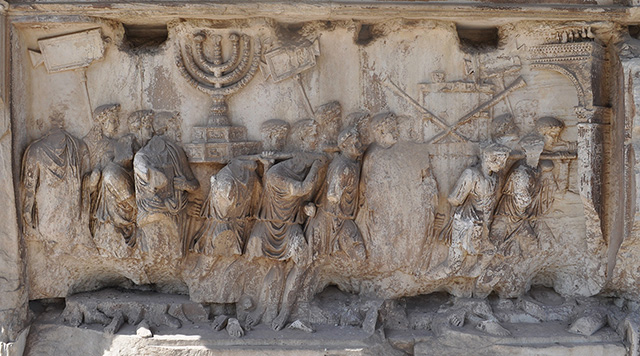
3. “seven golden lamp(stand)s” (v. 12b)—The author here repeats the verb e)pistre/yw (“turn upon/about”), adding dramatic suspense to his act of turning: “and, turning about, I saw…” These seven golden lamps are clearly parallel to the “seven Spirits” around God’s throne in verse 4 (cf. the earlier note), and again suggests that the manifestation of Jesus is very much like the manifestation of God himself. The most direct allusion is to Zechariah 4:2ff, where the lamps are explained as heavenly Messengers (“eyes”, v. 10b)—that is, Angels (“Spirits”)—but where there is also a connection with the presence of the Spirit of God (v. 6). The seven lamps may also allude to the golden lampstand, with seven branches, in the Tabernacle and (Second) Temple (Exod 25:31-40; 1 Macc 4:49-50; Josephus, Jewish War 5.217; the depiction on the Arch of Titus, etc).

4. “one like a son of man” (v. 13a)—This, of course, alludes to the famous description of the divine/heavenly being in Daniel 7:13-14 (also quoted earlier in verse 7 [cf. the note]):

“And see—with the clouds of heaven (one) like a son of man [vn`a$ rb^K=] was coming…”
LXX: “And see—upon the clouds of heaven (one) as a son of man [w($ ui(o\$ a)nqrw/pou] came…”

While the Greek version of Dan 7:13 uses the general particle w($ (“as”), the description here in Rev 1:13 is a bit more precise, using the adjective o%moio$ (“similar [to]”), emphasizing likeness. Originally, the expression “son of man” (Aram. vn`a$ rB^) simply meant “human (being)”, part of “(hu)mankind”; and, thus, the reference in Daniel is to a heavenly being who has the appearance of a human being. The use of the expression as a distinct title (“Son of Man”), referring specifically to such a divine/heavenly being, is fundamental to the early Christian understanding of Jesus, and of the eschatological outlook in the New Testament. For more on this topic, cf. Part 10 of the series “Yeshua the Anointed”. It is important to note that, while Dan 7:13f is the primary basis for the eschatological/Messianic title “Son of Man”, here the book of Revelation does not use the title, but goes back to the underlying wording in Daniel. The opening phrase “in the middle of the lampstands” emphasizes the centrality of Jesus, but also echoes the presence of God (and his throne) in the middle of the (surrounding) “seven Spirits”.

5. “a golden girdle [i.e. belt]” (v. 13b)—The initial description of this figure “like a son of man” refers to his clothing: “having been sunk in(to a garment) to the feet, and girded about toward the breasts (with) a golden girdle [i.e. belt]”. From a socio-cultural standpoint, this clothing indicates a high, honored/dignified status; possibly also a priestly status is suggested (cf. Exod 28:4-5; Zech 3:4, etc). It is best to view this clothing, with its golden belt, simply as characteristic of a heavenly being (Dan 10:5; cf. also Ezek 9:2f, and note again the description in Rev 15:6).

6. “his head and hairs were white as wool, white as snow” (v. 14a)—This would seem to be drawn from the description of God (the “Ancient of Days”) in Daniel 7:9 (cf. also 1 Enoch 46:1; 71:10). It may be intended to reflect the divine/heavenly generally (white symbolizing purity, etc), and could refer to a heavenly being (Angel) such as in 1 Enoch 106; however, the context of Dan 7:13, and the other parallels with the appearance of God (theophany), suggests a comparison with the “Ancient of Days” (Dan 7:9).

7. “his eyes (were) as a flame of fire” (v. 14b)—Again, this description would be characteristic of a heavenly/divine being (Dan 10:6; 1 Enoch 106:5f); the detail occurs again in 19:12.

8. “his feet (were) similar to white copper” (v. 15a)—The word xalkoli/banon refers to white[ned] (li/bano$) copper (xalko/$), i.e. refined/burnished bronze, “as (if) having been burned in a furnace”. It appears to be unique to the book of Revelation (also in 2:18), but is presumably derived from the description of the heavenly being in Dan 10:6. A shining fiery appearance at the feet (or below the feet) is also part of the manifestation of God (on his throne) in the language of theophany.

9. “his voice (was) as the sound of many waters” (v. 15b)—This image most likely comes from Ezekiel 1:24; 43:2, where it describes the approach of God (preceded and surrounded by heavenly beings). There is probably also an allusion to Daniel 10:6, as well as the thundering “voices” of God in the Sinai theophany (Exod 19:16; 20:18).

10. “he (was) holding…seven stars” (v. 16a)—These stars are being held in his right (lit. “giving”) hand, i.e. the hand or side indicating favor and blessing, as well as power and authority, etc. Power over the stars could be attributed to heavenly beings, but more properly relates to God as the Creator and sustainer of the heavens—i.e. God as the one who “causes the (heavenly) armies [i.e. bodies/beings] to be/exist” (toxb*x= hwhy). Verse 20 explains that the stars are, in fact, heavenly Messengers, connected with the seven congregations to whom the epistle-book of Revelation is addressed.

11. “out his mouth traveled a sharp two-mouthed sword” (v. 16b)—A two-edged (lit. “two-mouthed”, di/stomo$) sword was a military weapon, to be used for cutting/killing in battle (the “mouth” of the sword eats/consumes its victims). The image specifically relates to the traditional military role of the Messiah at the end-time (defeating/subduing the wicked nations), especially in the light of Isa 11:4 and 49:2, as these passages were given a Messianic interpretation. The idea of the “word of God” as a sword (Heb 4:12) presumably comes from the same background (esp. Isa 11:4 LXX, “the word of his mouth”). This military imagery is applied to Jesus more graphically in Rev 2:16; 19:15, 21.

12. “the sight of him (was) as the sun shining in its power” (v. 16c)—I have translated o&yi$ here as “sight”, i.e. “visual (appearance)”, but can specifically refer to the face, which is presumably intended here. The immediate Scriptural allusion is, again, to the heavenly figure in Dan 10:6, but, certainly, the sun (light, shining, etc) is a natural symbol for deity, and this is indicated by the qualifying phrase “in his/its power”.

This concludes the vision—that is the visual description—of the figure who appears to John. What follows in verses 17-20 are the words which the figure speaks. This will be discussed in the next daily note.

References marked “Koester” above, and throughout these notes, are to Craig R. Koester, Revelation, Anchor Bible [AB] Vol. 38A (Yale: 2014).

September 10: Revelation 1:9-10

Revelation 1:9-20

Verse 9 introduces the first vision of the book of Revelation. It differs from the other visions and visionary cycles in that the seer is addressed directly by the risen/exalted Jesus, rather than a heavenly intermediary. It is, however, compatible with the subsequent vision-cycles, in that it also follows a seven-fold pattern. The vision is closely connected with the seven “letters” which follow in chapters 2-3—it is the risen/exalted Jesus of 1:9-20ff who addresses the seven congregations.

Insofar as the book of Revelation utilizes an epistolary (and rhetorical) framework, 1:9-20 could be regarded as the narratio—the section in which the facts and background of the case are narrated. This encompasses the “letters” in chaps. 2-3. The historical character of the section is certainly indicated from the initial declaration by the author:

Rev 1:9

“I, Yohanan, your brother and com(panion) together (with you) in the (di)stress, and (in) the kingdom and (our) remaining under [i.e. enduring] in Yeshua—(I) came to be in [i.e. on] the island called Patmos, through the word of God and the witness of Yeshua.”

This clearly establishes the setting for the visions of the book: a seer/prophet named Yohanan (Grk.  )Iwa/nnh$, “John”) was residing on the island of Patmos. This small island, in the Aegean off the coast of Asia Minor (approx. 40 miles SW of Miletus, and not too far from Ephesus), was scarcely deserted, as might sometimes be imagined. There were communities living there, with a thriving culture. Even so, according to tradition, “John” was banished to Patmos, and many commentators would concur with this. The use of the verb form e)geno/mhn (“I came to be”) suggests that Patmos was not John’s normal place of residence. His reason for being there is explained as “through the word of God and witness of Yeshua”. This could be understood two ways: (1) it was for the purpose of preaching/witnessing (i.e. missionary activity), or (2) it was the result, or consequence, of his preaching/witnessing. The latter seems most likely (the reference to “the distress” suggests some measure of persecution); if so, then he may have been relegated to the island by provincial authorities (Roman province of Asia), according to a known mode of punishment (relegatio ad insulum). Christian tradition provides numerous speculative details on how/why John was relegated to Patmos. For more on the background/setting, related to Patmos, etc, consult any reputable Commentary (e.g., Koester, pp. 239-43) or Bible dictionary.

This is the third time that the author/visionary of the book is identified as Yohanan (“John”), and it is worth examining briefly several possibilities as to just who this “John” might be:

    • It is a pseudonym, presumably referring to John the Apostle
    • It is John the Apostle, son of Zebedee, in accordance with what came to be the established tradition
    • It is a different “Elder/Presybter” (presbu/tero$) named John, possibly the same person who authored the second and third Johannine letters (2 Jn 1; 3 Jn 1)
    • It is a separate and distinct John, an influential minister (and/or prophet) in Asia Minor

Critical commentators today are not as inclined (as past generations) to view the book as pseudonymous, despite the fact that much Apocalyptic literature is pseudepigraphic in nature (cf. my earlier article on these terms). The book is generally lacking in the kinds of details and references one might expect if the author were presenting himself as a famous (apostolic) figure. Some Christians chose the third option above, identifying the author with a second-generation Elder/Presbyter named John (cf. Eusebius, Church History III.39.4-6; VII.24.7ff). However, the main lines of Christian tradition identified the author as John the Apostle, an identification which appears to have been reasonably well-established by the end of the 2nd century (cf. Justin Martyr Dialogue with Trypho 81.4; Irenaeus Against Heresies III.11.1, 16.5ff; V.30.3; Clement On the Rich Man §42, etc).

The problem with the traditional view is that there is simply nothing in the book to suggest that this “John” is an Apostle and one of the Twelve (i.e. John the son of Zebedee)—indeed, Rev 21:14 could be seen as indicating the contrary. Thus, it is probably simpler (and safer) to rely upon the detail which the book itself provides—this “John” was a minister of some influence in Asia Minor (the area around Ephesus, etc), toward the end of the first century A.D., and may have been specially gifted as a prophet.

In discussing verse 2 (cf. the earlier note), I pointed out that there the genitive case in the twin expression “the word of God and the witness of Jesus” was subjective—that is, God is the one giving the word and Jesus is the one witnessing (to it). Now, however, in verse 9, the same expression occurs in a slightly different context, indicating that the genitive has switched to the object—i.e., the believer’s witness to Jesus, and the proclamation of the word/account (lo/go$) of what God has done (through the person of Jesus). Both of these aspects continue through the remainder of the book.

Rev 1:10

The introduction to the first vision continues with verse 10:

“I came to be in (the) Spirit, in [i.e. on] the day belonging (to) the Lord, and in back of me I heard a great voice as a trumpet (saying)…”

This description of the setting in vv. 9-10 involves three elements with the expression “I came to be in/on…” (e)geno/mhn e)n):

    • “on the island called Patmos” (location)
    • “in the Spirit” (condition)
    • “on the day belonging to the Lord” (time)

Central to this scenario is the detail that John was “in the Spirit” (e)n pneu/mati). This expression appears frequently in the New Testament, especially in Luke-Acts and the Pauline letters. It has a relatively wide range of significance, but often relates specifically to the prophetic aspect of God’s Spirit at work among his chosen people—cf. Mark 12:36; Luke 2:27; 4:1ff; 1 Cor 12:3ff; 14:2-3ff. The four occurrences in the book of Revelation (also at 4:2; 17:3; 21:10) are particularly important as they establish the spiritual basis—at four key points—for the prophetic legitimacy and authority of the visions. At each point, where there is a distinct change of setting in the visionary landscape, there is a note that this occurs “in the Spirit”. It is possible that the language itself may be drawing upon the book of Ezekiel (cf. 3:12; 8:3; 37:1; 43:5).

We should also here take note of the expression “on the day belonging to the Lord [e)n th=| kuriakh=| h(me/ra|]”. This “day belonging to the Lord”, using the adjective kuriako/$, occurs only here in the New Testament, but is found elsewhere in early Christian writings (Gospel of Peter 9:35; 12:50; Didache 14:1; Ignatius, Magnesians 9:1; Justin Martyr’s First Apology 67). It is typically translated “Lord’s Day”, and refers to Sunday, in association with the day of Jesus’ resurrection. However, we should also here recognize a deeper symbolism to the expression. The adjective kuriako/$ essentially means “belonging to the Lord [ku/rio$]”; and, while it is rare in the New Testament (elsewhere only at 1 Cor 11:20), in Greco-Roman usage it can relate to (Roman) imperial authority. Thus, it is likely that we have here a subtle, but significant, foreshadowing of the contrast, between the Kingdom of God and the (worldly) power of the Roman Empire, which is to become a major theme in the remainder of the book. Cf. Koester, p. 243.

Finally, which must consider the description which concludes the introduction in verse 10: “in back of me I heard a great voice as a trumpet”. In form, this seems to resemble Ezek 3:12 LXX, which is worth quoting:

“And the Spirit took me up, and down in back of me I heard (the) voice of a great shaking [i.e. earthquake] (saying)…”

Here the “great voice” is rather described “as a trumpet” (w($ sa/lpiggo$). In both Jewish (Old Testament) and early Christian tradition, the sounding of a trumpet often marks heavenly and eschatological phenomena (cf. Joel 2:1; Zech 9:14; Matt 24:31; 1 Cor 15:52; 1 Thess 4:16; and five more times in the book of Revelation, 4:1; 8:2, 6, 13; 9:14). In particular, a voice “like a trumpet” may be associated with the manifestation of God (Theophany), such as the famous appearance at Sinai—Exod 19:16; 20:18; Heb 12:19 (cf. also Psalm 47:5, etc). This is the first of several details in the vision which treat the appearance of the risen/exalted Jesus like a theophany. I list these here, to be discussed in more detail in the next daily note:

    • A great voice like a trumpet
    • The prophet turning to “see” the voice
    • The seven golden lamps
    • The white hair and fiery eyes
    • The shining/fiery appearance of the feet
    • The voice like the sound of rushing water
    • Holding (seven) stars in the right hand
    • Face shining like the sun

September 9: Revelation 1:7-8

Revelation 1:7-8

The introduction to the epistle-book of Revelation concludes with a pair of statements; the first is a Scriptural citation (by the author), and the second is a divine declaration repeating the triadic formula in verse 4 (cf. the previous note). We begin with the Scripture citation(s) in verse 7:

“See—he comes with the clouds, and every eye will look at him, even the (one)s who stabbed him (through), and they will beat (themselves) over him, all the (people)s arising (together out) of the earth. Yes, Amen.”

Two different Scripture passages are combined here:

    • Daniel 7:13:
      “And see! with the clouds of (the) heavens (one) like a son of man, coming (near), was (present)…”
      LXX: “And see—upon the clouds of heaven (one) as a son of man came…”
    • Zechariah 12:10 (along with v. 12)
      “…and they shall look closely [vb. fb^n`] to me whom they pierced [vb. rq^D*], and they shall wail (in mourning) upon [i.e. over] him, like (one) wailing upon th(eir) only (child)… “
      LXX: “…and they will look (closely) toward me, against [i.e. concerning] the (one) whom they danced over [impl. vb. dq^r*], and they will beat (themselves) over him, as (one) beating (themselves) over a (be)loved (child)…”

The association of these two Scriptures is not original to the book of Revelation; we find it also in Matthew’s version of Jesus’ “Eschatological Discourse” (24:30). Both Scriptures were also connected, in different ways, with Jesus death (Mark 14:62 par; John 19:37), giving the Passion narrative an eschatological dimension, at least in part. It is easy to see how early Christians would have interpreted Zech 12:10 in terms of Jesus’ death, by crucifixion, which would entail the “piercing” of his hands and feet. In the original context, the reference seems to have that of one killed in battle (“pierced” or run through with a sword, etc). In this regard, the use of it in the Gospel of John is somewhat more applicable, as the author associates it with the puncturing of Jesus’ side by a soldier’s spear (19:34).

The precise significance of Zech 12:10 in the Gospel of John is uncertain. It is by no means clear that the author intends it in the same sense as Matt 24:30 or here in Rev 1:7. The purpose of the citation in Jn 19:37 is to show that the puncturing of Jesus’ side, with its release of “blood and water”, was the fulfillment of prophecy. Overall, however, though it is not emphasized in the Gospel of John, an eschatological interpretation of the passage for early Christians remains the most plausible. This is certainly how the author of the book of Revelation understands it. By compressing the citation to include part of verse 12, the author gives special emphasis to the visible appearance of Jesus (in glory) at the end-time. It is somewhat difficult to decide how the symbolism of mourning should be understood. The original context of the passage suggests that it refers to mourning for the death of someone; but this does not fit the application to the return of the risen/exalted Jesus. There are several possibilities:

    • Mourning over sin and wickedness (i.e. the connection of Jesus’ death as a sacrifice for sin)—this entails the idea of repentance.
    • The people mourn over their role/responsibility for Jesus’ death—this may or may not indicate repentance. If the sense is that of mourning for Jesus’ sacrificial death on their behalf, then some measure of true repentance is in view.
    • The nations (“tribes of the earth”, not only the tribes of Israel), in their wickedness, mourn and lament over Jesus’ appearance which signifies the coming of God’s Judgment upon them.

Arguments can be made in favor of each of these, but it is the first (or some combination of the first two) which best seems to fit the context of the book. On the motif of the conversion of the nations, cf. Rev 5:5, 9; 7:9; 11:13; 21:24; 22:2 (Koester, p. 219).

The early Christian use of Daniel 7:13 will be addressed in upcoming articles of the current series “Prophecy and Eschatology in the New Testament”; I have already dealt with in some detail in an earlier study. Here it follows the Gospel Tradition, going back to the words of Jesus (Mark 13:26; 14:62 par) associating it with the end-time appearance of Jesus (the “Son of Man”).

As indicated above, verse 8 repeats the phrasing in v. 4, though here the three-fold divine title (in italics) is part of a declaration by God Himself:

“I am [e)gw/ ei)mi] the Alpha [a)] and the w@ [Omega], says the Lord God, the (One) being and the (One who) was and the (One) coming, the All-mighty.”

The use of e)gw/ ei)mi (“I am…”) is a standard component of divine revelation and manifestation (theophany), both in the Old Testament (LXX) and in other Greco-Roman literature. It can be traced back to the fundamental passage, introducing the name YHWH, in Exodus 3 (v. 14), being repeated numerous times in Scripture (e.g., Deut 32:39, etc). Especially noteworthy is the Prophetic usage, particularly in the book of Isaiah—cf. 43:25; 45:22; 46:9; 47:8ff; 51:12. The formula here is reasonably close in sense to that in Isa 41:4; 44:6; 48:12.

The use of the first and last letters of the Greek alphabet (alpha [a] and omega [w]) functions as a comprehensive symbol—”first and last” (Isa 41:4, etc)—indicating both completeness and, we may assume, transcendence. God transcends all of creation (and time), encompassing and filling all things. It is also possible that there is here a play on the name YHWH (hw`hy+, Yahweh), which, in Greek transliteration, could be rendered Iaw, including both alpha and omega. Cf. Koester, p. 220.

Two other divine names/titles appear in this declaration, and are worth noting:

    • ku/rio$ o( qeo/$ (“[the] Lord God”)—This reflects the Hebrew conjunction of Yahweh (hwhy) and Elohim (<yh!ýa$), first appearing in Gen 2:4b, and subsequently many times in the Old Testament. It establishes the fundamental religious (and theological) principle that the Deity worshiped by Israel (YHWH) is the one true (Creator) God.
    • o( pantokra/twr (“the All-mighty”)—This title, combining pa=$ (“all”) and kra/to$ (“strength, might”), occurs 9 times in the book of Revelation, but only once (2 Cor 6:18) in the rest of the New Testament. It is known in Greek literature, as a divine attribute, essentially meaning (“ruler of all [things]”), and is relatively frequent in the Greek version (LXX) of the Old Testament. There it typically renders the expression toab*x=, part of an ancient (sentence) title, toab*x= hwhy—Yahweh as the one who “causes the (heavenly) armies to be”, i.e. creates all the heavenly bodies and beings.

Thus, the Hebrew background of both titles emphasizes God (YHWH) as the Creator of all things. We will want to keep this background in mind as we proceed to verses 9ff, and the divine attributes and titles which are given to the risen/exalted Jesus in first vision of the book.

References marked “Koester” above, and throughout these notes, are to Craig R. Koester, Revelation, Anchor Bible [AB] Vol. 38A (Yale: 2014).

September 8: Revelation 1:4-6

Revelation 1:4-6

Verses 4-6 represent the standard greeting of the epistolary introduction. The author, already mentioned in verse 1, introduces himself and addresses his audience:

“Yohanan, to the seven (gatherings of believer)s in Asia (that are) called out (to assemble): Favor and Peace to you from the (One) being and the (One who) was and the (One) coming, and from the seven Spirits which (are) in the sight of His throne, and from Yeshua (the) Anointed, the trust(worthy) witness, the first-produced of the (ones who are) dead, and the chief (ruler) of the kings of the earth.” (vv. 4-5a)

The author identifies himself by the Hebrew name Yohanan (/n`j*oy), transliterated in Greek ( )Iwa/nnh$) and Anglicized as “John”. Traditionally, this person as been equated with John the Apostle, son of Zebedee, with the ‘Johannine’ Gospel and Letters being similarly ascribed to him. However, the Gospel and Letters are actually anonymous, and, indeed, as I have discussed previously (cf. my recent note) there are certain indications that the letters were not written by an Apostle. Only in the book of Revelation does the name “John” appear as author or source of the writing. However, nowhere is he identified as John the Apostle; in fact, here, too, there is evidence indicating that the author was not an Apostle. This will be discussed further in the note on verse 9.

John addresses his epistle-book to Christians in seven cities in Asia (the Roman province of Asia [Minor]), the same cities to whom the “letters” in chapters 2-3 are addressed. The word e)kklhsi/a, in its distinctive early Christian usage, is perhaps best rendered “congregation”, but I have given it an excessively literal (glossed) translation above, so as to capture its basic meaning. It is derived from the verb e)kkale/w (“call out”), and typically refers to citizens, or members of a community, who are summoned (“called out”) to public assembly. However, in Greco-Roman society, e)kklhsi/a appears rarely to have been used for religious assemblies or associations. This particular Christian usage stems largely from the idea of the corporate assembly (lh^q^) of the people Israel in Old Testament tradition. Almost certainly, there is also an allusion to believers being chosen (i.e. “called”) by God, whereby the connotation of the verb e)kkale/w (“call out”) blends with that of e)kle/gw (“gather out”, i.e. “choose”).

There is unquestionably a religious context to the greeting, as in most of the letters in the New Testament, where the “favor” (xa/ri$) and “peace” (ei)rh/nh) comes from God and Christ (together), being invoked as a kind of blessing upon the believers who are addressed (cf. Rom 1:7; 1 Cor 1:3; 2 Cor 1:2; Eph 1:2; Phil 1:2; Philem 3; 1 Pet 1:2; 2 Pet 1:2). Note the dual-formula, in the uniquely expanded form it occurs here in the book of Revelation:

    • from (a)po/) the (One) being and the (One who) was and the (One) coming [i.e. the Living God]
      —and from the seven Spirits which (are) in the sight of His throne
    • from (a)po/) Yeshua (the) Anointed, the trust(worthy) witness…

At first glance, it might seem that this is a three-fold formula, with the “seven Spirits” as a source of blessing parallel to God and Jesus; but this would probably be incorrect. It is best to view the phrase “and from the seven Spirits…” as subordinate to the Living God who sits on the throne. There is, however, a kind of synonymous parallelism between God and Jesus, which needs to be emphasized (cf. below).

Instead of the more traditional “God the Father”, here we have the peculiar triadic phrase in italics above:

o( w*n kai\ o( h@n kai\ o( e)rxo/meno$

The initial title o( w&n (“the [One] being [i.e. existing/living]”) derives primarily from Exodus 3:14 [LXX]: e)gw/ ei)mi o( w&n (“I am the [One] being/existing”)—cf. further, Josephus Antiquities 8.350; Philo Life of Moses I.75; Allegorical Interpretation III.181. However, there are also parallels in Greco-Roman literature, including a similar three-fold description of Deity which encompasses past, present, and future (e.g., Homer Iliad 1.70; Hesiod Theogony 1.38; Plutarch Moralia 354C); especially noteworthy is the triadic formula in Pausanias (Description of Greece 10.12.10), “Zeus was, Zeus is, Zeus shall be” (cf. Koester, p. 215).

The elegant customary translation, “the one who is and who was and who is to come”, glosses over the difficulty of the Greek syntax. The phrase is actually comprised of two articular participles, with an indicative verb (+ article) in between:

    • “the [one] being” (o( w&n)
    • “the [one who] was” (o( h@n)
    • “the [one] coming” (o( erxo/meno$)

Rhythmically, it is appealing, but grammatically it is quite awkward. The use of the definite article with an indicative verb (literally, “the was”) is strange indeed. Also unusual is the fact that there is no case inflection following the preposition a)po/ (“from”), as though the expressions, being Divine titles, were undeclinable. I would suggest that this phrase (repeated in verse 8 and 4:8, and echoed again in 11:17; 16:5) be understood in three ways:

    1. In the traditional sense of comprehensive existence—past, present, future.
    2. As a chiastic formula, in which the two participial expressions emphasize the eternal Life and Being possessed by God:
      —”the One being/existing”
      —”the One coming (to be)”
      With the indicative verb reflecting God’s presence and action in history.
    3. In an historical sense:
      (i) “the One being”—eternal existance
      (ii) “the One who was”—(past) manifestation in history
      (iii) “the One coming”—i.e. (present/future) coming to bring Judgment and to deliver His people

With regard to the “seven Spirits [pneu/mata]” in the presence (lit. “in the sight”) of God’s throne, these are best understood as heavenly beings (i.e. ‘Angels’), as I discussed in a previous note. The throne of God, emphasizing kingship and (royal) power, features prominently in Apocalyptic writings, and, often in such visionary literature, a description of the throne and its (heavenly) surroundings is included. There are specifically seven Angels mentioned in Tobit 12:15 and 1 Enoch 20:1-7. Of course, seven, as a symbolic number, representing completeness, etc, is especially frequent in the book of Revelation. Clearly, there is a thematic connection between these seven “Spirits” and the seven congregations of the greeting and the subsequent letters in chapters 2-3.

The blessing invoked by the author comes from God (the Father), but also, equally, from Jesus Christ (“Yeshua [the] Anointed”). On the particular title Xristo/$ (“Anointed [One]”), here used as a virtual second name of Jesus (according to established Christian convention), see my earlier series “Yeshua the Anointed”. As in the case of God, Jesus is also referred to with a three-fold expression (drawn from Psalm 89, especially vv. 19-37):

    • “the trust(worthy) witness” (Ps 89:37)—We typically do not tend to think of Jesus as a witness (it is believers who do the witnessing), but this characteristic was certainly applied to him by early Christians, and appears frequently in the Gospel of John. It was already used in verse 1 (cf. the previous note), in the expression “the witness of Jesus Christ”, which, as I discussed, does not mean witness about Jesus, but rather witness by Jesus (subjective genitive).
    • “the first-produced of the dead” (Ps 89:27a)—The adjective prwto/toko$ is often translated “firstborn”, but literally means “first-produced“, as of a plant coming up out of the ground. Here, it has nothing whatever to do with Jesus as the (pre-existant) Son of God (in a Johannine or Nicene sense), but, rather, relates specifically to his resurrection from the dead (i.e. of those who are dead). The adjective is used in this sense in Romans 8:29 (see v. 23); Col 1:18 (cp. verse 15); and cf. also Heb 12:23. This association is explained clearly in Acts 26:23. Jesus himself touches on the imagery in the beautiful illustration of Jn 12:24.
    • “the chief (ruler) of the kings of the earth” (Ps 89:27b)—This reflects the standard Messianic association, by which early Christians applied the Davidic ruler figure-type to Jesus. Again, the earliest Christian preaching connected this precisely (if not exclusively) with his resurrection and exaltation to heaven (Acts 2:24ff, 36, etc). However, it was also in his exaltation (to God’s right hand) that Jesus possessed a status virtually identical to that of God the Father, sharing his kingly rule (as Son and Heir). In early Christian thought, Jesus’ Sonship was defined primarily in terms of the resurrection (cf. Acts 13:33f; Rom 1:4; Heb 5:5ff). The book of Revelation expresses this in a most distinctive way, as we shall see.

The concluding portion of the greeting switches to a declaration of praise—to both God and Christ, though it is primarily the latter who is being addressed, as the wording indicates:

“To the (one) loving us and loosing us out of our sins, in his blood, and (so that) he made us (to be) a kingdom, sacred officials [i.e. priests] to his God and Father—to him be honor and strength into the Ages [of the Ages]. Amen.” (vv. 5b-6)

That Jesus’ death (his blood) served as a sacrificial offering which brought release (and/or cleansing) from sin, is a central tenet of Christian belief, expressed numerous times in the New Testament. There are several striking references among the relevant passages in the Johannine writings—Jn 1:29; 6:51, 53ff; (19:34); 1 Jn 1:7, 9; 2:2; 3:5; 4:10; 5:6, 8. As we shall see, this is also a theme that features prominently in the book of Revelation. It should be noted that some manuscripts read “washing us” instead of “loosing us”, understanding the verb to be lou/w rather than lu/w. This appears to be a ‘correction’, since the idea of washing (i.e. cleansing from sin) better fits the natural image of blood (and cf. the usage in 1 Jn 1:7, etc). However “loosing” is almost certainly correct, and reflects a different, primary aspect of Christ’s sacrificial work—loosing us from debt/bondage to sin. A similar idea, in relation to sin, is expressed by the verb a)fi/hmi (“set [free] from, release”), often translated in this context as “forgive”.

The idea that believers in Christ constitute a kingdom—i.e. the kingdom of God, ruled by Christ—appears many times in the New Testament, usually in terms of receiving or inheriting the kingdom (1 Cor 15:50; 1 Thess 2:12; 2 Thess 1:5; Col 1:13; Heb 12:28; James 2:5, etc). The twin concept of believers as priests of God is specifically drawn from ancient Israelite/Old Testament tradition (Exod 19:6; cf. also Isa 61:6). We find this also occasionally in the New Testament (1 Pet 2:5, 9; cf. also Rom 12:1; 15:16; 2 Cor 3:6ff, etc).

The praise and “glory” (do/ca, esteem/honor) here accorded to Jesus is precisely that which is given to God, and this a most important theological (and Christological) emphasis in the book. We will be exploring this further in the notes on verses 9-20. However, first it is necessary to examine the final portion of the epistolary introduction—the declarations in vv. 7 and 8—which we will do in the next daily note.

“…Spirit and Life” (concluded): The Book of Revelation

The Book of Revelation

We have reached the end of this series based on Jesus’ words in John 6:63: “The utterances [i.e. words] which I have spoken to you are Spirit and are Life”. The notes in this series have focused on the use of the words “spirit” (pneu=ma) and “life” (zwh/), especially in the Johannine writings—the Gospel and Letters of John. The Book of Revelation is usually regarded as a Johannine work as well, derived from the same general church environment, timeframe and setting. Many commentators feel that the Johannine congregations were centered around Ephesus, and that certainly fits the book of Revelation; the letters in chaps. 2-3 are addressed to Christians in Asia Minor, beginning with Ephesus. Of course, tradition attributes the Gospel, Letters, and the book of Revelation to John the apostle, but authorship is indicated only in the book of Revelation. Even so, it is far from certain that the “John” in Rev 1:1, 9 is John the apostle.

Most scholars believe that the author of the book of Revelation is not the same person as either the Gospel writer or the author of the letters. While certain ideas and expressions are similar between the works, the language and style of the book of Revelation is markedly different. As we shall see, even the sense of the words pneu=ma (“spirit”) and zwh/ (“life”) has a different orientation and emphasis than in the Gospel or Letters. Let us begin with the word pneu=ma. Apart from several occurrences of the plural, which refer to “unclean/evil spirits” (16:13-14; 18:2), it is always the Spirit of God which is in view, much as we find in the other Johannine writings. However, it is used in two distinctive ways which differ markedly from the Gospel and Letters: (1) references to “seven Spirits” of God, and (2) the prophetic role and work of the Spirit.

“Spirit” in the Book of Revelation

Four times in the book (1:4; 3:1; 4:5; 5:6), we read of “seven Spirits”, an idea that is unique to the book of Revelation among the New Testament writings. Christians have variously sought to associate this number seven with the Holy Spirit, often in terms of seven “gifts” or “attributes”, such as the traits listed in Isa 11:2-3. However, it would seem that these seven “Spirits” should be considered as distinct from the Holy Spirit, and identified instead with heavenly beings (i.e. “angels”). The evidence for this is:

    • Psalm 104:4 refers to God’s Messengers (“angels”) as “Spirits” and also as “flames of fire” (much like the seven Spirits in 4:5)
    • These “Spirits” are located in heaven, surrounding the throne of God, similar to the fiery/heavenly beings in Isa 6:1ff and Ezek 1:4-28, as well as the “living creatures” elsewhere in the book of Revelation. The image seems to be drawn most directly from Zech 4:2, 10, where the the seven lamps are said to function as God’s “eyes” (Rev 5:6, messengers sent out into the world). The idea of seven angels surrounding God’s throne generally follows Jewish tradition (cf. Tobit 12:15; 1 Enoch 20:1-7, etc).
    • These “Spirits” are treated as distinct from Jesus Christ in a way that would be most unusual if it were meant to refer to the Holy Spirit (cf. 1:4)
    • They are clearly connected with the “seven congregations” of chaps. 2-3, each of which has a Messenger (“Angel”) associated with it. In Israelite/Jewish tradition, certain heavenly Messengers were assigned to particular nations, groups or individuals (for protection, etc). This interpretation is more or less made explicit in 2:20.

In the remainder of the book, pneu=ma specifically refers to the activity and role of the Spirit (of God) in prophecy—the revealing of God’s word and will, to be communicated to God’s people (believers) by a chosen representative. This is expressed several different ways:

1. e)n pneu/mati (“in the Spirit”). This expression occurs first in Rev 1:10, which sets the scene for the prophetic visions described in the book:

“I came to be in the Spirit in/on the lordly day [i.e. Lord’s day], and I heard behind me a great voice…”

This is the basis of the visionary experience which comes to the prophet “John”; it reflects the older, traditional aspect of the prophetic figure being “in the Spirit” (Ezek 3:12; Luke 2:27, etc). Even among Christians, who experience the Spirit in a new way—as the permanent, abiding presence of Christ (and God the Father)—certain believers could still be gifted and inspired specially as prophets (cf. below).

The next occurrence of the expression is in 4:2, where the prophetic inspiration now takes the form of a heavenly vision—i.e., the ability to see things in heaven, a ‘spiritual’ dimension above (cf. Ezek 8:3-4; 11:5). There are numerous accounts in Jewish tradition of visionary travels through the heavenly realms (e.g., the Enoch literature, the Ascension of Isaiah, etc). Paul may have experienced something of this sort, according to his statement in 2 Cor 12:1-4. The remaining two occurrences take place later in the book, where the seer states that the heavenly Messenger “led me away in the Spirit” (17:3; 21:10). In each instance, he is transported into a visionary landscape (desert, high mountain), to a symbolic and undefined ‘spiritual’ location, similar to those in many mystical and ascetic religious experiences.

2. The Spirit speaks to/through the visionary. This is the core manifestation and dynamic of the prophetic experience. Through the prophet, the Spirit (of God) speaks to the wider Community. This takes place in the “letters” to the seven congregations in chaps. 2-3, each of which concludes with a common refrain:

“The one holding [i.e. possessing] an ear must hear what the Spirit says to the congregations” (2:7, 11, 17, 29; 3:6, 13, 22)

The first phrase follows wording used by Jesus (Mark 4:9 par, etc), especially in relation to his making known “secrets” to his followers, through the use of parables, etc. In speaking to these congregations, the Spirit essentially represents the risen Jesus, communicating his words to the believers in Asia Minor. As in other portions of the New Testament, prophecy is viewed as the work of the Spirit, in a uniquely Christian sense. There are two aspects to the fundamental meaning of the word profhtei/a (lit. speaking before):

    • The Spirit presents God’s message (His word and will) before the people (that is, to them, in front of them), through the inspired believer (prophet) as a spokesperson
    • He also announces things beforehand (i.e., foretells), indicated here by the eschatological orientation of the book

There is a specific association with prophecy in two additional passages:

    • 19:10—the expression “the Spirit of foretelling [i.e. prophecy]”, where the Spirit expressly conveys the word of the risen Jesus to the people; here the Spirit is identified as “the witness of Jesus”. This is also an important aspect of the Johannine view of the Spirit in the Gospel and Letters.
    • 22:6—the expression “the spirits of the foretellers [i.e. prophets]”; this refers to the (human) spirit of the prophet which is touched and inspired by the Spirit of God. In this way, the gifted believer, when speaking, is governed by the Spirit. Cf. 1 Cor 14:32, and also note 1 Jn 4:1-3.

3. The Spirit speaks directly. Twice in the book of Revelation we find the Spirit speaking directly, responding to a heavenly voice. In 14:13, the response echoes a command to write (v. 12); this solemn refrain is appropriate to the context of believers who are put to death for their faithfulness to Jesus. In 22:17, at the close of the book, it follows the announcement of Jesus’ imminent coming (vv. 7, 12). The Spirit responds along with the “Bride” (believers collectively), as well as “the one who hears” (i.e. hears the visions of the book read out). This reflects the work of the Spirit in and among believers, witnessing together with them (cf. John 15:26-27).

“Spirit” and “Life”

At several points in the book of Revelation, both the words “spirit” and “life” are used in the general sense of ordinary physical/biological (human) life. This life is given by God (11:11, cf. Gen 2:7; and note also 8:9; 16:3), and it plays on the dual meaning of pneu=ma as both “breath” and “spirit”. It is particularly associated with the idea of resurrection (2:8; 20:4-5), as we see also in the Gospel of John (5:19-29; chap. 11). Only here it is the traditional, eschatological understanding of resurrection, rather than the spiritual sense of “realized” eschatology which dominates the Gospel. The giving of “life” is also presented as part of the false/evil work performed by the forces of ‘antichrist’, in imitation of God’s work of creation (13:15).

“Life” in the Book of Revelation

The words zwh/ (“life”) and the related verb za/w (“live”) are used primarily in three different senses in the book of Revelation:

1. Traditional references to God as “living” (7:2) or as “the one who lives (forever)” (4:9-10; 10:6; cf. Dan 4:34; 12:7; Sirach 18:1, etc). Particularly important in this regard is the fact that Jesus identifies himself with this Divine title/attribute in 1:17-18; the declaration takes the form of an “I Am” saying similar to those we see throughout the Gospel of John:

“I am [e)gw/ ei)mi] the first and the last, and the living one [o( zw=n]…”

However, this is not necessarily an absolute statement of deity; it relates specifically to the resurrection and the risen Jesus:

“…I came to be dead, and see! I am living [zw=n ei)mi] into the Ages of the Ages, and I hold the keys of death and of Hades” (v. 18b)

2. Repeated references to “living (creature)s” (zw=|a) in heaven (i.e. heavenly beings) surrounding the throne of God (cf. Ezek 1:4-10ff)—4:6-7; 5:6, 8, 11, 14; 6:1, 3, 5-7; 7:11; 14:3; 15:7; 19:4. These are parallel, in certain respects, to the “seven Spirits” which surround the throne (cf. above). This Old Testament motif follows ancient Near Eastern religious imagery and iconography; it was revived in Jewish eschatological and apocalyptic tradition in the first centuries B.C./A.D.

3. There are a series of expressions with the genitive zwh=$ (“…of life”). Here we are closest to the meaning of the word zwh/ in the Gospel and Letters of John—as the divine/eternal Life which believers come to possess through faith in Christ and the presence of the Spirit. In the Gospel, we find similar expressions: “Bread of Life”, “Light of Life”, etc. In the book of Revelation, these are as follows:

a. “Paper-roll of Life” (h( bi/blo$ th=$ zwh=$, or to\ bibli/on th=$ zwh=$)—3:5; 13:8; 17:8; 20:12, 15; 21:27. The words bi/blo$ (bíblos) and bibli/on (biblíon) have essentially the same meaning. They are typically translated as “book”, but this is often somewhat misleading, especially in the current context. More properly, it refers to a paper (papyrus) roll or scroll; and here it is simply a roll on which names are recorded—the names of those persons (believers) who will come to inherit the divine/eternal Life. This is tied to the ancient (Near Eastern) scene of Judgment, envisioned as occurring after death. Jewish tradition came to apply it within an eschatological setting—i.e., of the Judgment which will take place at the end time. The specific image used in the book of Revelation has an Old Testament background (Exod 32:32; Psalm 69:28; Isa 4:3; Dan 12:1), which continued and developed in Jewish tradition (4Q524; Jubilees 30:22; 1 Enoch 108:3, etc), and into early Christianity (Luke 10:20; Phil 3:20; 4:3).

The concept draws upon Greco-Roman practice as well—lists of registered citizens, who receive the rights and benefits of citizenship. For believers in Christ, this is a heavenly citizenship in the “New Jerusalem” (chaps. 21-22). Sinning can cause a person’s name to be “wiped out” (erased) from the roll (3:5); however, the names of (true) believers have been inscribed from before the time of creation (17:8). These believers belong to the Lamb (Jesus Christ, 13:8) and have been destined to inherit Life. Even so, according to the view of the book of Revelation, this is not absolutely unconditional; rather, only the believers who endure faithfully to the end will receive the promised Life.

b. “Tree of Life” (to\ cu/lon th=$ zwh=$)—2:7; 22:2, 14, 19. The expression relates to an ancient Near Eastern religious and mythological image with parallels in many cultures worldwide. Here it derives primarily from Old Testament tradition, with the setting of the “garden of God” (Gen 2:9; 3:22ff; cf. also Ezek 28:13ff; 31:9; Isa 51:3). Conceivably, there could also be an allusion to Greco-Roman tree-shrines, since, at many points in the book of Revelation, true worship of God is contrasted with false/evil pagan (Greco-Roman) practices. There is a close eschatological association with the “Water of Life” motif (cf. below); both are part of the Paradise-Garden landscape utilized in closing visions of chap. 21-22, and were also preserved in Christian thought through Jewish wisdom traditions (Prov 3:18; 11:30; 13:12; 15:4; 2 Esdras 2:12; 8:52). The reward for believers is to eat of the fruit from the Tree, which also provides life-giving healing through its leaves (20:2, taken from Psalm 1:3).

c. “Water of Life” (to\ u%dwr th=$ zwh=$)—21:6; 22:1, 17. There is a similar expression, “living water” (cf. 7:17), which, in the Old Testament originally referred to naturally flowing water (from a stream or spring), but which came to be applied in a symbolic, spiritual sense (Song 4:5; Jer 2:13; 17:13; cf. Isa 49:10, etc). Such expressions are used by Jesus in the Gospel of John (4:10-11, 14; 7:38), which I have discussed in earlier notes in this series; there, water is primarily used as a symbol of the Spirit (cf. also Jn 3:3-8; 19:30, 34).

d. “Crown/Wreath of Life” (o( ste/fano$ th=$ zwh=$)—2:10 (cf. also 3:11; 4:4, 10). A circular wreath (ste/fano$), given as a sign of honor, was especially common in Greco-Roman culture. It was given to victors in athletic events and other competitions, for military service and triumphs, as well as for important public/civic service (see Koester, pp. 277-8 for a summary of examples from Classical literature). The primary association is that of victory (6:2). For believers in Christ, the honor (‘glory’) relates to faithfulness and endurance (against sin, evil, and apostasy [falling away]) during the time of testing and persecution. Paul uses much the same motif in 1 Cor 9:25, and alludes to it also in 1 Thess 2:19; Phil 4:1. The specific expression (“crown/wreath of Life”) is found in the letter of James (1:12), and 1 Peter 5:4 has “crown/wreath of honor [do/ca] without (any) fading” which is very close in meaning.

This study in the book of Revelation concludes the current series and also provides an introduction for the next (already being posted on this site), which deals with the subject of eschatology and prophecy in the New Testament. Parallel to the articles in this series, a running set of daily notes will work through the book of Revelation in more detail, focusing specifically on the background of the visionary language and symbolism in the book, as it would have been understood by the author and his original audience. I hope that you will join me for this exciting study.

References marked “Koester” above are to Craig R. Koester, Revelation, Anchor Bible [AB] Vol. 38A (Yale: 2014). This is a most valuable modern critical treatment of the book, with many relevant citations from Classical works.

September 7: Revelation 1:3

Revelation 1:3

The first two verses of the superscription were discussed in the previous note; today we will be looking at the declaration in verse 3:

“Happy the (one) making (this) known (in the reading of it), and (also) the (one)s hearing the words [lo/goi] of th(is) foretelling [i.e. prophecy] and watching (over) the (thing)s having been written in it, for the time is near.”

This is properly a beatitude (or macarism), much like the famous set of Beatitudes uttered by Jesus in the Gospel Tradition (Matt 5:3-12; Luke 6:20-23). For the background of the beatitude form, see my earlier series on the Beatitudes. At the conclusion of that series, I also provided a brief survey of the other beatitudes which occur in the New Testament.

According to the standard Greek formula, this beatitude begins with the adjective maka/rio$ (“happy”), often rendered as “blessed”, in light of the religious context which is typically involved. On the eschatological aspect of the beatitude form, again cf. the introductory articles of my earlier series.

Often obscured in translation is the fact this beatitude is addressed to two different groups: (1) the person(s) reading the book, and (2) the ones hearing it and guarding its contents. These two groups are marked by parallel participles, which reflect the circumstances of early Christian life and worship:

    • o( a)naginw/skwn—”the one [sg.] making (this) known (in the reading of it)”
    • oi( a)kou/onte$…kai\ throu=nte$—”the ones [pl.] hearing…and watching (over)”

The verb a)naginw/skw literally means “know again”, though the prefixed particle a)na is perhaps better understood as an intensive, i.e. “know (something) well”—i.e. through the reading of a written text. In the early Christian context, “reading” meant public reading—that is, reading aloud or reciting the text. In the ancient world literacy rates were far lower than in modern societies; moreover, the average Christian would likely not have possessed a copy (of the Scriptures, etc) for private reading, but would have relied upon hearing it read aloud in the congregation. This is precisely the situation envisioned here by the author.

The use of the verbs a)kou/w (“hear”) and thre/w (“[keep] watch [over]”) together reflects standard instruction, which, in the case of early Christians, goes back to Old Testament tradition regarding the Torah (Instruction) as the written word of God (cf. especially the foundational covenant scene in Exodus [19:7-8; 20:19; 24:3-4a, 7, etc]). The parallel use of these verbs, and the twin concepts of hearing and keeping/guarding, is especially prominent in the Johannine writings (Jn 5:24f; 8:47, 51; 12:47; 14:15, 21ff; 15:10, 20; 1 Jn 1:1ff; 2:3-5, 7, 24; 3:22-24; 5:3; 2 Jn 6). It is possible that the similar usage in the book of Revelation stems from a common tradition. The verb a)kou/w occurs 46 times in the book, while thre/w 11 times (including 5 times in the “letters” of chapters 2-3). In the specific context of 1:3, the verb thre/w relates, not so much to idea of obeying God’s instruction, but to guarding and protecting the record of the visions in the book. Most likely, there is a two-fold aspect to this watching/guarding: (a) paying close attention to the account and details of the visions, and (b) protecting it from misuse and misrepresentation. This latter aspect should serve as a caution for all those attempting to interpret the book today.

The content of the book is specifically referred to as “the words/accounts [lo/goi] of the th(is) foretelling”. This is the first of 7 occurrences of the Greek term profhtei/a (proph¢teía), which is typically transliterated in English as “prophecy”. As I discussed in the Introduction to the current series “Prophecy and Eschatology in the New Testament”, there are two basic meanings to the profht- word group, in relation to the prefixed particle pro (“before”): (1) a message presented before (i.e. in front of) an audience by a chosen spokesperson, and (2) a message which tells of (future) events beforehand. Both aspects apply to the use of these words among early Christians, though emphasis in the New Testament, when dealing with early Christian congregations, is decidedly on the former. Here in the book of Revelation, we certainly find both aspects:

    • The visions in the book are clearly described as “the word of God” and “the witness of Jesus”—a revelation which was given to the prophet (John) to be communicated to other believers.
    • At the same time, the visions primarily refer to future events which would occur “soon”.

The use of lo/go$ (“account, ‘word'”) emphasizes again the unique character of the book—visual experiences (images) being recorded/translated into written language (“the [thing]s having been written in it”).

Special notice must be given to the closing words of the verse:

“…for the time (is) near”
o( ga\r kairo\$ e)ggu/$

This statement must be taken together with the earlier expression e)n ta/xei (“in [all] speed”) in verse 1. As I discussed in the previous note, the expression e)n ta/xei essentially means “quickly”, “right away”. Here, there can be little doubt that we have the same idea, expressed differently:

o( kairo/$—The word kairo/$ differs somewhat from xro/no$, though both may be translated as “time”. The distinction may be summarized as: xro/no$ generally refers to the passage of time, while kairo/$ signifies the point at which something occurs. Understood in a temporal (rather than spatial) sense, kairo/$ refers to the point when an event takes place (or will take place).

e)ggu/$—The modifier e)ggu/$ is related to the verb e)ggi/zw (“come/bring close”), and thus means “close, near”. The word occurs 31 times in the New Testament, but only once more in the book of Revelation (22:10).

Taking these two elements together, the proper sense of the statement should be clear: the point in time when the events described in the visions will occur is very close. This, of course, creates considerable difficulty for Christians today. On the one hand, the most reasonable (and obvious) way of understanding these expressions is that the author is declaring that the events in the visions will occur very soon (presumably, in the lifetime of his [original] audience). Yet, as it would seem that many, if not most, of the visionary details did not then occur—nor have they occurred in the past 2,000 years—it would be hard for many believers to accept the accuracy and/or inspiration of the visions in this light. Thus, the various forms and modes of interpretation (“futurist”, “church-historical”, etc) which have arisen to bridge the gap and explain the apparent discrepancy. Yet, the very words here in vv. 1-3, at the beginning of the book, should serve as a caution against any interpretation which deviates too far from the fundamental meaning of the text.

(Regarding the imminent eschatological expectation among early Christians, and evinced throughout the New Testament, I will be dealing with this sensitive subject at various points in these notes, as well as in the articles of the Study Series “Prophecy and Eschatology in the New Testament”. There will also be a separate, special study upcoming as part of this Series.)

Finally, notice should be taken of the coordinating particle ga/r (“for”)—”…for the time is close”. The concluding declaration explains the importance of reading the book aloud in the congregations, and of believers hearing and guarding its contents. The reason this is so vital is that “the time (when these visions will take place) is very close”.