September 24: Revelation 5:9-10

Revelation 5:1-14 (continued)

The vision of the Lamb in chapter 5 climaxes with the song in verses 9ff, just as the throne-vision of chapter 4 concludes with a similar song—the parallelism between the two halves of the chap. 4-5 vision were discussed in the previous daily note. The song begins in vv. 9-10, sung by the four Living Beings and twenty-four Elders, before being taken up by the heavenly multitudes in vv. 11-13.

Rev 5:9-10

“and they sang a new song, saying, ‘a&cio$ are you to take the paper-roll and to open up its seals, (in) that [i.e. because] you went to the market-place [i.e. bought] for God in [i.e. with] your blood, (purchasing) out of every offshoot [i.e. tribe] and tongue [i.e. language] and people and nation, and you made them a kingdom and sacred officials [i.e. priests] for our God, and they will rule as king(s) upon the earth’.”

It is worth noting again the opening word of the song, which begins as in 4:11, to be repeated here in 5:11. The adjective a&cio$ is rather difficult to translate literally in English. Fundamentally, the underlying idea is of bringing something into balance (i.e. being weighed/measured on the scales), as, literally, “bringing [vb. a&gw] up” the beam of the scale. The adjective itself signifies something which is thus of an equal, or proper, weight. As an honorific, especially when used in a religious context (in reference to God, etc), it indicates that someone is deserving of honor and praise, etc, and so should be given the appropriate reverence and respect. It is typically translated in such instances as “worthy”. However, in this case, the parallelism between chapters 4 and 5 connotes a deeper theological meaning—that the Lamb (i.e. the exalted Jesus) is of the same “weight” (Heb. db)K*) as God, and, in his divine position/status, shares with God the Father the ruling authority, etc (including effective ownership of the seal on the scroll). It is possible that this is what is signified by the characterization of the song as “new” (kaino/$). A song of praise and worship to God is obvious and natural for any religious person; it is the extension of this song to the Lamb (Jesus) which is new. On the motif of a “new song”, cf. Psalm 40:3; 96:1; Isa 42:10).

The emphasis on the blood of the Lamb helps to clarify the sacrificial image. In the previous note, on verse 6, I outlined three sacrificial motifs with which Jesus’ death is associated in the New Testament: (1) the Passover Lamb, (2) the offering for sin/guilt, and (3) the sacrifice at the establishment of the Covenant. The Last supper scene, before Jesus’ impending death, blends together all three of these:

    • The context of the Passover meal (Mark 14:1, 12ff, 22ff par); in John’s account, Jesus is put to death on the day of Passover eve, identifying him more precisely with the Lamb that is slain (13:1; 18:28; 19:14).
    • The establishment of the (new) Covenant—the wine-cup is identified specifically as “the blood of the [new] covenant” (Mark 14:24 par)
    • A sacrifice for sin (Matt 26:28; cf. also John 1:29)

While the Lamb’s blood features prominently in the Passover narrative (Exod 12:7, 13), symbolizing God’s deliverance of his people and their protection (from death), here there is a more precise connection with the Covenant scene in Exodus 24. The blood thrown upon the people (v. 8), identifies that they are bound to God by the agreement (covenant) that has been established. The blood marks them as His people and consecrates them as “a holy nation” and “a kingdom of priests” (Exod 19:6). This is exactly the tradition which is being referenced here, and it is also the primarily meaning of the Last Supper symbolism—”this is my blood of the covenant th(at is) poured out over many“. Only here in Revelation, the “many” (polloi/) have been expanded and given a universal scope: “out of every tribe/race and tongue and people and nation”. According to the tradition of the (old) Covenant, Israel was purchased by God, from among all the other peoples/nations on earth, to be his own chosen people (Exod 15:16, etc). Now, the new people of God (believers in Jesus), have been similarly purchased, but as individuals taken from every conceivable ethnic and racial background. In order to preserve the etymology and concrete sense of the verb a)gora/zw, I have given it an excessively literal translation above. It signifies a person going to the market-place (a)gora/) and purchasing something. In this case, the “market-place” is the entire inhabited world—all peoples and nations, etc.

As mentioned above, verse 10 draws upon the ancient covenant tradition, and especially, the language in Exodus 19:6. The same wording and imagery is used in 1 Peter 1:5, 9—believers in Christ are the true people of God, fulfilling the very characteristics previously applied to Israel under the (old) Covenant. We are a “holy nation” and a “royal priesthood” (“kingdom of priests”). This is stated succinctly here in v. 10a, as it was earlier in 1:6. However, special attention must be given to the concluding statement in v. 10b:

“and they will rule as king(s) upon the earth”

First, one should note the variant readings involving the verb basileu/w (“rule/reign as king”). The textual evidence is divided between the present tense (basileu/ousin, “they rule as king[s]”), and the future tense (basileu/sousin, “they will rule as king[s]”)—the difference being a single letter (s). It is an important distinction, since it effects how one should interpret the nature and character of the believers’ reign. The present tense (supported by A 046 1006 1611 and other minuscules and versions), indicating that believers currently rule as kings on earth, would suggest a symbolic, or spiritual reign. By contrast, the future tense (read by a P 1 94 1854 2053 2344 and many other MSS and versions) most likely would be understood in an eschatological sense—in the Age to Come, believers will rule (with Christ). Moreover, the specific phrase “will rule upon the earth” would seem to indicate a concrete manifestation of the Kingdom of God (and Christ) on earth at the end of the current Age. For some commentators, this is readily identified with a (literal) Millennial Kingdom, in light of 20:1-6. Verse 6, in particular, is emphasized, though it should be noted that it applies specifically to those who were put to death for their faith in Jesus—following the resurrection, “they will be sacred officials [i.e. priests] of God and of the Anointed (One), and they will rule as king with him (for) a thousand years”. By contrast, 5:10 indicates that all believers will function as priests and kings. This will be discussed further when we come to 20:1-6; the question of the precise eschatological expectation, in terms of God’s Kingdom being established on earth, will also be addressed at several points as we continue through the book.

In the next daily note, we will look at the concluding song in verses 11-13.

September 23: Revelation 5:1-8

Revelation 5:1-14

Revelation 5:1 begins the second half of the vision in chapters 4-5. If chap. 4 was devoted to a vision of God (the Father) on His throne, chap. 5 is a vision of Jesus at the right hand of the Father—that is, sharing the ruling place with God. The parallelism between these two halves is unquestionable, and reflects a central theme of the book, theological and christological, which was already introduced in the opening words, and the first vision, in chapter 1. The key points in parallel are:

    • The central presence of the Throne, representing the seat of ruling-power in heaven. The Lamb has a place near and/or on the Throne.
    • Both God and Lamb are surrounded by the “seven Spirits” and have authority/control over them.
    • The Living Beings and Elders likewise surround both figures and give homage/praise to them, in a similar fashion.
    • The Song of praise that is sung to each uses similar language and form, beginning with the word a&cio$, usually translated “worthy”—i.e. “Worthy are you…”
Rev 5:1-4

The chapter begins with a narrowing of focus for the vision, closing in on the image of the throne:

“And I saw upon the giving [i.e. right] (hand) of the (One) sitting upon the ruling-seat, a paper-roll [i.e. scroll] having been written (on the) inside and on the back, (and) having been sealed down with seven seals.” (verse 1)

Here we have the central motif of the “right hand” of God. The adjective decio/$ literally means “giving”, referring to the right hand as the auspicious (or giving hand)—i.e. the hand or side from which blessing comes, where symbols of power and authority are focused, etc. A fundamental element in the early Christian view of Jesus, and the Gospel proclamation (kerygma), was that, following his death and resurrection, Jesus was exalted to a position at the “right hand” of God in heaven—cf. Acts 2:33-34; 5:31; 7:55-56; Rom 8:34; Col 3:1; Eph 1:20; Heb 1:3, 13; 8:1; 10:12; 12:2; 1 Pet 3:22. In terms of Jesus as the Anointed One (Messiah) and Son of God, this motif was largely drawn from Psalm 110:1, and its application goes back to Jesus’ own words (Mark 12:36; 14:62 pars). The viewpoint here of the right hand of the throne of God prepares the reader for the appearance of the exalted Jesus.

Another important detail in this verse is the seal or stamp (sfragi/$) on the scroll. Typically, a papyrus or parchment scroll (bi/blo$, here the diminutive bibli/on) would be tied up with a string, upon which a clay or wax (or lead) seal was applied, and then stamped down (vb. katasfragi/zw) with an engraved image (from a signet ring, etc) to indicate ownership. God, as the Ruler, is the one who has stamped down his signet onto the seal, indicating his ownership. No one could tamper with (i.e. break) this seal; only the owner (God himself) has the authority to open the scroll, or someone who possessed the same authority (from God). The divine character of this seal is further emphasized by the plural (“seals”) and use of the number seven. This is the point of the solemn declaration which follows in verse 2:

“And I saw a strong Messenger proclaiming in [i.e. with] a great voice, ‘Who is a&cio$ to open up the paper-roll and to loose(n) its seals?'”

This is the same adjective (a&cio$) applied to God in 4:11, and which will similarly be applied to the Lamb in verse 9. I have temporarily left it untranslated (cf. further in the next note), but will mention here the fundamental meaning of something which is brought into balance (i.e. being of equal/appropriate weight). The significance of this is brought out vividly in verse 3:

“And no one—(not) in heaven, and not upon the earth, and not down under the earth—was able [i.e. had power] to open up the paper-roll and to look at it.”

The implication, of course, is that no one in all of creation possessed the personal authority of (or from) God in order to be able, rightly, to break the seal. The verb du/namai literally means “be (en)powered, have power”, but is often better rendered in English as “be able (i.e. to do something)”. The emphasis is not on a test of strength or power as such, but on a person’s authority (i.e. ability) to do something. This scene becomes personalized when the visionary (seer) gives his own reaction:

“And I wept (very) much (at this), that no one was found a&cio$ to open up the paper-roll and (so) not to (be able to) look at it.” (v. 4)

The importance of looking (vb. ble/pw) at the contents of the scroll is emphasized repeatedly, though it is not immediately clear why this would be so. On the one hand, it can be regarded as a literary/narrative device, building suspense—the reader is waiting and eager to find out what is written on this scroll (v. 1). At the same time, the ability to look at its contents implies someone with the authority to open the scroll and read it, which, again, anticipates the appearance of the Lamb (Jesus), building narrative suspense. The person allowed to open a sealed scroll would be: (a) the owner of it (or his/her representative), or (b) the person to whom it was rightfully sent (and intended to be read). Both aspects of meaning are present here, though it is the former which is emphasized.

Rev 5:5-8

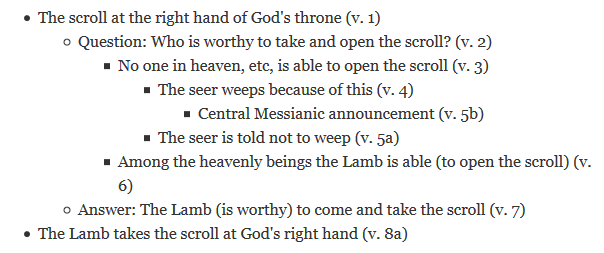
In these verses, we find a precise response to the scenario established in vv. 1-4—no one in all of creation is able to open the scroll. There is a chiastic structure to vv. 1-8 which I outline as follows :

Indeed, the answer comes in verse 5:

“And (then) one out of the Elder (Ones)s said to me: ‘Do not weep! (for) see, the lion th(at is) out of the offshoot [i.e. tribe] of Yehudah, the root of Dawid, (he is able) to open up the paper-roll and its seven seals!'”

On these “Elder Ones” (presbu/teroi), see the previous note on 4:4. His response is characteristic of heavenly beings (Angels) when they appear to chosen ones among God’s people (i.e., “Do not be afraid!”, etc). The declaration which follows is among the most overtly Messianic in the book of Revelation, expressed very much in traditional language, specifically related to the Davidic Ruler figure-type (cf. Parts 6–8 of the series “Yeshua the Anointed”). Two expressions are involved:

    • “the lion out of the tribe of Judah”—The lion commonly symbolizes power, but also a leading/regal position among all the other animals (i.e. ‘king of the beasts’); lion images were frequently used in the royal iconography of the ancient Near East. Here the expression is derived primarily from Genesis 49:9-10, part of Jacob’s testament (“last words”) to his sons (Judah, vv. 8-12). These verses were given a Messianic interpretation by the time of Jesus, as we see from the Qumran texts (4Q252 5:1-4), and other writings from the first centuries B.C./A.D. The ruling staff (tb#v@) in Gen 49:10, was blended together with that of Balaam’s oracle (Num 24:17), to form a dual Messianic reference, prophesying the coming of the (end-time) Davidic Ruler.
    • “the root of David”—This expression comes from Isaiah 11:1: “A stick/twig [rf#j)] will come forth from the stem [uz~G#] of Yishai {Jesse}, a green shoot [rx#n@] will bear (fruit) from his roots [vr#v, pl.]”. The Septuagint (LXX) translates both uz~G# (“stem”) and vr#v# (“root”) as r(i/za (“root”), which is used here in Revelation. Isaiah 11:1-4ff was one of the key passages interpreted as prophesying the coming of the Davidic Messiah. With its military allusions, which could only be realized for Christians at the return of Jesus, it is generally absent from the New Testament, except for 2 Thess 2:8 and (here) in the book of Revelation. David himself was more properly referenced by the “branch” [rx#n~ / rf#j)], which, under the influence of the similar expression “sprout/branch of David” (dw]d*[l=] j^mx#) in Jer 23:15; 33:5 (cf. also Zech 3:8; 6:12), gave rise to rich set of Messianic motifs—see the Qumran texts 4Q161 7-10 iii 22; 4Q174 1-3 i 11; 4Q252 5:3-4; 4Q285 5, and other writings of the period.

In verse 6, this Messianic description (of the exalted Jesus) gives way to the image/vision of a Lamb (a)rni/on):

“And, in the middle of the ruling-seat and the four Living (Being)s, and in the middle of the Elder (One)s, I saw a Lamb having stood as (one) having been slaughtered, holding seven horns and seven eyes, which are the the [seven] Spirits of God sent forth into all the earth.”

The repeated use of e)n me/sw| (“in the middle [of]”) is a bit confusing, but I believe it is meant to emphasize two things: (1) the central position of the Lamb in the heavenly scene, and (2) his close proximity to the throne of God. There are four visual attributes or characteristics of this Lamb:

    1. It is standing (i.e. alive) even though it appears to have been slain. The paradox of this image may be conveyed by the sequence of perfect verb forms—”having stood”, “having been slaughtered”. This aptly reflects the dual-aspect of Jesus’ death and resurrection, and the importance of both to his exaltated position/status as Messiah and Son of God.
    2. It has been slaughtered (vb. sfa/zw). This refers to ritual slaughter, i.e. a sacrificial offering. There are several possibilities:
      (i) The Passover lamb (Exod 12:6, etc), the blood of which symbolized God’s protection/deliverance for the faithful ones among His people.
      (ii) A sacrifice for sin/guilt (Lev 14:12-13), though lambs were more commonly used in the daily offering, etc, and not regularly connected with atonement for sin/guilt.
      (iii) The sacrificial offering at the establishment of the Covenant between God and His people—according to Exod 24:5-8, this was a sacrifice of “good will”, utilizing an ox/bull for the partial burnt offering.
      Jesus’ death is associated with all three of these, at various points in the New Testament. Probably the connection with the Passover is most clearly in view, as also in 1 Cor 5:7; 1 Pet 1:19, and, presumably, John 1:29, 36 (cf. the details in 13:1, etc, 19:14, 29[?], 31). There may also be a allusion here to Isaiah 53:7-8 (Acts 8:32-33).
    3. It has seven horns. The horn of a powerful animal, like the lion itself (cf. above), was a common ancient symbol of the strength and authority to rule; as such, it was natural as a Messianic motif—i.e. Luke 1:69 (cf. Ps 132:17; 92:10; 148:14; Ezek 29:1; 1 Sam 2:1, etc). The number seven here indicates divine power and authority, that the Lamb shares rule with God the Father (on/at His throne).
    4. It has seven eyes. These are identified specifically with the heavenly beings or Messengers (“Spirits”) which surround God’s throne and which “are sent forth into all the earth”. This imagery seems to be drawn from Zech 4:2ff, in which the “lamps” (Angels/Spirits) are described as “the eyes of the Lord” which travel back and forth in all the earth (v. 10). Here they are the eyes of the Lamb, indicating again the close relationship between the Lamb (the exalted Jesus) and God the Father.

Verse 7 narrates simply how the Lamb approaches the throne (at God’s right hand) and takes the scroll from God (“the One sitting on the ruling seat”). This action triggers an explosion of praise from the heavenly beings around the throne (vv. 8ff), similar to that which they offered to God in 4:8-11 (on this, cf. the previous note). It is an elaborate and dramatic scene, as the Living Beings and Elders again fall down to give homage—this time to the Lamb. They hold musical instruments (the kithara, a six- or seven-stringed harp) and golden dishes containing fragrant smoke (incense), identified as the “prayers” of the holy ones. These represent different aspects of worship—music and ritual offerings, only in the latter case the offerings, in a Christian context, have been defined in terms of prayer (largely eliminating the sacrificial/ritual dimension).

The Song sung by the heavenly beings will be discussed in the next daily note.

September 22: Revelation 4:8-11

Revelation 4:1-11 (continued)

(For the discussion on verses 1-7, see the previous note)

Rev 4:8

The throne-vision in chapter 4 reaches its climax with the four “living (being)s” and the worship which they give to God on the throne. I noted the general similarity between the description in vv. 6-7 with that of “living (being)s” (toYj^) in Ezek 1:4-11ff. However, for v. 8, there is a more immediate parallel in Isa 6:1-3, with the description of the six-winged “fiery (being)s” (v. 2, cp. Ezek 1:11). The “living beings” here in chapter 4 perform a function similar to to the “fiery beings” in Isa 6; even their declaration of praise is similar:

    • “Holy, holy, holy is the Lord God, the All-mighty…” (v. 8)
    • “Holy, holy, holy is YHWH (creator) of the (heavenly) Armies…” (Isa 6:3)

Both Ezek 1 and Isa 6 record theophanies, presented as prophetic visions of God on his throne. These are perhaps the clearest examples in the Old Testament Scriptures of the heavenly rule and splendor of YHWH, and certainly it is no coincidence that the throne-vision in the book of Revelation is described in similar terms. There is, however, a significant difference between the declarations in Rev 4:8 and Isa 6:3, in the second half:

    • Isaiah has: “…all of the earth is full of his weight [i.e. glory]”
    • Revelation has a variation on the earlier declaration in 1:4 (cf. also verse 8 and 11:17; 16:5):
      “the (One who) was, and the (One) being, and the (One) coming”

The expression in Isaiah is spatial and concrete, while that in Revelation is temporal and more abstract (existential); but both emphasis the comprehensive and all-encompassing nature of God. The motif of God as Creator is found in the parallel declaration by the 24 ‘Elders’ (verse 11, cf. below).

Rev 4:9-11

The praise and worship given to God by the “living beings” is echoed by the “elder (one)s” (‘Elders’), reflecting two distinct groups of beings who surround the throne of God. I have argued that the descriptions of these two groups of heavenly beings effectively represent, or symbolize:

    • All of created life (animal and human), particularly in its greatest and noblest aspects—Four Living Beings
    • The People of God, especially in the honor and rule which it shares with God—Twenty-Four [12 x 2] Elders

The two groups are clearly parallel in the description of their worship:

    • “And when the Living (Being)s give esteem [do/ca] and honor [timh/] and good (thanks for His) favor
      • to the (One) sitting upon the ruling-seat, the (One) living into the Ages of the Ages…”
    • “…the twenty-four Elder (One)s will fall (down)…and kiss toward [i.e. worship]
      • the (One) sitting upon the ruling-seat, the (One) living into the Ages of the Ages…”

I have above reordered the wording of verse 10 slightly in order to bring out the parallel. We may also identify a different sort of (chiastic) structure, bringing in verse 11:

    • Declaration of praise/worship: “a%gio$…”
      —The Living Beings give honor and thanks to the Living God on his throne
      —The Elders give homage and worship to the Living God on his throne
    • Declaration of praise/worship: “a&cio$…”

The assonance between a%gio$ (hágios) and a&cio$ (áxios) is, of course, lost in English translation. The first adjective is typically rendered “holy”, emphasizing the holiness and purity of God, that which separates him from all other (created) beings (Heb. vodq* in Isa 6:3). The second adjective (a&cio$) is more difficult to translate. It literally refers to something which brings into (equal) balance (as on the scales); however, it is commonly used in the more general, abstract sense of something which is proper or appropriate for a given situation (i.e. giving it the proper weight or balance). Recall that the word usually translated “glory” in Hebrew db)K* literally means “weight”. Created beings (especially human beings), should regard God in a way that is worthy of his awesome “weight”—i.e. his power and splendor, his holiness, etc. In such a context the Greek a&cio$ is typically translated “worthy”; rendering it this way in verse 11, we have the concluding declaration by the Elders (i.e. the heavenly People of God):

“Worthy are you, our Lord and God, to receive the esteem [do/ca] and the honor [timh/] and the power (we give to you) , (in) that [i.e. because] you formed all (thing)s, and (it is) through your will (that) they are and were formed!”

Note, again, the similarity to the declaration by the Living Beings, especially in the first half. The significance here of including the word du/nami$ (“power”) is often overlooked. Exactly what does it mean for other beings to give “power” to God? Is it not He who is all-powerful and gives power to others? Here it is necessary to consider the important gesture of the Elders who “throw (down) their crowns in the sight of [i.e. in front of] the ruling seat (of God)”. While it may seem that this is simply a spontaneous act of adoration, it likely has a deeper meaning as well. The gesture itself has a socio-political significance, whereby a subordinate (or vassal) indicates his submission to a superior. It indicates not only subordination, but also the relationship of vassalage—the vassal receives the power/authority to rule from the sovereign. Moreover, in Greco-Roman worship, wreaths would sometimes be placed at the feet of the gods (their statues, cf. Koester, p. 365). Both political and religious aspects are connoted by the gesture. The People of God in heaven rule because of the authority/power which God gives to them; the gesture of throwing down their crowns (symbolizing their rule) shows that the ruling power truly belongs to the Living God upon His throne.

The application to believers in Christ is obvious—we who are faithful will receive heavenly/eternal crowns from Jesus, indicating that we share in his rule. It is Jesus’ rule in heaven, alongside God the Father on His throne, which becomes the central theme and motif of the remainder of the vision in chapter 5, which we will examine in the next daily note.

September 21: Revelation 4:1-7

Revelation 4:1-11

With chapter 4, a new division of the book—the beginning of the main body—is introduced. The vision of chapter 4-5 leads into the great vision cycles that make up the bulk of chapters 6-18. As has been previous noted, the book of Revelation is also structured as a letter, and, from the standpoint of epistolary (and rhetorical) form, the throne-vision in chaps. 4-5 functions something like the propositio, or main statement (proposition) of the case to argued or expounded in the main body of the letter, the probatio. The visions (and vision cycles) which follow serve as the probatio, demonstrating (or “proving”) what is represented in the vision of chaps. 4-5.

Rev 4:1

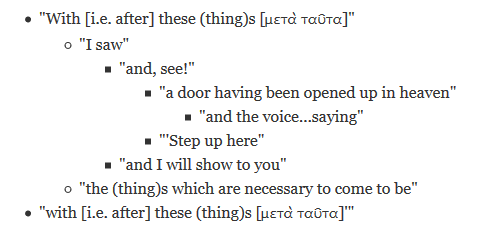
The structural shift is clear from verse 1, with its chiastic shape, marking a separation from the previous vision in 1:9-3:22:

“These things” refer specifically to what John heard and experienced in the previous visions, including the messages to the seven churches. The expression meta\ tau=ta (“after these [thing]s”) must be understood in this sense. Central to the verse is the description of the voice, which is again that of the risen Jesus, as in the earlier vision of 1:9ff:

“and the first voice which I heard as a trumpet speaking with me…”

It is Jesus who calls John to “step up” into heaven. The visionary motif of doors or gates opening into heaven is relatively common (cf. Gen 28:10ff; 1 Enoch 14:15ff; Testament of Levi 5:1, etc). An invitation to enter and experience the realm of the heavenlies is essentially a commonplace in apocalyptic literature (e.g., 1 Enoch 14:8ff; Testament of Levi 2:6ff; Martyrdom of Isaiah 7; cf. Koester, p. 359).

Rev 4:2-3

The parallel with the first vision is seen also in the language used in verse 2:

“(And) straightaway I came to be in the Spirit, and see!…”

With the shift to a new visionary location, the author mentions again being “in the Spirit” (e)n pneu/mati, 1:10). This consistent reference to the Spirit is important in terms of understanding the source and (revelatory) nature of the visions as described by the seer. The central point of the vision is that of God’s ruling-seat or “throne” (qro/no$) in Heaven. It is here that the rhetorical (and polemical) thrust of the book of Revelation begins to come clearly into focus: the rule of God (and Christ) in Heaven contrasted with the false/wicked rule of earthly (spec. Roman imperial) government. Of course, the idea and image of God’s throne goes back to most ancient times, with the royal iconography (and ideology) of the ancient Near East, and continuing on to the time of the Roman empire. There are numerous references in the Old Testament (Psalm 9:7; 11:4; 103:19, etc), but the most prominent passages include visionary scenes of the heavenly court, such as 1 Kings 22:19ff (par 2 Chron 18:18ff); Isa 6:1-3; Ezek 1:4ff (v. 26); Dan 7:9-10. The “throne” represented the ruling power of God, and served as a graphical way of depicting or referring to God, and could almost be seen as a living/divine entity in itself. Note here in vv. 2-3, how closely connected God and the throne are:

“See! a seat of rule [i.e. throne] was set in the heaven, and upon the ruling seat [i.e. throne] (One was) sitting, and the (One) sitting (was) in vision [i.e. appearance] like a stone (of) iaspis and sardios, and a (rain)bow [i@ri$] circling round the ruling seat in vision [i.e. appearance] like a smaragdos (stone)”
[The words in italics indicate colored stones or gems—purplish(?), red {carnelian}, and green {emerald}]

In many ways, the throne (and its surroundings) simply reflects the manifest and glorious appearance of God—the divine/heavenly character reflected by the description, which resembles that of other theophanies in the Old Testament and later Jewish tradition (Exod 24:10; Ezek 1:26-28; 10:1, etc). In the developed Jewish mystical/visionary tradition of the Rabbinic and early medieval periods, the “throne-chariot” (merkabah, inspired largely from Ezek 1) was a fundamental symbol.

Rev 4:4

As the description of the throne vision continues, we move outward from the center of the throne itself, and a somewhat surprising detail emerges:

“And circling round the ruling seat [qro/no$] (were) twenty-four (other) ruling seats [qro/noi], and upon the ruling seats (were) sitting twenty-four Elder (One)s cast about [i.e. clothed] in white garments, and upon their heads (were) gold crowns.”

The description of these twenty-four seats as “seats of rule” (qro/noi), which circle around God’s throne (qro/no$), rather clearly indicates that the persons/beings on these seats share in God’s rule in some way. They are called by the common term presbu/tero$, referring to an old/elder person. It is not entirely clear whether these should be regarded as: (a) heavenly beings, or (b) glorified human beings. They do seem to be distinct from the heavenly Messengers (i.e. Angels) in that the Messengers are sent by God out into the world (as his “eyes” or to convey his word), while these “Elders” appear to have fixed places (of rule) around His throne. The use of the term presbu/tero$, along with the number twenty-four (12 x 2), suggests that they represent the people of God—perhaps as a heavenly counterpart, or corollary, to God’s people on earth. The specific number 24 suggests a combination of (a) the twelve tribes of Israel, and (b) the twelve apostles (i.e. the Church). Recall that Elders, representing Israel, were present at the covenant Theophany in Exod 24; similarly, Elders, representing believers in Christ, were appointed by the Twelve (apostles) who were present at the establishment of the “new covenant” (Mark 14:22-25 par), and who represent the new constitution of the people of God (cf. the symbolism in Acts 1:6ff, 15ff; chap. 2). The twelve apostles and the twelve tribes are closely connected in an (eschatological) saying of Jesus (Matt 19:28; par Lk 22:28-30), and also in the vision of the “new Jerusalem” at the end of the book of Revelation (21:12-14ff, to be discussed). The crowns on the heads of the elders similarly suggest a connection with believers, who will inherit the crown/wreath (ste/fano$) as a heavenly honor (and sign of eternal life), as well a sign that they have a share in the kingdom/rule of Christ (2:10; 3:11).

Rev 4:5-7

After the description of the Elders, the vision returns to more traditional theophanous imagery:

    • “(lightning) flashes and voices and thunderings”—this draws upon ancient Near Eastern storm theophany, most commonly applied to the ‘Lord’ (Baal) Haddu (the Storm [deity]) in Canaanite religion, but was found just as prominently in Israelite descriptions of El-Yahweh. In the Semitic/Hebrew idiom, the word for thunder is literally “voice” (loq), based on the idea of thunder as the “voice” of God.
    • “seven lamps of fire burning in the sight of the ruling-seat”—this repeats the description from 1:4, and again refers to these heavenly beings as “the seven Spirits of God”. That these “Spirits” should be understood as heavenly beings (Messengers/Angels) is clear from the explanation in 1:20 and 3:1, as well as various references in the Old Testament and Jewish tradition (Psalm 104:4; Ezek 1:12-13; Zech 4:2, 10; Tobit 12:15; 1 Enoch 20:1-7; 90:21, etc).
    • “a glassy sea like ice-crystal”—this is said to be “in the sight of [i.e. in front of] the throne”, and also is a traditional image (cf. Exod 24:10; Ezek 1:22, 26), which likely is related to ancient Near Eastern cosmology, i.e. the firmament and God’s throne above the waters (Gen 1:6-7; cf. Psalm 29:3; 93:4; 104:3; 148:4).
    • “four living (being)s (appear)ing full of eyes in front and in back”—these living [zw=|a] beings are similar in description to those in Ezek 1:4-10 (cf. also Isa 6:2-3). Here they are said to be “in the middle” of the throne, perhaps meaning “in the middle, where the throne is”, and also “in a circle” around the throne. They feature prominently in the remainder of the vision.

The appearance of each of the four “living beings” combines various human, animal, and hybrid/heavenly characteristics. This is common, from the standpoint of ancient or traditional religious iconography, when attempting to describe the Divine. The ancient Near East, in particular, made use of many images of winged animals or beings with human and/or animal faces. It is almost as though it was necessary to make use of all the characteristics of living creatures, and the attributes these characteristics represent (strength, power, beauty, wisdom, etc), in order provide even a remotely adequate description of God. These living beings, indeed, have as their main task the praise and worship of God (v. 8). This aspect of the vision will be discussed in the next note.

Much has been made of the specific appearance of each being, resembling, in turn: (a) “a lion”, (b) “a bull/calf”, (c) human (“face/appearance as a man”), and (d) “an air(borne eagl)e flying”. These have been interpreted numerous ways, including the famous (traditional) association with the four Gospels (Evangelists). However, it is probably best to interpret them (if one must) as representing all of creation—specifically, living creatures (animal and human). It is, in particular, the noblest and most regal (lion, bull, human, eagle) portions of the animal world (according to the traditional reckoning) which are represented. Special emphasis is given on the wings of these living beings (v. 8), and this will be addressed in the next daily note (on vv. 8-11).

September 12: Revelation 1:17-20

Revelation 1:9-20 (continued)

Revelation 1:17-20

The previous daily note examined the visual details of the initial vision in verses 9-20 (vv. 12-16). There I pointed out that the figure of the vision was depicted and described with both heavenly and divine characteristics. The details (and language used to describe them) are drawn largely from four passages in the Old Testament:

Central to the vision, with its identification of the figure as “(one) like a son of man” (v. 13; Daniel 7:13f), is the description of “the Ancient of Days” in Dan 7:9-10. In this regard, there is an interesting variant reading in the Greek of Dan 7:13, for the Aramaic

“…(one) like a son of man was coming and reached unto [du^] the Ancient of Days”

where the preposition du^ is translated by the corresponding e%w$ (“unto, until”). However, some manuscripts of the LXX instead read the particle w%$ (“as”):

“…(one) as a son of man was coming and came near as [w($] the Ancient of Days”

which could be taken to mean that he had the likeness or appearance of the Ancient of Days.

In the verses which follow (vv. 17-20), the heavenly/divine figure addresses the seer John. It is introduced with a notice of the traditional reaction of fear to seeing a heavenly being (Ezek 1:28; Dan 8:17; 10:9-10; Tob 12:15-16; Mark 16:5 par; Luke 1:12; 24:5, etc), followed by the similarly traditional words of reassurance mh fobou= (“you must not be afraid”, “do not fear”), as in Lk 1:13, 30; 2:10; John 6:20 par; Acts 18:9; 27:24, etc.

The figure makes a declaration (“I am”, e)gw/ ei)mi) which is associated with God (YHWH) and which reflects divine attributes, following the pattern in 1:4, 8 (cf. also 21:6). There are two specific titles involved:

Two points must be noted in relation to this declaration: (1) this heavenly/divine figure is identified (implicitly) with the risen Jesus, and (2) the declaration is defined in terms of Jesus’ resurrection:

“…and I came to be dead, and see! I am living [zw=n] into the Ages of the Ages”

This is important, as it reflects the early Christian mode of thinking which identified Jesus’ deity primarily with his resurrection and exaltation (to the right hand of God). This can be seen especially in examples of the earliest Christian preaching and (Gospel) proclamation—e.g., Acts 2:24-36; 3:15-16; 7:55-56; 13:30-37ff; Rom 1:4; Phil 2:9-11, etc. Being exalted to divine/heavenly status, Jesus shares divine attributes and titles, such as “the Living One”. He also shares precisely the eternal Life which God possesses, and, as such, he lives “into the Ages of Ages” (i.e. forever)—cf. Dan 4:34; 6:26; 12:7, etc.

The final phrase of this declaration sharpens the eschatological context, touching upon the idea of the end-time Judgment. The risen Jesus how has authority over death and the dead (i.e. those who are dead):

“…and I hold the keys of Death and of the Unseen world (of the dead)”

Death is depicted primarily as a place—the traditional Hades (a)i+/dh$, or ai%dh$, a%|dh$), the “unseen” realm (below ground) where the dead reside. In figurative (and mythological) language, this realm is ruled over by a figure personifying Death itself. To say that Jesus “holds the keys” is a symbolic way of describing the power/authority he has (cf. Isa 22:22; Rev 3:7), as the living one, over death. In traditional Jewish thought, a heavenly being (Angel) typically had power over Death/Hades (cf. Apocalypse of Abraham 10:11, etc), an idea with a very long history (cf. Exod 12:23ff; Num 22:23ff; 1 Chron 21:12ff; and many other passages). This specific image of Jesus holding the key of Death is repeated in 9:1; 20:1, emphasizing its eschatological significance. The end-time Judgment was often closely connected with the resurrection of humankind, which by the time of the book of Revelation was typically applied to both the righteous and wicked together.

Following this declaration, in verse 19, John is given (again, v. 11) the command to write down the things he sees and hears: “Therefore you must write the (thing)s you see…” The verb ei@de$ is an aorist form, which often indicates past action (“saw”), and might, from the standpoint of the book and its publication, refer to the things which John saw. Along these lines, it is probably better to view the aorist form as referring to the visions taken as a whole, reflecting an “external” view. These visions are qualified here two ways:

    • “the (thing)s which are” (a^ ei)si/n)—present
    • “the (thing)s which are about to come to be” (a^ me/llei gene/sqai)—immediate future

The context makes clear that the “future” events should be understood as occurring (close) after events of the present time (i.e., from the standpoint of the author and his original audience). Note the wording: “…are about to come to be with [i.e. after] these (thing)s”.

Finally, in the concluding words of verse 20, the risen Jesus offers a partial explanation of the first vision, its secret (musth/rion). This is an important aspect of eschatological (and apocalyptic) language—the revealing of something which has been secret, or hidden. In this instance, as in the parables of Jesus (Mark 4:11ff par), it is the specific symbols which are interpreted; two symbols are involved:

    • “the seven stars…upon my right hand”
      = “(the) Messengers of the seven congregations”
    • “the seven gold lamp(stands)“
      = “the seven congregations” (contrast this with Zech 4:2ff)

There is a close connection here with the earlier reference to “the seven Spirits” in verse 4, which, as I have previously discussed, are best understood as heavenly beings (i.e. Angels). Note the symmetry:

    • Seven Spirits [Angels] before the throne of God (i.e. the ‘Ancient of Days’)
      —Seven stars (= heavenly Messengers) in the right hand of Jesus
    • Seven Lamps [Believers] surrounding the heavenly/divine figure (i.e. ‘one like a son of man’)

As in the introduction (vv. 1-3), Jesus serves as the intermediary:

    • God gives the message to
      • Jesus Christ, who gives it (through his Messenger[s]) to
        • Believers (through a chosen prophet)

This interplay continues into the “letters” which follow in chapters 2-3, as will be discussed in the next note. In the Old Testament and Jewish tradition, Angels are often ‘assigned’ to particular peoples or nations (Dan 10:13, 20-21; 12:1), and also to specific individuals (cf. Tob 12:14-16; 1 Enoch 100:5; Matt 18:10; Acts 12:15, etc). The idea that certain heavenly Messengers are designated to groups of believers (congregations) in various locations is fully in accordance with this line of tradition. As previously noted, the picture of seven Angels is also traditional (1 Enoch 20:1-7; Tob 12:15; 4Q403).

September 11: Revelation 1:11-16

Revelation 1:9-20 (continued)

Revelation 1:11-16

In the previous note, I examined the introduction (vv. 9-10) to the first vision of the book of Revelation. Today, I will be discussing the vision itself, which as I noted, is presented as a theophany (i.e. manifestation of God). The figure who appears, and speaks to the seer John, though not specifically identified as Jesus Christ, is certainly to be understood as the rised/exalted Jesus. His appearance is described with both heavenly and divine characteristics, largely drawn from Old Testament tradition. Each of these will be discussed in turn:

1. “a great voice as a trumpet” (v. 10b)—cf. the previous note.

2. “and I turned about to see the voice that spoke with me” (v. 12a)—Here English translations tend to obscure what may well be an allusion to the Sinai theophany (Exod 20:18, cf. also Deut 4:12): “And all the people saw the voices…and the voice of the horn [i.e. trumpet]…” The plural “voices” refers to the sounds of thunder (i.e. thunder as the “voice” of God). Jewish tradition has explained this wording along the lines that the voice of God was so great as to seem visible to those who heard/witnessed it (cf. Philo Life of Moses II.213; On the Decalogue 46-47; Josephus Antiquities 1.285; 2. 267ff, etc; Koester, pp. 244-5ff, and for a number of the references below).

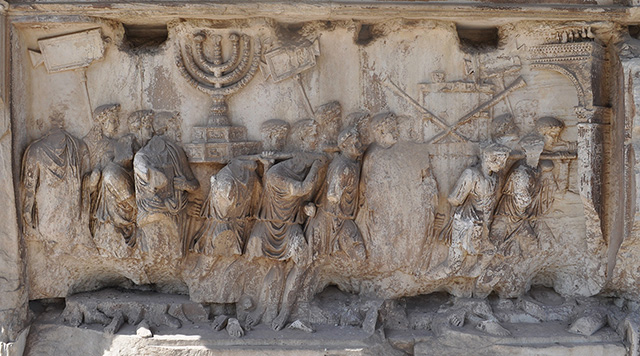
3. “seven golden lamp(stand)s” (v. 12b)—The author here repeats the verb e)pistre/yw (“turn upon/about”), adding dramatic suspense to his act of turning: “and, turning about, I saw…” These seven golden lamps are clearly parallel to the “seven Spirits” around God’s throne in verse 4 (cf. the earlier note), and again suggests that the manifestation of Jesus is very much like the manifestation of God himself. The most direct allusion is to Zechariah 4:2ff, where the lamps are explained as heavenly Messengers (“eyes”, v. 10b)—that is, Angels (“Spirits”)—but where there is also a connection with the presence of the Spirit of God (v. 6). The seven lamps may also allude to the golden lampstand, with seven branches, in the Tabernacle and (Second) Temple (Exod 25:31-40; 1 Macc 4:49-50; Josephus, Jewish War 5.217; the depiction on the Arch of Titus, etc).

4. “one like a son of man” (v. 13a)—This, of course, alludes to the famous description of the divine/heavenly being in Daniel 7:13-14 (also quoted earlier in verse 7 [cf. the note]):

“And see—with the clouds of heaven (one) like a son of man [vn`a$ rb^K=] was coming…”
LXX: “And see—upon the clouds of heaven (one) as a son of man [w($ ui(o\$ a)nqrw/pou] came…”

While the Greek version of Dan 7:13 uses the general particle w($ (“as”), the description here in Rev 1:13 is a bit more precise, using the adjective o%moio$ (“similar [to]”), emphasizing likeness. Originally, the expression “son of man” (Aram. vn`a$ rB^) simply meant “human (being)”, part of “(hu)mankind”; and, thus, the reference in Daniel is to a heavenly being who has the appearance of a human being. The use of the expression as a distinct title (“Son of Man”), referring specifically to such a divine/heavenly being, is fundamental to the early Christian understanding of Jesus, and of the eschatological outlook in the New Testament. For more on this topic, cf. Part 10 of the series “Yeshua the Anointed”. It is important to note that, while Dan 7:13f is the primary basis for the eschatological/Messianic title “Son of Man”, here the book of Revelation does not use the title, but goes back to the underlying wording in Daniel. The opening phrase “in the middle of the lampstands” emphasizes the centrality of Jesus, but also echoes the presence of God (and his throne) in the middle of the (surrounding) “seven Spirits”.

5. “a golden girdle [i.e. belt]” (v. 13b)—The initial description of this figure “like a son of man” refers to his clothing: “having been sunk in(to a garment) to the feet, and girded about toward the breasts (with) a golden girdle [i.e. belt]”. From a socio-cultural standpoint, this clothing indicates a high, honored/dignified status; possibly also a priestly status is suggested (cf. Exod 28:4-5; Zech 3:4, etc). It is best to view this clothing, with its golden belt, simply as characteristic of a heavenly being (Dan 10:5; cf. also Ezek 9:2f, and note again the description in Rev 15:6).

6. “his head and hairs were white as wool, white as snow” (v. 14a)—This would seem to be drawn from the description of God (the “Ancient of Days”) in Daniel 7:9 (cf. also 1 Enoch 46:1; 71:10). It may be intended to reflect the divine/heavenly generally (white symbolizing purity, etc), and could refer to a heavenly being (Angel) such as in 1 Enoch 106; however, the context of Dan 7:13, and the other parallels with the appearance of God (theophany), suggests a comparison with the “Ancient of Days” (Dan 7:9).

7. “his eyes (were) as a flame of fire” (v. 14b)—Again, this description would be characteristic of a heavenly/divine being (Dan 10:6; 1 Enoch 106:5f); the detail occurs again in 19:12.

8. “his feet (were) similar to white copper” (v. 15a)—The word xalkoli/banon refers to white[ned] (li/bano$) copper (xalko/$), i.e. refined/burnished bronze, “as (if) having been burned in a furnace”. It appears to be unique to the book of Revelation (also in 2:18), but is presumably derived from the description of the heavenly being in Dan 10:6. A shining fiery appearance at the feet (or below the feet) is also part of the manifestation of God (on his throne) in the language of theophany.

9. “his voice (was) as the sound of many waters” (v. 15b)—This image most likely comes from Ezekiel 1:24; 43:2, where it describes the approach of God (preceded and surrounded by heavenly beings). There is probably also an allusion to Daniel 10:6, as well as the thundering “voices” of God in the Sinai theophany (Exod 19:16; 20:18).

10. “he (was) holding…seven stars” (v. 16a)—These stars are being held in his right (lit. “giving”) hand, i.e. the hand or side indicating favor and blessing, as well as power and authority, etc. Power over the stars could be attributed to heavenly beings, but more properly relates to God as the Creator and sustainer of the heavens—i.e. God as the one who “causes the (heavenly) armies [i.e. bodies/beings] to be/exist” (toxb*x= hwhy). Verse 20 explains that the stars are, in fact, heavenly Messengers, connected with the seven congregations to whom the epistle-book of Revelation is addressed.

11. “out his mouth traveled a sharp two-mouthed sword” (v. 16b)—A two-edged (lit. “two-mouthed”, di/stomo$) sword was a military weapon, to be used for cutting/killing in battle (the “mouth” of the sword eats/consumes its victims). The image specifically relates to the traditional military role of the Messiah at the end-time (defeating/subduing the wicked nations), especially in the light of Isa 11:4 and 49:2, as these passages were given a Messianic interpretation. The idea of the “word of God” as a sword (Heb 4:12) presumably comes from the same background (esp. Isa 11:4 LXX, “the word of his mouth”). This military imagery is applied to Jesus more graphically in Rev 2:16; 19:15, 21.

12. “the sight of him (was) as the sun shining in its power” (v. 16c)—I have translated o&yi$ here as “sight”, i.e. “visual (appearance)”, but can specifically refer to the face, which is presumably intended here. The immediate Scriptural allusion is, again, to the heavenly figure in Dan 10:6, but, certainly, the sun (light, shining, etc) is a natural symbol for deity, and this is indicated by the qualifying phrase “in his/its power”.

This concludes the vision—that is the visual description—of the figure who appears to John. What follows in verses 17-20 are the words which the figure speaks. This will be discussed in the next daily note.

References marked “Koester” above, and throughout these notes, are to Craig R. Koester, Revelation, Anchor Bible [AB] Vol. 38A (Yale: 2014).

September 10: Revelation 1:9-10

Revelation 1:9-20

Verse 9 introduces the first vision of the book of Revelation. It differs from the other visions and visionary cycles in that the seer is addressed directly by the risen/exalted Jesus, rather than a heavenly intermediary. It is, however, compatible with the subsequent vision-cycles, in that it also follows a seven-fold pattern. The vision is closely connected with the seven “letters” which follow in chapters 2-3—it is the risen/exalted Jesus of 1:9-20ff who addresses the seven congregations.

Insofar as the book of Revelation utilizes an epistolary (and rhetorical) framework, 1:9-20 could be regarded as the narratio—the section in which the facts and background of the case are narrated. This encompasses the “letters” in chaps. 2-3. The historical character of the section is certainly indicated from the initial declaration by the author:

Rev 1:9

“I, Yohanan, your brother and com(panion) together (with you) in the (di)stress, and (in) the kingdom and (our) remaining under [i.e. enduring] in Yeshua—(I) came to be in [i.e. on] the island called Patmos, through the word of God and the witness of Yeshua.”

This clearly establishes the setting for the visions of the book: a seer/prophet named Yohanan (Grk.  )Iwa/nnh$, “John”) was residing on the island of Patmos. This small island, in the Aegean off the coast of Asia Minor (approx. 40 miles SW of Miletus, and not too far from Ephesus), was scarcely deserted, as might sometimes be imagined. There were communities living there, with a thriving culture. Even so, according to tradition, “John” was banished to Patmos, and many commentators would concur with this. The use of the verb form e)geno/mhn (“I came to be”) suggests that Patmos was not John’s normal place of residence. His reason for being there is explained as “through the word of God and witness of Yeshua”. This could be understood two ways: (1) it was for the purpose of preaching/witnessing (i.e. missionary activity), or (2) it was the result, or consequence, of his preaching/witnessing. The latter seems most likely (the reference to “the distress” suggests some measure of persecution); if so, then he may have been relegated to the island by provincial authorities (Roman province of Asia), according to a known mode of punishment (relegatio ad insulum). Christian tradition provides numerous speculative details on how/why John was relegated to Patmos. For more on the background/setting, related to Patmos, etc, consult any reputable Commentary (e.g., Koester, pp. 239-43) or Bible dictionary.

This is the third time that the author/visionary of the book is identified as Yohanan (“John”), and it is worth examining briefly several possibilities as to just who this “John” might be:

    • It is a pseudonym, presumably referring to John the Apostle
    • It is John the Apostle, son of Zebedee, in accordance with what came to be the established tradition
    • It is a different “Elder/Presybter” (presbu/tero$) named John, possibly the same person who authored the second and third Johannine letters (2 Jn 1; 3 Jn 1)
    • It is a separate and distinct John, an influential minister (and/or prophet) in Asia Minor

Critical commentators today are not as inclined (as past generations) to view the book as pseudonymous, despite the fact that much Apocalyptic literature is pseudepigraphic in nature (cf. my earlier article on these terms). The book is generally lacking in the kinds of details and references one might expect if the author were presenting himself as a famous (apostolic) figure. Some Christians chose the third option above, identifying the author with a second-generation Elder/Presbyter named John (cf. Eusebius, Church History III.39.4-6; VII.24.7ff). However, the main lines of Christian tradition identified the author as John the Apostle, an identification which appears to have been reasonably well-established by the end of the 2nd century (cf. Justin Martyr Dialogue with Trypho 81.4; Irenaeus Against Heresies III.11.1, 16.5ff; V.30.3; Clement On the Rich Man §42, etc).

The problem with the traditional view is that there is simply nothing in the book to suggest that this “John” is an Apostle and one of the Twelve (i.e. John the son of Zebedee)—indeed, Rev 21:14 could be seen as indicating the contrary. Thus, it is probably simpler (and safer) to rely upon the detail which the book itself provides—this “John” was a minister of some influence in Asia Minor (the area around Ephesus, etc), toward the end of the first century A.D., and may have been specially gifted as a prophet.

In discussing verse 2 (cf. the earlier note), I pointed out that there the genitive case in the twin expression “the word of God and the witness of Jesus” was subjective—that is, God is the one giving the word and Jesus is the one witnessing (to it). Now, however, in verse 9, the same expression occurs in a slightly different context, indicating that the genitive has switched to the object—i.e., the believer’s witness to Jesus, and the proclamation of the word/account (lo/go$) of what God has done (through the person of Jesus). Both of these aspects continue through the remainder of the book.

Rev 1:10

The introduction to the first vision continues with verse 10:

“I came to be in (the) Spirit, in [i.e. on] the day belonging (to) the Lord, and in back of me I heard a great voice as a trumpet (saying)…”

This description of the setting in vv. 9-10 involves three elements with the expression “I came to be in/on…” (e)geno/mhn e)n):

    • “on the island called Patmos” (location)
    • “in the Spirit” (condition)
    • “on the day belonging to the Lord” (time)

Central to this scenario is the detail that John was “in the Spirit” (e)n pneu/mati). This expression appears frequently in the New Testament, especially in Luke-Acts and the Pauline letters. It has a relatively wide range of significance, but often relates specifically to the prophetic aspect of God’s Spirit at work among his chosen people—cf. Mark 12:36; Luke 2:27; 4:1ff; 1 Cor 12:3ff; 14:2-3ff. The four occurrences in the book of Revelation (also at 4:2; 17:3; 21:10) are particularly important as they establish the spiritual basis—at four key points—for the prophetic legitimacy and authority of the visions. At each point, where there is a distinct change of setting in the visionary landscape, there is a note that this occurs “in the Spirit”. It is possible that the language itself may be drawing upon the book of Ezekiel (cf. 3:12; 8:3; 37:1; 43:5).

We should also here take note of the expression “on the day belonging to the Lord [e)n th=| kuriakh=| h(me/ra|]”. This “day belonging to the Lord”, using the adjective kuriako/$, occurs only here in the New Testament, but is found elsewhere in early Christian writings (Gospel of Peter 9:35; 12:50; Didache 14:1; Ignatius, Magnesians 9:1; Justin Martyr’s First Apology 67). It is typically translated “Lord’s Day”, and refers to Sunday, in association with the day of Jesus’ resurrection. However, we should also here recognize a deeper symbolism to the expression. The adjective kuriako/$ essentially means “belonging to the Lord [ku/rio$]”; and, while it is rare in the New Testament (elsewhere only at 1 Cor 11:20), in Greco-Roman usage it can relate to (Roman) imperial authority. Thus, it is likely that we have here a subtle, but significant, foreshadowing of the contrast, between the Kingdom of God and the (worldly) power of the Roman Empire, which is to become a major theme in the remainder of the book. Cf. Koester, p. 243.

Finally, which must consider the description which concludes the introduction in verse 10: “in back of me I heard a great voice as a trumpet”. In form, this seems to resemble Ezek 3:12 LXX, which is worth quoting:

“And the Spirit took me up, and down in back of me I heard (the) voice of a great shaking [i.e. earthquake] (saying)…”

Here the “great voice” is rather described “as a trumpet” (w($ sa/lpiggo$). In both Jewish (Old Testament) and early Christian tradition, the sounding of a trumpet often marks heavenly and eschatological phenomena (cf. Joel 2:1; Zech 9:14; Matt 24:31; 1 Cor 15:52; 1 Thess 4:16; and five more times in the book of Revelation, 4:1; 8:2, 6, 13; 9:14). In particular, a voice “like a trumpet” may be associated with the manifestation of God (Theophany), such as the famous appearance at Sinai—Exod 19:16; 20:18; Heb 12:19 (cf. also Psalm 47:5, etc). This is the first of several details in the vision which treat the appearance of the risen/exalted Jesus like a theophany. I list these here, to be discussed in more detail in the next daily note:

    • A great voice like a trumpet
    • The prophet turning to “see” the voice
    • The seven golden lamps
    • The white hair and fiery eyes
    • The shining/fiery appearance of the feet
    • The voice like the sound of rushing water
    • Holding (seven) stars in the right hand
    • Face shining like the sun