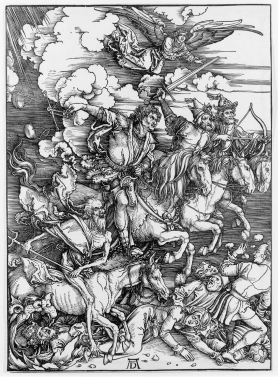
October 4: Revelation 9:13-21

Revelation 9:13-21

The sixth Trumpet-vision is similar in meaning and imagery to the fifth vision (9:1-12, discussed in the previous note). Both involve armies of (demonic) beings, with hybrid human/animal features, which come out from the depths of the earth to inflict suffering upon humankind. Before proceeding, it is worth outlining again the parallel thematic structure between the Seal- and Trumpet-vision cycles:

    • First Four Visions:
      • Seals—the four horses/riders symbolizing warfare and its effects on humankind
      • Trumpets—celestial/natural phenomena which bring about destructive effects on the world and humankind
    • Visions Five and Six:
      • Seals—celestial/natural phenomena which has terrifying/destructive effects on the world and humankind (6), together with the identity of believers and a voice sounding from the altar (5)
      • Trumpets—warfare on humankind from demonic military forces (horses/riders), along with the themes of the identity of believers (5) and a voice coming from the altar (6)

As noted previously, the twin themes of warfare and celestial/natural phenomena are also brought together in the Eschatological Discourse of Jesus (Mk 13:7-8, 24-25 par; also vv. 14ff [Lk 21:20-24]); interestingly, the Discourse also includes reference to the identity and persecution/suffering of believers (Mk 13:5-6, 9-13, 21-22 par), as well as the motif of the Temple/Altar location (Mk 13:14 par).

Rev 9:13-15

The solemn character and grandeur of this vision in marked by the voice from the heavenly altar which responds initially to the trumpet-blast:

“…and I heard a (single) voice (from) out of the [four] horns of the golden place for (ritual) slaughter [i.e. altar] th(at is) in the sight of God, saying to the sixth Messenger: ‘Loose the four Messengers, the (one)s having been bound upon the great river Euphrates!’ And the four Messengers were loosed, the (one)s having been made ready—unto the hour and day and month and year—(so) that they should kill off the third of men (on earth).”

In the earlier (fifth) seal-vision, the significance of the altar—the place for (ritual) slaughter (qusiasth/rion)—was related to believers who had been put to death during the time of persecution (6:9-11). Though the death of these believers may be seen as a kind of sacrifice, it is clear that in the book of Revelation the heavenly altar is an altar of incense, not animal sacrifice, and that the incense is connected symbolically to the prayers of believers (5:8; 6:10; 8:3; cf. also Luke 1:9-11; Acts 3:1; 10:4). The (four) horns of the altar are mentioned in relation to four Messengers who are to be released.

The specific location of the great Euphrates river is curious and requires comment, as it is apt to trip up commentators today. Like many of the specific symbols in the book of Revelation, it involves a matrix of ideas and associations. Here I would identify these as three-fold:

    • It reflects the place of origin for the conquering armies/powers coming from the east (and north) in Israelite history—i.e. of the Assyrian and Babylonian empires.
    • It marks the eastern boundary of the Roman Empire. Recall that the conquering horse/rider of the first seal-vision (6:2), carrying a bow, may have alluded the potential violence of non-Roman forces invading the empire. In the first century A.D., the Parthians were the major power along the Euphrates border.
    • In a sense, it also marks the outer region of the inhabited world (in the east), as known by people at the time in Syria/Palestine and further west. According to the Genesis creation narrative, the Euphrates is one of the four original, primeval rivers (Gen 2:10-12).

Crossing the Euphrates thus symbolizes the invasion of hostile and destructive forces into the known (civilized) world. The fact that the four Messengers (i.e. Angels) have been bound (dedeme/nou$) probably indicates that they are evil/fallen beings (20:2; cf. 2 Pet 2:4; Jude 6); if so, then they presumably lead the demonic armies which are unleashed, just like the “Messenger of the bottomless (pit)” in verse 11. They are given power to kill off a third of humankind, keeping with the common “one-third” motif of the Trumpet-visions. Verse 15 makes clear that this judgment/punishment corresponds with God’s plan and purpose, down to the precise day and hour.

Revelation 9:16-19

The description of the army which is unleashed across the Euphrates generally matches the grotesque, hybrid character of the locust-army in the fifth vision (cf. the previous note). This is presumably intended to reflect their demonic character—the ferocious, destructive appearance of spirits, etc, which represent (and/or cause) pestilence, disease, and death. Like the locust-army, it is primarily a cavalry force (i.e. horses/riders, as in the first four seal-visions, cf. above), wearing armor (qw/rac, chest-guard), with fierce animal attributes (spec. that of the lion), including a stinging tail. Several of the unique details are worth noting:

    • they are specifically identified as a body/force of armed soldiers (stra/teuma), riding horses (v. 16)
    • their number is indicated by the expression dismuria/de$ muria/dwn (“two multitudes of multitudes”), which, by arithmetic calculation would be 10,000 x 10,000 (= 200 million), but here simply means an immeasurably large number (cf. 5:11)
    • they are essentially fire-breathing creatures, and the colors of their armor match what comes forth out of their mouths (v. 17)—fire (red), dark blue (smoke), and yellow-green (sulphur)
    • the destructive fire from their mouth is also matched by the mouth/bite of their tail; the locusts had a stinging point (ke/ntron) at the end of the tail, while these creatures have a “head”, like a snake’s head (with a mouth) at the end of their tail (v. 19), making them doubly deadly.

Fire-breathing creatures are common in ancient myth, but here the description more closely resembles the chimera (xi/maira) of Greek legend (Homer Iliad 6.181-2; Hesiod Theogony 319ff; Virgil Aeneid 6.288; Ovid Tristia 4.7.13, etc; Koester, p. 467). It serves as a powerful climax to the six trumpet-visions, which emphasized the motif of judgment by fire (from heaven)—the fire cast down onto the earth now takes the form of burning plagues. The imagery here in this regard is three-fold: (1) fire (pu=r), (2) smoke (kapno/$), and (3) burning sulphur (qei=on). This last word is similar (and may be related) to the words for deity (qei=o$, neut. qei=on; qeo/$), and could conceivably indicate a bit of wordplay—the failure of human beings to recognize the true God (qeo/$ / qei=o$) leads to judgment by burning sulphur (qei=on); on this, cf. below. Judgment by fire and burning sulphur was part of the Sodom/Gomorrah narrative (Gen 19:24-28) which became a stock element of eschatological and apocalyptic judgment-imagery.

Rev 9:20-21 and interpretation of the 5th/6th visions

The six trumpet-visions, describing God’s end-time Judgment on the world, close with the narration in verses 20-21:

“And the (one)s remaining of the men (still alive), the (one)s who were not killed off in these (plague)s that struck (them), even (then they) did not change (their) mind [i.e. repent] out of the works of their hands, (so) that they would not kiss toward [i.e. worship] the daimons and the images (of) gold and silver and copper and stone and wood, which are not able to see nor to hear nor to walk about.” (v. 20)

This seems to imply that the limited scope (one-third) of the initial Judgment is meant to give humankind, even at that late time, the opportunity to repent. The flip side is that this painful “testing” (vb. basani/zw, verse 5) actually serves to demonstrate the wicked character of humankind (the non-believers)—even in the face of the anger of God clearly at work, people continued to follow their pagan/idolatrous ways. This is expressed entirely in traditional Old Testament language, from the Prophets, and sharpened in the light of Jewish and early Christian monotheism. All other deities, apart from the one true God (YHWH), must be false and/or evil—that is to say, either (a) non-existent, or (b) evil/malevolent beings. Both lines of thought can be found in the Old Testament, with the former dominating in the Prophetic writings—i.e. the ‘gods’ are simply lifeless images (Isa 44:9-20; Psalm 115:4-7, etc). By the time of the New Testament, Jews and early Christians tended to adopt the latter position (i.e. they are real spirits/beings [daimons], but evil/hostile to God and humankind); note, however, Paul’s careful treatment of the subject in 1 Corinthians 8-10. An important point in the letters of Revelation 2-3 involved the same issue addressed by Paul—believers taking part in food which had been offered to pagan deities (2:6[?]; 3:14-15, 20). The letters of Revelation contrast sharply with Paul’s approach, condemning the practice in no uncertain terms, without any qualification.

At the same time, this traditional religious polemic is joined with the ethical dimension of pagan religion and society, typically viewed by Jews and early Christians as thoroughly immoral (cf. Romans 1:18-32 for a similar description of the behavior which is the target of God’s impending Judgment). Here it is summarized by four terms:

    • fo/noi—acts of killing/slaying (i.e. murder)
    • fa/rmakon (pl.)—literally a medical potion or drug, which, according to the ancient mindset, would generally be thought to have magical properties; in this (religious) context, it can connote both (1) a harmful poison, and (2) the practice of magic/sorcery (cf. the related noun farmakei/a)
    • pornei/a—literally prostitution (sexual intercourse for payment/hire), but often used to describe sexual misconduct or immorality generally; based on Old Testament language and tradition, Jews and early Christians frequently used the word figuratively for religious unfaithfulness (cf. earlier at 2:21).
    • kle/mma (pl.)—literally “things (that are) stolen”, i.e. stealing, theft.

Thus Judgment comes upon humankind for this wickedness, expressed in both religious (v. 20) and ethical (v. 21) terms. How are we to understand the nature of this Judgment in the trumpet-visions? If we isolate out, for a moment, a layer of distinctly Biblical imagery (from the Exodus Plague Narratives, etc), the first four visions present extreme versions of the sort of natural and ecological disasters with which we are becoming increasingly familiar today—burning of grass and trees (as in the recent wildfires on the U.S. west coast), contamination of the oceans, lakes, and rivers, etc. The darkening of the sun and moon, etc., whether by a natural eclipse or other meteorological phenomena (including smoke/pollution), also is not uncommon. That God would make use of these natural means and forces in a special way at the end time, is fully in keeping with the witness of both Scripture and common religious tradition.

The fifth and sixth visions are a bit more difficult to interpret. On the whole, the armies of attacking creatures seem to represent the disease and destruction which comes about by demonic forces. If the judgment in the first four visions comes from above, that of the fifth and sixth visions comes from in/under the earth itself—based on the traditional idea that evil/fallen beings (Angels) have been bound in the depths under the earth (Gk. ta/rtaro$). Naturally, much, if not most, of this is quite foreign to our cosmology today. In the modern intellectual idiom, we might translate this to say that the forces bound up within the earth/nature itself work to bring about the suffering/destruction of humankind. In ancient thought, the forces and powers of nature are personified as living beings. At the same time, within Scripture, there is a long tradition of dualistic conflict between divine/heavenly forces—of good vs. evil, God vs. Satan. The visions in the book of Revelation are fully rooted in this line of tradition. It is worth noting that the natural phenomena of the first four visions primarily affect the natural world (the earth itself), while the last two target human beings. There is an obvious parallel between human wickedness, which involves the worship of false/evil deities, and the supernatural/demonic attacks which come about in response—in a sense, it is an entirely fitting and appropriate punishment.

October 3: Revelation 9:1-12

Revelation 9:1-12

The fifth and sixth Trumpet-visions should be considered together, just as the first four visions form a single group (cf. the previous note); however, due to the extensive detail in which each is presented in the text, it is necessary to treat them in separate daily notes.

Rev 9:1

The fifth vision, in its initial imagery, is similar to the third (8:10-11) in which a fiery star (a)sth/r) falls from heaven to earth. Most likely there is a play on the imagery in the two visions. In the third vision, we are presumably dealing with a natural celestial phenomenon (such as a meteor), despite the extraordinary effects it produces (poisoning a third of all rivers and springs). Here in the fifth vision, by contrast, the star is personified:

“…I saw a star having fallen out of heaven into/onto the earth, and the key of the pit th(at is) without depth [i.e. bottomless] was given to him” (v. 1)

The star is thus treated like a celestial/heavenly being (i.e. Angel) with power/control over the depths of the earth. In Near Eastern and Old Testament tradition, the stars were typically seen as divine beings, or Angels (Judg 5:20; Job 38:7, etc), as also in the symbolism used in Rev 1:20, etc. Moreover, in the Old Testament and Jewish tradition, the various celestial phenomena were controlled (by God) through heavenly Messengers (Angelic beings); this was expressed earlier in Rev 7:1-3.

The image of a falling star, or Angel, could conceivably allude to Satan or a similar demonic being (i.e. ‘fallen angel’), reflected in such passages as Luke 10:18 and Rev 12:7-9 (cf. also the negative connotations in Isa 14:12 and 1 Enoch 86:3; 88:1-3; 90:24-26; Koester, p. 456). However, the idea that this Star/Angel was given the key to the bottomless pit suggests positive divine presence and control (1:18; 3:7; cf. also 20:1-3). At the very least, the motif of falling, with its echo of the third vision, anticipates the destructive and demonic character of what comes out of the depths. The translation of a&busso$ (lit. “without depth”) can be misleading; in ordinary English idiom, “bottomless” (i.e. without a bottom limit to its depth) would be a more accurate rendering. The Greek is preserved as a transliterated loan-word in English (“abyss”). It occurs several more times in the book, as the location from whence demonic beings arise, and as the place where they belong (11:7; 17:8; 20:1-3). In at least one line of ancient Greek cosmology, the space under the earth, corresponding to the atmosphere (hemisphere) above, was bounded by a long and almost limitless gulf below (Homer Iliad 8.14-15f; Hesiod Theogony 119, etc) called by the name of ta/rtaro$ (of uncertain derivation).

Rev 9:2-3

The ominous character of this scene is expressed by a two-fold description of that which emerges from the bottomless pit—(a) immense, dark smoke, and (b) a terrifying swarm of locust:

“And he opened up the pit th(at is) without depth—and smoke [kapno/$] stepped up [i.e. came up] out of the pit, as the smoke of a great burning (oven), and the sun and the air were darkened out of [i.e. from] the smoke of the pit. (v. 2)
And out of the smoke there came out locusts [a)kri/de$] into/onto the earth; and authority [e)cousi/a] was given to them, (even) as the stinging (creature)s [skorpi/oi] of the earth hold authority.” (v. 3)

The image of smoke (kapno/$) continues the fire-imagery of the visions, as well as the motif of darkening (the sun, etc) common to ancient Judgment imagery and as expressed in the prior fourth vision (8:12). This fiery smoke also evokes the idea of warfare, as do the locusts which emerge in vv. 3ff. There are actually several aspects to the symbolism of a swarm of locust:

    • Destruction—as of the crops which are consumed/destroyed by locust, a potential disaster always in the mind of ancient farmers
    • Military attack—the swarm of locust symbolizing an army on the move
    • Pestilence—locusts themselves represent a terrible plague on humankind, and they can be used as representative of various kinds of plagues (diseases, etc)

All three aspects are relevant (and intended) here, and draw upon traditional imagery in the Old Testament, beginning with the Plagues on Egypt (Exod 10:4, 12-19; Psalm 105:34)—cf. Deut 28:38; Judg 6:5; 7:12; 1 Kings 8:37; Psalm 78:46; Prov 30:27; Joel 1:4; 2:25; Amos 4:9; 7:1; Nah 3:15-17; Jer 46:23; 51:14, 27. These locusts are distinguished from ordinary locust in that they have been given the power/ability to sting, like other insects/creatures (such as the scorpion, i.e. skorpi/oi).

Rev 9:4-6

These verses give further detail on the stinging power of these locusts. It was declared to them, i.e. by the Angel who released them, that they should not “take away justice” from (vb. a)dike/w, i.e. injure) the trees, grass or other vegetation (“green [plant]s”) of the earth. They would have power only over human beings (“men”), and then only over those who “do not hold the seal of God upon the (space) between the eyes [i.e. forehead]”. This seal (sfragi/$), mentioned previously in 7:2-3ff (cf. also the visions in chaps. 5-6), refers to the distinctive image impressed into clay or wax (or lead) marking an object as belonging to a person. This image (to be described in 14:1) consists of the names of God and the Lamb (i.e. the risen Jesus); however, at this point in the book, this detail has to be inferred, based on the context of chapters 5-6. Those who are sealed are identified as the true people of God—utilizing the traditional image of Israel (the twelve tribes) as God’s people. In the context of the book of Revelation (as in Rom 9-11, etc), this imagery refers to the people of God (Israel) who are believers in Christ (the Lamb). The seal also carries the idea of election—it was God (and the Lamb) who stamped them.

As for those who do not carry this seal, they will be afflicted (but not killed) for a (symbolic) period of “five months” (v. 5). The verb used is basani/zw, a word of uncertain derivation, which specifically (and originally) referred to the testing of metals (gold/silver, coinage, etc). The harsh treatment required by such testing eventually led to the word as signifying torture, etc, as a means of ascertaining the truth. Here the implication is that the torment these people will endure from the locusts reflects, and will demonstrate, their true nature—i.e., as those who do not belong to God. What they suffer will be like the poisonous stings of the scorpion, resulting in agony that will make them long for death as a relief (v. 6). In spite of the military imagery which follows (vv. 7ff), it is clear that this refers to pestilence or disease.

Rev 9:7-11

A detailed description of the stinging locusts follows in these verses. Previously in the book, most of the imagery has been traditional and relatively straightforward; from this point on, it becomes increasingly complex, causing great difficulty for commentators and those eager to understand exactly what is being described. The hybrid depiction of these locusts is striking indeed; note the rather bizarre combination of elements:

    • they have the overall likeness of “horses made ready for war”, immediately indicating a military motif (i.e. war-horses, cavalry)
    • there are objects like golden crowns upon their heads, indicating the power to achieve victory (i.e. in military combat)
    • they have human faces (“like the faces of men”)
    • they also have long flowing hair (“like the hair of women”)
    • their teeth are long and sharp (“like [those] of lions”)
    • they each wear a chest-guard or armor (qw/rac), with the appearance of iron
    • their wings make the sound of “many horse(-drawn) chariots running into battle”
    • they have tails like a scorpion (lit. stinging creature [skorpi/o$]), with a stinging point (ke/ntron) on the tail

This admittedly strange mixture of features makes more sense once we realize that it is an attempt to combine several kinds of imagery, each with its own symbolic significance:

    • Military—armor, horses, and the rush into battle, with the power/ability to conquer
    • Personification—the human attributes indicate something of the purpose and control which these creatures possess
    • Demonic—images with hybrid human & animal features were commonly used in the ancient Near East to represent deities (and their attributes); from the standpoint of Jewish and early Christian monotheism, all such (pagan) deities tended to be regarded as demonic, or as symbolizing the demonic. In particular, there is likely a reflection here of the religious-royal iconography associated with the conquering Assyrian, Babylonian and Persian empires.
    • The Scorpion—special emphasis is given to the (poisonous) stinging tail of creatures such as the scorpion
Rev 9:11

“They hold upon [i.e. over] them as king the Messenger of the (pit) without depth [a&busso$]—the name for him in Hebrew is Abaddôn, and in Greek (this) name holds as ‘Destroyer’ [Apollu/wn].”

This army of locust has as its ruler (basileu/$) a being called “the Messenger of the (pit) without depth” (i.e. Angel of the bottomless [pit]). It is not entirely clear if this is the same being as the Star/Angel which opened up the bottomless pit, or whether it reflects a different being (i.e. one who rules over the pit below); probably the latter is intended. The Hebrew name indicated here—/oDb^a&, transliterated as Abaddw/n in Greek and Abaddon in English—is derived from the verb db^a* (“perish, ruin, destroy”), and originally referred to the grave/underworld as a place of death and decay; in this regard, it was roughly synonymous with Heb. loav= (Sheol). The word is used in this general/neutral sense in the Old Testament (Psalm 88:11; Prov 15:11; Job 26:6; 28:22, etc). Only in later Jewish tradition, did it come to take on a more negative and hostile/evil connotation, as in the Qumran texts (1QH XI.19ff; 4Q491 8-10; 11Q11 4.10). The Greek name Apollu/wn, is a relatively faithful translation, at least in terms of capturing the later (negative/hostile) sense of the word; it is related to the verb a)po/llumi (lit. “cause/suffer loss from”, i.e. “ruin, destroy”, similar in meaning to Heb. db^a*) and the noun a)pw/leia (“loss, ruin, destruction”). Simply put, the name signifies the power which brings about suffering and death; personified as a divine (or semi-divine) being, it would naturally be identified with Satan and the fallen angels (and/or unclean spirits) in Jewish and Christian tradition.

Rev 9:12

The concluding words of this vision echo those earlier in 8:13:

“One woe has come along—see! two (more) woes (are) yet (to) come after these (thing)s!”

An interpretation of the vision as a whole will be offered in summary after the sixth vision (9:13-21) has been discussed in the next daily note.

October 2: Revelation 8:6-13

Revelation 8:6-13

For an introduction to the Trumpet-visions and their relation to the earlier Seal-visions, etc, see the previous daily note (on 8:1-5). Verses 6-13 cover the first four Trumpet-visions, all of which involve natural disasters as the result of celestial phenomena. The language and imagery used to describe these is drawn primarily from Old Testament tradition, but also would have been recognizable to people in the Greco-Roman world at large, since these sorts of celestial phenomena were widely seen as portents of disaster and divine anger/judgment which were to come upon humankind. For the background of the trumpet-motif as a herald of end-time Judgment, cf. the previous note.

Suspense is created in verse 6, adding to the sense of anticipation and foreboding: “And the seven Messengers, the (one)s holding the seven trumpets, made themselves ready (so) that they should sound the trumpet”. The idea of trumpets sounding (in the sky) announcing or forewarning of disaster to come is widespread, and not only in Old Testament tradition (cf. Ovid, Metamorphoses 15.784ff; Lucan Pharsalia 1.578). The first three trumpets (vv. 7-11) each announce judgment in the form of fire from heaven, which echoes both the Plagues on Egypt (Exod 9:23-24) and the Sodom & Gomorrah narrative (Gen 19:24ff) in Old Testament tradition. Both were natural figure-types for the end-time Judgment; on the use of Sodom/Gomorrah in this regard, cf. Luke 17:29; also Matt 10:15; 11:23-24; 2 Pet 2:6; Jude 7.

The first two trumpet-visions follow a common pattern, describing fire which was “thrown [e)blh/qh] (down) into [ei)$]” the earth/sea. This reflects the Messenger holding the golden bowl at the altar of incense, who throws fire down to the earth (vv. 4-5); however, ultimately the passive should be understood here as the divine passive, i.e. God as the implied actor. The third trumpet-vision differs slightly, in that the fire (a burning star) falls (e&pesen) out of heaven to land upon the earth. Here is a comparison of the details in the three visions:

  • First Trumpet (v. 7):
    • “hail and fire having been mixed in blood”—an obvious echo of the plague in Exod 9:13-26 (also Ps 78:48ff; 105:32), repeated as judgment imagery in Isa 30:30; Ezek 38:22; Wis 16:22-23. The added element of blood may be intended to continue the theme of warfare and violence (and its effects) from the earlier seal-visions. Blood raining from heaven is known as a visionary portent of war (cf. Lucan, Pharsalia 1.578; Cicero, On the Nature of the Gods 2.5.14; Sibylline Oracles 5:377-9, etc). A more immediate Old Testament allusion may be found in Joel 2:30.
    • thrown down into/onto the earth
    • a third of the earth’s surface (i.e. the dry land)—trees and green grass—is burnt down
  • Second Trumpet (vv. 8-9):
    • “(something) as/like a great mountain burning with fire”—i.e. a great fiery mass; there are similar eschatological/apocalyptic references in 1 Enoch 18:13; 21:3; and Sibylline Oracles 5:158-9.
    • thrown down into/onto the sea
    • a third of the sea becomes blood—a clear echo of Exod 7:16-23 and the plagues on Egypt; whether this means that the water came to be the color of blood, etc, or was miraculously transformed into actual blood, hardly matters (probably the latter was meant). As with the fire which struck the land (burning trees and grass), there are similarly two effects from the fire which strikes the sea:
      —a third of the creatures in the sea die, and
      —a third of the boats come to ruin, perhaps literally rotting or decaying
  • Third Trumpet (vv. 10-11):
    • “a great star burning as a brilliant (light) [i.e. lamp/torch]”—falling stars (i.e. comets, meteors) naturally served as omens and portents of death and disaster in the ancient world (cf. Manilius Astronomica 1.874-6, etc). If taken literally, here it is the image of a great (fiery) meteor landing on the earth.
    • falls out of heaven—it is conceivable that this shift in wording foreshadows the fifth and sixth trumpet-visions; or, perhaps, it is intended to convey a natural phenomenon, as opposed to the supernatural fire of the 1st/2nd trumpet-vision.
      It falls out of heaven and land upon the rivers and springs of earth; exactly how this comes about from a single star/meteor is unclear, nor is the scientific detail important.
    • a third of the waters are turned into a&yinqo$, a Greek word of uncertain derivation, which refers to a small plant (‘wormwood’) which yielded a bitter taste (cf. Prov 5:4; Jer 9:15; 23:5)—i.e. a third of all rivers and springs, with their water used for washing, drinking and cooking, etc, became poisoned and made bitter, resulting in the death of “many” people. Here there may be likely an allusion to the judgment upon the people following the Golden Calf incident, where they were forced to drink the contaminated water (Exod 32:20; cf. 15:23).

As in the third trumpet-vision, the fourth (v. 12) also involves natural celestial phenomena—namely the sun, moon, and stars together:

“…and a third of the sun and a third of the moon and a third of the stars were (each) struck, (so) that a third of them (each) would be darkened, and the day would not shine a third of its (light), and the night likewise.”

This, too, reflects the Plagues of Egypt—the plague of darkness on the land (Exod 10:21-23)—but the idea of the darkening of sun and moon came to be a common Judgment motif in the Old Testament (Isa 13:10; 24:23; Joel 2:10, 31; 3:15; Amos 5:20; 8:9; Zeph 1:15; Ezek 32:7), one which Jesus would make use of in the “Eschatological Discourse” (Mark 13:24-25 par). Unusual darkness, as during an eclipse, etc, was naturally seen as a dangerous omen or portent in the ancient world (Ovid Metamorphoses 15.785; Lucan Pharsalia 1.538-43, etc).

Verse 13 marks a division between the first four visions and the next two; from a literary standpoint, it also serves to heighten the dramatic suspense, pointing toward what is about to come. It is treated as a distinct vision:

“And I saw and heard one air-borne (being) winging [i.e. flying] in the middle of the heaven, saying with a great voice: ‘Woe, woe, (and) woe (again which is to come) to the (one)s putting down house [i.e. dwelling] upon the earth, out of the remaining voices of the trumpets of the three Messengers the (one)s about to sound the trumpet!”

I have translated a)eto/$ literally as a creature/being in the air, which usually refers to a bird (spec. an eagle); some manuscripts instead read a&ggelo$ (“Messenger”, i.e. Angel), which seems more likely to be a ‘correction’ of a)eto/$ than the other way around. Birds served as omens or portents of disaster, etc, in the ancient world, and the eagle would have represented the nobility (and reliability) of a divine messenger (cf. Homer Iliad 8.242, Odyssey 2.146, etc). The messenger, whether an eagle or heavenly being, here is announcing the judgment still to come in the remaining trumpet-visions.

A common detail through the first four visions is the motif of a third—the celestial phenomena, and the related disasters, are repeatedly (and consistently) said to affect a third of the world. The precise significance of this remains uncertain. Possibly it is meant to indicate one stage or portion of the final Judgment, which will be completed in the seven Bowl-visions of chapter 16, etc. It also may reflect traditional imagery, or a literary/prophetic device, such as we see in Ezek 5:2ff; Zech 13:8-9. More likely is the idea that the limited application of the Judgment (to a third of the earth and humankind, cf. also 9:15ff) is intended as an expression of God’s mercy, to give the survivors the opportunity to repent before the Judgment is completed; this is certainly implied in 9:20-21, as a concluding notice to the first six trumpet-visions, and should be taken seriously.

October 1: Revelation 8:1-5

Revelation 8:1-5

These five verses describe the opening of the seventh, and final, seal upon the scroll. As such, it mark the final portion of the eschatology represented by the seven seals. Though somewhat obscured by the amount of material remaining in the book, we must keep this idea of finality and completion in mind. It may be said that the seventh seal provides the context and setting for all that follows, from 8:6 to the end of chapter 20, including two more seven-part vision-cycles. This naturally means that the opening of the seventh seal is a matter of great importance, requiring a solemn and ceremonial treatment. There are three elements of the section which need to be studied:

    1. The silence in heaven when the seal is opened
    2. The introduction of the seven trumpets, and
    3. The motif of the golden censer and smoking incense

Each of these will be examined in turn.

Rev 8:1—Silence in Heaven

“And when he opened up the seventh seal, there came to be silence [sigh/] in heaven as (of) [i.e. for] a half-hour.”

The silence accompanying the opening of the final seal marks the awesomeness of the moment. The word sigh/ (“silence”) is rare in the New Testament (elsewhere only in Acts 21:4), though the related verb siga/w is a bit more frequent. Silence is an appropriate response for created beings in the presence of God (Deut 27:9; Job 4:16; Hab 2:20; Zech 2:13), or in expectation of His manifestation (Psalm 62:1; Isa 41:1). The eschatological context of Zeph 1:7 is perhaps close to the idea here in v. 1:

“Be silent from the face of [i.e. before] the Lord YHWH, for the day of YHWH is near…”

There may also be an allusion to the motif of silence at the beginning of creation (i.e. before God speaks), which can also be applied in terms of a new creation which follows the end of the current Age (cf. 2 Baruch 3:7; 2/4 Esdras 6:39; 7:30). A “half hour” here indicates a very short period of time.

Rev 8:2—Introduction of the Seven Trumpets

“And I saw the seven Messengers th(at) have stood in the sight of God, and seven trumpets were given to them.”

Previously in the book, these seven beings were called “Spirits” (1:4; 3:1; 4:5; 5:6), but it was clear that they were to be understood as heavenly beings or Angels (rather that God’s Spirit as such), and this is made explicit here. The seven trumpets given to these Messengers serve as the framework for the next vision-cycle, unfolding out of the first. The trumpet was used for ceremonial and military occasions, and both of these aspects are relevant here: (1) announcing the appearance of God, and (2) the Judgment expressed in traditional military terms. There is a long tradition related to the trumpet-image in the Old Testament (Exod 19:13-19; 20:18; Lev 23:24; Num 10:8-10; Josh 6:4ff; Psalm 47:5, etc); but it is in the Prophets where it begins to take on an (eschatological) association with the day of Judgment—cf. Isa 18:3; 27:13; Jer 4:5ff; 6:1ff; 51:27; Hos 8:1; Joel 2:1ff; Zech 9:14. Again, it is Zephaniah (1:14-18) which perhaps provides the closest parallel to the context of Rev 8-11 (cf. above on v. 1 and Zeph 1:7). The eschatological significance of the trumpet-sounding is clear from other passages in the New Testament (Matt 24:31; 1 Cor 15:52; 1 Thess 4:16).

Rev 8:3-5—The Golden Censer and Smoking Incense

“And another Messenger came and stood upon the place of slaughter [i.e. altar] holding a golden vessel for (burning) incense, and much fragrant powder was given to him (so) that he will give it, (along) with all the holy ones’ speaking out toward (God) [i.e. prayers], upon the golden place of slaughter [i.e. altar] in the sight of the ruling-seat.” (v. 3)

I have translated the noun qusiasth/rion literally as “place of (ritual) slaughter”, though it can be used in the more general sense of an “altar” even when no animal sacrifice takes place (such as the altar for burning incense). Clearly, in this heavenly vision, the altar does not involve animal sacrifice, but is limited to the burning of incense which symbolizes prayer (also in 5:8). Only in the reference to the blood of the Lamb, and the blood of the believers put to death for their faith (6:9-11), is there an allusion to animal sacrifice. However, retaining the fundamental meaning of the word (qusiasth/rion) here is, I think, important, as it may allude to the ‘slaughter’ which accompanies the Judgment (cf. Isa 30:25; Jer 7:32; Joel 3:1-2ff, etc). The association of prayer with incense is traditional (Psalm 141:1-2; cf. Luke 1:9-11), and reflects the idea of a purified form of religion (Isa 1:13; Mal 1:11). In the Temple-action by Jesus, as recorded in the Synoptic tradition, the citation of Isa 56:7 (Mark 11:17 par) would seem to give priority to prayer over and against animal sacrifice, suggesting a new role and purpose for the Temple (in this regard, cf. Luke 18:10; 24:53; Acts 3:1; 22:17).

It is interesting to see how the imagery progresses. First we have the incense itself, which is burned upon the altar. Then is emphasized the smoke from the offering:

“And the smoke [kapno/$] of the fragrant powder stepped [i.e. went] up, (along) with the holy ones’ speaking out toward (God) [i.e. prayers], out of the hand of the Messenger in the sight of God.” (v. 4)

Smoke is an ambivalent image—it can indicate the warmth and protection of fire (here also the soothing fragrance of the burning incense), but also the destructive effects of fire (war, natural disaster, etc). Thus the rising of the smoke serves as an effective transition to the motif of the fire of Judgment, which is the third step in the progression:

“And the Messenger took the vessel for (burning) incense and filled it out of the fire of the place of slaughter [i.e. altar], and (then) threw it into/unto the earth—and there came to be thunderings and voices and flashings and shaking.” (v. 5)

In this regard, just as the seven trumpets serve as the basis for the second vision-cycle (chaps. 8-11), the golden censer filled with fire prefigures the third vision-cycle (in chapter 16). It is useful here to keep in mind the structure of the seven seal vision-cycle. The visions from the first six seals involve: (a) warfare among the nations, (b) persecution/death of believers, and (c) disruption of the cosmic/natural order—all of which is preliminary to the day of Judgment itself. With the terrifying natural phenomena which strike when the sixth seal is opened, humankind is aware that God is present and about to bring Judgment. Now, with the opening of the seventh, final seal, the Judgment begins. This, I think, helps us to understand the framework of chapters 8-20—various ways of describing the nature and character of the coming Judgment. We will begin exploring this as we proceed through the remainder of the book, starting with the trumpet vision-cycle; the first four visions (8:6-13) will be examined in the next daily note.

September 30: Revelation 7:9-17

Revelation 7:9-17

Rev 7:9-10

Verse 9 begins with words similar to the opening of verse 1, indicating that these are two halves of a single visionary scene:

“With [i.e. after] these (thing)s, I saw, and see! a throng (of) many (people), which no one is able to number, out of every nation—and (all) offshoots [i.e. tribes] and peoples and tongues—having taken (their) stand in the sight of the ruling-seat and in the sight of the Lamb, having been cast about [i.e. clothed] in white dress and (with) palm branches in their hands, and they cried (out) with a great voice, saying: ‘The salvation (is) to our God, the (One) sitting upon the ruling-seat, and to the Lamb!'” (vv. 9-10)

The image of believers—those who are “able to stand” in the great Judgment (6:17)—begins with those sealed out of the twelve tribes of Israel (vv. 4-8, cf. the previous note), and concludes with a throng of people out of every nation, language, and ethnic group, etc. The relationship between these two will be discussed further below. First it is necessary to examine how this second “group” of believers is described here in vv. 9ff.

    • “cast about [i.e. clothed] in white dress”—this corresponds with the traditional description of heavenly/angelic beings (4:4; 19:14), as well as the heavenly reward/status promised to believers in 3:4-5, 18.
    • “(with) palm-branches in their hands”—the palm branch symbolized victory in Greco-Roman tradition (Virgil Aeneid 5:112; Livy Roman History 10.47.3; Plutarch Moralia 723-4; Pliny Natural History 17.244; Caesar Civil War 3.105, etc; cf. Koester, p. 420), and was recognized by Jews as well (1 Macc 13:37, 51; 2 Macc 10:7; 14:4; Philo On the Unchangableness of God §137). In John’s version of the Triumphal Entry scene, palm branches are used (Jn 12:13), presumably to greet Jesus as the (conquering) Messiah.
    • The song they sing is similar to that of the heavenly beings in chaps. 4-5, and reflects the same dual emphasis of the Lamb (the exalted Jesus) standing alongside God on His throne. It also indicates the same position of homage and adoration, in which the salvation believers have experienced is “given back” to God (and Christ), recognizing Him as its source. Ascribing salvation to God (that is, as coming from Him, or belonging to Him) is part of the Old Testament tradition (cf. Gen 49:18; 1 Sam 2:1; Psalm 3:8; 27:1; 38:22, etc).
Rev 7:11-12

The song by the believers effectively joins that of the heavenly throng (chaps. 4-5), and the heavenly beings around the throne of God answer in return, with a new refrain. On the language used here, cf. 4:9-10f; 5:9-14; in particular, the wording of the song in v. 12 echoes 4:11 and 5:12-13. Significantly, seven words are strung together, symbolizing the praise that is worthy of Deity.

Rev 7:13-14

The identity of the great throng clothed in white (vv. 9-10) is addressed here, by way of a leading question from one of the heavenly “Elders”. Such an exchange reflects similar episodes in Old Testament and Apocalyptic tradition—cf. Ezek 37:3; 40:3-4; Zech 1:8; Dan 7:16; 8:15; 1 Enoch 21:5; 22:3; 2 Baruch 55:3-4ff, etc; Koester, p. 420.

Elder: “These the (one)s cast about [i.e. clothed] with white dress—who are they and (from) where did they come?”
John: “My lord, you have seen [i.e. you know].” (cf. Ezek 37:3)
Elder: “These are the (one)s coming out of the great distress/oppression [qli/yi$], and they washed their dress and made the (garment)s white in the blood of the Lamb.”

Here the emphasis is on their white garments. The word stolh/ is often translated “robe”, but fundamentally it refers to any sort of (special) clothing or dress, used to indicate position, honor, etc. The white garments reflect the dress of heavenly/divine beings (cf. above), which believers receive as a sign of honor and victory (i.e. heavenly reward). Now, however, the color is given a particular significance, which is two-fold:

    • they have come out of “the great distress/oppression”
    • they have washed (i.e. rinsed under flowing water) their garments “in the blood of the Lamb”

Previously, the blood of the Lamb was tied to sacrifice—i.e. Jesus’ death in terms of (a) Passover, (b) the offering at the establishment of the covenant, and (c) a sin/guilt offering. Only the last of these is really in view here, with the distinctive idea of cleansing (i.e. from sin). Obviously, blood is antithetical or paradoxical as a symbol for cleansing, but it may relate to concepts of atonement (wiping out/off) through blood in ancient religious traditions—cf. Gen 9:6, etc. There was a sacred quality associated with blood, it could be used in religious ritual to consecrate people or objects (Exod 24:6, 8; 29:12ff; Levit 8, etc). The connection with washing is perhaps drawn more directly from Gen 49:11, as a Messianic prophecy (cf. Rev 5:5). Since these believers have come out of the time of great distress, which includes persecution and killing of believers (6:9-11), it is possible that here blood specifically refers to believers who are put to death for their faith. While this allusion is likely, the reference here should not be limited to that interpretation. According to basic early Christian teaching, all believers are cleansed through Jesus’ blood (Rom 3:25; 5:9; 10:16; Col 1:20; Eph 1:7; Heb 9:13-14ff; 10:4; 1 Pet 1:2; 1 John 1:7; Rev 1:5, etc). Moreover, the obvious parallel with baptism likewise would apply to believers generally.

Some comment is required regarding the expression “the great distress/oppression” (h( qli/yi$ h( mega/lh). Under the now-traditional designation “Great Tribulation”, this expression has very much taken on a life of its own, especially among Dispensationalist commentators. We must, however, be careful not to wrench it too quickly out of its context here, within the vision-cycle of the seven seals. Limiting it this way, at least for the moment, it must refer generally to the visions described for the first six seals, which we may summarize (again) as:

    • Seals 1-4, the four horses and riders—a period of intense warfare among the nations, resulting in disruption of the social order, culminating in hunger, disease and death.
    • Seal 5—persecution of believers, resulting in many being put to death
    • Seal 6—cosmic disruption of the natural order, marking the appearance of God to bring Judgment

As I noted previously, this sequence generally parallels that of Jesus’ sayings in the “Eschatological Discourse” (Mark 13:7-8, 9-13, 24-25 par). There, too, it is described in terms of great distress and suffering (the word qli/yi$ being used in vv. 19, 24). Jesus also ties this period to the choosing/election of believers (vv. 19-20, 27), as here in Rev 7:4-9ff, though without the specific image of sealing. It is customary for many Christians today to view this period (the “Great Tribulation”) as a time which has not yet come—i.e. many centuries after the author’s time. While this is understandable, it is hard to find support for such an interpretation, and certainly not based on what we have seen thus far through the first six chapters of the book, where the language of imminence is used throughout (Rev 1:1, 3, 7, 19; 2:5, 16; 3:3, 10-11, 20). Indeed, 3:10 refers to “the hour of testing that is about to come upon the whole inhabited (world)”. There is little, if any, indication that this “hour of testing” is anything other that the time of “great distress” mentioned in 7:14. The entire issue of imminent eschatology in the New Testament will be addressed in a special article, as part of the current series “Prophecy and Eschatology in the New Testament”

Rev 7:15-17

This answer by the Elder suddenly turns into a kind of poem, or hymn, which echoes that of v. 12 (also in chaps. 4-5), and serves as a fitting conclusion to the vision:

“Through this they are in the sight of the ruling-seat of God and do service for Him day and night in His shrine, and the (One) sitting upon the ruling-seat will stretch (out His) tent upon them. They will not yet hunger (any more), and will not yet thirst (any more), and (certainly) the sun shall not fall upon them, and not (either) any burning (heat), (in) that [i.e. because] the Lamb (standing) up in the middle of the ruling-seat will herd them and will lead the way for them upon fountains of waters of life, and God will wipe out every tear out of their eyes.”

The language of verse 15 brings out two motifs drawn from Israelite religious tradition:

    • Believers serving as priests (cf. 1:6; 5:10; 20:6), day and night, in the sanctuary—both of the Temple, and, more particularly, of the older Tent-shrine (Tabernacle)
    • The Tent-shrine (Tabernacle) indicating God’s presence, and the protection which that brings

Verses 16-17 also allude to a number of key passages in the Old Testament, such as Isaiah 49:10 and 25:8. The motif of the Lamb serving as a shepherd for the people, is primarily Messianic, by way of Ezek 34:23-24, etc. Both the shepherd-image and the idea of God’s sanctuary/dwelling among his people, are combined in Ezek 37:24-28. The exalted Jesus (the Lamb) is recognized as the Messiah, but also, through his divine status/position at the right hand of God, he fulfills the same life-giving and protecting role as God Himself. Jesus identifies himself similarly as a shepherd at various points in the Gospel tradition (Mark 14:27 par; John 10:1-18; cf. also Matt 2:6; 10:6; 15:24; Mark 6:34 par; Luke 15:3ff; 1 Pet 2:25; 5:4; Heb 13:20).

Concluding note on the two “groups” in vv. 4-17

The distinction in this passage—believers from the people of Israel and those from all the nations—would seem to reflect two themes in early Christian eschatology taken over from Jewish tradition, and which ultimately stem from the Old Testament Prophets (esp. the book of Isaiah):

    1. The Restoration of Israel. At the end time, the twelve tribes will be regathered from their dispersal among the nations, forming a new Israel, centered back at Judah/Jerusalem. Among the many passages note: Isa 11:12; 43:5-6; 49:5-6; Jer 29:14; 31:8-10; Ezek 11:17; 34:13; 36:24; 47-48; Zech 10:8-10; Sirach 36:11; 48:10; Tobit 13:5; 2 Macc 2:18; Jubilees 1:15-17; Psalms of Solomon 11; 17:28-31. Related to this theme is the idea that the restoration will involve a faithful remnant, or portion of the people—Amos 3:12; Zeph 3:11-13; Mic 2:12; Isa 10:19-22; 11:11ff; Jer 23:3, etc. Early Christians seem to have shared this latter idea with the Qumran Community—i.e., they represented the faithful remnant of Israel (Rom 9:27-29; 11:5ff).
    2. The Inclusion of the Gentiles. Along with the restoration of Israel, at the end time the nations (i.e. Gentiles) also would come to Jerusalem and be included among the people of God. This belief was fundamental to the early Christian mission to the Gentiles, but was reflected already in the Old Testament and Jewish tradition—e.g., Mic 4:1-5 (par Isa 2:2-4); Isa 49:5-6; 56:3-8; 60:3-7ff; 66:18-24; Zech 2:11; 8:20-23; Tobit 13:11; 14:6f.

As I noted above, it is possible that here the book of Revelation expresses and eschatological view similar to that of Paul in Rom 9-11, and that the portion sealed from the tribes of Israel, with its symbolic number of completeness (12 x 1000), is more or less equivalent to Paul’s statement regarding “all Israel” (Rom 11:26). As Paul describes this end-time conversion of Israelites (vv. 25-27), it suggests a sudden and miraculous event, which could be comparably expressed through God’s sealing of the 144,000 in Rev 7:4-8. Along with this large number of Jewish believers, there is an even larger number of believers from among the nations; Paul doubtless envisioned this as well (10:18; 11:11ff, 25). Both “groups” together—Jews and Gentiles as believers in Christ—make up the true, complete people of God.

September 29: Revelation 7:1-8

Revelation 7:1-8

The relationship of chapter 7 to the seal-visions in chapter 6 is problematic for readers who might be inclined to view these chapters as representing a strict chronological sequence of events. There is, however, a definite kind of (visionary) logic at work, as we shall see. More significant as a connecting point between the two chapters is the closing question in 6:17: “who is able to stand” in the face of God’s approaching Judgment? Chapter 7 gives the answer to this.

First, it is important to keep in mind the structure of the vision-cycle:

    • Group of 4 visions (seals 1-4)—horses and horsemen
    • Group of 2 visions (seals 5-6)
      {interlude}
    • The concluding vision (seal 7), which opens up into the next vision-cycle

The fifth and sixth visions involved, respectively: (i) the persecution of believers, and (ii) disruption of the natural order marking the beginning of the great Judgment by God. Chapter 7 combines both of these themes.

Rev 7:1-3

The theme and setting of the sixth seal-vision continues in verse 1:

“With [i.e. after] this, I saw four Messengers having taken (their) stand upon the four corners of the earth, holding firm(ly to) the four winds of the earth, (so) that the wind should not blow upon the earth, nor upon the sea, nor upon all tree(s).”

The sixth seal had a cosmic orientation, involving the universe (heaven and earth) as understood by ancient cosmology. Now the visionary setting has shifted to the surface of the earth. In ancient (Near Eastern) cosmology, while the universe was more or less spherical (or a hemisphere), the earth itself was essentially flat, typically envisioned as a disc or cylinder. There is no reason to think that this traditional image is not being followed here (the picture used at the top of the header above is quite inaccurate in this regard). The idea of four “corners” does not require a square shape; the number four is again traditional. Winds could be seen as coming from the ends of the earth, also identified as four (Mark 13:27; cf. Psalm 135:7; Jer 10:13; 25:32, etc). God’s power and control extends to the “ends of the earth” (Job 28:24; Psalm 46:9; 59:13; 72:8; Prov 30:4; Isa 40:28, etc), and His destructive Judgment both comes from the ends of the earth and goes out to them as well (Deut 28:49; 1 Sam 2:10; Isa 5:26; 13:5; 41:5; Jer 25:31f; 50:41). Similarly, God’s salvation extends to the ends of the earth, a motif found often in the book of Isaiah, which came to be part of the Messianic imagery (Psalm 2:8; 46:9; 65:5; 98:3; Isa 41:9; 43:6; 45:22; 48:20; 49:6; 52:10; 62:11; Jer 31:8; Mic 5:4; Zech 9:10; and cf. Acts 1:8; 13:47; Rom 10:18).

“And I saw another Messenger stepping up from the rising up of the sun [i.e. the east], holding (the) seal of the living God, and he cried (out) with a great voice to the four Messengers to whom (it) was given to them to take away the right (order) of the earth and the sea, saying: ‘Do not take away the right (order) of the earth, nor of the sea, nor of the trees, until we would seal the slaves of our God upon the (space) between their eyes [i.e. their forehead]!'” (vv. 2-3)

This makes clear that the (four) winds coming from the ends of the earth have a destructive power, and their unleashing by the Messengers (natural celestial forces were typically seen as being controlled by heavenly beings or Angels) is to be part of, and/or symbolic of, the great end-time Judgment upon the world. The adjective a&diko$ fundamentally means “without (a)) justice (di/kh)”, and the verb a)dike/w “be/act without justice”, sometimes in the sense of “take away [i.e. remove] justice”. However, here such a translation would be quite misleading; di/kh must be understood in the broader sense of “right (order)”. Thus the verb a)dike/w would be rendered “take away the right (order of things)”. In English, this is often translated more simply as “injure, harm”, but, in light of the theme of the disruption of the natural order in 6:12-17, it is perhaps best to retain this wider aspect.

The verb sfragi/zw is related to the seven-fold seal (sfragi/$) upon the scroll in chapters 4-6. As previously noted, it refers to the act of stamping an engraved image (from a signet ring, etc) upon a seal of clay or wax (or lead). This stamp marks the ownership (of the document, etc) by the one who has the signet (ring). Here it is stated that the winds will not be released (to disrupt/destroy the surface of the earth) until the “slaves of God” are stamped with the “stamp/seal of the living God” (v. 2). It is possible that this alludes to the marking/branding of slaves, such as occurred in Roman society (and many other cultures); if so, then it is a mixing of images with the sealing (through wax/clay/lead) of a document or object. The primary motif is doubtless the same, however—that the “slaves”, like the scroll, belong to God, who is their owner/master. In Romans 4:11, Paul refers to circumcision—the essential sign (shmei=on) of God’s binding agreement (covenant) with Israel—as a seal (sfragi/$) of God’s righteousness. As applied in an early Christian context, this seal marks believers as the people of God. Much the same is stated in 2 Tim 2:19:

“Yet (truly), the firm (foundat)ion set down by God has stood, holding this seal [sfragi/$]: ‘The Lord knew the (one)s being [i.e. who are] His (own)’…”

The theme of sealing will be used further in the book of Revelation, including a contrast between those sealed by God (true believers) and those stamped by the mark of the “Beast”. In this regard, it is quite likely that the stamp/seal here also is meant to indicate God’s protection. This seems to be the point for the way this detail is included in verses 1-3—the seal gives God’s “slaves” protection from the natural disasters (and other suffering) to come in the time of Judgment. The precise significance of this will be discussed and clarified in the upcoming notes.

Who are these “slaves”? The word dou=lo$ means “slave” or “(bond)servant”, but, to avoid confusion with certain historical occurrences and modern conceptions of slavery, it is often translated as “servant”. The word was regularly used, by early Christians, as a self-designation for believers—i.e. those belonging to God (and Christ), and bound to serve him (Acts 4:29, etc, and see earlier in Rev 1:1; 2:20). It could also refer specifically to one chosen by God for special service (as apostle, minister, etc). Paul uses it frequently to refer to himself (and his fellow ministers)—Rom 1:1; Gal 1:10; Phil 1:1; Col 4:12; cf. also James 1:1; 2 Pet 1:1, etc. Here in the book of Revelation, the point of reference is expounded in the verses which follow.

Rev 7:4-8

“And I heard the number of the (one)s having been sealed: one hundred and forty-four thousand, (one)s having been sealed out of all the offshoots of the sons of Yisrael—…” (v. 4)

A more precise syntax would have been “…out of the all the offshoots of Yisrael”, i.e. the tribes of Israel; we might paraphrase the actual wording here as “…out of all the tribes which make up the sons of Israel”. This brings up a somewhat difficult question of interpretation—do the ‘tribes of Israel’ here refer (1) to ethnically Israelite believers, or (2) to believers in Christ generally? The question is complicated by the relationship between vv. 4-8 and the description which follows in vv. 9-17. The answer may also depend, to some extent at least, on the orientation of the author and his audience. Was he writing (primarily) to Gentile believers, Jewish believers, or a mixed audience? On one level, it would seem that vv. 4-8 definitely refer to Israelite believers, in an ethnic sense. This would be confirmed by: (a) the combined use of “tribes (of Israel)” and “sons of Israel”, and (b) the ‘census’ in vv. 5-8, listing out the specific tribes. At the same time, the relationship between believers (Jews and Gentiles both) and the ethno-religious identity of Israel as the people of God, was extremely complex in early Christianity, and could be expressed in a number of ways. Even limiting ourselves to Paul’s letters—the most complete evidence we have from the first century—there is a wide range of images and concepts. We must be cautious in how we approach this religious dynamic in the New Testament. I would suggest three avenues for interpretation which, I believe, are supported by the 1st-century evidence:

    • Historical—Nearly all of the earliest believers were Jewish (and, presumably, Israelites); from this standpoint, Christianity was seen as a natural extension (and fulfillment) of God’s covenant with Israel—i.e. Israelites who accepted Jesus as the Messiah and Son of God. Only after the Gospel began to be proclaimed farther afield, in the Greco-Roman world, did this understanding change (and not without some difficulty) through the inclusion of significant numbers of non-Jewish believers.
    • Pauline—Paul’s letters give us a vivid picture of the formation of a new, and distinctly Christian, religious identity, in the years 50-60 A.D. Especially in Galatians and Romans, Paul forges this through a rich and complex series of arguments and illustrations. Even when writing primarily to Gentiles, he draws upon the Old Testament and the covenant traditions related to Israel as the people of God. All of this is redefined, as the “new covenant”, strictly in terms of faith in Jesus Christ, accompanied by the presence/work of the Spirit (of God and Christ). It is, however, also the fulfillment of the original covenant (with Abraham, etc), one which many Israelites and Jews have rejected. According to Romans 9-11, Paul views this as temporary—a brief period during which Gentiles are included (with Jewish believers) as the people of God; ultimately, at the end of this period, the Israelite/Jewish people will come to accept Christ in larger numbers. It is possible that Rev 7:4-8 reflects a similar eschatological idea.
    • Restoration Imagery—According to at least one line of tradition (and interpretation), believers represent the “restoration of Israel” at the end-time. This is symbolized through the tradition, fundamental to much eschatological and Messianic thought, that Israel—the twelve tribes—will be restored, coming back to the land (and to Jerusalem) from the surrounding nations. As I have argued elsewhere, Jesus’ selection of twelve apostles likely has this idea in mind. Certainly, it features in the eschatological awareness of the book of Acts (cf. the upcoming article on this subject). Only, instead of the emphasis being on the twelve tribes (and, eventually, the nations) coming to Jerusalem, here the twelve apostles (representing the tribes), along with others, go out from Jerusalem to proclaim the Gospel into all the nations.

All three of these approaches have merit and value in understanding the symbolism of Rev 7:4-8. And, it should be stated in passing, that there can be little doubt as to the symbolic character of the numbering (a)riqmo/n) here—144,000 = 12 x 12 x 1000. We will look again at the interpretative possibilities when we turn to vv. 9ff (in the next daily note).

Finally, it is worth considering two peculiarities in the list of tribes here in vv. 5-8:

    1. The order does not match that of the traditional lists elsewhere in the Old Testament (Gen 35:16-26; 46:8-27; 49; Deut 33; Num 1:5-15; Ezek 48, etc). Placing Judah first has obvious Messianic significance (Rev 5:5, etc); but otherwise, there does not appear to be any clear meaning to the ordering of the rest of the names.
    2. The tribes of Levi and Joseph are not included in the tribal allotments of land, etc, but would be included in any proper genealogical list of the tribes which make up the “sons of Israel”. However, the list here in Revelation, curiously, includes Joseph’s son Manasseh (half-tribe for Joseph), but leaves out Dan. While there are negative traditions associated with Dan in the Old Testament (Gen 49:17; Judg 18:30, etc), it is by no means certain that this is the reason for the exclusion here. Some early Christian commentators came to adopt the explanation that the ‘Antichrist’ would come from the tribe of Dan (Irenaeus Against Heresies 5.30.2; Hippolytus On Christ and Antichrist 14:5ff; Koester, p. 418); but there is nothing in the book of Revelation itself to confirm this.

September 28: Revelation 6:12-17

Revelation 6:9-17 (continued)

Rev 6:12-17

The vision coming from the sixth seal moves us closer to the actual appearance of God’s end-time Judgment. As I noted previously, there is a similar sequence in the “Eschatological Discourse” of Jesus, which continues here:

On the last item, the parallel can be extended to include:

    • Similar allusions to the Old Testament Prophets (cf. below)
    • An illustration involving the fig-tree (v. 13, cp. Mark 13:28f)

The signs of severe disruption in nature, here in the vision, begin:

“…and there came to be a great shaking [i.e. earthquake], and the sun came to be black as a cloth of hair (for mourning), and the whole moon came to be as blood, and the stars of the heaven fell unto the earth, (even) as the fig-tree casts (down) her unripe (fig)s (when) being shaken under a great wind…” (vv. 12-13)

The language and imagery is similar to certain passages from the Prophets—cf. Joel 2:10, 31; Isa 13:10; 24:18b ff; 34:4; 50:3. It has ancient roots in the language used to express the idea of nature being affected by the appearance / manifestation of the Deity (theophany, esp. the storm-theophany motif). The earth is said to shake and tremble at God’s approach, affecting all areas of nature (Judg 5:4-5; Nah 1:5-6; Hab 3:5-6ff, etc); this became part of the imagery associated with the “day of YHWH”, a time of Judgment to come against the wicked nations, etc (Isa 13:13; Jer 51:29; Ezek 38:19-23). The darkening of sun and moon was a common motif in this regard (Joel 2:31; 3:15; Amos 5:20; 8:9; Zeph 1:15; Isa 13:10; 24:13; Ezek 32:7-8). This came to be traditional eschatological language, referring to the end-time Judgment, in Jewish apocalyptic literature (Testament of Moses 10:4-6; Sibylline Oracles 5:512ff, etc), and Jesus utilizes it in the Eschatological Discourse (Mark 13:24-25 par). Such natural phenomena were, of course, depicted and interpreted as signs of divine wrath, etc, in many cultures (see, e.g., Ovid Metamorphoses 15.785; Lucan Pharsalia 1.536ff; Koester, p. 402).

The destructive signs in nature continue:

“…and the heaven made space away [i.e. separated] as a paper-roll [i.e. scroll] being coiled up, and every mountain and island was moved out of their places.” (v. 14)

The motif of the heaven/sky “rolling up” like a scroll is found in Isa 34:4, being repeated a number of times in apocalyptic writings (Sibylline Oracles 3:83; 8:233, etc). This could mean that the sky is no longer visible, though the verb a)poxwri/zw literally indicates a separation—i.e. the sky/heaven becoming detached out of its place—which is in keeping with the idea that the mountains and islands are “moved out of their places”. Clearly, this reflects an extraordinary disruption of the natural order. The point of it all is as a sign that the end-time Judgment by God is beginning:

“And the kings of the earth and the greatest (one)s and the (leader)s of a thousand [i.e. military commanders], and the rich (one)s and the strong (one)s, and every slave and free (person alike), hid themselves into the caves and into the rocks of the mountains, and said to the mountains and the rocks: ‘Fall upon us, and hide us from the face of the (One) sitting upon the ruling-seat, and from the anger of the Lamb!…'” (vv. 15-16)

The call of frightened humanity for the hills and rocks to bury them is an echo of Hos 10:8, and is also used by Jesus (in an eschatological context) in Luke 23:30. Death within the very rocks were they are hiding would be preferable to facing God Himself. That this involves the manifestation and appearance of God is clear from the phrase “hide us from the face [pro/swpon] of the One sitting upon the throne”. At once the people on earth recognize the presence of God, and that he is the true Ruler of all. This, of course, relates most definitely to the vision of chapters 4-5, and demonstrates an example of how this central theme is developed and applied in the remainder of the book. While all of humanity is affected (“slave and free”), it is the rich and powerful who face the brunt of the Judgment—their positions of earthly/worldly power are reduced to nothing. This is all the more appropriate, since it is the powerful ones who played leading roles in both the destructive period of warfare (vv. 1-8) and the persecution of believers (vv. 9-11). Readers of the book would immediately have recognized that the Roman imperial government, and the rich and influential in society who chiefly benefited from it, were primarily in view.

Verse 17, in the context of the vision, continues the declaration of humankind, yet it actually functions as an objective statement (by the author/seer), announcing

“that the great day of His anger came [i.e. has come], and who is able to stand?”

A fundamental tenet of early Christian belief was that trust in Jesus, following him faithfully, would enable believers to “stand” in the Judgment. Paul alludes to this a number of times—cf. Rom 5:2; 14:4, 10; 1 Cor 10:12; 15:1, etc. Ephesians 6:11-14 seems to extend this idea, naturally enough, to the faithful endurance of believers, during the time(s) of testing as the end approaches (cf. Mark 13:13 par, etc). Only through faith in Christ can human beings be saved from the coming Judgment; otherwise, as the Scriptures indicate in many places, it is impossible to stand before the presence of God (1 Sam 6:20; Psalm 76:7; Job 41:10; Nah 1:6; Jer 49:19; 1 Chron 5:14; Ezra 9:15); the declaration here in v. 17 is perhaps closest in tone to Malachi 3:2.

It is also interesting to note that, here again, Jesus Christ (the Lamb) has been included alongside of God (cf. the discussion on chapters 4-5), being embedded within the declaration:

    • “the face of the One sitting upon the throne”
      —”the anger of the Lamb”
    • “the great day of His anger”

Early Christian tradition held firmly to the idea that Jesus, as God’s representative (His Anointed One), would judge the earth, when he appeared/returned at the end-time. This is indicated by Jesus himself through the identification with the heavenly/divine Son of Man figure (Dan 7:13-14, cf. Part 10 of the series “Yeshua the Anointed”) in Mark 13:26; 14:62 pars. At best, this is only alluded to here in Rev 6:17; it will be expressed more directly later on in the book.

This brings up the observation that, based on a comparison with the sequence of events in Jesus’ “Eschatological Discourse” (cf. above), we would expect, at this point in the book of Revelation, a description of Jesus’ return (Mk 13:26-27 par). After all, when nature itself is falling apart, and humankind realizes that God’s Judgment has come, what is left to narrate? Indeed, the first readers/hearers of the book would doubtless have been expecting this as well; and yet much more is recorded before that moment is reached, building considerable suspense. This is a powerful dramatic (and literary) device, but it also reflects the inspired artistry of the visions of the book. The three great vision-cycles do not simply narrate a straightforward linear sequence of events, but function in parallel, with overlapping elements and details. This will be discussed as we proceed through the remaining chapters.

September 27: Revelation 6:9-11

Revelation 6:9-17

The visions from the first four seals (cf. the previous note)—the horses and their riders—deal with the theme of warfare among the peoples on earth, along with the suffering and death that results from it. The fourth rider was actually identified as “Death”, bringing people down to the grave (the “unseen realm” [a%|dh$] of the dead). Death from the sword (i.e. war) was widened to include death from hunger, disease, and attacks by wild animals (verse 8). Now in the vision from the fifth seal, the death-motif is extended to include believers in Christ who are put to death for their faith.

Rev 6:9-11

“And when he opened up the fifth seal, I saw down below the place of slaughter [i.e. altar] the souls having been [i.e. that had been] slaughtered through [i.e. because of] the account of God and the witness which they held.” (v. 9)

Here the slaughter from the nations at war is replaced by the slaughter of believers in Christ—specifically, those put to death as a result of proclaiming the Gospel (“the account/word [lo/go$] of God”), and acting as witnesses of Christ. This represents one of the earliest instances of the word martu/$ (“witness”, here the related noun marturi/a) in the technical Christian sense of one who is put to death for his/her faith in Jesus (the word[s] being transliterated in English as “martyr”, “martyrdom”, etc). It is described in terms of ritual slaughter—i.e., a sacrificial offering, just as Jesus’ own death was understood as a sacrifice (Passover, sin/guilt offering, or the sacrifice establishing the [new] Covenant). The altar-image seems to draw upon aspects of both altars in the Tabernacle/Temple design—(a) the altar of burnt offering in the sanctuary courtyard, and (b) the altar of incense in the shrine. The allusions for these two aspects are:

    • The position of the souls down at the bottom of the altar (v. 9)—In the ancient sacrificial ritual, blood from the slaughtered animal was poured/thrown down at the base of the altar (Lev 4:7, etc). The souls of the believers put to death are closely connected to this image of blood—since blood was typically understood as representing the life-essence of the person (much like the soul). Moreover “blood” can be synonymous with “death”, regardless of the extent to which a person’s death involved actual bloodshed; violent and/or wicked action leading to death of the innocent could be described simply as “bloodshed”.
    • The cry (i.e. prayer) of these souls (v. 10)—The connection between prayer and incense was traditional, and was established earlier here in 5:8.

The position of the souls (“down below the altar”) may also express the idea of taking refuge (with God) in the holy place. A temple sanctuary often served as a place of refuge or asylum—near the altar, in particular (1 Kings 1:50). For a similar image of souls (of the righteous) waiting in the heavenly sanctuary, cf. 2 Baruch 30:1-2; 2/4 Esdras 4:35; 7:32 (Koester, p. 399).

The cry of “how long…?” (Grk e%w$ po/te, “until when…?”) in verse 10 reflects passages in the Old Testament such as the Psalmist’s lament in Ps 6:3; 13:1; 35:17; 74:10; 79:5ff (cf. also Zech 1:12, etc). It expresses two underlying thoughts: (1) the idea that justice has been denied or was not established during one’s life on earth, and (2) a desire to experience God’s deliverance in time of trouble. Here the emphasis is decidedly eschatological—i.e., waiting for justice to be done (by God) at the end-time Judgment:

“And they cried (out) with a loud voice, saying: ‘Until when, O master, the (One) holy and true, do you not judge and work out justice (for) our blood out of [i.e. from] the (one)s putting down house [i.e. dwelling] upon the earth?'” (v. 10)

The verb e)kdike/w is sometimes translated “avenge”, but it is better here to maintain its fundamental meaning “work out justice” (i.e. on behalf of someone). Justice was not “worked out” for these believers during their time on earth, when they were put to death unjustly; it waits to be established at the end-time Judgment. A basic premise of justice in such instances (murder, bloodshed, etc) is a requital for the death (“blood”) of the innocent. This idea is most ancient, expressed famously in Gen 9:5-6, but was given a new formulation by Jesus in the Gospel tradition (Matt 23:29-35 / Lk 11:47-51)—the blood of the prophets put to death (by Israel) serves as a pattern for the execution of Jesus and his followers (cf. Matt 5:12; 11:12-14 par; Mark 9:12-13 par), and will bring judgment upon the people and the city of Jerusalem (Matt 23:36-39; Lk 13:33-35).

This introduces another interesting parallel between Revelation 6 and the “Eschatological Discourse” of Jesus. In both passages, a period of war among the nations/peoples (Rev 6:1-8; Mk 13:7-8 par) is followed by a reference to the persecution (and death) of believers (Rev 6:9ff; Mk 13:9-13 par). Also in both instances, the reference ends with a call for patient endurance (Rev 6:11; Mk 13:13 par). Here in verse 11, it is a response to the heartfelt cry of believers, longing to see justice done by God:

“And white dress was given to each of them, and it was uttered to them that they will rest up (for) a little time yet, until their (fellow) slaves with (them) and their brothers should also be fulfilled—the (one)s about to be killed off, even as they (were).”

On the significance of white garments, cf. the notes on 3:4-5, 18; 4:4, and further in 7:13-14. It is declared that justice will not be done—that is, the end-time Judgment will not come—until a “little time” (xro/no$ mikro/$) has passed. Based on 11:2-3; 12:6ff; 13:5, it is possible that this is equivalent to the (symbolic) period of 3½ years. In any case, based on the imminent eschatology clearly expressed in the book up to this point (cf. 1:1, 3, 8, 19; 2:16; 3:3, 10-11, 20), this declaration indicates that the end-time Judgment will take place very soon (though not immediately). This is confirmed by the announcement that the other believers, who will join them as martyrs for Christ, are “about [me/llonte$] to be killed”. This time, however short, or whatever the precise length, will be fulfilled when these other believers are put to death, completing their life-mission. On similar (and roughly contemporary) language, see, e.g., 1 Enoch 47:4; 2 Baruch 23:5; 2/4 Esdras 2:41; 4:35-37 (Koester, p. 400).

Clearly, the book of Revelation expresses the idea that the persecution (and execution) of believers is about to intensify and increase. While individual instances are mentioned, or alluded to, elsewhere in the New Testament, there is no real indication in the first century A.D. of widespread persecution. The opposition and attacks of early believers by Jews was most intense in the earliest years, but it was still experienced by Christians in Asia Minor toward the end of the century (as attested in 2:9-10 and 3:9). In terms of action against believers by Roman imperial authorities, this appears to have been sporadic and relatively infrequent. There were, of course, the famous (though very brief) state-sponsored executions under Nero’s reign (c. 64), which almost certainly influenced the imagery in the book of Revelation. However, the extent of persecution in the reign of Domitian (81-96), the period often thought to provide the setting of the book, does not appear to have been nearly so widespread as was often thought. Indeed, the evidence from the letters to the churches here in chaps. 2-3, suggests that executions were relatively infrequent in Asia Minor at the time of writing; imprisonment during interrogation would have been much more common. In the subsequent centuries (mid-2nd through the early 4th) there would be more intense periods of state-sponsored persecution, conducted on a wider scale.

September 26: Revelation 6:1-8

With chapter 6 the great 7-part vision cycles, which form the core of the remainder of the book, begin—the next cycle unfolding out of the seventh vision of the one prior. This triadic (3 x 7) visionary (and literary) structure, is tied back to the seven seals on the scroll at the right-hand of God’s throne (cf. the previous notes on the throne-vision of chaps. 4-5). From a rhetorical, epistolary standpoint, I had mentioned earlier that chapters 4-5 could be regarded as the propositio—the central proposition which is argued or expounded in the body of the letter. The proposition, if you will, might be stated as follows: even though Rome may seem to rule on earth at the present, in its socio-political and economic power, accompanied by corruption and wickedness, it is God and Jesus Christ (the Lamb) who truly rule over the peoples and nations. This “proposition” is implied in the words written on the scroll; the breaking of the seals, making these words known, is the exposition (probatio)—the “proof” of the proposition lies in the fact that the coming events, establishing God’s ultimate rule over humankind, have already been “written” and are destined to take place.

Revelation 6:1-8

Verse 1 shows the connection with the previous vision:

“And I saw (that) when the Lamb opened up one out of the seven seals…”

Interestingly, the visions which follow in chapter 6 do not necessarily correspond with anything written on the scroll as such; rather, they are preliminary, being revealed when each of the seals is broken (“opened up”). Only after the seven seals have been broken, can the scroll, properly speaking, be read. The opening of each seal is accompanied by the voice of one of the four Living Beings around the throne. The voice has the heavenly/divine characteristic of sounding like thunder (bronth/); recall that in Hebrew the common word for thunder (loq) literally means “voice” (i.e. thunder as the ‘voice’ of God, drawing upon ancient storm-theophany). Each Living Being announces “(you must) come! [e&rxou]”, creating a most effective visionary dynamic.

The first four seals (and visions) involve horses (and horsemen)—”see, a horse…and the (one) sitting upon it”—resulting in the traditional designation of the “Four Horsemen of the Apocalypse”, immortalized in artwork such as Dürer’s famous woodcut:

The first horse is white (leuko/$), and this has caused some confusion among readers and commentators. Because Jesus is depicted as the rider on a white horse in Rev 19:11ff, it is often assumed that he is rider here as well. But that is most unlikely, given the character of these four horses/horsemen when taken together as a group. It is true that white is typically the color associated with the divine/heavenly realm, representing holiness and purity, in particular (cf. the earlier use in 1:14; 2:17; 3:4-5, 18; 4:4). However, it can also symbolize victory (i.e., in warfare other contests), and, indeed, it carries this association in chapters 2-3. Moreover, a victorious military leader was frequently depicted (or presented) on a white horse—cf. Herodotus Histories 7.40; 9.63; Virgil Aeneid 3.537, etc; Koester, p. 393. Thus it is probably best to view this horse and rider as symbolizing military conquest, as emphasized by the double use of the verb nika/w in v. 2—”…and he went out being victorious, (so) that he might be victorious”. It is also suggestive of an overwhelming military strength, or as referring to one destined to conquer. The use of the bow (i.e. by mounted archers) does not appear to have been commonly employed by Roman forces at this time, being more typical of people outside the empire, or on its borders, such as the Parthians and Sarmatians. This likely is intended as a contrast to Roman Imperial control and security (cf. the beginning of the next note), but may also indicate the swiftness of the attack which could be carried out by mounted archers and cavalry units.

I believe that all four of the horses/horsemen primarily relate to the image of warfare; it is worth looking at them in summary:

    • White (leuko/$, v. 2)—military conquest, indicated by both the color, as well as the weapon (bow, to/con) and wreath (ste/fano$) in honor of victory
    • Red (purro/$, v. 4)—violence and death (red connoting blood, etc) as the result of military action (sword); a period of intense warfare is indicated:
      “…and it was given to him to take peace out of the earth, even (so) that they will slaughter each other, and (indeed) a great sword was given to him”
    • Black (me/la$, vv. 5-6)—which I take as symbolizing the darkness which follows in the wake of war, as when the sun turns dark (v. 12, etc) being obscured by smoke, and so forth. Here it seems to be defined in terms of socio-economic distress and oppression, i.e. the disruption of the balance of social order, indicated by the scale-beam (zugo/$) the rider holds in his hand. Verse 6 describes this two ways:
      (a) food shortage, growing in severity—”a choinix of wheat-grain for a denarius, and three choinixes of barley for a denarius”
      (b) the increasingly precious nature of olive oil and wine—”do not take away justice (from) [i.e. injure/mistreat] the olive (oil) and the wine”
      Koester (p. 397) gives the plausible explanation that these references express the burden placed on the populace as the result of constant warfare. The need to provide food for armies, in addition to the effects of war itself (siege/destruction of cities and villages), would result in shortages of food. Funding the military might also require increased production of oil and wine to meet the costs, making these commodities even more precious.
    • Green (xlwro/$, v. 8)—the rider is identified specifically by the name “Death” ([o(] qa/nato$), which, of course, is the most terrifying and traumatic result of war. The association with the color green is not entirely clear; it could be related to death and the dead in ancient tradition, but here more likely it refers to the fear (pale greenish look of the face, etc) with which people respond to death’s approach (cf. Homer, Iliad 7.479; Hippocrates Prognostikon 2, etc; Koester, p. 397). Death is followed by the “unseen realm” (a%|dh$, ‘Hades’) of the Dead, just as death (from warfare, etc) sends countless dead to the grave. In v. 8b, the scope widens from the effects of warfare (“the warfare”) to death from other factors—hunger and disease, and being killed by wild beasts (“under the beasts of the earth”), which could also occur with greater frequency as the result of war. One might also view warring parties symbolically as “beasts of the earth”.

In the “Eschatological Discourse” of Jesus, as recorded in the Gospel Tradition, a period of intense warfare is also predicted (Mark 13:7-8 par), at the beginning of the distress and suffering which precedes the coming Judgment—”these are the beginning of (the birth-)pains”. Jesus likewise describes this in terms of constant war involving many different nations and ethnic groups, etc. The visions of the first four seals here in the book of Revelation seem to expand upon this idea, intensifying it further, so that death would come to a fourth of the earth’s territory and population (v. 8b). While this is almost certainly a symbolic number (related to the four Living Beings, seals, and horses/horsemen), it is most striking as an indication of the sheer number of people who would suffer death during this period.

The warfare (and its effects) described in these visions is probably meant as a contrast to the peace and security which was thought to be the beneficial product of Roman Imperial rule. The ideal of Pax Romana, immortalized by the many Imperial shrines (most notably the Ara Pacis Augustae [“Altar of the Augustan Peace”] in Rome), is shattered, even as the rider on the second horse is given the authority to “take peace out of the earth”. The bow held by the rider on the first horse might also allude to warfare/attacks by non-Roman peoples on the surrounding border territories (e.g., the Parthians), which also would threaten the security of the Empire. Ultimately, true peace can be established only through the appearance of Jesus Christ on earth, as the book of Revelation will described in its later chapters.

The visions related to the fifth and sixth seals (vv. 9-17) will be discussed in the next daily note.

References marked “Koester” above, and throughout this series, are to Craig R. Koester, Revelation, Anchor Bible [AB] Vol. 38A (Yale: 2014).

September 25: Revelation 5:11-14

Revelation 5:1-14 (concluded)

Rev 5:11-13

Following the song sung by the Living Beings and Elders (cf. the previous note on vv. 9-10), a vast multitude, both in heaven and on earth (and below the earth), joins in the singing. First we read of “many Messengers” (i.e. Angels, heavenly beings), almost beyond numbering—indicated by the expression “ten thousands of ten thousands and thousands of thousands (more)”. As they add their voices, it is as though we are hearing a refrain to the song in vv. 9-10, as it follows a similar pattern:

“…a&cio$ [i.e. worthy] is the Lamb th(at) has been slaughtered to receive the power and wealth and wisdom and strength and honor and esteem and (a) good account!” (v. 12)

Not coincidentally, there are seven attributes listed here, in keeping with the seven horns and eyes possessed by the Lamb, as well as the seven seals on the scroll. In some ways, the sequence of seven is more important than the individual attributes, as it clearly indicates the divine status and character of the Lamb, who is worthy (on a&cio$, cf. the previous note) to receive the same declaration of praise, worship and homage that the heavenly beings would give to God on His throne. This is a fundamental theme of the chap. 4-5 vision, as well as the book of Revelation as a whole. The seven attributes are traditional, and require little comment; I begin with the first four, which properly reflect divine attributes:

    • du/nami$ (“power”)—For God (or Christ) to receive power from others is a reflection of the (ritual) language and imagery of vassalage. The beings around the throne receive their position of rule/power from God, and thus give it back to him, as an indication of their submission and obedience, etc. It is also a natural characteristic of (religious) praise to emphasize the greatness of the Divine. The word du/nami$ indicates not only strength, but also the ability or authority to do something.
    • plou=to$ (“wealth, riches”)—This is a collective noun related to the verb plh/qw (“filling, fullness”). The customary translation “wealth” or “riches” can be somewhat misleading, suggesting a static possession, whereas here it denotes the fullness of God’s presence, power, etc—the source of all life and blessing. To recognize this of God (and Christ) effectively gives “wealth” back to him.
    • sofi/a (“wisdom”)—In its more original (and practical) sense, sofi/a refers to a thorough knowledge or skill in a particular area. Eventually, it came to have a more strongly intellectual denotation. Among early Christians, in particular, the word took on an increasingly spiritual dimension. True knowledge and ability comes from God, through Christ, by way of the presence of the (Holy) Spirit at work in and among believers.
    • i)sxu/$ (“strength, ability”)—Fundamentally, this refers to something which a person holds, or possesses—the ability to do something, in terms of capability. It is tied more directly to a person’s life-force, than is the similar term du/nami$ (above). The declaration here recognizes God (and Christ) as the source of life, and our own (natural) strength and ability which we give back (through worship, service, etc).

The final three words are, in a sense, synonymous, forming a triad which reflects how devout religious persons (believers) view God/Christ:

    • timh/ (“honor”)—This word fundamentally means “value” or “worth”, but is usually translated in the New Testament as “honor”. It refers to the worth we place on God and Jesus, i.e. the extent, or the way in which we value them.
    • do/ca (“esteem”)—Often translated “glory”, the word more properly refers to the way in which we consider or regard someone/something. However, in traditional religious usage, this represents only one side of the equation. How we regard God and Jesus is based on the nature and character which they possess—i.e., they are esteemed because they are worthy of esteem. In Hebrew, the word typically translated as “glory” actually means “weight” (db)K*), i.e. the weight or value which God possesses in His person.
    • eu)logi/a (“good account”)—The word is derived from eu)loge/w, “give a good account”, i.e. “speak/think well (of someone)”. Customarily, eu)logi/a is translated as “blessing”, but that covers up to some extent the concrete sense of the word. Because of their nature and character, and what they have done for us, God and Jesus are deserving of good words (of praise, proclamation of the Gospel [“good message”], etc) from us.

In verse 13, all creatures—in heaven, on earth, and under the earth (cf. verse 3)—join the song, further expanding the vast number of voices. Their refrain serves as a climax to the entire vision of chaps. 4-5, joining God and the Lamb (the exalted Jesus) together as the focus of worship:

“To the (One) sitting upon the ruling-seat, and to the Lamb—(be) the good account and the honor and the esteem and the might [kra/to$] into the Ages of the Ages!”

The three attributes (cf. above), which reflect how created beings (should) view and respond to God and the Lamb (Jesus), are repeated here; and a fourth is added: kra/to$. I am inclined to view this word as a summary of the four divine attributes in v. 13 (cf. above); in which case, the multitude of living creatures here echoes that earlier refrain. The meaning of kra/to$ (often translated “might”) differs somewhat from the words du/nami$ (“power”) and i)sxu/$ (“strength”)—I would define this as signifying the manifest presence of power and strength. As such, it is commonly used in reference to Deity. It is rather rare in the New Testament, occurring just 12 times, but its earlier use in Rev 1:6 is worth noting. Indeed, it may well be that its presence here, following do/ca, is meant as a deliberate echo of the closing words of 1:6. The entire greeting of 1:4-6 has the same two-part structure as chaps. 4-5, and shares many of the same phrases and ideas.

Rev 5:14

This verse serves as a coda to the vision, repeating the gesture of homage by the four Living Beings and twenty-four Elders. In 4:9-10, it was given to God on His throne, while in 5:8, it is directed toward the Lamb; now, here, we must understand it as an act of worship for them both, together. It is a solemn and fitting conclusion to the grand dual-vision in chapters 4-5.