“Gnosis” in the NT: John 17:3

John 17:3

Today’s note, supplemental to the current series “Gnosis and the New Testament” will examine the statement in John 17:3, perhaps the most explicitly “gnostic”-sounding declaration in the entire New Testament:

“And this is the Life of-the-Age [i.e. eternal life]—that they should know you the only true God, and the (one) whom you se(n)t forth, Yeshua (the) Anointed.”

A question to be addressed right away is whether this statement is part of the actual words of Jesus in his prayer-discourse of chapter 17 or is an explanatory statement by the author of the Gospel (and/or his source). The specific reference to “Yeshua (the) Anointed” (Jesus Christ) strongly suggests the latter. If so, then the author/editor is specifically clarifying Jesus’ words in verse 2:

“Even as you [i.e. the Father] have given to him [i.e. the Son] authority o(ver) all flesh, (so) that (for) every (one) that you have given him, he should give to them life of-the-Age [i.e. eternal life].”

However, it is often difficult to know for certain where or when an author/editor’s comment could be interrupting the words of Jesus. This is especially true for the discourses of Jesus in John, which demonstrate an intricate blending of Jesus’ own words with an interpretive layer which gives added meaning and significance to his words. The discourse in 3:1-21 is another good example; commentators continue to debate whether Jesus’ words as such end with verse 15 or continue on through 21 (note also the wording in v. 11); similarly, whether John the Baptist’s word end at verse 30 or continue through v. 36. I see little (if any) substantial difference with regard to the meaning of 17:3, whether it represents the actual words of Jesus or a comment by the author, since, as noted above, the discourses of Jesus in John consistently seem to blend these two components throughout, so that Jesus’ own words are enhanced by a level of interpretation.

In the prior study on John 8:32, I mentioned the format or pattern which makes up the discourses of Jesus in John. This applies also to the great chain of discourses in chapters 13-17, with the exception of chapter 17, which is uniquely a kind of monologue, which I would qualify as a prayer-discourse. Here, Jesus is addressing God (the Father) in the presence of his followers, much as we see in 11:41-42. It serves as a perfect and exalted climax to the discourse(s) of chs. 13-17. It is so deep and rich in its structure and language, that no single outline will be entirely satisfactory; here, I have followed, with some modification, the outline offered by R. E. Brown (in his Anchor Bible [AB] commentary [Vol. 29A, p. 749], based on the earlier work of A. Laurentin):

    • Narrative setting (v. 1a)
    • Prologue—saying/statement (vv. 1b-3)
      —”Response” (v. 3)
    • Refrain:
      (a) Jesus’ relationship with the Father: the pre-existent glory (vv. 4-5)
      (b) Jesus has shone forth (manifest) the Father’s name (v. 6)
    • Part 1—Prayer/petition (vv. 7-12)
    • Part 2—Prayer/petition (vv. 13-23)
    • Refrain:
      (a) Jesus’ relationship with the Father: the pre-existent glory (vv. 24)
      (b) Jesus has shone forth (manifest) the Father’s name (vv. 25-26)

(Cf. also my study on chapter 17 in the Monday “Notes on Prayer” series)

The initial prayer statement in vv. 1-2 functions in a manner similar to the saying of Jesus with opens the great discourses (cf. 8:31-32 and the prior study). The statement in verse 3 (cf. above) could be said to function like the response by Jesus’ hearers in the discourses, except that here it reflects the understanding and faith of believers, rather than the misunderstanding (and unbelief) of those hearing his words. The “refrain” of vv. 4-6 (followed again in vv. 24-26), contains two great themes (and keywords) of chapter 17: (1) do/ca (“honor, splendor, glory”) and (2) fanero/w (“shine [forth], cause to appear, [make] manifest”). Another important word is the verb di/dwmi (“give”) which occurs 17 times in the chapter. It has a two-fold meaning—(a) that which the Father has given to the Son, and (b) what the Son has given to believers. Interestingly it is the believers who are at the heart of what God the Father has given to the Son, creating a reciprocal relationship—Father-Son-Believers—involving an intricate and repetitive language. The central portion of the prayer-discourse I also divide here into two parts (vv. 7-12, 13-23), each with a similar structure (cf. Brown, p. 749); each part:

    • begins with the particle nu=n (“now…”), and then contains, in turn:
    • a pronouncement (7-8, 13-14)
    • a main petition (9, 15ff)
    • reference to glory (10, 22)
    • reference to unity (11, 21-23)

There is a kind of logical chain running through the prayer:

    • The pre-existent glory (do/ca) which the Son and Father shared
    • –Believers were given to the Son
    • ––The Son came into the world from the Father
    • –––The Son shines forth the Father’s name (making it known) to believers
    • ––––The Son glorifies the Father in this work
    • –––––The death/resurrection/exaltation of the Son
    • ––––The Father glorifies the Son
    • –––Believers will make the Son and Father (His name) known to others
    • ––Believers remain in the world
    • –Believers are one (united) with the Son
    • Believers will inherit the glory shared by Father and Son, and so be one (united) with them both

It is important to read the statement in verse 3 in light of the overall context and structure of the prayer-discourse. The Son gives to the chosen ones (believers) the life-of-the-Age, i.e. life of the Age-to-Come, which ultimately means eternal life with God and Christ in Heaven. How is this life given to believers? This is expressed in various ways, with different images, throughout the Gospel, but here, as in 8:31ff, it is perhaps best understood in terms of the word(s) (logo$, r(hma[ta]) which Jesus “speaks”—cf. especially the statements in Jn 5:24 and 6:63 (also v. 68). The expression “word(s) of life”, along with the same underlying association, in relation to the Gospel message (of Christ), is also found elsewhere in the New Testament (e.g., Acts 5:20; 13:46, 48; Phil 2:16; 1 John 1:1). It is clear from the discourses of Jesus in John that this “word” does not simply represent the sayings and teachings of Jesus, but the presence of Christ himself, as the Son (of God) and living Word who reveals and manifests the Father (his name). Further, it is certainly to be identified also with the (Holy) Spirit, as indicated specifically in Jn 6:63. In chapters 14-16, the Spirit (Paraclete) is said to function effectively as the abiding presence of Christ in and with the believer (14:16-17, 26; 15:26; 16:13ff; cf. also 20:22).

It is now time to look a bit more closely at the statement in 17:3, which I will do in the next study.

“Gnosis” in the NT: John 8:32 (cont.)

John 8:32 (continued)

In the previous study, I examined the context and setting of the saying of Jesus in Jn 8:31-32; today, I will be giving attention to several key points regarding the saying:

    • The conditional relationship between the first and last clauses
    • The use of the terms “truth” and “free(dom)”, and
    • What it means to know the truth

“If you remain in my word [lo/go$], you are truly [a)lhqw=$] my learners [i.e. disciples], and you will know the truth [a)lh/qeia] and the truth will make/set you free.”

This saying is a conditional sentence, made up of two parts—the second (apodosis) is based on the condition established in the former (protasis):

Protasis—”If [e)a/n] you remain in my word [logo/$]”
Apodosis—”(then) you are truly my learners [i.e. disciples]…”

The apodosis actually has three components—that is, three things which will occur if the condition is met; note how each component involves the word truth (cf. below):

    1. you are truly my disciples
    2. you will know the truth
    3. the truth will make/set you free

It is significant that Jesus does not say “you will be my disciples”, but rather “you are my disciples”—that is, remaining in Jesus’ word demonstrates what these believers (already) are, namely, his true disciples. The verb me/nw (“remain”) is especially important, and is part of the key Johannine vocabulary—more than half of the NT occurrences are in the Gospel (40) and letters (27) of John. It occurs most notably in the famous illustration of the vine and the branches in chapter 15 (vv. 4-7, 9-10, 16). The orientation is eschatological: believers will continue in faith, united with Christ, until the end. This is all the more clear here, by Jesus’ use of the verb in 8:35:

“the slave does not remain [me/nei] into the Age, but the Son (does) remain into the Age”

The expression “into the Age”, often obscured in translation as “forever, eternal(ly)”, etc, specially means into the Age to Come, which in an early Christian context, refers to the return of Christ, the last Judgment, the resurrection and the entry of believers into eternal life. We could paraphrase here as: “the slave (to sin) does not enter into eternal life…”; only the Son possesses this life (5:26, etc), and he gives it to those who trust in him. This is expressed by the phrase “remain in my word“. In the discourses and sayings of Jesus in John, the reference can be: (1) to believers being in Christ (his word, light, etc) [5:35; 8:12; 12:46; 15:9-10; 16:33], and also (2) to his word, etc, being in believers [4:14; 5:38; 6:53; 11:10; 14:17; 15:2ff, 11; 17:10, 13]—for the two mentioned together, cf. Jn 6:56; 14:20; 15:4ff; 17:20-26. Paul has the same two-fold aspect of being “in Christ” and Christ being “in you”. With regard to the term lo/go$ (usually translated “word”), the more common idiom is of the lo/go$ being or remaining in the believer (5:38), and Jesus uses this in our passage as well (8:37, cf. also v. 44)—so both aspects are present in the discourse. Primarily, the lo/go$ refers to the “account”, i.e. the things Jesus said, the substance of his teaching, and so forth; but clearly, in the context of the use of this word in John (1:1ff, etc), it also refers to the presence and power of Christ (the Son) himself.

A key term in 8:31-32, and also the discourse of vv. 31-59, is a)lhqei/a (“truth”), which is likewise a common Johannine word—of the 100+ occurrences in the NT, nearly half are in the Gospel (25) and letters (20) of John. Key references elsewhere in the Gospel are 1:14, 17; 3:21; 4:23-24; 5:33; 14:6, 17; 15:26; 16:7, 13; 17:17, 19. It occurs five more times in this discourse:

    • v. 40: Jesus speaks the truth he has heard from God (the Father)
    • v. 44: the people (Jews) who oppose Jesus are actually children of the devil, of whom Jesus says that from the beginning “he has not stood in the truth” and “the truth is not in him” (note the two aspects)
    • v. 45: Jesus states, “because I give account of [le/gw, rel. to lo/go$] the truth, you do not trust [i.e. believe, have faith in] me”
    • v. 46: again, “if I give account of the truth, through what [i.e. for what reason] do you not trust (in) me?”

The use of the verb e)leuqero/w (“make/set free”) in v. 32 (and 36) is actually quite rare in the New Testament, occurring only in Paul (Rom 6:18, 22; 8:2, 21; Gal 5:1); similarly the adjective e)leu/qero$ (“free”) in vv. 33, 36 is primarily found in the Pauline letters. Indeed, Paul frequently makes use of the idea that God, through Christ, has freed human beings from bondage to sin, delivering (or ransoming, i.e. purchasing) them from the control and dominion of sin and darkness. The dualistic imagery is common in the Gospel of John, connecting Christ’s death with salvation from the dark and evil “world”, but not with this specific language of redemption, which is essentially unique to this passage in John.

What does it mean to know the truth? First, in the context of the discourse, the truth is something which Jesus has heard from the Father and speaks to the people (vv. 40ff). Thus it is intimately connected to the relationship between the Son and God the Father, which is expressed (by Jesus) in the Gospel of John, and which is formulated at the very beginning (1:1ff, using the term lo/go$, “word”). It is not so much the specific content of his teaching, but that his teaching reflects the very word ‘spoken’ by the Father. Elsewhere in the Gospel, knowledge (that is, knowing, ginw/skw/oi@da) means knowledge of the Son (Christ) who reveals the Father. This will be discussed further in the next study (on John 17:3). Here, 8:47 effectively summarizes Jesus’ (and the Johannine) meaning:

“The one being out of [i.e. from] God hears the words/utterances [r(h/mata] of God; through [i.e. because of] this, you [i.e. the Jewish opponents] do not hear, in that [i.e. because] you are not out of [i.e. from] God”

This saying is vital for a proper understanding of the “gnostic” aspect of Jesus’ teaching in John, as it conveys a very distinctive sense of salvation—the person who hears (that is, receives/accepts) Jesus’ words, which are the words of God the Father, does so because he/she actually comes from [lit. out of, e)k] God. In other words, the believer who is “born” as a child of God through faith (1:12-13) has ‘already’ come (i.e. been born) out of God. There is a paradoxical sense to this understanding, which will be explored further in the article in the series “Gnosis and the New Testament” dealing with election and predestination. Jesus says virtually the same thing in his famous dialogue with Pilate in Jn 18:37:

“…unto this [i.e. for this purpose] I have come to be (born) and unto this I have come into the world: that I might (bear) witness to the truth—every one being out of [e)k, i.e. from] the truth hears my voice.”

If we compare the parallel statement in 8:47 and 18:37, we see that the “truth” is essentially equivalent with God Himself. It is no wonder that Pilate, like the Jews of the discourse, responds with a lack of understanding: “What is (the) truth?”

“Gnosis” in the NT: John 8:32

John 8:32

“you will know the truth, and the truth will make/set you free”

This is one of the most famous and well-known statements in the New Testament, yet it is often cited out of context, without realizing that it is only half of a saying by Jesus in vv. 31-32:

“If you remain in my word [lo/go$], you are truly [a)lhqw=$] my learners [i.e. disciples], and you will know the truth [a)lh/qeia] and the truth will make/set you free.”

Even less familiar to the average Christian or student of the New Testament is the is the overall context of this saying—the discourse of Jesus in 8:31-59, part of larger sequence of discourses spanning chapter 7 and 8 (not including 7:53-8:11), and set during the festival of Sukkoth (Booths/Tabernacles) in Jerusalem. All of the discourses of Jesus in John follow a basic pattern, involving:

    • A statement/saying by Jesus
    • A response or question by those hearing him, indicating that they have misunderstood his true meaning
    • An explanation/exposition by Jesus

The longer discourses sometimes repeat the question-explanation format. There is a definite homiletic style at work, which suggests that actual (historical) teaching by Jesus has been carefully edited and given a layer of interpretation by the author of the Gospel (and/or his sources). It is not a mere stenographic record. The discourse in 8:31-59 begins according to the pattern cited above:

    • Statement by Jesus (vv. 31b-32)
    • Response/question with misunderstanding (v. 33)
    • Explanation by Jesus (vv. 34ff)

Here the question/explanation pattern is repeated several times, creating a heightened level of dramatic tension not found in the other discourses:

  • Response #1 (v. 33)
    Jesus’ answer #1 (vv. 34-38)
    • Response #2 (v. 39a)
      Jesus’ answer #2 (vv. 39b-41a)
      • Response #3 (v. 41b)
        Jesus’ answer #3 (vv. 42-47)
        • Response #4 (v. 48)
          Jesus’ answer #4 (vv. 49-51)
          • Response #5 (vv. 52-53)
            Jesus’ answer #5 (vv. 54-56)
            • Response #6 (v. 57)
              Jesus’ answer #6 (v. 58)

This chain involves a kind of step-parallelism—where the start of the next element builds upon the end of the previous one—which is fairly common in the Gospel of John. The initial misunderstanding by the people (“the Jews”) involves the sort of freedom referred to by Jesus:

“We are (the) seed of Abraham and have been enslaved to no one (at) any time; (so) how do you say that ‘you will come to be free’?” (v. 33)

They understand freedom and slavery in terms of personal and national liberty—that is, of material, physical freedom—much as people tend to use the terms today. A similar nationalistic sentiment is expressed by Eleazar at Masada in Josephus’ Wars VII.323. However, Jesus is actually referring to freedom from sin, as is clear in his explanation in vv. 34ff:

“…everyone doing sin is a slave [of sin].”

It is (only) the Son (o( ui(o/$) who can set people free from the power and control of sin:

“The slave does not remain [me/nei] in the house into the Age [i.e. forever], (but) the son remains into the Age; therefore, if the Son sets/makes you free, you (really) will be free!”

In the remainder of the discourse, Jesus draws upon the Jewish people’s claim to be sons (“the seed”) of Abraham, and sets it in the context of the relationship between the Father (God) and the Son. These two interlocking themes continue, with the tension and conflict building, until the climactic end, in which Jesus identifies himself (the Son) with the Father: “before Abraham came to be, I am!” (v. 58, cf. the similar climax in 10:30-39). In so doing, he has circumvented entirely the span of Israelite/Jewish history and tradition—the one who was with the Father before Abraham, is now here among the people. Instead of being sons/children of Abraham in the ethnic and religious sense, they (i..e the elect) now are called to be sons/children of God (1:12-13).

Returning to the initial saying of vv. 31-32, there are several key points which should be examined. I will do so in the next study.

Notes on Prayer: Jn 17:24-26 (continued)

This note is supplemental to the recent “Monday Notes on Prayer” series, in which I went through the great Prayer-Discourse of Jesus in John 17. In the last study of that series, we examined the concluding verses 24-26, but it remains to go into a bit more detail on the final vv. 25-26, to see how Jesus’ words serve to bring out and summarize many of the themes that run throughout the Discourses.

Verse 25

One important point to make is that there is a strong eschatological context to verses 24-26, even though that may not be immediately obvious to the average reader. To begin with, let us consider again the first address and petition to God the Father in verse 24:

“Father, (for) that which you have given to me, I wish that where I am those also [i.e. believers] would be with me, (so) that they would look upon my honor which you have given to me, (in) that you loved me before the casting-down [i.e. founding] of the world.”

In the setting of the Last Discourse and the Prayer of chap. 17, Jesus is about to depart and return back to the Father; the fundamental emphasis, then, of the wish that believers “would be with” him, is eschatological—i.e. that they/we would be with him in heaven, alongside the Father. This heavenly (and eternal) dimension is described two ways:

    • The Divine glory (do/ca, honor/splendor) which Jesus, as the Son, shares with the Father, and
    • Divine pre-existence, understood, as in verse 5, in relation to the creation of the world (ko/smo$)

When Jesus returns to his disciples (believers) again, it will be to take them with him to the Father (14:1-3). This is a basic early Christian belief, attested at numerous points in the New Testament (cf. especially Mark 13:26-27 par, and 1 Thess 4:16-17). However, in the Gospel of John, and in the Discourses in particular, this traditional eschatology is enhanced (and supplemented) by a distinct kind of “realized” eschatology, in which the things to be experienced by the righteous at the end-time are already realized now, in the present, for believers in Christ. This “realized” eschatology is central to the message of the Last Discourse, and is rooted in the idea of the coming (and presence) of the Paraclete/Spirit (discussed further below).

If this two-aspect eschatology relates to what believers experience—including eternal life (lit. “Life of the Age”) and the vision of God (emphasized here in v. 24)—it also applies to the Judgment which believers must pass through. This Judgment separates the righteous (believers) from the wicked (the “world”, ko/smo$); while traditionally, this occurs at the end-time, according to Jesus’ teaching in the Johannine Discourses, believers already experience the reality of it in the present—i.e. they/we have already passed through the Judgment. How has this occurred? It is stated most clearly in 5:24:

“Amen, amen, I relate to you that the (one) hearing my word [lo/go$] and trusting in the (One) having sent me holds (the) Life of the Age, and he does not come into (the) Judgment, but has stepped across out of death (and) into Life”.

This is very much what Jesus refers to in the conclusion to his Prayer (v. 25) as well. The manner of his address (“Just/Righteous Father”, Path\r di/kaie) suggests God the Father’s role as Judge and administrator of Justice, and that the idea of the Judgment is in view. The petition serves to bring to a climax the dualistic theme of contrast between Father/Son/Believers and the World (ko/smos). The traditional concept of God judging the world here is re-interpreted in relation to trust in Jesus, an emphasis we find repeatedly in the Gospel, going all the way back to the Prologue (1:5, 10-13). It is stated perhaps most succinctly in 3:17-21, a passage which can be compared with the close of chapter 17; note several points of comparison:

    • God the Father sends Jesus (the Son) so that the world might be saved through trust in him (3:16-17)
      • Disciples/Believers are sent by Jesus so that the world might come to know and trust (17:20-23)
    • The salvation of the world = “all those who trust”, i.e. all believers (“every one [pa=$] trusting in him”) (3:16)
      • Similarly the “world” trusting and knowing = the elect (believers) who are “in the world” but have not yet come to trust/know; once they come to faith, then the believers will “all” be one (17:20-23)
    • Judgment takes place in relation to trusting in the Son (Jesus); those who do not trust are (already) condemned because they cannot see (i.e. know) the truth (3:18-21)
      • The separation between believers and the “world” (now understood as the wicked/unbelievers) occurs on the basis of knowing (i.e. seeing) the Son, and through him, God the Father (17:25)

The last point, in particular, is a key theme in the Last Discourse, beginning with the dialogue in 14:5-10ff—one sees God the Father through the Son—and the same point is made in v. 24 of the Prayer (cf. above). We should pay attention to precise way the Judgment theme is brought out in verse 25:

“Just/Righteous Father, indeed, the world did not know you, but I knew you, and these [ou!toi, i.e. believers] knew that you se(n)t me forth”

The dualistic contrast, between Believers and the World, here takes the form of a chiasm:

    • the world did not know [ou)k e&gnw] you
      • but I knew [e&gnwn] you
    • believers (“these”) did know [e&gnwsan]…

Embedded in this very structure is the key theological point of the entire Gospel: that one knows God the Father through trust in Jesus (the Son). This is emphasized again in terms of what the believers (“these”) know. Jesus does not say “these knew you” (par. to “but I knew you”); rather, he says “these knew that you sent me forth“. In other words, what believers “know” is centered in the relationship between God the Father and Jesus the Son of God, as is clear from the theological formula included in the opening of the Prayer (v. 3). It also confirms the distinctive sense of the word ko/smo$ (“world”) in vv. 20-23, where, as I argued in an earlier study, it means the Elect/Chosen ones (believers) living “in the world” who have not yet come to trust in Jesus. Throughout the Johannine writings, ko/smo$ refers to a realm of wickedness and darkness that is opposed to God, which characterizes the current “world-order”. In vv. 21, 23, the focus is on believers dwelling in this wicked realm, while in v 25 it is the wicked (unbelievers) themselves who are in view.

Verse 26

The key Johannine motif of knowledge, knowing, in verse 25 is expanded upon by Jesus in v. 26; at the same time, the traditional future eschatology (first aspect, cf. above) gives way to a present “realized” eschatology (second aspect). The idea of believers separating from the world, and passing through the Judgment (implied) to see the glory of God in heaven, now shifts to the union believers have with God in the present. It is worth examining each component, or phrase, of this verse in some detail. To begin with, v. 26 is part of a single sentence with v. 25, marked by the conjunction kai/ (“and”):

“and I made known your name to them” (kai\ e)gnw/risa au)toi=$ to\ o&noma/ sou)—On the surface, this simply restates what Jesus already said earlier in the Prayer (v. 6, also 11-12), that, through his work on earth (as the incarnate Son), he revealed the Person and Presence of God the Father to the Elect/Chosen ones (disciples/believers), a process that will continue as those believers, in turn, proclaim and reveal the message of Jesus to others. However, it is the positioning of this phrase which is distinctive here—first, in relation to the previous phrase in v. 25:

    • “these knew that you sent me forth,
      and I made known to them your Name”

We might have expected a reverse sequence—i.e. they came to know because Jesus made the Father known to them—but this is contrary to the basic theological outlook of the Gospel of John, in which believers come to know because they are the Elect,  they already belong to God. And, because they belong to God, and God the Father gives them to the Son, they are able to recognize the truth of who Jesus is; and, as they become disciples (believers), Jesus then is able to reveal the Father to them.

Secondly, we must read it in connection with the phrase that follows:

    • “and I made known to them your Name,
      and I will (yet) make (it) known”

“and I will (yet) make (it) known” (kai\ gnwri/sw)—Here we have implicitly a key theme from the Last Discourse: that of the coming of the Paraclete/Spirit, who will continue Jesus’ work after his departure back to the Father. I have pointed out several times in the prior studies that, though the Spirit is not specifically mentioned in the Prayer, the idea is certainly present, and is to be inferred throughout. Note this revelatory aspect of the Spirit’s work from the statements in the Last Discourse:

    • “this is the Spirit of Truth which the world is unable to receive, (in) that it does not look upon him and does not know; but you know him…” (14:17)
    • “…(he) will teach you all (thing)s and will place under memory (for) you all (thing)s which I said to you” (14:26)
    • “…that (one) will witness about me, and you also will witness…” (15:26-27)
    • “…he will lead the way (for) you into all truth; for he will not speak from himself, but what (thing)s he hears he will speak…” (16:13)

Through the Spirit, Jesus himself will be speaking to believers, and that it is ultimately God the Father’s word that he speaks, making the Father known:

“…he will receive out of (what is) mine, and will give (it) up as a message [i.e. announce it] to you. All things what(ever) that the Father holds are mine; through this I said that he will receive out of (what is) mine and will give (it) up as a message [i.e. announce it] to you.” (16:14-15)

“(so) that the love (with) which you loved me would be in them” (i%na h( a)ga/ph h^n h)ga/phsa/$ me e)n au)toi=$ h@|)—The particle i%na here indicates the goal or end result (“[so] that”), and, indeed, it may be justly said to be the desired purpose and result of the entire Prayer. It essentially restates the request for unity that dominated the earlier vv. 20-23, combining two basic motifs:

    • The Son being “in” (e)n) believers
    • This unity reflects the relationship (union) between Father and Son

The final phrase of verse 23 further defines the unity/union believers have with Father and Son in terms of the Johannine theme of love (a)ga/ph):

“…that the world [i.e. the elect/believers in the world] would know that you sent me forth, and (that) you loved them just as you loved me.”

There Jesus asks that believers would know this Divine Love; now he requests that the Love be “in” (e)n) them. While the Spirit is not associated with love, particularly, in the Gospel of John, it is certainly an association that is part of the Johannine  theology, and is more prominent in the First Letter (see esp. 4:7-21). Love characterizes one who “comes to be (born)” of God, which is very much in accord with the language Jesus uses in relation to the Spirit in Jn 3:3-8 (cf. also 1:12-13). The words of Paul in Romans 5:5 seem to echo, independently, the language in v. 26 of the Prayer:

“…(in) that the love of God has been poured out in(to) our hearts through the Holy Spirit th(at is) given to us.”

“and I in them” (ka)gw\ e)n au)toi=$)—Just as the Love of God is present in us (believers) through the Spirit, so also is Jesus himself personally present in us. The parallelism is precise:

    • “the love…in them”
      “and I in them”

Ultimately, this is the central theme of the Last Discourse: that Jesus (the Son) will remain united with believers, dwelling in and among us, through the presence of the Spirit. It is also the climactic message of the Prayer, and, indeed, ought to be the central focus of every prayer we make to God the Father. In this regard, and in closing, consider the Lukan context of the Lord’s Prayer (teaching on prayer, 11:1-13), which begins with the Prayer itself (vv. 2-4), but ends with an emphasis on Jesus’ disciples asking God the Father specifically for the Holy Spirit (v. 13).

“…Spirit and Life”: John 17:3-4

John 17:2-3

Today’s note comes from the great prayer-discourse (chap. 17) which concludes the “Last Discourse” (for more on this passage, cf. the current “Prayer Notes” series). At the beginning of this section (vv. 2-3), we find the most precise definition of the expression “Life of the Age [zwh/ ai)w/nio$]” (i.e. eternal life) in the Gospel. It also happens to be one of the most “gnostic”-sounding statements in the New Testament; indeed, I discus this aspect of the passage at length in the series “Gnosis and the New Testament” (soon to be posted here. Here are verses 1b-2 in translation:

“Father, the hour has come—give honor to your Son (so) that your Son might give honor to you, even as you gave him authority [e)cousi/a] o(ver) all flesh, (so) that, (for) all (person)s, whom(ever) you have given to him, he should give to them (the) Life of the Age.”

This repeats the idea, expressed at numerous points in the earlier discourses, that the Father gives Life to the Son, and the Son, in turn, gives Life to believers. For the background of the specific expression “Life of the Age”, cf. the earlier notes in this series, as well as the notes on Jn 11:20-27. Verse 2 also expresses the idea that believers (elect/chosen ones) have been given to the Son by the Father (vv. 6ff). The definition of “Life of the Age” comes in verse 3:

“And this is the Life of the Age: that they should know you, the only true God, and the (one) whom you se(n)t forth, Yeshua (the) Anointed.”

This formulation, specifically referring to “Yeshua the Anointed [i.e. Jesus Christ]”, sounds very much like an early Christian credal statement; and, in fact, many critical commentators view it as a product of the Gospel writer, rather than a self-referential statement by Jesus himself. It is certainly possible to view verse 3 as a parenthetical comment by the writer—indeed, one can read verse 4 directly after v. 2 without any real disruption or loss of meaning. However one views the composition of verse 3, the value and significance of it as a definition of “the Life of the Age” is clear—and it is defined in terms of knowledge:

    1. of the only true God (i.e., God the Father, YHWH):
      “they should know you, the only true God”
    2. of the one sent forth by God (Jesus–Yeshua the Anointed):
      “(they should know) the (one) whom you sent forth…”

In terms of obtaining this knowledge, and thus possessing (“holding”) eternal Life, the order has to be reversed (cf. 1:18; 14:6-11, etc):

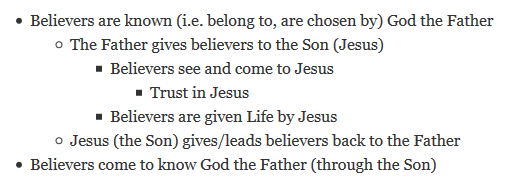
    1. One sees/knows Jesus (the Son)—i.e. recognizes and trusts in him
    2. One sees/knows God the Father through the Son

The theological framework of the Gospel of John can be outlined in more detail:

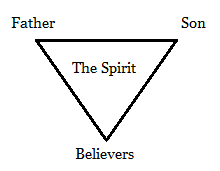
Thus the emphasis on knowledge in 17:3 can be misleading, if we think of it in terms of ordinary human knowledge and perception. Rather, in the Gospel of John, and much of the New Testament elsewhere, a deeper kind of theological and spiritual understanding is meant—centered on trust in Jesus and the presence of both the Son (Jesus) and the Father through the Holy Spirit. The Spirit is not mentioned directly in the prayer-discourse of chapter 17, but it can be inferred from the theme of unity (esp. verses 20-24) and the triadic relationship of Father-Son-Believer(s):

Mention should be made of the specific title xristo/$ (“Anointed [One]”). Though the Johannine portrait of Jesus goes far beyond the traditional Jewish conception(s) of the Anointed One (Messiah), it retains the title and the fundamental identification of Jesus with the Messianic figure-types—Prophet, Davidic Ruler, and also “Son of Man” (on these, cf. the series “Yeshua the Anointed”). The association of the titles “Anointed One” and “Son of God” goes back to the early Gospel traditions (in the Baptism and Passion/crucifixion scenes, etc), and, while the latter title (i.e. Jesus as God’s Son) dominates the Gospel of John, the former is certainly not forgotten. True knowledge of Jesus—the knowledge which is the same as Life—includes recognition that he is the Anointed One of God. The closing words of the Gospel proper give unmistakable expression to this fact:

“These (thing)s have been written (so) that you might trust that Yeshua is the Anointed One, the Son of God, and that, trusting, you would hold Life in his name.” (20:31)

“…Spirit and Life”: John 16:7-15

John 16:7-15

The fourth (and final) reference to the Spirit/Paraclete in the Last Discourse is the most extensive, and comes from the third part or division of the Discourse (cf. my earlier outline of the Discourse):

    • 16:4b-28—Discourse/division 3—Jesus’ departure (farewell)
      • The Promise of the Spirit (vv. 4b-15)
        • Initial statement by Jesus on his departure (vv. 4b-7a)
        • The Coming of the Spirit (vv. 7b-11)
        • Concluding statement by Jesus on his departure (vv. 11-15)
      • Jesus’ Departure and Return (vv. 16-24)
        • Initial statement by Jesus on his departure (v. 16)
        • Question by the disciples (vv. 17-18)
        • Jesus’ response: The Promise of his Return (vv. 19-24)
      • Concluding statement by Jesus on his departure (vv. 25-28)

Each of the three main divisions deals with the central theme of Jesus’ departure. Though the Last Discourse is set in the narrative prior to Jesus’ death, much of it has a post-resurrection orientation—that is, it refers primarily to Jesus’ ultimate return back to the Father. This is important for a proper understanding of the Spirit/Paraclete passages. As I indicated in the previous notes, the main role and significance of the para/klhto$ is that he represents the presence of both Jesus (the Son) and God the Father in and with the believer. Primarily, it is the presence of Jesus himself which is emphasized. Once Jesus has returned to the Father, his presence will continue through the Spirit, and this presence will continue “into the Age”—i.e., until the coming of the final Judgment and the new/future Age.

The first section of this division—16:4b-15—deals specifically with the Spirit/Paraclete, prefaced by a restatement of Jesus’ impending departure (vv. 4b-6). This establishes the context for verse 7:

“But I relate the truth to you: it bears together (well) for you that I should go away from (you); for, if I should not go away from (you), the one called alongside [para/klhto$] will not come toward you, but if I travel (away) (then) I will send him toward you.”

This coming of the Spirit represents the deeper meaning of Jesus’ promise that the disciples (and all believers) will see him again. On the surface, this promise more obviously relates to a post-resurrection or future appearance; however, in the context of Johannine theology, and the language of the discourses, where seeing Jesus is the same as knowing/recognizing him, the experience of the Spirit is a true fulfillment of the promise.

The Role of the Spirit/Paraclete in 16:7-15

The role of Spirit/Paraclete is described by Jesus in vv. 8-15, and it follows upon the theme of bearing/giving witness (15:26-27). There the emphasis was specifically on giving witness of Jesus—who he is and what he has said/done—expressed in terms of the Spirit’s role in the disciples’ (and other believers’) witness. Here, the scope of the Spirit’s witness has broadened, in the (eschatological) context of Judgment:

“And, at his coming, he will bring the world to shame/disgrace about sin and about justice and about judgment” (v. 8)

I have translated the verb e)le/gxw here rather literally; however, it is important to note that, in the New Testament, there is usually a legal and ethical connotation to its use—i.e., to expose (sin) and convict a person (of wrong), often with the religious aspect of bringing one to repentance. The “realized” eschatology found throughout the Johannine discourses means that the Spirit fulfills this role in God’s Judgment now, in the present time. Presumably this is done through the inspired witness and teaching of believers (following the train of thought in 15:26-27), though this is not specified here (but note vv. 12ff). In verses 9-11, each of the three subjects (governed by peri/, “about”) are clarified:

    • “about sin [a(marti/a$]—in that they do not trust in me” (v. 9)
    • “about justice/righteousness [dikaiosu/nh]—in that I lead (myself) back toward the Father and you do not see/observe me any longer” (v. 10)
    • “about judgment [kri/si$]—in that the chief/ruler of this world has been judged” (v. 11)

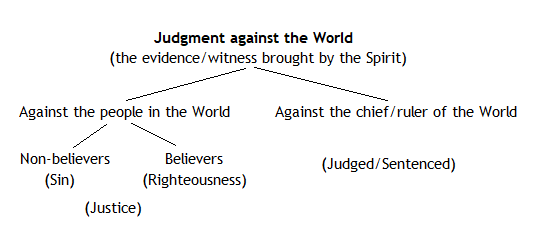
I have always found the logic of this three-fold exposition a bit difficult to follow; it appears to be somewhat inconsistent in its point of reference. However, some confusion is removed, I think, if we realize that it does not so much reflect three parallel elements, as it does a two-part division. I would summarize this as follows:

The evidence brought in judgment against the people in the world follows the basic dualism of the Gospel—believer/non-believer, righteousness vs. sin, etc. Those who belong to the world (non-believers) are governed by sin and darkness, while those who belong to God and Christ by righteousness and light. The situation regarding non-believers is stated simply: “they do not trust in me”. For believers, it is more complex—how is justice/righteousness revealed or made manifest? This is expressed differently, in terms of the very dynamic Jesus is describing in the Discourse: “I lead (myself) under [i.e. go back] toward the Father, and you do not see me any longer”. In other words, the Spirit takes Jesus’ place, as we have already discussed—this is the primary aspect of the Spirit’s witness for believers. It is also the theme of the closing verses (12-15) of this section:

“I hold yet many (thing)s to say/relate to you, but you are not able to bear (them) now; and (yet) when that (one) should come—the Spirit of Truth—he will lead the way for you in(to) all truth…” (vv. 12-13a)

This follows the declarations in 14:25-26 and 15:26-27, but with a more general emphasis on the Spirit’s guidance—he will lead the way into all truth. The basis for this guidance, and the truth which the Spirit possesses, is his distinctive relationship to Jesus (the Son) and God the Father, as expressed throughout the discourses, and again here:

“…for he will not speak from himself, but (rather) whatever (thing)s he shall hear, (those) he will speak and will give a message to you up(on) the (thing)s coming” (v. 13b)

This is precisely parallel to Jesus’ relationship to the Father—he (the Son) speaks only what the Father gives him to say. The Spirit has the same relation to Jesus (the Son)—

“That (one) will give honor to me, (in) that he will receive out of the (thing)s (that are) mine and will give a message up(on them) to you” (v. 14)

which is set clearly in context in the closing declaration:

“All (thing)s whatever that the Father holds are mine—through this [i.e. because of this] I said that he receives out of the (thing)s (that are) mine and will give a message up(on them) to you.” (v. 15)

The Father gives to the Son, the Son then gives to the Spirit, who, in turn, gives to believers. The three-fold chain—Father-Son-Believer—is expanded to four:

Father–Son–Spirit–Believer

“…Spirit and Life”: John 14:25-26; 15:26-27

John 14:25-26; 15:26-27

In this note, I will be examining the second and third references to the Spirit in the Last Discourse. The meaning of the word para/klhto$ and its identification with the Spirit were discussed in the previous note (on 14:16-17), along with the primary significance of the “one called alongside”—the abiding presence of both Jesus (the Son) and God the Father in and with the believer, a presence which will last “into the Age”. In the three references which follow—14:25-26; 15:26-27 and 16:7-15—Jesus provides more detail as to the role and work of the Spirit/Paraclete, and the kind of help/assistance which the he will provide on behalf of believers. In discussing these two passages, I wish to explore two key aspects:

    1. The relationship between Jesus and the Father in the sending of the Spirit/Paraclete, and
    2. The specific role/action of the Spirit/Paraclete

1. With regard to this first point, there can be a good deal of confusion: is it the Father or Jesus (the Son) who gives/sends the Spirit? Let us look at how this is described in each of the passages, beginning with the two under discussion today:

    • “…the one called alongside [para/klhto$], the holy Spirit, whom the Father will send in my name” (14:26)
    • “…the one called alongside [para/klhto$], whom I will send (from) alongside the Father, the Spirit of Truth…” (15:26)

There is even more variation if we include all four passages:

    • “I will ask (of) the Father and He will give…” (14:16)
    • “the Father will send in my name…” (14:26)
    • “I will send (from) alongside the Father…” (15:26)
    • “I will send (him)…” (16:7)

How are we to understand this interrelated dynamic—the involvement of both Father and Son (Jesus) in sending/giving the Spirit? To begin with, the ultimate source of the Spirit/Paraclete is God the Father, as is clear from 15:26: “…the Spirit of Truth which travels out [e)kporeu/etai] (from) alongside the Father”. This is also confirmed by the progression indicated in the four passages:

    • The Father gives (at Jesus’ request)—sole/primary action of the Father
    • The Father sends in Jesus’ name—primary action of the Father
    • Jesus sends from the Father—primary action of Jesus
    • Jesus sends—sole/primary action of Jesus

This transference reflects the basic theological model in the Johannine discourses—the Father gives to the Son (Jesus), who, in turn, gives to believers. This is expressed most precisely in 5:26:

“For just as the Father holds Life in himself, so also he gave to the Son to hold Life in himself”

Life and the Spirit are virtually synonymous in the Gospel of John, and this same relational dynamic is expressed, in terms of the Spirit, in 3:34-35:

    • “The Father…has given all things in(to) the (Son’s) hand” (v. 35)
    • “The (Son) God (the Father) sent…gives the Spirit” (v. 34)

2. The role and work of the Spirit/Paraclete is expressed by Jesus in both of these passages, which are closely parallel with each other:

“These things I have spoken (while) remaining alongside you, but the one called alongside, the holy Spirit, whom the Father will send in my name—that (one) will teach you all (thing)s and will put under your mind/memory all (the thing)s that I said to you.” (14:25-26)

“When he should come, the one called alongside, whom I will send to you (from) alongside the Father—the Spirit of Truth who travels out (from) alongside the Father—that (one) will give witness about me, and you also will give witness…” (15:25-27)

Thus there are two roles the Spirit/Paraclete will have for believers:

    • To teach them all things, and especially to help them remember the things which Jesus himself has taught them
    • To give/bear witness about Jesus—that is, through the disciples (believers), as is clear from verse 27 (cf. also Mark 13:11 par; Luke 12:12; Acts 4:8, 31; 6:10; 7:55, etc)

There is a tendency, perhaps, to limit these (esp. the first) to the disciples (apostles), but this is unwarranted; the Last Discourse, and, indeed, all of Jesus’ teaching in the discourses, can be taken as applying to all believers. The role of the Spirit teaching believers “all things” is confirmed by the similar (Johannine) statement in the first Letter (1 Jn 2:27):

“And the anointing which you received from him [i.e. Jesus] remains on/in you, and you have no business [i.e. need] that any one should teach you; but (rather), as the anointing (from) him teaches you about all things and is true, and is not a lie, and even as it/he taught you—remain in him.”

This corresponds precisely with what Jesus says of the Spirit/Paraclete in 14:26. The function of bearing witness will be developed further in the final passage in the Last Discourse (16:7-15), to be discussed in the next note.

“…Spirit and Life”: John 14:16-17

John 14:16-17

For the next three notes in this series, I will be examining the four passages in the Last Discourse where the Holy Spirit is specifically mentioned. The first of these is found in 14:16-17. I wish to discuss this reference according to three points:

    1. The meaning of the word para/klhto$ and its identification
    2. Its primary significance in the Last Discourse, and
    3. The connection between vv. 16-17 and verse 15
1. The meaning and identification of para/klhto$

The noun para/klhto$ literally means “one called alongside”, or, in the active sense, “one who calls (a person) alongside”. The “calling alongside” fundamentally refers to giving help or assistance to a person. This help sometimes is in the technical (legal) sense of a defender or “defense attorney”, i.e. an advocate—and so the word is rendered here in some translations. However, translations such as “Advocate” or “Comforter”, etc, are interpretive renderings which tend to focus only on one particular aspect of the kind of “help” a para/klhto$ might give. To avoid this, other translators and commentators give a simple transliteration in English—”Paraclete”—but this offers no guidance as to the meaning of the word. In point of fact, Jesus describes the specific “help” which the para/klhto$ will give to his disciples (believers) in the context of these sayings, so it is best to translate the word itself literally—i.e., “one called alongside”:

“And I will ask (of) the Father and he will give to you another (who is) called alongside [para/klhto$], (so) that he might be with you into the Age…” (v. 16)

The use of a&llo$ (“[an]other”) suggests that Jesus himself was a para/klhto$—i.e. one called alongside believers, and that this second “helper” will take his place. This would seem to be confirmed by 1 John 2:1, the only other occurrence of the word in the New Testament outside of the four in Jn 14-16. Who is this “second” para/klhto$? Jesus identifies him in verse 17:

“…the Spirit of Truth [to\ pneu=ma th=$ a)lhqei/a$], whom the world is unable to receive, (in) that [i.e. because] it does not observe [i.e. recognize] him and does not know (him)—but you know him, (in) that [i.e. because] he remains with you and will be in you.”

The expression “Spirit of Truth” is used to identify the para/klhto$ also in 15:26 and 16:13; only in 14:26 is the specific title “Holy Spirit” used. This has led some critical commentators to theorize that originally the “Spirit of Truth” may not have referred to the Holy Spirit (in a Christian sense), nor even to the essential Spirit of God (YHWH), but to a distinct divine/heavenly being (or “Angel”). The expression “Spirit of Truth” is found in the Qumran text 1QS (“Community Rule”), where the reference is to God’s cleansing of humankind (i.e. the righteous/believers) through His truth:

“He will sprinkle over him the spirit of truth like lustral water (in order to cleanse him) from…the unclean spirit, in order to instruct the upright ones with knowledge of the Most High…There will be no more injustice…Until now the spirits of truth and injustice feud in the heart of man: they walk in wisdom or in folly. In agreement with with man’s inheritance in the truth, he shall be righteous…” (1QS 4:21-24)

Even in the thought of the Qumran Community, this “spirit of truth” is identified with the “holy spirit”

“For it is by the spirit of the true counsel of God that are atoned the paths of man, all his iniquities, so that he can look at the light of life. And it is by the holy spirit of the community, in its truth, that he is cleansed…” (3:6-7)

The idea seems to be that God, through his own Spirit (of truth and holiness), cleanses the “spirit” of the Community, and that, by joining the Community, a person’s own “spirit” is likewise cleansed. For early Christians, this cleansing Spirit was associated with the person (and work) of Jesus, already in the earliest Gospel tradition (Mark 1:8 par).

2. The primary significance of para/klhto$

As indicated above, the essential meaning of the noun is “one called alongside [para/]”. The primary emphasis is not on what this person does, but rather his presence alongside believers. This is clear from Jesus’ words here in vv. 16-17

    • “(so) that he might be with you [meq’ u(mw=n] into the Age” (v. 16)
    • “(in) that he remains alongside you [par’ u(mi=n me/nei] and will be in you [e)n u(mi=n e&stai]” (v. 17)

The parallel with verses 23-24 strongly indicates that the presence of this para/klhto$ signifies the presence of both God the Father and Jesus—Father and Son—together:

“…my Father will love him [i.e. the believer], and we will come toward him and we will make our abiding/dwelling (place) with him” (v. 23b)

The noun monh/ (“abiding [place]”, i.e. place to stay) is related to the verb me/nw (“remain, abide”)—just as the Spirit/para/klhto$ abides with the believer, so Jesus and the Father together have their abode with him.

3. The connection between verse 15 and vv. 16-17

Perhaps the most difficult aspect of this passage is how verses 16-17 relate to the conditional statement in v. 15:

“If you love me, you will keep my e)ntolai/“

The noun e)ntolh/ is typically translated “commandment”, which can be somewhat misleading, especially in the Johannine discourses. As I have discussed in earlier notes, the word essentially refers to something given (laid on) a person to complete. When Jesus applies it to himself (always in the singular), it signifies the task, or mission, given to him by the Father. Every aspect of the mission is involved, including all that he is to say and do, culminating in his sacrificial death on the cross. When the word (either singular or plural) applies to believers, the emphasis is on accepting Jesus word—primarily in terms of the witness to his identity, as the divine/eternal Son sent by the Father. The use of the plural e)ntolai/ can be somewhat confusing, especially when translated “commandments”, since it gives the impression of a set of specific commands, such as the Decalogue (Ten Commandments) and other portions of the Old Testament Law (Torah). However, one finds no evidence for anything of the sort in the Gospel of John; and, while Jesus certainly gave considerable teaching of various kinds to his disciples, actual “commandments” are quite rare. Indeed, it is possible to isolate only two primary requirements which would seem to comprise Jesus’ e)ntolai/: (1) trust in Jesus, and (2) love for one another, according to Jesus’ own example. Both of these can be viewed as part of a single injunction to love; note the parallel:

    • “if you love me, you will keep/guard my e)ntolai/” (v. 15)
      “if anyone loves me, he will keep/guard my words [lo/goi]” (v. 23)
    • “the one holding my e)ntolai/ and keeping/guarding them—that (person) is the one loving me” (v. 21)

Loving Jesus is thus synonymous with keeping/guarding his words, which Jesus elsewhere identifies with the Spirit and Life (6:63).

Taking vv. 15-17 (and the parallel in vv. 23-24) out of context might lead to the idea of a probationary period for believers—i.e., only if they prove faithful and obedient to Jesus’ commands will the Spirit be sent to them. Such a view would be contrary to the overall evidence from the Gospel, and reflects a misunderstanding of the logic at work here. As will be discussed in an upcoming note (on Jn 20:22), the Spirit is given to believers immediately upon Jesus’ initial appearance to them after the resurrection. Similarly, in the book of Acts, the Spirit comes to believers in conjunction with their first demonstration of faith (usually associated with the baptism ritual), it is not earned as a result of religious obedience. How then should the conditional statements in vv. 15 and 23 be understood? The interpretive key, I believe, is found in the intervening statement in verse 21, which expresses two fundamental points:

    • The identity and character of the believer:
      “The one holding my e)ntolai/ and keeping/guarding them—that (person) is the one loving me”
      The person who loves Jesus is identified/characterized by accepting all his words and his identity as the Son sent by the Father—the acting out of this acceptance is not a pre-condition, but reflects the believer’s essential identity.
    • The reciprocal relationship of unity between Father, Son, and believer:
      “The one loving me will be loved by my Father and I (also) will love him”
      I.e., love is a sign of intimate relationship and unity.

If we wish to view this dynamic as a logical or temporal sequence, it might be summarized as follows:

Trust in Jesus—i.e. acceptance of his words, etc
|
Following the example of Jesus’ love—the presence of this love in the believer
|
The believer’s relationship with Father and Son is realized
|
The presence of the Father and Son is manifest in/with the believer

The Spirit is the manifest presence of Father and Son, as is clear both from verse 23 and the closing words of v. 21:

“…and I will make myself shine (forth) in/on him”

This relationship between Father, Son (Jesus) and Spirit will be discussed further in the next note (on 14:25-26 and 15:26-27).

Translation of the Qumran texts, given above, are taken from The Dead Sea Scrolls Study Edition (2 Vols), eds. Florentino García Martínez and Eibert J. C. Tigchelaar (Brill/Eerdmans: 1997-8).

For a discussion of the Spirit in the Pentecost narrative of Acts 2, cf. my earlier three-part article “The Sending of the Spirit” and the article on Peter’s Pentecost speech.

“…Spirit and Life”: John 14:6, 9

John 14:6, 19

Today’s note will examine two statements by Jesus in the great “Last Discourse”, set in the narrative on the night of the Last Supper (13:31-16:33 + chap. 17). The entire discourse-scene is extremely complex, bringing in and developing themes which occurred throughout the earlier discourses. Two of these involve “Spirit” (pneu=ma) and “Life” (zwh/)—the very two motifs (cf. Jn 6:63) which are the focus of this series. The latter dominated the first half of the Gospel (chapters 1-12 [32 times]); by comparison, zwh/ appears just four times in the remainder of the book (14:6; 17:2-3; 20:31). It has been suggested that the reason for this is that the Life promised by Jesus, through trust in him, is now coming to fruition as his Passion draws near. A better explanation is simply that there is considerably less teaching by Jesus in chapters 13-20, and it is of a different character—given only to his closest disciples in order to prepare them for his upcoming death and departure (back to the Father). For this reason, the coming of the Spirit takes on greater emphasis and importance in the Last Discourse.

John 14:6

I have discussed the famous saying of Jesus in 14:6 in an earlier pair of notes (on vv. 4-7), and will not reproduce that entire study here. Instead, I wish to focus primarily on Jesus’ use of the word “life” (zwh/) in this saying, in connection to the overall context of the passage, which has to do with Jesus’ departure, introduced in 13:33:

“(My dear) offspring [i.e. children], (it is) yet (only) a little (while that) I am with you—you will seek (for) me, and even as I said to the Yehudeans {Jews}, ‘(the) place where I lead (myself) under, you are not able to come (there)’, and (so) I say (this) to you now.”

This refers back to statements by Jesus during the Sukkoth discourse-scene in chapters 7-8 (7:33-36; 8:21-22), statements made to the “Jews”—that is, the (Jewish) people, as opposed to Jesus’ (Jewish) disciples (i.e. believers). It is now in the Last Discourse that Jesus is speaking directly (and only) to his true disciples (Judas having departed in 13:30). Yet, even his disciples had difficulty understanding this statement, much as the people did earlier. Peter is the first to ask—

“Lord, where [pou=] do you lead (yourself) under?” (13:36a)

to which Jesus responds with a similar statement as in v. 33, but with an important difference:

“The place where I lead (myself) under, you are not able to follow me now [nu=n], but you will follow later [u%steron]” (v. 36b)

To the people, Jesus used the word come, but to Peter he says follow, indicating the role of the disciple who follows his master (and the master’s example). Also, it is only now, at the present moment, that Peter (and the other disciples) are not able to follow Jesus; the promise is that they will be able to follow later on. There is a strong sense throughout the Last Discourse that the disciples are only just beginning to realize the truth about who Jesus is, and to understand the full meaning of his words (the motif of misunderstanding is prominent in all of the Johannine discourses).

Picking up from the tradition of the prediction of Peter’s denial (13:37-38), the exchange which follows in 14:1ff returns to the theme of Jesus’ departure, which now is made more clear—he is going away, back to the Father:

“In my Father’s house there are many (place)s to stay… I am traveling (there) to make ready a place for you” (v. 2)

Readers can find confusing these references to Jesus’ departure, which seem to blend together two distinct contexts (from the standpoint of the traditional Gospel narrative)—(1) his death, and (2) his ascension to heaven. In 13:33ff, Jesus is apparently speaking of his upcoming death, but now, in 14:1ff, the context seems to be his “ascension” to the Father in heaven. These two aspects are interrelated, and have been interwoven throughout the Gospel of John; both are contained in the initial statement by Jesus in 13:31, through use of the verb doca/zw (“give [or regard with] honor/esteem”). The ambiguity of these aspects continues through the Last Discourse, adding poignancy to the exchange between Jesus and Thomas in vv. 4-7:

(Jesus): “And the place where I lead (myself) under, you see [i.e. know] the way (there)”
(Thomas): “Lord, we have not seen where you lead (yourself) under; how are we able to have seen the way (there)?”
(Jesus): “I am [e)gw/ ei)mi] the way and the truth and the life—no one comes toward the Father, if not [i.e. except] through me…”

In the Gospel of John, seeing and knowing are essentially synonymous—”seeing” Jesus means “knowing” (i.e. recognizing) him. The motif of misunderstanding here in the discourse involves the idea of the way (o%do$). Thomas is thinking of a conventional (physical) path leading to a location, but the true meaning of Jesus’ statement is spiritual—it is not a way up through the clouds to heaven, but the path that leads directly to God the Father through the person of Jesus (the Son). This is made clear by Jesus’ use of the preposition dia/ (“through”), which is often obscured in translation. The way to the Father leads through Jesus. The theological context of the Johannine discourses suggests two main aspects to this way, or path:

    1. it is found through trust in Jesus
    2. it is realized through the presence of the Spirit

It is possible that both aspects are incorporated into the statement in verse 6:

    • “and the truth [a)lh/qeia]”—i.e. trust in Jesus as the Son sent by the Father, who is Truth
    • “and the life [zwh/]”—i.e. the Spirit, given by Jesus to the believer

Ultimately, Jesus identifies himself with all three terms—Way, Truth, and Life—a triad which can be variously interpreted. Does the Way lead to Truth and Life, or does it lead to Truth which then results in Life? Or are the terms meant to be synonymous—i.e. Way = Truth = Life? A strong argument can be made that Truth and Life are to be regarded as essentially synonymous, given the close associations between “Spirit/Life” and “Spirit/Truth”—and that the Spirit is the unifying idea. This would seem to be confirmed by the references to the Spirit which follow throughout chapters 14-16.

John 14:19

The basic message of vv. 1-7ff is restated in vv. 18-21:

    • Jesus’ departure: “I will not leave you abandoned…” (v. 18)
    • Inability of people to come: “(It is) yet a little (while), and (then) the world will no longer see/observe me…” (v. 19)
    • The disciples will see/follow him: “I come toward you… you (do) see/observe me…” (vv. 18-19)
    • Jesus leads the way to the Father: “…you will know that I am in the Father, and you are in me, and I am in you” (v. 20)

In verse 19, the disciples’ seeing Jesus is entirely different that the sight/observance by the “world”; it means trust in him—i.e. disciples are believers. They know/see the truth, which is manifest in the person of Jesus (1:14, 17; 5:33; 8:32, etc). With regard to life (zwh/), Jesus is more specific:

“…in that [i.e. because] I live [zw=], you also will live [zh/sete]”

This reflects the statement in 5:26, of the divine/eternal Life which Jesus possesses (given to him by the Father), and which he, in turn, gives to believers. This theme was prominent in the Lazarus scene in chapter 11 (cf. especially vv. 20-27), and in the earlier discourses as well. That the Life which Jesus gives is to be identified with the Spirit, is relatively clear from a number of passages, as has been discussed in prior notes, and more or less stated explicitly in 3:34. If there were any doubt that the Spirit is in view here in 14:19, one need only look to the preceding verses 15-17, where we find the first specific reference to the Spirit in the Last Discourse. This will be discussed in the next note.

“…Spirit and Life”: John 12:50 (continued)

John 12:50, continued

In the previous note, I discussed the context of Jn 12:50, the concluding verse (and statement by Jesus) in chapters 2-12 of the Gospel. Today I wish to examine the verse more closely, especially the statement in the first half:

“And I have seen [i.e. known] that his e)ntolh/ is (the) Life of the Age.”

There are three components to this statement, which will be discussed in turn.

kai oi@da o%ti (“and I have seen that”)

Throughout the Gospel of John the motif of seeing has been of great importance. It plays on the dual-meaning, especially, of the verb ei&dw (“see”), which can also mean “know”—i.e., seeing in the sense of being aware, perceiving, recognizing, etc. It generally carries this meaning in the perfect tense, as here (oi@da, “I have seen/known”). Given the theological (and Christological) importance of seeing in the Gospel of John, Jesus is almost certainly referring here to something more than general understanding or awareness. Rather, it relates to his identity as the Son, who has a close, intimate relationship to the Father, and who, as a faithful son, watches and listens carefully to his father. Repeatedly in the Johannine discourses, Jesus states that he says and does only what he has heard and seen from the Father (cf. 3:32; 5:19, 30; 6:46; 8:26, 38; 14:24; 15:15). Similarly, the one who sees/hears Jesus (the Son), also sees/hears the Father (5:37; 14:7, 9, etc)—just as Jesus gives to the believer what he has received from the Father (3:35; 5:26, etc). In the Gospel of John, seeing Jesus is essentially the same as trusting him (9:37ff; 12:45; 14:17), and this differs entirely from ordinary sight or perception (6:36). The conjunctive particle o%ti (“that”) indicates specifically what it is that Jesus has seen.

h( e)ntolh/ au)tou= (“his [charge laid] on [me] to complete”)

The noun e)ntolh/ is a relatively popular Johannine word. In addition to 11 occurrences in the Gospel, it is found 18 times in the Letters; and, if we include two others in the (Johannine) book of Revelation, that makes 31 total—nearly half of all occurrences (68) in the New Testament. The word is often translated “commandment”, but that can be somewhat misleading; I discussed the fundamental meaning of the noun in the previous note. Despite Paul’s frequent reference to the Old Testament Law (Torah, Gk. no/mo$), he does not often use the noun e)ntolh/; it occurs only 9 times in the undisputed letters (6 of which are in Rom 7:8-13; also 1 Cor 7:19; 14:37). In these passages, Paul seems to be using it in a somewhat broader sense (i.e. “the Law of God”, “the e)ntolh/ of God”), rather than restricting it to the specific (written) commands of the Torah as such, though the latter is certainly included in the usage. The semantic range of the word in the (Synoptic) sayings of Jesus is similar (note the expression “the e)ntolh/ of God” in Mk 7:8-9 par).

The Johannine use of the word is complicated by two factors—it can be used either:

In none of these references does e)ntolh/ refer to the commands of the Torah as such, though there is less certainty on this point when we examine the occurrences in the Letters (esp. 1 John). Let us consider the second factor mentioned above.

1. Between God the Father and Jesus (the Son)—This is the context of the usage in 10:18 and here in 12:49-50, and in both instances it is the singular form. As I discussed in the previous note, e)ntolh/ here should not be understood in the traditional sense of a religious or ethical “commandment”, but as a duty or mission given to Jesus (by the Father) to accomplish. In 10:18, this clearly refers to his sacrificial death (and resurrection), confirmed by Jesus’ final words on the cross in 19:30 (“it has been completed [tete/lestai]”, cf. also v. 28). The emphasis in 12:49-50 is on the words Jesus has been given by the Father to speak (i.e. what he is to say). In 14:31, the related verb e)nte/llomai is used of Jesus’ mission in a comprehensive sense, as a reflection of the love between Father and Son.

2. Between Jesus and Believers—Here we find both the singular and plural of e)ntolh/, apparently used interchangeably (as also in 1 John). This should caution us against identifying e)ntolh/ with any specific “commandment” given by Jesus, as though the e)ntolai/ represented a collection of commands similar to the Old Testament written Law (Torah). I believe there are three ways e)ntolh/ should be understood in this context:

    • as synonymous with Jesus’ word—i.e., whatever he says/speaks
    • as representative of all that he teaches believers, who would follow his example (just as Jesus follows that of the Father)
    • as epitomized by the command for believers to love one another (i.e. the so-called “Love-command”)

Even in the case of the “Love-command” (13:34-35, etc), the closest we come to a specific “commandment” (i.e., “you should love [each] other”), this should be understood not so much as an ethical injunction, but as a sign that believers are following the example of Jesus (“all will know that you are my disciples”).

zwh/ ai)w/nio$ e)stin (“is [the] Life of the Age”)

I have discussed the expression “Life of the Age” (i.e. eternal life) at length in prior notes, and will not go over that again here, except to mention that, in the context of the Johannine discourses, the reference is to the Life (zwh/) which God possesses and of which He is the source. What does it mean to say that the e)ntolh/ of God the Father is [e)stin] Life? There are a number of possibilities, but they are reduced considerably if we remember that here e)ntolh/ means specifically the charge [i.e. mission] given to Jesus to complete.

    • Qualitative—it describes the nature and character of Jesus’ mission from the Father
    • Significative—Jesus’ mission means or signifies Life
    • Resultative—Jesus’ mission results in Life for believers

All three are valid ways of interpreting the statement, and perhaps are best seen as three aspects of a single truth.