Saturday Series: Mark 11:1-10 par

Mark 11:1-10 par; John 12:12-19

This week we will be looking at the Triumphal Entry episode in the Gospels. This episode marks the celebration of Palm Sunday and the beginning of Holy Week. It also serves to bring to a close our recent critical studies on the Gospels. In this study, I will be presenting a critical overview and summary of the episode, briefly examining each area of Biblical criticism.

The first area, that of Textual Criticism, does not require much comment. The text of the episode, in all four Gospels, is generally secure. The only significant variant occurs at Luke 19:38, and you can find this discussed in a supplemental note. It demonstrates, among other things, that the Gospel writers had more freedom to alter or vary the response of the crowds to Jesus’ entry. While the basic substance of the response is consistent across the Tradition, the detail of how it is recorded differs slightly in each Gospel.

Source Criticism

This episode is part of the so-called “Triple Tradition”, meaning it is found in all three Synoptic Gospels, just as was the case with a number of the other passages we have examined recently. The wording is quite consistent across all three versions, which suggests one of two possibilities:

    • Matthew and Luke have essentially reproduced the version in Mark, or
    • The episode was firmly fixed in the Tradition by the time each Gospel writer received it, and the author, in each case, was not at liberty to alter or modify it except in very small ways

Of special note is the way that all three Gospel faithfully record the opening portion (Mk 11:1-6 par), which contains both the introductory narration (v. 1), and the instructions given by Jesus to his disciples, etc (vv. 2-6). In this regard, Matthew and Luke follow Mark quite closely (Matt 21:1-6; Lk 19:28-34); all three Gospels include this portion, even though it may be said to weaken the episode, from a literary standpoint (compare the shorter and more dramatic version in John, 12:12-15ff). While it is possible that these introductory verses represent a Markan composition that the other two Gospels have essentially copied, I think it more likely that the entire Synoptic narrative, as embodied in Mk 11:1-10, reflects a well-established tradition which the Matthean and Lukan authors, whether or not they inherited it directly from Mark’s Gospels, felt compelled to reproduce faithfully.

The Triumphal Entry is one of the few episodes in the “Triple Tradition” that has a parallel in the Gospel of John (12:12-19). There is little evidence to suggest that the Johannine author made use of the Synoptic Gospels, or that he was even familiar with them. A close comparison reveals similarities in basic outline, but few (if any) details that would indicate literary contact between John and the Synoptics. This means that two separate (and independent) lines of tradition are involved, and that the general points of similarity likely derive from a common historical tradition. This common Gospel tradition would have taken shape in the period between c. 35-55 A.D., before branching out to form the distinctive Synoptic and Johannine lines of tradition, respectively.

Historical Criticism

Our historical-critical examination should begin with the historical tradition that underlies both the Synoptic and Johannine narrative. The common details may be summarized as follows:

    • The setting of Jesus coming (in)to Jerusalem to celebrate the festival
    • A crowd accompanies (or meets) Jesus as he enters
    • Many in the crowd are carrying/waving branches that were cut from nearby trees
    • Jesus was riding on a donkey
    • The crowd shouts an exclamation that is based on Psalm 118:26, adapted (in the Gospel context) to identify Jesus as the coming (Messianic) king from the line of David
    • [Some reference is made to the surrounding populace being stirred up or disrupted]

To this we may add the interesting fact that Matthew and John have each (independently) cited Zech 9:9, noting that the episode was the fulfillment of prophecy. In passing, it should be mentioned that Matthew’s citation (21:4-5) introduces a problematic detail into the narrative. In Matthew’s version, Jesus directs the disciples to acquire two animals—a female donkey and her young colt. This detail (of which there is no trace in the other Gospels) is apparently the result of an over-literal interpretation of Zech 9:9, and one which (apparently) misunderstands the parallelism of Hebrew poetry. The lines in question are an example of synonymous parallelism—

“…riding upon a donkey,
upon a mule, son of a she-donkey”

where two phrases essentially refer to one thing—that is, in this case, the king riding upon a young (male) donkey. By his peculiar application, the Gospel writer has created a strange situation in which Jesus rides into Jerusalem astride the two animals. Again, it must be emphasized that in the other three Gospels there is only a single animal (young donkey) involved.

Apart from this aberrant detail in Matthew, the tradition common to both John and the Synoptics would seem to be historically reliable (on objective grounds), stemming from authentic historical tradition. It is natural, and quite in accordance with the wider evidence of the early Gospel Tradition, that a crowd of Jesus’ followers and admirers would have identified him as the Davidic Messiah. At a very early point, the similarities with Zech 9:9 would have been noticed; it is no surprise that two different Gospel writers would have specifically made the connection, independently of each other.

This raises two historical-critical questions that are rather more serious:

    1. Did Jesus himself have Zech 9:9 in mind, and was he intentionally seeking to invoke that Messianic association as he entered Jerusalem?
    2. Is this introductory portion of Mk 11:2-6 historically reliable, and does it reflect a conscious awareness (by Jesus) of the Messianic association with Zech 9:9?

With regard to the second question, the folkloric tenor of Mk 11:2-6 par, along with the fact that nothing of the sort occurs in the Johannine version of the scene (indeed, Jesus appears to find the donkey only after he has entered the city [Jn 12:14]), has led critical commentators to question the historical authenticity of those verses. However, on the surface, there is nothing implausible in Jesus instructing his disciples to obtain a donkey for him to ride. It is perhaps more important to consider the purpose of those introductory verses in the context of the Synoptic narrative. The details they contain emphasize a number of key points that will be developed in the chapters that follow (including the Passion narrative):

    • Jesus’ care in making preparations with his disciples for the events leading up to his Passion (to be repeated in Mk  14:12-16 par)
    • Jesus’ foreknowledge, which takes on greater prominence in the Passion narrative
    • The suitability of the young colt (not yet broken in) as an animal for a king to ride on his entry into the city
    • The wordplay involved in the statement “the Lord has need of it”, which could be rendered “its master has need of it”, but of course the term kýrios (“Lord”) has a deeper theological meaning for early Christians, as it is applied to Jesus. He is much more than the lord of the animal, he is Lord of all, in the sense of his identity as the Messiah and Son of God.

This leads to the question of Jesus’ own Messianic awareness, and whether he intentionally evoked the association with Zech 9:9. The issue needs to be examined from both an historical- and literary-critical standpoint, and may be expounded with a series of three related questions. Let us briefly consider each of them in turn.

How do the crowds in the narrative understand Jesus’ entry?

It seems unmistakable that the people, as their acclamations are recorded, have a definite Messianic idea in mind—that Jesus would be the coming Davidic king who will restore the kingdom of Israel. This seems most clear in John’s description of the crowd carrying palm branches to meet him (the Synoptics seem to depict crowds following along with Jesus [Mark 11:7-9 par.], John describes crowds coming out to meet him [12:13]—two separate groups?) Some have suggested that this indicates the time of Sukkoth (Feast of Tabernacles), but a nationalistic reference to the Maccabean revolt and the Dedication (Hanukkah) seems more appropriate (1 Macc. 13:51; 2 Macc. 10:7; cf. Brown, Anchor Bible [AB] 29 p. 461).

How did Jesus understand the event and his own actions?

So much attention is given in the Synoptics to the acquisition of the colt, it would seem to have been of considerable importance to Jesus. Whether or not he was consciously fulfilling prophecy is difficult to say. The fact that Zech 9-14 seems to have had a considerable influence over Gospel Tradition (Jesus himself cites 13:7b [Mark 14:27 par.]), means that the earliest believers, at least, saw the connection. I think it likely that Jesus indeed identified himself with the king of Zech 9:9, “righteous and [himself] bearing salvation, poor and riding upon an ass”.  If the Synoptic position of the Cleansing of the Temple (Mark 11:15-19 [par]) is historically correct, Jesus also manifested judgment as well, but not at all the kind that would have fulfilled popular Messianic expectation.

How did the Gospel writers understand the event?

It is interesting to consider the possible connection in John between Zech 9 and Zeph 3—many of the same themes appear, but with a different emphasis in the latter passage: the conversion of the nations (vv. 9-11), the purification of Israel (the “remnant”, v. 12-13), including a sanctification of the appointed feasts (v. 18). The passage parallel to Zech 9:9ff (vv. 14-17) is perhaps even more appropriate as applied to Christ, see v. 17: “the Lord your God is in your midst [or ‘within you’], strong he shall save, he will have joy over you with gladness, he will make quiet in his love, he will rejoice over you with shouting”.

Next week, we will continue our study from the standpoint of literary criticism. In particular, we will examine how the Triumphal Entry scene fits within the context of the Passion Narrative for each Gospel. In so doing, by focusing on how the Gospel writers understood the death of Jesus, as an expression of his Messianic identity, we will be preparing the way for a celebration of his resurrection (on Easter Sunday). For more on the early Christian use of Psalm 118:26 and Zech 9:9, the Scriptures central to the Triumphal Entry scene, see the upcoming articles in my series “The Old Testament in the Gospel Tradition”.

The Old Testament in the Gospel Tradition: Moses and Elijah, Part 1

Moses and Elijah (Part 1)

The figures of Moses and Elijah are central to the Gospel narrative, and to the Messianic identity of Jesus, particularly in the Galilean period of Jesus’ ministry which forms the first half of the Synoptic Narrative. Moses and Elijah were important prophetic figures in Israel’s history (and in Old Testament tradition), and, through the key Scriptures of Deut 18:15-19 and Mal 3:1ff; 4:5-6, came to be regarded as figure-types for the Messianic Prophet who was expected to appear at the end-time (prior to the great Judgment). For more on this subject, cf. Part 3 of the series “Yeshua the Anointed”.

Jesus was identified with both the Moses and Elijah figure-types, as I discuss in the aforementioned article. This can be seen at various points throughout the early Gospel tradition, associated with the Galilean ministry of Jesus as recorded (especially) in the Synoptic narrative. However, there are two episodes from this Galilean period where the Old Testament associations particularly stand out:

    1. The Miraculous Feeding episode, and
    2. The Transfiguration scene

Part 1 of this article will deal with the Miraculous Feeding  episode, while Part 2 will examine the Transfiguration scene.

The Miraculous Feeding Episode (Mark 6:30-44 par)

This episode makes for a fascinating test case in New Testament criticism. Not only do we have the three Synoptic versions (Triple-Tradition), along with a parallel version in the Gospel of John, but there is the second Feeding miracle (of the 4,000), nearly identical in its basic outline (to that of the 5,000), preserved in Mark and Matthew (Mk 8:1-10) par. It is not the place here to go into the many critical questions regarding the relationship between these versions; in any case, I have discussed the matter at considerable length elsewhere (cf. especially the articles in the series “Jesus and the Gospel Tradition”). In this particular study, I will be focusing on influence of the Old Testament on the Miraculous Feeding scene as it has been recorded in the Gospels.

As it happens, there are no direct citations or quotations of Scripture in the Feeding episode (in any of the versions); instead, we find a number of subtle, but significant, allusions to Old Testament traditions that have helped to shape the narrative. Three strands of tradition may be isolated, each of which relates, in certain ways, to the figures of Moses and Elijah:

    • The phrase “like sheep without a shepherd” (Mk 6:34 par)
    • Allusions to the Elisha tradition of 2 Kings 4:42-44
    • The Moses/Exodus traditions of the Passover and Manna, esp. as developed by Jesus in the Johannine discourse that follows the miraculous feeding
“Sheep without a shepherd” (Num 27:17; 1 Kings 22:17; Mk 6:34 par)

In the Synoptic (Markan) version of the feeding of the 5,000, we find the following narrative description:

“And coming out (of the boat), he [i.e. Jesus] saw (the) throng (of) many (people), and he was moved in (his) inner parts upon them, (in) that [i.e. because] they were as sheep not having [i.e. without] any herder, and he began to teach them many (thing)s.” (6:34)

Neither Matthew nor Luke contain the specific allusion to the people “as sheep without a shepherd”, though they include the detail of Jesus’ compassion for them, as well as the mention of his teaching and the healing miracles he performed. Conceivably, Mark has added the sheep/shepherd reference to the core Synoptic tradition, which would explain why Matthew and Luke do not have it in their version; nor is it part of the second Feeding (of the 4,000) narrative.

However it came to be included in the Markan version of the episode, its significance relates to the apparent allusion to Numbers 27:17, as descriptive of Joshua, the Spirit-endowed leader who follows Moses as guide (i.e., ‘shepherd’) for the people (vv. 12-23). Joshua stands in relation to Moses, much as Elisha does to Elijah (cf. below), with both receiving an ‘anointing’ of the same divine, prophetic Spirit that their predecessor possessed. Here is how the matter is described in Num 27:16-17:

“May YHWH, Mightiest (One) [i.e. God] of (the) spirits of all flesh, appoint a man over the assembly, who will go out before them and who will come (in) before them, who will bring them out and who will bring them (in), and (then) the assembly of YHWH will not be like a flock (of sheep) which does not (have) for them (one) giving pasture [i.e. a shepherd/herdsman].”

The allusion in Mk 6:34 indicates that Jesus is to be regarded, like Joshua (the two names being essentially identical), as the Spirit-empowered successor to Moses. It is Jesus who will lead and guide the people of God. Indeed, like Moses himself, Jesus serves as God’s chosen (= anointed) representative who miraculously provides food for the multitude as they sojourn in the desolate land.

The motif from Numbers 27:17 is repeated in 1 Kings 22:17, part of the Micaiah scene in chapter 22. The sheep/shepherd idiom is used there in a negative sense: because of the wickedness of the king (Ahab) and the many ‘false prophets’, the people of Israel truly are like sheep without a proper shepherd. While the prophetic significance of this Old Testament episode cannot be disregarded, it is only loosely related to the Elijah/Elisha traditions. Almost certainly, it is Num 27:17 that is being referenced in the Markan version of the Miraculous Feeding scene.

The Elisha tradition in 2 Kings 4:42-44

As nearly every New Testament commentator recognizes, the basic action of the Miraculous Feeding episode reflects, to some extent, the scene in 2 Kings 4:42-44. The way that the two narratives relate can be traced rather simply by comparing the relevant detail:

    • A man brings loaves of bread to Elisha (v. 42)
      / The disciples bring loaves to Jesus (Mk 6:37f, 41 par)
    • Elisha tells him to give the bread to the people to eat (v. 42)
      / Jesus tells the disciples to give the people food to eat (Mk 6:37a par)
    • The servant asks how he can give the bread to so many men (v. 43a)
      / The disciples ask how they are able to obtain food for so many people (Mk 6:37b par)
    • A repeated directive to bring/obtain loaves of bread (v. 43b; Mk 6:38 par)
    • All of the people eat and there is still some left over (vv. 43b-44a; Mk 6:42-43 par)
    • This is done/accomplished “according to the word of YHWH”, as expressed by the prophet Elisha (v. 44)
      / The miracle takes place according to the command of Jesus, accompanied by his word of blessing/consecration (Mk 6:39, 41)

These parallels make abundantly clear that Jesus is acting as an inspired Prophet, in the pattern of Elijah (and his disciple Elisha). Elijah was the great miracle-working prophet in the Old Testament and Jewish tradition, the mighty deeds and wonders taking place, by the power of God, through special prophetic Spirit that was upon him. Elisha, his disciple and appointed successor, would receive this same Spirit (2 Kings 2:9-10ff), even as Joshua inherits the Spirit-endowed mantle of leadership from Moses (cf. above, and note the more specific prophetic parallel in Num 11:16-17ff).

As I discuss in the previous article, by the 1st century B.C./A.D., the Spirit-inspired Herald of Isa 61:1ff had come to be associated with the (Messianic) figure-type of Elijah. This can be seen both in the Gospel Tradition (Lk 4:17-19ff and 7:18-22 par) and in the Qumran text 4Q521. The specific points of emphasis in the Nazareth episode of Lk 4:16-30 are again worth noting:

    • Jesus specifically identifies himself with the prophet/herald who is “anointed by the Spirit”, a prophetic detail that was fulfilled at the Baptism, and with the beginning of Jesus’ public ministry (3:22; 4:1, 14-15ff)
    • He again identifies himself as a prophet in the proverbial saying of 4:24 par
    • The Scripture examples he cites (vv. 25-27) are from the Elijah and Elisha narratives
    • Elisha was the only Old Testament prophet specifically said to have been anointed (cf. 1 Kings 19:16), in a manner that seems to have been primarily figurative, referring to the divine/prophetic Spirit that comes upon him
The Moses/Exodus Traditions

The allusion to Num 27:17 in Mk 6:34 (cf. above) suggests that Jesus is fulfilling the role of Moses, as the Spirit-empowered leader of the people, who guides them on their journey in the desolate land. The setting of the Miraculous Feeding episode fits this traditional paradigm, with: (a) the large crowd of people, (b) the desolate locale (Mk 6:35 par), and (c) the difficulty in finding food to eat. All of this naturally brings to mind Moses’ role as intermediary between God (YHWH) and the people, especially with regard to the miraculous feeding episodes recorded in the Exodus narratives. The prime narrative is in Exodus 16, where, according to Moses’ prophetic announcement, God brings down meat (quail) and bread (‘manna’) from the sky to feed the people.

There is only the faintest allusion to the manna-tradition in the Gospel narrative. However, it takes on more prominence in the Johannine version of the Miraculous Feeding (6:1-14). In at least two small details, John’s version emphasizes the association with Moses, rather than Elijah. The first is the reference to the time of the Passover festival (v. 4), a detail found only in John’s version, though the mention of green grass (Mk 6:39 par) suggests that the episode may have taken place in the Springtime.

The second significant detail comes at the conclusion of the narrative (v. 14), where people respond to the miracle by declaring that “this is truly the Prophet, the (one) coming into the world!” This demonstrates the popular expectation of a Messianic Prophet, which, most commonly, was conceived according to one of two prophetic figure-types: Moses and Elijah, respectively (cf. again Part 3 of the series “Yeshua the Anointed”). The title “the Prophet” is more likely to be a reference to the Moses figure-type (Deut 18:15-19), while the descriptive title “the (one who is) coming” (Grk o( e)rxo/meno$) better fits the Elijah type (cf. Mal 3:1ff, 4:5-6, and my earlier note on the subject). Given the Moses/Passover theme that runs through John 6, it seems probable that “the Prophet” is the “Prophet like Moses”.

In the great “Bread of Life” discourse that follows the Miraculous Feeding episode in the Gospel of John (6:22-59ff), the miraculous division of the bread-loaves is expounded in terms of the Moses/Exodus tradition of the manna—as “bread coming down from heaven”. This line of interpretation by Jesus is introduced in the discourse at verse 31:

“Our fathers ate the manna in the desolate (land), even as it has been written: ‘Bread out of heaven He gave them to eat’.”

The Scripture citation corresponds most directly to Psalm 78:24, but certainly refers to the main historical tradition in Exodus 16:4, 15 (cf. also Wisdom 16:20). As Jesus continues with this line of exposition, he brings up the (comparative) parallel with the figure of Moses:

“Amen, amen, I say to you: (it was) not Moses (who) has given you the bread out of heaven, but my Father gives you the true bread out of heaven.” (v. 32)

Two different points of contrast are at work in this statement:

    • It was not Moses who gave the bread, but God (YHWH) Himself
    • The manna was not the true “bread out of heaven”

Then Jesus goes a step further, identifying this “true bread” as a person who comes down from heaven:

“For the bread of God is the (one) stepping down out of heaven and giving life to the world.” (v. 33)

The remainder of the discourse (vv. 35ff) builds upon this idea, as Jesus, in response to the request by the people in v. 34 (reflecting their misunderstanding), declares:

“I am the Bread of Life…” (v. 35)

Jesus is himself the true “bread from heaven”, which God gives to His people (believers) in the world. The Moses/Manna theme is reiterated at several points throughout the discourse (cf. especially vv. 46, 49ff), but is very much central to the overall “Bread of Life” image. The allusions to Jesus’ death (vv. 33, 38, 50-51, and the eucharistic language in vv. 52-58) tie the imagery back to the Passover setting of the miracle (v. 4), since the death of Jesus took place at Passover, fulfilling the figure-type of the Passover sacrifice (cf. 1:29, 36; 2:18-23; 12:1; 13:1; 18:28, 39; 19:14, [29], 31-33, 36).

Conclusion: The Context of the Synoptic Narrative

To gain a full appreciation of the significance of the Miraculous Feeding episode as an expression of the Messianic identity of Jesus, we must consider carefully the place of this episode within the Synoptic narrative framework. In particular, the two Feeding miracles (in Mark and Matthew) are key to the shaping of this framework. I have outlined the Markan structure in earlier notes and articles, but it is worth presenting again here:

    • Reaction to Jesus, and his identity: the declaration by Herod—6:14-16 [inclusion of an associated tradition, 6:17-29]
    • Feeding Miracle (5,000): the disciples/12 baskets—6:30-44 Miracle on the water: Jesus with the disciples in the boat—6:44-52 (they did not understand about the miraculous loaves)
    • Healing Miracles—6:53-56
    • Conflict/debate with religious authorities over tradition and ritual—7:1-23 including a Parable and explanation by Jesus (vv. 14-16, 17-23)
    • Healing Miracles: 2 episodes—7:24-30, 31-37
    • Feeding Miracle (4,000): the disciples/7 baskets—8:1-10 Teaching on the water: Jesus with the disciples in the boat—8:11-21 (they did not understand, re. the miraculous loaves)
    • Healing miracle—8:22-26
    • Reaction to Jesus, and his identity: the confession by Peter—8:27-30

In my view there is a definite (chiastic) symmetry to this section in Mark. Consider first—the framing episodes (6:14-16; 8:27-30) involving the question of Jesus’ identity, in which the general reaction by people to Jesus is noted (i.e. identifying him as “Elijah” or one of the Prophets). At the same time, Herod and Peter each make a declaration regarding Jesus’ identity:

    • Herod—he is John the Baptist raised from the dead (6:16)
    • Peter—”You are the Anointed One” (8:29)

The second pair of (parallel) episodes are the two Feeding Miracles:

    • Reaction to Jesus (declaration by Herod)
      —Feeding of the Five Thousand (6:30-44)
      —Feeding of the Four Thousand (8:1-10)
    • Reaction to Jesus (confession by Peter)

The parallelism is reinforced by the inclusion, after the miracle, of an episode where Jesus and his disciples are together on the water (6:44-52; 8:11-21), and reference is made to the bread-loaves of the miraculous feeding (6:52; 8:19ff). The first episode involves a miracle (Jesus’ walking on the water), the second, teaching. A third parallel can be found in the healing miracles of 6:53-56 and 7:24-37:

    • Reaction to Jesus (declaration by Herod)
      • Feeding of the Five Thousand
        —Healing miracles narrated (6:53-56)
        —Healing miracles: 2 episodes (7:24-37)
      • Feeding of the Four Thousand
    • Reaction to Jesus (confession by Peter)

Finally, at the center of the section, we find the debate between Jesus and the religious authorities (Scribes and Pharisees) regarding religious tradition and the interpretation of the Law (7:1-23). This theme carries through the remainder of the section, especially the instruction of Jesus to his disciples in 8:11-21, in which he warns them of “the leaven of the Pharisees [7:1ff] and Herod [6:14-16ff]” (v. 15). It is part of the reaction to Jesus’ ministry that is illustrated in this section. While the people may react to Jesus at one level—viewing him as a miracle working prophet like Elijah (cf. above), or otherwise—his true disciples ultimately will recognize him as “the Anointed One” (and Son of God).

Thus we can see that the two Feeding Miracle episodes play a pivotal role in the Markan narrative, and are important in demonstrating Jesus’ identity—the primary theme of 6:14-8:30.

Luke’s Gospel has a somewhat different structure, due to the fact that the author omits (or otherwise does not include) all of the Synoptic material in Mk 6:45-8:26 par. The single Miraculous Feeding (of the 5,000) thus is more clearly rooted in the concluding portion of the Galilean narrative:

    • The Mission of the Twelve (9:1-6)
    • The Reaction of Herod (9:7-9)
    • The Miraculous Feeding (9:10-17)
    • The Reaction (Confession) of Peter (9:18-20)

Peter’s confession essentially brings the first half of the Synoptic narrative (the Galilean ministry period) to a close. The Transfiguration scene (Mk 9:2-8 par) may be viewed as transitional, or as the beginning episode in the second half of the Gospel (the Judean period), preceding as it does Jesus’ journey to Jerusalem (chap. 10). The journey section is framed by the three Passion predictions by Jesus, and so it is perhaps best to view the second half of the Synoptic narrative as starting with the first Passion prediction (Mk 8:31 par).

In any event, the Transfiguration scene is transitional in the sense that it completes the identification of Jesus as the prophetic Messiah, and prepares the way for his identification as the royal Messiah (from the line of David), which is the Messianic figure-type that comes to dominate the second half of the Gospel. In order to see how the associations with Moses and Elijah truly function within the Synoptic narrative, it is necessary for us to turn to this key episode of the Transfiguration, in Part 2.


Saturday Series: Mark 14:3-9 par

The Anointing of Jesus (Mark 14:3-9 par)

In our recent studies, we have seen how the Gospels—and the Synoptic Gospels, in particular—hold a special place in regard to New Testament Criticism. The Synoptics contain many passages which are clearly based on a common Tradition, and yet have been developed and modified by each Gospel writer in a variety of interesting ways. This is most evidence for passages which belong to the “Triple Tradition” —that is, traditions which are found in all three Synoptic Gospels. On occasion, we also find a Johannine parallel to the Synoptic episode—as in the case of the Miraculous Feeding episode. Another such instance is the Anointing scene.

The scene of the Anointing of Jesus (by a woman) is the first episode in the Synoptic Passion Narrative, as represented by the Gospel of Mark (14:3-9). The version in Matthew (26:6-13) follows Mark closely, while those in Luke (7:36-50) and John (12:1-8) contain significant differences. This has caused commentators to question whether we are dealing with one, two, or even three distinct historical traditions (and events). Only the scene in Mark/Matthew is part of the Passion Narrative proper, set after Jesus’ entry into Jerusalem. Even though John’s version is located prior to the Jerusalem entry, it still evinces a connection with the death/burial of Jesus that must have been part of the tradition from an early point.

The many points of difference between Luke’s account and the Synoptic scene in Mark/Matthew, may seem to leave little doubt that at least two separate historical traditions are involved. However, the Anointing Scene in all four Gospels follows the same basic narrative outline:

    • Jesus is dining (as a guest) in a particular house, and his he is reclining at the table
    • A women enters, or is present, who anoints Jesus with perfume
    • Others who are present react negatively to this
    • Jesus rebukes them for this reaction, and
    • He speaks on behalf of the woman, in support of her, etc

This common outline has convinced a number of scholars that ultimately we are dealing with multiple versions of the same historical tradition. It may be worth recalling that there were similar questions related to the Miraculous Feeding episode(s) (discussed in a previous study), as well as the scene of Jesus at Nazareth (see the earlier study).

It seems clear to me that the versions of the Anointing scene in Mark-Matthew and in John, at the very least, do reflect the same historical tradition (in spite of the minor difference in location within the narrative). For this reason, those three versions will be treated together in this study, leaving the Lukan version to be examined in next week’s study. We begin with the Anointing scene as it is found in the Gospel of Mark.

Mark 14:3-9

This episode, the first in the Passion Narrative, follows the narrative introduction in vv. 1-2. This brief notice contains two primary elements which run thematically through the narrative: (1) the Passover setting, and (2) the plans to arrest Jesus and put him to death. Mark sets the second element within the first, enveloping it:

    • “It was the festival of Pesah (Passover) and the Unleavened Bread after [i.e. in] two days” — “The chief sacred officials [i.e. Priests] and writers [i.e. Scribes] searched (out) how, grabbing hold of him in a (cunning) trap (right away), they might kill him off”
    • “For they said, ‘Not on the festival (day), (so) there will not be any clamor of [i.e. from] the people'”

The idea clearly is that the religious authorities wish to arrest and deal with Jesus prior to the day of Passover itself.

The narrative of the Anointing scene is generally simple and straightforward; it may be outlined as follows:

    • Narrative introduction/setting—the action of the woman (v. 3)
    • The reaction of those present (vv. 4-5)
    • Jesus’ response (vv. 6-9), including a climactic saying

This basic outline is common to many traditional narratives in the Synoptics, especially those which depict Jesus in dispute/conflict with religious authorities (on questions of Law and other beliefs)—cf. Mark 2:1-3:6 par, etc. It is worth noting that neither the woman nor those who respond negatively to her are identified. In this respect, Mark most likely preserves the earlier form of the tradition (compared with Matthew [cf. below] and John). Jesus’ response is comprised of four sayings or parts:

    • V. 6— “Leave her (alone)! (for) what [i.e. why] do you hold [i.e. bring] along trouble for her? It is a fine work she has worked on me.”
    • V. 7— “The poor you have with you always…but you do not always have me.”
    • V. 8— “She did that which she held (in her to do)—she took (the opportunity) before(hand) to apply ointment (to) my body, unto [i.e. for] the placing (of it) in the grave.”
    • V. 9— “Amen, I say to you, (that) wherever the good message is proclaimed, into the whole world, even th(at) which this (woman) did will be spoken unto her memorial [i.e. as a memorial for her].”

These may be divided into two groups, reflecting two aspects of the narrative:

    • The costliness of the anointing—Christian ideals of poverty and humility (represented by the onlookers’ objection) required that some explanation of this “waste” be given. The answer comes in vv. 6-7, especially Jesus’ saying regarding the poor in v. 7.
    • The connection with the death of Jesus—it is doubtless this aspect in vv. 8-9 which caused the episode to be set within the context of the Passion narrative. As we shall see, there is some indication that the original tradition/event may have originally occurred at an earlier point in the Gospel narrative.

Matthew 26:6-13

Matthew follows the Markan account rather closely. The Gospel writer has, in other respects, expanded the Passion Narrative considerably, such as can be seen in the narrative introduction (compare vv. 1-5 with Mk 14:1-2). The main difference is found in vv. 1-2, which contain a transitional statement (v. 1) and a declaration by Jesus (v. 2) which echoes the earlier Passion predictions (16:21; 17:22-23; 20:17-19 par). However, the Anointing scene itself shows relatively little development. Typically, Matthew’s version is smoother and simpler, lacking some of the specific detail and color of Mark’s account. It also contains certain details not found in Mark:

    • Those who object to the woman’s action are identified as Jesus’ disciples (v. 8). This is a significant development; John’s version is even more specific.
    • In v. 10a there is the possible indication that Jesus is aware of the disciples’ thoughts/hearts (cf. 9:4, etc).
    • The woman’s action (v. 12) is described by Jesus through a somewhat different formulation: “For this (woman), casting [i.e. pouring] the myrrh-ointment upon my body, did (this) toward [i.e. for] my being placed in the grave.” Matthew’s version emphasizes the allusion to the process of embalming, prior to burial.

Two of the four sayings by Jesus here—the second and the last (vv. 11, 13 / Mk 14:7, 9)—seem to be especially fixed in the tradition, with little variation:

    • Mk 14:7 / Matt 26:11—in the saying regarding the poor, Matthew’s version is shorter (an abridgment?), but otherwise the wording is very close.
    • Mk 14:9 / Matt 26:13—the authenticity of the closing statement regarding the woman would seem to be confirmed (on objective grounds), by: (a) the nearly identical wording, and (b) the formula “Amen, I say to you…” (am¢¡n légœ hymín), which is most distinctive and a sign of an early Jesus tradition. The solemnity of the saying was certainly influential in the preservation of the episode within the Gospel tradition.

There is more variation (between Matthew and Mark) in the other two sayings, especially that in Mk 14:8 par which associates the woman’s action with Jesus’ burial. This fluidity would suggest that the saying was not as well established in the tradition. As indicated above, Matthew’s version enhances the association between the anointing and the (symbolic) embalming of Jesus after death.

John 12:1-8

Anyone who studies these three versions (Mark-Matthew and John) carefully will immediately recognize how close John’s version is to the core Synoptic account of Mark-Matthew (especially that of Mark, 14:3-9 [see above]). Indeed, the similarities far outweigh the differences. This marks the (Bethany) Anointing tradition as both early and authentic (on objective grounds), having been preserved in two distinct lines of Gospel tradition (John and the Synoptic). However, there are several significant differences in John’s account:

    • John’s episode is set six days before Passover (v. 1), compared with two days before in the Synoptic version (Mk 14:1 par).
    • The woman who anoints Jesus is identified as Mary, sister of Lazarus (v. 3, cf. verse 2 and 11:1ff). In the Synoptics, the woman is unnamed (Mk 14:3 par).
    • She anoints the feet of Jesus (v. 3), rather than his head (Mk 14:3 par).
    • The person who voices objection to this action is identified as Judas Iscariot (vv. 4ff); cp. Mk 14:4-5 and Matt 26:8-9.
    • The beautiful image in v. 3b of the smell of the perfume filling the house is unique to John’s account.

Each of these will be discussed briefly, in turn.

1. Six days— “Then six days before the Pesah {Passover}, Yeshua came into Beth-Ananyah {Bethany}…” The context in Mk 14:1 par indicates that the Anointing took place two days before Passover. More significantly, John clearly sets the Anointing before Jesus’ “triumphal” entry into Jerusalem (12:12ff), while in the Synoptics (Mk/Matt) it takes place after. Which chronology is correct, or more accurately reflects the original historical event (and tradition)? On the one hand, the Synoptic version may have relocated it, setting it within the Passion narrative, in order to bring out the association with Jesus’ death and burial (Mk 14:8-9 par; Jn 12:7). On the other hand, it is possible that John has intentionally placed it earlier in the narrative, in order to bring out the association with Lazarus and Mary in chapter 11. The traditional commemoration of Jesus’ Triumphal Entry on Palm Sunday, one week prior to Easter, is based on the chronology in John.

2. Mary—John is unique among the Gospels in identifying the woman with Mary, sister of Lazarus (v. 3). The episode follows immediately after the resurrection of Lazarus in chapter 11, in which both Mary and her sister Martha play significant roles in the narrative (vv. 5, 19-27, 31-33, 45). All three siblings appear at the dinner in chapter 12 (vv. 2-3), which may have taken place in the family’s house. Outside of John 11-12, Martha and Mary appear in Lk 10:38-42, but without any mention of Bethany or Lazarus. The identification of the woman with Mary is likely a secondary development, in line with the early Christian (and Jewish) tendency of identifying unnamed figures in the Scriptures with specific persons. Almost certainly, Mark reflects an earlier version of the tradition in this regard.

3. Judas Iscariot—Similarly, John identifies the person objecting to the anointing as Judas Iscariot (v. 4). Here, we can actually trace the development:

    • Persons present at the dinner, otherwise unidentified (Mk 14:4)

Interestingly, Matthew’s identification of the people with Jesus’ disciples is presumably meant to be positive—they object to the extravagant ‘waste’ of costly perfume which could otherwise have been put to the more practical use of caring for the poor. However, in John, the identification with Judas turns this around and is decidedly negative—Judas was a ‘thief’ and did not really have any concern for the poor. Here we must separate out for consideration two specific details (or traditions) which John includes:

    1. The person voicing objection was Judas (v. 4)
    2. Judas was a thief and did not care for the poor (v. 6)

The first of these fits with the information in Matt 26:8, that Jesus’ disciples were the ones objecting to the waste of perfume. The second is more difficult. Many scholars are naturally suspicious of such a detail since it seems to follow the early Christian tendency to vilify Judas and depict him in an increasingly negative and hostile light. For more on this, see my note on Judas in the earlier series “Jesus and the Gospel Tradition”.

4. The feet of Jesus—In the Synoptic version, the woman anoints Jesus’ head (Mk 14:3 par), however, in John’s account, somewhat strangely, Mary anoints Jesus’ feet with the perfume (12:3). Traditional-conservative commentators might be inclined to harmonize here, and say that she anointed both the head and feet, but the Markan account would seem to rule this out. In Mk 14:3 it is stated that the women shattered the alabaster jar—the implication being that she poured all the perfume over Jesus’ head. This helps to explain the objection to the “waste”—she used it all up in one extravagant action. More to the point, in each of the versions, the woman anoints either Jesus’ head (Mk/Matt) or his feet (Jn), but never both. Curiously, in Luke’s version of the Anointing (to be discussed), the woman’s action matches that of Mary’s in Jn 12:3:

“and standing behind (him) alongside his feet (and) weeping, she began to wet his feet with (her) tears and she wiped (them) out with the hairs of her head, and she ‘kissed’ his feet and anointed (them) with the myrrh-ointment” (Lk 7:38)

John’s description of the action is simpler (indicated by the words in bold above), but appears to follow the same basic tradition:

“Then Maryam…anointed the feet of Yeshua and wiped out [i.e. off] his feet with her hair…” (v. 3)

Some critical commentators feel that this represents the original tradition—i.e. anointing Jesus’ feet—and that, in the Synoptic version, it has been modified to the more understandable act of anointing Jesus’ head. The latter, of course, is more fitting for Jesus’ identity and dignity as the Anointed One (Messiah/Christ) and King. However, the anointing of the feet is actually more appropriate, in some ways, for the symbolic embalming of a dead body (Mk 14:8-9 par; Jn 12:7).

5. The house was filled—It is likely that this beautiful and evocative detail in v. 3b is meant to symbolize the faith and devotion of Mary (and disciples/believers like her). In some ways this is parallel to the scene with Martha in the Lazarus narrative (11:20-27, esp. her declarations in v. 21 and 27). R. E. Brown (The Gospel According to John [AB vol. 29], p. 453) notes a (later) Jewish parallel from the Midrash Rabbah on Ecclesiastes 7:1: “The fragrance of a good perfume spreads from the bedroom to the dining room; so does a good name spread from one end of the world to the other” (translation his). This quotation also seems to suggest a relationship between v. 3 and the declaration by Jesus in Mk 14:9 par.

Next week, we will turn our attention to the Anointing episode in the Gospel of Luke. On the surface, the Lukan version seems to be recording an entirely different Anointing scene, and yet there are certain aspects and details which suggest that the author may, in fact, be drawing upon the same basic tradition as the other three versions.

March 24: Jonah 1:17; Matthew 12:39-41 par

Jonah 1:17ff

“And YHWH numbered [i.e., appointed] a great fish to swallow Yonah; and Yonah was in (the) belly of the fish three days and three nights.”

On at least one occasion, Jesus references the famous episode from the book of Jonah, in which the reluctant prophet is thrown into the sea and swallowed by a “great fish” (1:17). This provides the narrative setting for the splendid lament-poem in chapter 2 (vv. 2-9), which, in many ways, forms the heart of the book. The reference occurs at Matthew 12:40, and suggests that the “sign of Jonah” (v. 39) is the miraculous episode of the fish, and that the ‘three days and three nights’ is to be taken as a prophetic allusion to the death and resurrection of Jesus. There can be no doubt that the Gospel writer, along with many other early Christians, understood the matter this way. However, it would seem that, in the original Gospel tradition, the “sign of Jonah” had nothing to do with the famous episode of the fish.

Matthew 12:39-42 has a parallel in Luke 11:29-32, part of the so-called “Q” material—narrative episodes and sayings common to Matthew and Luke, but not found in Mark. And yet, each Gospel handles this material in a slightly different way, setting it within a different location in the overall narrative. For Luke, it is part of a collection of teaching by Jesus set during the long journey to Jerusalem (9:51-18:34). It is introduced in a very generic way, with little apparent connection to the preceding sections:

“And (with) the throng (of people) crowding upon (him), he began to say, ‘This (age of) coming-to-be [genea/] is an evil (age of) coming-to-be! (Its people) seek a sign, and (yet) no sign will be given to it, if not [i.e. except for] the sign of Yonah’.” (11:29)

Matthew sets this tradition within the context of various controversy-episodes between Jesus and the religious authorities (‘Scribes and Pharisees’), all of which are rooted in the main Synoptic Tradition:

In addition, the teaching in 12:33-37, similar to other “Q” sayings (7:11, 16-20; Lk 6:43-45), assumes the same sort of controversy-setting (as v. 34 makes clear). The introduction to the “sign of Jonah” saying (v. 38) must be understood within this narrative context:

“Then some of the Writers [i.e. Scribes] and Pharisees gave forth (an answer) to him, saying: ‘Teacher, we wish to see a sign [shmei=on] from you’.”

On the surface, this may seem like a simple and harmless request, and yet, the controversy-context of chapter 12 suggests that it must be read as a challenge, of sorts, to Jesus. This helps to explain Jesus’ rather harsh response:

“And, giving forth [an answer back] to them, he said: ‘[Only] an evil and unfaithful [i.e. adulterous] (age of) coming-to-be [genea/] seeks after a sign, and no sign will be given to it, if not [i.e. except for] the sign of Yonah the Foreteller!'” (v. 39)

I have translated genea/ in an extremely literal way, as an age or period of “coming to be”; it is typically rendered as “generation”, emphasizing the people of the age. The fundamental meaning is of a group/collection of people who have “come to be” (i.e., have been born and lived) in a particular place and time. When Jesus refers, as he frequently does, to “this genea/,” it is aimed directly at those people whom he is addressing—i.e., those alive in Galilee and Judea, etc, at the time. The expression “this genea/” almost always has a harsh and negative connotation.

In Matthew’s version of this material, the allusion to the “great fish” episode in the book of Jonah (1:17ff), follows in v. 40, indicating that the “sign of Jonah” refers to the miraculous episode (and as a prophetic foreshadowing of Jesus’ death and resurrection, cf. above). However, no such allusion occurs in Luke’s version, and most critical scholars would hold that the shorter Lukan version here represents the more original form of the “Q” tradition. Indeed, Luke’s version gives an entirely different meaning to the “sign of Jonah”:

“For, even as Yonah came to be a sign to the Ninevites, so also will the Son of Man be to this (age of) coming-to-be [genea/].”

There is no indication that the episode with the great fish had any bearing on Jonah’s mission to the people of Ninevah (chapter 3); indeed, the text nowhere suggests that they ever had occasion to hear of the matter. Rather, it was the prophetic message of Jonah, his preaching to the people, that constituted the “sign”. He warned them that, if they repented and trusted in God, the disaster coming upon them would be averted; the king and the people responded to this message, and they were saved from a disastrous judgment (by God), just as Jonah predicted.

This line of interpretation is confirmed by the second illustration offered by Jesus (Lk 11:31/Matt 12:42), regarding the “Queen of the South” (i.e., the Queen of Sheba), who traveled to Jerusalem to hear the wisdom (i.e., the inspired teaching) of Solomon (cf. 1 Kings 10:1-29, par 2 Chron 9:1-12). This wisdom-aspect is related to the inspired message of the prophet—both being manifestations of the word of God given to a specially chosen/gifted individual.

The ultimate point of these illustrations is made clearly enough, with a bit of harsh and biting irony. Faraway heathen peoples (the Ninevites, the Queen of Sheba) responded to the word of God, and yet many people right here in Israel (i.e., in the cities of Galilee) are unable or unwilling to accept it! And how much more should it be accepted when Jesus is the messenger, since he (the Son of Man) represents something even greater than Solomon (or the prophet Jonah). The Ninevites and the Queen of Sheba will rise up (as witnesses) at the tribunal of the great Judgment, bringing condemnation to the Galileans who refuse to trust in Jesus (Matt 12:41-42; Lk 11:31a, 32).

It seems clear enough that, in the original form of Jesus’ teaching, the “sign of Jonah” was the inspired prophetic message that led to faith and repentance by the people of Nineveh (Jonah 3). Now Jesus, a Prophet far greater than Jonah (indeed, even more than a prophet), is bringing a message to the people of Israel—and many of them refuse to accept it!

Interestingly, the rebuke of those who “seek after a sign” would seem to downplay the importance of Jesus’ miracles as a sign of his Messianic/Prophetic identity. It would be a mistake to interpret the passage in this way. To be sure, the emphasis here is on Jesus’ preaching and teaching; however, there is another tradition (also part of the “Q” material) where Jesus rebukes the people of Galilee, in a similar manner, for refusing to respond to his miracles—cf. Matt 11:20-24 / Lk 10:13-15.

The accepted critical view would be that the reference to the fish-episode of Jonah 1:17ff (Matt 12:40) is a Matthean addition to the original “Q” material. This would seem to be confirmed by the fact that the Gospel writer, apparently, does much the same thing with the comparable Synoptic/Markan saying of Jesus in Mk 8:11-12:

“And the Pharisees came out and began to seek to (question) him  together, seeking (from) alongside of him a sign from heaven, (and thus) testing him. And (to this), giving up a groan in his spirit, he says: ‘(For) what [i.e. why] does this (age of) coming-to-be [genea/] seek a sign? Amen, I say to you—(consider) if a(ny) sign shall be given to this (age of) coming-to-be!'”

This is similar in many respects to the “Q” episode, especially in the Matthean narrative setting of the controversy-scenes with the Scribes and Pharisees (cf. above). Indeed, many scholars would maintain that both Mk 8:11-12 and the “Q” episode derive from a single (common) historical tradition, having been preserved in two variant forms. Matthew seems to contain a version of this Synoptic/Markan tradition (16:1, 4a), combined with an additional illustration (vv. 2-3). As with the “Q” material, the Gospel writer has apparently added the Jonah reference to this tradition (perhaps to harmonize it with 12:39f): “…but no sign will be given to it, if not [i.e. except for] the sign of Yonah” (v. 4b). Of course it is always possible that Jesus may have made the same reference on multiple occasions; however, there are enough instances in the Gospels where separate sayings/traditions are joined together based on a common theme or “catchword” bonding, that it seems likely that this has taken place at both 16:4 and 12:40.

To say that Matt 12:40 represents an ‘addition’ by the Gospel writer does not mean that it is not an authentic tradition or a genuine saying by Jesus. If the “three days” motif was an authentic part of the Synoptic passion-predictions by Jesus (Mk 8:31; 9:31; 10:34 pars), it would have been simple enough for Jesus himself to latch on to the traditional motif as it occurred in the Jonah narrative (1:17ff). Along the same lines, one could scarcely fault the Gospel writer for including such an association where he does at Matt 12:40. The “three days” motif in Jonah 1:17 must have been readily applied by early Christians to the death and resurrection of Jesus (even apart from Matt 12:40), and all the more so if the motif was rooted in the early Gospel Tradition (through the passion predictions, etc).

Some commentators have suggested that, even if Luke 11:29-32 does not contain the allusion to Jonah 1:17, the Gospel writer understood (and intended) the association. This is intriguing, in light of the the way the Lazarus parable (in 16:19-31) ends. The Rich Man, in torment in Hades, pleads with Abraham that he be given the chance to warn his brothers, so that they might repent and avoid meeting the same terrible fate (vv. 27-28). This generally matches the idea of Jonah preaching to the Ninevites. Abraham responds that the man’s brothers already have “Moses and the Prophets [including Jonah!]” (v. 29)—the implication being that, if they will not repent their ways while they possess the inspired Scripture, they will likely not repent even if the man is able somehow to warn them. To this, the man further insists, “…if someone from the dead were to travel toward them, (then) they will change (their) mind-set [i.e. repent]” (v. 30). Abraham’s stinging reply is that not even the miracle of someone coming back from the dead is likely to cause them to repent!— “If they do not hear [i.e. listen to] Moshe and the Foretellers, (so) also they will not, even if one stood up out of the dead, be persuaded” (v. 31).


March 22: Hosea 6:6; Matthew 9:13; 12:7

Hosea 6:6

This note is included as part of the current series “The Old Testament in the Gospel Tradition”. The statement in Hosea 6:6 is of considerable significance, even if it plays only a minor role in the Gospel Tradition. It represents a marked trend in early Christianity—one which, it may be said, goes back to the teaching of Jesus.

The saying (or sayings) of Jesus that quotes part of Hosea 6:6 is found only in the Gospel of Matthew, where it occurs twice (9:13 and 12:7). There is every reason to think that it originally circulated as a separate saying, which was then added by the Gospel writer to the two Synoptic episodes, being generally appropriate to the context in each case. For some reason, this saying, with its citation of Hos 6:6, was only preserved in a line of tradition inherited by Matthew (so-called “M” material). Here are the two versions of the Matthean saying:

“But (as) you are traveling, learn what (this) is: ‘I wish (for) mercy, and not (ritual) slaughter’ —for I did not come to call just (person)s, but sinful (one)s.” (9:13)

“But if you had known what (this) is— ‘I wish (for) mercy, and not (ritual) slaughter’ —you would not have sought justice against (one)s (who are) without (any cause) to be questioned.” (12:7)

The core saying (in bold above) has been adapted slightly to the context in each episode. While it is certainly possible that this reflects Jesus’ actual usage of the Scripture in the historical setting, the lack of any such citation in the parallel Synoptic versions makes it much more likely that an independent saying of Jesus has been added (by the Gospel writer) to the scene in each case. There is, however, no a priori reason to doubt the authenticity of the saying (with its citation of Hos 6:6).

The portion of Hos 6:6 cited (in Greek) by Jesus in the Gospel is identical to the LXX translation:

e&leo$ qe/lw kai\ ou) qusi/an
“I wish (for) mercy/compassion, not (ritual) slaughter”

In the original Hebrew this is:

jb^z` al)w+ yT!x=p^j* ds#j# yK!
“For I delight (in) ds#j#, and not (ritual) slaughter”

The Greek emphasizes the will (wish) of YHWH, while the original Hebrew properly involves that which pleases or delights Him (vb Jp^j*); it is a subtle, but significant difference. On the other hand, the Greek noun qusi/a corresponds precisely in meaning with Hebrew jb^z#—literally, “slaughter”, but often in the technical sense of ritual slaughter (that is, of a sacrificial animal for an offering). An altar is literally the “place of slaughter” (j^B@z+m!), though it came to be used in a general sense for any altar, even when there was no slaughtered animal involved. Here, the noun jb^z# stands as a shorthand reference for the entire sacrificial ritual—the cultic system of offerings made at the Temple (and earlier shrines).

I have left the noun ds*j* temporarily untranslated above. It is the key word in the passage (6:4-6). In order to understand the verse properly, we must view it within the context of this passage:

“What shall I do to you, Eprayim?
What shall I do to you, Yehudah?
(For) your ds#j#, like a cloud (at) day-break,
and like (the) dew (fall)ing in the (early morn),
is (always) going (away).
Upon this [i.e. for this reason] I cut (them) with (my) spokesmen,
I (have) slain them with (the) utterances of my mouth—
my judgment goes forth like (the) light (of the sun)!
For I delight in ds#j#, and not (ritual) slaughter,
and knowledge of (the) Mightiest, (far) from (the) rising (smoke of) offerings!”

YHWH is speaking here; and, if vv. 4-6 is to be associated directly with the prior vv. 1-3, then God is responding to the declared intention of the people that they will “turn back to YHWH” (v. 1) and will “pursue the knowledge of YHWH” (v. 3). Here, he addresses both the northern kingdom (Ephraim) and the southern kingdom (Judah)–i.e., the people of Israel as a whole. In spite of their words (in vv. 1-3), history has demonstrated that their ds#j# is like a passing cloud or the morning dew, which only stays for a brief time and then goes away.

The word ds#j# covers a relatively wide semantic range, and is rather difficult to translate consistently in English. The fundamental meaning is something like “goodness, kindness”; however, quite often in the Old Testament, the word relates specifically to the binding agreement (covenant) between YHWH and Israel. In such a context, it connotes “faithfulness, loyalty, devotion”; in keeping with the basic meaning, we might capture this nuance by translating ds#j# as “good (faith)”. For the sake of a smooth translation here, and yet one which accurately interprets the sense of the passage, let us insert “loyalty” for ds#j# above. Verse 4 then would read:

“What shall I do to you, Eprayim?
What shall I do to you, Yehudah?
(For) your loyalty, like a cloud (at) day-break,
and like (the) dew (fall)ing in the (early morn),
is (always) going (away).”

In other words, His complaint is that the people’s loyalty—to Him and to the covenant—is only passing; it tends not to last. And it has been their lack of loyalty, their violations of the covenant, that has led YHWH to bring judgment upon them, at various times throughout their history. Often this judgment was announced through His chosen spokespersons (<ya!yb!n+, i.e., “prophets”); such messages “cut” the people, but was only a precursor to the actual killing blow when the judgment truly struck. The bright and shining character of God’s judgment, “like (the) light” of the sun, goes out in truth and justice to all people, seeing (and revealing) all things. No wickedness can be hidden from the light of YHWH.

This brings us to the climactic lines of verse 6. Again, substituting “loyalty” for ds#j#, these read as follows:

“For I delight in loyalty, and not (ritual) slaughter,
and knowledge of (the) Mightiest, (far) from (the) rising (smoke of offering)s!”

Loyalty to YHWH, along with “knowledge of God”, is here contrasted with the slaughter (jb^z#) of sacrificial animals, and the smoke that rises (hl*u*) when they are offered up on the altar. In other words, loyalty to God takes priority over performing the sacrificial ritual. The force of this contrast is captured by the prefixed preposition /m! in the second line. I have rendered the preposition quite literally above, as “(far) from”. This can be understood in a negative sense (i.e., “instead of, rather than”), or a comparative sense (“more than”). In the first instance, we would give a conventional translation of the line as “and knowledge of God rather than burnt offerings”; in the second instance, it would be “and knowledge of God more than burnt offerings”. The negative aspect is to be preferred.

This verse is part of a long line of prophetic messages that emphasize the importance of a person’s intention and overall behavior, rather that the simple matter of whether they fulfilled the required ritual. Performing the ritual (e.g., offering the sacrificial animal) could be done, according to the letter of the Law, without any real faithfulness or devotion to YHWH. This was all the more striking—and worthy of condemnation—when the same person who fulfilled the ritual requirement engaged in unethical, immoral, or impious behavior in other matters. Such superficial (and hypocritical) observance of the Torah was condemned by the Prophets in the harshest terms. Among the more notable passages are Isa 1:11-15; Jer 6:19-20; 7:8-11ff; Amos 5:22-24ff.

It is possible that Hos 6:6 may be echoing one of the earliest examples of this prophetic theme: the oracle of Samuel (addressed to Saul) in 1 Sam 15:22-23, which begins:

“Is there delight for YHWH in (the) rising (smoke of) offerings and slaughtered (animal)s, as much as (in) hearing (the) voice of YHWH?”

Then comes the key declaration:

“Hearing (is far) from (ritual) slaughter (in being) good [i.e. hearing/obedience is better than sacrifice]…”

Loyalty (ds#j#) to YHWH and His covenant could well be summarized as “hearing [i.e. listening to] the voice of YHWH”.

Returning the LXX translation, it is notable that ds#j# is typically rendered as e&leo$ (“mercy, compassion”), even though this does not seem to represent the fundamental meaning of the Hebrew. In any case, it is the aspect of mercy/compassion that Jesus emphasizes in his use of the verse.

As the saying is applied in the first Synoptic passage (the call of Levi, Matt 9:9-13 = Mk 2:13-17; Lk 5:27-32), it relates to the objections that some Jews had to Jesus dining with “toll-collectors and sinners”, which could be seen as a violation of the purity/holiness standards of the Torah. The Synoptic narrative concludes with the double-saying of Jesus in Mk 2:17 par:

“The (one)s being strong have no business with [i.e. no need for] a healer, but (only) the (one)s having (an) ill(ness); (so) I did not come to call just (person)s, but sinful (one)s.”

The “just/right” ones (dikai/oi), from a traditional religious standpoint, are those who faithfully observe the Torah; while the “sinners” are those who ignore or fail to observe the Law. In socio-religious terms, this latter category covered a wide range of persons, including many from the lower (and poorer) segments of society, as well as members of certain professions (like toll-collectors), and virtually all Gentiles (non-Jews). Jesus’ declaration makes clear that his mission is aimed at all people—especially those who fit into this broad category of “sinners”.

It is in this context that Matthew inserts the saying-quotation of Hos 6:6, at 9:13a, in between v. 12 and 13b. The addition of this saying has the effect of broading the scope of Jesus’ teaching, making the point that Jesus’ mission takes priority over observance of the Torah.

This becomes even clearer when we consider the use of the Hos 6:6 saying in the second Synoptic passage: the Sabbath controversy episode of Mark 2:23-28; Lk 6:1-5. In Matthew, this is found at 12:1-8. Again, the citation-saying is inserted into the middle of the traditional episode, before the climactic declaration: “So also the Son of Man is Lord even of the Shabbat” (Mk 2:28 par). This is a striking statement, with a two-fold meaning: (a) a human being (son of man) is lord over the Sabbath (and not the other way around), and (b) Jesus, specifically, as the Son of Man, is Lord over the Sabbath. In other words, Jesus has authority over the Sabbath (and its regulations), with the implication that following him (and his mission) takes precedence over observing the Sabbath regulations.

Matthew’s version adds an additional illustration involving the service of priests in the Temple (v. 5). In their role as priests, such persons are able to do things (work) which would otherwise be considered as a violation of the Sabbath regulations. In that regard, their Temple service takes precedence over the Sabbath laws. How much more, then, does service to Jesus take precedence; as he declares in v. 6: “(one) greater than the Temple is here”.

These examples from Matthew’s Gospel illustrate how Hosea 6:6, interpreted in the context of Jesus and his ministry, became part of an early Christian tendency to relativize the importance of observing the Torah regulations—especially those involving the sacrificial (Temple) ritual. I discuss the entire subject at considerable length in the series “The Law and the New Testament”. Special attention should be given to the articles on “Jesus and the Law”; in the introductory article of this set, you will find, I think, the critical question of Jesus’ relationship to the Torah well summarized.

Saturday Series: Luke 9:28-36

Luke 9:28-36

Having examined the Transfiguration scene (Mk 9:2-13 par), and its parallels with the Baptism of Jesus, in last week’s study, here I will be focusing on the meaning and significance of the episode, especially as presented in the Gospel of Luke. This will include a comparison of the variant readings in Lk 9:35, compared with those in John 1:34.

Interpretation of the Transfiguration scene

As I mentioned previously, the Transfiguration begins the second half of the Synoptic narrative, much as the Baptism scene begins the first. The Baptism of Jesus marks the start of his ministry (in Galilee), while the Transfiguration marks the beginning of his Passion (i.e. in Judea/Jerusalem) and precedes his journey to Jerusalem. The parallels between the Baptism and Transfiguration (see the list in the prior study) have to be understood in terms of these differing contexts within the narrative. Consider the following points:

1. The connection with John the Baptist and questions regarding the identity of the Messiah

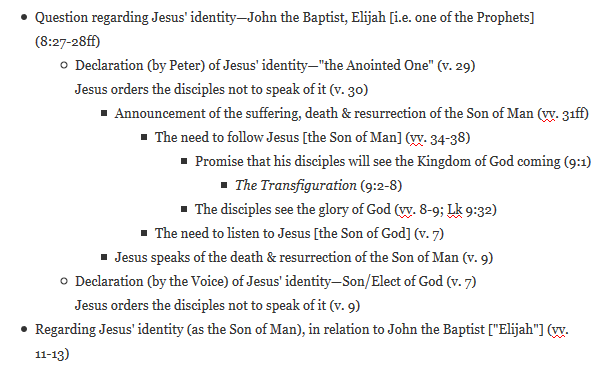
This has been a central theme in our study of the Baptism of Jesus in the Gospel tradition (discussed in detail in earlier studies). John the Baptist, of course, features prominently in the Baptism narrative, which opens with a description of John and his ministry, including the central association with the Isaiah 40:3ff prophecy (Mark 1:2-6 par). His presence in the Transfiguration scene is limited to the (separate?) tradition which appears at the end (Mk 9:11-13). It is generally assumed that Jesus is speaking of John in his reference to “Elijah” (compare Matt 11:14), drawing a parallel between the Baptist’s mistreatment/arrest and his own (i.e. of the “Son of Man”, 8:31; 9:12, etc). Note the framing structure surrounding 8:27-9:13, forming an inclusio:

The question regarding the identity of “the Anointed One” (i.e. Messiah) is given more prominence and clarity in Luke’s account of the Baptism (3:15; compare John 1:19-27).

2. The heavenly declaration corrects/clarifies the Messianic identification

This is implicit by the phenomena attending Jesus at his baptism, especially the descent of the Spirit upon him; Luke brings out the Messianic association more directly, in the subsequent scene at Nazareth, where Jesus identifies himself with the “Anointed” figure of Isa 61:1ff (Lk 4:17-21, cf. also 7:22). This makes clear in what sense Jesus is the Messiah (3:15) and the “one [who is] coming” (3:16; 7:19 par). The heavenly declaration at the Baptism adds to this by identifying Jesus as God’s Son (3:22 par), drawing upon the image of the king (i.e. the Davidic ruler) as “Son of God” (the variant reading in Lk quotes [the Messianic] Psalm 2:7). Similarly, prior to the Transfiguration, Peter declares Jesus to be “the Anointed One (Messiah) [of God]” (Mk 8:27 / Lk 9:2). The exchange between Peter and Jesus which follows (Mk 8:31-33 par, but omitted by Luke) suggests that Peter had in mind the Messianic figure-type of the Davidic ruler (cf. Parts 6–8 of the series “Yeshua the Anointed”), which would not have been compatible with the idea that Jesus must suffer and be put to death. It was Peter who also responds to the Transfiguration, without truly understanding the significance of what he sees (Mk 9:5-6 par, see below). Again, as at the Baptism, the heavenly voice declares Jesus to be the “Son of God”—but here, it would seem, not in the traditional Messianic sense, but hinting at something greater, tied to the death and resurrection of Jesus (Mk 8:31; 9:9, 12-13 par), which will lead to his exaltation to the right hand of God (Mk 14:62 par; Acts 2:32-35; 13:30-35 [citing Ps 2:7], etc).

3. The presence of Moses and Elijah—Jesus as a Prophet figure, specially chosen/anointed by God

That Jesus was seen as a Messiah of the Prophet figure-type seems clear enough from the Baptism scene, attested by different strands of tradition (Mk 1:7-8 par; Lk 3:15ff; 4:14-30; Jn 1:19-27), as well as the entirety of the period of his Galilean ministry, as it is recorded in the Synoptic narrative. Principally, he fulfilled the role of Spirit-endowed, miracle working Prophet (like Elijah), identified more specifically with the anointed herald of Isa 61:1ff. It has been popular to interpret the presence of Moses and Elijah in the Transfiguration scene as representing “the Law and the Prophets” which Jesus was fulfilling (Matt 5:17; Lk 16:16; 24:27, 44; Jn 1:45, etc). However, this does not seem to be correct. To begin with, Elijah is an odd choice to represent the Prophetic Scriptures (Isaiah would make more sense, cf. Jn 12:39-41). More importantly, Moses and Elijah each represent distinct Prophet-figures; and, in the original context of the Gospels, it is almost certain that Jesus, in the period of his Galilean ministry especially, was also seen as an Anointed Prophet. I would suggest that in the Transfiguration scene the significance of Moses and Elijah is two-fold:

    1. It identifies Jesus as a Messianic Prophet (like Moses and Elijah), marking the conclusion of his Galilean ministry in which this role was primarily being fulfilled, but also pointing to his eschatological role inaugurating a new era for the people of God. It is no coincidence that, in Jewish tradition by the time of Jesus, Moses and Elijah were seen as prophetic figures who would appear at the end-time, as a fulfillment of specific prophecies (Deut 18:15-20; Mal 3:1ff; 4:5-6).
    2. Moses and Elijah each experienced a theophany—manifestation of God’s presence—upon the holy mountain (Sinai/Horeb); similarly, Jesus (and his disciples) on this mountain experience the appearance of the cloud of God’s presence and the divine Voice from heaven. This theophany, in relation to Jesus, is of a different sort, reflecting his divine Sonship. For more on this, see below.
4. The Transfiguration scene prefigures the coming Passion—the death and resurrection of the Son of Man

This is clear from the position of the Transfiguration scene in the Synoptic narrative, as noted above. It marks the conclusion of Jesus’ Galilean ministry, and the beginning of his Passion—the upcoming journey to Jerusalem (Mk 10; Lk 9:51–18:34), and the events which would take place there. Luke’s account of the Transfiguration brings out this aspect more clearly (see below).

The Transfiguration in Luke 9:28-36

Note the following details or characteristics of the Lukan version, and its place in the specific context of the Gospel narrative:

    • Luke has given special prominence to Jesus’ role as a Messianic, Spirit-endowed Prophet in the period of his Galilean ministry (4:14–9:22); this gives greater significance to the presence of Moses and Elijah in the Transfiguration scene (see above).
    • Peter’s confession in Luke (9:20) reads “You are the Anointed One of God” which is parallel to the unique form of the heavenly declaration in the Lukan version of the Transfiguration “This is the Son of God, the Elect/Chosen (One)“. On this, see below.
    • Luke’s version of the Transfiguration brings out more clearly the association with Moses and the Exodus—especially the traditions regarding the cloud of God’s presence (9:29, 31a, 34-35, cf. Exod 13:21-22; 19:9, 16ff; 24:15-16ff; 33:9-10; 34:5; 40:34-38). In particular, note v. 34 which alludes to Moses entering the cloud (Exod 24:18, cf. also 33:9).
    • This also enhances the idea of the Transfiguration as a theophany, in which Jesus and his disciples experience the presence of God and see his glory/splendor (vv. 31-32, see also v. 27). In this context, the altered appearance of Jesus (v. 29) probably is meant to echo the tradition regarding Moses changed appearance in Exod 34:29-35.
    • Luke ties the Transfiguration more directly to the coming death and resurrection of Jesus in Jerusalem, in two respects: (1) by the detail he includes in v. 31, using the word éxodos (“way out”, i.e. “exodus”), and (2) its relation to the journey to Jerusalem which follows, and which features so prominently in the structure of the Lukan narrative (9:51-18:34)

The textual question in Luke 9:35 and John 1:34

Finally, mention should be made again of the textual variants for the heavenly declaration in Luke 9:35. The majority text (including A C* W 33, etc) follows the version in Mark (9:7):

“This is my Son, the (one who is) loved”
hoútós estin ho huiós mou ho agap¢tós

However, many of the earliest/best manuscripts (Ë45,75 a B L, etc) instead read:

“This is my Son, the (one) gathered out [i.e. elect/chosen]”
hoútós estin ho huiós mou ho eklelegménos

Most commentators prefer this as the original reading, considering it much more likely, considering scribal tendencies, that the passage would be harmonized with Mark than the other way around. As it happens, there is a similar textual variant related to the declaration of Jesus’ identity at the Baptism, in John 1:34. The Baptist’s statement, in the vast majority of manuscripts and witnesses (including Ë66) reads—

“…this is the Son of God”
hoútós estin ho huiós toú theoú

which, of course, is quite similar to the voice at the Transfiguration in the Synoptic tradition (cf. also the Matthean version of the Baptism, Matt 3:17). However, in a number of witnesses (Ë5,106vid a* b e ff2* etc) the reading is:

“…this is the (One) gathered out [i.e. Elect/Chosen] of [i.e. by] God”
hoútós estin ho eklektós toú theoú

A few MSS have the longer (conflate) reading “…the elect/chosen Son of God”, which is surprisingly close to the heavenly voice in the Lukan version of the Transfiguration (according to many of the best MSS, cf. above). The adjective eklektós is closely related to the participle eklelegménos (both from the verb eklégomai, “gather out of/from”), and has essentially the same meaning (“selected, elect, chosen”, etc). The adjective normally refers (in the plural) to believers (as the elect/chosen ones) in the New Testament, but the singular is used of Jesus (also as a title) in Luke 23:35; a few manuscripts likewise read the adjective, instead of the participle, in Lk 9:35. In the two Lukan references, and in Jn 1:34 v.l., the title “Elect/Chosen One” almost certainly must be understood in a Messianic context. The Lukan usage in 9:35, if original, suggests a parallel with the adjective agap¢tós (“[the one] loved [i.e by God]”)—the one chosen by God is loved by God, and vice versa. It also indicates that the title “Son of God” should not be understood here in terms of later orthodox Christology (nor even the developed Christology of the Fourth Gospel). The immediate narrative context of the Gospel has rather a different, two-fold emphasis:

    • Jesus is the Son of God in a Messianic sense, according to the interpretation of Psalm 2:7 etc in Jewish and early Christian tradition (cf. Lk 1:32, 35, etc), and
    • The declaration points to the death, resurrection (and exaltation) of Jesus, by which he is considered to be God’s Son (and Anointed One) in a very special sense (Acts 13:33, etc). The Johannine idea of Jesus’ Sonship—i.e. as the pre-existent, eternal Son of the Father, plays little (if any) role in the Synoptic narrative, and represents a somewhat later development in the Gospel tradition

As an interesting side note, the title “Elect/Chosen One of God” in Aramaic (ah*l*a$ ryj!B=, b®µîr °§l¹h¹°) is found in a text from Qumran (4Q534). It survives only as a fragmentary piece, so it is nearly impossible to determine the precise context, but it appears to be related in some way to the ancient Enoch traditions, most familiar as expressed in the work known as 1 Enoch. Column 1 lines 10-11 reads:

“in that [i.e. because] he is the chosen (one) of God, his being born [i.e. his birth] and the spirit [jwr] of his life-breath [<vn] {…} his thinking/reckoning [pl. i.e., plans] will be to the distant age (to come) [i.e. for ever]…”

It may perhaps be debated to what extent the title “Elect/Chosen One” is Messianic (compare Isa 42:1; Ps 89:3; 106:23); however, in the so-called Similitudes of Enoch (chap. 37-71), often dated roughly to the time of Jesus (early-mid 1st cent. A.D.), we find a heavenly figure (much like Jesus) who is variously given the titles “Son of Man”, “Anointed One” and “Elect/Chosen One”. All three of these titles appear together, in the context of the Transfiguration scene, in Luke 9 (vv. 20, 22, 26, 35 v.l., 44).

Next week, we will turn our critical lens to one of the most intriguing pieces of the “Triple Tradition” —the episode of the anointing of Jesus by a woman. Perhaps no other Gospel episode has been preserved in such a conflicting and controversial manner. In addition to the marked differences between the Synoptic version in Mark-Matthew and that in Luke, the separately preserved Johannine version contains details shared by both (along with its own distinctive features). Our studies on this fascinating tradition will prepare the way for the upcoming Holy Week.

Saturday Series: Mark 9:2-13 par

Mark 9:2-13; Matt 17:1-13; Luke 9:28-36

This week, our illustrative studies on the Gospel tradition (specifically the Synoptic Gospels) will turn to the Transfiguration scene. This episode is especially interesting in the way that it parallels the earlier Baptism scene. The parallelism raises significant critical questions regarding the underlying historical tradition. The points to be discussed here in this study are:

    1. The position and significance of the Baptism and Transfiguration in the structure of the Synoptic narrative as a whole
    2. Similar/parallel details between the Baptism and Transfiguration, and how they may differ or function in context, and
    3. The similarity of the heavenly declaration regarding Jesus’ identity

Study of the Transfiguration is much simpler than that of the Baptism, since it seems to be attested only in the primary Synoptic narrative, with no parallel in the Johannine tradition, and relatively little specific adaptation by the Gospel writer. Continuing with the approach I have been using in this series, the core (Synoptic) narrative is represented by the Gospel of Mark, in line with the fundamental critical hypothesis that Matthew and Luke each made use of Mark. There is always the possibility that all three Gospels are drawing (independently) upon a common “Synoptic” tradition; however, it must be affirmed that, if Matthew and Luke did not use Mark, they must have used a source very similar in content and structure.

In Mark, the Transfiguration occurs at 9:2-13, with the Synoptic parallels being Matt 17:1-13 and Lk 9:28-36. It does not seem to have been part of the so-called “Q” material (common to Matthew and Luke), nor is any such tradition recorded in the Gospel of John. Commentators debate whether Matthew and Luke may have inherited traditions apart from the core Synoptic narrative (so-called “M” and “L” material), which they included, or whether they have simply adapted the basic narrative. A reference to the Transfiguration is also found in 2 Peter 1:17-18, but it is not clear whether the immediate source of this is historical memory (Peter, taking the text at face value), the Synoptic narrative, or an independent tradition.

1. The Structure of the Synoptic Narrative

The Synoptic narrative, as shared by all three Gospels, is divided into two main portions: (1) The Galilean ministry of Jesus, and (2) The time in Judea (Jerusalem). The Galilean period begins with the Baptism, and concludes, we may say, with Peter’s confession of Jesus. In the Gospel of Mark, this covers the span of 1:2–8:30; Matthew and Luke generally follow this same outline (Luke being closer to the Markan order), but both Gospels “fill out” the narrative with additional sayings and episodes, i.e. the so-called “Q” material, along with other traditions (“M” and “L” content).

The Transfiguration is the major episode which begins the second half of the Gospel, much as the Baptism begins the first half; it follows the first (of three) announcements by Jesus of his upcoming Passion (Mk 8:31ff), and precedes the journey to Jerusalem. This journey is scarcely mentioned in Mark, serving as the setting for chapter 10 (vv. 1, 32, 46), but in Luke it is developed considerably as a prominent feature of the narrative, covering the entire collection of material from 9:51 to 18:34 (almost ten full chapters). Virtually all of Jesus’ activity in Judea is set in the second half of the narrative, giving the impression that the only journey Jesus made to Jerusalem was the one just before his death. By contrast, the Gospel of John records multiple visits to Jerusalem, coinciding with the major religious festivals, an arrangement which, in certain respects, one must assume more accurately reflects the historical situation.

2. Similarities between the Baptism and Transfiguration scenes

I begin with the narrative as represented by Mark, noting differences in the other Gospels along the way. There are a number basic elements which can be pointed to as parallels between the two scenes:

    • The isolated locale—the Judean desert/wilderness (1:4ff) vs. a high mountain [in Galilee?] (9:2)
    • Visual/visionary phenomena appear, in relation to Jesus (1:10; 9:2b-4)
    • These phenomena involve brightness/whiteness (1:10 [the dove image]; 9:3)
    • The phenomena may be said to have a Prophetic and/or Messianic context— “anointing” by the Spirit (Isa 61:1ff, see Lk 4:14-20, etc) and the presence of Moses/Elijah with Jesus
    • A cloud/presence, i.e. from heaven (1:10-11; 9:7)
    • The declaration by a heavenly voice (cf. the next section below)
    • A reference to John the Baptist as “Elijah” (1:2, 6; 9:12-13)
    • The scenes are connected (in different ways) with Peter, James and John as disciples of Jesus (1:16-20; 9:2ff)
    • Following closely after, Jesus works a healing (exorcism) miracle (1:21-28; 9:14-29)

In Matthew’s version, the parallel is made more precise by the fact that the heavenly declaration in both scenes is identical (Matt 3:17; 17:5b). The primary difference between the Baptism and Transfiguration scenes is twofold: (a) the presence of Jesus’ disciples and their response to the visionary experience, and (b) the Transfiguration more fully reflects a theophany (divine appearance/manifestation), such as recorded in the Old Testament. Luke, in particular, has brought out more clearly a connection with the theophany at Sinai (9:30-31, 34; compare Exod 19). Luke also adds the detail of Jesus being engaged in prayer in both scenes (3:21; 9:29a), which creates another parallel unique to that Gospel.

3. The declaration of the Heavenly Voice

In both scenes there is a heavenly Voice (i.e., that of God). Note the similarity of wording (in Mark):

“and there came to be [egéneto] a voice out of [ek] the heavens” (1:11a)
“and there came to be [egéneto] a voice out of [ek] the cloud (9:7a)

The main difference is one of closeness and intensity—the voice at the Transfiguration comes from a theophanous cloud [nefél¢], indicating the presence of God (see the Exodus traditions, Exod 13:21-22; 19:9, 16ff; 24:15-16ff; 33:9-10; 34:5; 40:34-38), which overshadowed [literally, cast shade upon] Jesus and his disciples. Luke’s account enhances the detail of the cloud (Lk 9:34), drawing upon the image of Moses entering the cloud, to the place where God was present (Exod 24:18, cf. also 33:9). The declaration of the heavenly voice in both scenes is very similar; in Mark it is:

    • “You are my Son, the (one who is) loved—in you I have good regard [i.e., think well, think good of]” (1:11b)
      su eí ho huiós mou ho agap¢tós en soi eudók¢sa
    • “This is my Son, the (one who is) loved” (9:7b)
      hoútos estin ho huiós mou ho agap¢tós

Matthew, insofar as he is following the Synoptic/Markan version, seems to have combined the two statements, so that they read as identical in both episodes:

    • “This is my Son, the (one who is) loved—in whom I have good regard” (3:17; 17:5)
      hoútos estin ho huiós mou ho agap¢tós en hœ¡ eudók¢sa

The situation in Luke is a bit more complicated, as there are significant variant readings for the declaration in both scenes. For the baptism (3:22b):

    • The Majority reading—identical with that in Mark (cf. above)
    • The minority “Western” reading—a quotation of Psalm 2:7 LXX:
      “You are my Son—today I have caused you to be (born)”
      huiós mou eí su egœ¡ s¢¡meron gegénnhká se

On this textual variant, cf. my earlier discussion. For the transfiguration (9:35):

    • Reading of Ë45,75 a B L, etc:
      “This is my Son, the (one) gathered out [i.e. elect/chosen]”
      hoútós estin ho huiós mou ho eklelegménos
    • The majority reading (A C* W 33 et al): identical with that in Mark

Most critical commentators consider the first reading as more likely to be original, the latter being adapted/normalized to the Synoptic parallel in Mark/Matthew and the baptism scene. A few manuscripts read the related adjective eklektós instead of the participle eklelegménos (cf. Lk 23:35), but with essentially the same meaning. This textual question will be discussed in relation to an interpretation of the Transfiguration scene, especially as it has been developed in the Gospel of Luke.

Finally, to round out the comparison, we should mention the version of the heavenly declaration at the Transfiguration, from 2 Peter 1:17, which is similar to that in Matthew, but with a different formulation in Greek (giving priority to the reading of Ë72 B):

“This is my Son, the (one) loved (by) me—unto whom I have good regard”
ho huiós mou ho agap¢tós mou hou!tós estin eis hón eudók¢sa

All of these extensive parallels relate to the underlying historical tradition, and how that tradition was shaped and adapted within the Synoptic narrative. It cannot be coincidental that the period of Jesus’ Galilean ministry, according to this narrative, begins and ends with two similar scenes (Baptism and Transfiguration)—each containing the declaration of Jesus’ identity by a heavenly voice. Of fundamental importance to the narrative is how each of these scenes establishes the Messianic identity of Jesus—and that this identity (announced by the heavenly voice) informs the entire narrative.

With this structure and thematic framework in mind, let us now consider how the historical tradition (of the Transfiguration) was interpreted within the Synoptic narrative. We can see this based by a careful study of the Lukan version of the scene (9:28-36). For this, however, it will be necessary first to bring out several key points that relate to the wider Synoptic tradition. By doing so, we can gain a better sense of how the earliest Christians understood Jesus’ Messianic identity. This will be the focus of next week’s study.

Saturday Series: John 6:22-59

John 6:22-59

This week we will follow-up on the previous study, in which we examined the Johannine version of the Miraculous Feeding episode. That episode is one of the rare instances where a distinct historical tradition has been preserved in both the Synoptics and the Gospel of John. Last week’s study looked especially at the episode as it was developed within the Johannine Tradition. One special aspect of the Johannine version involves the relationship between the Feeding Miracle tradition itself (6:1-15) and the Bread of Life discourse (6:22-59) that follows in the Gospel narrative. This was mentioned in the previous study, but is deserving of a more extensive treatment.

There are three motifs from the Miracle tradition which are developed in the Bread of Life discourse:

    1. The Passover setting—which is unique to John’s account, though Mk 6:39 could also indicate springtime.
    2. The eating of Bread, and
    3. The Eucharist (on these allusions, cf. the previous study)

These three themes run through the discourse, but it may be said that each dominates one of the three main sections. Verses 22-24 serve as the narrative introduction to the discourse, and are transitional, joining the discourse with the Feeding Miracle, etc, in vv. 1-21. Each of the three main sections builds on the dialogue/discourse format used in the Gospel—

    • Saying of Jesus
    • Reaction/question by the people, indicating some level of misunderstanding
    • Explanation/Exposition by Jesus

In addition, the three sections are joined together, forming a larger discourse, by way of a step-parallel thematic technique:

    • Miracle of the bread-loaves —>
      • Passover: manna / bread from heaven —>
        • Eating bread: Jesus the “bread from heaven”, Bread of Life —>
          • Jesus the Living Bread —>
            • Eucharist: eating his flesh/blood leads to (eternal) Life

Section 1 (vv. 25-34)

    • Principal saying by Jesus—verse 27: “Do not work (for) the food th(at is) perishing, but (for) the food remaining into (the) life of the Age(s) [i.e. eternal life]…”
    • [Explanation by Jesus]—v. 29
    • Reaction/question by the people—vv. 28-31
    • Explanation by Jesus—vv. 32-33
    • Theme: transition from the Feeding Miracle (v. 26) to the Passover motif (i.e. the manna, “bread from heaven”, vv. 31-33)

Section 2 (vv. 35-50)

    • Saying by Jesus—verse 35: “I am [egœ¡ eimi] the Bread of Life—the one coming toward me (no) he will not (ever) hunger, and the one trusting into me (no) he will not ever thirst. …”
    • [Explanation by Jesus]—vv. 36-40
    • Reaction/question by the people—vv. 41-42
    • Explanation by Jesus—vv. 44-50
    • Theme: Eating Bread—Jesus as the “Bread of Life”, the Bread come down from Heaven

Section 3 (vv. 51-58)

    • Saying by Jesus—verse 51a (parallel to v. 35): “I am [egœ¡ eimi] the Living Bread stepping down [i.e. coming down] out of Heaven—if any one should eat out of this bread he will live into the Age (to Come)…”
    • [Explanation by Jesus]—v. 51b
    • Reaction/question by the people—v. 52
    • Explanation by Jesus—vv. 53-58
    • Theme: transition from Bread (of Life) to the Eucharist motifs (vv. 53-56ff)

I will not here discuss the rich texture and theology of the discourse; this has been done in some detail in an earlier note (however, see the section below on John 6 and the Eucharist). The outline above is meant to demonstrate how the Gospel writer has developed the Feeding Miracle tradition, by making it part of the larger Bread of Life discourse, much as he did with healing miracle (and Sabbath controversy) episode in chapter 5. The Discourses of Jesus in John are complex and difficult to analyze, due to the sophisticated way that authentic historical traditions have been adapted and interpreted within the Johannine literary style/format (i.e. of the Discourses). This compositional style can be seen at many different points in the Gospel. Compare, for example, the close similarity of structure, language and ideas, between Jesus’ exchange with the Samaritan woman (4:9-15) and that of 6:25-34 (above, cf. also Brown, p. 267). The parallel between Jesus as the living water (ch. 4) and the living bread (ch. 6) is unmistakable, and is clearly intentional within the context of the Gospel.

Also most difficult is the relation between the Bread of Life and Eucharist symbolism in second and third sections (vv. 35-58) of the discourse. As challenging as these passages have been for Christians throughout the ages, Jesus’ words must have been completely baffling to the first hearers, if we accept the essential historicity of the discourse (v. 59). Indeed, this is a prominent theme of the Discourses in John—the misunderstanding of his words by the people who hear him. The explanation by Jesus, within in the discourse format, expounds the true (and deeper) meaning of his words, much as we see him, on occasion in the Synoptics, explaining his sayings and parables to the disciples in private (Mk 4:10-20 par, etc).

John 6:60-65ff

As it happens, John records a similar sort of “private” explanation by Jesus to the disciples in vv. 60-65. This comes in addition to the exposition(s) within the discourse proper; as such, vv. 60ff functions as an epilogue or appendix to the discourse. There is a loose parallel, perhaps, to this in 4:31-38. Verses 60-65 have greatly complicated interpretation of the discourse (particularly the eucharistic motifs in vv. 51-58), since they contain a distinctly spiritual explanation of Jesus’ words. This section may be outlined as follows:

    • Reaction by the disciples (i.e. to the discourse)—v. 60 “This account [i.e. word/discourse] is hard/harsh; who is able to hear it?”
    • Explanation by Jesus—vv. 61-65, which is framed by a question and a statement directed toward his disciples: “Does this trip you (up)?” (v. 61b) “But there are some of you that do not trust (in me)” (v. 64a)

The explanation in vv. 62-63 is comprised of three sayings, which must be taken together:

“Then if you should look upon the Son of Man stepping up to where he was at (the) first(, how will you react)?” (v. 62) “The Spirit is th(at which) makes (one a)live; the flesh does not help (in) anything” (v. 63a) “The utterances [i.e. words] which I have spoken to you (they) are Spirit and Life” (v. 63b)

The first saying (a rhetorical question) emphasizes the divine origin of the “Son of Man” (Jesus), and foreshadows his departure back to the Father. It is at the time of his departure that the Spirit will come to the disciples (14:16-17, 25-26; 15:26; 16:13-15; 20:22-23; cf. also 8:39). The second saying clearly states that the Spirit (of God, and Christ) is that which gives life; the flesh plays no role, or is of no use in this. In the third saying, Jesus identifies his words with the Spirit and with the life the Spirit gives. The disciples, at this point in the narrative, could not possibly understand the significance of these things, since they foreshadowed events which had not taken place. They simply had to trust Jesus. This is the emphasis of verses 64-65, and in the tradition which follows (vv. 66-71). Not all of Jesus’ disciples truly trust in him, but only those chosen and given to Jesus by the Father (i.e. the Elect believers). Here the author seems to have joined to the discourse a separate tradition, with similarities to several found in the Synoptics—i.e., the calling of the Twelve (cf. Mk 3:13-19 par) and the confession by Peter (vv. 68-69; cp. Mk 8:29 par). On the latter point, compare Peter’s words in Mk 8:29/Lk 9:20 and Jn 6:69 respectively:

“You are the Anointed One [Christós] of God” “You are the Holy One [Hágios] of God”

It is another example (among many) of how the Synoptic and Johannine traditions are so very similar, and yet, at the same time, so very different.

More on John 6 and the Eucharist

One of the most peculiar features of the Passion Narrative in the Gospel of John is the lack of any mention of the Eucharist (Lord’s Supper, the bread and cup) in the Last Supper scene (chap. 13). Many critical commentators believe that this detail has been transferred to an earlier location in the Gospel (the Bread of Life Discourse, 6:51-58), the precise reason for which remains uncertain. This interpretation is easier to maintain for critical scholars who tend to view the Discourses, etc, as primarily the product of early Christians, rather than representing the authentic words/sayings of Jesus himself. At the historical level indicated by the narrative setting of the Bread of Life discourse, for example, allusions to the Eucharist, while obvious to early Christian readers, would have been completely unintelligible for Jesus’ Galilean contemporaries (the people with whom he is said to be speaking in the Discourse). The same is true of the supposed references to (Christian) baptism in 3:5ff, and so forth.

There is certainly a similarity between 6:51ff and the words of institution in the Synoptic Lord’s Supper tradition; the saying in v. 51 forms the core statement of Jesus in the sub-discourse of vv. 51-58:

“I am the living bread, the (bread hav)ing stepped down out of heaven; if any (one) should eat out of this bread, he shall live into the Age, and the bread, indeed, which I will give is my flesh, over [hypér] the life of the world.”

The reaction (misunderstanding) of the crowd follows immediately in verse 52, and the exposition by Jesus comes in vv. 53-57, along with a restatement of the initial saying in the closing v. 58, bringing it line with the context of the discourse as a whole:

“This is the bread (hav)ing stepped [i.e. come] down out of heaven, not as the fathers ate and (then) died off—the (one) munching this bread will live into the Age.”

By combining the italicized portion of v. 51 above with the basic idiom of the exposition in vv. 53ff (i.e. eating and drinking Jesus’ flesh and blood) we can approximate the Eucharistic tradition of Mark 14:22-24 par:

“And (with) their eating, (hav)ing taken bread…he gave (it) to them and said ‘Take, [eat,] this is my body’. And, (hav)ing taken the drinking-cup…he gave (it) to them and they all drank out of it. And he said to them, ‘This is my blood…th(at is) being poured out over [hypér] many’.”

The force of the instruction in Jn 6:53-57 involves a contrast between those who eat/drink Jesus’ flesh/blood and those who do not:

“Then Yeshua said to them: ‘Amen, amen, I relate to you (that), if you should not eat the flesh of the Son of Man and drink his blood, you do not hold life in yourself’.” (v. 53)

“The (one) munching [i.e. eating] my flesh and drinking my blood holds (the) life of the Age [i.e. eternal life]…” (v. 54)
“The (one) munching [i.e. eating] my flesh and drinking my blood remains [ménei] in me, and I in him.” (v. 56)

Clearly, “holding life” is here synonymous with “remaining” in Jesus, both idioms being essential to the Johannine theological vocabulary and found repeatedly in the Gospel (and Letters). The verb ménœ (“remain”) is of special significance in the way that it defines the identity of the believer in Christ.

Some commentators would view the Vine instruction/illustration in 15:1-8 as a similar Eucharistic reference, with the vine (i.e. wine/cup) as a complement to the bread in the chap. 6 discourse. In point of fact, however, the main parallel between 6:51-58 and 15:1-8 lies in the use of the verb ménœ, and the idea of “remaining” in Jesus. Consider the words of Jesus in 15:4:

“You must remain [meínate] in me, and I in you. Even as the br(anch) broken (off) is not able to bear fruit from itself, if it should not remain [mén¢] in the vine, so also you (can)not if you should not remain [mén¢te] in me.”

The same language is repeated in vv. 5-7, and again, by way of exposition, in vv. 9-10. According to a sacramental (eucharistic) interpretation of these passages, the believer initially comes to Jesus through faith/trust in him, but remains in relationship with Jesus (his life-giving power, etc) by partaking in the ritual meal (sacrament of the bread and wine). While this would make perfect sense, I am sure, to many early Christians, there is precious little support for it in the Johannine Gospel (or Letters). The basis for “remaining” in Jesus, from the standpoint of the Johannine theology (and Christology), is two-fold:

    • Trust in Jesus—that he is the Son who manifests God the Father, and
    • Union with him—being united with both Son and Father—through the Spirit

This is further reflected in the two essential characteristics marking the true believer in Christ:

    • Obedience to the dual-command: of trust and love
    • The abiding and guiding presence of the Spirit

The former is clearly expressed in 15:9-10, where the “remaining in Jesus” of the vine-illustration, is explained precisely in terms of the ‘command’ (entol¢¡) of trust/love (for an explicit definition of this dual-command, cf. 1 John 3:23-24). As for the presence of the Spirit, while this is central to the entire Last Discourse (chaps. 14-16), it applies more directly to the eucharistic language in 6:51-58. Indeed, in the explanation of Jesus that follows in vv. 61ff, we read:

“Does this trip you (up)? Then if you could look at the Son of Man stepping up (to) where he was (at) first, (would that help)? The Spirit is the (thing) making [i.e. bringing] life; the flesh is not useful, not (for) one (thing)—(and) the utterances that I have spoken to you are Spirit and Life. But there are some out of you that do not trust.”

Does the flesh/blood of Jesus in 6:51-58 refer primarily to the Eucharist or to trust in Jesus? The explanation in verses 61ff, within the overall setting of the Johannine theology, clearly indicates the latter. It is our trust in the revelatory message about Jesus—who he is (Son of God the Father) and what he does (his sacrificial death)—which allows us to “hold” life within ourselves and to “remain” in him. Moreover, this message is identified with the Spirit, which is the source of the life we hold, and the presence of the Spirit is what unites us with Jesus the Son (and God the Father).

However, the message of Jesus does center upon his sacrificial death, which brings us around to the Passion setting of the eucharistic language. The “bread”, further described as the “body and blood” of Jesus, which he gives, is given “over the life of the world” (6:51; Mk 14:24 par “…over many”). This alludes to the covenant context of the ritual in Exodus 24:5-8—particularly the action involving the blood in verse 8 (parallel to v. 6). Blood is thrown on (i.e. over) the people as part of the ratification of the covenant (note the declaration of faith/obedience to the covenant in v. 7). Obedience to the covenant leads to life and blessing for Israel.

This idea is taken much further in early Christian thought. As a result of Jesus’ sacrificial death (and resurrection) those who believe in him are freed from the power of sin and evil, and rescued from the coming Judgment of God on the wickedness/evil in the world. We are never told exactly how this is accomplished, though the symbolism and imagery involved offer some clues. Paul, in his letters, provides rather more theological exposition in this regard, but ultimately it remains one of the great mysteries of Christian faith. Jesus’ death brings (eternal) life to all who believe (“…the life of the world”, cp. Jn 3:16 etc).

* * * * * * *

Next week, we will turn our attention to the Transfiguration scene in the Synoptic Gospels. This is another example of the “Triple Tradition”, but it is also particularly instructive for understanding the many subtle (but significant) ways that the individual Gospel writers shaped the historical tradition. It is also a fitting passage to study in celebration of the Lenten season, in preparation for the coming Holy Week. I hope you will join me here…next Saturday.

References marked “Brown” above are to R. E. Brown, The Gospel According to John I-XII Anchor Bible [AB] Vol. 29 (1966).

Saturday Series: John 6:1-15ff

John 6:1-15

Having now discussed the miraculous feeding narratives in the Synoptic Gospels (see last week’s study), it is time to examine the tradition as it appears in the Gospel of John. The corresponding passage in the fourth Gospel is found in Jn 6:1-15. The narrative setting of this episode in John is, of course, quite different:

    • Jesus has previously been in Jerusalem (Jn 5:1ff), and is now in Galilee (6:1); this abrupt shift would seem to indicate that we are dealing with the inclusion of traditional material, and no real attempt has been made by the author to smooth over the seam. Note the generic opening words, “After these things…” (metá taúta).
    • The occasion of Passover is mentioned (v. 4), which is almost certainly an insertion by the author to connect the miracle explicitly with the setting of the “Bread of Life” discourse which follows in 6:22-59.
    • Consider how the author includes the episode of Jesus’ walking on the water (6:16-20) right after the miraculous feeding, just as in the Synoptic tradition (Mark/Matthew), even though it doesn’t seem entirely to fit the narrative context in John (note the rather awkward transitional description in vv. 22-23). I take this as an indication that the two episodes were already coupled together at a very early point in the Gospel tradition. The connection with the walking-on-water episode will be discussed further below.
    • There is, certainly, nothing at all like the Bread of Life discourse following the feeding miracle in the Synoptic Gospels—it appears to be a tradition unique to John.

As I mentioned previously, the account of the Miraculous Feeding in John is interesting in that it appears to contain details or elements from both miracle episodes in the Synoptics. Special details in common between John’s account and the Synoptic feeding of the 5000:

    • Crossing the Sea of Galilee (by boat) (v. 1; see Mk 6:32)
    • Reference to Jesus’ healing the sick (v. 2) [see Matt 14:14; Luke 9:11]
    • Jesus looks (up) and sees the “great crowd” [polýs óchlos] (v. 5; Mk 6:34)
    • Specific mention by the disciples of the cost of (at least) 200 denarii to feed so many people (v. 7; Mk 6:37)
    • The number of loaves (5) (v. 9)
    • The specific (round) number of men in the crowd (5000) (v. 10)
    • The mention of grass (v. 10; Mark 6:39, par Matt)
    • There are twelve baskets [kophinos] of fragments left over (v. 13)

Details in common between John’s account and the Synoptic (Matthew-Mark) feeding of the 4000:

    • The specific location along/across the Sea of Galilee (v. 1) [see Matt 15:29]
    • Jesus going up onto a mountain (v. 3) [see in Matt 15:29, but note also the mountain theme in Mk 6:46 par. Matt).
    • Jesus takes the initiative regarding the crowd (v. 5) [see Mark 8:2-3 par]—however this is more of an original/distinctive element of John’s narrative.
    • Jesus’ question (v. 5b) is quite similar to the question by the disciples in Matt 15:33 (par Mk 8:4). The author’s comment in verse 6 suggests that he was uncomfortable with such a question coming from Jesus.
    • The verb “sit/fall back” [anapíptœ] is used (v. 10) instead of “lay back/down” [anaklínœ / kataklínœ]; also, there is no mention of the crowd sitting down in groups of fifty, etc.
    • Jesus “gives thanks” [eucharistéœ] (v. 11) as in Matt 15:36 and manuscripts of Mk 8:7, instead of “bless” [eulogéœ]
    • Jesus specifically directs the disciples to gather up the fragments (v. 12; see Mk 8:6, 8, but also note Matt 14:20)

The number of details in common with the feeding of the 4000 is striking—another indication, perhaps, that the two narrative episodes (of the 5000 & 4000) stem from a single historical tradition. It is also worth pointing out some details which are unique to John’s account:

    • The Passover setting (v. 4), though the mention of “green grass” (Mk 6:39) might generally indicate springtime.
    • Jesus’ specific question about buying food for the crowd (v. 5), described as intended to test the disciples (Philip) (v. 6)
    • The mention of specific disciples Philip (v. 5-7) and Andrew (v. 8), which may indicate a distinct Johannine tradition (see 1:40-46).
    • The boy with the loaves and fish (v. 9)
    • The loaves specified as “barley” [krithinos] and the fish as “dried-fish” [opsarion, instead of ichthys / ichthydion]
    • Jesus’ command to his disciples to gather up the fragments (v. 12), along with the use of sunágœ (“bring together”) instead of aírœ (“lift [up/away]”)
    • The reaction of the people to the miracle in vv. 14-15.

The significant number of details unique to John would seem to be incontrovertible evidence that John has not derived his account from any of the Synoptics, but has inherited an early Gospel tradition, some version of which is shared by the Synoptics as well. For a convenient chart comparing all of the miraculous feeding narratives in detail, see R. E. Brown, The Gospel According to John I-XII (Anchor Bible vol. 29: 1966), pp. 240-243.

Several of the details have a theological significance in the context of John’s Gospel. These include:

    • Reference to Jesus’ miracles as “signs” (semeía) (v. 2, 14)
    • The reference to Jesus going up the mountain, using the verb anérchomai (v. 3)
    • The Passover connection (v. 4)
    • The people coming to(ward) Jesus, with the verb érchomai (v. 5)
    • The eucharistic allusions (v. 11), which are scarcely unique to John’s account, but which have special importance in connection with the Bread of Life discourse that follows.
    • The salvific context of Jesus’ words to his disciples in v. 12
    • Jesus’ identity in relation to popular Messianic conceptions—i.e. as Prophet (v. 14) and Davidic ruler (King, v. 15)

Some of these are especially important in terms of the discourse which follows in vv. 22-58. But before proceeding to that discussion, it is necessary first to address two topics related to the Miraculous Feeding tradition: (1) its connection with the walking-on-water episode, and (2) the eucharistic emphasis.

The Walking on Water (Mk 6:45-52; Matt 14:22-33; Jn 6:16-21)

The episode of Jesus walking on the water follows directly after the Feeding miracle, both in the Synoptic Gospels (Mark/Matthew) and in John. Being thus preserved in two separate lines of tradition, it would seem that the Feeding miracle and the Walking on Water were connected at a very early point. Mark and Matthew follow the same basic narrative, the main difference being the Matthean addition in vv. 28-31 (involving Peter’s walking on the water out to Jesus). Mark certainly has the earlier form of the tradition, confirmed by the parallel in John. The common elements of the tradition are:

    • Jesus goes up the mountain (to be) alone—Mk 6:46 / Jn 6:15b; however, there are two (very) different explanations for Jesus’ departure:
      —Synoptic: Mk 6:45-46a
      —John: 6:14-15a
    • The disciples go out by boat across the lake, though with a different geographical location indicated:
      —to Bethsaida (Mk 6:45)
      —to Capernaum (Jn 6:16-17)
    • At evening, the boat is in the middle of the lake—the wind is rough and the disciples are (having difficulty) rowing—Mk 6:47-48a / Jn 6:16-19a
    • The separation between Jesus and the disciples is indicated
    • After a time/distance, they see Jesus coming to them, walking on the water—Mk 6:48b-49a / Jn 6:19a
    • The disciples are frightened by the sight of him—Mk 6:49b-50 / Jn 6:19b
    • Jesus tells them not to be afraid (Greek: egœ¡ eimi m¢ phobeísthe)—Mk 6:50b / Jn 6:20
    • Jesus comes into the boat and a miracle occurs—Mk 6:51 / Jn 6:21

Mark’s ending probably reflects the original tradition. John’s account has been adapted to fit the verses following (22-23ff) which join the Bread of Life discourse to this episode. Mk 6:52 is an addition, most likely by the author, which points back to the feeding miracle.

The inclusion of the Walking-on-the-Water episode in John causes some difficulty for the author, in terms of joining the Bread of Life discourse to the Feeding miracle. The awkwardness of verses 22-23 is largely the result of his inclusion of the Walking-on-Water episode (vv. 16-21). He clearly felt compelled to include it, which indicates again the strength of the (early) Gospel tradition. Even so, there are several (subtle) details which demonstrate Johannine adaptation of this traditional episode:

    • When the disciples are out on the water, John specifically states that there was darkness [skotía] (v. 17). There is definite theological significance to this word in the Gospel of John, where darkness is contrasted with Christ as the light (1:5; 8:12; 12:35, 46; cf. also 20:1, and note 1 Jn 1:5; 2:8-11). The reason for the darkness is clearly stated: “Jesus had not yet come toward them”.
    • In the Synoptic version, the storm/wind is decidedly negative—it is something against which the disciples struggle (Mk 6:48), and which Jesus’ presence immediately calms (v. 51). These details are absent from John’s version; there the storm/wind seems to function as a kind of theophany, marking the presence and appearance of Jesus, prior to his coming near the boat (vv. 18-19).
    • The presence of Jesus is signified by his words to the disciples—egœ eimi m¢ fobeísthe (“It is I! do not be afraid!”). The words are identical in the Synoptics and John, being part of the original tradition. However, in John, they take on deeper significance. The expression egœ eimi could also be rendered “I am (he)”, “I am (Jesus)”, or, literally, “I am”. As such, the expression appears numerous times in John, in the famous “I Am” sayings of Jesus, which begin with the Bread of Life discourse (v. 35). This is the second occurrence of egœ eimi, spoken by Jesus, in the Gospel (cf. 4:26, and compare 1:20-21; 3:28).

The Eucharistic Allusions

Let us begin with Mark’s account (Mk 6:30-44); the key verse is v. 41:

“And taking [labœ¡n] the five bread-loaves and the two fish (and) looking up into the heaven, he gave good account to [i.e. blessed eulóg¢sen] (God) and broke down [katéklasen] the bread-loaves and gave [edídou] (them) to [his] learners [i.e. disciples] to set alongside them [i.e. the people], and the fish he divided (among) them all”

Matthew’s account (Matt 14:13-21, v. 19) is simpler, but shows only minor differences, most notably perhaps the use of klᜠ(“break”) instead of the compound verb kataklᜠ(“break down”). Luke’s version (Lk 9:10-17) of this verse (v. 16) is almost identical with Mark.

On the surface, there might not seem to be much relation to the Eucharist here; after all, there is no mention of a cup, nothing to suggest symbolism of Jesus’ body (or blood), plus the mention of fish—is there actually a connection to the Lord’s supper? The answer is yes, and there are several reasons for this, which I will discuss in turn.

1. The Greek verbs used

Look at the Greek verbs indicated in square brackets in Mk 6:41 above, and you will see that, with just one slight variation, they are the same verbs (and in the same sequence) used to describe Jesus’ actions at the Last Supper (Mark 14:22 par):

“And in their eating, taking [labœ¡n] bread (and) giving good account [eulog¢¡sas] (to God), he broke [éklasen] (it) and gave [édœken] (it) to them and said, ‘Take (it)—this is my body'”

The only difference is that there, instead of the verb kataklᜠ(“break down”), the simple verb klᜠ(“break”) is used, as in Matthew’s account of the feeding of the five thousand (cf. above). As I pointed out in an earlier note, the same sequence of four verbs also is used in the Emmaus scene, when the disciples finally recognize the presence of Jesus in their midst:

Lk 24:30: “And it came to be, in his bending down [i.e. reclining] with them, taking [labœ¡n] the bread he gave good account [i.e. blessed eulóg¢sen] and, breaking [klásas] (it), he gave [epedídou] (it) to them…”

2. Textual evidence from the Feeding of the Four Thousand

In some ways, the wording in the Markan account of the feeding of the Four thousand (Mk 8:1-9, v. 6) is even closer to that of Jesus’ acts of institution at the Last Supper:

“And taking [labœ¡n] the seven bread-loaves (and) giving (words of) good favor [i.e. giving thanks eucharist¢¡sas] (over it), he broke [eklásen] (them) and gave [edídou] (them) to [his] learners [i.e. disciples] to set alongside (the people)…”

The parallel version in Matthew (Matt 15:32-39, v. 36) differs little. Interestingly, in Mark 8:7, in Jesus’ handling of the fish, there is a textual variant—some manuscripts read eucharistéœ, others read eulogéœ. The verb eucharistéœ (“give/grant good favor, give thanks, be thankful/grateful”) also appears in Jesus’ acts of institution as recorded by Luke (Lk 22:17, 19) and Paul (1 Cor 11:24); it is also used in John’s account of miraculous feeding (Jn 6:11).

3. The Context in the Gospel of John

If we compare the wording in Jn 6:11—

“Therefore Yeshua took [élaben] the bread-loaves and giving (words of) good favor [i.e. giving thanks, eucharist¢¡sas] (over it), he gave throughout [diédœken] to the ones (having) lain back [i.e. lain/sat down]…

it is noteworthy that we do not find nearly so close a parallel to Jesus actions at the Last Supper. Noticeably missing is any mention of breaking the bread (though “broken pieces” [klásmata] are mentioned in v. 12). This may well be an indication that John has inherited an early form of the tradition which was not yet shaped to fit the eucharistic imagery to the same extent (as we see it preserved in the Synoptics). However, the Johannine form of the narrative would have a considerable influence on Eucharistic formulae and imagery in the early Church, as we shall see below.

The miraculous feeding episode in John serves as the basic setting for the great “Bread of Life” discourse which follows in Jn 6:22-59, a discourse in which most commentators find at least some reference to the Eucharist (especially in vv. 53-58). This will be discussed in our next study (see below).

4. Early Christian tradition

Here I will limit discussion to several points and one or two references which show that early Christians understood a definite Eucharistic aspect or element to the miraculous feeding episode.

    1. The Johannine context. As mentioned above, the miraculous feeding is followed by the Bread of Life discourse, which has certain eucharistic elements. While the extent to which the eucharistic aspect applies to the meaning and intent of Jesus’ original words may be debated, there can be no doubt that Christians early on made the association. The Gospel of John is best dated somewhere between 70-90, and may include a late (c. 90-95) redaction.
    2. As discussed in an earlier note, the “breaking (of) bread” appears to have served as a kind of shorthand reference to the Eucharist. In virtually every instance in the New Testament where the breaking of bread is mentioned, there appears to be some connection to the Lord’s Supper. By way of “catch-word (or catch-image) bonding”, any occurrence of breaking bread in the narrative would likely have been associated with the Eucharist from a very early time on.
    3. The use of the verb eucharistéœ in John’s account (as in the Synoptic feeding of the four thousand) may have helped to increase the use of the verb in association with the Eucharist (a word which, of course, derives from a transliteration of the related noun eucharistía).
    4. There are a number of parallels between John’s account of the miraculous feeding and references to the Eucharist in the so-called Didache (or “Teaching” [of the Twelve Apostles]).

      • The Bread is simply called kla/sma (plur. kla/smata), “broken (piece[s])” in Didache 9:3-4 as in the feeding miracle (cf. Jn 6:12)
      • Note especially the prayer in Did 9:4:

“As this broken (bread) was scattered throughout up above (on) the mountains and was brought together (and) became one, thus may your called-out (people) [i.e. church/ekklesia] be brought together from the ends/limits of the earth into your Kingdom…”

With the following details:

      • The bread scattered on the mountains (the mountain setting in Jn 6:3 [cf. also Matt 15:29]).
      • The verb translated “brought together” (sunágœ) is the same used in Jn 6:12-13 for the gathering up of the fragments (klásmata). The same verb is also used in a Eucharistic setting in Did 14:1. The image of the (twelve) disciples gathering up the twelve baskets of fragments “so that nothing might be lost” [Jn 6:12b] was a suitable symbol of Church Unity, as the Didache clearly indicates.
      • The mention of the Kingdom (of God/Christ); perhaps coincidentally, John’s account is the only one which makes any reference to a king (v. 14f).
      • Note the three relevant details in succession in Didache 14:1:

“having been brought together [synachthéntes], break bread [klásate árton] and give good favor [eucharist¢¡sate—i.e. technically ‘celebrate the thanksgiving/eucharist‘]

Despite the name ascribed to the writing, the Didache is almost certainly not a product of the Apostles. It is typically dated sometime between 125-150 A.D., but may possibly preserve earlier tradition. It is a “church manual” of sorts, and provides at least a partial glimpse of what early Christianity may have been like in the first half of the second century (a generation or two after the later writings of the New Testament).

All of this well documents the distinctive way that the Gospel of John has adapted and incorporated the Gospel tradition of the Miraculous Feeding episode. However, in order to understand its place truly with the context of the Johannine Gospel, it is necessary to turn our attention to the great “Bread of Life” Discourse that follows in verses 22-59. This we will do in next week’s study. It will help us to glimpse more clearly, I think, the importance of careful critical study when it comes to examining the rich and complex textures of the Gospel Tradition.

Saturday Series: Mark 6:30-44; 8:1-10 par

In the previous two studies, we have looked at examples of the so-called “Triple Tradition” in the Synoptic Gospels. The term refers to narrative episodes, sayings of Jesus, and other traditions, that are found in all three Gospels. This is especially challenging for a critical study of the passages in question. On the one hand, the three Gospels all share the same basic tradition, and yet each has handled the tradition in distinctive ways. Occasionally, there are historical traditions that are preserved in all four New Testament Gospels—in the Gospel of John, as well as the Synoptics. One such tradition is the Miraculous Feeding (of the Five Thousand), surely one of the best known (and loved) of all Jesus’ miracles. This is the narrative episode I wish to discuss this week.

As it happens, there are aspects of this tradition which are especially problematic, from the standpoint of New Testament criticism, and which greatly complicate any critical study. Let us begin by addressing the most difficult question first—the occurrence of two Feeding Miracle episodes in the Synoptics (Mark/Matthew), each of which has a very similar outline, and many similar details as well (see below). The main question is: does this reflect two distinct historical events, or two versions of the same event? Most critical commentators hold to the latter view. Not only are the two episodes so closely alike, but, as we shall see, the account in John contains elements and details found in both Synoptic episodes. This would seem to confirm the critical view. However, at the same time, in the Synoptic narrative, Jesus himself refers to both of the miracles, mentioning distinct details from each. If the critical view is accepted, then the episode in Mk 8:14-21 par would have to be regarded as a kind of literary fiction. On the other hand, if one accepts the authenticity (and essential historicity) of Mk 8:14-21, then this would be proof that the two miracle stories reflect two historical episodes. Traditional-conservative commentators, naturally, are more inclined to accept the text—in this case, the Synoptic tradition (including Mk 8:14-21)—at face value.

Mark 6:30-44; 8:1-10

First let us consider the similarities between the two episodes, as they are found in Mark [6:30-44; 8:1-10]:

    • Jesus and his disciples had traveled to a desolate place (6:31-32, 35; 8:4b)
    • A great crowd had followed Jesus there (6:30, 33f; 8:1)
    • Concern for the people, and how they could be fed (6:34-36; 8:2-4) —specifically Jesus is said to have had compassion on them
    • A question from the disciples regarding how food could be found for so many (6:37; 8:4)
    • Jesus asks his disciples “how many loaves do you have?” (6:38a; 8:5)
    • There are on hand only a small number of bread loaves and a few fish (6:38b ; 8:5b, 7a)
    • Jesus directs the people to sit down (6:39; 8:6a)
    • Jesus blesses, breaks and divides the loaves, along with the fish (6:41; 8:6-7)
    • All the people eat and are satisfied (6:42; 8:8a)
    • A number of baskets full of leftovers are gathered [by the disciples] (6:43; 8:8b)
    • The size of the crowd is identified by the (round) number of the men who ate—5000/4000 (6:44; 8:9)
    • Afterwards, Jesus and his disciples are described as getting into a boat, with a specific geographical location indicated, i.e. relative to the lake (6:45; 8:10)

There are also some notable differences:

    • The second episode contains no references to the travels and ministry work of Jesus, as in the first (6:30-34; but compare Matthew 15:29-31)
    • In the first episode, the disciples appear to initiate the concern/effort to feed the people (6:35-36), while in the second this is done by Jesus (8:2-3)
    • In the first episode, Jesus challenges the disciples to give the people something to eat (6:37)
    • The first episode contains detail regarding the people sitting down on the ground in groups (6:39-40)

Clearly, the similarities far outweigh the differences. The two episodes, of course, involve different specific numbers—5 loaves / 12 baskets / 5000 men vs. 7 loaves / 7 baskets / 4000 men—but these are rather minor compared with the overall points of agreement.

How does the Gospel of Mark make use of these two episodes in the context of the narrative? The author was clearly aware of the similarities between them; indeed, this is an important aspect of the symmetry and parallelism of the narrative in 6:14-8:30. I outlined this in a previous note; here it is again:

    • Reaction to Jesus, and his identity: the declaration by Herod—6:14-16 [inclusion of an associated tradition, 6:17-29]
    • Feeding Miracle (5,000): the disciples/12 baskets—6:30-44
      Miracle on the water: Jesus with the disciples in the boat—6:44-52
      (they did not understand about the miraculous loaves)
    • Healing Miracles—6:53-56
    • Conflict/debate with religious authorities over tradition and ritual—7:1-23 including a Parable and explanation by Jesus (vv. 14-16, 17-23)
    • Healing Miracles: 2 episodes—7:24-30, 31-37
    • Feeding Miracle (4,000): the disciples/7 baskets—8:1-10
      Teaching on the water: Jesus with the disciples in the boat—8:11-21
      (they did not understand, re. the miraculous loaves)
    • Healing miracle—8:22-26
    • Reaction to Jesus, and his identity: the confession by Peter—8:27-30

In my view there is a definite (chiastic) symmetry to this section in Mark. Consider first—the framing episodes (6:14-16; 8:27-30) involving the question of Jesus’ identity, in which the general reaction by people to Jesus is noted (i.e. identifying him as “Elijah” or one of the Prophets). At the same time, Herod and Peter each make a declaration regarding Jesus’ identity:

    • Herod—he is John the Baptist raised from the dead (6:16)
    • Peter—”You are the Anointed One” (8:29)

The second pair of (parallel) episodes are the two Feeding Miracles:

    • Reaction to Jesus (declaration by Herod)
      —Feeding of the Five Thousand (6:30-44)
      —Feeding of the Four Thousand (8:1-10)
    • Reaction to Jesus (confession by Peter)

The parallelism is reinforced by the inclusion, after the miracle, of an episode where Jesus and his disciples are together on the water (6:44-52; 8:11-21), and reference is made to the bread-loaves of the miraculous feeding (6:52; 8:19ff). The first episode involves a miracle (Jesus’ walking on the water), the second, teaching. A third parallel can be found in the healing miracles of 6:53-56 and 7:24-37:

    • Reaction to Jesus (declaration by Herod)
      • Feeding of the Five Thousand
        —Healing miracles narrated (6:53-56)
        —Healing miracles: 2 episodes (7:24-37)
      • Feeding of the Four Thousand
    • Reaction to Jesus (confession by Peter)

Finally, at the center of the section, we find the debate between Jesus and the religious authorities (Scribes and Pharisees) regarding religious tradition and the interpretation of the Law (7:1-23). This theme carries through the remainder of the section, especially the instruction of Jesus to his disciples in 8:11-21, in which he warns them of “the leaven of the Pharisees [7:1ff] and Herod [6:14-16ff]” (v. 15). It is part of the reaction to Jesus’ ministry that is illustrated in this section. While the people may react to Jesus at one level—viewing him as a miracle working prophet like Elijah (note the allusions in the feeding miracle[s] to 1 Kings 22:17; 2 Kings 4:42-44), or otherwise—his true disciples ultimately will recognize him as “the Anointed One” (and Son of God).

Thus we can see that the two Feeding Miracle episodes play a pivotal role in the Markan narrative, and are important in demonstrating Jesus’ identity—the primary theme of 6:14-8:30. Now let us examine how these traditions were utilized in the Gospels of Matthew and Luke.

Matthew 14:13-21; 15:32-39

Matthew follows the Markan narrative in recording both Miraculous Feeding episodes (of the 5,000 and 4,000). Indeed, Matt 14:1-16:20 appears to follow the entire outline of Mk 6:14-8:30 fairly closely. The main differences are:

    • An expanded version of the walking on water episode (cf. 14:28-33)
    • The sayings of Jesus in 15:13-14 and 16:2-3
    • An expanded version of Peter’s confession (with Jesus’ response) in 16:16b-19

The structure of Mk 6:14-8:30, with its rather careful symmetry (see above), I would attribute, on the whole, to the author of the Gospel (trad. Mark), rather than to an earlier stage in the Gospel Tradition. If so, then the presence of the same outline in Matthew would provide strong confirmation, at this point, of the critical hypothesis that Matthew made use of Mark’s Gospel. The author (trad. Matthew) has certainly included episodes corresponding to Mark 6:30-44ff and 8:1-10ff (Matt 14:13-21ff; 15:32-39ff), at more or less the same positions in the narrative. Notably, the basic information from Mk 8:11-21 is repeated in 16:5-12—i.e., Jesus’ own reference to both of the Feeding Miracles.

The differences between Matthew and Mark in the two Miraculous Feeding episodes are relatively slight, the most significant being:

Miracle #1 (14:13-21)

    • A simplified narrative introduction (vv. 13-14; compare with Mk 6:30-34), giving the basic information:
      —That Jesus departed to a “desolate” place, and crowds followed him there (v. 13)
      —and Jesus’ reaction to seeing the people, with the specific detail that he healed the sick among them (v. 14, cf. also Lk 9:11)
    • Matthew’s introduction (v. 13a) also makes a smoother transition with the Baptist episode immediately prior; Mark, by contrast, refers back to the mission of the Twelve.
    • The beginning of the narrative proper (vv. 15-16) is also simpler than in Mark. The author omits, or otherwise does not include, the disciples’ question (Mk 6:37) and Jesus’ question to them in response (6:38a, “How many loaves…?”); however, he also adds the words of Jesus in v. 16a: “They have no business going [i.e. there is no need for them to go] away…”.
    • There is no reference to the crowd sitting down in groups (Mk 6:39-40).
    • Verses 19-21 are very close to Mk, with a small addition in v. 21b.

Overall, Matthew’s narrative is simpler and smoother, with some of the dramatic and local detail of Mark’s account absent.

Miracle #2 (15:32-39)

    • Matthew’s version is framed by specific geographical references, in relation to the sea of Galilee (vv. 29, 39; cp. Mark 7:31).
    • We also have the detail of Jesus going up into the hill(s)/mountain (v. 29b)
    • The references to healing miracles (vv. 30-31) have been integrated more closely into the narrative of the miraculous feeding (cp. Mk 7:32-37).
    • The basic narrative of vv. 32-38 is quite close to Mk 8:1-9, with minor differences in wording.
    • There is a small difference in the geographical location at the close of the episode (v. 39; Mk 8:10).

Again, Matthew’s narrative is a bit simpler and more streamlined, by comparison with Mark. In both miracle episodes, the author adapts the tradition to set it more clearly within the context of Jesus’ ministry—especially the healing miracles of Jesus (cf. 14:13-14; 15:29-31). The second half of the Galilean Period in Matthew covers 10:1-16:20, and has a clearly defined theme of the disciples’ participation in Jesus’ ministry, along with the theme of discipleship. Matthew includes much more traditional material between the mission of the Twelve (10:1-5ff) and the confession of Peter (16:13-20) than do the other Gospels. The author retains the Synoptic (Markan) structure in 14:1-16:20, including the two Feeding Miracles, but sets them within a more developed and expansive narrative outline.

Luke 9:10-17

If Matthew appears to have used the Gospel of Mark at this point (see above), it is less clear in the case of Luke. The main reason is that the author has omitted (or has otherwise not included) the material corresponding to Mark 6:53-8:26, including the second Feeding Miracle (Mk 8:1-10). As a consequence, there is no way of knowing whether he knew of the second episode, and/or what he thought of it. If Luke made use of Mark’s Gospel, then he intentionally omitted that entire section; however, we must also consider the possibility that he inherited a Synoptic narrative that was simpler/shorter than Mark. Insofar as Luke records the Miraculous Feeding tradition, he follows a version that more or less corresponds to the first miracle in Mark (and Matthew). The following points of comparison may be noted:

    • Luke retains the Markan connection with the mission of the Twelve (v. 10; Mk 6:30); the importance of this will be indicated below.
    • Luke uniquely records the geographical reference which locates the miracle in the area around Bethsaida (compare Mark 6:45).
    • Like Matthew (see above), Luke has a simpler narrative introduction (vv. 10-11) than does Mark. Verse 11 would seem to be simplified version of Mk 6:33.
    • As in Matthew, there is incorporated into the narrative a summary reference to Jesus healing the sick in the crowd (v. 11b; Matt 14:14).
    • Luke adds the specific detail that Jesus spoke to the people “about the Kingdom of God” (v. 11); this definitely would seem to be an (editorial) addition by the author (on this theme, and wording, cf. Acts 1:3, also Lk 4:43; 8:1; 9:2; 17:20; 19:11).
    • Verses 12-17 generally follows Mk 6:35-44, but with simpler narration; with Matthew, the two questions in Mk 6:37-38 are omitted. There are a number of other (minor) agreements in wording between Matthew and Luke (cf. vv. 11-14, 17 par).
    • Luke has set the mention of the crowd’s estimated size earlier in the narrative (v. 14); instead, his version of the episode closes with the gathering of the twelve baskets of leftovers (v. 17).

The ‘omission’ of the Synoptic traditions in Mk 6:53-8:26 means that the Lukan account of this portion of the Galilean Period looks very different than it does in Mark or Matthew. Consider that the section from the mission of the Twelve, through to the confession of Peter, takes up just twenty verses in Luke (9:1-20). By comparison, the same relative division of the narrative in Matthew covers nearly seven chapters (10:1-16:20). The outline for this portion of Luke is amazingly simple:

    • Jesus with his disciples—the Mission of the Twelve (9:1-6)
      The reaction to Jesus: the question of Herod (9:7-9)
      • The Twelve return to Jesus, telling him of their mission work (9:10)
        —The Feeding Miracle (9:10-17)
      • The Twelve baskets gathered up (by the Twelve) (9:17)
    • Jesus with his disciples—praying together (with the Twelve) (9:18ff)
      The reaction to Jesus: the confession of Peter (9:18b-20)

The central section in bold represents the Feeding Miracle. Luke’s streamlined account, more than the other Gospels, uses the Feeding Miracle here to represent and summarize the ministry of Jesus. The connection with Jesus’ disciples (the Twelve) is more prominent as well. This is almost certainly the reason why mention of the estimated size of the crowd was moved back to verse 14—so that the feeding miracle would conclude with a reference to the twelve baskets gathered by the disciples (i.e. symbolic of the Twelve). Indeed, the Greek of verse 17 specifically ends with the word dœ¡deka (“twelve”).

Having compared the versions of the Synoptic tradition(s), it now remains to turn to the account of the Feeding Miracle in the Gospel of John. In so doing, we will return to the critical question (i.e. originally one or two miracles?), as well as examine the unique way that the tradition has been adapted in the Fourth Gospel, through its connection with the great “Bread of Life” discourse in chapter 6. This will be the topic of next week’s study.