The Old Testament in the Gospel Tradition: Moses and Elijah, Part 2

Moses and Elijah (Part 2)

The Transfiguration Episode (Lk 9:28-36 par)

As I argued at the conclusion of Part 1, the Transfiguration scene, within the context of the Synoptic narrative, is set at the conclusion of the Galilean period and marks the beginning of the Judean period (the second half of the narrative). The second half of the Gospel narrative, I would maintain, properly opens with the first Passion prediction by Jesus (Mk 8:31 par), but the Transfiguration is the first major episode. It holds roughly the same place as the Baptism scene does in the first half of the narrative. Clearly there is an intentional (literary) parallel intended between the Baptism and Transfiguration scenes. In particular, the Voice from heaven makes a declaration that matches (or nearly matches) the heavenly declaration at the Baptism (Mk 1:11 par); indeed, in Matthew’s version, the two utterances are identical.

It is clear from the position of the Transfiguration scene in the Synoptic narrative, that it marks the conclusion of Jesus’ Galilean ministry, and the beginning of his Passion—the upcoming journey to Jerusalem (Mk 10; Lk 9:51–18:34), and the events which would take place there. Luke’s account of the Transfiguration brings out this aspect more clearly (cf. below).

The presence of Moses and Elijah

Central to the Transfiguration scene is the presence of Moses and Elijah, who appear alongside of Jesus (Mk 9:4-5 par). It has been popular to interpret the presence of Moses and Elijah in the Transfiguration scene as representing “the Law and the Prophets” which Jesus was fulfilling (Matt 5:17; Lk 16:16; 24:27, 44; Jn 1:45, etc). However, this does not seem to be correct. To begin with, Elijah is an odd choice to represent the Prophetic Scriptures (Isaiah would make more sense, cf. Jn 12:39-41). More importantly, Moses and Elijah each represent distinct Prophet-figures; and, in the original context of the Gospels, it is almost certain that Jesus, in the period of his Galilean ministry especially, was also seen as an Anointed Prophet.

That Jesus was seen as a Messiah of the Prophet figure-type seems clear enough from the Baptism scene, attested by different strands of tradition (Mk 1:7-8 par; Lk 3:15ff; 4:14-30; Jn 1:19-27), as well as the entirety of the period of his Galilean ministry, according to the Synoptic narrative. Principally, he fulfilled the role of Spirit-endowed, miracle working Prophet (like Elijah), identified more specifically with the anointed herald of Isa 61:1ff. For more on this, see the previous articles in this series, along with Parts 2 and 3 of the series “Yeshua the Anointed”.

I would suggest that in the Transfiguration scene the significance of Moses and Elijah is two-fold:

    1. It identifies Jesus as a Messianic Prophet (like Moses and Elijah), marking the conclusion of his Galilean ministry in which this role was primarily being fulfilled, but also pointing to his eschatological role inaugurating a new era for the people of God. It is no coincidence that, in Jewish tradition by the time of Jesus, Moses and Elijah were seen as prophetic figures who would appear at the end-time, as a fulfillment of specific prophecies (Deut 18:15-20; Mal 3:1ff; 4:5-6).
    2. Moses and Elijah each experienced a theophany—manifestation of God’s presence—upon the holy mountain (Sinai/Horeb); similarly, Jesus (and his disciples) on this mountain experience the appearance of the cloud of God’s presence and the divine Voice from heaven. This theophany, in relation to Jesus, is of a different sort, reflecting his divine Sonship.
Jesus and Moses: Luke 9:28-36

Luke’s version of the Transfiguration scene (9:28-36) contains a number of important details which emphasize the association of Jesus with Moses (and the Moses/Exodus traditions). These will be discussed here in turn.

“after…eight days” (v. 28)—Luke curiously dates the Transfiguration episode differently than in Mark-Matthew (“after six days”). One can only guess at the reasons for this, but it is possible that an allusion to the time-frame of the festival of Booths (Sukkot) is intended (Lev 23:35-36, and cf. below).

“he stepped up into/onto the mountain” (v. 28)—The mountain location of the Transfiguration fills the type-pattern of mount Sinai as the setting of the Sinai Theophany—the mountain Moses ascended to meet YHWH. This association is part of the core tradition; however, Luke’s wording here (“he stepped up into/onto the mountain,” a)ne/bh ei)$ to\ o&ro$) precisely matches the LXX of Exod 19:3.

“the visible (form) of his face (became) different” (v. 29)—The change in Jesus’ appearance is central to the Transfiguration scene (Mk 9:3); all three Gospels mention Jesus’ clothing becoming unusually bright/white, however Matthew and Luke specifically mention the shining of Jesus’ face. Luke emphasizes the transformation of Jesus’ face, stating that its visible appearance (ei@do$) became different (“other,” e%tero$). It is likely that this alludes to the tradition of the transformation of Moses’ face (Exod 34:29ff), even though the wording differs from the description(s) in Exodus.

“…who were being seen in splendor [do/ca]” (v. 31)—Luke adds the detail that Moses and Elijah appeared “in glory/splendor”. This can be taken as further emphasis on the tradition of the divine glory/splendor (do/ca) that was reflected on Moses’ face (Exod 34:30-35). Here it is extended to the figure of Elijah, so that all three figures—Jesus, along with Moses and Elijah—shine with heavenly/divine glory.

“…his way out [e&codo$]” (v. 31)—In the core tradition, Jesus converses with Moses and Elijah; however, only Luke provides information about the subject of their discussion. According to Luke’s version, the three spoke specifically about “his [i.e. Jesus’] way out, which he was about to fulfill in Jerusalem”. The expression “way out” is a literal translation of the noun e&codo$ (éxodus), which almost certainly stands as an allusion to the Exodus. If so, then Jesus effectively fulfills the role of Moses in leading the way for a “new Exodus”. It must be emphasized, however, that here the “exodus” refers specifically to Jesus’ “way out” of his life on earth—that is, his impending death (and resurrection) in Jerusalem.

“they saw his splendor/glory [do/ca]” (v. 32)—Only Luke includes the detail that the awakening disciples “saw the splendor/glory” of Jesus. In all likelihood, this again reflects the Moses tradition in Exod 34:29-35, where the people see the glory on Moses’ face. The wording here resembles the declaration in the Johannine Prologue (1:14ff), which also alludes the same Exodus traditions and contains a comparison between Jesus and Moses.

“we should make tents” (v. 33)—The declaration by Peter is part of the core tradition, which may contain an echo of the festival of Booths (Sukkot), as recorded in the Law of Moses (and which is part of the Moses/Exodus traditions, Lev 23:33-43; Neh 8:14-17; cf. also Exod 23:14-19; 34:22-24; Num 29:12-38; Deut 16:16-17; 31:9-13). As noted above, the specific dating of the Transfiguration in Luke (v. 28) may be intended to bring out this association.

“a cloud came to be and it cast shade upon them” (v. 34)—The overshadowing cloud is part of the core tradition, and almost certainly alludes to the Sinai Theophany (Exod 19:9ff; 24:15-18), though the theophanous Cloud, representing the manifest presence of YHWH, features throughout the Exodus narratives (Exod 16:10; 40:34, etc).

“…going into the cloud” (v. 34)—Only in Luke’s version do the disciples enter the cloud (with Jesus). This clearly echoes the scene at the Sinai theophany, where Moses enters the cloud of God’s glorious presence (Exod 24:18; cf. also 33:9). At the same time, this represents a shift in the significance of the two episodes, whereby access to the manifest presence of God is no long limited to the chosen representative (Moses/Jesus), but is opened up to (all) the faithful ones among God’s people.

“This is my Son, the (one) gathered out [i.e. chosen]” (v. 35)—The declaration by the heavenly Voice closely parallels that of the Baptism scene (in Matthew the two are identical). In the previous article on Isa 42:1ff, I discussed how the Baptism declaration likely alludes to this passage, and the same applies here in the Transfiguration scene. The Lukan form of the declaration, including the descriptive (substantive) participle o( e)klelegme/no$ (“the [one] having been gathered out”), more closely matches Isa 42:1 than that in Mark-Matthew.

In the aforementioned article, I also discuss how the “servant” of Isa 42:1ff can be interpreted as an inspired prophetic leader who follows in the pattern of Moses. That is to say, he functions as a “new Moses” who will lead the people of God in a “new Exodus” out of their time in Exile. It seems likely that the Transfiguration scene follows the line of interpretation that identifies Jesus as the “prophet like Moses” who is to come—that is, the Messianic prophet according to the figure-type of Moses (cf. above and Part 3 of “Yeshua the Anointed”).

“you must hear [i.e. listen to] him” (v. 35)—This directive, part of the heavenly declaration in the core tradition, almost certainly alludes to Deuteronomy 18:15, and the need for God’s people to hear/obey the words of the “prophet like Moses” who is to come. The implication, again, is that Jesus is to be identified with this Messianic prophet figure, even as his (more directly) in Acts 3:22; 7:37. The Lukan word order here is closer to the LXX of Deut 18:15 than is that of Mark-Matthew.

The transitional character of the Transfiguration scene is indicated by the way that Moses and Elijah vanish, leaving Jesus alone on the mountain. Their departure clears the way for the identification of Jesus with other Messianic figure types—most notably, the Davidic royal Messiah, as well as the heavenly “Son of Man” figure. Even more significant, from the standpoint of early Christian theology, is the heavenly declaration that affirms Jesus’ status as God’s Son. There can be no doubt that this episode marks Jesus as being superior to the prophetic figures of Moses and Elijah; however, it is important to realize that this superiority is expressed in the context of the Old Testament tradition.

Saturday Series: Luke 9:28-36

Luke 9:28-36

Having examined the Transfiguration scene (Mk 9:2-13 par), and its parallels with the Baptism of Jesus, in last week’s study, here I will be focusing on the meaning and significance of the episode, especially as presented in the Gospel of Luke. This will include a comparison of the variant readings in Lk 9:35, compared with those in John 1:34.

Interpretation of the Transfiguration scene

As I mentioned previously, the Transfiguration begins the second half of the Synoptic narrative, much as the Baptism scene begins the first. The Baptism of Jesus marks the start of his ministry (in Galilee), while the Transfiguration marks the beginning of his Passion (i.e. in Judea/Jerusalem) and precedes his journey to Jerusalem. The parallels between the Baptism and Transfiguration (see the list in the prior study) have to be understood in terms of these differing contexts within the narrative. Consider the following points:

1. The connection with John the Baptist and questions regarding the identity of the Messiah

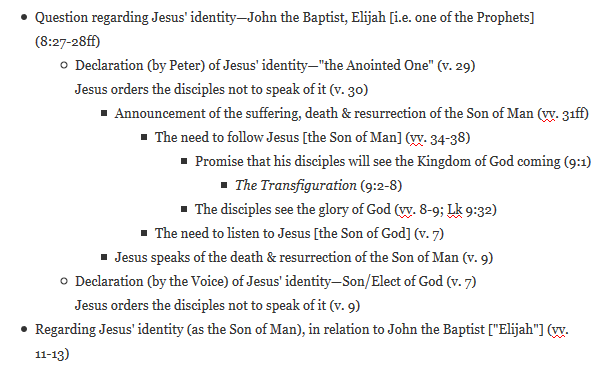
This has been a central theme in our study of the Baptism of Jesus in the Gospel tradition (discussed in detail in earlier studies). John the Baptist, of course, features prominently in the Baptism narrative, which opens with a description of John and his ministry, including the central association with the Isaiah 40:3ff prophecy (Mark 1:2-6 par). His presence in the Transfiguration scene is limited to the (separate?) tradition which appears at the end (Mk 9:11-13). It is generally assumed that Jesus is speaking of John in his reference to “Elijah” (compare Matt 11:14), drawing a parallel between the Baptist’s mistreatment/arrest and his own (i.e. of the “Son of Man”, 8:31; 9:12, etc). Note the framing structure surrounding 8:27-9:13, forming an inclusio:

The question regarding the identity of “the Anointed One” (i.e. Messiah) is given more prominence and clarity in Luke’s account of the Baptism (3:15; compare John 1:19-27).

2. The heavenly declaration corrects/clarifies the Messianic identification

This is implicit by the phenomena attending Jesus at his baptism, especially the descent of the Spirit upon him; Luke brings out the Messianic association more directly, in the subsequent scene at Nazareth, where Jesus identifies himself with the “Anointed” figure of Isa 61:1ff (Lk 4:17-21, cf. also 7:22). This makes clear in what sense Jesus is the Messiah (3:15) and the “one [who is] coming” (3:16; 7:19 par). The heavenly declaration at the Baptism adds to this by identifying Jesus as God’s Son (3:22 par), drawing upon the image of the king (i.e. the Davidic ruler) as “Son of God” (the variant reading in Lk quotes [the Messianic] Psalm 2:7). Similarly, prior to the Transfiguration, Peter declares Jesus to be “the Anointed One (Messiah) [of God]” (Mk 8:27 / Lk 9:2). The exchange between Peter and Jesus which follows (Mk 8:31-33 par, but omitted by Luke) suggests that Peter had in mind the Messianic figure-type of the Davidic ruler (cf. Parts 6–8 of the series “Yeshua the Anointed”), which would not have been compatible with the idea that Jesus must suffer and be put to death. It was Peter who also responds to the Transfiguration, without truly understanding the significance of what he sees (Mk 9:5-6 par, see below). Again, as at the Baptism, the heavenly voice declares Jesus to be the “Son of God”—but here, it would seem, not in the traditional Messianic sense, but hinting at something greater, tied to the death and resurrection of Jesus (Mk 8:31; 9:9, 12-13 par), which will lead to his exaltation to the right hand of God (Mk 14:62 par; Acts 2:32-35; 13:30-35 [citing Ps 2:7], etc).

3. The presence of Moses and Elijah—Jesus as a Prophet figure, specially chosen/anointed by God

That Jesus was seen as a Messiah of the Prophet figure-type seems clear enough from the Baptism scene, attested by different strands of tradition (Mk 1:7-8 par; Lk 3:15ff; 4:14-30; Jn 1:19-27), as well as the entirety of the period of his Galilean ministry, as it is recorded in the Synoptic narrative. Principally, he fulfilled the role of Spirit-endowed, miracle working Prophet (like Elijah), identified more specifically with the anointed herald of Isa 61:1ff. It has been popular to interpret the presence of Moses and Elijah in the Transfiguration scene as representing “the Law and the Prophets” which Jesus was fulfilling (Matt 5:17; Lk 16:16; 24:27, 44; Jn 1:45, etc). However, this does not seem to be correct. To begin with, Elijah is an odd choice to represent the Prophetic Scriptures (Isaiah would make more sense, cf. Jn 12:39-41). More importantly, Moses and Elijah each represent distinct Prophet-figures; and, in the original context of the Gospels, it is almost certain that Jesus, in the period of his Galilean ministry especially, was also seen as an Anointed Prophet. I would suggest that in the Transfiguration scene the significance of Moses and Elijah is two-fold:

    1. It identifies Jesus as a Messianic Prophet (like Moses and Elijah), marking the conclusion of his Galilean ministry in which this role was primarily being fulfilled, but also pointing to his eschatological role inaugurating a new era for the people of God. It is no coincidence that, in Jewish tradition by the time of Jesus, Moses and Elijah were seen as prophetic figures who would appear at the end-time, as a fulfillment of specific prophecies (Deut 18:15-20; Mal 3:1ff; 4:5-6).
    2. Moses and Elijah each experienced a theophany—manifestation of God’s presence—upon the holy mountain (Sinai/Horeb); similarly, Jesus (and his disciples) on this mountain experience the appearance of the cloud of God’s presence and the divine Voice from heaven. This theophany, in relation to Jesus, is of a different sort, reflecting his divine Sonship. For more on this, see below.
4. The Transfiguration scene prefigures the coming Passion—the death and resurrection of the Son of Man

This is clear from the position of the Transfiguration scene in the Synoptic narrative, as noted above. It marks the conclusion of Jesus’ Galilean ministry, and the beginning of his Passion—the upcoming journey to Jerusalem (Mk 10; Lk 9:51–18:34), and the events which would take place there. Luke’s account of the Transfiguration brings out this aspect more clearly (see below).

The Transfiguration in Luke 9:28-36

Note the following details or characteristics of the Lukan version, and its place in the specific context of the Gospel narrative:

    • Luke has given special prominence to Jesus’ role as a Messianic, Spirit-endowed Prophet in the period of his Galilean ministry (4:14–9:22); this gives greater significance to the presence of Moses and Elijah in the Transfiguration scene (see above).
    • Peter’s confession in Luke (9:20) reads “You are the Anointed One of God” which is parallel to the unique form of the heavenly declaration in the Lukan version of the Transfiguration “This is the Son of God, the Elect/Chosen (One)“. On this, see below.
    • Luke’s version of the Transfiguration brings out more clearly the association with Moses and the Exodus—especially the traditions regarding the cloud of God’s presence (9:29, 31a, 34-35, cf. Exod 13:21-22; 19:9, 16ff; 24:15-16ff; 33:9-10; 34:5; 40:34-38). In particular, note v. 34 which alludes to Moses entering the cloud (Exod 24:18, cf. also 33:9).
    • This also enhances the idea of the Transfiguration as a theophany, in which Jesus and his disciples experience the presence of God and see his glory/splendor (vv. 31-32, see also v. 27). In this context, the altered appearance of Jesus (v. 29) probably is meant to echo the tradition regarding Moses changed appearance in Exod 34:29-35.
    • Luke ties the Transfiguration more directly to the coming death and resurrection of Jesus in Jerusalem, in two respects: (1) by the detail he includes in v. 31, using the word éxodos (“way out”, i.e. “exodus”), and (2) its relation to the journey to Jerusalem which follows, and which features so prominently in the structure of the Lukan narrative (9:51-18:34)

The textual question in Luke 9:35 and John 1:34

Finally, mention should be made again of the textual variants for the heavenly declaration in Luke 9:35. The majority text (including A C* W 33, etc) follows the version in Mark (9:7):

“This is my Son, the (one who is) loved”
hoútós estin ho huiós mou ho agap¢tós

However, many of the earliest/best manuscripts (Ë45,75 a B L, etc) instead read:

“This is my Son, the (one) gathered out [i.e. elect/chosen]”
hoútós estin ho huiós mou ho eklelegménos

Most commentators prefer this as the original reading, considering it much more likely, considering scribal tendencies, that the passage would be harmonized with Mark than the other way around. As it happens, there is a similar textual variant related to the declaration of Jesus’ identity at the Baptism, in John 1:34. The Baptist’s statement, in the vast majority of manuscripts and witnesses (including Ë66) reads—

“…this is the Son of God”
hoútós estin ho huiós toú theoú

which, of course, is quite similar to the voice at the Transfiguration in the Synoptic tradition (cf. also the Matthean version of the Baptism, Matt 3:17). However, in a number of witnesses (Ë5,106vid a* b e ff2* etc) the reading is:

“…this is the (One) gathered out [i.e. Elect/Chosen] of [i.e. by] God”
hoútós estin ho eklektós toú theoú

A few MSS have the longer (conflate) reading “…the elect/chosen Son of God”, which is surprisingly close to the heavenly voice in the Lukan version of the Transfiguration (according to many of the best MSS, cf. above). The adjective eklektós is closely related to the participle eklelegménos (both from the verb eklégomai, “gather out of/from”), and has essentially the same meaning (“selected, elect, chosen”, etc). The adjective normally refers (in the plural) to believers (as the elect/chosen ones) in the New Testament, but the singular is used of Jesus (also as a title) in Luke 23:35; a few manuscripts likewise read the adjective, instead of the participle, in Lk 9:35. In the two Lukan references, and in Jn 1:34 v.l., the title “Elect/Chosen One” almost certainly must be understood in a Messianic context. The Lukan usage in 9:35, if original, suggests a parallel with the adjective agap¢tós (“[the one] loved [i.e by God]”)—the one chosen by God is loved by God, and vice versa. It also indicates that the title “Son of God” should not be understood here in terms of later orthodox Christology (nor even the developed Christology of the Fourth Gospel). The immediate narrative context of the Gospel has rather a different, two-fold emphasis:

    • Jesus is the Son of God in a Messianic sense, according to the interpretation of Psalm 2:7 etc in Jewish and early Christian tradition (cf. Lk 1:32, 35, etc), and
    • The declaration points to the death, resurrection (and exaltation) of Jesus, by which he is considered to be God’s Son (and Anointed One) in a very special sense (Acts 13:33, etc). The Johannine idea of Jesus’ Sonship—i.e. as the pre-existent, eternal Son of the Father, plays little (if any) role in the Synoptic narrative, and represents a somewhat later development in the Gospel tradition

As an interesting side note, the title “Elect/Chosen One of God” in Aramaic (ah*l*a$ ryj!B=, b®µîr °§l¹h¹°) is found in a text from Qumran (4Q534). It survives only as a fragmentary piece, so it is nearly impossible to determine the precise context, but it appears to be related in some way to the ancient Enoch traditions, most familiar as expressed in the work known as 1 Enoch. Column 1 lines 10-11 reads:

“in that [i.e. because] he is the chosen (one) of God, his being born [i.e. his birth] and the spirit [jwr] of his life-breath [<vn] {…} his thinking/reckoning [pl. i.e., plans] will be to the distant age (to come) [i.e. for ever]…”

It may perhaps be debated to what extent the title “Elect/Chosen One” is Messianic (compare Isa 42:1; Ps 89:3; 106:23); however, in the so-called Similitudes of Enoch (chap. 37-71), often dated roughly to the time of Jesus (early-mid 1st cent. A.D.), we find a heavenly figure (much like Jesus) who is variously given the titles “Son of Man”, “Anointed One” and “Elect/Chosen One”. All three of these titles appear together, in the context of the Transfiguration scene, in Luke 9 (vv. 20, 22, 26, 35 v.l., 44).

Next week, we will turn our critical lens to one of the most intriguing pieces of the “Triple Tradition” —the episode of the anointing of Jesus by a woman. Perhaps no other Gospel episode has been preserved in such a conflicting and controversial manner. In addition to the marked differences between the Synoptic version in Mark-Matthew and that in Luke, the separately preserved Johannine version contains details shared by both (along with its own distinctive features). Our studies on this fascinating tradition will prepare the way for the upcoming Holy Week.

Saturday Series: Mark 9:2-13 par

Mark 9:2-13; Matt 17:1-13; Luke 9:28-36

This week, our illustrative studies on the Gospel tradition (specifically the Synoptic Gospels) will turn to the Transfiguration scene. This episode is especially interesting in the way that it parallels the earlier Baptism scene. The parallelism raises significant critical questions regarding the underlying historical tradition. The points to be discussed here in this study are:

    1. The position and significance of the Baptism and Transfiguration in the structure of the Synoptic narrative as a whole
    2. Similar/parallel details between the Baptism and Transfiguration, and how they may differ or function in context, and
    3. The similarity of the heavenly declaration regarding Jesus’ identity

Study of the Transfiguration is much simpler than that of the Baptism, since it seems to be attested only in the primary Synoptic narrative, with no parallel in the Johannine tradition, and relatively little specific adaptation by the Gospel writer. Continuing with the approach I have been using in this series, the core (Synoptic) narrative is represented by the Gospel of Mark, in line with the fundamental critical hypothesis that Matthew and Luke each made use of Mark. There is always the possibility that all three Gospels are drawing (independently) upon a common “Synoptic” tradition; however, it must be affirmed that, if Matthew and Luke did not use Mark, they must have used a source very similar in content and structure.

In Mark, the Transfiguration occurs at 9:2-13, with the Synoptic parallels being Matt 17:1-13 and Lk 9:28-36. It does not seem to have been part of the so-called “Q” material (common to Matthew and Luke), nor is any such tradition recorded in the Gospel of John. Commentators debate whether Matthew and Luke may have inherited traditions apart from the core Synoptic narrative (so-called “M” and “L” material), which they included, or whether they have simply adapted the basic narrative. A reference to the Transfiguration is also found in 2 Peter 1:17-18, but it is not clear whether the immediate source of this is historical memory (Peter, taking the text at face value), the Synoptic narrative, or an independent tradition.

1. The Structure of the Synoptic Narrative

The Synoptic narrative, as shared by all three Gospels, is divided into two main portions: (1) The Galilean ministry of Jesus, and (2) The time in Judea (Jerusalem). The Galilean period begins with the Baptism, and concludes, we may say, with Peter’s confession of Jesus. In the Gospel of Mark, this covers the span of 1:2–8:30; Matthew and Luke generally follow this same outline (Luke being closer to the Markan order), but both Gospels “fill out” the narrative with additional sayings and episodes, i.e. the so-called “Q” material, along with other traditions (“M” and “L” content).

The Transfiguration is the major episode which begins the second half of the Gospel, much as the Baptism begins the first half; it follows the first (of three) announcements by Jesus of his upcoming Passion (Mk 8:31ff), and precedes the journey to Jerusalem. This journey is scarcely mentioned in Mark, serving as the setting for chapter 10 (vv. 1, 32, 46), but in Luke it is developed considerably as a prominent feature of the narrative, covering the entire collection of material from 9:51 to 18:34 (almost ten full chapters). Virtually all of Jesus’ activity in Judea is set in the second half of the narrative, giving the impression that the only journey Jesus made to Jerusalem was the one just before his death. By contrast, the Gospel of John records multiple visits to Jerusalem, coinciding with the major religious festivals, an arrangement which, in certain respects, one must assume more accurately reflects the historical situation.

2. Similarities between the Baptism and Transfiguration scenes

I begin with the narrative as represented by Mark, noting differences in the other Gospels along the way. There are a number basic elements which can be pointed to as parallels between the two scenes:

    • The isolated locale—the Judean desert/wilderness (1:4ff) vs. a high mountain [in Galilee?] (9:2)
    • Visual/visionary phenomena appear, in relation to Jesus (1:10; 9:2b-4)
    • These phenomena involve brightness/whiteness (1:10 [the dove image]; 9:3)
    • The phenomena may be said to have a Prophetic and/or Messianic context— “anointing” by the Spirit (Isa 61:1ff, see Lk 4:14-20, etc) and the presence of Moses/Elijah with Jesus
    • A cloud/presence, i.e. from heaven (1:10-11; 9:7)
    • The declaration by a heavenly voice (cf. the next section below)
    • A reference to John the Baptist as “Elijah” (1:2, 6; 9:12-13)
    • The scenes are connected (in different ways) with Peter, James and John as disciples of Jesus (1:16-20; 9:2ff)
    • Following closely after, Jesus works a healing (exorcism) miracle (1:21-28; 9:14-29)

In Matthew’s version, the parallel is made more precise by the fact that the heavenly declaration in both scenes is identical (Matt 3:17; 17:5b). The primary difference between the Baptism and Transfiguration scenes is twofold: (a) the presence of Jesus’ disciples and their response to the visionary experience, and (b) the Transfiguration more fully reflects a theophany (divine appearance/manifestation), such as recorded in the Old Testament. Luke, in particular, has brought out more clearly a connection with the theophany at Sinai (9:30-31, 34; compare Exod 19). Luke also adds the detail of Jesus being engaged in prayer in both scenes (3:21; 9:29a), which creates another parallel unique to that Gospel.

3. The declaration of the Heavenly Voice

In both scenes there is a heavenly Voice (i.e., that of God). Note the similarity of wording (in Mark):

“and there came to be [egéneto] a voice out of [ek] the heavens” (1:11a)
“and there came to be [egéneto] a voice out of [ek] the cloud (9:7a)

The main difference is one of closeness and intensity—the voice at the Transfiguration comes from a theophanous cloud [nefél¢], indicating the presence of God (see the Exodus traditions, Exod 13:21-22; 19:9, 16ff; 24:15-16ff; 33:9-10; 34:5; 40:34-38), which overshadowed [literally, cast shade upon] Jesus and his disciples. Luke’s account enhances the detail of the cloud (Lk 9:34), drawing upon the image of Moses entering the cloud, to the place where God was present (Exod 24:18, cf. also 33:9). The declaration of the heavenly voice in both scenes is very similar; in Mark it is:

    • “You are my Son, the (one who is) loved—in you I have good regard [i.e., think well, think good of]” (1:11b)
      su eí ho huiós mou ho agap¢tós en soi eudók¢sa
    • “This is my Son, the (one who is) loved” (9:7b)
      hoútos estin ho huiós mou ho agap¢tós

Matthew, insofar as he is following the Synoptic/Markan version, seems to have combined the two statements, so that they read as identical in both episodes:

    • “This is my Son, the (one who is) loved—in whom I have good regard” (3:17; 17:5)
      hoútos estin ho huiós mou ho agap¢tós en hœ¡ eudók¢sa

The situation in Luke is a bit more complicated, as there are significant variant readings for the declaration in both scenes. For the baptism (3:22b):

    • The Majority reading—identical with that in Mark (cf. above)
    • The minority “Western” reading—a quotation of Psalm 2:7 LXX:
      “You are my Son—today I have caused you to be (born)”
      huiós mou eí su egœ¡ s¢¡meron gegénnhká se

On this textual variant, cf. my earlier discussion. For the transfiguration (9:35):

    • Reading of Ë45,75 a B L, etc:
      “This is my Son, the (one) gathered out [i.e. elect/chosen]”
      hoútós estin ho huiós mou ho eklelegménos
    • The majority reading (A C* W 33 et al): identical with that in Mark

Most critical commentators consider the first reading as more likely to be original, the latter being adapted/normalized to the Synoptic parallel in Mark/Matthew and the baptism scene. A few manuscripts read the related adjective eklektós instead of the participle eklelegménos (cf. Lk 23:35), but with essentially the same meaning. This textual question will be discussed in relation to an interpretation of the Transfiguration scene, especially as it has been developed in the Gospel of Luke.

Finally, to round out the comparison, we should mention the version of the heavenly declaration at the Transfiguration, from 2 Peter 1:17, which is similar to that in Matthew, but with a different formulation in Greek (giving priority to the reading of Ë72 B):

“This is my Son, the (one) loved (by) me—unto whom I have good regard”
ho huiós mou ho agap¢tós mou hou!tós estin eis hón eudók¢sa

All of these extensive parallels relate to the underlying historical tradition, and how that tradition was shaped and adapted within the Synoptic narrative. It cannot be coincidental that the period of Jesus’ Galilean ministry, according to this narrative, begins and ends with two similar scenes (Baptism and Transfiguration)—each containing the declaration of Jesus’ identity by a heavenly voice. Of fundamental importance to the narrative is how each of these scenes establishes the Messianic identity of Jesus—and that this identity (announced by the heavenly voice) informs the entire narrative.

With this structure and thematic framework in mind, let us now consider how the historical tradition (of the Transfiguration) was interpreted within the Synoptic narrative. We can see this based by a careful study of the Lukan version of the scene (9:28-36). For this, however, it will be necessary first to bring out several key points that relate to the wider Synoptic tradition. By doing so, we can gain a better sense of how the earliest Christians understood Jesus’ Messianic identity. This will be the focus of next week’s study.

January 19: John 1:34 (continued)

John 1:34, continued

In order to gain a better understanding of the declaration by John the Baptist in verse 34 (and the important text-critical question in the verse, cf. the previous note), it is necessary to examine the narrative context of vv. 19-51. As previously discussed, verses 29-34 make up one of four sections in the narrative, which are joined together using the literary device of setting the four episodes on four successive days. This may be outlined, again, as follows:

    • Day 1—The testimony of John the Baptist regarding his own identity (1:19-28)
    • Day 2—The testimony of John regarding the identity of Jesus (1:29-34)
    • Day 3—Disciples follow/encounter Jesus as the result of John’s witness (1:35-42)
    • Day 4—Disciples follow/encounter Jesus as the result of his (and other disciples’) witness (1:43-51)

The first “Day” involves the question of John the Baptist’s identity. He specifically denies any identification with three figures or titles— “the Anointed One” (i.e. Messiah), “Elijah”, and “the Prophet”. The last two relate to a Messianic Prophet figure-type, drawn from the Old Testament figures of Elijah and Moses (Deut 18:15-20); this subject is discussed further in the series “Yeshua the Anointed” (Part 3). It is not entirely clear whether “the Anointed One” refers to a Messiah generally, a Messianic Prophet, or the traditional Messianic ruler from the line of David; based on the overall context of vv. 29-51, the latter is more likely.

The second and third “Days” follow a similar pattern; each begin with John the Baptist’s identification of Jesus as “the Lamb of God” (vv. 29, 36). Each ends with a distinct declaration regarding Jesus’ identity. The declaration of the second day is that of verse 34; that of the third day again involves the title Messiah— “We have found the Messiah!” (v. 41), where the Hebrew word j^yv!m* is transliterated as Messi/a$ (before being translated, “Anointed One” [Xristo/$]).

This common Messianic theme, running through the narrative episodes, would perhaps suggest that the reading “Chosen/Elect One” is to be preferred, since this title (presumably derived from Isa 42:1) is more directly Messianic than is “Son of God”. This is certainly the case with its use in Lk 9:35 and 23:35, the only other occurrences in the New Testament where the title is applied to Jesus.

However, a careful examination of the fourth “Day” (vv. 43-51) points in the opposite direction. Here the declaration regarding Jesus’ identity, made by Nathanael (v. 49), is two-fold:

“You are the the Son of God, you are the King of Israel“

The thematic and narrative structure suggests that these two titles are parallel to those in the declarations of the 2nd and 3rd days:

    • “Son of God” = “<Chosen | Son> of God” (v. 34)
    • “King of Israel” = “Messiah” (v. 41)

The parallelism would tend to favor “Son” in v. 34, if only slightly. This, along with the overwhelming external manuscript evidence (in favor of “Son”), makes it the preferred reading. Still, the matter is far from decisive, and it is worth keeping the variant “Elect/Chosen One” well in mind whenever you read this passage. Consider how the two titles (and concepts) are closely intertwined in Luke’s version of the Transfiguration scene, in which the voice from Heaven declares (according to the best manuscripts):

“This is my Son, the Elect/Chosen One [o( e)klelegme/no$]…” (9:35)

The title “Elect/Chosen (One)” here takes the form of a substantive (perfect) participle of the verb e)kle/gomai (“gather out”), from which the adjective e)klekto/$ is derived. Literally, it would be translated “the (one) having been gathered out” (o( e)klelegme/no$), but it is essentially identical in meaning to o( e)klekto/$. The latter occurs as a title of Jesus, albeit delivered mockingly to him, in Lk 23:35, and is clearly used in a Messianic sense (“the Anointed [One], the Elect/Chosen [One] of God”). There can be no real doubt that the same significance is to be found in its usage in the Lukan Transfiguration scene.

The Transfiguration scene, of course, parallels the earlier Baptism scene in the Synoptic Gospels, in which the voice from Heaven makes a similar declaration (in Matthew they are identical). Now, the Gospel of John only narrates the Baptism indirectly (vv. 29-34), through the testimony of John the Baptist, who witnesses the visionary phenomena. His declaration is in the same climactic position as the Divine/Heavenly voice in the Synoptics:

Yet consider, too, a comparison with the variant reading from John—

    • “You are My Son…” / “This is My Son…”
    • “This is the Chosen One of God” (Jn 1:34 v.l.)

which matches the words of the heavenly voice in Lk 9:35:

“You are my Son, the Chosen One”

This declaration, in turn, is an echo of Isaiah 42:1, where God speaks of “My Servant [db#u#]…my Chosen (One) [ryj!B^]…”. In Greek, db#u# is translated by pai=$, which can also mean “child” — “my Child” is obviously close in meaning to “my Son“. At the same time, ryj!B^ is translated by  e)klekto/$, the same word used in Jn 1:34 v.l. (and related to that in Lk 9:35).

It may be helpful at this point to summarize three important aspects of the Johannine tradition in vv. 19-51:

    • The narrative, despite its adapation of the early Gospel tradition into the Johannine idiom, preserves authentic historical tradition. For more on this, cf. the articles dealing with Jn 1:19-51 in my earlier series “Jesus and the Gospel Tradition” (The Baptism of Jesus).
    • This early tradition specifically relates to the identity of Jesus as the “Anointed One” (Messiah), and particularly so in terms of the Messianic Prophet figure-type(s). It is the Anointed herald of the (Deutero-)Isaian oracles (e.g., 42:1ff; 61:1ff) that is most clearly in view, and is the figure with which Jesus was identified in the earliest strands of the Tradition. Cf. Parts 2 and 3 of the series “Yeshua the Anointed”.
    • Again, in the earliest tradition, the title “Son of God” was fundamentally Messianic in significance. Even though the Gospel of John clearly understands the title in terms of a pre-existence Christology, it still retains the older, traditional meaning as well.

None of this is sufficient to decide the text-critical question of which title— “Son of God” or “Elect/Chosen One of God” —was the original reading. Both titles are appropriate to the Messianic context of vv. 19-51, and, in a sense, can be seen as interchangeable (or, at least, complementary). As noted above, the overwhelming manuscript support, as well as the Johannine usage, favors the reading “Son of God” (o( ui(o\$ tou= qeou=), and I am inclined to adopt it, by a narrow margin. The Baptist’s declaration would then read:

“And I have seen and have witnessed that this (one) is the Son of God“

In so doing, John is the first to give witness to Jesus’ identity as God’s Son. In the context of the Gospel Prologue, this refers to his identity as the pre-existent Son; however, in the immediate context of the narrative (vv. 19-51), and in terms of the early Gospel tradition, the title is to be understood in a Messianic sense (i.e., “Anointed One” = “Elect/Chosen One”). Both aspects are fundamental to the Johannine theology, and must be taken into account when summarizing the Christological portrait in the Gospel. No better summary can be found than the confessional statement by Martha in 11:27:

“I have trusted that you are the Anointed (One), the Son of God…”

This confession holds roughly the same place in the Gospel of John as Peter’s confession does in the Synoptics (Mk 8:29 par). It also is close in form and sense to the Baptist’s declaration in 1:34, especially if we were to combine the two variant readings:

“I have seen…that this (one) is the Elect/Chosen (One), the Son of God”

An even more precise confessional formula is used by the author in his conclusion to the Gospel:

“I have written these (thing)s (so) that you would trust that Yeshua is the Anointed (One), the Son of God…” (20:31)

The uniqueness of the Johannine Gospel lies in the way that the earlier Gospel tradition, which understood the title “Son (of God)” primarily in a Messianic sense, has been adapted and developed to give a deeper theological (and Christological) meaning to the traditional manner of expression. Jesus is still the Anointed One, exalted by God the Father through his death and resurrection; but he is also something more: the incarnation of the pre-existent Logos, who was, even in the very beginning, the Son resting together with God the Father in the bond of His eternal love and power.

June 2: Mark 1:9-11 par

Mark 1:9-11 par

Along with the saying of the Baptist (cf. the previous note), there is a related early Gospel tradition involving the Spirit of God (and/or the “holy Spirit”)—the famous narrative of the Baptism of Jesus. I have discussed the entire episode of Jesus’ Baptism at great length in the series “Jesus and the Gospel Tradition”; here, in this note, the discussion will be limited to how this narrative tradition reflects a development of the earlier lines of Old Testament and Jewish tradition, regarding the Spirit of God.

The core Synoptic narrative is best represented by the Markan version (1:9-11), with the descent of the Spirit described in verse 10:

“And straightaway, stepping up out of the water, he saw the heavens being split (open) and the Spirit as a dove stepping down unto him”

The Matthean version (3:16) is expanded, offering more precise (if blander) detail:

“And (hav)ing been dunked, Yeshua straightaway stepped up from the water, and see!—the heavens were opened (up), and he saw [the] Spirit of God stepping down, as if a dove, [and] coming upon him”

The Lukan version (3:21-22), by contrast, is briefer, but embedded within a complex syntactical structure that is difficult to translate; the relevant portion reads:

“…(an) opening (up) of the heaven and (the) stepping down of the holy Spirit, in bodily appearance as a dove, upon him”

The main details are consistent across the Synoptic tradition, and are also shared by the Johannine version (1:32ff), presented as an indirect narration by the Baptist:

“I have looked at the Spirit stepping down as a dove out of heaven, and it remained upon him”

The three key details, found in all versions, are: (1) the Spirit “stepping down” out of heaven, (2) the form/appearance as a dove, and (3) its coming “upon” Jesus. Let us briefly consider each of these.

1. “stepping down” (vb katabai/nw) out of heaven

This signifies the heavenly origin of the Spirit, implying that it comes from God in heaven. The Markan and Johannine versions specifically state that it came “out of” (e)k) heaven, while Matthew has “from” (a)po/) heaven. The dramatic opening up of the heavens (i.e. the skies) in Mark/Matthew makes clear the idea that the Spirit comes down onto the earth. The use of the verb katabai/nw (lit. “step down”, i.e. come down) has special significance in the Gospel of John, which uses both katabai/nw and the related a)nabai/nw (“step up”) in a uniquely theological (and Christological) sense. The “descent” of the Spirit marks the beginning of this descent/ascent motif—that is, the incarnation and exaltation of Jesus, respectively—in the Gospel (cf. 1:51, etc).

2. The Dove

Commentators continue to debate the significance of the dove appearance of the Spirit in this episode. Many ideas and associations have been suggested, but three seem particularly relevant:

    • The Creation account, which depicts the spirit (or breath) of God “hovering/fluttering” like a bird (Gen 1:2, cf. the earlier note); other Old Testament passages similarly describe God’s presence in creation (that is, among His people) using bird-imagery (e.g., Deut 32:11-13).
    • The fundamental meaning of both pneu=ma in Greek and j^Wr in Hebrew is that of wind, i.e. something blowing; this makes for a natural association with the image of a bird in flight. Similarly, the image of a bird in the expanse of the skies (or heavens) connotes freedom, exaltation, purity, and so forth. Many religious traditions worldwide depict the life-breath (i.e. soul, spirit) of a person as a bird.
    • The whiteness that characterizes many doves, and is traditional of the dove, serves as a natural symbol for the holiness (i.e. purity) of God’s Spirit.

Only the last of these relates specifically to a dove, and is particularly important to the baptism setting, with its emphasis on cleansing. It is worth remembering that the literal expression in Hebrew is, most commonly, “spirit of [God’s] holiness” (vd#q) j^Wr), rather than “holy spirit”; that is, the emphasis is squarely on holiness and purity as a divine characteristic.

3. Coming “upon” Jesus

The Markan version uses the preposition ei)$, which is somewhat ambiguous; literally, it could mean “into”, but most commentators would render it here as “unto”. In Old Testament tradition, this could be comparable to the idea of God’s Spirit coming (or “rushing”) to a person, using the preposition la#. By contrast, Matthew and Luke (along with the Johannine version) use the preposition e)pi/ (“upon”), corresponding to the Hebrew lu*. There are even more Old Testament passages which express the idea of God’s Spirit being (or coming) upon a person—cf. Num 11:17ff; Judg 3:10; 14:6; 1 Sam 10:6, 10; 11:6, etc (discussed in recent notes). Moreover, this was the basic idiom that was developed in later Prophetic tradition, involving the image of the Spirit being “poured out” upon a person (cf. the discussion below).

The Significance of the Baptism Scene

This needs to be considered from several vantage points:

    • The Baptism scene in the context of the early Gospel narrative
    • The language and imagery in the scene itself, especially the detail of the “voice” from heaven
    • How the scene was understood, in context, by the Gospel writers
The Context of the early Gospel narrative

This involves: (a) the baptism rite in the setting of John’s ministry, and (b) the saying of the Baptist regarding “the one coming”. Both of these aspects were discussed in the previous note, where I pointed out the significant parallels with the water-ritual performed for entrants into the Qumran Community. The ritual symbolized the person’s “spirit” being cleansed (and made holy) by God’s own Spirit; moreover, this cleansing was preparatory for the purification that would take place at the end-time. The Gospel narrative clearly indicates that the baptism rite, as performed by John, was for the cleansing of sin, and that it similarly anticipated the end-time Judgment of God—when the righteous/faithful ones would be purified, while the wicked would be consumed.

What is distinctive about the Baptist’s message in this regard, is the localization of this end-time cleansing with the Messianic figure of “the one coming”. On the derivation of this expression from the tradition in Malachi 3:1, as interpreted in a Messianic sense, cf. the previous note, along with my supplemental note in the series “Yeshua the Anointed”. Implicit in the early Gospel narrative is that Jesus, with his initial appearance at his baptism, is being identified with this Messianic figure. The point is not made explicit at all in the simpler Synoptic narrative of Mark, but the connection is evinced, in different ways, by the other Gospel writers. For example, the inclusion of the Infancy narratives in Matthew and Luke establishes the Messianic identity of Jesus even prior to the Baptism, a point reinforced by Matthew’s citation of Isa 9:1-2 in 4:12-16. Luke sets the Baptism episode in the context of questions regarding whether John the Baptist might be the Anointed One (3:15ff); this is presented even more prominently in the Johannine Gospel (1:19-27).

The pouring of water in the baptism-rite also suggests the idea of anointing—indeed, both motifs were associated with the Spirit of God in Old Testament Tradition, as discussed in prior notes. In the ancient kingship traditions—going back to the earlier leadership of Moses, Joshua, and the Judges—the Spirit of God came upon the ruler, in a manner similar to prophetic inspiration (cf. 1 Sam 10:6, 11; 11:6, etc). In the case of Saul and David, there is a close connection between the coming of God’s Spirit and the anointing ritual (1 Sam 16:13f); even after the principle of Spirit-inspired charismatic leadership waned, the presence of the Spirit was still tied to the king’s anointing in the (Judean) royal theology. There is less evidence for the anointing of prophets; however, the expression “anointed one” (j^yv!m*, i.e. messiah) could be applied to prophets, as well as kings and priests. As mentioned in the prior note, the early Gospel tradition, during the period of his ministry, seems to have identified Jesus as a Messianic prophet rather than the Davidic ruler figure-type. Cf. Parts 2 and 3 of the series “Yeshua the Anointed”.

The Voice from Heaven

The heavenly voice in the Baptism narrative primarily represents a theophany—that is, the manifestation of God among human beings (His people, or their chosen representative[s]). The main Old Testament example, of course, is the Sinai theophany, when the people heard the voice of God speaking (Exod 19:19ff; 20:18-21; Deut 4:10-12). In the Gospels, this theophanic voice relates specifically to key moments during Jesus’ ministry, demonstrating God’s relationship to him specifically. In addition to the Baptism and Transfiguration episodes (Mk 9:7 par; Lk 9:35 [v.l.]), there is a comparable occurrence in the Gospel of John (12:27-32). The heavenly voice at the Transfiguration essentially repeats the voice at the Baptism (in Matthew’s version they are virtually identical), and the parallel episodes serve to divide the structure of the Synoptic narrative:

    • The Baptism marks the beginning of Jesus’ (Galilean) ministry
    • The Transfiguration marks the end of that ministry, and the beginning of the events leading up to his Passion

The declaration made by the heavenly voice, and its precise significance, continue to be debated. There does seem to be an allusion to Psalm 2:7, which would strongly indicate an identification of Jesus as the Anointed One (Messiah) of the Davidic ruler type—i.e., future/end-time king from the line of David. In some manuscripts of Luke 3:22, the voice actually quotes Psalm 2:7, an indication, at the very least, that early Christians had made the connection. However, it seems more likely that the primary allusion is to Isaiah 42:1, which clearly references the Spirit coming upon God’s chosen one (cf. my earlier note on the passage). The Greek word translating db#u# (“servant”) is pai=$, which literally means “child”, and so could easily be interpreted in the specific sense of “son” (ui(o/$). The Servant of the deutero-Isaian poems is best understood as an Anointed leader patterned after Moses, who will lead Israel in their return from exile (a ‘new Exodus’). He thus serves as a Messianic prophet-figure, parallel to the end-time Prophet patterned after Elijah (Mal 3:1; 4:5-6, cf. the previous note). In the Transfiguration scene, Jesus is associated with both Moses and Elijah.

The Meaning of the Scene in the Gospels

Given the explicit notice that the purpose of John’s baptizing was for repentance and forgiveness of sin, it is interesting that the Gospel writers do not give any evidence of the theological implications of this in relation to Jesus. At the level of the historical tradition, the idea of Jesus’ sinlessness was not yet an issue, and, by the time the Gospels were written, the Baptism-tradition was so well-fixed that the writers were no longer free to comment on the matter. Only at Matt 3:14-15 is there any indication of an apologetic concern, expressed more in terms of Jesus’ apparent submission to John, than on his need for repentance.

Whatever the specific reasons or circumstances for Jesus being baptized, at the historical level, the Gospels quite clearly demonstrate that the scene is not about cleansing and purification, but of consecration and empowerment. The best parallel from Old Testament tradition is that of prophetic inspiration—that is, the Spirit of God coming upon the chosen/gifted spokesperson (ayb!n`) who will serve as God’s representative. The idea of Jesus as a Davidic (royal) Messiah is largely foreign to the first half of the Synoptic narrative (the Galilean ministry period); only with the journey to Jerusalem, and the events leading to his Passion, does the Davidic association come more clearly into view. Two aspects of Jesus’ ministry are most directly relevant to the ayb!n` (prophet) role:

    • Preaching and teaching—i.e. Spirit-inspired utterance, and
    • Healing miracles, demonstrating his power and authority over spirits of disease, etc.

Of the Old Testament Prophets, the working of miracles is associated most commonly with Elijah (and his successor Elisha), and also, to a lesser extent, with Moses. Inspired preaching is common to many of the prophets, though the specific idea of teaching, with its connection to the Torah, would be most closely related to Moses. Thus Jesus could well be viewed as an Anointed (Messianic) prophet patterned after both Moses and Elijah (cf. the Transfiguration scene). However, direct allusions in the Gospels are slight, and it is only in the Gospel of Luke that we find a clearer portrait of the kind of Anointed figure Jesus understood himself to be. This will be discussed in the next daily note.

March 24: Luke 9:28-36

Within the Synoptic tradition, the Transfiguration episode is part of a series that divides the Gospel narrative between the time of Jesus’ ministry (in Galilee) and his ministry in Jerusalem prior to his death. Using Mark as the reference point, I would outline these as follows:

    • Peter’s Confession of Jesus as “the Anointed” [Christ/Messiah] (Mk 8:27-30)
      —Instruction not to reveal it to anyone (v. 30)
    • Jesus’ first prediction of the Passion (Mk 8:31ff) [Son of Man saying]
    • Five sayings on discipleship (following Jesus), in an eschatological context (Mk 8:34-9:1) [Son of Man saying, v. 38]
    • The Transfiguration (Mk 9:2-10), with reference by Jesus to his death/resurrection
      —Instruction not to reveal it to anyone (v. 9f)
    • Question and teaching regarding the (eschatological) coming of Elijah (Mk 9:11-13) [Son of Man saying, v. 12]
    • A healing miracle (Mk 9:14-28)
    • Jesus’ second prediction of the Passion (Mk 9:30-32) [Son of Man saying]
    • Question involving Jesus’ disciples and their position (Mk 9:33-34), leading to teaching regarding true discipleship and humility, including an illustration involving children (Mk 9:35-37ff, 10:13-16)
    • Request of a man [‘Rich Young Ruler’], culminates in a question of whether he will follow Jesus (Mk 10:17-22ff), followed by additional teaching for his disciples (10:23-31)
    • Jesus’ third prediction of the Passion (Mk 10:32-34) [Son of Man saying]
    • Question involving Jesus’ disciples and their position (Mk 10:35-40), leading to teaching regarding true discipleship and humility (Mk 10:41-45) [Son of Man saying, v. 45]
    • Request of a man [a blind beggar], culminates in his following Jesus (Mk 10:46-52)

We can see how the three Passion predictions punctuate and portion out fairly evenly the material in these chapters (Mark 9-10). In particular there is a loose, but clear pattern to the second and third sections. All three Synoptic Gospels share this basic outline, though, as I have already pointed out, Luke has greatly expanded the portion corresponding to Jesus’ journey to Jerusalem, ‘omitting’ Mk 9:42-10:12 par, and ‘adding’ all of Luke 9:51-18:14. Referring to the above outline, Luke 9:18-50 corresponds to Mark 8:27-9:41, and even more decisively marks division between the earlier (Galilean) ministry (Lk 3:23-9:17) and the journey to Jerusalem (9:51ff). This is important for an understanding of the Lukan version of the Transfiguration scene, which I will explore briefly here.

The Transfiguration (Luke 9:28-36)

For students and readers of the Gospels, this episode should be quite familiar, at least in its basic outline. It is common to all three Synoptics (Mk 9:2-10; Matt 17:1-9), and Luke follows the common account, though adding a few significant and important details which are worth examining [for an additional reference to the Transfiguration, cf. 2 Peter 1:16-18].

  • Luke introduces the account with “and it came to be, eight days after these sayings…” (v. 28), instead of “and after six days…” (in Mk 9:2; Matt 17:10). The author appears to be intentionally dating the episode differently, the “eight days” perhaps being an allusion to the feast of Booths (Sukkoth, cf. Lev 23:36). This seems likely, given the greater emphasis on motifs related to Moses and the Exodus in Luke’s version of the scene. The Sukkoth traditions (and the symbolism surrounding them) provide the context for Peter’s desire to build three tents (v. 33).
  • It is stated that Jesus went up into the mountain for the purpose of praying (v. 28b). The inclusion of this detail may be a foreshadowing of the garden scene in the Passion narrative (Lk 22:39-41ff par); prayer is also given particular emphasis throughout Luke-Acts.
  • The description of Jesus is modified slightly—Matthew and Luke (independently?) including a reference to the transformation of Jesus’ face (v. 29; Matt 17:2). Matthew states that his face “radiated (light)” [e&lamyen]; in Luke’s version “the visible-shape [ei@do$] of his face (became) other/different [e%tero$]”. It is not unlikely that an allusion to the transformation of Moses’ face (Ex 34:29) is involved here.
  • In the description of Jesus’ encounter with Moses and Elijah, Luke adds two details (v. 31):
    (a) they were made visible before one’s eyes [vb. o)pta/nomai] in splendor [e)n do/ca]—this may be an intentional echo of the Son of Man saying in v. 26 (note also v. 27 par)
    (b) they spoke with Jesus regarding “his way out [e&codo$, éxodos] which he was about to fulfill in Jerusalem”—probably referring both to Jesus’ death (cf. 2 Pet 1:15) and resurrection/exaltation, which clearly connects with the surrounding (Son of Man) Passion predictions of vv. 22, 44. Use of the word e&codo$ is almost certainly an allusion to Moses and the Exodus (cf. Exod 19:1; Num 33:38; Heb 11:22).
  • Matthew and Luke each (independently?) give greater emphasis to the cloud that appears (vv. 34-35; Matt 17:5), perhaps as an allusion to the theophany at Sinai (Exod 19:16ff). This is far more likely in the Lukan version, which adds the detail that “they [i.e. the three disciples] went into the cloud“, just as Moses entered into the cloud on Sinai (Exod 24:18).
  • In Mark/Matthew (Mk 9:7; Matt 17:5), the (Divine) voice from the cloud echoes the voice at Jesus’ baptism (in Matthew they are identical)—”this is my (be)loved Son…” However, in Luke (v. 35, according to the best manuscript evidence [Ë45, 75 a B L etc]) the declaration reads “this is my Son, the One gathered out [o( e)klelegme/no$] (i.e. the Chosen One)”. Luke’s use of verb e)kle/gomai is distinctive (11 of the 22 NT occurrences are in Luke-Acts); especially noteworthy is the use of the related (verbal) adjective e)klekto/$ (“chosen”) in Luke 23:35—there o( e)klekto/$ (“the Chosen [One]”) is set parallel with o( xristo/$ (“the Anointed [One]”), being applied (mockingly by the onlookers) to Jesus while he is on the cross.

These details shape and color Luke’s version of the scene in two principal ways:

  1. Greater emphasis is given to motifs associated with Moses and the Exodus, and especially with the theophany (manifestation of God) at Sinai. This, in turn, creates a closer connection between Jesus and Moses, as well as with Elijah, who also experienced a theophany at Mt. ‘Sinai’ (Horeb) [cf. 1 Kings 19:11ff].
  2. The transfiguration is brought more clearly into the context of Jesus’ (impending) death and resurrection, as found in the surrounding Passion predictions and Son of Man sayings. Lk 9:31, in particular, effectively sets the stage for Jesus great journey to Jerusalem (to begin in v. 51ff).
This image has an empty alt attribute; its file name is SonOfMan_header-small-1.png

March 19: Mark 9:2-10 par

Mark 9:2-10 (par Matt 17:1-9; Luke 9:28-36 )

The Transfiguration—from the Latin translation (transfiguratus) of the Greek (metamorfw/qh, “he was trans-formed”) in Mark 9:2—is one of the more famous episodes in the Gospels. It is part of the “Triple Tradition” (i.e., occurs in all three Synoptic Gospels: Mark 9:2-10; Matthew 17:1-9; Luke 9:28-36), and is to be found at the same point in the narrative framework: following Peter’s Confession, and in between the two pronouncements by Jesus of his upcoming betrayal and death (Mark 8:31; 9:31-32 par.); however only in the Lukan account, is it connected directly with the Passion (Luke 9:31, but see also the question concerning Elijah, Mark 9:11-13 par).

Still, the entire episode remains enigmatic; it has been, and continues to be, interpreted any number of ways. Particularly curious are the presence of Moses and Elijah (Peter apparently recognizes them without any explanation), “speaking with” (sullalou=nte$) Jesus (only Luke mentions their discussion, see below). The two Old Testament figures are commonly thought to represent the Law and the Prophets, with Jesus in the middle as a kind of fulfillment of the Scriptures. However, in the original context of the Gospels—and at the historical level—I think it is more likely that Moses and Elijah both represent prophetic figures. Jesus as a Prophet (or as the eschatological, coming Prophet) was an important concept during the time of his own ministry and in the earliest Christian period. That there was widespread (‘messianic’) expectation of an eschatological Prophet is confirmed by numerous passages in intertestamental Jewish literature (1 Maccabees 14:41, CD 6), the Qumran scrolls (1QS 9, 4Q175 [Testimonia], etc), and the New Testament (see esp. John 1:21, 25; [4:19, 25]; 6:14; 7:40; Acts 3:22-23; 7:37). There were key Old Testament passages in this regard—(1) Deuteronomy 18:15ff (cf. Exodus 20:21 in the Samaritan Pentateuch), which speaks of a “prophet like Moses” who is to come; and (2) Malachi 3:1; 4:5 [MT 3:22], where a Messenger preceding the coming of the great Day of the Lord is mentioned, along with Elijah (cf. Sirach 48:10; Sibylline Oracles 2:187-189; Mark 9:11-13 par; Matthew 11:4; Luke 1:17; 9:8; John 1:21, 25; [Rev 11:1-13]). One might also mention a third prophetic paradigm from the Old Testament: the “Servant of the Lord” from the book of Isaiah (esp. Isa 61, which Jesus specifically applies to himself [Luke 4:17-21]); a text from Qumran (4Q521) describes an Elijah-like Messianic figure in language drawn from Isa 61 and Psalm 146. (For more on this subject, cf. especially Parts 2 and 3 of the series “Yeshua the Anointed”)

Of course, the climax of the Transfiguration scene is the Divine Voice (Mark 9:7; Matthew 17:5; Luke 9:35), speaking out of the cloud. It seems to come in response to Peter’s desire to build three “tents” (in imitation of the Sukkot, Feast of Booths); after the Voice has spoken, the cloud, along with Moses and Elijah, has vanished. I would like to examine briefly this verse, from two vantage points: one, text-critical, and the other, source-critical (or historical-critical).

1. Text-Critical: Luke 9:35 differs notably from the parallel text in Matthew and Mark—instead of the articular adjective o( a)gaphto/$ (“[the one] loved”), it reads the articular (passive) participle o( e)klelegme/no$ (“[the one] chosen”). This is almost certainly the original reading, found in Ë45, 75 a B L C (579) 892 1241 pc, and in a range of Latin, Syriac (syrs, hmg) and Coptic manuscripts. In numerous MSS it was harmonized to the text of Mark (A C* W f13 33 ª et al) or Matthew (C3 D Y pc), but not the other way around; in a few MSS we also find the more common adjective e)klekto/$ used instead. By all accounts, the reading o( e)klelegme/no$ is more unusual (and difficult—lectio difficilior potior); it is hard to imagine how it could have come about if the reading common to Matthew/Mark were original, whereas a scribal tendency to harmonize with the “easier” reading in the other two Gospels is quite natural. Literally, e)kle/gw/e)kle/gomai should be translated “gather out [of/from]” (le/gw in its original, primary sense of “gather, collect”), and was used quite often in the LXX, normally translating the Hebrew rjb (“choose, chosen”); and, as such, often with real theological significance—’anointed’ kings and priests, David, the city of Jerusalem, the “Servant of the Lord”, etc., were all chosen by God. Jesus, then, as o( e)klelegme/no$, is “the one [being] gathered out” from all other beings. It is perhaps easy to see how such a title might make scribes and commentators in the early Church uncomfortable: the text could have been modified for doctrinal reasons, in order to avoid an “adoptionistic” view of Christ.  However, it would be dangerous to read later Christological concerns very far into Luke’s account: more vital to him, surely, are the Old Testament parallels: just like the people Israel, David, Jerusalem, and the Prophets, so Jesus was chosen by God.

2. Source-Critical: In studying any one of the Synoptic Gospels, it is always worth holding up the common passages for comparison, to look carefully at the differences between them. Here, for example, is the best text in each Gospel for the Divine Voice:

Mark 9:7:
ou(to/$ e)stin o( ui(o\$ mou o( a)gaphto/$
“This is my (be)loved son”
Matthew 17:5b:
ou(to/$ e)stin o( ui(o/$ mou o( a)gaphto/$, e)n w!| eu)do/khsa
“This is my (be)loved son, in whom I have good regard”
Luke 9:35:
ou(to/$ e)stin o( ui(o/$ mou o( e)klelegme/no$
“This is my son the (one I have) gathered out [i.e. chosen]”
or, “This is my son the Chosen (One)”

In each Gospel, the voice concludes, a)kou/ete au)tou= (Lk. reverses the two words), “hear him!” The question of the text of Luke 9:35 was examined above. But what of the relationship between the three Gospels here? The common critical theory—that Matthew and Luke each made use of Mark as a written source—encounters difficulties in the Transfiguration scene, as both Evangelists (Luke, in particular) use very different language in places and include numerous details not found in Mark’s account. This means, at the very least, that Matthew and Luke are drawing from other traditions (or their own inspired creativity), in telling the story. Luke, especially, seems to apply an extra layer of symbolism, drawn from the Old Testament, at key points in the narrative (on this again, see below). In Mark (and Matthew), the Divine Voice speaks much as it did at the climax of Jesus’ baptism, and Matthew may be intentionally drawing a closer connection (in Matthew the two pronouncements are identical). Is it possible to determine the text at the historical level? One might view Mark’s version as “original”, to which the other Evangelists have added details. From a traditional-conservative position, one may be tempted to combine all three, in which case the Voice would have said something like: “This is my (be)loved son, the Chosen one, in whom I have (good) pleasure”. However, there is really no basis for such a conflate reading, beyond a pious desire to avoid discrepancy. Instead, should we not consider that, at the level of the inspired received text, the Voice speaks all three ways?

Old Testament parallels in Luke:

In conclusion, I would like to note several details, unique to Luke’s account of the Transfiguration, which seem to be the result of specific Old Testament symbolism applied to the traditional text.

  1. Jesus’ Face (Luke 9:29):
    Instead of stating that Jesus metamorfw/qh (“was trans-formed”), Luke indicates that the ei@do$ [“sight” i.e., appearance] of his face [prosw/pon] was e%tero$ [“other, different”, i.e. altered]. Matthew also mentions Jesus’ face (one of several minor agreements between Matthew and Luke, against Mark); however, here, especially, a reference to the glorification (LXX dedo/castai) of Moses (Exodus 34:29-33) seems to be in mind. Luke also refers twice in this context to “splendor” [do/ca], once referring to the appearance of Moses and Elijah (v. 31). Also, as Moses speaks (LXX e)la/lhsen) to the (chosen) representatives of Israel (34:31), so he speaks with (sunela/loun) Jesus.
  2. The Conversation (Luke 9:31):
    Luke records something of the nature of the conversation Jesus has with Moses and Elijah, that they recounted [i.e. spoke of] th\n e&codon au)tou= h^n h&mellen plhrou=n e)n Ierousalh/m (“…his way out [i.e. departure], which he was about to [ful]fill in Jerusalem”). The Greek word e&codo$ (éxodos, lit. “way out [of/from]”) unmistakenly references the “Exodus” of the Israelites, under Moses, out of Egypt and into the Promised Land.
  3. The Cloud (Luke 9:34-35):
    All three Gospels mention the cloud (nefh/lh), and the Divine Voice issuing out of it, as well as the cloud overshadowing (e)piskia/zw) them; but only Luke mentions the unusual detail: e)fobh/qhsan de\ e)n tw=| ei)selqei=n au)tou\$ ei)$ th\n nefe/lhn, “and they were afraid in their coming into the cloud”—apparently the disciples (with Jesus) enter into the cloud. This would seem to be an echo of Exodus 19:20, where God calls Moses up onto the mountain to the “thick cloud” (LXX nefe/lh, v. 16) where God Himself is; see also 1 Corinthians 10:1-2, in reference to the “pillar of cloud”. The image of believers “entering into” the dark cloud of God’s Presence, proved to be a powerful symbol in Christian mystical tradition (cf. Gregory of Nyssa, Life of Moses II:162-169; Pseudo-Dionysius’ Mystical Theology §1ff; and many other references).

The archetypal imagery of the Transfiguration was particularly prominent in the mystical tradition of the Greek Church. Especially noteworthy is an episode in the Hesychast controversy of the 14th century. “Hesychasm” (from h(suxi/a, “quiet, stillness, silence”) was a characteristic term applied to mystic-ascetic monks and hermits in the Eastern Church, reflecting a life of contemplation and unceasing prayer [“prayer of the heart”], with the ultimate goal of union with God and qe/wsi$ (“deification”, i.e., man becoming like God, cf. John 1:12-13 and Athanasius’ famous axiom, On the Incarnation 54.3). Part of this mystical contemplation involved a special vision of the Divine “Light”—not the essence of God, but his “energy” (e)ne/rgeia)—an uncreated, “hypostatic” light, synonymous with the Glory of Christ (as manifested especially during the Transfiguration [traditionally on Mt. Tabor]), and sometimes referred to as the “Taboric light”. Famously, Barlaam of Calabria and Gregory of Akindynos opposed the possibility of such a transcendent vision, while the Hesychast position was powerfully defended by Gregory Palamas in his Triads.

Jesus and the Gospel Tradition: The Baptism, Pt 4 (Lk 9:28-36 etc)

This note follows up on the prior discussion, regarding the Transfiguration scene (Mk 9:2-13 par), and its parallels with the Baptism of Jesus. Here I will be focusing on the meaning and significance of the episode, especially as presented in the Gospel of Luke. This will include a comparison of the variant readings in Lk 9:35, compared with those in John 1:34.

Interpretation of the Transfiguration scene

As I mentioned in the prior note, the Transfiguration begins the second half of the Synoptic narrative, much as the Baptism scene begins the first. The Baptism of Jesus marks the start of his ministry (in Galilee), while the Transfiguration marks the beginning of his Passion (i.e. in Judea/Jerusalem) and precedes his journey to Jerusalem. The parallels between the Baptism and Transfiguration (cf. the list in previous note) have to be understood in terms of these differing contexts within the narrative. Consider the following points:

1. The connection with John the Baptist and questions regarding the identity of the Messiah

This has been a central theme in our study of the Baptism of Jesus in the Gospel tradition (discussed in detail in the prior notes). John the Baptist, of course, features prominently in the Baptism narrative, which opens with a description of John and his ministry, including the central association with the Isaiah 40:3ff prophecy (Mark 1:2-6 par). His presence in the Transfiguration scene is limited to the (separate?) tradition which appears at the end (Mk 9:11-13). It is generally assumed that Jesus is speaking of John in his reference to “Elijah” (cp. Matt 11:14), drawing a parallel between the Baptist’s mistreatment/arrest and his own (i.e. of the “Son of Man”, 8:31; 9:12, etc). Note the framing structure surrounding 8:27-9:13, forming an inclusio:

The question regarding the identity of “the Anointed One” (i.e. Messiah) is given more prominence and clarity in Luke’s account of the Baptism (3:15; cp. John 1:19-27).

2. The heavenly declaration corrects/clarifies the Messianic identification

This is implicit by the phenomena attending Jesus at his baptism, especially the descent of the Spirit upon him; Luke brings out the Messianic association more directly, in the subsequent scene at Nazareth, where Jesus identifies himself with the “Anointed” figure of Isa 61:1ff (Lk 4:17-21, cf. also 7:22). This makes clear in what sense Jesus is the Messiah (3:15) and the “one [who is] coming” (3:16; 7:19 par). The heavenly declaration at the Baptism adds to this by identifying Jesus as God’s Son (3:22 par), drawing upon the image of the king (i.e. the Davidic ruler) as “Son of God” (the variant reading in Lk quotes [the Messianic] Psalm 2:7). Similarly, prior to the Transfiguration, Peter declares Jesus to be “the Anointed One (Messiah) [of God]” (Mk 8:27 / Lk 9:2). The exchange between Peter and Jesus which follows (Mk 8:31-33 par, but omitted by Luke) suggests that Peter had in mind the Messianic figure-type of the Davidic ruler (cf. Parts 6–8 of the series “Yeshua the Anointed”), which would not have been compatible with the idea that Jesus must suffer and be put to death. It was Peter who also responds to the Transfiguration, without truly understanding the significance of what he sees (Mk 9:5-6 par, cf. below). Again, as at the Baptism, the heavenly voice declares Jesus to be the “Son of God”—but here, it would seem, not in the traditional Messianic sense, but hinting at something greater, tied to the death and resurrection of Jesus (Mk 8:31; 9:9, 12-13 par), which will lead to his exaltation to the right hand of God (Mk 14:62 par; Acts 2:32-35; 13:30-35 [citing Ps 2:7], etc).

3. The presence of Moses and Elijah—Jesus as a Prophet figure, specially chosen/anointed by God

That Jesus was seen as a Messiah of the Prophet figure-type seems clear enough from the Baptism scene, attested by different strands of tradition (Mk 1:7-8 par; Lk 3:15ff; 4:14-30; Jn 1:19-27), as well as the entirety of the period of his Galilean ministry, as recorded in the Synoptic narrative. Principally, he fulfilled the role of Spirit-endowed, miracle working Prophet (like Elijah), identified more specifically with the anointed herald of Isa 61:1ff. It has been popular to interpret the presence of Moses and Elijah in the Transfiguration scene as representing “the Law and the Prophets” which Jesus was fulfilling (Matt 5:17; Lk 16:16; 24:27, 44; Jn 1:45, etc). However, this does not seem to be correct. To begin with, Elijah is an odd choice to represent the Prophetic Scriptures (Isaiah would make more sense, cf. Jn 12:39-41). More importantly, Moses and Elijah each represent distinct Prophet-figures; and, in the original context of the Gospels, it is almost certain that Jesus, in the period of his Galilean ministry especially, was also seen as an Anointed Prophet. I would suggest that in the Transfiguration scene the significance of Moses and Elijah is two-fold:

    1. It identifies Jesus as a Messianic Prophet (like Moses and Elijah), marking the conclusion of his Galilean ministry in which this role was primarily being fulfilled, but also pointing to his eschatological role inaugurating a new era for the people of God. It is no coincidence that, in Jewish tradition by the time of Jesus, Moses and Elijah were seen as prophetic figures who would appear at the end-time, as a fulfillment of specific prophecies (Deut 18:15-20; Mal 3:1ff; 4:5-6).
    2. Moses and Elijah each experienced a theophany—manifestation of God’s presence—upon the holy mountain (Sinai/Horeb); similarly, Jesus (and his disciples) on this mountain experience the appearance of the cloud of God’s presence and the divine Voice from heaven. This theophany, in relation to Jesus, is of a different sort, reflecting his divine Sonship. For more on this, cf. below.
4. The Transfiguration scene prefigures the coming Passion—the death and resurrection of the Son of Man

This is clear from the position of the Transfiguration scene in the Synoptic narrative, as noted above. It marks the conclusion of Jesus’ Galilean ministry, and the beginning of his Passion—the upcoming journey to Jerusalem (Mk 10; Lk 9:51–18:34), and the events which would take place there. Luke’s account of the Transfiguration brings out this aspect more clearly (cf. below).

The Transfiguration in Luke 9:28-36

Note the following details or characteristics of the Lukan version, and its place in the specific context of the Gospel narrative:

  • Luke has given special prominence to Jesus’ role as a Messianic, Spirit-endowed Prophet in the period of his Galilean ministry (4:14–9:22); this gives greater significance to the presence of Moses and Elijah in the Transfiguration scene (see above).
  • Peter’s confession in Luke (9:20) reads “You are the Anointed One of God” which is parallel to the unique form of the heavenly declaration in the Lukan version of the Transfiguration “This is the Son of God, the Elect/Chosen (One)“. On this, see below.
  • Luke’s version of the Transfiguration brings out more clearly the association with Moses and the Exodus—especially the traditions regarding the cloud of God’s presence (9:29, 31a, 34-35, cf. Exod 13:21-22; 19:9, 16ff; 24:15-16ff; 33:9-10; 34:5; 40:34-38). In particular, note v. 34 which alludes to Moses entering the cloud (Exod 24:18, cf. also 33:9).
  • This also enhances the idea of the Transfiguration as a theophany, in which Jesus and his disciples experience the presence of God and see his glory/splendor (vv. 31-32, cf. also v. 27). In this context, the altered appearance of Jesus (v. 29) probably is meant to echo the tradition regarding Moses changed appearance in Exod 34:29-35.
  • Luke ties the Transfiguration more directly to the coming death and resurrection of Jesus in Jerusalem, in two respects:
    (1) by the detail he includes in v. 31, using the word e&codo$ (exodos, “way out”, i.e. “exodus”), and
    (2) its relation to the journey to Jerusalem which follows, and which features so prominently in the structure of the Lukan narrative (9:51-18:34)

The textual question in Luke 9:35 and John 1:34

Finally, mention should be made again of the textual variants for the heavenly declaration in Luke 9:35. The majority text (including A C* W 33, etc) follows the version in Mark (9:7):

“This is my Son, the (one who is) loved”
ou!to/$ e)stin o( ui(o/$ mou o( a)gaphto/$

However, many of the earliest/best manuscripts (Ë45,75 a B L, etc) instead read:

“This is my Son, the (one) gathered out [i.e. elect/chosen]”
ou!to/$ e)stin o( ui(o/$ mou o( e)klelegme/no$

Most commentators prefer this as the original reading, considering it much more likely, considering scribal tendencies, that the passage would be harmonized with Mark than the other way around. As it happens, there is a similar textual variant related to the declaration of Jesus’ identity at the Baptism, in John 1:34. The Baptist’s statement, in the vast majority of manuscripts and witnesses (including Ë66) reads—

“…this is the Son of God”
ou!to/$ e)stin o( ui(o\$ tou= qeou=

which, of course, is quite similar to the voice at the Transfiguration in the Synoptic tradition (cf. also the Matthean version of the Baptism, Matt 3:17). However, in a number of witnesses (Ë5,106vid a* b e ff2* etc) the reading is:

“…this is the (One) gathered out [i.e. Elect/Chosen] of [i.e. by] God”
ou!to/$ e)stin o( e)klekto/$ tou= qeou=

A few MSS have the longer (conflate) reading “…the elect/chosen Son of God”, which is surprisingly close to the heavenly voice in the Lukan version of the Transfiguration (according to many of the best MSS, cf. above). The adjective e)klekto/$ is closely related to the participle e)klelegme/no$ (both from the verb e)kle/gomai, “gather out of/from”), and has essentially the same meaning (“selected, elect, chosen”, etc). The adjective normally refers (in the plural) to believers (as the elect/chosen ones) in the New Testament, but the singular is used of Jesus (also as a title) in Luke 23:35; a few manuscripts likewise read the adjective, instead of the participle, in Lk 9:35. In the two Lukan references, and in Jn 1:34 v.l., the title “Elect/Chosen One” almost certainly must be understood in a Messianic context. The Lukan usage in 9:35, if original, suggests a parallel with the adjective a)gaphto/$ (“[the one] loved [i.e by God]”)—the one chosen by God is loved by God, and vice versa. It also indicates that the title “Son of God” should not be understood here in terms of later orthodox Christology (nor even the developed Christology of the Fourth Gospel). The immediate narrative context of the Gospel has rather a different, two-fold emphasis:

    • Jesus is the Son of God in a Messianic sense, according to the interpretation of Psalm 2:7 etc in Jewish and early Christian tradition (cf. Lk 1:32, 35, etc), and
    • The declaration points to the death, resurrection (and exaltation) of Jesus, by which he is considered to be God’s Son (and Anointed One) in a very special sense (Acts 13:33, etc). The Johannine idea of Jesus’ Sonship—i.e. as the pre-existent, eternal Son of the Father, plays little (if any) role in the Synoptic narrative, and represents a somewhat later development in the Gospel tradition.
The title “Elect/Chosen One of God” (ah*l*a$ ryj!B=) is found in an Aramaic text from Qumran (4Q534). It survives only as a fragmentary piece, so it is nearly impossible to determine the precise context, but it appears to be related in some way to the ancient Enoch traditions, most familiar as expressed in the work known as 1 Enoch. Column 1 lines 10-11 reads: “in that [i.e. because] he is the chosen (one) of God, his being born [i.e. his birth] and the spirit [jwr] of his life-breath [<vn] {…} his thinking/reckoning [pl. i.e., plans] will be to the distant age (to come) [i.e. for ever]…”. It may perhaps be debated to what extent the title “Elect/Chosen One” is Messianic (cp. Isa 42:1; Ps 89:3; 106:23); however, in the so-called Similitudes of Enoch (chap. 37-71), often dated roughly to the time of Jesus (early-mid 1st cent. A.D.), we find a heavenly figure (much like Jesus) who is variously given the titles “Son of Man”, “Anointed One” and “Elect/Chosen One”. All three of these titles appear together, in the context of the Transfiguration scene, in Luke 9 (vv. 20, 22, 26, 35 v.l., 44).

Jesus and the Gospel Tradition: The Baptism, Pt 4 (Mk 9:2-13 par)

Mark 9:2-13; Matt 17:1-13; Luke 9:28-36

Today’s note represents the final part of the series of notes on the Baptism of Jesus in the Gospel Tradition. In it we will examine the parallel of the Transfiguration scene in the Synoptic Gospels, in comparison with the Baptism. I have already touched upon this in the Introduction to the larger series “Jesus and the Gospel Tradition”. The points to be discussed in this note are:

    1. The position and significance of the Baptism and Transfiguration in the structure of the Synoptic narrative as a whole
    2. Similar/parallel details between the Baptism and Transfiguration, and how they may differ or function in context, and
    3. The similarity of the heavenly declaration regarding Jesus’ identity

Study of the Transfiguration is much simpler than that of the Baptism, since it seems to be attested only in the primary Synoptic narrative. In the method I have been using in this series, this core narrative is represented by the Gospel of Mark, following the fundamental critical hypothesis that Matthew and Luke made use of Mark. There is always the possibility that all three Gospels are drawing (independently) upon a common “Synoptic” tradition; however, it must be affirmed that, if Matthew and Luke did not use Mark, they must have used a source very similar in content and structure. In Mark, the Transfiguration occurs at 9:2-13, with the Synoptic parallels being Matt 17:1-13 and Lk 9:28-36. It does not seem to have been part of the so-called “Q” material (common to Matthew and Luke), nor is any such tradition recorded in the Gospel of John. Commentators debate whether Matthew and Luke may have inherited traditions apart from the core Synoptic narrative (so-called “M” and “L” material), which they included, or whether they have simply adapted the basic narrative. A reference to the Transfiguration is also found in 2 Peter 1:17-18, but it is not clear whether the immediate source of this is historical memory (Peter, taking the text at face value), the Synoptic narrative, or an independent tradition.

1. The Structure of the Synoptic Narrative

The Synoptic narrative, as shared by all three Gospels, is divided into two main portions: (1) The Galilean ministry of Jesus, and (2) The time in Judea (Jerusalem). The Galilean period begins with the Baptism, and concludes, we may say, with Peter’s confession of Jesus. In the Gospel of Mark, this covers the span of 1:2–8:30; Matthew and Luke generally follow this same outline (Luke being closer to the Markan order), but both Gospels “fill out” the narrative with additional sayings and episodes, i.e. the so-called “Q” material, along with other traditions (“M” and “L” content). The Transfiguration is the major episode which begins the second half of the Gospel, much as the Baptism begins the first half; it follows the first (of three) announcements by Jesus of his upcoming Passion (Mk 8:31ff), and precedes the journey to Jerusalem. This journey is scarcely mentioned in Mark, serving as the setting for chapter 10 (vv. 1, 32, 46), but in Luke it is developed considerably as a prominent feature of the narrative, covering the entire collection of material from 9:51 to 18:34 (almost ten full chapters). Virtually all of Jesus’ activity in Judea is set in the second half of the narrative, giving the impression that the only journey Jesus made to Jerusalem was the one just before his death. By contrast, the Gospel of John records multiple visits to Jerusalem, coinciding with the major religious festivals, an arrangement which, in certain respects, one must assume more accurately reflects the historical situation.

2. Similarities between the Baptism and Transfiguration scenes

I begin with the narrative as represented by Mark, noting differences in the other Gospels along the way. There are a number basic elements which can be pointed to as parallels between the two scenes:

    • The isolated locale—the Judean desert/wilderness (1:4ff) vs. a high mountain [in Galilee?] (9:2)
    • Visual/visionary phenomena appear, in relation to Jesus (1:10; 9:2b-4)
    • These phenomena involve brightness/whiteness (1:10 [the dove image]; 9:3); for more on this, cf. “Did You Know?” below.
    • The phenomena may be said to have a Prophetic and/or Messianic context—”anointing” by the Spirit (Isa 61:1ff, cf. Lk 4:14-20, etc) and the presence of Moses/Elijah with Jesus (more on this in the next note).
    • A cloud/presence, i.e. from heaven (1:10-11; 9:7)
    • The declaration by a heavenly voice (cf. the next section below)
    • A reference to John the Baptist as “Elijah” (1:2, 6; 9:12-13)
    • The scenes are connected (in different ways) with Peter, James and John as disciples of Jesus (1:16-20; 9:2ff)
    • Following closely after, Jesus works a healing (exorcism) miracle (1:21-28; 9:14-29)

In Matthew’s version, the parallel is made more precise by the fact that the heavenly declaration in both scenes is identical (Matt 3:17; 17:5b). The primary difference between the Baptism and Transfiguration scenes is twofold: (a) the presence of Jesus’ disciples and their response to the visionary experience, and (b) the Transfiguration more fully reflects a theophany (divine appearance/manifestation), such as recorded in the Old Testament. Luke, in particular, has brought out more clearly a connection with the theophany at Sinai (9:30-31, 34; cp. Exod 19). Luke also adds the detail of Jesus being engaged in prayer in both scenes (3:21; 9:29a), which creates another parallel unique to that Gospel.

3. The declaration of the Heavenly Voice

In both scenes there is a heavenly Voice (i.e., that of God). Note the similarity of wording (in Mark):

“and there came to be [e)ge/neto] a voice out of [e)k] the heavens” (1:11a)
“and there came to be [e)ge/neto] a voice out of [e)k] the cloud (9:7a)

The main difference is one of closeness and intensity—the voice at the Transfiguration comes from a theophanous cloud [nefe/lh], indicating the presence of God (cf. the Exodus traditions, Exod 13:21-22; 19:9, 16ff; 24:15-16ff; 33:9-10; 34:5; 40:34-38), which overshadowed [lit. cast shade upon] Jesus and his disciples. Luke’s account enhances the detail of the cloud (Lk 9:34), drawing upon the image of Moses entering the cloud, to the place where God was present (Exod 24:18, cf. also 33:9). The declaration of the heavenly voice in both scenes is very similar; in Mark it is:

    • “You are my Son, the (one who is) loved—in you I have good regard” (1:11b)
      su\ ei@ o( ui(o/$ mou o( a)gaphto/$ e)n soi\ eu)do/khsa
    • “This is my Son, the (one who is) loved” (9:7b)
      ou!to$ e)stin o( ui(o/$ mou o( a)gaphto/$

Matthew, insofar as he is following the Synoptic/Markan version, seems to have combined the two statements, so that they read as identical in both episodes:

    • “This is my Son, the (one who is) loved—in whom I have good regard” (3:17; 17:5)
      ou!to$ e)stin o( ui(o/$ mou o( a)gaphto/$ e)n w!| eu)do/khsa

The situation in Luke is a bit more complicated, as there are significant variant readings for the declaration in both scenes. For the baptism (3:22b):

    • The Majority reading—identical with that in Mark (cf. above)
    • The minority “Western” reading—a quotation of Psalm 2:7 LXX:
      “You are my Son—today I have caused you to be (born)”
      ui(o/$ mou ei@ su/ e)gw\ sh/meron gege/nnhka/ se

On this textual variant, cf. my earlier discussion. For the transfiguration (9:35):

    • Reading of Ë45,75 a B L, etc:
      “This is my Son, the (one) gathered out [i.e. elect/chosen]”
      ou!to/$ e)stin o( ui(o/$ mou o( e)klelegme/no$
    • The majority reading (A C* W 33 et al): identical with that in Mark

Most critical commentators consider the first reading as more likely to be original, the latter being adapted/normalized to the Synoptic parallel in Mark/Matthew and the baptism scene. A few manuscripts read the related adjective e)klekto/$ instead of the participle e)klelegme/no$ (cf. Lk 23:35), but with essentially the same meaning. This textual question will be discussed in related to an interpretation of the Transfiguration scene, especially as it has been developed in the Gospel of Luke, in the next note.

Finally, to round out the comparison, we should mention the version of the heavenly declaration at the Transfiguration, from 2 Peter 1:17, which is similar to that in Matthew, but with a different formulation in Greek (giving priority to the reading of Ë72 B):

“This is my Son, the (one) loved (by) me—unto whom I have good regard”
o( ui(o/$ mou o( a)gaphto/$ mou ou!to/$ e)stin ei)$ o^n eu)do/khsa

One detail which entered the Gospel tradition regarding the Baptism of Jesus was a great light/fire which flashed in the water around him at the moment of his baptism, presumably associated with the presence of the Spirit. This tradition was relatively widespread, appearing in the Old Latin MS (a) and one Vulgate MS between Matthew 3:15 and 16, with similar references in Justin Martyr (Dialogue with Trypho 88), and Epiphanius (Panarion 30.13.7). It came to be immensely popular and influential in the Syrian Church, being described in the Gospel Harmony (Diatessaron) of Tatian (cf. the Commentaries of Ephrem [IV. §5] and Ish‘odad of Merv). In the Syrian baptismal tradition, a principal motif was that Jesus’ glory, ‘left behind’ in the water, is picked up by the believer when he/she “puts on” Christ—restoring the “robe of glory” originally lost by Adam & Eve. On this, cf. my earlier Epiphany note.

Birth of the Son of God: Mark 1:9-11 par

The octave of Epiphany (Jan 13) in the West has traditionally commemorated the baptism of Jesus. It is in the context of Jesus’ baptism, as recorded in the Gospels, that we find some of the most intriguing and provocative references to the “birth of the Son of God” (the theme of these Christmas season notes).

Mark 1:9-11 par

The core narrative, in its clearest form, is that of Mark 1:9-11:

  • In verse 9 it is simply stated that Jesus was dunked/dipped (i.e. baptized) in the Jordan river by John
  • In verse 10, a three-fold sequence of ascent/descent is narrated:
    • Jesus stepping up [a)nabai/nwn] out of the water
      —he saw the heavens splitting open
    • The Spirit as a dove stepping down [katabai/nwn] (out of heaven) into/unto him
  • In verse 11—”there came to be a voice out of the heavens: “You are my Son the (be)loved, I think/consider good in you [i.e. I think well of you, I have delight in you]”

Both Matthew and Luke include tradition(s) regarding John’s ministry (Matt 3:7-12; Lk 3:7-20), which expands the narrative. Luke’s account of the baptism itself (Lk 3:21-22) is rather brief, shorter even than that in Mark, with several extra details:

  • It is mentioned that, while being baptized, Jesus was praying (lit. “speaking out toward [God]”)
  • Instead of Jesus seeing the heavens split open, it is simply stated that “the heaven opened up”
  • It is said that the Spirit descends in bodily appearance as a dove
  • (For the textual variants involving the words of the heavenly voice, cf. below)

Matthew includes a brief exchange between John and Jesus (Matt 3:13-15), but otherwise his account of the baptism is essentially a blend of the wording in Mark and Luke. The heavenly voice differs slightly—”This is my Son the (be)loved, in whom I think/consider good“—as a declaration rather than a personal address to Jesus.

The Gospel of John does not given an account of the baptism as such—it is narrated indirectly as part of John the Baptist’s testimony in Jn 1:29-34. The concluding declaration essentially takes the place of the heavenly voice in identifying Jesus as God’s Son:

“and I have seen and have given witness that this is the Son of God” (v. 34)

The Johannine account (Jn 1:29-34) is discussed in more detail in an upcoming note.

Textual variants in Luke 3:22 and John 1:34

There are two key variant readings which are worth noting:

  1. In John 1:34 (cf. above), instead of “the Son of God” (o( ui(o\$ tou= qeou=), several manuscripts and versions (Ë5vid a* b e ff2* syrs,c) read “the (one) gathered out [i.e. Chosen one] of God” (o( e)klekto\$ tou= qeou=) or the conflation “the Chosen Son of God” (a ff2c syrpal sah). The conflate reading is certainly secondary, but some scholars have argued that “the Elect/Chosen (One) of God” is original (cf. Ehrman, pp. 69-70). However, the external manuscript evidence, as well as Johannine usage, would seem to favor “the Son of God”.
  2. In Luke 3:22, a number of (Western) witnesses (D a b c d ff2 l r1) record the heavenly voice quoting Psalm 2:7—”You are my Son, today I have caused you to be (born)”—instead of the declaration “You are my (be)loved Son…” It is also attested by quite a few Church Fathers in the 2d-4th centuries, and a minority of textual critics accept it as original (cf. Ehrman, pp. 62-67). I have discussed the question in some detail in a previous note.

Psalm 2:7, of course, was one of the principal “Messianic” passages interpreted as referring to Jesus in the early Church, as I have noted on a number of occasions. The oldest application seems to have been to Jesus’ resurrection and exaltation to heaven—i.e., the moment when he is “born” as God’s Son—as indicated by its use in Acts 13:32-33ff [note the similar use of Ps 110:1 in Acts 2:24-36]; cf. also Rom 1:4 and Rom 8:22-23, 29; Col 1:18; Rev 1:5. Orthodox Christology would come to understand Psalm 2:7 (along with Ps 110:1) in terms of Jesus’ eternal, pre-existent Sonship, as association which is already reflected in Heb 1:5ff. Actually, Hebrews seems to combine both views—Jesus as pre-existent Son and “Son” as a result of the resurrection/exaltation—based on a careful study of chapter 1 and the way Ps 2:7 and 110:1 are cited in chapter 5 (cf. also Heb 2:8-13, etc). We find a similar combination in Paul’s writings (cf. Rom 1:3-4; Phil 2:6-11).

The Transfiguration Scene (Mark 9:7; Matt 17:5; Lk 9:35)

There is a clear parallel with the Baptism of Jesus in the Transfiguration scene narrated in the Synoptics (Mark 9:2-8 / Matt 17:1-8 / Lk 9:28-36) and referenced in 2 Peter 1:17-18. In Mark 9:7, a voice from Heaven declares:

“This is my Son the (be)loved, hear [i.e. listen to] him!”

The italicized portion is closest to the form of the divine voice in Matthew’s account of the Baptism (cf. above), also reflected in the Matthean Transfiguration scene (Matt 17:5):

“This is my Son the (be)loved, in whom I think/consider good—hear him!”

The words in italics are identical to that of the voice in Matt 3:17, which strongly suggests that an original 2nd person address there was modified to match the form in the Transfiguration scene (and vice versa!). The Lukan version (Lk 9:35) matches the shorter form in Mark, with one major difference (noted by italics):

“This is my Son the (One) gathered out [i.e. Elect/Chosen One], hear him!”

Instead of the adjective a)gaphto/$ (“[be]loved”), Luke has the participle e)klelegme/no$ (“having been gathered out”). While many manuscripts of Lk 9:35, naturally enough, read a)gaphto/$ (harmonizing with Matt/Mark), e)klelegme/no$ is most likely original (cf. TCGNT, p. 124, and Ehrman, pp. 67-68). The verb e)kle/gomai (“gather out”, i.e. “select, choose”) is relatively common in Luke-Acts (11 of the 22 NT occurrences), but is used elsewhere in the Synoptics only once (Mark 13:20).

Finally, we should mention the reference to the heavenly voice at the Transfiguration in 2 Peter 1:17, which, interestingly enough, matches the version in Matthew (specifically Matthew’s account of the Baptism):

“This is my Son, my (be)loved, in whom I think/consider good”
Differs from Matt 3:17 only in word order and inclusion of a second mou (“my”)

The Symbolism of Baptism

A number of key passages in the New Testament which refer either to believers as “sons/children” of God, or specifically as being “born”, are in a context relating in some way to baptism. Most of these have already been discussed in the previous Christmas season notes; I point out here again the most relevant passages:

  • John 3:3-8—especially significant is the expression “come to be (born) [gennhqh=|] out of water and (the) Spirit” (v. 5), parallel to “come to be (born) from above” in v. 3. Nearly all of the instances in the New Testament where water and Spirit are juxtaposed refer to baptism—either of Jesus or of believers (Mark 1:8-10 par; John 1:33; Acts 1:5; 8:39; 10:47; 11:16; the reference in 1 John 5:6-8 is more complicated).
  • Galatians 3:26-27ff—the idea of believers as the “sons of God” (v. 26, cf. also v. 29) is connected specifically with baptism in verse 27.
  • Romans 6:3-4ff; 8:12-23, 29—In Paul’s thought, baptism is symbolic of the believer’s identification with, and participation in, the death and resurrection of Christ (Rom 6:3-4ff; cf. also Col 2:12). As pointed out above, it is through his resurrection (and exaltation) that Jesus was understood as God’s “Son” in early Christian preaching (Acts 13:32-33; Rom 1:4, etc), and it is also the means by which believers are “born” as “sons/children” of God, at least in one strand of Christian tradition (cf. Rom 8:12-23, 29; 1 Pet 1:3; Heb 2:10, also 1 Cor 15:20, 23, 36-37, 42ff). On the specific expression “firstborn of the dead” (Col 1:18; Rev 1:5), cf. the prior article.

This concludes the series of Christmas season notes, devoted to the theme of “the Birth of the Son of God”. During this season, it is right and proper that we should celebrate both Jesus own birth—whether from Mary, in the Baptism, by his Resurrection, or eternally from God—as well as our own birth as sons and daughters, children of God, in union with Christ. It is to be hoped that this survey and study of all the New Testament passages related to this theme has been informative and enriching, in at least some small way, for those who have followed it.

References above marked “TCGNT” are to the Metzger/UBS Textual Commentary on the Greek New Testament (2nd edition, 1994/2002); those marked “Ehrman” are to Bart D. Ehrman, The Orthodox Corruption of Scripture: The Effect of Early Christological Controversies on the Text of the New Testament (Oxford: 1993).