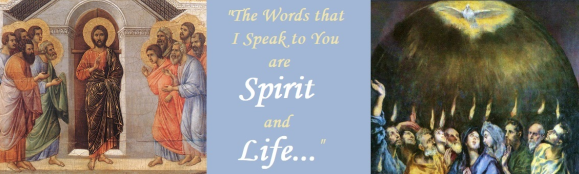
August 1: John 6:63 (1)

John 6:63

“The Spirit is the (thing) making (a)live, the flesh does not benefit anything! (and) the utterances which I have spoken to you are Spirit and are Life.”

This famous Spirit-reference in John 6:63 has featured as an important part of recent discussions in the series “Spiritualism and the New Testament” —cf. the article and supplemental note. I thought it worth giving more consideration to this provocative reference, looking at it particularly from a Christological standpoint. In the prior studies, the emphasis tended to be exegetical and interpretive. The mention of Jesus’ words (“utterances” r(h/mata) has naturally led commentators to explain v. 63 in relation to the words of Jesus in the Bread of Life Discourse (vv. 22-59)—that is, the statement in v. 63 further expounds the message and teaching(s) of the Discourse. Beyond this, the specific contrast between Spirit and flesh (sa/rc) has been understood, in various ways, as an explication of the use of sa/rc in vv. 51-58.

Commentators have not examined v. 63 much from the standpoint of the Johannine Christology;

A rare exception is the brief discussion by George Johnston, The Spirit-Paraclete in the Gospel of John, Society for New Testament Studies Monograph Series 12 (Cambridge: 1970), pp. 22-8.

however, in light of the immediate context of Jesus’ question in v. 62, a Christological examination would seem to be warranted.

Admittedly, the question in v. 62 has proven rather enigmatic, the precise thrust of it being difficult to determine—at least for readers and commentators today. Some of Jesus’ disciples themselves had complained about the difficulty of their master’s words: “This word [lo/go$] is hard—who is able to hear it?” (v. 60). While vv. 60ff may represent an originally separate tradition, unrelated to the preceding Discourse, in the literary setting of the Gospel, it can only refer to Jesus’ teaching in vv. 22-59—and, most likely, to the specific words (and the eucharistic language) in vv. 51-58.

But the thrust of the Discourse is Christological. Specifically, Jesus identifies himself as the “bread having come down out of heaven” (v. 41, 51); in contrast to the manna sent by God (through the mediation of Moses), Jesus is the true (a)lhqino/$) bread from heaven (vv. 32-33, 38ff, 55, 58; cf. v. 31; Psalm 78:25; 105:40; Neh 9:15), and the living bread (vv. 35, 48ff, 51ff)—specifically in the sense that it is ‘bread’ which gives (eternal) life to those who ‘eat’ it (vv. 40, 47, 51, 54, 57-58). The implication is that Jesus has come down (vb katabai/nw) from heaven, having been sent from God the Father.

This further implies the pre-existence Christology of the Johannine Gospel—entailing Jesus’ identity as the eternal (and pre-existent) Son (and  Logos) of God. This Christology is expressed most clearly in the Prologue (1:1-18), and again in the chap. 17 Prayer-Discourse (vv. 1-5), but it can be seen throughout the entire Gospel, running as a thread through the Discourses. Earlier in the Discourses, this thematic motif of “coming down” (lit. “stepping down,” vb katabai/nw) was associated specifically with Jesus’ identity as the “Son of Man” (o( ui(o\$ tou= a)nqrw/pou). While the expression “Son of Man,” and Jesus’ use of it, is more common in the Synoptic Gospels, it occurs at a number of points of the Gospel of John as well, indicating that it was a significant part of the Johannine tradition (no less than the Synoptic).

The first Son of Man saying, also utilizing the verb katabai/nw (and its parallel, a)nabai/nw, “step up”) is the enigmatic vision-saying in 1:51. The next occurs in 3:13f, which is more directly relevant to the Bread of Life Discourse. It is worth citing vv. 12-15 together:

“If I told you (about) the (thing)s on earth, and you do not trust, how (then), if should tell you (about) the (thing)s above (the) heavens, will you trust? (For) indeed, no one has stepped up into heaven, if not the (one hav)ing stepped down out of heaven—the Son of Man. And, just as Moshe lifted high the snake in the desolate (land), so it is necessary (for) the Son of Man to be lifted high, (so) that every (one) trusting in him should hold (the) Life of the Age(s) [i.e., eternal life].”

The points of emphasis in these verses are particularly significant for a proper understanding of 6:61-63, in their Johannine literary and theological context. These will be discussed in the next daily note, in preparation for applying the points to the statement in 6:62.


Spiritualism and the New Testament: John: Jn 6:63

John 6:63

“The Spirit is the (thing) making (a)live, the flesh does not benefit anything! (and) the utterances which I have spoken to you are Spirit and are Life.”

In some ways, this provocative statement by Jesus captures the essence of Johannine spiritualism better than any other passage in the Gospel. Yet it is arguably the most difficult of the Spirit-passages to interpret. Much of the reason for this is the position of the saying in relation to the “Bread of Life” Discourse in chapter 6, and, in particular, the apparent eucharistic references in vv. 51-58.

Chapter 6 represents a more complex literary structure than the Discourses in chaps. 3-5. Like the discourse in chap. 5, the “Bread of Life” discourse in chap. 6 is related to an established Gospel tradition—a miracle-episode, in this case, the Miraculous Feeding episode (vv. 1-15), an historical tradition also found in the Synoptics (Mark 6:32-44 par); I discuss this episode in the series “Jesus and the Gospel Tradition”.

The Discourse proper begins at verse 22, with vv. 22-24 serving as the narrative introduction. There are three sections to the Discourse, each of which follows the Johannine discourse-pattern:

    • Principal saying by Jesus
    • Reaction/question by the audience
    • Exposition/explanation by Jesus

Here is my outline of the Discourse:

Section 1 (vv. 25-34)

    • Principal saying by Jesus—verse 27: “Do not work (for) the food th(at is) perishing, but (for) the food remaining into (the) life of the Age(s) [i.e. eternal life]…”
    • [Explanation by Jesus]—v. 29
    • Reaction/question by the people—vv. 28-31
    • Explanation by Jesus—vv. 32-33
    • Theme: transition from the Feeding Miracle (v. 26) to the Passover motif (i.e. the manna, “bread from heaven”, vv. 31-33)

Section 2 (vv. 35-50)

    • Saying by Jesus—verse 35: “I am [e)gw/ ei)mi] the Bread of Life—the one coming toward me (no) he will not (ever) hunger, and the one trusting into me (no) he will not ever thirst. …”
    • [Explanation by Jesus]—vv. 36-40
    • Reaction/question by the people—vv. 41-42
    • Explanation by Jesus—vv. 44-50
    • Theme: Eating Bread—Jesus as the “Bread of Life”, the Bread come down from Heaven

Section 3 (vv. 51-58)

    • Saying by Jesus—verse 51a (parallel to v. 35): “I am [e)gw/ ei)mi] the Living Bread stepping down [i.e. coming down] out of Heaven—if any one should eat out of this bread he will live into the Age (to Come)…”
    • [Explanation by Jesus]—v. 51b
    • Reaction/question by the people—v. 52
    • Explanation by Jesus—vv. 53-58
    • Theme: transition from Bread (of Life) to the Eucharist motifs (vv. 53-56ff)

Thematically, the “Bread of Life” discourse follows the Samaritan Woman discourse in chap. 4 (discussed in the previous article), with the expression “the bread of life” (o( a&rto$ th=$ zwh=$) parallel to “living water” (u%dwr zw=n). The expression in v. 51, “living bread” (o( a&rto$ o( zw=n), makes for an even more precise parallel. In chapter 4, Jesus gives (i.e. is the source of) the “living water”, while here in chap. 6, he himself is the “living bread”.

Working from the Miraculous Feeding, and the Passover setting of the miracle (v. 4), Jesus utilizes the motif of bread, drawing upon the Moses/Exodus tradition of the manna—the “bread from heaven”. In good homiletic style, Jesus works from a Scripture reference (v. 31; Exod 16:4, 15, cf. also Psalm 78:24), giving to it a unique theological (and Christological) interpretation. At the historical level, it is possible that the Exodus reference may be following the Synagogue (v. 59) Scripture readings (sedarim) for the Passover season (cf. Brown, pp. 277-80).

The bread motif runs through all three sections of the Discourse; and we can see the expository development at work, moving from the Scriptural motif (“bread out of heaven”) to the Johannine theological expression (“living bread”):

    • “bread out of heaven” (vv. 31-34)—Jesus identifies himself with this bread, since he is the one who came from heaven (v. 38; 3:13, 31ff), that is, from God—hence the parallel expression “bread of God” (v. 33)
    • “bread of life” (vv. 35, 48)—as the “bread from heaven” (v. 41), sent by God to give life to the world (vv. 32-33, 40; cf. 3:15-16, etc), he is rightly identified further as the bread of life (zwh/, i.e. eternal life)
    • “living bread” (vv. 51, 58)—as the “bread of life,” one can also speak of Jesus according to the Johannine theological idiom as “living” (zw=n) bread, parallel to the expression “living water” (4:10-11; 7:38), as noted above.

It is possible to trace this expository development in theological/Christological terms:

    • “bread out of heaven” —Jesus is the Son sent from heaven by God the Father
    • “bread of life” —he is the source of the Divine/eternal life, which he received from the Father, and gives (in turn) to believers
    • “living bread” —referring more properly to the eternal life which he possesses (as the Son), sharing it with the Father (v. 57); as such, this expression alludes more definitely to the presence of the Spirit.

One is to receive the living bread by “eating” it, just as one “drinks” the living water that Jesus gives. Interestingly, in the third section, the idiom of eating is expanded to eating and drinking, even though the idea of drinking does not fit the bread motif. It is just here that the ‘eucharistic’ aspect of the imagery comes into view, as is clear from the initial wording in verse 51:

“I am the living bread, (hav)ing stepped [i.e. come] down out of heaven; if any(one) should eat this bread, he shall live into the Age—and, indeed, the bread which I shall give is my flesh, (given) over the life of the world.”

Jesus expounds this statement in vv. 53-56, following the reaction by the people in v. 52; in particular the central declaration of v. 51 is expounded—first negatively, then positively:

    • “if any(one) should eat this bread, he shall live into the Age”
    • “if you should not eat the flesh of the Son of Man and drink his blood, you do not hold life in yourselves” (v. 53)
    • “the (one) eating my flesh and drinking my blood holds (the) life of the Age [i.e. eternal life]” (v. 54)

Clearly, “bread” is explained as Jesus’ “flesh” and “blood”, which one must eat and drink (v. 55). The apparent eucharistic language in vv. 53-54 (Mk 14:22-24 par) is further expounded in the Johannine theological idiom, in verse 56:

“the (one) eating my flesh and drinking my blood remains [me/nei] in me, and I in him”

The statement that follows in verse 57, often neglected in discussions on this passage, is vital for a proper understanding of vv. 51-58 in context; again the wording follows the Johannine mode of theological expression:

“Just as the living [zw=n] Father sent me forth, and I live [zw=] through the Father, (so) also the (one) eating me, that (one) also shall live [zh/sei] through me.”

The verb za/w (“[to] live”) is used three times, and the specific forms have theological significance, in terms of expressing the chain of relation between Father, Son, and believer(s):

    • zw=n (“living”)—present participle, as an attribute of God (the Father), referring to the Divine/eternal life which He possesses, and by which He is the ultimate source of life.
    • zw= (“I live”)—present indicative (first person), expressing the active reality of the life which Jesus (the Son) receives from the Father
    • zh/sei (“he shall life”)—future indicative (third person), referring to the life which the believer receives from the Son, which includes the promise of future eternal life.

Based on the earlier statements in 3:34-35, we can identify this Divine/eternal life with the Spirit. As we saw, the “living water” that Jesus gives to the believer is also identified with the Spirit, and it is fair to assume that the same is true for the “living bread” here in 6:51ff. We find confirmation of this line of interpretation in the section that immediately follows (vv. 60-71) the end of the Discourse proper (in v. 59).

In verse 60, we finally hear the disciples’ reaction to the Discourse (especially vv. 51-58):

“This word [lo/go$] is hard—who is able to hear it?”

To what, precisely, does “this word” refer? In terms of the Discourse as a whole, as it has come down to us, we can discern three levels to the reference:

    1. The principal saying, presented with variation in each section of the Discourse, by which Jesus identifies himself as the “bread from heaven” (vv. 32-33, 35 and 48, 51)
    2. The idea, as developed by Jesus, that one must “eat” him (v. 50); according to some commentators, in the original form of the Gospel, verse 60 would have immediately followed v. 50, with vv. 51-58 representing a subsequent addition
    3. The specific (eucharistic) idea in vv. 51-58 that one must eat and drink Jesus’ flesh and blood in order to have life.

The disciples naturally find all of this difficult to understand (and accept). This reaction reflects the regular discourse-feature of misunderstanding by Jesus’ hearers. The implication seems to be that the disciples are reacting in a manner similar to that of the other people (in v. 52), whereby they understand Jesus to be speaking at the ordinary, material level, referring to his actual (physical) flesh and blood. As we saw in both the Nicodemus and Samaritan Woman discourses, this is basic to the failure of Jesus’ hearers to understand the true meaning of his words. For he is not speaking on the material level—i.e., of ordinary flesh and blood, etc—but on the spiritual level. Just as he was not speaking of an ordinary physical birth in chapter 3, nor of ordinary water in chap. 4, so here in chap. 6 he is speaking neither of ordinary bread nor of his physical flesh and blood.

Responding to the disciples’ frustration, Jesus asks them simply: “Does this trip you up?” (v. 61), and follows this with another question: “Then (what) if you should look (and behold) the Son of Man stepping up (back to) where he was (at) the first?” (v. 62). Commentators continue to debate the force of the Son of Man saying in v. 62; the main significance, however, surely is to the divine/heavenly origin of Jesus (the Son). The saying forms both a promise and a challenge to his disciples—they must confront the truth regarding Jesus’ identity as the Son of God come to earth from heaven. Moreover, it is only after Jesus’ death, resurrection, and return to the Father, that the disciples will be able to receive the Spirit. Their understanding will remain incomplete until the Spirit dwells within them.

In the previous study, we saw how “drinking” the living water Jesus gives essentially means trusting in him. The same is true regarding the idea of “eating” the living bread Jesus gives. However, there are two additional components to the imagery here which broaden and deepen the theological significance of the eating/drinking idiom. First, Jesus does not only give the living bread—he is the bread (v. 51). This essential predication specifies that trust in Jesus means trust in his identity (who he is), as the Son come from the Father in heaven. Second, by eating this ‘bread’, we are eating and drinking Jesus’ flesh and blood, which is symbolic (eucharistic) language signifying the sacrificial death of Jesus. Thus, trust in Jesus also entails, fundamentally, belief in the atoning and life-giving power of his death.

This brings us to the saying in verse 63, where Jesus makes clear that he is not talking about eating ordinary physical flesh (nor drinking actual blood)—these things take place in a spiritual way, at the level of the Spirit. Moreover, Jesus declares that the words (lit. utterances, r(h/mata) of his discourse “are spirit and are life”. As the living Word (lo/go$) of God, who possesses the eternal Life and Spirit from God the Father, the words which Jesus (the Son) speaks are God’s own. And, since God is Spirit (4:24), His words are also Spirit, and must be received (and understood) in a spiritual way, through the Spirit; and, since God’s words have life-giving power, so also do Jesus’ words. This is certainly true of the words given by Jesus here in vv. 51-58.

What, then, of the eucharistic language in vv. 51-58? Is the Gospel writer (to say nothing of Jesus as the speaker) referring to the ritual of the Lord’s supper? And, if so, how does this relate to the rest of the Bread of Life discourse, and to the Spirit-saying of Jesus here in v. 63? If the essence and significance of the words are spiritual, if the concrete physical aspect (“flesh”) of the idea expressed in vv. 51-58 is not of any use, then how should the eucharistic language be understood?

Some commentators (e.g., Brown, pp. 299-300) would claim that the term “flesh” (sa/rc) here in v. 63 has a fundamentally different meaning than it does in vv. 51ff; and, as such, Jesus’ statement does not refer to the same eucharistic emphasis of vv. 51-58. For many Christians, this is the only way that the apparent eucharistic focus in vv. 51-58 can be maintained within the context of the Discourse. After all, how can Jesus say that a person needs to eat his flesh (in the ritual sense of actually eating the physical bread of the Supper), and then go on to say that the “flesh” is of no benefit?

Taken on its own, the statement in v. 63 is fundamentally spiritualistic, providing a clear contrast—between the Spirit (pneu=ma) and the flesh (sa/rc). As we have seen, such dualism is a common feature of Paul’s letters, where he uses it repeatedly—cf. especially Romans 8:4-6ff; Gal 3:3; 4:29; 5:16-17; 6:8; Phil 3:3. It is much less common in the Johannine writings, but may be found in Jn 3:6 (cf. the prior study), and a negative connotation to the term “flesh”, as something contrary or inferior to God, is present in 8:15 and 1 John 2:16. Usually, this negative aspect is expressed by “(the) world” (ko/smo$). Here, in verse 63, the contrast is especially pronounced—not only does the flesh not give life, but it offers no benefit at all! This harsh statement must be understood properly, in terms of the comparison of the flesh with the Spirit. Compared with the Spirit, which gives everything (Life), the flesh offers nothing.

Through trust in Jesus’ words—his teaching and witness as to who he is (the Son come from the Father in heaven)—one receives from Jesus the life-giving Spirit; similarly, we also receive, through the Spirit, the life-giving power of his sacrificial death. Our participation in his death (and resurrection) is described symbolically as “eating his flesh” and “drinking his blood”. Even if the Gospel writer (and the Johannine ‘Community’) still deemed important the partaking of the ritual meal (the Eucharist/Supper), the emphasis is clearly on participation in Jesus’ death in a spiritual manner, through the presence of the Spirit.

The scandalous nature of this language was not lost on Jesus’ hearers, neither the people at large nor his disciples (who call the message “hard/harsh” [sklhro/$], v. 60). After all, in Old Testament and Jewish tradition, the imagery of eating flesh and drinking blood refers to hostile and violent action (cf. Deut 32:42; Psalm 27:2; Isa 49:26; Ezek 39:17-18; Jer 46:10; Zech 11:9). Even the very juxtaposition of flesh/blood can designate violence and slaughter (e.g., Psalm 79:2-3; Ezek 32:5-6; Zeph 1:17; 4 Macc 6:6). And, of course, the idea of ingesting blood (along with flesh [meat]), a fundamental violation of the Torah regulations, would have been abhorrent to any devout Israelite or Jew (Gen 9:4; Lev 3:17; 19:26; Deut 12:23; Ezek 33:25; Acts 15:20). Cf. Brown, p. 284.

It is easy to see how Jesus’ words would “trip up” and offend even his close disciples. In addition to the difficult concept of Jesus (in his person) as the “bread from heaven” that one must ‘eat’, he adds the particularly offensive idea of eating/drinking his flesh/blood. All of this, however, must be understood in a spiritual way, in terms of the life-giving Spirit. To “eat the flesh” and “drink the blood” of Jesus means to trust in the message of who Jesus is (the Son of God come from heaven), and to be united with him (to “remain” in him) through the Spirit.

In a supplemental note, I will discuss the Spirit-sayings, here in 6:63 and in 4:23-24, in relation to more developed (and extreme) forms of Christian spiritualism, whereby any external ritual or worship observance is deemed unnecessary, since the essence of all religious experience is realized entirely through the Spirit. Since Jesus’ statements in 4:23-24 and 6:63 (in connection with the Eucharist, vv. 51-58) could be read and interpreted in this light, it is worth giving some consideration to the extent of Johannine spiritualism.

References above marked “Brown” are to Raymond E. Brown, S.S., The Gospel According to John I-XII, Anchor Bible [AB] vol. 29 (1966).

April 18: John 6:51-58, 63

John 6:51-58, 63

There is an important connection between the Spirit and the death of Jesus in the Bread of Life Discourse in John 6. The connection depends, in large part, upon the relationship between verses 51-58 and the statement by Jesus in verse 63. However, there are subtle allusions to be found throughout the discourse. One such allusion involves use of the verb di/dwmi (“give”) as a keyword. The prime saying by Jesus, in the first section of the discourse, states that the ‘bread of life’ will be given by the Son of Man:

“Do not work (for) the food th(at is) perishing, but (for) the food th(at is) remaining [me/nousan] into the Life of the Ages [i.e. eternal life], which the Son of Man will give [dw/sei] to you…” (v. 27)

Earlier in 3:13-14, the title “Son of Man” was used, first (v. 13), in reference to Jesus as the one coming down (descent) from the Father (in heaven), and second (v. 14), in reference to his exaltation (ascent) back to the Father—a process of being “lifted (up) high” that begins with Jesus’ death on the cross.

On the one hand, Jesus himself is identified with the “bread of life”, the “bread from heaven”, and so to eat the bread means ‘eating’ Jesus himself (thus the provocative language in vv. 51-58, cf. below). In this way, by giving the ‘bread’, Jesus is giving himself—which certainly includes the idea of giving himself over to death, as a self-sacrifice, a sacrifice that brings life for the world (v. 33).

At the same time, it is said that the Father gives this bread (v. 32), which could be taken to mean that the Father sends the Son to the world, in order to give it life—an idea that is very much prominent in the Gospel of John; indeed, in 3:16-17, the verbs di/dwmi (“give”) and a)poste/llw (“send forth”) are used interchangeably to express this. However, there is equally present in the Gospel the idea of the Father giving to the Son—and the foremost of what He gives to the Son (Jesus) is the Spirit (3:34-35). This motif of the Father giving to the Son features prominently in the discourse (vv. 37-40ff), and reaches its climax in verse 57:

“Just as the living Father sent me forth, and I live through the Father, (so) also the (one) eating me will live through me.”

The Father gives life to the Son, and the Son, in turn, gives life to the person ‘eating’ (trw/gwn) him. There is thus here a close connection between Jesus giving life and giving himself (in death).

If giving “life” is defined in terms of ‘eating’ the “living bread”, it is right that we should understand the idiom in relating to the parallel in the Samaritan Woman discourse (4:10-15), where Jesus gives “living water” to drink. This “living water” is explicitly identified with the Spirit in 7:37-39, so there is good reason to believe that the same meaning attaches to “living bread” in chapter 6. In both discourses, the motifs of eating and drinking are interchangeable, and essentially carry the same meaning (4:10ff, 32; 6:50-51ff).

There are thus two closely related aspects to the significance of the imagery in the Bread of Life discourse:

    • Jesus (the Son of Man) gives himself (as the bread) to believers through his sacrificial death
    • The Father gives life (i.e., the living bread) to the Son (Jesus), through the Spirit, and the Son, in turn gives this life (the Spirit) to believers.

This means that there is indeed a connection here between the Spirit and the death of Jesus, and that it is actually central to the message of the Discourse as a whole. Let us consider this further by focusing specifically on verses 51-58.

One of the most peculiar features of the Passion Narrative in the Gospel of John is the lack of any mention of the Eucharist (Lord’s Supper, the bread and cup) in the Last Supper scene (chap. 13). Many critical commentators believe that this detail has been transferred to an earlier location in the Gospel (the Bread of Life Discourse, 6:51-58). There is certainly a similarity between 6:51ff and the words of institution in the Synoptic Lord’s Supper tradition; the saying in v. 51 forms the core statement of Jesus in the sub-discourse of vv. 51-58:

“I am the living bread, the (bread hav)ing stepped down out of heaven; if any (one) should eat out of this bread, he shall live into the Age, and the bread, indeed, which I will give is my flesh, over [u(pe/r] the life of the world.”

The reaction (misunderstanding) of the crowd follows immediately in verse 52, and the exposition by Jesus comes in vv. 53-57, along with a restatement of the initial saying in the closing v. 58, bringing it line with the context of the discourse as a whole:

“This is the bread (hav)ing stepped [i.e. come] down out of heaven, not as the fathers ate and (then) died off—the (one) munching this bread will live into the Age.”

By combining the italicized portion of v. 51 above with the basic idiom of the exposition in vv. 53ff (i.e. eating and drinking Jesus’ flesh and blood) we can approximate the Eucharistic tradition of Mark 14:22-24 par:

“And (with) their eating, (hav)ing taken bread…he gave (it) to them and said ‘Take, [eat,] this is my body’. And, (hav)ing taken the drinking-cup…he gave (it) to them and they all drank out of it. And he said to them, ‘This is my blood…th(at is) being poured out over [u(pe/r] many’.”

The force of the instruction in Jn 6:53-57 involves a contrast between those who eat/drink Jesus’ flesh/blood and those who do not:

“Then Yeshua said to them: ‘Amen, amen, I relate to you (that), if you should not eat the flesh of the Son of Man and drink his blood, you do not hold life in yourself’.” (v. 53)

“The (one) munching [i.e. eating] my flesh and drinking my blood holds (the) life of the Age [i.e. eternal life]…” (v. 54)
“The (one) munching [i.e. eating] my flesh and drinking my blood remains [me/nei] in me, and I in him.” (v. 56)

Clearly, “holding life” is here synonymous with “remaining” in Jesus, both idioms being essential to the Johannine theological vocabulary and found repeatedly in the Gospel (and Letters). The verb me/nw (“remain”) is of special significance in the way that it defines the identity of the believer in Christ (note its earlier use in verse 27, cf. above).

Some commentators would view the Vine instruction/illustration in 15:1-8 as a similar Eucharistic reference, with the vine (i.e. wine/cup) as a complement to the bread in the chap. 6 discourse. In point of fact, however, the main parallel between 6:51-58 and 15:1-8 lies in the use of the verb me/nw, and the idea of “remaining” in Jesus. Consider the words of Jesus in 15:4:

“You must remain [mei/nate] in me, and I in you. Even as the br(anch) broken (off) is not able to bear fruit from itself, if it should not remain [me/nh|] in the vine, so also you (can)not if you should not remain [me/nhte] in me.”

The same language is repeated in vv. 5-7, and again, by way of exposition, in vv. 9-10. According to a sacramental (eucharistic) interpretation of these passages, the believer initially comes to Jesus through faith/trust in him, but remains in relationship with Jesus (his life-giving power, etc) by partaking in the ritual meal (sacrament of the bread and wine). While this would make perfect sense, I am sure, to many early Christians, there is precious little support for it in the Johannine Gospel (or Letters). The basis for “remaining” in Jesus, from the standpoint of the Johannine theology (and Christology), is two-fold:

    • Trust in Jesus—that he is the Son who manifests God the Father, and
    • Union with him—being united with both Son and Father—through the Spirit

This is further reflected in the two essential characteristics marking the true believer in Christ:

    • Obedience to the dual-command: of trust and love
    • The abiding and guiding presence of the Spirit

The former is clearly expressed in 15:9-10, where the “remaining in Jesus” of the vine-illustration, is explained precisely in terms of the ‘command’ (e)ntolh/) of trust/love (for an explicit definition of this dual-command, cf. 1 John 3:23-24). As for the presence of the Spirit, while this is central to the entire Last Discourse (chaps. 14-16), it applies more directly to the eucharistic language in 6:51-58. Indeed, in the explanation of Jesus that follows in vv. 61ff, we read:

“Does this trip you (up)? Then if you could look at the Son of Man stepping up (to) where he was (at) first, (would that help)? The Spirit is the (thing) making [i.e. bringing] life; the flesh is not useful, not (for) one (thing)—(and) the utterances that I have spoken to you are Spirit and Life. But there are some out of you that do not trust.”

Does the flesh/blood of Jesus in 6:51-58 refer primarily to the Eucharist or to trust in Jesus? The explanation in verses 61ff, within the overall setting of the Johannine theology, clearly indicates the latter. It is our trust in the revelatory message about Jesus—who he is (Son of God the Father) and what he does (his sacrificial death)—which allows us to “hold” life within ourselves and to “remain” in him. Moreover, this message is identified with the Spirit, which is the source of the life we hold, and the presence of the Spirit is what unites us with Jesus the Son (and God the Father).

However, the message of Jesus does center upon his sacrificial death, which brings us around to the Passion setting of the eucharistic language. The “bread”, further described as the “body and blood” of Jesus, which he gives, is given “over the life of the world” (6:51; Mk 14:24 par “…over many”). This alludes to the covenant context of the ritual in Exodus 24:5-8—particularly the action involving the blood in verse 8 (parallel to v. 6). Blood is thrown on (i.e. over) the people as part of the ratification of the covenant (note the declaration of faith/obedience to the covenant in v. 7). Obedience to the covenant leads to life and blessing for Israel.

This idea is taken much further in early Christian thought. As a result of Jesus’ sacrificial death (and resurrection) those who believe in him are freed from the power of sin and evil, and rescued from the coming Judgment of God on the wickedness/evil in the world. We are never told exactly how this is accomplished, though the symbolism and imagery involved offer some clues. Paul, in his letters, provides rather more theological exposition in this regard, but ultimately it remains one of the great mysteries of Christian faith. Jesus’ death brings (eternal) life to all who believe (“…the life of the world”, cp. Jn 3:16 etc). This development by Paul will be discussed further in the upcoming notes.

The Ancient Israelite Festivals: Passover (Part 3)

Passover—Part 3:
Jesus and the Passover

The Gospel tradition

The most notable use of the Passover tradition in the Gospels is historical. That is to say, it relates to the historical tradition that Jesus’ death took place around the time of Passover. This is confirmed by multiple lines of tradition—in both the Synoptic Gospels (Mk 14:1ff par) and the Gospel of John (12:1; 13:1), as well as in subsequent Jewish tradition (e.g., the Talmudic baraitha in b. Sanhedrin 43a). The ‘Last Supper’ was, by all accounts, a celebration of the Passover meal (Mk 14:12-16ff par; Lk 22:15), regardless of how one chooses to deal with the chronological problems between the Synoptic and Johannine narratives. I have treated all of this at some length recently in the “Passion Narrative” series (Episode 2), including a discussion and overview of the chronological issue, and will not be repeating it here. The Lukan version of the Supper is presented rather more clearly as a Passover meal (for more on this, cf. the study on Lk 22:14-38 in the aforementioned series).

In the Synoptic Narrative, Jesus makes just one journey to Jerusalem; however, there is reliable evidence in the Gospels that this was not his only such journey. The Gospel of John alludes to a number of trips to Jerusalem (cf. below), coinciding with the major festivals. Passover (along with the festival of ‘Unleavened bread’) was one of the three pilgrimage festivals (<yG]j^), during which all adult males (at the least) were expected to travel to the central sanctuary (in Jerusalem) to celebrate the festival—cf. Exod 23:14-17; 34:18-23; Deut 16:16f; 2 Chron 8:13; and see the discussion in Parts 1 and 2. In traveling to Jerusalem for the three <yG]j^, Jesus would have been acting like any devout and observant Israelite, and following the example of his own parents, according the tradition Luke narrates in 2:41ff (cf. also vv. 21-24, 39).

Indeed, this is significant for an understanding of the place of the Passover within the Gospel tradition as a whole. We may begin with a brief consideration, again, of the fact that the ‘Last Supper’ was a Passover meal, and that, in holding this meal with his closest disciples, Jesus was celebrating the Passover with them.

As noted above, it is the Lukan Gospel that brings out this association most clearly, both by the way that the meal presented in the narrative (cf. the recent study), and by the words of Jesus in 22:15 (which occur only in Luke’s Gospel). His declaration begins with a Semitic idiom (cognate verbal complement), rendered in Greek, that is almost impossible to translate in English: e)piqumi/a| e)pequ/mhsa, a verb preceded by a (dative) noun from the same root. This syntactic device gives greater intensity and emphasis to the verb. In this instance, the verb is e)piqume/w, which essentially denotes having an impulse (qumo/$) directed toward (lit. upon, e)pi/) something; in English idiom, we would speak of having one’s heart/mind upon something. The related noun e)piqumi/a refers to this impulse. Literally, the two words would be translated something like “with an impulse upon (it), I have set my impulse upon…”; in this case, the sense is better captured in conventional English, respecting the intensive/emphatic purpose of the cognate verbal complement: “I have very much set my heart on…”. I will use this conventional rendering, in idiomatic English, of the first two words as I fill out the translation:

“I have very much set my heart on this Pesaµ [pa/sxa], to eat (it) with you before my suffering [paqei=n].”

There is an obvious wordplay here between pa/sxa, a transliteration of the Hebrew js^P# (pesaµ), and the verb pa/sxw (“suffer”). Philo of Alexandria brings out this same association (cf. the discussion in Part 2), and doubtless it would have been noticed by many Greek-speaking Jews. The verb e)piqume/w also brings in the connotation of “passion,” which, in a religious-ethical context, also contains the idea of suffering.

It is just here that the Passover came to have an entirely new meaning for early Christians, by its connection with the suffering and death of Jesus. Interestingly, the sacrificial language used by Jesus in the ‘words of institution’ for the Supper (Mk 14:24 par; 1 Cor 11:25) derives, not from the Passover tradition, but from the covenant-ratification ceremony in Exodus 24:1-11. The sacrificial offerings in this ceremony included <ym!l*v= offerings, of which only certain parts were burnt on the altar, with the rest of the meat being eaten by the worshiper; indeed, the covenant-ceremony apparently concluded with a ritual meal (v. 11). Like the Passover lamb, the flesh of the <ym!l*v= offerings was eaten, while the blood—at least in the covenant-ritual—was splashed upon both the altar and the people.

The Gospel of John

The Passover tradition is more prominent in the Gospel of John than in the other Gospels. According to the chronology of the Johannine narrative, Jesus was present in Jerusalem for at least three different Passovers, and the Christian interpretation of the festival—specifically in relation to the death of Jesus—was developed in a distinctive way in the Gospel of John. For more on the Johannine theme of Jesus fulfilling, in his person, key aspects of the festivals, cf. parts 8 and 9 of the series “Jesus and the Law”.

John 1:29, 36

In 1:29, and again in v. 36, John the Baptist declares regarding Jesus:

“See, the lamb of God, the (one) taking (up) the sin of the world!”

This is part of the important theme (especially prominent in chaps. 1-3) of John the Baptist as a witness to who Jesus is. Part of this witness involves identifying Jesus as the “lamb” (a)mno/$) of God. Since Jesus is specifically identified with the lamb slain at Passover elsewhere in the Gospel (cf. below), it is naturally for commentators to make the same connection here. Probably this is the primary point of reference intended by the Gospel writer, though one might rightly question whether this would have been the meaning (at the historical level) for John the Baptist. For a concise survey of the interpretive options, cf. the discussion in Brown, pp. 58-63.

How would the Passover lamb have been connected with the idea of “taking away sin”, which more properly refers to a sin offering? There are three factors that may help explain such a connection, within the Gospel tradition, as it was developed.

First, as the Passover lamb came increasingly to be viewed as a sacrificial offering, it was natural that this concept would attract features of other sacrificial offerings—such as the offerings made for sin, or the <ym!l*v= offerings which were more akin (in nature and purpose) to the Passover lamb. Second, central to the Passover tradition were the themes of salvation, liberation from bondage, and protection from God’s judgment—all of which could be applied, figuratively, in relation to sin. There is evidence from Philo of Alexandria’s writings, for example, that Jews in the first centuries B.C./A.D. were already interpreting the Passover tradition in this way. Indeed, his utilization of the pa/sxa/pa/sxw wordplay (cf. above) occurs in just such a context. Egypt represents the passions, which lead people to irrational (and sinful) behavior, while the Passover represents moving away from such passions. And, since sin leads to God’s judgment, one can easily see how the protective blood from the slain lamb can also symbolize removal of the effect of sin (by saving/protection from judgment). Finally, there is the established Gospel tradition of Jesus’ words at the Last Supper, where the blood “poured out” was connected with the removal of sin, by at least the time of Matthew’s Gospel, since the Matthean version (26:28) contains an explicit reference to the forgiveness of sin.

John 2:13-22

In the Johannine version of Jesus’ Temple-action (i.e., the ‘cleansing’ of the Temple), though it is narrated at the beginning of Jesus’ ministry, rather than toward the end (as in the Synoptics), it still takes place around the time of Passover (2:13, 23). Scholars continue to be divided on whether the Gospel of John has relocated the episode to an earlier point in the narrative, or whether the Synoptics have included an earlier Jerusalem episode as part of Jesus’ final time in Jerusalem (since the Synoptic narrative records just one journey to Jerusalem).

The view of some traditional-conservative commentators, that Jesus performed essentially the same Temple-action on two different occasions, has little to recommend it, beyond serving an innate desire to harmonize or explain away the chronological discrepancy.

In the Synoptic version, the connection with Jesus’ death is contextual, occurring as it does so close in time to the Passion-events. By contrast, in the Johannine version, the connection is made explicit—not through the narration of the Temple-action itself, but in the Temple-saying that follows in verses 19ff:

“Loosen [i.e. dissolve/destroy] this shrine, and, in three days, I will raise it.”

This saying is similar to the charge made against Jesus in the Synoptic version of the Sanhedrin interrogation-scene (Mark 14:58/Matt 26:61; cp. Acts 6:14), which, in that narrative, is presented as a false charge, or at least a misrepresentation of what Jesus actually said. According to Jn 2:19, Jesus did, in fact, utter a Temple-saying along these lines. In any case, it is the Gospel writer’s comment in vv. 21-22 that makes the connection with Jesus’ death clear:

“…but he said (this) about the shrine of his body.”

Jesus identifies the Temple with his own person (and body), implying, according to the Johannine theological idiom, that Jesus himself is the true Temple—in contrast to the ordinary/physical Temple in Jerusalem. For more on this subject, cf. Parts 6–7 the series “Jesus and the Law”; just as Jesus represents the true Temple, so he also fulfills, in his own person and being, the true meaning of all the festivals (cf. Parts 8–9 of the aforementioned series).

The Bread of Life Discourse (John 6)

In the Johannine version (6:1-15) of the Miraculous Feeding episode (on which, cf. the articles in the series “Jesus and the Gospel Tradition”), the miracle takes place around the time of Passover (v. 4). In terms of the original historical tradition, this is quite plausible, given the detail of the presence of green grass (v. 10; Mk 6:39 par), which suggests a spring-time setting. For the Gospel of John, this means that the Bread of Life Discourse which follows (vv. 22-59), and which clearly relates to the miracle, also has a Passover setting.

According to v. 59, the Discourse took place in the synagogue (of Capernaum), and it is possible that Jesus is specifically drawing upon the synagogue Scripture-readings for Passover season (for more on this theory, see the study by A. Guilding, The Fourth Gospel and Jewish Worship: A Study of the Relation of John’s Gospel to the Ancient Jewish Lectionary System [Oxford: 1960]; cf. Brown, pp. 278-80). In any case, he utilizes the Moses-Exodus tradition of the Manna (Exod 16), referred to as “bread from heaven” (v. 4; cf. Psalm 78:24-25; 105:40; Neh 9:15).

On the relation of the Bread of Life Discourse to contemporary Jewish expository and homiletical tradition, cf. the important study by P. Borgen, Bread from Heaven: An Exegetical Study of the Concept of Manna in the Gospel of John and the Writings of Philo (Brill: 1965).

Jesus identifies himself as the true manna, sent by God the Father to give life to the world (vv. 33, 51); thus he further expounds the expression “bread from heaven” (vv. 32-34) as the “bread of life” (vv. 35-40ff) and “living bread” (vv. 51-58), comparable to the “living water” of 4:10-15. The first section of the discourse (vv. 25-34) develops the expression “bread out of heaven”, with the theological emphasis on Jesus as the one who has come down from heaven (from the Father) to give life. The second section (vv. 35-50) develops the expression “bread of life”, emphasizing that (eternal) life comes through trusting in Jesus (as the one who has come from the Father). Finally, the third section (vv. 51-58) develops the expression “living bread”, emphasizing the life that Jesus, as the Son sent by the Father, possesses, and that one must partake of that life by ‘eating’ and ‘drinking’ it.

It is in this final section that the association with Jesus’ death comes clearly into view. And it is unlikely that any early Christian would have missed the strong eucharistic emphasis of vv. 51-58, drawing upon the Gospel tradition of Jesus’ words at the Last Supper (Mk 14:23-25 par), a connection that had already been made within the tradition of the Miraculous Feeding episode itself (cf. verse 11; and compare the language in Mk 6:41 par). I have discussed verses 51-58, as well as the Discourse as a whole, in some detail in prior notes and studies, including currently in the series “Spiritualism and the New Testament” and as part of a set of notes on “The Spirit and the Death of Jesus”, focusing on the specific interpretive relation between vv. 51-58 and verse 63.

The Passion Narrative (John 19)

Finally, the Johannine Passion narrative clearly identifies Jesus, in his death, as the lamb that is slain for Passover. This is unique to the Fourth Gospel, and, we may presume, to the Johannine tradition which the Gospel writer inherited. Contrary to the chronology of the Passion narrative, Jesus is crucified on the day of Passover Eve (Nisan 14), which means that the Last Supper, if it was intended as a Passover meal, would have been celebrated in advance.

One way that scholars have attempted to harmonize the Synoptic and Johannine chronologies, is to posit that Jesus and his disciples were following a different calendar than that of the Jewish religious establishment. One theory is that they followed a (364-day) solar calendar akin to that which, apparently, was used by the Community of the Qumran texts (cf. the discussion in Part 2). According to this view, Jesus and his disciples celebrated Passover earlier in the week, before the date when the rest of Judaism (including the members of the Sanhedrin) would have observed it. This has the benefit of avoiding the implausibility of the Council convening a meeting to interrogate Jesus on the day of Passover. On the whole, it is an attractive theory, but not without its own problems; indeed, the actual evidence supporting it is extremely slight.

There are two (possibly three) details in the narration of Jesus’ death (in chapter 19) which bring out this interpretation of Jesus as the Passover lamb:

    • According to v. 14, Jesus was crucified on the day of Passover eve (cf. above), around the time that the lambs were being killed
    • The mention of the hyssop branch in v. 29 (if original) may be an allusion to the Passover instruction in Exod 12:22
    • Jesus’ legs remaining unbroken (vv. 31-33) is explained (v. 36) in terms of the instruction regarding the Passover lamb (Exod 12:46; Num 9:12; cf. also Psalm 34:20)

In Part 4, we will examine the Passover tradition as it is referenced and interpreted elsewhere in the New Testament and other early Christian writings.

The Passion Narrative: Episode 2 (John 6:51-58; chap. 13)

Episode 2: The Passover Meal

John 6:51-58; 13:1-38

It now remains to examine how the “Last Supper” Passover scene is presented in the Gospel of John. Here, as is often the case, we are dealing with an entirely separate line of tradition, though one which shares certain elements and details with the Synoptic.

The first point to consider is the identification of the “Last Supper” as a Passover meal. This is all but certain in the Synoptic tradition (see the discussion in parts 1–2–3 of this study), but not so in the Gospel of John. Indeed, the Gospel of John has rather a different chronology for the Passion narrative, which will be discussed in more detail in a separate note. As we shall see, there are other prominent differences between the two (John and the Synoptics); and yet certain elements would seem to confirm that they are drawing upon a common historical tradition. The common features may be outlined as follows:

    • If not on the eve/day of Passover proper (Mk 14:1, 12ff par), clearly there is a general Passover setting for this meal (John 13:1, see also 11:55; 12:1; 18:28, 39; 19:14).
    • It is a meal shared between Jesus and his disciples (Mk 14:12ff par; Jn 13:1-2ff).
    • It is connected with a narrative introduction referencing the betrayal by Judas (Mk 14:10-11 par; Jn 13:2).
    • Jesus’ prediction of his betrayal, including the identification of the betrayer (Mk 14:18-21 par; Jn 13:18-30 [note the greatly expanded tradition in John]).
    • The prediction of Peter’s denial, following the scene of the meal (Mk 14:27-31 par; Jn 13:36-38).

The main differences in John’s account, compared with the Synoptic tradition, may be summarized:

    1. The meal does not occur on the evening which marks the start of Passover proper (Nisan 15), but some time before this (Jn 13:1).
    2. There is no account of the “Lord’s Supper” and its institution (see part 3).
    3. In its place we find a different sort of symbolic, sacramental act—Jesus’ washing of the disciples’ feet (vv. 3-17).
    4. Judas features more prominently in the episode (vv. 2, 25-30; see also 12:4-6).
    5. In between the Last Supper meal and the Gethsemane/Garden scene (18:1-11) there is an extensive collection of teaching by Jesus—the “Last Discourse” (13:31-17:26).

Items #1 and 4 will be discussed in separate upcoming notes; today, and in the note following, we will examine #2, 3, and 5.

The Absence of the “Lord’s Supper” (cf. Jn 6:51-58)

As discussed in part 3, the Lord’s Supper, with Jesus’ words of institution, features prominently in the Synoptic tradition (Mk 14:22-25; Matt 26:26-29; Luke 22:17-20). It is all but certain that the Gospel writers, in various ways, have shaped this portion of the narrative to reflect early Christian ritual and practice regarding the “Supper of the Lord” (1 Cor 11:20), which came to be known by the technical term of Eucharist (from the verb used by Jesus, eucharistéœ). There is nothing of this at all in John’s version of the scene, a fact which has perplexed commentators throughout the years. However, as it turns out, there is a scene in the Fourth Gospel which seems to relate in some way to the Eucharist—in Jn 6:51-58, part of the great “Bread of Life” discourse (6:25-59). I have discussed these verses several other times on this site, such as in the notes on the Feeding Miracle (6:1-15) in the series “Jesus and the Gospel Tradition” (see the note on Jn 6:22-59). There is general similarity between verse 51 and Mk 14:22ff par (note the words in bold):

    • “taking bread…and giving it to the disciples (he) said, ‘Take (it and) eat—this is my body‘” (Matt 26:26 [very close to Mk])
    • “taking bread…he gave (it) to them, saying, ‘This is my body th(at is be)ing given over you‘” (Lk 22:19 MT)
    • “if any one should eat this bread…the bread which I will give is my flesh (given) over the life of the world” (Jn 6:51)

Moreover, there are other instances of strong Eucharist language or allusions in the verses which follow (esp. vv. 52-56):

    • The people ask “how is this (man) able to give us [his] flesh to eat?” (v. 52) (the four statements by Jesus in response clearly have a parallel structure, set in tandem):
    • “If you would not eat the flesh of the Son of Man and drink his blood, you do not hold life in your(selves)” (v. 53)
      • “The one chomping [i.e. eating] my flesh and drinking my blood holds (the) life of the Age [i.e. eternal life]” (v. 54)
    • “For my flesh truly is food and my blood truly is drink” (v. 55)
      • “The one chomping [i.e. eating] my flesh and drinking my blood remains in me and I in him” (v. 56)

Commentators continue to debate how one should interpret these references in the context of the Bread of Life discourse. There are a number of possibilities:

    • Option 1: The statements are all part of an authentic discourse given by Jesus at the time indicated in the narrative, and that he is referring to the Lord’s Supper—i.e. the Christian Eucharist.
    • Option 2: The narrative setting is authentic, but Jesus is not primarily referring to the Eucharist, but to a symbolic/spiritual “eating” of his words (and the power/presence of his person), as indicated in vv. 35-50 and vv. 60-63ff. A Eucharistic interpretation is secondary, but applicable.
    • Option 3: Eucharistic words by Jesus, from an original Last Supper (Passion) setting, have been “relocated” and included within the earlier discourse by the Gospel writer (or the tradition he has inherited).
    • Option 4: Vv. 51-58 represent an early Christian interpretation (by the Gospel writer?) of Jesus’ Bread of Life discourse/teaching, so as to tie it in with the Eucharist.
    • Option 5: Vv. 51-58, along with much of the discourse as a whole, are essentially an early Christian production, derived (in some fashion) from Jesus’ actual words. As such, they definitely refer to the Eucharist.

In my view, only the middle three (2nd, 3rd and 4th) options have any real chance of being correct. Traditional-conservative commentators (especially Evangelical Protestants) would perhaps opt for the second; and, it must be said, the overall tone of the discourse (and Johannine thought) favors a spiritual/symbolic interpretation of vv. 51-58. Critical scholars would probably tend toward option 4—i.e., that vv. 51-58 represent a distinctly Christian ‘layer’ of interpretation that has been added to the discourse, which otherwise would have been a Passover exposition (given to Jews in the Synagogue, v. 59) on the “Bread of Life” motif from Exodus. However, there is much to be said for option #3—that the Gospel writer(?) has included Jesus’ Eucharistic words and teaching, originally given to his disciples in the context of the Last Supper and his impending Passion. Arguments in favor of this view are:

    • The lack of any reference to the Eucharist at the “Last Supper” (see above). The author certainly knew of this tradition, and it is hard to image that he would not have included it, or a reference to it, somewhere in the Gospel.
    • The general similarity here to the words (and essential thought) presented by Jesus at the Last Supper in the Synoptic tradition (Mk 14:22ff par, see above).
    • The fact that, in the chapter 6 setting, such references to eating/drinking Jesus’ flesh and blood would have been virtually incomprehensible to people at the time (including interested but uncommitted followers). They are more intelligible when spoken to Jesus’ close disciples at a time closer to his death.
    • The Passover setting in chapter 6 might have made it possible, in the mind of the author, to “transfer” the Eucharistic words from one Passover to another, so as to take advantage of the “Bread of Life” motif (which involves ‘eating’ Jesus).

A careful examination of the structure of vv. 51-58 may help us to interpret the passage more clearly. Consider:

    • V. 51a: I AM saying of Jesus (“I am the Living Bread stepping down out of Heaven”); this connects vv. 51-58 with the earlier portions of the discourse (vv. 26-34, 35-50).
    • Vv. 51b-52: Exposition by Jesus (v. 51b)—The need to eat this Bread, which is identified with Jesus’ flesh Reaction/Question by the people (v. 52)
    • Vv. 53-56: Exposition by Jesus (four statements)—Eating/drinking his flesh and blood
    • V. 57: Exposition by Jesus—Feeding on him (the Son)
    • V. 58: Concluding statement by Jesus (“This is the Bread stepping down out of Heaven”)

There is a definite chiasmus involved in this structure:

    • Bread coming down out of Heaven (v. 51a)
      • Eating this Bread, which is Jesus’ flesh (vv. 51b-52)
        —Eating/drinking his flesh and blood [Eucharistic motif] (vv. 53-56)
      • Eating Jesus, the one (Son) sent from the Father (v. 57)
    • Bread coming down out of Heaven (v. 58)

It appears that the Eucharistic motif in vv. 53-56 has been carefully set or ‘inserted’ into the conceptual structure of the Bread of Life discourse—with the sudden (and rather unexpected) shift from bread/flesh to flesh and blood. Only in these verses is there any mention of drinking in the discourse, which otherwise naturally, and appropriately, refers only to eating. The critical question is whether the Gospel writer or Jesus himself is responsible for this development. If one decides that the latter is more likely, then it is harder to maintain a primary Eucharistic reference in vv. 51-58 (though a secondary application is still possible); if the former, then a direct allusion to the Eucharist is all but certain.

The Old Testament in the Gospel Tradition: Moses and Elijah, Part 1

Moses and Elijah (Part 1)

The figures of Moses and Elijah are central to the Gospel narrative, and to the Messianic identity of Jesus, particularly in the Galilean period of Jesus’ ministry which forms the first half of the Synoptic Narrative. Moses and Elijah were important prophetic figures in Israel’s history (and in Old Testament tradition), and, through the key Scriptures of Deut 18:15-19 and Mal 3:1ff; 4:5-6, came to be regarded as figure-types for the Messianic Prophet who was expected to appear at the end-time (prior to the great Judgment). For more on this subject, cf. Part 3 of the series “Yeshua the Anointed”.

Jesus was identified with both the Moses and Elijah figure-types, as I discuss in the aforementioned article. This can be seen at various points throughout the early Gospel tradition, associated with the Galilean ministry of Jesus as recorded (especially) in the Synoptic narrative. However, there are two episodes from this Galilean period where the Old Testament associations particularly stand out:

    1. The Miraculous Feeding episode, and
    2. The Transfiguration scene

Part 1 of this article will deal with the Miraculous Feeding  episode, while Part 2 will examine the Transfiguration scene.

The Miraculous Feeding Episode (Mark 6:30-44 par)

This episode makes for a fascinating test case in New Testament criticism. Not only do we have the three Synoptic versions (Triple-Tradition), along with a parallel version in the Gospel of John, but there is the second Feeding miracle (of the 4,000), nearly identical in its basic outline (to that of the 5,000), preserved in Mark and Matthew (Mk 8:1-10) par. It is not the place here to go into the many critical questions regarding the relationship between these versions; in any case, I have discussed the matter at considerable length elsewhere (cf. especially the articles in the series “Jesus and the Gospel Tradition”). In this particular study, I will be focusing on influence of the Old Testament on the Miraculous Feeding scene as it has been recorded in the Gospels.

As it happens, there are no direct citations or quotations of Scripture in the Feeding episode (in any of the versions); instead, we find a number of subtle, but significant, allusions to Old Testament traditions that have helped to shape the narrative. Three strands of tradition may be isolated, each of which relates, in certain ways, to the figures of Moses and Elijah:

    • The phrase “like sheep without a shepherd” (Mk 6:34 par)
    • Allusions to the Elisha tradition of 2 Kings 4:42-44
    • The Moses/Exodus traditions of the Passover and Manna, esp. as developed by Jesus in the Johannine discourse that follows the miraculous feeding
“Sheep without a shepherd” (Num 27:17; 1 Kings 22:17; Mk 6:34 par)

In the Synoptic (Markan) version of the feeding of the 5,000, we find the following narrative description:

“And coming out (of the boat), he [i.e. Jesus] saw (the) throng (of) many (people), and he was moved in (his) inner parts upon them, (in) that [i.e. because] they were as sheep not having [i.e. without] any herder, and he began to teach them many (thing)s.” (6:34)

Neither Matthew nor Luke contain the specific allusion to the people “as sheep without a shepherd”, though they include the detail of Jesus’ compassion for them, as well as the mention of his teaching and the healing miracles he performed. Conceivably, Mark has added the sheep/shepherd reference to the core Synoptic tradition, which would explain why Matthew and Luke do not have it in their version; nor is it part of the second Feeding (of the 4,000) narrative.

However it came to be included in the Markan version of the episode, its significance relates to the apparent allusion to Numbers 27:17, as descriptive of Joshua, the Spirit-endowed leader who follows Moses as guide (i.e., ‘shepherd’) for the people (vv. 12-23). Joshua stands in relation to Moses, much as Elisha does to Elijah (cf. below), with both receiving an ‘anointing’ of the same divine, prophetic Spirit that their predecessor possessed. Here is how the matter is described in Num 27:16-17:

“May YHWH, Mightiest (One) [i.e. God] of (the) spirits of all flesh, appoint a man over the assembly, who will go out before them and who will come (in) before them, who will bring them out and who will bring them (in), and (then) the assembly of YHWH will not be like a flock (of sheep) which does not (have) for them (one) giving pasture [i.e. a shepherd/herdsman].”

The allusion in Mk 6:34 indicates that Jesus is to be regarded, like Joshua (the two names being essentially identical), as the Spirit-empowered successor to Moses. It is Jesus who will lead and guide the people of God. Indeed, like Moses himself, Jesus serves as God’s chosen (= anointed) representative who miraculously provides food for the multitude as they sojourn in the desolate land.

The motif from Numbers 27:17 is repeated in 1 Kings 22:17, part of the Micaiah scene in chapter 22. The sheep/shepherd idiom is used there in a negative sense: because of the wickedness of the king (Ahab) and the many ‘false prophets’, the people of Israel truly are like sheep without a proper shepherd. While the prophetic significance of this Old Testament episode cannot be disregarded, it is only loosely related to the Elijah/Elisha traditions. Almost certainly, it is Num 27:17 that is being referenced in the Markan version of the Miraculous Feeding scene.

The Elisha tradition in 2 Kings 4:42-44

As nearly every New Testament commentator recognizes, the basic action of the Miraculous Feeding episode reflects, to some extent, the scene in 2 Kings 4:42-44. The way that the two narratives relate can be traced rather simply by comparing the relevant detail:

    • A man brings loaves of bread to Elisha (v. 42)
      / The disciples bring loaves to Jesus (Mk 6:37f, 41 par)
    • Elisha tells him to give the bread to the people to eat (v. 42)
      / Jesus tells the disciples to give the people food to eat (Mk 6:37a par)
    • The servant asks how he can give the bread to so many men (v. 43a)
      / The disciples ask how they are able to obtain food for so many people (Mk 6:37b par)
    • A repeated directive to bring/obtain loaves of bread (v. 43b; Mk 6:38 par)
    • All of the people eat and there is still some left over (vv. 43b-44a; Mk 6:42-43 par)
    • This is done/accomplished “according to the word of YHWH”, as expressed by the prophet Elisha (v. 44)
      / The miracle takes place according to the command of Jesus, accompanied by his word of blessing/consecration (Mk 6:39, 41)

These parallels make abundantly clear that Jesus is acting as an inspired Prophet, in the pattern of Elijah (and his disciple Elisha). Elijah was the great miracle-working prophet in the Old Testament and Jewish tradition, the mighty deeds and wonders taking place, by the power of God, through special prophetic Spirit that was upon him. Elisha, his disciple and appointed successor, would receive this same Spirit (2 Kings 2:9-10ff), even as Joshua inherits the Spirit-endowed mantle of leadership from Moses (cf. above, and note the more specific prophetic parallel in Num 11:16-17ff).

As I discuss in the previous article, by the 1st century B.C./A.D., the Spirit-inspired Herald of Isa 61:1ff had come to be associated with the (Messianic) figure-type of Elijah. This can be seen both in the Gospel Tradition (Lk 4:17-19ff and 7:18-22 par) and in the Qumran text 4Q521. The specific points of emphasis in the Nazareth episode of Lk 4:16-30 are again worth noting:

    • Jesus specifically identifies himself with the prophet/herald who is “anointed by the Spirit”, a prophetic detail that was fulfilled at the Baptism, and with the beginning of Jesus’ public ministry (3:22; 4:1, 14-15ff)
    • He again identifies himself as a prophet in the proverbial saying of 4:24 par
    • The Scripture examples he cites (vv. 25-27) are from the Elijah and Elisha narratives
    • Elisha was the only Old Testament prophet specifically said to have been anointed (cf. 1 Kings 19:16), in a manner that seems to have been primarily figurative, referring to the divine/prophetic Spirit that comes upon him
The Moses/Exodus Traditions

The allusion to Num 27:17 in Mk 6:34 (cf. above) suggests that Jesus is fulfilling the role of Moses, as the Spirit-empowered leader of the people, who guides them on their journey in the desolate land. The setting of the Miraculous Feeding episode fits this traditional paradigm, with: (a) the large crowd of people, (b) the desolate locale (Mk 6:35 par), and (c) the difficulty in finding food to eat. All of this naturally brings to mind Moses’ role as intermediary between God (YHWH) and the people, especially with regard to the miraculous feeding episodes recorded in the Exodus narratives. The prime narrative is in Exodus 16, where, according to Moses’ prophetic announcement, God brings down meat (quail) and bread (‘manna’) from the sky to feed the people.

There is only the faintest allusion to the manna-tradition in the Gospel narrative. However, it takes on more prominence in the Johannine version of the Miraculous Feeding (6:1-14). In at least two small details, John’s version emphasizes the association with Moses, rather than Elijah. The first is the reference to the time of the Passover festival (v. 4), a detail found only in John’s version, though the mention of green grass (Mk 6:39 par) suggests that the episode may have taken place in the Springtime.

The second significant detail comes at the conclusion of the narrative (v. 14), where people respond to the miracle by declaring that “this is truly the Prophet, the (one) coming into the world!” This demonstrates the popular expectation of a Messianic Prophet, which, most commonly, was conceived according to one of two prophetic figure-types: Moses and Elijah, respectively (cf. again Part 3 of the series “Yeshua the Anointed”). The title “the Prophet” is more likely to be a reference to the Moses figure-type (Deut 18:15-19), while the descriptive title “the (one who is) coming” (Grk o( e)rxo/meno$) better fits the Elijah type (cf. Mal 3:1ff, 4:5-6, and my earlier note on the subject). Given the Moses/Passover theme that runs through John 6, it seems probable that “the Prophet” is the “Prophet like Moses”.

In the great “Bread of Life” discourse that follows the Miraculous Feeding episode in the Gospel of John (6:22-59ff), the miraculous division of the bread-loaves is expounded in terms of the Moses/Exodus tradition of the manna—as “bread coming down from heaven”. This line of interpretation by Jesus is introduced in the discourse at verse 31:

“Our fathers ate the manna in the desolate (land), even as it has been written: ‘Bread out of heaven He gave them to eat’.”

The Scripture citation corresponds most directly to Psalm 78:24, but certainly refers to the main historical tradition in Exodus 16:4, 15 (cf. also Wisdom 16:20). As Jesus continues with this line of exposition, he brings up the (comparative) parallel with the figure of Moses:

“Amen, amen, I say to you: (it was) not Moses (who) has given you the bread out of heaven, but my Father gives you the true bread out of heaven.” (v. 32)

Two different points of contrast are at work in this statement:

    • It was not Moses who gave the bread, but God (YHWH) Himself
    • The manna was not the true “bread out of heaven”

Then Jesus goes a step further, identifying this “true bread” as a person who comes down from heaven:

“For the bread of God is the (one) stepping down out of heaven and giving life to the world.” (v. 33)

The remainder of the discourse (vv. 35ff) builds upon this idea, as Jesus, in response to the request by the people in v. 34 (reflecting their misunderstanding), declares:

“I am the Bread of Life…” (v. 35)

Jesus is himself the true “bread from heaven”, which God gives to His people (believers) in the world. The Moses/Manna theme is reiterated at several points throughout the discourse (cf. especially vv. 46, 49ff), but is very much central to the overall “Bread of Life” image. The allusions to Jesus’ death (vv. 33, 38, 50-51, and the eucharistic language in vv. 52-58) tie the imagery back to the Passover setting of the miracle (v. 4), since the death of Jesus took place at Passover, fulfilling the figure-type of the Passover sacrifice (cf. 1:29, 36; 2:18-23; 12:1; 13:1; 18:28, 39; 19:14, [29], 31-33, 36).

Conclusion: The Context of the Synoptic Narrative

To gain a full appreciation of the significance of the Miraculous Feeding episode as an expression of the Messianic identity of Jesus, we must consider carefully the place of this episode within the Synoptic narrative framework. In particular, the two Feeding miracles (in Mark and Matthew) are key to the shaping of this framework. I have outlined the Markan structure in earlier notes and articles, but it is worth presenting again here:

    • Reaction to Jesus, and his identity: the declaration by Herod—6:14-16 [inclusion of an associated tradition, 6:17-29]
    • Feeding Miracle (5,000): the disciples/12 baskets—6:30-44 Miracle on the water: Jesus with the disciples in the boat—6:44-52 (they did not understand about the miraculous loaves)
    • Healing Miracles—6:53-56
    • Conflict/debate with religious authorities over tradition and ritual—7:1-23 including a Parable and explanation by Jesus (vv. 14-16, 17-23)
    • Healing Miracles: 2 episodes—7:24-30, 31-37
    • Feeding Miracle (4,000): the disciples/7 baskets—8:1-10 Teaching on the water: Jesus with the disciples in the boat—8:11-21 (they did not understand, re. the miraculous loaves)
    • Healing miracle—8:22-26
    • Reaction to Jesus, and his identity: the confession by Peter—8:27-30

In my view there is a definite (chiastic) symmetry to this section in Mark. Consider first—the framing episodes (6:14-16; 8:27-30) involving the question of Jesus’ identity, in which the general reaction by people to Jesus is noted (i.e. identifying him as “Elijah” or one of the Prophets). At the same time, Herod and Peter each make a declaration regarding Jesus’ identity:

    • Herod—he is John the Baptist raised from the dead (6:16)
    • Peter—”You are the Anointed One” (8:29)

The second pair of (parallel) episodes are the two Feeding Miracles:

    • Reaction to Jesus (declaration by Herod)
      —Feeding of the Five Thousand (6:30-44)
      —Feeding of the Four Thousand (8:1-10)
    • Reaction to Jesus (confession by Peter)

The parallelism is reinforced by the inclusion, after the miracle, of an episode where Jesus and his disciples are together on the water (6:44-52; 8:11-21), and reference is made to the bread-loaves of the miraculous feeding (6:52; 8:19ff). The first episode involves a miracle (Jesus’ walking on the water), the second, teaching. A third parallel can be found in the healing miracles of 6:53-56 and 7:24-37:

    • Reaction to Jesus (declaration by Herod)
      • Feeding of the Five Thousand
        —Healing miracles narrated (6:53-56)
        —Healing miracles: 2 episodes (7:24-37)
      • Feeding of the Four Thousand
    • Reaction to Jesus (confession by Peter)

Finally, at the center of the section, we find the debate between Jesus and the religious authorities (Scribes and Pharisees) regarding religious tradition and the interpretation of the Law (7:1-23). This theme carries through the remainder of the section, especially the instruction of Jesus to his disciples in 8:11-21, in which he warns them of “the leaven of the Pharisees [7:1ff] and Herod [6:14-16ff]” (v. 15). It is part of the reaction to Jesus’ ministry that is illustrated in this section. While the people may react to Jesus at one level—viewing him as a miracle working prophet like Elijah (cf. above), or otherwise—his true disciples ultimately will recognize him as “the Anointed One” (and Son of God).

Thus we can see that the two Feeding Miracle episodes play a pivotal role in the Markan narrative, and are important in demonstrating Jesus’ identity—the primary theme of 6:14-8:30.

Luke’s Gospel has a somewhat different structure, due to the fact that the author omits (or otherwise does not include) all of the Synoptic material in Mk 6:45-8:26 par. The single Miraculous Feeding (of the 5,000) thus is more clearly rooted in the concluding portion of the Galilean narrative:

    • The Mission of the Twelve (9:1-6)
    • The Reaction of Herod (9:7-9)
    • The Miraculous Feeding (9:10-17)
    • The Reaction (Confession) of Peter (9:18-20)

Peter’s confession essentially brings the first half of the Synoptic narrative (the Galilean ministry period) to a close. The Transfiguration scene (Mk 9:2-8 par) may be viewed as transitional, or as the beginning episode in the second half of the Gospel (the Judean period), preceding as it does Jesus’ journey to Jerusalem (chap. 10). The journey section is framed by the three Passion predictions by Jesus, and so it is perhaps best to view the second half of the Synoptic narrative as starting with the first Passion prediction (Mk 8:31 par).

In any event, the Transfiguration scene is transitional in the sense that it completes the identification of Jesus as the prophetic Messiah, and prepares the way for his identification as the royal Messiah (from the line of David), which is the Messianic figure-type that comes to dominate the second half of the Gospel. In order to see how the associations with Moses and Elijah truly function within the Synoptic narrative, it is necessary for us to turn to this key episode of the Transfiguration, in Part 2.


Saturday Series: John 6:22-59

John 6:22-59

This week we will follow-up on the previous study, in which we examined the Johannine version of the Miraculous Feeding episode. That episode is one of the rare instances where a distinct historical tradition has been preserved in both the Synoptics and the Gospel of John. Last week’s study looked especially at the episode as it was developed within the Johannine Tradition. One special aspect of the Johannine version involves the relationship between the Feeding Miracle tradition itself (6:1-15) and the Bread of Life discourse (6:22-59) that follows in the Gospel narrative. This was mentioned in the previous study, but is deserving of a more extensive treatment.

There are three motifs from the Miracle tradition which are developed in the Bread of Life discourse:

    1. The Passover setting—which is unique to John’s account, though Mk 6:39 could also indicate springtime.
    2. The eating of Bread, and
    3. The Eucharist (on these allusions, cf. the previous study)

These three themes run through the discourse, but it may be said that each dominates one of the three main sections. Verses 22-24 serve as the narrative introduction to the discourse, and are transitional, joining the discourse with the Feeding Miracle, etc, in vv. 1-21. Each of the three main sections builds on the dialogue/discourse format used in the Gospel—

    • Saying of Jesus
    • Reaction/question by the people, indicating some level of misunderstanding
    • Explanation/Exposition by Jesus

In addition, the three sections are joined together, forming a larger discourse, by way of a step-parallel thematic technique:

    • Miracle of the bread-loaves —>
      • Passover: manna / bread from heaven —>
        • Eating bread: Jesus the “bread from heaven”, Bread of Life —>
          • Jesus the Living Bread —>
            • Eucharist: eating his flesh/blood leads to (eternal) Life

Section 1 (vv. 25-34)

    • Principal saying by Jesus—verse 27: “Do not work (for) the food th(at is) perishing, but (for) the food remaining into (the) life of the Age(s) [i.e. eternal life]…”
    • [Explanation by Jesus]—v. 29
    • Reaction/question by the people—vv. 28-31
    • Explanation by Jesus—vv. 32-33
    • Theme: transition from the Feeding Miracle (v. 26) to the Passover motif (i.e. the manna, “bread from heaven”, vv. 31-33)

Section 2 (vv. 35-50)

    • Saying by Jesus—verse 35: “I am [egœ¡ eimi] the Bread of Life—the one coming toward me (no) he will not (ever) hunger, and the one trusting into me (no) he will not ever thirst. …”
    • [Explanation by Jesus]—vv. 36-40
    • Reaction/question by the people—vv. 41-42
    • Explanation by Jesus—vv. 44-50
    • Theme: Eating Bread—Jesus as the “Bread of Life”, the Bread come down from Heaven

Section 3 (vv. 51-58)

    • Saying by Jesus—verse 51a (parallel to v. 35): “I am [egœ¡ eimi] the Living Bread stepping down [i.e. coming down] out of Heaven—if any one should eat out of this bread he will live into the Age (to Come)…”
    • [Explanation by Jesus]—v. 51b
    • Reaction/question by the people—v. 52
    • Explanation by Jesus—vv. 53-58
    • Theme: transition from Bread (of Life) to the Eucharist motifs (vv. 53-56ff)

I will not here discuss the rich texture and theology of the discourse; this has been done in some detail in an earlier note (however, see the section below on John 6 and the Eucharist). The outline above is meant to demonstrate how the Gospel writer has developed the Feeding Miracle tradition, by making it part of the larger Bread of Life discourse, much as he did with healing miracle (and Sabbath controversy) episode in chapter 5. The Discourses of Jesus in John are complex and difficult to analyze, due to the sophisticated way that authentic historical traditions have been adapted and interpreted within the Johannine literary style/format (i.e. of the Discourses). This compositional style can be seen at many different points in the Gospel. Compare, for example, the close similarity of structure, language and ideas, between Jesus’ exchange with the Samaritan woman (4:9-15) and that of 6:25-34 (above, cf. also Brown, p. 267). The parallel between Jesus as the living water (ch. 4) and the living bread (ch. 6) is unmistakable, and is clearly intentional within the context of the Gospel.

Also most difficult is the relation between the Bread of Life and Eucharist symbolism in second and third sections (vv. 35-58) of the discourse. As challenging as these passages have been for Christians throughout the ages, Jesus’ words must have been completely baffling to the first hearers, if we accept the essential historicity of the discourse (v. 59). Indeed, this is a prominent theme of the Discourses in John—the misunderstanding of his words by the people who hear him. The explanation by Jesus, within in the discourse format, expounds the true (and deeper) meaning of his words, much as we see him, on occasion in the Synoptics, explaining his sayings and parables to the disciples in private (Mk 4:10-20 par, etc).

John 6:60-65ff

As it happens, John records a similar sort of “private” explanation by Jesus to the disciples in vv. 60-65. This comes in addition to the exposition(s) within the discourse proper; as such, vv. 60ff functions as an epilogue or appendix to the discourse. There is a loose parallel, perhaps, to this in 4:31-38. Verses 60-65 have greatly complicated interpretation of the discourse (particularly the eucharistic motifs in vv. 51-58), since they contain a distinctly spiritual explanation of Jesus’ words. This section may be outlined as follows:

    • Reaction by the disciples (i.e. to the discourse)—v. 60 “This account [i.e. word/discourse] is hard/harsh; who is able to hear it?”
    • Explanation by Jesus—vv. 61-65, which is framed by a question and a statement directed toward his disciples: “Does this trip you (up)?” (v. 61b) “But there are some of you that do not trust (in me)” (v. 64a)

The explanation in vv. 62-63 is comprised of three sayings, which must be taken together:

“Then if you should look upon the Son of Man stepping up to where he was at (the) first(, how will you react)?” (v. 62) “The Spirit is th(at which) makes (one a)live; the flesh does not help (in) anything” (v. 63a) “The utterances [i.e. words] which I have spoken to you (they) are Spirit and Life” (v. 63b)

The first saying (a rhetorical question) emphasizes the divine origin of the “Son of Man” (Jesus), and foreshadows his departure back to the Father. It is at the time of his departure that the Spirit will come to the disciples (14:16-17, 25-26; 15:26; 16:13-15; 20:22-23; cf. also 8:39). The second saying clearly states that the Spirit (of God, and Christ) is that which gives life; the flesh plays no role, or is of no use in this. In the third saying, Jesus identifies his words with the Spirit and with the life the Spirit gives. The disciples, at this point in the narrative, could not possibly understand the significance of these things, since they foreshadowed events which had not taken place. They simply had to trust Jesus. This is the emphasis of verses 64-65, and in the tradition which follows (vv. 66-71). Not all of Jesus’ disciples truly trust in him, but only those chosen and given to Jesus by the Father (i.e. the Elect believers). Here the author seems to have joined to the discourse a separate tradition, with similarities to several found in the Synoptics—i.e., the calling of the Twelve (cf. Mk 3:13-19 par) and the confession by Peter (vv. 68-69; cp. Mk 8:29 par). On the latter point, compare Peter’s words in Mk 8:29/Lk 9:20 and Jn 6:69 respectively:

“You are the Anointed One [Christós] of God” “You are the Holy One [Hágios] of God”

It is another example (among many) of how the Synoptic and Johannine traditions are so very similar, and yet, at the same time, so very different.

More on John 6 and the Eucharist

One of the most peculiar features of the Passion Narrative in the Gospel of John is the lack of any mention of the Eucharist (Lord’s Supper, the bread and cup) in the Last Supper scene (chap. 13). Many critical commentators believe that this detail has been transferred to an earlier location in the Gospel (the Bread of Life Discourse, 6:51-58), the precise reason for which remains uncertain. This interpretation is easier to maintain for critical scholars who tend to view the Discourses, etc, as primarily the product of early Christians, rather than representing the authentic words/sayings of Jesus himself. At the historical level indicated by the narrative setting of the Bread of Life discourse, for example, allusions to the Eucharist, while obvious to early Christian readers, would have been completely unintelligible for Jesus’ Galilean contemporaries (the people with whom he is said to be speaking in the Discourse). The same is true of the supposed references to (Christian) baptism in 3:5ff, and so forth.

There is certainly a similarity between 6:51ff and the words of institution in the Synoptic Lord’s Supper tradition; the saying in v. 51 forms the core statement of Jesus in the sub-discourse of vv. 51-58:

“I am the living bread, the (bread hav)ing stepped down out of heaven; if any (one) should eat out of this bread, he shall live into the Age, and the bread, indeed, which I will give is my flesh, over [hypér] the life of the world.”

The reaction (misunderstanding) of the crowd follows immediately in verse 52, and the exposition by Jesus comes in vv. 53-57, along with a restatement of the initial saying in the closing v. 58, bringing it line with the context of the discourse as a whole:

“This is the bread (hav)ing stepped [i.e. come] down out of heaven, not as the fathers ate and (then) died off—the (one) munching this bread will live into the Age.”

By combining the italicized portion of v. 51 above with the basic idiom of the exposition in vv. 53ff (i.e. eating and drinking Jesus’ flesh and blood) we can approximate the Eucharistic tradition of Mark 14:22-24 par:

“And (with) their eating, (hav)ing taken bread…he gave (it) to them and said ‘Take, [eat,] this is my body’. And, (hav)ing taken the drinking-cup…he gave (it) to them and they all drank out of it. And he said to them, ‘This is my blood…th(at is) being poured out over [hypér] many’.”

The force of the instruction in Jn 6:53-57 involves a contrast between those who eat/drink Jesus’ flesh/blood and those who do not:

“Then Yeshua said to them: ‘Amen, amen, I relate to you (that), if you should not eat the flesh of the Son of Man and drink his blood, you do not hold life in yourself’.” (v. 53)

“The (one) munching [i.e. eating] my flesh and drinking my blood holds (the) life of the Age [i.e. eternal life]…” (v. 54)
“The (one) munching [i.e. eating] my flesh and drinking my blood remains [ménei] in me, and I in him.” (v. 56)

Clearly, “holding life” is here synonymous with “remaining” in Jesus, both idioms being essential to the Johannine theological vocabulary and found repeatedly in the Gospel (and Letters). The verb ménœ (“remain”) is of special significance in the way that it defines the identity of the believer in Christ.

Some commentators would view the Vine instruction/illustration in 15:1-8 as a similar Eucharistic reference, with the vine (i.e. wine/cup) as a complement to the bread in the chap. 6 discourse. In point of fact, however, the main parallel between 6:51-58 and 15:1-8 lies in the use of the verb ménœ, and the idea of “remaining” in Jesus. Consider the words of Jesus in 15:4:

“You must remain [meínate] in me, and I in you. Even as the br(anch) broken (off) is not able to bear fruit from itself, if it should not remain [mén¢] in the vine, so also you (can)not if you should not remain [mén¢te] in me.”

The same language is repeated in vv. 5-7, and again, by way of exposition, in vv. 9-10. According to a sacramental (eucharistic) interpretation of these passages, the believer initially comes to Jesus through faith/trust in him, but remains in relationship with Jesus (his life-giving power, etc) by partaking in the ritual meal (sacrament of the bread and wine). While this would make perfect sense, I am sure, to many early Christians, there is precious little support for it in the Johannine Gospel (or Letters). The basis for “remaining” in Jesus, from the standpoint of the Johannine theology (and Christology), is two-fold:

    • Trust in Jesus—that he is the Son who manifests God the Father, and
    • Union with him—being united with both Son and Father—through the Spirit

This is further reflected in the two essential characteristics marking the true believer in Christ:

    • Obedience to the dual-command: of trust and love
    • The abiding and guiding presence of the Spirit

The former is clearly expressed in 15:9-10, where the “remaining in Jesus” of the vine-illustration, is explained precisely in terms of the ‘command’ (entol¢¡) of trust/love (for an explicit definition of this dual-command, cf. 1 John 3:23-24). As for the presence of the Spirit, while this is central to the entire Last Discourse (chaps. 14-16), it applies more directly to the eucharistic language in 6:51-58. Indeed, in the explanation of Jesus that follows in vv. 61ff, we read:

“Does this trip you (up)? Then if you could look at the Son of Man stepping up (to) where he was (at) first, (would that help)? The Spirit is the (thing) making [i.e. bringing] life; the flesh is not useful, not (for) one (thing)—(and) the utterances that I have spoken to you are Spirit and Life. But there are some out of you that do not trust.”

Does the flesh/blood of Jesus in 6:51-58 refer primarily to the Eucharist or to trust in Jesus? The explanation in verses 61ff, within the overall setting of the Johannine theology, clearly indicates the latter. It is our trust in the revelatory message about Jesus—who he is (Son of God the Father) and what he does (his sacrificial death)—which allows us to “hold” life within ourselves and to “remain” in him. Moreover, this message is identified with the Spirit, which is the source of the life we hold, and the presence of the Spirit is what unites us with Jesus the Son (and God the Father).

However, the message of Jesus does center upon his sacrificial death, which brings us around to the Passion setting of the eucharistic language. The “bread”, further described as the “body and blood” of Jesus, which he gives, is given “over the life of the world” (6:51; Mk 14:24 par “…over many”). This alludes to the covenant context of the ritual in Exodus 24:5-8—particularly the action involving the blood in verse 8 (parallel to v. 6). Blood is thrown on (i.e. over) the people as part of the ratification of the covenant (note the declaration of faith/obedience to the covenant in v. 7). Obedience to the covenant leads to life and blessing for Israel.

This idea is taken much further in early Christian thought. As a result of Jesus’ sacrificial death (and resurrection) those who believe in him are freed from the power of sin and evil, and rescued from the coming Judgment of God on the wickedness/evil in the world. We are never told exactly how this is accomplished, though the symbolism and imagery involved offer some clues. Paul, in his letters, provides rather more theological exposition in this regard, but ultimately it remains one of the great mysteries of Christian faith. Jesus’ death brings (eternal) life to all who believe (“…the life of the world”, cp. Jn 3:16 etc).

* * * * * * *

Next week, we will turn our attention to the Transfiguration scene in the Synoptic Gospels. This is another example of the “Triple Tradition”, but it is also particularly instructive for understanding the many subtle (but significant) ways that the individual Gospel writers shaped the historical tradition. It is also a fitting passage to study in celebration of the Lenten season, in preparation for the coming Holy Week. I hope you will join me here…next Saturday.

References marked “Brown” above are to R. E. Brown, The Gospel According to John I-XII Anchor Bible [AB] Vol. 29 (1966).

April 2 (1): John 6:51-58; 1 John 5:6-8

John 6:51-58; 1 John 5:6-8

One of the most peculiar features of the Passion Narrative in the Gospel of John is the lack of any mention of the Eucharist (Lord’s Supper, the bread and cup) in the Last Supper scene (chap. 13). Many critical commentators believe that this detail has been transferred to an earlier location in the Gospel (the Bread of Life Discourse, 6:51-58), the precise reason for which remains uncertain. This interpretation is easier to maintain for critical scholars who tend to view the Discourses, etc, as primarily the product of early Christians, rather than representing the authentic words/sayings of Jesus himself. At the historical level indicated by the narrative setting of the Bread of Life discourse, for example, allusions to the Eucharist, while obvious to early Christian readers, would have been completely unintelligible for Jesus’ Galilean contemporaries (the people with whom he is said to be speaking in the Discourse). The same is true of the supposed references to (Christian) baptism in 3:5ff, and so forth.

There is certainly a similarity between 6:51ff and the words of institution in the Synoptic Lord’s Supper tradition; the saying in v. 51 forms the core statement of Jesus in the sub-discourse of vv. 51-58:

“I am the living bread, the (bread hav)ing stepped down out of heaven; if any (one) should eat out of this bread, he shall live into the Age, and the bread, indeed, which I will give is my flesh, over [u(pe/r] the life of the world.”

The reaction (misunderstanding) of the crowd follows immediately in verse 52, and the exposition by Jesus comes in vv. 53-57, along with a restatement of the initial saying in the closing v. 58, bringing it line with the context of the discourse as a whole:

“This is the bread (hav)ing stepped [i.e. come] down out of heaven, not as the fathers ate and (then) died off—the (one) munching this bread will live into the Age.”

By combining the italicized portion of v. 51 above with the basic idiom of the exposition in vv. 53ff (i.e. eating and drinking Jesus’ flesh and blood) we can approximate the Eucharistic tradition of Mark 14:22-24 par:

“And (with) their eating, (hav)ing taken bread…he gave (it) to them and said ‘Take, [eat,] this is my body’. And, (hav)ing taken the drinking-cup…he gave (it) to them and they all drank out of it. And he said to them, ‘This is my blood…th(at is) being poured out over [u(pe/r] many’.”

The force of the instruction in Jn 6:53-57 involves a contrast between those who eat/drink Jesus’ flesh/blood and those who do not:

“Then Yeshua said to them: ‘Amen, amen, I relate to you (that), if you should not eat the flesh of the Son of Man and drink his blood, you do not hold life in yourself’.” (v. 53)

“The (one) munching [i.e. eating] my flesh and drinking my blood holds (the) life of the Age [i.e. eternal life]…” (v. 54)
“The (one) munching [i.e. eating] my flesh and drinking my blood remains [me/nei] in me, and I in him.” (v. 56)

Clearly, “holding life” is here synonymous with “remaining” in Jesus, both idioms being essential to the Johannine theological vocabulary and found repeatedly in the Gospel (and Letters). The verb me/nw (“remain”) is of special significance in the way that it defines the identity of the believer in Christ.

Some commentators would view the Vine instruction/illustration in 15:1-8 as a similar Eucharistic reference, with the vine (i.e. wine/cup) as a complement to the bread in the chap. 6 discourse. In point of fact, however, the main parallel between 6:51-58 and 15:1-8 lies in the use of the verb me/nw, and the idea of “remaining” in Jesus. Consider the words of Jesus in 15:4:

“You must remain [mei/nate] in me, and I in you. Even as the br(anch) broken (off) is not able to bear fruit from itself, if it should not remain [me/nh|] in the vine, so also you (can)not if you should not remain [me/nhte] in me.”

The same language is repeated in vv. 5-7, and again, by way of exposition, in vv. 9-10. According to a sacramental (eucharistic) interpretation of these passages, the believer initially comes to Jesus through faith/trust in him, but remains in relationship with Jesus (his life-giving power, etc) by partaking in the ritual meal (sacrament of the bread and wine). While this would make perfect sense, I am sure, to many early Christians, there is precious little support for it in the Johannine Gospel (or Letters). The basis for “remaining” in Jesus, from the standpoint of the Johannine theology (and Christology), is two-fold:

    • Trust in Jesus—that he is the Son who manifests God the Father, and
    • Union with him—being united with both Son and Father—through the Spirit

This is further reflected in the two essential characteristics marking the true believer in Christ:

    • Obedience to the dual-command: of trust and love
    • The abiding and guiding presence of the Spirit

The former is clearly expressed in 15:9-10, where the “remaining in Jesus” of the vine-illustration, is explained precisely in terms of the ‘command’ (e)ntolh/) of trust/love (for an explicit definition of this dual-command, cf. 1 John 3:23-24). As for the presence of the Spirit, while this is central to the entire Last Discourse (chaps. 14-16), it applies more directly to the eucharistic language in 6:51-58. Indeed, in the explanation of Jesus that follows in vv. 61ff, we read:

“Does this trip you (up)? Then if you could look at the Son of Man stepping up (to) where he was (at) first, (would that help)? The Spirit is the (thing) making [i.e. bringing] life; the flesh is not useful, not (for) one (thing)—(and) the utterances that I have spoken to you are Spirit and Life. But there are some out of you that do not trust.”

Does the flesh/blood of Jesus in 6:51-58 refer primarily to the Eucharist or to trust in Jesus? The explanation in verses 61ff, within the overall setting of the Johannine theology, clearly indicates the latter. It is our trust in the revelatory message about Jesus—who he is (Son of God the Father) and what he does (his sacrificial death)—which allows us to “hold” life within ourselves and to “remain” in him. Moreover, this message is identified with the Spirit, which is the source of the life we hold, and the presence of the Spirit is what unites us with Jesus the Son (and God the Father).

However, the message of Jesus does center upon his sacrificial death, which brings us around to the Passion setting of the eucharistic language. The “bread”, further described as the “body and blood” of Jesus, which he gives, is given “over the life of the world” (6:51; Mk 14:24 par “…over many”). This alludes to the covenant context of the ritual in Exodus 24:5-8—particularly the action involving the blood in verse 8 (parallel to v. 6). Blood is thrown on (i.e. over) the people as part of the ratification of the covenant (note the declaration of faith/obedience to the covenant in v. 7). Obedience to the covenant leads to life and blessing for Israel.

This idea is taken much further in early Christian thought. As a result of Jesus’ sacrificial death (and resurrection) those who believe in him are freed from the power of sin and evil, and rescued from the coming Judgment of God on the wickedness/evil in the world. We are never told exactly how this is accomplished, though the symbolism and imagery involved offer some clues. Paul, in his letters, provides rather more theological exposition in this regard, but ultimately it remains one of the great mysteries of Christian faith. Jesus’ death brings (eternal) life to all who believe (“…the life of the world”, cp. Jn 3:16 etc).

1 John 5:6-8

Within the Johannine congregations, there was apparently some controversy over the place of Jesus’ death in the Gospel message. The author of 1 John refers to ‘false’ believers (whom he calls a)nti/xristo$, “against the Anointed”, i.e. antichrist), who, by their (erroneous) view of Jesus, effectively deny him as the Messiah and Son of God. The details of their Christology are difficult to determine (I discuss the matter at length in several recent Saturday Series studies), but it can be pieced together, to some extent, by a careful examination of the main passages (2:18-27; 4:1-6; 5:1-12; 2 Jn 7-11). I would maintain that the key is found in 5:6-8. A true/proper belief in Jesus (as the Anointed and Son of God) entails an affirmation that

“This is the (one hav)ing come through water and blood—Yeshua (the) Anointed—not through the water only, but through the water and the blood; and the Spirit is the (one) giving witness, (in) that the Spirit is the truth. (For it is) that the (one)s giving witness are three: the Spirit, and the water, and the blood—and the three are into the one.”

This is a most challenging passage, which commentators have sought to interpret in various ways. I discuss it in several earlier notes and articles (most recently in a Saturday Series study). In my view, “the water” refers primarily to Jesus’ birth and life as a human being, while “the blood” refers to his death (as a human being). The importance the author gives to affirming that Jesus came both “in the water” and “in the blood” strongly suggests that the ‘false’ believers, in some sense, denied the second portion—the reality of Jesus’ death, and/or the significance of it. Certainly, the Johannine Gospel tends to downplay the human suffering of Jesus (compare the Passion narrative and crucifixion scene with that in the Synoptics), and some in the Community may have distorted or exaggerated this aspect of the Gospel portrait of Jesus.

Be that as it may, the central theological point in 1 Jn 5:6-8 is that the Spirit conveys the meaning (and reality) of both Jesus’ human life (“water”) and death (“blood”) for believers—uniting both aspects together into a single, life-giving power. This very symbolism is expressed in the Gospel, following the death of Jesus, when “blood and water” came out of him (19:34), parallel with the earlier notice that, at the moment of his death, he “gave along the Spirit” (v. 30). This will be discussed further in the next daily note, the second for Good Friday.


June 14 (1): John 6:51; Luke 22:19f

John 6:51; Luke 22:19f

Today, in commemoration of Corpus Christi (originally for Memorial Day), I wish to return to the declaration by Jesus in John 6:51, part of the great Bread of Life discourse (cf. the previous note and the earlier Saturday Series discussion), especially as it relates to the institution of the Lord’s Supper (Eucharist). Here is verse 51, with the main points for comparison given in italics:

“I am the Living Bread th(at) is stepping [i.e. coming] down out of heaven—if any one should eat out of this bread, he will live into the Age; and the bread which I will give is even my flesh, (given) over the life of the world.”

The form of the words of institution (in the Synoptic tradition), closest to the language here, is found in the Gospel of Luke:

“And taking bread (and) giving (thanks to God) for (his) favor, broke (it) and gave (it) to them, saying: ‘This is my body th(at is) being given over you—do this unto my remembrance’.” (Lk 22:19)

The last phrase is unique to the Lukan version, but Paul has similar wording in 1 Cor 11:23-25, except that the phrase “do this unto my remembrance” is applied to both the bread and the cup.

It is interesting to consider the differences in the object of the preposition (u(pe/r, “over”) between the Lukan and parallel Synoptic versions, as well as here in Jn 6:51:

    • “over you [pl.]” [u(pe\r u(mw=n] (Lk 22:19-20, applied to both bread and cup)
    • “over many” [u(pe\r pollw=n] (Mk 14:24, par Matt 26:28, applied only to the cup)
    • “over the life of the world” [u(pe\r th=$ tou= ko/smou zwh=$] (Jn 6:51, applied to bread)

The Lukan version is straightforward—Jesus is referring to his disciples (believers). The references in Mark/Matt and John 6:51 are more difficult. Who are the “many” in Mk 14:24 par? There is a similar expression in Mk 10:45 (par Matt 20:28), in which Jesus says:

“For the Son of Man also did not come to be served, but to serve, and to give his soul [i.e. life] in exchange for (the) many [a)nti\ pollw=n], as a means of loosing (them from bondage).”

In both passages, Jesus is almost certainly alluding to Isaiah 53:11-12:

    • “by his knowledge my [righteous] Servant will cause righteousness (to be established) for the many [<yB!r^l*]” (v. 11)
    • “…and he carried/lifted the sin of (the) many [<yB!r^]” (v. 12b)

There is strong sacrificial language used in Isa 53:10-12, including the offering for sin/guilt (<v*a*, v. 10), which relates to the suffering and/or death of the Servant. This made the passage an obvious Scripture to apply to the sacrificial death of Jesus, an association which was recognized already by the earliest Christians (Acts 8:30-35, etc). However, there is some question whether “(the) many” should be understood in the generic sense (i.e. many people), or in a specific religious sense, as the assembly (of God’s people). While Christians typically read the passage in the former sense, an increasing number of commentators feel that it is really the latter which is in view. The same would apply to the use of <yB!r^(h*) in Daniel 11:33; 12:3.

The basis for this specific denotation of the word <yB!r^ is found in the texts associated with the Qumran Community, where the the word is used repeatedly as a title for the Community, especially in the Damascus Document (CD) 13-15 and the “Community Rule” (1QS) 6-8. The members of that Community viewed themselves as the Elect of Israel, the ones remaining faithful to the ancient covenant, who will see (and play a central role in) the coming Messianic Age. The Anointed One(s) will deliver and lead the Community. This involves a decidedly sectarian identity of the people of God—not the entire Israelite/Jewish population, but only a portion, the elect who, when assembled together in the Community, represent “the Many”. There is a clear application and development of the “remnant” image from the Prophets.

It is possible that a similar background of thought applies to the earliest Christians and Jesus’ own use of the expression “(the) many” in Mk 10:45; 14:24 par (cf. also Rom 5:15-19; Heb 9:28). In other words, he is not saying that he gives his body/life for people generally “many people”, but for “the Many” who are his followers. Certainly the fundamental idea of the covenant (diaqh/kh) God established with Israel is present in the Last Supper scene. While it is described as a new covenant (cf. Jer 31:31ff), the basic imagery is derived from the sacrificial ritual by which the covenant between God and Israel was established (Exod 24:4-8). There is thus a dual meaning to the preposition u(pe/r (“over”):

    • the concrete sense of blood being poured (or sprinkled) over the altar and on the people
    • the more abstract meaning “on behalf of”, “for (the sake of)”

If “the many” designates the disciples of Jesus as the new covenant Community within Israel, then it corresponds with the the plural pronoun (“you”) in the Lukan version (22:19-20):

“this is my body th(at is) being given over you“
“this cup (is) the new covenant [diaqh/kh] in my blood being poured out over you“

What of the expression in Jn 6:51, “over the life of the world”? We are accustomed to seeing this in the more general (universalist) sense—i.e., Jesus died on behalf of all people in the world. This would seem to be supported by 3:16-17 (cf. also 4:42; 12:47), in which the desire is expressed that the world (i.e. the people in it) should not be destroyed, but saved. Yet, elsewhere in the Gospel, there is a strong negative connotation (and denotation) to the word ko/smo$ (“world”), where it more literally signifies the world order—the current order and arrangement of things, dominated and governed by sin and darkness. The imagery is fundamentally dualistic—the “world” is opposed to God and his Spirit, to Jesus and his disciples (believers). The basic Johannine construct may be summarized as follows:

    • The “world” has rejected God’s Word and is dominated by sin and darkness
    • God sends Jesus (the Son and Living Word) into the world, to bring light, truth, etc, and salvation to it—that is, to believers—the elect who are in the world, but do not belong to it
    • Jesus (the Son) returns to God the Father and will bring believers with him—he has called them out of the world

The work of Jesus in the world is centered upon his self-sacrificial act—laying down his life, giving his (human) life for the sake of the world. Yet we must be careful to preserve his distinctive wording in 6:51 (and earlier in v. 33):

    • “for the Bread of Life is th(at which is) stepping [i.e. coming] down out of heaven and giving Life to the world” (v. 33)
    • “and the Bread which I will give is even my flesh (given) over the life of the world” (v. 51)

There is here a parallel to Creation, as expressed in the Prologue: Jesus (the Living Word) brings light and life to the world, but those who belong to the darkness do not receive the light—only those who belong to the light are able to receive it. Thus, we should probably not read the expression “life of the world”, as ‘for the sake of the world’, but, rather, in the more precise theological sense found in the Johannine discourses, etc—of Jesus as “the Life of the world”. This would be almost exactly parallel with the expression “Light of the world” in 8:12, which I will be discussing in an upcoming note. We also find the expression “Light of Life” in that same verse. This Light (and Life) is found in Jesus’ own person (in the world), and believers come to hold this Light/Life (in the world).

I would conclude this note with the one element which is unique to the Lukan (and Pauline) version of the words of institution of the Lord’s Supper. While it is stated that Jesus gives his body and blood “over you”—that is, over believers—who are also “the many” whom God has called out of the world, an additional directive is given to us (who are believers):

“do this [i.e. this same thing] unto my remembrance [ei)$ th\n e)mh\n a)na/mnhsin]”

We are thus called to repeat Jesus’ action as a memorial, in memory of what he has done. This should be understood on two levels. First, in terms of repeating the ritual/symbolic act—i.e. the consecrated “Lord’s Supper”. This is certainly how Paul understands it in 1 Cor 11. However, second, and even more important: we are to follow Jesus’ own example of self-sacrifice, on behalf of others (and esp. our fellow believers)—not as a mere repetition of ritual, but as a way of life and thought. This comes through abundantly clear in the foot-washing scene in the Gospel of John (Jn 13:4-17), which effectively takes the place of the Lord’s Supper institution in the narrative. As expressed by the love command (13:34-35), it also becomes the central theme of the great Last Discourse (chaps. 14-16, and the prayer-discourse of chap. 17).

“The fine (shep)herd sets (down) his soul over the sheep…and I set (down) my soul over the sheep”
(Jn 10:11, 14)

(Peter): “I will set (down) my soul over you”
(Jesus): “Will you (indeed) set (down) your soul over me?”
(Jn 13:37-38)

“No one holds greater love than this—that one should set (down) his soul over his dear (friend)s”
(Jn 15:13)

“…Spirit and Life”: John 6:27ff

John 6:27-58

The motif of “life” (zwh/) is especially prominent in the great “Bread of Life” discourse in chapter 6. This discourse is similar to that of chapter 5 (cf. the previous notes), in being centered on a miracle story—in this case, the Miraculous Feeding episode, which is also found in the Synoptic Tradition (Mk 6:30-44 par, cf. also 8:1-10 par). I have discussed the Bread of Life discourse in a number of prior notes and articles, most recently as part of the series “Jesus and the Gospel Tradition” (cf. the relevant notes). The discourse, in the context of the chapter as a whole, is quite complex; I would outline it as follows:

  • Narrative Introduction—the Feeding Miracle Episode:
    • Narrative setting (vv. 1-4)
    • Tradition: The Feeding Miracle (vv. 5-14)
    • Transitional statement (v. 15)
    • Associated Tradition: The Walking on Water (vv. 16-21)
  • Introduction to the Discourse (vv. 22-24)
  • Part 1—The Bread from Heaven [Passover/Manna theme] (vv. 25-34)
    • Encounter scene—Question from the crowd (vv. 25-26)
    • Saying of Jesus (v. 27)
    • Initial reaction by the people (v. 28)
    • Exposition (second saying) by Jesus (v. 29)
    • Reaction by the people (vv. 30-31)
    • Exposition by Jesus (vv. 32-33)
    • Concluding/transitional response by the people (v. 34)
  • Part 2—The Bread of Life [exposition of Bread from Heaven theme] (vv. 35-50)
    • Saying of Jesus (v. 35), with exposition (vv. 36-40)
    • Reaction by the people (vv. 41-42)
    • Exposition by Jesus (vv. 43-50)
  • Part 3—The Living Bread [exposition of Bread of Life theme] (vv. 51-58)
    • Saying of Jesus (v. 51)
    • Reaction by the people (v. 52)
    • Exposition by Jesus (vv. 53-58)
  • Narrative Conclusion (v. 59)

There are thus three separate divisions to the discourse proper (vv. 25-58), each of which follows the basic discourse format: saying (by Jesus)–reaction (by the people)–exposition (by Jesus). In each instance, the exposition builds upon the central saying (vv. 27, 35, 51), explaining the true meaning of Jesus’ words. The word zwh/ (“life”), along with related verb za/w (“live”), occurs repeatedly throughout these verses; these references may be grouped as follows:

    • The expression “Bread of Life“, in two forms:
      “bread of Life” o( a&rto$ th=$ zwh=$ (vv. 35, 48)
      “living bread” o( a&rto$ o( zwh=n (v. 51)
    • The expression “Life of the Age” (vv. 27, 40*, 47*, 53-54*, also v. 68*)
      the asterisk indicates that the expression involves the verb e&xw (“hold, have”)
      —i.e. “hold the Life of the Age”
    • The noun “Life” without modification:
      —giving Life to/for the world (v. 33)
      —over the life of the world (v. 51)
    • The verb “Live” (participle “Living“):
      —will live into the Age (v. 51, 58)
      —Living Father…I live…that one will live (v. 57)

All told, there are 13 occurrences over a span of 32 verses—quite a high number. The expression “Bread of Life” (once “Living Bread”) features in the second and third sayings of Jesus, both of which relate back to the first saying (in verse 27):

“Do not work for the food th(at is) going to ruin, but (for) food th(at is) remaining into (the) Life of the Age, which the Son of Man will give to you—for God the Father has set (his) seal (on) this (person).”

Jesus begins from the context of the feeding miracle—the eating of bread-loaves by the people—to establish a contrast between ordinary bread (which perishes) and the bread (or “food”, brw=si$) which the Son of Man (Jesus) gives. This is precisely parallel to the contrast between ordinary water and the “living water” which Jesus gives (4:7-15ff)—one involves eating, the other drinking. During this portion of the discourse, the motif shifts to another kind of “bread” provided miraculously to the people—the manna of ancient Israelite and Old Testament tradition (Exod 16:31ff; Num 11:6ff; Deut 8:3, etc). This manna is referred to as “bread from heaven” in Exod 16:4; Psalm 105:40; Neh 9:15—some combination of these may be intended by the general Scripture citation in v. 31 (“He gave them bread out of heaven to eat”). This reference, given by the people in their reaction to Jesus’ statement(s), almost certainly should be seen as relating to the Passover setting of the feeding miracle (v. 4). The people’s reaction should be understood according to the context of the following points in the saying/exposition by Jesus:

    • Jesus’ identification with the Son of Man who gives eternal food/bread
    • The divine/heavenly source of this—”God the Father set (his) seal”
    • Obtaining this food involves doing (working) the “work of God” (as in the gathering of the manna by the Israelites)
    • Jesus defines this “work” more precisely in v. 29b:
      “…that you would trust in th(e one) whom that (One) [i.e. God the Father] se(n)t forth”

The reaction by the people in vv. 30-31 is thus similar to the question by the Samaritan woman in 4:12. It also touches upon the contrast between Jesus and Moses (the Torah/Scriptures) in 5:39ff. The wording of verse 31 is significant:

“Our fathers ate manna in the desolate (land), even as it has been written…”

One can envision an implied question/challenge along the lines of 4:12—i.e., “you are not greater than Moses, through whom God gave us this food to eat, are you?” Jesus makes the contrast definite in v. 32:

“Amen, amen, I say to you, (it was) not Moshe (who) has given to you the ‘bread out of heaven’, but my Father gives you the true bread out of heaven.”

This bread coming down from heaven is said to “give Life to the world” (v. 33). Jesus has gone a step beyond the discourse with the Samaritan woman; now, rather than being simply one who gives Life, Jesus identifies himself (the “Son of Man”) with that very Life itself. This is clear enough from the saying which begins the second portion of the discourse:

“I am [e)gw/ ei)mi] the Bread of Life; the one coming toward me should not (ever) hunger, and the one trusting in me will not (ever) thirst.”

The blending of hunger and thirst (eating and drinking) suggests that Jesus (and/or the Gospel writer) has the earlier “living water” discourse in mind, though the specific image of bread would seem to apply only to eating. The “I am” declaration is repeated in verse 48 (“I am the Bread of Life”), where it is connected back to the manna tradition (“Bread out of Heaven”). In the intervening exposition, Jesus makes absolutely clear that eating this “Bread of Life” means trusting in him:

    • “every one looking (closely) at the Son and trusting [pisteu/wn] in him holds (the) Life of the Age” (v. 40)
    • “the one trusting [pisteu/wn] in me holds (the) Life of the Age” (v. 47)

As in the earlier discourses, the expression “Life of the Age” (i.e. eternal life) is primarily eschatological, referring to the life which the righteous (believers) will come to possess in the end-time, following the resurrection (v. 40b, etc). Within the context of the Johannine discourses, however, this is blended with a “realized” eschatology for believers in Jesus—they experience in the present the very Life which the righteous are thought to inherit at the end-time. This is the main significance of the expression “holds the Life of the Age”—i.e. the believer already possesses it now.

The third portion of the discourse runs parallel to the second, and begins with a parallel saying by Jesus:

“I am [e)gw/ ei)mi] the Living Bread th(at is) stepping down out of Heaven; and if any one should eat out of this Bread, he will live into the Age…” (v. 51)

If the second portion of the discourse expounds the theme of the first (“Bread from Heaven”), the third portion also expounds the theme of the second (“Bread of Life”). Now, it is designated as “living Bread” (similar to the “living water” of 4:10ff), and the spiritual significance of the exposition is deepened by the introduction of eucharistic language and motifs. I have discussed this controversial aspect of the discourse at length in prior notes (cf. especially the earlier Saturday Series discussion). The eucharistic association is established already in the second half of the verse 51 saying:

“…and the Bread which I will give is my flesh, over [u(pe/r] the life of the world”

One need not look any further than words of institution (of the Lord’s Supper) in the Gospel tradition:

    • Mark 14:22-24:
      “this is my body…this is my blood…th(at is) being poured out over [u(pe/r] many”
    • Luke 22:19-20 [MT]:
      “this is my body given over [u(pe/r] you…”

If there were any doubt as to an apparent eucharistic allusion here, verses 53-54 make it all but certain:

“Amen, amen, I say to you, if you would not eat the flesh of the Son of Man and drink his blood, you do not hold Life in yourself. (But) the one chomping my flesh and drinking my blood holds (the) Life of the Age, and I will stand him up in the last day.”

It is interesting to consider the three aspects of (eternal) Life present in this statement:

    • Life which the believer holds in him/herself—i.e. through the essential presence of Jesus (his “flesh” and “blood”)
    • The Life of the Age which the believer holds (now, in the present)—”realized” eschatology
    • The Life which the believer will possess at the end time, following the Resurrection—traditional (future) eschatology

While the last two aspects have been present in the prior discourses (in chaps. 3-5), the first aspect is new to the Gospel here, though it has been implied, to some extent, both in the prologue and, perhaps, in verses 5-8 of chapter 3. It refers to the essential unity between the believer and Jesus, and this is a theme which will be developed considerably as one proceeds through the Gospel.