January 18: John 1:29-51

In a previous note, I offered a basic outline for John 1:19-51; however, there is an alternative way to outline 1:29-51:

The Three Days of John 1:29-51

One can demarcate three sections, each of which begins with the phrase th=| e)pau/rion, “upon the (morning) air” (i.e. “upon the morrow”, in conventional English, “the next day, next morning”):

Th=| e)pau/rion (vv. 29-34)—

  • Witness of John the Baptist—Jesus coming toward [e)rxo/menon pro/$] him (“See, the Lamb of God…”), v. 29
    • Statement of John the Baptist concerning the true nature and superiority of Jesus (v. 30); his baptizing reveals Jesus to Israel (v. 31)
    • Statement of John the Baptist (v. 32); Jesus’ true nature (and superiority) revealed in John’s baptizing (v. 33)—descent of the Spirit & Divine announcement (baptism of Jesus implied)
  • Witness of John the Baptist—”This (one) is the Son of God”, v. 34

Th=| e)pau/rion (vv. 35-42)—

  • Witness of John the Baptist (with his followers)—Jesus traveling alongside (“See, the Lamb of God…”), v. 35-36
  • The Baptist’s disciples leave to follow Jesus; their exchange with Jesus—they remained [e&meinen] with him, vv. 37-39
  • Jesus’ followers witness to others (Andrew to Simon), including—(1) a confession of Jesus’ identity (“Messiah”) and (2) a statement by Jesus to the new disciple (Simon), vv. 40-42

Th=| e)pau/rion (vv. 43-50)—

  • (Short prefatory narrative introducing Philip, vv. 43-44)
  • Jesus’ follower witnesses to another (Philip to Nathanael), with a confession of Jesus’ identity (“the one of whom Moses… and the prophets wrote”), vv. 45-46
  • Nathanael leaves to find Jesus; his exchange with Jesus, vv. 47-48
  • Witness of Jesus’ follower—(1) a confession of Jesus’ identity (“Son of God”, “King of Israel”) and (2) a statement by Jesus to the new disciple, vv. 49-50

While not completely symmetrical, there are clear points of parallelism between the three sections. One can even detect a trace of “staircase” parallelism (a Johannine technique), whereby the first element of a line or section picks up and builds on the last element of the prior one. Note also that each section contains at least two separate titles for Jesus, each given as a revelatory declaration by the speaker:

    • “Lamb of God” (v. 29) / “Son of God” (or “Elect of God”) (v. 34)
    • “Lamb of God” (v. 35) / “Messiah” (v. 41)
    • “The One of whom Moses… and the Prophets wrote” (v. 45) / “Son of God” and “King of Israel” (v. 49)

The “Three Days” culminate with the statement in verse 50:

“Because I said to you that I saw you underneath the fig-tree, you trust (in me)?
Greater than these (things) you will see.”

Nathanael had responded to a miraculous (but apparently mundane) bit of foreknowledge by Jesus (what Jesus saw); Jesus responds in turn by emphasizing what the disciple will see. This sort of simple but powerful wordplay occurs over and over again throughout the Gospel of John. It also stresses the important Johannine theme of seeing.

John 1:51

Verse 51 may well be a separate (detached) saying of Jesus that has been appended here by the Gospel writer. The saying on its own:

“Amen, amen, I say to you: ‘You will see the heaven opened up and the Messengers of God stepping up and stepping down [i.e. ascending and descending] upon the Son of Man'”

At the narrative level, it is hard to explain just how it relates to the preceding section. A precise or definite interpretation of the saying itself is also extremely difficult; many pages of possible explanation could be offered. However, I would suggest three primary avenues for interpretation:

1. Jacob’s Ladder. The central image of Messengers (Angels) of God “ascending and descending” almost certainly reflects Jacob’s dream vision at Bethel (Genesis 28:12ff):

And he dreamed and see!—a ‘ladder’ being made to stand up (from) the earth, and its head was touching (to) the heavens; and see!—Messengers of the Mightiest One [i.e. God/Elohim] were going up and coming down on it. 13And see!—YHWH stood himself upon it [i.e. over it] and said…

The Septuagint (LXX) phrase is nearly identical to that of Jn 1:51—oi( a&ggeloi qeou= a)ne/bainon kai\ kate/bainon e)p’ au)th=$ (“the Messengers of God stepped up and stepped down [i.e. ascended and descended] upon it”). The early Rabbis offered various interpretations of the ladder and the vision as a whole (see in Midrash Rabbah on Genesis 68-69); interestingly, they explored the possibility that the suffixed preposition oB in v. 12 might be read “on him” instead of “on it“—in other words, the Angels were ascending/descending on Jacob rather than the ladder. Similarly for the preposition wyl*u* in v. 13: YHWH was standing over/upon him [Jacob] instead of it [the ladder]. It is impossible to know just how old this interpretation is, but it would provide a close parallel with Jn 1:51. Significantly, it is not only the angels, but YHWH himself who is over/upon the ladder (or Jacob); and, while this is not specified in Jn 1:51, the fulness of this Heavenly/Divine glory may be implied. The Aramaic Targums typically substitute the Memra/Shekinah (personified Word/Glory) for YHWH himself in such anthropomoprhic appearances, and so in Gen 28:13 (cf. Onkelos). This is certainly part of the Jewish background to the Word (Lo/go$) concept in the Gospel of John (and note here the interpretation of Jn 1:51 in Justin Martyr, Dialogue with Trypho 86:2). One other bit of Christological detail: in the alternative Rabbic interpretation of Gen 28:12-13 mentioned above, the angels ascending and descending represent the exaltation and humiliation of Jacob, respectively (cf. Genesis Rabbah 68.12)—comparable to the “two states” of the incarnate Christ in classical theology.

2. The Baptism of Jesus. A number of words and images in the Jn 1:51 saying are closely related to the Baptism of Jesus:

  • Seeing the heavens opened (o&yesqe to\n ou)rano\n a)new|go/ta, “you will see the heaven opened up”). In Mark 1:4, it is said that “he [Jesus] saw [ei@den]” the heavens split and the Spirit/dove descending; also in Matt 3:16 he [Jesus] saw [ei@den] the Spirit/dove, while the heaven opening is a narrative declaration (“see! [i)dou/]”). In John, while the Baptism is not narrated as such, there are numerous references to seeing—the Baptist sees [ble/pei] Jesus (v. 29, 36, “See [i&de], the Lamb of God…”); twice John states that he did not know/see [h&|dein] Jesus (v. 31, 33); he beheld [teqe/amai] the Spirit descending (v. 32, also v. 33 “you will see [i&dh|$] the Spirit…”); and he testifies “I have seen [e(w/raka] and witnessed…” (v. 34); cf. also v. 39, 46, 50. The verb o)pta/nomai (also used in v. 39 and 50), emphasizes looking “with (open) eyes”, i.e. gazing, perceiving (similar to qea/omai), and occurs in John almost exclusively in terms of perceiving Jesus and beholding his glory (Jn 3:36; 11:40; 16:16-17, 19, 22; 19:37; 1 Jn 3:2). The fact that this verb ends verse 50 may be one reason that v. 51 (if originally a separate saying) was added here, by way of “catchword-bonding”.
    The verb a)noi/gw (“open up”) is used in the Matthean and Lukan accounts of the Baptism (Matt 3:16; Luke 3:21). Even though the Gospel of John has no comparable account, it is clear enough from 1:29-34 that the author was familiar with the same underlying tradition preserved in the Synoptics, which had a reference to the heavens “opening”. Otherwise, this verb is used in John almost exclusively for “opening the eyes” of the blind (in Jn 9; 10:21; 11:37), and occurs frequently in the Johannine book of Revelation.
  • Use of the verb a)nabai/nw (lit. “step up”). In the Mark and Matthean accounts of the Baptism (Mark 1:10; Matt 3:16), this verb is used to describe Jesus’ “coming up” out of (or from) the water. The verb occurs somewhat frequently in John, in a related two-fold sense—(1) to describe Jesus’ “going up” to Jerusalem (Jn 2:13; 5:1; 7:8, 10, 14), and (2) for Jesus’ “ascension” to Heaven to the Father (Jn 3:13; 6:62; 20:17; note esp. reference to the “Son of Man” in 6:62).
  • Use of the verb katabai/nw (lit. “step down”). In all three Synoptic accounts of the Baptism, and in Jn 1:32-33, the verb is used to describe the Spirit coming down “as a dove”. In Matt 3:16; Lk 3:22, as in Jn 1:32-33 and 51, we find the expression “coming down upon him [e)p’ au)to/n]”. Parallel to the related verb a)nabai/nw, in the Gospel of John katabai/nw is used in reference to Jesus’ “coming down” (out of heaven [e)c ou)ranou=])—cf. Jn 3:13; 6:33, 38, 41-42, 50-51, 58.
  • Even though it does not occur in the canonical accounts, mention perhaps should be made of the early tradition whereby a great light (i.e. fire/glory) shone from the water at Jesus’ baptism. This is actually narrated in Latin MSS of Matthew 3:15-16 (a vgms), was apparently mentioned in the Diatessaron (Gospel Harmony) of Tatian (2nd century), and is cited by Justin Martyr (Dialogue with Trypho 88). The motif was especially emphasized in the Eastern churches, and became a prominent part of the Baptismal liturgies. For more on the relation of this theme to Baptism (and the Baptism of Jesus), see my earlier Epiphany note.

3. The Son of Man. Of the many sayings of Jesus involving the Son of Man, a number relate to his (eschatological) coming in judgment and glory (see esp. Mark 13:26; 14:62 par.; Matt 24:27, 30, 37, 39; Lk 12:40; 17:22-30; 18:8). The Son of Man is specifically associated with angels in Mark 13:26-27 par.; Matt 13:41. In the Gospel of John, the “Son of Man” is mentioned primarily in the context of being glorified, lifted up, ascending, etc.—Jn 3:13-14; 6:62; 8:28; 12:23, 34; 13:31. In Jn 3:13, Jesus speaks of the Son of Man having ascended (a)nabai/nw) and descended (katabai/nw), a significant parallel to the saying in Jn 1:51. There are also quite a few references, in the Synoptics at least, to the suffering of the Son of Man (Mark 8:28; 9:12, 31; 10:33; 14:21, 41, et al. and par.); it may be worth considering in this regard the Rabbinic interpretation of Gen 28:12 (see above), whereby the angels ascending and descending (upon Jacob) refer to his exaltation and humiliation.

January 16: John 1:32-34

This is the last of three notes on John 1:29-34 (commemorating the Baptism of Jesus); each of the Baptist’s three revelatory statements is being discussed in turn. To summarize:

  • First—”See, the Lamb of God, the (one) taking up/away the sins of the world” (v. 29)
  • Second—”A man comes (in) back of me who has come to be in front of me, (in) that he was first/foremost (over) me” (v. 30)

John 1:32-34

Verse 32 begins: And Yoµanan {John} witnessed, saying/relating that…

“I beheld the Spirit stepping down as a dove out of heaven, and it remained upon him”

This is the closest parallel to the Synoptic accounts of the Baptism of Jesus:

Mark 1:10

“And straight away stepping up out of the water, he [i.e. Jesus] saw the heavens being split (open) and the Spirit as a dove stepping down unto/into him”

Matthew 3:16

“But having been dipped/dunked, Yeshua straight away stepped up from the water, and see!—the heavens were opened [for him] and he saw [the] Spirit of God stepping down as if a dove and coming upon him”

Luke 3:21-22a

“And it came to be, among the entire people being dipped/dunked, Yeshua also was being dipped/dunked and (as he) was praying—(see! the) opening up of heaven and (the) stepping down of the Holy Spirit, in bodily shape seen as a dove, upon him…”

Note: The Lukan version is difficult to render literally into English, in particular the construct e)geneto + infinitives with accusative, which is prefatory and builds to the main clause: the voice (of God) from heaven. A more conventional rendering to capture the sense of this might be:

“And it came to be, as all the people were being dipped/dunked, Yeshua also was dipped/dunked and (as he) was praying, the heavens opened up and the Holy Spirit, in bodily shape as a dove came down upon him, and…”

The unique elements of the Johannine account are:

  • The Baptist sees the descent of the Spirit. The Matthean and Lukan accounts increasingly emphasize the public character of the event (and the vision), whereas in Mark it is narrated more as a private vision to Jesus. The implication in John is that it is a special revelation vouchsafed to the Baptist.
  • Use of the verb qea/omai, which literally means “wonder (at), look/view in wonder”, but can also have the sense of “observe (closely)”, “perceive”, “contemplate”, etc (the archaic English “behold” approximates this reasonably well). This verb appears most often (among several verbs of seeing) in the Gospel and First Epistle of John, occasionally in the context of a revelatory observing of Jesus (cf. Jn 1:14; 11:45; 1 Jn 1:1; 4:14).
  • The dove/Spirit comes out of heaven (e)c ou)ranou=). This phrase occurs frequently in John, referring to Jesus as one who comes “out of [i.e. from] heaven” (Jn 3:13, 31; 6:32-33, 38 [a)po], 41-42, 50-51, 58; cf. also 1:51; 3:27; 12:28).
  • The dove/Spirit comes [lit. steps] down upon Jesus (as in the Synoptics), but also remains (e&meinen) upon him. The verb me/nw (“remain, abide”) occurs often in the Gospel and First Epistle, reflecting a profound spiritual-theological sense of the relationship between Christ and the believer (see Jn 5:38; 6:27, 56; 8:31, 35, et al.).

Perhaps most significant of all is that the actual baptism of Jesus is nowhere mentioned (at best it is implied in 1:31); in fact, if the Synoptic accounts were not available for comparison, we might not guess from John 1 that Jesus had been baptized at all. In my view, this is an intentional and careful omission. Especially noteworthy in this regard is the purpose of John’s baptizing: as stated in the Synoptics (Mark 1:4 par.) it was a baptism “of repentance unto the release [i.e. forgiveness] of sins”. In the Fourth Gospel, however, the emphasis is on Jesus as the one “taking away sins” (Jn 1:29, 35), and a very different purpose is indicated for John’s baptizing (see below).

It will be helpful here to consider the parallel structure of vv. 30-31 and 32-33; in each we have—(a) the witness of John in direct speech (a revelatory declaration about Jesus, i.e. John as the “voice”), and (b) the witness in action (the divine revelatory purpose/reason for John’s baptizing). In between is a statement by John: “and I did not see/know him” (ka)gw\ ou)k h&|dein au)to/n).

  • The witness in speech: “A man comes… ” (v. 30)
    “And I did not see/know him“
    • The witness in action: Reason for baptizing in water:
      So that Jesus might be made to shine forth [i.e. appear] to Israel (v. 31)
  • The witness in speech: “I beheld the Spirit…” (v. 32)
    “And I did not see/know him”
    • The witness in action: Reason for baptizing in water:
      Message of God revealing Jesus unto John: “He upon whom you see the Spirit…
      …this is the one baptizing in the Spirit” (v. 33)

In the Synoptics, the emphasis in John’s baptizing is on the people (“repentance unto the release of sins”); in the Fourth Gospel, it is on the person of Jesus (to reveal him as the Messiah / Son of God). This becomes clear when we examine the concluding verse 34:

“And I have seen and have witnessed that this (one) is the { } of God”

The majority reading is “Son” (ui(o/$) where the braces occur above; however, in a number of manuscripts and versions (Ë5vid a* 77 218 b e ff2* and Old Syriac versions) it is “elect/chosen (one)” (e)klekto/$ lit. “gathered out”)—i.e. “the Son of God” vs. “the Elect (One) of God”. The former is more common as a title for Jesus; for the latter, see Luke 9:35; 23:35. In early Gospel tradition (and the earliest Christian theology), these would probably have been interchangeable as titles for Jesus, with “Son of God” not necessarily carrying the full force of later Christology (for example, see John 1:49). Some scholars have expressed doubt whether “Son of God” would have been understood as a ‘Messianic’ title in Jesus’ own time; but the royal/Davidic theology, with its background of the (anointed) king as God’s “son” (Psalm 2; 2 Samuel 7), makes this likely (cf. 4Q246 from Qumran and the earlier article on this text). I feel confident in stating that both “Son of God” and “Elect/Chosen (One) of God” in this context would serve equally well to identify Jesus principally as the Divinely “Anointed” One (Messiah/Christ).

On the Subordination of John to Jesus:

I noted above the lack of any mention of Jesus’ actual baptism by John in the Fourth Gospel, and to the very different reason given for John’s baptizing. These details are part of a definite and (it would seem) theologically motivated effort to subordinate John to Jesus. This appears to have been an important emphasis in early Gospel tradition; there are several ways this is reflected in the Synoptic Gospels:

  • John is portrayed as the Prophet/Messenger (Elijah) who prepares the way for the Messiah (Mal 3:1; 4:5; cf. Mark 1:2; 9:12-13 par.; Matt 11:9ff; Luke 1:17). However, in the Fourth Gospel, John specifically denies being Elijah (Jn 1:21), seemingly in contrast to Jesus’ own words recorded elsewhere (Matt 11:14; Mark 9:12-13 par.).
  • Luke gives the birth narratives of John and Jesus a parallel structure and places them side-by-side (Lk 1:5-2:40), creating an implicit comparison between the two.
  • Matthew adds/includes the exchange between John and Jesus prior to the baptism, in which John expresses that he is unworthy to baptize Jesus. Common to all four Gospels, of course, is the saying of John (more objectively verifiable) in Mark 1:7; Matt 3:11; Luke 3:16; Jn 1:27; Acts 13:23.

In the fourth Gospel, this comparison (between John and Jesus) runs much deeper, is developed to a greater extent, and runs throughout the early chapters (especially in chapter 1). Consider:

  • The parenthetical statements inserted in the prologue (Jn 1:1-18)—verses 6-8 (John was not the true Light, but only bore witness to it); and verse 15 (a declaration of John nearly identical to that in v. 30 [see in the prior note]).
  • The tradition(s) recorded in vv. 19-27, where John specifically denies being the Messiah (v. 20), Elijah, or the Prophet to come (v. 21). To this is appended the traditional saying in v. 27 (cf. also v. 26), which will be ‘expounded’ in the next section.
  • The statements in vv. 29-34 (especially that in v. 30), along with the explanations for John’s baptizing and the fact that Jesus’ actual baptism is not narrated (on these points, see above).
  • In vv. 35-42, followers of the Baptist leave John to follow Jesus. The inclusion of John’s declaration in v. 36 (identical to that in v. 29) implies that he instigates or encourages their departure. Nothing similar is narrated in the Synoptics.
  • John’s testimony in 3:27-30, which is set in the context of a peculiar episode wherein the followers of John and Jesus appear side by side.

The fact that Jesus was baptized by John is virtually certain (on purely objective grounds); this has suggested to some critical scholars that Jesus had been a disciple of John before setting out on his own ministry. That there was some rivalry between the disciples of John and Jesus is suggested by the account in Jn 3:22-30 and by later tradition as well (e.g. the Ps-Clementine Recognitions 1.54, 60). More to the point, it has been theorized that the author of the Fourth Gospel is combating the view that John the Baptist was the Messiah. Given the decisive and repeated sayings and traditions recorded in chapter 1, and the way they are included in the narrative, this certainly is possible.

January 15: John 1:30-31

This is the second of three notes on John 1:29-34, in celebration of the Baptism of Jesus—the first discussed the revelatory statement of the Baptist in verse 29 (“See, the Lamb of God…”); today’s note will explore verses 30-31.

John 1:30-31

These verses build upon the statement in v. 29: “See, the Lamb of God, the (one) taking up the sins of the world”. V. 30 begins “This is (the one) over whom I said…”—then follows the difficult saying:

o)pi/sw mou e&rxetai a)nh\r o^$ e&mprosqe/n mou ge/gonen o%ti prw=to/$ mou h@n
“(in) back of me comes a man who has come to be in front of me (in) that [i.e. because] he was first/foremost (over) me”

This is nearly identical to verse 15, which begins “Yoµanan {John} witnessed about him and cried out, relating/saying, ‘This was (the one of) whom I said…”

o( o)pi/sw mou e)rxo/meno$ e&mprosqe/n mou ge/gonen o%ti prw=to/$ mou h@n
“the (one) coming (in) back of me has come to be in front of me (in) that [i.e. because] he was first/foremost (over) me”

There are three phrases in this saying (in v. 30), each of which is governed by a specific verb (and form) which is most significant to observe (the distinctions being generally obscured in translation):

    • “a man comes [e&rxetai]  in back of [o)pi/sw] me”
    • “who has come to be [ge/gonen] in front of [e&mprosqe/n] me”
    • “(he) was [h@n] first/foremost [prw=to/$] (over) me”

These three verbs are used with great care in the Gospel, when applied to Jesus, and especially in the ‘Prologue’ (Jn 1:1-18). Let us consider them in turn (references to verses in the Prologue exclude v. 15 which is largely identical to v. 30):

e&rxomai is a basic verb in narration and description which fundamentally means “come, go”. It is used frequently in the Gospel of John, often with a deeper theological or spiritual nuance than ordinary coming/going—in particular Jesus speaks of coming from the Father and going (back) to the Father; believers also come to Jesus (and to the Father). In the Prologue, the verb occurs three times (outside of v. 15):

    1. John came [h@lqen] as a witness to the (true) Light (v. 7)
    2. The reference is to someone coming [e)rxo/menon] into the world (v. 9). It is not entirely clear whether this relates to “every man” or “the true Light”; the latter is to be preferred, making it a reference to the Word (Christ) coming into the world
    3. The Word (Christ) came [h@lqen] to his own… (v. 11)

These references all relate to the appearance/presence of a human being in the world (i.e. among people). The present indicative form [e&rxetai] in verse 30 is closest to the present participle in v. 9 (and 15). In terms of Christ (the incarnate Word), we might speak here of the “historical Jesus”—that is, the man who was born, lived, and ministered in the world, among his own (the people of Israel).

gi/nomai has the primary meaning “come to be, become”, again common in narration and description, and, like e&rxomai, is often used with special significance in the Gospel of John. It can carry the nuance of “come to be born”, and, as such, is very close to the related verb genna/w. This latter verb is used in John for the spiritual “birth” of believers (Jn 1:13; 3:3-8) and gi/nomai also is used frequently to describe coming to faith (i.e. “becoming” believers, Jn 12:36; 13:19; 14:29; 15:8, etc). Gi/nomai occurs 8 times in the Prologue (outside of v. 15):

    1. For the things which came-to-be [e)ge/neto/ge/gonen] through the Word (v. 3 [x 3], 10)
    2. A man (John) came-to-be (born) [e)ge/neto] (v. 6)
    3. The Word came-to-be [e)ge/neto] flesh… (v. 14)
    4. “Grace and truth” came-to-be [e)ge/neto] through Christ (v. 17)—contrast with “the Law was given” through Moses.
    5. Those who received (Christ) are given authority to become [gene/sqai] sons of God (v. 12)

The perfect form [ge/gonen] in verse 30 (and 15) creates a difficulty in interpretation (discussed below), however it would seem to relate to the aorist form [e)ge/neto] in v. 14 (“the Word became flesh”).

ei)mi is the primary (existential) verb of being. In the prologue it occurs 10 times (outside of v. 15):

    1. Three times in v. 1: the Logos was [h@n] (on this, see below); and in v. 2.
    2. Twice in v. 4: In him (the Word) was [h@n] life, and the life was [h@n] the light…; and in v. 9 “the true light was [h@n]…”
    3. John was [h@n] not the (true) light (v. 8)
    4. The Word (Christ) was [h@n] in the world (v. 10)

The three occurrences of h@n in verse 1 form a definite contrast to the three forms of gi/nomai in verse 3:

  • In the beginning the Logos was
  • The Logos was toward [pro/$] God
  • God was the Logos
    (given in the literal word order, i.e. the Logos was God)
    • All things came to be [e)ge/neto] through him
    • Apart from him came to be [e)ge/neto] not even one (thing)
    • {one (thing)} which has come to be [ge/gonen]

In other words, the things in creation come to be (gi/nomai), but God is (ei)mi). For a similar contrast, see John 8:58: pri\n  )Abraa\m gene/sqai e)gw\ ei)mi/ (“before Abraham came to be, I am“). So the use of ei)mi in verse 30 in context clearly refers to the Divine existence of Jesus. Let us explore a little further how these three verbs—e&rxomai, gi/nomai and ei)mi—may relate here by glossing the terms in each phrase:

1. o)pi/sw mou e&rxetai a)nh\r (“[in] back of me comes a man”):

o)pi/sw mou (“[in] back of me”)—this can mean: (a) Jesus is younger, and has appeared publicly later than, John; or (b) Jesus is/was a follower of John; or even (c) Jesus was unknown or less well known than John. Many critical scholars accept (b) as an authentic historical detail, which can be debated. In terms of Gospel tradition as it has come down to us, and the overall presentation in the Gospel of John here, probably little more than (a), or some combination of (a) and (c), is intended.

e&rxetai (“comes”)—that is, the immediate (historical) presence/appearance of the man Jesus, publicly, in the midst of the people (see above on e&rxomai in 1:7, 9, 11).

a)nh\r (“a man”)—i.e., the “historical Jesus”, a real human being, a man like all the other people around John.

2. o^$ e&mprosqe/n mou ge/gonen (“who has come to be in front of me”):

o^$ (“who/which”)—relative particle qualifying a)nh\r and serving to join the first and second phrases.

e&mprosqe/n mou (“in front of me”)—this is clearly a contrast with o)pi/sw mou (“[in] back of me”), but in what sense? Much depends on the interpretation of ge/gonen, but I see this a typical bit of Johannine wordplay, whereby the immediate (apparent) sense is overshadowed (and may even be contrary) to the deeper (true) meaning. One might think that the Baptist (or the Gospel writer) here is simply saying that Jesus, who was younger than John and relatively unknown, is now coming into greater prominence. The immediate context would certainly suggest this—those who were following John now follow Christ (vv. 35ff, cf. also 3:27-30).

ge/gonen (“has come to be”)—the usage of gi/nomai in the Prologue (see above), and especially in verse 14 (“the Word became [e)ge/neto] flesh”), strongly suggests that the Incarnation be understood here. In other words, Jesus has come to be “in front of” John because he is the eternal Word (Lo/go$) that became flesh. The perfect form here (ge/gonen, parallel to the occurrence in v. 3) may be meant to indicate that something which took place in the (eternal) past, is presently true.

3. o%ti prw=to/$ mou h@n (“[in] that he was first/foremost [over] me”):

o%ti (“[in] that [i.e. because]”)—the reason why Jesus is “in front of” John.

prw=to/$ mou (“first/foremost [over] me”)—the superlative adjective prw=to$ is the climax of a step-parallelism (a favorite Johannine technique) with the earlier prepositions o)pi/sw (“[in] back of”) and e&mprosqen (“in front of”). Not only is Jesus “in front of” John, but he is “first (of all)” or “foremost” over him; indeed, this is the reason for his being “in front”. It is a dense and powerful symbolic chain of argument.

h@n (“was”)—this is the same form of ei)mi used throughout the Prologue (esp. vv. 1-2), and serves to identify Jesus, in no uncertain terms, with the Divine (and pre-existent) Word (Lo/go$) of God.

Many critical scholars have expressed doubts that this remarkable saying could have come from the historical John; it seems rather more like a theological-christological declaration by the Gospel writer. The point certainly can be debated; however, even if it does not preserve the ipsissima verba of the Baptist, the words very likely stem from a genuine saying. Other traditions, more objectively verifiable, are recorded, in all four Gospels, whereby John confesses the (far) greater status of Jesus (Mark 1:7-8 par.; Matt 3:14-15; John 3:27-30). In the concluding note, I will look at the idea that the Fourth Gospel has a special christological purpose in subordinating John to Jesus. In context here, verse 31 clearly is supplemental to v. 30, building on the earlier statement in more practical (historical) terms:

“And I did not see [i.e. know/perceive] him, but that he might be made to shine forth [i.e. appear], through this [i.e. for this reason] I came dipping/dunking {baptizing} in water”

There is both a text-critical and interpretative question involving the perfect form ge/gonen in Jn 1:4. Verses 3-4 can be read two ways:
(1) “all things came to be through him, and apart from him came to be not even one (thing) which has come to be [ge/gonen]. In him was life…”
(2) “all things came to be through him, and apart from him came to be not even one (thing). That which has come to be [ge/gonen] in him was life…”
In addition, (2) can be also rendered two ways: (a) “that which has come to be, in him was life…” or (b) “that which has come to be in him was life…”. Commentators and textual critics remain divided on which of these is the correct intepretation. See an earlier article of mine for more detail, including arguments supporting the different readings.

January 14: John 1:29

The Gospel of John differs markedly from the three Synoptic Gospels (Matthew-Mark-Luke), and nowhere more so than in describing the Baptism of Jesus (commemorated on the octave of Epiphany, January 13). While clearly drawing from common traditions, the Fourth Gospel offers no narrative description of the baptism such as is found three-fold in Mark 1:9-11, Matthew 3:13-17, and Luke 3:21-22. Instead, we find testimony given by John the Baptist (John 1:29-34), involving three revelatory statements (one might treat these as pieces of early Christian kerygma) which serve to demarcate this brief narrative:

    1. John 1:29—”See! the Lamb of God…”
    2. John 1:30-31—”This is he over whom I said…”
    3. John 1:32-34—”I beheld the Spirit…”

I will be discussing each of these over three successive notes.

John 1:29

It is important first to consider the place of this episode in the structure of the Gospel (chapter 1). I would outline this as follows:

  • The Prologue (Jn 1:1-18)—this famous and remarkable section may reflect an earlier Jewish-Christian hymn which has been adapted by the Gospel writer. Notably, two (parenthetical) references to John the Baptist have been inserted:
    (1) Introducing John, with a statement that he was not the true Light, but only bore witness to it (1:6-8)
    (2) A statement summarizing John’s witness (1:15, nearly identical with v. 30).
  • The testimony of John the Baptist (Jn 1:19-28)—”I am not the Christ… (nor) the Prophet…”
    • The theological witness of John the Baptist (Jn 1:29-34)—”See, the Lamb of God…”
    • The evangelistic witness John the Baptist (Jn 1:35-39)—”See, the Lamb of God…”
  • The testimony of the first followers (Jn 1:41-51)—”We have found the Messiah… of whom Moses.. and the prophets wrote…”

In John 1:19-28 is narrated not only the Baptist’s testimony (in answer to questions by priests and Levites from Jerusalem), but a description of his baptizing (lit. dipping/dunking) and the reason for it. This sets the stage for verse 29:

“Upon the morrow he sees Yeshua coming toward him and says/relates: ‘See—the lamb of God, the (one) taking up the sins of the world!'”

The interpretation of this verse involves determining the meaning and context for two expressions:

    • “the lamb of God” (o( a)mno\$ tou= qeou=)
    • ” the (one) taking up the sins of the world” (o( ai&rwn th\n a(marti/an tou= ko/smou)

The first expression “Lamb of God” is so familiar as a Christian title for Jesus, it may be surprising to learn that it occurs nowhere else in the New Testament outside of the parallel references in John 1:29, 36. Elsewhere, the idea of Jesus as a lamb only appears in 1 Peter 1:10 and in the book of Revelation (29 times), although there the word a)rni/on (diminutive of a)rh/n) is used. a)mno/$ occurs only twice in the New Testament outside of John 1:29, 36 (in Acts 8:32 [quoting Isa 53:7], and 1 Peter 1:19). There are three primary images associated with the Lamb (a)mno/$) relevant to the context here:

1. The Lamb as a symbol of innocence and meekness (in the face of suffering). This actually reflects two themes: (a) the gentleness/innocence of the lamb, often contrasted with the wolf (Isa 11:6; 65:25); and (b) the helplessness of the lamb (Isa 40:11; Luke 10:3, etc), especially as one led for slaughter (Isa 53:7; Jer 51:40). The use of a)mno/$ in Isa 53:7, would especially come to mind for early Christians, for it was a passage applied to the suffering and death of Christ from the earliest time—it is read/quoted in Acts 8:32, and note the silence of Jesus before the Sanhedrin and Pilate in the Passion accounts (Mark 14:61; 15:5, and par.).

2. The Sacrificial (Passover) Lamb. a)rni/on (or a)rh/n) is used in the LXX for the burnt offering (Lev 1:10) and for the Passover lamb in Ex 12:5; whereas a)mno/$ is used for the daily offering (Ex 29:38-39) and for ‘guilt’/purification offerings in (Lev 14:10; Num 6:12). So, a)mno/$ here would better fit the idea of sacrifice for ‘sin’ or sacrifice in general. However, the Gospel of John makes frequent use of Passover motifs and symbols, including an explicit identification of Jesus with the Passover lamb in Jn 19:14, 31-36. The Passover Lamb also seems to be in mind with the use of a)mno/$ in 1 Pet 1:19.

3. The Conquering Lamb (of Judgment). This is an important theme in the book of Revelation (from the same author and/or community as the Gospel): Jesus is not only the “lamb that was slain” (Rev 5:12; 13:8, “blood of the lamb” in 7:14; 12:11), but also is exalted/worshiped as the Lamb in Heaven (Rev 5:6-12; 7:9-10, 17; 14:1ff, etc.); included within this motif is the Lamb as a conquering figure in the eschatological Judgment (6:1, 16; 17:14, etc). The book of Revelation uses a)rni/on instead of a)mno/$, but, as seen above, these words are relatively interchangeable. Now the theme of (eschatological) Judgment was central in John the Baptist’s preaching, much more than Christians today may wish to admit (cf. Matt 3:7-12; Luke 3:7-9, 17; and the central citation of Isa 40:3/Mal 3:1 in Mark 1:2-3 par.). It is certainly possible that he (perhaps moreso than the Gospel writer) has this association in mind—as a possible parallel, cf. the Testament of Joseph 19:8 (which may however be a Christian interpolation).

In my view the second image above (that of the Sacrificial Lamb) is most directly applicable in Jn 1:29. However what of the other expression “the (one) taking up the sins of the world”?

“The sins of the world” (th\n a(marti/an tou= ko/smou) is fairly straightforward, as it reflects closely the idea that Jesus acts on the behalf of the sins of (many) people (cf. Matt 1:21; 13:41; 26:28; Mark 2:10; 3:28; Lk 11:4; 24:47; Jn 8:24; 15:22, 24; 16:8-9; 20:23, etc. and all pars.). In the Gospel of John there also is a frequent association of “the world” (o( ko/smo$) with darkness, evil, and sin (Jn 1:10; 3:17-19; 7:7; 8:23; 9:39; 12:31; 14:17, 19, 30; 15:18-19; 16:8, 11, 20, et al.), which may be responsible for the unique expression as it stands here. The more difficult point of interpretation is in the use of the verb ai&rw, which has the primary meaning “take up”—here o( ai&rwn (“the [one] taking up…”). This can be understood in one of three ways:

  • “taking up” as in lifting, bearing, carrying—the emphasis would be that the Lamb takes up or carries the (burden of) the world’s sins. Language involving “lifting” or “raising” occurs often in the Gospel of John, including use of the verb ai&rw; see for example in context of the Good Shepherd parable(s), Jn 10:18, 24. This motif would better apply to the Day of Atonement than Passover, but it could be understood from the standpoint of vicarious sacrifice in general. Jesus is “lifted up” on the cross as the slain Passover lamb in Jn 19:14, 31-36 (cf. also Jn 3:14; 8:28; 12:32, 34).
  • “taking up” in the sense of taking away—i.e., forgiveness. This is no doubt the most common understanding of the expression here; however, “forgiveness of sin” as such is normally expressed with the verb a)fi/hmi (“send [away] from” or “let [go] from”) or the noun a&fesi$ (“release”)—cf. Mark 1:4; 2:9; 3:28; 6:12, 14-15; Matt 9:2, 5-6; 12:31-32; 26:28; Lk 24:47; John 20:23; Acts 2:38; 5:31; 10:43, etc.
  • “taking up” as taking away, but in the sense of removing or destroying sins—i.e. esp. in the (eschatological) Judgment. For something of this idea, see Matthew 13:41, which is reasonably close to the scene of Judgment in John’s preaching (Matt 3:12; Lk 3:9, 17); that the Baptist himself understood this in terms of an (imminent) eschatological Judgment seems clear enough from Lk 3:7. See also in this regard the ethical saying of Jesus to “cut off” the cause of sin (Mk 9:42-47 par., again in the context of the Judgment). In other words, the Johannine image of Jesus as savior of the world (John 3:16-17; 4:42; 6:33; 12:47, etc) involves not just forgiveness, but destruction of sin. This is the two-fold aspect of (the coming) Judgment (and wrath of God): salvation and destruction—see Jn 3:17, 19; 7:7; 9:39; 12:46-47; 16:8-11.

Perhaps the soundest guide to interpretation of the expressions in Jn 1:29 come from the closest parallel, namely 1 John 3:5:

“and know that this one [i.e. Jesus] was made to shine forth [i.e. appear] so that he might take up/away [a&rh|] sins; and in him there is no sin”

for which there is a parallel, explanatory statement in 1 John 3:8b:

“and unto this the Son of God was made to shine forth [i.e. appear] so that he might loose [i.e. dissolve/destroy] the works of the Accuser [i.e. Devil]”

In other words, “taking away sins” is connected with “dissolving the works of the Devil”. In 1 Jn 3:5 we also have mention of Jesus’ sinlessness, which can be understood as a parallel to the (Passover) Lamb without spot or blemish (cf. 1 Peter 1:19 [a)mno/$]).

For several references and observations in these posts on John 1:29-34, I am indebted to the discussion in R. E. Brown’s classic Commentary (John 1-12, Anchor Bible vol. 29, 1966, pp. 58-67).

For more on the Baptism of Jesus, see the recently posted daily notes for Jan 6 and Jan 13.

One critical theory is that a)mno/$ (“lamb”) in John 1:29 reflects an ambiguity in, or misunderstanding of, an original Aramaic word (ay`l=f^ ‰alyâ, Heb. hl#f*) which can mean both “lamb” or “child, youth, servant”. Now pai=$ also can carry the sense of “servant”; so the argument goes that the original expression would have been something like ah*l*ad@ ay`l=f^, i.e., “Servant of God”, which ought to have been rendered in Greek as o( pai=$ qeou=, was instead (mistakenly) translated o( a)mno/$ qeou=. It is an intriguing argument (for a more detailed summary cf. J. Jeremias, TDNT I:338-340), but apart from all other objections, the process by which original sayings of Jesus and John the Baptist, etc., presumably given in Aramaic, were turned into traditional oral and written (Greek) sources for our Gospels is still quite uncertain (and have been hotly debated by scholars). Even if John originally used the word ay`l=f^, the idea that it was then ‘mistranslated’ into Greek is highly speculative.

Birth of the Son of God: John 3:3-8

This Christmas series was intended to run through the Baptism of Jesus, which is commemorated on Epiphany (Jan 6) in the Eastern Churches; in Western tradition, Jesus’ Baptism is celebrated on the octave of Epiphany (Jan 13).

The next several daily notes will explore the idea of believers as “sons of God”, which ultimately cannot be separated in Christian thought from the idea of Jesus himself as the “Son of God”. I have discussed this relationship already in a number of the prior Christmas season notes (on the theme of the “Birth of the Son of God”), but it is necessary to examine in more detail just how this is expressed in the New Testament. Today I will look specifically at the motif of believers in Christ being born. This involves use of the verb genna/w (“come to be [born]”), which is related to the more general verb gi/nomai (“come to be”), as I have noted on a number of occasions previously. It is used once of Jesus’ birth in the Gospel of John (Jn 18:37), along with a parallel use of gi/nomai in context of the incarnation (Jn 1:14, and vv. 15, 30). For the birth of believers, genna/w occurs in John 1:13—

“the (one)s who…came to be (born) [e)gennh/qhsan] out of God”

which is parallel to verse 12 (using gi/nomai):

“he gave them authority to come to be [gene/sqai] offspring [i.e. children] of God”

The spiritual birth of believers is described with more detail and involved imagery in the famous third chapter of John.

John 3:3-8

This is part of the great dialogue (3:1-21), that begins with the exchange between Jesus and Nicodemus (3:1-10ff). Nicodemus starts with a polite and (semi-)reverent address (v. 2); Jesus’ response sparks the brief exchange that follows:

“Amen, amen, I relate to you (that) if one does not come to be (born) [gennhqh=|] from above, he is not able to see the kingdom of God” (v. 3)

The use of genna/w, along with a&nwqen (“from above”), which Nicodemus understands in the sense of “again”, is the cause of his confusion—thinking that Jesus is referring to a second physical/biological birth (v. 4). Jesus’ answer is almost precisely parallel to his statement in verse 3:

“Amen, amen, I relate to you (that) if one does not come to be (born) [gennhqh=|] out of water and (the) Spirit, he is not able to come into the kingdom of God” (v. 5)

In several respects, this is an example of synonymous (and/or synthetic) parallelism—first with regard to being born:

    • “from above” (a&nwqen)
    • “out of… (the) Spirit” (e)k…pneu/mato$)

And, secondly, in terms of its result and effect:

    • “…(able) to see the kingdom of God”
    • “…(able) to come into [i.e. enter] the kingdom of God”

The inclusion of u%dato$ (“out of water and [the] Spirit”) is somewhat problematic (I have discussed various ways of interpreting the phrase in earlier notes); here it is sufficient to point out: (a) the traditional association between water and the Spirit (in the context of cleansing/holiness), and that (b) water and Spirit are connected in the New Testament primarily with the imagery surrounding baptism (Mark 1:8, 10 par; Jn 1:33; Acts 1:5; 8:39; 10:47). Originally, the water for ritual dipping/dunking (i.e. baptism) was associated with cleansing; but early in Christian application, especially related to the baptism of Jesus (cf. the Gospel accounts), water came to be symbolic of a new “birth”—i.e. entry into a new life and mode of being. In Pauline terms, one dies (symbolically, with Christ’s death) and is ‘reborn’ (with Christ’s resurrection); it is precisely in context of the resurrection that Jesus was understood to be ‘born’ as God’s Son in the earliest layers of Christian preaching and teaching (cf. the use of Ps 2:7 in Acts 13:32-33ff). The conjunction between water and the Spirit in 1 John 5:6 is more complex, and cannot be dealt with here. As far as the expression “from above” (a&nwqen) in John 3:3, this is part of the dualistic contrast in John between above and below (3:31; 8:23; 19:11), ascent and descent (Jn 1:51; 3:13; 6:62, etc), and so forth.

Within the context of the dialogue, this birth of believers is tied to the Son’s sacrificial death and exaltation (vv. 11-16), and to our trust/faith in Christ as the Son of God (vv. 17-21, cf. also 1 Jn 4:15; 5:10-13, etc). 1 John uses the same expression as in Jn 3:3, “come to be born out of God (or, out of Him)”, six (actually seven) times—always in connection with the adjectival particle pa=$ (“all, every”), to establish the condition or test for being “born of God”. This ‘birth’ has a two-fold aspect, in terms of: (a) ethical behavior (righteousness), and (b) faith/trust in Christ (as the Son of God):

  • 1 Jn 2:29—”every one doing right(eousness) has come to be born out of Him“
  • 1 Jn 3:9—”every one having come to be born out of God does not do sin” (cf. also at the end of this verse)
  • 1 Jn 4:7—”every one loving has come to be born out of God“
  • 1 Jn 5:1—”every one trusting that Yeshua is the Anointed has come to be born out of God“
  • 1 Jn 5:4—”every (thing) having come to be born out of God is victorious (over) the world”—identified with faith/trust
  • 1 Jn 5:18—”every one having come to be born out of God does not sin” (cf. 3:9)

All six (or seven) occurrences of genna/w are perfect forms—that is, indicating a past action or condition that continues on through the present (and future). Three times (2:29; 4:7; 5:1) it is an indicative in the predicate position; the other three times (3:9; 5:4, 18) it is a participle substantively modifying pa=$ o( (“every one/thing th[at]…”).

Other New Testament Passages

Galatians 4:21-31

In Gal 4:21-31, Paul also refers to spiritual birth, in the context of the Abraham narratives in Genesis—specifically interpreting the promise to Abraham, which is inherited by believers through trust in Christ and through the Spirit (Gal 3:14-18, 29). The Hagar/Sarah allegory (cf. Gen 16-17) is used to symbolize slavery and freedom—the freedom in Christ vs. slavery under the Law (and sin). Verses 23 and 29 have parallel expressions:

“the one having come to be born [gege/nnhtai]…through the promise” (v. 23)
“the one coming to be born [gennhqei\$]…according to (the) Spirit” (v. 29)

1 Peter 1:3, 23

The expression “born from above” in Jn 3:3-8 is sometimes translated “born again”; while it can be understood this way (and it is part of Nicodemus’ misunderstanding of Jesus’ words), “born again” more properly renders the verb a)nagenna/w (“come to be [born] again”), which is used only in 1 Peter 1:3 and 23.

  • v. 3—“our being born again“, which is followed by a chain of result/purpose clauses beginning with ei)$ (“into/unto”), vv. 3-5:
    • into [ei)$] a living hope—through the resurrection of Jesus
      • into [ei)$] a lot [i.e. inheritance]…in heaven
        • into [ei)$] salvation, to be uncovered [i.e. revealed] in the last time
  • v. 23—“having been born again“
    • through the living word/account [lo/go$] of God (parallel with the “living hope” of v. 3)—this is qualified two ways:
      —not out of decaying [i.e. corruptible, perishing] seed
      —remaining/abiding [me/nonto$] (into the Age, v. 25)

The imperishable seed (spo/ra, literally, “[thing] sown”) from which believers are born is also mentioned (using the different word spe/rma) in 1 John 3:9 (above)—here is the full reference:

“Every one having come to be (born) out of God does not sin, (in) that [i.e. because] His seed is in him and he is not able to sin, (in) that he has come to be (born) out of God”

Note the precise chiasm in this verse:

    • Come to be born out of God
      • Does not sin
        • God’s seed is in him
      • Not able to sin
    • Come to be born out of God

Elsewhere in the New Testament, Paul uses seed [spe/rma] to refer to believers under the image “seed of Abraham” (Rom 4:13, 16, 18; 9:7-8; Gal 3:16, 19, 29)—we come to be “children of the promise” through Christ (cf. above). Note also a similar expression in Heb 2:16.

The idea of spiritual ‘rebirth’ (or “regeneration”) is also expressed in Titus 3:5, using the nouns paliggenesi/a (“coming to be [i.e. born] back [again]”, cf. also Matt 19:28) and a)nakai/wsi$ (“being [made] new again, renewal”, cf. in Rom 12:2).

Birth of the Son of God: Luke 2:49

Traditionally the Sunday after Epiphany commemorates the Holy Family—Jesus and his parents, Mary and Joseph—as marked by the last scenes of the Lukan Infancy Narrative, Luke 2:39-40, 41-50, 51-52. The scene in Lk 2:41-50 is especially significant, narrating the family’s journey to Jerusalem to celebrate Passover (vv. 41-42), and Jesus’ decision to stay behind in Jerusalem (without his parents’ knowledge, v. 43). On the way back, Joseph and Mary realize that Jesus is missing (vv. 44-45) and eventually return to Jerusalem to find Jesus sitting in the Temple precincts (as a devout pupil) with the teachers of the Law (vv. 46-47). The popular image of the boy Jesus teaching in the Temple (often depicted in Christian art), while understandable as a pious sentiment, is unwarranted and reads or assumes much into the text that is not there. I have discussed this episode, including the question of his parents (v. 48), with Jesus’ famous response (v. 49), in a prior article. Today I will focus in detail on the phrase e)n toi=$ tou= patro/$ mou.

Luke 2:49

“…did you not see [i.e. know] that it is necessary for me to be e)n toi=$ tou= patro/$ mou?” (v. 49)

As I have mentioned previously, the words in Greek here from Jesus’ response in v. 49 have customarily been rendered “in my Father’s house [i.e. the Temple]”. While this is tolerable as a translation in itself, it is really not accurate, and is actually rather misleading, for Jesus is not talking about the Temple building per se. If the Temple were meant specifically, Jesus (or the author rendering/recording the words) could easily have used oi@ko$ (“house”), which is regularly used for the Temple (i.e. house of God). The expression here literally reads “in the (thing)s of my Father”, with the preposition e)n (“in”) either in the sense of “involved in” or, more likely, “among”—”did you not know that it is necessary for me to be among the (thing)s of my Father?” Let us look at the immediate context to see how this is best understood.

  • Mary and Joseph look for Jesus among their relatives and others known to them—e)n toi=$ suggeneu=sin kai\ toi=$ gnwstoi=$ (v. 44)
    At the historical level, the journey to and from Jerusalem would have been made by caravan train, with family, friends and fellow travelers (with their belongings) moving together in a group, largely for reasons of safety and protection.
  • Not finding him, they turn back to Jerusalem
    —searching up (and down) [a)nazhtou=nte$] for him
    —and after three days
  • They found him in the Temple
  • Mary and Joseph question Jesus, with his reply to them—e)n toi=$ tou= patro/$ mou (v. 49)

Note the juxtaposition:

  • Not finding Jesus among the relatives and acquaintances [e)n toi=$ suggeneu=sin kai\ toi=$ gnwstoi=$]
  • They find Jesus in the Temple | among the teachers [e)n tw=| i(erw=| | e)n me/sw| tw=n didaska/lwn]

Moreover, there is a chain of phrases, marked the preposition e)n (“in, among”) + the dative, indicating the place where Jesus is (or is supposed to be):

  • e)n toi=$ suggeneu=sin kai\ toi=$ gnwstoi=$ (“among the relatives and the [one]s known [i.e. acquaintances]”)
  • e)n tw=| i(erw=| | e)n me/sw| tw=n didaska/lwn (“in the sacred place [i.e. Temple]” | “in the middle of the teachers of [the] Law”)
  • e)n toi=$ tou= patro/$ mou (“in/among the [thing]s of my Father”)

The twin phrases of v. 46—e)n tw=| i(erw=| | e)n me/sw| tw=n didaska/lwn—give us a sense of what the expression in v. 49 means: (1) the sacred place (the Temple precincts), and (2) study of [and devotion to] God’s Law (the Torah). However, when one compares the expression of v. 49 (e)n toi=$ tou= patro/$ mou) with the phrase in v. 44 (e)n toi=$ suggeneu=sin…), this, in  turn, sheds light on Jesus’ response to his parents—”th(eir) relatives [i.e. in the caravan]” | “the things/ones of my Father”. This parallel contrasts Jesus’ earthly/familial relations with his (heavenly) Father:

    • “your father”—in Mary’s question to Jesus (v. 48)
    • “my Father”—in Jesus’ reply (v. 49)

The closing words of Jesus’ reply are also significant: dei= ei)nai/ me “it is necessary for me to be”—i.e. “it is necessary for me to be in/among the (thing)s of my Father”, with e)n toi=$ tou= patro/$ mou set first in emphatic position within the clause. The particle dei= (“[it is] necessary”) is used frequently in Luke-Acts, including a number key statements by Jesus regarding his Divinely-appointed mission (Lk 4:43; 9:22, etc).

There are of course many references throughout the New Testament to Jesus as the Son (of God) and his relation to the Father; however, this theme holds a special place in the Gospel of John.

Jesus the Son and God the Father in the Gospel of John

There are dozens of instances in the Gospel of John where Jesus refers to himself as “the Son” and/or his unique relationship with God “the Father”—so many, in fact, that it is not possible (or useful) to list them all here. A fair percentage of them can be grouped into several related categories:

The basic image is of a dutiful child who says and does what he hear/sees the father saying and doing. This involves more than parental instruction and filial obedience. In most families, children—especially the eldest/only son—would typically take up the father’s trade; this meant the role of an apprentice, learning all the ins and outs of particular occupation or craft in detail, developing skill and expertise in the work. That Joseph was a carpenter is well-established in Gospel tradition, though it is not known for certain whether, or to what extent, Jesus followed in this trade. In any event, Jesus uses this imagery to describe his relationship with God, the heavenly Father—he does the Father’s work, which he was sent to do, as he learned it from the Father. This takes on deeper theological (and Christological) significance at several key points in the Gospel—most notably in the great prayer that concludes the discourses of John 13-17:

  • John 17:1-5 (echoing the earlier 13:31-32)—the Son shares in the glory of the Father
    • indicating Divine pre-existence (v. 5)
  • John 17:18ff—the Son is sent by the Father into the world
    • indicating Jesus’ incarnation and (human) birth (cf. Jn 1:14; 18:37)
  • John 17:20-23ff—a reciprocal relationship is established with believers (as sons of God) (cf. the key verse 11)
    • union/unity with the Father (cf. Jn 14:20)
    • binding unity is established through love (vv. 23-26)

There are three noteworthy passages in the subsequent death and resurrection scenes in the Gospel:

  • John 19:25b-27—Jesus’ address (on the cross) to Mary “his mother” in which he relinquishes the familial ties of his earthly existence (cf. above)
  • John 20:17—his words to Mary Magdalene, referring to his ascension/return to the Father (cf. Jn 13:33, 36; 14:2-4ff, 12, 28; 16:15ff, 16-17ff, 28; 17:11, 13)
  • John 20:21—Jesus sent by the Father | sends the disciples
    Here the specific context is two-fold:
    • The disciples’ receiving the Holy Spirit
    • Their mission to proclaim the Word of God (implied), cf. 17:20

With regard to the last reference, these are two elements specifically connected with the birth of believers as sons/children of God—John 1:12-13; 3:3-8, cf. vv. 17-21.

Saturday Series: John 1:51 (continued)

John 1:51 (continued)

Last week we looked at the enigmatic statement by Jesus in John 1:51:

“Amen, amen, I say to you (that) you [pl.] will see the heaven opened up and the Messengers of God stepping up and stepping down upon the Son of Man.”

A proper study of such difficult passages requires a careful two-step approach: (1) analysis of the Greek words/phrases and how they are used, and (2) the context of the passage within the book. Last week we dealt with the first of these, today we will explore the second—that is, the context of the verse within the Gospel of John. Much of the difficulty surrounding this saying has been in trying to identify it with an actual event which the disciples experienced (or would experience). I mentioned three possibilities: (a) an otherwise unrecorded event during Jesus’ ministry, such as the Transfiguration scene in the Synoptic Gospels; (b) a post-resurrection vision or encounter; or (c) an eschatological vision. None of these really seem to fit the narrative setting of this saying—at the very beginning of Jesus’ ministry, just after the Baptism and the call of the first disciples. It seems more likely that it is meant by the author (trad. John the Apostle) as a symbolic picture, and that its fundamental meaning is Christological. I believe that a study of the Greek (last Saturday) already points rather clearly in this direction. But let us examine things a bit further.

1. The Location of the Saying

After the hymnic prologue of Jn 1:1-18, the first main section of the Gospel is Jn 1:19-51, which has, as its primary theme, the testimony of John the Baptist regarding Jesus. The section is divided into four “days”, and with each “day” the witness of Jesus’ identity is developed:

  • vv. 19-28—the Baptist’s testimony regarding himself (“I am not…”)
  • vv. 29-34—the Baptist’s testimony regarding Jesus
    • account of the Baptism (vv. 31-33)
  • vv. 35-42—disciples respond to the Baptist’s testimony and follow Jesus
    • a disciple (Peter)’s encounter with Jesus (vv. 41-42)
    • saying of Jesus (v. 42)
  • vv. 43-51—disciples respond to the testimony of other (disciple)s and follow Jesus
    • a disciple (Nathanael)’s encounter with Jesus (vv. 47-51)
    • saying of Jesus (v. 51)

Each of the last three days follows a basic pattern, which includes a pair of declarations regarding Jesus, using a range of significant titles or descriptions:

  • Day 2: “Lamb of God” (v. 29) / “Son of God” (or “Elect/Chosen One of God”) (v. 34)
  • Day 3: “Lamb of God” (v. 36) / “Messiah” (“Anointed One [Christ]”) (v. 41)
  • Day 4: “the one of whom Moses and the Prophets wrote” (v. 45) /
    “Son of God” | “King of Israel” (v. 49)

The saying in Jn 1:51 thus concludes this opening section of the Gospel, which fundamentally has a Christological orientation, in two respects:

  1. The focus moves from John the Baptist to Jesus (see vv. 8, 15, 30; 3:28-30)
  2. John and the disciples witness (see) Jesus—that is, they begin to recognize who he is, and testify as to his identity.

The account of Jesus’ Baptism (vv. 31-34) is central to this section. Moreover, its close proximity to verse 51 makes it extremely likely that some sort of allusion to it is intended. Last week I mentioned several words in verse 51 which echo the baptism:

  • The Holy Spirit, in the form/shape of a dove, descends [lit. “steps down”] upon Jesus, using the same verb (katabainœ) as in Jn 1:51. Also, the versions in Matthew/Luke specifically use the preposition epi (“upon”) and narrate the episode as something observable by all the people.
  • In the descent of the Spirit, the heavens are said to separate; in Matthew/Luke (Matt 3:16; Lk 3:21), the verb used is anoigœ (“open up”) as in Jn 1:51.

The Baptism is not narrated as something that people observe directly—it is only “seen” through the verbal account (or word) of the Baptist. Similarly, throughout this section “seeing” Jesus is intimately connected with hearing and responding to the message of the Baptist and the first disciples (vv. 34, 36, 39, 46). In Nathanael’s encounter with Jesus (vv. 47ff), he also “sees” based on what Jesus says to him; note, in particular, the wording:

“Jesus responded and said to him, ‘(In) that [i.e. because] I said to you that I saw you underneath the fig-tree, you trust (in me)? (Thing)s greater than these you will see!” (v. 50)

This interplay between “seeing” and “saying” should caution us against the simple assumption that a concrete visible event is intended in v. 51.

Consider also that, while the saying in v. 51 concludes the first section (1:19-51), it also marks the beginning of the next—that is to say, the beginning of Jesus’ ministry. In terms of the Gospel of John, this means the core narrative of the Gospel spanning chapters 2-20. Commentators typically divide this into two main parts:

  1. Chapters 2-12, sometimes referred to as the “Book of Signs”, in which the narrative alternates between accounts of miracles and teaching (discourses) by Jesus—the miracle (sign) often serving as the basis and starting point for the discourse which follows (see especially in chapters 5, 6, and 9). All but the first and last of the Son of Man sayings are found in these chapters.
  2. Chapters 13-20, which narrate the Passion (and Resurrection) of Jesus—chapter 13 (a Last Supper scene similar to that in the Synoptic tradition) leads into the great Discourses in 13:31-16:33, concluding with the remarkable Prayer-Discourse of chapter 17.

The last Son of Man saying in John (13:31) opens the Discourses which are set at the beginning of the last major section of the Gospel (chs 13-20). It seems likely that the first Son of Man saying (1:51) is meant to have a similar transitional role in the structure of the Gospel narrative.

2. The other Son of Man Sayings

There are numerous Son of Man sayings in the Gospel of John. As mentioned above, all but the first and last sayings occur in chapters 2-12, which is significant for two reasons:

  • They are part of the Discourses of Jesus in these chapters, marked by a unique style of teaching. A statement or action by Jesus is misunderstood by the audience, leading to a pointed question, and the subsequent response (and exposition) by Jesus, answering the question at a deeper level of meaning. This process of redirection and reformulation always involves Jesus’ identity—his Person and Teaching—the Son in relation to God the Father. Where they occur, the Son of Man sayings (esp. 3:13-14; 6:27, 53, 62; 8:28; 12:23, 32, 34) are central to the Discourse.
  • They point toward the death and exaltation (resurrection, return to the Father) of Jesus described in chapters 13-20. Indeed, the principal sayings all have a dual-meaning, centered on Jesus’ death and resurrection. The sayings which refer to the Son of Man being “lifted high” (Jn 3:14; 8:28; 12:32, 34) or being “glorified” (Jn 12:23; also 13:31) have both aspects in mind.

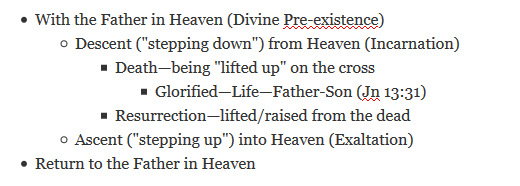
The dualism of these sayings is best demonstrated by the use of the verbs katabainœ and anabainœ (“step down”, “step up”), as in Jn 1:51. The saying in 3:13 is followed by that of v. 14 (which speaks of the Son of Man “lifted high”); the sayings in Jn 6:27, 53, 62 have a more complex reference matrix, as part of the great Bread of Life discourse (6:25-66). In schematic form, we might outline the dualism as follows:

According to this outline, the last Son of Man saying (Jn 13:31) reflects the central, inner dynamic of the Father-Son relationship and identity, governed by the verb doxazœ (“give honor/esteem/glory”, i.e. “glorify”). If this is correct, then it is not unreasonable to assume that the first of the Son of Man sayings (Jn 1:51) is parallel to this in some way, and may reflect the outer dynamic—the ascent/descent. Again, this would seem to be correct considering the use of the verbs katabainœ and anabainœ in 1:51. However, in that first saying, it is not the Son of Man descending/ascending, but rather of Angels (“Messengers of God”) ascending/descending on the Son of Man.

3. An allusion to Genesis 28:12

As mentioned last week, in Jesus’ saying there is almost certainly an allusion to Genesis 28:12. In Jacob’s dream-vision at Bethel, he sees Angels ascending and descending on the ladder; in the Greek Version (Septuagint) “ascending and descending” uses the same verbs (anabainœ and katabainœ) as Jn 1:51. Note also:

  • There is a traditional Jewish interpretation which understands the Angels ascending/descending on him (Jacob). In one reference (Genesis Rabbah 68:12) Jacob is seen as being simultaneously in heaven.
  • The Targums (Aramaic translations) express the idea that the shekinah—the visible manifestation and/or personification of God’s glory—was on the ladder. In Justin Martyr’s Dialogue with Trypho (mid-2nd century A.D.), we find the earliest evidence for the interpretation that Christ was on the ladder (86:2).
  • Bethel as the “House of God”, i.e. the rock/stone which symbolizes the Temple and its foundation. In ancient and traditional religious thinking, the Temple served as the meeting place between God and human beings, a point of contact between Heaven and Earth. Moreover, in John 2:19ff (not long after the saying in 1:51), the Temple is identified with Jesus’ own person (and body), specifically in connection with his death and resurrection.

4. A Comprehensive Symbol?

Returning to the specific context of John’s Gospel, there is still more evidence to suggest that the saying of Jesus John 1:51, in its particular position within the structure of the narrative, is intended primarily as a symbolic picture that effectively encompasses the entire Gospel—a framing device representing beginning and end, much like the “Alpha and Omega” (A and W) of Revelation 1:8; 21:6; 22:13 (another Johannine work, with definite parallels in thought and language to the Gospel). Here are some points I would cite in favor of this interpretation:

  • The clear parallels with the Baptism (see above, and the discussion last week), which marks the beginning of Jesus’ earthly ministry (descent/incarnation). Again, the location of Jn 1:51 strongly suggests an allusion to the Baptism.
  • Similar parallels with the Resurrection (ascension), which effectively marks the end of Jesus’ earthly existence.
  • Similarities to descriptions of the Son of Man coming in glory at the end-time (especially in the Synoptic Gospels, Mk 13:26; Matt 16:27-28, etc). However, the Gospel of John understands the Son to have had this position and glory prior to his incarnation/birth as a human being (that is, divine pre-existence). This means, in the Johannine context, that such images cannot refer only to Jesus’ exaltation and future return, but to a reality that encompasses and transcends the entire process of descent/ascent.
  • The saying in Jn 1:51 is part of a parallel, between the beginning and end of the Gospel. This expressed by the encounter of two disciples (Nathanael and Thomas) with Jesus, and involve parallel confessions:
    • Jn 1:49: “You are the Son of God | you are the King of Israel!”
    • Jn 20:28: “My Lord | my God!”
      It is possible that these confessions themselves as bracketing the entire narrative of chapters 2-20:
      • “Son of God” (in a Messianic context)
        —”King of Israel” (i.e. Anointed Davidic Ruler)
        —”My Lord” (Jesus as Messiah/Lord, cf. Ps 110:1)
      • “My God” (Deity)
    • Each of the confessions also includes a response by Jesus (Jn 1:50-51; 20:29) related to disciples/believers seeing him.
  • In the Gospel of John, “seeing” often signifies a level of spiritual perception (or of faith/trust) that is different from visual observation (Jn 1:14, 18; 3:3; 6:36, 46; 9:37-41; 11:9, 40; 12:45; 14:7, 9, 17, 19; 17:24; 20:29, etc). It is likely that the declaration “you will see” (opsesthe) does not refer to a concrete, visible event, but rather to the recognition and realization of Jesus’ true identity—as the Son who reveals and leads the way to the Father. This, of course, is also related to “seeing” the Son in terms of being with him, in his presence, as other instances of the verb optanomai, optomai/opsomai would indicate (Jn 16:16-17, 19, 22).
  • As a concluding observation that “seeing” in Jn 1:51 signifies something more than a concrete vision, note the parallel with 20:29:
    • “because I said to you that I saw [eidon] you… you trust?
      you will see [opsesthe] the heaven opened up and the Messengers of God… upon the Son of Man” (1:51)
    • “because you have seen [heœrakas] me you trust?
      Happy/blessed are the ones not seeing [idontes] and (yet) trusting!” (20:29)

In both Jn 1:51 and 20:29, the eventual seeing by the believer is contrasted with the disciple believing on the basis of an extraordinary or miraculous experience. Even the concrete evidence for Jesus’ resurrection (in the case of Thomas) should not be relied upon as the basis for faith and trust in Christ, but rather the word that bears witness to him and the Spirit that draws us to him.

It is a great wonder that, wherever you turn in the Gospel of John, there appears to be an almost limitless depth to the passage. Even a careful, objective treatment of individual words inevitably leads down into a wide expanse of meaning and spiritual significance. I hope that I have been able to offer some help in demonstrating how a study of both the words and context of the passage can serve as a reliable guide to exploration. For next week, I would exhort you to continue on in a similar manner, reading and studying the next two chapters of the Gospel as carefully and thoughtfully as you are able. It will prepare you for a discussion on one of the most familiar verses in all the New Testament, but one which is often cited without much consideration for its context in the Gospel. As you may have guessed, this is the world-famous John 3:16—and we will be looking at its context most carefully…next Saturday.

Birth of the Son of God: Epiphany

Today, January 6, traditionally called Epiphany, was the date associated with Jesus’ birth in the Eastern Church by the late-3rd century, corresponding to December 25th in the West. During the 4th century, a kind of ‘cultural exchange’ took place, whereby each Tradition adopted the date of the other—in the West, Jan 6 came to be associated with the visit of the Magi (Matt 2:1-12), and with Jesus’ baptism in the East. The Greek word e)pifa/neia (epipháneia) is derived from e)pifai/nw (epiphaínœ)—”shine forth upon”, i.e., upon earth (or upon us)—often in the sense of the manifestation or (sudden) appearance of someone (in Greek usage, this could include the appearance of a deity). The root meaning clearly relates to the shining of light; and, it is in this context that I wish to examine light associated with the “Birth of the Son of God”—briefly, according to three aspects:

  1. Jesus as light
  2. Light imagery in the Infancy narratives, principally the star of Matt 2:1-12
  3. Believers as light (“sons of light”)

1. Jesus as Light

In Old Testament tradition, God (YHWH) is often associated with light; of the many references, see Gen 1:3ff; Psalm 13:3; 18:28; 27:1; 36:9; 43:3; 56:13; 89:15; 90:8; 97:11; 104:2; 112:4; 118:27; Prov 29:13; Isa 2:5; 9:2; 42:6; 51:4; 58:8; 60:1, 19-20; Mic 7:8-9; Hab 3:4; Dan 2:22; as well as light as a component of various theophanies (e.g., Exod 13:21; 24:9-10ff; Ezek 1:4ff; Dan 7:9-10). It can also appear in an eschatological context, of the “Day of YHWH” (Zech 14:6-7, also Isa 10:17; 30:26).

Sometimes it is specifically the word or message of God that brings light (Psalm 119:105, 130; Prov 6:23; Hos 6:5), or connected in terms of salvation God brings (Psalm 27:1; 43:3; 44:3; Isa 9:2; 58:8ff, etc). There are several important (Deutero-)Isaian references which came to be understood in a Messianic sense: Isa 9:2; 42:6; 49:6; 60:1ff, including within the New Testament (Matt 4:15-16), and even the Lukan Infancy narrative itself (connected with Jesus’ birth)—Lk 1:78-79; 2:32 (below).

Apart from the narrative scenes involving light (such as the Transfiguration and Resurrection [Matt 17:2; 28:3 par], Acts 9:3 etc, which parallel OT theophany accounts, cf. above), Jesus himself is identified with light in the New Testament, primarily in the Gospel and Letters of John—Jn 1:4-9; 3:19-21; 5:35; 8:12; 9:5; 11:9-10; 12:35-36, 46; 1 Jn 2:8ff. On the eschatological imagery in Rev 21:23-24; 22:5, see below.

2. Light in the Infancy narrative—the Star of Matt 2:1-12

The main image of light associated with the birth of Jesus, is the famous “Star of Bethlehem” in Matt 2:1-12 (see vv. 2, 7, 9-10). The wording of these references is worth noting:

V. 2: “Where is the (one) produced [i.e. born] (as) King of the Jews? For we saw [ei&domen] his star [au)tou= to\n a)ste/ra] in the rising up [e)n th=| a)natolh=|] and came to kiss toward him [i.e. worship, give homage to him]”

V. 7: “Then Herod, calling the Magoi privately, sought (to know) exactly alongside [i.e. from] them the time of the star’s shining (forth) [tou= fainome/nou a)ste/ro$]”

V. 9: “…and see [i)dou/]!—the star [o( a)sth/r] which they saw [ei@don] in the rising up [e)n th=| a)natolh=|] led (the way) before them until, coming, it stood [e)sta/qh] over above where the child was”

V. 10: “And seeing [i)do/nte$] the star [to\n a)ste/ra], they were extremely glad (with) great gladness”

As discussed in a previous note, in the ancient world, according to tradition (and/or superstition) a star or other celestial phenomena were often thought to accompany (and mark) the birth of great persons, such as a king or ruler. For a 1st-century A.D. belief that a world-ruler would arise from the Jews, cf. Josephus, Jewish War VI.310-12, and Tacitus, Histories V.13. In all likelihood, this latter idea stems from Messianic expectation of the period—that is, for an end-time king from the line of David who would restore the kingdom to Israel (cf. Acts 1:6ff; Luke 2:25, 38, etc). For the 1st-century B.C.—prior to the time of Jesus himself—our best information comes from the Qumran texts (the Dead Sea Scrolls). Among the Old Testament passages which were given a Messianic interpretation, one of the most prominent was Balaam’s oracle in Numbers 24:15-19, especially the parallel couplet of verse 17:

la@r*c=Y]m! fb#v@ <q*w+ / bq)u&Y~m! bk*oK Er^D*
“a star will march from Ya’aqob / and a staff/branch will stand up from Yisrael”

Both the verbs Er^D* (“walk, tread”) and <Wq (“stand, rise”) in context would seem to indicate dominion or rule. The noun fb#v@ is the branch or stick (i.e. “staff, scepter”) which a ruler wields. In the Greek (the LXX) this verse is rendered as:

a)natalei= a&stron e)c Iakwb / kai\ a)nasth/setai a&nqrwpo$ e)c Israhl
“a star will rise up out of Ya’aqob / and a man will stand up out of Yisrael”

The peculiar use of “man” (a&nqrwpo$) in place of fb#v@ (“staff”) in the LXX could conceivably be an interpretive gloss, i.e. on the “star”, to specify that a (human) ruler is meant, as in the Aramaic Targums. We find a quasi-Messianic interpretation of Num 24:17 in the Damascus Document (CD 7 [MS A]), where the “star” and “staff” seem to refer to separate figures. There is a relatively clear “Messianic” allusion (connected to Isa 11:1-5) in 1QSb 5:27, and it is also cited in an eschatological context in 4Q175 and 1QM 11:6-7. That Num 24:17 was understood in a definite Messianic sense by the early 2nd-century is indicated by its use in the Testament of Judah 24:1-6 and by the revolutionary leader Simeon bar-Kosiba who was called bar-Kokhba (“son of the Star”).

Interestingly, Num 24:17 is not used in reference to Jesus in the New Testament, apart from a possible allusion to it here in Matt 2:1-12. I have discussed this possibility in a note last Christmas season. Apart from the common reference to a star, consider the linguistic parallels (marked by italics in the quotations of vv. 2, 7, 9-10 above):

  • Repeated references to seeing (Greek ei&dw) the star—Num 24:17 beings by Balaam declaring “I see him…” (LXX “I will show/point [to] him”); Balaam was a seer whose “eyes were open” (vv. 15, 16)
  • In Num 24:17, the star “will rise up” (a)natalei=, from a)nate/llw); the Magi saw the star in the “rising up” (related noun a)natolh/), which sometimes is meant in the directional sense of “east” (i.e. the sun’s rising), but here probably should be rendered literally—they followed the star from the time of its rising.
  • There is (perhaps) a faint echo in the star standing (“it stood” [e)sta/qh]) where the child was (v. 9); in Num 24:17, the staff (or man in LXX) stands (up) (Greek a)nasth/setai).
  • In both Matt 2 and the LXX, the star is identified specifically with a man (or a male child)—”his star” (Mat 2:2, cf. also v. 9 “…where the child was”)
  • It should also be pointed out that, in Jewish tradition at least as early as Philo (Life of Moses I.276), and thus contemporary with the New Testament, Balaam was referred to as a magos (ma/go$, plur. ma/goi [“Magi”]).

There are two other passages, in the Lukan Infancy narratives, which utilize similar light imagery:

Luke 1:78-79

These are the last lines of the “Song of Zechariah” (the Benedictus); to preserve the immediate context, I include verse 77:

“…77to give knowledge of salvation to his people,
in (the) release [i.e. forgiveness] of their sins
78through the inner-organs of (the) mercy of our God,
in which a rising-up [a)natolh/] out of (the) height will look upon us,
79to shine (forth) upon [e)pifa=nai] the (one)s sitting in darkness and (the) shadow of death,
to put our feet down straight into (the) way of peace”

Note the use of a)natolh/ (“rising up”) and the verb e)pifai/nw (“shine [forth]”), similar to that in Matt 2:2, 7 (above) and Isa 60:1-2 LXX (also mentioned above). The specific meaning of a)natolh/ here is not entirely certain, but it would seem to refer to the sun or a great light generally. Though verses 76ff relate primarily to the child John (uttered by his father), vv. 78-79 evince a Messianic application or interpretation of the (Deutero-)Isaian verses Isa 60:1-2; 42:6-7; 9:2 (also perhaps Mal 4:2 [3:20]), and, in context, clearly refer to Jesus.

Luke 2:32

This is the concluding couplet of the brief “Song of Simeon” (the Nunc Dimittis, vv. 29-32). As with Lk 1:78-79, the canticle draws upon the language and imagery of several (Deutero-)Isaian passages—namely, Isa 40:5; 42:6; 46:13; 49:6; 52:9-10 (cf. above). Simeon’s prophetic oracle identifies the child Jesus with salvation—”my eyes saw [ei@don] your salvation, which you [i.e. God] prepared according to the face [i.e. before] all the peoples” (vv. 30-31). On the use of ei&dw (“see”) in Matt 2:2ff and Balaam seeing the future figure (Num 24:15-17), cf. above. At the start of v. 32, this salvation is described as light (fw=$), followed (and qualified) by two purpose phrases governed by the preposition ei)$ (“into/unto”):

  • “uncovering [a)poka/luyin] of the nations” [i.e. Gentiles]
  • “esteem [do/can] of your people Israel”

The light does two things: (1) it shines upon the people (from the nations) who are in darkness (cf. Lk 1:79), and (2) it gives glory to God’s people Israel. In the Lukan context, this esteem/glory (do/ca) involves the joining of the Gentiles with the people (lao/$, sing.) of God to form “the peoples” (laoi/, plur.), v. 31. For a similar idea in Luke-Acts, see esp. Acts 26:18, 23.

3. Believers as light (“sons of light”)

Already in the Old Testament, light is associated with the righteous: Psalm 37:6; 97:11; 112:4; Prov 4:18; 13:9; Isa 10:17; 60:3; Est 8:16; Job 33:30, including also the idea of walking in light (Psalm 56:13; 89:15; Isa 2:5; 50:10-11; Job 22:28; 29:3). This symbolism carries over into the New Testament and early Christian tradition, where believers in Christ as identified with light—cf. Matt 5:14-16; 6:22-23 [par Lk 8:16-17; 11:33-36]; Acts 13:47 (citing Isa 49:6); Rom 13:12; 2 Cor 4:6; Phil 2:15; Col 1:12; Eph 5:8-9; 1 Pet 2:9, sometimes as part of an ethical (dualistic) contrast between light and darkness (2 Cor 6:14, etc). Believers are urged (and expected) to walk in the light (Jn 8:12; 11:9-10; 12:35; Rom 13:13; Eph 5:8; 1 Jn 1:6-7; cf. 2:11)—compare the Pauline idea of walking in the Spirit (Gal 5:16-25).

Four times in the New Testament, believers are described as “sons of light” (including once “children of light”):

  • Luke 16:8—”…the sons of this Age are intelligent/thoughtful over [i.e. more than] the sons of light [tou\$ ui(ou\$ tou= fw=to$]…”
  • John 12:36—”as you hold the light, trust into the light, so that you might come to be sons of light [ui(oi\ fwto/$]”
  • 1 Thess 5:5—”for you are all sons of light [ui(oi\ fwto/$] and sons of (the) day [ui(oi\ h(me/ra$]; we are not of (the) night and not of darkness”
  • Eph 5:8—”for then (previously) you were darkness, but now light—(so) walk about as offspring [i.e. children] of light [te/kna fwto/$]”

The expression “sons of light” (Heb. roa yn@B= b§nê °ôr, Aram. ar*hon+ yn@B= b§nê n§hôr¹°) is known from the Qumran texts (1QS 1:9; 2:16; 3:13, 24-25; 1QM 1:1, 3, 9, 11, 13; 1QFlor [174] frag 1 vv. 8-9; 1QCatena [177] frag 11-10 v. 7, 12-13 v. 11; 4Q544 frag 3 v. 1; 4Q548 frag 1 vv. 9-10ff), and so was presumably already part of traditional Jewish religious language adopted by the New Testament writers. In Semitic idiom,  “sons of…” often indicates belonging to a particular group, especially among those who possess a certain attribute or characteristic. In the Qumran texts, strong dualistic imagery is used—the contrast with “sons of darkness, sons of Belial”—and it was the faithful Community that saw itself as “sons of light” (par. “sons of justice”, ” sons of truth”, “sons of heaven”, etc), just as for early Christians the expression would relate to faithful believers. Within the New Testament, sonship for believers is metaphorical and spiritual, depending on our union with Christ (through the Spirit)—I have already discussed the idea of believers as “sons of God” in prior notes, and will do so again, in more detail, in an upcoming note.

It is in the Gospel of John that we find the (reciprocal) relationship between Christ (the Son) and believers (the “sons”) defined and described in terms of light:

  • John 1:4-9—Jesus as the true (Divine) Light (cf. 1 Jn 1:5) coming into the world [e)rxo/menon ei)$ to\n ko/smon] (v. 9)
  • John 3:19-21—Light has come into the world [e)lh/luqen ei)$ to\n ko/smon], but people love darkness rather than light (contrast of light vs. darkness established, cf. John 1:5)
  • John 8:12 (and 9:5)—Jesus: “I am the Light of the world [tou= ko/smou]”—believers following Jesus will walk in light, not darkness (1 Jn 1:7; 2:8-10), and will have “the light of life”
  • John 11:9-10; 12:35-36—the emphasis is on believers walking in light, with the contrast between light vs. darkness; note the context of Jesus’ death and resurrection/exaltation: the Son (of Man) being lifted high
    Jn 12:36 is the climactic reference: “that you may come to be [ge/nhsqe] sons of light”—see the similar use of gi/nomai in Jn 1:12-13 (“he gave them authority to come to be [gene/sqai] offspring/children of God”)
  • In John 12:46 Jesus again identifies himself as the Light that has come into the world

In Revelation 21:23-24; 22:5, we see is a final (Johannine) image of believers in the Holy City, with allusions to Isa 60:3, 5, 11, 19-20—”the Lord God gives light upon them” (22:5).

Conclusion: The Baptism of Jesus

In Eastern Tradition, the baptism of Jesus (commemorated Jan 6) involves an interesting (and beautiful) light motif:

According to at least one strand of early tradition, when Jesus was in the river, at the descent of the Spirit, a great light appeared in the water. This detail was part of the 2nd-century Diatessaron (Gospel harmony) of Tatian, according to commentators Isho’dad and Dionysius Barsalibi (9th and 12th centuries), and is found in two Latin manuscripts (at Matt 3:15), as well as being mentioned by Justin Martyr (Dialogue with Trypho §88) in the mid/late-2nd century (cf. also Epiphanius’ Panarion 30.13.7). The baptismal tradition of the Eastern (Syrian) Churches expresses the idea that, during Jesus’ baptism, he left something of his glory and presence in the water—at the spiritual/mystical level—which believers then receive when they are baptized. Even though he does not mention it in his Commentary on the Diatessaron, Ephrem the Syrian makes much of this image, drawing upon the parallel between the glory lost by Adam that is restored to humankind through Christ. He mentions it several times in his Hymns on the Nativity, in connection with Jesus’ birth (e.g. Hymn 1.43, 16.11, 22.39, 23.13, also the Ps-Ephrem Epiphany Hymn 4.19-20, 12.1, etc). In stanzas 21-22 of Nativity Hymn 6, Ephrem juxtaposes the light of the star at Jesus’ birth (cf. above) with the light at Jesus’ baptism:

…the star of light cried out in the air, “Behold the King’s Son!”
The sky was opened, the water sparkled;
the dove hovered over; the voice of the Father,
more weighty than thunder said,
“This is My Beloved”…
(translation Kathleen E. McVey, Ephrem the Syrian: Hymns [Paulist Press:1989])

Saturday Series: John 1:51

John 1:51

Today I want to continue on in the first chapter of the Gospel of John, with a verse that is one of the most difficult to interpret in the entire book—the saying of Jesus in Jn 1:51. Unlike the situation in verses 18 and 34 (discussed on prior Saturdays), there is no question about the text of the verse. The Greek is secure and there really are no significant variant readings. But this only raises a different sort of critical question: how does one proceed when we are sure of the text, but the passage is still difficult to understand? Consider the saying itself as I give it here in a (literal) translation:

“And (Jesus) says to him [i.e. Nathanel]. ‘Amen, amen, I say to you (that) you [pl.] will see the heaven opened up and the Messengers of God stepping up and stepping down upon the Son of Man’.”

This saying has proven sufficiently difficult and obscure for commentators throughout the years, resulting in a wide range of possible interpretations. To what, exactly, is Jesus referring here?

A fundamental question is whether the saying should be taken as a concrete prediction (of a future event), or a symbolic picture. If the former, then one must ask to which specific event or episode it refers; there are three possibilities—(1) a supernatural event witnessed by the disciples (similar to the Transfiguration), but otherwise unrecorded, (2) the resurrection and/or ascension, or (3) the future/end-time appearance of Christ. Given the similarities with key eschatological Son of Man sayings in the Synoptics, the third option makes most sense. Heavenly “Messengers” (i.e., Angels) are present in both the eschatological Son of Man sayings (Mk 13:26-27; Matt 13:41; 25:31, etc) and the resurrection/ascension scenes (Mk 16:5; Lk 24:23, etc; Acts 1:10f). However, neither of these seem to fit the context where the saying is set in John. If we are to understand the saying primarily as a symbolic picture—whether by the Gospel writer or Jesus himself—then there a number of possible associations or allusions which may be in mind.

An important part of Biblical criticism involves examining the intent of the author, as far as this can be determined. In order to do this, we must explore the verse from two vantage points, much as we did in studying the text of Jn 1:18 and 34. These two aspects are: (1) the specific language and terminology (i.e. the Greek words and syntax) used, and (2) the context—both the immediate context, and that of the Gospel as a whole. Today I will examine (1) the language and terminology, leaving (2) the context for next Saturday.

1. The language and terminology used in the saying

Interpretation should always be based on a careful study of the original language (here the Greek of the NT)—the specific words and phrases, and how they are used in the passage (i.e. the grammar and syntax). I will look briefly here at the significant words and phrases, in the order they appear in the verse.

[Amen, amen]—The Greek am¢n (a)mh/n) is a transliteration of the Hebrew °¹m¢n (/m@a*), an adverb which means something like “surely, certainly, truly”. As a Semitic idiom, it was used frequently by Jesus, and is often preserved in its Hebrew/Aramaic form in the Gospels (41 times in Matthew, 13 in Mark, and 6 in Luke). It occurs 25 times in John, always in the double form (“amen, amen…”) we see in 1:51. In this form, it tends to be used by Jesus when addressing his disciples (or would-be disciples) and declaring to them something of the utmost importance. A comparable form of address in English idiom might be something like: “You may be sure of this…”, “I tell you the truth when I say that…”, etc. The formula introduces key sayings in the Johannine Discourses of Jesus, and often are central to the theological (and Christological) points being made by Jesus in his exposition (cf. Jn 3:3, 5, 11; 5:19, 24-25; 6:26, 32, etc).

[you will see]—The Greek verb optanomai (o)pta/nomai) in the future tense commonly means “see”, though its concrete, fundamental meaning would be something like “look with (open) eyes”. The motif of seeing, especially the idea of seeing Jesus, has special theological (and Christological) significance in the Gospel of John. Typically it refers to something more than the ordinary (sensory) experience of sight. There are too many passages to cite them all here—e.g., 1:14, 33-34; 3:3, 36; 6:36, 46, 62; 9:37ff; 11:9, etc. The future form (of optanomai) occurs 9 times elsewhere in the Gospel, the first being in 1:39, where it relates to the basic idea of the disciple encountering Jesus, and realizing something of his true identity. In 3:36 the context is the experience of salvation (i.e. eternal life) through faith/belief in Jesus. The context of 11:40 (the miracle of raising Lazarus) indicates that it primarily refers to witnessing the splendor of God manifest in the person of Jesus, by way of his life-giving (and miracle-working) power. The four occurrences in 16:16-22 are more difficult to decipher, due to the wordplay and dual-layered meaning running throughout the passage: of the disciples encountering Jesus (a) after his resurrection and/or (b) in the future, following his return to the Father.

[the heaven opened up]—The wording here is an echo of the earlier baptism scene (vv. 29-34). Even though John does not describe the heaven “opening up”, the Gospel writer (trad. John the Apostle) almost certainly was aware of the historical tradition (vv. 32-33). In the Synoptic account (Mk 1:10), we find the specific image, including the same verb (anoigœ, a)noi/gw, “open up”) in Luke’s version (3:21) as used here in v. 51. Elsewhere in John, this verb is often used in the idiom “open up (one’s) eyes”, as a reference again to the important theme of seeing.

[the Messengers of God]—”Messenger” is the proper translation of the Greek angelos (a&ggelo$), which is usually transliterated into English as “Angel”. Here, of course, it refers to God’s heavenly Messengers (Angels) rather than human messengers. As noted above, in the Gospels, Angels are associated both with the resurrection/ascension of Jesus (as in Jn 20:12), as well as a number of the eschatological Son of Man sayings in the Synoptics (cf. Mk 8:38; 13:26 par; Matt 16:27, etc). However, there is also here likely an allusion to Genesis 28:12.

[stepping up and stepping down]—The Greek verbs anabainœ (a)nabai/nw) and katabainœ (katabai/nw) are usually translated “ascend” and “descend”, but literally mean “step up” and “step down”, respectively. Both verbs are used frequently in the Gospel of John, and often with special theological (and Christological) significance. This will be discussed when addressing the context of v. 51 next Saturday. This is the first occurrence in the Gospel of anabainœ, but katabainœ was used earlier in the description of the Baptism scene (vv. 32-33), of the Spirit descending (lit. “stepping down”) upon Jesus. These two verbs are also used in the Greek (Septuagint) version of Gen 28:12, of the Angels ascending and descending upon (the ladder). This makes an allusion to that Old Testament tradition here all but certain.

[upon]—The preposition epi (e)pi/) here again relates to both the Baptism of Jesus (the Spirit descending upon him, vv. 32-33) and to the Gen 28:12 tradition.

[the Son of Man]—This is a translation of the Greek ho huios tou anthrœpou (o( ui(o\$ tou= a)nqrw/pou). The expression is a Semitic (Hebrew/Aramaic) idiom which is generally synonymous with “Man”, referring to human beings or humankind, sometimes in the specific sense of human nature or the human condition. Jesus makes use of the expression in several special ways, which have been preserved in the Gospels. Two fundamental groups of “Son of Man” sayings relate to: (1) Jesus’ suffering and death, and (2) his appearance in glory at the end-time. Similarly, in the Gospel of John these two aspects are found in the (twelve) Son of Man sayings, though expressed in language and imagery that has special meaning in the context of the Johannine theology (and Christology). A number of Son of Man sayings involve the very verbs—anabainœ and katabainœ—used in this verse.

Next week we will be examining the context of this verse more closely. In the meantime, I would recommend that you continue to study and meditate on Jesus’ saying. Based on what we have done so far—studying the specific words and phrases that are used—does this offer you any new insights on the meaning and significance of the verse? You may wish to write these down, or at least keep them in mind as we continue…and I will see you next Saturday.

Saturday Series: John 18:37

In celebration of this Christmas season, I thought it worth taking a slight detour in order to discuss briefly the only passage in the Gospel of John which specifically refers to Jesus’ birth—Jn 18:37. There are a number of references to Jesus, as the Word (Logos) and Son of God, coming to earth as a human being (what we would call the Incarnation), and one oblique reference to the birth of the Messiah (in Bethlehem, 7:42). However, only in 18:37 is Jesus’ birth actually mentioned. Let us examine this verse, according to the method and approach adopted in this Saturday Series, to demonstrate how a careful study of the Greek text allows for greater insight into the meaning of the Scripture.

John 18:37

This verse is part of the dialogue between Jesus and Pontius Pilate, which makes up the interrogation/trial scene in the Fourth Gospel (18:28-19:16). It clearly draws upon the basic Gospel tradition, in which Jesus’ interrogation before Pilate centered upon his possible identity as “King of the Jews”—a title with strong nationalistic (and Messianic) implications. This is virtually all the information we have about the interrogation scene in the Synoptic Gospels (Mark 15:2-5 par), and it is confirmed, objectively, by the written charge applied to Jesus on the cross, recorded (with slight variations) in all four Gospels (Mk 15:26 par; Jn 19:19ff).

While John’s version follows this tradition, it is written in a manner more in keeping with the great Discourses of Jesus that run throughout the Gospel (to be discussed further in the Saturday Series studies). These Discourses have both an historical and a literary aspect, and it is virtually impossible to separate the two. From a literary standpoint, the Discourses follow a basic pattern (with certain variations):

  • A saying, statement or question, by Jesus
  • The reaction of his audience, indicating a lack of understanding of his true meaning, which leads to
  • An exposition of the saying by Jesus

Sometimes the discourse takes on the character of a dialogue, with multiple exchanges between Jesus and his audience. Jn 18:37 puts us in the middle of such a dialogue:

Then Pilate said to him, “Are you not then a king?”
Yeshua answered: “You say that I am a king. I have come to be (born) unto this, and unto this I have come into the world—that I should witness to the truth; every one being [i.e. who is] out of the truth hears my voice.”

Both the similarity and the contrast with the Synoptic tradition could not be more clear; for the points of similarity, note the italicized portions here and above:

And Pilate asked him, “Are you the king of the Yehudeans {Jews}?”
But, answering him, he [i.e. Jesus] said: “You said (it)“
(Mark 15:2)

However, according to the Synoptics, that short response is all that Jesus says (Mk 15:5a par). By contrast, in John’s version, there is a more extensive exchange between Jesus and Pilate. Critical commentators naturally would question the historicity of this, in light of the Synoptic tradition. However one judges the matter (that is, the relation between the Synoptic and Johannine versions), there can be no doubt that Jesus’ statements to Pilate, in 18:36-37 and 19:11, effectively serve as a summary of the theology (and Christology) of the Fourth Gospel. This is especially true of the twin declarations in 18:36-37, set at this key climactic point of the Gospel narrative. The statement in v. 36 is negative—Jesus declares that he is not the sort of king Pilate envisions. With the statement in v. 37, on the other hand, Jesus declares the sort of “king” that he truly is. It is a formulation that utilizes and repeats a number of key words and phrases occurring throughout the Gospel, and, especially, in the earlier discourses of Jesus. Let us survey them here, though in order to understand them properly, it is necessary to study them as they appear elsewhere in the Gospel.

First, we have the motif of misunderstanding, which is essential to the Johannine Discourses. In verse 36, Jesus does speak of his “kingdom”, so it is natural that Pilate would assume that Jesus thinks he is a king—i.e. “King of the Jews” (v. 33), in the traditional/conventional sense. Jesus’ response makes clear that Pilate does not truly understand—”You say that I am a king”. This is a notable example of how the Gospel tradition (see above) is developed in John, expanding to include statements of profound theological (and Christological) significance. Such development is intrinsic to the Johannine Discourses.

In fact, Jesus is not at all a king as Pilate imagines; rather, he is something much more. Here are the words and phrases he uses:

1. First, notice the word order and emphasis in his response:
(a) The emphatic contrast: “You [su]…I [egœ]…”—each pronoun is in emphatic position at the beginning of the sentence.
(b) The first sentence ends with the verb eimi (“I am”), while the second sentence begins with the pronoun egœ (“I”)—thus there is embedded here the formula egœ eimi (“I am”) which features so prominently in the Fourth Gospel (3:28; 4:26; 6:20, 35, 41; 8:12, 18, 24, etc). It reflects both Jesus’ identity as the Son of God and his identifying relationship with God the Father. Pilate misunderstands this identity (“You say that I am…”).

2. The demonstrative pronoun houtos/touto (“this”) is often used to specify Jesus’ identity with the truth—i.e., “this water”, “this bread” —the spiritual reality of what the (earthly) object symbolizes, and so forth. Here it indicates the true meaning and purpose for Jesus’ life on earth as a human being. This is emphasized by the grammatical structure—two parallel phrases governed by a prepositional expression (eis touto, “unto this”, i.e. for this purpose):

    • “unto this [eis touto] I have come to be born”
    • “unto this [eis touto] I have come into the world”

3. These two phrases employ two verbs in the perfect tense, which often indicates a past action or condition that continues into the present. Here it refers specifically to Jesus’ life and existence as a human being. The two verbs are:

  • gennᜠ(“come to be [born]”)—gegénn¢mai (“I have come to be [born]”)
  • érchomai (“come”)—el¢lytha (“have come”)

3a. The verb gennᜠ(genna/w) is a primary existential verb of being/becoming (“come to be”). It is cognate to the verb gínomai (gi/nomai), which has a very similar meaning. Both refer to someone or something coming to be, i.e. coming into existence, happening, etc., which, in the case of a human being often means the person’s birth. The verb gennaœ more properly refers to a human birth, but ginomai can be used in this sense as well. Gennaœ occurs 18 times in the Gospel of John, referring both to the ordinary (natural) birth of a human being (9:2; 16:21, etc), but also for the spiritual birth of believers in Christ (1:13; 3:3-8). Spiritual “birth” is also the meaning it carries in all but one (?) of the 10 occurrences in 1 John as well (2:29; 3:9; 4:7; 5:1, 4, 18).

The incarnation of the Word/Son of God, as described primarily in the Prologue (1:1-18), always uses the related verb ginomai, not gennaœ. For example, in v. 14: “The Word [Logos] came to be flesh…” (cf. also vv. 15, 30; overall the verb occurs 9 times in the Prologue). This distinction is important, even though the author would surely accept that Jesus (the Word/Son) was truly born as a human being. In the Prologue, he is referring not so much to his birth, specifically, as to his life/existence as a human being. In 18:37, Jesus is almost certainly referring to his birth, as such, even though the use of gennaœ otherwise differs little from that of ginomai. Both verbs are used for the spiritual birth of believers in 1:13-14. The two-fold use of gennaœ in 1 John 5:18, is more complicated, and involves variant readings which affect the meaning.

3b. The verb érchomai (e&rxomai) is also a principal verb which means “come, go”, and occurs frequently in ordinary narration. However, in the Gospel of John it also carries a deeper significance. Like ginomai, it refers to Jesus (the Word/Son of God) coming to earth as a human being, though with the specific connotation of his ministry and work on earth. Note especially the careful use of the verbs erchomai (“come”), ginomai (“come to be”), and eimi (“be”) in Jn 1:15 and 30. It is thus possible to identify the two aspects indicated by the parallel phrases here:

    • gennaœ: “I have come to be (born)“—Jesus’ birth as a human being
    • erchomai: “I have come into the world”—His human life and ministry

If these two phrases reflect the mystery and power of the Incarnation, the remainder of Jesus’ statement expounds the purpose for it, as contained within the expression “unto this” (eis touto), i.e. “for this purpose”. Space does not allow for a detailed exposition of the remaining words and phrases; here, I can offer only a brief summary:

  • “the world” (ho kosmos)—The noun kosmos (ko/smo$, “world-order, world”) is a key word, occurring 78 times in the Gospel of John (out of 186 total in the NT). It is primarily used in a negative, dualistic sense, signifying the realm of evil and darkness which is opposed to God. However, it also figures prominently in the idea of salvation—the Light (Jesus, the Son) comes into the world of darkness to save humankind. The usage here is similar to that in 3:16, etc (emphasizing salvation), while in the prior statement of 18:36, it is the negative contrast with God that is in view.
  • “witness” (vb. martyreœ)—The verb martyreœ (marture/w, “[give/bear] witness”) is another regular Johannine word, occurring 33 times in the Gospel, and another 10 times in the Letters (also 4 in Revelation), more than half of all NT occurrences. Especially important is the idea of Jesus as a witness—as the Son he makes known the person, presence and nature of God the Father to humankind.
  • “out of” (ek)—The Gospel and Letters of John frequently use the preposition ek (e)k, lit. “out of”) to refer to birth—specifically the birth of believers. One is born from (i.e. coming “out of”) another. As believers, we are born “out of the Spirit”, which is the same as being born “out of God” (Jn 1:13-14; 3:3-8; 1 Jn 3:9; 4:7; 5:1, etc). Here the expression is “out of the truth”, but it essentially means the same thing, from the standpoint of Johannine theology (God = Truth = the Spirit, cf. below). The specific phrase used here by Jesus, “everyone being [i.e. who is] out of the truth”, is similar to that found repeatedly in 1 John (3:9; 4:7; 5:1, 4, 18); note also the close syntax (with the participle œn, “being”) in Jn 3:31.
  • “the truth” (h¢ al¢theia)—The word al¢theia (a)lh/qeia, “truth”) is another Johannine key term (25 times in the Gospel, 20 in the Letters, out of 109 in the NT). It refers to a fundamental characteristic of God the Father which is virtually identical with His Person. Jesus, as the Son, also identifies himself as Truth (Jn 14:6, etc).
  • “hears my voice”—The idea of hearing the voice is likewise fundamental to Johannine expression, especially in the Discourses. It goes back to Old Testament tradition—to the Sinai theophany (cf. 5:37), and to the idea of the Prophets hearing God’s word. Jesus, as the Son, hears the Father’s voice, indicating both obedience and the receiving of revelation. In turn, believers respond (in faith) to Jesus’ voice, which reflects and embodies the very voice of God (14:24, etc). See especially Jn 5:24-25ff; 8:43; 10:3ff, 16, 27; 12:47. Jesus’ words in 8:47 are very close to those here in 18:37.

The immediate exchange between Jesus and Pilate closes with Pilate’s famous question “What is (the) truth?” (v. 38). The answer is implicit in the message of the Gospel as a whole, and becomes clear enough through a careful study of the Discourses and other passages. However, if one seeks a more direct answer to the question, it is necessary to turn to the First Letter of John. I leave you today with these words from 1 John 5:6:

“…the Spirit is the Truth”
to pneuma estin h¢ al¢theia