Notes on Prayer: John 14:13-14, etc

John 14:13-14, continued

Last week, we began a study on the references to prayer in the Last Discourse of Jesus in the Gospel of John (13:31-16:33). The first such references are the twin sayings of 14:13-14. There are two aspects of these sayings which need to be examined further: (1) the relationship between God the Father and Jesus (the Son), and (2) the precise meaning and significance of prayer “in Jesus’ name”.

Before embarking on a study of these aspects, it is worth surveying the basic outline and focus of these sayings, as they fit a basic pattern. Similar sayings occur elsewhere in the Last Discourse; we shall examine these in turn, but let us begin by citing them here (alongside the dual-saying in 14:13-14):

“any(thing) that you would request in my name, this I will do…
if you would request any(thing of) me in my name, I will do (it)” [14:13-14]

“any(thing) that you would request (of) the Father in my name, he shall give to you” (15:16)
“any(thing) that you would request (of) the Father in my name, he will give (it) to you” (16:23)
(cf. also 14:26)

There are two formal components to these sayings: (a) the promise that the request made by Jesus’ disciples will be answered, and (b) that the request is made “in Jesus’ name”. Each of these components is attested elsewhere in the Gospel Tradition, and in themselves are not unique to the Gospel of John; it is the specific combination that is distinctive of the sayings in the Last Discourse.

The first component (a)—the promise of answered prayer—is found in simple form in 15:7 and 16:24:

    • “whatever you would wish (for), request (it) and it shall come to be (so) for you” (15:7)
    • “(make a) request, and you will receive” (16:24)

There is a Synoptic parallel for the latter, which has an extremely simple, proverbial character, typical of many of Jesus’ sayings:

“(make a) request, and it will be given to you…
every(one mak)ing a request receives (it)” (Matt 7:7-8, par Lk 11:9-10)

There is also a general similarity to the longer Johannine form (15:7) in Matt 21:22 (cf. also Mark 11:24):

“and all (thing)s, whatever you would request in speaking out toward (God) [i.e. in prayer], (if you are) trusting, you will receive.”

In Matt 18:19, there is a different saying which also relates to the Johannine sayings (above):

“if two of you should give voice together [i.e., speak in agreement] upon earth about any deed, that which they would request, it will come to be (so) for them (from) alongside my Father in the heavens.”

The second component (b) of the saying-form (noted above) also has Synoptic parallels. Note, in particular, the saying in Matt 18:20, and its conjunction with the earlier prayer-saying in v. 19:

“For (the place in) which two or three have been brought together in my name, there I am in the middle of them.”

There are other references to Jesus’ disciples speaking and acting “in his name” —Mk 9:37-39 par; Matt 7:22; Lk 6:22; cf. also Mk 13:6 par, and the commissioning-traditions in Lk 24:47; Matt 28:19; [Mk 16:17]. In the Gospel of John, outside of the Last Discourse, the emphasis is on Jesus (the Son) acting in the name of the Father; however, cf. the confessional statements in 1:12; 2:23; 3:18; 20:31 which record the principal early Christian (and Johannine) understanding of trust in Jesus defined as being “in his name”.

Turning again to the twin sayings in Jn 14:13-14, there is an interesting point of difference when compared with the sayings in 15:16 and 16:23. In Jn 14:13-14, prayer is apparently being made to Jesus, and it is he who acts in response to the request; by contrast, in the other two sayings, prayer is directed to the Father, who is the one answering. This seeming inconsistency has troubled commentators at times, and doubtless explains why some manuscripts of 14:13 specify “the Father” as the one to whom the request should be made. However, the interchangeability of roles is of fundamental importance to the Johannine theology, with its unique emphasis on the relationship between Father and Son—especially the key theme that the Son (Jesus) follows the example (and instruction) of his Father, in all that he says and does. Put another way, as the Son, Jesus possesses the same authority and divine/creative power that belongs to the Father; thus, he is able to fill the Father’s role, for example, as the one who hears and responds to prayer.

The same interchangeability is seen in the passages of the Last Discourse that refer to the sending of the Spirit/Paraclete; these will be discussed in an upcoming study. Moreover, this tendency is not limited to the Johannine tradition, but, instead, reflects the early Christology, as it developed among the first generation(s) of believers. As a simple example, the title ku/rio$ (“Lord”), as a divine title, could be applied equally to God the Father (YHWH) and to Jesus; we see evidence of this all throughout the New Testament. Similarly, in the Pauline letters, the (Holy) Spirit can be called the “Spirit of God” and the “Spirit of [Jesus] Christ”, interchangeably; this is very much like the situation in the Johannine writings, and can be seen elsewhere in the New Testament as well.

The context of 14:13-14, in which Jesus (the Son) is the one who hears and answers prayer, implies the exaltation of Jesus, and his place alongside God the Father in heaven. And, indeed, it is the departure of the Son, back to the Father, that is the central theme of the discourse-segment of 14:1-14 (cf. the previous study). From his place at the “right hand” of God, the Son acts in the Father’s place, with His authority. In certain lines of early Christian tradition, we find the specific idea of Jesus making intercession for believers to the Father (e.g., Rom 8:34; Heb 9:24; 1 John 2:1). This relates to the motif of Jesus as a high priest (cf. Part 9 of the series “Yeshua the Anointed”), and assumes his place in heaven, i.e., the heavenly sanctuary, in the presence of God Himself. In any case, the prayer saying in Jn 14:26 alludes to intercession, and includes the role of both Father and Son in responding to believers’ prayer.

In next week’s study, we will look in detail at the second main aspect noted above—that is, the precise meaning and significance of the prayer-request being made in Jesus’ name.


Notes on Prayer: John 14:13-14

John 14:13-14

Some of the most important references to prayer in the New Testament are found in the great Last Discourse of Jesus in the Gospel of John. The Johannine writings never use the common Greek terms for prayer (proseuxh/, vb proseu/xomai); instead, the idea of prayer is expressed by the verb ai)te/w, emphasizing making a request of God.

There are significant critical issues surrounding the origin and composition of the Johannine discourses. On the one hand, they are unlike anything we see in the Synoptic Gospels; in addition, they evince a language and style that is distinctly Johannine, and very close, for example, to that of First John. At the same time, there are Synoptic parallels for certain sayings and traditions in the Gospel of John, and there is clear evidence that the discourses, at the very least, are rooted in authentic historical tradition. Thus, the arguments regarding the Discourses—whether they are primarily Johannine compositions, or accurate reflections of Jesus’ own words throughout—run both ways. And, indeed, both aspects must be kept in mind with any study of the Gospel of John.

The great “Last Discourse”, set (in the narrative) on the eve of Jesus’ arrest, actually represents a complex of inter-related discourses, spanning more than three chapters (13:31-16:33). It may be outlined as follows:

    • 13:31-38—Introduction to the Discourse (cf. above)
    • 14:1-31—Discourse/division 1—Jesus’ departure
      • The relationship between Jesus and the Father (vv. 1-14)
      • Jesus’ Words for His Disciples (vv. 15-31)
    • 15:1-16:4a—Discourse/division 2—The Disciples in the World
      • Illustration of the Vine and Branches: Jesus and the Disciples (vv. 1-17)
      • Instruction and Exhortation: The Disciples and the World (15:18-16:4a)
    • 16:4b-28—Discourse/division 3—Jesus’ departure (farewell)
      • The Promise of the Spirit (vv. 4b-15)
      • Jesus’ Departure and Return (vv. 16-24)
      • Concluding statement by Jesus on his departure (vv. 25-28)
    • 16:29-33—Conclusion to the Discourse

The first Discourse/division (14:1-31), the first of two on the primary theme of Jesus’ departure, may be outlined in further detail:

    • 14:1-31—Discourse/division 1—Jesus’ departure
      • The relationship between Jesus and the Father (vv. 1-14)
        • Initial statement by Jesus on his departure (vv. 1-4)
        • Question by the disciples [Thomas] (v. 5)
        • Jesus’ response: I AM saying (vv. 6-7)
        • Question by the disciples [Philip] (v. 8)
        • Jesus’ response: I AM saying (vv. 9-11)
        • Concluding statement by Jesus on his departure (vv. 12-14)
      • Jesus’ Words for His Disciples (vv. 15-31)
        • Instruction to the Disciples: Love and the Commandments (vv. 15-24)
          —Initial statement: Promise of the Spirit (vv. 15-17)
          —Instruction: Relation of the Disciples to Jesus and the Father (vv. 18-21)
          —Question by the disciples [Judas] (v. 22)
          —Jesus’ response: The disciples and the world in relation to Jesus and the Father (vv. 23-24)
        • Exhortation for the Disciples: Farewell Promise of Peace (vv. 25-27)
          —Initial statement: Promise of the Spirit (vv. 25-26)
          —Exortation: Jesus’ gift of his Peace (v. 27)
        • Concluding statement by Jesus on his departure (vv. 28-31)

The first sayings on prayer are in 14:13-14, which forms the conclusion of the first section, on the relationship between Jesus and the Father (vv. 1-14). The basic Johannine discourse format is clear: Jesus makes an initial statement (vv. 1-4) which his audience (here, his close disciples) fails to understand (v. 5); Jesus responds in turn with an exposition of the true and deeper meaning of his words (vv. 6ff). Sometimes this discourse-format is expanded to include multiple exchanges between Jesus and his audience, and, indeed, we see this at several points in the Last Discourse. Even within this first section, there are two questions by the disciples, which lead to two different “I Am” sayings by Jesus in response (vv. 6-7, 9-11).

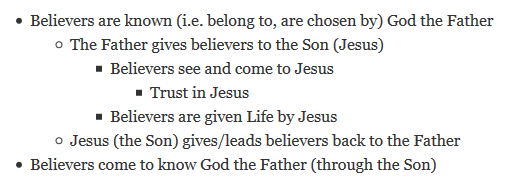
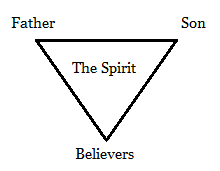
The substantive message of the first section involves the idea of Jesus leading the way for believers to the Father. As his exposition makes clear, this is not to be understood in traditional religious terms, nor in the special sense of a metaphysical translation to heaven (though that will take place in the future). Rather, the “way” to the Father comes through trust in Jesus and through union with him. Trust leads to union, and this essential union is realized through the presence of the Spirit, which is the Spirit of both Father and Son, and represents the abiding presence of Jesus in and among believers. Through this union with Jesus, believers already are in the presence of God the Father, and have access to Him.

This theological and Christological outlook, which is hardly unique to the Last Discourse, but is woven throughout the entire Johannine Gospel, informs the sayings on prayer. There are two sayings on prayer in vv. 13-14, virtually identical in form and meaning, and separated by a key phrase re-emphasizing the relationship between God the Father and Jesus (the Son). I give the translation as a chiasm, to outline this structure:

    • “and any(thing) that you should request in my name, this I will do,
      • (so) that the Father should be given honor in the Son;
    • if you request any(thing of) me in my name, I will do (it).”

The granting of the request has, at its heart, the purpose of giving honor to the Father. The verb doca/zw is an important part of the Johannine vocabulary, occurring 23 times in the Gospel, and 13 times in the Last Discourse and Prayer-Discourse (13:31-16:33 and chap. 17). The Passion-focus of this usage begins to take on prominence in 12:28, and continues through the Last Discourse. By fulfilling the duty and mission placed on him (e)ntolh/) by God the Father, through his sacrificial death and resurrection, the Son (Jesus) gives honor and esteem to the Father. According to the narrative setting of the Last Discourse, the moment of Jesus’ death is drawing near, and so the moment of the Son bringing do/ca (“esteem, honor, glory”) to the Father is also at hand.

But the specific setting here within the discourse is of Jesus’ departure, the return of the Son back to the Father, which implies a post-resurrection context. It is perhaps worth asking how granting the requests of his disciples gives honor to the Father. The answer, I believe, is two-fold. First, it is predicated upon the special relationship between Father and Son; as a dutiful and faithful son, everything Jesus does is to the honor of his father. This is a principal Johannine theme, and is central to the Christology of the Gospel. Secondly, it involves the significance of the request being made in Jesus’ name (“in my name”, e)n tw=| o)no/mati/ mou). As we shall see, this is no superficial designation, as though we were simply to tack on the phrase “in Jesus’ name” to our prayers. Instead, the phrase cuts to the very heart of our identity as believers in Christ, and of our relationship to the Father through him. This will be discussed further in the following studies, as we proceed through all the key references in the Last Discourse.

As these studies will appear on Mondays during the weeks of Advent and Christmas, and will focus on the idea of Jesus’ name, you may wish to explore my earlier Christmas series “You Shall Call His Name…”, which deals with the significance of names and naming in the ancient Near East, and the importance of this within the Gospel Infancy narratives (Matt 1-2; Luke 1-2).


Note on the Johannine “Paraclete” passages

This is a supplement to the recent daily note, the last of a series exploring the development of traditions regarding the Spirit of God within early Christianity. Given the special character of the “Paraclete” passages in the Johannine writings, I felt it was best to discuss them separately. I will not be presenting a detailed critical and exegetical analysis of them here, as that has been done in earlier notes and studies. Instead, the focus will be along the lines of the recent note on the Johannine references to the Spirit, considering how these passages relate to the development of the early Christian belief.

The term “Paraclete” is a transliteration of the noun para/klhto$ (parákl¢tos), used as a title four times in the Johannine Last Discourse of Jesus (13:31-16:33)—at 14:16, 26; 15:26; 16:7. It also occurs at 1 John 2:1, but nowhere else in the New Testament (nor in the LXX), essentially marking it as a distinctive Johannine term. The noun is derived from the more common verb parakale/w (“call alongside”), often used in the sense of calling someone alongside to give help. This help can be understood various ways, including the more technical sense of serving as a (legal) advocate. The relatively wide semantic range has led New Testament translators to render para/klhto$ variously as “advocate”, “counselor”, “comforter”, all of which can be misleading and are not entirely accurate. A safer route would be to transliterate the noun as a title in English—i.e., Paraclete—as many translators and commentators have done. The best solution, however, is to adhere to the literal, fundamental meaning of “(one) called alongside” (i.e. to give help). A related noun, para/klhsi$ (parákl¢sis), more common in the New Testament, refers properly to the help that is given by the person “called alongside”.

In each of the four references in the Last Discourse, Jesus first mentions the para/klhto$, and then subsequently identifies it with the Spirit (pneu=ma):

    • 14:16-17— “And I will make a request of the Father, and He will give to you another (one) called alongside [para/klhto$], (so) that he would be with you into the Age, the Spirit of truth…”
    • 14:26— “…but the (one) called alongside [para/klhto$], the holy Spirit, whom the Father will send in my name, that (one) will teach you all (thing)s…”
    • 15:26— “When the (one) called alongside [para/klhto$] should come, whom I will send to you (from) alongside the Father, the Spirit of truth who travels out (from) alongside the Father, that (one) will give witness about me”
    • 16:7, 13— “…if I should not go away, the (one) called alongside [para/klhto$] will not come toward you; but, if I should travel (away), (then) I will send him toward you. …. And, when that (one) should come, the Spirit of truth, he will lead the way for you in all truth…”

This has led to all kind of interesting speculation as to whether the Last Discourse material may originally have referred only to the para/klhto$, and that the identifications with the Spirit were introduced in a subsequent stage of editing. I do not find such theories very convincing; in any event, within the overall framework of the Gospel as we have it, there can be no doubt that the “Paraclete” and the Spirit are identical.

In three of the references, the expression “Spirit of truth” is used, while “holy Spirit” is found in 14:26 (though some manuscripts there read “Spirit of truth” as well). It should be noted that “holy Spirit” is quite rare in the Johannine writings; apart from a traditional reference in the baptism scene (Jn 1:33), presumably inherited as part of the wider Gospel tradition, the expression occurs only in the episode where Jesus gives the Spirit to his disciples (20:22), and does not occur in the Johannine letters at all. Also, it is worth noting that there is no other reference to the Spirit in the Last Discourse, apart from these four “Paraclete” references.

It is perhaps best to begin with the use of the word para/klhto$ in 1 John 2:1, as in some ways it is the key to a correct understanding of the term in the Last Discourse as well. There the author assures his readers that, if any believer happens to commit sin, “we hold (one) called alongside [para/klhto$] (for us) toward the Father—Yeshua (the) Anointed, (the) just/righteous (one)”. In his role as para/klhto$, Jesus speaks before God on our behalf, much like a legal advocate in front of a judicial court. This implies the exalted position of Jesus (following his resurrection), standing at the “right hand” of God the Father, in accordance with the exaltation-Christology that dominated the earliest period of Christianity.

The main point to note, however, is that it is Jesus who is identified as the para/klhto$, a fact which helps to explain the use of the expression “another para/klhto$” in Jn 14:16. Jesus himself was the first para/klhto$, one called by God to be alongside believers (i.e. his disciples) during his time on earth. He quite literally spent time alongside (para/) them, having previously been alongside (para/) the Father. In his ministry, Jesus gave all sorts of help and guidance to his disciples, teaching them about God the Father and instructing them in the way of truth. The Spirit continues this same work of Jesus, remaining alongside the disciples (believers) and “leading the way” for them “in all truth” (16:13). This association of the Spirit with the truth of God is a key Johannine theme, expressed most clearly elsewhere in John 4:23-24 and 1 John 4:6; 5:6 (“the Spirit is the truth”); cf. also Jn 1:14ff; 8:32, 44; 14:6; 17:17-19; 18:37; 1 Jn 1:8; 2:4; 3:19.

Even more important, from the standpoint of the Last Discourses, is the idea that the Paraclete/Spirit represents the abiding presence of Jesus himself, after he has departed/returned back to the Father. This is part of a wider tendency in early Christianity, whereby the Spirit came to be understood as both the Spirit of God and the Spirit of Jesus. Paul uses “Spirit of God” and “Spirit of Christ” more or less interchangeably, though the latter is admittedly more rare. In prior notes, we examined the idea, best seen at several points in Paul’s letters, that, through his resurrection/exaltation, Jesus came to be united with God’s own Spirit. The Gospel of John, of course, expresses a much clearer sense of Jesus’ pre-existent deity; and his identity as the Son—both in the Gospel prologue and throughout the Discourses—must be understood in light of this Christological emphasis. Jesus the Son was present with the Father, in heaven/eternity, prior to his human life and ministry on earth. With his departure from his disciples, he returns back to the Father, leaving the Spirit in his place. Through the Spirit, Jesus remains with believers (the important Johannine use of the verb me/nw, “remain”); it is also the means by which Jesus shows the way for us to the Father. We are united with both Jesus the Son and God the Father through the presence of the Spirit.

Commentators have long noted the apparent ambiguity with regard to who it is that sends the Spirit, whether the Father or the Son, or the two of them together:

    • The Father gives the Spirit at Jesus’ request (14:16)
    • The Father sends the Spirit in Jesus’ name (14:26)
    • Jesus sends the Spirit from the Father (15:26; 16:7)

Ultimately, the Spirit comes from the Father, but this has to be understood in terms of the clear chain of relationship established and expressed repeatedly throughout the discourses: the Father gives all things to the Son, who, in turn, gives them to believers. The Spirit is certainly among those things that are given—indeed, it is the primary thing given by God to the Son (and then to us as believers). This is summarized and expressed most clearly in John 3:35:

“The Father loves the Son, and has given all (thing)s in(to) his hand.”

According to the prior verse 34, the Spirit is what is primarily in view in this statement:

“For the (one) whom God sent forth from (Himself) speaks the utterances of God, for (it is) not out of a measure (that) He gives the Spirit.”

To say that God does not give his Spirit “out of a measure” means that he gives it fully and completely—that is, here, fully and completely to the Son. The Son, in turn, is able to bestow God’s Spirit upon all who trust in him.

1 John 4:1-6

Finally, some light may be shed on the Paraclete passages from the discussion in 1 John 4:1-6, where the expression “Spirit of truth” is used. This passage has a strong eschatological orientation, whereby the author has set the conflict (in the Johannine Community) involving certain ‘false’ believers as part of the end-time appearance of “Antichrist” —a)nti/xristo$, literally “against the Anointed”. According to the author, these false Christians hold a false view of Jesus Christ, which, being false, cannot be inspired by the Spirit of truth—that is the Spirit of God and Christ. Instead, such “false prophets” are inspired by evil and deceitful spirits—the opposite of God’s own Spirit—characterized as “the spirit th(at is) against the Anointed” (i.e., spirit of ‘antichrist’). Part of the early Christian eschatology, inherited from the Judaism of the period, involved the expected rise of “false prophets” and Satanic-inspired figures during the time of distress (qli/yi$) which precedes the end of the current Age. For further study, cf. my three-part article “The Antichrist Tradition” in the series “Prophecy and Eschatology in the New Testament”.

This eschatological worldview was central to much early Christian thought, going back to Jesus’ own teachings, and received a distinctive expression within the Johannine writings. The presence of the Spirit marked the beginning of the New Age for believers in Christ. All of the anticipated future blessings of the New Age—resurrection, eternal life, abiding with God in heaven—were experienced by believers, through the Spirit, already in the present. This is the “realized” aspect of early Christian eschatology, and it is especially prominent in the Gospel of John. At the same time, the activity of the Spirit in the present offers a promise of what will be experienced fully in the future. For more on the Johannine eschatology, in terms of the Last Discourse and references to the Spirit, cf. my articles in the series “Prophecy and Eschatology in the New Testament”, along with the earlier notes, e.g., on Jn 16:7-15.


April 3: John 16:16-33

John 16:16-33

In the previous note, we examined the concluding words of Jesus in the Last Discourse (16:33); today, I wish to look more closely at the final discourse-unit (vv. 16-33) as a whole. The unit itself follows the Johannine discourse format:

    • Initial saying of Jesus (v. 16)
    • Response/misunderstanding by his audience (vv. 17-18)
    • Exposition by Jesus, in which he explains the true/deeper meaning of the saying (vv. 19-29)

Here is the central saying/statement by Jesus:

“A little (while), and you (will) no longer look on me; and again a little (while), and you will (look) at me (with open) eyes.”

This repeats an important theme of the Last Discourse: the departure of Jesus from his disciples (and from the world). The theme is stated several different ways, most notably at the beginning of the Discourse (13:33, par 7:33-34), and again in the discourse-unit 14:1-4ff, where a saying by Jesus regarding his going away leads into the dialogue with his disciples. In all of these passages, the difficulty for interpretation is that Jesus’ departure can be understood on a least two different levels:

    • His death and burial, which would be the most immediate point of reference based on the narrative context (i.e. the Passion setting of the Discourse).
    • His (final) departure back to the Father, which appears to be the better sense for the Discourse as a whole.

Along with this, the disciples’ seeing Jesus, and his coming (back) to them, can be interpreted on three different levels:

    • His appearing to them after the resurrection
    • His end-time appearance from heaven, and
    • His presence in the interim, through the Spirit

All of this is further complicated by the fact that, apparently, Jesus ascends/returns to the Father shortly after the resurrection (implied in 20:17ff), while his ultimate ascension/return is not narrated in the Gospel at all.

From the standpoint of the Passion Narrative, the tendency would be to read 16:16 in terms of Jesus’ impending death and burial (a fitting subject for Holy Saturday), yet confusion remains regarding the true point of reference. Within the narrative (the discourse), the disciples were also confused by this (vv. 17-18): “What is this that he says to us?…”. The key, of course, lies in the exposition by Jesus (vv. 19ff), though often in the Johannine Discourses Jesus does not provide the sort of conventional, straightforward explanation that his audience is expecting.

Let us briefly examine the first part of this exposition, beginning with verse 20:

“Amen, amen, I relate to you that you will weep and mourn, and (by contrast) the world will delight; but (yet) your sorrow will come to be delight.”

The reference to weeping (vb klai/w, loud crying/wailing) and mourning (vb qrhne/w) connotes funerary practices in the ancient world. Indeed, qrh=no$ can be a technical term for a funeral dirge or lament. As such, this would certainly be appropriate for the death and burial of Jesus. The “delight” (xara/) that the world (ko/smo$) might feel regarding his death simply reflects the fundamental idea that the “world” (i.e., the order of the things in the current Age of wickedness) is opposed to God, hostile to Him and to His Son, Jesus. This is all part of the Johannine theological vocabulary.

The message of encouragement for the disciples is that the “sorrow” (lu/ph) they experience from his death/departure will be changed into (“will come to be”, genh/setai) their own true delight. The use of the verb gi/nomai (“come to be”), which can connote coming to be born, along with this juxtaposition of sorrow-joy, leads into the illustration of childbirth in verse 21:

“When a woman should produce (a child), she holds sorrow, (in) that her hour (has) come; but when the child comes to be (born) [gennh/sh|], she no longer remembers the distress [qli/yi$], through the delight (she feels) that a man [i.e. child] (has) come to be (born) into the world.”

Almost imperceptibly, this illustration blends together aspects of Jesus’ suffering/death with the eschatological suffering that believers will experience following his death and departure. As previously discussed, the use of the word “hour” (w%ra) likewise encompasses (and combines) both of these aspects. Moreover, the motif of the woman in labor was commonly used as an eschatological image, though it could just as well serve as a general symbol of the suffering that is characteristic of the human condition.

In the Old Testament, childbirth was frequently used as a metaphor for human suffering, either in the negative sense of pain (and possible death) or the positive sense of the joy which replaces the pain when the child is delivered (such as in Jesus’ illustration here). Of the many relevant passages in Scripture, cf. Gen 3:16-17; Psalm 48:6; Mic 4:9-10; Isa 13:8; 21:3; 26:17-19; 42:14; 66:7-8; Jer 4:31; 22:23; 48:41; 49:22ff; Gal 4:19. In the Genesis Creation narrative, the pains associated with childbirth are part of the “curse” —the suffering and ‘evil’ —that marks the current Age. In a similar sense, the pains of women also serve to symbolize the suffering that comes in relation to God’s Judgment—Psalm 48:6; Mic 4:9-10; Isa 13:8; 21:3; 26:17; 42:14; Jer 4:31; 6:24; 13:21; 22:23; 30:6; 48:41; 49:22, 24; 50:43.

The illustration used by Jesus suggests the idea of deliverance from pain/suffering—Mic 4:10; 5:3; Isa 65:23ff; 66:7-9—which also can have an eschatological significance. Perhaps the closest Old Testament parallel is in Isa 26:17-18, though 66:7-8 expresses a similar idea. In several other New Testament passages, the motif of childbirth, and the pains associated with it, are unquestionably used in an eschatological sense or context. Most notably, we have Jesus’ prophecy (in the Eschatological Discourse [Mk 13 par]) of the coming events/phenomena that mark the end-time period of distress; he describes all of these signs in vv. 5-8 with the declaration that “these (are the) beginning of (the birth) pains” (a)rxh\ w)di/nwn tau=ta). Other eschatological references of note are:

    • The suffering of Judea/Jerusalem predicted by Jesus in Luke 23:28-31.
    • Paul’s statement in Romans 8:22: “we see that all creation groans together and is in pain together until now”.
    • The vision of the Woman and the Dragon in Revelation 12.

In fact, the eschatological motif is traditional; the time of suffering, marking the end of the current Age, came to be referred to as “the birth pains of the Messiah”.

The other clear eschatological allusion in Jn 16:21 involves the use of the word qli/yi$ (“distress”), which came to be a technical term in early Christianity for the end-time ‘period of distress’ that will come upon humankind, and which will entail, specifically, the persecution and oppression of believers. Such use of the word derives primarily from the Greek version (LXX) of Daniel 12:1 (cf. also LXX Zeph 1:14-15; Hab 3:16). Jesus uses it in this sense in the Eschatological Discourse (Mk 13:19, 24 par), and it occurs repeatedly in the book of Revelation (1:9; 2:22; 7:14 etc). Other references, by Paul, and elsewhere in the New Testament, are almost certainly eschatological as well, though less explicitly so—e.g. 1 Thess 3:3, 7; 2 Thess 1:4, 6; Rom 2:9, etc.

The illustration of the woman in labor is applied to the situation of the disciples in verse 22:

“And so you, (on the one hand) now you hold sorrow, but (on the other hand) again I will (look) at you with (open) eyes, and your heart will have delight, and your delight no one takes (away) from you.”

In verse 16, the vantage point was the disciples seeing Jesus; here the same relationship is established from the opposition direction—Jesus will see the disciples again; in both instances the future sense of seeing is expressed by the verb o)pta/nomai (“[look] with [open] eyes”), i.e. Jesus and the disciples will gaze at one another. Does this refer to an initial post-resurrection appearance (20:19-23) by Jesus, or does it reflect the eschatological dimension of v. 21, or both? The idea that “no one takes” away the disciples’ delight suggests something more permanent than the initial joy of seeing the resurrected Jesus again—is it an allusion to the presence of the Spirit (20:22)?

The expression “in that day” (vv. 23, 26), also occurring earlier in 14:20, might perhaps clarify the context of Jesus’ statement further; however, the same ambiguity attends its use in the Discourse. The immediate Passion setting of the narrative suggests that it refers to the day of Jesus’ resurrection, but its use elsewhere in the New Testament rather indicates that it has an eschatological connotation—cf. Mark 13:11, 32 par; Matt 7:22; Luke 6:23; 17:31; 2 Thess 1:10; 2 Tim 1:18; 4:8. Since here in vv. 23-27, the focus is on what God the Father will do for believers in Jesus’ name—i.e. when they pray and make request to him—the context would have to be the time after Jesus’ (final) departure/return to the Father, while he remains present with his disciples (believers) through the Spirit. Thus the eschatological sense of the expressions “that day”, and “(the) hour” (that is coming), is best understood in terms of the New Age that believers in Christ experience now, in the present, following the death and resurrection of Jesus. This is the “realized” eschatology that dominates the Johannine Gospel—believers experience the end-time events of the resurrection, passing through the Judgment, and inheriting eternal life, in the present, through the Spirit.

According to the early Christian eschatology, the period during which believers experience the New Age, through the Spirit, would be relatively brief; Jesus’ was expected to return very soon, to deliver his people (believers) and to usher in the Judgment. The imminence of this eschatology is not nearly so prominent in the Gospel of John, and is offset by the emphasis on the present (“realized”) aspect. Even so, the early Christian outlook, involving (1) the death and resurrection of Jesus, (2) the New Age realized for believers as they live in the world during the period of distress, and (3) the return of Jesus—all understood as end-time events—was much tighter and closely-knit than it would be for believers living centuries later (or today, after 1900+ years).

Let us consider the thematic outline of Jesus’ exposition, in light of our study so far:

    • The sadness and mourning that will be experienced initially as a result of Jesus’ death and burial (v. 20)
    • Illustration of the woman in labor (v. 21)—the sadness they experience is part of the pain/suffering they will have during the end-time period of distress
    • At the same time, with the resurrection, they will have joy, and it will continue all through the time of distress (v. 22); they will see Jesus again, both immediately after the resurrection, and through the abiding presence of the Spirit
    • While Jesus is with the Father, he will remain present, united with believers through the Spirit, giving them access to the divine/eternal life and power of God; this is explained in terms of:
      • Prayer, making request/petition to the Father in Jesus’ name (vv. 23-24)
      • Instruction/understanding regarding the Father (vv. 25-27)

This exposition comes between the initial statement in v. 16 and restatement of it, in terms of Jesus’ return back to the Father, in verse 28. It bridges the gap between the moment of his death, and his  exaltation/return to the Father. Jesus returns to the moment of his death in the conclusion to the discourse (verse 32), as he establishes again the idea that his Passion begins the end-time period of distress (qli/yi$) for believers. Yet, even at the darkest point of this suffering, we can be assured that, as believers, we also share in the joy and victory that Jesus’ death and resurrection accomplished.

Prophecy & Eschatology in the New Testament: The Gospel of John

The Johannine Writings, Part 1:
The Gospel of John

The final (two-part) article in this series will examine the Johannine Writings—that is, the Gospel and Letters of John. They are called “Johannine” because of their traditional ascription to John the Apostle; technically speaking, however, they are anonymous, and we cannot be entirely certain about their authorship. Scholars today do retain the label “Johannine”, but more properly in reference to the Community (i.e. the regional congregations, etc) within which these writings were produced and first distributed. The Gospel and Letters share a common religious and theological outlook, with many similarities in language, style, mode of expression, points of emphasis, etc. If they were not written by the same person, they almost certainly were the product of the same Community. The Book of Revelation is often considered to be another “Johannine” writing, but whether it stems from the same Community as the Gospel and Letters remains a point of debate among scholars. In any case, I have discussed the Book of Revelation at length in an extensive series of daily notes, and so will not be devoting a separate article to it here. Only the Gospel and Letters of John will be examined.

When considering the Gospel of John, in terms of its eschatology, one notices immediately that there is nothing in it remotely like the great “Eschatological Discourse” in the Synoptics, nor the many eschatological parables and sayings (“Son of Man” sayings, etc) preserved in those Gospels. Indeed, the eschatology in the Gospel of John is somewhat limited, based primarily on two areas:

    1. References to the Resurrection in chapters 5 and 11, and
    2. References to Jesus’ (future) coming/return in the Last Discourse (13:31-16:33)

Perhaps the most distinctive aspect of Johannine eschatology is what is commonly referred to as “realized” eschatology. As this term will be used throughout this article, it may be worth defining and explaining what is meant by it beforehand. I would summarize it as follows:

The idea that things and events thought to occur in the future, at the end (and in the afterlife), are experienced (or “realized”) by believers in Christ now, in the present.

Commentators tend to make too much of the distinction between “realized” and future eschatology in the New Testament. In point of fact, early Christian eschatology was characterized by both aspects throughout. It was a fundamental belief that the person and work of Jesus, as the Messiah, marked the end of the current Age, and the beginning of the new. However, as Jesus did not fulfill this Messianic expectation entirely in his lifetime, nor did he usher in the great end-time Judgment, etc, these final eschatological events would have to wait until his future return—which early Christians believed was imminent, to occur very soon. This dichotomy, together with the experience of the presence and work of the Spirit, created a unique eschatological situation among Christians. The time prior to Jesus’ return—that is, the present period—is understood to be a short interim, during which the realization of the New Age is experienced by believers through the Spirit. And, because the Gospel of John places such emphasis on the role and presence of the Spirit (whether implicitly or directly), it tends to give more emphasis to the present, “realized” aspect of eschatology.

1. The Resurrection

There are two main passages in the Gospel of John dealing with the resurrection—that is, of the resurrection of the dead understood to take place at the end-time. In Jewish eschatology of the period, this resurrection was more or less limited to the righteous; however, by the end of the 1st-century A.D., there is more evidence for belief in a general resurrection—i.e. of all humankind, the righteous and wicked alike. The righteous would pass through the Judgment, into eternal life, while the wicked would face (eternal) punishment. This is the traditional eschatological expectation, and both Gospel passages deal with it, interpreting and applying it in a distinctive way.

John 5:19-29

This section is part of the great Discourse of Jesus in chapter 5, based upon the Gospel tradition (healing miracle & Sabbath controversy episode) narrated in verses 1-9ff. Verses 9b-16 are transitional, introducing and developing the Sabbath theme, and establishing the framework for the Discourse proper, which follows the basic form-pattern of the Johannine Discourses:

    • Statement/saying by Jesus (v. 17)
    • Reaction by his audience, expressing misunderstanding (v. 18)
    • Exposition by Jesus, in which he explains the true meaning of the saying (vv. 19-47)

The lengthy exposition is complex, and may be divided into two parts:

    • The Son performs the work(s) of the Father—vv. 19-30
    • These works are a witness to the Son (and to the Father)—vv. 31-47

The first part (vv. 19-30) is also divided into two sections, like poetic strophes, in which the same theme and motifs are repeated:

    • The Son gives eternal/spiritual life to those who believe—vv. 19-24
    • The Son gives new life (resurrection) at the end time (to those who believe)—vv. 25-30

These two aspects of the resurrection power at work in Jesus very much correspond to the “realized” and future aspects of early Christian eschatology. The “realized” aspect is emphasized in vv. 19-24, in which the traditional understanding of the resurrection (and the Judgment) is given a new interpretation:

“For, just as the Father raises the dead and makes (them) live, so also the Son makes alive th(ose) whom he wishes. For the Father judges no one, but all judgment he has given to the Son, (so) that all should give honor to the Son, even as they give honor to the Father. The (one) not honoring the Son does not honor the Father, the (One hav)ing sent him.” (vv. 21-23)

The power of judgment and resurrection both are concentrated in the person of Jesus, God’s Son; as a result, the entirety of the end-time (eschatological) framework of resurrection and the Judgment is defined in terms of whether one recognizes and acknowledges Jesus as God’s Son. Judgment is moved from the future, into the present, so that it occurs already (i.e. it is “realized”) based on a person’s trust (or lack of belief) in Jesus:

“Amen, amen, I relate to you, that the (one) hearing my word/account and trusting in the (One hav)ing sent me, holds (the) Life of the Ages [i.e. eternal life] and does not come into (the) Judgment, but has stepped across, out of death (and) into Life.” (v. 24)

The parallel declaration in verse 25 couples this “realized” eschatology with the more traditional future view:

“Amen, amen, I relate to you, that (the) hour comes—and is now (here)—when the dead shall hear the voice of the Son of God, and the (one)s hearing shall live.”

In vv. 19-24, the idea of resurrection was spiritual, understood in terms of the life that comes from trust in Jesus; now, in vv. 25-29, it is a physical resurrection that is in view, such as will take place at the end (together with the Judgment, vv. 28-29). However, there are two main differences here with the traditional understanding of the resurrection: (1) as in vv. 19-24, it is Jesus the Son of God who holds the power of the resurrection (and the Judgment), and (2) people are already experiencing this (physical) resurrection from the dead now. The latter point is, primarily, an allusion to the resurrection of Lazarus in chapter 11, which we shall now consider.

John 11—The Raising of Lazarus (esp. verses 23-27)

The narrative episode of the raising of Lazarus (chapter 11) illustrates the very teaching in the Discourse, discussed above (on 5:19-29). The Lazarus-narrative itself, while relatively straightforward, contains within it two small sections with Discourse-elements:

    • Verses 7-16—especially the dialogue of vv. 11-16, in which the disciples misunderstand Jesus’ words in verse 11.
    • Verses 17-27—the dialogue between Jesus and Martha

It is in the latter dialogue (which I have discussed in considerable detail in an earlier series of notes), that we find the subject of the end-time resurrection again being addressed; it very much follows the basic Johannine Discourse-pattern:

    • Statement by Jesus (v. 23)
    • Misunderstanding by Martha (v. 24)
    • Exposition by Jesus on the true meaning of his words (vv. 25-27)

Let us briefly consider each of these.

Statement by Jesus (v. 23)

“Yeshua says to her, ‘Your brother will stand up [i.e. out of the dead]'”

This is a declaration that Lazarus will be raised from the dead, using the Greek verb a)ni/sthmi (lit. “stand up”). The verb can be used either in a transitive (“make [someone] stand up”) or intransitive sense. By the time of Jesus, among Greek-speaking Jews, it had come to have a technical meaning in reference to the raising of the dead—with the related noun a)na/stasi$ (“resurrection”). It was used previously (four times), in the Bread of Life discourse of chapter 6, in which Jesus identifies himself as “the Bread from Heaven”, i.e. which has come down out of Heaven. This is followed by a dual (parallel) statement regarding the will of God (the Father):

  • “And this is the will of the (One) having sent me—
    • that every(thing) which he has given to me I shall not lose (anything) out of it
      • but I will make it stand up [a)nasth/sw] in the last day” (v. 39)
  • “For this is the will of my Father—
    • that every(one) th(at is) looking (closely) at the Son and trusting in him might hold (the) life of the Age [i.e. eternal life]
      • and I will make him stand up [a)nasth/sw] in the last day” (v. 40)
Misunderstanding by Martha (v. 24)

“Martha says to him, ‘I have seen [i.e. known] that he will stand up [a)nasth/setai] in the standing-up [a)nasta/sei] in the last day’.”

Martha clearly understands Jesus as referring to the traditional idea of the end-time resurrection (“in the last day”). This is entirely reasonable; indeed, in the Bread of Life discourse (cf. above), Jesus uses the verb in precisely the same context— “and I will make him stand up in the last day” (6:39, 40). In 5:19-29, it was declared that Jesus (as God’s Son) holds the power over the end-time resurrection (and the Judgment). However, there was a deeper meaning to his words in that passage (cf. above), which expressed a special kind of “realized” eschatology—and a similar line of exposition follows here in vv. 25ff.

Exposition by Jesus (vv. 25-27)

“Yeshua said to her, ‘I am the standing-up and the life—the (one) trusting in me, even if he should die away, he will live; and every (one) living and trusting in me shall (surely) not die away into the Age.'” (vv. 25-26)

As in 5:19-29, the power of resurrection and life is concentrated in the person of Jesus (the Son); as a result, this pulls the future aspect of the resurrection into the present, where Jesus is among his disciples. Here the exposition has been compressed into a single, almost elliptical declaration. It is not possible here to analyze this remarkable statement in detail (for an extensive exegetical study, cf. the earlier notes on vv. 25-26). What is most important to note, from an eschatological standpoint, is the way that the three different aspects of resurrection—also found in 5:19-29—are combined together:

    • Raised into eternal life at the end-time—Martha’s understanding
    • Raised into new life in the present—the miracle of raising Lazarus
    • Raised into eternal life (now) through trust in Jesus—the reality for believers

The first aspect represents the traditional framework of Jesus’ teaching (and Martha’s misunderstanding); the second is illustrated by the Gospel tradition (the miracle) at the heart of the narrative; and the third reflects the ultimate message of the Gospel, summarized by Martha’s climactic confession:

“Yeshua said to her…’Do you trust this?’ (And) she says to him, ‘Yes, Lord, I have trusted that you are the Anointed (One), the Son of God, the (one) coming into the world‘.” (vv. 26-27)

2. The Return/Coming of Jesus (The Last Discourse)

The great Last Discourse of Jesus (13:31-16:33), set within the narrative during the Last Supper on the eve of his Passion, is perhaps better viewed as a sequence of separate Discourses, encompassing a range of (Johannine) Gospel tradition. Many important themes, from earlier in the Gospel, are brought together and developed/expressed in a new way. Within this matrix, two key themes especially dominate the Discourse:

    • Jesus’ impending departure, back to the Father (i.e. the Son’s return to the Father), and
    • The sending/coming of the Spirit (also called para/klhto$, “one called alongside”)

These are twin themes that go hand-in-hand: Jesus’ departure leads to the coming of the Spirit, and, indeed, is the reason for it. Complicating the situation, within the fabric of the Discourse, are several references to Jesus’ coming back to his disciples. The richness of the Discourse is such that it is possible to understand these references on three different levels:

    • Jesus’ immediate return, following his death and resurrection (cf. 20:17-29)
    • His presence in the Spirit, tied to his departure to the Father, and
    • His future return at the end-time

It is not always easy to know for certain which aspect is primarily in view, especially in light of the emphasis on the Spirit and the “realized” eschatology in the Gospel of John (cf. above). I offer an overview of the eschatology of the Discourse in a separate note. Here, I wish to focus on two specific passages in the Discourse, which, as it happens, tend to reflect the future and present (“realized”) aspects, respectively.

Future—John 14:1-4

“Your heart must not be disturbed; you trust in God, (now) also trust in me. In the house of my Father (there) are many (place)s to stay [monai/]—and, if not, I (would have) told you, (for it is) that I travel to make ready a place for you. And if I would travel and make ready a place for you, (then know that) I come again and will take you along toward myself, (so) that (at) what(ever) place I am, you also may be (there). And (the) place where I lead myself under [i.e. go away, go back], you have seen the way (there).”

Most commentators are agreed that this statement by Jesus refers to his end-time return (from heaven). At the historical level, this may seem rather out of place. After all, his disciples had difficulty understanding (and accepting) the idea of his death and resurrection, much less that of a future return (which assumes the resurrection and ascension, etc). From a literary standpoint, however, it would have made perfect sense to early Christians and readers of the Gospel. Moreover, it follows the general pattern of the Johannine Discourses, whereby a statement by Jesus is not fully or properly understood by his audience (including his disciples). Accepting the authenticity of the saying, the disciples surely would not have understood its true significance until sometime later (cp. the asides in 2:21-22 and 7:39).

Even if we grant the reference to Jesus’ future return, when he will gather all believers to himself (cf. Mark 13:26-27 par; 1 Thess 4:13-18), this basic tradition takes on new meaning within the Johannine context. This can be illustrated from two important details: (1) the vocabulary of the passage, especially the idea of “remaining” (vb me/nw), and (2) the individual discourse that follows (vv. 5-11ff), based on the specific statement in verse 4 (on knowing/seeing the “way” [o%do$]).

1. The ‘dwellings’ of God’s “house” are referenced with the plural noun monai/, i.e., places to remain or stay; it is related to the verb me/nw (“remain”), which has special theological significance in the Johannine writings. It occurs 40 times in the Gospel (compared with just 12 in the three Synoptics combined), including 14 occurrences in the Last Discourse. Its significance is two-fold: (a) it refers to the believer’s trust (and continued trust) in Jesus, and (b) it denotes the believer’s union with God the Father (and Jesus the Son), through the presence of the Spirit. Thus, believers can be said to have dwelling-places (monai/) with God now, in the Spirit, just as well as when they/we are in heaven, in the future.

2. The exposition on verse 4, about believers seeing the way to God, has a similar Christological emphasis—i.e., the way is seen/known through the person of Jesus (the Son), and our union with him. The latter point is only hinted at (in verse 6 and 12-14), until the theme of the coming/sending of Spirit is introduced in vv. 15-17. These verses are transitional to the focus on the present (“realized”) eschatology that dominates in vv. 18-24ff.

Present (“Realized”)—John 14:18-24

Once again, in verse 18, Jesus announces his departure and return:

“I will not leave you bereaved (of a father)—I come toward you. A little (while) yet, and the world no longer (will) look upon me, but you do look upon me, (in) that I live, (so) you also will live.” (vv. 18-19)

The motifs of Jesus’ own resurrection, and the future resurrection of the righteous (believers), are blended together here in a unique way (cf. above). Because Jesus (the Son) is going away, his disciples will no longer have access to God the Father; so, in a real sense, they would be orphans, bereaved (o)rfano/$) of their father. This could refer to Jesus’ impending death, his ultimate departure to the Father, or both. For more on this dual-aspect, cf. the supplemental article on the thematic structure of the Discourse. However, Jesus promises that he will not leave them without a father (God the Father), and announces again that “I come”. The immediate context (vv. 15-17, 25ff) clearly indicates that, in this instance, his coming refers, not to his traditional end-time return, but to his presence with believers through the Spirit. According to the Gospel narrative (cf. 20:19-23), this coming/sending of the Spirit took place, for Jesus’ immediate disciples, very soon after his resurrection (cp. the comparable, but very different, tradition in Luke-Acts). It will effectively be repeated for every person who comes to trust in Christ through the message of the Gospel (17:20-21ff; 20:29, 31, etc).

Other Eschatological References

There are several other eschatological references that could be cited from the Gospel of John. In closing, I would offer this brief survey of four references (and categories of references), that are worth noting.

1. References to the Judgment

There are a number of passages in the Johannine Discourses where Jesus refers to the Judgment (kri/si$), which is certainly eschatological, whether viewed specifically in an end-time or afterlife setting. As in 5:19-29 (cf. above), two points of emphasis are typically made: (a) the power of Judgment belongs to the Son (Jesus), and (b) the Judgment is defined almost entirely in terms of trust in Jesus. While this does not eliminate the traditional future aspect of the Judgment (cf. 5:29; 12:48), it places the emphasis squarely on the present—i.e., those who refuse to accept Jesus have already been judged (and condemned), while those who trust (believers) have already passed through the Judgment into eternal life. This was stated clearly enough in 5:24, and similarly in 3:19-21: “And this is the Judgment: that the light has come into the world, and the men [i.e. people] loved the darkness more than the light…. But the (one) doing the truth comes toward the light…”.

Similar declarations are found in 9:39 and 12:31:

“Unto Judgment I came into the world, (so) that the (one)s not seeing would see, and the (one)s seeing would come to be blind” (9:39)
“Now is (the) Judgment of this world, (and) now the chief of this world shall be thrown out” (12:31)

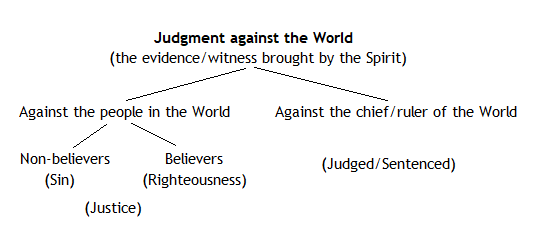
The Spirit testifies regarding this same Judgment (16:8-11), again defined specifically in terms of trust in Jesus, with the sin of humankind understood as a lack of trust.

2. The Destruction of the Temple

The Synoptic “Eschatological Discourse” of Jesus (Mark 13 par) is built upon a prediction, by Jesus, of the destruction of the Temple (Mk 13:2 par). The Temple’s destruction (fulfilled in 70 A.D.) is to be taken as a definite indicator that the end is near (vv. 4, 14, 24, 28-30 par), and with it the return of Jesus and beginning of the great Judgment. However problematic this chronology might be for Christians today, there can be little doubt that the destruction of the Temple was a key eschatological event for believers at the time. I discuss the matter at length in the articles on the Eschatological Discourse, and on the Temple in Jewish and early Christian Eschatology.

The Gospel of John contains nothing like the Eschatological Discourse, nor the prophecy of the Temple’s destruction that features so prominently in it; however, there is a statement regarding the destruction of the Temple (the Temple-saying), in John 2:19, part of the Johannine version of the Temple-action episode (the ‘cleansing’ of the Temple, vv. 13-22):

“Loose [i.e. dissolve/destroy] this shrine, and in three days I will raise it (up).”

This is quite similar to the statement reported at the Sanhedrin interrogation (‘trial’) of Jesus in the Synoptics (Mark 14:57-58 / Matt 26:60-61). There the Synoptic tradition indicates that it was reported by false witnesses; yet, if we accept the authenticity of the Johannine saying (in substance), then it would seem that Jesus did, in fact, make a statement of that sort, however it may have been misrepresented by unreliable or hostile witnesses. Jesus himself does not explain the saying—it is the Gospel writer who gives the explanation, as an aside (vv. 21-22). Many critical commentators assume that Jesus’ statement, in its original context, was eschatological, very much along the lines of the prediction in Mark 13:2 par—i.e., the destruction of the Temple marks the end of the current Age, and God, through his Anointed Jesus, would introduce a new Temple in the New Age. To the extent that such a view is correct, the eschatological aspect, in the Johannine version, has been transformed into a Christological statement, the Temple being identified with the person of Jesus. Thus, any eschatological significance for the saying follows the present, “realized” emphasis that dominates throughout the Gospel of John—the death and resurrection of Jesus marks the end of the current Age, and a New Age for believers, realized through the Spirit.

3. The “Son of Man” saying in John 1:51

There are relatively few “Son of Man” sayings in the Gospel of John, compared with the Synoptics, and those which do occur, tend to emphasize the death and resurrection of Jesus (cp. Mk 9:12, 31; 10:33 par), rather than his end-time appearance—cf. 3:13-14; 6:27, 53, 62; 8:28; 12:23, 34; 13:31. Only in 5:27 do we find the clear eschatological context of the Son of Man overseeing the end-time Judgment.

The “Son of Man” saying in 1:51 is perhaps the most enigmatic verse in the entire Gospel. It has been interpreted many ways, including as an eschatological reference—that is, to the end-time appearance of the Son of Man (Jesus) in glory. There are certainly elements of this saying that resemble several eschatological Son of Man sayings in the Synoptics:

“Amen, Amen, I say to you—you will see [o&yesqe] the heaven opened up and the Messengers of God stepping up and stepping down [i.e. ascending and descending] upon the Son of Man” (Jn 1:51)

Matthew’s version (16:27-28) of a core Son of Man saying in the Synoptic tradition (Mk 8:38; Lk 9:26) begins: “For the Son of Man is about to come in the glory of his Father with his Messengers [i.e. Angels]…” and concludes with the specific formulation:

“…there will be some of the (one)s having stood here who should not taste death (themselves) until they should see [i&dwsin] the Son of Man coming in his Kingdom” (note the parallel in Lk 9:27: “…until they should see the Kingdom of God”, and also Lk 23:42 v.l.)

Several points should be made about the context and significance of this Synoptic passage:

    • The reference is to the end-time Judgment, and (in the developed Gospel tradition) to the parousia (or second coming) of Jesus.
    • It is positioned directly between Peter’s confession and the Transfiguration (a vision of Jesus in glory witnessed by several of the disciples). Moreover, in both Synoptic tradition and Jn 1:19-51, the Son of Man saying follows soon after Jesus gives Peter his new name (Matt 16:18; Jn 1:42).
    • The Son of Man is associated with Angels in a number of sayings, all eschatological and emphasizing the end-time Judgment—Matt 13:41ff; 16:27 par; 24:30-31 par; 25:31; Luke 12:8-9; cf. also Matt 4:6 par; 26:53.

I discuss these and other aspects of the saying in Jn 1:51 at length in prior notes and articles.

4. The Tradition in John 21:20-23

Our final passage comes from that last chapter (chap. 21,the so-called appendix) of the Gospel of John, and derives from an entirely different (Johannine) line of tradition than the Synoptic material. It relates to the person in the Gospel known as “the disciple whom (Jesus) loved” (13:23; 19:26; 20:2; 21:7, 20ff). The disciple is unnamed (though almost certainly known to the original audience), and identified, according to Christian tradition, as John the apostle, son of Zebedee. Embedded in the brief (traditional) narrative, is a saying by Jesus regarding this disciple, which, we can assume, was a relatively well-known part of the Johannine tradition. The context is clearly eschatological, related to the end-time return of Jesus. The very point being addressed in the tradition more or less proves the imminent eschatology—i.e. that Jesus’ return would occur within the lifetime of the apostles (and first generation of believers)—that was widespread in early Christianity during the first-century. I discuss this passage as part of the earlier study on the imminent eschatology in the New Testament.

Eschatology and the Structure of the Last Discourse

This note is supplemental to the current article on the Gospel of John. The great Last Discourse (13:31-16:33) of the Gospel is built around a major eschatological theme: the departure and return of Jesus. However, the way this theme is developed within the Discourse-sequence is quite complex, operating at two (or three) levels, in terms of the eschatology of the Gospel. Generally speaking, this two-level exposition corresponds with the two aspects of early Christian eschatology—future and present (“realized”). Moreover, as I noted in the article, Jesus’ departure and return can be understood three different ways:

    • Jesus’ immediate return, following his death and resurrection (cf. 20:17-29)
    • His presence in the Spirit, tied to his departure to the Father, and
    • His future return at the end-time

Several of the key passages are discussed in the main article, but I feel it will be helpful to supplement that discussion with a brief analysis of the structure of the Discourse.

The Structure of the Last Discourse (Jn 13:31-16:33)

In an earlier article, I presented a detailed thematic outline of the Last Discourse, which I would divide into three distinct, interconnected discourses, with an introduction and conclusion that relate more directly to the literary (and historical) setting of the Last Supper scene (chap. 13):

    • 13:31-38—Introduction to the Discourse (cf. above)
    • 14:1-31—Discourse/division 1—Jesus’ departure
      • The relationship between Jesus and the Father (vv. 1-14)
      • Jesus’ Words for His Disciples (vv. 15-31)
    • 15:1-16:4a—Discourse/division 2—The Disciples in the World
      • Illustration of the Vine and Branches: Jesus and the Disciples (vv. 1-17)
      • Instruction and Exhortation: The Disciples and the World (15:18-16:4a)
    • 16:4b-28—Discourse/division 3—Jesus’ departure (farewell)
      • The Promise of the Spirit (vv. 4b-15)
      • Jesus’ Departure and Return (vv. 16-24)
      • Concluding statement by Jesus on his departure (vv. 25-28)
    • 16:29-33—Conclusion to the Discourse

In terms of the literary/historical setting of the narrative, the departure of Jesus would refer primarily to his impending death, when he would be separated from his disciples for a short time. To judge by Jesus’ words in 20:17, in context, this departure (in the present) involved a return to the Father (cf. below). The introduction and conclusion to the Discourse seem to refer to the imminent events of his Passion and death:

    • 13:31-38—Announcement of his going away (v. 33), followed by a prediction of Peter’s denial (vv. 36-38, cf. 18:15-18, 25-27 par)
    • 16:29-33—Jesus’ prediction of his disciples being ‘scattered’ (cp. Mark 14:27 par), following the (second) announcement of his going away (vv. 16-17)

Within this framework, Jesus’ departure & return are presented in both future and present (“realized”) aspects. In terms of the handling of the Gospel tradition, this may be outlined as a parallel step-sequence:

PRESENT:

    • Jesus’ departure—his death
      • His return to the Father (unnarrated, cf. 20:17)
        • His return to the disciples, with the coming/bringing of the Spirit (20:19-23)
          • He brings his disciples to the Father, where they dwell together with Him, in the Spirit

FUTURE:

    • Jesus’ departure—leaving the world
      • His return to the Father (unnarrated, cp. Acts 1:9-11 etc)
        • His end-time return to his disciples
          • He brings his disciples to the Father, where they dwell together with Him, in heaven

How is this expressed within the Last Discourse? I believe it is possible to illustrate this by working from the thematic outline above, isolating a multi-level concentric structure that reflects the eschatological development—from traditional to “realized” (i.e., realized in/through the Spirit):

  • His death and return (13:31-38, in/for “a little while” [mikro/n], v. 33)
    • His departure to the Father, with promise of future return (14:1-4ff)
      • His coming again to the disciples in the person of the Spirit (14:15-24ff)
        • His disciples in the world, united with Father and Son in the Spirit (15:1-16:4a)
      • His coming again to the disciples in the person of the Spirit (16:4b-15)
    • His departure to the Father, with promise of future return (16:4bff, 16-24)
  • His death and return (16:16ff, 25-29, in/for “a little while” [mikro/n], v. 16)

The first layer represents the Gospel tradition of Jesus’ death and resurrection, the literary (and historical) setting of the Discourse. The second layer reflects the traditional (future) eschatology—Jesus’ end-time return in glory, parallel with his exaltation to heaven (at God’s right hand). The third, inner layer represents the “realized” eschatology so prominent and important to the theology of the Discourses. And, at the center of the great Discourse, is the central theme of believers living in the world, while not belonging to the world, united with God the Father and Jesus the Son through the presence of the Spirit; this is expressed primarily by way of the Vine/Branches illustration of 15:1-17.

Notes on Prayer: Jn 17:24-26 (continued)

This note is supplemental to the recent “Monday Notes on Prayer” series, in which I went through the great Prayer-Discourse of Jesus in John 17. In the last study of that series, we examined the concluding verses 24-26, but it remains to go into a bit more detail on the final vv. 25-26, to see how Jesus’ words serve to bring out and summarize many of the themes that run throughout the Discourses.

Verse 25

One important point to make is that there is a strong eschatological context to verses 24-26, even though that may not be immediately obvious to the average reader. To begin with, let us consider again the first address and petition to God the Father in verse 24:

“Father, (for) that which you have given to me, I wish that where I am those also [i.e. believers] would be with me, (so) that they would look upon my honor which you have given to me, (in) that you loved me before the casting-down [i.e. founding] of the world.”

In the setting of the Last Discourse and the Prayer of chap. 17, Jesus is about to depart and return back to the Father; the fundamental emphasis, then, of the wish that believers “would be with” him, is eschatological—i.e. that they/we would be with him in heaven, alongside the Father. This heavenly (and eternal) dimension is described two ways:

    • The Divine glory (do/ca, honor/splendor) which Jesus, as the Son, shares with the Father, and
    • Divine pre-existence, understood, as in verse 5, in relation to the creation of the world (ko/smo$)

When Jesus returns to his disciples (believers) again, it will be to take them with him to the Father (14:1-3). This is a basic early Christian belief, attested at numerous points in the New Testament (cf. especially Mark 13:26-27 par, and 1 Thess 4:16-17). However, in the Gospel of John, and in the Discourses in particular, this traditional eschatology is enhanced (and supplemented) by a distinct kind of “realized” eschatology, in which the things to be experienced by the righteous at the end-time are already realized now, in the present, for believers in Christ. This “realized” eschatology is central to the message of the Last Discourse, and is rooted in the idea of the coming (and presence) of the Paraclete/Spirit (discussed further below).

If this two-aspect eschatology relates to what believers experience—including eternal life (lit. “Life of the Age”) and the vision of God (emphasized here in v. 24)—it also applies to the Judgment which believers must pass through. This Judgment separates the righteous (believers) from the wicked (the “world”, ko/smo$); while traditionally, this occurs at the end-time, according to Jesus’ teaching in the Johannine Discourses, believers already experience the reality of it in the present—i.e. they/we have already passed through the Judgment. How has this occurred? It is stated most clearly in 5:24:

“Amen, amen, I relate to you that the (one) hearing my word [lo/go$] and trusting in the (One) having sent me holds (the) Life of the Age, and he does not come into (the) Judgment, but has stepped across out of death (and) into Life”.

This is very much what Jesus refers to in the conclusion to his Prayer (v. 25) as well. The manner of his address (“Just/Righteous Father”, Path\r di/kaie) suggests God the Father’s role as Judge and administrator of Justice, and that the idea of the Judgment is in view. The petition serves to bring to a climax the dualistic theme of contrast between Father/Son/Believers and the World (ko/smos). The traditional concept of God judging the world here is re-interpreted in relation to trust in Jesus, an emphasis we find repeatedly in the Gospel, going all the way back to the Prologue (1:5, 10-13). It is stated perhaps most succinctly in 3:17-21, a passage which can be compared with the close of chapter 17; note several points of comparison:

    • God the Father sends Jesus (the Son) so that the world might be saved through trust in him (3:16-17)
      • Disciples/Believers are sent by Jesus so that the world might come to know and trust (17:20-23)
    • The salvation of the world = “all those who trust”, i.e. all believers (“every one [pa=$] trusting in him”) (3:16)
      • Similarly the “world” trusting and knowing = the elect (believers) who are “in the world” but have not yet come to trust/know; once they come to faith, then the believers will “all” be one (17:20-23)
    • Judgment takes place in relation to trusting in the Son (Jesus); those who do not trust are (already) condemned because they cannot see (i.e. know) the truth (3:18-21)
      • The separation between believers and the “world” (now understood as the wicked/unbelievers) occurs on the basis of knowing (i.e. seeing) the Son, and through him, God the Father (17:25)

The last point, in particular, is a key theme in the Last Discourse, beginning with the dialogue in 14:5-10ff—one sees God the Father through the Son—and the same point is made in v. 24 of the Prayer (cf. above). We should pay attention to precise way the Judgment theme is brought out in verse 25:

“Just/Righteous Father, indeed, the world did not know you, but I knew you, and these [ou!toi, i.e. believers] knew that you se(n)t me forth”

The dualistic contrast, between Believers and the World, here takes the form of a chiasm:

    • the world did not know [ou)k e&gnw] you
      • but I knew [e&gnwn] you
    • believers (“these”) did know [e&gnwsan]…

Embedded in this very structure is the key theological point of the entire Gospel: that one knows God the Father through trust in Jesus (the Son). This is emphasized again in terms of what the believers (“these”) know. Jesus does not say “these knew you” (par. to “but I knew you”); rather, he says “these knew that you sent me forth“. In other words, what believers “know” is centered in the relationship between God the Father and Jesus the Son of God, as is clear from the theological formula included in the opening of the Prayer (v. 3). It also confirms the distinctive sense of the word ko/smo$ (“world”) in vv. 20-23, where, as I argued in an earlier study, it means the Elect/Chosen ones (believers) living “in the world” who have not yet come to trust in Jesus. Throughout the Johannine writings, ko/smo$ refers to a realm of wickedness and darkness that is opposed to God, which characterizes the current “world-order”. In vv. 21, 23, the focus is on believers dwelling in this wicked realm, while in v 25 it is the wicked (unbelievers) themselves who are in view.

Verse 26

The key Johannine motif of knowledge, knowing, in verse 25 is expanded upon by Jesus in v. 26; at the same time, the traditional future eschatology (first aspect, cf. above) gives way to a present “realized” eschatology (second aspect). The idea of believers separating from the world, and passing through the Judgment (implied) to see the glory of God in heaven, now shifts to the union believers have with God in the present. It is worth examining each component, or phrase, of this verse in some detail. To begin with, v. 26 is part of a single sentence with v. 25, marked by the conjunction kai/ (“and”):

“and I made known your name to them” (kai\ e)gnw/risa au)toi=$ to\ o&noma/ sou)—On the surface, this simply restates what Jesus already said earlier in the Prayer (v. 6, also 11-12), that, through his work on earth (as the incarnate Son), he revealed the Person and Presence of God the Father to the Elect/Chosen ones (disciples/believers), a process that will continue as those believers, in turn, proclaim and reveal the message of Jesus to others. However, it is the positioning of this phrase which is distinctive here—first, in relation to the previous phrase in v. 25:

    • “these knew that you sent me forth,
      and I made known to them your Name”

We might have expected a reverse sequence—i.e. they came to know because Jesus made the Father known to them—but this is contrary to the basic theological outlook of the Gospel of John, in which believers come to know because they are the Elect,  they already belong to God. And, because they belong to God, and God the Father gives them to the Son, they are able to recognize the truth of who Jesus is; and, as they become disciples (believers), Jesus then is able to reveal the Father to them.

Secondly, we must read it in connection with the phrase that follows:

    • “and I made known to them your Name,
      and I will (yet) make (it) known”

“and I will (yet) make (it) known” (kai\ gnwri/sw)—Here we have implicitly a key theme from the Last Discourse: that of the coming of the Paraclete/Spirit, who will continue Jesus’ work after his departure back to the Father. I have pointed out several times in the prior studies that, though the Spirit is not specifically mentioned in the Prayer, the idea is certainly present, and is to be inferred throughout. Note this revelatory aspect of the Spirit’s work from the statements in the Last Discourse:

    • “this is the Spirit of Truth which the world is unable to receive, (in) that it does not look upon him and does not know; but you know him…” (14:17)
    • “…(he) will teach you all (thing)s and will place under memory (for) you all (thing)s which I said to you” (14:26)
    • “…that (one) will witness about me, and you also will witness…” (15:26-27)
    • “…he will lead the way (for) you into all truth; for he will not speak from himself, but what (thing)s he hears he will speak…” (16:13)

Through the Spirit, Jesus himself will be speaking to believers, and that it is ultimately God the Father’s word that he speaks, making the Father known:

“…he will receive out of (what is) mine, and will give (it) up as a message [i.e. announce it] to you. All things what(ever) that the Father holds are mine; through this I said that he will receive out of (what is) mine and will give (it) up as a message [i.e. announce it] to you.” (16:14-15)

“(so) that the love (with) which you loved me would be in them” (i%na h( a)ga/ph h^n h)ga/phsa/$ me e)n au)toi=$ h@|)—The particle i%na here indicates the goal or end result (“[so] that”), and, indeed, it may be justly said to be the desired purpose and result of the entire Prayer. It essentially restates the request for unity that dominated the earlier vv. 20-23, combining two basic motifs:

    • The Son being “in” (e)n) believers
    • This unity reflects the relationship (union) between Father and Son

The final phrase of verse 23 further defines the unity/union believers have with Father and Son in terms of the Johannine theme of love (a)ga/ph):

“…that the world [i.e. the elect/believers in the world] would know that you sent me forth, and (that) you loved them just as you loved me.”

There Jesus asks that believers would know this Divine Love; now he requests that the Love be “in” (e)n) them. While the Spirit is not associated with love, particularly, in the Gospel of John, it is certainly an association that is part of the Johannine  theology, and is more prominent in the First Letter (see esp. 4:7-21). Love characterizes one who “comes to be (born)” of God, which is very much in accord with the language Jesus uses in relation to the Spirit in Jn 3:3-8 (cf. also 1:12-13). The words of Paul in Romans 5:5 seem to echo, independently, the language in v. 26 of the Prayer:

“…(in) that the love of God has been poured out in(to) our hearts through the Holy Spirit th(at is) given to us.”

“and I in them” (ka)gw\ e)n au)toi=$)—Just as the Love of God is present in us (believers) through the Spirit, so also is Jesus himself personally present in us. The parallelism is precise:

    • “the love…in them”
      “and I in them”

Ultimately, this is the central theme of the Last Discourse: that Jesus (the Son) will remain united with believers, dwelling in and among us, through the presence of the Spirit. It is also the climactic message of the Prayer, and, indeed, ought to be the central focus of every prayer we make to God the Father. In this regard, and in closing, consider the Lukan context of the Lord’s Prayer (teaching on prayer, 11:1-13), which begins with the Prayer itself (vv. 2-4), but ends with an emphasis on Jesus’ disciples asking God the Father specifically for the Holy Spirit (v. 13).

“…Spirit and Life”: John 17:3-4

John 17:2-3

Today’s note comes from the great prayer-discourse (chap. 17) which concludes the “Last Discourse” (for more on this passage, cf. the current “Prayer Notes” series). At the beginning of this section (vv. 2-3), we find the most precise definition of the expression “Life of the Age [zwh/ ai)w/nio$]” (i.e. eternal life) in the Gospel. It also happens to be one of the most “gnostic”-sounding statements in the New Testament; indeed, I discus this aspect of the passage at length in the series “Gnosis and the New Testament” (soon to be posted here. Here are verses 1b-2 in translation:

“Father, the hour has come—give honor to your Son (so) that your Son might give honor to you, even as you gave him authority [e)cousi/a] o(ver) all flesh, (so) that, (for) all (person)s, whom(ever) you have given to him, he should give to them (the) Life of the Age.”

This repeats the idea, expressed at numerous points in the earlier discourses, that the Father gives Life to the Son, and the Son, in turn, gives Life to believers. For the background of the specific expression “Life of the Age”, cf. the earlier notes in this series, as well as the notes on Jn 11:20-27. Verse 2 also expresses the idea that believers (elect/chosen ones) have been given to the Son by the Father (vv. 6ff). The definition of “Life of the Age” comes in verse 3:

“And this is the Life of the Age: that they should know you, the only true God, and the (one) whom you se(n)t forth, Yeshua (the) Anointed.”

This formulation, specifically referring to “Yeshua the Anointed [i.e. Jesus Christ]”, sounds very much like an early Christian credal statement; and, in fact, many critical commentators view it as a product of the Gospel writer, rather than a self-referential statement by Jesus himself. It is certainly possible to view verse 3 as a parenthetical comment by the writer—indeed, one can read verse 4 directly after v. 2 without any real disruption or loss of meaning. However one views the composition of verse 3, the value and significance of it as a definition of “the Life of the Age” is clear—and it is defined in terms of knowledge:

    1. of the only true God (i.e., God the Father, YHWH):
      “they should know you, the only true God”
    2. of the one sent forth by God (Jesus–Yeshua the Anointed):
      “(they should know) the (one) whom you sent forth…”

In terms of obtaining this knowledge, and thus possessing (“holding”) eternal Life, the order has to be reversed (cf. 1:18; 14:6-11, etc):

    1. One sees/knows Jesus (the Son)—i.e. recognizes and trusts in him
    2. One sees/knows God the Father through the Son

The theological framework of the Gospel of John can be outlined in more detail:

Thus the emphasis on knowledge in 17:3 can be misleading, if we think of it in terms of ordinary human knowledge and perception. Rather, in the Gospel of John, and much of the New Testament elsewhere, a deeper kind of theological and spiritual understanding is meant—centered on trust in Jesus and the presence of both the Son (Jesus) and the Father through the Holy Spirit. The Spirit is not mentioned directly in the prayer-discourse of chapter 17, but it can be inferred from the theme of unity (esp. verses 20-24) and the triadic relationship of Father-Son-Believer(s):

Mention should be made of the specific title xristo/$ (“Anointed [One]”). Though the Johannine portrait of Jesus goes far beyond the traditional Jewish conception(s) of the Anointed One (Messiah), it retains the title and the fundamental identification of Jesus with the Messianic figure-types—Prophet, Davidic Ruler, and also “Son of Man” (on these, cf. the series “Yeshua the Anointed”). The association of the titles “Anointed One” and “Son of God” goes back to the early Gospel traditions (in the Baptism and Passion/crucifixion scenes, etc), and, while the latter title (i.e. Jesus as God’s Son) dominates the Gospel of John, the former is certainly not forgotten. True knowledge of Jesus—the knowledge which is the same as Life—includes recognition that he is the Anointed One of God. The closing words of the Gospel proper give unmistakable expression to this fact:

“These (thing)s have been written (so) that you might trust that Yeshua is the Anointed One, the Son of God, and that, trusting, you would hold Life in his name.” (20:31)

“…Spirit and Life”: John 16:7-15

John 16:7-15

The fourth (and final) reference to the Spirit/Paraclete in the Last Discourse is the most extensive, and comes from the third part or division of the Discourse (cf. my earlier outline of the Discourse):

    • 16:4b-28—Discourse/division 3—Jesus’ departure (farewell)
      • The Promise of the Spirit (vv. 4b-15)
        • Initial statement by Jesus on his departure (vv. 4b-7a)
        • The Coming of the Spirit (vv. 7b-11)
        • Concluding statement by Jesus on his departure (vv. 11-15)
      • Jesus’ Departure and Return (vv. 16-24)
        • Initial statement by Jesus on his departure (v. 16)
        • Question by the disciples (vv. 17-18)
        • Jesus’ response: The Promise of his Return (vv. 19-24)
      • Concluding statement by Jesus on his departure (vv. 25-28)

Each of the three main divisions deals with the central theme of Jesus’ departure. Though the Last Discourse is set in the narrative prior to Jesus’ death, much of it has a post-resurrection orientation—that is, it refers primarily to Jesus’ ultimate return back to the Father. This is important for a proper understanding of the Spirit/Paraclete passages. As I indicated in the previous notes, the main role and significance of the para/klhto$ is that he represents the presence of both Jesus (the Son) and God the Father in and with the believer. Primarily, it is the presence of Jesus himself which is emphasized. Once Jesus has returned to the Father, his presence will continue through the Spirit, and this presence will continue “into the Age”—i.e., until the coming of the final Judgment and the new/future Age.

The first section of this division—16:4b-15—deals specifically with the Spirit/Paraclete, prefaced by a restatement of Jesus’ impending departure (vv. 4b-6). This establishes the context for verse 7:

“But I relate the truth to you: it bears together (well) for you that I should go away from (you); for, if I should not go away from (you), the one called alongside [para/klhto$] will not come toward you, but if I travel (away) (then) I will send him toward you.”

This coming of the Spirit represents the deeper meaning of Jesus’ promise that the disciples (and all believers) will see him again. On the surface, this promise more obviously relates to a post-resurrection or future appearance; however, in the context of Johannine theology, and the language of the discourses, where seeing Jesus is the same as knowing/recognizing him, the experience of the Spirit is a true fulfillment of the promise.

The Role of the Spirit/Paraclete in 16:7-15

The role of Spirit/Paraclete is described by Jesus in vv. 8-15, and it follows upon the theme of bearing/giving witness (15:26-27). There the emphasis was specifically on giving witness of Jesus—who he is and what he has said/done—expressed in terms of the Spirit’s role in the disciples’ (and other believers’) witness. Here, the scope of the Spirit’s witness has broadened, in the (eschatological) context of Judgment:

“And, at his coming, he will bring the world to shame/disgrace about sin and about justice and about judgment” (v. 8)

I have translated the verb e)le/gxw here rather literally; however, it is important to note that, in the New Testament, there is usually a legal and ethical connotation to its use—i.e., to expose (sin) and convict a person (of wrong), often with the religious aspect of bringing one to repentance. The “realized” eschatology found throughout the Johannine discourses means that the Spirit fulfills this role in God’s Judgment now, in the present time. Presumably this is done through the inspired witness and teaching of believers (following the train of thought in 15:26-27), though this is not specified here (but note vv. 12ff). In verses 9-11, each of the three subjects (governed by peri/, “about”) are clarified:

    • “about sin [a(marti/a$]—in that they do not trust in me” (v. 9)
    • “about justice/righteousness [dikaiosu/nh]—in that I lead (myself) back toward the Father and you do not see/observe me any longer” (v. 10)
    • “about judgment [kri/si$]—in that the chief/ruler of this world has been judged” (v. 11)

I have always found the logic of this three-fold exposition a bit difficult to follow; it appears to be somewhat inconsistent in its point of reference. However, some confusion is removed, I think, if we realize that it does not so much reflect three parallel elements, as it does a two-part division. I would summarize this as follows:

The evidence brought in judgment against the people in the world follows the basic dualism of the Gospel—believer/non-believer, righteousness vs. sin, etc. Those who belong to the world (non-believers) are governed by sin and darkness, while those who belong to God and Christ by righteousness and light. The situation regarding non-believers is stated simply: “they do not trust in me”. For believers, it is more complex—how is justice/righteousness revealed or made manifest? This is expressed differently, in terms of the very dynamic Jesus is describing in the Discourse: “I lead (myself) under [i.e. go back] toward the Father, and you do not see me any longer”. In other words, the Spirit takes Jesus’ place, as we have already discussed—this is the primary aspect of the Spirit’s witness for believers. It is also the theme of the closing verses (12-15) of this section:

“I hold yet many (thing)s to say/relate to you, but you are not able to bear (them) now; and (yet) when that (one) should come—the Spirit of Truth—he will lead the way for you in(to) all truth…” (vv. 12-13a)

This follows the declarations in 14:25-26 and 15:26-27, but with a more general emphasis on the Spirit’s guidance—he will lead the way into all truth. The basis for this guidance, and the truth which the Spirit possesses, is his distinctive relationship to Jesus (the Son) and God the Father, as expressed throughout the discourses, and again here:

“…for he will not speak from himself, but (rather) whatever (thing)s he shall hear, (those) he will speak and will give a message to you up(on) the (thing)s coming” (v. 13b)

This is precisely parallel to Jesus’ relationship to the Father—he (the Son) speaks only what the Father gives him to say. The Spirit has the same relation to Jesus (the Son)—

“That (one) will give honor to me, (in) that he will receive out of the (thing)s (that are) mine and will give a message up(on them) to you” (v. 14)

which is set clearly in context in the closing declaration:

“All (thing)s whatever that the Father holds are mine—through this [i.e. because of this] I said that he receives out of the (thing)s (that are) mine and will give a message up(on them) to you.” (v. 15)

The Father gives to the Son, the Son then gives to the Spirit, who, in turn, gives to believers. The three-fold chain—Father-Son-Believer—is expanded to four:

Father–Son–Spirit–Believer

“…Spirit and Life”: John 14:25-26; 15:26-27

John 14:25-26; 15:26-27

In this note, I will be examining the second and third references to the Spirit in the Last Discourse. The meaning of the word para/klhto$ and its identification with the Spirit were discussed in the previous note (on 14:16-17), along with the primary significance of the “one called alongside”—the abiding presence of both Jesus (the Son) and God the Father in and with the believer, a presence which will last “into the Age”. In the three references which follow—14:25-26; 15:26-27 and 16:7-15—Jesus provides more detail as to the role and work of the Spirit/Paraclete, and the kind of help/assistance which the he will provide on behalf of believers. In discussing these two passages, I wish to explore two key aspects:

    1. The relationship between Jesus and the Father in the sending of the Spirit/Paraclete, and
    2. The specific role/action of the Spirit/Paraclete

1. With regard to this first point, there can be a good deal of confusion: is it the Father or Jesus (the Son) who gives/sends the Spirit? Let us look at how this is described in each of the passages, beginning with the two under discussion today:

    • “…the one called alongside [para/klhto$], the holy Spirit, whom the Father will send in my name” (14:26)
    • “…the one called alongside [para/klhto$], whom I will send (from) alongside the Father, the Spirit of Truth…” (15:26)

There is even more variation if we include all four passages:

    • “I will ask (of) the Father and He will give…” (14:16)
    • “the Father will send in my name…” (14:26)
    • “I will send (from) alongside the Father…” (15:26)
    • “I will send (him)…” (16:7)

How are we to understand this interrelated dynamic—the involvement of both Father and Son (Jesus) in sending/giving the Spirit? To begin with, the ultimate source of the Spirit/Paraclete is God the Father, as is clear from 15:26: “…the Spirit of Truth which travels out [e)kporeu/etai] (from) alongside the Father”. This is also confirmed by the progression indicated in the four passages:

    • The Father gives (at Jesus’ request)—sole/primary action of the Father
    • The Father sends in Jesus’ name—primary action of the Father
    • Jesus sends from the Father—primary action of Jesus
    • Jesus sends—sole/primary action of Jesus

This transference reflects the basic theological model in the Johannine discourses—the Father gives to the Son (Jesus), who, in turn, gives to believers. This is expressed most precisely in 5:26:

“For just as the Father holds Life in himself, so also he gave to the Son to hold Life in himself”

Life and the Spirit are virtually synonymous in the Gospel of John, and this same relational dynamic is expressed, in terms of the Spirit, in 3:34-35:

    • “The Father…has given all things in(to) the (Son’s) hand” (v. 35)
    • “The (Son) God (the Father) sent…gives the Spirit” (v. 34)

2. The role and work of the Spirit/Paraclete is expressed by Jesus in both of these passages, which are closely parallel with each other:

“These things I have spoken (while) remaining alongside you, but the one called alongside, the holy Spirit, whom the Father will send in my name—that (one) will teach you all (thing)s and will put under your mind/memory all (the thing)s that I said to you.” (14:25-26)

“When he should come, the one called alongside, whom I will send to you (from) alongside the Father—the Spirit of Truth who travels out (from) alongside the Father—that (one) will give witness about me, and you also will give witness…” (15:25-27)

Thus there are two roles the Spirit/Paraclete will have for believers:

    • To teach them all things, and especially to help them remember the things which Jesus himself has taught them
    • To give/bear witness about Jesus—that is, through the disciples (believers), as is clear from verse 27 (cf. also Mark 13:11 par; Luke 12:12; Acts 4:8, 31; 6:10; 7:55, etc)

There is a tendency, perhaps, to limit these (esp. the first) to the disciples (apostles), but this is unwarranted; the Last Discourse, and, indeed, all of Jesus’ teaching in the discourses, can be taken as applying to all believers. The role of the Spirit teaching believers “all things” is confirmed by the similar (Johannine) statement in the first Letter (1 Jn 2:27):

“And the anointing which you received from him [i.e. Jesus] remains on/in you, and you have no business [i.e. need] that any one should teach you; but (rather), as the anointing (from) him teaches you about all things and is true, and is not a lie, and even as it/he taught you—remain in him.”

This corresponds precisely with what Jesus says of the Spirit/Paraclete in 14:26. The function of bearing witness will be developed further in the final passage in the Last Discourse (16:7-15), to be discussed in the next note.