“…the things about the Kingdom of God”

“…through forty days being seen by them and speaking of the things about the Kingdom of God.”
(Acts 1:3)

Many of the notes and articles on the New Testament posted here reference the Kingdom of God—especially as the expression occurs in the sayings, parables, and teachings of Jesus in the Gospels. I thought it worth devoting a separate article to look at this idea of the Kingdom of God (h( basileia/ tou= qeou=). The subject is so vast, however, that even this can only serve as an introductory study. It will be structured as follows:

    1. A survey of New Testament references, particularly the sayings of Jesus in the Synoptic Gospels.
    2. A brief examination of eschatological aspects of the concept, especially related to the “restoration of Israel” (Acts 1:6)
    3. A glance at the unique tension which appears to exist between present and future aspects of the Kingdom concept in the New Testament

1. A Survey of New Testament References

The list which follows here is more or less exhaustive, though one could no doubt find additional passages which use other relevant royal language or imagery, or where the Kingdom may be implied. Also, I have made no attempt to address any significant textual variants or text-critical issues in these passages.

References in the Synoptic Gospels:

References to the Kingdom (Christ as King, etc.) in the Gospel of John:

References to the Kingdom (Christ as King, etc.) in the Book of Acts:

  • Specific references to the Kingdom (of God):
    • Acts 1:3 – Reference to Jesus speaking about the Kingdom of God following his resurrection
    • Acts 8:12 – Reference to preaching the “good news about the Kingdom of God” (see above)
    • Acts 19:8; 20:25; 28:23, 31 —References to Paul proclaiming, testifying ,etc. to the Kingdom (of God)
    • Acts 14:22—”enter the Kingdom of God” (in description of Paul speaking to disciples in Antioch)
  • “Lord, in this time will you restore the kingdom to Israel?” (Acts 1:6)
  • Acts 17:7: reference to Jesus as “another king” besides Caesar
  • References to Christ (or the Son of Man) at the right hand of God (see also above): Acts 2:25, 33-34; 5:31; 7:55-56

References to the Kingdom (Christ as King, etc.) in the Pauline Epistles (both undisputed and disputed):

References to the Kingdom (Christ as King, etc.) in the remaining Epistles (Hebrews–Jude):

References to the Kingdom (Christ as King, etc.) in the book of Revelation:

Even a brief examination of the passages referenced above indicate that the Kingdom (of God) is a relatively wide-ranging concept. I would isolate four basic senses of the term in the New Testament:

  1. The eternal rule of God (in Heaven)
  2. An eschatological Kingdom (on earth), which can be understood in two different aspects:
    a. An absolute sense: New heavens and new earth (preceded by judgment on the World)
    b. A contingent sense: Messianic kingdom (preceded by judgment of the Nations)
  3. The presence of Christ—His life, work and teaching, death and resurrection
  4. The presence of God/Christ (through the Spirit) in the hearts, minds, and lives of believers

The fundamental idea informing the phrase “Kingdom of God” is that of the rule of God—that is, His governing power and authority—coming to be present, or made manifest, on earth, in a manner beyond what one sees in the natural order of things.

If one examines the references from the New Testament Epistles (see above), senses #1 and 4 appear to dominate, with the following points of emphasis:

    • The Kingdom is of God and of Christ—He rules in Heaven at the right hand of God (from whence he will come to judge the world)
    • The theme of believers inheriting/entering the Kingdom, also found in Jesus’ teachings (see above), is related to life in Christ through the prevailing power of the Spirit and the promise of salvation from the Judgment to come

References in Acts generally follow those in the Synoptic Gospels (especially in Luke), so it is necessary to examine these—the vast majority of which are found in recorded sayings and parables of Jesus. With regard to these sayings and parables, an introductory notice is required:

Traditional-conservative commentators generally regard the sayings/parables as accurately reflecting Jesus’ words (translated into Greek and with minimal modification). Critical scholars, on the other hand, tend to view the matter differently: many of the sayings, to greater or lesser extent, are effectively products of the early church, and to judge them several key “criteria of authenticity” have been developed. I neither reject nor disregard these critical analyses; however, for the purposes of this study, I assume that the sayings in the Synoptic Gospels are authentic in substance—if not always the ipsissima verba, then at least the ipsissima vox.

One can examine all of sayings and parables, according to the detailed list above. In addition, I will here group them into several categories:

  • Sayings where the subject refers to those who hear Jesus’ words—particularly the disciples (lit. “learners”) and others who would follow him.
  • Sayings where the subject primarily (or effectively) refers to God’s action (or Christ as God’s representative)
  • Sayings which reflect the mysterious nature or “secret” of the Kingdom
a. Sayings centered on the disciples, etc.—in relation to the Kingdom

This comprises the bulk of references, including those which speak of seeking, receiving, inheriting or entering the Kingdom, as well as passages related to the status of those in the Kingdom, those who act/suffer for the sake of the Kingdom, and so forth. In particular, one should note the number of sayings centered on:

  • Entering the Kingdom:
    Matt. 5:20 – justice/righteousness must surpass that of scribes/Pharisees
    Matt. 7:21 – only those who do the will of the Father in Heaven
    Matt. 8:11 – Gentiles who trust (in Christ, implied), cf. par. Luke 13:28-29
    Matt. 18:3 – one must come to be as children (cf. Mark 10:15)
    Mark 9:47 par. – avoid/eliminate sin (cut off the offending eye, etc.)
    Mark 10:23-25 par. – difficulty of entering (especially for those with earthly wealth/riches)
    Matt. 21:31 – ‘sinners’ will enter ahead of key religious leaders (chief priest and elders, in context)
  • Receiving the Kingdom:
    Mark 4:11 par. – disciples have been given (de/dotai perfect passive) the secret of the Kingdom
    Mark 10:15 par. – must receive/accept the Kingdom as a little child (or will not enter)
    Matt. 21:43 – Kingdom will be taken away from rebellious/violent (parable of the Tenants) and given to a(nother) people
    Also:
    Matt. 16:19 – “keys of the Kingdom (of Heaven)” given (“I will give”) to the disciples (Peter, following his confession of belief)
    Luke 12:32 – God as subject to give the Kingdom to disciples (context of seeking the Kingdom, v. 31); cf. also Luke 22:29-30
  • Inheriting the Kingdom:
    Matt. 25:34 – those who act with love and mercy to the hungry, sick, stranger, etc.
    Matt. 5:3, 10 – the ‘poor in spirit’ and those persecuted for the sake of righteousness (inheritance implied: “theirs is the Kingdom…”); these two verses encompass all the Beatitudes
    Matt. 13:38ff – inheritance implied (“children of the Kingdom”), righteousness indicated (v. 43); cf. also Matt. 8:11-12
    See also Mark 10:14 par. – disciples must be as little children: “for the Kingdom of God is of such [as this]

Note the strong ethical dimension (righteousness/justice) to many of these passages; but also an emphasis on trust (“faith”) in Christ [implied], along with humility, mercy, etc. These very themes, along with the language of entering/inheriting the Kingdom would become an important part of early Christian parenesis and ethical instruction.

b. Sayings centered principally on God’s action, in relation to the Kingdom

Here I would include most of the general references to Jesus and the disciples preaching/proclaiming the Kingdom, as related to the basic message that the Kingdom is coming or has “come near”.

  • The Kingdom “has come near”: Mark 1:15 par.; Luke 10:9, 11 par.; Luke 21:31; cf. also Mark 3:2.
    In all of these passages the Kingdom is the subject, and the verb h&ggiken (perfect active of e)ggi/zw “come near, approach”), except for Luke 21:31 which uses the related adverb e)ggu/$ (“near”). Other passages imply an imminent coming of the Kingdom—e.g., Mark 9:1 par. (perfect participle of e)rxomai); Luke 19:11.
  • The Kingdom coming:
    • Matt. 6:10; Luke 11:2 – Lord’s Prayer: “let your Kingdom come (e)lqe/to, aorist imperative)”
    • Matt. 12:28; Luke 11:20 – Jesus’ miracles: “if in/by the Spirit of God I cast out the daimons, then (truly) the Kingdom of God has come suddenly upon you”. The verb translated “has come” is e&fqasen (aorist). Luke reads “finger of God” instead of “Spirit of God”.
    • Luke 17:20-21 – Pharisees’ question “when comes (e&rxetai) the Kingdom of God?” with Jesus’ reply: “the Kingdom of God comes not with parath/rhsi$ [lit. ‘watching alongside’, i.e. careful/attentive watching]”
    • Luke 22:18 – Last Supper: “now I will not drink from th(at which) comes-to-be [i.e. fruit] from the vine until the (time in) which the Kingdom of God should come (e&lqh, aorist subjunctive)”
    • For other Gospel references related to a coming/expected Kingdom, see Mark 11:10 par.; 15:43 par.; Luke 2:25, 38, as well as Jesus’ eschatological sayings and parables.
  • God giving the Kingdom (to believers/disciples):
    • Mark 4:11 par. – ” to you has been given (de/dotai, perfect passive) the secret of the Kingdom of God”
    • Luke 12:32 – “your Father thought it good to give (dou=nai, aorist infinitive) you the Kingdom”
    • Matt. 21:43 – “the Kingdom of God shall be carried (away) from you [the ‘wicked tenants’] and shall be given (doqh/setai, future passive) to a nation producing its fruits”
    • Luke 22:29f – “and I assign [lit. set through; present middle] to you, even as my Father has assigned [aorist middle] to me, a Kingdom…”
    • See also Luke 19:12, 15; Matt. 16:19; and Mark 10:15 par.

The range of meanings here in these passages is complex and fascinating, as are the tenses of the verbs involved:

    1. References to the Kingdom “coming near” typically use the same perfect form: h&ggiken (“has come near”)
    2. Other references to the Kingdom “coming” (e)rxomai, but also other verbs) tend to be in the aorist.
    3. References to God “giving” the Kingdom cover past (perfect/aorist), present and future.
c. Sayings centered on the (mysterious) nature of the Kingdom

These include many (or most) of the Parables: especially the Markan (4:26-32 & par.) and first Matthean (13:24-52, one par. in Luke) groups, as well as the triple-attested parable of the Sower (Mark 4:3-9, 14-20 & par.). Here images from daily life are used to represent and symbolize the mysterious and ineffable working of the power and presence of God (i.e. the Kingdom). Embedded in many of these one also finds the image of people searching or working in response to the Kingdom’s presence (symbolized by seed, pearl, hidden treasure, etc); one also finds at times an eschatological reference (cf. the parable of the Net, Matt. 13:47-50, etc.). The later Matthean parables (18:23-25; 20:1-16; 22:2-14; 25:1-30) are longer narratives, depicting the actions of disciples (or would-be disciples) in relation to the (coming) Kingdom in greater detail. The parables of the Talents/Minas (Matt. 25:14-30; Luke 19:11-27), and the parable of the Wicked Tenants (Mark 12:1-12 par.) all have a clear eschatological context.

A number of sayings also touch on the mysterious nature of the Kingdom, which may also be reflected in the idea of it’s coming suddenly or unexpectedly (cf. Matt. 12:28 par.). As indicated above, Jesus also refers at least once to the “secret[s] of the Kingdom of God” which have been given to believers (Mark 4:11; Matt. 13:11; Luke 8:10).

Perhaps most difficult of all is Luke 17:20-21, which may well combine two originally separate sayings:

20 And being inquired upon by the Pharisees (as to) ‘when comes the Kingdom of God?’ he answered them and said: “The Kingdom of God comes not with close watching, 21 nor shall they utter ‘See here! or (see) there!’ For see—the Kingdom of God is in(side) of you (pl.).”

Pages could be—and have been—written on these verses; as I have discussed them in some detail elsewhere, for the moment I won’t deal with them further here.

Perhaps the thorniest critical question related to the sayings of Jesus is the extent to which he speaks of an eschatological (earthly) Kingdom of God—that is, of a restored Davidic (Messianic) kingdom, along the lines of that hoped for by many of his contemporaries. It is to the eschatological aspect (or aspects) of the Kingdom I will turn next.

Yeshua the Anointed, Part 5: The Kingdom of God

Having examined the idea of Jesus as an Anointed (Messianic) Teacher in the previous article, here I will be looking at one specific (central) theme of Jesus’ teaching—the Kingdom of God. It is not possible to cover all of the aspects of this theme in one relatively short article; I have already addressed certain points and references in some detail in earlier notes and articles, and will cite these below.

The importance of the Kingdom (of God) in Jesus’ teaching is indicated by the fact that, of the approx. 125 occurrences of “kingdom” (basilei/a, basileía) in the Gospels, all but one or two relate to Jesus and his teaching, with more than a hundred recorded in Jesus’ own words. In addition, we may note the following:

  • In the Synoptic tradition, Jesus’ first recorded words of his public ministry are: “the time has been (ful)filled and the kingdom of God has come near” (Mark 1:15; par Matt 4:17).
  • This is also the primary declaration Jesus gives to his disciples when they are sent out (according to Matt 10:7; Luke 10:11).
  • In Luke 4:43, preaching the Kingdom is stated by Jesus as the primary purpose of his ministry travels through Galilee and the surrounding regions—”I was set forth [i.e. sent] from (God) unto this [i.e. for this purpose]” (cf. also Matt 4:23).
  • In the Gospel of Matthew, Jesus’ first recorded words of instruction to his disciples are a declaration (beatitude/macarism) involving the Kingdom of God (Matt 5:3 [also v. 11], par Luke 6:20). For more on this passage, see my series of notes on the Beatitudes.
  • While references to the Kingdom are rare in the Gospel of John, it plays an important role in two key scenes (John 3:3ff; 18:36), set at the beginning and end of Jesus’ ministry (according to the structure of the narrative).

A major difficulty that commentators face when analyzing and interpreting the Kingdom of God in Jesus’ teaching, is that he appears to use “Kingdom” as a multivalent expression in a fairly wide range of contexts. However, I believe that it is possible to separate Jesus’ sayings, teachings and parables on the Kingdom into three formal categories, those which involve:

    1. The Kingdom coming upon the earth
    2. People coming into the Kingdom, and
    3. Descriptions/illustrations of the character and nature of the Kingdom

In terms of the sense in which “Kingdom” is used, again we may divide this into several categories:

    • As God’s dwelling/domain in Heaven
    • As an end-time domain on earth ruled by God(‘s representative)
    • As an expression of God’s rule—the will/law of the King, the character of its citizens, etc

For a fairly thorough survey and outline of references to the Kingdom in the Gospels (and the rest of the New Testament), see my earlier article “…the things about the Kingdom of God“. With regard to Messianic thought in Judaism at the time of Jesus (1st centuries B.C./A.D.), the Kingdom theme is associated with it and expressed several ways:

  • The belief that a future/end-time Anointed (Davidic) ruler will restore the kingdom to Israel, subjugating her enemies and ushering in the Age to Come.
  • The idea of God’s impending end-time Judgment coming upon the earth (the Day of YHWH motif in the Old Testament Prophets). As we have seen, this may involve related traditions of an Anointed Prophet (Elijah) who will come and bring people to repentance prior to the Judgment. A separate strand of tradition (to be discussed) seems to involve an Angelic/Heavenly figure who will come as God’s representative to usher in and oversee the Judgment. By the end of the first century, the Messianic figures of Davidic ruler and Heavenly Judge appear to have merged (attested in at least three strands of Jewish/Christian tradition). The Gospel motifs of “inheriting”, “receiving” and “entering” the Kingdom all stem from the basic concept of the faithful/righteous passing through God’s Judgment.
  • In the Qumran texts, we find the idea that only those who remain faithful to the Covenant—understood as adherence within the Community to the Torah and the words of the “Teacher/Instructor of Righteousness”—will pass through the Judgment of God. The Qumran Community, which almost certainly viewed itself as the faithful of the last days, is to be identified generally with the Kingdom of God (spec. the Covenant)—the law/rule of the Community is essentially the law of the Kingdom. As pointed out in the previous article, this “Teacher of Righteousness” (probably to be identified also with the “Interpreter of the Law”), is a quasi-Messianic figure. In at least two passages, his future/end-time appearance is emphasized, and in one text he is associated specifically with the coming “Anointed (One) of Aaron and Israel”.

Before turning again to the place of the Kingdom in Jesus’ teaching, let us first explore several passages from Jewish writings of the first centuries B.C./A.D. which mention the Kingdom, or are otherwise relevant in this regard:

  • In the Book of Wisdom (Wisdom of Solomon) 6:1-11, the earthly rule of kings is seen as coming from the sovereignty of God; as a result, rulers should follow God’s Law and Wisdom. In 6:20; 10:10, following Wisdom and the way of Righteousness leads one to the Kingdom of God.
  • In Jubilees 23:24-31, as part of a (prophetic) summary of Israelite/Jewish history, according to the Old Testament model, the punishment/judgment of the Exile will ultimately be followed by an age of peace and restoration for Israel, in which God himself will reign (vv. 30-31).
  • The third book of the Sibylline Oracles (Sib Or 3:652ff) prophecies that God will send a king “from the sun” who will subdue the nations (i.e. the Roman Empire) and establish a rule of peace over the world.
  • The 17th of the so-called Psalms of Solomon (Ps Sol 17:3ff) vividly describes the coming of a Davidic Ruler (called Anointed/Messiah) who will come to Jerusalem, subdue the nations, and establish the (Messianic) Kingdom of God on earth.
  • Specific references to the Kingdom of God are rare in the Qumran texts, but at least two are worth noting:
    • The so-called War Rule (1QM, 4QM), which throughout refers to the coming war of the “Sons of Light” (the faithful of Israel, i.e. the Community) against the “sons of darkness” (the nations/unbelievers, especially the Kittim [cipher for Rome, cf. Dan 11:30]). See especially 1QM 1:4f, the hymns in 1QM 10, 12, 14, 19, and the citation of Num 24:17ff in 1QM 11:7ff. Other texts also refer to this end-time battle.
    • The Aramaic 4Q246, inspired by the book of Daniel (and/or its underlying traditions), predicts the coming of a great king (column 1, lines 7-9 [restored]) who will subdue the nations (and bring peace). Parallel to the rise of this ‘Messianic’ figure (called “son of God” and “son of the Most High” col. 2, line 1, cf. Lk 1:32, 35), we find the rise of the People of God (line 4), and the establishment of the everlasting (Messianic?) kingdom of God (lines 5-9).
  • The Testament of Moses 10:1ff describes the end-time appearance of the Kingdom of God, in terms of the great Judgment of God upon the earth, with a new age of peace and dominion for Israel (vv. 8-9).
  • In the Similitudes of Enoch (1 Enoch 37-71), the heavenly “Righteous/Elect One” or “Son of Man” exercises God’s judgment against kings and rulers on earth (cf. 45:3ff; 46:4-6; 52:4-9; 55:4; 61:8-9; 62:3-5ff; 69:27-29); the establishment of a future dominion for the righteous/Israel is indicated in 53:6-7, etc. The contrast between earthly rulers and God as king is expressed in 1 Enoch 63:1-9ff.
  • In 2 Baruch 70-72 the end-time Judgment by God coincides with the coming of the Messiah; chapters 73-74 describe the establishment of the (Messianic) Kingdom of God.
  • In 2/4 Esdras 2:10-14, God’s control over the kingdom of Israel/Judah is expressed. Throughout the core chapters of the book (chaps. 4-13), there are numerous eschatological visions and prophecies of the coming Judgment and the subsequent new Age; especially notable are the description of the ‘Messianic kingdom’ in 7:26ff, the vision and interpretation in chaps. 11-12 (drawing on Daniel 7), and the final vision of chap. 13. The Messianic Kingdom (of God) is presented vividly in 12:22-39.
  • In the Testament of Judah (Christian, but drawing upon earlier Jewish material), God’s control over the kingdom of Israel/Judah is described in chapters 21-22. In 24:1-6, the prophecy of Balaam (Num 24:17ff) is cited (cf. above): “then will the scepter of my kingdom shine forth…and from it will spring a staff of righteousness for the Gentiles, to judge and save all who call upon the Lord” (vv. 5-6).

These passages generally draw upon three distinct traditions from the Old Testament Scriptures:

  1. The coming Day of YHWH, when God will appear to bring Judgment upon the nations of the earth. Perhaps the latest reference to this is found in Malachi 3:1ff, a passage which, as we have seen, proved to have tremendous influence on eschatological/Messianic thought at the time of Jesus.
  2. The kingdom-visions of Daniel 2 and 7—in which a series of earthly empires is ultimately succeed by an everlasting Kingdom (of God) which is given to the People of God (Dan 7:24-27). These motifs are played out in the later visions of chapters 10-12, and the basic motifs—contrasting earthly and Divine rule—are also expressed in the account of Nebuchadnezzar (Dan 4, see esp. the hymn of praise in vv. 34-35), the episode of Belshazzar and the handwriting (Dan 5), the declaration by Darius in Dan 6:26-27, and Daniel’s prayer in chapter 9.
  3. The hope/promise for a coming end-time/ideal Age of peace and security, as described most vividly in the oracles of (Deutero-)Isaiah, as well as elsewhere throughout the Prophets. In Zechariah 9:9-17, the age of peace is brought about by a coming King, making this a seminal prophecy for the subsequent idea of a Messianic Kingdom established by God on earth.

Now let us return to the Kingdom of God as expressed in Jesus’ teaching. It will be useful here, in conclusion, to examine how the three categories of his sayings/teachings on the Kingdom relate to Messianic thought of the period.

1. The Kingdom as Coming (upon the earth)

Here we have the primary declaration from the start of Jesus’ ministry (“the kingdom of God has come near”, Mark 1:15 par), also in Matt 10:7; Luke 10:9, 11. There is little reason to think that this declaration does not stem from the lines of Old Testament and Jewish tradition cited above, in the sense that—(a) the context is eschatological (cf. Luke 21:31), and that (b) it relates to the end-time Judgment by God (the OT “Day of YHWH”). This latter was perhaps expressed more clearly in John the Baptist’s preaching (cf. Matt 3:2, 7), but the same emphasis on repentance can be found in Jesus’ preaching as well (Matt 4:17 / Mk 1:15). The coming of the Kingdom is not limited to Judgment, but is also proclaimed as a “good message” (Matt 4:23; 9:35; 24:14; Luke 4:43; 8:1; 16:16)—reflecting the other side of the Day of YHWH, in terms of salvation/deliverance for the people of God (the faithful/righteous). In the context of early Gospel tradition, this aspect is closely tied to the (healing) miracles of Jesus (Matt 11:5 / Lk 7:22, cf. also Lk 9:1-2 etc), and is almost certainly inspired by Isaiah 61:1 and its Anointed Prophet-figure (Lk 4:18ff).

It should be pointed out that while there definitely appears to be an imminent expectation of the Kingdom in Jesus’ teaching (and throughout early Christian tradition), and while it clearly has associations with the appearance of Messiah-figures (cf. above), he does not seem to identify the Kingdom specifically (or entirely) in terms of his own person and presence. Though the kingdom may have “come/drawn near” in Jesus’ earthly ministry (Matt 12:28/Lk 11:20), it is yet to come, as expressed in the petition of the Lord’s Prayer (Matt 6:10/Lk 11:2). According to Luke 19:11, Jesus attempts to avert the expectation that the Kingdom would come immediately upon his arrival in Jerusalem (cf. Mark 11:10 par), and goes so far to deny that the Kingdom will appear with concrete visible signs (Lk 17:20-21). This last reference seems to suggest that the Kingdom is present (invisibly) among people by the presence of Jesus himself, but there are considerable difficulties in interpreting this saying. At any event, Jesus does clearly teach that the Kingdom of God is near through his words and actions (cf. also Mark 12:34).

Did Jesus envisage the Kingdom as a temporal, earthly kingdom, which was about to be established by God? There are several passages which point in this direction (Mark 10:29-30, 35-40 par; Matt 19:28/Lk 22:28-30), but it is by no means clear that a concrete earthly kingdom is involved, and the weight of Jesus’ other sayings, taken together, suggests rather the opposite. His response to the disciples’ question in Acts 1:6 purposely avoids discussion of the conventional idea of an earthly kingdom being restored to Israel, emphasizing rather the disciples’ role in proclaiming the Gospel. In a number of instances, the Gospel (“good message/news”, cf. above) and the Kingdom are closely intertwined, nearly synonymous.

2. People coming into (receiving, inheriting, etc) the Kingdom

Jesus frequently uses the motif of “coming into” (entering) the Kingdom (Mark 9:47; 10:23-25 pars; Matt 5:20; 7:21; 8:11 [implied, par]; 21:31; cf. also Lk 23:42). Similar in sense and meaning are the idea of “inheriting” or “receiving (being given)” the Kingdom (cf. Mk 4:11; 10:15 pars; Matt 5:3, 10; 8:11-12; 13:38, 41, 43; 21:43; 25:34; Lk 22:29-30). Along the same lines are sayings which refer to believers/disciples “belonging” to the Kingdom, or of being fit/worthy for it (Mark 10:14; Matt 5:3, 10, 20; 7:21; 13:38, 52 and pars; Lk 9:62, etc). All of these references draw upon a separate image of the Judgment—human beings appearing before the Divine/Heavenly tribunal after death or at the end-time. This is also the context generally of the Beatitude form—those who are deemed worthy to pass through the Judgment and enter the heavenly realm are called “happy/blessed”. In at least one saying of Jesus, we see the Son of Man (identified with Jesus himself) overseeing the heavenly tribunal (Lk 12:8-9, cf. also Matt 7:21-23). Similarly, in the Similitudes of Enoch, the Messianic “Righteous/Elect One” and “Son of Man” serves as heavenly Judge over humankind. We may also recall that in the Qumran texts we find the idea that faithfulness/loyalty to the “Teacher of Righteousness” will be the basis for being freed from the Judgment by God. The sayings of Jesus in Gospel tradition make faithfulness in following Christ and the Gospel the basis for entering/inheriting the Kingdom. A particularly Christian emphasis is on suffering for the sake of the Kingdom (= for the sake of the Gospel), cf. Matt 5:10; 19:12; Luke 18:29 par, and also Mark 9:47. This is, of course, patterned after Jesus’ own suffering (Mark 8:31, 34-37; 9:12-13; Matt 8:19-20; 10:17ff pars, etc). It is to be expected that the Kingdom (that is, the proclamation of the Gospel) should endure violence and persecution (Mk 10:29-30; 12:1-12 par; Lk 19:14, 27; Matt 11:12; 23:13, etc, and see Acts 14:22).

3. Descriptions of the Kingdom

Jesus’ unique understanding and proclamation of the Kingdom is given deeper expression in the numerous parables and illustrations (Mark 4:26-32 par; Matt 13:24-30, 33 [par Lk 13:20-21], 44-50; 20:1-16; 22:2-14; 25:1-30; cf. also Mk 3:23-27; 4:3-8, 14-20; Lk 14:16-24 and pars). Many of these have an eschatological context; others prefigure his own suffering and death, the spread of the Gospel, and so forth. Especially worthy of note are the teachings and illustrations which describe the character of the Kingdom (and those belonging to it). Here the emphasis is on meekness, humility, mercy and forgiveness, self-sacrifice, a desire for righteousness, etc—all summarized powerfully and concisely in the Beatitudes (Matt 5:3-12). Jesus also symbolizes these Kingdom-traits in the figure of a little child (Mark 10:14-15 par, etc)—the least in the Kingdom of God is greater than the most prominent and influential person in the current age (Matt 11:11/Lk 7:28). Jesus frequently uses this reversal-of-fate motif in his teaching—the poor and humble will pass through the Judgment, while the rich and powerful will not (cf. especially the Lukan Beatitudes [Lk 6:20-26]).

As mentioned previously, there are few references to the Kingdom in the Gospel of John; but one major passage is found in Jn 3:3-8, part of the discourse with Nicodemus. There Jesus makes two parallel statements:

“unless a person comes to be (born) from above, he is not able to see the Kingdom of God” (v. 3)
“unless a person comes to be (born) out of water and (the) Spirit, he is not able to come into [i.e. enter] the Kingdom of God” (v. 5)

The Synoptic idea of faithfulness in following the example and teaching of Jesus (= the Gospel), has been deepened still further in meaning and symbolism—defined as coming to be born from above and from the Spirit. This rather indicates a personal transformation, an entirely new identity: as children/offspring born from God (Jn 1:12-13). The new birth, of course, is dependent upon receiving/accepting Christ as the unique Apostle and Son of God. The other passage in the Gospel of John occurs during the exchange/discourse between Jesus and Pilate (Jn 18:33-38, part of the Passion narrative). In v. 36, in response to Pilate’s question “are you the king of the Jews?”, Jesus ultimately answers:

“My Kingdom is not out of [i.e. from, belonging to] this world…”

When Pilate asks again “You are not (really) then a king, (are you)?”, Jesus defines his kingship in unexpected terms (v. 37):

“Unto this I have come to be (born), and unto this I have come into the world:
that I should witness to the truth—every one that is out of [i.e. from, belonging to] the truth hears my voice”

Jesus’ role and position as King will be discussed further as part of a study on the Messiah as King/Ruler, to begin in the next article (Part 6 of this series). For more on these passages from the Gospel of John, see the second half of my earlier article on the Kingdom of God.

February 22: Luke 5:1-11

At the end of the previous note, I compared the reaction of the people of Nazareth to Jesus (cf. Luke 4:16-30) with the reaction of the first disciples as recorded in Luke 5:1-11. Today I will be examining this passage a bit more closely. It derives, in part, from a common tradition found, in much simpler form, in Mark 1:16-20 / Matthew 4:18-22. The difference between the Lukan and Markan/Matthean accounts are significant, but clearly we are dealing with a single historical tradition involving the calling of the first disciples (Peter [and Andrew], James and John). This would serve to disprove any need to posit, e.g., two “cleansings” of the Temple, two visits to Nazareth, etc., in order to harmonize apparently divergent chronologies. The order and arrangement of episodes in the Gospels is as much literary as it is chronological. Still, it is useful to recognize the unique elements of the Lukan narrative, for it reveals something of the purpose and meaning the author attributes to it. Here are the main differences, compared with the account in Mark/Matthew:

    1. It is set after the initial ministry in Capernaum (Lk 4:31-44), instead of before (cf. Mark 1:21-39 par).
    2. It begins with a different historical/narrative setting (5:1-3)
    3. It incorporates a miracle, similar to that recorded in John 21:1-8, which is also centered on Simon Peter (5:4-9)
    4. The narrative of the miracle includes a significant saying of Simon Peter (5:8)
    5. The saying of Jesus, central to the main call narrative, differs from the version in Mark 1:17 par (5:10)

Each of these points will be discussed in turn.

1. The setting after Jesus’ initial ministry in Capernaum

In between the episode in Nazareth (4:16-30) and the call of the Disciples here, Luke records three narrative episodes set in Capernaum: (a) healing of the demon-possessed man in the synagogue (4:31-37); (b) healing of Peter’s mother-in-law (4:38-39), with other similar healings being described (4:40-41); (c) Jesus’ retiring to a solitary place, with a statement regarding his mission (4:42-44). These can all be found in Mark/Matthew (Mk 1:21-39 par., in the same sequence), but they occur after the call of the first disciples (Mk 1:16-20). The Lukan order creates a much more dramatic (some would say, more realistic) setting for the call of Peter, et al.—it is only after they have spent some time with Jesus (in Capernaum), having witnessed a number of miracles, that they leave everything to follow him. By comparison, in Mark/Matthew, the disciples appear to follow Jesus on the spot, at first sight, with no psychological motivation provided. Luke may even suggest that a longer time is involved, with additional preaching in Judea (v. 44, other manuscripts reading “Galilee”), before the call in chapter 5. It could be too that the joining of several different traditions (from a later Galilean ministry setting, cf. below) has caused the narrative to move further down in the relative chronology of the Gospel.

2. A different historical/narrative setting

Mark 1:16 states simply that Jesus was himself going alongside the sea [qa/lassa] of Galilee and saw Simon Peter, etc. Luke, on the other hand, records that a crowd was laid upon Jesus as he stood alongside the lake [li/mnh] of Gennesaret (v. 1), and he gets into Simon Peter’s boat and preaches to the crowd. In addition to more precise terminology for the body of water, the setting of verses 1-3 is similar to that in Mark 4:1 / Matt 13:1. Luke would seem to be aware of this, for at the same point (Lk 8:4) he omits mention of Jesus teaching to the crowd from a boat (having already used this setting here in chap. 5). Of course, at the historical level, Jesus may of done this sort of thing on more than one occasion, but there is evidence here of conscious modification by the Gospel writer: he has combined elements from different parts of the (Synoptic) Tradition. Was this done simply for dramatic effect? for greater historical accuracy? or is there a theological reason for the change? In my view, the most likely reason for the joining of these traditions here is literary—by way of “catchword” bonding, with a common motif (the boat/lake setting), elements from different traditions are brought together here. This may seem forced and artificial to us today, but it was an effective and meaningful way of communication—of building up narrative—in the ancient world.

3. Incorporation of a (separate?) Miracle story

The central portion of the Lukan narrative is a miracle involving an extraordinary catch of fish (vv. 4-9). Even a casual reader of the Gospels will recognize the similarity to the miracle recorded in John 21:1-8, the latter of course taking place (in the Gospel setting) after the Resurrection. How are we to explain this? There are three possibilities:

    • They reflect different (authentic) historical events—one occurring early, the other late—which happen to have similar details.
    • The episode reflects a single historical tradition, which has been transferred, from an early Galilean setting (Luke) to a post-resurrection setting (John), or vice versa.
    • It is a “floating” tradition, which has been incorporated into different (chronological) settings in Luke and John.

The third option is perhaps more likely, on objective critical grounds. The first would generally be the traditional-conservative view, but is wrapped up within the larger critical question of the nature and composition of John 21 as a whole (and its relation to Jn 20:19-29 [cf. also Lk 24:36-53, esp. v. 49]). In any case, the miracle, as Luke relates it, would seem to belong to its setting in the (early) Galilean ministry of Jesus. It is the turning point upon which the disciples (Simon Peter, James and John; curiously Luke does not mention Andrew, cf. Mark 1:16) decide to leave their boats and nets to follow Jesus (v. 9-11). Harmonizing passages such as Lk 5:1-11 and Jn 21:1-8 on historical/chronological grounds is a questionable procedure at best; a comparison on symbolic or theological grounds is more profitable (and useful):

    • In both accounts, Simon Peter is the central figure, along with his companions (incl. disciples of Jesus) (Lk 5:3-5; Jn 21:3)
    • In each they fish all night and catch nothing (Lk 5:5; Jn 21:3b); in Lk this is said to Jesus
    • Jesus tells them to (go out again and) let down their nets:
      “Lead (out) upon (the water) into the deep and let go your nets unto a catch” (Lk 5:4)
      “Cast the net (down) into the giving [i.e. right] (side) of the sailboat and you will find” (Jn 21:6)
    • The disciples obey and catch a great “multitude of fish (plh=qo$ [tw=n] i)xqu/wn)” (Lk 5:6; Jn 21:6), so that:
      —the boats became filled so as to sink down (Lk 5:7)
      —they were not strong (enough) to drag it in (Jn 21:6)
    • The miracle brings about recognition of Jesus:
      “And at (his) seeing (it), Simon Peter…” (Lk 5:8)
      “Therefore that disciple whom Jesus loved said to Peter: ‘(It) is the Lord!'”(Jn 21:7)
    • Peter acts in response (Lk 5:8; Jn 21:7b)

Most significantly perhaps (as noted by many commentators), in Lk the nets are breaking [lit. rip through], but in Jn it is stated that the nets were not split, and the great catch (153 fish) is brought onto land (Jn 21:8, 11). This is sometimes seen as a symbol of the Church and her unity; in the Johannine context especially, an ecclesiastical image (associated with Peter, cf. vv. 15-17) probably is intended.

4. The saying of Simon Peter

This exclamation by Peter in the narrative context is noteworthy:

But (at his) having seen (it), Shim’ôn Rock {Simon Peter} fell to Yeshua’s knees, relating/saying: “Go out (away) from me! (in) that I am a sinning/sinful man, Lord!” (v. 8)

It would seem to be a reaction not just to the miracle, but also to the doubt which he had initially expressed in v. 5. However, in the previous note, I discussed the reaction of the people of Nazareth in relation to the prophecy of Simeon (Lk 2:34-35)—that the purpose prophesied for the child (Jesus) was to uncover the thoughts [counting/reckoning] out of many hearts. In the Nazareth episode, this uncovering leads to outright hostility; here, it leads to repentance and humility. Perhaps a slight irony is involved as well: the people of Nazareth, in passionate anger, cast out [e)ce/balon] Jesus from the city; Peter shouts to Jesus, “Go out [e&celqe] (away) from me!” Similar words, but a very different sense.

It is hard to determine whether this saying of Peter reflects a separate tradition (from the miracle story); if so, it has been joined effectively, for it fits within the context of the miracle extremely well. Some critical scholars have felt that Peter’s repentance expressed here is more appropriate in the post-resurrection context (of Jn 21), in light of his three-fold denial of Jesus during the Passion; I find this rather unlikely, on objective grounds. There is nothing else in Lk 5:1-11 which remotely suggests such a context—indeed, without Jn 21 for comparison, I doubt if anyone would consider such an association based on the details of Lk 5:1-11 itself.

5. The form of Jesus’ saying

The saying of Jesus as it appears in Mark 1:16 is:

deu=te o)pi/sw mou kai\ poih/sw u(ma=$ gene/sqai a(liei=$ a)nqrw/pwn
“Come (here) behind me and I will make you to become fishers of men”

These are the only words Jesus speaks in the short narrative (the par. saying in Matt 4:19 is nearly identical). The version of the saying in Lk 5:11 is noticeably different:

mh\ fo/bou: a)po\ tou= nu=n a)nqrw/pou$ e&sh| zwgrw=n
“Do not fear! from now (on) you will be catching men alive”

These are different enough to count as entirely separate sayings; however, assuming Luke was aware of the simpler Gospel tradition (and saying) in Mark, he has either modified or substituted the saying here. Most translations partially harmonize the Markan and Lukan saying by rendering the latter with “…you will be catching men”. However, the verb zwgre/w literally means “capture/take alive“. The contrast is more than simply catching men instead of fish: the disciples will be catching them alive. There may be a distinct soteriological nuance as well: catching men alive implies catching them unto (eternal) life. Since zwgre/w can also be used in the technical sense of taking someone captive (2 Tim 2:26), it may not be inappropriate to compare the Pauline idea of taking people “captive” for Christ—cf. especially 2 Cor 10:5, where the verb ai)xmalwti/zw (lit. take [away] by spear-point) is used.

In conclusion, it is worth comparing the two statements by Jesus which bracket the miracle narrative in vv. 4-9:

    • “Lead (out) upon (the water) into the deep and let go your nets unto a catch [a&gran]” (v. 4)
    • “Do not fear! from now (on) you will be catching men alive [zwgrw=n]” (v. 11)

This highlights the way in which Jesus, with a few simple words, could transform ordinary human activity into a profound expression of the work of God in the lives of human beings. This is not just a question of ‘evangelism’ and missionary work (important as those are), but cuts to the very heart of the nature of the eternal and spiritual dimension which Christ reveals at every moment.

(The Call of the Disciples is examined in more detail as part of the series “Jesus and the Gospel Tradition”, soon to be posted here)

Ipsissima Verba and Ipsissima Vox

Ipsissima verba is a Latin expression translated as “the actual words”, i.e. of a particular author or speaker. It has been used primarily in Gospel studies, applied to the sayings of Jesus (see below). It can also be applied to any of the narrative portions of Scripture (including most of Genesis through Esther, the four Gospels and Acts), as well as to the oracles and sayings of the Prophetic and Wisdom books, and even to the (superscriptions of the) Psalms. The expression can be understood or qualified two ways:

    1. In a strict sense—the exact words in the exact language
    2. In a looser sense—the actual words, but in translation, or modified/edited slightly in context

The first is a matter of linguistics and source-criticism. In fact, the words of the speakers in many of the Biblical narratives would not be considered their “actual words” (ipsissima verba) in the strict sense. For example, nearly all of the speakers in Genesis through Samuel would have spoken a language (or dialect) often very different from the Hebrew in which their words have come down to us—this is certainly true, say, for Abraham and Moses (the traditional author of the Pentateuch). In the New Testament, it is generally assumed that Jesus would have done most of his normal speaking and teaching in Aramaic; if so, then the Greek of the Gospels does not preserve Jesus’ “actual words” in the strict sense (except in the rare instances of transliterated Aramaic, Mark 5:41, etc). The same could be said for the words of Peter, James, etc (and even Paul, to some extent) in the book of Acts. Anyone who has attempted to translate Hebrew (or Greek) into a very different language (such as English) knows how difficult it can be to capture and transmit accurately the detail (and even the basic sense) of the original—a strict word-for-word, or otherwise ‘literal’, rendering can, at times, be almost impossible. The idea of ipsissima verba (in this strict sense) is, to a great extent, the result of an interest in trying to “recover” the original Aramaic of Jesus’ sayings; however, as I point out below, this has been rendered largely obsolete by modern trends in New Testament scholarship.

The second, looser, sense of the expression ipsissima verba is of far greater interest, from the standpoint of historical criticism. It has to do with the question of whether, or to what extent, the words of the speakers in the Scriptures are: (a) authentic and (b) (historically) accurate. Here it is worth mentioning the corollary expression ipsissima vox (“the actual voice“)—by this is meant that, though they may not represent the speakers “actual words” (in either a strict or loose sense), the words preserved in the Scripture do reflect the substance of what was actually said. In this regard, let us consider the two characteristics mentioned above:

    • Authenticity—i.e., the speaker really did say, in whole or in part, something similar to what is recorded. Again, this concept is most prevalent in Gospel studies, where scholars have sought to defend, disprove, or otherwise determine, whether sayings of Jesus are authentic. Critical scholars have developed a number of so-called “criteria of authenticity”, some of which are more useful (and convincing) than others.
    • Accuracy—i.e., on the whole, to a varying degree, the recorded words are reasonably close to what the speaker actually said (even if given in translation); to this may be added the qualification that the words may (or may not) have been spoken in the exact historical context (the place and position) indicated within the Scripture narrative.

A special difficulty arises with regard to the extended speeches in Biblical narrative—in the New Testament, most notably, the discourses of Jesus in the Gospel of John and the speeches in the book of Acts. As I discuss the latter in a study series (soon to be posted here), I will use the speeches of Acts as an example. Traditional-conservative scholars would tend to accept the speeches as representing the “actual” words of Peter, Stephen, Paul, etc, whereas many critical scholars believe the speeches are largely the product of the author (trad. Luke). A moderate critical position would see the end product as essentially Lukan, but built, to some extent, upon authentic tradition. Consider for the moment, the idea that the speeches do represent the ipsissima verba (as at least some tradition-conservative commentators would hold)—how exactly could this be? There are two possibilities: one natural, the other supernatural.

    • Natural—Luke (or the author of Acts) has access to a source (written or oral) of the speech, a stenographic record preserved by eye/ear-witnesses.
    • Supernatural—God (by the Holy Spirit) has somehow vouchsafed to the author a (perfect) stenographic record of the speech.

A “natural” word-for-word (or otherwise accurate) source for speeches (especially lengthy ones) given years prior can be extremely hard to obtain, as Thucydides clearly admits (cf. The Peloponnesian War I.22.1); to expect a record of the ipsissima verba of such speeches by entirely natural means would seem to be quite unrealistic. A “supernatural” source is often assumed simply on the basis of a belief of the divine inspiration of Scripture (for many believers, this includes the idea of verbal/plenary inerrancy). However, it is often unclear just how this works, especially in the case of historical speeches (as in Acts). Most of the clear examples of divine inspiration (or, more accurately, revelation) described in the Scriptures themselves refer either to: (a) God’s own original words (of instruction, prophecy, etc), or (b) foreknowledge of future events (including things people will say). It is hard to find many definite instances where inspiration functions by preserving a perfect record of what was done/said in the past. A “synergistic” theory, whereby the Spirit of God guides and superintends—enhancing, if you will—the natural process and development of historical tradition appears far more realistic. Along these lines, I might recommend a variation of the moderate critical view of the speeches in Acts: they accurately record a substantive tradition regarding what was said at the time (i.e. ipsissima vox), but are, to a significant degree, expressed by the author’s own (Spirit-guided) artistic style and wording. Clearly, the end result is not a mere stenographic record, but a powerful, dynamic work of literary art.

On the ipsissima verba of Jesus and Gospel Studies

As mentioned above, the expression ipsissima verba has been used primarily in terms of criticism and study related to the sayings of Jesus in the Gospels (primarily the Synoptic Gospels). In the late 19th-century through to the middle of the twentieth, there was a particular interest among many New Testament scholars in the relationship between the current Greek of the Gospels (and Acts) and the Aramaic with which many of the original sayings and traditions are assumed to have been expressed. This interest and emphasis can be seen in the work of scholars such as Gustav Dalman, Adolf Harnack, C. C. Torrey, Matthew Black, and many others. To a large extent, this involved an effort to ‘recover’ or re-establish the “original” Aramaic, by way of, e.g.—

(1) textual criticism, working back from textual variants and other details in the text to find examples where the Greek may translating (or mis-translating) an Aramaic original
(2) comparative analysis, working with the Syriac versions, the Targums, etc., sometimes involving attempts to convert (retrovert) the Greek into a possible Aramaic original
(3) historical and critical study regarding possible (original) Aramaic versions and/or sources of the Gospels and Acts

In more recent decades, New Testament scholars have largely abandoned such efforts, along with a growing recognition that theories involving Aramaic sources for the Gospels and Acts are highly speculative and questionable. Scholars with an Aramaic speciality (such as J. A. Fitzmyer) have offered incisive criticism of earlier methodology, such as the use of later Jewish Aramaic sources to establish the Aramaic of the first-century. A greater emphasis on form-, genre- and literary-critical approaches has also tended to focus scholars back to the Greek text (of the Gospels and Acts) as it has come down to us, and away from pursuing source-critical Aramaic theories.

The Beatitudes: Conclusion

By way of conclusion for this series on the Beatitudes, I thought it worth examining in summary fashion other Beatitude-sayings in the New Testament and early Christian literature. Besides the sayings in the Sermon on the Mount/Plain, there are a number of Beatitudes elsewhere in the Gospel tradition:

1. Matthew 11:6 (identical with Luke 7:23)

maka/rio/$ e)stin o^$ e)a\n mh\ skandalisqh=| e)n e)moi/
“happy is the (one) who would not be tripped (up) in me”

The expression skandalisqh=| e)n e)moi/ is foreign to English; typically it is translated something like “would not be offended by me”. A ska/ndalon (skándalon) is a trap or snare, such as would cause one to trip or fall and so be caught; the verb skandali/zw (skandalízœ) in the active voice means “to trap”, with the general sense of “cause (one) to trip, stumble”, while the passive refers to the one who is trapped or tripped up. In the figurative sense, to trip/stumble over a person means to take offense or be led astray, etc by him/her—in English, we might say “find offense in (someone)”. What the person says or does (or what he/she represents) can cause one to be offended or troubled. In both Matthew and Luke, the saying is part of Jesus’ response to messengers from John the Baptist who ask “are you the one coming [i.e. the Messiah/end-time-Prophet] or do we look toward (receiving) another?”

2. Matthew 13:16 (par. Luke 10:23b)

u(mw=n de\ maka/rioi oi( o)fqalmoi\ o%ti ble/pousin kai\ ta\ w@ta u(mw=n o%ti a)kou/ousin
“but happy your eyes (in) that they see (these things), and your ears (in) that they hear…”

The Lukan saying is shorter and simpler: maka/rioi oi( o)fqalmoi\ oi( ble/ponte$ a^ ble/pete (“happy the eyes seeing the [things] which you see”). The context is different, but in both versions the emphasis is upon the disciples who have seen and heard Jesus (something prophets and kings [or righteous persons] wished to see, but did not [Matt 13:17; Lk 10:24]). Contrary to the original setting and main purpose of the Beatitude form, the saying here refers specifically to the present, though the promise of future (eternal) happiness may also be implied. Parts of the body are sometimes singled out for happiness/blessing.

3. Luke 11:28 (cf. verse 27)

maka/rioi oi( a)kou/onte$ to\n lo/gon qeou= kai\ fula/ssonte$
“happy the (ones) hearing the account/word of God and watching/guarding (it)”

This is Jesus’ response to a declaration by a woman in the crowd: “happy the belly th(at) held you (up) and the breasts which you sucked!”—a natural, popular view of sacredness by association. Jesus begins his response with the emphatic particle menou=n(ge), which could be rendered something like “yes, indeed, but…”—he draws attention away from the sign (the biological/familial aspect) of his person to that which the sign signifies (the word of God). A similar point and parallel is made in Mark 3:31-35 par.

4. Matthew 16:17

maka/rio$ ei@ Si/mwn Bariwna=, o%ti sa\rc kai\ ai!ma ou)k a)peka/luye/n soi a)ll’ o( path/r mou o( e)n toi=$ ou)ranoi=$
“happy are you Shim±ôn Bar-Yôna, (in) that flesh and blood did not take the cover from [i.e. uncover, reveal] (this) for you, but my Father in the Heavens”

This is part of Peter’s famous confession and subsequent commission in Matthew 16. The basis for the Beatitude is that Peter’s confession (“you are the Anointed, the Son of the living God”, v. 16) came as the result of special divine revelation.

5. Luke 12:37 (with repetition in v. 38, 43; par. Matthew 24:46)

maka/rioi oi( dou=loi e)kei=noi ou^$ e)lqw\n o( ku/rio$ eu(rh/sei grhgorou=nta$
“happy the slaves who the lord having come should find (stay)ing awake/aroused”

This is part of a parable with an eschatological emphasis, about the importance of disciples staying alert and watchful for the Lord’s return. As such, it is very much in keeping with the original eschatological/judgment setting of the Beatitude form.

6. Luke 14:14 (cf. verse 15)

maka/rio$ e&sh|, o%ti ou)k e&xousin a)ntapodou=nai/ soi, a)ntapodoqh/setai ga/r soi e)n th=| a)nasta/sei tw=n dikai/wn
“happy you will be (in) that they have no (means) to give back (in return) to you, for it will be given back (in return) to you in the standing-up [i.e. resurrection] of the just/righteous (ones)”

The context of this saying is Jesus’ teaching that hospitality and expense (of food, etc) should be extended to the poor and sick rather than to one’s well-to-do friends and relatives. This has much in common with the Beatitudes, in particular: (1) the importance of Jesus’ followers identifying with the poor and lowly; (2) the emphasis on (heavenly) repayment in the life to come. In the next, related pericope a man dining with Jesus utters another beatitude: “happy the one who will eat bread in the kingdom of God!”, which prompts Jesus to relate the parable of the ‘Great Banquet’ (for a similar narrative device and parallel, cf. on Luke 11:27-28, above).

7. Luke 23:29

maka/riai ai( stei=rai kai\ ai( koili/ai ai^ ou)k e)ge/nnhsan kai\ mastoi\ oi^ ou)k e&qreyan
“happy the firm [i.e. sterile] ones and the bellies th(at) have not caused (children) to be (born) and breasts which have not thickened (i.e. nourished [children])”

This is an eschatological beatitude of a very different sort. In the narrative setting (on the way to his death), Jesus responds to the lamentation of women in the crowd (v. 27) with a warning of coming (impending) tribulation (v. 28): “Daughters of Jerusalem, do not weep upon me, (but all the) more weep upon yourselves and upon your offspring, (in) that see—the days are coming…” The blessing of verse 29 is darkly ironic in the face of the terrible travail that is coming, though it is in keeping with the focus of the Beatitudes (esp. in Luke) on the poor and suffering. For Jesus’ foretelling of end-time tribulation (fulfilled, in part at least, during the war of 66-70 A.D.), cf. Luke 19:41-44; 21:5-36 par.

8. John 13:17

ei) tau=ta oi&date, maka/rioi/ e)ste e)a\n poih=te au)ta/
“if you see/know these things, happy are you if/when you should do them”

The immediate context of this (conditional) beatitude is the example (washing the disciples’ feet) and teaching of Jesus in Jn 13:3-16, but it certainly could be said to apply to Jesus’ teaching in general (as recorded in the Gospel of John). In its simple, generic way, this Beatitude summarizes the famous Matthean/Lukan Beatiudes—the disciple will be declared happy/blessed in so far as he/she follows the will of God (in the person and teaching of Jesus). Indeed, there are here a number of parallels to themes in the Sermon on the Mount: (a) the importance of humility and sacrificial service, (b) identifying with the poor and lowly (i.e. the menial task of footwashing), and (c) an emphasis on imitating God (in Christ) by performing such service. For a similar saying, cf. James 1:25.

9. John 20:29

maka/rioi oi( mh\ i)do/nte$ kai\ pisteu/sante$
“happy the (one)s not seeing and (yet) trusting”

This is the conclusion of Jesus’ post-resurrection appearance to the disciples (especially to Thomas) in Jn 20:24-29 (cf. the ‘earlier’ appearance in vv. 19-23). Upon seeing Jesus, his doubt removed, Thomas exclaims “my Lord and my God!”, to which Jesus’ replies: “(In) that you have seen me you have trusted? Happy the ones not seeing and (yet) trusting!” In effect, this simple and beautiful saying concludes the Gospel of John as well.

10. Acts 20:35

maka/rio/n e)stin ma=llon dido/nai h* lamba/nein
“It is more happy (for one) to give than to receive”

Paul cites this saying of Jesus at the close of his farewell address to the Ephesian elders in Acts 20, but it is otherwise unattested in the Gospels.

11. Revelation 22:7, 14

maka/rio$ o( thrw=n tou\$ lo/gou$ th=$ profhtei/a$ tou= bibli/ou tou/tou
“happy the (one) guarding the accounts [i.e. words] of the foretelling [i.e. prophecy] of this scroll”

maka/rioi oi( plu/nonte$ ta\$ stola\$ au)tw=n, i%na e&stai h( e)cousi/a au)tw=n e)pi\ to\ cu/lon th=$ zwh=$…
“happy the (ones) washing their robes, that their exousia [i.e. right, permission] will be upon the tree of life…”

These sayings are recorded as coming from Jesus (implied) in the final vision of the book of Revelation. They recapture the original context of the Beatitude form—that of declaring the righteous able to pass through the judgment to enter into heavenly bliss—but in other respects the language and sentiment differs considerably from the Beatitudes of Jesus in the Gospels.

Other Beatitudes in the New Testament not spoken by Jesus are: Luke 1:45; Romans 4:7-8 (quoting Psalm 32:1-2); 14:22b; James 1:12, 25; 1 Peter 3:14; 4:14; Revelation 1:3; 14:13; 16:15; 19:9; 20:6; cf. also Acts 26:2; 1 Cor 7:40. In the writings of the so-called Apostolic Fathers (late-1st–mid-2nd centuries), Beatitudes also appear; sometimes these are citations from Jesus or the Gospels, in other instances they are original formulations—cf. 1 Clement 44:5; 50:5 (also 35:1); ‘2 Clement’ 16:4; 19:3; Ignatius Philadelphians 10:2; Polycarp Philippians 2:3; Didache 1:5; Barnabas 10:10; 11:8; Hermas Visions 3.8.4; Commandments 8.9; Similitudes 5.3.9; 6.1.1; Martyrdom of Polycarp 2:1.

As for the “Woes” corresponding to the Lukan Beatitudes (Lk 6:20-23, 24-26), there are similar Woe-sayings of Jesus elsewhere in the Gospels (Mark 13:17; 14:21 pars; Matt 11:21; 18:7; 23:13-29 pars; Lk 17:1), as well as several other Woes in the New Testament (1 Cor 9:16; Jude 11; Rev 8:13; 9:12; 11:14; 12:12; 18:10, 16, 19).

Finally, it may be worth mentioning the Beatitudes in the Coptic Gospel of Thomas. This document, the date and origins of which still uncertain (it was probably written or compiled sometime between 100 and 150), consists entirely of sayings of Jesus. It is an interesting and, it would seem, unusual mixture of: (1) sayings similar to those recorded in the (Synoptic) Gospels; (2) otherwise unknown sayings similar in character and style to those in the Gospels; (3) unknown sayings which seem to have a ‘Gnostic’ sense about them, or are otherwise difficult to interpret. With regard to the sayings with parallels in the Synoptic Gospels, scholars continue debate whether these, on the whole, are dependent on the canonical books or are independent of them. There are a good many sayings similar to those in the Sermon on the Mount, including the following “versions” of the Beatitudes:

#54: “Blessed are the poor, for yours is the kingdom of heaven” (Lk 6:20b; Matt 5:3)

#68a (cf. also #69a): “Blessed are you when you are hated and persecuted” (Lk 6:22-23; Matt 5:11-12)

#69b: “Blessed are the hungry, for the belly of him who desires will be filled” (Lk 6:21a; cf. Matt 5:6)

Translation of Thomas O. Lambdin in James Robinson ed., The Nag Hammadi Library in English, 3rd edition (Brill:1988), pp. 126-138.

Other Beatitudes in the Gospel of Thomas are in sayings #18, 19 , 49, 58, 69a, 79 [Lk 11:27-28; 23:29], along with a lone Woe-saying in #112.

January 27: Mark 1:14-15

The first occurrence of the noun eu)agge/lion in the Gospel of Mark is found in the opening words of Mk 1:1, which function as a title for the work as a whole (cf. the discussion in the previous note). The next occurrence is in the fundamental tradition of 1:14-15—an early tradition which is central to the core Synoptic narrative, and, in the form which we have it, likely pre-dates the Markan Gospel by a number of years. It preserves a very simple form: (a) narrative introduction/summary, followed by (b) a saying of Jesus. This is the basic building-block structure for the Gospel narrative as a whole, only here the block of tradition consists of a single declaration by Jesus. The noun eu)agge/lion occurs in both portions, the first (narrative) perhaps being the result of the second (Jesus saying). Here is the Markan form of the tradition as a whole:

  • Narrative introduction/summary (v. 14):
    “And, with Yohanan being given along (into custody), Yeshua came into the Galîl, proclaiming the good message [to\ eu)agge/lion] of God[, and saying]”
  • Saying by Jesus (v. 15):
    “The time has been fulfilled and the kingdom of God has come near—change your mind [i.e. repent] and trust in the good message!”

This is clearly a rather different meaning of eu)agge/lion than we found in verse 1 (cf. the previous note), where it referred to the comprehensive message regarding the person and work of Jesus as recorded in the Gospel narrative. The meaning can be discerned at three distinct levels: (i) the historical saying (of Jesus), (ii) the saying as transmitted by the earliest Christians, and (iii) in the literary context of the Markan Gospel. Some critical commentators have expressed doubt as to the authenticity of the saying, at least in terms of the use of the noun eu)agge/lion, since it otherwise seems to have a developed Christian meaning, both in Mark and the remainder of the New Testament. However, while that may be true of other Markan passages, it does not appear to be the case here. If we consider the context of the tradition closely, the “good message” would seem to be the eschatological announcement that “the kingdom of God has come near”. That this is the essential content of the message, is, I think, confirmed by the chiastic bracketing in vv. 14-15:

    • “the good message of God”
      • “the time has been fulfilled and the kingdom of God has come near
    • “…trust in the good message”

This eschatological message, with its twin announcement of judgment and deliverance, is fully rooted in the Old Testament and Jewish tradition, and follows the tone and spirit of John the Baptist’s preaching. That the Baptist tradition(s) recorded in the Gospels are fundamentally authentic, on entirely objective grounds, is reasonably well established. I discuss this in the series “Jesus and the Gospel Tradition” (soon to be posted here). That Jesus’ declaration is eschatological is all but certain from the wording (“the time has been fulfilled”), especially the use of the verb e)ggi/zw in the perfect (h&ggiken, “has come near”). I would maintain strongly that Jesus’ words here are in accord with traditional Jewish eschatology (and Messianic thought) of the period. The message may be summarized as follows: God is about to appear to bring Judgment upon humankind (the wicked/nations) and to rescue/deliver (the faithful ones of) his people from this current evil Age. In so doing, God establishes his Kingdom—his authority and rule over the earth and all humankind—and ushers in the New Age. There is here no trace of any specifically Christian content in the message, that is, no reference to Jesus’ own person and work. This fact, in my view (and on objective grounds), confirms the essentially authenticity of the saying.

At the historical level, Jesus likely would have done most, if not all, of his preaching and teaching in Aramaic. If the Greek of Mark 1:15 is an accurate rendering of Jesus’ words (in Aramaic), then the Greek noun eu)agge/lion may correspond to the Aramaic cognate of the Hebrew hr*c)B= (b®´œrâ), from the root verb rc^B*, “bring (good) news” (cf. the earlier note). The Palestinian Aramaic at*r=ocB= (“the [good] news”), which is the equivalent of to\ eu)agge/lion, is found, for example, in the M§gillat Ta±¦nît text (late 1st century A.D.?): “…on the 28th (day), (good) news came to the Yehudeans” (cf. Fitzmyer-Harrington, pp. 186-7). There is no reason why Jesus might not have used such language, given the Scriptural prophetic/eschatological connotation of rcb, though this is better attested for the verb than the related noun hr*c)B=.

If we wish to learn what Jesus understood his own role to be in regard to this “good news”, we must turn to a different line of early tradition, one involving the key passage of Isaiah 61:1ff. This we will do in the next daily note. However, before proceeding, it is worth considering how the Synoptic tradition in Mark 1:14-15 was preserved in the Gospels of Matthew and Luke. Matthew includes the saying of Jesus, but only in its central portion, omitting mention of the “good message”:

“Change your mind [i.e. repent]! For the kingdom of the heavens has come near!” (Matt 4:17)

The expression “kingdom of the heavens”, in place of “kingdom of God”, is a feature unique to the Matthean Gospel. A narrative summary, roughly equivalent to that in Mk 1:14, occurs in a different position in Matthew, with developed features, most notable the expression “good message of the Kingdom” (eu)agge/lion th=$ basilei/a$). This occurs in Matt 4:23, and is repeated in 9:35 (cp. Mk 1:39). Luke does not record the saying of Jesus at the corresponding point in his narrative, though a similar declaration is made a bit later on, in 4:43:

“It is necessary for me to bring the good message [eu)aggeli/sasqai] of the kingdom of God to the other cities…”

Verse 44 is a short narrative summary (similar to Matt 4:23), and it would seem that Luke has blended the tradition from Mk 1:14-15 together with that of 1:38-39. The expression “the good message of the kingdom of God” is more precise than the Matthean “good message of the Kingdom”, and more closely encapsulates the saying in Mk 1:15. Two points, however, must be noted which are vital for a proper understanding of the Lukan saying:

  • In place of the Mk 1:15 tradition, Luke has included the episode at the synagogue in Nazareth, so that the first recorded words from Jesus’ ministry are a citation from Isaiah 61:1
  • Instead of the noun eu)agge/lion, Luke uses the verb eu)aggeli/zomai

It is conceivable, perhaps even likely, that Luke, in the 4:43 saying, preserves the more authentic phrasing by Jesus, utilizing the verb eu)aggeli/zw (Heb/Aram rc^B*). The key, I believe, is in Jesus’ own use of the Isaiah 61 passage. We will look at this more closely in the next daily note.

References above marked “Fitzmyer-Harrington” are to Joseph A. Fitzmyer and Daniel J. Harrington, A Manual of Palestinian Aramaic Texts, Biblica et Orientalia 34 (Editrice Pontificio Istituto Biblico, Rome: 1978/1994).

Saturday Series: John 3:16

John 3:16

This week I would like to address again the importance of studying a verse or passage in context. I turn to John 3:16, one of the most famous verses in all the New Testament. Countless Christians (and non-Christians as well) are familiar with it, yet I wonder how many have ever really read or studied it in its context within the Gospel of John.

It is part of Jn 3:1-21, one of the great Discourses of Jesus in the Fourth Gospel. These Discourses, which are really unlike anything in the other (Synoptic) Gospels, present the historical traditions—that is, Jesus’ words and actions—within a very distinctive literary setting, utilizing a dialogue format. Generally, they follow a common structure:

    • Narrative introduction, which establishes the setting and action of the historical episode, often a miracle or encounter episode.
    • A central saying or statement by Jesus
    • The reaction of those who see/hear him, reflecting some measure of misunderstanding
    • An explanation by Jesus of the true, deeper meaning of his words

Sometimes there are multiple exchanges between Jesus and his audience, so that the discourse preserves a more extensive dialogue. The outline of John 3:1-21 should be examined according to this pattern:

    • Narrative introduction (vv. 1-2)—an encounter episode, between Jesus and Nicodemus (a member of the Jewish Council [Sanhedrin]), presumably in Jerusalem (see 2:13-25). Nicodemus comes to Jesus at night (secretly?), and addresses him (verse 2).
    • Central saying/statement by Jesus (v. 3).
    • Reaction by Nicodemus who has not understood the true meaning of Jesus’ words (v. 4)
    • Explanation by Jesus (vv. 5-8)
    • Second reaction (question) by Nicodemus (v. 9)
    • Explanation/exposition by Jesus (vv. 10-21)

The central saying by Jesus is in verse 3:

“Amen, amen, I say to you, if one does not come to be (born) from above, he is not able to see the kingdom of God”

This statement is apparently in response to Nicodemus’ address in verse 2, in which he recognizes that Jesus is “a teaching (who) has come from God”, yet does not fully realize Jesus’ identity. The implication is that only the person who has been “born from above” can see and recognize Jesus truly. The recognition of Jesus is described in more conventional religious terms, drawn from Old Testament and Jewish thought, as seeing “the kingdom of God”.

From verse 4, it is clear that Nicodemus has misunderstood Jesus. This is based on a bit of wordplay in Greek. The adverb anœthen literally means “from above”, but can also have the sense of “from the beginning, again”. This is how Nicodemus takes it, thinking that Jesus is referring to a second physical birth from the mother’s womb. Jesus’ explanation, touching on the true meaning of his words, begins with a statement parallel to that of verse 3:

“Amen, amen, I say to you, if one does not come to be (born) out of water and (the) Spirit, he is not able to come into the kingdom of God” (v. 5)

Clearly, being born “from above” is essentially the same as being born “out of water and (the) Spirit”. The exact relationship between water and the Spirit in this statement continues to be debated by commentators. Some take it as a reference to the need for (Christian) Baptism, but this likely would not have been Jesus primary meaning, if we accept the substance of the saying as genuine. A simpler interpretation, in accord with that of verse 3 (and the discourse as a whole), would be that, without a spiritual birth (from above), in addition to one’s natural human birth (out of water), one cannot see/enter the Kingdom. Nicodemus is still thinking and experiencing things from the ordinary human standpoint. In verse 8, Jesus identifies the birth “from above” specifically with being born “out of [i.e. from] the Spirit“.

A second question from Nicodemus (“How are these things able to come to be?”, v. 9) introduces the exposition (by Jesus) which makes up the remainder of the discourse. This exposition can be divided into two parts:

    1. Jesus as the Son of Man who has come down from Heaven (vv. 10-15), and
    2. Jesus as the Son (of God) who brings light and life into the world (vv. 16-21)

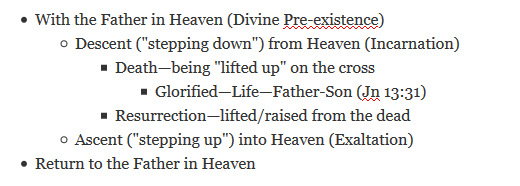
At first glance, it may not seem obvious how these sections relate to the exchange with Nicodemus in vv. 1-9. But I believe that the key lies in a narrative technique found in the Gospel of John sometimes referred to as “step-parallelism”, in which a word or idea from a prior passage is taken up to start the next. Remember that the central idea in Jesus’ exchange with Nicodemus was that of being born “from above” (anœthen, verse 3). It is this motif that Jesus expounds in response to Nicodemus’ question. There are two components to the first part of Jesus’ explanation (vv. 11-15): (a) the heavenly source of Jesus’ words (his testimony), vv. 11-12, and (b) the heavenly origin of Jesus (the “Son of Man”), vv. 13-15. Consider how these two aspects relate, centered on the motif of heaven (i.e. from above):

    • Earthly things (v. 12a)
      —Heavenly things (v. 12b)
      —Ascent to Heaven (v. 13a)
    • Descent from Heaven [to earth] (v. 13b)

In verse 13-15 Jesus picks up and further expounds this motif of ascent/descent (using the verbs anabainœ and katabainœ, literally “step up” and “step down”, see last week’s study on John 1:51). According the Johannine view of Jesus, as expressed (by Jesus) in the other discourses, this ascent/descent concept is one of several in the Gospel which serves as a comprehensive symbol or image of both the death and exaltation of Jesus. Another such concept involves the verb hypsoœ (“lift high”) which Jesus uses in vv. 14-15:

“And even as Moshe lifted (up) high the snake in the desert, so it is necessary (for) the Son of Man to be lifted high, (so) that every one trusting [in him] may have [lit. hold] (the) Life of the Age [i.e. Eternal Life].”

The primary emphasis here has shifted to Jesus’ sacrificial death (on the cross) which will bring (eternal) life to every one who trusts in him. This now becomes the transition to the second half of Jesus’ exposition (vv. 16-21), which begins with the famous verse 16 (note the points of similarity with vv. 14-15):

“For God loved the world this (way), so (that) he even gave his only (born) [monogen¢s] Son, so that every one trusting into him will not be destroyed, but might have/hold (the) Life of the Age [i.e. Eternal Life].”

The joining word which introduces vv. 16-21 is the adverb houtœ[s], related to the demonstrative pronoun houtos (“this”). The idea seems to be that God loved the world “this way”, referring to what precedes—i.e. the “lifting up” of the Son of Man in the manner of the snake upon the pole (Numbers 21:9). This connection also serves to identify Jesus the “Son of Man” as the “only Son” of God (see the earlier study on John 1:18). Once again, by way of step-parallelism, Jesus takes up this motif and continues it for the remainder of the exposition:

    • God sent forth his Son into the world, so that the world might be saved through him (v. 17)
    • Salvation comes through trusting (vb. pisteuœ) in [lit. “into”, eis] God’s Son (v. 18)

Two important Johannine motifs are blending into verse 18: (1) the adjective monogen¢s (“only [born]”), i.e. God’s only Son, and (2) the identification of the person (Jesus) with his name. According to ancient Near Eastern thought, the essence of a person was seen has being bound up, in a quasi-magical sort of way, with his/her name. This took on special significance for Israelites and Jews with regard to the name of God (YHWH), and early Christians developed a similar reverence for the name of Yeshua/Jesus. In the Gospel of John, we find the important idea that Jesus (the Son) reveals God (the Father) by making known his name (i.e., who He truly is)—see 5:43; 10:25; 12:26; 17:6-26. At the same time, the Father acts on behalf of believers in the Son’s name (14:13-14, 26; 15:16, 21; 16:23-26). This inter-relationship of Father and Son is typical of John’s theology and Christology, and is found all throughout the Discourses of Jesus.

In verse 17-21 there is an interesting shift, from the theme of life (vv. 17-18) to that of light (19-21). Both are central to the Gospel of John and feature prominently in the Prologue (1:4-9ff). After the reference to Jesus’ death in verse 14, it seems that it is the incarnation of the Son (Jesus) which is more clearly in view in vv. 17-21. Jesus, in his very person, brings life and light into the world. The reference to light in verse 19 also introduces an aspect of dualism into the discourse—light vs. darkness. This takes us back to the original saying in verse 3. The word “from above” reflects a similar sort of dualism—above vs. below, heavenly vs. earthly. Only those who belong to the light, etc, are able to come to it (i.e. trust in Jesus). Trust is not a matter of human will-power, nor even of repentance and sacrifice, but of belonging to God. This is perhaps best expressed by Jesus words (to Pilate) in John 18:37:

“Unto this [i.e. for this purpose] I have come to be (born) and unto this I have come into the world, that I should give witness to the truth—every one being out of [i.e. who is from/of] the truth hears my voice.”

And consider also the words of Jn 1:12-13:

“(for) as many as received him, he gave to them authority to come to be offspring of God, to the ones trusting in his name—the (one)s which, not out of blood, and not out of the will of the flesh, and not out of the will of man, but out of God, came to be (born)”

This concludes our study of John 3:16 in the context of the discourse (vv. 1-21). Often it is useful, and even necessary, to consider the wider context of the book as well. I would thus encourage you to go back and read again the first two chapters of John, paying especially close attention to chapter two and episode(s) of verses 13-25. As you read these verses, keep in mind your study of 3:1-21.

And I will see you again next Saturday.

Saturday Series: John 1:51 (continued)

John 1:51 (continued)

Last week we looked at the enigmatic statement by Jesus in John 1:51:

“Amen, amen, I say to you (that) you [pl.] will see the heaven opened up and the Messengers of God stepping up and stepping down upon the Son of Man.”

A proper study of such difficult passages requires a careful two-step approach: (1) analysis of the Greek words/phrases and how they are used, and (2) the context of the passage within the book. Last week we dealt with the first of these, today we will explore the second—that is, the context of the verse within the Gospel of John. Much of the difficulty surrounding this saying has been in trying to identify it with an actual event which the disciples experienced (or would experience). I mentioned three possibilities: (a) an otherwise unrecorded event during Jesus’ ministry, such as the Transfiguration scene in the Synoptic Gospels; (b) a post-resurrection vision or encounter; or (c) an eschatological vision. None of these really seem to fit the narrative setting of this saying—at the very beginning of Jesus’ ministry, just after the Baptism and the call of the first disciples. It seems more likely that it is meant by the author (trad. John the Apostle) as a symbolic picture, and that its fundamental meaning is Christological. I believe that a study of the Greek (last Saturday) already points rather clearly in this direction. But let us examine things a bit further.

1. The Location of the Saying

After the hymnic prologue of Jn 1:1-18, the first main section of the Gospel is Jn 1:19-51, which has, as its primary theme, the testimony of John the Baptist regarding Jesus. The section is divided into four “days”, and with each “day” the witness of Jesus’ identity is developed:

  • vv. 19-28—the Baptist’s testimony regarding himself (“I am not…”)
  • vv. 29-34—the Baptist’s testimony regarding Jesus
    • account of the Baptism (vv. 31-33)
  • vv. 35-42—disciples respond to the Baptist’s testimony and follow Jesus
    • a disciple (Peter)’s encounter with Jesus (vv. 41-42)
    • saying of Jesus (v. 42)
  • vv. 43-51—disciples respond to the testimony of other (disciple)s and follow Jesus
    • a disciple (Nathanael)’s encounter with Jesus (vv. 47-51)
    • saying of Jesus (v. 51)

Each of the last three days follows a basic pattern, which includes a pair of declarations regarding Jesus, using a range of significant titles or descriptions:

  • Day 2: “Lamb of God” (v. 29) / “Son of God” (or “Elect/Chosen One of God”) (v. 34)
  • Day 3: “Lamb of God” (v. 36) / “Messiah” (“Anointed One [Christ]”) (v. 41)
  • Day 4: “the one of whom Moses and the Prophets wrote” (v. 45) /
    “Son of God” | “King of Israel” (v. 49)

The saying in Jn 1:51 thus concludes this opening section of the Gospel, which fundamentally has a Christological orientation, in two respects:

  1. The focus moves from John the Baptist to Jesus (see vv. 8, 15, 30; 3:28-30)
  2. John and the disciples witness (see) Jesus—that is, they begin to recognize who he is, and testify as to his identity.

The account of Jesus’ Baptism (vv. 31-34) is central to this section. Moreover, its close proximity to verse 51 makes it extremely likely that some sort of allusion to it is intended. Last week I mentioned several words in verse 51 which echo the baptism:

  • The Holy Spirit, in the form/shape of a dove, descends [lit. “steps down”] upon Jesus, using the same verb (katabainœ) as in Jn 1:51. Also, the versions in Matthew/Luke specifically use the preposition epi (“upon”) and narrate the episode as something observable by all the people.
  • In the descent of the Spirit, the heavens are said to separate; in Matthew/Luke (Matt 3:16; Lk 3:21), the verb used is anoigœ (“open up”) as in Jn 1:51.

The Baptism is not narrated as something that people observe directly—it is only “seen” through the verbal account (or word) of the Baptist. Similarly, throughout this section “seeing” Jesus is intimately connected with hearing and responding to the message of the Baptist and the first disciples (vv. 34, 36, 39, 46). In Nathanael’s encounter with Jesus (vv. 47ff), he also “sees” based on what Jesus says to him; note, in particular, the wording:

“Jesus responded and said to him, ‘(In) that [i.e. because] I said to you that I saw you underneath the fig-tree, you trust (in me)? (Thing)s greater than these you will see!” (v. 50)

This interplay between “seeing” and “saying” should caution us against the simple assumption that a concrete visible event is intended in v. 51.

Consider also that, while the saying in v. 51 concludes the first section (1:19-51), it also marks the beginning of the next—that is to say, the beginning of Jesus’ ministry. In terms of the Gospel of John, this means the core narrative of the Gospel spanning chapters 2-20. Commentators typically divide this into two main parts:

  1. Chapters 2-12, sometimes referred to as the “Book of Signs”, in which the narrative alternates between accounts of miracles and teaching (discourses) by Jesus—the miracle (sign) often serving as the basis and starting point for the discourse which follows (see especially in chapters 5, 6, and 9). All but the first and last of the Son of Man sayings are found in these chapters.
  2. Chapters 13-20, which narrate the Passion (and Resurrection) of Jesus—chapter 13 (a Last Supper scene similar to that in the Synoptic tradition) leads into the great Discourses in 13:31-16:33, concluding with the remarkable Prayer-Discourse of chapter 17.

The last Son of Man saying in John (13:31) opens the Discourses which are set at the beginning of the last major section of the Gospel (chs 13-20). It seems likely that the first Son of Man saying (1:51) is meant to have a similar transitional role in the structure of the Gospel narrative.

2. The other Son of Man Sayings

There are numerous Son of Man sayings in the Gospel of John. As mentioned above, all but the first and last sayings occur in chapters 2-12, which is significant for two reasons:

  • They are part of the Discourses of Jesus in these chapters, marked by a unique style of teaching. A statement or action by Jesus is misunderstood by the audience, leading to a pointed question, and the subsequent response (and exposition) by Jesus, answering the question at a deeper level of meaning. This process of redirection and reformulation always involves Jesus’ identity—his Person and Teaching—the Son in relation to God the Father. Where they occur, the Son of Man sayings (esp. 3:13-14; 6:27, 53, 62; 8:28; 12:23, 32, 34) are central to the Discourse.
  • They point toward the death and exaltation (resurrection, return to the Father) of Jesus described in chapters 13-20. Indeed, the principal sayings all have a dual-meaning, centered on Jesus’ death and resurrection. The sayings which refer to the Son of Man being “lifted high” (Jn 3:14; 8:28; 12:32, 34) or being “glorified” (Jn 12:23; also 13:31) have both aspects in mind.

The dualism of these sayings is best demonstrated by the use of the verbs katabainœ and anabainœ (“step down”, “step up”), as in Jn 1:51. The saying in 3:13 is followed by that of v. 14 (which speaks of the Son of Man “lifted high”); the sayings in Jn 6:27, 53, 62 have a more complex reference matrix, as part of the great Bread of Life discourse (6:25-66). In schematic form, we might outline the dualism as follows:

According to this outline, the last Son of Man saying (Jn 13:31) reflects the central, inner dynamic of the Father-Son relationship and identity, governed by the verb doxazœ (“give honor/esteem/glory”, i.e. “glorify”). If this is correct, then it is not unreasonable to assume that the first of the Son of Man sayings (Jn 1:51) is parallel to this in some way, and may reflect the outer dynamic—the ascent/descent. Again, this would seem to be correct considering the use of the verbs katabainœ and anabainœ in 1:51. However, in that first saying, it is not the Son of Man descending/ascending, but rather of Angels (“Messengers of God”) ascending/descending on the Son of Man.

3. An allusion to Genesis 28:12

As mentioned last week, in Jesus’ saying there is almost certainly an allusion to Genesis 28:12. In Jacob’s dream-vision at Bethel, he sees Angels ascending and descending on the ladder; in the Greek Version (Septuagint) “ascending and descending” uses the same verbs (anabainœ and katabainœ) as Jn 1:51. Note also:

  • There is a traditional Jewish interpretation which understands the Angels ascending/descending on him (Jacob). In one reference (Genesis Rabbah 68:12) Jacob is seen as being simultaneously in heaven.
  • The Targums (Aramaic translations) express the idea that the shekinah—the visible manifestation and/or personification of God’s glory—was on the ladder. In Justin Martyr’s Dialogue with Trypho (mid-2nd century A.D.), we find the earliest evidence for the interpretation that Christ was on the ladder (86:2).
  • Bethel as the “House of God”, i.e. the rock/stone which symbolizes the Temple and its foundation. In ancient and traditional religious thinking, the Temple served as the meeting place between God and human beings, a point of contact between Heaven and Earth. Moreover, in John 2:19ff (not long after the saying in 1:51), the Temple is identified with Jesus’ own person (and body), specifically in connection with his death and resurrection.

4. A Comprehensive Symbol?

Returning to the specific context of John’s Gospel, there is still more evidence to suggest that the saying of Jesus John 1:51, in its particular position within the structure of the narrative, is intended primarily as a symbolic picture that effectively encompasses the entire Gospel—a framing device representing beginning and end, much like the “Alpha and Omega” (A and W) of Revelation 1:8; 21:6; 22:13 (another Johannine work, with definite parallels in thought and language to the Gospel). Here are some points I would cite in favor of this interpretation:

  • The clear parallels with the Baptism (see above, and the discussion last week), which marks the beginning of Jesus’ earthly ministry (descent/incarnation). Again, the location of Jn 1:51 strongly suggests an allusion to the Baptism.
  • Similar parallels with the Resurrection (ascension), which effectively marks the end of Jesus’ earthly existence.
  • Similarities to descriptions of the Son of Man coming in glory at the end-time (especially in the Synoptic Gospels, Mk 13:26; Matt 16:27-28, etc). However, the Gospel of John understands the Son to have had this position and glory prior to his incarnation/birth as a human being (that is, divine pre-existence). This means, in the Johannine context, that such images cannot refer only to Jesus’ exaltation and future return, but to a reality that encompasses and transcends the entire process of descent/ascent.
  • The saying in Jn 1:51 is part of a parallel, between the beginning and end of the Gospel. This expressed by the encounter of two disciples (Nathanael and Thomas) with Jesus, and involve parallel confessions:
    • Jn 1:49: “You are the Son of God | you are the King of Israel!”
    • Jn 20:28: “My Lord | my God!”
      It is possible that these confessions themselves as bracketing the entire narrative of chapters 2-20:
      • “Son of God” (in a Messianic context)
        —”King of Israel” (i.e. Anointed Davidic Ruler)
        —”My Lord” (Jesus as Messiah/Lord, cf. Ps 110:1)
      • “My God” (Deity)
    • Each of the confessions also includes a response by Jesus (Jn 1:50-51; 20:29) related to disciples/believers seeing him.
  • In the Gospel of John, “seeing” often signifies a level of spiritual perception (or of faith/trust) that is different from visual observation (Jn 1:14, 18; 3:3; 6:36, 46; 9:37-41; 11:9, 40; 12:45; 14:7, 9, 17, 19; 17:24; 20:29, etc). It is likely that the declaration “you will see” (opsesthe) does not refer to a concrete, visible event, but rather to the recognition and realization of Jesus’ true identity—as the Son who reveals and leads the way to the Father. This, of course, is also related to “seeing” the Son in terms of being with him, in his presence, as other instances of the verb optanomai, optomai/opsomai would indicate (Jn 16:16-17, 19, 22).
  • As a concluding observation that “seeing” in Jn 1:51 signifies something more than a concrete vision, note the parallel with 20:29:
    • “because I said to you that I saw [eidon] you… you trust?
      you will see [opsesthe] the heaven opened up and the Messengers of God… upon the Son of Man” (1:51)
    • “because you have seen [heœrakas] me you trust?
      Happy/blessed are the ones not seeing [idontes] and (yet) trusting!” (20:29)

In both Jn 1:51 and 20:29, the eventual seeing by the believer is contrasted with the disciple believing on the basis of an extraordinary or miraculous experience. Even the concrete evidence for Jesus’ resurrection (in the case of Thomas) should not be relied upon as the basis for faith and trust in Christ, but rather the word that bears witness to him and the Spirit that draws us to him.

It is a great wonder that, wherever you turn in the Gospel of John, there appears to be an almost limitless depth to the passage. Even a careful, objective treatment of individual words inevitably leads down into a wide expanse of meaning and spiritual significance. I hope that I have been able to offer some help in demonstrating how a study of both the words and context of the passage can serve as a reliable guide to exploration. For next week, I would exhort you to continue on in a similar manner, reading and studying the next two chapters of the Gospel as carefully and thoughtfully as you are able. It will prepare you for a discussion on one of the most familiar verses in all the New Testament, but one which is often cited without much consideration for its context in the Gospel. As you may have guessed, this is the world-famous John 3:16—and we will be looking at its context most carefully…next Saturday.

“And you shall call His Name…”: Luke 2:49

Luke 2:49

Today’s note looks at the final episode of the Lukan Infancy narrative (vv. 41-50), and, in particular, the saying of Jesus in verse 49. I have discussed this in some detail during a prior Christmas season note, and will not repeat all of that analysis here. Today I will be examining the saying from the standpoint of the current series—in terms of the names and titles of Jesus, especially that of “Son (of God)”. This is a title that really only occurs in the Annunciation scene, twice, in 1:32 and 35:

“He [i.e. the child Jesus] will be great and will be called ‘Son of the Highest’…” (v. 32)
“therefore the (child) coming to be (born) will be called Holy, (the) Son of God” (v. 35)

Somewhat surprisingly, there is no suggestion of it in the birth narrative itself, not even in the Angelic announcement to the shepherds, which otherwise makes use of exalted (and Messianic) language. For the remainder of the Infancy narrative proper, Jesus is referred to in realistic (human) terms as the “baby” (bre/fo$) or “(little) child” (paidi/on)—cf. 2:12, 16, 17, 27. To the extent that Jesus’ sonship is mentioned, it is entirely in reference to his human parents, Joseph and Mary (2:22-23, 27, 39, 41ff, 51). Verse 51a, in particular, emphasizes how Jesus was submissive to his parents, as a dutiful son—and this, in spite of the declaration in v. 49 (cf. below).

It is only here, in the account of this episode of Jesus at the age of twelve, that there is any kind of tension between Jesus as the son of Joseph/Mary and his identity as the Son of God. The realistic detail of the narrative brings out the human familial relationship:

  • The repeated mention of Jesus’ parents (gonei=$) in vv. 41, 43 (cf. also 48, 51). The word, which literally relates to a child coming-to-be (i.e. born), is used generally, even when it is a matter of legal (rather than biological) parentage.
  • The cultural setting of the pilgrimage festival (Passover)—vv. 41-42
  • The traveling caravan of relatives and friends (v. 44)
  • The parental concern (and rebuke) expressed by Mary (v. 48, cf. vv. 44-45)
  • The specific reference to Joseph as Jesus’ father, and Mary as his mother (vv. 38, 51b)

Set within this narrative framework is the central detail of Jesus staying behind in Jerusalem, while the rest of his family had set off on their return trip (vv. 43-44). When Joseph and Mary find him again, after three days’ searching and travel, Jesus is said to be

“in the sacred place [i.e. Temple], sitting in the middle of the ones teaching [i.e. Teachers], both hearing them and asking them (question)s” (v. 46b)

Pious tradition has interpreted this scene as Jesus himself teaching the adult teachers, but there really is little (if any) indication of this in the text. There is no reason to see Jesus here as anything other than an interested pupil, albeit one most gifted, with a special understanding of the Scriptures and the Law (Torah). The general location is important to the symbolism of the scene, as Jesus is sitting “in the middle [e)n me/sw|] of the ones teaching”. The emphasis is not on Jesus’ position (i.e. student vs. teacher) but on exactly where he is located—among those teaching/discussing the Law of God. This is significant when we come to Jesus’ saying (v. 49), in response to his mother’s rebuke:

“(For) what [i.e. why] did you do this to us? See, your father and I, being distressed, (have been) search(ing for) you!” (v. 48)

“(For) what [i.e. why] (is it) that you (are) search(ing for) me? Did you not see [i.e. know] that it is necessary for me to be among the (thing)s of my Father?” (v. 49)

The contrast between “your father and I” (Joseph/Mary) and “my Father” (God/Yahweh) is certainly clear. Even more interesting is the notice that Joseph and Mary had been searching among the things of their relatives and neighbors, rather than among the “things of God”. This parallel is generally lost in translation, but a literal rendering of the Greek brings it out:

  • e)n toi=$ suggeneu=sin kai\ toi=$ gnwstoi=$ (v. 44)
    “among the (thing)s of the ones coming to be together (with them) and the ones known (to them) [i.e. relatives and acquaintances]”
  • e)n toi=$ tou= patro/$ mou (v. 49)
    “among the (thing)s of my Father”

Jesus’ phrase is often translated “in my Father’s house”, but it should be noted that the word corresponding to “house” (oi@ko$), i.e. the Temple as God’s house, is not present. If the author (or Jesus as the speaker) wanted to emphasize the Temple precincts or building as such, it would have been easy enough to do. More accurate would be “in the household of my Father”—i.e. the “things” referring to household belongings (like the belongings of the caravan in v. 44), generally and collectively. Such an interpretation must also include the people—that is, those spending time in the Temple, devoted to the Scriptures and the “things of God” (cf. the description of Simeon and Anna in vv. 25-27, 37-38).

With regard to the precise meaning of the expression “my Father” by Jesus, we must consider three possibilities:

  • His identification with the faithful/righteous of Israel as God’s “Son”—cf. Exod 4:22-23; Deut 32:6; Isa 43:6; 64:8; Hos 1:10; 11:1; Jer 31:19; Wisd 2:16-18; 18:13, etc. This association is much more direct in the Matthean Infancy narrative, Matt 1:21; 2:13-15ff, but note the positioning of the Lukan genealogy which follows in 3:23ff.
  • As a firstborn child consecrated to the service of God. The parallels with the Samuel story, that run through the Lukan narrative (cf. 1:46-47ff; 2:22ff, 40, 52, etc), make it highly likely that this aspect of the scene is intended by the author. While Samuel would spend his childhood in the Temple precincts, this can only be represented symbolically in the case of Jesus, who otherwise grew up with his parents in Nazareth (vv. 39, 51-52; 4:16ff).
  • As the unique Son of God in something like the orthodox Christological sense. This is hinted at already in the Angelic annunciation, though the parallels with the Qumran text 4Q246 (cf. the earlier discussion) should caution us against reading a developed Christology too quickly into this passage. Overall, the emphasis—in both Luke 1:32-35 and 4Q246—would appear to be Messianic. The situation is, I should say, somewhat different in the baptism scene which follows in Lk 3:21-22. And this will be discussed further in the next note, the final one of this Christmas season series.

January 7-8: Luke 2:49

This coming Sunday (the first Sunday after Epiphany), is traditionally the date commemorating the Boy Jesus in the Temple (Luke 2:41-52), although more recently churches have celebrated it on the Sunday after Christmas. The episode—usually considered part of the Lukan Infancy Narrative (1:5-2:52)—is the only narrative in the New Testament depicting the boyhood of Jesus. Very soon many more stories would surface, with increasingly spectacular and (no doubt) fictional details, such as can be found in the surviving extra-canonical “Infancy Gospels”—the Gospel of Pseudo-Matthew, the Infancy Gospel of Thomas, the Arabic Gospel of the Infancy, and so forth. The narratives in these Gospels have perhaps more in common with Saints’ Lives from the early Medieval period than with the ancient Jesus traditions. Although the boy Jesus in Luke’s Gospel is depicted as a most precocious child, he is far from the wonder-working prodigy of later tales (see for example the Infancy Gospel of Thomas, c. 2, and throughout).

In fact, there is very little in the Lukan Infancy Narratives which would suggest that Jesus experienced anything other than normal growth and development (in his human nature)—cf. Luke 2:40 and the parallel/doublet of 2:52. Whether, or to what extent, Jesus actively possessed (and exercised) the Divine Attributes (such as omniscience, et al.) as a child is probably an unsolvable Christological question. One is reminded of the Kenosis/Krypsis debate among Lutheran theologians—whether the incarnate Christ ’emptied’ himself (kenosis) of the divine attributes, or ‘hid’ (krypsis) their use through most of his life. It is a fascinating, but highly speculative area of study, and should be approached with caution.

With regard to this particular narrative, it is best to pay attention to what Luke records Jesus himself as saying about his identity. When his parents (and relatives) left Jerusalem to return home from the feast, Jesus remained behind, somehow without his parents knowing it. When they do find him at last, in the Temple, Mary says to him:

te/knon, ti/ e)poi/hsa$ h(mi=n ou%tw$; i)dou o( path/r sou k)agw o)dunw/menoi e)zhtou=me/n se.
“Child, what [i.e. why] have you done thus to us? See, your father and I, being in pain, search [for] you”

This passage raises all sorts of questions for modern readers—logistical (‘how could Mary and Joseph set off on such a long journey not knowing Jesus was missing?’), psychological (‘how did Mary and Joseph feel when their son was missing?’), and ethical (‘how could Jesus let his parents worry about him that way?’)—which are far removed from Luke’s purpose: he says nothing at all about such matters. The entire story, as Luke tells it, leads up to a profound revelatory moment—Jesus’ pronouncement in response to his mother’s question:

ti/ o%ti e)zhtei=te me; ou)k h&|deite o%ti e)n toi=$ tou= patro/$ mou dei= ei@nai/ me;
“(For) what (is it) that [i.e. why do] you search [for] me? Did you not know that it is necessary for me to be e)n toi=$ tou= patro/$?”

The precise meaning of the portion I have left untranslated is still disputed. Literally, it reads: “in [i.e. among] the [ones/things] of my father”. There are three main possibilities for interpretation (see J. A. Fitzmyer, The Gospel According to Luke V1 [Anchor Bible 28], pp. 443-444, for a more detailed summary):

  1. “among the people of [i.e., belonging to] my father”—presumably referring to the teachers of the law, temple personnel, or perhaps more generally to those studying and expounding the Scriptures. This would seem to be the most literal rendering, and is certainly possible, though, I think, unlikely.
  2. “in the affairs of my father”—that is, the things in an abstract sense, again referring, one would assume, to the teaching of the Torah and temple activity. Sometimes cited supporting this basic meaning is Luke 20:25, but better Mark 8:33/Matthew 16:23. Again, this is possible, but I would prefer a more concrete sense of the expression (see below).
  3. “in the house(-hold) of my father”—the expression e)n toi=$ tou= {person} (“in/among the things/people of {so-and-so}”) can have the wider sense of “in/among the possessions of …”, translated conventionally as “in the house(-hold) of…”. Such a basic meaning is attested in the Greek version of the Old Testament (cf. Genesis 41:51), and elsewhere in Greek texts of the period; a close parallel is found in Josephus (Against Apion I.118: e)n toi=$ tou= Dio$ “in the house-(hold) [i.e. temple] of Zeus”).

This last meaning is certainly close to the mark; however, I would say that the standard translation “in my Father’s house”, is still somewhat inappropriate. If Luke (or Jesus as the speaker) had wanted to emphasize the Temple building as God’s house, he could have used oi@ko$, where the Temple is commonly referred to as God’s house (oi@ko$ qeou). I rather prefer a more general (literal) translation: “in/among the things of my Father”; this, for two reasons:

1) the translation emphasizes “my Father” rather than “house” (the Temple), which better preserves the (intentional) juxtaposition between Joseph and God as Jesus’ “father”. In her address to Jesus, Mary specifically states “your father and I…search for you”, to which Jesus responds “it is necessary for me… things of my father“. Interestingly, in the manuscript tradition, a number of scribes modified “your father” to read “Joseph” or “your relatives”, presumably in an effort to safeguard the idea of the Virgin Birth (on this, see the earlier article on textual variants in the Infancy narratives); however, this is a prime example of misguided orthodoxy at work, for the change completely ruins the parallel (and the actual Christological point!).

2) I think it possible that here with e)n toi=$ tou=… there may be a reference relevant to the historical context, which Luke preserves. Travel in the Ancient Near East, such as from Nazareth to Jerusalem for the feast of Passover, would have involved a caravan (sunodi/a, “[those] together [on the] way”)—groups of persons, often relatives, travelling together (for safety and protection), along with any necessary possessions for the journey, pack/travel animals, and the like. It is not straying too far from Luke’s narrative context to imagine, in his parents “anxious searching” (to which Mary refers), they would first begin searching among the people and possessions in the caravan train. In essence, Jesus might be saying—by an expanded paraphrase—”why were you searching for me [among the things in the caravan], didn’t you know you would find me among my Father’s things?”

In any event, the comparison between the possessions of his (legal human) father Joseph, and those of his (Divine heavenly) Father God, would seem to be at the center of the Christological message, which is the point of the story. At the same time, the Temple setting, the teachers of the Law/Scripture (didaskaloi), the Passover feast, all retain the Old Testament connection so prominent to the setting of the Lukan Infancy Narrative. The central (self-)revelation of the Incarnate Christ as being the Son of God (even as a youth) takes place right in the middle of (e)n me/sw|) the history and religion of Israel, symbolized appropriately by the Temple (and the teaching therein) as e)n toi=$ tou= qeou=.

The traditional image of the Boy Jesus teaching the Scribes, so familiar from Christian art and commentary, is a pious interpretation (or exaggeration), influenced in part, it would seem, from the extra-canonical legends mentioned above (see the Infancy Gospel of Thomas [chap. 19] for an amplified version of the same narrative).  Luke, however (2:46-47), describes nothing of of the sort: it is merely stated that Jesus was in the temple e)n me/sw| tw=n didaska/lwn (“in the middle of the teachers”) and a)kou/onta au)tw=n kai e)perwtw=nta au)tou/$ (“he gave ear [i.e. listened] to them and inquired after them”), much as would any young pupil to a Rabbi. The teachers were “astonished” (e)ci/stanto) by young Jesus’ understanding (su/nesi$) and responses (a)po/krisi$); but nowhere is it stated, or even really suggested, that Jesus acted as their teacher.