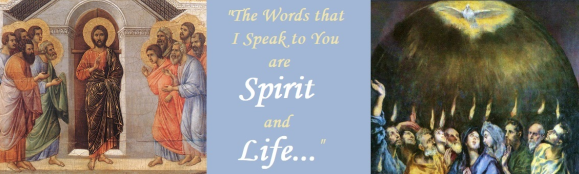
“…Spirit and Life”: John 3:15-16, 34-36

John 3:15-16, 34-36

The explanation by Jesus in Jn 3:5-8 (of the central saying in verse 3) is followed by a second, more detailed exposition in verses 10-21. It is introduced by a second question from Nicodemus, again indicating his lack of understanding: “How are these (thing)s able to come to be?” (v. 9). Thus the exposition which follows builds upon the previous discussion in vv. 3-8, dealing with idea of being born “from above” (i.e. from God, “out of the Spirit”). This setting of vv. 10-21 in the context of the discourse is vital to any proper interpretation. The exposition is divided into two parts:

    • Vv. 10-15—The testimony of the Son of Man
    • Vv. 16-21—The witness and work of the Son of God

Two important motifs are introduced in the first section, appearing together in verse 12:

“If I said to you th(ing)s upon [i.e. about] (the) earth and you do not trust, how will you trust if I say to you th(ing)s upon [i.e. about] Heaven?”

The two motifs are: (1) the idea of trusting (vb. pisteu/w) and (2) the contrast between heaven and earth, i.e. above vs. below. This latter motif relates back to the central saying (and theme) from verse 3—of being born from above (a&nwqen). Verses 13-15 introduce the figure of the “Son of Man”, as used by Jesus in the Gospel Tradition, according to two important aspects:

    • The Son of Man as a heavenly/divine figure who will appear on earth (at the end time) to attend/oversee the Judgment
    • “Son of Man” as a self-designation by Jesus

Both aspects are combined together here, and are related to the two key motifs identified above. There is a definite progression to the line of thought in vv. 13-15:

  • The Son of Man (Jesus) is the one who has come down out of heaven (i.e. from above) [v. 13]
    • He will be “lifted high” [v. 14]—an expression of ascent (i.e. back to heaven), parallel to his descent (from heaven), understood as a comprehensive symbol entailing three aspects:
      (a) Jesus’ death—lifted up on the cross (the immediate reference to Num 21:9)
      (b) His resurrection, rising from the dead
      (c) His return to God (in Heaven)
      • Trust in him, in the entire context of his person and work (vv. 13-14), leads to Life [v. 15]—i.e. being born from above (v. 3)

As indicated above, there is a shift from Jesus as “Son of Man” to his identity as the “Son of God” (vv. 16-21)—a title which encapsulates two concepts: (1) Jesus’ relationship to the Father (as an only Son), and (2) Jesus as the one sent by the Father as His perfect representative (i.e. a “Son”). Verses 15-16 serve as the hinge joining the two sections (vv. 10-15, 16-21)—”Son of Man” and “Son of God”. The verses contain parallel statements involving the motifs of “trust” and “life” (zwh/). This parallelism can be seen by comparing the formula used in vv. 15 and 16b respectively:

    • “(so) that every one trusting in him might hold (the) Life of the Age” (v. 15)
      “(so) that every one trusting him should not (come to) ruin, but might hold (the) Life of the Age” (v. 16b)

Centered in between these statements is the famous declaration of v. 16a:

“For God loved the world this (way)—so (that) he even gave his only (born) Son…”

I discussed the background of the expression “Life of the Age” (zwh\ ai)w/nio$) in the earlier notes on Jn 11:20-27. It is an eschatological idiom, referring to the blessed (divine) life which the righteous will inherit at the end-time, in the Age to Come. However, this eschatological meaning was transformed in Christianity—and in the Gospel of John, especially—so that it also refers to the life which believers possess in the present, through union with Christ. This is often described as “realized” eschatology. It should be pointed out, however, that the use of the subjunctive in 3:15-16 (“might hold, should [come to] hold”) retains much of the original eschatological (future) orientation of the expression. The end-time Judgment features prominently in vv. 16-21, but it has been reinterpreted entirely in terms of faith (trust) in Jesus. The “realized” aspect of this eschatological theme is clear enough:

“The one trusting in him is not judged; but the one not trusting has already been judged, (in) that he has not trusted in the name of the only (born) Son of God” (v. 18)

More nuanced (but equally clear) is the concluding exposition beginning in verse 19:

“And this is the Judgment: that the Light has come into the world and the men [i.e. all those in the world] loved the darkness rather (than) the Light…”

In other words, Judgment is realized already (in the present) when a person comes to the Light (Jesus) and/or does not come to it (because he/she prefers darkness).

John 3:34-36

The motifs of “Spirit” (pneu=ma) and “Life” (zwh/) occur together in the closing verses of chapter 3—part of a separate discourse (vv. 22-36) involving John the Baptist (rather than Jesus), but one which has a number of features in common with that of vv. 1-21. In particular, the exposition by Jesus in vv. 10-21 runs parallel, in certain respects, with the exposition (by the Baptist [?]) in vv. 31-36. I have outlined the common elements in an earlier (Saturday Series) discussion. For the purposes of this particular series of notes, the following parallels are of special importance:

    • V. 34: Jesus, as the one sent by God, speaks the words of God—this word/speaking is connected with the giving of the Spirit
      —In vv. 5-8ff, being born “out of the Spirit” is related to trust in the testimony of Jesus, as the one sent by God (vv. 11-12ff, 16ff)
    • V. 36: Trust in the Son (Jesus) results in the believer possessing Life; by contrast, the one failing to trust (lit. being unpersuaded) will not see Life, but will endure the Judgment (“the anger of God remains on him”)
      —Vv. 15-16 is a precise parallel to v. 36a; while vv. 18ff more properly relates to v. 36 as a whole.

In particular, verses 35 and 36a, taken together, result in a formulation close to that of v. 16 (common words/expressions in italics):

    • “The Father loves the Son and has given all [pa=$]… the one trusting in the Son holds Life of the Age…” (vv. 35-36a)
    • “God loved…he gave his only Son, so that every [pa=$] one trusting in him…should hold Life of the Age” (v. 16)

It is interesting to consider the different ways that the verb give (di/dwmi) is used in these two discourses of chapter 3:

    • God (the Father) has given all things/people [spec. the Elect/Believers] to the Son (v. 35, cf. also v. 27)
    • God gave his Son to the world [i.e. humankind, spec. the Elect/Believers] (v. 16)
    • The Son (Jesus) gives the Spirit [to Believers] (v. 34)

The idea of Jesus giving the Spirit to believers will take on greater prominence later in the Gospel, in the Last Discourse (and following). I discussed the interesting expression “not out of measure” (ou) e)k me/trou)—i.e., “for (it is) not out of measure (that) he gives the Spirit”—in the previously mentioned discussion on v. 34.

May 15: Mark 3:28-29; Matt 12:31-32; Lk 12:10

Mark 3:28-29; Matthew 12:31-32; Luke 12:10

The next passage to be discussed, in this Pentecost-season series of daily notes on the Holy Spirit in the Gospel Tradition, is the famous (and controversial) saying of Jesus regarding the so-called “sin (or blasphemy) against the Spirit” in Mark 3:28-29 par. Over the centuries, this has proven to be one of the most challenging sayings of Jesus for commentators and believers generally to interpret and apply. The interpretive difficulties are complicated by the questions surrounding the differing forms of the saying (or sayings) as preserved in the Synoptic Tradition.

I begin with the version in Mark 3:28-29, which is set in the context of Jesus’ exorcism miracles (vv. 22-27, cf. verses 11-12, 15). This central section is framed by two episodes which express the misunderstanding and/or opposition to Jesus by his family and relatives:

    • vv. 20-21—”the ones alongside him”
    • vv. 31-35—”his mother and his brothers”

The pericope concludes with the declaration that Jesus’ followers are his true family (vv. 34-35). Here is the saying regarding the Holy Spirit in verses 28-29:

“All things will be released [i.e. forgiven] for the sons of men—the sins and insults, whatever they may insult—but whoever gives insult unto the holy Spirit, he does not have release into the Age, but is held in (guilt) of a sin of the Age(s).”

This use of the Greek ai)w/n, indicating an age/era or (long) period of time, is hard to render meaningfully into English, often being generalized as “(for)ever, eternal(ly)”, etc.; however, in the Israelite/Jewish idiom and thought world, there is a strong eschatological aspect which must be preserved—”into the Age” specifically refers to the “Age to Come”, which is ushered in by God’s Judgment upon the world at the close of the present Age. Also, I would call attention to the Greek verb blasfhme/w, which is often simply transliterated into English as “blaspheme”, but this tends to gloss over and distort the fundamental meaning—to speak evil or abusive words, i.e. insult, revile, mock, slander, etc. I have translated blasfhme/w above simply as “insult”. At first glance, there would seem to be relatively little difficulty in the interpretation of this saying, since verse 30 which follows in Mark’s account gives a rather clear explanation:

“(This was in) that [i.e. because] they said ‘He has/holds an unclean spirit’.” (cf. verse 22)

Matthew essentially preserves the Markan narrative context—

Luke’s account differs even more, with the varied inclusion of (so-called) “Q” material:

However, the Lukan version of the Holy Spirit saying occurs in a very different context—that of believers acknowledging/confessing Jesus (the Son of Man) publicly (Lk 12:8-12). The saying in verse 10 would seem to be based on a “Q” version that corresponds to Matt 12:32. Let us first examine Matthew 12:31-32 in terms of the Markan version:

Mark 3:28-29Matthew 12:31-32
“All things will be released [i.e. forgiven] for the sons of men—the sins and insults, whatever they may insult—but whoever gives insult unto the holy Spirit, he does not have release into the Age, but is held in (guilt) of a sin of the Age(s).”“Every sin and insult will be released [i.e. forgiven] for men, but the insult(ing) of the Spirit will not be released. And whoever should say an (evil) word/account against the Son of Man, it will be released for him; but whoever should say (evil) against the holy Spirit, it will not be released for him—not in this Age and not in the (Age that) is about (to come).”

The italicized portions in Matthew indicate the portions shared by the saying in Mark. The saying regarding the “Son of Man” does not correspond to anything in Mark, but it is similar to the Lukan version of the saying (Lk 12:10):

“Every one who will speak an (evil) word/account unto the Son of Man, it will be released for him; but for the (one) giving insult unto the holy Spirit, it will not be released.”

According to the standard critical theory, Matthew and Luke each made use of Mark, as well as a collection of sayings and traditions commonly referred to as “Q” (from German quelle, “source”). Luke 12:10 and the non-italicized portion of Matt 12:32 above represent the “Q” version of the saying. Matthew has apparently combined the Markan and Q versions. As always, when dealing with similar and/or parallel sayings of Jesus in the Gospels, the key critical question is: (a) do these represent separate sayings given by Jesus on different occasions, or (b) are they different versions of the same saying which were transmitted and preserved separately? Traditional-conservative commentators usually opt for (a), while critical scholars and commentators tend to choose (b). In most instances, valid arguments can be offered for each position, and it can be difficult to come up with a definitive solution on entirely objective grounds (i.e., without relying on doctrinal or ideological presuppositions). In the case of this particular saying, there is one strong argument that favors the common critical view, which can be illustrated by a comparison of the first portion of the Markan and “Q” versions respectively:

Saying/Version 1 (‘Mark’) Saying/Version 2 (“Q”)
“All/every sin(s) and insult(s) will be released for the sons of men [toi=$ ui(oi=$ tw=n a)nqrw/pwn]…” “Every one who speaks an (evil) word/account unto/against the Son of Man [to\n ui(o\n tou= a)nqrw/pou], it will be released for him…”

Mark has likely preserved the original wording “sons of men” (Matthew simply reads “men”). Is it possible that the Semitic idiom “son of man” was confused during the process of transmission? Originally, the Hebrew expression “son of man” (<d*a* /B#, Aramaic vn`a$ rB^) simply referred to human beings generally, as a parallel to “man” (<d*a*). The idiom is foreign to Greek—indeed, quite unusual—and the expression o( ui(o\$ tou= a)nqrw/pou (“[the] son of man”) is found in the New Testament only in the words of Jesus, and in a few citations of the Old Testament. With regard to the words of Jesus, the Greek is generally assumed to be a rendering of sayings originally spoken in Aramaic; and, by the time the Gospels came to be written (by 60 A.D. and following) and transmitted to the wider Greek-speaking world, many of the Semitic idioms and expressions had long since been translated or reworked into meaningful Greek. I have addressed the difficulties surrounding Jesus’ use of the expression “Son of Man” at length in earlier notes and articles.

Returning to the saying in question, did “son of man” in the “Q” version originally have the general/generic meaning—i.e., “whoever speaks (evil) against a(nother) human being…”? If so, then it would correspond roughly to the Markan version, and could conceivably be traced back to a single (Aramaic) saying by Jesus. However, it should be noted that Luke definitely understands this “Q” version of the saying as referring to Jesus himself (“the Son of Man”), as the context clearly indicates. Let me here summarize briefly Jesus’ self-identification as “Son of Man” in the Synoptic tradition, especially the Gospel of Luke, isolating the following usage:

    • In the generic sense—”human being”—but often, it would seem, as a substitute for the pronoun “I”, i.e. “this human being” (myself).
    • Many of the Son of Man sayings are related to Jesus’ earthly life and existence, by which he identifies himself with the human condition—especially in terms of its mortality, weakness and suffering.
    • A number of these sayings refer specifically to Jesus’ Passion—predictions of the suffering and death which he would face in Jerusalem.
    • There are also additional sayings where Jesus identifies himself with a heavenly figure (“the Son of Man”) who will appear, as God’s representative, at the end-time Judgment, largely influenced by Daniel 7:13-14 and resultant traditions.

In the next daily note, I will examine further how Matthew and Luke understand the Holy Spirit saying, as well as the additional (related) saying in Matt 12:28 / Lk 11:20.

April 15 (2): Acts 7:55-56

This is the last in the series of daily notes for Easter Season, during which we have explored the Son of Man sayings of Jesus in the Gospels of Luke and John. Today’s note is on Acts 7:55-56—the last Son of Man verse in Luke-Acts, and one of only four occurrences of the expression “Son of Man” outside of the Gospels (the others being Heb 2:6 [quoting Ps 8:4ff] and Rev 1:13; 14:14 [referring to Dan 7:13]).

Acts 7:55-56

Most of the Son of Man sayings in Luke relate either to: (1) Jesus’ suffering and death, or (2) his exaltation to Glory (and future return in Judgment). As I have previously discussed, the use of “son of man” in the first instance would seem to identify Jesus specifically with humankind in its mortality (weakness, suffering and death); in the second, he identifies himself as the Divine/Heavenly figure (of Daniel 7:13ff) who will appear at the end-time Judgment by God. These two aspects of the expression “Son of Man” are present during the night of Jesus’ arrest and “trial” before the Sanhedrin (Lk 22:22, 48 and Lk 22:69), and also in the Angelic announcement of Lk 24:7 where the predictions of Jesus’ Passion (Lk 9:22, 44-45; 18:31-33) are connected with the Resurrection.

When we turn to the book of Acts, the theme of Jesus’ suffering (and death) continues—both with regard to the message that is proclaimed by the disciples (Acts 1:16; 2:23ff; 3:13-15, 17-18; 4:10, 27-28; 5:30 etc), and as a pattern for their own experience of suffering and persecution (cf. throughout chapters 3-7), predicted by Jesus himself (Lk 12:11-12; 21:12-19). So also the theme of Jesus’ exaltation (cf. below). Acts 7:55-56 represents the climactic moment of the Stephen narrative, which spans chapters 6-7:

  • 6:1-7: Introduction, setting the stage for the conflict
  • 6:8-15: The conflict with Stephen, including his arrest and appearance before the Sanhedrin
  • 7:1-60: The Sermon-Speech and Execution of Stephen
    • 7:1: The question of the High Priest to Stephen, which serves as the immediate narrative introduction to the Speech
    • 7:2-53: The Sermon-Speech of Stephen
    • 7:54-60: The response to the Speech and Execution of Stephen
  • 8:1a: Transitional verse, mentioning Saul/Paul’s role in the execution
  • 8:1b-4: Narrative summary describing the onset of Persecution (led by Saul)

Of the three major scenes in Acts which show the early believers in conflict with the Jewish authorities in Jerusalem (cf. Acts 4:1-22; 5:17-42), it is the Stephen narrative which most clearly follows the pattern of Jesus’ Passion. The parallels (some more precise than others) may be outlined as follows:

  • Stephen was “full of faith/trust and the Holy Spirit” and “full of the favor (of God) and power” (Acts 6:5, 8)
    —Jesus likewise, at the beginning of his ministry (Lk 4:1), was said to be “full of the Holy Spirit”; cf. also Lk 4:14 and Lk 1:15, 17; 2:40.
  • Stephen did “great wonders and signs among the people” (Acts 6:8)
    —Cf. especially the notice of Jesus’ miracles in Acts 2:22
  • It is stated that Stephen’s opponents “did not have strength to stand against the wisdom and the Spirit in which he spoke” (Acts 6:10)
    —Cf. Luke 20:26, etc; 21:15
  • The accusation of blasphemy (i.e. insult/slander against God) (Acts 6:11)
    —The declaration of the High Priest (Mark 14:64 par), implied in Lk 22:71
  • Stephen’s opponents “stirred together” the crowds etc. against him (Acts 6:12)
    —The Jewish authorities “shook up” the crowds against Jesus (Mark 15:11, not in Luke)
  • “They seized him and led him into the Sanhedrin” (Acts 6:12b)
    —Cf. Luke 22:52, 54, 66; 23:1, also the specific mention of “Elders and Scribes” (Lk 22:66)
  • False witnesses give testimony, involving the Temple (Acts 6:13)
    —False witnesses against Jesus rel. to the “Temple-saying” (Mark 14:57-59 par, not in Luke)
  • The claim that Jesus would destroy the Temple (Acts 6:14)
  • Stephen stands in the middle of the Council (cf. Luke 22:66)
  • The question by the High Priest regarding the truth of the accusations (Acts 7:1)
    —The specific question in Mark 14:60 par (not in Luke); cf. also Mk 14:61 par; Lk 22:67, 70
  • Stephen’s vision of the Son of Man (Acts 7:55-56)
    —Jesus’ answer to the Council regarding the Son of Man (Lk 22:69 par; in Matt/Mark, seeing the Son of Man)
  • The reaction of the Council (including tearing their garments) (Acts 7:52; Mark 14:63-64 par, cf. Lk 22:71)
  • Stephen is taken outside of the city to be put to death (Acts 7:58, cf. Lk 23:26, 33)
  • Stephen’s dying words: “Lord Jesus, receive my spirit” (Acts 7:59)
    —Jesus’ dying words: “Father, into your hands I place [i.e. give] along my spirit” (Lk 23:46)
  • Stephen asks God to forgive those putting him to death: “Do not hold up this sin against them” (Acts 7:60)
    —Jesus’ prayer of forgiveness on the cross (Lk 23:34 [not in some MSS])
  • After Stephen’s death “there came to be… a great persecution upon the Church” (Acts 8:1)
    —After Jesus’ death “there came to be darkness upon the whole land” (Luke 23:44)

From a narrative standpoint, these parallels illustrate vividly the disciple following in Jesus’ footsteps, even to the point of death (Lk 5:11, 27-28; 9:23, 57-62; 18:22, 28; 21:12-19; 22:39, 54; 23:27, 49 pars; cf. also Mk 10:38-40, etc). Let us compare specifically the Son of Man parallel:

Jesus’ saying (Lk 22:69):

“From now on, the Son of Man will be sitting out of [i.e. on/at] the right hand of the power of God”

The formula in Mark/Matthew is:

“[From now] you will see the Son of Man sitting out of [i.e. on/at] the right hand of the Power, and coming with/upon the clouds of Heaven“

The declaration by Stephen (in Acts 7:56) is:

“I behold the heavens opening through and the Son of Man standing out of [i.e. on/at] the right hand of God“

The preceding narrative in verse 55 adds the following details: (1) he saw the glory of God, and (2) Jesus is specifically identified as the Son of Man (“Jesus standing at the right hand of God”).

The use of the verb dianoi/gw (“open through[out], open thoroughly”) is interesting, as it appears to be a favorite of Luke’s—7 of the 8 occurrences in the New Testament are in Luke-Acts, and five of these refer to the knowledge and awareness of Jesus, and of coming to faith, etc. Note:

    • Luke 24:31—”and their eyes were opened through [dihnoi/xqhsan] and they knew upon [i.e. recognized] him…”
    • Luke 24:32—”Were our hearts not burning [i.e. being set on fire] [in us] as he spoke with us in the way, as he opened through [dih/noigen] to us the Writings [i.e. Scriptures]?”
    • Luke 24:45—”Then he [i.e. Jesus] opened through [dih/noicen] their mind for th(eir) bringing together the Writings [i.e. understanding the Scriptures]”
    • Acts 16:14—”a certain woman {Lydia}… of whom the Lord opened through [dih/noicen] (her) heart”
    • Acts 17:3—Paul gathered through [i.e. discussed, argued] with them from the Scriptures, “opening through [dianoi/gwn]…that it was necessary for the Anointed (One) to suffer and stand up (again) out of the dead, and that this Yeshua is the Anointed (One)…” (cf. Luke 9:22; 24:7, 26, 46)

The early chapters of Acts (chs. 1-7) are still connected in many ways with the Gospel narrative, so it is fitting perhaps that they close with this vision by Stephen of the Son of Man, a fulfillment of the sayings by Jesus such as that in Luke 22:69. His vision confirms the reality of Jesus’ exaltation to heaven (at the right hand of God) and of his identity as the divine/heavenly Son of Man. Christ’s presence in heaven at God’s right hand was a common motif in early Christian tradition (Acts 2:25, 33ff; 5:31; Rom 8:34; Col 3:1; Eph 1:20; 1 Pet 3:22; Heb 1:3, etc), largely influenced by Psalm 110:1 (Acts 2:34; Heb 1:13). The remainder of the book (chapters 8-28), on the other hand, narrates the spread of Christianity outside of Judea, out into the wider Greco-Roman world, and thus focuses more precisely on the message (the Gospel) of Jesus, and how people respond to it. If Stephen saw a vision of heaven “opened”, that is, the revelation of God in the person of Jesus, so also do believers have their hearts and minds “opened” to the truth, and, in turn, proclaim the message of Christ to others, “opening” and explaining the Scriptures.

April 14 (1): John 1:51

In today’s note for the third day of Easter (Easter Tuesday), I continue the study of the Son of Man saying in John 1:51, begun yesterday (for more on the Son of Man sayings in John, cf. the earlier note). Here I will be looking more specifically at the meaning of the saying in the context of the Gospel narrative.

John 1:51

“Amen, Amen, I say to you—you will see [o&yesqe] the heaven opened up and the Messengers of God stepping up [a)nabai/nonta$] and stepping down [katabai/nonta$] upon the Son of Man”

In the previous note, I explored four images or traditions which seem to be especially relevant for an interpretation of the saying, based on similarities in language and concept: (1) the baptism of Jesus, (2) the resurrection/ascension, (3) his (future) coming in glory, and (4) the dream-vision of Jacob’s ladder in Gen 28:12. It must be admitted, however, that none of these are sufficient, nor do they entirely fit the position and context of the saying in John. Therefore, it is necessary to examine the narrative and thematic structure of the Gospel, in order to gain a better understanding of the ultimate significance of the saying. I will proceed, briefly, according to the following outline:

    1. The location of the saying, at the beginning of Jesus’ ministry
    2. Its connection with the other Son of Man sayings in John
    3. Its possible purpose as a comprehensive symbol

1. The Location of the Saying

After the hymnic prologue of Jn 1:1-18, the first main section of the Gospel is Jn 1:19-51, which has, as its primary theme, the testimony of John the Baptist regarding Jesus. The section may be divided as follows:

    • vv. 19-28—the Baptist’s testimony regarding himself (“I am not…”)
    • vv. 29-34—the Baptist’s testimony regarding Jesus
      • account of the Baptism (vv. 31-33)
    • vv. 35-42—disciples respond to the Baptist’s testimony and follow Jesus
      • a disciple (Peter)’s encounter with Jesus (vv. 41-42)
      • saying of Jesus (v. 42)
    • vv. 43-51—disciples respond to the testimony of other (disciple)s and follow Jesus
      • a disciple (Nathanael)’s encounter with Jesus (vv. 47-51)
      • saying of Jesus (v. 51)

The saying in Jn 1:51 thus concludes this opening section of the Gospel. In the previous note, I mentioned several parallels with the Baptism of Jesus, and, given the position of the saying in relation to the Baptism (and the Baptist’s testimony) in this section, it is likely that some sort of allusion is intended. Interestingly, and altogether typical of John’s Gospel, the Baptism is not narrated as something that people observe directly—it is only “seen” through the verbal account (or word) of the Baptist. Similarly, throughout this section “seeing” Jesus is intimately connected with hearing and responding to the message of the Baptist and the first disciples (vv. 34, 36, 39, 46). In Nathanael’s encounter with Jesus (vv. 47ff), he also “sees” based on what Jesus says to him; note, in particular, the wording:

“Jesus responded and said to him, ‘(In) that [i.e. because] I said to you that I saw you underneath the fig-tree, you trust (in me)? (Thing)s greater than these you will see!” (v. 50)

This interplay between “seeing” and “saying” should caution us against the simple assumption that a concrete visible event is intended in v. 51. That the saying concludes the first section (1:19-51) means that it also marks the beginning of the next—that is to say, the core narrative of the Gospel spanning chapters 2-20. Commentators typically divide this into two main parts:

    1. Chapters 2-12, sometimes referred to as the “Book of Signs”, in which the narrative alternates between accounts of miracles and teaching (discourses) by Jesus—the miracle (sign) often serving as the basis and starting point for the discourse which follows (cf. especially in chapters 5, 6, and 9). All but the first and last of the Son of Man sayings are found in these chapters.
    2. Chapters 13-20, which narrate the Passion (and Resurrection) of Jesus—chapter 13 (a Last Supper scene similar to that in the Synoptic tradition) leads into the great Discourses in 13:31-16:33, concluding with the remarkable Prayer-Discourse of chapter 17.

The last Son of Man saying in John (13:31) opens the Discourses which are set at the beginning of the last major section of the Gospel (chs 13-20). It seems likely that the first Son of Man saying (1:51) is meant to have a similar transitional role in the structure of the Gospel narrative.

2. The other Son of Man Sayings

For a survey of the other Son of Man sayings in John, cf. my earlier note. As mentioned above, all but the first and last sayings occur in chapters 2-12, which is significant for two reasons:

    • They are part of the Discourses of Jesus in these chapters, marked by a unique style of teaching—a statement or action by Jesus is misunderstood by the audience, leading to a pointed question, and the subsequent response (and exposition) by Jesus, answering the question at a deeper level of meaning. This process of redirection and reformulation always involves Jesus’ identity—his Person and Teaching—as the Son in relation to God the Father. Where they occur, the Son of Man sayings (esp. 3:13-14; 6:27, 53, 62; 8:28; 12:23, 32, 34) are central and climactic to the Discourse.
    • They point toward the death and exaltation (resurrection, return to the Father) of Jesus described in chapters 13-20. Indeed, the principal sayings all have a dual-meaning, centered on Jesus’ death/resurrection. The sayings which refer to the Son of Man being “lifted high” (Jn 3:14; 8:28; 12:32, 34) or being “glorified” (Jn 12:23; also 13:31) have both aspects in mind.

The dualism of these sayings is best demonstrated in those which use the verbs katabai/nw and a)nabai/nw (“step down”, “step up”), as in Jn 1:51. The saying in 3:13 is followed by that of v. 14 (which speaks of the Son of Man “lifted high”); the sayings in Jn 6:27, 53, 62 have a more complex reference matrix, as part of the great Bread of Life discourse (6:25-66). In schematic form, we might outline the dualism as follows:

  • With the Father in Heaven (Divine Pre-existence)
    • Descent (“stepping down”) from Heaven (Incarnation)
      • Death—being “lifted up” on the cross
        • Glorified—Life—Father-Son (Jn 13:31)
      • Resurrection—lifted/raised from the dead
    • Ascent (“stepping up”) into Heaven (Exaltation)
  • Return to the Father in Heaven

According to this outline, the last Son of Man saying (Jn 13:31) reflects the central, inner dynamic of the Father-Son relationship and identity, governed by the verb doca/zw (“give honor/esteem/glory”, i.e. “glorify”). If this is correct, then it is not unreasonable to assume that the first of the Son of Man sayings (Jn 1:51) is parallel to this in some way, and may reflect the outer dynamic—the ascent/descent. Again, this would seem to be correct considering the use of the verbs katabai/nw and a)nabai/nw in 1:51. However, in that first saying, it is not the Son of Man descending/ascending, but rather of Angels (“Messengers of God”) ascending/descending on the Son of Man.

3. A Comprehensive Symbol?

I am very much inclined to the view that the saying of John 1:51, in its particular position within the structure of the narrative, is intended primarily as a symbolic picture that effectively encompasses the entire Gospel—a framing device representing beginning and end, much like the “Alpha and Omega” (A and W) of Revelation 1:8; 21:6; 22:13 (another Johannine work, with definite parallels in thought and language to the Gospel). Here are some points I would cite in favor of this interpretation:

    • The clear parallels with the Baptism (cf. the previous note), which marks the beginning of Jesus’ earthly ministry (descent/incarnation); the location of Jn 1:51 also strongly suggests an allusion to the Baptism.
    • Similar parallels with the Resurrection (ascension), which effectively marks the end of Jesus’ earthly existence.
    • Similarities to descriptions of the Son of Man coming in glory at the end-time (esp. in the Synoptic tradition); however, the Gospel of John understands the Son to have had this position and glory prior to his incarnation/birth as a human being (i.e. divine pre-existence). This means, in the Johannine context, that such images cannot refer only to Jesus’ exaltation and future return, but to a reality that encompasses and transcends the entire process of descent/ascent (cf. above).
    • The saying in Jn 1:51 is part of a parallel, between the beginning and end of the Gospel, expressed by the encounter of two disciples (Nathanael and Thomas) with Jesus, and involving parallel confessions:
      —Jn 1:49: “You are the Son of God | you are the King of Israel!”
      —Jn 20:28: “My Lord | my God!”
      It is possible that these confessions themselves together form a bracketing chiasm:
      “Son of God” (in a Messianic context)
      —”King of Israel” (i.e. Anointed Davidic Ruler)
      —”My Lord” (Jesus as Messiah/Lord, cf. Ps 110:1)
      “My God” (Deity)
      Each of the confessions also includes a response by Jesus (Jn 1:50-51; 20:29) related to disciples/believers seeing him.
    • In the Gospel of John, “seeing” often signifies a level of spiritual perception (or of faith/trust) that is different from visual observation (Jn 1:14, 18; 3:3; 6:36, 46; 9:37-41; 11:9, 40; 12:45; 14:7, 9, 17, 19; 17:24; 20:29, etc). It is likely that the declaration “you will see” (o&yesqe) does not refer to a concrete, visible event, but rather to the recognition and realization of Jesus’ true identity—the Son who reveals and leads the way to the Father. This, of course, is also related to “seeing” the Son in terms of being with him, in his presence, as other instances of the verb o)pta/nomai, o&ptomai/o&yomai would indicate (esp. Jn 16:16-17, 19, 22). As a concluding observation that “seeing” in Jn 1:51 signifies something more than a concrete vision, note the parallel with 20:29:
      • “because I said to you that I saw [ei@don] you… you trust?
        you will see [o&yesqe] the heaven opened up and the Messengers of God… upon the Son of Man” (1:51)
      • “because you have seen [e(w/raka$] me you trust?
        Happy/blessed are the ones not seeing [i)do/nte$] and (yet) trusting!” (20:29)

In both Jn 1:51 and 20:29, the eventual seeing by the believer is contrasted with the disciple believing on the basis of an extraordinary or miraculous experience. Even the concrete evidence for Jesus’ resurrection (in the case of Thomas) should not be relied upon as the basis for faith and trust in Christ, but rather the word that bears witness to him and the Spirit that draws us to him.

April 13 (1): John 1:51

Today, for the second day of Easter (Easter Monday), and following the theme of these seasonal daily notes, I will be examining the Son of Man saying in John 1:51. In an earlier note (for Holy Saturday), I surveyed all of the Son of Man sayings in John, noting three main categories:

    • Sayings which speak of the Son of Man being “lifted high” (using the verb u(yo/w)—Jn 3:14; 8:28; 12:32, 34
    • Sayings involving the descent/ascent of the Son of Man (verbs katabai/nw, a)nabai/nw)—Jn 3:13; 6:22, 53, 62
    • Sayings which refer to the Son of Man being glorified (vb. doca/zw)—Jn 12:23, 31

John 1:51 generally belongs to the second category. All of these sayings refer in some way to Jesus’ death, and also relate to the two-fold sense in which the Son is “lifted up”, according to the symbolism and imagery in John—(1) his death on the cross, and (2) his exaltation (resurrection and return to the Father).

John 1:51

“Amen, Amen, I say to you—you will see [o&yesqe] the heaven opened up and the Messengers of God stepping up [a)nabai/nonta$] and stepping down [katabai/nonta$] upon [e)pi] the Son of Man”

This saying has proven sufficiently difficult and obscure for commentators throughout the years, resulting in a wide range of possible interpretations. A fundamental question is whether the saying should be taken as a concrete prediction, or a symbolic picture. If the former, then one must ask to which specific event or episode it refers; there are three possibilities—(1) a supernatural event witnessed by the disciples (similar to the Transfiguration), but otherwise unrecorded, (2) the resurrection and/or ascension, or (3) the future/end-time appearance of Christ. Given the similarities with key eschatological Son of Man sayings in the Synoptics, the third option makes most sense; however, it does not especially seem to fit the context where the saying is set in John. If we are to understand the saying primarily as a symbolic picture—whether by the Gospel writer or Jesus himself—then there a number of possible associations or allusions which may be in mind. I summarize the most relevant and important of these here (cf. R. E. Brown, The Gospel According to John, Anchor Bible [AB] vol. 29, pp. 89-91):

The Baptism—There are two details in the (Synoptic) account of Jesus’ baptism (Mark 1:10 par) which are especially relevant:

    • The Holy Spirit, in the form/shape of a dove, descends [lit. “steps down”] upon Jesus, using the same verb (katabai/nw) as in Jn 1:51. Also, the versions in Matthew/Luke specifically use the preposition e)pi (“upon”) and narrate the episode as something observable by all the people (in contrast with Mark’s account). John does not narrate Jesus’ baptism as such, but provides a comparable (indirect) description as part of the Baptist’s testimony (cf. Jn 1:32).
    • In the descent of the Spirit, the heavens are said to separate; in Matthew/Luke (Matt 3:16; Lk 3:21), the verb used is a)noi/gw (“open up”) as in Jn 1:51.

Matthew 16:27-28 par—Matthew’s version of a core Son of Man saying in Synoptic tradition (Mk 8:38; Lk 9:26) begins: “For the Son of Man is about to come in the glory of his Father with his Messengers [i.e. Angels]…” and concludes with the specific formulation:

“…there will be some of the (one)s having stood here who should not taste death (themselves) until they should see [i&dwsin] the Son of Man coming in his Kingdom” (note the parallel in Lk 9:27: “…until they should see the Kingdom of God”, and also Lk 23:42 v.l.)

Several points should be made about the context and significance of this passage:

    • The reference is to the end-time Judgment, and (in the developed Gospel tradition) to the parousia (or second coming) of Jesus.
    • It is positioned directly between Peter’s confession and the Transfiguration (a vision of Jesus in glory witnessed by several of the disciples). Moreover, in both Synoptic tradition and Jn 1:19-51, the Son of Man saying follows soon after Jesus gives Peter his new name (Matt 16:18; Jn 1:42).
    • The Son of Man is associated with Angels in a number of sayings, all eschatological and emphasizing the end-time Judgment—Matt 13:41ff; 16:27 par; 24:30-31 par; 25:31; Luke 12:8-9; cf. also Matt 4:6 par; 26:53.

The Resurrection/Ascension—Note especially the following:

    • In Mark 16:4 of the Old Latin MS Bobiensis (k), it is narrated that angels descend to Jesus and ascend with him (cf. also the extra-canonical Gospel of Peter §§36-40).
    • The appearance of Angels in the Synoptic tradition, associated with the Resurrection (variously described, Mk 16:5-7; Matt 28:2-7; Lk 24:4-7) and the Ascension (Acts 1:10-11) of Jesus. In Matthew 28:2, it is stated that the Angel “stepped down” out of heaven, using the same verb (katabai/nw) as in Jn 1:51 (cf. above).
    • John does not record a visible ascension of Jesus, but note Jn 20:17: “…I step up [a)nabai/nw] toward my Father”.

An allusion to Genesis 28:12—In Jacob’s dream-vision at Bethel, he sees Angels ascending and descending on the ladder; in the LXX “ascending and descending” uses the same verbs (a)nabai/nw and katabai/nw) as Jn 1:51.

    • There is a traditional Jewish interpretation which understands the Angels ascending/descending on him (i.e. Jacob), cf. Genesis Rabbah 69:3 (in 68:12 Jacob is seen as being simultaneously in heaven).
    • The Targums (cf. Onkelos) express the idea that the shekinah—the visible manifestation and/or personification of God’s glory—was on the ladder. In Justin Martyr’s Dialogue with Trypho (mid-2nd century A.D.), we find the earliest evidence for the interpretation that Christ was on the ladder (86:2).
    • Bethel as the “House of God”, i.e. the rock/stone which symbolizes the Temple and its foundation. In Jn 2:19ff (not long after the saying in 1:51), the Temple is identified with Jesus’ own person (and body), specifically in connection with his death and resurrection.

These are the most plausible associations with Jn 1:51, based on similarities of language and imagery—(1) the account of Jesus’ baptism, (2) his resurrection/ascension, (3) his return in glory at the end-time Judgment, and (4) the theophanic dream-vision of Jacob’s ladder in Gen 28:12. In the next note I will look a bit more closely at Jn 1:51 in terms of its likely meaning and purpose within the context and structure of the Gospel narrative.

April 12 (1): Luke 24:6-7

Luke 24:6-7

The last occurrence of the expression “the Son of Man” in the Gospel of Luke is found in the Resurrection narrative (Luke 24), as part of the Angelic announcement (vv. 5-7) to the women on Easter morning. Luke follows the early Gospel tradition of women (including Mary Magdalene) being the first to witness the empty tomb, and the authenticity of this tradition would seem to be quite secure (on entirely objective grounds). The Synoptics also record the presence of Angels at the tomb who announce the resurrection, but here the specific details vary considerably between the three accounts. Most notable is the difference in the announcement itself (cp. with Mark 16:6-7), which includes similar points of reference (in italics):

“Do not be astonished! You seek Yeshua the Nazarean, the (one) put to the stake [i.e. crucified], but he has been raised—he is not here!” (Mk 16:6)
“(For) what [i.e. why] do you seek the living (one) with the dead (ones)? [He is not here, but has been raised!]” (Lk 24:5b-6a)

So also in the second half of the declaration:

“but go under [i.e. go back] and say to his learners [i.e. disciples] and to ‘Rock’ {Peter} that he goes before you into the Galîl {Galilee}—there you will see him, even as he said to you” (Mk 16:7)
“remember how he spoke to you while he was yet in the Galîl {Galilee}, saying… (Lk 24:6)

In Luke, the context and direction of the Angelic announcement has changed significantly—instead of referring ahead to the post-resurrection appearance of Jesus in Galilee (cf. Matt 28:16-20), it refers back to the Passion predictions by Jesus (Lk 9:22, 43-45; 18:31-34 par) while he and his disciples were still in Galilee. As discussed in previous notes, these Passion predictions all involve the identification of Jesus as the “Son of Man”. Let us compare the formula here in verse 7 with the three earlier statements by Jesus:

Lk 24:7

“saying (of) the Son of Man that it is necessary (for him) to be given along into the hands of sinful men and to be put to the stake [i.e. crucified], and to stand up [i.e. rise] (again) on the third day”

Lk 9:22

“it is necessary (for) the Son of Man to suffer many (thing)s and to be removed from examination [i.e. rejected] from [i.e. by] the Elders and Chief Sacred-officials [i.e. Priests] and Writers [i.e. Scribes], and to be killed off [i.e. put to death], and to be raised on the third day“

Lk 9:44

“For the Son of Man is about to be given along into the hands of men“

Lk 18:31b-33

“…and all the (thing)s written through the Foretellers [i.e. Prophets] about the Son of Man will be completed: for he will be given along into (the hands of) the nations, and he will be treated in a childish (way) and will be abused and will be spat on, and whipping (him) they kill him off [i.e. put him to death], and he will stand up [i.e. rise] (again) on the third day.

The formulation in Luke 24:7 blends elements from all three predictions, as indicated by the italicized portions above. The phrase “into the hands of sinful men” comes from the second prediction (Lk 9:44), but without the qualifying adjective “sinful” (cf. Mark 14:41 par). The phrase “be put to the stake” simply specifies the manner in which he is to be “killed off”, i.e. put to death (cf. Matt 20:19). The Lukan version of the third prediction (Lk 18:31-33) includes the detail that the suffering, death and resurrection of the Son of Man (Jesus) is a fulfillment of Scripture (“the things written by the Prophets”). This becomes an important point of emphasis in the remainder of Luke 24, and subsequently throughout the book of Acts. Indeed, each of the three episodes in the Resurrection narrative includes a comparable statement regarding Jesus’ Passion in this manner:

    • Lk 24:1-12: The Disciples at the empty tomb — the Angels’ announcement (v. 7, cf. above)
    • Lk 24:13-35: The Appearance to Disciples on the road to Emmaus (v. 26)
    • Lk 24:36-49: The Appearance to the Disciples in Jerusalem (v. 46)

As discussed above, the first statement (echoing the Passion predictions) uses “Son of Man”, while the last two (by Jesus) instead use “the Anointed (One)” (o( xristo/$):

    • Lk 24:26: “Was it not necessary for the Anointed (One) to suffer these (thing)s and to come into his glory?”—Jesus is said to demonstrate this, explaining the Scripture passages in “Moses and all the Prophets” (v. 27)
    • Lk 24:46: “…thus it has been written (that it is necessary) for the Anointed (One) to suffer and to stand up out of the dead on the third day”—this also was explained to his disciples from passages “in the Law of Moses and in the Prophets and Psalms” (vv. 44-45)

The last of these statements, in particular, echoes verses 6-7 and the earlier Passion predictions, especially if we include Jesus’ words from v. 44:

“These are the words which I spoke to you, being yet [i.e. while I was] with you, that it is necessary to be fulfilled all the (thing)s written about me in the Law of Moses and in the Prophets and Psalms….”

The declarations by Jesus in 24:26 and 44-46 make two points which are fundamental to the early Christian Gospel preaching (as recorded in the book of Acts):

    1. That Jesus is the Anointed One (o( Xristo/$), and in a sense rather different from the type-figure of Anointed Davidic Ruler (as typically understood in Messianic thought of the period). Cf. my current series “Yeshua the Anointed”, esp. Parts 6–8.
    2. That the suffering and death (and resurrection) of Jesus—that is, of the Anointed One—was prefigured and foretold in the Scriptures. This means that it can be demonstrated by a study and exposition of the relevant Scripture passages; Luke never indicates just what these are, but for a list of likely candidates, cf. the article “He opened to us the Scriptures“.

Of the numerous references in the narrative of Acts which indicate the importance of this theme, cf. especially Acts 1:16; 2:31ff; 3:18, 20; 8:32-35; 9:22; 10:43; 13:27; 17:2-3, 11; 18:5, 28; 26:22-23; 28:23.

April 11 (1): John 3:14; 8:28; 12:32, etc

Today for Holy Saturday and the Vigil of Easter, I am moving away from the Gospel of Luke to explore the Son of Man sayings of Jesus in the Gospel of John. In examining the expression “Son of Man” in Luke (and the Synoptic tradition), we have seen it used by Jesus four different ways—(1) as a self-reference, a substitute for “I”; (2) to identify himself as a human being or with the human condition, especially in terms of weakness, suffering and death; (3) in reference to his Passion; and (4) as a heavenly being who will come (again) to judge the world at the end-time. In some ways, all four uses are interrelated or connected in the Synoptics, and so also in the Gospel of John; however the sayings in John tend to have a more specific Christological emphasis, and may be grouped into three main categories:

1. The Son of Man “lifted high”—Here the verb used is u(yo/w (“make/place high”, i.e. “raise, lift up”):

    • John 3:14: “so it is necessary for the Son of Man to be lifted high [u(ywqh=nai]”—the comparison is with the ‘fiery’ copper/bronze serpent lifted by Moses (on a pole) which brought healing (from the burning snakebite) to all who looked at it (Num 21:9); the reference is primarily to Jesus’ death (on the stake/cross), but almost certainly has his resurrection and exaltation in mind as well (cf. below). This is described in terms of salvation: “…so that every one trusting in him might have (the) Life of the Age [i.e. eternal life]”.
    • John 8:28: “when you (have) lifted high [u(yw/shte] the Son of Man…”—the formulation here (“when you…”) indicates more precisely Jesus being put to death (on the stake/cross), but again the subsequent exaltation is also in view. Throughout the discourse(s) of chapters 7-8, Jesus has been expressing, in various ways, his relationship to (and identification with) God the Father; here specifically Jesus states that when they have lifted up the Son of Man “…then you will know that I am, and I do nothing from myself, but just as the Father taught me, (so) I speak these things”. In verse 26, this is also described in terms of judgment, which is associated with the eschatological Son of Man figure of many of Jesus’ sayings in the Synoptics.
    • John 12:32: “and if I am lifted high [u(ywqw=] I will drag all (people/things) toward me”—this is related to the previous sayings (especially 3:14), as well as to the Son of Man saying in 12:23 (cf. below). The context is specifically that of Jesus’ impending death (and resurrection), again relating to the promise of salvation and eternal life (vv. 24-25, 27-28, 33, 36).
    • John 12:34: “you say that it is necessary for the Son of Man to be lifted high…”—this is part of a question to Jesus from the crowd, referring (in context) to verse 32, but more properly it cites the saying in 3:14 (above). There is a clear connection with the “Anointed (One)”, and expresses some confusion on the part of the people in the crowd as to just what Jesus means by the expression Son of Man—”…who is this ‘Son of Man’?”

These are the only instances of the verb in John; for similar usage elsewhere, cf. Acts 2:33; 5:31.

2. The Son of Man “descending and ascending”—The verbs involved are katabai/nw and a)nabai/nw (literally “step down” and “step up”), and are commonly used in the Gospel narrative (“go up” etc), especially a)nabai/nw for “going up” to Jerusalem. However, they take on an important theological/Christological connotation in John; apart from these Son of Man sayings, cf. Jn 1:32-33; 20:17, and the play on words in Jn 2:12-13; 6:16; 7:8, 10, 14; 10:1; 11:55; 12:20.

    • John 1:51: “You will see the heaven opened up and the Messengers of God stepping up and stepping down upon the Son of Man”—on this saying, cf. below.
    • John 3:13: “no one has stepped up into heaven if not the one stepping down out of heaven, the Son of Man”—this saying is obviously related to that of verse 14 (cf. above); it identifies/contrasts a person being raised/exalted to heavenly status with one who has (first) come down out of heaven. The implication is that Jesus is not simply a human being who has been (or will be) raised to a heavenly/divine position, but was previously in heaven (with God) before coming to earth. This, of course, is stated clearly in the Prologue of John (1:1ff) and indicated throughout the Gospel by Jesus; in precise theological terms, it refers to the (divine) pre-existence of Jesus. This is made even more definite in the manuscripts which read “…the Son of Man, the (one) being in Heaven”.
    • John 6:27: “work…for the food th(at) remains in the Life of Ages [i.e. eternal life], which the Son of Man will give to you”
      John 6:53: “if you do not consume the flesh of the Son of Man and drink his blood, you will not hold Life in yourself”
      John 6:62: “then (what) if you should behold the Son of Man stepping up [a)nabai/nonta] (to) where he was (at) the first?”
      These sayings are part of the great Bread of Life discourse in John 6:27-71, which I have discussed in considerable detail in prior articles. Especially noteworthy are the references to the bread that has come down (lit “stepped down”) from Heaven (vv. 33, 38, 41-42, 50-51, 58), which in context clearly symbolizes Jesus (the Son of Man) who has stepped down from Heaven (i.e. the incarnation), and who will soon step back up into Heaven (back to the Father) from whence he came (v. 62). As in 3:13 (above), this indicates a pre-existent, heavenly status in relationship to God, and must be understood in light of the many references throughout the Gospel—especially in the discourses of chapters 13-17—where Jesus speaks of the Son coming from and going (back) to the Father. There is, of course, eucharistic symbolism in the bread—broken down into the dual image of eating his body and drinking his blood—which connects these sayings specifically with Jesus’ sacrificial death.

3. The Son of Man “glorified”—These sayings (using the verb doca/zw, “esteem, honor”, i.e. “give glory, glorify”) combine elements of categories 1 and 2 above, and also unite more precisely the two aspects of the Son of man being lifted up—(a) his death (on the cross), and (b) his exaltation (resurrection/ascension) and return to the Father:

    • John 12:23: “The hour has come that the Son of Man should be glorified [docasqh=]”—as indicated above, the primary context in this passage is to Jesus’ upcoming death.
    • John 13:31: “Now the Son of Man is glorified [e)doca/sqh], and the Father is glorified in him”—this saying effectively begins the great Discourses of chapters 13-17, and is tied throughout to the idea that Son is about to go away: a dual-layered reference to his death and his return to the Father. Similarly, Jesus’ coming again (and the disciples’ seeing him again) should be understood on these two levels—i.e., (1) of his appearance after the resurrection, and (2) his future (and permanent) appearance, either in terms of the coming of the Spirit/Paraclete or Jesus’ own end-time/future return (or both).

For additional occurrences of the verb doca/zw in reference to Jesus (or the Son) being glorified, cf. John 7:39; 8:54; 11:4; 12:16; 14:13; 15:8; 16:14; 17:1, 4-5, 10.

There are only two other Son of Man sayings in the Gospel of John:

    • John 5:26-27: “For (even) as the Father holds life in himself, so also he gave the Son to hold life in himself; and he [i.e. the Father] gave him authority [e)cousi/a] to make judgment, (in) that [i.e. because] he is the Son of Man”
    • John 9:35: “Do you trust in the Son of Man?” (other manuscripts read “…in the Son of God“)

Both of these are set in the context of healing miracles, and thus are perhaps closer to the Son of Man sayings which occur in the Synoptics (from the standpoint of the Gospel narrative) during the period of Jesus’ ministry in Galilee. The first saying draws on the on the figure of Son of Man as Divine/Heavenly Judge, familiar from a number of the Synoptic sayings (in Luke) we have been examining during this series. The second saying also has a reference to Jesus’ role in judgment (vv. 39-41), but overall the emphasis is on his healing/saving power.

Finally, we must mention John 1:51, which is almost certainly the most difficult of all these sayings:

“You will see the heaven opened up and the Messengers of God stepping up and stepping down upon the Son of Man”

There have been many and varied attempts at interpreting this apparently ambiguous utterance by Jesus. Because of its important position as the first Son of Man saying in John, and because, in my view, it is meant (by the Gospel writer) as a specific image that frames/binds the start of Jesus’ ministry (chapter 2) with the end of it (his Passion/Resurrection/Exaltation), I will be commenting on it in detail in an upcoming note (during the three days of Easter).

April 10 (1): Lk 23:4, 14, 41, 47

Today’s note for Good Friday continues the series of notes on the Son of Man sayings in the Gospel of Luke. There are no occurrences of the expression “Son of Man” (ui(o\$ tou= a)nqrw/pou) in the account of Jesus’ trial and death in Luke 23, nor in the Synoptic tradition, but there are several instances where the expression “this man” (a&nqrwpo$ ou!to$) is used, and these are especially significant in the Lukan context.

Luke 23:4, 14, 41, 47

The expression “this man” (a&nqrwpo$ ou!to$), or “this (one)” (ou!to$), occurs 5 times in four key verses, all of which specifically relate to Jesus’ innocence:

  • V. 4—Pilate states: “I do not find any cause (for guilt) in this man“
  • V. 14—Pilate again: “I did not find any cause (for guilt) in this man”
    • —contrasted with the Jewish authorities: “You brought this man to me… you spoke out [i.e. brought a charge] against him”
  • V. 41—Man on cross: “This (man) has not done anything without place [i.e. out of place, improper]”
    • —contrasted with the two on the cross, who have been judged/sentenced rightly/justly [dikai/w$]
  • V. 48: Centurion: “This man (truly/really) was just [di/kaio$]”

The first two instances use the substantive ai&tion (“cause”)—Pilate find no cause or basis for guilt in Jesus, even after examination; that is to say, Jesus is innocent of the accusation brought against him (vv. 1-3). The last two refer specifically to justice (using di/kaio$/dikai/w$)—not only was Jesus innocent, he was also just or righteous. This appears again in the use of the title “Just/Righteous One” (o( di/kaio$) of Jesus in Acts 3:14; 7:52; 22:14.

In addition, there are two important aspects to this expression, represented by the two words or elements which comprise it:

“This (one)” (ou!to$)—The use of the demonstrative pronoun becomes a way of referring to Jesus in the early Gospel proclamation (kerygma) as recorded in the sermon-speeches of the book of Acts:

Note also:

It indicates that it is specifically Jesus, in the context of his death and resurrection, in whom healing and salvation may be found.

“Man” (a&nqrwpo$)—The specific usage in Luke 23 is almost certainly an intentional echo of the Son of Man sayings related to his suffering and death, especially the Passion predictions by Jesus in Luke 9:22, 43-45; 18:31-34 (cf. the earlier notes on these). I have argued that in the use of “son of man” in such a context, Jesus is identifying himself with the human condition, in terms of mortality—i.e. weakness, suffering and death. Note, in particular, the Lukan version of the second Passion prediction (in 9:43b-45) with its precise parallel “son of man”–”men”:

“the Son of Man is about to be given over into the hands of men” (v. 44b)

The importance of the Son of Man in the Passion narrative has already been discussed (cf. the previous two notes), where the two main aspects of its association with Jesus are emphasized:

    1. The suffering (and death) of the Son of Man—Lk 22:22, 48
    2. His coming in glory as end-time Judge—Lk 22:69

The occurrence of “this man” in Lk 23:4, 14 (above) has a parallel in the Gospel of John:

    • John 18:29—”What charge do you bring against this man?”
    • John 19:5—”See—the man!”

In the latter reference, Pilate brings Jesus out (after the flogging) “…so that you may know that I find no cause (for guilt) in him” (cf. Lk 23:4, 14). The declaration in v. 5 may indicate contempt and ridicule, or even pity. However, it is also possible that, from the standpoint of the Gospel writer, there is a Messianic allusion (of sorts) at a deeper level for early believers. Consider the interesting parallel with Zechariah 6:12:

i)dou\ o( a&nqrwpo$ (“See—the man”)
i)dou\ a)nh/r (“See—a man”) [Zech 6:12 LXX]

Zech 6:11-12 is definitely a passage that would have been understood in a Messianic sense at the time of Jesus, based on evidence from the Qumran texts and other Jewish writings of the period. The key phrase is omv= jm^x# vya! hN@h! (“See, the man—’Sprout’ [is] his name”), cf. also in Zech 3:8. The Hebrew jm^x# refers to something springing up, i.e. a sprout (from the ground) or a branch (from the root of a tree). The use of the term in association with prophecies regarding David in Jeremiah 23:5; 33:15 (cf. also Isa 11:1) proved to be influential on Messianic thought and expression. The Messianic title “Sprout/Branch of David” [dw]d* jm^x#] appears 5 times in three different texts from Qumran. In the Septuagint (LXX) of Zech 6:12, the Hebrew jm^x# is translated literally by a)natolh/ (“springing up”), related to the verb a)nate/llw, which also occurs in this verse (a)natelei=, translating Hebrew jm*x=y]). As it happens, there is another important text where a)natolh//a)nate/llw is connected with the coming of a Man—Numbers 24:17:

“a Star will march (forth) from Jacob, and a Staff will stand (up) [i.e. arise] from Israel”
which, in the LXX, reads—
“a Star will spring/rise up [a)natelei=] out of Jacob, and a Man [a&nqrwpo$] will stand up out of Israel”

Balaam’s prophecy of the Star and the Staff was a prime Messianic text in the 1st-century B.C./A.D. (see the current series “Yeshua the Anointed”), though, interestingly, it was not applied to Jesus in the New Testament, apart from a possible allusion in Matt 2:1-12.

The “man” of Zech 6:12 is also associated with building the Temple (“…and he will build the temple/palace of YHWH”), which creates another connection with Jesus’ death and the Passion narrative:

    • An accusation against Jesus during his appearance before the Sanhedrin involved a reported saying that he would destroy the Temple and rebuild it in three days (Mk 14:58 / Matt 26:61, cf. also Acts 6:14). Mark and Matthew attribute this to false testimony, however, John records a similar saying by Jesus (Jn 2:19). Jesus’ prediction of the destruction of the Temple (Mk 13:1-2 par) also has a Passion setting in the Synoptic narrative.
    • The Temple-saying in Jn 2:19, along with the exposition in vv. 21-22, interprets the destruction and rebuilding of the Temple in terms of Jesus’ death and resurrection.

Finally, we might also note another eschatological reference to “the man”, similar in some respects to Jesus’ usage of the title “Son of Man” in Lk 22:69 etc—namely, Acts 17:31:

“(God) has set [lit. made stand] a day in which he will [lit. is about to] judge the inhabited (world) in justice [dikaiosu/nh], in a man that he has (already) marked out [i.e. appointed, ordained], holding along as a trust (of this for us), standing him up [i.e. raising him] out of the dead”

In other words, Jesus is the man through whom God will judge the world at the end-time (i.e. the coming “Son of Man”); the sign/proof of this is that God has raised him from the dead (and exalted him to His right hand). Interestingly, we find in Acts 17, both aspects of the Son of Man outlined above:

    • “This Jesus, the Anointed (One), who I announce to you…” (v. 3)
      —”the Anointed (One)…to suffer and to rise from the dead“
    • The man through whom God is about to Judge the world, having raised him from the dead (v. 31)

It is the supreme paradox of the Gospel message and narrative that in Jesus, at the moment he his most fully identified with humankind and human weakness—at the time of his humiliation, suffering and death—we also find a declaration of his divine status and glory, both aspects being wrapped up in the powerful and challenging expression “the Son of Man”.

For more on the associations related to Zech 6:12 etc, above, cf. R. E. Brown, The Gospel According to John (Anchor Bible [AB] Vol. 29A), p. 876.

Jesus and the Gospel Tradition: The Passion Narrative, Pt 4 (Mk 14:53-72 par)

The Interrogation (“Trial”) of Jesus before the Sanhedrin

The “trial” of Jesus, which the Gospel Tradition preserves in two episodes—(1) an interrogation by the Sanhedrin and (2) and examination by the Roman governor (Pilate)—has been one of the most hotly debated aspects of the Passion narrative, primarily in terms of the historicity of the differing Gospel accounts. I will not be dealing extensively with all the historical-critical questions, but will address certain points related specifically to the Sanhedrin episode in a supplemental note.

There would seem to be three primary lines of tradition preserved:

    1. What we may call the core Synoptic tradition, represented by Mark and Matthew
    2. The Lukan version, which only partly follows the Synoptic, and
    3. The Johannine, which differs considerably in various ways

Even though many critical scholars feel that John preserves the most accurate historical detail and ordering of events, I will continue the method in this series of beginning with the Synoptic Tradition, represented primarily by the Gospel of Mark.

Mark 14:53-72; Matthew 26:57-75; Luke 22:54-71

The Markan outline of the episode is as follows:

    • Vv. 53-54—Introduction, establishing the two scenes:
      • (a) The assembly of the Chief Priests, Elders and Scribes—i.e. the Council (Sanhedrin), v. 53
      • (b) Peter waiting outside in the courtyard of the High Priest, v. 54
    • Vv. 55-65—Jesus before the Council (sune/drion), which may be divided into three parts:
      • The (false) witnesses against Jesus, with a report of the “Temple-saying” (vv. 55-59)
      • The question by the High Priest, with Jesus’ response (vv. 60-62)
      • The judgment against Jesus, with the subsequent mocking/mistreatment of him (vv. 63-65)
    • Vv. 66-72—Peter’s three-fold denial of Jesus

I will be discussing the scene of Peter’s denial in more detail in an upcoming note (on the Peter traditions in the Passion and Resurrection narratives). It is important to emphasize two facts:

    • The essential outline of the three denials, and the basic setting/location, are common to all four Gospels, indicating an extremely well-established and fixed tradition. The three-fold denial can be assumed (on objective grounds) to derive from a reliable historical tradition, since a single denial surely would have been sufficient in terms of its place and value in the narrative.
    • The specific details with regard to how each denial took place—where and when it occurred, who was involved, etc—differ considerably between Mark/Matthew, Luke and John. Even between Mark and Matthew, otherwise so close at this point, there are key differences. This indicates that the precise details surrounding the denials were not nearly so well-established, and remained fluid in the way they were presented by each Gospel writer. For a convenient comparative chart showing the many differences in detail, see R. E. Brown, The Gospel According to John, Anchor Bible [AB] Vol. 29, 29A (1970), pp. 830-1.

Each Gospel writer understood the dramatic power of the denial scene, and felt free to explore and express this creatively. Consider the slight but significant difference between the introduction in Mk 14:54 and Matt 26:58—the description of Peter in the courtyard is very close, except for the final words which set the dramatic tension:

    • Mark creates a vivid visual picture:
      “…and he was…warming himself toward the light [i.e. in front of the fire]”
    • While Matthew has a more psychological orientation:
      “..and he sat… (waiting) to see the completion [i.e. how things would end]”

The rooster crow of the original tradition is also extremely evocative, indicating that Peter suddenly awakes to realize what he has done. The effect is emphasized by his sudden weeping (in remorse/regret); Matthew and Luke share a detail in common here, specifically stating that Peter went away (outside of the courtyard): “…and going outside he wept bitterly” (Matt 26:72; par Lk 22:62). The rooster crow, together with Peter’s reaction, is the climactic moment of the episode in Mark/Matthew.

Luke (22:54-71) treats the scene differently in the way he has ordered events, placing it first in the episode, ahead of the interrogation of Jesus. The effect of this is two-fold:

    • It makes Jesus’ response to the Council (vv. 66-71) the climactic moment of the episode, and
    • It joins Peter’s denial to betrayal of Jesus by Judas (vv. 47-53 + 54-62), just as the author does in the Last Supper scene. In the earlier episode this appears to have been done, in part, to emphasize the theme of true and false discipleship, by connecting the prediction of Judas’ betrayal (vv. 21-23) to the prediction of Peter’s denial (vv. 31-34) with a short block of teaching (vv. 24-30) between.

In contrast to the accounts in Luke and John, Mark and Matthew portray the scene of Jesus before the Council in terms of a formal trial, with witnesses and the delivery of a sentence. This portrait informs the structure of the scene, with its three parts.

Part 1—The Witnesses against Jesus (Mk 14:55-59; Matt 26:59-62)

The Synoptic tradition here records that the Council desperately sought to find witnesses against Jesus (to support a sentence of death), but they could find no reliable testimony. The only charge brought against Jesus was a report of a saying regarding the Temple (the so-called “Temple saying”); interestingly, Matthew and Mark differ in the wording of this (as it was reported in the narrative):

“I will loose down [i.e. dissolve/destroy] this shrine made-with-hands, and through [i.e. after] three days I will build another (house) made-without-hands” (Mk 14:58)
“I am able to loose down [i.e. dissolve/destroy] the shrine of God, and through [i.e. after] three days to build (the house again)” (Matt 26:61)

Mark and Matthew both state that this report was made by false witnesses, presumably implying that the report was false (i.e. that Jesus never said any such thing). The closest we come in the Synoptics is Jesus’ prediction of the Temple’s destruction in Mark 13:2 par. However, the Gospel of John records a saying by Jesus rather similar to that which is reported by the “false” witnesses:

“Loose [i.e. dissolve/destroy] this shrine and in three days I will raise it (again)!” (Jn 2:19)

If we accept this as an authentic saying by Jesus, occurring at the time of the Temple “cleansing” scene (located close to the Passion narrative in the Synoptics), then the report of the “false” witnesses could certainly reflect the memory of such a saying. The Gospel of John, of course, specifically interprets the saying in 2:19 as referring to the death and resurrection of Jesus himself (vv. 21-22)—an interpretation most appropriate in the context of the Passion narrative. For more on the Temple saying (and cleansing) traditions, cf. my earlier notes and article on the subject.

Part 2—The Question by the High Priest (Mk 14:60-62; Matt 26:62-64)

The initial question by the High Priest (identified in Matthew as Caiaphas) relates to the testimony of the “false” witnesses, and to this Jesus gives no answer (Mk 14:60-61a). The second question is central to the episode (and the entire Passion narrative), as well as serving as the climactic statement regarding the identity of Jesus within the Synoptic Tradition. In Mark, the exchange is:

    • High Priest: “Are you the Anointed One [o( xristo/$], the Son of the (One) spoken well of [i.e. Blessed One, God]?” (v. 61b)
    • Jesus: “I am—and you will see the Son of Man sitting out of the giving [i.e. right-hand] (side) of the Power and coming with the clouds of Heaven!” (v. 62)

For more on this saying, see my earlier notes and the article on the title “Son of Man” in the series “Yeshua the Anointed”. The Son of Man saying here is an allusion both to Daniel 7:13 and Psalm 110:1—Scripture passages which were enormously influential in shaping early Christian thought regarding the nature and identity of Jesus. As I have argued elsewhere, in the Son of Man sayings with an eschatological orientation, Jesus appears to identify himself specifically with the heavenly figure called “Son of Man” (from Daniel’s “one like a son of man”, 7:13)—who will appear at the end-time to deliver God’s people and oversee the Judgment on humankind. Early Christian tradition associated it specifically with the image of the exalted Jesus seated at the right hand of God (Acts 7:55-56, etc).

Matthew’s version of the Son of Man saying (26:64) is close to that in Mark, but the question by the High Priest shows signs of development—i.e., it has been shaped to echo the confession by Peter in 16:16:

    • Peter: “You are the Anointed One, the Son of the Living God”
    • Caiaphas: “I require an oath out of you, according to the Living God, that you would say (to us) if you are the Anointed One, the Son of God!”

For more on the differences in this scene, cf. below.

Part 3—The Judgment and mistreatment of Jesus (Mk 14:63-65; Matt 26:65-68)

The reaction to Jesus’ response—in particular, the identification of himself as the heavenly/divine “Son of Man”—results in the charge of blasphemy, i.e. that he has insulted (vb. blasfeme/w) God by claiming divine status and attributes. This is the basis for their decision that he is one who holds on him [i.e. against him] the (grounds for) death (e&noxo$ qana/tou e)stin). The mistreatment of Jesus is parallel to the more expanded tradition of his being mocked by the Roman guards (Mk 15:16-20 par), and would certainly be seen as a fulfillment of the Passion prediction in Mk 10:32-34 par.

Luke 22:54-71 and John 18:12-27

As noted above, Luke has the scenes in reverse order from that of Mark/Matthew, resulting in three distinct parts:

    • Peter’s Denial (vv. 54-62)
    • Mistreatment of Jesus (vv. 63-65)
    • Jesus before the Council (vv. 66-71)

The question of whether Luke has the more correct historical order of events will be discussed in the supplemental note on the Trial episode. I mentioned the significance for the author of joining together the failure of the two disciples—Judas (the Betrayal, vv. 21-23, 47-53) and Peter (the Denial, vv. 31-34, 54-62)—to bring out the theme of true discipleship, found in vv. 25-30 and the double exhortation of the Lukan Prayer scene (vv. 40, 46). The unique detail of Jesus turning to look at Peter following the rooster crow (v. 61a) probably should be taken as parallel to the words of Jesus to Peter in vv. 31-32—a sign of care and concern. The connection also serves to enhance the dramatic moment when Peter realizes what he has done, and how it had been foreseen by Jesus (v. 61b).

The Lukan version of the Council scene, though clearly drawing upon the same basic tradition as Mark/Matthew, is presented in a very different form. Apart from the morning setting (v. 66a, cf. the supplemental note), Luke’s version has the following differences:

    • There is no reference to the witnesses or Temple-saying (cf. above), thus removing the sense that this is a formal trial.
    • Luke presents the Council as a whole questioning Jesus, rather than the High Priest specifically (vv. 66b, 70a [“they all said…”]). The Council plays a similar collective role in Luke’s version of the Roman trial scene (23:13ff, 18ff).
    • The question involving the titles “Anointed One” and “Son of God” is divided into two distinct questions, separated by the Son of Man saying by Jesus (vv. 67-70):
      • “If you are the Anointed One, say (it) to [i.e. tell] us” (v. 67)
      • Jesus: “…but from now on the Son of Man will be sitting out of the giving [i.e. right-hand] (side) of the power of God” (v. 69)
      • “Then you are the Son of God…?” (v. 70)

Historical considerations aside, this arrangement may be intended to make a theological (and Christological) point—namely, that Jesus is something more than the Anointed One (i.e. Messiah) as understood by the traditional figure-types of an expected end-time Prophet or Davidic ruler. The allusion to Psalm 110:1 reminds us of the interesting tradition, set in the general context of the Passion (the last days in Jerusalem), in which Jesus discusses the meaning and significance of this verse (Mk 12:35-37 par). For more on this, cf. my earlier series “Yeshua the Anointed” (esp. Part 8, and Part 12 on the title “Son of God”).

While the form of the Son of Man saying is relatively fixed between the Synoptic Gospels, that of Jesus’ initial answer to the question(s) by the Council differs markedly. In Mk 14:62, Jesus gives a clear affirmative answer: “I am”, while Matthew’s version (26:64) is much more ambiguous—”You said (it)”, and could be understood in the sense of “You said it, not me”. Because Luke records two separate questions, Jesus gives two answers:

    • To the question “If you are the Anointed One, tell us”:
      “If I say (it) to you, you will (certainly) not trust (it), and if I question you (about it), you (certainly) will not answer.” (vv. 67b-68)
    • To the question “Then are you the Son of God?”:
      “You say that I am.” (v. 70b)

The second Lukan answer seems to combine both the Markan and Matthean forms—truly an interesting example of variation and development within the Gospel tradition.

John 18:12-27

John’s account of this episode differs again from the Synoptics (its relation to the Lukan order/arrangement of events will be discussed in the supplemental note). The two main points of difference are:

    • There is no scene of Jesus before the Council, as in the Synoptics; rather we find different interrogation scene in the house of the chief priest Annas (formerly the High Priest A.D. 6-15). The introductory notice (18:13) states that Annas was the father-in-law of the current Chief Priest Caiaphas (A.D. 18-36). Verse 19 is ambiguous, but the reference in v. 24 indicates that Annas is the “Chief Priest” interrogating Jesus (cf. also Luke 3:2).
    • Peter’s denial is intercut with the interrogation scene:
      • Scene 1—Jesus is arrested and let to Annas (vv. 12-14)
        —Peter’s First Denial (vv. 14-18)
      • Scene 2—Jesus is interrogated by Annas (vv. 19-24)
        —Peter’s Second and Third Denials (vv. 25-27)

Clearly John’s Gospel is drawing upon a separate line of tradition. The interrogation scene in vv. 19-24 is surprisingly undramatic, compared with the Synoptic version, but it fits the essential portrait of Jesus in the Johannine Passion narrative. As I discussed in the earlier note on Garden scene, the depiction of Jesus’ calm and commanding authority is set in contrast to Peter’s rash and violent act with the sword. The intercutting in verses 12-27, I believe, serves much the same purpose—to juxtapose Jesus’ calm and reasoned response to the interrogation (vv. 20-21) with Peter’s reaction to the ones interrogating him.

It is hard to tell how much development has gone into the tradition recorded in vv. 13-14, 19-24. We do find several Johannine themes present in Jesus’ response:

    • His presence in the world, speaking (the words of the Father)
    • His public teaching in the Synagogue and Temple, which reflects the great Discourses of chapters 6-8 and 10:22-39.
    • The emphasis on his followers (disciples) as those who bear witness to him

Overall, however, the development would seem to be slight, compared with the dialogue scenes between Jesus and Pilate in 18:33-38; 19:9-11 (to be discussed).

April 9 (2): John 6:51-58

All four Gospels record Jesus’ “Last Supper” with his disciples (Matthew 26:17-29; Mark 14:12-25; Luke 22:7-23ff; John 13:1-30), but with a well-known chronological difference: the Synoptics indicate that it was a Passover meal (Matthew 15:7; Mark 14:12; and esp. Luke 22:7), the 14/15th of Nisan; while John records Jesus’ death during the preparation for Passover, 14th Nisan (John 19:14; also cf. 12:1). A number of solutions have been offered to explain or harmonize the difference between the accounts, none, I should say, entirely satisfactory. Much more interesting, however, is the fact that John records no institution of the sacrament (Lord’s Supper), attention rather being given to Jesus’ washing of the disciples’ feet (13:3-20). In fact, the only mention of the bread and cup would seem to be in the “Bread of Life” discourse in chapter 6 (vv. 53-57); this has prompted many scholars to ask if perhaps vv. 51-58 have been inserted by the author/redactor into the current location from a traditional Last Supper setting. But this raises an even more significant question: do verses 51-58 in fact refer to the Eucharist (that is, to the material sacrament)? As I will discuss below, I do not think the primary reference is to the sacrament. However, here are some arguments in favor of a sacramental reference:

    1. Suddenly, in place of Jesus himself (or his words) identified with the Bread from Heaven (“the Bread [which] came down from Heaven”, o( e)k tou= ou)ranou= kataba/$, cf. esp. v. 51), we hear of “eating his flesh” (fa/ghte th\n sa/rka) and  “drinking his “blood” (pi/hte au)tou= to\ ai!ma) (vv. 53-56)
    2. The verb (trw/gw) used in verse 56, conveys a very concrete image of eating (literally “striking” or “crunching” away; in colloquial English it might be rendered “munching”). This would suggest a physical eating (of a material sacrament) and not simply a spiritual appropriation.
    3. It is most unlikely that the Gospel of John would not have some reference to the Eucharist, and this is the only passage which fits.
    4. The “embedded” reference to the Eucharist is parallel to a similar reference to the sacrament of Baptism in the Discourse with Nicodemus (see 3:5)
    5. The Bread of Life Discourse follows the Feeding of the Multitude, which, in all four Gospels, is described using Eucharistic language, and presumably was understood in connection with the Eucharist from earliest times.
    6. One critical argument is that a redactor of the final version of the Gospel intentionally added in more specific sacramental details in order to modify or qualify an otherwise “spiritualist” teaching.

What about the idea that the author (or redactor) added Eucharistic teachings of Jesus to the discussion of vv. 25-50? One can certainly see how verse 51(b) could have been a connection point with the prior teachings on the “Bread from Heaven” (expounding the Passover theme of the Manna), as well as teaching on the Eucharist. The mention of “flesh” (o( a&rto$ de\ o^n e)gw\ dw/sw h( sa/rc mou/ e)stin u(pe\r th=$ tou= kosmou/ zwh=$, “and the bread which I will give over [i.e. on behalf of] the life of the world is my flesh“) would lead naturally to discussion of the Eucharist. The real problem, however, is not so much vv. 51-58, but rather what follows: vv. 60-71, especially verse 63: to\ pneu=ma/ e)stin to\ zw|opoiou=n, h( sa\rc ou)k w)felei= ou)den (“the spirit is th[at which] makes live, the flesh profits nothing”). The tone of this portion seems to be at odds with a reference to the material sacrament in vv. 51-58. A number of critical scholars have noted that reading 6:25-50 and 60-71 in sequence makes good sense, while including vv. 51-58 creates an interpretive difficulty. R. E. Brown, in his commentary (Anchor Bible 29 pp. 302-303), takes the precarious step of assuming both that vv. 51-58 were added by a redactor, and that we should read vv. 60-71 as relating to vv. 25-50 but not to vv. 51-58.

In my view, it is important to look at the Gospel as it has come down to us, whether or not sayings of Jesus from different contexts have been combined together to give it its current form. I would outline the chapter as follows:

  • 6:1-14: The Miraculous Feeding, which includes Eucharist language and imagery [v. 11-13] + transitional verse 15
  • [6:16-21: The traditional episode of the Jesus’ Walking on the Water to meet his disciples]
  • [6:22-24: Transitional section which sets the scene]
  • 6:25-30: Discussion of the Miraculous Feeding, with a saying of Jesus on the “work of God” (tou=to/ e)stin to\ e&rgon tou= qeou=, i%na pisteu/hte ei)$ o^n a)pe/steilen e)kei=no$, “this is the work of God: that you should trust in the [one] whom that one sent”, v. 29)
  • 6:31-59: The Bread of Life Discourse, which I break down into four parts:
    a) The Scripture reference (“Bread from Heaven”), and Jesus’ initial exposition: 6:31-33
    b) Crowd (“Lord, give us this bread always”) and Jesus’ Response: e)gw/ ei)mi o( a&rto$ th=$ zwh=$ (“I Am the bread of life…”), 6:34-40
    c) ‘The Jews’ reaction to “I am the Bread”/”which came down out of Heaven” and Jesus’ Response, 6:41-51
    d) ‘The Jews’ reaction to “The Bread that I will give…is my flesh” and Jesus’ Response, 6:52-58 + concluding note v. 59
  • 6:60-71: Discussion of the Bread of Life Discourse (the Disciples’ Reaction), in two parts:
    a) The reaction “This is a rough account [i.e. word/saying], who is able to hear it?” and Jesus’ Response, 6:60-65
    b) The turning away of many disciples, with Peter’s response (“you have words of life [of the] Age [i.e. eternal life]”), 6:66-71

Here I view vv. 51-58 as integral to the Discourse as we have it. The “flesh and blood” of vv. 53-56 is an intensification and expansion of the imagery in verse 51: the “bread that he gives” is his “flesh [and blood]”—compare verses 51 and 54:

e)a\n ti$ fa/gh| e)k tou/tou tou= a&rtou
(“If someone should [actually] eat out of [i.e. from] this bread…”)
o( trw/gwn mou th\n sa/rka kai\ pi/nwn mou to\ ai!ma
(“The [one] chewing [‘chopping at’] my flesh and drinking my blood…“)

zhsei ei)$ to\n ai)w=na (“…he shall live into the Age [i.e. have eternal life]”)
e&xei zwh\n ai)w/nion (“…has life [of the] Age [i.e. has eternal life]”)

Jesus’ returns to mention just the bread again in the concluding verse 58, which also reiterates the OT scripture (and motif) that began the Discourse: ou!to/$ e)stin o( a&rto$ o( e)c ou)ranou= kataba/$, “this is the bread (which) came down out of heaven”.

Another way to read the core section of the discourse (6:35-58) is in parallel, as though verses 35-50 and 51-58 represented two aspects of the same message. Note the points of similarity:

    • Saying of Jesus: “I am the bread of life / living bread” which begins the section (v. 35a / 51a)
    • Teaching by Jesus expounding the “bread of life” in terms of “coming/believing” and “eating his flesh”, respectively (35b-40 / 51)
    • Question by “the Jews” (grumbling/disputing), reacting (with misunderstanding) to Jesus’ teaching (41-42 / 52)
    • Jesus’ Response: second exposition (43-47 / 53-57)
    • Concluding “Bread of Life” statement, comparing those who ate manna with those who eat the true bread from heaven (48-50 / 58)

Each of these sections follows the basic pattern of the discourses in the Gospel of John (see the previous day’s note). It is interesting that in vv. 35-50, eating as such is not mentioned (until the conclusion, vv. 49-50); rather the emphasis is on “coming toward” Jesus and “believing in [lit. trusting into/unto]” him, which is part of the initial statement in verse 35:

“The (one) coming toward me, no he shall not hunger; and the (one) trusting into/unto me, no he will not thirst, never”

This is contrasted with vv. 51-58 where the theme is specifically “eating” (Grk fa/gw):

“If (any) one should eat out of this bread he will live into the Age; and the bread which I will give is my flesh, over [i.e. on behalf of] the life of the world” (v. 51b)

It is also interesting the way that “bread” clearly represents both food and drink in v. 35. This is paralleled in vv. 51-58, where the bread (“flesh”) of v. 51 quickly expands to include “blood” in verse 53ff; it signifies both aspects of human sustenance as well as both primary aspects of the human (physical) constitution, in conventional terms.

How should we relate these two main points of emphasis: “coming/believing” and “eating/drinking”? Is one sapiental (response to Jesus’ words as teaching/wisdom) and the other sacramental (participation in the ritual symbol [eucharist])? Or do they reflect two sets of images corresponding to the single idea of spiritual life in union with Christ? I prefer to regard them as signifying two “levels” for the believer. The first, that of coming/believing (vv. 35-50), is well served by the use of the two prepositions (pro$ “toward”, and ei)$ “unto/into”)—the believer approaches Christ through faith, coming, we could even say, “into” him. At the second level (vv. 51-58), believers commune and nourish themselves—now Christ comes “into” the believer, there is now life in us (cf. the powerful statement in verse 57). But is this second level specifically the Eucharist, in a ritual sense?

In the context of the Discourse, the sacrament of the Eucharist may be implied (a preshadowing), but I do not think it is at all primary to Jesus’ teaching. It is rather the Person of Jesus himself and the Life which he conveys—by means of the Spirit—which is central to the message; and it is this “word” (lo/go$) which the disciples find “rough” or difficult to hear. Too much has been made of verse 63, for it simply gives priority to the Spirit—especially in a sacramental context (Eucharist)—just as the Spirit takes priority in the context of Baptism (3:5-8). In other words, Spirit first, then sacrament; too often in Church history, Christians have made it the other way around, as though only through the tangible sacrament (as a “means of grace”), can one truly experience the Spirit. Consider the fierce fighting over the words of the institution (tou=to/ e)stin to\ sw=ma/ mou, “this is my body”, Mark 14:22 par.)—all of the ink (and blood) spilled over the significance of “is” (e)stin)—when it would have been better, I think, to focus on the demonstrative pronoun (“this”, tou=to): that is, not the reality of the sacrament, but the reality of what it signifies. In this regard, it is absolutely necessary to study and meditate carefully on the Bread of Life discourse in John.