Spiritualism and the New Testament: Paul: 1 Corinthians 2:10-15

This study on Spiritualism and the New Testament (cf. the Introduction and article defining the term “Spiritualism”) will be divided into two main sections, corresponding to the Pauline and Johannine writings, respectively. We begin with the Pauline Letters.

The Letters of Paul

Paul wrote extensively on the Spirit, and doubtless he played a significant role in shaping first-century Christian views on the subject. Paul inherited early Christian traditions and beliefs regarding the Spirit, but, in his own way, he also developed these, presenting them within a deeper and more systematic framework. Before proceeding to the first passage of our study, let us first conduct a brief survey of several key beliefs which Paul shared, we may assume, with many other believers in the mid-first century (c. 50 A.D.).

    • The coming of the Spirit upon believers marks the fulfillment of the exilic/post-exilic prophetic oracles regarding the pouring out of God’s Spirit on His people in the New Age (of Israel’s restoration).
    • Believers receive the Spirit in connection with the ritual of baptism, which parallels the tradition of Jesus’ own baptism (Mk 1:8, 10 par).
    • The Spirit is communicated (by God) through the person of the exalted Jesus.
    • The exaltation of Jesus (to heaven, at God’s right hand), following his resurrection, gave to him a Divine status and position that enabled Jesus to share in God’s own Spirit. For more on this, cf. below.
    • Thus, when believers receive the Spirit of God, they/we are also receiving the Spirit of Christ. Through the Spirit, the exalted Jesus is manifest and present in (and among) believers.
    • Upon receiving the Spirit, believers are enabled to function as prophets, communicating the word and will of God, accompanied by other special abilities and ‘gifts’ (including speaking in ‘tongues’ and the working of miracles).

Because of the number of Paul’s letters that are available to us, we have a clearer understanding of these early beliefs. For example, Paul is the only New Testament author who offers any kind of an explanation of how Jesus came to share the Spirit of God (as his own Spirit). We can obtain a glimpse of this Christological point by combining Paul’s words in 1 Cor 15:45 (in the context of his discussion on the resurrection in chap. 15) with the declaration in 6:17. And, on this point, we may note the way that Paul can refer to the (Holy) Spirit as the Spirit of God and the Spirit of Christ (or of Jesus) interchangeably (see esp. Rom 8:9).

1 Corinthians 2:10-15

In the section 1:18-2:16, Paul contrasts worldly wisdom with the wisdom of God. The Gospel proclamation centered on the painful and humiliating death (by crucifixion) of Jesus, embodies, rather paradoxically, the wisdom of God. And yet, Paul speaks in vv. 6-15, of a wisdom that is spoken among those believers who are complete (te/leio$). In describing this wisdom, Paul’s exposition seems to have a spiritualist emphasis. The key verses are 10-15; however, before examining them in detail, it is necessary to give careful consideration to how Paul leads into that discussion. Let us begin with verse 6.

1 Corinthians 2:6

“And (yet) we (do) speak wisdom among the (one)s (who are) complete, and (it is) wisdom not of this Age, and not of the chief (ruler)s of this Age th(at are) being made inactive…”

This statement introduces a new section, building upon vv. 1-5 (see my earlier note). In verse 5, Paul contrasts human/worldly wisdom (“the wisdom of men”) with the power of God; now, here in verse 6, he returns to the earlier contrast between two different kinds of wisdom. The conjunction de/, translated “and” above (first two instances), has adversative force, and could just as well be rendered “but”. In contrast with worldly wisdom:

    • Believers (and esp. Christian ministers) do speak/use wisdom, but
      • It is altogether different from the wisdom of the world and its rulers

There have been longstanding questions regarding the precise identity of both this “wisdom” (sofi/a) and the ones who are “complete” (te/leio$). In a prior note, I outlined some of the more common suggestions offered by commentators; here they are listed again for reference, with no priority indicated by the numbering:

    1. The basic Gospel message (wisdom) is given to all believers, but a more advanced (esoteric?) Christian wisdom (teaching, etc) is offered for those who are “complete”—mature and committed in the faith sufficiently to receive it.
    2. Paul is simply making a rhetorical contrast. There is only one wisdom—that of the person of Christ and his death/resurrection. The “complete” believers are able to recognize this and do not need to seek after any other “wisdom”.
    3. He is distinguishing between the Gospel proclamation and the teaching/instruction, etc., which builds upon the basic message, interpreting and applying it for believers as they grow in faith. For the “complete” this includes a wide range of “wisdom” —ways of thinking/reasoning, use of argument, illustration, allegory/parable, (creative) interpretations of Scripture, etc.
    4. Paul himself evinces certain gnostic/mystic tendencies whereby there are envisioned levels or layers in the Gospel—i.e. the basic proclamation and belief regarding the person and work of Christ—as in the Scriptures, the deepest of which involve the most profound expressions of God’s wisdom. Only the “complete” are able to realize this, and to be able to communicate something of it to the wider community.
    5. Paul is responding to gnostic/mystic tendencies among believers in Corinth. Here, as a kind of rhetorical approach, he is drawing upon their own thinking and sensibilities, trying to bring their focus back to the centrality of the Gospel and a proper understanding of the work of the Spirit. As such, the apparent distinctions he makes are somewhat artificial, perhaps running parallel to the (actual) divisions among the Corinthians themselves.
    6. The wisdom for the “complete” reflects a deep understanding of, and participation in, the work of the Spirit. Believers who are completely guided by the Spirit need no other instruction. Paul is essentially expounding this thought in vv. 9-16, only to make (painfully) clear to the Corinthians how far they still are from the ideal.

I have discussed the passage, running through 3:1-3, in considerable detail in earlier notes, a portion of which I am reproducing (especially those on 2:10-15) as part of this series. I have indicated certain conclusions which may be drawn from the text, that help clarify what Paul means here in 2:6. I list these as bullet points:

    • The wisdom spoken to the “complete” comes by way of the Spirit. No other source of “wisdom” is possible.
    • The revelation of the (secret) wisdom of God is fundamentally tied to the proclamation of the Gospel.
    • The hidden wisdom of God relates to the very depths (the deepest parts) of God’s own being.
    • The “wisdom” is not limited to the Gospel message, but ought to be understood more comprehensively as “all the (deep) things under God”.
    • It is dependent upon our having received the (Holy) Spirit
    • Through the Spirit we are able to know and experience this wisdom
    • It is “taught” by the Spirit to believers, and is to be communicated (“spoken”) to others in turn.
    • The ones who are “complete” essentially = the ones who “have the Spirit”
    • The ones who are “complete” are defined, in a negative sense by the opposite—those who think and act in a “fleshly” manner are “incomplete”.

From these points, the spiritualistic tendency in Paul’s thought seems clear enough. That is to say, the wisdom of God is manifest fundamentally, and principally, through the presence of the Spirit in and among believers. But let us look more closely at the wisdom Paul has in mind. I would isolate three primary aspects:

    • It is based on the proclamation of the Gospel, i.e. of the person and work of Christ
    • It includes all that the Spirit communicates to believers, which they receive as a gift to be shared/communicated to others
    • It extends to the working and guidance of the Spirit (= the “mind of God/Christ”) in all things

With regard to those who are complete, this can be defined even more simply:

    • They are those believers who consistently think and act under the guidance of the Spirit; this must be distinguished on two levels:
      • The reality of having/holding the Spirit (in us)
      • The ideal of living out this identity—i.e., “walking in/by the Spirit” (cf. Gal 5:16, 18, 25)

The very fact that Paul, like Jesus himself, exhorts believers to be “complete”, means that it is not automatically realized through faith in Christ and receiving the Spirit; rather, it reflects a process of growth and development which, in most instances, will take place over a lifetime. This, however, does not change the force and urgency of the exhortation. Jesus’ own exhortation (Matt 5:48) to his followers essentially takes the form of a promise—if you live according to the teaching (i.e. in 5:21-47, etc), “you will be complete [te/leio$], as your heavenly Father is complete”.

In Gal 5:16ff, Paul expounds upon this idea, now in a decidedly Christian sense, with the force of an imperative; note the sequence of phrases, with its central (conditional) premise:

    • “Walk about in the Spirit…” (v. 16)
      — “If you are led in the Spirit…” (v. 18)
      — “If (indeed) we live by the Spirit…” (v. 25a)
    • “We should step in line in the Spirit” (v. 25b)

The statement in Gal 5:16 reflects the very issue Paul is dealing with in 1 Corinthians, and the lament he expresses in 1 Cor 3:1-3:

“Walk about in the Spirit, and you should not complete [tele/shte, related to te/leio$] the impulse of the flesh”
“We speak wisdom among the (one)s (who are) complete… “
“And (yet) I was not able to speak to you as (one)s (who are) of the Spirit, but as (one)s (who are) of the flesh”

Is it possible that Paul, in some sense, does have a more precise and sharp division in mind, i.e. between the “complete” and the ‘incomplete’ —two distinct groups or categories of believers? While this would seem to contradict much of his own argument in 1:18ff, it is conceivable that he is playing off of the very “divisions” which exist among the Corinthians. Certainly, it has been suggested from the distinction he makes in 3:2 between “milk” (ga/la) and “(solid) food” (brw=ma)—the Corinthians are behaving as immature “infants” (v. 1), and cannot be treated (i.e. spoken to) as mature adults. There are several possibilities for understanding this distinction:

    • “Milk” is the simple Gospel message, while the solid “Food” represents deeper (Christian) teaching and instruction
    • The difference is between the basic ‘facts’ of the Gospel, and its deeper meaning
    • Similarly, it is between the Gospel message and how it is (effectively) applied and lived out by believers in the Christian Community
    • It rather reflects a difference in the way believers respond—as immature infants or mature adults
    • It is simply a rhetorical image, drawn from the idea of the Corinthians as “infants”, and should not be pressed further

Something may be said for each of these interpretations, except perhaps the first. Insofar as it reflects a substantive distinction in Paul’s mind, the third and fourth best fit the overall context of the passage.

Finally, I would like to bring out a particular point of emphasis that is sometimes overlooked in this passage. When Paul speaks of the wisdom of God in terms of “the (deep) things” of God, he couches this within the general expression “all things” (pa/nta). In my view, this should be understood in an absolute comprehensive sense. Note how this is framed conceptually in chapters 2 & 3:
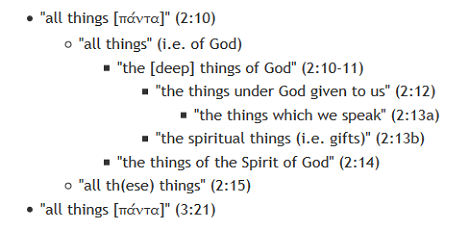
The wisdom of God encompasses “all things”, as Paul makes clear in 3:21-23, where he establishes a (hierarchical) chain of relationship, presented in reverse order— “all things” (pa/nta), he says:

belong to you (pl., believers), and you in turn
belong to Christ, who in turn
belongs to God the Father

If we allow ourselves to be guided by the Spirit and the mind of God/Christ, then we are free to study and examine all things (cf. 2:10, 15), and this itself becomes an integral expression of the “wisdom of God” which we speak.

This analysis of the thrust of 2:6-16 (extending to 3:1-3) provides the framework for our detailed study of 2:10-15, which contain the key references to the Spirit. For this study, see the first note, on v. 10.

December 23: John 1:11-12a

John 1:11

“He came unto (his) own (thing)s,
and his own (people) did not take him along.”

This couplet follows the tricolon of verse 10 (discussed in the previous note). It continues the framework of that triad: “he was in the world…the world did not know him”, but with the concept of the “world” (ko/smo$) now narrowed to the land and people of Israel. Let us consider the parallel:

    • “he was in the world” (v. 10)
      e)n tw=| ko/smw| h@n
    • “he came unto (his) own” (v. 11)
      ei)$ ta\ i&dia h@lqen

The structure of each statement is identical: a locative prepositional phrase followed by the verb. The prepositional expressions are comparable in meaning, and suggest a development, a narrowing of focus: being “in the world” => coming “into his own (place)”. The use of the personal adjective i&dio$, pertaining to self, has a dual meaning in context: (1) it refers to the place of God’s own people (i.e., Israel as the people of God), and (2) it refers to the place of Jesus’ people (i.e., the place where he lived and worked). The plural adjective is neuter (ta\ i&dia), lit. “(his) own (thing)s”; however, as a reference to a person’s belongings, the expression can signify a “household” or “home” —i.e., the place/area where a person lives. This same sort of wording occurs in the famous saying of the boy Jesus in Luke 2:49, referring to “the (thing)s of my Father” (i.e., God’s household, the things belonging to Him).

In the next line, the adjective is repeated, but as a masculine plural, indicating that it refers to “men” (i.e. people)—oi( i&dioi, “(his) own (one)s,” “(his) own (people)”. Again, there is a sense of progression: the Logos come into his own place (homeland), and proceeds to encounter his own people (those who live there). On the motif of the divine Wisdom seeking to find a dwelling place on earth among human beings (and the people Israel), cf. the discussion in the previous note. 1 Enoch 42:2 describes how Wisdom failed to find a suitable dwelling among the people, reflecting the traditional idea of humankind (the majority of the population) rejecting the Wisdom of God. The verb used here in v. 11 is paralamba/nw, “take/receive along(side)”, in the sense of welcoming a traveler or neighbor, involving the traditional custom and ideal of hospitality. In the Gospel context, of course, this has the deeper meaning of accepting Jesus, and trusting in him as the Son of God. The progression in vv. 10-11 is leading toward the specific idea of the Logos coming to be born as a human being (v. 14).

John 1:12a

“But, as many (people) as did receive him,
he gave them (the) ability to become (the) offspring of God.”

This couplet builds upon the one prior (v. 11), and probably should be read as a related compound clause in the poetic context:

“He came unto (his) own (thing)s,
and his own (people) did not take him along;
but, as many (people) as did take him (along),
he gave them (the) ability to become (the) offspring of God.”

Clearly, the idea of Israel as the people of God is implicit here, including the specific motif of being “sons [i.e. children] of God”. Of the Old Testament passages referring (or alluding) to Israel as God’s “son”, cf. Exod 4:22-23; Deut 32:6, 19; Hos 1:10 [2:1]; 11:1; Isa 43:6; Jer 31:9. In Wisdom literature, this is given a more pronounced ethical and religious emphasis, referring to the righteous, i.e., those who are wise and embrace the Wisdom of God, as being His true children (cf. Wisd 2:16-18; Sirach 4:10, etc). This provides further confirmation for the influence of Wisdom tradition on the Prologue-hymn, especially the Hellenistic Jewish line of tradition that has blended the personified Wisdom with the Logos-concept from Greek philosophy and theology. Those in Israel who accept the Logos are those very same people who accept the Divine Wisdom. Needless to say, from the early Christian perspective, this also means that they would come to trust in Jesus, accepting his identity as the Son and Word/Wisdom of God. It is likely that the Gospel writer would consider anyone who refused to accept Jesus as having rejected Wisdom, in the true sense, as well.

The verb lamba/nw (“take, receive”) is the same root verb as in the compound paralamba/nw (“take/receive alongside,” v. 11), and has precisely the same meaning in context—i.e., it refers to the people who did take/receive the Logos alongside. The correlative pronoun o%so$ confirms the point made in v. 11, that many people refused/rejected the Logos; however, the promise that follows in v. 12 applies to everyone who did accept him. The basic meaning of the pronoun is “as (many) as”, i.e., “every(one) who…” . And the promise refers to that which is described in the developed Wisdom tradition (cf. above)—viz., that they will be regarded as the children of God.

The specific expression here in the Prologue is “(the) offspring of God” (te/kna qeou=), with the noun te/kna being a plural of the neuter te/knon, which signifies something that is produced or “brought forth” (vb ti/ktw). It is often used specifically for the birth of a child (i.e., “brought forth” from the mother’s womb). Interestingly, the Johannine writings always use te/knon when speaking of believers (as children of God), reserving the noun ui(o/$ (“son”) for the person of Jesus; by comparison, other New Testament writings occasionally refer to believers as “sons [ui(oi/] of God”.

Because of the importance of this concept within the Johannine theology, we shall devote a more detailed discussion for the next daily note (Christmas Eve), where v. 12a will be studied in the context of the expository statement that follows in vv. 12b-13.

December 22: John 1:10

John 1:10-12a

Verse 10 marks the beginning of the third poetic unit (or strophe) in the Christ-hymn of the Johannine Prologue. The four units expound a Christological development from pre-existence (strophe 1) to incarnation (strophe 4). This third strophe provides the transition between the creation of the universe by the Logos (vv. 3-5) and the incarnation of the Logos in the life of Jesus (vv. 14-16).

Verse 10

“He was in the world,
and the world came to be through him,
and (yet) the world did not know him.”

These lines form a triad, a poetic triplet/tricolon, with three statements, each involving the relationship between the Logos and the “world” (ko/smo$). The noun ko/smo$ can refer to what we call the universe (cosmos), but it more properly signifies the arrangement of things in the universe, the order of creation; the translation “world-order” is generally accurate, if cumbersome. I have followed the customary rendering of ko/smo$ as “world”, since the English word has a comparable sort of semantic range.

The noun ko/smo$ is an especially distinctive part of the Johannine vocabulary. It occurs 78 times in the Gospel, and another 24 in the Letters—more than half of all the New Testament occurrences (185). Occasionally the word is used in the neutral sense of the universe, or, more precisely, the inhabited world (of human society). However, in the majority of instances, it has a decidedly negative meaning—referring to the world, in the current Age, as it is dominated by the forces of darkness and evil. There is a striking dualism that runs through the Johannine writings, contrasting the “world” (of darkness and evil) with the realm of God and the Spirit (of light and truth). Early Christians in the first century generally shared this worldview, often expressed within an eschatological framework—i.e., the current Age is becoming increasingly wicked, as the end draws near. Paul evinces a similar sort of dualism, emphasizing how the world in the current Age is in bondage to the power of sin. Even so, the specific Johannine dualism that depicts the “world” (ko/smo$) as fundamentally in opposition to God (and, by extension, to His Son Jesus and those who trust in him), defined largely as a contrast of “light vs darkness”, is distinctive.

Let us examine each of the statements of the contrast here in the Prologue, between the “world” and the Logos:

e)n tw=| ko/smw| h@n
“he was in the world”

This simple statement contains two components: the verb (a form of the verb of being) and a predicate prepositional expression (in emphatic [first] position). As previously noted, the verb of being (ei)mi) in the Prologue is reserved for God, and is only used of God the Father and the Logos (= Jesus the Son). Here it is the same imperfect active indicative form (h@n, “was”) that is used elsewhere in the Prologue. Thus the deceptively simple statement “he was in the world” implicitly contains a deeper theological meaning: the pre-existent Wisdom/Word of God was in the world. While this alludes to the earthly life of Jesus, it cannot be limited to that aspect (cf. below).

To say that the Logos was “in” (e)n) the world, is parallel with the idea that the divine/eternal Life was “in” (e)n) him (v. 4a). This Life is communicated to human beings (i.e., those in the world), v. 4b. The Life, under the image of light (i.e., the Light of God), is thus “in” (e)n) the world, under the negative aspect of the ko/smo$ (cf. above)—that is, in the midst of the darkness of the world (e)n th=| skoti/a|, v. 5). This personal presence of the Logos was foreshadowed in the closing words of verse 9, where the Logos is referred to as the “true Light” that is “coming into [ei)$] the world”.

kai\ o( ko/smo$ di’ au)tou= e)ge/neto
“and the world came to be through him”

According to the vocabulary of the Prologue, the verb of becoming (gi/nomai) is used for created beings (in contrast to the verb of being, used only of God). This re-states the declaration in verse 3: “all (thing)s came to be through him [di’ au)tou=]” —God created all things in the universe through the Logos (His Word/Wisdom). As applied to the person of Jesus, this same Wisdom tradition was utilized in the context of other Christ hymns (cf. Colossians 1:16; Hebrews 1:2b-3). The point is emphasized here in order to make a stark contrast with the statement that follows:

kai\ o( ko/smo$ au)to\n ou)k e&gnw
“and the world did not know him”

In light of the prior statement, this is a powerful declaration: human beings (in the world) did not recognize the one who created them. To say that they did not recognize the Logos (the Word/Wisdom) of God essentially means that they did not recognize God Himself. This aspect of recognition is expressed through the verb ginw/skw (“know”)—a common verb, but one which takes on special (theological) meaning in the Johannine writings. It occurs 56 times in the Gospel, and another 26 in the Letters (more than a third of all NT occurrences), where it is used parallel with the verb ei&dw [oi@da] (“see”). The verbs ei&dw and ginw/skw are partially interchangeable in Greek, due the close relationship between “seeing” and “knowing”. The Johannine writings make considerable use of this dual-meaning, which ties in naturally with the light-motif (and its light/darkness dualism). In addition to ei&dw (85 times in the Gospel, 16 in the Letters), the Johannine writings make significant use of the verbs ble/pw, qea/omai, qewre/w, and o(ra/w—all denoting sight/observation/perception (= discernment/understanding).

Based on this Johannine usage, to “know” Jesus means to trust and accept him, recognizing that he is the Son of God. From the standpoint of the Prologue, this also means realizing the identification, established in the Christ hymn, of Jesus with the Word and Wisdom (i.e., the Logos) of God. For this reason, it would be a mistake to interpret the statement here as referring simply to the rejection of Jesus by the population during his earthly life and ministry. While the earthly life of Jesus is certainly in view, it is his identification with the Logos, in particular, that is being emphasized.

The influence of Wisdom tradition is very much present here, as it also is in the “Christ hymns” of Colossians (1:15-20) and Hebrews (1:2b-4). On the combination of Jewish Wisdom tradition with the Logos-concept in Greek philosophy, cf. the earlier note on verse 1. The term lo/go$ was especially useful in this regard, encompassing as it does the idea of both the Wisdom and Word of God. In Old Testament and Jewish tradition, we find the motif of the divine Wisdom dwelling among human beings. This is part of a broader tradition, in which God (YHWH) is said to make His dwelling (Heb. /k*v=m!) among the people Israel (symbolically, in the Tent-shrine or Temple sanctuary, etc). Sirach 24:8ff describes how the Divine Wisdom similarly set up his Tent-dwelling among the people (cf. also the more general reference in Prov 8:31).

The same idea can be expressed in terms of the personified Word of God. In particular, we may note the line of Jewish tradition, represented in the Aramaic Targums, in which the term ar*m=ym@ (mêmr¹°, “the saying, the word”) came to be used as a conceptual intermediary when speaking of the person of God. It developed as a pious circumlocution, a way to avoid attributing to YHWH Himself specific human (i.e., anthropomorphic) characteristics or actions. According to this line of tradition, when God says “I will be with you” (Exod 3:12), it is rendered/interpreted as “My Mêmr¹° will be your support”. Similarly, the concept of YHWH dwelling among His people would be explained in terms of His Word (Mêmr¹°) dwelling among them. Cf. Brown, p. 523-4.

An important part of the Wisdom tradition involves the specific exhortation for God’s people (the righteous) to pursue wisdom, with the understanding that many people (even in Israel) will reject it. Thus, the motif of Wisdom seeking to dwell among the people, when combined with the idea of many people rejecting Wisdom, leads to the natural image of Wisdom failing to find a suitable dwelling-place on earth. In 1 Enoch 42, the story is told of Wisdom finding a home among the angels in heaven; the brief narrative involves an unsuccessful attempt to find a dwelling on earth among human beings:

“Then Wisdom went out to dwell with the children of the people, but she found no dwelling place” (v. 2, translation E. Isaac in Charlesworth, OTP).

Almost certainly, the Christ hymn here in the Prologue draws upon the same basic line of Wisdom tradition.

December 15: John 1:3

John 1:3-5

The first section of the “Christ hymn” in the Johannine Prologue (vv. 1-2) emphasizes how the relationship between the Logos and God existed “in the beginning” —that is, prior to the creation of the universe (cf. the discussion in the previous note). This is clearly indicated by the allusion to Genesis 1:1, and by the fact that the section which follows (vv. 3-5) refers specifically to the creation. However, the theme of a pre-creation existence of the Logos, and its relationship (indicated by the preposition pro/$, “toward,” in vv. 1-2) to God, is also implied by the use of the term lo/go$ (lógos) itself.

In a prior note (on v. 1b), I discussed the meaning and background of the noun lo/go$, and the special philosophical/theological use of the term, going back to the pre-Socratic philosopher Heraklitos in the 6th/5th century B.C. The meaning of the Logos-concept, in this context, may be summarized as: a manifestation of God, a rational intelligence that gives order to all things in creation. Philo of Alexandria is perhaps the best example of a Jewish philosopher who utilized the Logos-concept, applying it to Old Testament religious and theological tradition. He also happens to be a contemporary (fl. 20-50 A.D.) of the first-generation of Christians (and the earliest New Testament writings), so his application of a Logos-theology is especially pertinent to the similar development that we see here in the Johannine Prologue.

Philo uses the noun lo/go$ more than 1400 times in his writings, and often in the specialized philosophical/theological sense noted above. What is particularly significant, is the way that he has blended the Greek Logos-concept with Hellenistic Jewish Wisdom tradition. According to this line of tradition, Wisdom (Grk sofi/a) was considered to be the image (ei)kw/n) of God (Wisd 7:26), by which the world (and human beings) were created (2:23). The thought goes back, primarily, to the famous passage in Proverbs 8:22-31, in which Wisdom (Heb hm*k=j*), personified as a pre-existent divine being, it is said, acted to bring about God’s work of Creation. Philo similarly speaks of the Logos (lo/go$) as the image of God; the created universe, in turn, is the visible image of the Logos of God, like a personal stamp upon a coin (On the Creation §25; On Dreams 2.45; On the Special Laws I.81). This idiom is not limited to Jewish tradition, as it can be seen in other strands of philosophy, such as in Platonic thought, going back to Plato’s concept of the visible world as the perceptible image (ei)kw/n) of an intelligible Deity (Timaeus 92c).

The Logos (like the divine Wisdom) plays a central role in God’s creation of the universe, and it continues to function as the governing power of God by which all things in the universe are “held together” (sune/sthke). The Logos is similarly described as a “bond”, the binding force, that holds the cosmos together (Philo, Who Is the Heir §23, cf. On Flight and Finding §112). In Wisdom 1:7, the Wisdom of God is likewise said to be that which holds all things together (sune/xon ta\ pa/nta); while in Sirach 43:26, it is stated that all things lay (bound) together (su/geitai ta\ pa/nta) in the Word (Lo/go$) of God. This language clearly relates to the the thought-world of the Johannine Prologue, as also of the other New Testament “Christ hymns” we have studied (cf. especially Col 1:17 and Heb 1:3, and note also the wording in 2 Peter 3:5). For more on the place of the Logos (Lo/go$), the personified Word/Wisdom of God, and its role in creation, in the writings of Philo, see On the Creation §146; Who Is the Heir? §§7, 130ff; On the Special Laws I.80-81; III.83, 207; IV.123b; On the Migration of Abraham §6; On the Cherubim §125f; On Flight and Finding §§12, 95; On the Work of Planting §§18, 50; The Worse Attacks the Better §§83, 86; On Dreams 1.72, 215 (Attridge, p. 40ff). The influence of this Wisdom/Logos tradition on the Johannine prologue is obvious, but, as I previously discussed, the authors of Hebrews and the Colossians hymn (whether Paul or another) almost certainly drew upon it as well. For comparable references to the divine Wisdom in Hellenistic Jewish tradition, cf. Wisdom 7:22-8:1; 9:2ff; 10:1ff; Sirach 1:3-10; chap. 24; 33:7-8ff; 42:21; Baruch 3:15ff, etc.

It is in Proverbs 8:22-31 that we find the origin of the Jewish concept, and, especially, the idea of the close relationship between Wisdom and the Creator God. In verse 30, the personified Wisdom declares “I was near (lx#a@) Him”; the Greek LXX renders Hebrew lx#a@ with the preposition para/ (“alongside”). Even though the Johannine Prologue (vv. 1-2) uses a different preposition (pro/$, “toward”), the same basic idea is being expressed. The Logos was with God, in close proximity to him, at the time when the universe was created.

Verse 3

The first line of verse 3 states the role of the Logos in the creation of the universe quite clearly and simply:

pa/nta di’ au)tou= e)ge/neto
“all (thing)s came to be through him”

Let us briefly examine each of the three components in this statement.

pa/nta (“all [thing]s”)—The comprehensive adjective pa=$ (“all”) occurs here in a substantive plural form, as the subject of the clause. “All things” = everything in the universe. In our study of the Colossians hymn (1:15-20), we saw how the adjective pa=$ was used repeatedly (7 times in the hymn) to give special emphasis to the exalted position of Jesus over “all” creation; his exalted position is due, in part, to the role that he (as the pre-existent Son) played in the process of creation itself. In that hymn, a predicate use of the substantive plural (ta\ pa/nta, “all things”) occurs several times (vv. 16-17 [twice in each verse], 20), as it also does in Hebrews 1:3, which in many ways is closer to the thought expressed here in the Prologue:

“…and bearing [i.e. carrying] all (thing)s by the utterance [i.e. word] of his power”

In that statement, the noun r(h=ma (“utterance”) is used rather than lo/go$, but the meaning is comparable, and almost certainly reflects the same Logos/Wisdom theology summarized above.

di’ au)tou= (“through him”)—The Logos is the means, the instrument, through which God created the universe. This is fully in accordance with the Logos/Wisdom theology (cf. above), and is similarly applied to the (pre-existent) person of Jesus elsewhere in the Christ hymns. Note, in particular, Hebrews 1:2b (“through whom He [i.e., God the Father] made the Ages”); cf. also Colossians 1:16b (“all things have been founded [i.e. created] through him…”).

e)ge/neto (“came to be”)—The use of the verb of becoming (gi/nomai) in the Prologue is significant, since it provides a clear distinction (and contrast) with the verb of being (ei)mi). The verb of being, used in vv. 1-2, refers specifically to the being of God (i.e., Divine being), while the verb of becoming (beginning here in v. 3) refers to created beings (esp. human beings). The verb gi/nomai can mean “coming to be born,” referring to the birth of a human being, though the related verb genna/w expresses this more precisely. The important distinction between ei)mi and gi/nomai will be discussed further as we proceed through the Prologue.

The emphasis on “all things” (note the emphatic [first] position of pa/nta in the line) is reinforced by the statement that follows in v. 3:

“and apart (from) him not even one (thing) came to be”

Again, the meaning of statement is quite clear: God created everything through the Logos. However, it is at this point in the section that considerable difficulties of interpretation arise. We will attempt a clear and succinct discussion of these in the next daily note.


December 9: John 1:1b

John 1:1, continued

The central word in the first verse of the Prologue, and the subject of each of the three clauses in v. 1 (cf. the previous note) is the noun lo/go$ (logos), which can be difficult to translate due to its rather wide semantic range. Because the word is so important for establishing the meaning and the theology of the Prologue, it is worth discussing the matter here in some detail.

On the word lo/go$

The noun lo/go$ is derived from the verb le/gw, which has the fundamental meaning of “gather”, but also came to be used in range of related senses: (a) “lay out”, i.e., arrange the things gathered; (b) “count”, both in the concrete sense of enumerating things gathered, but also in the more abstract sense of a mental gathering (i.e., reckon, consider, recall [from memory], etc); (c) “give an account”, then in the more general sense of “narrate”; and, finally, (d) “speak, say”, generalizing the idea of giving a spoken (oral) account of something. The common signification of “speak/say” for le/gw can again take on various nuances of meaning, when used in different contexts involving speech, narration, etc.

The noun lo/go$ (“gathering, collection”) itself covers much the same semantic range as the verbal root le/gw (cf. above). Basically, this range of meaning can be divided into: (i) a mental gathering (“reckoning, calculation, plan, reason”), and (ii) a more concrete accounting, either as a written/notational account, or a spoken (oral) account (“speech”). The basic meaning of “account” for lo/go$ is perhaps the closest to the mark, but the mental and spoken aspects can be generalized as “thought” and “word”, or even in a more abstract generalization as “thing” (i.e., something thought or spoken of).

Given this wide range of meaning, with an emphasis on thought and reason, etc, it is not surprising that lo/go$ came to be used in specialized philosophical and theological contexts. It is most often associated with Stoic philosophy, but this usage goes back at least as far as the pre-Socratic philosopher Heraklitos (c. 540-480 B.C.). In a number of surviving fragments, quoted by later authors, Heraklitos uses the term lo/go$ to refer to the divine power/presence that binds the universe together, giving it order and holding its different components and aspects in balance. In fragment 1 (Sextus Empiricus VII.132), he states that “all things (are) coming to be according to the lo/go$” (ginome/nwn pa/ntwn kata\ to\n lo/gon). The same author (VII.129) quotes Heraklitos as referring to this “divine lo/go$” (o( qei=o$ lo/go$). The logos is thus divine, a manifestation of God, a rational intelligence that gives order to all things in creation, providing a balanced arrangement that holds and binds the universe together. This generally corresponds with the later Stoic use of the term for the mind of God that penetrates creation, ordering and controlling all things.

Hellenistic Jewish philosophers—of whom Philo of Alexandria is the most notable example—blended this Logos-concept together with a line of Old Testament Wisdom tradition that reaches back to the famous passage in Proverbs 8:22-31. Wisdom (Hebrew hm*k=j*), personified as a divine or heavenly being, was with God at the beginning of creation, and functioned as the means/instrument through which YHWH created the universe. Later Jewish tradition expanded upon this idea, developing the concept of the divine Wisdom (Grk Sofi/a) that created, pervades, and sustains the universe (Wisdom 7:22-8:1; 9:2ff; 10:1ff; Sirach 1:3-10; chap. 24; 33:7-8ff; 42:21; Baruch 3:15ff, etc). Philo of Alexandria subsumed this Wisdom tradition under the concept of the Logos, and the Prologue of John appears to have done much the same. It is probably more accurate to say that the Johannine Prologue, like the New Testament “Christ hymns” in Philippians, Colossians, and Hebrews, drew upon a common line of Hellenistic Jewish Logos/Wisdom tradition. The Logos/Wisdom concept was adopted by early Christians and applied to the person of Jesus. This will be discussed further as we proceed through the Prologue.

Verse 1b

“In (the) beginning was the Lo/go$, (1a)
and the Lo/go$ was toward God, (1b)
and the Lo/go$ was God.” (1c)

The first clause (1a) was introduced in the previous note. Today, we will focus on the second clause (1b), while keeping the first in view.

kai\ o( lo/go$ h@n pro\$ to\n qeo/n
“and the Word was toward God”

kai/ (“and”)—the three component clauses of v. 1 are joined by the conjunctive particle kai/. Here the conjunction indicates that the statements are unified, in terms of referring to the Logos as divine, but that the statements also complement (or supplement) each other, emphasizing different aspects of a single theological declaration. In this case, the whole is truly greater than the sum of its parts.

o( lo/go$ (“the word”)—on the meaning and background of the noun lo/go$, cf. the discussion above. Translation of this noun is notoriously difficult, as has been indicated, all the more so when the term used in the specialized philosophical and theological sense—whether by Heraklitos, Philo of Alexandria, or here in the Johannine Prologue. The basic idea involves a rational (divine) intelligence that gives order to all things in creation. However, Old Testament and Jewish tradition added to this philosophical concept the important aspect of God (YHWH) creating the universe—which He does through His Wisdom (Prov 8:22-31), but also through His Word (Gen 1:1ff). The term lo/go$ is especially useful because it captures this aspect of speech (the spoken word), in addition to the mental aspect (thought, plan, reason). It has become customary to translate lo/go$ in Jn 1:1 and 14 as “word”, and, in context, this is as good a translation as any, though it certainly does not encompass the entire meaning.

h@n (“was”)—in each of the three clauses of v. 1, the verbal element is an imperfect active indicative form of the common verb of being (ei)mi). As mentioned in the previous note, this verb form has special theological significance in the Gospel of John (and the Johannine Prologue, in particular). In each of the clauses, it is used to signify the deity of the Logos. However, this is done in different ways. The first clause has no proper predicate, but simply states that the Logos was—with the implication being that it had existence “in the beginning”, that is, a divine pre-existence. Here, in the second clause, the force of the verb is somewhat different, because of the predicate expression that follows, establishing an important point of reference regarding the relationship between the Logos and God.

pro/$ (“toward”)—the preposition pro/$ literally, and primarily, means “toward”, and so I have translated it above. This can be understood either in terms of (a) facing toward, or (b) moving toward. Whether the positional or dynamic aspect is being emphasized is difficult to say. The main point is that the Logos is present with God “in the beginning”, and has a close/intimate relationship with Him. There is almost certainly an intentional parallel in the closing verse of the Prologue (v. 18), when it speaks of the Son (par. Logos) being “in” (lit. “into”, ei)$) the lap of the Father.

o( qeo/$ (“God”)—as noted above, the predicate of the clause is a prepositional phrase that establishes the relationship of the Logos with God. Certainly, by qeo/$ here is meant El-Yahweh, the Creator and one true God, according to the traditional monotheistic belief held in common by Israelites, Jews and early Christians. In Old Testament and Jewish tradition, the divine Wisdom (personified) was the first of God’s creation, and was with Him at the beginning, when the universe was created (Prov 8:22-31). In Prov 8:30, Wisdom declares that, in the beginning, he/she was “near” (lx#a@) YHWH, which is expressed in the LXX by the preposition para/ (“alongside”).

While early Christians drew upon this line of tradition, they gave to it a new dimension when it was applied to the person of Jesus. The Wisdom motif had to be incorporated within the established parameters of the early Christology, centered around three primary titles— “Anointed One” (Messiah), “Son of God”, and “Lord” —and the central Gospel message of the resurrection/exaltation of Jesus. The aspect of YHWH as God the Father must be understood here, in the context of the Johannine theology, even though the theme of Jesus’ Sonship has not yet been introduced in the Prologue. The central relationship (indicated by the preposition pro/$) between the God and the Logos is very much akin to that of Father and Son (note again the parallel between vv. 1 and 18).

December 3: Hebrews 1:3 (3b)

Hebrews 1:3, continued

Verse 3b

fe/rwn te ta\ pa/nta tw=| r(h/mati th=$ duna/mew$ au)tou=
“and bearing all (thing)s by the word of his power”

This is the second of the two participial clauses in verse 3ab, each of which illustrate different aspects of the pre-existence Christology that came into prominence during the period c. 60-90 A.D. It is helpful to keep in mind the syntactical structure:

    • (the Son) “who” (o%$)
      • “being…” (w&n) [3a]
        • “…a beam (shining) forth of the splendor (of God)”
          a)pau/gasma th=$ do/ch$
        • “…an engraving of th(at which) stands under Him”
          xarakth\r th=$ u(posta/sew$ au)tou=
      • “and bearing all (thing)s by the word of His power” (fe/rwn te ta\ pa/nta tw=| r(h/mati th=$ duna/mew$ au)tou=) [3b]

Both of the key participles (w&n, fe/rwn) are present-tense forms, and, as such, may be intended to establish characteristics of Jesus the Son of God that are eternal (i.e., ever-present); or, at least, that they have fundamental meaning and significant in the present, rather than simply referring to events or conditions in the past. The first participle (cf. the discussion in the previous note) is a form of the verb of being (ei)mi), and thus the clause functions as a declaration of who Jesus is. The second participle is of an active/transitive verb (fe/rw), meaning “bear, carry”, and refers to what Jesus (the Son) does.

The doing of Jesus involves the act of creation—that is, of God creating the universe. This is a central aspect of the early pre-existence Christology, and it is influenced by Hellenistic Jewish Wisdom/Logos tradition, being originally derived (primarily, if not exclusively) from the ancient Wisdom-tradition in Proverbs 8:22-31. For the basic details on this line of tradition, cf. the discussion in the previous note, as well as the earlier notes on the Colossians hymn (1:15-20).

However, while the Colossians hymn, like the Johannine prologue, refers to Jesus’ role in creation in terms of “making, establishing, forming” (kti/zw, ti/ktw), here in v. 3b the emphasis seems to be on sustaining the universe, maintaining its unifying bond of existence. Let us see how this is expressed by examining the two component phrases of the clause.

fe/rwn ta\ pa/nta

As noted above, the participle is the verb fe/rw (“bear, carry”), and it expresses how the Son’s divine character is manifest in the world—he carries all things, meaning that he supports and sustains all of Creation. Particularly important to this line of Christology is the substantive use of the adjective pa=$ (“all”), in the plural, as a comprehensive (and emphatic) reference to everything in the universe (“all things,” ta/ pa/nta). The adjective is used repeatedly (7 times) in the Colossians hymn (ta\ pa/nta in vv. 16-17, 20). While this coincides with Pauline usage, the same emphatic term here in Hebrews demonstrates that the language in Col 1:15-20 could just as easily be derived from an earlier (non-Pauline) hymn or confessional statement.

tw=| r(h/mati th=$ duna/mew$ au)tou=

This sustaining of creation is done “by the utterance [r(h=ma] of his power”, which blends the Wisdom/Creation traditions (cf. above) with the fundamental religious/cosmological idea of God creating the universe by His speaking a word. Both of these ideas are established more clearly in the Johannine Prologue (1:1-3ff), but they are certainly present here as well, and relate to the divine pre-existence of Jesus as the Son. The same divine power that brought the world into existence now providentially sustains it.

The noun r(h=ma is used, rather than lo/go$ (as in the Johannine prologue), but the same basic idea of the spoken word is involved. Admittedly, lo/go$ is more closely rooted to the underlying Wisdom tradtion, since it connotes the Divine thought and reason that brings shape and order to the universe. This all-pervasive sustaining and ordering of creation is attributed, famously, to the Divine Wisdom in Wis 7:24ff. In the writings of Philo of Alexandria, this is expressed in terms of the Logos (Lo/go$), as the means by which God sustains the cosmos (On the Migration of Abraham §6, cp. Who Is the Heir? §7, On Dreams 1.241. In certain passages, the Logos is referred to as a “pillar” that supports the universe, and to the “bond” (desmo/$) that holds all things together (On the Work of Planting §8; On Flight and Finding §112; cf. Attridge, p. 45).

“His power,” of course, refers to the power of God, and indicates that the creative (and world-sustaining) power of the Son (like the Logos) is that of the Father Himself. The pre-existent Jesus thus shares the same Spirit (i.e. Power) of God, affirming a central point of the developing Christology, common to the great hymns in Philippians and Colossians, as well as other key Christological passages of the New Testament.

June 18: 1 Corinthians 2:9-16

1 Corinthians 2:9-16

The extensive Corinthian letters of Paul, so complex in structure and rich in content, provide us with a number of key passages indicating how an understanding of the Spirit of God developed in early Christianity. As one of the most influential voices of the time, Paul’s theological brilliance and inspired expression makes his treatment of the Spirit in his letters of the utmost importance.

The first main passage in the Corinthian correspondence (as it has come down to us) is in 1 Cor 2:9-16, part of the opening section (1:18-2:16) of the main body (probatio) of the letter. In it, Paul begins to address the main issue—the propositio (1:10ff)—on the existence of various divisions in the congregations which are contrary to the ideal of Christian unity. In 1:18ff, as Paul’s initial line of argument, he focuses on the Gospel message (“the account of the cross”) as a fundamental point of unity for believers. He draws heavily upon Wisdom traditions, emphasizing that the message of Christ represents the true wisdom of God, revealed especially now, at the end of the current Age. The wisdom of the “world”, of this current Age, is set in direct contrast to God’s wisdom (the Gospel).

In 2:9-16, this wisdom is defined in terms of the presence and activity of God’s Spirit. The association between wisdom and the Spirit is ancient, part of a line of Wisdom tradition that goes back at least to the book of Job in the Old Testament. This was discussed in earlier notes, especially those on Job 32:8 (cf. 33:4) and Gen 41:38. The association is especially prominent in the Book of Wisdom (the so-called Wisdom of Solomon, cf. my earlier note), and Paul’s use of the motif in 1 Corinthians has much in common with this Hellenistic Jewish outlook. The basic line of tradition begins with the idea that the very ability for human beings to understand and comprehend is due to the Spirit of God as the source of the human spirit (at creation/birth). More than this, those individuals who evince a special kind of understanding, ability, or skill were seen as being uniquely gifted by God’s Spirit.

Paul draws upon this idea, but turns it decidedly in the direction of the Gospel—that is, those who accept the message of Christ, and who receive the Holy Spirit (at baptism), possess a special wisdom and insight due the presence of God’s Spirit. This argument is introduced by way of a composite Scripture quotation (from Isaiah 64:4, cf. also Isa 52:15; Sirach 1:10), emphasizing that the spiritual revelation accessible to believers is of a kind of “wisdom” that is unknown and unintelligible to people at large. In verse 10, he states clearly:

“But to us God (has) uncovered (it) through the Spirit—for the Spirit seeks (out) all (thing)s, even the deep (thing)s of God.”

Paul explains this further in verse 11, on the basic (philosophical/epistemological) principle that a thing can be truly understood only through familiarity with the essence (or “spirit”) of the thing. What it means to be human (“the [thing]s of man”) can only be understood (“seen/known”) by “the spirit of man”, i.e. the spirit that is within a person. From this standpoint of understanding, the “spirit” is more or less equivalent to the “mind” (nou=$, cf. below). By extension, “the (thing)s of God” can only be known by the Spirit of God (= the “mind” of God). Paul’s claim in verse 12, that believers are able (unlike the rest of humankind) to understand the “(deep) things of God”, is striking indeed:

“But we did not receive the spirit of the world, but the Spirit (that is) out of God, (so) that we would see [i.e. know] the (thing)s given as a favor to us under [i.e. by] God.”

The participle xarisqe/nta (charisthénta), from the verb xarizomai (“give/grant [as] a favor”), establishes the important theme of the “spiritual gifts” that will be developed further on in the letter. Those “gifts” reflect the presence and activity of the Spirit in/among believers, giving to them—both individually and collectively—understanding of the “spiritual things” and the “things of God”, which Paul refers to here, more dramatically, as “the deep (thing)s [ba/qh] of God” (v. 10). Indeed, the Spirit teaches these things to believers (v. 13)—spiritual things can only be understood by teaching in “spiritual (word)s” (i.e., words spoken to us by the Spirit).

In verses 14-15, Paul returns to the contrast between worldly and divine wisdom, defining it more precisely in anthropological terms which are most difficult to translate. Two contrasting adjectives are used: yuxiko/$ and pneumatiko/$. The latter is typically translated “spiritual”, which is generally accurate; however, based on that pattern, the former adjective would have to be translated something like “soulish” (from yuxh/, “soul”). Many translations render yuxiko/$ as “natural”, but that is rather inaccurate and misleading, in terms of the contrast Paul is making. In the context here, it is better understood as “with (only) a soul”, in the sense of persons who only possess a human soul/spirit, but not the Spirit of God. That this the point of Paul’s comparison, is indicated by his use of the same terminology in 15:44-46, a usage that finds definite confirmation elsewhere in the New Testament (James 3:15; Jude 19). Indeed, Jude effectively defines the adjective yuxiko/$ in context as a person “not holding [i.e. possessing] the Spirit”.

The character of believers, who do possess the Spirit of God, as “spiritual” (pneumatiko/$), means that they/we are able to discern “all things”, including the “deep things” of God. The concluding quotation of Isa 40:13 in v. 16 again identifies the Spirit of God with the “mind” (nou=$) of God. That believers are seen as possessing this divine mind is not surprising, given Paul’s line of argument here; however, what is especially notable is how Paul further identifies the mind of God (“the Lord”, in Isa 40:13) with the mind of Christ. This interpretation, uniquely Christian, is possible because of the dual-meaning of the title “the Lord” (o( ku/rio$) among early Christians—it can refer both to God the Father (YHWH) and Jesus Christ.

“and (yet) we hold (the) mind of (the) Anointed”

This closing declaration clearly states that believers possess the “mind of Christ”, which can be understood several ways:

    • It refers to the presence of Christ himself in and among believers
    • Individually and collectively, believers possess a dual-mind, whereby our own mind/spirit interacts with the mind/spirit of Christ
    • We are able to understand the very mind/thought of Christ (which also means we can understand the mind of God)
    • Our own mind is conformed to the mind of Christ himself

All of these are valid concepts, though the second and third aspects are most directly relevant to Paul’s line of argument here. What is most significant is the implication that the “mind of Christ” (and, by extension, the mind of God) is communicated to believers through the Spirit. Paul does not explain here the theological/Christological basis for this, nor indicate in any detail the dynamic or process that is involved. However, there are other passages in his letters which do shed some light on the matter, including elsewhere in 1 Corinthians. This will be discussed in the next daily note, as we look at 1 Cor 6:17ff together with 15:44-46.

January 3: John 1:12-13, 14

John 1:12-13, 14

The prologue of the Gospel of John (1:1-18) is probably the most famous and distinctive exposition of the divine pre-existence of Jesus, and of his identity as the Son of God, anywhere in the New Testament. This familiarity belies the complexity of the passage, both from a literary and theological standpoint. Most commentators have note the poetic, hymnic character of the prologue (most of it), and many consider it to have been a Jewish-Christian hymn which the author adapted. If so, then the substance of the prologue pre-dates the Johannine Gospel itself, which is generally regarded as the latest of the four Gospels (c. 90 A.D.), though containing many earlier traditions.

The prologue differs from the Gospel proper in a number of ways, with the poetic verses (and strophes) distinguished from the several prose statements (by the Gospel writer). The main additions by the author would seem to be the two statements regarding John the Baptist (vv. 6-9, 15), which function as comments, likely in response to adherents of the Baptist who viewed him as the Messiah, etc, instead of Jesus. Nowhere in the Gospel tradition is there such a pronounced contrast between John and Jesus (1:19-34; 3:22-30ff), with the Gospel declaring the superiority of Jesus in no uncertain terms.

Verses 13 and 17-18 are probably also explanatory statements by the Gospel writer that have been added to the earlier hymn; these statements enhance the theological and Christological dimension of the poem. If, indeed, the bulk of the prologue represents a pre-existing hymn, or poem, it would seem to reflect Old Testament and Jewish Wisdom traditions that have been applied to the person of Jesus Christ. In this regard, it is similar in style and tone with two other Christological ‘hymns’ in the New Testament—Colossians 1:15-20 and Hebrews 1:1-4 (cf. the previous note)—and may have been written at about the same time (c. 60-70). In his now-classic Commentary on the Gospel of John, Raymond E. Brown, following the work of earlier scholars, divides the poetic prologue into four parts or strophes (pp. 3-4), which I have further annotated here:

    • Strophe 1 (vv. 1-2)—Pre-existence: The Son (as the Word) with God in eternity
    • Strophe 2 (vv. 3-5)—Creation by the Word of God, which is also the Light
    • Strophe 3 (vv. 10-12a)—Response of humankind to the Word/Light
    • Strophe 4 (vv. 14, 16)—The presence of the incarnate Word with humankind (believers)

According to this sequence, the third strophe (vv. 10-12a) describes the entry of the Word (lo/go$) into the world (ko/smo$). While this alludes to the incarnation of Christ, it is not limited to that historical phenomenon. Rather, the orientation is wider, reflecting traditions regarding the presence of God’s Wisdom in the world; in particular, verses 10-11 draw upon the theme of Wisdom seeking a place among human beings on earth and finding none (cf. 1 Enoch 42:2). Since Jesus is the eternal Word/Wisdom of God, this traditional language and imagery is entirely appropriate:

“He was in the world, and the world came to be through him, and (yet) the world did not know him. Unto his own (thing)s he came, and his own (people) did not receive him alongside.” (vv. 10-11)

Only a few (the wise) accept Wisdom, even as only the righteous few accept the Word of God. Within the Johannine writings, this is understood in terms of what we would call election—that is, there are those who belong to God, chosen by Him, and it is they who are able to accept the Truth. Those who belong to God the Father, and who accept His truth, will be drawn to Jesus the Son, and will accept him (cf. 3:20-21; 18:37, etc). This theology underlies the statement in v. 12a:

“But as (many) as received him, he gave to them the e)cousi/a to become offspring of God”

The Word gives to the elect (i.e. those who receive him) the ability to become the offspring, or children, of God. Again, this is only realized within the Gospel context of the ministry of Jesus and the presence/work of the Spirit. The noun e)cousi/a, difficult to translate in English, refers (literally) to something which comes out of a person’s being, i.e., something one is able to do. To give e)cousi/a thus means giving someone the ability to do something, often in the sense of authority given by a superior to one who is subordinate. Verse 12b-13, which may represent an explanatory comment by the Gospel writer, expounds the idea of believers as the children (or offspring, te/kna, lit. those produced) of God:

“…to the (one)s trusting in his name, the (one)s who, not out of blood, and not out of (the) will of (the) flesh, and not out of (the) will of man, but out of God, came to be (born).”

This is a uniquely Johannine way of describing believers (“the ones trusting”), using the verb genna/w (“come to be [born]”). In the First Letter, the verb occurs 10 times, always (with just one exception) in the special sense of believers being born out of God; especially important is the articular (perfect) participle, used to define the identity of the believer— “the (one) having come to be born out of God” (3:9; 5:1, 4, 18). Only with the aorist participle in 5:1 is it used of Jesus, as the one born out of God (i.e., the Son); that peculiar usage is presumably meant to emphasize Jesus’ Sonship as the basis for our own (as children of God). The main Gospel passage expressing this is Jn 3:3-8, where the verb occurs 8 times. Here, coming to be born “out of God” (e)k tou= qeou=) is defined two-fold as being born “from above” (a&nwqen, v. 3) and “out of the Spirit” (e)k tou= pneu/mato$, vv. 6, 8). Being born “out of the Spirit” is contrasted with an ordinary human birth (“out of water”); there is a similar (three-fold) contrast with being born “out of God” in 1:13:

    • “not out of blood [pl. bloods]” —in the Semitic idiom, the plural usually refers to “acts of blood(shed)”, but here it may indicate the more general physiological idea of “actions involving (the) blood” (i.e., menstruation, etc)
    • “not out of the will of the flesh” —the will of the flesh signifies primarily the sexual drive
    • “not out of the will of man” —i.e., the intention and activity of the parent(s)

These three, taken together, refer to the ordinary (physical/biological) birth of human beings; this is very different from the spiritual birth of believers as sons/children of God. Interestingly, the only time in the Gospel when the verb genna/w is used of Jesus (in 18:37) it generally refers to his birth as human being; this is also the sense of what follows in 1:14 (using the related verb gi/nomai):

“And the Word came to be [e)ge/neto] flesh and put down (his) tent among us, and we looked (closely) at his splendor—(the) splendor as (the) only (one) coming to be [monogenh/$] (from) alongside (the) Father, full of favor and truth.”

This is the climactic moment of the Prologue (the poem), describing the incarnation of the eternal Word, i.e. his birth as a human being. This birth is implied by the specific wording, especially the verb gi/nomai (“come to be, become”), from which also the compound adjective monogenh/$ is essentially derived. The adjective is notoriously difficult to translate in English; literally, it means “only (one) coming to be”, and, while it can refer to an only child, it more properly denotes something like “one of a kind”. Here, it refers to the incarnate Word (Jesus) as the unique Son (ui(o/$) of God. Indeed, in the Johannine writings, ui(o/$ is never used of believers; it is reserved for the one Son (Jesus), and, instead, the plural te/kna (“offspring, children”) is used when referring to believers as the sons/children of God.

The Johannine Prologue, especially with the concluding verses 14-18, represents the pinnacle of the expression of early Christian belief in Jesus as the Son of God, blending the doctrines of divine pre-existence and incarnation together in the most powerful way, within the matrix of Jewish Wisdom tradition (cp. 1:14 with Sirach 24:8ff). It is also most remarkable how the Gospel writer, in developing and expounding his traditional material, combines the idea of believers as the sons/children of God with that of Jesus as the unique Son. This is very much a Johannine emphasis (in both the Gospel and Letters), but one also shared by Paul (in his Letters), indicating that it was a part of a natural development in early Christian thought. It is this that we will explore further in the next note—how early Christians understood believers in Christ to be born as “sons of God”.

* * * * * * *

The reference to the birth of believers in 1:12-13 was apparently confusing, and/or problematic, for many readers and copyists. Some early witnesses (primarily Latin) read the singular in v. 13 instead of the plural, beginning with the relative pronoun (o%$) and including the form of the verb genna/w; thus vv. 12b-13 would be translated as follows:

“…to the (one)s trusting in his name, the (one) who, not out of blood, and not out of (the) will of (the) flesh, and not out of (the) will of man, but out of God, came to be (born).”

The entire relative clause would then refer back to the subject of “his name”, rather than to “the ones trusting”, that is, to the birth of Jesus, rather than the spiritual birth of believers. The distinction was not lost on Tertullian, who accepted the singular as original, and accused Gnostics of altering the text to eliminate the idea of Jesus’ miraculous birth, replacing it with their own ‘spiritual’ birth (as gnostics), cf. On the Flesh of Christ 19. Tertullian, however, is almost certainly mistaken on this textual point, the reading with the singular being instead an example of an “orthodox corruption” (cf. B. Ehrman, The Orthodox Corruption of Scripture [Oxford: 1993], pp. 26-27). To be sure, it is understandable how the variant reading might come to be reasonably well-establish, offering as it does support for the doctrine of the Virgin Birth, and perhaps, at the same time, reflecting a certain unease among the orthodox regarding the identification of believers as the sons/children of God. I have discussed this in more detail in earlier notes.

August 31 (2): 1 Corinthians 2:6ff

Today’s note concludes this series of daily notes on 1 Corinthians 1:18-2:16. For those just coming to this study, or who are interested in reading the prior posts, it began with the note for August 16. Of special interest in the study is the interpretation of Paul’s statement in 2:6a:

“And (yet) we (do) speak wisdom among the (one)s (who are) complete…”

There have been longstanding questions regarding the precise identity of both this “wisdom” (sofi/a) and the ones who are “complete” (te/leio$). In a prior note, I outlined some of the more common suggestions offered by commentators; here they are listed again for reference, with no priority indicated by the numbering:

    1. The basic Gospel message (wisdom) is given to all believers, but a more advanced (esoteric?) Christian wisdom (teaching, etc) is offered for those who are “complete”—mature and committed in the faith sufficiently to receive it.
    2. Paul is simply making a rhetorical contrast. There is only one wisdom—that of the person of Christ and his death/resurrection. The “complete” believers are able to recognize this and do not need to seek after any other “wisdom”.
    3. He is distinguishing between the Gospel proclamation and the teaching/instruction, etc., which builds upon the basic message, interpreting and applying it for believers as they grow in faith. For the “complete” this includes a wide range of “wisdom”—ways of thinking/reasoning, use of argument, illustration, allegory/parable, (creative) interpretations of Scripture, etc.
    4. Paul himself evinces certain gnostic/mystic tendencies whereby there are envisioned levels or layers in the Gospel—i.e. the basic proclamation and belief regarding the person and work of Christ—as in the Scriptures, the deepest of which involve the most profound expressions of God’s wisdom. Only the “complete” are able to realize this, and to be able to communicate something of it to the wider community.
    5. Paul is responding to gnostic/mystic tendencies among believers in Corinth. Here, as a kind of rhetorical approach, he is drawing upon their own thinking and sensibilities, trying to bring their focus back to the centrality of the Gospel and a proper understanding of the work of the Spirit. As such, the apparent distinctions he makes are somewhat artificial, perhaps running parallel to the (actual) divisions among the Corinthians themselves.
    6. The wisdom for the “complete” reflects a deep understanding of, and participation in, the work of the Spirit. Believers who are completely guided by the Spirit need no other instruction. Paul is essentially expounding this thought in vv. 9-16, only to make (painfully) clear to the Corinthians how far they still are from the ideal.

In the notes on the passage, running through 3:1-3, I have indicated certain conclusions which may be drawn from the text, that help clarify what Paul means here in 2:6. I list these as bullet points:

    • The wisdom spoken to the “complete” comes by way of the Spirit. No other source of “wisdom” is possible.
    • The revelation of the (secret) wisdom of God is fundamentally tied to the proclamation of the Gospel.
    • The hidden wisdom of God relates to the very depths (the deepest parts) of God’s own being.
    • The “wisdom” is not limited to the Gospel message, but ought to be understood more comprehensively as “all the (deep) things under God”.
    • It is dependent upon our having received the (Holy) Spirit
    • Through the Spirit we are able to know and experience this wisdom
    • It is “taught” by the Spirit to believers, and is to be communicated (“spoken”) to others in turn.
    • The ones who are “complete” essentially = the ones who “have the Spirit”
    • The ones who are “complete” are defined, in a negative sense by the opposite—those who think and act in a “fleshly” manner are “incomplete”.

I would summarize these points, in light of our study of the passage as a whole, as follows—first, regarding the wisdom, I isolate three primary aspects:

    • It is based on the proclamation of the Gospel, i.e. of the person and work of Christ
    • It includes all that the Spirit communicates to believers, which they receive as a gift to be shared/communicated to others
    • It extends to the working and guidance of the Spirit (= the “mind of God/Christ”) in all things

With regard to those who are complete, this can be defined even more simply:

    • They are those believers who consistently think and act under the guidance of the Spirit; this must be distinguished on two levels:
      • The reality of having/holding the Spirit (in us)
      • The ideal of living out this identity—i.e., “walking in/by the Spirit” (cf. Gal 5:16, 18, 25)

The very fact that Paul, like Jesus himself, exhorts believers to be “complete”, means that it is not automatically realized through faith in Christ and receiving the Spirit; rather, it reflects a process of growth and development which, in most instances, will take place over a lifetime. This, however, does not change the force and urgency of the exhortation. Jesus’ own exhortation (Matt 5:48) to his followers essentially takes the form of a promise—if you live according to the teaching (i.e. in 5:21-47, etc), “you will be complete [te/leio$], as your heavenly Father is complete”. In Gal 5:16ff, Paul expounds upon this idea, now in a decidedly Christian sense, with the force of an imperative; note the sequence of phrases, with its central (conditional) premise:

    • “Walk about in the Spirit…” (v. 16)
      —”If you are led in the Spirit…” (v. 18)
      —”If (indeed) we live by the Spirit…” (v. 25a)
    • “We should step in line in the Spirit” (v. 25b)

The statement in Gal 5:16 reflects the very issue Paul is dealing with in 1 Corinthians, and the lament he expresses in 1 Cor 3:1-3:

“Walk about in the Spirit, and you should not complete [tele/shte, related to te/leio$] the impulse of the flesh“
“We speak wisdom among the (one)s (who are) complete… “
“And (yet) I was not able to speak to you as (one)s (who are) of the Spirit, but as (one)s (who are) of the flesh“

Is it possible that Paul, in some sense, does have a more precise and sharp division in mind, i.e. between the “complete” and the ‘incomplete’—two distinct groups or categories of believers? While this would seem to contradict much of his own argument in 1:18ff, it is conceivable that he is playing off of the very “divisions” which exist among the Corinthians. Certainly, it has been suggested from the distinction he makes in 3:2 between “milk” (ga/la) and “(solid) food” (brw=ma)—the Corinthians are behaving as immature “infants” (v. 1), and cannot be treated (i.e. spoken to) as mature adults. There are several possibilities for understanding this distinction:

    • “Milk” is the simple Gospel message, while the solid “Food” represents deeper (Christian) teaching and instruction
    • The difference is between the basic ‘facts’ of the Gospel, and its deeper meaning
    • Similarly, it is between the Gospel message and how it is (effectively) applied and lived out by believers in the Christian Community
    • It rather reflects a difference in the way believers respond—as immature infants or mature adults
    • It is simply a rhetorical image, drawn from the idea of the Corinthians as “infants”, and should not be pressed further

Something may be said for each of these interpretations, except perhaps the first. Insofar as it reflects a substantive distinction in Paul’s mind, the third and fourth best fit the overall context of the passage.

Finally, I would like to bring out a particular point of emphasis that is sometimes overlooked in this passage. When Paul speaks of the wisdom of God in terms of “the (deep) things” of God, he couches this within the general expression “all things” (pa/nta). In my view, this should be understood in an absolute comprehensive sense. Note how this is framed conceptually in chapters 2 & 3:

The wisdom of God encompasses “all things”, as Paul makes clear in 3:21-23, where he establishes a (hierarchical) chain of relationship, presented in reverse order—”all things” (pa/nta), he says:

belong to you (pl., believers), and you in turn
belong to Christ, who in turn
belongs to God the Father

If we allow ourselves to be guided by the Spirit and the mind of God/Christ, then we are free to study and examine all things (cf. 2:10, 15), and this itself becomes an integral expression of the “wisdom of God” which we speak.

August 30: 1 Cor 2:16 (continued)

[This series of notes is on 1 Corinthians 1:18-2:16]

1 Corinthians 2:16

In yesterday’s note, I looked at the first part of this verse, the citation from Isa 40:13 (LXX); today I will examine the second part, with Paul’s concluding declaration:

“…and (yet) we hold the mind of (the) Anointed {Christ}”

There are four components to this statement, beginning with the (emphatic) pronoun h(mei=$ (“we”), to be discussed below. The remaining three elements are:

    • de/ (“and/but”)—a conjunctive particle with an adversative sense, establishing a contrast with what is stated in the quotation of Isa 40:13. There the rhetorical question (“who knows/knew the mind of God?”) carries the obvious (implied) answer of “no one”. For the relation of the context of Isa 40:12-13 with 1 Cor 2:10ff, cf. my discussion in the previous note. Paul’s declaration may be (re)formulated as: “Of course, no one knows (or can have known) the mind of the Lord (God) Himself, and yet we do hold the mind of the Lord (Christ)!”
    • nou=$ xristou= (“[the] mind of [the] Anointed”)—as I indicated in the prior note, many witnesses read “mind of [the] Lord [kuri/ou]”; if original, then Paul is certainly making use of the wordplay involving ku/rio$, which can be understood as “the Lord (YHWH)” or “the Lord (Jesus Christ)”, interchangeably, by early Christians. The expression “mind of Christ” does not occur elsewhere in the New Testament (nor “mind of Jesus”, or anything similar). Perhaps the closest we come is in Philippians 2:5: “This (work)ing of (the) mind must (be) in you which also (was) in (the) Anointed Yeshua {Jesus Christ}”; though here Paul uses the verb frone/w rather than the noun nou=$. For more on this verse, cf. below. There are a number of points of contact between 1 Cor 1:18-2:16 and Romans 7-8, especially 8:26-27, which has the parallel expression “mind [fro/nhma] of the Spirit”.
    • e&xomen (“we hold”)—the verb e&xw is often translated more generally as “have”, i.e. “hold (in one’s possession)”; however, here it seems useful to retain the more concrete and fundamental sense of holding something. This preserves contact with the basic context of Isa 40:12-13, with its concept of measuring—it is impossible to contain the Spirit/Mind of the Lord in a measuring-vessel, etc, and yet we hold the mind of the Lord (Christ) within (and among) us. That this occurs through the presence and work of the Spirit is confirmed both by the overall context of 1 Cor 2:10ff as well as the parallel expressions mentioned above:
      • “the mind [nou=$] of Christ” (v. 16)
      • “the working of (the) mind [frone/w]…which was in Christ Jesus” (Phil 2:5)
      • “the mind [fro/nhma] of the Spirit” (Rom 8:27)

Paul’s argument in Phil 2:1-5ff is similar to 1 Cor 1:18-2:16, in several important respects:

Finally, something must be said regarding the use of the pronoun “we” (h(mei=$) in v. 16. Often there is a certain ambiguity regarding Paul’s use of the 1st person plural in his letters; it can be understood three ways:

    • As a (rhetorical) reference to Paul himself, essentially = “I”
    • As a (collective) reference to Paul and his fellow ministers
    • Collectively, and generally, of (all) believers

So, when Paul says “we have the mind of Christ”, he could be saying:

    • “I have the mind of Christ” (cf. 7:40, etc), in which case it brings us back to the start of his argument and the autobiographical aspect of 1:14-17; 2:1-5
    • “We (the inspired apostles, etc) have the mind of Christ”, which generally fits the context of 2:1-7 and 3:4ff
    • “We (all believers) have the mind of Christ”

The overall emphasis of 1:18-4:21, in my view, decisively favors the latter interpretation. Recall that the initial emphasis in the narratio (1:11-17) was that believers should not be relying on the status and gifts/abilities of prominent ministers (such as Paul and Apollos, etc), but should rather be trusting in (a) Christ and the message of the Gospel, and (b) the presence and work of the Spirit—these two being closely connected. What follows in 3:1 only confirms this view, as Paul laments the fact that is not able to speak to the Corinthians as ones who are “complete” (2:6)—they are not thinking and acting according to their true identity (in Christ), as those who are “spiritual” (i.e. who have the Spirit). However, it is possible that there is a progression or development in 2:1-16, which I would chart as follows:

    • “I came to you” (vv. 1-5)—Paul himself, as the founding apostle, proclaiming the Gospel message (“the secret of God”)
    • “We speak…” (vv. 6-9)—Paul and his fellow ministers, those who first preached the Gospel among the Corinthians and worked to establish congregations, etc
    • “To us…revealed…” (vv. 10-12)—transitional, emphasizing the work of God and the giving of the Spirit to believers
    • “We speak these things…” (vv. 13-15)—Believers as ministers, those gifted to speak and interpret the “deep things of God”, especially apostles, prophets and teachers, etc
    • “We hold the mind of God” (v. 16)—All believers, united with Christ, who have received the Spirit of God (and Christ)

The progression is from the (initial) proclamation of the Gospel of Christ (vv. 1-2) to the unity of believers in Christ (v. 16). This point will be touched on further in the next daily note.