“Who Is This Son of Man…?”: Daniel 7:13-14 (Part 3)

In Part 2 of this study, we explored the use of Daniel 7:13-14 in two Jewish writings from the first century A.D.: the Similitudes (or Parables) of Enoch, and 2/4 Esdras (also known as 4 Ezra). The time-frame and eschatological orientation of these works is significant in relation to the Gospel Tradition—particularly with regard to the expression “(the) son of man”. Actually, this expression does not occur in 2/4 Esdras; however, the vision in chapter 13 clearly alludes to the “(one) like a son of man” in Dan 7:13f. There are similar allusions in the Similitudes of Enoch, along with specific (and repeated) use of the expression “son of man”, in three different Ethiopic (Ge‘ez) formulations. The Similitudes offer a much more robust work for comparison with the Gospel Tradition; and, since the treatment of Dan 7:13f in 2/4 Esdras is generally comparable to that in the Similitudes, we can use the Similitudes as the basis for consideration of the Dan 7:13f tradition in first-century Judaism.

The Similitudes of Enoch and the Gospel Tradition

There are actually a number of significant (and meaningful) parallels between the use of the expression “son of man” in the Similitudes and the expression, as applied to Jesus, in the Gospel Tradition. The following three points may be noted for comparison:

    1. Daniel 7:13-14 is given an eschatological and Messianic interpretation, with the “(one) like a son of man” being understood as a Messianic figure. The specific title “(the) Anointed (One)” is applied to this figure.
    2. This figure is referred to by several Messianic titles, derived from Scriptural tradition (interpreted in a Messianic way), most notably: “the Righteous (One)” (e.g., Isa 53:11), and “the Elect/Chosen (One)” (Isa 42:1).
    3. Ultimately, this figure is identified with an exalted human being (“son of man”), a man who was exalted to a divine/heavenly position and status—namely, Enoch.

Let us briefly discuss each of these points.

1. Apart from the fact that the title “Anointed (One)” is used at 48:10 and 52:4, the general Messianic character of the “son of man” in the Similitudes is clear from his role in the end-time Judgment (cf. the discussion and references in Part 2)—acting as God’s representative in judging the nations, bringing punishment upon the wicked. At the same time, this figure functions as leader/ruler and protector of the righteous (the people of God). These are eschatological roles associated with several different Messianic figure-types, including the royal/Davidic type. The royal character of the “son of man” in the Similitudes is generally clear, even though specific references to his kingship tend to be avoided; for the author, it would seem that ultimately Kingship belongs to God, with the “son of man” as His subordinate ruler (and representative). The Davidic aspect of the royal figure-type is more or less absent from the Similitudes; this is a key point of difference with the Gospel Tradition, where Jesus’ specific identity as the Davidic Messiah (“son of David”) is very much emphasized (cf. Parts 6–8 of the series “Yeshua the Anointed”).

2. The Messianic titles “Righteous (One)” and “Elect/Chosen (One)” are applied to the “son of man” in the Similitudes (38:2; 39:6; 40:5; 45:3-4; 49:2, 4; 51:3, 5; 52:6, 9; 53:6; 55:4; 61:5, 8, 10; 62:1) and also to Jesus in the Gospels and early Christian tradition. For the title “(the) Righteous (One)” ([o(] di/kaio$), see Acts 3:14; 7:52; 22:14; 1 Jn 2:1; cf. also 1 Jn 2:29; 3:7; Matt 27:19; 2 Tim 4:8. The title “Elect/Chosen (One)” ([o(] e)klekto/$) occurs in Luke 23:35 and John 1:34 v.l., with an equivalent title using the verbal noun (perfect participle) e)klelegme/no$ in Luke 9:35; cf. also 1 Peter 2:4, 6 (citing Isa 28:16). There is a clear correspondence between “the Righteous (One)” in heaven and the community of the “righteous (one)s” on earth; similarly, the title “Elect/Chosen (One)” relates to the righteous people as “elect/chosen (one)s”. A similar correspondence is found in the New Testament, with believers in Christ referred to as “righteous (one)s” and “elect/chosen (one)s” (for the latter, cf. Mark 13:20ff; Lk 18:7; Rom 8:33; Col 3:12; 1 Pet 1:1, etc). The righteous are also referred to as “(the) holy (one)s” in the Similitudes, even as they are in Daniel 7 (vv. 18, 21-22, 25, 27). The parallelism in Daniel 7 suggests that the title “Holy (One)” could be applied to the heavenly figure (“[one] like a son of man”), even though that title is not actually used. Nor is it used of the Messianic figure in the Similitudes; however, it is a title applied to Jesus the Messiah in the New Testament (Mark 1:24 par; John 6:69; Acts 2:27 [13:35]; 3:14; 1 Jn 2:20; cf. also Lk 1:35; Acts 4:27, 30; Rev 3:7 [cf. 6:10; 16:5]). Believers, of course, are regularly referred to as “holy (one)s” (i.e., ‘saints’).

3. Surely the most distinctive parallel between the Similitudes and the Gospel Tradition is that the heavenly “son of man” (from Dan 7:13-14) is identified with an exalted human being—Enoch (70:1; 71:14, 17) and Jesus, respectively. In this regard, it would seem that the author of the Similitudes (at least, the person who made this identification) understood the expression “son of man” in the concrete sense of a human being. That is to say, this figure is not simply “like a son of man” (Dan 7:13); rather, he is a “son of man” (human being). He is an exalted human being, raised to become “that son of man” seen in the heavenly visions (46:1ff). It seems likely that the original application of the Dan 7:13-14 tradition to the person of Jesus was also focused on his exaltation to heaven. This, certainly, is the emphasis in the Mark 14:62 par saying—particularly in the Lukan version of the saying (22:69, see the recent study on Acts 7:55-56). The use of Dan 7:13f in the context of Jesus’ subsequent return to earth (Mark 13:26 par) probably represents a secondary application, even though it came to be the primary association for early Christians by the end of the first century (see the prior study dealing with Revelation 1:7; 14:14). It is from Jesus’ exalted position in heaven (primary point of reference) that he will return to earth (secondary reference), as he ushers in the end-time Judgment.

The Enoch/Jesus parallel is striking indeed, especially when one combines all three points of comparison outlined above. Is it possible that this treatment of Enoch as the “son of man” in the Similitudes could have influenced the Gospel Tradition—and even Jesus’ own use of the expression “the son of man”? Many New Testament scholars would answer in the affirmative. A dating of the Similitudes in the early first century makes such a line of influence at least conceivable. Even if Jesus and/or the early Christians did not know or make use of the Similitudes directly, it is possible that the tradition(s) regarding Enoch’s exaltation (to become the “son of man” figure of Dan 7:13-14) could have been in circulation during the first century, to be utilized as a traditional type-pattern applied to Jesus.

Personally, I can find no clear evidence for any such influence, apart from the general (though definite) parallels cited above. It may well be that the parallelism is coincidental, reflecting (at best) certain basic currents in Jewish eschatology and Messianic thought, as they relate to the interpretation of Daniel 7:13-14. Once the possibility, that the heavenly “(one) like a son of man” referred to an exalted human being, was established, there were only a few candidates available for such an identification. Clearly, Enoch was one of these, based on the tradition(s) regarding his exaltation to heaven (cf. Gen 5:24); Moses and Elijah are two others. The exaltation of Jesus naturally would lend itself to a similar identification. The idea of his exaltation, however, is not rooted in Scriptural tradition, but in the immediate historical tradition of his resurrection (and ascension to heaven). According to the early exaltation-Christology, the Divine/heavenly status and position of Jesus—his Messiahship and Divine Sonship—was understood primarily in terms of his resurrection and exaltation to heaven (at God’s right hand): cf. the emphasis especially in the early kerygma (Gospel proclamation), [Mark 16:19]; Acts 2:33-34; 5:31; 7:55-56 [Mk 14:62 par]; Rom 1:3-4; 8:34; Heb 1:3; 10:12; 1 Pet 3:22, etc. The place of the expression “(the) son of man” in the subsequent pre-existence Christology is less clear; it definitely played a role in the Johannine Christology (at least, in the Gospel). Some of the broader implications, in relation to orthodox Christology, will be discussed in the Conclusion to this series.

It is in the kerygma—the early Gospel preaching, as presented in the first half of the book of Acts—that the combination of elements found in the Similitudes is most clearly present: (1) Jesus as the Messiah, (2) the theme of his exaltation to heaven, and (3) the titles “Righteous (One)”, “Holy (One)”, and “Elect/Chosen (One)”; cf. the references above. In addition, the identification of Jesus with the “son of man” of Dan 7:13f is found in the context of the Acts sermon-speeches (7:55-56), where the emphasis is unquestionably on the exaltation of Jesus to heaven, echoing the Lukan version (22:69) of the “son of man” saying in Mk 14:62 par.

Another interesting parallel involves the use of the demonstrative pronoun in the Similitudes—viz., “that son of man”, utilizing the Ge‘ez demonstratives zekku (46:2; 48:2; 62:5, 9, 14; 63:11) and we’etu (69:26, 29; 70:1; 71:17)—and, in one case, “this son of man” (zentu, 46:4). In my studies on the Synoptic “son of man” sayings, I argued that translating the definite article (in the Greek “the son of man” [o( ui(o\$ tou= a)nqrw/pou]) effectively as a demonstrative, i.e., “th(is) son of man”, makes excellent sense for the use of the expression throughout the Tradition. Since, in the Gospels, Jesus is primarily using the expression as a self-reference, it becomes a way of referring to himself as ‘this particular person’. The demonstratives in the Similitudes have a different point of reference: they point back to the figure resembling a human being, whom Enoch sees in heaven in the vision (46:1ff)—that particular “son of man”. Still, one may note the general similarity of usage, whereby the expression “son of man” is used to refer to a specific, particular human being.

There is a further interesting use of the demonstrative pronoun—both ou!to$ (“this”) and e)kei=no$ (“that”)—in the New Testament, as a distinctive way of referring to Jesus. We see it, for example, at a number of points in the early Gospel preaching recorded in the book of Acts: 2:23, 32, 36; 4:11; 6:14; 17:3—where the usage is “this (one)” or “this Yeshua”. It is also part of the Johannine style, with the demonstratives frequently used in reference to Jesus—note, in particular, the use of e)kei=no$ (“that [one]”) in 1 John: 2:6; 3:3, 5, 7, 16; 4:17. The demonstrative pronoun often functions as the Divine subject within the Johannine essential predication: Divine subject | verb of being | predicate noun/phrase. Such statements provide essential information about Jesus (the Son)— “that/this (one) is …”. In terms of such essential predication, one may note the identification-statement made in John 5:27 (cf. the earlier study): “he is [e)stin] (the) son of man”. One is reminded again of the closing portion of the Similitudes (cf. Part 2), where Enoch also is identified as the “son of man”: “You (are) that son of man, who was born for righteousness…” (71:14).

Concluding Note on the Influence of Dan 7:13-14

There is no doubt that the sayings in Mark 13:26 and 14:62 pars allude to Daniel 7:13f. It remains highly debatable, however, whether (or to what extent) the same tradition informs the wider Gospel usage of the expression “the son of man”. Given the allusion in Mark 13:26 par, where the reference (in the Gospel context) is clearly to the return of the exalted Jesus to earth at the time of the Judgment, it might seem natural to assume that the expression in sayings such as Mark 8:38; Matt 13:41; 16:27-28; 24:27, 30, 37, 39 [pars], 44; Luke 18:8 would also have Dan 7:13f in mind. However, in none of those sayings is there any wording or terminology that might indicate a conscious reference or allusion to Daniel 7:13-14—apart from the expression “son of man” itself. If the Daniel 7 tradition has influenced these eschatological sayings, it did so only in a most subtle or generalized way.

This raises the question again as to the authenticity of the eschatological sayings. For commentators who would maintain that they are not authentic sayings by Jesus, it is entirely plausible that early Christians fashioned the sayings, in light of the tradition in Mark 13:26 par, identifying Jesus—in his end-time return—with the heavenly “son of man” figure in Daniel 7 (cf. Revelation 1:7; 14:14). However, if the eschatological sayings (any or all of them) are considered authentic sayings by Jesus, then the influence of Daniel 7, in my view, become less likely. Throughout the Gospels, Jesus makes use of the expression “the son of man” primarily as a self-reference; there being no definite or obvious allusions to Daniel 7 in the eschatological sayings (apart from Mk 13:26 par), it is fair to assume that the same usage applies. Jesus is referring to his own end-time role (in relation to the Judgment, etc). Some commentators have theorized that Jesus originally used the expression, in the eschatological sayings, in reference to a heavenly figure separate from himself; if so, then an allusion to Daniel 7 becomes more plausible. But, as previously discussed, such a theory is highly speculative, with little hard evidence to support it. The eschatological sayings remain problematic, when considered as authentic sayings by Jesus; this is a matter which will be discussed again in the Conclusion to this series.

I am forced to reject the line of interpretation which explains the Gospel usage of the expression (by Jesus), as a whole, as influenced by Daniel 7:13f. Admittedly, when the “son of man” sayings are considered from the standpoint of orthodox Christology, such an interpretation becomes more favorable. If one examines the sayings under the assumption of a pre-existence Christology, then the Gospel sayings—even those such as Mark 2:10, 28 par; 10:45—could be explained in terms of the incarnation of a heavenly “son of man” figure (viz., the pre-existent Christ). Yet I find no evidence, whatsoever, that such a pre-existence Christology informs any of the Synoptic sayings. The situation is rather different for the Johannine sayings, where the expression unquestionably does refer to the incarnation of the (pre-existent) Son. Yet, as we have seen, the Johannine sayings show virtually no evidence of influence from the Dan 7:13f tradition—with the possible exception of the saying in 5:27 (cf. the earlier study on this verse).

“Who Is This Son of Man…?”: Synoptic Sayings (Mark, pt 1)

The Synoptic “Son of Man” Sayings

When considering the use of the expression “(the) son of man” ([o(] ui(o\$ [tou=] a)nqrw/pou) in the Gospels (see the Introduction), we shall begin with the sayings of Jesus in the Synoptic Tradition. The core tradition is represented by the Gospel of Mark. All of the “son of man” sayings in Mark are also found in the Gospels of Matthew and/or Luke.

Before proceeding, we should revisit the three main uses of the expression “son of man” (Heb. <d*a* /B#, Aram. an`a$ rB^) which would likely inform, or relate to, the usage (as spoken by Jesus) in the Gospels:

    • The indefinite usage (i.e., “a person…”, “one…”), whereby the speaker/author can refer to him/herself in the third person.
    • The generic usage, whereby the expression simply means “a human being”; in Old Testament poetry, where the expression is paired with “man” (using one the four nouns, <d*a*, vona$, vya!, or rb#G#), the emphasis tends to be on the limitations and weakness (including the mortality) of the human condition.
    • A special reference to the exalted figure in Daniel 7:13-14 (“[one] like a son of man”).

In the Gospel of Mark, we find a progression involving these three lines of tradition:

    • The first two sayings (2:10, 28) involve, rather simply, the indefinite and/or generic use.
    • The seven sayings in the heart of the narrative (also in 14:21, 41) involve the indefinite use, but drawing, it would seem, upon the emphasis the expression conveys in Old Testament poetry—viz., alluding to the weakness and mortality of the human condition.
    • Two of the final sayings (13:26; 14:62) clearly allude to the exalted figure of Dan 7:13-14.
Mark 2:10 & 28

The first “son of man” saying occurs in the context of Jesus’ healing of the paralytic in Capernaum (2:1-12; par Matt 9:1-8; Lk 5:17-26). This episode represents one of the first recorded miracles in the Synoptic narrative, and it introduces a conflict theme—between Jesus and the religious leaders, in response to his ministry—that is developed over the course of the narrative. Here, the particular issue—and the point of objection for the religious leaders (‘scribes’)—is the declaration by Jesus to the paralyzed man in verse 5: “your sins are put away”. By this declaration, Jesus indicates that he has the authority (and ability) to remove the guilt and effects of a person’s sins—an authority which, in their mind, belongs to God alone (v. 6). For a human being to take on the authority of God in such a way was, effectively, to give insult (vb blasfhme/w) to God.

This provides the background (and context) for Jesus’ use of the expression “the son of man” at the climactic moment of the episode (v. 10), just before he heals the paralyzed man:

“…but (so) that you might see [i.e. know] that the son of man holds authority [e)cousi/a] to put away [vb a)fi/hmi] sins upon the earth…”

At the historical level, it is most unlikely that Jesus uses the expression “the son of man” here as an exalted title for himself (in allusion to Dan 7:13, etc), even though many early Christians might have understood the reference in that way. The issue in the episode, as noted, is that a human being (“son of man”) dares to take the place of God in removing sin for an individual (cf. the comment in Matt 9:8). Thus, it would seem that Jesus is using the expression in its generic sense (see above).

However, the expression occurs with the definite article in Greek, which suggests, on the assumption that the saying would have originally been uttered by Jesus in Aramaic, that the expression was given in the determinate state, with the a– sufformative. Presumably, the Aramaic would have been av*n`a&-rB^, where the a– sufformative would either stand for the definite article or as an emphatic marker.

How does this relate to the statement by Jesus in verse 10? The particular form of the expression, suggested above, could either indicate definiteness or emphasis. In the latter case, Jesus would be saying, “…a son of man [i.e. human being] can forgive sin on earth”; in the former, the point would be that “this son of man [i.e. this particular human being] can (indeed) forgive sin”. In either case, Jesus is identifying himself as the person who can forgive/remove sin, acting on God’s behalf.

The second saying, in 2:28, seems to have a similar focus. It, too, is part of a conflict-episode—the first of the Sabbath-controversy episodes (2:23-28 par), which I discuss in an earlier article (in the series “Jesus and the Law”). Again certain religious leaders raise an objection—this time in response to the conduct of Jesus’ disciples on the Sabbath (v. 24). Jesus answers their objection with an example from Scripture (vv. 25-26) that illustrates how human need (such as hunger) supersedes the Sabbath regulations. This leads to the maxim, in verse 27, which states the principle more directly: “the Šabbat came to be for the man, and not the man for the Šabbat”. That is to say, the Sabbath regulations are for the benefit and service of human beings, and not the other way around. Humankind is referenced by the noun a&nqrwpo$ (with the definite article), lit. “the man” [i.e., mankind].

The saying that follows in verse 28, builds upon this maxim, and brings the episode to a climax:

“And so the son of man is lord even of the Šabbat.”

The case for a generic use of the expression “the son of man” is even stronger here than it was in v. 10, given the clear parallelism between “man” (v. 27) and “son of man” (v. 28). One might paraphrase the relation between the sayings as follows:

“The Šabbat came to be for man…
and so the son of man is even lord of the Šabbat!”

Yet, it is likely that here, as in verse 10, Jesus is referring to himself, specifically, by the definite/determinate “the son of man” (Aramaic av*n*a& rB^). In this regard, one might translate vv. 27-28 as:

“The Šabbat came to be for man…
and this son of man is even lord of the Šabbat!”

Mark 8:31 / 9:31 / 10:33

As noted above, there are seven “son of man” sayings at the heart of the Markan Gospel, and these are anchored by the three Passion-predictions by Jesus—in 8:31, 9:31, and 10:33, respectively. In the Markan version of these sayings, they all use the expression “the son of man” (o( ui(o\$ tou= a)nqrw/pou). In each instance, it is quite clear that Jesus is using the expression in reference to himself.

The first of these Passion-predictions occurs in 8:31, following Peter’s confession of Jesus as the “Anointed (One)” (i.e., Messiah), in verse 29. He warns his disciples not to tell anyone about his Messianic identity (v. 30), and then proceeds to inform them of his impending suffering and death. The first Passion-prediction is couched within the Gospel narration:

“And he began to teach them that ‘It is necessary (for) the son of man to suffer many (thing)s, and to be (remov)ed from consideration by the elders and the chief sacred officials [i.e. priests] and the writers [i.e. scribes], and to be killed off, and (then), after three days, to stand up (again)’.” (v. 31)

This “son of man” reference resembles that of 2:10 in the way it stems from the narration. It is possible to read the syntax so that the use of the expression “son of man” comes from the narrator, rather than from Jesus:

“And, (so) that you might see that the son of man holds authority to put away sins on earth, he says to the paralytic: ‘To you I say, rise up!…'”

Similarly, 8:31 could be treated entirely as narration, or, perhaps, as an indirect quotation:

“And he began to teach them that it is necessary for the son of man to suffer…”

This raises an interesting question regarding the early development of the “son of man” sayings within the tradition. How much are they the product of the Gospel narrative, as the various traditions are presented, in hindsight, with knowledge of Jesus’ identity as the exalted Messiah (and Son of God)? Is it possible that the Synoptic narrative preserves a vestige of this sort of development?

Indeed, there are a number of critical commentators who would regard many, or even all, of the “son of man” sayings as, effectively, the creation of early Christians. That is to say, a Messianic (or Christological) title, identifying Jesus as “the Son of Man” (from Dan 7:13f), is placed on the lips of Jesus, even though he did not (necessarily) utter it himself. I find such a theory to be most improbable, on objective grounds. The main argument against it is the utter lack of evidence for such a title (“the Son of Man”) being used by Christians in the first century (see my discussion on this point in the Introduction). The presence of the expression in the Gospel Tradition is best explained as being due to the use of it by Jesus himself.

It is another matter whether the Gospel writers (and their readers) understood the expression principally as a Christological (or Messianic) title. There is some evidence that they did. We should be careful to distinguish between the original use of the expression by Jesus, and how that usage was, subsequently, interpreted and applied by early Christians.

In Parts 2 and 3 of this article on the Synoptic/Markan sayings, we will examine the place of the expression in the Passion-predictions in more detail. Variations in the Matthean and Lukan versions will be noted, and the other “son of man” sayings, connected with the three main Passion-predictions, will also be examined.

August 12: John 6:69

John 6:69

Verse 69 represents the second part of Peter’s confession (on the first part, v. 68, see the previous note), which forms the climactic point of the great Bread of Life Discourse-Narrative in chap. 6. It holds a place in the Johannine Gospel similar to that of the more famous confession in the Synoptics (Mk 8:29 par, cf. below). The two parts are related syntactically as comprising a single confessional statement:

    • “You hold (the) utterances of (the) Life of the Age(s) [i.e. eternal life]
      and
    • we have trusted and have known that you are the holy (one) of God.”

The verbs pisteu/w (“trust”) and ginw/skw (“know”), though commonly used by early Christians (in a religious and theological sense), are especially prominent in the Gospel of John. The verb pisteu/w occurs 98 times (out of 241 in the entire NT), while ginw/skw is used somewhat less frequently (57 out of 222 NT occurrences). There is a special emphasis on knowing the truth (8:32, etc), which is defined in the Christological sense of trusting in Jesus (as the Son of God)—in this way, one “knows” the Son, and, through him, knows God the Father as well (7:28-29; 8:14ff, 19, 28; 10:14-15, 27, 38; 14:4-7ff, 20; 15:15; 17:3, 7-8, 23ff).

Peter’s confession of trust in Jesus is centered on the title “the holy (one) of God” (o( a%gio$ tou= qeou=). In the Old Testament Scriptures, “holy (one)” (vodq*) is used almost exclusively as a title of YHWH (Job 6:10; Prov 9:10; Hos 11:9, 12; Hab 1:12; 3:3; Ezek 39:7), where it typically occurs within the expression “the Holy (One) of Israel” (2 Kings 19:22; Psalm 71:22; 78:41; 89:18; Jer 50:29; 51:5). It is used most frequently in the book of Isaiah (1:4; 5:19, 24; 10:20; 12:6, et al.), while in later Jewish writings the substantive “Holy One” continues to be used almost entirely as a Divine title (e.g., Sirach 4:14; 23:29; 43:10; 47:8; 48:20; Baruch 4:22, 37; 5:5; 2 Macc 14:36; 1 Enoch 1:2; 93:11; 97:6). The title itself relates to the fundamental attribute of holiness (Josh 24:19; 1 Sam 2:2), which Israel, as God’s people, must maintain as well (Lev 11:44-45; 19:2; 20:7, 26; Deut 7:6, etc).

Only on rare occasions in the Old Testament is the substantive “holy (one)” applied to a human being, in reference to the consecrated priests (Num 16:7; Psalm 106:16), while in Dan 8:13 vodq* refers to a heavenly (angelic) being. In Prayer of Azariah 12, the title “holy one” is applied to Israel. In Old Testament and Jewish tradition, it was common to refer to both heavenly beings and righteous Israelites as “holy ones”; the Qumran texts make a good deal of this parallelism, identifying the Community as the “holy ones” on earth, who act in consort with the “holy ones” in heaven—both groups functioning as end-time representatives of God.

The only Old Testament parallel to the specific title “the holy one of God” is found in Psalm 106:16— “(the) holy (one) of YHWH” (hwhy vodq=)—referring to the special status of the high priest Aaron. The adjective ryz]n`, which similarly denotes a consecrated individual, separated out for special service to God, has comparable meaning when used as a substantive “consecrated [i.e. holy] (one)”. In Judg 13:5, 7 and 16:17, we find the expression <yh!ýa$ ryz]n+ (“consecrated [i.e. holy] one of God”), which is quite close to the corresponding Greek here in Jn 6:69. Most English versions transliterate ryz]n` (i.e., “Nazir[ite]”) rather than translate it; on the Nazirite vow, cf. the regulations in Numbers 6 (cp. Amos 2:11-12).

Thus, for the historical background of the expression “holy one of God”, we find two lines of religious tradition: (a) the sanctified status of the (high) priest, and (b) those set apart for service by the Nazir(ite) vow. In the New Testament, the latter is related to John the Baptist, where, in the Lukan Infancy narrative, it refers to his eschatological/Messianic status, fulfilling the figure type of the prophet Elijah (Lk 1:15-17; cf. also vv. 76ff). In the Gospel of John, as elsewhere in the Gospel tradition, it is Jesus, rather than John the Baptist, who fulfills the Elijah figure-type (1:21, 25); for more on this subject, cf. Part 3 of the series “Yeshua the Anointed”.

Other occurrences of the title “holy (one)” in the New Testament confirm its significance as a Messianic designation that is applied to Jesus. It occurs once in the Synoptic Tradition (Mk 1:24 / Lk 4:34), in the context of Jesus’ miracle-working power—as a sign that he fulfills the role of Messianic Prophet (in the manner of Elijah, cf. the references in Lk 4:24-27, in the context of vv. 18ff). In Acts 2:27 and 13:35, the expression “holy one” in Psalm 16:10 (where the Hebrew adjective is dys!j* rather than vodq*) is clearly intended as a Messianic reference, applied specifically to the resurrection of Jesus (cf. vv. 24, 30-31ff, 36). The title also has a Messianic (Davidic) significance in Rev 3:7.

These factors, taken together, make it all but certain that here, in v. 69, Peter similarly uses the title “the holy one of God” in a Messianic sense—though it is not immediately clear which Messianic figure type is primarily in view. The immediate context of the Feeding Miracle (vv. 1-14) suggests a Messianic Prophet (like Elijah); however, the Bread of Life Discourse (as well as the wider literary context of the Johannine Gospel) indicates that a Prophet like Moses is intended. Yet the reference in verse 15 also raises the possibility that a royal (Davidic?) Messiah may be in view as well. In any case, the Messianic identity of Jesus is very much the focus of Peter’s confession in the Synoptic Gospels:

“You are the Anointed (One) [i.e. the Messiah]”
(Mk 8:29)

The Lukan version corresponds generally with the Johannine tradition here:

“You are the Anointed (One) of God” (Lk 9:20)
“You are the Holy (One) of God” (Jn 6:69)

From the standpoint of the Johannine theology, the title “holy (one)” also refers to Jesus’ identity as the (pre-existent) Son of God, sent to earth from heaven by God the Father. This gives to the Messianic title a deeper Christological significance, as is suggested by Jesus’ statement in 10:36:

“…(the one) whom the Father made holy [vb a(gia/zw, i.e. set apart, consecrated] and sent forth into the world”

This statement is connected with a more direct declaration of his essential identity as God’s (eternal) Son: “I am [e)gw\ ei)mi] (the) Son of God”. The Johannine theological and literary context (esp. in the Prologue) clearly connects this Divine Sonship with a strong pre-existence Christology, rather than the earlier Christology which explained the Sonship almost entirely in terms of Jesus’ exaltation (to God’s right hand in heaven) following his death and resurrection. In the Johannine writings, the confession of the true believer combines both titles— “Anointed One” and “Son of God” —with this distinctive Christological understanding, giving new meaning to the older forms.

In this regard, the main Johannine statement (in the Gospel) is not the confession by Peter, but the one by Martha in 11:27:

“I have trusted that you are the Anointed (One), the Son of God, the (one) coming into the world.”

The Gospel concludes with a similar confessional statement, in 20:31 (cp. 17:3; 1 Jn 1:3; 3:23; 5:20). The combination of titles, of course, also resembles the Matthean version of Peter’s confession, as representing a comparable (theological/Christological) development of the Synoptic tradition:

“You are the Anointed (One), the Son of the living God” (Matt 16:16; cf. 26:63ff)

Finally, I would suggest that, from the Johannine theological standpoint, the title “holy one of God” also alludes to Jesus’ association (and identification) with God’s holy Spirit. In addition to the immediate context of the Spirit-saying in v. 63 (the Christological significance of which has been examined, in detail, in recent notes), there are other aspects of the Johannine writings (Gospel and First Letter) which seem to bear this out, including the intriguing use of the title “holy one” in 1 John 2:20. I will discuss this verse in the next daily note.

*   *   *   *   *   *

Textual Note on Jn 6:69—There is some variation in the manuscripts (and versions) with regard to the text of title in Peter’s confession (cf. above). The text followed above, o( a%gio$ tou= qeou= (“the holy [one] of God”), would seem to have decisive manuscript support, representing the reading of Ë75 a B C* D L W al. In other witnesses, the title was expanded in various ways, most likely as a harmonization with the Matthean form (16:16) of the Synoptic version of Peter’s confession (cp. Mk 8:29; Lk 9:20), or with the local Johannine confessional statements in 1:49; 11:27. Cf. the brief note in the UBS/Metzger Textual Commentary (4th revised edition), p. 184, and in the various exegetical-critical commentaries (ad loc).

The Passion Narrative: Note on Luke 23:47

Luke 23:47

In the most recent study in this series on the Passion Narrative, I discussed briefly the difference between the centurion’s declaration in Luke and that in the Synoptic tradition of Mark/Matthew. It is one of the most dramatic differences or discrepancies in the Synoptic Passion Narrative, and has resulted in a considerable amount of commentary, both from a critical and traditional-conservative viewpoint, much of which is foreign to the context of the Gospels.

To begin with, a simplistic harmonization to the effect that the centurion actually said both things, together or in sequence, would seem to be ruled out by the fact that the two versions of the declaration have virtually the same form:

    • a)lhqw=$ (Truly)
    • o&ntw$ (Really)
      • ou!to$ o( a&nqrwpo$ (this man)
      • o( a&nqrwpo$ ou!to$ (this man)
        • ui(o\$ qeou= ([the] Son of God)
        • di/kaio$ (just/righteous)
          • h@n (was)
          • h@n (was)

Critical commentators who hold that Luke made use of the Gospel of Mark would assume that the former has altered the Synoptic tradition at this point. On the other hand, if a change/development in the tradition took place, it is perhaps more likely that it was in the opposite direction—altering “righteous (one)” to the more exalted title “Son of God”, rather than the other way around. If one is determined to retain the historicity of both, conceivably the centurion could have said something like, “Surely this man was a righteous son [of God]” —however, this remains entirely a matter of speculation.

However one judges the historical-critical question, and whether or not Luke has altered the Synoptic tradition, we are left to consider what the Gospel writer intends to convey to us with this form of the centurion’s declaration. An important detail is preserved in the first half of the verse: “And seeing the (thing which) came to be, the chief-of-a-hundred [i.e. centurion] gave esteem/honor to God [e)do/cazen] saying…”. Thus the centurion is portrayed as a God-fearing Gentile who gives esteem [do/ca] to God—i.e. recognizes and worships the true God—much like the centurion in 7:2-5ff or the centurion Cornelius in Acts 10. This is an important theme in Luke-Acts, closely related to the early Gentile mission—cf. Lk 2:30-32; 3:6; Acts 10:34-35, 44-48; 11:18; 13:46-48; 15:7-11ff, etc. On the motif of giving honor/esteem (i.e. “glory”) to God, using the verb doca/zw, see Lk 2:20; 5:25-26; 13:13; 17:15; 18:43.

As far as the declaration itself in verse 47b, there are two other important aspects to consider in the use of the adjective di/kaio$ (díkaios, “just, righteous”):

1. The Innocence of Jesus

In the LXX, di/kaio$ can be used to translate Hebrew yq!n` (“clean, without guilt”, etc), as in Gen 20:5; Prov 6:17; Joel 3:19; Jon 1:14. It seems to have this sense also in Matt 27:19 and Acts 16:39 D (cf. also 1 Pet 3:18). The innocence of Jesus is an important motif in the Passion Narrative, but is especially prominent in Luke’s version, running through the entirety of the Roman interrogation and crucifixion scenes of chapter 23—cf. especially vv. 4, 11, 14-15, 22, 41. In the dialogue between Jesus and the criminals on the cross, di/kaio$ referred to the just punishment given to the criminals, while the “good” thief declares that Jesus, on the other hand, has done “nothing out of place [i.e. nothing wrong]”. Jesus’ punishment then is not just, for he is innocent of any guilt, precisely as the centurion states in v. 47.

2. Jesus as the Just/Righteous One

The adjective di/kaio$, used as a substantive, occurs in the Lukan book of Acts as a title of Jesus—i.e., “the Just/Righteous One”, Acts 3:14; 7:52; 22:14. It is found similarly in the New Testament in 1 Jn 2:1, etc. The references in Acts reflect early Christian tradition, i.e. preaching and proclamation of the Gospel message by the first believers. It is natural that Luke would prepare his readers for it here at the end of the Gospel narrative. The early Christian use of the title may derive from Messianic passages in the Old Testament (Jer 23:5; Zech 9:9; also Isa 53:11) and later Jewish tradition (Ps Sol 17:32). We may also recall how in Luke’s version of the Crucifixion Jesus quotes Psalm 31:5; in verse 18 of the same Psalm, in a context evocative of the crucifixion scene, the sufferer is referred to as “the just/righteous one”.

Returning to the difference in the titles used by the centurion in the Markan and Lukan version of his confession— “Son of God” and “Righteous One” —it is worth considering the association of the righteous as “sons/children of God”. This derives from the Old Testament image of Israel as God’s “son” —more specifically, of the faithful ones in Israel as the sons/children of God. In Wisdom Literature, it was natural to extend this to the righteous ones generally. In the book of Wisdom, such an identification is made (cf. 2:13, 16, 18); moreover, in 3:1 there is a passage which would seem to apply well to the idea expressed by Jesus in his dying utterance (Lk 23:46): “the souls of the righteous is in the hand of God”.

Saturday Series: Luke 9:28-36

Luke 9:28-36

Having examined the Transfiguration scene (Mk 9:2-13 par), and its parallels with the Baptism of Jesus, in last week’s study, here I will be focusing on the meaning and significance of the episode, especially as presented in the Gospel of Luke. This will include a comparison of the variant readings in Lk 9:35, compared with those in John 1:34.

Interpretation of the Transfiguration scene

As I mentioned previously, the Transfiguration begins the second half of the Synoptic narrative, much as the Baptism scene begins the first. The Baptism of Jesus marks the start of his ministry (in Galilee), while the Transfiguration marks the beginning of his Passion (i.e. in Judea/Jerusalem) and precedes his journey to Jerusalem. The parallels between the Baptism and Transfiguration (see the list in the prior study) have to be understood in terms of these differing contexts within the narrative. Consider the following points:

1. The connection with John the Baptist and questions regarding the identity of the Messiah

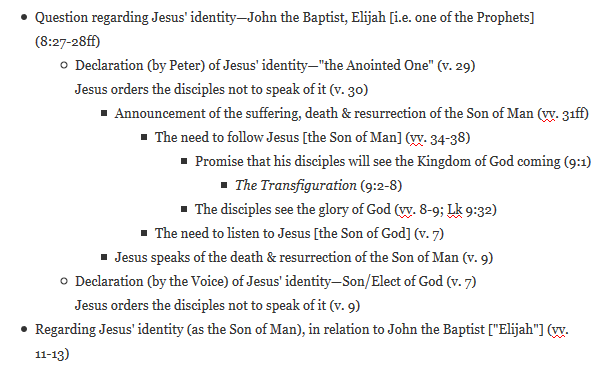
This has been a central theme in our study of the Baptism of Jesus in the Gospel tradition (discussed in detail in earlier studies). John the Baptist, of course, features prominently in the Baptism narrative, which opens with a description of John and his ministry, including the central association with the Isaiah 40:3ff prophecy (Mark 1:2-6 par). His presence in the Transfiguration scene is limited to the (separate?) tradition which appears at the end (Mk 9:11-13). It is generally assumed that Jesus is speaking of John in his reference to “Elijah” (compare Matt 11:14), drawing a parallel between the Baptist’s mistreatment/arrest and his own (i.e. of the “Son of Man”, 8:31; 9:12, etc). Note the framing structure surrounding 8:27-9:13, forming an inclusio:

The question regarding the identity of “the Anointed One” (i.e. Messiah) is given more prominence and clarity in Luke’s account of the Baptism (3:15; compare John 1:19-27).

2. The heavenly declaration corrects/clarifies the Messianic identification

This is implicit by the phenomena attending Jesus at his baptism, especially the descent of the Spirit upon him; Luke brings out the Messianic association more directly, in the subsequent scene at Nazareth, where Jesus identifies himself with the “Anointed” figure of Isa 61:1ff (Lk 4:17-21, cf. also 7:22). This makes clear in what sense Jesus is the Messiah (3:15) and the “one [who is] coming” (3:16; 7:19 par). The heavenly declaration at the Baptism adds to this by identifying Jesus as God’s Son (3:22 par), drawing upon the image of the king (i.e. the Davidic ruler) as “Son of God” (the variant reading in Lk quotes [the Messianic] Psalm 2:7). Similarly, prior to the Transfiguration, Peter declares Jesus to be “the Anointed One (Messiah) [of God]” (Mk 8:27 / Lk 9:2). The exchange between Peter and Jesus which follows (Mk 8:31-33 par, but omitted by Luke) suggests that Peter had in mind the Messianic figure-type of the Davidic ruler (cf. Parts 6–8 of the series “Yeshua the Anointed”), which would not have been compatible with the idea that Jesus must suffer and be put to death. It was Peter who also responds to the Transfiguration, without truly understanding the significance of what he sees (Mk 9:5-6 par, see below). Again, as at the Baptism, the heavenly voice declares Jesus to be the “Son of God”—but here, it would seem, not in the traditional Messianic sense, but hinting at something greater, tied to the death and resurrection of Jesus (Mk 8:31; 9:9, 12-13 par), which will lead to his exaltation to the right hand of God (Mk 14:62 par; Acts 2:32-35; 13:30-35 [citing Ps 2:7], etc).

3. The presence of Moses and Elijah—Jesus as a Prophet figure, specially chosen/anointed by God

That Jesus was seen as a Messiah of the Prophet figure-type seems clear enough from the Baptism scene, attested by different strands of tradition (Mk 1:7-8 par; Lk 3:15ff; 4:14-30; Jn 1:19-27), as well as the entirety of the period of his Galilean ministry, as it is recorded in the Synoptic narrative. Principally, he fulfilled the role of Spirit-endowed, miracle working Prophet (like Elijah), identified more specifically with the anointed herald of Isa 61:1ff. It has been popular to interpret the presence of Moses and Elijah in the Transfiguration scene as representing “the Law and the Prophets” which Jesus was fulfilling (Matt 5:17; Lk 16:16; 24:27, 44; Jn 1:45, etc). However, this does not seem to be correct. To begin with, Elijah is an odd choice to represent the Prophetic Scriptures (Isaiah would make more sense, cf. Jn 12:39-41). More importantly, Moses and Elijah each represent distinct Prophet-figures; and, in the original context of the Gospels, it is almost certain that Jesus, in the period of his Galilean ministry especially, was also seen as an Anointed Prophet. I would suggest that in the Transfiguration scene the significance of Moses and Elijah is two-fold:

    1. It identifies Jesus as a Messianic Prophet (like Moses and Elijah), marking the conclusion of his Galilean ministry in which this role was primarily being fulfilled, but also pointing to his eschatological role inaugurating a new era for the people of God. It is no coincidence that, in Jewish tradition by the time of Jesus, Moses and Elijah were seen as prophetic figures who would appear at the end-time, as a fulfillment of specific prophecies (Deut 18:15-20; Mal 3:1ff; 4:5-6).
    2. Moses and Elijah each experienced a theophany—manifestation of God’s presence—upon the holy mountain (Sinai/Horeb); similarly, Jesus (and his disciples) on this mountain experience the appearance of the cloud of God’s presence and the divine Voice from heaven. This theophany, in relation to Jesus, is of a different sort, reflecting his divine Sonship. For more on this, see below.
4. The Transfiguration scene prefigures the coming Passion—the death and resurrection of the Son of Man

This is clear from the position of the Transfiguration scene in the Synoptic narrative, as noted above. It marks the conclusion of Jesus’ Galilean ministry, and the beginning of his Passion—the upcoming journey to Jerusalem (Mk 10; Lk 9:51–18:34), and the events which would take place there. Luke’s account of the Transfiguration brings out this aspect more clearly (see below).

The Transfiguration in Luke 9:28-36

Note the following details or characteristics of the Lukan version, and its place in the specific context of the Gospel narrative:

    • Luke has given special prominence to Jesus’ role as a Messianic, Spirit-endowed Prophet in the period of his Galilean ministry (4:14–9:22); this gives greater significance to the presence of Moses and Elijah in the Transfiguration scene (see above).
    • Peter’s confession in Luke (9:20) reads “You are the Anointed One of God” which is parallel to the unique form of the heavenly declaration in the Lukan version of the Transfiguration “This is the Son of God, the Elect/Chosen (One)“. On this, see below.
    • Luke’s version of the Transfiguration brings out more clearly the association with Moses and the Exodus—especially the traditions regarding the cloud of God’s presence (9:29, 31a, 34-35, cf. Exod 13:21-22; 19:9, 16ff; 24:15-16ff; 33:9-10; 34:5; 40:34-38). In particular, note v. 34 which alludes to Moses entering the cloud (Exod 24:18, cf. also 33:9).
    • This also enhances the idea of the Transfiguration as a theophany, in which Jesus and his disciples experience the presence of God and see his glory/splendor (vv. 31-32, see also v. 27). In this context, the altered appearance of Jesus (v. 29) probably is meant to echo the tradition regarding Moses changed appearance in Exod 34:29-35.
    • Luke ties the Transfiguration more directly to the coming death and resurrection of Jesus in Jerusalem, in two respects: (1) by the detail he includes in v. 31, using the word éxodos (“way out”, i.e. “exodus”), and (2) its relation to the journey to Jerusalem which follows, and which features so prominently in the structure of the Lukan narrative (9:51-18:34)

The textual question in Luke 9:35 and John 1:34

Finally, mention should be made again of the textual variants for the heavenly declaration in Luke 9:35. The majority text (including A C* W 33, etc) follows the version in Mark (9:7):

“This is my Son, the (one who is) loved”
hoútós estin ho huiós mou ho agap¢tós

However, many of the earliest/best manuscripts (Ë45,75 a B L, etc) instead read:

“This is my Son, the (one) gathered out [i.e. elect/chosen]”
hoútós estin ho huiós mou ho eklelegménos

Most commentators prefer this as the original reading, considering it much more likely, considering scribal tendencies, that the passage would be harmonized with Mark than the other way around. As it happens, there is a similar textual variant related to the declaration of Jesus’ identity at the Baptism, in John 1:34. The Baptist’s statement, in the vast majority of manuscripts and witnesses (including Ë66) reads—

“…this is the Son of God”
hoútós estin ho huiós toú theoú

which, of course, is quite similar to the voice at the Transfiguration in the Synoptic tradition (cf. also the Matthean version of the Baptism, Matt 3:17). However, in a number of witnesses (Ë5,106vid a* b e ff2* etc) the reading is:

“…this is the (One) gathered out [i.e. Elect/Chosen] of [i.e. by] God”
hoútós estin ho eklektós toú theoú

A few MSS have the longer (conflate) reading “…the elect/chosen Son of God”, which is surprisingly close to the heavenly voice in the Lukan version of the Transfiguration (according to many of the best MSS, cf. above). The adjective eklektós is closely related to the participle eklelegménos (both from the verb eklégomai, “gather out of/from”), and has essentially the same meaning (“selected, elect, chosen”, etc). The adjective normally refers (in the plural) to believers (as the elect/chosen ones) in the New Testament, but the singular is used of Jesus (also as a title) in Luke 23:35; a few manuscripts likewise read the adjective, instead of the participle, in Lk 9:35. In the two Lukan references, and in Jn 1:34 v.l., the title “Elect/Chosen One” almost certainly must be understood in a Messianic context. The Lukan usage in 9:35, if original, suggests a parallel with the adjective agap¢tós (“[the one] loved [i.e by God]”)—the one chosen by God is loved by God, and vice versa. It also indicates that the title “Son of God” should not be understood here in terms of later orthodox Christology (nor even the developed Christology of the Fourth Gospel). The immediate narrative context of the Gospel has rather a different, two-fold emphasis:

    • Jesus is the Son of God in a Messianic sense, according to the interpretation of Psalm 2:7 etc in Jewish and early Christian tradition (cf. Lk 1:32, 35, etc), and
    • The declaration points to the death, resurrection (and exaltation) of Jesus, by which he is considered to be God’s Son (and Anointed One) in a very special sense (Acts 13:33, etc). The Johannine idea of Jesus’ Sonship—i.e. as the pre-existent, eternal Son of the Father, plays little (if any) role in the Synoptic narrative, and represents a somewhat later development in the Gospel tradition

As an interesting side note, the title “Elect/Chosen One of God” in Aramaic (ah*l*a$ ryj!B=, b®µîr °§l¹h¹°) is found in a text from Qumran (4Q534). It survives only as a fragmentary piece, so it is nearly impossible to determine the precise context, but it appears to be related in some way to the ancient Enoch traditions, most familiar as expressed in the work known as 1 Enoch. Column 1 lines 10-11 reads:

“in that [i.e. because] he is the chosen (one) of God, his being born [i.e. his birth] and the spirit [jwr] of his life-breath [<vn] {…} his thinking/reckoning [pl. i.e., plans] will be to the distant age (to come) [i.e. for ever]…”

It may perhaps be debated to what extent the title “Elect/Chosen One” is Messianic (compare Isa 42:1; Ps 89:3; 106:23); however, in the so-called Similitudes of Enoch (chap. 37-71), often dated roughly to the time of Jesus (early-mid 1st cent. A.D.), we find a heavenly figure (much like Jesus) who is variously given the titles “Son of Man”, “Anointed One” and “Elect/Chosen One”. All three of these titles appear together, in the context of the Transfiguration scene, in Luke 9 (vv. 20, 22, 26, 35 v.l., 44).

Next week, we will turn our critical lens to one of the most intriguing pieces of the “Triple Tradition” —the episode of the anointing of Jesus by a woman. Perhaps no other Gospel episode has been preserved in such a conflicting and controversial manner. In addition to the marked differences between the Synoptic version in Mark-Matthew and that in Luke, the separately preserved Johannine version contains details shared by both (along with its own distinctive features). Our studies on this fascinating tradition will prepare the way for the upcoming Holy Week.

Notes on Prayer: John 14:13-14, etc (continued)

John 14:13-14, continued

A major aspect of the references to prayer in the Last Discourse involves the expression “in Jesus’ name” and what this signifies in the Johannine context. This context is related to the wider early Christian tradition, but the Johannine Gospel give to the tradition a distinctive theological emphasis, along with a new and deeper meaning. The early tradition may be summarized according to three points: (1) disciples of Jesus acting and gathering “in his name”, i.e., as his representatives (Mk 9:37-39 par; Matt 7:22; 18:20; Lk 24:47; Acts 3:6ff; 9:15, etc); (2) speaking/praying “in Jesus’ name” as an extension of the apostolic witness (Acts 4:17-18; 8:12; 15:17; 2 Thess 1:12; Col 3:17; James 5:10-14, etc); and (3) the ritual dimension of being baptized “in(to) Jesus’ name”, that is, into the (religious) identity of being believers in Christ (Acts 2:38; 8:16; 10:48; 19:5; 1 Cor 1:13ff; 5:4, etc).

The Johannine development of the early tradition is significant, and must be studied carefully. I offer here an exposition, according to a number of key points.

1. To begin with, references to the name of Jesus in the Gospel of John are primarily related to trust (pi/sti$, vb pisteu/w) in Jesus. This can be seen most clearly in the confessional statements presented (and/or composed) by the Gospel writer—1:12; 2:23; 3:18; 20:31 (cf. also 1 John 3:23; 5:13). Jn 3:18 is part of a discourse by Jesus, but corresponds precisely (and is formulated according to) the Johannine theology. Trust in Jesus is defined by the expression “in his name”, using either the preposition ei)$ (“into”) or the more conventional e)n (“in”). This very much follows the early tradition (Acts 2:21; 4:12ff; Rom 10:13, etc), but with a more precise definition.

2. According to the ancient Near Eastern worldview, the name of a person represents and embodies the nature and character of the person. Thus, to trust in Jesus’ name fundamentally means to trust in the person of Jesus. There is nothing specifically Johannine about this, except insofar as the theology of the Johannine writings presents a distinctive portrait of who Jesus is. For more on the ancient background of names and naming, as it relates to the Gospel and early Christianity, cf. my prior series “You Shall Call His Name…”.

3. The Johannine Gospel and Letters, perhaps more than any other writings in the New Testament, emphasize trust in Jesus in terms of his special (and unique) identity, represented by the two titles “Anointed One” (Messiah/Christ) and “Son of God”. These titles are joined together in the key confessional statements of 11:27 and 20:31 (cf. also 1:34 [v.l.] and 1 Jn 3:23; 5:20), and it is clear that the identity of the (true) believer in Christ depends on the proper (Christological) view of what it means to call Jesus by these titles (cf. especially the discussion running through 1 John).

4. It is the title Son of God that is most pertinent for the Johannine theology and the portrait of Jesus in the Gospel. Throughout the Gospel Discourses, Jesus refers to himself as “the Son” —primarily in the discourses of chapters 5 and 6, but also in the opening sections of the Last Discourse (14:13, cf. also 13:31), and the great Prayer-Discourse (17:1). The statements in 3:16-18, while part of the Nicodemus discourse (of Jesus), are also formulated in accordance with the (Johannine) theology of the Gospel writer.

5. Central to the Johannine Christology, in this regard, is the special relationship between Jesus (the Son) and God the Father. The Father-Son relationship runs through the Gospel Discourses, and is established from the beginning, in the Prologue (1:1, 14, 18). Key statements occur within the chapter 3 discourse-episodes (vv. 16-18, 35-36), and are central to the Discourses of chapter 5 (vv. 17-27, 36-37) and 6 (vv. 27, 37ff, 57). Again this theological theme dominates portions of the Sukkot-discourses (8:16-19, 27-59; 10:15-18, 29-38), and features in the transitional episodes leading into the Passion narrative (and the Last Discourse)—12:26-28, 49-50; 13:1ff.

6. The theological dimension of the Father-Son relationship, within the Johannine Discourses, is based upon two lines of illustration. First, a son naturally imitates the behavior of his father; a dutiful son, in particular, consciously follows his father’s example, which often extends to a period of apprenticeship in his occupation. A number of times in the Discourses, Jesus refers specifically to how he, the Son, does and says what he sees/hears the Father doing/saying (5:19, 36; 8:28, 38ff; 10:37; 12:50; 14:10ff; 15:15). In this regard, the Son (Jesus) speaks and acts in His Father’s name (5:43; 10:25).

Second, is the image of a father providing for his son, giving to him, both in terms of instruction/guidance, but also covering the aspect of inheritance—the son as heir to the father. The Discourses also build upon this idea, emphasizing how the Father gives “all things” to the Son (3:34-35; 16:15). This includes the duty that the Father has given to him, to complete in his time on earth (5:36; 10:18; 17:4ff), and also the power to complete the work–specifically, the life-giving power that belongs to God (5:19-21ff; 6:27ff, 57; 14:10; 17:2). Jesus’ own disciples, those who come to trust in him, were also given to him by the Father (6:37, 44ff, 65; 10:29; 17:2, 6-19ff). All of this can be summarized, in the concluding Prayer-Discourse, by the key references to the name of the Father—which was given to Jesus (the Son), and who, in turn, has given it (i.e., made it known) to believers; note the important statements in 17:6, 11-12, 26.

7. According to the ancient significance of names and naming (cf. above), for Jesus to make known the name of the Father is essentially the same as making known the Father Himself. This is possible, again, because Jesus himself is the Son of the Father, the Son of God. The Son manifests the Father in his own person, because he represents the Father, speaking and acting just as the Father does (with the Father’s authority). He also shares in the Father’s own nature and character, possessing the same power and ability, indicated especially by (a) his life-giving power, and (b) the presence of God’s Spirit. The last point will be discussed further in the upcoming studies.

8. Jesus’ possession of a Divine name is a theme found in the Christ-hymns of Philippians (2:6-11) and Hebrews (1:2b-4), discussed in recent daily notes. In these passages, the “name” of Jesus in not simply “Jesus (Yeshua)”, but a name belonging to God Himself. The context in Hebrews suggests that the “name” is the specific title “Son (of God)”, in the developed Christological sense of the title that is evident throughout both Hebrews and the Johannine writings (cf. above). In the Philippians hymn, the “name” appears to be the divine name YHWH, as represented by the title “Lord” (ku/rio$). A similar dynamic occurs in the Gospel of John, where Jesus possesses the Divine name of God the Father.

Significantly, in Philippians and Hebrews, this Divine naming is associated with the exaltation of Jesus, following his death and resurrection. This reflects the exaltation-Christology of the earliest believers, to which a pre-existence Christology is balanced in the hymns (cf. also Col 1:15-20). What is distinctive in the Johannine Discourses, is the fact that Jesus is clearly identified as the Son of God, and possesses the Divine name, prior to his resurrection—that is, during the time of his earthly ministry, and even stretching back to his pre-existence, before the very creation of the world. In my view, this demonstrates an even more developed Christology within the Johannine writings that goes beyond what is expressed in the other Christ hymns.

9. Finally, along these same lines, we must note one aspect that is truly distinctive—if not unique—to the portrait of Jesus in the Johannine Discourses. It is evinced by the famous “I am” sayings of Jesus that occur throughout the Discourses—6:35ff; 8:12 (also 9:5); 10:7-9, 11, 14; 11:25; 14:6; 15:1, 5, cf. also 6:20; 18:5. As nearly all commentators recognize, this “I am” (e)gw/ ei)mi) usage intentionally alludes to ancient religious tradition, associated with the self-revelation of God—and, specifically, to the tradition involving the interpretation of the Divine name YHWH in Exodus 3:14 (LXX). In the Discourses, Jesus is identifying himself with God, even as the Son identifies himself with the Father, and the Logos is identified with the Creator God in the Prologue (1:1ff). Moreover, from the standpoint of Johannine theology, trust and belief in Jesus (= in Jesus’ name) entails a recognition of Jesus as the Divine “I am”. This is expressed rather clearly by the sayings in 8:24, 28 and 13:19 (cf. also 8:58). As is typically the case, the Gospel of John presents early Christian tradition—here, the idea of Jesus possessing the Divine name—with greater theological precision and depth of meaning.

This study, it is to be hoped, will aid greatly in our understanding of the key lines of Johannine thought, regarding the “name of Jesus”, as we continue through the remaining references to prayer in the Last Discourse.


December 4: Hebrews 1:3 (concluded)

Hebrews 1:3 (conclusion)

As we conclude our study on the ‘Christ hymn’ in Hebrews 1:2b-4 (spec. verse 3), it is worth keeping in mind the syntax of the passage (vv. 3-4), in which a complex sequence of four participial clauses is governed by an initial relative pronoun (o%$):

    • o%$ (“who”)
      • w&n a)pau/gasma… (“being [the] beam [shining] forth…”) [3a]
      • fe/rwn ta\ pa/nta… (“bearing all [thing]s…”) [3b]
      • kaqarismo/n poihsa/meno$… (“[hav]ing made cleansing…”) [3c]
      • tosou/tw| krei/ttwn geno/meno$… (“[hav]ing come to be so much stronger…”) [4]

The clauses in verse 3ab, discussed in the previous two notes, reflect the pre-existence Christology that gradually came to prominence among early Christians, as believers gradually came to the realization that Jesus must have had existence as the Son of God even prior to his life on earth. The remainder of vv. 3-4 more properly follows the older conception of Jesus as the Son—that is, divine Sonship in terms of his death, resurrection, and exaltation to the right hand of God the Father in heaven (i.e., the traditional exaltation Christology). Verse 3c summarizes this concisely:

“(hav)ing made cleansing of sins, he sat on the giving [i.e. right] (hand) of the Greatness in high (place)s”

Interestingly, the actual death and resurrection of Jesus, so central to the early Gospel preaching, is not even stated, but simply taken for granted. The author moves from the atoning/saving aspect of Jesus’ work straight to his exaltation. In some ways, this reflects the unique theological emphasis of Hebrews, focusing on the work of Jesus as a fulfillment of the priestly office (cf. Part 9 of the series “Yeshua the Anointed,” with its supplemental study on Hebrews). The noun kaqarismo/$ (“cleansing”) alludes to the Old Testament sacrificial ritual and purity regulations (LXX Exod 29:36; 30:10; Lev 15:13, etc; cf. 2 Peter 1:9), with the related verb kaqari/zw (“make clean, cleanse”) being more common in the New Testament (used in Hebrews, 9:14, 22-23; 10:2).

The motif of the exalted Jesus receiving a position at the “right hand” of God in heaven is a key element of the early Gospel preaching, and is central to the exaltation Christology affirmed by all first-century believers—cf. Mk 14:62 par; [16:19]; Acts 2:25, 33-34; 5:31; 7:55-56; Rom 8:34; Col 3:1; Eph 1:20; Heb 8:1; 10:12; 12:2; 1 Pet 3:22. As a motif, it is derived primarily from Psalm 110:1, as a Messianic passage applied to Jesus (Mk 12:36 par; Acts 2:34; Heb 1:13), though perhaps influenced by other Scriptures as well (such as Dan 7:13-14). The pre-existence Christology that developed in the second half of the 1st-century complements (and mirrors) the traditional exaltation-aspect. This is a pattern that can be seen in the two major “Christ hymns” (Phil 2:6-11; Col 1:15-20) we have studied, and the two aspects are especially well-balanced in the Christology of Hebrews.

The closing lines in verse 4 build upon the idea of the Son’s superiority (over the Angels), again expressed in terms of his exaltation after his death. The language and thought, in this respect, is quite similar to that of the Christ-hymn in Philippians (2:9-11). However, the specific use of the comparative/superlative adjective krei/ttwn (“stronger [than]”) is distinctive to Hebrews (12 of the 15 NT occurrences), and is central to the message of the letter—namely, that the New Covenant, realized in the person of Jesus, is far superior to the Old Covenant, mediated through the priesthood, sacrificial ritual, and regulations of the Torah.

As in the Philippians hymn, the exalted Jesus is given a name (o&noma). As I discussed previously (cf. the notes on Phil 2:9-10), the context of the Philippians hymn indicates that this name—one “th(at is) over every name” —is God’s own name, as embodied in the title ku/rio$ (“Lord”), according to the traditional substitution of yn`oda& (“my Lord”) for YHWH. Here in Hebrews, however, the reference seems to be to the title “Son of God” —that is, the identification of the exalted Jesus as God’s Son (cf. the citation of Psalm 2:7 in the early Gospel preaching, in the specific context of Jesus’ resurrection, Acts 13:33; cp. Rom 1:4). The pre-existence Christology establishes that Jesus was already God’s Son, prior to his earthly life; however, the wording here in verse 4 is drawing upon the older line of tradition. Note how the author of Hebrews applies Psalm 2:7 to both aspects of 1st-century Christology—exaltation and pre-existence (1:5; 5:5).

Indeed, it is at just this point (v. 5) that the author introduces the citation of Psalm 2:7 (along with 2 Sam 7:14):

“For to who among the Messengers did He ever say, ‘You are my Son, today I have caused you to be (born)’, and again: ‘I will be unto a Father for him, and he will be unto a Son for me’?” (v. 5)

In inclusion of 2 Sam 7:14 confirms the Messianic context of the birth/sonship motif in Psalm 2:7. As we have seen, this originally applied to the earthly life and ministry of Jesus, and, in particular, his death and resurrection. In this he was to be recognized as God’s Son, but still in the figurative sense that the Messianic interpretation would have entailed. Now, however, a deeper Christological meaning has been given to it, since Jesus is now seen as God’s Son from before the beginning of Creation. This also gives to all the birth and sonship images a new depth, as the author continues in verse 6:

“And, again, when He brought His first-formed (child) into the inhabited (world), He says: ‘And all the Messengers of God must kiss toward [i.e. worship] him’.”

The citation presumably comes from Deut 32:43 LXX, but it is the wording used to frame the citation that is especially significant. It refers to the Son’s incarnation, or coming into the world of human beings (cp. John 1:9ff, 14). But here the context makes quite clear two important points about Jesus as God’s Son: (1) he is God’s “firstborn” child prior to the incarnation, and (2) the citation of Psalm 2:7 (and 2 Sam 7:14) also applies to his sonship prior to the incarnation. This represents a genuine development in early Christian belief regarding the “birth” and sonship of Jesus, one quite similar with what we find in the Gospel of John. It remains to consider again how the author of Hebrews frames this dual aspect of Jesus’ sonship—the ‘older’ aspect of his resurrection/exaltation, and the ‘newer’ aspect of his pre-existent deity. Chapter 1 closes with a pair of Scripture quotations (from the Psalms) applied to Jesus as the Son. It is part of the running comparison between the Son and the other heavenly beings (Angels):

“And toward the Messengers He says (v. 7)… But toward the Son (He says, v. 8)…”

The first passage, from Psalm 45:6-7, alludes to the exaltation of Jesus, of his being raised (as Son) to the throne of God; the second passage (Psalm 102:25-27), by contrast, implies the Son’s pre-existence, with its Creation-setting: “You, Lord, down at (the) beginning, set (the foundation for) the earth, and the heavens (are) the works of your hands”. In the original Psalm, of course, the “Lord” (ku/rio$) is YHWH, but here it is meant to apply more properly to Jesus, based on the common dual-use of ku/rio$ among early Christians (cf. above). The final citation of Psalm 110:1 (v. 13), a Messianic passage at least as important as Psalm 2:7 (compare Acts 2:34-35 with 13:32-33), demonstrates again how the early Christian understanding of Jesus as the Son of God has been transformed in the light of the growing Christological awareness. In Acts 2, this Scripture is interpreted in terms of Jesus’ resurrection/exaltation, while here in Hebrews it has an altogether new and deeper meaning—one which combines the exaltation motif with divine pre-existence.

References above marked “Attridge” are to Harold W. Attridge, The Epistle to the Hebrews, Hermeneia Commentary series (Fortress Press: 1989).

October 27: Philippians 2:10a

Philippians 2:10a

i%na e)n tw=| o)no/mati Ihsou=
“(so) that, in the name of Yeshua…”

This clause—indeed, the whole of vv. 10-11—is subordinate to v. 9, and depends on the exaltation of Jesus by God (making him “high over [all]”, v. 9a, note) as being defined by “the name th(at is) over every name” (v. 9b, note), which God gives to him as a special favor. The “name th(at is) over every name”, given to Jesus, is clearly the same “name” (o&noma) referred to here. Strangely, many readers (and commentators) seem to understand the phrase in v. 9 in light of the expression here in v. 10, rather than the other way around. Moreover, in this regard, a casual (and careless) reading of the passage could lead one to think that “the name over every name” is simply the name Jesus (Yeshua). While Jesus/Yeshua, as a name, was certainly of great importance to early believers (cf. below), it almost certainly is not the focus or point of reference here. There are two ways one can understand the genitive relationship in the expression “the name of Yeshua” here:

    • an explicative genitive = “the name Yeshua”
    • a possessive genitive = “the name belonging to Yeshua”

The latter option is to be preferred as correct, if for no other reason than that the name is something given to Jesus (after his death and resurrection), implying that it was not something he already possessed (during his earthly life). What, then, is the “name th(at is) over every name”? A correct understanding requires that we pay close attention to the overall structure and context of hymn. In particular, I would make the following points:

    • The name relates specifically to the exaltation of Jesus (v. 9a)
    • The chiastic structure of the hymn, with its juxtaposition of “making low” vs. “making high”, indicates that the exaltation entails a return to the sort of (exalted) position Jesus held prior to his earthly life
    • Traditionally, in early Christian belief, the exaltation of Jesus is defined in terms of Jesus standing alongside (“at the right hand of”) God in heaven
    • Based on the description in v. 6, this would seem to imply that the exaltation involves the idea of his “being equal with God” (ei@nai i&sa qew=|)

All of this would imply that the name given to Jesus must be related to God’s own name. Bearing in mind the significance of names and naming in the ancient world (cf. the previous note), the “name” of God is no mere word or label, but represents and embodies the very nature and character of God Himself. There were two titles, applied to Jesus by early believers, which serve to express a belief in the divine status, or deity, of the exalted Jesus: (1) “Son of God”, and (2) “Lord”. In the earliest Christology, both titles were applied to Jesus primarily in terms of the resurrection, and, as it happens, by way of a distinctive interpretation of two Psalm passages (2:7ff and 110:1). This is clear enough from the early Gospel preaching (kerygma) recorded in the book of Acts (cf. 2:24-36; 13:30-33ff); the same basic kerygma surely underlies the formal usage of both passages in Heb 1:3b-13 and 5:5-10 as well.

However, given the more ambiguous nature of the title “Son of God”, which at an early stage was also applied to Jesus at the time of his baptism and earthly ministry (Mk 1:11 par; Lk 3:22 [v.l.]), it seems rather more likely that the title “Lord” (ku/rio$) is in view here in the hymn. There are several factors which would tend to confirm this; for one thing, it is the title that is actually applied to the exalted Jesus here in the hymn (v. 11, to be discussed). Also, the wording in Acts 2:36, reflecting the early kerygma, seems to be especially relevant; it states, somewhat uncomfortably (perhaps) for orthodox Christology, that “God made him (to be) Lord” (ku/rion au)to\n…e)poi/hsen o( qeo/$) at the resurrection. Vv. 9-10 of the hymn seem to be expressing much the same idea.

The importance of this title, ku/rio$ (“Lord”), as applied to the exalted Jesus, lies in its traditional use as a substitution when reciting the name of God (i.e., hwhy/YHWH/Yahweh). In Hebrew, the word /oda* (yn~d)a&, “my Lord”, cf. my earlier article on this title) was used, with the corresponding ku/rio$ for Greek speakers. While Jesus’ followers may originally have called him “Lord” as a simple honorific (= “Master”, “Rabbi”), the title soon carried a deeper religious (and theological) meaning for believers, as they increasingly came to realize the special divine status (and nature) which Jesus possessed. Indeed, there are instances in the New Testament when one cannot be entirely certain if the title ku/rio$ refers to God the Father, Jesus, or both together; for most early Christians, it seems, the title could be used interchangeably.

The Gospel of John expresses this identification of Jesus (the Son) with the deity of God the Father in a slightly different manner (which may be unique to the Johannine tradition). First, we have the numerous “I am” (e)gw/ ei)mi) statements by Jesus in the Discourses, which, in their own way, connect Jesus with the name of God (YHWH, cf. Exod 3:14 and my earlier article on the name). Second, there is the important theme, emphasized primarily in the great Prayer-Discourse of chapter 17, of Jesus (the Son) manifesting the name of the Father to his followers (believers)—cf. verses 6ff, 11-12ff, 26. The name also serves to define the special relationship between Son and Father at various points throughout the Discourses (5:43; 10:25; 12:13, 28; and note also the emphasis on Jesus‘ name [“my name”] in the Last Discourse).

Thus, for the reasons outlined above, I would tend to agree with those commentators (e.g., O’Brien, pp. 237-40) who identify the “name” given to Jesus as God’s own name, represented by the divine title (in Greek) ku/rio$, “Lord”. This interpretation follows (and is supported by) the line of early Christian tradition that associates the title specifically with the resurrection of Jesus and his exaltation to the “right hand” of God (cf. Acts 2:36 and the discussion above).  To call Jesus “Lord” in this sense recognizes that he holds a divine position and status alongside of God the Father (i.e., equal with God, v. 6). It is a ruling position, in which Jesus rules “over all” —which means that the “name” given to him is likewise high over all other names and titles, being the name/title of God Himself.

It remains now to consider the expression in the context of the full prepositional phrase: “in [e)n] the name of Yeshua”. Typically, in the New Testament (and early Christian tradition), the phrase “in the name of Jesus” is understood two ways:

The use of phrase here in the hymn is related to, but not exactly the same as, this traditional usage. There is the common theme of Jesus as an intermediary, through whom believers are able to worship and relate to God the Father in a new (and more direct) way. The idea of Jesus as a divine representative of God Himself is fundamental to early Christian belief, and is reflected here in the hymn as well. Similarly, our trust in Jesus is ultimately based on his special divine status as the Anointed One of God, His Son, who can be recognized as the very Lord Himself. Our salvation (from the Judgment), and with it the promise of eternal life, is rooted in the resurrection and exaltation of Jesus; when we “call on the name of Jesus” (= trusting in Jesus’ name), we participate in the symbolic imagery that runs through vv. 9-11 of the hymn. In particular, our salvation (through trust in Jesus) allows us to pass through the scene of Judgment alluded to in the climactic lines of verses 10-11. This will be discussed further in the next note.

References marked “O’Brien” above, and throughout this set of notes, are to Peter T. O’Brien, The Epistle to the Philippians, The New International Greek Testament Commentary [NIGTC] (Eerdmans: 1991).

October 26: Philippians 2:9b

Philippians 2:9b

The clause in v. 9b is subordinate to the main clause (9a), expounding and qualifying it; that is to say, it explains what is meant, primarily, to say that God “made (Jesus) high over (all)”. The two parts of the verse should be read as a poetic couplet, with synthetic parallelism:

“And therefore God made him high over (all),
and favored him (with) the name th(at is) over every name”

Before proceeding with an exegesis of v. 9b, I feel it is important to emphasize again the context established by the main clause of v. 9a (discussed in the previous note). In particular, let us give further consideration to the following two parts of the clause:

1. dio\ kai/—This dual conjunction, governed by the inferential conjunction dio/ (“therefore”), provides the transition between vv. 6-8 and vv. 9-11. In the immediate context, it indicates the reason for God’s action in “making Jesus high over all”. As the syntax makes clear, God’s action is in response to Jesus “emptying himself” and “lowering himself”. In this regard, it is worth keeping in mind the way that the hymn as a whole is governed by four primary aorist verbs:

    • e)ke/nwsen [Jesus] “he emptied (himself)”
    • e)tapei/nwsen [Jesus] “he lowered (himself)”
    • u(peru/ywsen [God] “he made (him) high over (all)”
    • e)xari/sato [God] “he showed (him) favor”

Jesus’ willingness to give up his exalted position (with God in heaven), and to take on the lowest position (as a human slave), prompts God to “show him favor”, exalting him to the highest position. This paradox—that lowering oneself leads to exaltation—is fundamental to the New Testament message, rooted in Jesus’ own example and epitomized in his famous saying of Matt 23:12; Luke 14:11; 18:14. In particular, Jesus’ willingness to submit himself (like a slave) to human authority, leading to his suffering and death (in the manner of a criminal slave), results in his being given a position of rule over all humankind (and all creation).

2. u(peru/ywsen (“he showed favor”)—The verb encapsulates the entirety of the earliest Christology (during the period c. 35-60 A.D.). As I have repeatedly noted, this was an exaltation Christology, meaning that Jesus’ divine status and identity as the Son of God was understood primarily (if not exclusively) through the resurrection. After being raised from the dead, Jesus was further exalted to a position “at the right hand” of God in heaven. This was a fundamental belief, widespread among the earliest believers, as the New Testament record makes clear (cf. Mk 12:36; 14:62 pars; [16:19]; Acts 2:25, 33-34; 5:31; 7:55-56; Rom 8:34; Col 3:1; Eph 1:20; Heb 1:3, 13; 8:1; 10:12; 12:2; 1 Pet 3:22). The implication is that the  exalted Jesus now stands alongside God on His throne, and thus shares in that ruling position. The developing pre-existence Christology (reflected in the first half of the hymn) is essentially patterned after the exaltation portrait—that is to say, Jesus held a similar position, alongside God the Father in heaven, prior to his life and mission on earth.

Now, turning to the clause that follows in v. 9b:

kai\ e)xari/sato au)tw=| to\ o&noma to\ u(pe\r pa=n o&noma
“and He favored him (with) the name th(at is) over every name”

e)xari/sato (“he showed favor”)—The two main aorist verbs in the second half of the hymn are treated as a pair: u(peru/ywsen kai\ e)xari/sato (“He made [him] high over [all] and favored [him]”). The two actions thus go hand-in-hand, and should be treated as two components (or aspects) of the same exaltation of Jesus by God the Father.

The middle deponent verb xari/zomai means “give a favor, show (someone a) favor”, and is rather frequent in the Pauline letters (16 of the 23 NT occurrences, including 2 in Ephesians). The usage is closely tied to Paul’s key theme of God showing “favor” (xa/ri$) to us through the work (his sacrificial death) of Jesus; indeed, the verb is almost always used in this context, and it is quite rare to see it applied to Jesus himself (i.e., God showing favor to him).

au)tw=| (“to him”)—The unusual use of the verb xari/zomai (applied to the relationship between God the Father and Jesus), noted above, is significant, though its importance is easily glossed over by commentators eager to assert that Jesus maintained his exalted (heavenly) position even throughout his earthly life. The “emptying” (kenosis) of Jesus here in the hymn is stripped of its essential meaning if one attempts to force into the passage the Christological idea that Jesus maintained his exalted position all throughout his life as a human being. Because Jesus truly did empty and lower himself, it was necessary and fitting that God should raise him (back) to a position of glory. This was something that God did to him, through His own eternal power and glory—the exaltation to God’s right hand, even as He also raised him from the dead.

to\ o&noma to\ u(pe\r pa=n o&noma (“the name th(at is) over every name”)—This phrase has proven to be rather problematic, and source of debate among commentators. It is the direct object of the verb xari/zomai—that is to say, it represents the special favor granted by God to Jesus. But just what is this “name th(at is) over every name”? In my view, readers of the passage (including many commentators) have been tripped up here by the corresponding expression “the name of Jesus” in v. 10. A careless reading might lead one to think that the “name of Jesus”, and thus also the “name over every name”, is simply the name Jesus (Yeshua). Almost certainly, this is not correct, though the importance of the point requires a more detailed discussion, which will be provided in the next note (on v. 10).

The phrase “the name th(at is) over [u(pe/r] every name” is clearly parallel with the idea of God making Jesus high over [u(per-] all (v. 9a). The parallelism of this wordplay is often lost (or ignored) in translation, but I have preserved it precisely in the literal translation  above. Indeed, the name is central to the exaltation itself, and serves to explain what it means for God to “make him high over (all)”. This will be discussed in the next note.

It is vital here that one recognize the significance of the name (o&noma), from the standpoint of ancient Near Eastern religious thought and cultural tradition. A person’s name was seen as embodying his/her essential nature and character; this means that, to know a person’s name, in this sense, is to know the person. This was equally true in a religious context—to know the name of a deity is to know the deity. For this reason, it is easy to see how names—especially the names and titles of God—could come to possess a kind of magical quality. To invoke or “call” the name of God was the same as connecting, in a real way, with the personal power and presence of the Divine. For more on the subject, cf. the introduction to my earlier series “And you shall call his name…”.

Given this ancient understanding and use of the name, one can readily see how Jesus‘ name would take on special importance among early believers. In fact, there are three areas of early Christian belief which must be kept in view, in order to achieve a correct interpretation of vv. 9-10:

    • The importance of Jesus’ name for believers
    • The use of the (divine) title “Lord” (ku/rio$) applied to Jesus, and
    • The idea that Jesus has special access to God’s own name

Each of these will be discussed as we proceed with our study of verse 10.

December 31: Luke 1:32, 35

This note continues our examination of the development in early Christian thought, in terms of an awareness of Jesus’ identity as the Son of God. By the time the Gospels of Matthew and Luke were written—and their Infancy narratives, in particular (c. 70-80 A.D.?)—this Christological awareness extended all the way back to Jesus’ birth as a human being, encompassing his entire life. This meant that the earlier association with his resurrection (and exaltation to heaven) was expanded to include many aspects of his earthly life and ministry, especially with regard to the salvation it brings. It is this aspect of Jesus as the Savior of his people (Matt 1:21ff) which informs the only reference to Jesus as God’s Son in the Matthean narrative (2:15, citing Hosea 11:1). This was discussed in the previous note, and now we turn to the Lukan narrative, where there is also a reference to Jesus as the Son of God—it is a two-fold reference, part of the Angelic announcement to Mary (1:32, 35).

Luke 1:32, 35

The famous annunciation scene in Luke (Lk 1:26-38) follows the basic pattern of angelic announcements in Old Testament narrative—for birth annunciations, see Genesis 16:7-13; chapters 17-18 (esp. 17:15-21; 18:10-15) and Judges 13, as well as Lk 1:11-20 and Matt 1:20-21 in the infancy narratives (for more on this, cf. the article in the series “The Old Testament and the Birth of Jesus”). There are three parts to the angel’s message, each followed by Mary’s response:

    • Verse 28—Mary is addressed by name
      • V. 29—Mary is startled by what she sees
    • Verses 30-33—The Message to Mary
      • V. 34—Mary asks “how will this be?”
    • Verses 35-37—Answer to Mary’s question, with a sign
      • V. 38—Mary responds “…may it come to be for me according to your word”

Each part has a theological/christological element:

    • v. 28b—”the Lord is with you”
    • vv. 31ff—”this one will be great and will be called Son of the Highest…”
    • v. 35a—”The Holy Spirit… power of the Highest…
      v. 35b—…(the child) will be called Holy, the Son of God”

The fundamental emphasis of these phrases is unquestionably Messianic. With the regard to the first phrase in v. 28b, it is reminiscent of the wording in the famous prophecy of Isa 7:14 (cited in the Matthean Infancy narrative), with the name Immanuel (la@ WnM*u!, ±imm¹nû °¢l)—”God with us”. The context of Isa 8:8-10 indicates that this name reflects God’s support and protection of the (righteous) king, connected with peace, prosperity, and the salvation of the land/people from enemies. In terms of the original historical context, the most reasonable identification is with Hezekiah (cf. 2 Kings 18:7). Later on, of course, the passage (along with Isa 9:1-6) came to be interpreted in a (future) Messianic sense, and was applied by Christians to the birth of Jesus (Matt 1:22-23). I discussed these verses in considerable detail in series of advent notes.

There may also be an allusion to Zeph 3:14-17 here in Lk 1:28. Apart from the formal similarity of the opening (xai=re, “be glad / rejoice!” as a greeting) and a possible parallel between Mary and “daughter of Zion” (Jerusalem/Judah personified), note the similar assurance that is offered:

Zeph 3:14-17 LXX

    • v. 15b: ku/rio$ e)n me/sw| sou (“the Lord is in the middle of you [i.e. is in your midst]”)
    • v. 17a: ku/rio$ o( qeo/$ sou e)n soi (“the Lord your God is in/among you”)

Luke 1:28b

o( ku/rio$ meta\ sou=
“the Lord is with you”

In Zeph 3:14-17 it is also a promise of protection and salvation. According to the Old Testament/Jewish background, the “Lord” (o( ku/rio$) is YHWH, God the Father; but note the use of ku/rio$ to refer to Jesus in Lk 1:43; 2:11, and the more ambiguous reference in Lk 1:76. There can be little doubt that, by the time the Gospel of Luke had been written (around 70 A.D. or a bit later), ku/rio$ was being regularly applied to Jesus in terms of his divine nature or status, connected especially with his resurrection and exaltation to the right hand of God (Acts 2:36, etc, cf. the earlier notes in this series). The expression corresponding to o( ku/rio$ meta\ sou= (“the Lord is with you” or “the Lord be with you”) appears as a pious, but ordinary, greeting in Ruth 2:4. A closer parallel to our passage is found in the angelic annunciation to Gideon in Judg 6:12, as an assurance of God’s support and care. In Lk 1:28, 30, this divine care is described in terms of God’s favor (xa/ri$)—Mary is one who has been favored (kexaritwme/nh) by God (xa/rin para\ tw=| qew=|).

The emphasis on the Messianic character and status of the child continues in vv. 31-33. To begin with, there is the announcement of the conception (“you will receive together [sullh/yh|] in the womb”) and birth (“you will produce [te/ch|]”) a son [ui(o/$] (v. 31a)—this is connected with the favor (xa/ri$) Mary receives from God (vv. 28, 30). In terms of the naming of the child (v. 31b), there may here be an echo of Isa 7:14 LXX (cf. above)—note the similar sequence “will produce” [te/cetai] followed by “will call his name” [kale/sei$ to\ o&noma au)tou]—as is made explicit in Matthew (“you will call his name Yeshua” / “they will call his name Immanuel”, Matt 1:21, 23).

Almost certainly, in this passage there are allusions to 2 Sam 7:8-16—a prophetic announcement regarding the Davidic line, which had come to be interpreted in a Messianic sense by the time the Gospels were written, cf. the Qumran text 4QFlor (174) lines 10-13. Note the following points of correspondence:

      • v. 32a—Jesus’ greatness and his name (2 Sam 7:9)
      • v. 32b—Jesus as God’s son (2 Sam 7:14)
      • v. 33—The throne of David and his kingdom, which will last forever (2 Sam 7:13, 16)

Cf. also Isa 9:5-6 (6-7) and Dan 7:14. There are two main theological/christological phrases in Lk 1:32:

e&stai me/ga$ (“he will be great”)—The absolute use of me/ga$ (“great”) in the LXX typically refers to YHWH (Psalm 48:2 [145:3]; 86:10; 135:5); it tends to be qualified when used of human beings, as of John in Lk 1:15 (“he will be great in the eyes of the Lord”)—see also 2 Sam 19:33; Sir 48:22 (cf. Fitzmyer, p. 325). The fact that the Lukan infancy narratives present the births of John and Jesus side by side—with Jesus having the more exalted status—indicates that me/ga$ here means something decidedly greater than when applied to John.

ui(o\$ u(yi/stou klhqh/setai (“he will be called Son of the Highest”)—Here, in context, klhqh/setai (“he will be called“) is parallel and generally synonymous with e&stai (“he will be“); see, for example, the parallel saying of Jesus in Matt 5:9 / Lk 6:35. In ancient (Near Eastern) thought, the name represented the essential identity and character of the person, often in a dynamic, quasi-magical sense. The giving of a name—especially when given by God—confers (and confirms) just who the child is, and what he/she will become. In this respect, it is worth noting the ‘prophetic’ nature of many naming scenes in the Old Testament (Gen 5:29 et al), and in the New Testament as well (Matt 1:21; 16:17-18, etc). Here the specific name is “son of the Highest” (ui(o\$ u(yi/stou)—u(yi/sto$, which is attested in (pagan) Greek usage (of Zeus, etc), is used in the LXX of YHWH, as a translation of Hebrew /oyl=u# ±Elyôn (Gen 14:18; Dan 4:14; cf. also Jubilees 16:18, and note 1 Enoch 9:3; 10:1; 46:7; 60:1, 22). It is used relatively often in Luke-Acts (Lk 1:35, 76; 6:35; 8:28; Acts 7:48; 16:17)—in Lk 1:76, it is said of John, “you will be called Foreteller [i.e. Prophet] of the Highest [profh/th$ u(yi/stou klhqh/sh|]”. Cf. Fitzmyer, pp. 347-8.

Luke 1:35 “…will be called Holy, the Son of God”

In this verse, the prophetic announcement and naming of the child by the angel (Gabriel) comes to a climax with the title “Son of God” (ui(o\$ qeou=). Actually, the syntax of this phrase is somewhat ambiguous, and there are at least two other ways it could be translated: (a) “…(will be) holy (and) will be called Son of God”, or (b) “the holy (child)…will be called Son of God”. It does seem better to read a%gion (as a substantive adjective) and ui(o\$ qeou= as parallel predicates which are generally apposite. As a whole, verse 35 refers to both the conception and birth of the child:

Conception (v. 35a)—with two phrases:

There is a strong poetic quality to the angel’s words and the phrases clearly are in synonymous parallelism: “Holy Spirit / Power of the Highest”, “come upon you / cast shade upon you”). The two-fold image or metaphor reflects both the presence and power of God.

Birth (v. 35b)—here there are likewise two phrases, which follow the general pattern of the announcement in v. 31:

“you will produce a son | and you will call his name Yeshua” (v. 31)
“the (child) coming to be born | will be called Holy, (the) Son of God” (v. 35)

    • “the (child) coming to be (born)” (to\ gennw/menon)—in a few MSS (C* Q f1 33), versional witnesses, and in several Church Fathers, the reading is “the (child) coming to be (born) out of you [e)k sou]”; if the addition was intentional, the purpose may have been to emphasize the full reality of Jesus’ human birth, i.e. that he genuinely partook from Mary’s flesh (contrary to the view of certain “Gnostics”)—for more on this possibility, cf. B. Ehrman, The Orthodox Corruption of Scripture (Oxford:1993), p. 139. The fundamental meaning of genna/w, like the cognate verb gi/nomai, is “come to be, become”, though often with the specific denotation of coming to be born. Subsequent notes will provide further exploration of the use of this verb in the New Testament.
    • “will be called Holy, (the) Son of God” (a%gion klhqh/setai ui(o\$ qeou=)—assuming that this is the correct way to render the syntax of this verse (cf. above), there are two names or titles given to Jesus:
      —a%gion (“Holy [One]”), a neuter substantive; Jesus is not often referred to specifically as “holy” (a%gio$) in the New Testament, but there are several key passages where it is used as a substantive appellation (Luke 4:34 par; Jn 6:69; Acts 3:14 [cf. also 4:27, 30]; Rev 3:7). In Luke 1:49, it is used specifically as a name/title of God the Father (YHWH); cf. also Rev 4:8; 6:10.
      —ui(o\$ qeou= (“Son of God”), used frequently of Jesus, in various forms, sometimes in the unqualified/absolute form “(the) Son” ([o(] ui(o/$). In the Gospel of John, Jesus often identifies himself as “the Son”, though, throughout the Gospels, the specific title “Son of God” is almost never spoken by Jesus (cf. Jn 5:25 and note Lk 22:70 par), the title “Son of Man” being far more common.

In conclusion, one ought to mention the extraordinary correspondence of several key elements from the annunciation which are found, together, in a text from Qumran (the Dead Sea Scrolls)—4Q246, sometimes referred to as the Aramaic “Son of God” text. The four key phrases in 1:32, 35 are indicated and compared side by side with 4Q246:

aura lu hwhl br[ ] “[he will be] great upon the earth” (I.7)
rmaty la yd hlb “Son of God he will be hailed” (II.1)
hnwrqy /wylu rbw “and Son of the Highest he will be called”
<lu twklm htwklm “his kingdom is an everlasting kingdom” (II.5)
ou!to$ e&stai me/ga$ “this (one) will be great” (Luke 1:32)
klhqh/setai ui(o\$ qeou= “he will be called | Son of God”
kai\ ui(o\$ u(yi/stou klhqh/setai “and Son of the Highest he will be called” (1:35)
kai\ th=$ basilei/a$ au)tou= ou)k e&stai te/lo$ “and of his kingdom there will not be an end” (1:33)

For more on this remarkable text, see the “Dead Sea Scrolls Spotlight” article.

In exactly what sense should we understand the expression “Son of God” as applied to Jesus in this passage? Based on both the Jewish background, parallels with the Matthean Infancy narrative, and the immediate context in Luke, the primary significance is Messianic—that is, based on the idea that the anointed king is God’s “son” (cf. Psalm 2:7), in a figurative or symbolic sense. This takes on sharper meaning in a developed Messianic interpretation, such as we see the Gospels of Matthew and Luke c.70 A.D., since the Anointed figures, who are to appear at the end-time, are God’s divinely appointed emissaries, who represent God Himself in a more concrete sense. Beyond this, the Lukan use of the title “Son of God” has an even deeper significance, based on two key factors that are present in the passage:

    • The application of the title “Lord” (ku/rio$) to Jesus, part of a dual-use of the word by early Christians—using it equally, and often interchangeably, for both God the Father (YHWH) and Jesus.
    • The presence of the Spirit of God in relation to Jesus’ conception. The wording and imagery in the Lukan annunciation (v. 35, cf. above) goes beyond the basic idea of a supernatural (virginal) conception, and even beyond the declaration regarding the Holy Spirit in Matt 1:18, 20; it alludes to the manifest presence of God (YHWH) Himself, as expressed in Old Testament tradition.

In my view there is no clear evidence for a belief in the divine pre-existence of Jesus in Luke-Acts; however, the factors mentioned above shows the Lukan form of the Gospel Tradition as pointing in that direction. It finds full-fledged expression in the Johannine Gospel, as well as at several other points in the later writings of the New Testament. This we will explore in the next daily note.

References above marked “Fitzmyer” are to J. A. Fitzmyer, The Gospel According to Luke I-IX, Anchor Bible [AB] Volume 28 [1981].