July 11: 1 John 5:16-19 (6)

1 John 5:18, continued

The author’s statement in 5:18 is arguably the most difficult of the entire work, at least from the viewpoint of modern interpreters. It is here that the author’s ambiguity in the use of pronoun and verbal subject—something that is rather typical of Johannine style as a whole—is most problematic. A literal translation (of the best text) is as follows:

“We have seen that every (one) having come to be (born) out of God does not sin, but the (one hav)ing come to be (born) out of God watches him, and (so) the evil does not touch him.”

The verse can be divided into three clauses (18a-c), the first of which (18a, corresponding to 3:9a) is relatively straightforward, once one is aware of the Johannine theological idiom:

“…every (one) having come to be (born) out of God does not sin”
which means:
“every (true) believer does not sin”

This statement, of course, carries its own interpretive difficulty, as discussed in the previous note (and supplemental article). The real problem(s) of interpretation, however, come with the second clause:

“the (one hav)ing come to be (born) out of God watches him”
o( gennhqei\$ e)k tou= qeou= threi= au)to/n

There are two textual variation-units in this statement, and they are indicative of the difficulties that copyists seem to have found in understanding the clause. The problem is two-fold: (1) who is the identifying subject of the participle gennhqei/$, and (2) to whom does the object pronoun au)to/n (“him”) refer? On the latter, it is most natural to assume that the pronoun refers to the believer (“the one born of God”, in the first clause); on the former, there are two possibilities: (a) the participle (echoing that of the first clause) again refers to the believer, or (b) it refers (in this instance) to Jesus (as God’s Son).

Some copyists, at least, must have assumed (a), since, instead of the pronoun au)to/n, the text reads the reflexive pronoun e(auto/n (or au(to/n) [“himself”]; among the important manuscripts that attest the reflexive pronoun are a Ac K P Y 33 81 1739. The meaning of the clause would then be:

“the one born of God [i.e. the believer] watches (over) himself [i.e. guards/protects himself from sin]”

A small number of witnesses (four minuscule mss, the Vulgate, Harklean Syriac, Bohairic, and several Church Fathers) attest a different reading: instead of the participle gennhqei/$ (“[hav]ing come to be [born]”), they read (or translate) the noun ge/nnhsi$ (“coming to be [born,” i.e., “birth”):

“the coming to be (born) out of God keeps watch (over) him”
i.e., the spiritual birth of the believer guards him against sin

Assuming that the participle gennhqei/$ is original, the interpretive crux is whether the substantive o( gennhqei/$ (“the [one hav]ing come to be [born]”) refers to the believer (as God’s offspring) or to Jesus (as God’s Son).

Everywhere else in the Johannine writings, the substantive verbal noun (of the vb genna/w) with the definite article refers to the believer—Jn 3:8; 1 Jn 3:9a; 5:1, 4, and here in 18a; and cf. also the use of genna/w in Jn 1:13; 3:3-7; cp. 8:41; 1 Jn 2:29; 3:9b; 4:7; 5:1. Only in Jn 18:37 is the verb used of Jesus, but of his birth as a human being, rather than his spiritual birth (as God’s Son).

On the other hand, when genna/w is used of the believer, it is typically in the perfect tense, not the aorist. Of the 10 occurrences of the verb in 1 John, eight are in the perfect tense; only with the second occurrence in 5:1 (and here in 18b) is the aorist used, while the aorist is also used in Jn 1:13; 3:3-5, 7. Here in 5:18ab, does the switch from perfect to aorist tense represent a significant distinction, or merely a stylistic variation by the author (to avoid being overly repetitive)?

A closer examination of the only other occurrence of the aorist (of genna/w) in 1 John is in order. In 5:1, we read:

“Every (one) having trusted that Yeshua is the Anointed (One) has come to be (born) [gege/nnhtai] out of God; and every (one) loving the (One hav)ing caused to be (born) [gegennh/santa] also loves the (one) having come to be (born) [gegennhme/no$] out of Him.”

The perfect tense (passive voice) refers to the believer, while the aorist (active voice) clearly refers to God (as the one who begets / gives birth). Here in v. 18b, we have the more unusual occurrence of the aorist passive, which, however, is attested in Jn 1:13, where it refers to believers (plural form of the vb).

Yet it is worth mentioning that there is some versional (mainly Latin) and patristic evidence for the occurrence of the singular, with the verb genna/w (aorist passive indicative) used in reference to Jesus. Cf. Old Latin MS b; Tertullian On the Flesh of Christ 19, 24; Irenaeus Against Heresies III.16.2, 19.2; and the Epistle of the Apostles (chap. 3).

The evidence is thus somewhat mixed. Let us consider the three possible ways of interpreting v. 18b:

    • “the (one hav)ing come to be (born) out of God [i.e. the believer] watches him(self) [pronoun understood reflexively]“
    • “the (one hav)ing come to be (born) out of God [i.e. Jesus the Son] watches (over) him”
    • “(as for) the (one hav)ing come to be (born) out of God [i.e. the believer], He [i.e. God] watches (over) him”

The strongest argument in favor of the first option is the overall use of the verb genna/w in the Johannine writings (cf. above); especially when a substantive (articular) participle is used, the verb always refers to the believer. On the other hand, the idea of the believer protecting himself is rather foreign to Johannine thought, though it may be seen (loosely) in the ethical instruction of 1 Jn 2:15-17. More frequently, it is God the Father or Jesus the Son who watches over and protects believers.

Indeed, this is the strongest argument for the second option above, particularly when we consider the use of the verb thre/w (“watch, keep [watch]”) in the chap. 17 Prayer-Discourse of the Gospel, which provides the closest parallel to the usage here in v. 18b. In verse 12, Jesus says:

“When I was with them [i.e. the disciples], I watched (over) [e)th/roun] them, in your name which you have given to me, and I guarded [e)fu/laca] them, and not one of them was lost…”

To this may be added the idea that Jesus will continue to remain with believers (through the Spirit, Jn 14:17ff, etc), and, specifically, of his intercessory role in providing cleansing and forgiveness of sin (1 Jn 1:7-2:2).

In favor of the third option (above), is the fundamental theological premise that the protection of believers ultimately comes from God the Father. This also is expressed by Jesus in the Gospel Prayer-Discourse:

“Holy Father, may you keep watch (over) [th/rhson] them in your name which you have given to me, that they may be one, even as we (are).” (17:11b)
“I do not request that you should take them out of the world, but that you would keep [thrh/sh|$] them out of [i.e. away from] the evil.” (v. 15)

Verse 15, in particular, is very close in thought to 1 Jn 15:18bc.

In conclusion, the use of the verb genna/w favors the idea that the participle o( gennhqei/$ refers to the believer; however, the most relevant parallel to the use of the verb thre/w, in John 17, suggests most strongly that it is Jesus the Son (or God the Father, via the Son) who guards and protects the believer.

In the vast majority of occurrences in the Johannine writings, the verb thre/w is used in the context of a person keeping the word/command of God (or, specifically, of Jesus). This includes the other six occurrences in 1 John (2:3-5; 3:22, 24; 5:3); only here and in Jn 17:11ff (cf. above) is thre/w used in the specific context of keeping watch over a person. It would perhaps be possible to interpret the use of thre/w here in the sense that the believer keeps watch over himself/herself by keeping/guarding God’s word (lo/go$); this word abides in the believer, through the presence of His Spirit, and is realized for believers through the fulfillment of the duty (e)ntolh/) that God requires (cf. 3:23-24).

Before attempting to make a decision on the best interpretation of v. 18b, let us example the final clause in 18c, which we will do in the next daily note.

July 23: John 3:5-8, 34 etc

We bring this current series of notes to a close with a brief study on the references to the Spirit in the Gospel and Letters of John. All of these references were discussed previously, at considerable length, in the earlier study series “…Spirit and Life”. Here they will be discussed only briefly, in summary fashion, in terms of the development of traditions regarding the Spirit of God in early Christianity.

This question of development is complicated in the case of the Gospel of John, due to the nature and character of the Discourses of Jesus. On the one hand, the Johannine Discourses are rooted in authentic historical traditions regarding the words and teachings of Jesus; on the other, they also evince signs of having been shaped (and interpreted) within a distinctive literary and theological framework. This framework may be called “Johannine”, referring to the Community of believers within which the Gospel and Letters were produced and disseminated. That there was some definite literary and theological shaping of the Discourses is confirmed by the close similarities in thought and expression—the language, style, etc—between the Discourses and First John.

Thus, insofar as the Discourses reflect the genuine sayings/teaching of Jesus, they represent the beginning of the process of development; insofar as they reflect the Johannine thought-world at the time the Gospel was composed/completed, they represent a relatively late stage in the process. Most (critical) commentators would date the Gospel and Letters to the end of the first century (c. 90-100 A.D.), while the historical traditions drawn upon by the Gospel may have taken shape decades earlier. A proper study of the Discourses requires that both aspects of the critical question be kept clearly in view.

An objective analysis and survey of the references to the Spirit yields the following results:

1. The life-giving character of the Spirit, as symbolized by water. This traditional association of the Spirit with water is used by Jesus in his famous dialogue with Nicodemus (3:5ff), the discourse with the Samaritan woman (4:10-14, 21-24), and his declaration in 7:37-38 (where the Gospel writer explains that this is a reference to the coming of the Spirit, v. 39). The Johannine writings are unique in the way that they specifically associate the Spirit with “water and blood” —that is, the blood of Jesus, meaning his sacrificial death. This can be glimpsed in three passages:

    • The ‘Eucharistic’ allusions in the Bread of Life discourse of chapter 6, with the comparable reference to drinking Jesus’ blood in order to quench one’s thirst—vv. 35, 53-57. In the context of this discourse, we find Jesus’ climactic words to his disciples stating that, in reality, it is the Spirit that gives life (6:63), rather than some sort of concrete (sacramental) eating and drinking, and that this Spirit is communicated to believers through Jesus’ own words.
    • The reference to “blood and water” coming out of Jesus at his death (19:34) must be understood in the context of his allusion to the giving of the Spirit at the moment of his death (v. 30).
    • The famous declaration in 1 John 5:6-8ff; cf. my earlier notes for a detailed study on this passage.

2. The coming of the Spirit as the mark of a ‘New Age’ for the people of God. This is another traditional theme, deriving ostensibly from the Prophetic writings of the 6th century B.C., and continuing down into the New Testament period. According to this line of tradition, in the New Age God will ‘pour out’ his Spirit upon the people as a whole, marking a new and restored relationship (or covenant) with YHWH. We saw how this idea received a unique development among early Christians, expressed throughout the early chapters of the book of Acts, and given an even deeper theological treatment, for example, by Paul in his letters. It may well be that the basic line of interpretation, among the earliest Christians, stems from Jesus’ own teachings, though there is relatively little evidence for this in the Gospels. However, it is certainly suggested by Jesus in his discourse with the Samaritan woman (esp. 4:21-24), as well as by the place of his references to the Spirit within the “realized” eschatology that dominates the Discourses—cf. the following note on the ‘Paraclete’ passages.

3. Jesus as the means by which the Spirit is given to God’s people. This belief regarding Jesus’ role in communicating God’s Spirit is rooted in early Gospel tradition—most notably, the saying of John the Baptist in Mark 1:7-8 par. That saying relates to an identification of Jesus as God’s chosen/anointed representative (Messiah), who will appear at the end of the current Age and usher in the New Age for the people of God. This Messianic association with the Spirit is a bit unusual, but not entirely unprecedented, when one considers the development of Messianic thought from its Prophetic roots, and as it is attested, for example, in a number of the Qumran texts (cf. my earlier article on the Holy Spirit in the Dead Sea Scrolls). In the Gospel tradition, the saying of the Baptist is tied to the manifestation of the Spirit during Jesus’ baptism (Mk 1:9-11 par)—all of which the Gospel of John records, in its own way (cf. 1:29-34).

Even more significant, along these same lines, are the references to the Spirit in the Discourses. In addition to the ‘Paraclete’ passages of the Last Discourse (cf. the discussion in the note following), we have:

    • The key statement (by the Gospel writer?) in 3:34-35
    • The idea of Jesus giving the Spirit under the symbolic figure of water—4:10, 13-14; 7:37-38 (cf. above)
    • The allusion to his giving the Spirit at his death (19:30, cp. verse 34)
    • The giving of the Spirit to his disciples following his resurrection (20:22)
    • The statements in 1 John 3:24; 4:13

4. The role of the Spirit in a “new birth” for believers as sons/children of God. The roots of such birth imagery, in connection with the Spirit of God, are probably to be found (a) in the general sense of the Spirit’s life-giving power (manifest at creation, etc), and (b) the Prophetic imagery that depicted the restoration of God’s people with the motif of new life from the dead (i.e. resurrection, in a figurative sense). Both aspects are naturally tied to the death and resurrection of Jesus, and the resurrection-motif is especially prominent in the Gospel of John (5:25-29; 6:39-40ff; chapter 11 [esp. verses 23-27]).

A comparable matrix of ideas developed around the symbolism of the baptism-ritual, which entailed (i) the believer’s participation in the death and resurrection of Jesus, and (ii) the life-giving presence of the Spirit. Both of these aspects serve to effect our union with Christ (the Son), and, at the same time, with God the Father. Paul draws out the connection of the Spirit with the divine sonship of believers, in the context of the baptism symbolism, in Galatians 4:4-7 and Romans 8:9-17 (discussed in prior notes).

The Johannine writings similarly emphasize the role of the Spirit in the experience of the “new birth” that allows believers to realize their identity as sons/children of God. The Gospel and Letters use the term te/knon (plur. te/kna), “offspring” for believers as children of God, reserving the noun ui(o/$ (“son”) more or less exclusively for Jesus (the Son). For instances of this usage, cf. Jn 1:12; (11:52); 1 Jn 3:1-2, 10; 5:2. Even more common in the Johannine writings is the idiom of “coming to be (born) of God”, with its distinctive use of the verb genna/w (“come to be, become”)—Jn 1:13; 1 Jn 2:29; 3:9; 4:7; 5:1, etc. In First John, believers are often referenced as such through the use of a substantive perfect participle—i.e., “the (one) having come to be (born)”, cf. 3:9; 5:1, 4, 18.

The main Johannine passage associating the Spirit with this “birth” of believers, is the famous discourse with Nicodemus (3:3-8, cf. my earlier notes). In 1 John, the key references to the Spirit (3:24; 4:13; 5:6ff) occur within the context of a discussion centered around the identity of the (true) believer as one who has come to be born of God—i.e., the child/offspring of God—using the terminology mentioned above.

Due to the special importance of the ‘Paraclete’ references in the Johannine writings, these will be treated in a supplemental note.

Saturday Series: 1 John 5:13-21 (continued)

1 John 5:13-21, continued

Verses 13-21 of 1 John 5 form the conclusion of the letter; last week, we examined the first section (vv. 13-17), and now it remains to explore the final four verses. This portion is notable, since it serves as an effective summary of the letter’s message, and, indeed, of the Johannine theology as a whole. It may be divided into four components—the three principle statements of vv. 18-20, along with a closing (if cryptic) exhortation in verse 21. Each of these contains at least one significant critical issue, and, in addressing them we can again illustrate the principles and methods of Biblical Criticism at work.

To begin with, we have the three main statements in vv. 18-20; each begins with the first person plural perfect indicative verb form oídamen— “we have seen“, which can also be rendered “we have known“. The verb eídœ properly means “see”, but is also used equivalent to ginœ¡skœ (“know”). In the Johannine writings, especially, the motifs of seeing and knowing are interchangeable and go hand in hand.

1 John 5:18

“We have seen [oídamen] that every (one) having coming to be (born) out of God does not sin, but (rather) the (one hav)ing come to be (born) out of God guards him, and (so) the Evil does not attach (itself to) him.”

There are two text-critical questions which are key to a proper understanding of this verse. In addition, there is an important point of interpretation, related to the issue of sin and the believer. Let us begin with this last point.

Sin and the Believer (revisited)

The primary message of vv. 18-20, and of 1 John as a whole, is centered on the identity of the true believer in Christ. The letter essentially begins and ends with the question of the believer’s relationship to sin. The question is both theological and practical, centered on the apparent contradiction that a believer both can, and cannot, commit sin. In 1:6-2:2, it is clear that the author understands that believers do sin, and yet, following this, we have the declarations in 3:4-10 (esp. vv. 6, 9) that the true believer does not (and cannot) sin. Likewise, in 5:13-17, it is understood that believers commit sin (but not the sin that is “toward death”), yet here again, in verse 18, is a declaration (nearly identical with that in 3:9) that the true believer does not sin. How can such seemingly contradictory statements be harmonized or explained?

We have discussed this thorny question several times in previous studies (on 2:28-3:10, and last week on 5:13-17). Let me here briefly summarize four ways of interpreting these passages:

    • The sinlessness of the believer represents the ideal, to which every Christian should seek for his/her own life; it is realized essentially through our union with Christ, but still has to be experienced practically through faithfulness to Christ (and the guidance of the Spirit) in daily life.
    • The intended contrast is between occasional sins by the believer (that are confessed and forgiven, 1:7, 9) and a pattern of sinfulness that characterizes the person and their true identity.
    • The believer is sinless insofar as he/she remains in Christ. Sin occurs when the person (momentarily) falls out of this union; however, through forgiveness, he/she is restored. This line of interpretation draws on the Vine illustration by Jesus in John 15—the forgiven believer is ‘grafted’ back in to the vine.
    • Believers may commit occasional sin, but no true believer can sin in the sense of violating the great two-fold command (3:23-24, etc)—the only command binding for believers. Violation of the two-fold command is the sin, which no true believer can ever commit.

There are certainly elements of truth to each of these lines of interpretation; however, what is important here is how the author of 1 John understood the matter. In my view, the overall evidence from the letter itself, taken in combination with key parallels in the Johannine Gospel, suggests that the last (fourth) option above is to be preferred as the primary emphasis. Especially important is the theological vocabulary involving the noun hamartía and the related verb hamartánœ—on this, see the summary in last week’s study. The significance of sin in 1 John (and the Johannine Gospel) relates fundamentally to trust in Jesus—in other words, sin is defined not in terms of immorality or religious failing, but as unbelief. To be sure, the author would have taken for granted that true believers would live moral and upright lives, but that sort of ethical instruction is not what is being emphasized in the letter. Throughout, the author’s arguments center on the two-fold command (stated succinctly in 3:23-24), stressing that the ‘false’ believers (called “antichrist”) who separated from the Community have demonstrated both a lack of true belief in Jesus and a lack of true love for others.

Of special importance is the identity of the true believer defined in terms of being born of God, utilizing the verb gennᜠ(“come to be, become”) in its uniquely Johannine sense of coming to be born out of God. That was the language used in 3:9f and again here: “every one having come to be (born) out of God does not sin”. Instead, the believer, born out of God, is protected from evil—particularly from the evil of “antichrist”.

Textual Criticism

The main text-critical question in verse 18 involves the substantive participle (with definite article) ho genn¢theís. This is an aorist participle, parallel to the perfect participle (of the same verb) earlier in the verse. The perfect participle is the more common Johannine usage, especially when referring to believers—i.e., as “the (one) having come to be (born)”, ho gegenn¢ménos. It is not immediately clear whether the aorist form, similarly meaning “the (one hav)ing come to be (born)”, refers to the believer or to Jesus. The verb gennᜠis almost always used of believers in the Johannine writings (Jn 1:13; 3:3-8ff, etc), but Jesus is the subject at least once, generally referring to his human birth/life, in 18:37. That some copyists understood both occurrences of the verb here in verse 18 as referring to believers is indicated by the manuscripts that read the reflexive pronoun heautón (“himself”) instead of autón (“him”); with the reflexive pronoun, the verse would read:

“every (one) having coming to be (born) out of God does not sin, but (rather) the (one hav)ing come to be (born) out of God guards himself…”

That is to say, the believer guards himself/herself from evil, i.e. so that the true believer will not sin. This makes the verse more of an ethical exhortation than a theological statement. In a few manuscripts and witnesses, the meaning is clarified by reading the noun génn¢sis (“coming to be [born]”, i.e. birth) instead of the participle genn¢theís. According to this reading, it is the spiritual birth itself that protects the believer. While this is closer to the Johannine theology, it is almost certainly not the original reading. Even though the verb gennᜠ is rarely used of Jesus in the Johannine writings, it would seem to be the best way of understanding the statement in verse 18. Believers are children of God, having come to be “born out of God”, just as Jesus, the Son of God came to be “born out of God” (Jn 1:12-13, 14, 18). Our union with God the Father is based on our union with Jesus the Son, and it is his sinlesseness (and power over evil) that protects us from sin and evil.

The second text-critical question involves the substantive adjective (with definite article) ho pon¢rós, “the evil (one)”. There is a certain ambiguity with this language—does it refer to the evil that is in the world, or to an evil person, the “Evil One” (i.e., the Satan/Devil). The same sort of ambiguity occurs, famously, in the Lord’s Prayer (Matt 6:13), but a much closer parallel is found in the the Prayer Discourse of Jesus in chap. 17 of the Johannine Gospel, where Jesus prays that God would protect his disciples (believers) from “the evil” (17:15), using the same verb t¢r霠 (“keep watch [over]”) as here in v. 18. Most likely, the author is thinking in terms of “the Evil (One)”, the Satan/Devil who is the opponent of God and controller of the evil in the world; however, in the Johannine theology, there is little difference between the evil in the world and the Evil One who dominates the world, as is clear from the statement in v. 19.

1 John 5:19

“We have seen [oídamen] that we are out of God, and (that) the whole world is stretched out in the Evil.”

Here the contrast is between believers—again using the motif of being born out of God—and the world. This is a key point in the Johannine theology, expressed many times in both the Gospel and Letter. The usage of the word kósmos (“order, arrangement”, i.e. world-order, how things are arranged in the world) in the Last Discourse(s) of Jesus (chaps. 14-17) is quite close to that in 1 John. It is in those chapters that Jesus most clearly establishes the conflict between believers (his disciples) and the world (kósmos)—see 14:17ff, 27, 30-31; 15:18-19; 16:8-11, 20-21, 28, 33, and all through chap. 17 (where kósmos occurs 18 times). The noun occurs almost as frequently in 1 John (24 times). The world—the current world-order—is dominated by darkness and evil. Jesus was sent by God the Father into the world, to free believers from its power; now believers remain in the world, but we are no longer dominated by the power of sin and evil.

That the current world-order is thoroughly and completely evil is clearly expressed here in verse 19: “the whole world is stretched out in the evil”. Here the substantive adjective ho pon¢rós (“the evil”) is perhaps better understood as a domain or kingdom, rather than a person. It is where the world lies stretched out (vb keímai), though this could still be personified as the hand or presence of the Evil One. According to the author of 1 John, those ‘false’ believers who separated from the Community went out into the world, into the domain of evil. True believers, by contrast, do not belong to the world.

1 John 5:20

“And we have seen [oídamen] that the Son of God comes here (to us), and has given to us (the ability to work) through (the) mind [diánoia], (so) that we would know the (One who is) true, and (indeed) we are in the (One who is) true and in His Son Yeshua (the) Anointed.”

This is the third and final oídamen-statement; these statements reflect a theological progression which may be outlined as follows:

    • Believers are protected from sin and evil, since they/we are “born out of God”, even as Jesus (the Son) was “born out of God”.
    • As ones “born out of God”, believers do not belong to the world, which is thoroughly dominated by Evil.
    • This birth allows believers to know and recognize the truth—the truth of God and His Son (Jesus), with whom they/we are united. This is also the truth of their/our identity (as true believers).

The first verb and tense used are curious—the present tense of the relatively rare h¢¡kœ, “he comes here” (h¢¡kei). We might rather expect the past tense—i.e., he came, and so now we can know the truth, etc. Perhaps the closest parallel is in 8:42 of the Gospel:

“…for I came out of God, and come (to you) here [h¢¡kœ]…”

The present tense indicates the immediate encounter of human beings with Jesus the Son of God, in the present, prompting either trust or unbelief as a result. This is a present reality for all people, both believers and unbelievers alike. The truth of who Jesus is stands as the essence our identity as believers. Moreover, we continue to encounter him, in the present, through the presence and work of the Spirit.

By freeing believers from the power and influence of the evil in the world (and the Evil One), it is possible for them to know and recognize the truth—and this truth has two aspects or components: (1) the truth of God Himself (and His Son), and (2) the truth of our identity as believers, that we are in God (and in His Son). The substantive adjective ho al¢thinós (“the true”) is parallel with the substantive ho pon¢rós (“the evil”) in vv. 18-19, and there is a similar sort of ambiguity—does it refer to that which is true, or the one who is true? Here, the context more clearly indicates that it refers to a person, namely God the Father; some manuscripts make this specific by adding the noun theós, “God”, though this is scarcely necessary, given the closing words of v. 20.

The final declaration in verse 20 summarizes all three oídamen-statements of vv. 18-20. The syntax, however, is problematic, causing some difficulty of interpretation; literally it reads:

“This is the true God and Life of the Age [i.e. eternal life].”

The demonstrative pronoun hoútos (“this”) is rather ambiguous. The nearest antecedent is “Yeshua the Anointed”, but the demonstrative pronoun could still refer back to an earlier subject (compare the syntax in 2 John 7). There are, in fact, four possibilities for how this statement can be understood:

    • The demonstrative pronoun (“this [one]”) refers to Jesus, in which case it is Jesus who is called both “true God” and “eternal Life”
    • It refers back to the substantive “the (one who is) true” (i.e. God the Father), and identifies the substantive explicitly as “the true God” who is also “eternal Life”
    • It is a dual reference, matching the earlier statement: “the (one who is) true [i.e. God the Father] and His Son”, i.e. “the one who is true” = “the true God”, and “His Son Yeshua the Anointed” = “eternal Life”
    • It refers comprehensively to what is stated in verse 20 (and/or all of vv. 18-20), i.e. this is all said of the true God and the eternal life that comes through His Son.

In my view, the some combination of the second and third options best fits both the syntax and the Johannine theology. A rather close parallel is the declaration in John 17:3:

“And this is the Life of the Age [i.e. eternal life]—that they should know you, the only true God, and the (one) whom you sent forth, Yeshua (the) Anointed”

Here the adjective al¢thinós and the expression “the true God” unquestionably refer to God the Father, but in connection with His Son Jesus, the two—Father and Son—joined together as a unified pair. If I might paraphrase the closing words of v. 20 in this light, I think that the following well captures the meaning:

“The ‘one who is true’ —this is the true God, who, with His Son Yeshua, is the source of eternal Life.”

1 John 5:21

“(My dear) offspring, you must guard yourselves from the images.”

The letter ends with this curious exhortation (and warning). The meaning and purpose in context is difficult to determine, and has somewhat perplexed commentators. There is a general parallel here with the thought of verse 18:

“the (one hav)ing come to be (born) out of God keeps watch over him [i.e. over the believer], and the Evil does not attach itself to him”

The reading with the reflexive pronoun (see above) would offer a closer formal parallel:

“the (one hav)ing come to be (born) out of God keeps watch over himself…”

The verb fylássœ (“guard”) in v. 21 is generally synonymous with t¢réœ (“keep watch [over]”) in v. 18. It would serve as a fitting corollary to the statement in v. 18:

    • V. 18: The believer’s union with Jesus, as one “born out of God”, protects him/her from evil (and sin)
    • V. 21: At the same time, it is necessary for the believer to guard him/herself from the influence of evil

Perhaps the main difficulty in verse 21 is how to interpret the significance and force of the word eídœlon (“image”, here plural “images”). There are several possibilities:

    • “Images” in the simple and concrete sense of (Greco-Roman) pagan religious images (idols); or, perhaps a specific reference to food, etc, that has been consecrated to such images (Acts 15:20 par; 1 Cor 8-10; Rev 2:14, 21).
    • As a shorthand term for the influence of (Greco-Roman) paganism in general
    • As a similar shorthand pejorative for false religious belief, specifically that of the ‘false’ believers opposed by the author of 1 John

The second option seems most appropriate, given the setting of the letter and those believers to whom it is being addressed. And yet, there is very little religious or ethical instruction of the sort elsewhere in the letter (2:15-17 comes closest), so its sudden appearance here is surprising. Perhaps the author felt it necessary to include such an exhortation, in passing, as a reminder of the baleful influence of the pagan culture that surrounded his readers. Already well aware of this, his audience presumably would not require any more explanation.

Personally, I am inclined to the third option above, which, if correct, would preserve the author’s warning as a more integral part of vv. 18-21 (and the letter as a whole). Since the overall message and thrust of the letter was to warn his readers against those false (“antichrist”) believers who had separated from the Community, it seems likely that the author would continue this focus to the very end. Perhaps this helps to explain the emphasis in verse 20 on the true God (see above)—in contrast to the false “gods” of idolatry. However, instead of the traditional contrast between Christianity and Paganism, in 1 John it is between true and false belief in Jesus. In 2:22-23, the author treats the “antichrist” views of the ‘false’ believers as effectively the same as denying both the Son of God and God the Father himself! It would not be taking things much further to equate such false belief in God with the “idols” of false religion.

This study of the closing verses of 1 John have touched upon text-critical, historical-critical, and literary-critical issues—the latter, in particular, dealing with the vocabulary, syntax, and style of the author (compared with the Johannine Gospel, etc). All of these aspects and approaches are necessary to take into consideration when studying a passage. They will not always lead to definitive solutions to questions of interpretation, but such critical analysis, when done honestly and objectively, and in an informed way, should bring valuable elucidation to the Scriptures. Having now concluded a representative analysis on many of the key passages and issues in First John, it is now time to turn our attention to the second and third Letters. This we will do, God willing, next Saturday…I hope you will join me.

“…Spirit and Life”: 1 John 5:20

1 John 5:20

This is the last note in this series dealing with First John. It treats what may be regarded as the final word of the letter (verse 21 functioning as a coda), though the declaration in 5:20 is actually part of a sequence of three statements, each beginning with the expression oi&damen o%ti (“we have seen that…”), and each dealing with the idea of being born of God:

    • V. 18: “We have seen [oi&damen] that every (one) having come to be (born) out of God…”
    • V. 19: “We have seen [oi&damen] that we are out of God…”
    • V. 20: “And we have seen [oi&damen] that the Son of God reached (us)…”

The verb ei&dw means both “see” and “know” (i.e. perceive, recognize), and is interchangeable with ginw/skw (“know”); especially in the Johannine writings there is a close (theological) relationship between “seeing” and “knowing”. The way the verb is used here in vv. 18-20, it has two levels of meaning:

    1. What believers have known and recognized from the beginning (1:1ff), ever since they first heard the Gospel message of Jesus, and experienced his presence through the Spirit.
    2. What the author has established for his audience throughout the letter.

The rhetorical thrust (“we have seen…”) essentially includes the readers into the author’s own sphere—the implication being that they will certainly agree with him and confirm, in their own hearts and minds, the truth of what he has said to them in the letter.

I have discussed verse 18 extensively in the three previous notes (July 5, 8, and 9). It uses the expression genna/w (“come to be [born]”) + e)k [tou=] qeou= (“out of [i.e. from] God”)—an expression which was used repeatedly in both the Johannine Gospel and First Letter (Jn 1:13 [also 3:3-8]; 1 Jn 2:29; 3:9; 4:7; 5:1, 4). The verb genna/w, used in this symbolic sense of a (spiritual) “birth” from God, always applies to believers; it is thus worth revisiting briefly the text-critical question surrounding the second occurrence of the verb in v. 18. The phrase involved is:

a)ll’ o( gennhqei\$ e)k tou= qeou= threi= au)to/n
“but the (one) coming to be (born) out of God keeps watch (over) him”

It is also possible to read the last word as au(to/n or e(auto/n (as in some MSS), in which case the subject of the phrase is definitely the believer:

“but the (one) coming to be (born) out of God [i.e. the believer] keeps watch (over) himself“

In other manuscripts, the reading is not a verbal participle (gennhqei/$), but the related noun ge/nnhsi$ (“[a] coming to be [born]”, i.e. “birth”), which would mean that it is the spiritual “birth” from God itself which protects the believer. This reading, while making good sense, is almost certainly not original, but was likely introduced as a way of explaining the text. In my view, contrary to a number of commentators, the expression o( gennhqei/$ most probably refers to Jesus. The Johannine fondness for wordplay and dual-meaning makes this all the more likely. It may also relate to the idea expressed in 3:9, which is otherwise very close in form and thought to 5:18, where it is stated that “His [i.e. God’s] seed remains/abides in him [i.e. the believer]”. The “seed” (spe/rma) is best understood as the living and abiding presence of Jesus (God’s Son), through the Spirit. This would seem to be confirmed again by what follows here in verse 20. A thematic outline may help establish the connection:

    • Verse 18—The relation of the believer (the one born of God) to Jesus (the one born of God); this relationship (and identity) protects and preserves the believer from sin.
    • Verse 19—The contrast between this identity of the believer (born of God) and “the world” which is dominated by sin and evil—i.e., what we are, and what we are not.
    • Verse 20—The nature of this identity of the believer, and our relationship to Jesus (as the Son of God).

Let us examine verse 20 more closely:

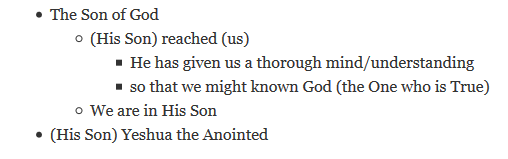
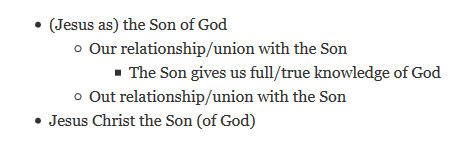
“And we have seen that the Son of God reached (us) and has given to us a thorough mind [dia/noia], (so) that we might know the (One who is) true, and (indeed) we are in the (One who is) true—in His Son, Yeshua (the) Anointed. This is the true God and (the) Life of the Age.”

The principal statement is bracketed by references to Jesus as God’s Son; this is vital to an understanding of the verse, as it governs the structure of the statement, which I outline here as a chiasm:

This outline may be summarized:

This is very nearly a perfect epitome of Johannine theology, conforming to everything we find in both the Gospel and the First Letter. Somewhat more difficult is the concluding statement of the verse:

ou!to/$ e)stin o( a)lhqino\$ qeo\$ kai\ zwh\ ai)w/nio$
“This is the True God and (the) Life of the Age [i.e. eternal Life].”

Particularly problematic is the relation of the demonstrative pronoun ou!to$ (“this”) to the previous sentence, as well as the predicate statement which follows. There are several possibilities:

    • The pronoun identifies the substantive o( a)lhqino/$ (“the true [one], the [one who is] true”) as God the Father—i.e., “this (one) is the true God“—who is also “the Life of the Age”.
    • It identifies “the One who is True” as God the Father (the True God), and His Son (Jesus) as “the Life of the Age”.
    • It identifies Jesus as both “the True God” and “the Life of the Age”.
    • It summarizes the entire Gospel message about both God the Father and Jesus (the Son)—i.e., “this is (the message of) the True God and Eternal Life”.

Sound arguments can be made for each of these four interpretations, and I find it almost impossible to make a conclusive choice. Most likely, based on Johannine usage, the expression “the Life of the Age” should be understood in relation to Jesus; he is identified as “(the) Life”, and the immediate source of Life for believers, in numerous places (Jn 1:4; 5:26; 11:25; 14:6; 1 Jn 1:1-2; 5:11-12, etc). Yet it is also entirely appropriate to refer to the Gospel message as “Life” in a similar way (cf. Jn 6:63; 12:50; 17:3; 20:31). The opening words of 1 John (1:1-2) seem to play on both of these meanings of “the Life”, and it is likely that a similar dual-meaning is present in the closing words of the letter as well.

Many commentators question whether Jesus would have been identified directly as “the true God”. While there is no doubt that, in both the Gospel and First Letter, the essential deity of Jesus (including his pre-existence and union with the Father) is clearly expressed, his identification as o( qeo/$ (“the [one true] God”) is less certain. Note, for example, the careful wording in John 1:1c (qeo/$ without the definite article). I have discussed the famous textual question in Jn 1:18 on a number of occasions (cf. the most recent treatment). As the textual evidence between qeo/$ (“God”) and ui(o/$ (“Son”) is rather evenly divided, one cannot simply read qeo/$ without futher ado. Even so, most manuscripts also read qeo/$ without the definite article in verse 18, for whatever that might signify (and it remains much disputed).

Syntactically, in 5:20, it is worth noting that the most proximate reference for ou!to$ would be Jesus, as the phrase “…His Son Yeshua the Anointed” immediately precedes the demonstrative pronoun. However, this is by no means a certain indicator of the pronominal relationship; consider the example of 2 John 7:

“…the ones not giving common account of [i.e. confessing] Yeshua (as hav)ing come in the flesh. This [ou!to/$] is the (one speaking) false(ly) and the (one who is) against the Anointed [i.e. ‘antichrist’]!”

Clearly, in this case, ou!to$ refers back to “the ones not confessing Jesus…” rather than to “Jesus”. Based on this syntax, ou!to$ in 1 Jn 5:20 would more likely refer back to “the One who is True” (i.e. God the Father), rather than to Jesus. At the same time, the syntax in 2 Jn 7 would suggest that both the pronoun and the two expressions (“the True God” and “the Life of the Age”) refer to a single subject, in which case, Jesus is the more probable subject.

Despite the many difficulties in deciding between the options listed above, I am inclined to favoring the second and fourth, or, perhaps, some combination of the two:

    • The two expressions “the True God” and “the Life of the Age” relate back to the two subjects—God the Father (“the One who is True”) and Jesus Christ (His Son), respectively.
    • As the concluding declaration of the letter, the pronoun ou!to$ also effectively summarizes the entire content of the letter; parallel with the opening words (1:1-2), it refers to the Gospel message, of what (the true) God has done for us through his Son Jesus, which leads to eternal Life for those who believe.