January 16: John 1:32-34

This is the last of three notes on John 1:29-34 (commemorating the Baptism of Jesus); each of the Baptist’s three revelatory statements is being discussed in turn. To summarize:

  • First—”See, the Lamb of God, the (one) taking up/away the sins of the world” (v. 29)
  • Second—”A man comes (in) back of me who has come to be in front of me, (in) that he was first/foremost (over) me” (v. 30)

John 1:32-34

Verse 32 begins: And Yoµanan {John} witnessed, saying/relating that…

“I beheld the Spirit stepping down as a dove out of heaven, and it remained upon him”

This is the closest parallel to the Synoptic accounts of the Baptism of Jesus:

Mark 1:10

“And straight away stepping up out of the water, he [i.e. Jesus] saw the heavens being split (open) and the Spirit as a dove stepping down unto/into him”

Matthew 3:16

“But having been dipped/dunked, Yeshua straight away stepped up from the water, and see!—the heavens were opened [for him] and he saw [the] Spirit of God stepping down as if a dove and coming upon him”

Luke 3:21-22a

“And it came to be, among the entire people being dipped/dunked, Yeshua also was being dipped/dunked and (as he) was praying—(see! the) opening up of heaven and (the) stepping down of the Holy Spirit, in bodily shape seen as a dove, upon him…”

Note: The Lukan version is difficult to render literally into English, in particular the construct e)geneto + infinitives with accusative, which is prefatory and builds to the main clause: the voice (of God) from heaven. A more conventional rendering to capture the sense of this might be:

“And it came to be, as all the people were being dipped/dunked, Yeshua also was dipped/dunked and (as he) was praying, the heavens opened up and the Holy Spirit, in bodily shape as a dove came down upon him, and…”

The unique elements of the Johannine account are:

  • The Baptist sees the descent of the Spirit. The Matthean and Lukan accounts increasingly emphasize the public character of the event (and the vision), whereas in Mark it is narrated more as a private vision to Jesus. The implication in John is that it is a special revelation vouchsafed to the Baptist.
  • Use of the verb qea/omai, which literally means “wonder (at), look/view in wonder”, but can also have the sense of “observe (closely)”, “perceive”, “contemplate”, etc (the archaic English “behold” approximates this reasonably well). This verb appears most often (among several verbs of seeing) in the Gospel and First Epistle of John, occasionally in the context of a revelatory observing of Jesus (cf. Jn 1:14; 11:45; 1 Jn 1:1; 4:14).
  • The dove/Spirit comes out of heaven (e)c ou)ranou=). This phrase occurs frequently in John, referring to Jesus as one who comes “out of [i.e. from] heaven” (Jn 3:13, 31; 6:32-33, 38 [a)po], 41-42, 50-51, 58; cf. also 1:51; 3:27; 12:28).
  • The dove/Spirit comes [lit. steps] down upon Jesus (as in the Synoptics), but also remains (e&meinen) upon him. The verb me/nw (“remain, abide”) occurs often in the Gospel and First Epistle, reflecting a profound spiritual-theological sense of the relationship between Christ and the believer (see Jn 5:38; 6:27, 56; 8:31, 35, et al.).

Perhaps most significant of all is that the actual baptism of Jesus is nowhere mentioned (at best it is implied in 1:31); in fact, if the Synoptic accounts were not available for comparison, we might not guess from John 1 that Jesus had been baptized at all. In my view, this is an intentional and careful omission. Especially noteworthy in this regard is the purpose of John’s baptizing: as stated in the Synoptics (Mark 1:4 par.) it was a baptism “of repentance unto the release [i.e. forgiveness] of sins”. In the Fourth Gospel, however, the emphasis is on Jesus as the one “taking away sins” (Jn 1:29, 35), and a very different purpose is indicated for John’s baptizing (see below).

It will be helpful here to consider the parallel structure of vv. 30-31 and 32-33; in each we have—(a) the witness of John in direct speech (a revelatory declaration about Jesus, i.e. John as the “voice”), and (b) the witness in action (the divine revelatory purpose/reason for John’s baptizing). In between is a statement by John: “and I did not see/know him” (ka)gw\ ou)k h&|dein au)to/n).

  • The witness in speech: “A man comes… ” (v. 30)
    “And I did not see/know him“
    • The witness in action: Reason for baptizing in water:
      So that Jesus might be made to shine forth [i.e. appear] to Israel (v. 31)
  • The witness in speech: “I beheld the Spirit…” (v. 32)
    “And I did not see/know him”
    • The witness in action: Reason for baptizing in water:
      Message of God revealing Jesus unto John: “He upon whom you see the Spirit…
      …this is the one baptizing in the Spirit” (v. 33)

In the Synoptics, the emphasis in John’s baptizing is on the people (“repentance unto the release of sins”); in the Fourth Gospel, it is on the person of Jesus (to reveal him as the Messiah / Son of God). This becomes clear when we examine the concluding verse 34:

“And I have seen and have witnessed that this (one) is the { } of God”

The majority reading is “Son” (ui(o/$) where the braces occur above; however, in a number of manuscripts and versions (Ë5vid a* 77 218 b e ff2* and Old Syriac versions) it is “elect/chosen (one)” (e)klekto/$ lit. “gathered out”)—i.e. “the Son of God” vs. “the Elect (One) of God”. The former is more common as a title for Jesus; for the latter, see Luke 9:35; 23:35. In early Gospel tradition (and the earliest Christian theology), these would probably have been interchangeable as titles for Jesus, with “Son of God” not necessarily carrying the full force of later Christology (for example, see John 1:49). Some scholars have expressed doubt whether “Son of God” would have been understood as a ‘Messianic’ title in Jesus’ own time; but the royal/Davidic theology, with its background of the (anointed) king as God’s “son” (Psalm 2; 2 Samuel 7), makes this likely (cf. 4Q246 from Qumran and the earlier article on this text). I feel confident in stating that both “Son of God” and “Elect/Chosen (One) of God” in this context would serve equally well to identify Jesus principally as the Divinely “Anointed” One (Messiah/Christ).

On the Subordination of John to Jesus:

I noted above the lack of any mention of Jesus’ actual baptism by John in the Fourth Gospel, and to the very different reason given for John’s baptizing. These details are part of a definite and (it would seem) theologically motivated effort to subordinate John to Jesus. This appears to have been an important emphasis in early Gospel tradition; there are several ways this is reflected in the Synoptic Gospels:

  • John is portrayed as the Prophet/Messenger (Elijah) who prepares the way for the Messiah (Mal 3:1; 4:5; cf. Mark 1:2; 9:12-13 par.; Matt 11:9ff; Luke 1:17). However, in the Fourth Gospel, John specifically denies being Elijah (Jn 1:21), seemingly in contrast to Jesus’ own words recorded elsewhere (Matt 11:14; Mark 9:12-13 par.).
  • Luke gives the birth narratives of John and Jesus a parallel structure and places them side-by-side (Lk 1:5-2:40), creating an implicit comparison between the two.
  • Matthew adds/includes the exchange between John and Jesus prior to the baptism, in which John expresses that he is unworthy to baptize Jesus. Common to all four Gospels, of course, is the saying of John (more objectively verifiable) in Mark 1:7; Matt 3:11; Luke 3:16; Jn 1:27; Acts 13:23.

In the fourth Gospel, this comparison (between John and Jesus) runs much deeper, is developed to a greater extent, and runs throughout the early chapters (especially in chapter 1). Consider:

  • The parenthetical statements inserted in the prologue (Jn 1:1-18)—verses 6-8 (John was not the true Light, but only bore witness to it); and verse 15 (a declaration of John nearly identical to that in v. 30 [see in the prior note]).
  • The tradition(s) recorded in vv. 19-27, where John specifically denies being the Messiah (v. 20), Elijah, or the Prophet to come (v. 21). To this is appended the traditional saying in v. 27 (cf. also v. 26), which will be ‘expounded’ in the next section.
  • The statements in vv. 29-34 (especially that in v. 30), along with the explanations for John’s baptizing and the fact that Jesus’ actual baptism is not narrated (on these points, see above).
  • In vv. 35-42, followers of the Baptist leave John to follow Jesus. The inclusion of John’s declaration in v. 36 (identical to that in v. 29) implies that he instigates or encourages their departure. Nothing similar is narrated in the Synoptics.
  • John’s testimony in 3:27-30, which is set in the context of a peculiar episode wherein the followers of John and Jesus appear side by side.

The fact that Jesus was baptized by John is virtually certain (on purely objective grounds); this has suggested to some critical scholars that Jesus had been a disciple of John before setting out on his own ministry. That there was some rivalry between the disciples of John and Jesus is suggested by the account in Jn 3:22-30 and by later tradition as well (e.g. the Ps-Clementine Recognitions 1.54, 60). More to the point, it has been theorized that the author of the Fourth Gospel is combating the view that John the Baptist was the Messiah. Given the decisive and repeated sayings and traditions recorded in chapter 1, and the way they are included in the narrative, this certainly is possible.

January 15: John 1:30-31

This is the second of three notes on John 1:29-34, in celebration of the Baptism of Jesus—the first discussed the revelatory statement of the Baptist in verse 29 (“See, the Lamb of God…”); today’s note will explore verses 30-31.

John 1:30-31

These verses build upon the statement in v. 29: “See, the Lamb of God, the (one) taking up the sins of the world”. V. 30 begins “This is (the one) over whom I said…”—then follows the difficult saying:

o)pi/sw mou e&rxetai a)nh\r o^$ e&mprosqe/n mou ge/gonen o%ti prw=to/$ mou h@n
“(in) back of me comes a man who has come to be in front of me (in) that [i.e. because] he was first/foremost (over) me”

This is nearly identical to verse 15, which begins “Yoµanan {John} witnessed about him and cried out, relating/saying, ‘This was (the one of) whom I said…”

o( o)pi/sw mou e)rxo/meno$ e&mprosqe/n mou ge/gonen o%ti prw=to/$ mou h@n
“the (one) coming (in) back of me has come to be in front of me (in) that [i.e. because] he was first/foremost (over) me”

There are three phrases in this saying (in v. 30), each of which is governed by a specific verb (and form) which is most significant to observe (the distinctions being generally obscured in translation):

    • “a man comes [e&rxetai]  in back of [o)pi/sw] me”
    • “who has come to be [ge/gonen] in front of [e&mprosqe/n] me”
    • “(he) was [h@n] first/foremost [prw=to/$] (over) me”

These three verbs are used with great care in the Gospel, when applied to Jesus, and especially in the ‘Prologue’ (Jn 1:1-18). Let us consider them in turn (references to verses in the Prologue exclude v. 15 which is largely identical to v. 30):

e&rxomai is a basic verb in narration and description which fundamentally means “come, go”. It is used frequently in the Gospel of John, often with a deeper theological or spiritual nuance than ordinary coming/going—in particular Jesus speaks of coming from the Father and going (back) to the Father; believers also come to Jesus (and to the Father). In the Prologue, the verb occurs three times (outside of v. 15):

    1. John came [h@lqen] as a witness to the (true) Light (v. 7)
    2. The reference is to someone coming [e)rxo/menon] into the world (v. 9). It is not entirely clear whether this relates to “every man” or “the true Light”; the latter is to be preferred, making it a reference to the Word (Christ) coming into the world
    3. The Word (Christ) came [h@lqen] to his own… (v. 11)

These references all relate to the appearance/presence of a human being in the world (i.e. among people). The present indicative form [e&rxetai] in verse 30 is closest to the present participle in v. 9 (and 15). In terms of Christ (the incarnate Word), we might speak here of the “historical Jesus”—that is, the man who was born, lived, and ministered in the world, among his own (the people of Israel).

gi/nomai has the primary meaning “come to be, become”, again common in narration and description, and, like e&rxomai, is often used with special significance in the Gospel of John. It can carry the nuance of “come to be born”, and, as such, is very close to the related verb genna/w. This latter verb is used in John for the spiritual “birth” of believers (Jn 1:13; 3:3-8) and gi/nomai also is used frequently to describe coming to faith (i.e. “becoming” believers, Jn 12:36; 13:19; 14:29; 15:8, etc). Gi/nomai occurs 8 times in the Prologue (outside of v. 15):

    1. For the things which came-to-be [e)ge/neto/ge/gonen] through the Word (v. 3 [x 3], 10)
    2. A man (John) came-to-be (born) [e)ge/neto] (v. 6)
    3. The Word came-to-be [e)ge/neto] flesh… (v. 14)
    4. “Grace and truth” came-to-be [e)ge/neto] through Christ (v. 17)—contrast with “the Law was given” through Moses.
    5. Those who received (Christ) are given authority to become [gene/sqai] sons of God (v. 12)

The perfect form [ge/gonen] in verse 30 (and 15) creates a difficulty in interpretation (discussed below), however it would seem to relate to the aorist form [e)ge/neto] in v. 14 (“the Word became flesh”).

ei)mi is the primary (existential) verb of being. In the prologue it occurs 10 times (outside of v. 15):

    1. Three times in v. 1: the Logos was [h@n] (on this, see below); and in v. 2.
    2. Twice in v. 4: In him (the Word) was [h@n] life, and the life was [h@n] the light…; and in v. 9 “the true light was [h@n]…”
    3. John was [h@n] not the (true) light (v. 8)
    4. The Word (Christ) was [h@n] in the world (v. 10)

The three occurrences of h@n in verse 1 form a definite contrast to the three forms of gi/nomai in verse 3:

  • In the beginning the Logos was
  • The Logos was toward [pro/$] God
  • God was the Logos
    (given in the literal word order, i.e. the Logos was God)
    • All things came to be [e)ge/neto] through him
    • Apart from him came to be [e)ge/neto] not even one (thing)
    • {one (thing)} which has come to be [ge/gonen]

In other words, the things in creation come to be (gi/nomai), but God is (ei)mi). For a similar contrast, see John 8:58: pri\n  )Abraa\m gene/sqai e)gw\ ei)mi/ (“before Abraham came to be, I am“). So the use of ei)mi in verse 30 in context clearly refers to the Divine existence of Jesus. Let us explore a little further how these three verbs—e&rxomai, gi/nomai and ei)mi—may relate here by glossing the terms in each phrase:

1. o)pi/sw mou e&rxetai a)nh\r (“[in] back of me comes a man”):

o)pi/sw mou (“[in] back of me”)—this can mean: (a) Jesus is younger, and has appeared publicly later than, John; or (b) Jesus is/was a follower of John; or even (c) Jesus was unknown or less well known than John. Many critical scholars accept (b) as an authentic historical detail, which can be debated. In terms of Gospel tradition as it has come down to us, and the overall presentation in the Gospel of John here, probably little more than (a), or some combination of (a) and (c), is intended.

e&rxetai (“comes”)—that is, the immediate (historical) presence/appearance of the man Jesus, publicly, in the midst of the people (see above on e&rxomai in 1:7, 9, 11).

a)nh\r (“a man”)—i.e., the “historical Jesus”, a real human being, a man like all the other people around John.

2. o^$ e&mprosqe/n mou ge/gonen (“who has come to be in front of me”):

o^$ (“who/which”)—relative particle qualifying a)nh\r and serving to join the first and second phrases.

e&mprosqe/n mou (“in front of me”)—this is clearly a contrast with o)pi/sw mou (“[in] back of me”), but in what sense? Much depends on the interpretation of ge/gonen, but I see this a typical bit of Johannine wordplay, whereby the immediate (apparent) sense is overshadowed (and may even be contrary) to the deeper (true) meaning. One might think that the Baptist (or the Gospel writer) here is simply saying that Jesus, who was younger than John and relatively unknown, is now coming into greater prominence. The immediate context would certainly suggest this—those who were following John now follow Christ (vv. 35ff, cf. also 3:27-30).

ge/gonen (“has come to be”)—the usage of gi/nomai in the Prologue (see above), and especially in verse 14 (“the Word became [e)ge/neto] flesh”), strongly suggests that the Incarnation be understood here. In other words, Jesus has come to be “in front of” John because he is the eternal Word (Lo/go$) that became flesh. The perfect form here (ge/gonen, parallel to the occurrence in v. 3) may be meant to indicate that something which took place in the (eternal) past, is presently true.

3. o%ti prw=to/$ mou h@n (“[in] that he was first/foremost [over] me”):

o%ti (“[in] that [i.e. because]”)—the reason why Jesus is “in front of” John.

prw=to/$ mou (“first/foremost [over] me”)—the superlative adjective prw=to$ is the climax of a step-parallelism (a favorite Johannine technique) with the earlier prepositions o)pi/sw (“[in] back of”) and e&mprosqen (“in front of”). Not only is Jesus “in front of” John, but he is “first (of all)” or “foremost” over him; indeed, this is the reason for his being “in front”. It is a dense and powerful symbolic chain of argument.

h@n (“was”)—this is the same form of ei)mi used throughout the Prologue (esp. vv. 1-2), and serves to identify Jesus, in no uncertain terms, with the Divine (and pre-existent) Word (Lo/go$) of God.

Many critical scholars have expressed doubts that this remarkable saying could have come from the historical John; it seems rather more like a theological-christological declaration by the Gospel writer. The point certainly can be debated; however, even if it does not preserve the ipsissima verba of the Baptist, the words very likely stem from a genuine saying. Other traditions, more objectively verifiable, are recorded, in all four Gospels, whereby John confesses the (far) greater status of Jesus (Mark 1:7-8 par.; Matt 3:14-15; John 3:27-30). In the concluding note, I will look at the idea that the Fourth Gospel has a special christological purpose in subordinating John to Jesus. In context here, verse 31 clearly is supplemental to v. 30, building on the earlier statement in more practical (historical) terms:

“And I did not see [i.e. know/perceive] him, but that he might be made to shine forth [i.e. appear], through this [i.e. for this reason] I came dipping/dunking {baptizing} in water”

There is both a text-critical and interpretative question involving the perfect form ge/gonen in Jn 1:4. Verses 3-4 can be read two ways:
(1) “all things came to be through him, and apart from him came to be not even one (thing) which has come to be [ge/gonen]. In him was life…”
(2) “all things came to be through him, and apart from him came to be not even one (thing). That which has come to be [ge/gonen] in him was life…”
In addition, (2) can be also rendered two ways: (a) “that which has come to be, in him was life…” or (b) “that which has come to be in him was life…”. Commentators and textual critics remain divided on which of these is the correct intepretation. See an earlier article of mine for more detail, including arguments supporting the different readings.

January 12: Luke 2:52 (continued)

Luke 2:52, continued

Kai\  )Ihsou=$ proe/kopten [e)n th=|] sofi/a| kai\ h(liki/a| kai\ xa/riti para\ qew=| kai\ a)nqrw/poi$

para\ qew=| kai\ a)nqrw/poi$ (“…alongside God and men”). This phrase qualifies (and locates) the ‘progress’ Jesus makes in “wisdom and age and favor”, and is (with the verse as a whole) drawn from 1 Samuel 2:26 (cf. also below on the parallel in Proverbs 3:4). The preposition para/ would be rendered properly “alongside”, but often has the sense of “with” (cf. meta/ in the LXX of 1 Sam 2:26) or “before”—i.e., “with God and men”, “before God and men”. It hardly need be said that “men” (pl. of a)nqrw/po$) here means people in general, other human beings.

How does this expression relate to each of the three terms coming before it? To begin with the second, h(liki/a (“age”): to say that Jesus progressed in age (or size/stature) alongside (other) men is simply another way of stating that he grew up into an adult just like everyone else around him. See Galatians 1:14, where Paul states that he “progressed [proe/kopton] in Judaism above many together-in-age [sunhlikiw/ta$, i.e. those his same age]”. An interesting question is whether the phrase “alongside God and men” governs all three terms, or just (e)n) xa/riti. In my view the phrase applies primarily to xa/riti (i.e. “in favor alongside God and men”), but covers the whole verse as well (i.e. the progress in wisdom/age/favor all takes place “alongside God and men”).

What of wisdom (sofi/a) in this regard? There are several possibilities:

    • Jesus progresses/increases in both human and divine wisdom
    • His progress/advancement in wisdom (whether understood generally or as human or divine wisdom) takes place both before God and among other people.
    • His wisdom (human and/or divine) is increasingly recognized by both God and men.

As I feel that wisdom generally is meant in verse 52, the second interpretation seems more likely; however, the nature of the Lukan Gospel narrative as a whole makes the third at least possible (for the theme of recognition in the Infancy narrative, cf. Lk 1:41ff; 2:16-18, 19, 27ff, 38, 46-48, 50-51).

The word xa/ri$ has a closer (proximate) connection to the phrase “alongside God and men”, as indicated above. This is made clear in 1 Samuel 2:26 (the main model for Lk 2:52): “and the child Samuel passed on and became great and (was) good both with the Lord and with men“. This is a literal rendering of the Hebrew: “and the youth Samuel went [lit. walked] and became great, and was good both with YHWH and also with men”. Consider also the similar wording in Proverbs 3:4: “and find [imperative] favor and good-skill in the eyes of God and man”. The word here translated “skill” (lk#c@) is somewhat similar in meaning to sofi/a (“intelligence, understanding”, etc). In any case, there is a general connection here between “favor” [/j@ = xa/ri$] and ‘wisdom’, as in Lk 2:52. To gain favor in the eyes of someone, means that he/she increasingly thinks well of, and is pleased with (or finds joy/delight in), that person.

Even though the righteous (or believers) may experience persecution, there is also the thought expressed that they will (or should work honestly to) gain favor in the eyes of people in the world (believers and non-believers alike). As an example, consider the initial reaction to Jesus in the Lukan account of his appearance back in Nazareth (Lk 4:16-30). Since this is the first episode (in Luke’s Gospel) of Jesus’ public ministry (following the baptism and temptation), its connection back to 2:52 (and 2:40) is noteworthy. There are actually several verbal and thematic points of contact:

    • Following the baptism, Jesus returns “full of the Holy Spirit” (Lk 4:1); on the parallel with “being filled with wisdom” in 2:40, see the previous day’s note.
    • Following the temptation, Jesus returns “in (the power) of the Spirit” (4:14); cf. the longer reading of 2:40.
    • Jesus comes to Nazareth, where he had been nourished/nurtured [i.e. brought up, raised] (4:16); this connects back to the end of the Infancy narrative (esp. 2:39-40, 50-51) and to his progressing “in age” [h(liki/a|] in v. 52.
    • Jesus reads from the scroll of Isaiah (Isa 61:1-2): “the Spirit of the Lord is upon me…” (4:18f); this is parallel to the “the favor [xa/ri$] of God was upon him” in v. 40 (cf. “in favor [xa/riti] before God”, v. 52).
    • Upon his reading, and the saying in 4:21, the townspeople in the synagogue all “gave (good) witness concerning him and wondered at the gracious/favorable/pleasant [xa/rito$] words that were passing/coming out of his mouth” (4:22)

Of course, the crowd turns against Jesus halfway through the episode, but the first portion at least serves almost as an illustration of 2:52.

In conclusion, it is necessary to return to the Christological question touched upon in the previous days’ notes: what exactly does the Gospel writer (trad. Luke) indicate regarding the person of Jesus in this verse? I would make the following points:

1. An emphasis on the humanity of Jesus. In a primary sense the growth of v. 40 and the progress of v. 52 is that which is common to all human beings. What of the idea of his advancement in wisdom? Luke certainly seems to be affirming that Jesus grew in human skill and understanding, and, indeed, to deny this of him virtually results in a one-sided (docetic) Christology. Fully human means just that—it includes (natural) growth and development in knowledge and understanding. The presence of h(liki/a (age/size/stature) positioned in between sofi/a (wisdom) and xa/ri$ (favor) confirms that normal human development is involved.

2. What Jesus shares in common with the righteous. Wisdom (sofi/a) and favor (xa/ri$) are attributed to the righteous (of Israel), and to believers; this includes the motif of being “filled with wisdom” and having “the favor God upon” him. Consider especially in this regard, the following details in the Infancy narrative: (a) the Temple setting, (b) the presence of devout pious Israelites such as Zechariah/Elizabeth and Simeon/Anna, (c) the themes and Scriptural allusions in the canticles, (d) the faithfulness and obedience of Jesus’ parents, (e) the theme of fulfilling the Law.

3. The connection between wisdom/favor and (the) Spirit. On these points, see above and in the previous note. There is a reasonably close parallel between being filled with wisdom and being filled with the Spirit; similarly the favor of God can be related to the Spirit being or coming upon a person. At the very least, this conjunction of elements shows Jesus to be especially or uniquely favored (one may say chosen). But the angelic annunciation to Mary earlier in the narrative (Lk 1:35) indicates an even closer connection to the Spirit. The relationship to God is only implied in 2:40, 52, but will be expressed more fully at the baptism (Lk 3:21-22), in the Lukan account of the transfiguration (Lk 9:28-36), and the post-resurrection narratives.

4. His unique/chosen character will be recognized by both God and men. People may respond to Jesus’ human wisdom (Lk 2:46-48; 4:22), or they may penetrate to a deeper understanding of his Person. In this regard, note especially the canticle (Lk 2:29-32) and prophecy (Lk 2:34-35) of Simeon, and the carefully narrated responses by Mary in 2:19, 51b. In other words, the Incarnation as such does not exist in a vacuum: it occurs alongside (para/) human beings—they may respond positively or negatively, with acceptance or rejection.

5. A suggestion of the Two Natures? It must be admitted that Luke does not specifically declare or narrate the Deity of Jesus (in the traditional orthodox sense) in chapters 1-2. Of course, it is not in any way denied either. In the angelic announcements (Lk 1:32, 35; 2:11) and the exclamation of Elizabeth (Lk 1:43) we find the closest thing to an outright declaration—effectively identifying Jesus with the Lord (YHWH) and as Son of God. One may also read 2:40 as an indication of divine status, in some sense. Is it possible that there is even a hint of the ‘Two Natures’ of Christ in v. 52? It is noteworthy that the Infancy narrative ends with the phrase “alongside God and men“. While I think it unlikely that Luke would consciously have had such an allusion in mind, the inspired authors of Scripture almost certainly wrote better than they themselves knew or understood. By any standard, the doctrine of the hypostatic union requires that one at least acknowledge the profound mystery of the Incarnation even in verses as apparently simple and unassuming as Lk 2:52.

Birth of the Son of God: Luke 2:49

Traditionally the Sunday after Epiphany commemorates the Holy Family—Jesus and his parents, Mary and Joseph—as marked by the last scenes of the Lukan Infancy Narrative, Luke 2:39-40, 41-50, 51-52. The scene in Lk 2:41-50 is especially significant, narrating the family’s journey to Jerusalem to celebrate Passover (vv. 41-42), and Jesus’ decision to stay behind in Jerusalem (without his parents’ knowledge, v. 43). On the way back, Joseph and Mary realize that Jesus is missing (vv. 44-45) and eventually return to Jerusalem to find Jesus sitting in the Temple precincts (as a devout pupil) with the teachers of the Law (vv. 46-47). The popular image of the boy Jesus teaching in the Temple (often depicted in Christian art), while understandable as a pious sentiment, is unwarranted and reads or assumes much into the text that is not there. I have discussed this episode, including the question of his parents (v. 48), with Jesus’ famous response (v. 49), in a prior article. Today I will focus in detail on the phrase e)n toi=$ tou= patro/$ mou.

Luke 2:49

“…did you not see [i.e. know] that it is necessary for me to be e)n toi=$ tou= patro/$ mou?” (v. 49)

As I have mentioned previously, the words in Greek here from Jesus’ response in v. 49 have customarily been rendered “in my Father’s house [i.e. the Temple]”. While this is tolerable as a translation in itself, it is really not accurate, and is actually rather misleading, for Jesus is not talking about the Temple building per se. If the Temple were meant specifically, Jesus (or the author rendering/recording the words) could easily have used oi@ko$ (“house”), which is regularly used for the Temple (i.e. house of God). The expression here literally reads “in the (thing)s of my Father”, with the preposition e)n (“in”) either in the sense of “involved in” or, more likely, “among”—”did you not know that it is necessary for me to be among the (thing)s of my Father?” Let us look at the immediate context to see how this is best understood.

  • Mary and Joseph look for Jesus among their relatives and others known to them—e)n toi=$ suggeneu=sin kai\ toi=$ gnwstoi=$ (v. 44)
    At the historical level, the journey to and from Jerusalem would have been made by caravan train, with family, friends and fellow travelers (with their belongings) moving together in a group, largely for reasons of safety and protection.
  • Not finding him, they turn back to Jerusalem
    —searching up (and down) [a)nazhtou=nte$] for him
    —and after three days
  • They found him in the Temple
  • Mary and Joseph question Jesus, with his reply to them—e)n toi=$ tou= patro/$ mou (v. 49)

Note the juxtaposition:

  • Not finding Jesus among the relatives and acquaintances [e)n toi=$ suggeneu=sin kai\ toi=$ gnwstoi=$]
  • They find Jesus in the Temple | among the teachers [e)n tw=| i(erw=| | e)n me/sw| tw=n didaska/lwn]

Moreover, there is a chain of phrases, marked the preposition e)n (“in, among”) + the dative, indicating the place where Jesus is (or is supposed to be):

  • e)n toi=$ suggeneu=sin kai\ toi=$ gnwstoi=$ (“among the relatives and the [one]s known [i.e. acquaintances]”)
  • e)n tw=| i(erw=| | e)n me/sw| tw=n didaska/lwn (“in the sacred place [i.e. Temple]” | “in the middle of the teachers of [the] Law”)
  • e)n toi=$ tou= patro/$ mou (“in/among the [thing]s of my Father”)

The twin phrases of v. 46—e)n tw=| i(erw=| | e)n me/sw| tw=n didaska/lwn—give us a sense of what the expression in v. 49 means: (1) the sacred place (the Temple precincts), and (2) study of [and devotion to] God’s Law (the Torah). However, when one compares the expression of v. 49 (e)n toi=$ tou= patro/$ mou) with the phrase in v. 44 (e)n toi=$ suggeneu=sin…), this, in  turn, sheds light on Jesus’ response to his parents—”th(eir) relatives [i.e. in the caravan]” | “the things/ones of my Father”. This parallel contrasts Jesus’ earthly/familial relations with his (heavenly) Father:

    • “your father”—in Mary’s question to Jesus (v. 48)
    • “my Father”—in Jesus’ reply (v. 49)

The closing words of Jesus’ reply are also significant: dei= ei)nai/ me “it is necessary for me to be”—i.e. “it is necessary for me to be in/among the (thing)s of my Father”, with e)n toi=$ tou= patro/$ mou set first in emphatic position within the clause. The particle dei= (“[it is] necessary”) is used frequently in Luke-Acts, including a number key statements by Jesus regarding his Divinely-appointed mission (Lk 4:43; 9:22, etc).

There are of course many references throughout the New Testament to Jesus as the Son (of God) and his relation to the Father; however, this theme holds a special place in the Gospel of John.

Jesus the Son and God the Father in the Gospel of John

There are dozens of instances in the Gospel of John where Jesus refers to himself as “the Son” and/or his unique relationship with God “the Father”—so many, in fact, that it is not possible (or useful) to list them all here. A fair percentage of them can be grouped into several related categories:

The basic image is of a dutiful child who says and does what he hear/sees the father saying and doing. This involves more than parental instruction and filial obedience. In most families, children—especially the eldest/only son—would typically take up the father’s trade; this meant the role of an apprentice, learning all the ins and outs of particular occupation or craft in detail, developing skill and expertise in the work. That Joseph was a carpenter is well-established in Gospel tradition, though it is not known for certain whether, or to what extent, Jesus followed in this trade. In any event, Jesus uses this imagery to describe his relationship with God, the heavenly Father—he does the Father’s work, which he was sent to do, as he learned it from the Father. This takes on deeper theological (and Christological) significance at several key points in the Gospel—most notably in the great prayer that concludes the discourses of John 13-17:

  • John 17:1-5 (echoing the earlier 13:31-32)—the Son shares in the glory of the Father
    • indicating Divine pre-existence (v. 5)
  • John 17:18ff—the Son is sent by the Father into the world
    • indicating Jesus’ incarnation and (human) birth (cf. Jn 1:14; 18:37)
  • John 17:20-23ff—a reciprocal relationship is established with believers (as sons of God) (cf. the key verse 11)
    • union/unity with the Father (cf. Jn 14:20)
    • binding unity is established through love (vv. 23-26)

There are three noteworthy passages in the subsequent death and resurrection scenes in the Gospel:

  • John 19:25b-27—Jesus’ address (on the cross) to Mary “his mother” in which he relinquishes the familial ties of his earthly existence (cf. above)
  • John 20:17—his words to Mary Magdalene, referring to his ascension/return to the Father (cf. Jn 13:33, 36; 14:2-4ff, 12, 28; 16:15ff, 16-17ff, 28; 17:11, 13)
  • John 20:21—Jesus sent by the Father | sends the disciples
    Here the specific context is two-fold:
    • The disciples’ receiving the Holy Spirit
    • Their mission to proclaim the Word of God (implied), cf. 17:20

With regard to the last reference, these are two elements specifically connected with the birth of believers as sons/children of God—John 1:12-13; 3:3-8, cf. vv. 17-21.

January 11: Luke 2:52 (continued)

Luke 2:52, continued

Kai\  )Ihsou=$ proe/kopten [e)n th=|] sofi/a| kai\ h(liki/a| kai\ xa/riti para\ qew=| kai\ a)nqrw/poi$

e)n th=| sofi/a| kai\ h(liki/a| kai\ xa/riti (“…in wisdom and age and favor”). These three terms represent the areas in which Jesus progressed/advanced (proe/kopten). To begin with the second: h(liki/a would be rendered “age” in its primary sense, but also carries the meaning “size” or “stature” (cf. Lk 12:25 par; 19:3; John 9:21, 23; Eph 4:13; Heb 11:11). It is clear enough that the word here indicates normal human physiological growth. But what of the two surrounding terms?

sofi/a and xa/ri$ also occur together in the prior summary description of the child Jesus’ growth (Lk 2:40), so it is reasonable to assume that their use here has some relation to that in v. 40. The first word sofi/a has the basic sense of knowledge/ability, the practical side of which we might render as “skill”, often with the sense of being experienced, etc; the more abstract intellectual side is best translated by “wisdom”, and it is this meaning that came to be predominant. The word occurs more than 50 times in the New Testament, with three points of reference—(1) wisdom generally, (2) specifically human wisdom, or (3) specifically divine wisdom. In regard to these last two, see especially Paul’s interchange between them in 1 Corinthians 1-2. The epistle of James also distinguishes the wisdom “from above” with flawed/false human ‘wisdom’ (James 3:15, 17). More to the point is the usage of sofi/a in Luke-Acts: apart from proverbial references to wisdom in Lk 7:35; 11:31, most of the occurrences relate to the special wisdom possessed by the righteous (Lk 1:17) or believers (Lk 21:15), the latter indicating a specific gift from God. Two passages are particularly worth noting:

  1. Wisdom is attributed to Stephen (parallel with “Spirit” [pneu=ma]) in Acts 6:3, 10; cf. especially v. 3: “full of [the] Spirit and wisdom”. The expression is similar to that in Lk 2:40. Here, as in Lk 1:80, it is not absolutely certain that pneu=ma means the Holy Spirit, but this is more likely when referring to believers in Acts.
  2. Wisdom is attributed to Moses in Stephen’s speech (Acts 7:10, 22). Here normal human wisdom, or wisdom generally, is indicated. The expression in 7:10, “and (God) gave him favor [xa/rin] and wisdom [sofi/an] in front of Pharaoh”, is fairly close to that of Lk 2:52 and is certainly the closest parallel.

There is a fine line, perhaps, between the wisdom of God (i.e. divine wisdom) and special wisdom/understanding which God grants to the believer or righteous one. Is the wisdom attributed to Moses (in Acts 7:10) or Jesus (in Lk 2:40, 52) a unique/attenuated form of human (intellectual) ‘skill’ or does it reflect an inspired, revelatory charisma in a deeper sense?

The final word, xa/ri$, can be somewhat difficult to translate, for it carries a rather wide semantic range. The primary sense is “joy, delight”, the noun being derived from xai/rw (“rejoice, be glad/pleased”); in other words, that which brings joy or delight, etc. The xa/ri$, the response to that which brings joy, can be understood either in terms of giving or receiving—a person who finds joy/pleasure in someone or something, bestows favor, or a gift on the object of joy; one who receives favor (or a gift) will, in turn, over an expression of gratitude or thanks. In English, “grace” has a similarly multivalent meaning, but has also become heavily infused with a specific theological-soteriological sense (by way of Paul, Augustine, and the Reformers). Generally, “favor” is preferable as a translation of xa/ri$, both in Luke 2:40, 52 and in the rest of the New Testament as well.

Let us consider the use of sofi/a and xa/ri$ in Luke 2:40; there it states that the child (Jesus) “grew and became strong, being filled [plhrou/menon present pass. participle] with wisdom [sofi/a|] and (the) favor [xa/ri$] of God was [h@n imperfect active indicative] upon him”. So there are two expressions:

    • “[being] filled with wisdom”
    • “favor of God [was] upon him”

With regard to the first expression, there seems to be a connection between wisdom (sofi/a) and spirit (or “Spirit”, pneu=ma)—cf. Acts 6:3, and the Lukan references to John and his parents being “filled” with the Spirit (Lk 1:15, 41, 67). In Lk 1:80 there is also the statement that the child John “grew and became strong in (the) spirit [pneu/mati]”. As indicated in a prior note, some manuscripts and versions of Lk 2:40 also contain pneu/mati, though most scholars consider the shorter reading to be original. In my view, Lk 1:15, 41, 67 (and Acts 6:3) all refer to the (Holy) Spirit, but for Lk 1:80, something more akin to “the (prophetic) spirit of Elijah” (Lk 1:17) is intended. In the book of Acts, believers too are “filled with the Spirit” (Acts 2:4; 4:8, 31; 9:17, etc); and it is noteworthy that the Gospel of Luke uses the expression of Jesus as well (Lk 4:1), though more commonly Jesus is “in the Spirit” (4:1, 14; 10:21) or the Spirit is “upon him” (3:22; 4:18, cf. also 1:35). There may also be a parallel between “favor of God upon him” and “the Spirit (of God) upon him”. In any case, Lk 2:40 clearly refers to the unique relationship between Jesus and God. But should we identify the “wisdom” here with divine wisdom? I believe that the connection with wisdom and Spirit is close enough in this regard to justify the equation. In the Old Testament and Jewish tradition, wisdom (Heb. hm*k=j*) was occasionally personified as an aspect (or hypostasis) of God Himself—i.e. Divine Wisdom (see Proverbs 8, and the deutero-canonical book of Wisdom). In early Christian theology, Jesus too was often identified both with the Word (Lo/go$) and Wisdom (Sofi/a) of God. With regard the the favor (xa/ri$) of God, I do not think it inappropriate to draw upon the words of the divine Voice at Jesus’ baptism: “this is my (be)loved Son, in you I am well-pleased [lit. think well of]” (Lk 3:22 par.).

The situation is somewhat different with the use of sofi/a and xa/ri$ in Luke 2:52, for here more decidedly the emphasis is on Jesus’ human growth and development (as will be discussed in the next note). I would argue that “wisdom” and “favor” are used in a more general sense, in a way that would be applicable to all human beings (or at least, all righteous/believers). It would be much too simplistic to say, from an orthodox perspective, that verse 52 refers to Jesus’ humanity, and verse 40 to his deity, but I think there is a sense in which this is not far from the mark. The Christological problem, of course, comes in relating the humanity and deity of Christ—how exactly should we understand his progressing/advancing “in wisdom… and favor”? There is no reason to think that the Gospel writer (trad. Luke) means anything other than a normal (albeit especially gifted) growth in human wisdom (knowledge/understanding/skill/experience), such as would have been found in Moses, for example (on this, see Acts 7:10, 22, also Josephus Antiquities II.228-231). The expression, as applied to the righteous in general, is close to that of Proverbs 3:4. Does Luke intend something deeper as well? This will be discussed in the concluding note on this verse; however, consider the following paradigm as a possible expression of the Christological mystery:

The Wisdom [sofi/a] (v. 40, 52)
(of God)
{parallel to the Spirit [pneu=ma] of God}
which fills him
(v. 40, cf. also Lk 4:1 etc)
Jesus progresses/advances in age [h(liki/a] (v. 52)
as he grows and becomes strong (v.40)
—an expression of his human nature which is
in between expressions of his deity (his relationship to God)
The Favor [xa/ri$] (v. 40, 52)
of God
{i.e. this is my beloved Son in whom He is well-pleased, cf. Luke 3:22}
which is upon him {as the Spirit [pneu=ma] is upon him}
(v. 40, cf. Luke 3:22; 4:18)

Saturday Series: John 1:51 (continued)

John 1:51 (continued)

Last week we looked at the enigmatic statement by Jesus in John 1:51:

“Amen, amen, I say to you (that) you [pl.] will see the heaven opened up and the Messengers of God stepping up and stepping down upon the Son of Man.”

A proper study of such difficult passages requires a careful two-step approach: (1) analysis of the Greek words/phrases and how they are used, and (2) the context of the passage within the book. Last week we dealt with the first of these, today we will explore the second—that is, the context of the verse within the Gospel of John. Much of the difficulty surrounding this saying has been in trying to identify it with an actual event which the disciples experienced (or would experience). I mentioned three possibilities: (a) an otherwise unrecorded event during Jesus’ ministry, such as the Transfiguration scene in the Synoptic Gospels; (b) a post-resurrection vision or encounter; or (c) an eschatological vision. None of these really seem to fit the narrative setting of this saying—at the very beginning of Jesus’ ministry, just after the Baptism and the call of the first disciples. It seems more likely that it is meant by the author (trad. John the Apostle) as a symbolic picture, and that its fundamental meaning is Christological. I believe that a study of the Greek (last Saturday) already points rather clearly in this direction. But let us examine things a bit further.

1. The Location of the Saying

After the hymnic prologue of Jn 1:1-18, the first main section of the Gospel is Jn 1:19-51, which has, as its primary theme, the testimony of John the Baptist regarding Jesus. The section is divided into four “days”, and with each “day” the witness of Jesus’ identity is developed:

  • vv. 19-28—the Baptist’s testimony regarding himself (“I am not…”)
  • vv. 29-34—the Baptist’s testimony regarding Jesus
    • account of the Baptism (vv. 31-33)
  • vv. 35-42—disciples respond to the Baptist’s testimony and follow Jesus
    • a disciple (Peter)’s encounter with Jesus (vv. 41-42)
    • saying of Jesus (v. 42)
  • vv. 43-51—disciples respond to the testimony of other (disciple)s and follow Jesus
    • a disciple (Nathanael)’s encounter with Jesus (vv. 47-51)
    • saying of Jesus (v. 51)

Each of the last three days follows a basic pattern, which includes a pair of declarations regarding Jesus, using a range of significant titles or descriptions:

  • Day 2: “Lamb of God” (v. 29) / “Son of God” (or “Elect/Chosen One of God”) (v. 34)
  • Day 3: “Lamb of God” (v. 36) / “Messiah” (“Anointed One [Christ]”) (v. 41)
  • Day 4: “the one of whom Moses and the Prophets wrote” (v. 45) /
    “Son of God” | “King of Israel” (v. 49)

The saying in Jn 1:51 thus concludes this opening section of the Gospel, which fundamentally has a Christological orientation, in two respects:

  1. The focus moves from John the Baptist to Jesus (see vv. 8, 15, 30; 3:28-30)
  2. John and the disciples witness (see) Jesus—that is, they begin to recognize who he is, and testify as to his identity.

The account of Jesus’ Baptism (vv. 31-34) is central to this section. Moreover, its close proximity to verse 51 makes it extremely likely that some sort of allusion to it is intended. Last week I mentioned several words in verse 51 which echo the baptism:

  • The Holy Spirit, in the form/shape of a dove, descends [lit. “steps down”] upon Jesus, using the same verb (katabainœ) as in Jn 1:51. Also, the versions in Matthew/Luke specifically use the preposition epi (“upon”) and narrate the episode as something observable by all the people.
  • In the descent of the Spirit, the heavens are said to separate; in Matthew/Luke (Matt 3:16; Lk 3:21), the verb used is anoigœ (“open up”) as in Jn 1:51.

The Baptism is not narrated as something that people observe directly—it is only “seen” through the verbal account (or word) of the Baptist. Similarly, throughout this section “seeing” Jesus is intimately connected with hearing and responding to the message of the Baptist and the first disciples (vv. 34, 36, 39, 46). In Nathanael’s encounter with Jesus (vv. 47ff), he also “sees” based on what Jesus says to him; note, in particular, the wording:

“Jesus responded and said to him, ‘(In) that [i.e. because] I said to you that I saw you underneath the fig-tree, you trust (in me)? (Thing)s greater than these you will see!” (v. 50)

This interplay between “seeing” and “saying” should caution us against the simple assumption that a concrete visible event is intended in v. 51.

Consider also that, while the saying in v. 51 concludes the first section (1:19-51), it also marks the beginning of the next—that is to say, the beginning of Jesus’ ministry. In terms of the Gospel of John, this means the core narrative of the Gospel spanning chapters 2-20. Commentators typically divide this into two main parts:

  1. Chapters 2-12, sometimes referred to as the “Book of Signs”, in which the narrative alternates between accounts of miracles and teaching (discourses) by Jesus—the miracle (sign) often serving as the basis and starting point for the discourse which follows (see especially in chapters 5, 6, and 9). All but the first and last of the Son of Man sayings are found in these chapters.
  2. Chapters 13-20, which narrate the Passion (and Resurrection) of Jesus—chapter 13 (a Last Supper scene similar to that in the Synoptic tradition) leads into the great Discourses in 13:31-16:33, concluding with the remarkable Prayer-Discourse of chapter 17.

The last Son of Man saying in John (13:31) opens the Discourses which are set at the beginning of the last major section of the Gospel (chs 13-20). It seems likely that the first Son of Man saying (1:51) is meant to have a similar transitional role in the structure of the Gospel narrative.

2. The other Son of Man Sayings

There are numerous Son of Man sayings in the Gospel of John. As mentioned above, all but the first and last sayings occur in chapters 2-12, which is significant for two reasons:

  • They are part of the Discourses of Jesus in these chapters, marked by a unique style of teaching. A statement or action by Jesus is misunderstood by the audience, leading to a pointed question, and the subsequent response (and exposition) by Jesus, answering the question at a deeper level of meaning. This process of redirection and reformulation always involves Jesus’ identity—his Person and Teaching—the Son in relation to God the Father. Where they occur, the Son of Man sayings (esp. 3:13-14; 6:27, 53, 62; 8:28; 12:23, 32, 34) are central to the Discourse.
  • They point toward the death and exaltation (resurrection, return to the Father) of Jesus described in chapters 13-20. Indeed, the principal sayings all have a dual-meaning, centered on Jesus’ death and resurrection. The sayings which refer to the Son of Man being “lifted high” (Jn 3:14; 8:28; 12:32, 34) or being “glorified” (Jn 12:23; also 13:31) have both aspects in mind.

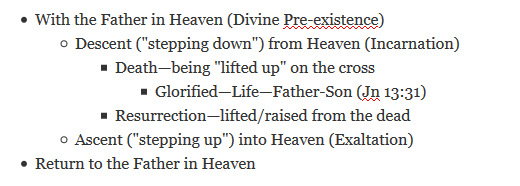
The dualism of these sayings is best demonstrated by the use of the verbs katabainœ and anabainœ (“step down”, “step up”), as in Jn 1:51. The saying in 3:13 is followed by that of v. 14 (which speaks of the Son of Man “lifted high”); the sayings in Jn 6:27, 53, 62 have a more complex reference matrix, as part of the great Bread of Life discourse (6:25-66). In schematic form, we might outline the dualism as follows:

According to this outline, the last Son of Man saying (Jn 13:31) reflects the central, inner dynamic of the Father-Son relationship and identity, governed by the verb doxazœ (“give honor/esteem/glory”, i.e. “glorify”). If this is correct, then it is not unreasonable to assume that the first of the Son of Man sayings (Jn 1:51) is parallel to this in some way, and may reflect the outer dynamic—the ascent/descent. Again, this would seem to be correct considering the use of the verbs katabainœ and anabainœ in 1:51. However, in that first saying, it is not the Son of Man descending/ascending, but rather of Angels (“Messengers of God”) ascending/descending on the Son of Man.

3. An allusion to Genesis 28:12

As mentioned last week, in Jesus’ saying there is almost certainly an allusion to Genesis 28:12. In Jacob’s dream-vision at Bethel, he sees Angels ascending and descending on the ladder; in the Greek Version (Septuagint) “ascending and descending” uses the same verbs (anabainœ and katabainœ) as Jn 1:51. Note also:

  • There is a traditional Jewish interpretation which understands the Angels ascending/descending on him (Jacob). In one reference (Genesis Rabbah 68:12) Jacob is seen as being simultaneously in heaven.
  • The Targums (Aramaic translations) express the idea that the shekinah—the visible manifestation and/or personification of God’s glory—was on the ladder. In Justin Martyr’s Dialogue with Trypho (mid-2nd century A.D.), we find the earliest evidence for the interpretation that Christ was on the ladder (86:2).
  • Bethel as the “House of God”, i.e. the rock/stone which symbolizes the Temple and its foundation. In ancient and traditional religious thinking, the Temple served as the meeting place between God and human beings, a point of contact between Heaven and Earth. Moreover, in John 2:19ff (not long after the saying in 1:51), the Temple is identified with Jesus’ own person (and body), specifically in connection with his death and resurrection.

4. A Comprehensive Symbol?

Returning to the specific context of John’s Gospel, there is still more evidence to suggest that the saying of Jesus John 1:51, in its particular position within the structure of the narrative, is intended primarily as a symbolic picture that effectively encompasses the entire Gospel—a framing device representing beginning and end, much like the “Alpha and Omega” (A and W) of Revelation 1:8; 21:6; 22:13 (another Johannine work, with definite parallels in thought and language to the Gospel). Here are some points I would cite in favor of this interpretation:

  • The clear parallels with the Baptism (see above, and the discussion last week), which marks the beginning of Jesus’ earthly ministry (descent/incarnation). Again, the location of Jn 1:51 strongly suggests an allusion to the Baptism.
  • Similar parallels with the Resurrection (ascension), which effectively marks the end of Jesus’ earthly existence.
  • Similarities to descriptions of the Son of Man coming in glory at the end-time (especially in the Synoptic Gospels, Mk 13:26; Matt 16:27-28, etc). However, the Gospel of John understands the Son to have had this position and glory prior to his incarnation/birth as a human being (that is, divine pre-existence). This means, in the Johannine context, that such images cannot refer only to Jesus’ exaltation and future return, but to a reality that encompasses and transcends the entire process of descent/ascent.
  • The saying in Jn 1:51 is part of a parallel, between the beginning and end of the Gospel. This expressed by the encounter of two disciples (Nathanael and Thomas) with Jesus, and involve parallel confessions:
    • Jn 1:49: “You are the Son of God | you are the King of Israel!”
    • Jn 20:28: “My Lord | my God!”
      It is possible that these confessions themselves as bracketing the entire narrative of chapters 2-20:
      • “Son of God” (in a Messianic context)
        —”King of Israel” (i.e. Anointed Davidic Ruler)
        —”My Lord” (Jesus as Messiah/Lord, cf. Ps 110:1)
      • “My God” (Deity)
    • Each of the confessions also includes a response by Jesus (Jn 1:50-51; 20:29) related to disciples/believers seeing him.
  • In the Gospel of John, “seeing” often signifies a level of spiritual perception (or of faith/trust) that is different from visual observation (Jn 1:14, 18; 3:3; 6:36, 46; 9:37-41; 11:9, 40; 12:45; 14:7, 9, 17, 19; 17:24; 20:29, etc). It is likely that the declaration “you will see” (opsesthe) does not refer to a concrete, visible event, but rather to the recognition and realization of Jesus’ true identity—as the Son who reveals and leads the way to the Father. This, of course, is also related to “seeing” the Son in terms of being with him, in his presence, as other instances of the verb optanomai, optomai/opsomai would indicate (Jn 16:16-17, 19, 22).
  • As a concluding observation that “seeing” in Jn 1:51 signifies something more than a concrete vision, note the parallel with 20:29:
    • “because I said to you that I saw [eidon] you… you trust?
      you will see [opsesthe] the heaven opened up and the Messengers of God… upon the Son of Man” (1:51)
    • “because you have seen [heœrakas] me you trust?
      Happy/blessed are the ones not seeing [idontes] and (yet) trusting!” (20:29)

In both Jn 1:51 and 20:29, the eventual seeing by the believer is contrasted with the disciple believing on the basis of an extraordinary or miraculous experience. Even the concrete evidence for Jesus’ resurrection (in the case of Thomas) should not be relied upon as the basis for faith and trust in Christ, but rather the word that bears witness to him and the Spirit that draws us to him.

It is a great wonder that, wherever you turn in the Gospel of John, there appears to be an almost limitless depth to the passage. Even a careful, objective treatment of individual words inevitably leads down into a wide expanse of meaning and spiritual significance. I hope that I have been able to offer some help in demonstrating how a study of both the words and context of the passage can serve as a reliable guide to exploration. For next week, I would exhort you to continue on in a similar manner, reading and studying the next two chapters of the Gospel as carefully and thoughtfully as you are able. It will prepare you for a discussion on one of the most familiar verses in all the New Testament, but one which is often cited without much consideration for its context in the Gospel. As you may have guessed, this is the world-famous John 3:16—and we will be looking at its context most carefully…next Saturday.

January 10: Luke 2:52 (continued)

Luke 2:52, continued

(see the previous daily note)

Kai\  )Ihsou=$ proe/kopten [e)n th=|] sofi/a| kai\ h(liki/a| kai\ xa/riti para\ qew=| kai\ a)nqrw/poi$

proe/kopten (“[and Yeshua/Jesus] struck forward”). The verb proko/ptw literally means “to cut/strike forward”, but is typically translated “to progress, advance, etc”; in English idiom we might say “make (one’s) way ahead, make headway”. The verb is used just five other times in the New Testament: once in Romans 13:12 (as a locution for the coming of night), and three times in 2 Timothy. These latter instances warn against believers’ failure to make (positive) spiritual progress (2 Tim 3:9); indeed many may go from bad to worse (2 Tim 2:16; 3:13). The use in Galatians 1:14 corresponds closely to that in Lk 2:52: there Paul states that (as a young man) he “progressed [proe/kopten] in Judaism over many (of those) together-in-age [sunhlikiw/ta$, i.e. those his own age]”. The verb is not found in the Septuagint, but the related noun prokoph/ (“progress”) does occur in Sirach 51:17; 2 Macc 8:8, as well as several times in the New Testament (Phil 1:12, 25; 1 Tim 4:15).

As mentioned in an earlier note, the narrative summary statements in Luke 1:80; 2:40, 52 are modeled, in part, after the descriptions of the child Samuel‘s development in 1 Samuel 2:21, 26 (in particular, Lk 2:52 is rather close to 1 Sam 2:26). An examination of the verbs used may be helpful:

  • 1 Sam 2:21 [LXX]—”and the (little) child Samuel became great [e)megalu/nqh aorist passive]…”
  • 1 Sam 2:26 [LXX]—”and the (little) child Samuel passed on [e)poreu/eto imperfect middle] and became great [e)megalu/neto imperfect passive]…”
  • Luke 1:80; 2:40—”and the (little) child grew [hu&canen imperfect active] and became strong [e)krataiou=to imperfect passive]…”
  • Luke 2:52—”and Jesus struck forward [proe/kopten imperfect active]…”

The expression in 1 Sam 2:26, which is a literal rendering of the Hebrew syntax, indicates continued growth (“become great” generally = “grow”). Luke 1:80; 2:40 roughly corresponds by use of a similar expression “grew and became strong”. proe/kopten in Luke 2:52 more specifically emphasizes progress or advancement.

This progress cannot be separated from the following three terms—wisdom (sofi/a), age (h(liki/a), and favor (xa/ri$). I will be discussing these in the next note; but, suffice it to say, there is almost nothing in this verse to suggest anything other than normal human growth and development. The situation is perhaps a little different in verse 40, where the relationship is specifically between the child and God—there the same words wisdom (sofi/a) and favor (xa/ri$) also occur, but in distinctive expressions common to the Old Testament: the child was “filled with wisdom” and “the favor of God was upon him”. Even here, however, the context need not indicate anything more than the sort of divine gifting and favor shown to prophets and patriarchs of old.

Needless to say, these references to Jesus’ growth and progress have created some difficulty for those accustomed to thinking of him from an orthodox Christological point of view. Development in terms of age/stature (h(liki/a) is not really a problem, but the idea of growth in wisdom (sofi/a) and grace/favor (xa/ri$) for one understood to be the incarnate Son of God (fully divine from birth) is a bit more troublesome. Even we limit sofi/a to human wisdom and understanding, it is not entirely clear how one would relate Jesus’ growth and progress here to the divine omniscience, etc. one usually attributes to him. This is all part and parcel of the mystery of the incarnation and the person of Christ, and it is surely dangerous to read too much into these few short verses. But what Christological point or stance (if any) does the Gospel writer (trad. Luke) wish to convey here? This will be explored a bit further in the next note.

Birth of the Son of God: Hebrews 1:1-4

Today’s note, on the Christmas theme of the “Birth of the Son of God” will look at the ‘birth’ of the Son in terms of divine revelation. I begin with the introduction (exordium) of the Letter to the Hebrews.

Hebrews 1:1-4

Verses 1-2 deal specifically with the idea of God’s revelation, beginning with “God spoke”, and indicating a contrast:

V. 1: God (has) been speaking [lalh/sa$]

V. 2: (God) spoke [e)la/lhsen]

    • (in) many parts and many ways
    • (in) old (times) [pa/lai]
    • to the Fathers [toi=$ patra/sin]
    • in the Foretellers [i.e. Prophets] [e)n toi=$ profh/tai$]


    • in one new way (implied)
    • in these last days [e)p’ e)sxa/tou tw=n h(merw=n tou/twn]
    • to us [h(mi=n]
    • in (the) Son [e)n ui(w=|]


The new revelation (to us) is marked primarily by two elements or characteristics: (1) it is eschatological, set in the “last days”, (2) it takes place in the person of the Son. The Greek e)n ui(w=| does not have the definite article, so it is possible to translate “in a Son”, but it is clear from the context that God’s Son—the Son—is meant. Verse 2b presents the nature of this Son, with a pair of relative clauses:

    • whom [o^n] He has set (as the) one receiving the lot [i.e. heir] of all (thing)s
    • through whom [di’ ou!] He made the Ages

The first of these draws on the idea of Christ being exalted to heaven following the resurrection, in common with the earliest Christian tradition; the second expresses Christ’s role in creation, implying some sort of divine pre-existence. These two Christological approaches were shared by several strands of early tradition (e.g. Paul, the Gospel of John), and were not deemed to be contradictory in any way. The author of Hebrews will present the two views side-by-side at a number of points in the letter (cf. below).

In verses 3-4, the Son is described in greater detail; four elements are stressed in v. 3:

  • Reflection/manifestation of God’s glory and nature (3a)
  • Role in creating/sustaining the universe—”by the utterance of his power” (3b)
  • Salvific work—priestly cleansing of sin (by way of sacrifice, i.e. his death) (3c)
  • Exaltation to the right hand of God (3d)

The outer elements (first and last) indicate the Son’s divine/heavenly status, the inner elements (second and third) parallel creation and incarnation (Christ’s work in both). This is the sort of chiastic conceptual framework—

    • pre-existence
      —incarnation
    • exaltation

which the author of Hebrews makes use of elsewhere (2:8-13, cf. also the famous Christ-hymn of Phil 2:6-11). In verse 4, Christ’s divine/heavenly status is emphasized—that it is greater than that of other heavenly beings (“angels”). This superiority is understood in terms of the name that he has inherited (cf. Phil 2:9ff), which, though not specified here, is best identified with ku/rio$ (“Lord”), the conventional rendering of the divine name YHWH.

There can be little doubt that Sonship (i.e. Son of God) here is defined in the context of divine pre-existence—a blending of the Davidic “Messiah” with the concept of a heavenly Redeemer-figure which is also known from Jewish tradition at roughly the same time as the (later) New Testament, such in the Similitudes of Enoch and 4 Ezra (2/4 Esdras). In Hebrews, this is indicated by the citations of Psalm 2:7 and 2 Sam 7:14—both passages given Messianic interpretation—in verse 5. Recall that in Acts 13:32-33ff, Psalm 2:7 is cited in the context of Jesus’ resurrection and exaltation—i.e., the Son is “born” following the resurrection. Verse 6, however, shows that the author of Hebrews has a view of Christ that is comparable to the prologue of the Gospel of John (esp. Jn 1:1ff, 9, 14, etc; cf. also Rom 1:3; Gal 4:4; Phil 2:6ff):

  • Christ is already God’s “firstborn” (prwto/tokon)
  • God leads him into the inhabited-world (oi)koume/nh, possibly the heavenly realm of angels in addition to the world of human beings)—ei)$ th\n oi)koume/nhn as parallel to the Johannine ei)$ to\n ko/smon (“into the world”)

As indicated above, the author presents two different Christological portraits, and continues this in vv. 8-12 (citing Scripture):

  • vv. 8-9—in more traditional language of exaltation (citing Psalm 45:6-7)
  • vv. 10-12—of Jesus’ divine status and existence encompassing the beginning and end of creation (citing Psalm 102:25-27, cf. also verse 2b above)

As I have already pointed out, there are a number of similarities with the basic Christology of the author and that presented in the Gospel of John; for more on Jesus as “the Son” in relation to God the Father, see the previous Christmas season note. Elsewhere in the New Testament writings, Jesus as God’s Son is an important theological identification, especially in: (1) Paul’s letters, (2) the first letter of John (par. with the Gospel of John), and (3) here in Hebrews.

  1. Paul’s letters—in the context of
    a) God’s work through Christ, esp. his sacrificial and atoning death: Romans 1:3-4; 5:10; 8:3, 32; Gal 1:16; 2:20; 4:4; 1 Thess 1:10; Col 1:13.
    b) specific association with the Gospel message: Rom 1:9; Gal 1:6
    c) the unity and bond of believers (with Christ, the Spirit): Rom 8:29; 1 Cor 1:9; 2 Cor 1:19; Gal 4:6; Col 1:13, and also Eph 4:13
    Note also 1 Cor 15:28
  2. The letters of John—similarly, along with the Gospel of John:
    a) the union of believers with God and Christ: 1 Jn 1:3; 2:23-24; 3:23; 4:9b, 15; 5:12-13
    b) Christ’s redemptive work: 1 Jn 1:7; 3:8; 4:9-10, 14; 5:11
    c) the identity of Christ: 1 Jn 2:22-23; 4:15a; 5:5, 9-10, 20
  3. Hebrews—in addition to 1:2, 8 we have (context indicated):
    Heb 3:6—role as heir/master of the household, emphasizing his faithfulness
    Heb 4:14; 5:5, 8; 7:3, 28—role as (exalted) High Priest, indicating his sacrificial work; 5:5 cites Ps 2:7 [as in 1:5]; 7:3 has spec. title “Son of God”
    Heb 5:8—his suffering (incarnation and death) and obedience (to the Father)
    Heb 6:6—his death on the cross (spec. title “Son of God” is used)
    Heb 10:29—his holy/sacrificial work, i.e. his death (“blood of the covenant”)
  4. Other passages:
    2 Peter 1:7 (referring to the Transfiguration scene [Mark 9:7 par])
    Revelation 2:18—the message (to Thyatira): “the Son of God relates these (thing)s…”

This last reference to the Son of God speaking brings us back to the first verses of Hebrews—”God spoke…in (the) Son”. How did God speak? We do not find much mention in Hebrews of the things Jesus actually said; the emphasis is rather on: (1) who he is, and (2) what he has done—in classic theological terms, this means the person and work of Christ. God speaks first through the person of Christ, i.e. his (pre-existent) divine status and/or nature as Son, and then through his work—in creation, his sacrificial (and atoning) death, his resurrection and exaltation to the right hand of the Father in heaven. Here New Testament Christology reaches perhaps its fullest and most rounded expression—of Jesus Christ as the Son of God.

Birth of the Son of God: Philippians 2:6-11

“God sent His Son”

An important aspect of the Birth of the Son of God (the theme of these Christmas season notes) is the idea of God (the Father) sending Jesus. For a key reference in early Christian preaching, see Acts 3:26 (v. 20 apparently being to Jesus’ future appearance). It also appears numerous times related to Jesus’ earthly ministry (in his own words, as preserved in Gospel tradition)—Mark 9:37 par; Matt 15:24; Luke 4:18 (citing Isa 61:1), 43; 10:16—often in the specific context of salvation (cf. Acts 13:26). In the sayings of Jesus, there is a (reciprocal) parallel to his sending of the disciples (Mark 9:37 par; Lk 10:16; John 13:20; 17:18ff; 20:21, also Matt 10:16; Lk 10:3; 22:35; Jn 4:38). In the Gospel of John, there are dozens of instances where Jesus refers to himself (or “the Son”) being sent by the Father (several of which have already been mentioned):

Jn 4:34; 5:23-24, 30, 36-37; 6:38-39, 44, 57; 7:16, 18, 28-29, 33; 8:16, 18, 26, 29, 42; 9:4; 10:36; 11:42; 12:42-45, 49; 13:16, 30; 14:24; 15:21; 17:3, 8, 18, 21, 23, 25; 20:21

A number of these strongly suggest divine pre-existence of the Son (cf. Jn 1:1ff; 8:58), while others indicate, at the very least, being sent prior to his (human) birth.

Among the most important references to Jesus (as God’s Son) being sent are Galatians 4:4 and Romans 8:3, both of which have been discussed in detail in prior notes (cf. in Advent season and on “Paul’s view of the Law in Romans” [soon to be posted here]):

o%te de\ h@lqen to\ plh/rwma tou= xro/nou e)cape/steilen o( qeo\$ to\n ui(o\n au)tou= geno/menon e)k gunaiko/$ geno/menon u(po\ no/mon
“but when the fullness of time came, God set forth out from (him) his Son, coming to be out of a woman, coming to be under the Law…” (Gal 4:4)

o( qeo\$ to\n e(autou= ui(o\n pe/mya$ e)n o(moiw/mati sarko\$ a(marti/a$ kai\ peri\ a(marti/a$ kate/krinen th\n a(marti/an e)n th=| sarki/, i%na to\ dikai/wma tou= no/mou plhrwqh=| e)n h(mi=n
“…God, sending his own Son in (the) likeness of flesh of sin [i.e. sinful flesh] and about [i.e. for the sake of] sin, judged against sin in the flesh, (so) that the just/right (thing) of the Law should be filled up [i.e. fulfilled] in us” (Rom 8:3b-4a)

 There is a similar passage in John 3:16-17 and the parallel 1 John 4:9-10 (v. 14) which also emphasize Jesus’ sacrificial (and salvific) death—God sends his Son as Savior, through his death and resurrection. Indeed, according to at least one strand of early Gospel preaching (as preserved in the book of Acts), it is specifically through his resurrection (and exaltation) that Jesus was understood to be ‘born’ as Son of God (see esp. the use of Psalm 2:7 in Acts 13:32-33). These two aspects—his death and resurrection—provide the defining structure to the so-called “Christ hymn” of Philippians 2:6-11.

Philippians 2:6-11

This famous passage, which, according to the view of many scholars, is part of an earlier hymn that Paul makes use of in his letter, begins with Jesus’ divine status/position/nature in verse 6—”beginning under [i.e. being/subsisting] in the form of God [e)n morfh=| qeou=]”. It is not possible to examine this difficult phrase in detail, but it certainly indicates some manner of pre-existence. The second phrase of the verse is even more problematic (and controversial), but I interpret the basic idea to be that Jesus did not take the opportunity of seizing equality (lit. “did not lead seizure [for himself] to be equal”) to God—which can be understood several different ways (cf. my earlier note on this passage). More important in terms of Paul’s purpose is the fact that Jesus willingly “emptied [e)ke/nwsen] himself”—a kind of self-sacrifice, referred to in theology as kenosis (from Greek ke/no$, “empty”). This is connected to the doctrine of incarnation—the divine Christ/Son taking on human form, which, of course, cannot be separated from the reality of his (human) birth. Note the phrases which follow in vv. 7-8:

  • morfh\n dou/lou la/bwn “taking the form of a slave” (par. to “the form of God” in v. 6)
  • e)n o(moiw/mati a)nqrw/pwn geno/meno$ “coming to be in the likeness of men” (note the similar use of gi/nomai as in Jn 1:14; Gal 4:4; Rom 1:3, and of “likeness [o(moi/wma]” in Rom 8:3)
    —kai\ sxh/mati eu(reqei\$ w($ a&nqrwpo$ “and being found having (the) shape/appearance as a man”
  • geno/meno$ u(ph/koo$ me/xri qana/tou “coming to be obedient [lit. hearing under] until death…” (v. 8)

The clause “he lowered himself” (e)tapei/nwsen e(auto\n) beginning verse 8 is parallel to “he emptied himself” (e(auto\n e)ke/nwsen) at the start of verse 7. In traditional theological/christological language, this emptying/lowering is referred to as the humiliation of Christ—the first of two so-called “states of Christ”. It is followed by the second state—his exaltation—in vv. 9-11:

  • V. 9a: “God lifted/raised him high” (o( qeo\$ au)to\n u(peru/ywsen)
    —V. 9b: “and showed favor [e)xari/sato] to him (with) the name th(at is) over every name”
  • V. 10-11: this powerful compound clause depicts Jesus’ exalted status in heaven—as ruler/judge

There is a clear Christological chiasm expressed in these verses—moving from divine/heavenly (pre-)existence, and back to an exalted status (as God/Lord) in heaven:

  • God sends his Son from him (i.e. from heaven)
    • to be born (lit. come to be) of a woman (Gal 4:4)
      • into the suffering/slavery of the human condition (v. 7a)
      • suffering/death on the cross (v. 8)
    • through the resurrection, Jesus is “born” (i.e. firstborn of the dead)
  • God exalts him to heaven, at his right hand, as Son of God (cf. Ps 2:7 / Acts 13:32-33) and Lord

This same sequence is indicated, in simpler form, by the four main aorist verbs that guide the syntax of the passage:

  • e)ke/nwsen (“he [Jesus] emptied [himself]”)—his ‘departure’ from heaven and birth/incarnation as a human being
  • e)tapei/nwsen (“he lowered [himself]”)—his suffering and death
  • u(peru/ywsen (“[God] lifted [him] high”)—Jesus’ resurrection and ascension/exaltation
  • e)xari/sato (“[God himself] showed favor [to him]”)—”with the name over every name”, as Lord and (Son of) God in heaven

Phil 2:9-11 shows the importance of Jesus’ name and titles—which, according to the ancient/traditional mindset, indicate and represent his essential identity. In this regard, the name and titles used in the Lukan Infancy narratives are especially significant:

  • Jesus/Yeshua ( )Ihsou=$)—v. 10; Luke 1:31; 2:21 (cf. Matt 1:21 for the traditional etymological association with salvation)
  • Lord (ku/rio$)—traditionally used to render YHWH, and almost certainly the “name” granted to Jesus in vv. 9-10; cf. Luke 1:43, 76; 2:11
  • Son of God (o( ui(o\$ qeou=)—Luke 1:32, 35; not used in Phil 2:6-11, but note the parallel to Gal 4:4; Rom 1:3-4 and the general context of vv. 6, 9
  • Anointed (xristo/$)—Luke 2:11 (also v. 26); note the traditional juxtaposition of “Anointed” and Jesus/Yeshua at the end of v. 5, right before vv. 6-11 (the relative pronoun o%$ [“who”] at the start of v. 6 refers specifically to “[the] Anointed Yeshua”)

Finally, it is worth noting the association of the expression “coming to be (born) of a woman” (Gal 4:4; cf. similar use of gi/nomai [“come to be”] in Rom 1:3; Jn 1:14 and here in Phil 2:7) in terms of the suffering of the human condition, including a specific connection with sin. This is a most sensitive point, to be discussed in upcoming notes. In Phil 2:6-11, this is referred to under the common Pauline motive of slavery (“taking the form of a slave“, v. 7). Consider the parallel (and at least partly synonymous) expressions:

  • “under the Law” (Gal 4:4)—”God sent forth his Son, coming to be… under the Law”
  • “in the likeness of flesh of sin” (Rom 8:3)—”…sending His own Son in the likeness of flesh of sin” (cf. also 2 Cor 5:21)

However we may interpret these difficult passages—i.e. in terms of the connection between Jesus’ incarnate human nature and sin—they must be understood primarily from the standpoint of Jesus’ sacrificial and atoning death. This is also the context of the occurrence of genna/w (“come to be born”, cognate with gi/nomai) in John 18:37, in his dialogue with Pilate prior to the crucifixion (cf. the recent discussion): “unto this have I come to be (born), and unto this have I come into the world.” Here, as in several other passages which we have looked at in these Christmas season notes, the birth and death of the Son of God come together—two sides of the same Gospel message.

Birth of the Son of God: Romans 1:3-4

Continuing with the Christmas season theme of “The Birth of the Son of God”, the last articles in this series looked at Jesus as the “Son of God” within the context of early Christian preaching (i.e., the sermon-speeches in the book of Acts)—in Acts 2:29-36 and 13:26-41. Today I will examine Romans 1:3-4, often considered by scholars to be part of an early creed or hymn adapted and included by Paul within his greeting.

Romans 1:3-4

The opening and greeting (Epistolary Prescript [praescriptio]) of Romans 1:1-7 is actually a single sentence in Greek, framed by verses 1 and 7—”Paul…. to the (one)s in Rome…”—and the core of which is built upon the concluding words of verse 1: “the good message [i.e. Gospel] of God”. The syntax of vv. 2-6 may be outlined as follows:

“the good message of God”—

  • which [o^] He gave as a message [i.e. announced/promised] before(hand) through his Foretellers in (the) holy Writings (v. 2)
  • about [peri\] His Son [tou= ui(ou= au)tou=] (v. 3)
    • the (one) coming to be [tou= genome/nou] out of the seed of David (v. 3)
      —according to the flesh
    • the (one) marked (out) [tou= o(risqe/nto$] (as) Son of God [ui(ou= qeou=] in power (v. 4)
      —according to (the) spirit of holiness out of the standing-up [i.e. resurrection] of the dead
    • Yeshua (the) Anointed [xristou=] our Lord [tou= kuri/ou] (vv. 4-5)
      • through whom [di’ ou!]
        • we have received… (v. 5)
          • in [e)n] all the nations
          • in/among [e)n] whom (v. 6)
        • you also are called
      • of Yeshua (the) Anointed

Verses 3-6 represent the Christological kerygmatic statement that “fills” the epistolary prescript, in two portions:

  • vv. 3-4 are about Christ proper (i.e. the person of Christ)
  • vv. 5-6 are about believers in Christ (the result of his work)

Verses 3-4—this verse pair is made up of two participial phrases:

  • “the one coming to be” [tou= genome/nou] (v. 3)
    • “out of the seed of David” [e)k spe/rmato$ Daui\d]
    • “according to (the) flesh” [kata\ sa/rka]
  • “the one marked (out)” [tou= o(risqe/nto$] (v. 4)
    • “(as) Son of God in power” [ui(ou= qeou= e)n duna/mei]
    • “according to (the) spirit of holiness” [kata\ pneu=ma a(giwsu/nh$]
      • “out of (the) standing-up [i.e. resurrection] of the dead” [e)c a)nasta/sew$ nekrw=n]

The poetic parallelism is clear, with the possible exception of the last phrase. Let us look at each verse in detail.

Romans 1:3

First, it should be noted that manuscripts 51 61* 441 and later Byzantine MSS, read gennwme/nou (gennœménou) instead of genome/nou (genoménou), also reflected in some versional witnesses (Syriac and Old Latin MSS). The reading gennwme/nou, from genna/w (“come to be [born]”) rather than cognate gi/nomai (“come to be”), would more specifically emphasize Jesus’ birth, as mentioned in my discussion of genna/w/gi/nomai in prior notes. That such a reading could be seen as indicating the reality of Jesus’ human birth, can be seen from the arguments by Tertullian (On the Flesh of Christ §22) and Irenaeus (Against Heresies III.22.1) against their “gnostic” opponents. However, genome/nou is certainly the original reading. Occasionally, traditional-conservative scholars have cited the use of gi/nomai (instead of genna/w) here as evidence for Paul’s belief in the virgin birth, but this reads far too much into the text.

In terms of the reality of Jesus’ birth, this is already indicated with the phrase kata\ sa/rka (“according to [the] flesh”)—an expression normally used by Paul in a different theological/anthropological sense (part of a dualistic contrast between “flesh” and “spirit”), cf. Rom 8:4-9, 12-13; Gal 3:2-3; 5:16-19; 1 Cor 5:5; Phil 3:3. Here, it is used in an ‘ordinary’, conventional sense—of Jesus’ human nature, growth and upbringing, his ethnic/social background, etc—comparable to that in Rom 4:1; 9:3, 5. For similar early use of “flesh” (sa/rc) in this respect, applied to Christ, see 1 Pet 3:18, and the ‘credal/hymnic fragment’ in 1 Tim 3:16.

The phrase “out of the seed of David” (e)k spe/rmato$ Daui\d) is somewhat more problematic. That Jesus was a (real) descendant of David is evidenced by the Matthean/Lukan genealogies (Matt 1:1-17 [v. 6]; Luke 3:23-38 [v. 31]), as well as Acts 2:30; Luke 1:32, 69; 2 Tim 2:8; Rev 5:5; 22:16, and may implied in Mark 12:35-37 par; John 7:42. Within the Infancy narratives, Joseph certainly is designated as a descendant of David (Luke 1:27; 2:4; Matt 1:20), and this is presumably how the genealogies are to be understood—i.e., Joseph as legal (but not biological) parent of Jesus. Here too, in Romans, “out of the seed of David, according to the flesh” could be viewed in this same legal/metaphorical sense, except that a comparison with Gal 4:4 suggests otherwise:

“coming to be [geno/menou] out of the seed of David [e)k spe/rmato$ Daui\d]” (Rom 1:3)
“coming to be [geno/menon] out of a woman [e)k gunaiko/$]” (Gal 4:4)

Did Paul (and/or the tradition he inherited) understand Mary as being of Davidic descent? It is hard to be certain, since he never actually mentions Mary anywhere in his letters, nor the birth of Jesus specifically apart from these two references. Of course, Mary as a descendant of David came to be a common-place belief in the early Church, attested already in the early 2nd century by Ignatius (Ephesians 18:2) and the so-called Proto-Gospel (Protevangelium) of James (§10). However, there is no indication of this in the New Testament itself; indeed, what little evidence we have (Luke 1:5) suggests descent from the tribe of Levi rather than from Judah. Traditional-conservative commentators have often sought to harmonize the (partially) discordant genealogies of Matt 1 and Lk 3 with the theory that they record the genealogies of Joseph and Mary, respectively; but this is flatly contradicted by the text itself—both genealogies are for Joseph (Matt 1:16; Lk 3:23), despite the apparent discrepancies.

The title “Son of David” is used of Jesus in numerous places in the Gospels—Mk 10:47-48 par; 12:35-37 par; Matt 9:27; 12:23; 15:22; 21:9, 15. This title is used in conjunction with “Lord” (ku/rio$) in Matt 15:22; 20:30-31, and has a clear Messianic connection in Mark 12:35-37 par; Matt 12:23; 21:9 [par Mk 11:10].

What about Paul’s own understanding of Jesus as God’s Son? There is a strong likelihood that Rom 1:3 indicates something akin to the orthodox view of Jesus’ divine pre-existence. While this is not absolutely certain, such a general belief is expressed elsewhere in his writings (cf. Phil 2:6-7; Col 1:15ff). In examining Paul’s use of ui(o/$ (“son”) in relation to Jesus, these references can be divided more or less into three categories:

  1. Of a general relationship with God the Father—1 Cor 1:9; 2 Cor 1:19; Rom 1:9; 8:29
  2. Indicating his post-resurrection position and status in heaven (cf. Acts 13:33ff)—1 Thess 1:10; 1 Cor 15:28; Gal 1:16?; also Col 1:13
  3. Indicating divine status/nature in (or prior to) his death—Gal 2:20; Rom 5:10; 8:32

Galatians 4:4 is a close parallel to Rom 1:3 (cf. also Rom 8:3) which I have discussed in considerable detail in other notes and articles (see the recent note).

Romans 1:4

The verb o(ri/zw has the basic meaning “mark out, mark off”, as of a limit, boundary, etc., and is often used in the sense of “determine, designate, appoint” and so forth. An early kerygmatic (Christological) signficance here is indicated by its use in:

  • Acts 2:23—referring to the role of Jesus’ death in God’s (predetermined) plan
  • Acts 10:42; 17:31—Christ is designated or appointed as eschatological/heavenly Judge

There are two principal ways the verb can be understood in Rom 1:4—Jesus is “marked out / appointed” as Son of God, either:

  1. By divine foreknowledge, prior to his death; as previously discussed, early Christians could speak of Jesus as God’s “Son” in terms of: (a) divine pre-existence, (b) birth, or (c) at his baptism
  2. Through his death and resurrection—i.e., by means of, or as a result of

The first view is more amenable to orthodoxy, as suggested by the common Latin rendering praedestinatus (instead of destinatus), which would seem to assume Greek proorisqe/nto$ (from proori/zw, “mark out [i.e. determine/appoint] beforehand”). This reading is not found in any manuscript, but it is used or mentioned by several Church Fathers—Eusebius, Against Marcellus 1:2; Epiphanius Panarion 54.6 (cf. Fitzmyer, pp. 234-5). The use of o(ri/zw in Acts 2:23 might otherwise confirm this meaning as well.

However, the overall context of Rom 1:3-4, as well as a comparison with the early Gospel preaching in Acts 2 and 13, etc (see the previous notes), strongly suggests option #2—that it is through his death and resurrection that Jesus is designated/appointed as “Son of God”. This would seem to be indicated by the qualifying phrase “in power” (e)n duna/mei) as well. There are two ways that “power” (du/nami$) is used in the preaching of Acts and in Paul’s letters: (a) of miraculous deeds, and (b) specifically in reference to the Spirit. These of course are related. Even though Jesus’ miracles during his ministry are referred to as “power” (Acts 10:38), it is in the resurrection and exaltation of Christ that God’s power is most prominently made manifest. The connection between the Spirit and the power of God is certainly clear (see esp. Luke 1:35; 4:14; Acts 1:8; 8:19; 10:38; Rom 15:13, 19; 1 Cor 2:4, etc), and it is in his exalted position (at the right hand of God) that Jesus has this power (Acts 2:33; Mark 14:62 par), receiving the Spirit from the Father. In both Luke-Acts and the Gospel of John, we find the idea of the raised/exalted Christ sending the Spirit (from the Father) to his disciples. There may be a parallel to the specific phrase “in power” (e)n duna/mei) in the ‘credal fragment’ of 1 Tim 3:16, where Jesus is said to have ascended “in glory” (e)n do/ch|).

There is some difficulty surrounding the expression “spirit of holiness” (pneu=ma a(giwsu/nh$). In his letters, Paul nearly always uses pneu=ma in reference to the the Holy Spirit (the Spirit of God/Christ); that fact, plus the connection between “spirit” and “power” (cf. above) might lead one to assume that this is what is meant here as well. However, this is by no means certain. His very use of the particular expression “spirit of holiness” may be intended to draw a distinction with the more common “Holy Spirit”. As I mentioned above, pneu=ma is juxtaposed with sa/rc (“flesh”), but not in the typical Pauline sense; again this, in part, may be why Paul qualifies pneu=ma with a(giwsu/nh$ (“of holiness”). Is this meant to indicate the way in which Jesus is “appointed” Son of God—in terms of God’s holiness?

Interestingly, “holy” and “holiness” are only rarely used of Jesus specifically in the New Testament, being limited primarily to the earlier strands of Christian preaching—i.e. the appellation “Holy (One)”, using both a%gio$ and o%sio$, Acts 2:27; 3:14, and note Lk 1:35; cf. also Acts 4:27, 30; 13:34-35. In his letters, Paul almost never uses “holy/holiness” of Jesus (1 Cor 7:34 is close), though he certainly sees a close connection between Christ and the Holy Spirit, viewing the Spirit, to a large extent, as the abiding presence of Christ in and among believers. Holiness, of course, is often seen as a characteristic and attribute of God, but even this association is relatively rare in Paul’s writings. Somewhat surprisingly, the noun a(giwsu/nh (“holiness”) only appears 3 times in the New Testament, the other two occurrences also being from Paul’s letters:

  • 1 Thess 3:13—prayer/exhortation to establish the hearts of believers to be “blameless in holiness” before God at the (eschatological) appearance of Jesus
  • 2 Cor 7:1—believers are urged to cleanse themselves, “completing holiness in the fear of God”; here too we find a similar juxtaposition of “flesh” and “spirit”

Perhaps the best way to understand the expression in context is as the (personal) holiness of Jesus which is manifest by God in the resurrection—or, viewed another way, as the holiness of God being manifest in the person of Christ. This may be similar to the idea of the “righteousness of God” being manifest in his person (1 Cor 1:30; cf. Rom 1:17; 3:21ff, etc).

It is possible that the reference to the resurrection in Rom 1:4 should not be limited simply to Jesus’ own resurrection—there may be an association with the wider idea of resurrection, such as we see expressed by Paul in 1 Cor 15:20, 23, where Jesus, by his resurrection, is the “firstfruits” of the harvest, i.e., those who will be raised again to life at the end-time. Notably, Paul describes this in terms of sonship in Rom 8:23, 29 (cf. Gal 4:5). Even more significant for our Christmas season theme is the further image of birth within this same context—Jesus is the “firstborn” (prwto/toko$) out of the dead (Col 1:18; cf. Rev 1:5), and, as such, the “firstborn” of “many brothers” (Rom 8:28; cf. also Heb 1:6; 12:23). Once again we see a powerful statement of two-fold birth: Christ as the Son of God and believers as the “sons of God”.

References here marked “Fitzmyer” are to J. A. Fitzmyer, Romans (Anchor Bible [AB] volume 33, 1993).