“…Spirit and Life”: 1 John 5:6-8 & the Trinitarian addition

1 John 5:6-8 (continued)

In the previous note, I argued that the expression “in/through water and blood” in 1 Jn 5:6 refers to two aspects of Jesus’ humanity (that is, his real humanity, against a “docetic” view of Christ): (1) his human birth and life, and (2) his sacrificial death (involving the shedding of blood). Both of these appear together at the time of his death (“blood and water”, Jn 19:34), and may be prefigured (i.e. water and wine [= blood]) in the episode at Cana at the beginning of his earthly ministry (2:1-11). It is Jesus’ very life (water and blood) which is poured out on behalf of humankind. If this interpretation is correct, then we must ask exactly how the Spirit relates to these two aspects, since, in vv. 6b-8, the Spirit is joined to “water” and “blood” to form a triad.

Let us first consider how this is introduced by the author:

“This is the (one) coming through water and blood—Yeshua (the) Anointed—not in water only, but in water and in blood; and the Spirit is the (one) giving witness (of this), (in) that [i.e. because] the Spirit is the Truth.” (v. 6)

There are two phrases involved. The first is:

“the Spirit is the (one) giving witness”
to\ pneu=ma/ e)stin to\ marturou=n

The basic meaning of this is clear enough: the Spirit gives witness (to believers) of Jesus’ coming “in/through water and blood”—i.e. of his real human life and sacrificial death. It may seem a bit strange for us today that there would be Christians who might deny or object to Jesus Christ as a real flesh-and-blood human being. In modern times, the opposite is more often the case—many people accept Jesus’ humanity and death on the cross, but object to the idea that he was divine or the “Son of God” in any real sense. The context of 1 John suggests a Christian setting which espoused a “high” Christology—i.e., Jesus as the pre-existent Son of God—but which was a distance removed from any memory of Jesus’ actual earthly life and ministry. Thus Johannine Christians could easily confess Jesus as the “Son of God” but have genuine doubts or questions about whether, or to what extent, he was actually a human being like us. The author of the letter goes out of his way, at several points, to emphasize this point. We see it already in the opening verses (1:1ff), where he speaks of Jesus as the “word of Life” which “we” (i.e. the apostles or an earlier generation of believers) have heard, seen with eyes, felt with hands, etc—Jesus was a real human being who walked and lived among us. Most scholars regard the Johannine Letters as addressed to a later (second or third) generation of Christians, dated c. 90-100 A.D., and this is likely to be close to the mark.

An important point in the Last Discourse is that the Spirit/Paraclete will teach and instruct believers, giving witness of things both to them and through them (14:26; 15:26-27; 16:13-15); in particular, 15:26f states:

“…that one [i.e. the Spirit/Paraclete] will give witness about me, and you also will give witness…”

Thus the first statement about the Spirit in 1 Jn 5:6 is fully in accord with the view of the Spirit presented in the Gospel, and is confirmed again in 2:26-27, with the idea that the Spirit (“the anointing”) instructs believers in all things. In the view of the author, true believers will hold a correct view of Jesus because they hold the Spirit who gives true witness about Jesus. This leads to the second statement:

“(in) that [i.e. because] the Spirit is the Truth”
o%ti to\ pneu=ma/ e)stin h( a)lh/qeia

In the Gospel, this is expressed by the title “Spirit of Truth” (14:17; 15:26; 16:13) and also in 1 Jn 4:6. The Spirit is also associated closely with Truth in Jn 4:23-24, and also with the indwelling word/presence of God in 1 Jn 1:8; 2:4, etc. That Jesus and God the Father also also identified as Truth (Jn 1:14, 17; 14:6; 18:37, etc) simply confirms the basic Johannine idea that the Spirit is both the Spirit of God the Father and of Jesus (the Son). Interestingly, this statement in 1 Jn 5:6b seems to provide a belated answer to the question by Pilate in Jn 18:38:

    • Question: “What is (the) truth?”
    • Answer: “The Spirit is (the) Truth”

In the immediate context of the letter, however, the emphasis is on the truthfulness of the Spirit’s witness. Since the Spirit is Truth itself, it/he can only speak the truth, as indicated by Jesus in Jn 16:33: “…he will lead the way for you in all truth”.

While it might seem that the Spirit is sufficient to give witness for believers, in verses 7-8 the author of the letter turns to the ancient legal principle that testimony in a court of law must be confirmed by at least two witnesses (i.e. two or three witnesses). This is expressed a number of times in the Old Testament Law (cf. Deut 19:15, etc), and appears in the Johannine discourses of Jesus (5:30-46; 8:16-19). In Jn 5:30ff, Jesus cites four different sources of testimony that give witness about his identity (as the Son sent by the Father). Here the author of the letter cites three:

“(so) that the (one)s giving witness are three—the Spirit and the water and the blood—and the three are (together) into one.” (vv. 7-8)

This thematic formula of three-in-one certainly helps explain the trinitarian addition, found in some Latin (Vulgate) manuscripts, which, inappropriately, made its way into the 16th/17th century “Textus Receptus” editions of the New Testament (see spec. the KJV of vv. 7-8). It is, however, clearly a secondary addition (interpolation), as virtually all today commentators agree. We must avoid reading later theological concepts (from Nicene orthodoxy, etc) into the passage, and focus instead on the thought-world of the author and the (Johannine) congregations whom he is addressing. The main question is: how exactly does the Spirit relate to the “water” and “blood” which, as I have argued, symbolize the human life (and sacrificial death) of Jesus. There are are several avenues to explore:

    • The relationship of the Spirit to Jesus in the Johannine Gospel and Letters
    • The connection between the Spirit and water, especially as a symbol of birth and life for those who trust in Jesus
    • The connection between the Spirit and the death (i.e. blood) of Jesus

This will be done in the next note which will conclude our extended discussion on 1 John 5:6-8.
“…Spirit and Life”: 1 John 5:6-8 (continued)

1 John 5:6-8 (continued)

In the previous note I examined the context of 1 John 5:6 and began exploring the statements made in the verse itself. I noted the parallel with 4:2-3, especially the two expressions “in the flesh” and “in/through water and blood” which I regard as being closely related in thought. If the expression “come in the flesh [e)n sarki/]” refers to Jesus being born and appearing on earth as a true human being, then it stands to reason that “in/through water and blood” in 5:6 follows this same basic meaning. There appears to be little apparent difference here in the use of the prepositions dia/ (“through water and blood”) and e)n (“in water and…blood”), though it is possible that distinct aspects of Jesus birth/life as a human being are implied. We see the same interchangeability of the prepositions in Hebrews 9:12, 25 and Rom 6:4 / Col 2:12 (Brown, p. 574).

Before proceeding, I should point out that many Greek manuscripts and versions have a different reading of the first phrase in verse 6 (“the one coming through water and blood”), variously adding “and (the) Spirit” (or “and the holy Spirit”), to form a triad. That this reading is secondary, and not original, is strongly indicated by the fact that the reference to the Spirit appears at different points in the phrase; the most widespread of these variant readings is: “through water and blood and (the) Spirit” (a A 104 424c 614 1739c, etc). It may simply reflect the influence of what follows in vv. 6b-8. However, if early Christians understood the verse as referring to Jesus’ birth (cf. below), then the addition of “and (the) Spirit” in 6a could have theological significance (i.e. to safeguard the idea of the virginal conception, and the role of the Spirit in Jesus’ conception); on this, cf. Ehrman, pp. 60-1.

What exactly does the author mean when stating that Jesus came “through (or in) water and blood”? There would seem to be three main possibilities recognized by commentators:

    1. It refers to the birth and death of Jesus, respectively—fundamentally, to his (incarnate) human life on earth
    2. Similar to #1, it refers to the baptism and death of Jesus—to his mission on earth
    3. It refers specifically to Jesus’ death, following Jn 19:34
    4. In relation to #2, the reference is primarily sacramental—to baptism (water) and the eucharist (esp. the cup [blood])

In my view, the last of these can be eliminated. There is little indication anywhere else in the letter that either sacrament (Baptism or the Lord’s Supper) is in view. While it is possible that “water” and “blood” could be shorthand keywords for Baptism and the Eucharist, it seems quite out of place here in the letter, where the emphasis is clearly on the person and identity of Jesus. Otherwise, I can find no other definite Johannine references to (Christian) baptism, despite the emphasis on baptism in the early Gospel traditions recorded in Jn 1:19-34 and 3:22-23ff; there are eucharistic allusions in chapter 6 of the Gospel (esp. vv. 51-58), but the Lord’s Supper (i.e. as a ritual or sacrament introduced by Jesus) is completely absent from the Last Supper scene in John.

The choice, then, is between interpretations #1-3 above. There can be little doubt that “blood” refers to the sacrificial death of Jesus. The statement in 1:7 (“the blood of Yeshua…cleanses us from all sin”) reflects the idea of Jesus’ death (the shedding/pouring of blood) as a sacrificial offering, already found in the Gospel tradition of Mark 14:24 par (recording Jesus’ own words); there are, indeed, two aspects to this sacrificial motif:

    • The blood shed and poured on the altar (and upon the people) at the establishment of God’s covenant with Israel (cf. Exod 24:3-8)
    • The blood of the sin offering poured/sprinkled on the altar (Lev 4:1-5:13, etc)

While the Gospel of John does not record the institution of the Lord’s Supper (and the symbolic drinking of Jesus’ “blood”), the language in 6:51-58 is quite similar (esp. vv. 51b, 53). It is only in the Fourth Gospel that the shedding of Jesus’ blood is actually narrated and described (19:34, cf. below).

More difficult is determining exactly what is signified by “water”. There are seven other significant Johannine passages, in the Gospel and Letters, involving water (all from the Gospel):

    • The traditions related to John the Baptist and the Baptism of Jesus (1:26-34, cf. also 3:22ff)
    • The miracle of turning water into wine (2:6-9ff)
    • The discourse/dialogue with Nicodemus (3:5-8)
    • The “living water” dialogue with the Samaritan woman (4:7-15)
    • The “living water” declaration by Jesus (7:37-38f)
    • The washing of the disciples’ feet during the Last Supper scene (13:5ff)
    • The “blood and water” which came out of Jesus’ side after his death (19:34)

Commentators have sought to associate these passages variously with Baptism (cf. above), but the only instance where such an association can plausibly be made is in 3:3-8, and yet I am not at all convinced that (Christian) baptism is being referred to by Jesus in that passage (except, possibly, in a secondary sense). As far as water being related to the baptism of Jesus, it is noteworthy that the Gospel of John appears to downplay this episode; it is not even narrated directly, but only indirectly, through the testimony of the Baptist. The traditional detail from the Baptism scene which the author emphasizes is two-fold:

    • The presence of the Spirit (1:32-33), and
    • The identification of Jesus as the Son and Chosen (i.e. Anointed) One of God (1:34)

It thus seems unlikely to me that the author of the letter is specifically referring to Jesus’ baptism in 5:6-8. This leaves options #1 and 3 above. In analyzing each of these, it is important to consider the significance of water in the Gospel. I find three distinct themes or aspects:

    • A figure and symbol of the Spirit
    • Symbolic of the new/eternal Life which Jesus gives
    • Association with the sacrificial death of Jesus

The evidence cited above appears to be divided rather equally between these, with the first two being particularly emphasized. I would divide the passages into two primary themes:

    1. Life through the Spirit—1:26 (cf. 32-33); 3:3-8 (birth motif); 4:7-15ff; 7:37-39
    2. Association with Jesus’ death (i.e. blood)—2:6-9ff (cp. 6:51-58); 13:5ff; 19:34

Now, in Johannine thought, Life and the Spirit are closely associated with the idea of birth—especially the motif of believers coming to be born (i.e. a new, spiritual birth). This is expressed most clearly in John 3:3-8, where water and the Spirit are tied together in a manner similar to water and blood in 1 Jn 5:6-8; note the parallelism of logic:

    • born out of water and the Spirit (Jn 3:5)—i.e. not out of water alone, but also of the Spirit (cp. the same contrast in 1:26)
    • come in/through water and blood—not only water, but also blood (1 Jn 5:6)

It is important to understand the contrast Jesus establishes in Jn 3:5ff; as verse 6 makes clear, there is a parallel between water and flesh, indicating that the idea of human birth is in view:

    • water = “flesh”—ordinary, physical human birth and life
    • water and Spirit—the new spiritual life (“from above”) given to a human being through trust in Jesus

Based on this thematic logic, I believe that the birth (and human life) of Jesus is primarily in view in 1 John 5:6:

    • coming through/in water = Jesus’ birth and (incarnate) life
    • coming through/in blood = Jesus’ sacrificial death

These reflect the beginning and end points of Jesus’ earthly life and mission, and, significantly, “water and blood” are featured in the two episodes which open and close Jesus’ ministry on earth:

    • The miracle at Cana (2:1-11)—water and wine (= “blood”)
    • The death of Jesus (19:34)—blood and water

Both elements (water and blood) reflect Jesus’ human life which he sacrificed (poured out) for us. The issue for the author of 1 John is that there were would-be believers (“antichrists”, who have separated from the Johannine congregations) who did not correctly believe (and confess) that Jesus “came in the flesh”—that he was born and lived on earth as a true human being (i.e., an early “docetic” view of Christ). Now, if Jesus did not exist as a true flesh-and-blood human being, then neither did he shed real (human) blood on behalf of humankind. For later Christian authors and theologians in the second and third centuries, this was the most serious consequence of a docetic Christology—if Jesus was not a real human being like us, then he could not have truly suffered and died on our behalf, and this effectively nullifies the salvific meaning of Jesus’ suffering and death. In combating the docetic views of “Gnostics” and others at the time, proto-orthodox theologians such as Ignatius, Irenaeus and Tertullian were absolutely clear on this point. The same point, it would seem, was recognized already by the author of First John. Consider the logic:

    • Jesus came “in the flesh“—i.e. incarnation, existence as a real human being
      • = came “in/through water“—a real earthly life on earth, including the period of his ministry (the beginning of which is marked by water-motifs in 1:26-34; 2:1-11)
      • not only a real earthly life (in/through water), but Jesus also
        • came “in/through blood“—a real (human) death and shedding of blood, which has saving power for humankind

Johannine theology is unique in the way that these essential Christological motifs are tied so closely to the presence of the Spirit. The association between the Spirit and water is clear enough from the passages we have studied (and are cited above); however, the precise relationship between the Spirit and blood is not as readily apparent. And yet, the statements in vv. 6b-8 bring all three elements, or aspects, together into a triad. This is the subject which we will be discussing in the next note.

References above marked “Brown” are to R. E. Brown, The Epistles of John, Anchor Bible [AB] Vol. 30 (1982). Those marked “Ehrman” are to B. Ehrman, The Orthodox Corruption of Scripture: The Effect of Early Christological Controversies on the Text of the New Testament (Oxford: 1993).

“…Spirit and Life”: 1 John 5:6-8

1 John 5:6-8

The two central themes of 1 John—trust in Jesus and love of believer for one another—are brought together again at the start of chapter 5. Just as they represented the two aspects of the two-fold command, or duty, for the believer in Christ, so here they define one’s Christian identity—as a son/child of God, one who has come to be born of God. This is stated clearly in verse 1:

“Every (one) trusting that Yeshua is the Anointed (One) has come to be (born) out of God, and every (one) loving the (One) causing (one) to be (born) [also] loves the (one) having come to be (born) out of Him.”

The articular perfect participle o( gegennhme/no$ (“the [one] having coming to be [born]”) serves as a title for believers in the Johannine letters. Apart, it would seem, from the second occurrence in 5:18, the verb genna/w in 1 John always is used of believers, referring to our spiritual birth “out of God” (e)k tou= qeou=)—cf. 2:29; 3:9 (twice); 4:7; 5:4, 18; also Jn 1:13; 3:3-8. It is always used in the passive, i.e. the so-called “divine passive”, where God (and the Spirit of God) is the implied subject; only in the second occurrence here in verse 1 is God indicated as the active subject.

Love is the aspect emphasized in vv. 2-3, while faith/trust in Jesus is given emphasis in vv. 4ff. Indeed, in verses 4-5 it is stated that our trust in Jesus is that which gives us victory over the world:

“(For it is) that every (one) having coming to be (born) out of God is victorious [nika=|] (over) the world; and this is the victory [nikh/] th(at) gives victory [nikh/sasa] (over) the world—our trust. [And] who is the (one com)ing to be victorious (over) the world, if not the (one) trusting that Yeshua is the Son of God.”

In the Johannine writings the word ko/smo$ refers, according to the fundamental meaning of the word, to the current world order—i.e. the arrangement of things as they have come to be for created (spec. human) beings, governed and dominated by sin and darkness. In John 16:33, the closing words of the Last Discourse proper, Jesus declares “I have been victorous [neni/khka] (over) the world!” Presumably it is the completion of Jesus’ mission on earth—the e)ntolh/ given to him by the Father—culminating in his sacrificial death (cf. 19:30) which is in view. This same duty or “command” (e)ntolh/) is expressed for the believer in terms of trust in Jesus and love for fellow believers, as we have seen. The word e)ntolh/ appears again here in verse 3, connected specifically with the duty to love, but it would apply just as well to the trust that is emphasized in vv. 4ff. Just as Jesus was victorious over the world, so, too, are we through our trust in him.

This “trust” (pi/sti$) is not left unqualified. For the author of the letter, true trust or “faith” in Jesus means something definite—a specific recognition (and confession) of Jesus’ identity as the Anointed One (Christ/Messiah) and Son of God. Of particular interest for the author is the Christological belief that Jesus was the Anointed One and Son of God who came to earth in the flesh (e)n sarki/). This is the test given in 4:2-3, and any message which denies, or is unwilling to admit, this about Jesus, is “against the Anointed” (a)nti/xristo$, i.e. “antichrist”). From the context, we may fairly assume that such a Christological view characterized those who separated from the Johannine congregations. It may also explain why the author begins the letter as he does (in 1:1), emphasizing the (concrete) hearing, seeing and touching of Jesus. Such a view (denying Jesus’ coming “in the flesh”) would seem to reflect some early kind of “docetic” Christology—i.e., that Jesus was not a true flesh-and-blood human being (in the ordinary sense), but only seemed to be so. It must be admitted, as many commentators have noted, that it would not be difficult for such a Christological outlook to develop from the Gospel of John itself with its “high” Christology. By comparison with the Synoptic Gospels, and other early strands of Gospel tradition, the portrait of Jesus in the Fourth Gospel gives relatively less emphasis on certain aspects of Jesus’ human nature—i.e. his experience as a true human being.

It is particularly in regard to Jesus’ experience of human suffering that the Gospel of John differs considerably from the Synoptics. Consider that:

    • There is no institution of the “Lord’s Supper” in the Last Supper scene; as a result, the breaking of his body and shedding of his blood is not emphasized (or even mentioned) in chapters 13-17. By contrast, earlier references to Jesus’ upcoming death stress his (divine) authority in laying down his life, and taking it up again (cf. 10:17-18, etc).
    • In the Garden scene (18:1-11f), there is no account of any suffering by Jesus such as we see in Mk 14:34-39 par; [Lk 22:43-44] (but note Jn 12:27). By contrast, Jesus is depicted as being fully in control of events, speaking with such authority to his captors that they fall to the ground (v. 5-8).
    • Similarly, Jesus speaks with divine authority to Pilate (18:33-38; 19:9-11), while in the Synoptics he says virtually nothing.
    • There is no “cry of dereliction” by Jesus on the cross, nor any loud cry at the moment of his death; nor is there any account of people standing by mocking him. By contrast, Jesus is surrounded by his mother and close disciples, and appears to speak calmly, depicted as being in control of events, even at the very moment of his death (19:25-30).

Clearly, the Gospel writer has a very different side of the story he is telling, one which, while drawing upon many of the same fundamental historical traditions as the Synoptics, is presented in different manner, with themes and points of emphasis unique to the Johannine Tradition. One especially important tradition—that of the blood and water emerging out of Jesus side (19:31-37, vv. 34, 37)—would seem to relate in some way to 1 John 5:6-8. Here is how this passage begins:

“This is the (one) coming through water and blood—Yeshua (the) Anointed—not in the water only, but in the water and the blood; and the Spirit is the (one) giving witness (to this), (in) that [i.e. because] the Spirit is the Truth.” (v. 6)

The initial (emphatic) pronoun (“this”, ou!to$) picks up from the end of verse 5, and refers to Jesus, the Son of God (“…that Yeshua is the Son of God”); the same identification is specified parethetically in v. 6, thus combining the two titles marking Jesus’ identity:

    • “Yeshua…the Son of God“
    • “Yeshua the Anointed (One)“

As in the case of the declaration in 4:2-3, it is not enough to trust/proclaim Jesus by these titles, but also to recognize (and confess) that Jesus came “through water and blood”. This phrase, and the statement in v. 6a, has long perplexed commentators—how exactly should this phrase be understood, and what, indeed, does it mean? The first clue lies in the obvious parallel with 4:2-3; note the specific belief regarding Jesus which was the point of contention between the author and the “antichrists”:

    • Jesus…has come in the flesh [e)n sarki/] (4:2)
    • Jesus…is the one (hav)ing come through water and blood [di’ u%dato$ kai\ ai%mato$] (5:6)

While the preposition dia/ (“through”) is different, that it may be understood as synonymous with e)n (“in”) is clear from the phrasing which follows: “in water and blood” (e)n tw=| u%dati kai\ tw=| ai%mati). Thus the parallel is even more precise:

    • in the flesh
    • in water and blood

In other words, to say that Jesus came “in water and blood” is generally the same as saying that he came “in the flesh”. At the same time, the phrase in 5:6 also appears to build on that in 4:2, indicating a development of thought. If “in the flesh” indicates that Jesus was born as a real flesh-and-blood human being, taking on the human condition, then the expression “water and blood” must relate to this in some way. This will be the focus of the discussion in the next note.

“…Spirit and Life”: 1 John 4:13

1 John 4:13

As I discussed in the previous notes, in chapters 4-5 of 1 John, the theme of trust/faith in Jesus takes on greater prominence, though still interconnected with the theme of love among believers which was emphasized in chapters 2-3. These represent the two aspects of the two-fold command defined and presented by the author in 3:23-24. According to the author, only those who confess the proper belief in Jesus, and who demonstrate proper love, can be considered true believers. The act/behavior indicates the underlying reality (cf. 3:10). Consider how this is expressed here in chapter 4:

    • 4:1-6: Trust in Jesus—confession of proper belief in his identity, indicating that we are of/from God
    • 4:7-12: Love for one another—demonstration that we follow his (and God the Father’s) example
    • 4:13-21: Trust and Love together—we abide in God and God abides in us

The two themes are unified in vv. 13-21, as indicated by the opening words:

“In this we know that we remain in Him and He in us, (in) that He has given us His Spirit.” (v. 13)

Properly speaking, here God (the Father) is the one who gives us the Spirit (“his Spirit”), and yet elsewhere in the Johannine writings it is stated that Jesus (the Son) is the one who gives the Spirit (Jn 3:34; 7:37-39; 15:26; 16:7; 20:22). This is part of the essential theological viewpoint in these writings: the Father gives to the Son (Jesus), and the Son, in turn, gives to believers. Here it is said that the Spirit allows us to know—that is, to recognize and be aware—of God’s abiding presence in us. In this sense, the Spirit both testifies and teaches, according to Jesus’ words in 14:26; 15:26; 16:8-15. The knowledge believers receive is an intimate awareness and understanding of both God the Father and his Son Jesus Christ (Jn 17:3). The author essentially repeats here what he stated previously in 3:24 (cf. the earlier note on this verse).

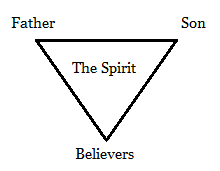
The verb me/nw (“remain, abide”) is an important Johannine keyword, occurring 40 times in the Gospel and 27 in the Letters—more than half of all the occurrences (118) in the New Testament. It has tremendous theological significance (and symbolism), even when apparently being used in an ‘ordinary’ sense in the Gospel narrative (e.g., 1:38-39). It is perhaps the single most important word which summarizes the believer’s identity in Christ; it is both (a) reciprocal, and (b) establishes us in the chain of relationship Father–Son–Believers:

    • Jesus (the Son) abides in us, and we in him, and as a result:
    • We abide in the Father and, and the Father in us
    • Father and Son both abide (together) in us through the presence of the Spirit
      This unifying presence (of the Spirit) may be illustrated by the simple diagram:

An important aspect of the verb me/nw is idea of remaining—this relationship between Father, Son and Believer, through the Spirit, remains and continues “into the Age”. The traditional eschatological image of divine/eternal Life, which the righteous are though to receive following the Judgment, is “realized” and experienced by believers now, in the present, and will continue on into eternity. This is a fundamental aspect of Johannine thought, expressed many times by Jesus in the Gospel Discourses.

It is interesting to consider how this Christian identity, marked by the twin themes of trust/faith and love, is presented throughout this section. I offer the following (chiastic) outline:

    • Trust: Confession of Jesus’ identity—the Son of God, sent by the Father (vv. 14-15
      —God’s love for us—sending his Son to us (v. 16a, also v. 14)
      ——His love abides/remains in us, completing/perfecting us (vv. 16b-18)
      —God’s love for us—we follow his (and the Son’s) example (v. 19)
    • Love: Demonstration of love for one another [among believers] (vv. 20-21)

The “command” (e)ntolh/) given to us by God is here defined primarily by the second aspect, love—both God’s love for us and our love for one another. This is a uniquely Johannine expression of the great “Love command” in early Christian and Gospel tradition. In this regard, it is worth emphasizing again the distinctive use (and meaning) of the word e)ntolh/ in the Gospel and Letters of John, which is best understood by the literal (fundamental) meaning as something given to us (i.e. laid on us) to complete. Here this “completion” has a dual meaning—not only our completion of the duty/mission to love one another, but of God’s love being completed in us. This is at the heart of the passage, in vv. 16b-18 (cf. above):

    • “In this our love has been made complete [tetelei/wtai]…” (v. 17)
    • “…complete [telei/a] love casts out fear…the (one) fearing has not been made complete [tetelei/wtai] in love.” (v. 18)

Note the precise parallelism:

    • our love has been made complete
    • we have been made complete in love

This is the truest and deepest sense of the word e)ntolh/.

Special Note on 1 John 4:3

Special Note on 1 John 4:3

As indicated in the most recent note in this word-study series (“…Spirit and Life”), there is a famous text-critical question in 1 Jn 4:3. It is unusual in that the majority reading is found in the entire Greek manuscript tradition, as well as nearly all versions, and yet the minority reading is still thought to be original by a number of scholars. Here is a translation of the verse with the variation unit marked by braces:

“…and every spirit which { } Yeshua is not out of [i.e. from] God; and this is the (spirit) th(at is) against the Anointed [a)nti/xristo$], of which you have heard that it comes, and now is already in the world.”

The first italicized phrase characterizes this “spirit” which is subsequently identified as being “against the Anointed (One)”. Let us examine the verb which is at the point of variation:

    • The majority reading:
      pa=n pneu=ma o^ mh\ o(mologei= to\n Ihsou=n
      “every spirit which does not give common account [i.e. confess] (regarding) Yeshua…”
    • The minority reading:
      pa=n pneu=ma o^ lu/ei to\n Ihsou=n
      “every spirit which looses Yeshua…”

As indicated above, the majority reading is found in every Greek manuscript (and lectionary), as well as nearly all the versions, and in most of the Church Fathers who cite the passage. The minority reading, by contrast, has very limited attestation. Indeed, the Greek (manuscript) evidence is limited to the margin of the 10th century MS 1739, where it is noted that the verb lu/ei is the reading known by Irenaeus, Clement of Alexandria, and Origen in the late 2nd century. That Irenaeus and Origen knew (and cited) this reading is confirmed, but only in Latin translation, by Against Heresies III.16.5, 8 and Origen’s Commentary on Matthew (§65 [PG] of the books/portions preserved only in Latin). The Latin equivalent of lu/ei to\n Ihsou=n (solvit Iesum) is also cited by Tertullian (Against Marcion 5:16), Priscillian (Tract 1:31), and other Church Fathers, as well as in a number of Old Latin and Vulgate MSS. The earliest surviving citation of the actual Greek would seem to be by the 5th century historian Socrates (Church History 7:32).

On the basis of the overwhelming textual evidence, most commentators accept the majority reading as original, though some scholars prefer the minority text as the lectio difficilior (on the principle that the “more difficult reading” is more likely to be original). If secondary, it is hard to explain how the verb lu/ei would have been introduced in place of mh\ o(mologei=. On the other hand, mh\ o(mologei= is grammatically peculiar enough that its presence in the entire Greek manuscript tradition, substituted throughout in place of lu/ei, seems most unlikely. Which ever direction the change took place, it probably occurred as an explanatory gloss, perhaps as a marginal reading such as we see in the Greek MS 1739. The reading lu/ei to\n Ihsou=n (solvit Iesum, “looses Yeshua”) is cited in the 2nd-3rd centuries—by Irenaeus, Origen, Tertullian (and, presumably, Clement of Alexandria)—in relation to the Christological controversies of the time. This increases the likelihood that the reading was introduced, perhaps intentionally, in order to defend an orthodox (or proto-orthodox) Christology against certain “Gnostic” views which separated the man Jesus from the divine Christ. According to such an interpretation, the (variant reading of) 1 John 4:3 was cited to demonstrate that anyone who “separated” Jesus in this way was, in effect, denying him; certainly such a person was not giving account (i.e. confessing) as one (with the orthodox believers) the proper view of Christ.

But is this anything like what the author of the letter had in mind? Let us consider for a moment what the variant reading lu/ei might have meant for the author if original. The verb means “loos(en)”, and can be used: (1) in this general, fundamental sense; (2) of loosening a bond in the sense of freeing or releasing a person; (3) in the negative sense of “dissolve” (i.e. destroy). It occurs 7 times in the Gospel and Letters of John, more or less in each of these three senses:

    1. The basic meaning of “loosen” (Jn 1:27)
    2. The positive sense of freeing or releasing a person (Jn 11:44)
    3. The negative sense of dissolving/destroying something (Jn 2:19; 1 Jn 3:8)
      To this may be added a special usage (3a) related to the observance of the commands, etc. in the Law (Torah). To “loosen” observance of the Law means essentially to nullify its binding authority (Jn 5:18; 7:23; cf. also 10:35).

The context of 1 John 4:3 is decidedly negative, which suggests that something like meaning 3 above would be intended. The closest parallel is found in the Temple-saying by Jesus in Jn 2:19:

“Loose [i.e. dissolve] this shrine, and in three days I will raise it (again).”

The Gospel writer in verse 21 makes clear that the sanctuary, or Temple building, of which Jesus spoke was his own body. This association is not too far removed from false view of Jesus in 1 Jn 4:2-3. As verse 2 speaks of confessing that Jesus is the Anointed One who has come in the flesh—i.e., as a real flesh-and-blood human being—the contrary message or belief in verse 3 would deny this. In effect, such a “spirit” would dissolve or destroy the body of Jesus, perhaps in the less concrete sense of denying or nullifying its importance for believers (cf. the parallel in Jn 5:18; 7:23).

Of course, if the majority text is original, the question is moot. The author in verse 3 simply negates the (orthodox) view of Christ in verse 2: the different “spirit” does not agree that Jesus is the Anointed One who has come in the flesh.

For several citations and points above, I have relied upon the detailed discussion by Bart Ehrman in The Orthodox Corruption of Scripture: The Effect of Early Christological Controversies on the Text of the New Testament (Oxford: 1993), pp. 125-35. He presents strong arguments in favor of the Majority text of 1 Jn 4:3.

“…Spirit and Life”: 1 John 4:1-6

1 John 4:1-6

There is a shift in the letter of 1 John, beginning in chapter 4. Previously, the theme of love for one another was emphasized in chaps. 2-3; now, that of faith in Christ comes more clearly into view. These represent the two aspects of the two-fold “command” defined in 3:23 (for more on this, cf. the previous note). This shift is marked by the sudden and striking wording in 4:1:

“Loved (one)s, you must not trust every spirit, but consider the spirits (carefully)—if they are out of [i.e. from] God (or not)—(in) that [i.e. because] many false foretellers [i.e. prophets] have gone out into the world.”

This use of the word pneu=ma (“spirit”) follows upon the closing words of the previous section (3:24): “…out of the Spirit which he gave to us”. Thus there is a clear contrast between the Spirit (of God and Christ) given to believers, and other “spirits” in the world. Are these to be understood as spiritual beings or in a more abstract sense, i.e. representing generally views, ideas, teachings, etc, which are contrary to God and the truth? Most likely, the author has the former in mind. The reference to “false foretellers [i.e. prophets]” suggests that these other “spirits” are entities which inspire the false prophets just as the Spirit of God inspires and teaches believers in Christ. If so, then this marks the only portion of either the Gospel or Letters of John where the word pneu=ma refers to false or evil “spirits”.

The context indicates that these “false prophets” are people who claim to be Christians, speaking in the name of Christ and in the Spirit, but who are not true believers and actually speak against Christ and thus speak from a different “spirit”. This section (4:1-6) must be read in light of the earlier passage in 2:18-25, where the word an)ti/xristo$ is introduced, which literally means “against (the) Anointed”, and which has been preserved as a transliteration in the English “Antichrist”. We are accustomed to think of “Antichrist” as a grandiose end-time ruler, based on passages such as 2 Thess 2:1-12 and Rev 13-17; notably, however, the word an)ti/xristo$ does not appear in such passages, but only in the letters of John, where it has a quite different denotation.

It is clear in 1 Jn 2:18ff that the “antichrists” are to be identified with supposed believers who have “gone out from us”—i.e., from the Community/congregations (of true, faithful believers) with whom the author considers himself to belong. This identification with the Community is clearly stated in verse 19 (note the wordplay involving the preposition e)k, “out of”):

“They went out of [i.e. away from] us, but they were not out of [i.e. belonging to] us; for if they (had) been out of [i.e. belonging to] us, they would have remained with us, but (they left so) that it might be made to shine forth [i.e. be revealed] that they all are not out [i.e. belonging to] us.”

In conventional religious terminology, we would say that these were separatist Christians—i.e., those who separated from the ‘mainstream’ Johannine congregations, and, we may assume, had a somewhat different theological (and Christological) outlook. The false (“lying”) message referenced in 2:21-22 and 4:1ff is described as a)nti/xristo$ (“against the Anointed”, 2:18, 22; 4:3, also 2 Jn 7). As such, it clearly relates to Jesus’ own identity as “the Anointed (One)”, which, in the Gospel tradition, at a very early point, was closely connected with the title “Son of God”. These two titles, taken together, were part of a confessional statement among Johannine believers, as indicated by passages such as Jn 1:34; 11:27; 20:31, and 1 Jn 1:3; 3:23; 5:20, etc. It is noteworthy that they are part of the foundational “command” in 3:23: “…that we should trust in the name of His Son Yeshua (the) Anointed” (cf. the previous note). Consider the way the names/titles are combined:

    • His Son [i.e. Son of God]
      —Yeshua/Jesus
    • The Anointed One

The titles are clearly parallel, and, in many ways, equivalent. But what, exactly, was meant by them? The history of Christology provides countless examples of how believers can declare Jesus to be the “Anointed One” (Messiah/Christ) or “Son of God”, and yet each mean something slightly different. For the author of 1 John, the “antichrists” and “false prophets”, who separated from the Community, declare a different view of Jesus than he (and his Community) holds. This is stated in both of the passages under consideration:

    • “Who is the false (speaker) if not the (one) denying that Yeshua is the Anointed (One)? This is the (one who is) against the Anointed [a)nti/xristo$], the (one) denying the Father and the Son.” (2:22)
    • “Every spirit which gives account as one [i.e. confesses together] (that) Yeshua (the) Anointed has come in the flesh is out of [i.e. from] God.
      And every spirit which does not give (this) account as one [i.e. confess together] (about) Yeshua is not out of [i.e. from] God—and this is the (spirit) th(at is) against the Anointed [a)nti/xristo$]…” (4:2-3, cf. the similar statement in 2 Jn 7)

The implication would seem to be that the one who speaks falsely about Jesus’ identity is inspired by a false/lying spirit—and that both speaker and spirit are characterized as “against the Anointed” (a)nti/xristo$). Two distinct “false” statements regarding Jesus’ identity are indicated:

    • Jesus is not the Anointed One
    • Jesus, the Anointed One, has not come in the flesh

It is possible that these could represent the purported views of different groups or leaders. The second statement is much more precise, and suggests a kind of “docetic” view of Christ—that he did not come to earth as a true flesh-and-blood human being, or that his humanity needs to be qualified in some way. Yet, as there is a wide range of such views in early Christianity, we cannot be certain just what Christological belief these Johannine opponents or “separatists” held. Greater clarity can perhaps be provided from 5:6-12, which will be discussed in an upcoming note. The famous variant reading in 4:3 could conceivably shed light on the context; I discuss this in a separate note.

Regardless of the specific Christological view characterized as “against the Anointed”, it is clear that the author (and the congregations he represents) identifies himself, along with all true believers, as possessing the Spirit of God (and Christ), rather than the false/lying spirit(s) of the ‘separatists’, as indicated in verse 6:

“We are out of [i.e. from] God, (and) the (one) knowing God hears us, (while) the (one) who is not out of [i.e. from] God does not hear us. Out of [i.e. from] this we know the Spirit of Truth and the spirit of error [lit. straying].”

According to tradition, the author of the letter is the Apostle John, one of Jesus’ close disciples, and, we must assume, among those addressed in the Last Discourse (Jn 13:31-16:33; chap. 17) and in the commission of Jn 20:21-23. This would give added weight to the idea of other believers hearing an Apostolic voice who represents Jesus for the congregations under his leadership. However, even if the traditional identification of authorship is not correct, the same authority would apply to the Community as a whole (i.e. “hearing us“)—all true believers who possessed the Spirit of God and Christ. According to the view of the author, one who separates from the Community of (true) believers, and proclaims a different (i.e. “false”) message regarding Jesus Christ, possesses a different “spirit”. Here in verse 6, the second occurrence of the word pneu=ma seems to be used in a more abstract sense—i.e., “the spirit of straying” (to\ pneu=ma th=$ pla/nh$). It could still refer to a spiritual entity, an evil/sinning spirit who leads would-be believers away from the true path. A pla/no$ is one who wanders about, straying from a path; figuratively, it can refer to one who is deceived/deluded or who misleads others. For the expression “Spirit of Truth” as a title for the Holy Spirit, the Spirit of God and Christ, cf. John 14:17; 15:26; 16:13, and 1 Jn 5:6. There is a similar dualistic distinction between the “spirit of truth” and “spirit of falsehood” in the “Two Spirits” section of the Qumran ‘Community Rule’ text (1QS 3:13-4:26).

“…Spirit and Life”: 1 John 3:24

1 John 3:24

The section 3:11-24 (cf. the previous note on vv. 14-15) concludes with a declaration in verse 23 which is the clearest and most explicit definition on what the author means by the word e)ntolh/ (usually translated “commandment”), and it is quite different from what we typically think of by “commandment”. Consider the final statement in verse 24 (temporarily translating e)ntolh/ as “commandment”), along with the earlier one in v. 22:

“…whatever we might ask (for) we receive from Him, (in) that [i.e. because] we keep His commandments and we do the (thing)s acceptable in His sight.” (v. 22)

“And the (one) keeping His commandments remains in Him and He in him…” (v. 24)

Taking these statements out of context, one might think that the author is referring either to the directives, etc, from the Old Testament Law (Torah), or to teaching of Jesus such as that brought together in the Sermon on the Mount. Yet, as I have argued in other notes and articles, a careful study of both the Gospel and the Letters shows that neither of these conventional views is correct. Indeed, here, in the intervening verse 23, we see definitively what the author (and Johannine theology) understands by the word e)ntolh/:

“And this is His e)ntolh/: that
—we should trust in the name of his Son Yeshua (the) Anointed, and
—we should love (each) other”

In a technical sense, there is only one “commandment”—a two-fold command—for believers. All religious and ethical behavior stems entirely from these. It is both God the Father’s command, and Jesus’ own command; this is indicated by the structure of the verse:

    • This is His [i.e. God the Father’s] e)ntolh/
      —trust in the name of his Son…
      —love one another
    • even as he [i.e. Jesus] gave (the) en)tolh/ to us

Literally, the word e)ntolh/ refers to something (i.e. a charge/duty/mission) placed on someone to complete. In the case of Jesus himself, the e)ntolh/ he was given by the Father (i.e. the mission/duty to complete) involved his entire ministry on earth, including everything he said and did, culminating in his sacrificial death. This is made clear at a number of points in the Gospel, including his dying word on the cross (Jn 19:30): tete/lestai (“It has been completed”). For believers, the e)ntolh/ similarly involves completing the mission, etc, which Jesus gives, following his own example. This also culminates in an act (or in acts) of sacrificial love—we must be willing to lay down our own life, just as Jesus did. The reciprocal and imitative nature of this mission is indicated by Jesus’ words to his disciples after the resurrection:

“Even as the Father has se(n)t me forth, I also send you.” (20:21)

This charge, or duty, is summarized here in 1 John 3:23: (1) trust in Jesus, and (2) love for one another. The author has already discussed true love in chapters 2-3, and will begin to deal more extensively with the question of true faith/trust in chapter 4, as we shall see. Then, as now, to say that one trusts or believes in Jesus can connote many different things. Johannine theology—or, we might say, Christology—in both the Gospel and Letters begins to define trust in Jesus rather more sharply than we find elsewhere in the New Testament. Many commentators would see this development as the beginnings of early Christian orthodoxy (or proto-orthodoxy).

With this understanding of the word e)ntolh/ in mind, let us return to the closing statement in verse 24:

“And the (one) keeping/guarding His e)ntolai/ remains in Him, and He in him; and in this we know that we remain in Him—out of the Spirit which He gave to us.”

I have capitalized the ‘divine’ pronoun (He/His/Him) to distinguish it from the pronoun referring to the believer. However, there is ambiguity as to whether this pronoun refers to Jesus or God the Father, or both. Almost certainly, the latter is intended, in light of the statement by Jesus in John 14:23-24—Jesus (the Son) and God (the Father) both come to abide in the believer, through the presence of the Spirit (vv. 16-17, etc). It is hard to imagine the author of the Letter holding a different view. That the dwelling of Father and Son is through the Spirit is clear from the final words of 1 John 3:24—”…the Spirit which He gave to us”. The preposition e)k (“out of, from”) is frequently used in the Gospel and Letter to indicate source—i.e., that which comes out of God. The Spirit represents the Divine presence—both Father and Son together—and the Life which we possess as a result of this union in us.

“…Spirit and Life”: 1 John 3:14-15

1 John 3:14-15

Verse 11 of chapter 3 begins a new section of the letter, which continues on through verse 24. The theme is clear from the initial statement in verse 11:

“(And it is) that this is the message which you heard from the beginning: that we should love (each) other.”

In 2:8, the author treats the directive to love as a new command (cf. John 13:34), while here he describes it as something which believers have heard “from the beginning”. This builds on the play between “old” and “new” in 2:7ff—the two-fold command to trust in Jesus and to love one another (3:23-24) is both old and new. This may be understood in many ways; certainly for the early (Jewish) believers, faith in Christ and love for one’s neighbor could be viewed as a fulfillment of the Old Law (Torah), cf. Romans 10:4; 13:10, etc. It is also something which believers have been taught from the very beginning (i.e. since they first heard the Gospel message). Yet, it continues to be restated and presented anew in the life of each community and to each generation of believers. The very thrust of 2:7-11, and again here in 3:11-24, suggests that there may have been Christians who were not truly living out the directive to love. Indeed, this would appear to be at the heart of the author’s polemic in the letter (which takes on prominence in 4:1ff), marking those who have separated from the Community as being without the proper love (for the Community).

The rivalry between the world and believers in Jesus, as also between “true” and “false” believers, is indicated clearly by verses 12-13, where the ancient example of Cain and Abel is introduced. Here is an illustration of someone hating his brother—just the opposite of love. This hate leads to murder, and the author, along the lines of Jesus’ teaching in the Antitheses of the Sermon on the Mount (Matt 5:21-26), equates hate with murder/manslaughter, even if no actual killing occurs. This hatred of one’s brother is further equated with the world’s hatred of believers (v. 13). In verses 14-15, this conflict is defined in terms of the dualistic contrast between life (zwh/) and death (qa/nato$):

“We have seen [i.e. known] that we have stepped across, out of death (and) into life, (in) that we love the brothers; the (one) not loving remains in death.” (v. 14)

The verb metabai/nw specifically means “step across”, with the preposition meta/ indicating a change of place or position (lit. within [a boundary]), i.e. from one point to the next—in this case from death to life. The same language and imagery is found in the Johannine discourses of Jesus (Jn 5:24):

“Amen, amen, I relate to you that the (one) hearing my word/account [lo/go$], and trusting in the (one) sending me, holds (the) Life of the Age [i.e. eternal life] and does not come into (the) Judgment, but has stepped across out of death (and) into Life.”

This fits the motif of resurrection—of the dead hearing the voice of the Son (of God)—in John 5:19-29. In vv. 24-25, the end-time resurrection is given a new interpretation (i.e. “realized” eschatology) for believers in Christ, and it is this spiritual sense of resurrection that we find also in First John. The “Life of the Age” is defined more generally as “Life”, i.e. in Christ, and in the Spirit. The opposite of 3:14 is stated in verse 15, continuing the dualistic contrast (Abel/Cain, love/hate, life/death):

“Every one hating his brother is a man-killer [a)nqrwpokto/no$], and we have seen [i.e. known] that every man-killer does not hold [i.e. have] the Life of the Age remaining [i.e. abiding] in him.”

This statement follows the fundamental ethnical-religious principle that a murderer (who in the law would be put to death) will surely not pass through the Judgment and inherit eternal life (cf. Exod 20:13; Num 35:16ff; Matt 5:21ff; Rom 1:29ff; 1 Cor 6:9-10; Gal 5:19-21, etc). Hatred toward one’s brother (i.e. toward a fellow believer) is regarded as the equivalent of murder or manslaughter. We must understand that, for the author, “hating” (vb. mise/w) does necessarily require the kind of overt ill-feeling and hostility usually associated with the word. It is better defined here as the absence/opposite of the true love which believers ought to have toward one another. The nature of this love is clear from verse 16 (following Jesus’ words in 13:14-15, 34-35; 15:12-17)—it entails following Jesus’ own example of sacrificial love, laying down one’s own life for another.

Moreover, it is clear that, the one who fails to love violates the fundamental ‘command’ of Christ (and God the Father), and is thus sinning. And, according the theology in the letter, any one who sins this way has not been “born of God”, and possesses neither the living Word nor the Spirit of God. The significance of this for the remainder of the letter is indicated by verses 23-24, where the command to love is linked to the command to trust in Jesus—i.e. the two-fold command which governs all true believers. This will be discussed further, in the next note.

“…Spirit and Life”: 1 John 2:25

1 John 2:25

In the previous note on 1 John 1:1-2, we examined the use of the expression a)p’ a)rxh=$ (“from the beginning”) in the opening words, noting the parallels with the Prologue to the Gospel (John 1:1ff). I pointed out that the “word” (lo/go$) in the first verse of the Letter (the expression “the Word of Life” [o( lo/go$ th=$ zwh=$]) is to be understood and carrying a dual meaning:

    1. the Living Word of God (identified with Jesus), and
    2. the word/account of Jesus (i.e. the Gospel message).

It so happens that there is a similar double-meaning to the expression “from the beginning [a)p’ a)rxh=$]”, which occurs seven more times in the letter (2:7, 13-14, 24 [twice]; 3:8, 11), and twice more in 2 John 5-6. The word a)rxh/ (“beginning, first, leading”) does not appear in the Johannine letters apart from this expression.

In 2:7, which begins a section of exhortation and instruction (vv. 7-17), the author says:

“Loved (one)s, (it is) not (about something) new laid on (you) to complete (that) I write to you, but (about something) old laid on (you) to complete, which you hold from the beginning [a)p’ a)rxh=$]—th(is) ‘old’ (charge) laid on (you) to complete is the word [lo/go$] which you heard.”

He goes on to write:

“(But) again, I (do) write to you (about) a new (charge) laid on (you) to complete—which is true in him and in you—(in) that the darkness is leading [i.e. passing] along and the true Light already shines.” (v. 8)

I have translated the word e)ntolh/ here in an excessively literal manner, according to its fundamental meaning, rather than with the customary “command(ment)”, which can be quite misleading in the context of the Johannine writings. We are not dealing with a specific set of religious or ethical “commands”—certainly not of the Old Testament Law (Torah), nor even a collection of Jesus’ teaching such as we find in the Sermon on the Mount. A careful reading of both the Gospel and the Letters makes clear that there are really only two commands as such: (1) trust in Jesus as the Anointed One and divine Son sent by God, and (2) love for one another, following Jesus’ example. The author states this specifically in 3:23-24.

Moreover, it is clear from vv. 9ff, that the new ‘command’ in 2:8 is the command to love one another, which Jesus gave to his disciples in Jn 13:34-35. What, then, is the old ‘command’? As the author identifies this in v. 7 with “that which you hold/held from the beginning”, we must conclude that it is essentially equivalent to the first ‘command’ in 3:23—namely, trust in Jesus Christ as God’s Son. Both of these ‘commands’—trust in Jesus and love for fellow believers—are the tests by which the author (and, we must assume, the communities/churches he represents) defines one’s identity as a true Christian. The emphasis in 2:7ff suggests that there may have been Christians in the Johannine churches, or known to them, who demonstrated a true faith in Christ but were perhaps not exhibiting true love. At any rate, this is the thrust of the exhortation (and warning) in 2:9-11.

We see, then, that in 2:7ff, the expression “from the beginning” refers not to eternity and the beginning of Creation (as in John 1:1), but rather to the beginning of believers’ trust in Jesus, and subsequent new/spiritual “birth” as children of God. In particular, the context is of the word (lo/go$) heard from the beginning, which I take to mean primarily the Gospel message (i.e. truth about Jesus), but also the presence and work of the Spirit which teaches believers the truth, and continues Jesus’ own work. In 2:13-14, this is defined in terms of knowledge of God the Father (and Jesus the Son):

“…you have known the (one) from the beginning…

This is probably best understood as “the (one who is) from the beginning”, returning to the context of John 1:1ff and 1 John 1:1-2. It is also likely that there is some wordplay involved; at least the syntax here is slightly ambiguous. What is clear, however, from the remainder of the letter, is that true knowledge is more or less synonymous with proper/correct belief in Jesus (cf. John 17:3, etc)—i.e. just what is meant in saying that he is the Anointed One (Messiah) and Son of God.

When we turn to 2:24-25, we find the author once again reflecting the language and thought of the discourses of Jesus from the Gospel (note esp. the use of the verb me/nw, “remain, abide”):

“(That) which you heard from the beginning, you must (let/have) it remain [mene/tw] in you. If (that) which you heard from the beginning should remain [mei/nh|] in you, (then) you also will remain in the Son and in the Father.” (v. 24)

The exact reference of “that which you heard from the beginning” is again somewhat ambiguous. Primarily, it refers to the Gospel message (i.e. the truth) about Jesus; yet, the use of me/nw indicates something deeper as well—the abiding presence of Jesus (the Living Word), both through the Spirit and also the love which fills and works in the believer. The association with the Spirit (as the abiding presence of Christ) is confirmed by what follows in vv. 26-27, referring to the “anointing” (xri/sma) which remains/abides in the true believer.

The author concludes the thought from v. 24 in verse 25:

“And this is the message which he presented as a message [i.e. announced] to us: the Life of the Age.”

The noun e)paggeli/a is rather difficult to translate literally in English. The fundamental meaning of the verb a)gge/llw is “give a message, report, declare”. The prefixed preposition e)pi/ is an intensive, emphasizing a message/report about something or upon a subject, etc. Used in the sense of a declaration, it can refer specifically to something one offers or promises to do. The latter connotation typically applies to the noun e)paggeli/a in the New Testament, and is often translated as “promise”. Again, it is wise to translate as literally as possible, preserving the fundamental meaning, recognizing that it can be understood here on two levels: (1) the message of the Gospel (about Jesus) given to us, and (2) what God has declared or promised to us. With regard to the latter, it is important to note that the noun e)paggeli/a (with the verb e)page/llw) is specifically associated with the Spirit in a number of passages, including Luke 24:49; Acts 1:4; 2:33ff; Gal 3:14ff; Eph 1:13; cf. also Rom 9:8; Gal 4:23ff.

On the one hand, according to the traditional background of the expression “Life of the Age”, verse 25 simply asserts the (eschatological) promise of eternal life for the believer. However, as we have seen in the earlier notes in this series, the discourses of Jesus (and the Gospel as a whole), reflect a “realized” eschatology—believers experience the reality of the divine/eternal Life already in the present, through trust in Jesus and the presence of the Spirit. The author of the Letter certainly shares this basic outlook, and expresses it in his use of “Life” and “Life of the Age” elsewhere in the letter, such as in 3:14-15, the passage we will examine in the next note.

“…Spirit and Life”: 1 John 1:1-2

The Johannine Letters (1 John)

In this series, we now turn to the Letters of John, to see how the words “Spirit” (pneu=ma) and “Life” (zwh/) are used in these other Johannine writings. Many commentators believe that both the Gospel and the Letters (esp. the First Letter) may be written by the same author. Tradition does ascribe them to the same person (John the Apostle), though technically the works are anonymous. At the very least, it is clear that the Gospel and First Letter draw upon similar language and imagery, sharing the same basic theological (and Christological) point of view. Critical commentators have typically explained this by way of a Johannine Community or “School”. Both tradition and internal factors have led many scholars to see these writings (along with the book of Revelation) as being the product of distinct Christian communities in Asia Minor (centered around Ephesus).

An especially complex critical issue lies in the fact that the Johannine discourses (indicated as being spoken by Jesus) and the Letters of John (esp. 1 John) are often so close in thought and wording. Many passages in 1 John could have been lifted right out of the discourses. This raises the question as to the Gospel writer’s role in the creation/composition of the discourses. Most critical scholars would view the discourses as largely the product of the author, while traditional-conservative commentators, naturally enough, are more inclined to seem them as reflecting the actual words of Jesus (with some amount of translation and editing allowed). The situation is akin to that of the Sermon-Speeches in the book of Acts—though they are said to be spoken by different persons (and even in different languages?), much of the actual (Greek) language and wording seems to reflect that of the author of Luke-Acts. For more on this latter question, see my earlier series on the Speeches of Acts.

The words pneu=ma (“spirit”) and zwh/ (“life”) occur only in the First Letter, thus the discussion will generally be limited to that writing. The second and third Letters will be referenced only to give supplemental information, or to help clarify an idea or expression in 1 John. The relevant passages to be discussed are:

1 John 1:1-2

The first two occurrences of the word zwh/ (“life”) come from the introductory sentence of the Letter (vv. 1-3a), which, as even a casual reading should make clear, is similar in thought and expression to the opening of the Gospel Prologue (1:1-4ff). This is only confirmed by a study of the Greek words and phrases involved. Consider the opening words of the letter:

“That which was from the beginning…”
o^ h@n a)p’ a)rxh=$

A comparison with John 1:1 suggests that here the demonstrative pronoun o%$ refers to the “Word” (lo/go$) indicated in the opening of the Prologue:

“In the beginning was the Word…”
e)n a)rxh=| h@n o( lo/go$

The combination of the word a)rxh/ (“beginning”), reflecting Genesis 1:1 [LXX], with the verb of being (ei)mi, the spec. form h@n, “was”), makes it likely that the author of the letter had the Gospel Prologue (or a similar tradition) in mind. The distinctive use of the verb of being in the Prologue (and elsewhere in the Gospel) is theological—referring to God as source of all being and existence.

However, the fact that a neuter form of the demonstrative pronoun (o%) appears at the start of 1 John, indicates that the reference is more generalized and comprehensive—i.e. “(all) that which…”—that is to say, both to the Living Word (Lo/go$) of God, identified with Jesus, and to the “word” or account (lo/go$) of Jesus (i.e. the Gospel message). This dual-meaning of lo/go$ appears a number of times in the letter, beginning here in v. 1 (cf. below).

Before proceeding to examine several key words and phrases, here is the opening sentence of vv. 1-3a in translation:

“(That) which was from the beginning, which we have heard, which our eyes have seen (clearly), which we have looked (upon), and (which) our hands have felt, about the word of Life—and th(is) Life was made to shine forth, and we have seen (it clearly) and give witness and give up as a message to you the Life of the Age(s) which was toward the Father and made to shine forth to us—(that) which we have seen (clearly) and have heard, we also give up as a message to you, (so) that you also might also hold common (bond) with us.”

Despite the repetitiveness in much of this statement (preserved accurately above), the basic idea is clear enough, and it is fully in accord with the outlook of the Gospel writer; note the conceptual structure:

    • The Word which was from the beginning (i.e. with God the Father)
    • This Word was made to shine forth to us (in the person of Jesus)
    • (1) We have seen/heard/felt this (incarnate) Word
      (2) and we, in turn, give witness about it to others
    • This witness is the word of the (Gospel) message

At the very center of this statement is the expression “Word of Life” (o( lo/go$ th=$ zwh=$), which, as I indicated above, has a dual-meaning: (a) Jesus as the Living Word of God (and source of Life), and (b) the message (word/account) regarding Jesus, which will lead to Life for those who trust in him. In the Gospel, the noun zwh/ virtually always refers to the Life which God possesses (i.e. divine, eternal Life), and which is given to believers through Jesus. Just as God the Father’s word and voice gives life to all things (Gen 1:3ff; cf. also Psalm 119:25, 107, etc), so that of the Son (Jesus) gives this same life (Jn 1:3-4; 5:24-29; 6:63; 11:43, etc).

Verse 2 is essentially a parenthesis which explains this Life; there appears to be a loose chiastic structure to its logic:

    • This Life (i.e. the divine/eternal Life)
      —Manifest to us (in the person of Jesus)
      ——We have seen it
      ——We give witness/message of it
      —Manifest to us (through Jesus’ gift)
    • The Life which was with [lit. toward] God

The closing reference to Life uses the expression “Life of the Age”, which appears repeatedly in the Gospel, and which I have discussed at length in earlier notes. It typically refers to the Life given by Jesus to believers, which is also identified numerous times in the Gospel with the Spirit. This same association may be intended here, though the actual word pneu=ma does not occur until chapter 3 of the letter.

If there were any doubt regarding the connection between John 1:1-3 and vv. 1-3 here in the letter, there is added confirmation in the fact that in verses 5ff light is introduced as a thematic motif, just as it is in vv. 4-5ff of the Gospel Prologue. The theme includes the same dualistic light vs. darkness contrast. This may help to explain the interesting use of the preposition pro/$ in Jn 1:1-2 and 1 Jn 1:2. It is typically translated “with”—i.e. the Word was with God—but properly it indicates direction or location, i.e. of motion toward something, or facing toward (i.e. before, in front of) something. Presumably the latter is intended here—the Living Word facing toward God the Father. This would seem to be confirmed by the close association with light-imagery and use of the verb fanero/w (“shine [forth]”). Christ the Son and Living Word of God faces the Father and is (perfect) reflection of the Father’s Light, etc. That same Light is then made to shine forth to believers.