March 3: 2 Corinthians 3:18; 4:6

[This is the final note in the series on 2 Corinthians 3, supplemental to the current exegetical study series “Spiritualism and the New Testament”; the previous note concluded our discussion on 4:3-6; for an overview of the passage, cf. the main article.]

CONCLUSION (2 Cor 3:18; 4:6)

Following our discussion in the previous note, we shall now consider how Paul understands the seeing of God by believers. The focus will remain on the statements in 3:18 and 4:6 in light of Paul’s line of argument and exposition throughout the passage (2:14-4:6). Mention was made of the juxtaposition of the seeing/image motif with the fundamental idea of the believer’s encounter with God taking place spiritually, at the level of the Spirit. How, indeed, does one ‘see’ God in the Spirit?

In answering this question, we must begin with the overall context of the passage—namely, a description (and defense) of the apostolic ministry by Paul, with specific emphasis on the mission of proclaiming the Gospel. This is very much the focus in 2:14-17, and Paul returns to this point of reference at the conclusion of the passage (4:1-3); note, in particular, how 4:3 reflects the earlier wording in 2:15, as an example of the way that Paul deftly blends together the thematic strands of his discussion.

Thus, we may say that the process of ‘seeing’ God, begins with the believer receiving the Gospel of Christ. The ‘blindness’ of the world is defined specifically in terms of being unwilling (or unable) to accept the Gospel and to recognize its truth (4:3, par 3:14-15). The missionary/minister plays a vital role in bringing the light of the Gospel, at first, to the believer. Note, again, the parallel expressions used by Paul in 4:4 and 6:

    • the good message [eu)agge/lion] of the splendor of Christ //
      the knowledge [gnw=si$] of the splendor of God

The Gospel leads to the knowledge of God’s glory; for more on this parallelism, cf. the previous notes on vv. 3-6.

Once a person has received the Gospel, trusting in Jesus Christ, then he/she receives the Spirit. The locus of the Spirit’s presence within the person is usually referenced as the “heart” (kardi/a), as here in 4:6. Traditionally, the giving/sending of the Spirit by God is expressed in terms of liquid (water or oil) being poured. This would have been reinforced by the symbolism of the baptism-ritual. Paul fully embraces this imagery, referring repeatedly to believers receiving the Spirit in their hearts (Rom 5:5; 2 Cor 1:22; Gal 4:6; cf. also the context of Rom 2:29; 8:27; and here in 2 Cor 3:3ff). He does not often describe the presence and activity of the Spirit through light-imagery, but there can be little doubt that here in 4:6 the light that shines in the heart is the same as the Spirit that is poured, etc, into the heart (Rom 5:5). For a similar reference to light shining in the heart, cf. 1 Cor 4:5.

In a number of passages in his letters, Paul describes various aspects of the Spirit’s activity, in and among believers. Some of the key points may be summarized as follows:

Thus, according to Paul, the Spirit’s role within the believer covers the full range of religious experience. However, it is important to remember that the specific references to the Spirit here in 3:17-18 are fundamentally Christological—particularly in terms of our ‘seeing’ God through the Spirit. Indeed, the ‘image’ (ei)kw/n) which we see in the Spirit is Christ’s image. Paul makes explicit in 4:4 what is implied in 3:18, essentially explaining that “the same image” (th\n au)to/n ei)ko/na) which we behold—and into which we are transformed—is that of Christ as “the image of God” (ei)kw\n tou= qeou=, cf. also Col 1:15 and Rom 8:29).

What is specifically involved in this transformative beholding of the image of Christ? There are several key aspects which should be emphasized:

    • Noetic—i.e., the mind of the believer is transformed, to become like that of Christ himself. In this regard, Paul follows Philo’s application of the Moses traditions in Exod 34, even so far as his use of the mirror (ka/toptron) motif and the rare verb katoptri/zomai; cf. the discussion in the prior note. By allowing ourselves to be guiding by the Spirit within, the way we think is changed, and this leads to fundamental (ethical/moral) changes in the way we act. Cf. Rom 8:5-7; 12:2; 1 Cor 2:16; Phil 2:5; and note the context of Gal :16-25. See also the recent study in this series on 1 Cor 2:10-16.
    • Mimetic—along with the ethical transformation that comes from the renewal of our minds and allowing ourselves to be guided by the Spirit, there is the specific idea of following the example of Christ. The conscious imitation of Jesus should be viewed as a specific aspect of ‘walking in the Spirit’ (Gal 5:16, 25). Cf. Phil 2:5ff. Often Paul frames this in terms of following his own example, as he himself imitates Christ—1 Thess 1:6; 2:14; 1 Cor 11:1; 4:16; Phil 3:17.
    • Mystical Union—Paul defines the believer’s union with Christ in a very distinctive way, in terms of participation in the death and resurrection of Jesus. The key passage is Romans 6:3-4, but the idea is expressed all throughout his letters; most notably, cf. Rom 7:6; 8:2ff, 10-11ff; Gal 2:20; 5:24-25; 1 Cor 15:20-24ff, 49; 2 Cor 4:10-11; 5:14-21; Phil 1:21; 3:10-11. Paul’s association of this concept with the symbolism of the baptism ritual is quite clear; in addition to Rom 6:1-11, cf. Gal 3:26-27; Col 2:12. However, this union is realized through the presence and power of the Spirit.
    • Spiritual Union—Paul also hints at a union of the believer with God, realized through our union with Christ, in the Spirit. Cf. 1 Cor 6:17, and various allusions throughout his letters; typically, the idea is couched in terms of the future glory that awaits believers (with the resurrection).

The knowledge (gnw=si$) of God that begins with receiving the Gospel, culminates in the union of believers with God Himself (theosis). To ‘see’ God in this respect entails a conscious awareness, and a volitional (willing) exercise of our heart/mind. The greatest form of knowledge is union, illustrated by the idea of knowing fire. One can know something about fire by hearing it described; then, one can know it better by actually seeing it and feeling its warmth; it can be known even further once a person is burnt by it; however, one cannot fully know fire until one is united with it, being completed consumed by fire.

It is through Christ’s presence that we are able to ‘see’ God’s image in this way; and his presence is realized through the Spirit. Our ‘seeing’ does not take place through the eyes (or any of the senses), but is spiritual. So also our union with Christ (the Son), and so ultimately with God (the Father), is realized through the Spirit. This Christological and mystical dimension of Paul’s spiritualism is well expressed here, at the climax of his expository discourse, in 3:17-18. First, he emphasizes that “the Lord is the Spirit,” meaning that God can only be experienced through the Spirit—which is also the Spirit of His Son Jesus (Gal 4:6). This is clarified through the declaration in verse 18, which concludes emphasizing that our transformation (vb metamorfo/w) into the image of God (in Christ), takes place through the same Spirit of God— “…just as from (the) Lord (the) Spirit.”

February 22: 2 Corinthians 4:3-6 (cont.)

[These notes are part of the series “Spiritualism and the New Testament”; the previous note began the discussion on 4:3-6; for an overview of the passage, cf. the main article.]

2 Corinthians 4:3-6, continued

As part of our discussion in the previous note, we considered how Paul’s concluding statements in 4:4 and 6 help us understand the famous declaration in 3:18. In particular, he makes use of two parallel constructions, involving complex genitive-chains:

    • V. 4: “unto the…shining [vb au)ga/zw] (of)
      • the enlightenment [fwtismo/$]
        • of the good message
          • of the splendor [do/ca]
            • of the Anointed
              • who is (the) image of God“
    • V. 6: “He shone [vb la/mpw] in our hearts
      • the enlightenment [fwtismo/$]
        • of the knowledge
          • of the splendor [do/ca]
            • of God
              • in (the) face of (the) Anointed“

At the end of each genitival chain, a clause or phrase is added emphasizing that Jesus Christ reflects the glory of God. In the first instance, Jesus is called the “image” (ei)kw/n) of God, as in Col 1:15; Rom 8:29. In the context of the mirror (ka/toptron) motif in 3:18, this image certainly should be understood as a reflection of God’s own image. In the second instance, Paul again has the Moses tradition of Exod 34:29-35 in mind, the episode in which the glory of God was reflected (by way of a shining light/aura) on Moses’ face.

Like Moses, believers encounter God with faces uncovered, beholding in a mirror (katoptrizo/menoi) the glory of the Lord (3:18). This “mirror” is to be identified with the presence of Christ in the heart of the believer (“in our hearts,” 4:6). In our heart, we are able to behold directly the glory of God reflected, with perfect clarity, in the person of Christ. And, as we see, we are at the same time being transformed (metamorfou/meqa) into the same image.

This motif of light is more suitable for the experience of ‘seeing’ at the level of the Spirit. It is visible, but in a diffuse and essentially formless manner. The more abstract nature of light as an image (ei)kw/n) suggests that a deeper kind of ‘seeing’ is involved, properly represented by Paul’s use of the term gnw=si$ (“knowledge”) in 4:6. The parallel idiom of seeing/knowing is made especially convenient in Greek, since the verb ei&dw can mean both “see” and “know” almost interchangeably. The Gospel of John, in particular, makes considerable use of this dual-meaning, applying it, in a theological and Christological context, throughout the narrative. Paul is doing much the same here in our passage.

There can be little doubt that Paul has been influenced heavily by certain lines of Jewish tradition, including strands of mystical-philosophical thought and expression in Hellenistic Judaism, best seen in the writings of Philo of Alexandria and the deutero-canonical Book of Wisdom. In prior notes, I have discussed Philo’s use of the same Moses tradition (from Exod 33-34) that Paul has utilized here in 2 Cor 3:7-4:6, including use of the same rare verb katoptri/zomai and similar application of the mirror (ka/toptron) motif. Perhaps even closer to the language and thought of 3:18/4:6 is the declaration in Wisdom 7:25-26, where it is stated that Wisdom is:

“…an emanation of the splendor of the Almighty shining pure…
For it is a shining forth [a)pau/gasma] of eternal light [fw=$],
and a spotless mirror [e&soptron] of the working of God,
and (the) image [ei)kw/n] of His goodness”

The noun e&soptron refers to a glass that one “looks in(to)”, with virtually the same meaning as ka/toptron (‘looking-glass, mirror’).

All of these things stated above regarding the Divine Wisdom personified, Paul applies to the person of Christ. Just as important, the same Hellenistic Jewish traditions would identify Wisdom (and/or the Logos) with the Spirit of God (cf. Wisd 1:7; 7:7, 22; 9:17; 12:1). Philo, in particular, utilizes Moses as the paradigm for the mystical-philosophical experience of God filling the purified and enlightened soul with His Spirit. I will be discussing this further in an upcoming article in the “Ancient Parallels” feature on this site.

For Paul, of course, his understanding of the indwelling Spirit is fundamentally (and radically) different, in two respects: (1) its Christological orientation, and (2) it applies to all believers equally, regardless of one’s adeptness for mystical philosophy. To this, one may add the communal component, with Paul’s unique manner of expressing the idea of believers, collectively and united, as the “body of Christ”.

This brings us to the interpretive (and theological) question that we have slowly been addressing in these past few notes. How do believers “see” God (His glory), when the encounter takes place inwardly, and invisibly, through the Spirit? The answer to this question will go a long way, I think, toward elucidating the nature of Paul’s spiritualism. I have begun to answer the question, inductively, through the exegesis of 3:16-18 and 4:4-6 (consult the recent notes on these verses). This allows us to draw some further conclusions, and to gain a relatively clear picture of what Paul has in mind. However, in order to fill out the portrait, it will be necessary to draw upon several other passages in his letters. This we will do, in the next daily note, our final note in this series on 2 Corinthians 3.

February 20: 2 Corinthians 3:18 (concluded)

[These notes are part of the series “Spiritualism and the New Testament”; the previous note continued the discussion on verse 18; for an overview of the passage, cf. the main article.]

2 Corinthians 3:18, continued

“And we all, with uncovered face, the splendor of (the) Lord (behold)ing in a looking-glass, are transformed (into) the same image, from splendor to splendor, even as from (the) Lord (the) Spirit.”

An important question, touched on briefly in the previous note, is exactly what it means for believers to “see” the glory of God. This is important for an understanding of Paul’s spiritualism, at least as it is expressed in the current passage. If our encounter with God is spiritual, taking place at the level of the Spirit, what is the significance of the motifs of “image” (ei)kw/n) and “form” (morfh/) that Paul uses, implying a visible or physical/material shape? Before addressing this in more detail, let us proceed with an examination of the final phrases of the verse.

“from splendor to splendor”
(a)po\ do/ch$ ei)$ do/can)

This compound prepositional phrase qualifies the main statement “we are transformed (into) the same image” (cf. the discussion in the previous note). This transformation (vb metamorfo/w) takes place “from” (a)po/) glory and “into/unto” (ei)$) glory. How should we understand the two occurrences of “glory” (do/ca) as they relate to each other?

1. One possibility is that Paul is furthering the contrast between the lesser glory of the old covenant and the far greater glory of the new covenant. This is certainly the context for how the word do/ca is used in verses 7-11, and follows the overall theme of the discourse. If the preposition a)po/ is used here in the sense of “away from”, then there would be little question that the fundamental idea was of believers moving away from the fading glory of the old covenant, and into the new glory found in Christ.

2. Another option is that the phrase emphasizes the continual (and progressive) process of transformation that takes place for believers in Christ. The verbal forms katoptrizo/menoi (“[behold]ing in a looking-glass”) and metamorphou/meqa (“we are [being] transformed”) are present forms, meaning they refer to actions (or conditions) that are currently taking place, and/or are ongoing.

3. A third possibility relates to both the concept of looking into a mirror and of being transformed. As we (believers) are transformed into the image reflected in the mirror, we shift from God’s glory (that we are beholding) to our glory (into which we are transformed). There are a number of places where Paul specifically refers to the glory of believers, though usually in relation to the promise of our future resurrection—Rom 5:2; 8:18-25; 1 Cor 15:40-43; 2 Cor 4:17; Col 1:27; 3:4; cf. also 1 Cor 2:7. The image that we behold, and into which we are transformed, is, of course, Christ’s image—it is his glory that allows for us to partake in God’s glory; cf. Rom 8:29; 2 Thess 2:14.

4. Finally, one may understand the phrase primarily in a Christological sense. That is to say, we first encounter God’s glory through the glory of Christ, who is the image and reflection (as Son) of God the Father (2 Cor 4:4; Col 1:15; Rom 8:29). Thus, we proceed from the glory of Christ to the glory of God.

“even as from (the) Lord (the) Spirit”
(kaqa/per a)po\ kuri/ou pneu/mato$)

In my view, this final phrase is epexegetical; that is to say, it further explains the prior phrase. This is indicated by the use of the comparative particle kaqa/per, “very (much) as, just as, even as”. It also would seem to be confirmed by the parallel with the preposition a)po/:

    • “from splendor…” (a)po\ do/ch$…)
      “from (the) Lord…” (a)po\ kuri/ou…)

The double genitive expression kuri/ou pneu/mato$ is itself problematic. Does it represent a genitival chain, or are the nouns kur/io$ (“Lord”) and pneu=ma (“Spirit”) in apposition, both being governed by the same preposition (a)po/)? In the first instance, the phrase would be “from (the) Lord of (the) Spirit,” or “from (the) Spirit of (the) Lord,” which would match the expression in v. 17b. In the second instance, the phrase could be filled out two ways:

    • “from (the) Lord, (the) Spirit” or
    • “from (the) Lord (who is the) Spirit”

This corresponds with the statement in v. 17a, and it is to be preferred, I think. However, in my translation above, I have rendered the phrase quite literally (and flatly) as “from (the) Lord (the) Spirit”. Paul, indeed, may be attempting to combine both expressions of verse 17, relating (and identifying) “the Lord” with “the Spirit”.

In any case, the juxtaposition of the two prepositional phrases makes clear that our transformation “into glory” occurs through the Spirit. If Paul primarily has the future resurrection in mind (cf. above), then Romans 8:11 may provide a suitable parallel to his thought here:

“And if the Spirit of the (One hav)ing raised Yeshua out of the dead dwells in you, the (One hav)ing raised (the) Anointed out of the dead also will make alive your dying bodies through His Spirit dwelling in you.”

However, I do not think that the spiritual transformation described in 2 Cor 3:18 can be limited to the future resurrection. Indeed, it is possible that the two occurrences of do/ca in the prior phrase (cf. above) could be understood as a contrast between the present glory and our future glory. Both are realized through the Spirit, but the present glory is experienced inwardly, in an invisible and immaterial manner within the body. Only with the future glory (of the resurrection) will our visible/material bodies finally be transformed by the Spirit.

This brings us to the question posed at the beginning of this note: what is the manner of our “seeing” God’s glory that brings about our transformation? In what way do we “see” that which invisible, when our encounter with God takes place in and through the invisible Spirit?

To begin with, as partial answer, it is to be emphasized that the “image” (ei)kw/n) that we behold in the mirror is the image of Jesus Christ, who, as mentioned above, is the image of God. Paul states this explicitly further on at 4:4 (cp. Col 1:15). The noun ei)kw/n occurs seven other times in Paul’s letters. In Rom 1:23, there is a negative (religious) contrast between the glory (do/ca) of God and idolatrous images made by human beings (cp. Wisd 13:16; 14:15ff; 15:5). The other six references are more relevant to our passage, where the word ei)kw/n is used in two specific contexts:

Based on Col 3:10, Paul seems to understand the Gen 1:26-27 tradition primarily in a noetic sense, in terms of the mind—knowledge, understanding, and wisdom. This line of interpretation is typical of the philosophical strands of Hellenistic Judaism, represented most notably in the writings of Philo of Alexandria and the deutero-canonical Book of Wisdom (e.g., 2:23; 7:26). Elsewhere, in Old Testament and Jewish tradition, the Divine Wisdom is identified specifically with the Spirit, as the source of our human reasoning and wisdom (cf. especially Job 32:8; Wisdom 7:7, 22; 9:17).

As previously noted, the only other use of the verb metamorfo/w by Paul is in Romans 12:2, where the transformation of believers takes place through “the renewing [a)nakai/nwsi$] of the mind [nou=$]”. This suggests that our ‘seeing’ in 2 Cor 3:18 should be understood in terms of knowledge (knowing), the way we think and perceive things internally. This aspect of Paul’s spiritualism corresponds with the noetic spiritualism of Philo, for example. But what is it that we come to know, and how does it relate to our experience of God through the Spirit? We will pick up this discussion in the next daily note, as we extend our exegetical study, beyond the discourse of vv. 7-18, to the continuation of Paul’s argument in 4:1-6.

February 15: 2 Corinthians 3:18

[These notes are part of the series “Spiritualism and the New Testament”; the previous note discussed verse 17; for an overview of the passage, cf. the main article.]

2 Corinthians 3:18

“And we all, with uncovered face, the splendor of (the) Lord (behold)ing in a looking-glass, are transformed (into) the same image, from splendor to splendor, even as from (the) Lord (the) Spirit.”

This concluding verse (of the discourse in vv. 7-18) is so rich and profoundly splendid, as a statement on its own, that it is easy to read it out of context. It is important to understand it thoroughly from the standpoint of Paul’s entire line of thought and argument here in chapter 3. This is best done, I believe, by looking closely at each specific word and phrase. Because of the level of detail required by such an approach, it will be necessary for our exegesis of verse 18 to take place over several daily notes.

“And we all”
(h(mei=$ de\ pa/nte$)

The force and scope of the adverb pa=$ (“all”) here could be disputed. Given the focus in chapter 3 on Paul’s role as a minister (of the new covenant), one might be inclined to limit the sense of pa=$ here to “all of us who are ministers.” This, however, would be incorrect, ignoring, among other factors, the central theme in chaps. 1-7 of the relationship between Paul (as apostle) and the Corinthian congregations. The bond of unity between missionary and church is the Spirit—which is the same unifying bond of the new covenant itself.

Thus, when Paul says “all of us,” he means “all of us who are believers, who are united in Christ (through the Spirit)”. Paul tends to use the adverb pa=$ in such a universal, comprehensive sense. In the immediate context of 2 Corinthians, cf. 1:1; 2:3, 5, where he is referring to all believers in Corinth, or to all believers everywhere (3:2).

In terms of the discourse in vv. 7-18, there is also the important parallel between the Israelite people and believers, established in vv. 14-16; this is complementary to the similar parallel between the believer and Moses in vv. 13 and 17. The relationship between Moses and Israel (in the old covenant) is fundamentally different from the relationship between the apostolic minister (e.g., Paul) and the community of believers. It was only Moses who had a direct encounter with God, in a place from which the rest of the people were cut off. The Israelites could only experience the revelatory word and accompanying glory of God through the personal mediation of Moses. By contrast, in the new covenant, apostle and community are united and experience the word and glory of God the same way, through the Spirit, without any distinction.

“with uncovered face”
(a)nakekalumme/nw| prosw/pw|)

This is essentially a prepositional phrase, but with an absent preposition (e)n, cp. 2:10; 4:6; 5:2) implied by the use of the dative case. It is a qualifying phrase, preceding and anticipating the main clause later in the verse. The word translated “uncovered” is a verbal adjective, a passive participle of the verb a)nakalu/ptw (“uncover”), which occurs only here (and earlier in v. 14) in the New Testament. It literally means “take up the cover”, but has virtually the same sense as the more common a)pokalu/ptw (“take the cover [away] from”); both verbs essentially mean “uncover” (rel. to the base verb kalu/ptw, “cover”).

Paul’s use of the verb in verse 14 provides the key point of contrast (cf. the discussion in the earlier note): Israelites and Jews, as a whole, have a “covering” (ka/lumma) over them, since they continue to operate under the old covenant (palaia/ diaqh/kh), not realizing that in Christ the old covenant has ceased to be operative (vb katarge/w), replaced by a new covenant (kainh/ diaqh/kh, v. 6). We should pay attention to Paul’s exact wording:

“…the same covering…[of the old covenant] remains, not being uncovered, that in (the) Anointed {Christ} is made inactive”

The expression “the same covering” is a way for Paul to apply the tradition of the veil over Moses’ face to the Israel/Jewish people as a whole. He places them in a congregational setting, implying worship in the synagogue, when the Torah (= the Scriptures) of the old covenant is read out. The parallel with Christian congregations (of the new covenant) is obvious.

Paul uses the same participle, but the use of the negative particle (mh/) emphasizes the point of contrast between the old and new covenant:

    • “not being uncovered” (mh\ a)nakalupto/menon) [v. 14]
    • “having been uncovered” (a)nakekalumme/nw|) [v. 18]

There are other subtle differences in how Paul uses the verb. Both participles are neuter, but they have different subjects, with distinct points of reference. In verse 14, the subject is the covering (ka/lumma) itself, and the participle has true verbal force. When the covering is taken away, then the person realizes that the old covenant is no longer in effect, and no longer feels compelled to live under its restrictions.

This is the condition that is described in verse 18, where the subject of the participle is the face (pro/swpon) of the believer. The believer now lives in the new covenant of the Spirit and has complete freedom (e)leuqeri/a, v. 17), being freed from the restrictions and limitations of the old covenant. In verse 14, the participle is in the present tense, indicating a situation (the covering remaining) that currently prevails for people (Israelites and Jews); in v. 18, by contrast, the perfect tense is used, indicated an action (removal of the covering) that has already taken place, with the effects of it (i.e., the freedom in the Spirit) continuing for believers in present.

It is the face of believers that is uncovered, referring to the Moses tradition (Exod 34:29-35) that Paul expounds in the discourse (cf. the prior notes, and the recent Saturday Series study on the Exodus passage). Believers—that is, the people as a whole (“all of us,” cf. above)—now fulfill in the new covenant the comparable role that Moses alone held in the old covenant. There are thus two points of difference: (1) there is no longer any covering, and (2) all the people now experience the revelation and glory of God’s presence.

What this means specifically for believers will be considered in the next daily note, as we continue through verse 18.

February 3: 2 Corinthians 3:17

[These notes are part of the series “Spiritualism and the New Testament”; the previous note discussed verse 16; for an overview of the passage, cf. the main article.]

2 Corinthians 3:17

“Now, the Lord is the Spirit; and the (place) at which the Spirit of the Lord (is), (there is) freedom.”

The expository declaration by Paul in verse 17 builds upon the statement in v. 16 (cf. the previous note), by which the detail of the Moses tradition in Exod 34:34 is applied to believers in Christ. When a person turns to God—which, for Paul, means accepting the Gospel and trusting in Christ—the “covering” is removed from one’s mind and heart. In vv. 14-15, the veil over Moses’ face was applied to the Israelite/Jewish people as a whole, and to their inability (and/or unwillingness) to recognize the new covenant that is now in effect (replacing the old covenant) in the person of Jesus Christ. Now, in verse 16, while this interpretive aspect is maintained (that is, believing Israelites and Jews have the covering removed), Paul also reverts back to the motif of Moses’ visionary encounter with YHWH. The believer in Christ, in a sense, fulfills the figure-type of Moses.

And what is the nature of this visionary encounter for believers? Paul offers an explanation here in verse 17, when he declares that “the Lord is the Spirit” (o( ku/rio$ to\ pneu=ma/ e)stin). One is reminded of the Johannine statement made by Jesus (to the Samaritan woman) in John 4:24: “God is Spirit” (pneu=ma o( qeo/$). In my view, both the Pauline and Johannine lines of tradition reflect a fundamental spiritualism, though with rather different points of emphasis. Here, for Paul, the emphasis, and his reason for identifying “the Lord” with the Spirit, is twofold: (1) it builds upon the dualistic contrast between the old and new covenants which runs through the discourse, and (2) it makes clear that the believer’s encounter with God takes place in/through the Spirit.

It is difficult to say whether this encounter is to be understood as qualitatively different from Moses’ encounters with YHWH in the Tent. Since the same “Lord” (ku/rio$) is involved, probably we should understand both encounters as spiritual in nature—that is, encounters with God’s Spirit. The difference lies elsewhere, in two primary respects: (a) the effect of the believer’s encounter is permanent and abiding, and (b) it applies to every believer, not merely to chosen minister(s) like Moses. Both of these points will be developed by Paul in verse 18.

The second part of the declaration in verse 17 introduces the theme of freedom (e)leuqeri/a). This is somewhat unexpected, as it is a theme that Paul has not really dealt with in the discourse thus far. The context suggests that we should understand its introduction here in two ways:

First, the idea of freedom relates to the immediate context of Jewish believers having the Mosaic “covering” removed from their hearts and minds. When this occurs they are freed to recognize the truth and reality of the new covenant in Christ. Second, we should look to Paul’s use of the noun e)leuqeri/a (and the related verb e)leuqero/w) in Galatians and Romans. In Christ, and through the presence of the Spirit, believers are freed from bondage to the power of sin (and death), and, at the same time, freed from the binding authority of the Torah regulations of the old covenant. The emphasis on freedom from the Torah is, quite naturally, more prominent in Galatians (esp. 5:1ff, 14; also 2:4; 4:21-31), but is also part of the discussion in Romans (7:1-6; 8:2, etc). The broader soteriological aspect of freedom from sin and death is a fundamental component of the exposition in Romans (5:12-17ff; 6:6-10ff, 15-23; 8:21, etc). The complex relationship between the Law, sin, and death in Paul’s thought is expounded in chapter 7, in particular; note also the way that the two aspects of the bondage/freedom motif are joined together in 8:2ff.

Both in Romans and Galatians, this freedom for believers is specifically defined in terms of the abiding presence and power of the Spirit. The main passages are the climactic exposition in chapter 8 of Romans (beginning with the declaration in verse 2), and the ethical-religious instruction in chapter 5 of Galatians (especially vv. 16-25, which will be discussed in an upcoming article in this series). The centrality of the Spirit in this regard is also emphasized here in verse 17:

“and where [ou!] the Spirit of (the) Lord (is), (there is) freedom”

In other words, this freedom is realized when believers encounter and experience the Spirit of the Lord. This verse is seminal to an understanding of the spiritualism of Paul, and needs to be examined further (in the next daily note). Three specific points will be discussed:

    1. The theological and Christological significance of Paul’s repeated identification of the Spirit with “the Lord”
    2. The relation of the key word “freedom” (e)leuqeri/a) with the earlier term “outspokenness” (parrhsi/a) in verse 12, and
    3. A further consideration on the spiritual nature of the new covenant in Christ

January 23: 2 Corinthians 3:2-3

[These notes are part of the series “Spiritualism and the New Testament”; for an overview of the passage, cf. the main article.]

2 Corinthians 3:1-6

Verses 2-3

“You are our (letter) sent out, having been written on our hearts—being known, and being known again (through reading), by all men, being made to shine (forth) that you are (the letter) of (the) Anointed sent out, (hav)ing been served under [i.e. by] us—having been written, not with black (ink), but with (the) Spirit of (the) living God, (and) not on (the) flat surfaces of stones, but on (the) flat surfaces of fleshy hearts.”

Paul prepares the way for his 2 Corinthinans 3 discourse with this statement in verses 2-3. It is a relatively complex sentence, as the translation above indicates, and the syntax of which I outline below.

The theme in verse 1-6 involves “letters of commendation”; the word sustatiko/$ is derived from suni/sthmi/sunista/w (“stand [together] with”), in the sense of placing things together (and presenting them) in front of someone. As a technical term, it came to be applied to letters a person carried, introducing him/her to another group or in a place where he/she was not known. In the ancient world, which lacked modern-day high-speed communication, such practice was necessary to establish a person’s identity and credentials; it also could serve as a source of authority and legitimacy.

Naturally enough, the more impressive or prestigious the letter of recommendation, the more influence it provided; even today, the right letter of recommendation still carries tremendous weight for prospective employers, and so forth. It is possible that Paul’s opponents included visiting “apostles” who possessed such letters and credentials.

In vv. 1-6, he argues that neither he nor his colleagues require written letters recommending them to the believers of Corinth (v. 1), since they are already well known—that is to say, this written authentication is already there in the hearts of the believers, having been written by the very Spirit of God (v. 3). He is referring primarily to the work of preaching the Gospel, which the Corinthian believers accepted; as a result they themselves become “the epistle of Christ”, under the service/ministry of Paul and his fellow missionaries.

It is important to understand the reference to the Spirit in verse 3 within the context of vv. 1-6 as a whole. Let us begin, in particular, with the immediate context of the sentence in vv. 2-3. I would outline the syntax of this sentence as follows:

    • “You are our e)pistolh/
      • having been written [e)ggegramme/nh] on our hearts
        • being known [ginwskome/nh]
          and being known again [a)naginwsokme/nh]
          by all men
        • being made to shine forth [fanerou/menoi]
          • that you are the e)pistolh/ of Christ
            having been administered by us
      • having been written [e)ggegramme/nh]
        • not with black ink,
          but with the Spirit of the living God
        • not on tablets of stone,
          but on tablets of fleshy hearts.”

The structure is governed by repeated use of passive participles, modifying the subject u(mei$ (“you” [plural]) and the corresponding predicate noun of the main declaration, e)pistolh/ (singular). The passive participles here (for the most part) agree with the noun e)pistolh/ (feminine singular), which designates a letter “sent upon [i.e. to]” (vb e)piste/llw) someone. Often, this noun is simply transliterated in English as “epistle” (epistol¢¡).

At the first level, the two main modifying participles are the two occurrences of e)ggegramme/nh (perfect passive particple of the verb gra/fw, “write”), which characterizes the letter (e)pistolh/), naturally enough, as “having been written”. The first participial clause is: “having been written on our hearts” (e)ggegramme/nh e)n tai=$ kardi/ai$ h(mw=n). The parallel in the second participial clause is: “having been written…on tablets of hearts of flesh” (e)ggegramme/nh…e)n pla/cin kardi/ai$ sarki/nai$).

In between these two clauses, at a secondary (subordinate) level, the subject is further modified by the passive participles:

    • ginwskome/nh (“being known”)
      / a)naginwskome/nh (“being known again”)
    • fanerou/menoi (“being made to shine forth”)

What has been written is “made known” (ginw/skw); the compound verb a)naginw/skw (“made known again”) is added by Paul to convey the idea of something being made known by reading. The verb a)naginw/skw essentially means “read” —that is, to know something again, by reading it (and re-reading it) in written form. People everywhere are able to ‘read’ the letter, as Paul and his fellow missionaries travel about, since the ‘letter’ is written in their hearts.

What has been written is further made to “shine forth” (fanero/w)—that is, its meaning and significance is made known. It becomes apparent to everyone who ‘reads’ this ‘letter’ that Paul and his fellow missionaries are simply servants administering (i.e., carrying/transmitting) the letter. In fact, the letter belongs to their master, Jesus Christ—it is an e)pistolh\ Xristou=, a letter “of (the) Anointed (One)”.

This brings us to the second (and final) participial clause, involving the main participle e)ggegramme/nh (“having been written”). Here, Paul expounds the relatively simple idea of a letter “written on the heart” by way of a dualistic contrast:

    • “not with black (ink)” (ou) mela/ni)
    • “but with (the) Spirit…” (a)lla\ pneu=mati…)

A normal physical/material letter (written with ink on paper, etc) is contrasted with a spiritual letter. This basic contrast reflects the essential spiritualism of Paul, and we gain a rather clear sense of its power and place in his thought by the way that he so quickly leaps to the profound and inspired (in every sense) discourse that follows in the remainder of chapter 3.

The full expression “…(the) Spirit of (the) living God” requires comment. The language is rooted in Old Testament tradition (e.g., Deut 5:26; Josh 3:10; 1 Sam 17:26, 36; 2 Kings 19:4, 6; Psalm 42:3; 84:3; Isa 37:4, 17; Hos 2:1 [1:10]), as rendered in the Greek of the LXX, and occurs elsewhere in the New Testament, either with the definite articles (Matt 16:16; 26:63; Rev 15:7) or without (Acts 14:15; Heb 3:12; 9:14; 10:31; 12:22; Rev 7:2). For other occurrences in the Pauline letters, see 1 Thess 1:9; 2 Cor 6:16; Rom 9:26; and also 1 Tim 3:15; 4:10. Cf. Furnish, p. 182.

Paul’s use of the expression has particular significance here, as he is emphasizing two important aspects of the Spirit: (1) it is the Spirit of God, and (2) it is living (and life-giving). The first point may be obvious, but it reflects a fundamental premise of Christian spiritualism that is often overlooked: by possessing the Holy Spirit, believers in Christ have direct access to the abiding presence of God’s very Spirit. The second point is more immediately relevant to Paul’s discussion, since it anticipates his contrast in verse 6 between the letter that kills (i.e., brings death) and the Spirit that gives life (lit. makes [a]live, vb zwopoie/w).

The parallel contrast that Paul makes, at the close of verse 3, is just as important as the first contrast (between ordinary ink and the Spirit):

    • “not on tablets of stone” (ou)k e)n placi\n liqi/nai$)
    • “but on tablets of fleshy hearts” (ou)k e)n placi\n kardi/ai$ sarki/nai$)

The use of the adjective sa/rkino$ (“of flesh, fleshy”) is somewhat surprising, given Paul’s dualistic contrast elsewhere in his letters between the Spirit and the flesh (sa/rc). This can be explained, in part, from that fact that, once again here, he is drawing upon Old Testament tradition—cf. Ezek 11:19 and 36:26 (see also Jer 31:33), contrasting a “heart of stone” with the “heart of flesh” that Israel will possess in the New Age (of the ‘new covenant’). In that line of Prophetic tradition, the New Age of Israel’s restoration is characterized by the special presence of God’s Spirit on His people.

Even so, we might expect that an immaterial, spiritual aspect of the human “heart” (kardi/a) would be emphasized here. Instead, God writes with His Spirit upon a heart of flesh. This is distinctive of the early Christian understanding of the relationship of the Spirit to the believer. As a human being, the believer possesses the Spirit within a body of flesh. Paul took a special interest in this seeming paradox, and develops the idea, expounding it at a number of points in his letters. Some of these passages will be discussed in upcoming articles and notes in this series.

Our exegesis will continue, in the next daily note on verses 4-5.

References above marked “Furnish” are to Victor Paul Furnish, II Corinthians, Anchor Bible [AB] Vol. 32A (1984).

Spiritualism and the New Testament: Paul: 2 Corinthians 3

The first Pauline passage we examined was 1 Corinthians 2:10-15, within the wider context of 1:18-2:16 (extending into 3:1-3)—cf. the article and the supplemental series of exegetical notes. Paul emphasizes the role of the Spirit instructing believers in the wisdom of God; indeed, this wisdom is fundamentally spiritual in character. A key statement is the climactic declaration in verse 16: “but we hold (the) mind of (the) Anointed”. To this may be added the statement in v. 15: “the (one) with the Spirit judges all ([th]ese) things, and (yet) he is judged under no one” — “these things” referring to “the (thing)s of the Spirit” (ta\ tou= pneu/mato$).

Given the spiritualistic tenor and emphasis to Paul’s discussion, one might readily ask what is the place of the human teacher, as well as the role of external sources of religious (and moral) authority. The reason why Paul writes to the Corinthians as he does, is because, on the whole, they are not yet spiritually mature (“complete”), often thinking and behaving like one who does not possess the Spirit (3:1-3). But how would he write to them if they were mature? Would there be any need for him to write to them at all? Presumably, there would be more opportunity for exploring and expounding the “deep things of God” (2:10), but what would his role be, in this regard, if the people to whom he was writing were themselves being fully guided and instructed by the Spirit?

It is an interesting question to ponder. In general, it is fair to say that Paul’s spiritualism, to judge by the evidence from 1 Corinthians, was tempered by two main considerations:

    1. the manifestation of the Spirit within the confines of the Community, through specific ‘spiritual gifts‘ given to specific individuals.
    2. the unique role (and authority) of the apostle—that is, the missionary, sent and commissioned by Christ himself, who (first) proclaimed the Gospel in a region and helped to found the first congregations.

According to the first principle, expounded and applied in some detail by Paul in chapters 12-14, an individual believer would not rely wholly on the inner guidance and instruction of the Spirit; rather, one must also experience the Spirit as manifest within the Community, through the distinct spiritual gifts given to the various members.

The second principle—the role and place of the founding apostle—is given special attention by Paul in 2 Corinthians. One passage, in particular, relates the apostolic ministry to the wider experience of the Spirit’s presence and work among believers. As such, a careful examination of it should allow us to gain a better sense of Paul’s spiritualism, especially in relation to other (external) aspects of Christian ministry.

2 Corinthians 3

The passage under examination is the “new covenant” section in 2 Corinthians—3:1-18, the central portion of the wider section of 2:14-4:6. It is rather typical of Paul’s unique (and inspired) manner of expression, that the powerful theological component to his line of argument in this passage is not even central to the main point he is making. Indeed, here in 2:14-4:6 the focus is on Paul’s role and position as an apostle, in relation to the Corinthian congregations (i.e., the second of the two themes outlined above). The theological and expository excursus in 3:1-18 is simply a natural byproduct of Paul’s understanding of the Gospel and the nature of the Christian ministry. I will be exploring the passage, from a critical and rhetorical standpoint, in the Saturday Series studies during the remainder of January and February.

I will also be devoting detailed notes (a series of daily notes) to an exposition of the passage. But let us begin here with a focus on Paul’s references to the Spirit, and how they relate to the “new covenant” theme of the section. Let us begin with his statement in verse 3 (picking up from v. 2, in italics):

“you are our e)pistolh/…being made to shine forth [fanerou/menoi] that you are (the) e)pistolh/ of (the) Anointed, being served under [i.e. by] us, (and) having been written not with black (ink), but with (the) Spirit of (the) living God, not on (the) flat surfaces of stones, but on (the) flat surfaces of hearts (of) flesh.”

Paul here makes a stark contrast between ordinary (physical/material) written letters and spiritual ones (for more, see the note on verses 2-3). This sort of dualistic language (and imagery) is typical of Paul’s spiritualism. But it is interesting to consider the way that this is introduced here.

The theme in verse 1-6 involves “letters of commendation”, the word sustatiko/$ being derived from suni/sthmi/sunista/w (“stand [together] with”), in the sense of placing things together (and presenting them) in front of someone. As a technical term, it came to be applied to letters a person carried, introducing him/her to another group or in a place where he/she was not known. The noun e)pistolh/ (epistol¢¡, i.e. ‘epistle’), which I left untranslated above, is derived from e)piste/llw (“set [forth] upon” a person, i.e. send to someone), related to a)poste/llw (i.e., send from someone). Here the e)pistolh/ refers ostensibly to a letter of introduction/recommendation. The point is that Paul and his fellow-missionaries, who preached the Gospel to the Corinthians, do not require any customary letter of introduction—the effect of the Gospel in their hearts is proof enough of his place as an apostle with them! It is a letter of Christ himself, whom Paul serves as a minister, written with the Spirit of the living God.

The expression “living God” (in Greek, qeo$ zw=n) derives from Old Testament usage (e.g. Deut 5:26; Josh 3:10; 1 Samuel 17:26, 36, etc). The inclusion of the modifying verbal adjective is primarily emphatic (cf. Matt 16:16; 26:63, etc), however it also refers to the life-giving power of God’s Spirit (cf. Gal 5:25; 6:8; Rom 8:1-11), and thus is central to the spiritualistic emphasis in Paul’s thought—the living Spirit being contrasted with the dead material thing. There is also implicit the traditional sense of the Spirit as the active manifestation of God among His people. In particular, we should draw attention to the metaphor of the “finger of God”, and the idea that the tablets of the Law (Torah) were written with the finger of God (Exod 24:12; 31:18; 34:1; Deut 9:10f). One is immediately reminded of the saying of Jesus in Luke 11:20 (discussed previously):

“But if (it is) in [i.e. with] the finger of God (that) I cast out the daimons, then the kingdom of God (has already) arrived upon you!”

The Matthean version (12:28) reads “Spirit of God”, instead of “finger of God”, evidence that the two expressions were essentially seen as synonymous. Almost certainly, Paul has this same correspondence in mind—i.e., the Spirit of God writes on the hearts of believers just as the finger of God wrote on the stone tablets. This establishes the thematic contrast of “letter vs. Spirit”, old/new covenant, that runs through the remainder of chapter 3.

It is interesting the way that the initial metaphor in v. 3 leads Paul so readily to the dualistic juxtaposition contrasting the old and new covenants, in terms of “the written (word/letter) [to\ gra/mma]” and “the Spirit [to\ pneu=ma]”. See how this contrast in made, twice, in vv. 1-3 and 4-6:

    • Commendatory letters for apostles—believers under their ministry
      • written in the heart
        • contrast with being written in tablets of stone (v. 3)
    • Confidence for apostles before God—ministers of a new covenant
      • of the Spirit
        • contrast with the written word (v. 6)

Paul specifically refers to himself (and others) as “servants of (the) new diaqh/kh” (v. 6). The noun diaqh/kh literally signifies the “setting through” of things (into an arranged order); in English idiom we would say “putting things in order”, i.e., in terms of a legal will/testament or other contractual agreement. In the LXX and New Testament, it typically is used in place of the Hebrew tyr!B=, which means a binding agreement; both Hebrew and Greek terms tend to be translated as “covenant”. The word diaqh/kh is relative rare in the Pauline letters, occurring 8 times, in Corinthians, Galatians, and Romans (+ once in Ephesians). Paul’s use of it is entirely traditional; apart from references to the Old Testament and Israelite history (Rom 9:4; 11:27; Gal 3:15, 17; 4:24), we have his citation of the Lord’s Supper tradition (1 Cor 11:25; cf. Luke 22:20 and Mk 14:24 v.l.).

As in the Lord’s Supper tradition, Paul here uses the expression kainh\ diaqh/kh (i.e. “new covenant”), terminology which goes back to Prophetic tradition (in the 6th/5th centuries B.C.) regarding the restoration of Israel in the New Age (Jer 31:31-34; cf. also 32:40; Ezek 11:19; 18:31; 34:25ff; 36:26; 37:26). Jesus, in his own way, was alluding to this in the Last Supper tradition, but it received much more precise exposition among early Christians in the period c. 30-60 A.D. The specific motif of the “pouring out” of the Spirit upon God’s people was part of the traditional restoration-theme. In previous notes, on the “Spirit of God in the Old Testament”, I discussed at length the role of the Spirit in the key restoration-prophecies of the exilic and post-exilic periods (in Joel, Deutero-Isaiah, Jeremiah, Ezekiel, and Zechariah).

In the remainder of chapters 3 (vv. 7-18) Paul embarks on an exposition of the difference between the old and new covenants. He draws upon the Moses narratives and traditions in the book of Exodus; in particular, Paul takes a midrashic interpretive approach to Exodus 34:29-35, which describes Moses’ return from Mount Sinai carrying the two tablets of the Covenant.

This contrast between the old and new covenants is centered on the idea of “glory” (do/ca). Paul makes use of a series of qal wa-homer arguments—a traditional (Jewish) principle of interpretation, which argues from the lesser to the greater: if something is true in this (lesser) case, then how much more is it to be so regarded in the (greater) case. According to this mode of argument (a fortiori), Paul is working from the basic assumption that the new covenant is superior to the old covenant which God established with Israel at Sinai. The first two arguments (in vv. 7-9) involve the diakoni/a (“service, ministry”), that is, the administration of the covenant—in the case of the old covenant this began with Moses (and Aaron) and continued through the established priesthood and ritual apparatus (Temple, sacrificial offerings, purity regulations, etc), as well as through teaching and tradition. Note the contrast:

    • Vv. 7-8: service/ministry of death [h( diakoni/a tou= qana/tou]
      • service/ministry of the Spirit [h( diakoni/a tou= pneu/mato$]
    • Vers. 9: service/ministry of judgment against [h( diakoni/a th=$ katakri/sew$]
      • service/ministry of justice/righteousness [h( diakoni/a th=$ dikaiosu/nh$]

The characterization of the old covenant as “the ministry of death” is striking; for the uniquely Pauline view on the relationship between the Law, sin and death, read carefully Romans 5-7 (cf. the articles on 5:12-21 and 7:7-25 in the series “Paul’s View of the Law”), and note also in Gal 3:10-14, 19-22; 1 Cor 15:56. In vv. 7-8 here, the qal wa-homer argument is:

“If the ministry of death came to be in (such) esteem [do/ca]… how will the ministry of the Spirit not (even) more be in esteem?”

The old covenant came to have glory/esteem (perfect of the verb doca/zw), but now it has come to have no glory/esteem (again, with the perfect of doca/zw). It is hard to imagine a more antinomian statement by Paul—the old covenant, with its written Law, now has no glory. However, he makes clear that this is true only in one respect: because the glory of the new covenant goes so far beyond it (the verb u(perba/llw means to throw or cast something over/beyond, i.e. past a particular distance or measure). This is an important principle for understanding Paul’s apparently negative statements regarding the Law—its binding force has come to an end because of Christ. Indeed, the old covenant has come to an end, he makes this clear in verse 11, using the verb katarge/w—literally to “make (something) cease working”, i.e. render inactive, ineffective, often in the technical (legal) sense of “nullify, invalidate, make void”, etc. The second verb is me/nw, “remain (in place), abide”. The contrast is clear enough: the old covenant ceases to be in effect, the new covenant remains and lasts; one is temporary, the other permanent.

The new covenant (kainh\ diaqh/kh) is governed by the Spirit (vv. 6-8), and not by the Torah; indeed, the Spirit takes the place of the Torah. This reflects, in my view, a clear spiritualistic tendency in Paul’s thought. However, the emphasis in 2 Cor 3:1-18 is on Paul and his fellow missionaries as ministers of this new covenant. In this light, in verses 12-18, he continues his contrast of old vs. new covenant, utilizing the motif of the covering (ka/lumma) that Moses kept over his face (cf. Exod 34:29-35) when he met with the people after speaking to God.

In the initial period of the old covenant, the people were wholly dependent on Moses as the prophet or spokesperson (ayb!n`) who communicated the word and will of God to them. Apostles and missionaries such as Paul served a similar role in the new covenant, but with a major difference: the communication of the Gospel of Christ took place without any covering, the ‘veil’ having been removed. The implication of this is that the people (i.e. believers) now are able to experience the presence and glory of God directly, without any intermediary. This is due to the fact that, with the communication (and acceptance) of the Gospel, believers receive the very Spirit of God. Paul’s wording in verse 16 is striking (and rather controversial) in this regard:

“But whenever (one) would turn about toward the Lord, the covering is taken (up from) around (him).”

This removal of the covering (symbolized by the veil of Moses) has two aspects in its meaning:

    • people are able to experience the full revelation of God, and
    • it signifies that the old covenant (of Moses and the Torah) has come to an end (cf. Rom 10:4)

The latter aspect means that believers in Christ are freed from the old covenant and its Torah, and this freedom (e)leuqeri/a) is due to our contact with the Spirit of God:

“And the Lord is the Spirit, and that which (is) of the Spirit of (the) Lord, (is) freedom [e)leuqeri/a].” (v. 17)

Insofar as we turn to God’s Spirit, we have complete freedom—meaning, in this context, primarily, freedom from the Law (Torah). Here the expression “Spirit of the Lord” presumably means the Spirit of God, though Paul does, on occasion, also use the expression “Spirit of Christ” (see the discussion at the beginning of the previous article). There can be no doubt, however, that the idea of turning to the Spirit of the Lord entails acceptance of the Gospel, and of conforming our lives to the presence of Christ dwelling in us.

This latter point is emphasized especially in the famous concluding words to this section (v. 18). Given the overall focus of the passage, one might expect Paul to end with another reference to the role of apostles—persons called to represent Christ and preach the Gospel—and yet, following the association of the Spirit and freedom in verse 17, he moves in an entirely different (and rather spiritualistic) direction: “but we all…” The glory of the old covenant was associated with a special person—Moses—who was set apart to represent God for the people; only he spoke directly with God, and the glory shone only from his face. How different is the new covenant, where every believer in Christ beholds the glory of the Lord, and is transformed, in a permanent manner, far greater than the transfiguration that Moses experienced. The true apostle and missionary does not emphasize his (or her) own abilities and accomplishments—ultimately the new covenant is administered and shared by all believers together.

This may be related to what I have referred to as the “democratization” of the Spirit in the New Age of Israel’s restoration—the idea that God’s Spirit (and the prophetic spirit) would come upon all people, the nation as a whole, rather than upon specific chosen/gifted individuals. This was reflected most notably, for early Christians, by the citation of Joel 2:28-29 in Peter’s Pentecost speech (Acts 2:17-18). The reference to Moses, here in our passage, brings to mind the tradition in Numbers 11:16-30 (discussed in an earlier note), in which seventy elders were allowed to share in the prophetic spirit—the Spirit of YHWH—that had been upon Moses exclusively. For believers in Christ, the inclusivity extends even further—to all of God’s people, essentially fulfilling the very wish, expressed by Moses himself:

“…who would (not) give (that) all (the) people of YHWH (would be) <ya!yb!n+ [i.e. prophets], (and) that YHWH would give His spirit [j^Wr] upon them!” (Num 11:29)

January 21: 1 Corinthians 3:1-3

[This series of notes, on 1 Corinthians 2:10-15, is part of the series “Spiritualism and the New Testament”. The previous note dealt with 2:16; and see the initial note with links to earlier notes covering 1:18-2:6; cf. also the main article.]

1 Corinthians 3:1-3

Before concluding this series of daily notes (focusing on 1 Corinthians 2:10-15), it is necessary to study briefly the opening of the section which follows (3:1-4:21), in which Paul applies the arguments of 1:18ff more directly to the situation at Corinth. To begin with, the parallel between 2:6 and 3:1 is unmistakable, and must be noted:

“And we speak wisdom among the (one)s (who are) complete…” (2:6)
“And I was not able to speak to you as (one)s with the Spirit…” (3:1)

This allows us to supplement the earlier conclusions regarding a proper interpretation of 2:6a more precisely: the ones who are “complete” essentially = the ones who “have the Spirit”. However, the distinction in 2:6-16 was between those who have the Spirit and those who have (only) the soul/spirit of a human being—the contrast of the adjectives pneumatiko/$ and yuxiko/$ being that of believer vs. non-believer. Here in 3:1ff, on the other hand, Paul is speaking directly to believers, which means that he now gives a somewhat different nuance to the adjective pneumatiko/$ (“spiritual”). To the basic sense of “one who has (received) the Spirit”, we must add the connotation of “one who thinks/acts according to the Spirit“. This is confirmed by Paul’s use of the more familiar contrast between “Spirit” and “flesh”, with its strong moral/ethical implication. The Corinthian believers are not living out (i.e. thinking and acting according to) their identity as believers who have the Spirit. We can capture this through a careful translation of v. 1:

“And I, brothers, was not able to speak to you as (one)s of the Spirit [pneumatikoi/], but (rather) as (one)s (still) of the flesh [sarki/noi], as infants in (the) Anointed {Christ}.”

This “fleshly” manner of thinking/acting is marked by the very divisions (“rips/tears”) in the Community mentioned in 1:10ff, along with jealously, quarreling and partisan/sectarian identity (“of Paul”, “of Apollos”, etc). Paul actually makes use of two related adjectives:

    • sa/rkiko$ (sárkikos)—generally belonging to, or characterized by, the flesh (sa/rc)
    • sa/rkino$ (sárkinos)—more specifically, something made of, or constituted by, the flesh

The second of these is used initially in v. 1, followed by the first (twice) in v. 3. The adjective sa/rkino$ (sárkinos) carries the more neutral sense of a physical human being (i.e. made of flesh). It is used by Paul, somewhat metaphorically, in 2 Cor 3:3, while in Rom 7:14 it preserves the moral/ethical sense of the spirit vs. flesh distinction; the only other NT occurrence is in Heb 7:16. The adjective sa/rkiko$ (sárkikos) is a bit more common, used by Paul in 1 Cor 9:11; 2 Cor 1:12; 10:4 and Rom 15:27; the only non-Pauline occurrence in the NT is 1 Pet 2:11. It is likely that the specific use of sa/rkino$ in 3:1 is due to the earlier usage of the adjective yuxiko/$ (psychikós) in 2:14. There would seem to be a progression of terms involved, which narrows the focus of Paul’s discussion:

    • yuxiko/$ (2:14)—one who has the inner life-breath (“soul”) of a human being, but has not received the Spirit of God
    • sa/rkino$ (3:1)—a human being who is “made of flesh”, i.e. in his/her physical and sensual aspect
    • sa/rkiko$ (3:3)—a person who thinks/acts “according to the flesh” —that is, fundamentally in a sinful, selfish or “immature” manner

The progression involves a kind of natural and logical consequence:

    • The person without the Spirit is merely a human being, and is not able to be guided by the power and direction of the Spirit
    • He/she is left to be guided by his/her own natural impulses and inclinations, which tend to be dominated by physical and sensual concerns
    • As a result, the person tends to act, and ultimately think, in a selfish and sinful manner

This again allows us to refine a basic conclusion regarding Paul’s terminology in 2:6a: the ones who are “complete” are defined, in a negative sense by the opposite—those who think and act in a “fleshly” manner are “incomplete”.

January 18: 1 Corinthians 2:14-15 (cont.)

[This series of notes, on 1 Corinthians 2:10-15, is part of the series “Spiritualism and the New Testament”. See the initial note with links to earlier notes covering 1:18-2:6; cf. also the main article.]

1 Corinthians 2:14-15

In yesterday’s note, I provided a fairly detailed study on two key words used in these verses (14-15)—the adjective yuxiko/$ (related to yuxh/) and the verb a)nakri/nw. This was necessary in order to give a proper translation and interpretation of the passage.

“And the man with a soul does not receive [i.e. accept] the (thing)s of the Spirit of God, for it is (all) stupidity [mwri/a] to him and he is not able to know (them), (in) that they are judged (carefully) with the Spirit. And the (one) with the Spirit judges all ([th]ese) things, and (yet) he is judged under no one.”

It will be helpful to offer notes on specific words and phrases as they occur in the passage:

“with a soul” —I have decided, as a practical necessity, to slant the grammar of my translation, in order to give a meaningful rendering of the adjectives yuxiko/$ and pneumatiko/$ (cf. the previous note). Fundamentally, Paul’s use of yuxiko/$ here (and in 15:44-46), means a human being with a soul, but not yet united to (i.e. having received) the Spirit of God. As the prior look at the usage of yuxiko/$ in James 3:15 and Jude 19 makes clear, the sense of the term as a whole is not limited to this—it also connotes a distinctly worldly, human way of thinking and acting. However, Paul captures this more negative aspect in 1 Cor 1:18-2:16 by specific use of “world” (ko/smo$) and “(hu)man” (a&nqrwpo$).

“receive” —It is worth noting the difference between the verbs de/xomai (here) and lamba/nw (in v. 12), both of which can be rendered “receive”. The verb lamba/nw basically means “receive” in the sense of taking (hold) of something, while de/xomai as accepting something offered as a gift, etc. This also touches back on verse 12, where the “things of God [lit. under God]” are said to be given (by God) to us as a favor or gift. The human being without the Spirit does not (indeed, can not) receive or accept the things offered to us (believers) as a gift.

“the (thing)s of the Spirit of God” —Paul’s use of a plural substantive with the definite article (“the [thing]s…”) is an important syntactical (and thematic) element of his argument in 1:18-2:16, and especially of 2:6ff, where the emphatic “wisdom” (sofi/a), i.e. of God, is given collective (and comprehensive) expression by the plural. It begins with the Scriptural citation(s) in verse 9— “the (thing)s which” (a%)—and continues on through the passage:

    • V. 10: “all (thing)s [pa/nta]”
    • V. 10-11: “the deep (thing)s of God [ta\ ba/qh tou= qeou=]”; “the (thing)s of God [ta\ tou= qeou=]”
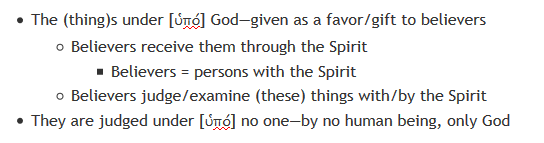
    • V. 12: “the (thing)s under God [ta\ u(po\ tou= qeou=] given as a favor/gift to us”
    • V. 13a: “the (thing)s which [a%] we also speak”
    • V. 13b: “spiritual (thing)s [pneumatika/]”, or better, “(thing)s of the Spirit”
    • V. 14: “the (thing)s of the Spirit of God [ta\ tou= pneu/mato$ tou= qeou=]”
    • V. 15: “all ([th]ese thing)s [{ta\} pa/nta]”

“to him it is stupidity” —The noun mwri/a (“dullness, stupidity”), along with the related adjective mwro/$ and verb mwrai/nw, is a keyword of the entire section (cf. 1:18, 20-21, 23, 25, 27, and the notes on these verses; also 3:18-19; 4:10). Previously it described the world’s view of God’s wisdom as expressed specifically in the proclamation of the Gospel (and the death of Christ); now, it represents the world’s reaction to the wisdom of God taken as a whole— “all the (deep) things of God”. Note how the comprehensive plural is here put into the singular “it is [e)stin]”; Paul may be suggesting that the human mind/soul is inclined to dismiss all of God’s wisdom at a single stroke. I have tried to capture this with a parenthesis— “it is (all) stupidity”. The pronoun is emphatic in the phrase: “to him [i.e. the human] it is stupidity”.

“he is not able to know (them)” —The verb du/namai essentially means having the power, i.e. being empowered, to do something. Paul has already established the connection between the Spirit of God and power (du/nami$) in 2:4-5 (cf. also 1:18, 24; 4:19-20). The idea of knowledge (gnw=nai [ginw/skw], “to know”) is implicit under the arching theme of wisdom (sofi/a) in the passage (cf. 2:8, 11, 16; also 3:20; 4:19). Earlier, Paul applied this to believers with the verb ei&dw (“see”, i.e. perceive, recognize, know) in 2:2, 11-12. The object of the verb “know” here has to be supplied—I identify it with the comprehensive plural (“the [thing]s…”, i.e. “them”) relating to the wisdom of God (cf. above).

“judged/judges” —Paul uses the verb a)nakri/nw three times in vv. 14-15. Understanding the prepositional component (a)na) to the verb as an intensive, I render it as “judge (something) closely”, in the basic sense of “examine closely/carefully”. Each instance of the verb here has a slightly different nuance:

    • “the things of the Spirit of God…are judged with the Spirit” —they can only be examined (and understood) spiritually, by way of the Spirit of God, through the guidance of the Spirit; this may be related to the idea of the Spirit “searching out” the (deep) things of God in vv. 10-11.
    • “the one with the Spirit judges all (these) things” —the Spirit enables the believer to examine all the things of God closely. It is possible that Paul is beginning to shift the meaning slightly, with a play on pa/nta (“all things”); there may be an allusion here to the idea of believers judging the world (“all things”), as in 6:2ff.
    • “he is judged under no one” —here it would seem that Paul is drawing on a specific judicial meaning of the verb (interrogate, etc); i.e. believers stand under the judgment of no other human being, since we are truly judged only by God before the (heavenly) tribunal at the end-time. This emphasis would seem to be confirmed by the parallel discussion in 4:1-5.

We should probably also understand a bit of word-play between a)nakri/nw and sugkri/nw in v. 13 (see below).

“with the Spirit” —As indicated above, I use this to render the adjective pneumatiko/$ (second instance in the translation above), but also the related adverb pneumatikw=$ (first instance above). This contrasts with the standard translation “spiritual(ly)”, which is accurate enough, but misses the comparison between the human soul and God’s Spirit. The adjective describes the person (the believer), who is characterized by the Spirit, while the adverb describes the action (judging/examining). There is almost certainly a close parallel to be drawn with the phrase in verse 13: “judging spiritual (thing)s with spiritual (word)s”.

The verb sugkri/nw shares with a)nakri/nw the root verb kri/nw (“judge, examine,” etc), which is extremely wide-ranging, but usually retains something of the primitive sense (“separate, divide, sift/sort”). As believers examine the things of God (of his Spirit), by the Spirit, and begin to understand them, we are able to sift through them and bring them together, allowing us to express and communicate them to others in the body of Christ.

“all ([th]ese thing)s” ([ta\] pa/nta)—There is a textual question regarding this word. A number of important manuscripts (Ë46 A C D* al) include the definite article, while many others do not. If the article is original, it almost certainly means that Paul is referring specifically to “the (thing)s of God”, i.e. the wisdom of God in a comprehensive/collective sense (see above). Even if the article is secondary, it may indicate that scribes sought to make the same point clear, to avoid confusion—the word pa/nta (“all [thing]s”) being taken in a general sense. I believe that here, as in verse 10, Paul is playing on the two aspects of this word: (a) all things generally, and (b) the wisdom of God specifically. The dual meaning is more properly combined at the end of the chapter 3 (vv. 21-23), where “all things” (in creation, etc) are subsumed under Christ (the wisdom of God manifest), who is, in turn, under God (YHWH, the Father) himself.

“under no one” —The preposition u(po/ can carry an instrumental sense (“by [way of], through”), but more properly it means “under”; here specifically the reference is to believers being examined and judged (in a judicial sense) under a human authority. Only God truly has the authority to judge believers (in Christ), at the end time (cf. 4:1-5). Note an interesting kind of parallel in Paul’s use of u(po/:

The line of reasoning serves as a fittingly climax to the overall contrast of human vs. divine wisdom, etc, running through this section, and which culminates powerfully with the declaration in verse 16, to be discussed in the next daily note.

January 17: 1 Corinthians 2:14-15

[This series of notes, on 1 Corinthians 2:10-15, is part of the series “Spiritualism and the New Testament”. The previous note discussed verse 13, and see the initial note with links to earlier notes covering 1:18-2:6; cf. also the main article.]

1 Corinthians 2:14-15

Before proceeding with the translation of these verses, it is necessary first to examine two important words which are central to a correct interpretation of the passage.

yuxiko/$ (psychikós)—An adjective here parallel to pneumatiko/$ (pneumatikós), the two being related to the words yuxh/ (psych¢¡, usually translated “soul”) and pneu=ma (pneu¡ma, usually translated “spirit”), respectively. The fundamental meaning of both words is of something blowing (cf. the primary verbs yu/xw and pne/w)—especially of wind (as a natural phenomena) or breath (of a living being), the two concepts or images being related in the ancient mind (wind as the ‘breath’ of the deity). The main difference between the word-groups can be described this way:

    • yu/xw refers to blowing in the sense of cooling—i.e. a cool(ing), cold breeze
    • pne/w refers primarily to movement—a stream of air (i.e. wind) with its visible effect (causing motion)

Each aspect, however, could be (and was) related to the life-breath of a (human) being. The ancient conception is preserved in Genesis 2:7, in which God breathes (blows) a wind/breath into the first human being; according to the Greek version (LXX), God breathes/blows in (e)nefu/shsen) a “living breath [pnoh/]” and the man becomes a “living breath [yuxh/]”. Here we see the two words used in tandem—pnoh/ (pno¢¡, closely related to pneu=ma pneu¡ma) and yuxh/ (psych¢¡). John 20:22 records a similar process (a “new creation”), when Jesus blows/breathes in(to) the first believers and they receive the Holy Spirit [pneu=ma]. The distinction between the two nouns can be defined generally as follows:

    • yuxh/ is the “life-breath” —that is, the invisible, inward aspect of a person, marking him/her as a living, breathing being (i.e., “soul”)
    • pneu=ma is the life-giving “breath” which animates and sustains a (human) being (i.e. “spirit”)

The two terms overlap in meaning, and the relationship between them in Greek thought is rather complex. Paul uses them each to refer to the inner dimension of a human being, but they are not to be understood as separate “things”, as though a person has “a spirit” in addition to “a soul”.

Earlier in 1 Cor 2:11, Paul refers to the “spirit/breath [pneu=ma] of man th(at is) in him“, and distinguishes it from the Spirit/Breath of God—that is to say, every human being has a “spirit” in him/her, but only believers (in Christ) have the “Spirit (of God)”. Now here in verse 14, a similar contrast is made—i.e., between the believer and the “ordinary” human being. This time, Paul establishes it, not by playing with the two senses of pneu=ma (“spirit”), but by playing on the difference between the two words pneu=ma and yuxh/ and their corresponding adjectives; which brings us to the problem of translation:

    • pneumatiko/$ (pneumatikós)—something belonging to, or characterized by, pneu=ma “spirit” (i.e. “spiritual”), only here it refers specifically to the “Spirit (of God)”
    • yuxiko/$ (psychikós)—something belonging to, or characterized by, yuxh/ “soul”, that is, the human soul

Unfortunately, there is no appropriate English word corresponding to this last adjective. A formal equivalence would be something like “soulish”, but that is exceedingly awkward. Most translators tend to use “natural”, for lack of any better option; however, while this manages to get the meaning across, and preserves a meaningful comparison here in verse 14, it distorts the original Greek and the fine word-distinction being used. Based on Paul’s vocabulary elsewhere, we might expect him to use the adjective sarkiko/$ (sarkikós, “fleshly”) here (see esp. 1 Cor 3:3, also Rom 15:27; 1 Cor 9:11; 2 Cor 1:12; 10:4). Only that word carries a definite negative connotation in Paul’s thought (associated with sin); here he wishes to preserve the more neutral, quasi-scientific sense of a normal, living human being.

The adjective yuxiko/$ appears in only three other passages in the New Testament; in Paul’s letters, the only other occurrences are in 1 Cor 15:44-46, which I will touch on below. The other two instances are in James 3:15 and Jude 19 and may help us to understand its usage by Paul here:

    • James 3:15—As in 1 Cor 1:18-2:16, a contrast is made between the wisdom (sofi/a) of God (“from above”, a&nwqen) and earthly (e)pi/geio$) wisdom. The adjective “earthly” (lit. “[from] upon earth”) is followed by yuxiko/$, and then daimoniw/dh$ (“of the daimons“). Here yuxiko/$ means essentially human, as part of a triad of terms characterizing this inferior “wisdom” —earthly–human–demonic. In verse 16, the author (“James”) mentions jealousy and strife/quarrels associated with this worldly “wisdom”, which is also an important aspect of Paul’s argument in 1 Corinthians.
    • Jude 19—Again the adjective yuxiko/$ is the second of three descriptive terms, characterizing the ‘false’ Christians of vv. 5ff:
      (a) oi( a)podiori/zonte$ “the (one)s marking (themselves/others) off from”, i.e. separating (them) from the rest of the (true) believers
      (b) yuxikoi/—i.e. “ordinary” human beings, the term being glossed by
      (c) pneu=ma mh\ e&xonte$ “not holding/having the Spirit (of God)”

Paul uses the adjective yuxiko/$ in much the same sense as Jude—referring to human beings who possess a soul/spirit but who have not (yet) received the (Holy) Spirit. Without the guidance of the Spirit, they are led by their own human (or animal) desires and impulses.

a)nakri/nw (anakrínœ)—Paul uses this verb several times in vv. 14-15, but it does not allow for easy translation. The primary verb kri/nw I have consistently rendered with the semantic range “(to) judge”, sometimes with the nuance of “decide, examine,” etc, though its original meaning was something like “(to) separate, divide, distinguish”. The prepositional component a)na/ is best understood here as “again”, in the sense of doing something again (i.e. repeatedly); however, in the verbal context it essentially functions as an intensive element. Perhaps the best translation of the verb is “examine closely“; in a judicial setting, it can refer to an interrogation or investigation. More than half of the NT occurrences (10 of 16) are in 1 Corinthians, the only letter of Paul where the verb is used; 6 are in 1 Cor 1:18-4:21 (2:14-15; 4:3-4), being neatly divided:

    • 3: 2:14-15—the reference is to the “complete” believer, “the spiritual (one)” (see v. 6)
    • 3: 4:3-4—the reference is to Paul himself as a minister of Christ

On 1 Cor 15:44-46—Returning to the word yuxiko/$ (cf. above), it may be helpful to consider briefly Paul’s use of it in 1 Cor 15:44-46, where the context is the (end-time) resurrection. Here, too, it is contrasted with pneumatiko/$; the human being is:

    • scattered [i.e. sown, in death] (as) a yuxiko/$ body—i.e., as body in which there is a life-breath (yuxh/, “soul”)
    • raised [i.e. from the dead] (as) a pneumatiko/$ body—i.e., as a spiritual body, transformed by the Spirit of God/Christ

In verse 45, Paul explicitly cites Gen 2:7 (cf. above), making the contrast more definite—between the human soul [yuxh/] (Adam) and the Spirit [pneu=ma] (Christ). It is not simply the Spirit of God (YHWH), according to traditional Jewish thought; following his resurrection, Christ himself becomes a life-giving Spirit. The two passages, using the yuxiko/$/pneumatiko/$ contrast, reflect the two ends of early Christian (and Pauline) soteriology:

    • Regeneration—The believer experiences a “new creation” in Christ, whereby the human soul/spirit is united with the Spirit of God/Christ
    • Resurrection—The human soul (and body) of the believer is completely transformed by the Spirit of God/Christ

In 1 Cor 2:14-15, Paul has the first of these in view. The analysis above should go far in helping us gain a solid understanding of what Paul is saying in these two verses. A translation and (brief) interpretation will be offered in the next daily note.