January 16: 1 Corinthians 2:13

[This series of notes, on 1 Corinthians 2:10-15, is part of the series “Spiritualism and the New Testament”. The previous note discussed verse 12, and see the initial note with links to earlier notes covering 1:18-2:6; cf. also the main article.]

1 Corinthians 2:13

“…which we also speak not in words taught of [i.e. by] (hu)man wisdom, but in (words) taught of [i.e. by] (the) Spirit, judging spiritual (thing)s together with/by spiritual (word)s.”

It must be emphasized that this verse, along with much that follows in vv. 14-15, is difficult to translate accurately into English, for a variety of reasons. Here, especially, translation and interpretation go hand-in-hand.

To begin with, verse 13 builds upon (and concludes) the declaration in v. 12 (cf. the prior note). The relative pronoun form a% (“which”) refers back to the concluding expression of v. 12: “the (thing)s under God given as a favor to us”. In the note on v. 12, I pointed out the parallel between this expression and “the deep (thing)s of God”, and connected both to the “wisdom of God” mentioned previously—and especially at the beginning of verse 6. This is confirmed by Paul’s language here at the start of v. 13:

    • “we speak (the) wisdom [of God]” (vv. 6-7)
    • “which (thing)s we also [kai/] speak” (v. 13)

The particle kai/ should be regarded as significant here, since it may be intended to draw a distinction between what it is that “we” speak in vv. 6-7 and 13, respectively. There are two ways to place the emphasis:

    • “these things also we speak” —as it is have been given to us to know them, so also we speak/declare them
    • “these things also we speak” —not only the Gospel do we proclaim, but all the deep things of God given to us by the Spirit

Most commentators opt for the first reading, according to the immediate context of vv. 12-13; however, the overall flow and structure of Paul’s argument in vv. 6-16 perhaps favors the second.

More important to the meaning of the verse is the continuation of the comparison/contrast between worldly/human wisdom and the wisdom of God. Here Paul formulates this with a specific expression: “in words of… [e)n…lo/goi$]”. I have regularly been translating lo/go$ as “account” (i.e. oral, in speech); but here it is perhaps better to revert to a more conventional translation which emphasizes the elements or components of the account (i.e. the words). Earlier, in 1:17 and 2:1ff, Paul uses lo/go$ in the sense of the manner or style of speech used (in proclaiming the Gospel); here he seems to be referring to the actual content (the words) that a person speaks.

The contrast he establishes is as follows:

    • “in words taught of [i.e. by] (hu)man wisdom” (e)n didaktoi=$ a)nqrwpi/nh$ sofi/a$ lo/goi$)
    • “in (word)s taught of [i.e. by] (the) Spirit” (e)n didaktoi=$ pneu/mato$ [lo/goi$])
      Note: I include lo/goi$ in square brackets as implied, to fill out the comparison, though it is not in the text

The contrast is explicit— “not [ou)k] in… but (rather) [a)ll’] in…” Especially significant too is the use of the adjective didakto/$ (“[being] taught”, sometimes in the sense “able to be taught”, “teachable”), rare in both the New Testament and the LXX. The only other NT occurrence is in the discourse of Jesus in John 6:45, citing Isa 54:13, part of an eschatological prophecy where it is stated that the descendants of God’s people (“your sons/children”) “…will all (be) taught [didaktou\$] by God”. This same reference is certainly in the background in 1 Thess 4:9, where Paul uses the unique compound form qeodi/dakto$ (“taught by God”). This passage is helpful for an understanding of Paul’s thought here:

“And about the fondness for (the) brother(s) [i.e. fellow believers] you hold no occasion [i.e. there is no need] (for me) to write to you, for you (your)selves are taught by God [qeodi/daktoi] unto the loving of (each) other [i.e. to love one another].”

If we ask how believers are “taught by God”, apart from Paul’s written instruction, there are several possibilities:

    • The common preaching and tradition(s) which have been received (including the sayings/teachings of Jesus, etc)
    • The common witness and teaching of the believers together, in community
    • The (internal) testimony and guidance of the Spirit

Probably it is the last of these that Paul has primarily in mind, though not necessarily to the exclusion of the others. This would certainly be an indication of spiritualism in Paul’s thought. For a similar mode of thinking expressed in Johannine tradition, cf. 1 John 2:7-8, 21, 24; 3:10ff; 4:7-8ff, and the important passages in the discourses of Jesus in the Gospel. We will be considering these passages in upcoming articles and notes in this series.

Here, in 1 Cor 2:13, we may simply note that Paul is, rather clearly enough, referring to the work of the Spirit. That the Spirit would give (“teach”) believers (and, especially, Christian ministers/missionaries) the words to say was already a prominent feature of the sayings of Jesus in Gospel tradition (Mark 13:11 par, etc), depicted as being fulfilled with the first preachers of the Gospel in the book of Acts (2:4ff; 4:8, 29ff; 6:10, etc). However, the underlying thought should not be limited to the (uniquely) inspired preaching of the apostles, but to all believers. Paul’s use of “we” in this regard will be discussed in more detail in an upcoming note (on 1 Cor 2:16).

Particularly difficult to translate is the verb sugkri/nw in the last phrase of verse 13. A standard literal rendering would be “judge together” or “judge [i.e. compare] (one thing) with (another)”. However, in the case of this verb, it is sometimes better to retain the more primitive meaning of selecting and bringing/joining (things) together. Paul’s phrase here is richly compact—pneumatikoi=$ pneumatika\ sugkri/nonte$. He (literally) joins together two plural forms of the adjective pneumatiko/$ (“spiritual”), one masculine, the other neuter. The first is in the dative case, but without any preposition specified, indicating a rendering something like “spiritual (thing)s with/by spiritual (one)s”. However, given the expression e)n…lo/goi$ (“in words of…”) earlier in the verse, it is probably best to read this into the context here as well.

I would thus suggest the following basic translation:

“bringing together spiritual (thing)s in spiritual (word)s”

I take this to mean that the “spiritual things” are given expression—and communicated to other believers—through “spiritual words”, i.e. words given/taught to a person by the Spirit. The “spiritual (thing)s [pneumatika]” almost certainly refer to “the deep (thing)s of God” and “the (thing)s under God” in vv. 10 and 12, respectively.

The Spirit “searches out” these things and reveals or imparts them to believers. This is especially so in the case of ministers—those gifted to prophesy and teach, etc—but, according to the view expressed throughout chapters 12-14, in particular, all believers have (or should have) gifts provided by the Spirit which they can (and ought to) impart to others.

This allows us to draw yet another conclusion regarding the “wisdom” mentioned in verse 6a: it is “taught” by the Spirit to believers, and is to be communicated (“spoken”) to others in turn. It is also worth noting that all throughout the discussion in verses 9-13, there is no real indication that this “wisdom” is limited to the proclamation of the death/resurrection of Jesus. We should perhaps keep an eye ahead to Paul’s discussion of the “spiritual (thing)s” in chapters 12-14.

The next daily note will examine verses 14-15.
January 14: 1 Corinthians 2:12

[This series of notes, on 1 Corinthians 2:10-15, is part of the series “Spiritualism and the New Testament”. The previous note discussed verses 10-11, with links to earlier notes covering 1:18-2:6; cf. also the main article.]

1 Corinthians 2:12

“And (so) we did not receive the spirit of the world, but the Spirit th(at is) out of [i.e. from] God, (so) that we should see [i.e. know] the (thing)s under God given as a favor to us.”

This declaration follows upon what has been stated in vv. 10-11 (cf. the prior note). The first half of the verse continues the running contrast between God and the world—only Paul now shifts from wisdom (sofi/a) to spirit (pneu=ma):

    • “the spirit of the world” (to\ pneu=ma tou= ko/smou)
    • “the Spirit th(at is) out of [i.e. from] God” (to\ pneu=ma to\ e)k tou= qeou=)

Note the slight difference in terminology:

(1) the first phrase uses an expression with the genitive (of the world), which can either be subjective (belonging to the world) or objective (consisting of [the things of] the world)—both are possible, but the former perhaps fits the context (and the comparison) better
(2) the second phrase uses the preposition e)k (“out of, from”), indicating primarily the source of the spirit (God himself)

The “spirit of the world” builds upon “the spirit of man” in v. 11:

    • “the spirit of man” (to\ pneu=ma tou= a)nqrw/pou)—the invisible, inner aspect (“th[at is] in him”) of a human being, corresponding roughly with our concept of “soul”; the relation between the terms pneu=ma (“spirit”), yuxh/ (“soul”), and nou=$ (“mind”) in Greek thought and anthropology is complex, and Paul uses all three terms in the verses which follow.
    • “the spirit of the world” (to\ pneu=ma tou= ko/smou)—this expression is parallel to “the wisdom of the world” in 1:20 (and 3:19), with the term “world” (and “of the world”) appearing repeatedly throughout the passage (cf. 1:20-21, 27-28).
      The Greek ko/smo$ fundamentally refers to an (orderly) arrangement, sometimes emphasizing decorative beauty; commonly it applies to the order of creation or the world. Paul, and other New Testament writers, draw upon a basic three-fold meaning for the term:
      (a) the created order, along with the powers which govern it
      (b) the human institutions, authorities, etc, which govern and dominate the operation of society, and
      (c) humankind, or human society, treated collectively
      Often in early Christian thought ko/smo$ has a decidedly negative connotation—signifying the corrupt/sinful condition of humankind (and creation at large), and especially human thought and endeavor which is opposed to God or seeks to function apart from him. The expression “spirit of man” is essentially neutral, while “spirit of the world” draws upon this negative meaning.

There are several points to consider in the second half of the verse. First, we should note the connecting particle i%na (“[so] that”), indicating purpose—we received the Spirit from God so that we might see, etc. The verb form ei)dw=men (from ei&dw, “see”) is a rare occurrence of a perfect subjunctive; there are only 10 occurrences in the New Testament (apart from several participial forms), and always with the verb ei&dw (Mark 2:10 par; 1 Cor 13:2; 14:11, etc). Rendered literally, the phrase would be “so that we might have seen…,” but this is misleading in English; the (intensive or consummative) force of the phrase is perhaps better translated, “so that we might surely/truly see….”

In Greek idiom, to “see” (esp. with the verb ei&dw) essentially means to know (i.e. perceive, recognize). And what is it that we might come to see/know?—this is expressed in the final phrase of the verse: “the (thing)s given as a favor to us under God”. The verb xari/zomai is derived from the noun xa/ri$ (“favor”) and means “give/grant/do (something) as a favor”. It is relatively frequent in the Pauline letters (16 of the 23 occurrences in the NT), though the noun xa/ri$ (typically translated “grace”, or, more accurately, “gift”) is much more common.

The preposition u(po/ (“under”) means that the things given as a favor to believers are under God’s control and come through his guidance and generosity. Note the important parallel with verse 10:

    • “the deep (thing)s of God” (ta\ ba/qh tou= qeou=)
    • “the (thing)s under God” (ta\ u(po\ tou= qeou=)

In a locative sense, u(po/ indicates “beneath”, making the connection with the “deeps/depths” of God more obvious. There is no way in English to translate the plural literally without adding in a word like “thing” — “the (thing)s…” —and yet it is perhaps not entirely appropriate to the Greek idiom. We should perhaps understand the formal expression in a collective, comprehensive sense—i.e., “(all) the depths of God”, “(every)thing under God” (see ta\ pa/nta, “all [thing]s” in v. 10a). In terms of Paul’s thought here, it also would not be inappropriate to combine the expressions— “all the deep (thing)s under God” —to summarize what it is that God, through the Spirit, gives to us as a favor (or gift).

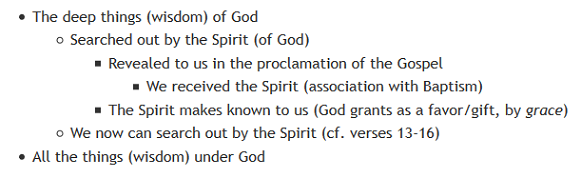
We might outline this as follows:

This analysis also allows us to draw several additional conclusions regarding the interpretation of verse 6a (cf. the discussion in the previous note, and the main article):

    • The “wisdom” is not limited to the Gospel message, but ought to be understood more comprehensively as “all the (deep) things under God”.
    • It is dependent upon our having received the (Holy) Spirit
    • Through the Spirit we are able to know and experience this wisdom

It will be possible to expand upon these points as we proceed through vv. 13-16 in the upcoming notes.

January 13: 1 Corinthians 2:10

These notes on 1 Corinthians 2:10-15 are part of the series “Spiritualism and the New Testament”. They are reproduced, in large part, from an earlier set of notes, covering 1:18-2:16 (and including 3:1-3). You may wish to consult these earlier notes, beginning with 1:18—cf. also the following notes on 1:21, 23-24, ,27-28, 30; 2:1-5, and 6.

1 Corinthians 2:10

“And (yet) to us God has uncovered (this) through the Spirit—for the Spirit searches out all (thing)s, and (even) the deep(est thing)s of God.”

The statement in verse 10 is the culmination of the line of argument in vv. 6ff. It may be helpful to outline the thematic (and logical) development:

    • There is a wisdom spoken to the believers who are “complete” —it is different from the wisdom of this Age and its rulers/leaders (who have no effect for believers and will be without power in the Age to Come) [v. 6]
      • instead (“but/rather”, a)lla), this wisdom (of God) is spoken in a secret hidden away from the world [v. 7a]
        • which [h%n] God established (“marked out”) before the beginning of this Age, for the honor/glory of believers [v. 7b], and
        • which [h%n] none of the rulers/leaders of this Age knew (or understood) [v. 8] —demonstrated by the fact that they put Jesus Christ (“the Lord of honor/glory”) to death
          • instead (“but/rather”, a)lla), this secret was prepared beforehand, only to be revealed for “those who love God” [v. 9, citing Scripture]
            • and (de) God has revealed this to us (believers) through the Spirit [v. 10]

The thrust of this argument is clear: the wisdom of God has been kept secret, hidden away from the world, and is only revealed now to believers through the Spirit. The emphasis on the Spirit (of God) here is vital to Paul’s discussion. With regard to a correct interpretation of verse 6a (see the main article, as well as my earlier note on the verse), it is possible to make at least one firm conclusion—the wisdom spoken to the “complete” comes by way of the Spirit. No other source of “wisdom” is possible. Based on the context of vv. 6ff, we may assume that apostles and ministers (such as Paul), are the immediate (proximate) source, as chosen/inspired preachers and teachers, to communicate this wisdom.

The wording in v. 6 (“we speak…”) is slightly ambiguous—it could refer to (a) Paul primarily, (b) Paul and his fellow ministers, or (c) believers generally. Probably the first person plural should be understood as inclusive of all three points of reference, in the order given here: Paul (founding Apostle)–Ministers–Believers.

It is significant that the work of the Spirit essentially reverses the process established by God—the (secret) wisdom is, first:

    • hidden from [a)pokekrumme/nhn] the world [v. 7], and then
    • the cover is removed from [a)peka/luyen] it [v. 10], revealing it to believers

The first verb (a)pokru/ptw, “hide [away] from”) is a passive perfect (participle) form, indicating action which began at a point (in time) and the force or effect of which continues into the present. It is an example of the “divine passive”, with God as the one performing the action (unstated). As a participle it modifies the noun “wisdom” (sofi/a), emphasizing its character as hidden/secret wisdom; this is especially clear from the precise Greek syntax and word order:

    • wisdom of God
      —in (a) secret
    • hidden from (the world)

The second verb (a)pokalu/ptw, “take/remove the cover from”, i.e. “uncover”) is a simple aorist indicative form with God as the subject. The aorist would suggest a past action performed by God (through the Spirit); there are several possibilities for a specific point of reference here:

    • The resurrection and exaltation of Jesus
    • The preaching/communication of the Gospel
    • The receipt of the Spirit by believers (associated with the baptism ritual)
    • Post-conversion work/manifestation of the Spirit to believers

The second of these—the proclamation of the Gospel (by Paul and his fellow ministers)—best fits the context. This allows us to draw a second conclusion regarding the interpretation of v. 6a: the revelation of the (secret) wisdom of God is fundamentally tied to the proclamation of the Gospel. However, I believe we will gain additional insight by a careful consideration of the last half of verse 10, which describes more generally the work of the Spirit:

“…for the Spirit searches out all (thing)s, and (even) the deep(est thing)s of God”

Two phrases are combined, the second of which builds on the first:

    • “for the Spirit searches out [e)rauna=|] all things [pa/nta]
      • even the deep things [ta\ ba/qh] of God”

The essential activity of the Spirit is described by the verb e)reuna/w, which means to search out (or after) something. The searching of God’s Spirit is all-powerful and all-inclusive—it searches out all things. The second phrase narrows this to “the deep things” of God. The idea is that the Spirit, in its searching, travels (steps) all the way to the “depths” of God himself, in a manner (somewhat) similar to the functioning of the human “spirit” (v. 11).

By inference, we may draw a third conclusion in relation to verse 6a: the hidden wisdom of God relates to the very depths (the deepest parts) of God’s own being. It is an extraordinary thought (and claim) that the Spirit might communicate to believers the deepest wisdom of God himself. Perhaps this suggests something of what Paul means when he states that such wisdom is spoken to “the ones (who are) complete” (in this regard, see esp. the famous words of Jesus in Matt 5:48). For a more immediate exposition (and explanation), in the context of this passage, we now turn to verse 12, to be discussed in the next note.

Spiritualism and the New Testament: Paul: 1 Corinthians 2:10-15

This study on Spiritualism and the New Testament (cf. the Introduction and article defining the term “Spiritualism”) will be divided into two main sections, corresponding to the Pauline and Johannine writings, respectively. We begin with the Pauline Letters.

The Letters of Paul

Paul wrote extensively on the Spirit, and doubtless he played a significant role in shaping first-century Christian views on the subject. Paul inherited early Christian traditions and beliefs regarding the Spirit, but, in his own way, he also developed these, presenting them within a deeper and more systematic framework. Before proceeding to the first passage of our study, let us first conduct a brief survey of several key beliefs which Paul shared, we may assume, with many other believers in the mid-first century (c. 50 A.D.).

    • The coming of the Spirit upon believers marks the fulfillment of the exilic/post-exilic prophetic oracles regarding the pouring out of God’s Spirit on His people in the New Age (of Israel’s restoration).
    • Believers receive the Spirit in connection with the ritual of baptism, which parallels the tradition of Jesus’ own baptism (Mk 1:8, 10 par).
    • The Spirit is communicated (by God) through the person of the exalted Jesus.
    • The exaltation of Jesus (to heaven, at God’s right hand), following his resurrection, gave to him a Divine status and position that enabled Jesus to share in God’s own Spirit. For more on this, cf. below.
    • Thus, when believers receive the Spirit of God, they/we are also receiving the Spirit of Christ. Through the Spirit, the exalted Jesus is manifest and present in (and among) believers.
    • Upon receiving the Spirit, believers are enabled to function as prophets, communicating the word and will of God, accompanied by other special abilities and ‘gifts’ (including speaking in ‘tongues’ and the working of miracles).

Because of the number of Paul’s letters that are available to us, we have a clearer understanding of these early beliefs. For example, Paul is the only New Testament author who offers any kind of an explanation of how Jesus came to share the Spirit of God (as his own Spirit). We can obtain a glimpse of this Christological point by combining Paul’s words in 1 Cor 15:45 (in the context of his discussion on the resurrection in chap. 15) with the declaration in 6:17. And, on this point, we may note the way that Paul can refer to the (Holy) Spirit as the Spirit of God and the Spirit of Christ (or of Jesus) interchangeably (see esp. Rom 8:9).

1 Corinthians 2:10-15

In the section 1:18-2:16, Paul contrasts worldly wisdom with the wisdom of God. The Gospel proclamation centered on the painful and humiliating death (by crucifixion) of Jesus, embodies, rather paradoxically, the wisdom of God. And yet, Paul speaks in vv. 6-15, of a wisdom that is spoken among those believers who are complete (te/leio$). In describing this wisdom, Paul’s exposition seems to have a spiritualist emphasis. The key verses are 10-15; however, before examining them in detail, it is necessary to give careful consideration to how Paul leads into that discussion. Let us begin with verse 6.

1 Corinthians 2:6

“And (yet) we (do) speak wisdom among the (one)s (who are) complete, and (it is) wisdom not of this Age, and not of the chief (ruler)s of this Age th(at are) being made inactive…”

This statement introduces a new section, building upon vv. 1-5 (see my earlier note). In verse 5, Paul contrasts human/worldly wisdom (“the wisdom of men”) with the power of God; now, here in verse 6, he returns to the earlier contrast between two different kinds of wisdom. The conjunction de/, translated “and” above (first two instances), has adversative force, and could just as well be rendered “but”. In contrast with worldly wisdom:

    • Believers (and esp. Christian ministers) do speak/use wisdom, but
      • It is altogether different from the wisdom of the world and its rulers

There have been longstanding questions regarding the precise identity of both this “wisdom” (sofi/a) and the ones who are “complete” (te/leio$). In a prior note, I outlined some of the more common suggestions offered by commentators; here they are listed again for reference, with no priority indicated by the numbering:

    1. The basic Gospel message (wisdom) is given to all believers, but a more advanced (esoteric?) Christian wisdom (teaching, etc) is offered for those who are “complete”—mature and committed in the faith sufficiently to receive it.
    2. Paul is simply making a rhetorical contrast. There is only one wisdom—that of the person of Christ and his death/resurrection. The “complete” believers are able to recognize this and do not need to seek after any other “wisdom”.
    3. He is distinguishing between the Gospel proclamation and the teaching/instruction, etc., which builds upon the basic message, interpreting and applying it for believers as they grow in faith. For the “complete” this includes a wide range of “wisdom” —ways of thinking/reasoning, use of argument, illustration, allegory/parable, (creative) interpretations of Scripture, etc.
    4. Paul himself evinces certain gnostic/mystic tendencies whereby there are envisioned levels or layers in the Gospel—i.e. the basic proclamation and belief regarding the person and work of Christ—as in the Scriptures, the deepest of which involve the most profound expressions of God’s wisdom. Only the “complete” are able to realize this, and to be able to communicate something of it to the wider community.
    5. Paul is responding to gnostic/mystic tendencies among believers in Corinth. Here, as a kind of rhetorical approach, he is drawing upon their own thinking and sensibilities, trying to bring their focus back to the centrality of the Gospel and a proper understanding of the work of the Spirit. As such, the apparent distinctions he makes are somewhat artificial, perhaps running parallel to the (actual) divisions among the Corinthians themselves.
    6. The wisdom for the “complete” reflects a deep understanding of, and participation in, the work of the Spirit. Believers who are completely guided by the Spirit need no other instruction. Paul is essentially expounding this thought in vv. 9-16, only to make (painfully) clear to the Corinthians how far they still are from the ideal.

I have discussed the passage, running through 3:1-3, in considerable detail in earlier notes, a portion of which I am reproducing (especially those on 2:10-15) as part of this series. I have indicated certain conclusions which may be drawn from the text, that help clarify what Paul means here in 2:6. I list these as bullet points:

    • The wisdom spoken to the “complete” comes by way of the Spirit. No other source of “wisdom” is possible.
    • The revelation of the (secret) wisdom of God is fundamentally tied to the proclamation of the Gospel.
    • The hidden wisdom of God relates to the very depths (the deepest parts) of God’s own being.
    • The “wisdom” is not limited to the Gospel message, but ought to be understood more comprehensively as “all the (deep) things under God”.
    • It is dependent upon our having received the (Holy) Spirit
    • Through the Spirit we are able to know and experience this wisdom
    • It is “taught” by the Spirit to believers, and is to be communicated (“spoken”) to others in turn.
    • The ones who are “complete” essentially = the ones who “have the Spirit”
    • The ones who are “complete” are defined, in a negative sense by the opposite—those who think and act in a “fleshly” manner are “incomplete”.

From these points, the spiritualistic tendency in Paul’s thought seems clear enough. That is to say, the wisdom of God is manifest fundamentally, and principally, through the presence of the Spirit in and among believers. But let us look more closely at the wisdom Paul has in mind. I would isolate three primary aspects:

    • It is based on the proclamation of the Gospel, i.e. of the person and work of Christ
    • It includes all that the Spirit communicates to believers, which they receive as a gift to be shared/communicated to others
    • It extends to the working and guidance of the Spirit (= the “mind of God/Christ”) in all things

With regard to those who are complete, this can be defined even more simply:

    • They are those believers who consistently think and act under the guidance of the Spirit; this must be distinguished on two levels:
      • The reality of having/holding the Spirit (in us)
      • The ideal of living out this identity—i.e., “walking in/by the Spirit” (cf. Gal 5:16, 18, 25)

The very fact that Paul, like Jesus himself, exhorts believers to be “complete”, means that it is not automatically realized through faith in Christ and receiving the Spirit; rather, it reflects a process of growth and development which, in most instances, will take place over a lifetime. This, however, does not change the force and urgency of the exhortation. Jesus’ own exhortation (Matt 5:48) to his followers essentially takes the form of a promise—if you live according to the teaching (i.e. in 5:21-47, etc), “you will be complete [te/leio$], as your heavenly Father is complete”.

In Gal 5:16ff, Paul expounds upon this idea, now in a decidedly Christian sense, with the force of an imperative; note the sequence of phrases, with its central (conditional) premise:

    • “Walk about in the Spirit…” (v. 16)
      — “If you are led in the Spirit…” (v. 18)
      — “If (indeed) we live by the Spirit…” (v. 25a)
    • “We should step in line in the Spirit” (v. 25b)

The statement in Gal 5:16 reflects the very issue Paul is dealing with in 1 Corinthians, and the lament he expresses in 1 Cor 3:1-3:

“Walk about in the Spirit, and you should not complete [tele/shte, related to te/leio$] the impulse of the flesh”
“We speak wisdom among the (one)s (who are) complete… “
“And (yet) I was not able to speak to you as (one)s (who are) of the Spirit, but as (one)s (who are) of the flesh”

Is it possible that Paul, in some sense, does have a more precise and sharp division in mind, i.e. between the “complete” and the ‘incomplete’ —two distinct groups or categories of believers? While this would seem to contradict much of his own argument in 1:18ff, it is conceivable that he is playing off of the very “divisions” which exist among the Corinthians. Certainly, it has been suggested from the distinction he makes in 3:2 between “milk” (ga/la) and “(solid) food” (brw=ma)—the Corinthians are behaving as immature “infants” (v. 1), and cannot be treated (i.e. spoken to) as mature adults. There are several possibilities for understanding this distinction:

    • “Milk” is the simple Gospel message, while the solid “Food” represents deeper (Christian) teaching and instruction
    • The difference is between the basic ‘facts’ of the Gospel, and its deeper meaning
    • Similarly, it is between the Gospel message and how it is (effectively) applied and lived out by believers in the Christian Community
    • It rather reflects a difference in the way believers respond—as immature infants or mature adults
    • It is simply a rhetorical image, drawn from the idea of the Corinthians as “infants”, and should not be pressed further

Something may be said for each of these interpretations, except perhaps the first. Insofar as it reflects a substantive distinction in Paul’s mind, the third and fourth best fit the overall context of the passage.

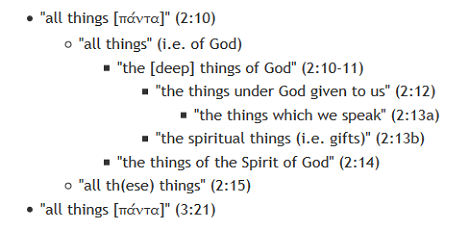
Finally, I would like to bring out a particular point of emphasis that is sometimes overlooked in this passage. When Paul speaks of the wisdom of God in terms of “the (deep) things” of God, he couches this within the general expression “all things” (pa/nta). In my view, this should be understood in an absolute comprehensive sense. Note how this is framed conceptually in chapters 2 & 3:

The wisdom of God encompasses “all things”, as Paul makes clear in 3:21-23, where he establishes a (hierarchical) chain of relationship, presented in reverse order— “all things” (pa/nta), he says:

belong to you (pl., believers), and you in turn
belong to Christ, who in turn
belongs to God the Father

If we allow ourselves to be guided by the Spirit and the mind of God/Christ, then we are free to study and examine all things (cf. 2:10, 15), and this itself becomes an integral expression of the “wisdom of God” which we speak.

This analysis of the thrust of 2:6-16 (extending to 3:1-3) provides the framework for our detailed study of 2:10-15, which contain the key references to the Spirit. For this study, see the first note, on v. 10.

Spiritualism and the New Testament: Introduction

This study series will explore what I believe is a significant (and largely neglected) area of study: namely, the question of whether, or to what extent, spiritualist tendencies are present in the New Testament Scriptures. Unfortunately, the term “spiritualism,” or “spiritualist(s),” is one of the most ill-defined and misunderstood in the history of religious studies. Even more so than “mysticism” and “gnosticism,” the term “spiritualism” suffers from careless and imprecise application. For more on this, see my article in the Definitions and Explanations of Terms feature.

To summarize the discussion in that article, I define and explain “spiritualism” as follows:

A religious phenomenon whereby the esoteric (i.e., inward and invisible) aspect of religion is decidedly given priority over the exoteric (i.e., outward and visible) aspect of religion. The latter includes such things as: rituals, sacred places and objects, religious meetings/gatherings, institutional/organizational structures, written texts, laws and creedal formulations, etc. This “inward” aspect is understood in terms of the idea of the spirit (Latin spiritus, Greek pneu=ma, pneuma)—whether human or divine.

The related term “spiritualist” simply means: related to spiritualism or characterized by it. As a religious phenomenon applicable to Christianity, I have defined it, somewhat more concisely, as:

A set of beliefs or tendencies which emphasize the role and place of the Spirit (of God) as the supreme principle governing all aspects of religious life and experience. According to this principle, the inward and invisible spiritual aspect takes priority over all outward/visible/material elements of religion.

As noted in the aforementioned article, Christian spiritualism is distinctive because of the strong emphasis on the Holy Spirit. Thus, we may further define the principle of “spiritualism”, in the context of Christianity, as follows:

The presence and manifestation of the Spirit takes priority over all other external aspects and religious features. The Spirit is the normative, guiding force for believers, rather than rituals, sacred places, written texts (i.e. the Scriptures), creeds, and so on.

In this very specific and qualified sense, we may properly speak of spiritualism in Christianity, and also of Christian spiritualism.

Since, in Christian spiritualism, the spirit (pneu=ma) refers primarily, if not exclusively, to the Holy Spirit ([to\] pneu=ma [to\] a%gio$), we may fairly infer that any spiritualist tendencies in the New Testament derive (and would have developed) naturally from the early Christian understanding of the (Holy) Spirit. And, as may be demonstrated quite readily, the early Christian view of the Spirit, in turn, was derived from the view of the Spirit in Old Testament and Jewish tradition. I have discussed the latter in some detail, examining all of the most relevant passages, in a recent series (cf. the links at the end of this article), and so will not be repeating that analysis in the current study series. However, I will, on occasion, refer to certain key examples that may be seen as having specifically influenced aspects of the (possible) spiritualist tendencies in the New Testament.

As for the references to the Spirit in the New Testament Scriptures, I also have treated these extensively in earlier series—two in particular: “…Spirit and Life” and “The Holy Spirit in the Gospel Tradition”. Here, I will be focusing almost exclusively on the passages which may reflect spiritualism (or spiritualist tendencies), and only occasionally discussing the other references. All of the principal passages are found in the Pauline and Johannine Writings.

Before proceeding with that extended study, however, it will be necessary to discuss several aspects of the Spirit-references in the Synoptic Gospels and Acts, which may have helped lead to the development of a seminal kind of spiritualism among believers in the first-century. I would isolate four such aspects:

    • The association of the Holy Spirit (that is, the Spirit of God) with the person of Jesus, being manifest and located on/in his person.
    • The tendency whereby Jesus, in his person, came to take priority over the external elements of Jewish religion—the temple and its ritual, along with the Torah regulations, etc.
    • The application to Jesus of Messianic and eschatological expectations, including those drawn from exilic and post-exilic Prophetic tradition, involving the coming of the Spirit upon God’s people in the New Age. That is, the New Age is fundamentally characterized by the guiding presence of God’s Spirit in (and among) His people.

With regard to the first point, the association of Jesus with the Holy Spirit is expressed mainly through two lines of early tradition: (1) the descent of the Spirit upon Jesus at the baptism, and (2) the resurrection of Jesus and his exaltation to heaven (at God’s right hand). The Synoptic Gospels record the descent of the Spirit at Jesus’ baptism (Mk 1:10; par Matt 3:16; Lk 3:22), relating it to the saying by the Baptist in Mk 1:8 par (cf. also Acts 1:5; 11:16). The descent of the Spirit marks the beginning of Jesus’ public ministry, and his divine empowerment for that prophetic work. It is in Luke where this aspect is given particular prominence, with special emphasis placed on Jesus’ relationship to the Spirit—4:1ff (cf. Mk 1:12 par), 14, 18ff, characterized as an anointing by the Spirit (4:18; Acts 10:38). The presence of the Spirit gives to Jesus authority over the evil/unclean spirits (cf. Mk 1:23ff; 3:11, 22ff, 28-30; 6:7 pars), and also marks the divine character of his teaching (Mk 1:22 par; Acts 1:2, etc). Luke again places special emphasis on the Spirit in this regard, as a focus of Jesus’ teaching, such as in the pericope on prayer in chapter 11 (v. 2 [v.l.], 13, and note the contextual Spirit-reference in 10:21).

It was especially after the resurrection of Jesus, with his exaltation to God’s right hand, that he actually came to be identified with the Spirit. This divine status and position, including his specific identity as the Son of God (according to the early exaltation-Christology), enabled Jesus to communicate the Spirit of God to believers (Lk 24:49; Acts 1:5, 8; cf. also Jn 20:22; 7:39). Moreover, at various points in the New Testament, as we shall see, Jesus himself is manifest in the Spirit to believers. Through the resurrection, Jesus was united with God the Father as one Spirit (see esp. 1 Cor 15:45; cp. 6:17); this explains how early Christians could refer to the (Holy) Spirit as the Spirit of God and the Spirit of Jesus, interchangeably.

Beyond this, the Spirit was also associated with the conception and birth of Jesus (as a human being), though this does not appear to have been part of the earliest Gospel kerygma-narrative. The relative age of the tradition, however, is indicated by its independent attestation in both the Matthean and Lukan infancy narratives (Matt 1:18-20; Lk 1:35), and may (possibly) be alluded to by Paul in Gal 4:4-6. The Spirit, of course, is a prominent theme, developed by the author, in the Lukan infancy narrative as a whole (1:15ff, 41, 67; 2:25-27).

The second point outlined above relates specifically to the subject of Jesus and the Law. The Gospel Tradition, in a number of places, exhibits the tendency whereby Jesus, in his person, came to take priority over the external elements of Jewish religion—the temple and its ritual, along with the Torah regulations. I discuss the issue of Jesus and the temple extensively in an earlier article, examining both the temple-action (Mk 11:15-18 par; Jn 2:13-17) and saying(s) of Jesus (Jn 2:19ff; cp. Mk 14:58 par; Acts 6:14, and note Mk 13:2 par). The saying of Jesus in Matt 6:6 (in the context of that particular Synoptic tradition, 6:1-8 par) is also of special significance.

Jesus’ primacy over the Torah regulations has to do, in large part, with his authoritative interpretation of the Torah regulations, situated at the heart of his teaching (e.g., in the Sermon on the Mount, Matt 5:17-20 ff). However, the Gospel portrait is rather more complex, and goes well beyond that limited aspect of Jesus’ relation to the Law. For more on the subject, see my survey of passages (in the series “Jesus and the Law”), as well as the articles on the Synoptic “Sabbath Controversy” episodes.

The third point relates to Jesus’ identity as the Messiah, and the Old Testament prophetic traditions regarding the role of the Spirit in the eschatological New Age for God’s people. As noted above, I have discussed all of the relevant passages in an earlier series of notes on “The Spirit in the Old Testament”, and I recommend consulting these for further study:

As far as Jesus’ identity as the Messiah is concerned, in which he was identified by believers as fulfilling all of the Messianic figure-types known in Judaism at the time, see the various articles in my series “Yeshua the Anointed”. On the significance of the Holy Spirit in this regard, as attested in Judaism during the first centuries B.C./A.D., you may wish to consult my earlier note on Wisdom 9:17, etc, as well as the two-part article “The Holy Spirit in the Dead Sea Scrolls” .


The Spirit and the Birth of Jesus: Part 5

Spirit and Divine Birth in the Johannine Writings

Before embarking on our final topic (here in Part 5), let us summarize some of the results from our study thus far. This can be done best, I think, by presenting the key points of development in something of a chronological sequence.

    • In the earliest strands of the Gospel Tradition, Jesus was identified as an Anointed (Messianic) Prophet—an identification that was defined, in part, by the servant/herald figures of Isaiah 42:1ff and 61:1ff, upon whom God is said to put His Spirit. The Heavenly Voice at Jesus’ baptism, in the core Synoptic Tradition, apparently alludes to Isa 42:1. Jesus, even during the time of his ministry, could have been thought of as God’s son in this Messianic sense.
    • Jesus also was identified as the royal/Davidic Messiah, though increasingly more so after his resurrection. Passages such as Psalm 2:7 (and 2 Sam 7:14), expressing the ancient Near Eastern tradition of referring to the king as God’s “son” (“born” at his coronation), already given a Messianic interpretation, were applied to Jesus. If the ‘Western’ reading of the Lukan version (3:22) of the Heavenly Voice is original, then the Gospel writer may have intended this specific Messianic identification of Jesus at his baptism (cp. the Transfiguration parallel, Lk 9:35).
    • For early Christians, such Messianic passages were applied to Jesus primarily in the context of his resurrection (and exaltation to heaven). It was through his exaltation that Jesus was ‘born’ as God’s Son. Jesus’ resurrection took place through the presence and power of God’s Holy Spirit, and the exalted Jesus (at God the Father’s right hand) shared in the same Divine Spirit as the Father.
    • Christians soon came to realize that Jesus must have been God’s Son (in this Divine/exalted sense) even prior to his resurrection—that is, during the time of his earthly life and ministry. The Heavenly Voice at Jesus’ baptism (marking the start of his public ministry), declaring him to be God’s Son, would thus have taken on a deeper theological significance.
    • Gradually, the belief developed that Jesus’ Divine status (and nature) as God’s Son preceded even his birth. Belief in the Divine pre-existence of Jesus is attested by 60 A.D., at the latest (the ‘Christ hymn’ of Philippians 2:6-11). Psalm 2:7 was further interpreted in this sense—viz., that Jesus was already ‘born’ as God’s Son in eternity, before the world was created. Hebrews evinces a pre-existence Christology, alongside the earlier exaltation Christology, and can cite Psalm 2:7 (and the idea of Jesus’ being “born” as God’s Son) in both contexts.
    • At around the same time, a seminal narrative of Jesus’ human birth developed, as one of the last strands of the Gospel Tradition. By at least 70 A.D., there was in existence a seminal narrative, common to the core of the Matthean and Lukan Infancy narratives. It includes the central belief of the role of the Holy Spirit in the miraculous (virginal) conception of Jesus. However, there is no real evidence of a pre-existence Christology in the Infancy narratives.

To these Christological points, we should mention the important parallel between Jesus’ as God’s Son and believers as the sons/children of God. Paul notably brings out this parallel (and relationship) in Galatians 4:1-7 and Romans 8:12-17, explaining that our sonship, as believers, comes through our receiving of the Holy Spirit. Traditionally, the receiving of the Spirit took place during (and was symbolized by) the baptism ritual. This follows the pattern of Jesus’ own baptism, when the Holy Spirit descended upon him. Paul also juxtaposes Jesus’ incarnate birth (as a human child) with the divine birth of believers (and children of God).

All of these Christological themes reach their pinnacle in the Johannine Writings—the Gospel and First Letter of John. In the Gospel of John, all of the main lines of tradition, regarding the relationship between Jesus (the Son) and the Spirit, are brought together and given new depths of meaning. For example, we have the Spirit descending upon Jesus at his baptism (1:32ff), along with the declaration by the Heavenly Voice (1:34), as in the Synoptic Tradition. Also, the Spirit is associated with the resurrection/exaltation of Jesus, after which Jesus is able to communicate the Spirit, sending it to his disciples (20:22).

However, there are two very distinctive points of Johannine development:

    • Through the Spirit, the manifest presence of Jesus abides in and among believers. We are united with Jesus the Son through the Spirit, and, through the Son, with God the Father, since Father and Son share the same Spirit.
    • Believers come to be “born” of God, through the Spirit, thus becoming children/offspring of God. While Jesus is the Son (ui(o/$), we, as believers, are God’s children (te/kna).

Both of these thematic ideas can be found elsewhere in the New Testament (in Paul’s letters, for example), but they have a very special emphasis in the Johannine Writings. It is the latter idea—of the birth of believers, through the Spirit—that I wish to focus on here. This will be done through a survey of the Johannine passages, many of which I have discussed in detail elsewhere.

John 1:12-13

In order to view this verse properly in context, we must begin with the first portion in verse 12:

“But as (many) as received him, to them he gave the exousia [i.e. ability/authority] to come to be [gene/sqai] (the) offspring of God [te/kna qeou=, i.e. sons/children of God]—to the ones trusting in his name…”

The context is clear enough—Christ himself gives the ability to become “children of God” to believers (the ones who trust/believe in him). The the verb gi/nomai (cognate with genna/w) is used, more or less, in the sense of coming to be born, as is clear from the parallel in v. 13. The expression te/kna qeou= (“offspring/children of God”) is generally synonymous with ui(oi\ qeou= (“sons of God”), as demonstrated by a comparison of Rom 8:16-17, 21 with Rom 8:14, 19; Gal 3:26, etc. The Gospel and letters of John (Jn 11:52; 1 Jn 3:1, 10; 5:2) prefer te/kna qeou=; based on the slight evidence available, Luke (and the Synoptics) tends to use ui(oi\ qeou= (cf. Lk 20:36; and 6:35, where it is u(yi/stou instead of qeou=, as in Lk 1:32).

The sentence continues in verse 13:

“…who, not out of blood [lit. bloods] and not out of (the) will of (the) flesh and not out of (the) will of man, but (rather) out of God [e)k qeou=], have come to be (born) [e)gennh/qhsan]”

Note the general parallel with Lk 1:28-35, especially if v. 35b is expanded with the additional (variant) e)k sou (“out of you”):

    • Jn 1:13—e)gennh/qhsan “(the ones who) have come to be born”
      Lk 1:35—to\ gennw/menon “the (one) coming to be born”
    • Jn 1:13—e)k qeou= “out of God”
      Lk 1:35—[e)k sou=] “[out of you]” (v.l.)

In Lk 1:35, Jesus is born (as a human being) out of Mary’s body (i.e. her “flesh”); in Jn 1:13, believers are born (spiritually) out of God.

John 3:3-8

The spiritual birth of believers is referred to on several occasions in the Gospel of John, most notably in the famous passage Jn 3:3-8, where the verb genna/w appears 8 times; by contrast, it is used of Jesus’ incarnate (human) birth only in Jn 18:37. In the Nicodemus discourse, Jesus specifically contrasts an ordinary human birth (“out of [e)k] flesh,” “out of [e)k] water”) with being born “out of the Spirit” (e)k tou= pneu/mato$, vv. 5-6, 8). Being born out of the Spirit is the same as being born “from above” (a&nwqen), v. 1 (also v. 7), which Nicodemus misunderstands (v. 2) as a second fleshly birth (a&nwqen can also mean “again”). Clearly, this is a heavenly and divine birth (“from above”), and e)k [tou=] pneu/mato$ essentially has the same meaning as e)k qeou= (“out of God“). Jesus also, as the incarnate Son, comes “out of” (e)k) the divine realm above, down to earth (3:13, 31; 6:41-42, 50-51, 58; 8:23, etc).

John 8:47; 15:19; 17:6ff; 18:37

The expression e)k qeou= is used as a characteristic of believers elsewhere in the Gospel. It is often translated in the sense of “belonging to God”, but surely the idea of coming to be born out of God is also implicit in this expression. See, for example, the context of 8:47 (vv. 41-47), dealing with the idea of believers as sons/children of God (i.e., God as their Father); those who reject the Son, or who otherwise to not believe, have the Devil as their father, and belong to (being born of) the world below (8:23). As it is, believers do not belong to the world in this way (15:19). The same language runs through the Prayer-Discourse of chapter 17 (see vv. 6, 14-16).

One may also mention Jesus’ statement in 18:37, in which he declares that those who trust in him are “out of the truth” (e)k th=$ a)lhqei/a$). This is can be understood as “belong to the truth”, but again we should not ignore the implicit idea of being born, especially since Jesus himself mentions it (that is, his own birth) earlier in the same verse. The close connection between truth (a)lhqei/a) and the Spirit in the Johannine writings, makes it likely that the believer’s spiritual birth is being alluded to. The Holy Spirit is specifically called (“the Spirit of Truth“, 1 Jn 4:6; Jn 14:17; 15:26; 16:13, cf. also 4:23-24), and, in 1 John 5:6, it is even declared that “the Spirit is the Truth” —providing a belated answer, if you will, to the question by Pilate in Jn 18:38.

1 John 3:9, et al

The author of 1 John repeatedly refers to believers—true believers—has those who have been born of God, using the verb genna/w, just as in John 1:12-13 (cf. above). He introduces this language at the close of the first half of the letter (i.e., at the end of the section 2:28-3:10), and then proceeds to develop the theme in the second half. It relates to the central message of the letter, affirming the religious (and spiritual) identity of true believers—members of the Community—in contrast to the false believers (called false prophets and ‘antichrist’) whom he opposes (and of whom he is warning his readers against).

Here is a summary of the references:

1 John 3:9

“Every (one) having come to be (born) [gegennhme/no$] out of God does not sin, (in) that His seed remains in him, and he is not able to sin, (in) that he has come to be (born) [gege/nnhtai] out of God.”

Note the symmetric (chiastic) structure of this verse:

    • Every one having come to be born out of God
      • (he) does not sin
        • (God’s) seed remains in him
      • he is not able to sin
    • he has come to be born out of God
1 John 4:7

“…every (one) loving has come to be (born) [gege/nnhtai] out of God and knows God”

There is also a chiastic structure to 4:7-8:

    • “love is out of God”
      • “the one loving…knows God”
      • “the one not loving does not know God”
    • “God is love”

Here showing love is comparable to not sinning (3:9) as a fundamental attribute of the true believer—i.e., one who has been born of God.

1 John 5:1

“Every (one) trusting that Yeshua is the Anointed (One) has come to be (born) [gegennhtai] out of God, and every (one) loving the (One hav)ing caused (him) to be (born) [also] loves the (one) having come to be (born).”

Trust in Jesus and love for one’s fellow believers are the two components of the great Commandment (3:23-24). In 1 John, sin is defined primarily in terms of violating this two-fold great Commandment, which (in the author’s mind) is what the ‘antichrist’ opponents do. Here the main point is that, if one truly loves God, then that person will show proper love to other believers. The fundamental identity of believers as having been born of God is expressed by the two sides—active and passive—of the process of giving birth. That is, God causes the believer to be born (active participle gennh/santa), and the believer as the one who has come to be born (passive participle gegennhme/non).

1 John 5:4

“everything having come to be (born) [gegennhme/non] out of God is victorious (over) the world; and this is the victory (hav)ing been victorious (over) the world: our trust.”

A neuter participle is used here, since what is born of God includes both the believer, and the believer’s trust/faith (pi/sti$) in Jesus. The masculine participle returns in verse 5, referring again to the believer: “Who is the (one) being victorious (over) the world, if not the (one) trusting that Yeshua is the Son of God?”

1 John 5:18

“We have seen that every (one) having come to be (born) [gegennhme/no$] does not sin, but the (one hav)ing come to be (born) [gennhqei/$] out of God keeps watch (over) him, and the Evil does not touch him.”

The textual and interpretive difficulties in this verse center on the second passive participle of genna/w, in the aorist (rather than perfect) tense. The Johannine writings use this verb of becoming in relation to believers, and never (or almost never) to Jesus. However, the expression threi= au)to/n (“he keeps watch [over] him”) suggests that the second participle refers here to Jesus, and that he—the Son who is also born of God—protects the believer from evil. If, on the other hand, both participles refer to the believer, then the verb threi= must be understood reflexively, i.e., “he keeps watch (over) him(self)”; in some manuscripts, the reflexive pronoun is used (e(auto/n, instead of au)to/n), which solves the problem. I discuss this verse in more detail in an earlier study.

In some ways, it would be appropriate if the two passive participles of genna/w in 5:18 did refer to both the believer and Jesus, respectively. This would be fitting for the rich and complex theology of the Johannine writings, expressing the relationship between Jesus (the Son) and believers (the children), who are united together as offspring of God.

However, it is worth mentioning again that believers are always referred to as te/kna qeou= (“offspring/children of God”) rather than ui(oi\ qeou= (“sons of God”), as indicated above. For the author (and the tradition/community in which he writes), there is only one true “Son” (ui(o/$) of God, and this is almost certainly the proper way to understand the term monogenh/$ in the  context of Jn 1:14, 18—Christ is the only [monogenh/$] (Son) of God the Father. Within the Gospel, Jesus frequently identifies himself as “(the) Son”, usually in terms of his relationship to, and identity with, God the Father. Believers come to be (born as) “children of God” through Christ—that is, we are dependent on him for our relationship to the Father. Paul says much the same thing (though in different terms) in Rom 8:3ff, 14-15, 22-29; Gal 3:26; 4:4-7.

The Spirit and the Birth of Jesus: Part 4 (Heb 1:5; 5:5; 9:14)

In the previous section of Part 4, we considered the role of Psalm 2:7 in the development of Christology in the first century. We saw how the Scripture was applied in the context of Jesus’ resurrection (and exaltation to heaven), as a way of understanding his identity as the Son of God (cf. Acts 13:33ff). It also could be used in the context of Jesus’ baptism, as in the variant ‘Western’ reading of Luke 3:22b, in which the Heavenly Voice quotes Psalm 2:7, rather than the allusion to Isa 42:1 in the majority text (and the other Synoptics). As a reference to Jesus’ Messianic identity, the use of Ps 2:7 in the baptism scene would most likely be intended to identify Jesus more precisely as the royal/Davidic Messiah (drawing upon the ancient Near Eastern tradition of the king as God’s ‘son’, in a figurative and symbolic sense).

Gradually, however, early Christians came to realize that Jesus must have been God’s Son, in terms of a Divine/exalted status, even prior to his resurrection—that is to say, during the time of his life and ministry on earth. Since the Gospel Tradition marks the beginning of Jesus’ career with his baptism, it was natural for Christians to interpret the declaration of the Heavenly Voice (at the baptism) in a deeper theological sense. In other words, Jesus was truly the Son of God, possessing a Divine/exalted position (and nature), from the beginning of his ministry.

Eventually, this idea of Jesus’ Divine Sonship was extended further back, to a time even before he was born—a point attested clearly enough by the Matthean and Lukan Infancy narratives. The Infancy narratives themselves do not indicate a belief in the Divine pre-existence of Jesus, but we know that such a belief—representing a further stage of Christological development—is attested by at least the mid-50s A.D., since Paul alludes to it at several points in his letters. The earliest definite evidence for belief in Jesus’ pre-existence is the ‘Christ hymn’ in Philippians 2:6-11, which Paul either composed himself (c. 60 A.D.), or incorporated (and adapted) from older traditional material.

The ‘Christ hymns’ in the New Testament appear to have served as a locus for Christological development. I have discussed all of these passages, in considerable detail, in an earlier series of notes. One such ‘Christ hymn’ occurs in the introduction (exordium) of Hebrews (1:1-4). This passage is especially significant for our study here, since it leads into a chain (catena) of Scriptures, imbued with Christological meaning, that begins with a quotation of Psalm 2:7 (v. 5). Therefore it is worth examining briefly these introductory verses which establish the theological (and Christological) context for the application of Ps 2:7.

Hebrews 1:1-5

Verses 1-2 deal specifically with the idea of God’s revelation, beginning with “God spoke”, and indicating a contrast:

V. 1: God (has) been speaking [lalh/sa$] V. 2: (God) spoke [e)la/lhsen]
    • (in) many parts and many ways
    • (in) old (times) [pa/lai]
    • to the Fathers [toi=$ patra/sin]
    • in the Foretellers [i.e. Prophets] [e)n toi=$ profh/tai$]
 
    • in one new way (implied)
    • in these last days [e)p’ e)sxa/tou tw=n h(merw=n tou/twn]
    • to us [h(mi=n]
    • in (the) Son [e)n ui(w=|]
 

The new revelation (to us) is marked primarily by two elements or characteristics: (1) it is eschatological, set in the “last days”, (2) it takes place in the person of the Son. The Greek e)n ui(w=| does not have the definite article, so it is possible to translate “in a Son”, but it is clear from the context that God’s Son—the Son—is meant. Verse 2b presents the nature of this Son, with a pair of relative clauses:

    • whom [o^n] He has set (as the) one receiving the lot [i.e. heir] of all (thing)s
    • through whom [di’ ou!] He made the Ages

The first of these draws on the idea of Christ being exalted to heaven following the resurrection, in common with the earliest Christian tradition; the second expresses Christ’s role in creation, implying some sort of divine pre-existence (cf. above). These two Christological approaches were shared by several strands of early tradition (e.g. Paul, the Gospel of John), and were not deemed to be contradictory in any way. The author of Hebrews will present the two views side-by-side at a number of points in the letter (cf. below).

In verses 3-4, the Son is described in greater detail; four elements are stressed in v. 3:

    • Reflection/manifestation of God’s glory and nature (3a)
    • Role in creating/sustaining the universe— “by the utterance of his power” (3b)
    • Salvific work—priestly cleansing of sin (by way of sacrifice, i.e. his death) (3c)
    • Exaltation to the right hand of God (3d)

The outer elements (first and last) indicate the Son’s divine/heavenly status, the inner elements (second and third) parallel creation and incarnation (Christ’s work in both). This is the sort of chiastic conceptual framework—

    • pre-existence
      —incarnation
    • exaltation

which the author of Hebrews makes use of elsewhere (2:8-13, cf. also the famous Christ-hymn of Phil 2:6-11). In verse 4, Christ’s divine/heavenly status is emphasized—that it is greater than that of other heavenly beings (“angels”). This superiority is understood in terms of the name that he has inherited (cf. Phil 2:9ff), which, though not specified here, is best identified with ku/rio$ (“Lord”), the conventional rendering of the divine name YHWH. For more on the ‘Christ-hymn’ in vv. 3-4, see my earlier series of notes.

There can be little doubt that Sonship (i.e. Son of God) here is defined in the context of divine pre-existence—a blending of the Davidic “Messiah” with the concept of a heavenly Redeemer-figure which is also known from Jewish tradition at roughly the same time as the (later) New Testament, such as in the Similitudes of Enoch and 4 Ezra (2/4 Esdras). In Hebrews, this is indicated by the citations of Psalm 2:7 and 2 Sam 7:14—both passages given Messianic interpretation—in verse 5. Recall that in Acts 13:32-33ff, Psalm 2:7 is cited in the context of Jesus’ resurrection and exaltation (cf. above)—i.e., the Son is “born” following the resurrection. Verse 6, however, shows that the author of Hebrews has a view of Christ that is comparable to the prologue of the Gospel of John (esp. Jn 1:1ff, 9, 14, etc; cf. also Rom 1:3; Gal 4:4; Phil 2:6ff):

    • Christ is already God’s “firstborn” (prwto/tokon)
    • God leads him into the inhabited-world (oi)koume/nh, possibly the heavenly realm of angels in addition to the world of human beings)
      —ei)$ th\n oi)koume/nhn as parallel to the Johannine ei)$ to\n ko/smon (“into the world”)

As indicated above, the author presents two different Christological portraits, and continues this in vv. 8-12 (citing Scripture):

    • vv. 8-9—in more traditional language of exaltation (citing Psalm 45:6-7)
    • vv. 10-12—of Jesus’ divine status and existence encompassing the beginning and end of creation (citing Psalm 102:25-27, cf. also verse 2b above)

Jesus as God’s Son is an important theological identification throughout the New Testament; let us consider the thematic development and presentation here in Hebrews. In addition to 1:2, 8 we have (context indicated):

    • Heb 3:6—role as heir/master of the household, emphasizing his faithfulness
    • Heb 4:14; 5:5, 8; 7:3, 28—role as (exalted) High Priest, indicating his sacrificial work (cf. below); 5:5 cites Ps 2:7 [as in 1:5], cf. below; 7:3 has spec. title “Son of God”
    • Heb 5:8—his suffering (incarnation and death) and obedience (to the Father)
    • Heb 6:6—his death on the cross (spec. title “Son of God” is used)
    • Heb 10:29—his holy/sacrificial work, i.e. his death (“blood of the covenant”)

As the above summary indicates, there is a special emphasis in Hebrews on Jesus’ Sonship in terms of his sacrificial death.

Hebrews 5:5; 9:14

The theme of the Son’s superiority over the prophets and mediators (Moses, Aaron, etc) of the old covenant was established in the introduction (1:1-4, cf. above). In 4:14-5:10 the comparison is narrowed to the specific motif of Jesus as a new (and superior) kind of High Priest. This Priesthood of Jesus is defined in terms of his death and resurrection. In this regard, the citation of Psalm 2:7 (again) here in 5:5 draws upon the early tradition associating that particular Scripture with the resurrection (and exaltation to heaven) of Jesus. The opening words in 4:14 make clear that the exaltation is primarily in view, identifying Jesus as a great high priest “…having gone through the heavens”.

We saw, however, that the earlier citation of Psalm 2:7 (in 1:5, cf. above) was applied equally to the pre-existence of Jesus. In light of this developed Christology, the reference to Jesus as the “Son of God” here in 4:14 has a deeper significance. Even though he was already God’s Son, he humbled himself so as to take on the role of High Priest through his life on earth, with its suffering (5:7-8). Jesus’ obedience in enduring this suffering (v. 8) resulted in a greater completion (and perfection) of his Sonship (v. 9). The same basic paradigm is found in the Christ-hymn of Philippians 2:6-11:

    • Pre-existence (alongside God)
      • Incarnation/earthly life (lowering himself)
        • Suffering/death (obedient humbling of himself)
      • Exaltation by God
    • Heavenly position (at God’s right hand)

The Priesthood that Jesus took upon himself in his earthly life (and death) was translated into a heavenly Priesthood. In this regard, Hebrews uniquely blends together Psalm 2:7 and 110:1 (5:5-6). Both of these Scriptures were treated as Messianic passages, applied to Jesus, at a very early stage of Christian tradition. They hold the same kerygmatic position, respectively, in Peter’s Pentecost speech and Paul’s Antioch speech (2:34-35; 13:33); in each instance, as we have discussed, they were interpreted in the context of the resurrection/exaltation of Jesus. Hebrews, however, focuses on the figure of Melchizedek in Psalm 110, drawing upon an entirely different line of Messianic tradition, identifying the exalted Jesus with a Divine/Heavenly Savior figure (cf. Part 10 of the series “Yeshua the Anointed,” along with the supplemental study on Hebrews in that series).

The synthesis of Christological beliefs and traditions in Hebrews is rich and complex. To this, we may add a very distinctive reference to the Spirit in 9:14. Comparing the sacrifice of Jesus (as High Priest) with the sacrificial offerings of the old covenant, the author concludes as follows:

“…how much more the blood of the Anointed (One), who through (the) Spirit of the Ages brought himself without blemish toward God, shall cleanse our conscience from dead works to give service to (the) living God.”

The blood of the material sacrificial offerings (goats and calves, etc) of the old covenant are contrasted with the spiritual offering of Christ himself. He who is the High Priest offers himself as a sacrifice to God. This is done in an entirely spiritual way. The expression used is “through (the) Spirit of the Ages” (dia\ pneu/mato$ ai)wni/ou), i.e., “through (the) eternal Spirit”. This draws upon the basic early Christian belief that Jesus’ resurrection took place through the Spirit of God, but extends the role of the Spirit to his sacrificial death as well. Moreover, the sacrifice itself takes place “through the Spirit” since Jesus himself, as the pre-existent Son of God (cf. above), from the beginning shared in the Divine Spirit.

Once the Divine pre-existence of Jesus was recognized, the role of the Holy Spirit in relation to him took on an entirely new and deeper Christological significance. The older traditions had to be reworked and reinterpreted. We can see this process at work in Hebrews, and it is even more prominent in the Johannine writings, to which we will turn in Part 5.

The Spirit and the Birth of Jesus: Part 4 (Luke 3:22)

The Birth of Jesus as the Son of God
(The example of Psalm 2:7)

In the concluding notes of Part 3, we looked at Galatians 4:1-7 (and the similar passage in Romans 8:12-17), where the birth of Jesus is connected to the sonship of believers. There is thus an implicit parallel established between Jesus’ incarnate birth (as a human being) and believers’ divine birth (as sons/children of God). In Galatians and Romans, Paul uses the idiom of adoption, rather than birth per se, but he is quite capable of referring to believers being “born” (cf. 4:23, 29). This “birth” takes place through the Holy Spirit, when believers receive the Spirit (Rom 8:15f).

Traditionally, the receiving of the Spirit occurred during (and was symbolized by) the baptism rite. In this regard, believers follow the type-pattern of Jesus’ own baptism, when the Spirit descended on/into him (Mark 1:10 par). This brings up an important point of Christology.

We have already examined how, from the standpoint of the earliest Christology, Jesus’ identity as God’s Son was understood primarily in terms of his resurrection and exaltation (to heaven). In this regard, he could be said to have been “born” as God’s Son as a result of the resurrection and exaltation. This is demonstrated quite clearly by the use of Psalm 2:7 in Paul’s Antioch speech in the book of Acts (13:33, cf the context of vv. 30-37). As it happens, the same Scripture-verse is cited, in the context of Jesus’ baptism, in the ‘Western’ text of the Lukan version (3:22).

Luke 3:22

In the majority of manuscripts, the words of the heavenly voice (3:22b) match those of the other Synoptic versions (Mark 1:11 par):

“You are my Son [su\ ei@ o( ui(o/$ mou], the (Be)loved One [o( a)gaphto/$]; I have good thought/consideration in you [e)n soi eu)do/khsa]”

There is probably an echo of Isa 42:1 here, a Messianic passage for which the parallel is even closer in the Lukan version of the voice at the Transfiguration (9:35, cf. my earlier discussion). In the opening lines of that prophetic poem, God declares that He has put His Spirit upon the servant-figure (“I have given my Spirit upon him”). Moreover, the figure of a young servant (db#u#), beloved by his master, is not that far removed from the figure of a son. This is all the more so, when we consider that the word used by the LXX (pai=$) to translate db#u# can mean both “servant” and “child”. It is easy to see how the Greek version could take on a subtle interpretive shift to approximate the message of the Heavenly Voice—

“my child [o( pai=$ mou]…my soul thinks good [e&dwka] of him…”

all in connection with the act of God “giving” His Spirit to be “upon” the beloved child/servant. For further study, cf. my article in the series on “The Old Testament in the Gospel Tradition,” as well as the supplemental note on Isa 42:1-4; see also the exegetical note (on Isa 42:1 and 61:1) in the series on the Spirit in the Old Testament.

However, in the ‘Western’ Text of Luke 3:22b—in Codex D [Bezae] and a number of Old Latin manuscripts (a b c d ff2, l, r1)—and in the writings quite a few Church Fathers (cf. the footnote at the end of this article), the heavenly voice actually quotes Psalm 2:7:

“You are my son; today I have caused you to be (born)”
ui(o/$ mou ei@ su/ e)gw\ sh/meron geg/nnhka/ se

This verse, of course, came to be a primary Messianic reference as applied to Christ, though usually in connection with the resurrection, not the baptism (Acts 13:33 [cf. above]; Heb 1:5; 5:5). While a number of scholars do accept this minority reading in Lk 3:22b as original (for a good summary and defense of this position, see Bart Ehrman, The Orthodox Corruption of Scripture pp. 62-67, and notes), it is usually regarded as a secondary (variant) reading. I would tend to agree with this opinion, and would point to the very usage of Psalm 2:7, in connection with the resurrection, as an indication that its association with the baptism (in Lk 3:22 v.l.) reflects a measure of the Christological development that took place in the first century. This point deserves to be discussed a bit further.

Christological Development

There are two lines of early Christian tradition in which Jesus was identified as God’s Son, connected with the presence and work of God’s Spirit. The first is the resurrection of Jesus and his exaltation to God’s right hand in heaven (cf. above). The second involves the Messianic identity of Jesus, connected in the early Gospel tradition with the Isaian prophecies in 42:1ff (cf. above) and 61:1ff, and located, in the Gospel narrative, at the beginning of his public ministry—that is, at his baptism (and thereafter).

As the prophetic context of Isa 42:1 and 61:1 makes clear, the earliest strands of the Gospel tradition identified Jesus primarily as a Messianic prophet-figure, rather than the royal Davidic Messiah. Jesus’ fulfillment of the prophet figure-types is well-rooted in the Gospel tradition, but is hardly to be found at all in the remainder of the New Testament, and by the 2nd century the idea of Jesus as an Anointed/Eschatological Prophet had virtually disappeared from Christian thought. Even in the New Testament period, the Messianic identity of Jesus soon was understood primarily in terms of the Davidic Messiah, but also (and increasingly) through the figure of a Divine/Heavenly Savior who would appear at the end-time. I discuss all of these Messianic figure-types at length in the series “Yeshua the Anointed”; on the Prophet-types, cf. Parts 2 and 3; the royal/Davidic figure is discussed in Parts 6-8, and the Heavenly Deliverer (Son of Man, etc) in Part 10.

Early on, as Jesus’ Messianic identity came to be defined increasingly in terms of a royal Messiah (from the line of David), it is easy to see how Psalm 2:7 might have been cited in the context of Jesus’ baptism, in place of the allusion to Isa 42:1. This could have been done by the Gospel writer (trad. Luke) himself, in which case the quotation of Psalm 2:7 by the Heavenly Voice would be the original reading. But it is just as likely that Psalm 2:7 could have been included subsequently by a copyist, whether intentionally or mistakenly, perhaps inserted by way of a marginal gloss. Just as the Israelite/Judean king could be regarded as God’s “son”, with his coronation as a “birth”, in a figurative and symbolic sense, so could one speak of the royal Messiah as having been born as God’s son (on this, cf. my earlier series on “The Birth of the Messiah”). The prophetic motif of being “anointed” by God’s Spirit (Isa 61:1) could easily be understood in the sense of a royal anointing (for the Davidic Messiah).

Gradually, of course, early Christians came to realize that Jesus must have been the Son of God, in the sense of his exalted and Divine status, even prior to his resurrection—that is, during the time of his earthly ministry. In this regard, the announcement of the Voice at his baptism, declaring that he is God’s Son, would go far beyond the Messianic sense of sonship, implying that Jesus possessed an exalted/Divine position (and nature) even from the beginning of his earthly ministry (i.e., at his baptism). Here, the interpretation of Psalm 2:7 in terms of the resurrection is significant, when it is applied to an earlier point in Jesus’ life. 

In the next section of this article, we will turn to another use of Psalm 2:7, by the author of Hebrews, to see how the Christological aspects surrounding the idea of Jesus’ “birth” (as the Son of God) underwent further development in the later 1st century.

The primary patristic citations for the ‘Western’ reading of Luke 3:22b (cf. above) are as follows: Justin Martyr [Dialogue with Trypho 88, 103], Clement of Alexandria [Paedagogus I.25], Origen [Commentary on John I.29 {32}], Methodius [Symposium VIII.9], the Didascalia [93], Lactantius [Institutes IV.15], Hilary of Poitiers [On the Trinity VIII.25], Augustine [Harmony II.14, Enchiridion 49, Against Faustus 23], and so forth; it was also, apparently, the text found in the so-called Gospel According to the Hebrews [cf. Jerome, Commentary on Isaiah 11, 12] and Gospel of the Ebionites [cf. Epiphanius, Panarion 30.13], which may be derived from Luke’s reading, and in the Apocryphal Acts [e.g., Acts of Peter and Paul sect. 29]. It is sometimes difficult to know when a Church Father is citing a specific Gospel, but most of these references would seem to be from Luke.

The Spirit and the Birth of Jesus: Part 3 (Gal 4:1-7; Rom 8:12-17)

In the previous portion of this article, we discussed the statement in Galatians 4:4. It is important, however, to understand this verse within the context of Galatians, and to see more clearly the association between the Spirit and the birth of Jesus in Paul’s thought.

Paul developed the early Christian idea that the coming of the Spirit upon believers in Christ represented the fulfillment of the Prophetic tradition, regarding the role of the Spirit of God in the restoration of Israel in the New Age. Paul sharpened this concept of a “new covenant” in the Spirit, drawing a clear contrast between the old covenant (of Moses and the Torah) that has now passed away, and the new covenant (of the Gospel and the Spirit) that remains in its place. While these covenantal associations are unmistakable, and fully in accord with the Prophetic traditions regarding the Spirit, for ministers like Paul this role of the Spirit was thoroughly Christian, in the sense of being rooted in the message (the Gospel) of Jesus Christ. It was not merely a matter of the spiritualization of the Old Covenant; the presence and activity of the Spirit was tied directly to the believer’s trust in Jesus, and the salvation brought about by his death and resurrection.

Indeed, from the earliest moments of Christianity, the coming of the Spirit was related to a confession of trust in the Gospel message of Christ. This traditionally took place (publicly) in connection with the baptism ritual.

Paul says relatively little in his letters regarding baptism directly; he clearly follows the early Christian tradition, and yet, as he makes use of this tradition, he endues the ritual form and imagery with new theological (and Christological) depth. In these notes on Paul’s understanding of the Spirit, we must examine this baptismal aspect; it can be seen, strikingly, in a pair of passages in Galatians and Romans, which express a similar line of thought.

Galatians 4:1-7

These verses continue the arguments of chapter 3 on behalf of the central proposition (propositio, 2:15-21) that believers in Christ are freed from the binding obligation to observe the Torah. To illustrate this, in 4:1ff Paul uses the example of the son who is heir to his father’s estate. Though he has a legal right to everything the father possesses, while he is still a minor (or, until a specific time established by the father), the child is under the restrictive guidance of household servants. Though free, the child, during this time, has a practical status very much like a servant or slave (3:23-25; 4:1-2).

This illustration refers to the believer, in the period prior to coming to faith—or, viewed in terms of salvation history, to the time prior to the death and resurrection of Jesus. This period of guardianship is the current Age where humankind is in bondage to the power of sin, and also in bondage under the regulations of the Law (Torah)—Paul views the two aspects together. Through a clever bit of argument, Paul puts non-Jews (Gentiles) under the Law just as much as Jews and Israelites, even though they may be unfamiliar with the specific regulations of the Torah (vv. 3, 8ff, and cf. his more extensive discussion in Romans 2:12-3:20).

The illustration is followed by a Christological statement in vv. 4-5, which may be pre-Pauline in origin—that is, Paul may derive it, in part, from earlier Christian tradition (cp. Rom 1:3-4). Verse 5 more clearly expresses the Pauline application: Christ came to earth to free humankind from bondage under the Law. To this, he adds the emphasis on the identity of believers as “sons” (ui(oi/) of God. The context of the climactic declarations in verses 6-7 is thus profoundly Christological, and involves three key points which Paul develops from early Christian tradition:

    1. The identity of Jesus as the Son of God.
      This is not to be understood from the standpoint of the developed Christology (and trinitarian theology) of later generations, but, rather, in terms of the early Christian belief that located the divine Sonship of Jesus ostensibly at the time of his resurrection and exaltation to the right hand of God. While Paul may evince belief in a rudimentary doctrine of Jesus’ divine pre-existence (Phil 2:6ff, cf. also Col 1:15-17), it does not feature prominently in his letters.
    2. Jesus as the “seed” of Abraham, the son who inherits the divine promise to Abraham. This is the focus of Paul’s argument in 3:6-14ff (cp. Romans 4), using an over-literal reading of the singular “seed” to identify Jesus as the seed, the only son of the promise (i.e. the Spirit), vv. 14, 16-18.
    3. Believers are united with Jesus—this is realized at the time of baptism (3:26-27ff), when they/we receive the Spirit.

All three points run through the arguments of chapters 3-4, and, indeed, are central to them; however, they are generally emphasized in the reverse order given above, which also accords with the logic of Christian experience and revelatory insight:

    1. The Galatian believers are united with Jesus and experience the Spirit, as symbolized by the baptism ritual—3:2ff, 26-27ff
    2. This union with Jesus means that they share in the sonship of Jesus as the promised “seed” of Abraham, and receive the promised blessing (of the Spirit)—3:6-9, 16-18, 29
    3. The union of sonship further means that believers share in Jesus’ identity as the Son of God, and are likewise sons (i.e. children) of God, through the presence of the Spirit—4:4-7

The language whereby this is expressed in 4:6-7 is most significant for an understanding of Paul’s view of the Spirit. Following the Christological statement, identifying Jesus as God’s Son, and drawing upon the traditional idea of our union with Jesus (symbolized in the baptism ritual), and the identity of believers as sons/children of God, Paul states in verse 6:

“And (in) that [i.e. because] you are sons, God se(n)t out from (Him) the Spirit of His Son into our hearts crying ‘Abba, Father!'”

The coming (or pouring) of the Spirit into the hearts of believers is a traditional image, adapted by early Christians (Rom 5:5, cf. 2 Cor 3:3; Rom 2:29), part of the wider idea of being “filled” by the Spirit. Normally, however, this is understood as the Spirit of God, but here Paul’s uses the unique expression “Spirit of His Son” (pneu=ma tou= ui(ou= au)tou=). This would identify the holy Spirit (of God) as also being the Spirit of Christ. Indeed, Paul appears to use the expression “Spirit of God” and “Spirit of Christ” interchangeably, though the latter is admittedly rare (Rom 8:9, and “Spirit of Jesus Christ” in Phil 1:19). The theological basis for this is Jesus’ identity as the Son of God, as understood through the early Christological belief regarding Jesus’ resurrection and exaltation (to the right hand of God). It was through the resurrection/exaltation that Jesus’ spirit and person was transformed by God’s own Spirit—forever united as one life-giving Spirit (1 Cor 6:17; 15:45). This Christology would eventually develop to include a belief in the divine pre-existence of Jesus as the Son of God, however, the exaltational aspect remains at its core in the New Testament (cp. both sides of the portrait in Phil 2:6-11).

Thus, the coming of God’s Spirit upon believers, means that it is also Christ’s Spirit that fills us and empowers us, and through the Spirit we are united with the exalted Jesus, our spirits uniting with his and being similarly transformed (cf. again 1 Cor 6:17; 15:45ff). This means that, as believers, we share in his divine Sonship, receiving all that he does, as co-heirs to God:

“And so (then), not any (more) are you a slave, but a son; and if a son, (then) also (one) receiving the lot [i.e. an heir] through God.” (v. 7)

Romans 8:12-17

Paul largely repeats this argument in Romans 8:12-17, developing it, however, in several respects—one of which is the strong ethical emphasis on believers being guided by the Spirit, otherwise found in Galatians in a later section (5:1-6:10). This ethical aspect, utilizing the flesh/Spirit contrast, is clearly present in the Sonship statements of Romans 8:12-17. Note the strong contrast in verse 13:

“for if you live according to the flesh, you are about to die off; but if, in the Spirit, you put to death the deeds of the body, you will live.”

Many of the themes and much wording from the instruction in Galatians are present here, and could have been lifted out of the earlier letter:

“For as (many) as are led by (the) Spirit of God, these are sons of God. For you did not receive a spirit of slavery again, unto fear, but you received (the) Spirit of placement as a son [ui(oqesi/a], in which we cry ‘Abba, Father’.” (vv. 14-15)

The noun ui(oqesi/a is typically translated as “adoption”, but literally means something like “placement (as) a son”. It refers to a person’s legal status as a son, though one may not be a son by birth. In the New Testament, the word occurs only in the Pauline letters—here further in verse 23, and also 9:4; Gal 4:5, and Eph 1:5. The context of its use in Gal 4:5 is virtually identical (cf. above).

In verses 16-17, Paul expands on the thought in Gal 4:6-7, giving more detail on how he understands the Spirit “crying” out in us, as well as what it means to be a co-heir of God with Jesus:

“The Spirit it(self) gives witness together with our spirit that we are  (the) offspring [te/kna] of God. And, if (His) offspring, (then) also (one)s receiving the lot [i.e. heirs]—(on the one hand, one)s receiving the lot of God, but (on the other hand, one)s receiving the lot together (with) (the) Anointed, if indeed we suffer together with him, (so) that also we will be given honor together with (him).”

The Greek syntax makes repeated use of verb and noun forms prefixed with the preposition su/n (“[together] with”), which serves as a powerful emphasis of the believer’s union with Jesus (the Son):

    • The Spirit gives witness together with (vb summarture/w) our spirit. The idea is that our own spirit responds to the presence and action of God’s Spirit, and we become aware of our identity as sons (or children) of God. Here Paul uses the term te/kna (“offspring”) which is more common, referring to believers as ‘children’ of God, in the Johannine writings.
    • Being united with Jesus (the Son and heir) we also understand our identity as co-heirs (sugklhrono/moi) of God. Literally the compound noun means “(one) receiving/sharing the lot together with (another)”.
    • At the heart of our union with Jesus is a pair of verbs:
      • “suffer together with” (sumpa/sxw)—i.e. we suffer together with him
      • “are honored together with” (sundoca/zw)—we receive honor/glory together with him

This latter point, with its pair of verbs, reflects a uniquely Pauline emphasis, which may be referred to as believers “dying and rising with Christ”. Central to the baptism ritual, as it symbolizes our union with Jesus, is the idea of our participation in the death and resurrection of Jesus. It is through the Spirit that the power of both Jesus’ death and resurrection is communicated to us, so that we are able to participate in it.

The Spirit and the Birth of Jesus: Part 3 (Galatians 4:4)

In the first portion of this article, we saw how the earliest Christian belief in Jesus as the Son of God was related directly to his resurrection (and exaltation to heaven), as the moment when he was “born” as God’s Son (cf. Acts 13:33, citing Psalm 2:7; cp. Heb 5:5). With the development of the early Gospel tradition, Christians were able to give expression to the growing awareness that Jesus must have been God’s Son even before the resurrection—that is, all during the period of his earthly ministry, beginning with his baptism (Mk 1:11; Lk 3:22 par, again drawing upon Psalm 2:7). It followed naturally that this belief would be extended to the entire period of Jesus’ earthly life, beginning with his physical/biological birth as a human being.

Paul is the only New Testament author, outside of the Infancy narratives, who connects Jesus’ actual birth, as a human being, with his exaltation (as Messiah and Son of God) through the Spirit. We saw how this synthesis of traditions was preserved in the opening verses of Romans (1:3-4), and now we turn to another key passage, written (most likely) just a year or two earlier

Galatians 4:4

The passage under consideration is Galatians 4:1-7, at the heart of which is the following statement:

“…but when the fullness of time came, God set (forth) out from (Himself) [i.e. sent out] His Son, coming to be out of a woman, coming to be under (the) Law” (v. 4)

The key phrase in italics is geno/menon e)k gunaiko/$, “coming to be out of a woman”; it is similar to the phrase in Rom 1:3 (cf. the previous discussion on this passage):

“…the (one) coming to be out of (the) seed of David according to (the) flesh”

The participial phrase “coming to be out of the seed of David” is generally equivalent with “coming to be out of a woman”. In some manuscripts (and ancient versions) of both passages, it is the participle gennw/menon (from genna/w) instead of geno/menon (from gi/nomai). The verbs gi/nomai and genna/w are related, and both essentially mean “come to be, become”; each can also mean specifically “come to be born“, but this is more commonly denoted by genna/w rather than gi/nomai. The participle gennw/menon thus may be intended to make more clear that it is the birth of Jesus (a real human birth) that is being referenced.

Both in Rom 1:3 and here in Gal 4:4, Paul’s wording suggests that Jesus was God’s Son prior to his birth. Even if Rom 1:3-4 represents an older Christological formula adopted by Paul (as many commentators think), the opening words of v. 3, leading into the formula, likely are Paul’s own: “about His Son…”. In Galatians 4:4, the theological orientation is more clearly expressed: “God sent out His Son…”; a more literal rendering of the verb e)cape/steilen would be “set (forth) out from”, i.e. out from Himself, or out from where He is. At the very least, this suggests a heavenly origin for Jesus as God’s Son, much as we see in the Christ-hymn of Philippians 2:6-11. The same sort of wording occurs in Romans 8:3:

“For the (thing that it was) without power for the Law (to do), in which it was without strength through the flesh, God (did by) sending His own Son in the likeness of sinful flesh, and, about [i.e. regarding] sin, He brought down judgment on sin in the flesh.”

A different verb is used—the more common pe/mpw (“send”)—but the idea is essentially the same: God sent His Son to be born as a human being. If we combine the key phrasing of Rom 1:3, Gal 4:4, and Rom 8:3 together, it results in a snapshot of Pauline theology (and Christology):

    • “coming to be out of the seed of David” (Rom 1:3)—Jesus as the Messiah
    • “coming to be out of a woman” (Gal 4:4)—the human birth of Jesus
    • “coming to be under the Law” (Gal 4:4)—joining with humankind under bondage to the Law
    • “…in the likeness of sinful flesh” (Rom 8:3)—sharing in humankind’s bondage under the power of sin

The last point is potentially problematic for orthodox Christology; Paul was no doubt aware of this (in his own way), and he states he matter carefully (compare with 2 Cor 5:21). His emphasis is not on Jesus’ relation to sin as a human being, but on the fact that, as a result of his life and work on earth (as a human being), the ruling power of sin in the flesh is condemned. The verb katakri/nw literally means “bring down judgment” or “judge against”, a legal term indicating the passing of a sentence against crime, etc, including the idea of punishment and of rendering a person unable to pursue evil. The influence of sin in the “flesh” is not entirely removed for human beings (believers), but its ruling power is ended.

Galatians 4:4ff and Romans 8:3ff also share the important theme that Jesus’ Sonship, and his saving work as a human being, is the basis for the sonship of believers—our own identity as sons/children of God. In particular, Rom 8:12-17 is very close in thought to Gal 4:4-7. For this reason, and in order to consider more closely Paul’s understanding of the role of the Spirit, our study here in Part 3 will be extended to include a comparative examination of these passages.