“…Spirit and Life (continued): Spirit in the Pauline Letters and other Writings

“Spirit” (pneu=ma) in the Pauline Letters

Here I will survey the occurrences of the word pneu=ma in the Pauline letters, beginning with the undisputed letters (including Colossians and 2 Thessalonians), then addressing the letters where Pauline authorship is most often disputed (Ephesians and the Pastorals), as well as the related adjective pneumatiko/$ and adverb pneumatikw/$. The subject is enormous, as Paul refers to the Spirit more than a hundred times in the undisputed letters, and gives to the term a rich development which reflects his unique theological approach. On the other hand, he is very much in keeping with the early Christian view of the Spirit, of which we have seen signs in the discourses of Jesus in the Gospel of John.

To begin with, occasionally Paul uses pneu=ma to refer to an individual human person—i.e. his/her soul, mind or “presence” (e.g., 1 Thess 5:23; 1 Cor 2:11-12; 5:3-5; Rom 1:9, etc). There are also instances where the word is used in an abstract sense, in expressions such as “spirit of gentleness” (1 Cor 4:21), “spirit of trust” (2 Cor 4:3), etc. However, in the vast majority of occurrences, Paul is referring specifically to the Spirit—that is, the Spirit of God (and/or Christ). From a trinitarian point of view, it must be admitted that there is little evidence to indicate that Paul thinks of the Spirit as a distinct person, separate from either God the Father or Jesus. As in the Gospel of John, Paul can refer to the Spirit as being of God or of Jesus, without any obvious distinction, though specific references to the latter are far less common.

Here I summarize the Pauline evidence according to the most prominent expressions and concepts:

Other significant ideas and expressions:

    • The witness of the Spirit in/with our human spirit—Rom 8:16
    • The Gospel as manifestation of the Spirit—1 Thess 1:5-6
    • The teaching of the Spirit—1 Cor 2:13-14
    • The aid and help given to believers by the Spirit—Rom 8:26-27; 9:1
    • The “firstfruits” of the Spirit—Rom 8:23
    • The “fruit of the Spirit”—Gal 5:22ff (cf. also 6:8)
    • The “things of the Spirit” (cf. on the adjective pneumatiko/$ below)—1 Cor 2:14
    • Believers as the temple/shrine/house of the Spirit—1 Cor 6:19
    • The Spirit as a “deposit”, i.e. of the resurrection and the future/divine Life—2 Cor 1:22; 5:5
    • “Written” by the Spirit—2 Cor 3:3
    • Association of the Spirit with the (new) Covenant—2 Cor 3:6ff
    • Idea of “quenching” the Spirit—1 Thess 5:19

Especially worth noting are passages which identify God (and/or Jesus) as Spirit:

    • 2 Cor 3:17-18 (“the Lord is Spirit / Spirit of the Lord”)
    • 1 Cor 15:45: “the last Adam [i.e. Jesus] came to be (transformed) into a life-giving Spirit“

It is interesting that Paul rarely, if ever, uses pneu=ma to refer to an unclean/evil “spirit” (i.e. a daimon or “demon”)—implied in 1 Cor 12:10, and cf. also 2 Cor 11:4; 2 Thess 2:2, and the expression “spirit of the world” in 1 Cor 2:12. Only in 1 Timothy 4:1 do we read specifically of “spirits” more or less identified with daimons/demons.

The “Disputed” Pauline Letters (Ephesians, 1-2 Timothy, Titus)

There are 21 occurrences of the word pneu=ma in these letters (14 in Ephesians, and 7 in the Pastorals). For the most part, the usage and semantic range corresponds with what we see in the “undisputed” letters (cf. above). The human “spirit” (mind/soul/person) is intended in Eph 4:23 and 2 Tim 4:22; while a “spirit” of sin/wickedness is referenced in 2:2, perhaps (but not necessarily) the same point of reference as the personal “spirits” in 1 Tim 4:1. Elsewhere, the word is used of the Spirit of God (and/or Jesus), in a manner similar to the Pauline references cited above:

    • Believers are “in the Spirit”—Eph 2:22; 3:5; 4:3, 30; 6:18
    • The Spirit dwells in believers—2 Tim 1:14
    • New life comes through the Spirit (resurrection/rebirth motifs)—Titus 3:5, cf. also Eph 3:16
    • The Spirit as a promise of future Life—Eph 1:13
    • Unity/community through the Spirit (“one Spirit”)—Eph 2:18ff; 4:3-4
      with a special emphasis in Ephesians 1-2 on the unity of Jewish and Gentile (non-Jewish) believers in Christ
    • An association between the Spirit and Baptism (washing/cleansing motif)—Titus 3:5
    • The Spirit reveals truth to believers—Eph 3:5; 1 Tim 4:1
    • Believers are led by the Spirit—Eph 2:18
    • Believers as the Temple/shrine (“house of God”) of the Spirit—Eph 2:22

Certain ideas and expression are unique to these letters:

The more abstract usage of pneu=ma in expressions such as “spirit of wisdom” (Eph 1:17), “spirit of power”, etc (2 Tim 1:7), almost certainly still has the Spirit of God in view.

One ambiguous occurrence of the word is in 1 Tim 3:16, which appears to be part of an early Christian credal formula or hymn. There are two ways of reading the words e)dikaiw/qh e)n pneu/mati:

    • “he was made/declared just in the spirit/Spirit”
    • “he was given justice [i.e. vindicated] by the Spirit”

The second option is to be preferred, and would certainly refer to the work done (on Jesus’ behalf) by the Spirit. However, if one opts for the first reading, it is not entirely clear whether pneu=ma refers to the human “spirit” (parallel to the earlier “flesh”) or God’s Spirit. The poetic character of the verse allows for a dual-meaning, both of the word pneu=ma as well as the preposition e)n (“in”).

Pneumatiko/$

The adjective pneumatiko/$ (“spiritual, of the Spirit”) is a popular term for Paul—of the 26 occurrences in the New Testament, all but 2 (in 1 Pet 2:5) are found in the Pauline letters. Quite often it is used in the plural, as a substantive—i.e. “spiritual (thing)s” or, perhaps, “(thing)s of the Spirit”: Romans 1:11; 15:27; 1 Cor 2:13; 9:11; 12:1; 14:1. The word is especially prominent in the first Letter to the Corinthians, in which Paul gives instruction to congregations which are clearly quite “charismatic” in character—experiencing (and expecting to experience) the regular manifestation of the Spirit in the corporate meetings and life of the congregation, through various means and ‘gifts’ (1 Cor 12:1ff). The word xa/risma (“favor [granted], gift”) appears in vv. 4, 9, 28, 30-31 of chapter 12, though the specific expression “spiritual gift” is found only in Rom 1:11. These are things “of the Spirit”, meaning they come from the Spirit of God (and Christ), but they can also be communicated to others by gifted believers.

Believers themselves can be called “spiritual (one)s” or “(ones/those) of the Spirit”, using the same plural substantive (1 Cor 2:15; 3:1; 14:37; Gal 6:1). In these passages, the adjective “spiritual” is meant to reflect a level of spiritual maturity for believers in Christ. In Eph 6:12, pneumatiko/$ refers to things (and/or beings) of spiritual wickedness (i.e. the opposite of things of the Spirit).

Occasionally the adjective is used with a specific object or in a particular expression, such as:

    • “spiritual food” and “spiritual drink”—Paul’s Christological interpretation of Exod 16:15ff and Deut 8:3 in 1 Corinthians 10:3-4; the baptismal and eucharistic associations are quite clear from the context.
    • “spiritual body” (1 Cor 15:44 and 46)—referring to the believer after the resurrection; in verse 45, the resurrected Jesus is said to have become a “life-giving Spirit”.
    • “spiritual wisdom and understanding” (Col 1:9)—Paul’s prayer is that believers will be so filled by God (through His Spirit).
    • “spiritual chants/songs” (Col 3:16, also Eph 5:19)—to be sung or recited by believers to God (through the Spirit)
    • “spiritual blessings” (Eph 1:3)—that is, “(word)s of good account” given/spoken over believers by God (through/by the Spirit)

In Romans 7:14, Paul states that “the Law is spiritual” (or “…is of the Spirit”), using the same adjective. As I have discussed elsewhere, I believe that here (and in other passages) Paul understands the Law [o( no/mo$] in a broader sense, using the specific expression “the Law of God”. It is not strictly equivalent to the written Law of the Old Testament (i.e. Torah), though certainly the latter is included under the former. Since God is Spirit, his Word (or “Law”) is also Spiritual.

The related adverb pneumatikw/$ (“spiritually, [done] by/in the Spirit”) occurs twice in the New Testament, including by Paul in 1 Cor 2:14—where he states that spiritual things can only be understood (and judged) spiritually, i.e. by the Spirit.

“Spirit” in the Remainder of the New Testament

Here I will briefly summarize the occurrences of the word pneu=ma in the rest of the New Testament (not including the Johannine Letters and the book of Revelation). There are 25 such occurrences:

Hebrews (12)
    • 1:7, 14—Heavenly Messengers (“Angels”) as ministering spirits (v. 7 cites Psalm 104:4), i.e. ministering specifically to Jesus and the spread of the Gospel (to believers); cf. also 12:9, where God is referred to as the “Father of the spirits”
    • 2:4—God manifests himself to believers through the various work of the Holy Spirit
    • 3:7—The special inspiration of Scripture (by the Holy Spirit) is indicated (citing Psalm 95:7-11); cf. also in 9:8; 10:15, where the idea of the Spirit witnessing to believers is emphasized
    • 4:12—The sharpness of the living Word of God is indicated by its ability even to divide between soul and spirit (i.e. inside a person). On the actual identification of the Word of God with the Spirit, cf. Eph 6:17
    • 6:4—Believers are said to have become (together) ones who hold the Holy Spirit
    • 9:14—Jesus is said to have offered himself (as a sacrifice) to God “through the (eternal) Spirit”
    • 10:29—The one who dishonors Christ’s sacrifice (through sin and disbelief) is said to have “cast insult upon the Spirit of (God’s) favor”
    • 12:23—Here the idea is that the righteous (i.e. believers), their “spirits”, come to be among the other spirits (i.e. Angels) in Heaven, as the “firstborn” (i.e. through Jesus)

It should be noted that the usage in Hebrews, especially in the way in which the title “Holy Spirit” is referenced, evinces a level of theological development, beyond what we find in Paul’s letters (cf. above), in the direction of a trinitarian distinction—i.e. the Holy Spirit as a distinct person.

James (2)

In James 2:26, the human/animal “spirit”—i.e., the life-animating power or “breath” is meant. By contrast, in 4:5, it would seem that the “Scripture” cited (identification remains uncertain) has been interpreted in reference to the Spirit dwelling in the believer. However, as there is no other specific reference to the Spirit of God (or Holy Spirit) in the letter, it is difficult to be certain of the author’s view of the matter.

1 Peter (8)
    • 1:2—As a central tenet, believers are “made holy” (i.e. sanctified) through the power and presence of the Spirit (“sanctification of the Spirit”)
    • 1:11-12—Three distinct points may discerned here:
      • The Spirit (of God) revealed future events to the Prophets whose oracles and visions are recorded in Scripture
      • This source of inspiration is actually called “the Spirit of Christ” (v. 11)
      • The “Holy Spirit” similarly inspired the apostles and other early Christian witnesses who declared the Gospel (v. 12b)
    • 3:18—Jesus is said to have been “made alive in/by (the) Spirit”. Compare with 1 Tim 3:16, where there is a similar ambiguity between the (human) “spirit” of Jesus (compared with “flesh”) and the Spirit of God. Perhaps something akin to Paul’s statement in 1 Cor 15:45 is intended here.
    • 3:19—apparently a reference to the tradition of “fallen Angels” (Gen 6:1-4), i.e. Angels as “spirits”, though it is at least conceivable that the spirits of the dead are also meant. For a more symbolic application, cf. 4:6
    • 4:6—A parallel statement to 3:18-19, though applied to believers, who are made alive by/through the Spirit
    • 4:14—The Spirit of God is said to rest upon believers

The author (indicated as Peter) also uses the adjective pneumatiko/$, twice in 2:5, referring to believers as a “spiritual house” (i.e. Temple or house of God), and as holy priests who offer “spiritual offerings” to God.

2 Peter (1)
Jude (2)
    • V. 19—The author refers to pseudo-believers, referring them as “souls” (yuxikoi/) who do not hold the Spirit; on a similar distinction between “soul” and “spirit” (or “Spirit”), cf. above
    • V. 20—The reference is to believers “praying in the Holy Spirit” (cf. Eph 6:18)

“…Spirit and Life” (continued): Acts and the Pauline Letters

Having examined all of the relevant passages in the Gospel of John, before proceeding to the Johannine Letters, it will be useful to look at some of the key references to the Spirit and Life in the remaining New Testament writings.

I have already discussed the passages in the Synoptic Gospels and the book of Acts, dealing with the Holy Spirit, in an earlier series of notes on “The Holy Spirit in the Gospel Tradition” (the articles “The Spirit in Luke-Acts” cover the Acts references).

Life (zwh/) in Luke-Acts

There are five occurrences of the noun zwh/ in the Gospel of Luke, along with nine of the related verb za/w (“live”). Most of these are derived from the wider Synoptic tradition, such as the use of the expression zwh/ ai)w/nio$ (“Life of the Age”) in 10:25 (+ the verb za/w in v. 28); 18:18, 30. In these episodes, a devout/religious person asks Jesus “What should I do to receive the lot of [i.e. inherit] (the) Life of the Age?”—that is, to inherit the divine/heavenly (eternal) life given to the righteous in the Age to Come (after the Judgment). In the first episode, Jesus elicits from the man the answer of the two-fold “Great Commandment” (Deut 6:5 + Lev 19:18), which came to be understood in early Christian terms as the so-called Love-command (Rom 13:8-10; Gal 5:14; James 2:8; cf. also John 13:34-35; 15:9-13; 1 Cor 12:31b-14:1a, etc). In the second episode, Jesus emphasizes the need to follow him, and, in the process, give up the worldly things valued in this life. The only other occurrence of zwh/ in something like the sense of “eternal life” is the saying in 12:15, and in a similar context—i.e., the “life” of a person does not come out of an abundance of (material) possessions.

The verb za/w also refers to “eternal life” in Lk 10:28; we may also note the traditional citation of Deut 8:3 in the Temptation scene: “it is not upon bread alone that man will live” (Lk 4:4)—i.e., one “lives” through the life-giving Word of God. The discourses of Jesus in John develop this idea, as we have seen, especially in the Bread of Life discourse of chapter 6 (and the key-verse of this series, 6:63). A similar idea is expressed in the Lukan version of the saying in 20:38: “But he is not God of the dead, but of the living, for all live in/by him”. The giving of new (spiritual) life to persons lost or “dead” in sin, so familiar in the Johannine discourses, also appears at the conclusion of the Prodigal Son parable: “…this brother of yours was dead and came alive (again), and had ruined [i.e. lost] (himself) and was found!” (15:32).

Of course, the verb is also used of the actual resurrection of Jesus, as in 24:5, 23; Acts 1:3; 25:19 (on the symbolic/spiritual idea of resurrection, cf. John 5:21-24ff; 11:21-27), and similarly of physical raising of persons from the dead in the book of Acts (9:41 etc).

An interesting use of the verb is in Acts 7:38, where Stephen, in his sermon-speech, refers to the words given by God to Moses as “living sayings/declarations” (lo/gia zw=nta), the idea being that words spoken by the living God are themselves living. The concept of God as the source of life is expressed twice by Paul in sermon-speeches, delivered in a non-Jewish (Greco-Roman) setting—of the one true living God (14:15), and cf. especially the famous philosophical formula cited in 17:28: “for in Him we live and move and have being [e)sme/n]”.

“Life” in the Pauline Letters and Theology

Paul uses the verb za/w (“live, have life”) frequently in his letters (more than 50 times in the undisputed letters). Sometimes it is meant in the ordinary sense of human life (and/or daily living), but quite often it denotes divine/eternal or spiritual Life.

Paul also makes use of the verb zwopoie/w (“make [a]live”)—7 of the 11 occurrences in the New Testament are found in his letters (cf. also John 5:21 [twice]; 6:63; 1 Pet 3:18):

    • Rom 4:17; 8:11—where the reference is specifically to the life-giving (and resurrection) power of God
    • 1 Cor 15:22, 36, 45—the life-giving power of Jesus, specifically through his resurrection (on the last reference, cf. below)
    • 2 Cor 3:6—the life-giving power of the Spirit (Spirit/Law [“Letter”] contrast), cf. also Gal 3:21

The noun zwh/ (“life”) is somewhat less common, occurring 28 times in the undisputed letters (with 9 more in Ephesians and the Pastorals). The specific expression “Life of the Age” (zwh/ ai)w/nio$) occurs five times—Rom 2:7; 5:21; 6:22-23; Gal 6:8 (cf. also 1 Tim 1:16; 6:12; Tit 1:2; 3:7)—usually in a strongly ethical context (but note the emphasis on the “favor” [xa/ri$] of God in Rom 5:21; 6:23).

The remaining Pauline passage which are particularly relevant may summarized as follows:

“Life” in the other New Testament Writings

Before continuing on to look at the references to the Spirit in the Pauline letters, it is worth surveying briefly other occurrences of the noun zwh/ and verb za/w in the rest of the New Testament (excluding the Johannine letters and book of Revelation):

Hebrews
    • The basic idea of eternal life (in the sense of always living) is applied variously to the figure of Melchizedek (as a type/figure of Jesus) in 7:3, 8, 16, 25
    • The figure of God as living (cf. above), along with his Word as living—3:12; 4:12; 9:14; 10:31; 12:22
    • Of the sacrificial (priestly) work of Jesus, which leads to Life—10:20 (“living way”)
    • One lives through trust in Jesus—10:38 (citing Hab 2:4, cf. above)
James
    • The expression “crown of life” as a motif for eternal Life (1:12)
1 Peter
    • Life through (the death and resurrection of) Jesus—1:3 (“living hope”); 2:24
    • Participation/union of believers with Jesus, i.e. we are “living” as he is “living”—2:4-5
    • The living (and life-giving) Word of God—1:23
    • Life comes to believers through the favor [xa/ri$] of God—3:7 (“favor of life”)
    • Believers live “in the Spirit”—3:18 (vb. zwopoie/w); 4:6
2 Peter & Jude

August 31 (2): 1 Corinthians 2:6ff

Today’s note concludes this series of daily notes on 1 Corinthians 1:18-2:16. For those just coming to this study, or who are interested in reading the prior posts, it began with the note for August 16. Of special interest in the study is the interpretation of Paul’s statement in 2:6a:

“And (yet) we (do) speak wisdom among the (one)s (who are) complete…”

There have been longstanding questions regarding the precise identity of both this “wisdom” (sofi/a) and the ones who are “complete” (te/leio$). In a prior note, I outlined some of the more common suggestions offered by commentators; here they are listed again for reference, with no priority indicated by the numbering:

    1. The basic Gospel message (wisdom) is given to all believers, but a more advanced (esoteric?) Christian wisdom (teaching, etc) is offered for those who are “complete”—mature and committed in the faith sufficiently to receive it.
    2. Paul is simply making a rhetorical contrast. There is only one wisdom—that of the person of Christ and his death/resurrection. The “complete” believers are able to recognize this and do not need to seek after any other “wisdom”.
    3. He is distinguishing between the Gospel proclamation and the teaching/instruction, etc., which builds upon the basic message, interpreting and applying it for believers as they grow in faith. For the “complete” this includes a wide range of “wisdom”—ways of thinking/reasoning, use of argument, illustration, allegory/parable, (creative) interpretations of Scripture, etc.
    4. Paul himself evinces certain gnostic/mystic tendencies whereby there are envisioned levels or layers in the Gospel—i.e. the basic proclamation and belief regarding the person and work of Christ—as in the Scriptures, the deepest of which involve the most profound expressions of God’s wisdom. Only the “complete” are able to realize this, and to be able to communicate something of it to the wider community.
    5. Paul is responding to gnostic/mystic tendencies among believers in Corinth. Here, as a kind of rhetorical approach, he is drawing upon their own thinking and sensibilities, trying to bring their focus back to the centrality of the Gospel and a proper understanding of the work of the Spirit. As such, the apparent distinctions he makes are somewhat artificial, perhaps running parallel to the (actual) divisions among the Corinthians themselves.
    6. The wisdom for the “complete” reflects a deep understanding of, and participation in, the work of the Spirit. Believers who are completely guided by the Spirit need no other instruction. Paul is essentially expounding this thought in vv. 9-16, only to make (painfully) clear to the Corinthians how far they still are from the ideal.

In the notes on the passage, running through 3:1-3, I have indicated certain conclusions which may be drawn from the text, that help clarify what Paul means here in 2:6. I list these as bullet points:

    • The wisdom spoken to the “complete” comes by way of the Spirit. No other source of “wisdom” is possible.
    • The revelation of the (secret) wisdom of God is fundamentally tied to the proclamation of the Gospel.
    • The hidden wisdom of God relates to the very depths (the deepest parts) of God’s own being.
    • The “wisdom” is not limited to the Gospel message, but ought to be understood more comprehensively as “all the (deep) things under God”.
    • It is dependent upon our having received the (Holy) Spirit
    • Through the Spirit we are able to know and experience this wisdom
    • It is “taught” by the Spirit to believers, and is to be communicated (“spoken”) to others in turn.
    • The ones who are “complete” essentially = the ones who “have the Spirit”
    • The ones who are “complete” are defined, in a negative sense by the opposite—those who think and act in a “fleshly” manner are “incomplete”.

I would summarize these points, in light of our study of the passage as a whole, as follows—first, regarding the wisdom, I isolate three primary aspects:

    • It is based on the proclamation of the Gospel, i.e. of the person and work of Christ
    • It includes all that the Spirit communicates to believers, which they receive as a gift to be shared/communicated to others
    • It extends to the working and guidance of the Spirit (= the “mind of God/Christ”) in all things

With regard to those who are complete, this can be defined even more simply:

    • They are those believers who consistently think and act under the guidance of the Spirit; this must be distinguished on two levels:
      • The reality of having/holding the Spirit (in us)
      • The ideal of living out this identity—i.e., “walking in/by the Spirit” (cf. Gal 5:16, 18, 25)

The very fact that Paul, like Jesus himself, exhorts believers to be “complete”, means that it is not automatically realized through faith in Christ and receiving the Spirit; rather, it reflects a process of growth and development which, in most instances, will take place over a lifetime. This, however, does not change the force and urgency of the exhortation. Jesus’ own exhortation (Matt 5:48) to his followers essentially takes the form of a promise—if you live according to the teaching (i.e. in 5:21-47, etc), “you will be complete [te/leio$], as your heavenly Father is complete”. In Gal 5:16ff, Paul expounds upon this idea, now in a decidedly Christian sense, with the force of an imperative; note the sequence of phrases, with its central (conditional) premise:

    • “Walk about in the Spirit…” (v. 16)
      —”If you are led in the Spirit…” (v. 18)
      —”If (indeed) we live by the Spirit…” (v. 25a)
    • “We should step in line in the Spirit” (v. 25b)

The statement in Gal 5:16 reflects the very issue Paul is dealing with in 1 Corinthians, and the lament he expresses in 1 Cor 3:1-3:

“Walk about in the Spirit, and you should not complete [tele/shte, related to te/leio$] the impulse of the flesh“
“We speak wisdom among the (one)s (who are) complete… “
“And (yet) I was not able to speak to you as (one)s (who are) of the Spirit, but as (one)s (who are) of the flesh“

Is it possible that Paul, in some sense, does have a more precise and sharp division in mind, i.e. between the “complete” and the ‘incomplete’—two distinct groups or categories of believers? While this would seem to contradict much of his own argument in 1:18ff, it is conceivable that he is playing off of the very “divisions” which exist among the Corinthians. Certainly, it has been suggested from the distinction he makes in 3:2 between “milk” (ga/la) and “(solid) food” (brw=ma)—the Corinthians are behaving as immature “infants” (v. 1), and cannot be treated (i.e. spoken to) as mature adults. There are several possibilities for understanding this distinction:

    • “Milk” is the simple Gospel message, while the solid “Food” represents deeper (Christian) teaching and instruction
    • The difference is between the basic ‘facts’ of the Gospel, and its deeper meaning
    • Similarly, it is between the Gospel message and how it is (effectively) applied and lived out by believers in the Christian Community
    • It rather reflects a difference in the way believers respond—as immature infants or mature adults
    • It is simply a rhetorical image, drawn from the idea of the Corinthians as “infants”, and should not be pressed further

Something may be said for each of these interpretations, except perhaps the first. Insofar as it reflects a substantive distinction in Paul’s mind, the third and fourth best fit the overall context of the passage.

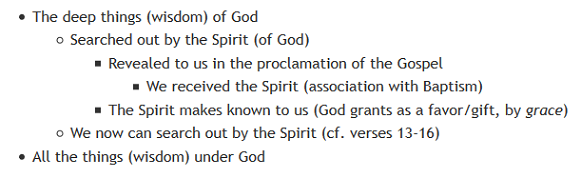
Finally, I would like to bring out a particular point of emphasis that is sometimes overlooked in this passage. When Paul speaks of the wisdom of God in terms of “the (deep) things” of God, he couches this within the general expression “all things” (pa/nta). In my view, this should be understood in an absolute comprehensive sense. Note how this is framed conceptually in chapters 2 & 3:

The wisdom of God encompasses “all things”, as Paul makes clear in 3:21-23, where he establishes a (hierarchical) chain of relationship, presented in reverse order—”all things” (pa/nta), he says:

belong to you (pl., believers), and you in turn
belong to Christ, who in turn
belongs to God the Father

If we allow ourselves to be guided by the Spirit and the mind of God/Christ, then we are free to study and examine all things (cf. 2:10, 15), and this itself becomes an integral expression of the “wisdom of God” which we speak.

August 31 (1): 1 Corinthians 3:1-3

[This series of notes is on 1 Corinthians 1:18-2:16; the previous note dealt with 2:16]

1 Corinthians 3:1-3

Before concluding this series of daily notes (on 1 Cor 1:18-2:16), it is necessary to study briefly the opening of the section which follows (3:1-4:21), in which Paul applies the arguments of 1:18ff more directly to the situation at Corinth. To begin with, the parallel between 2:6 and 3:1 is unmistakable, and must be noted:

“And we speak wisdom among the (one)s (who are) complete…” (2:6)
“And I was not able to speak to you as (one)s with the Spirit…” (3:1)

This allows us to supplement the earlier conclusions regarding a proper interpretation of 2:6a more precisely: the ones who are “complete” essentially = the ones who “have the Spirit”. However, the distinction in 2:6-16 was between those who have the Spirit and those who have (only) the soul/spirit of a human being—the contrast of the adjectives pneumatiko/$ and yuxiko/$ being that of believer vs. non-believer. Here in 3:1ff, on the other hand, Paul is speaking directly to believers, which means that he now gives a somewhat different nuance to the adjective pneumatiko/$ (“spiritual”). To the basic sense of “one who has (received) the Spirit”, we must add the connotation of “one who thinks/acts according to the Spirit“. This is confirmed by Paul’s use of the more familiar contrast between “Spirit” and “flesh”, with its strong moral/ethical implication. The Corinthian believers are not living out (i.e. thinking and acting according to) their identity as believers who have the Spirit. We can capture this through a careful translation of v. 1:

“And I, brothers, was not able to speak to you as (one)s of the Spirit [pneumatikoi/], but (rather) as (one)s (still) of the flesh [sarki/noi], as infants in (the) Anointed {Christ}.”

This “fleshly” manner of thinking/acting is marked by the very divisions (“rips/tears”) in the Community mentioned in 1:10ff, along with jealously, quarreling and partisan/sectarian identity (“of Paul”, “of Apollos”, etc). Paul actually makes use of two related adjectives:

    • sa/rkiko$ (sárkikos)—generally belonging to, or characterized by, the flesh (sa/rc)
    • sa/rkino$ (sárkinos)—more specifically, something made of, or constituted by, the flesh

The second of these is used initially in v. 1, followed by the first (twice) in v. 3. The adjective sa/rkino$ (sárkinos) carries the more neutral sense of a physical human being (i.e. made of flesh). It is used by Paul, somewhat metaphorically, in 2 Cor 3:3, while in Rom 7:14 it preserves the moral/ethical sense of the spirit vs. flesh distinction; the only other NT occurrence is in Heb 7:16. The adjective sa/rkiko$ (sárkikos) is a bit more common, used by Paul in 1 Cor 9:11; 2 Cor 1:12; 10:4 and Rom 15:27; the only non-Pauline occurrence in the NT is 1 Pet 2:11. It is likely that the specific use of sa/rkino$ in 3:1 is due to the earlier usage of the adjective yuxiko/$ (psychikós) in 2:14. There would seem to be a progression of terms involved, which narrows the focus of Paul’s discussion:

    • yuxiko/$ (2:14)—one who has the inner life-breath (“soul”) of a human being, but has not received the Spirit of God
    • sa/rkino$ (3:1)—a human being who is “made of flesh”, i.e. in his/her physical and sensual aspect
    • sa/rkiko$ (3:3)—a person who thinks/acts “according to the flesh”—that is, fundamentally in a sinful, selfish or “immature” manner

The progression involves a kind of natural and logical consequence:

    • The person without the Spirit is merely a human being, and is not able to be guided by the power and direction of the Spirit
    • He/she is left to be guided by his/her own natural impulses and inclinations, which tend to be dominated by physical and sensual concerns
    • As a result, the person tends to act, and ultimately think, in a selfish and sinful manner

This again allows us to refine a basic conclusion regarding Paul’s terminology in 2:6a: the ones who are “complete” are defined, in a negative sense by the opposite—those who think and act in a “fleshly” manner are “incomplete”.

The discussion on 1:18-2:16 will conclude (in a final note) with a summary interpretation of 2:6a in context.

August 28: 1 Cor 2:14-15 (continued)

[This series of notes is on 1 Corinthians 1:18-2:16]

1 Corinthians 2:14-15

In yesterday’s note, I provided a fairly detailed study on two key words used in these verses (14-15)—the adjective yuxiko/$ (related to yuxh/) and the verb a)nakri/nw. This was necessary in order to give a proper translation and interpretation of the passage.

“And the man with a soul does not receive [i.e. accept] the (thing)s of the Spirit of God, for it is (all) stupidity [mwri/a] to him and he is not able to know (them), (in) that they are judged (carefully) with the Spirit. And the (one) with the Spirit judges all ([th]ese) things, and (yet) he is judged under no one.”

It will be helpful to offer notes on specific words and phrases as they occur in the passage:

“with a soul”—I have decided, as a practical necessity, to slant the grammar of my translation, in order to give a meaningful rendering of the adjectives yuxiko/$ and pneumatiko/$ (cf. the previous note). Fundamentally, Paul’s use of yuxiko/$ here (and in 15:44-46), means a human being with a soul, but not yet united to (i.e. having received) the Spirit of God. As the prior look at the usage of yuxiko/$ in James 3:15 and Jude 19 makes clear, the sense of the term as a whole is not limited to this—it also connotes a distinctly worldly, human way of thinking and acting. However, Paul captures this more negative aspect in 1 Cor 1:18-2:16 by specific use of “world” (ko/smo$) and “(hu)man” (a&nqrwpo$).

“receive”—It is worth noting the difference between the verbs de/xomai (here) and lamba/nw (in v. 12), both of which can be rendered “receive”. The verb lamba/nw basically means “receive” in the sense of taking (hold) of something, while de/xomai as accepting something offered as a gift, etc. This also touches back on verse 12, where the “things of God [lit. under God]” are said to be given (by God) to us as a favor or gift. The human being without the Spirit does not (indeed, can not) receive or accept the things offered to us (believers) as a gift.

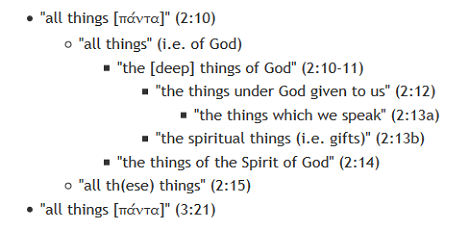
“the (thing)s of the Spirit of God”—Paul’s use of a plural substantive with the definite article (“the [thing]s…”) is an important syntactical (and thematic) element of his argument in 1:18-2:16, and especially of 2:6ff, where the emphatic “wisdom” (sofi/a), i.e. of God, is given collective (and comprehensive) expression by the plural. It begins with the Scriptural citation(s) in verse 9—”the (thing)s which” (a%)—and continues on through the passage:

    • V. 10: “all (thing)s [pa/nta]”
    • V. 10-11: “the deep (thing)s of God [ta\ ba/qh tou= qeou=]”; “the (thing)s of God [ta\ tou= qeou=]”
    • V. 12: “the (thing)s under God [ta\ u(po\ tou= qeou=] given as a favor/gift to us”
    • V. 13a: “the (thing)s which [a%] we also speak”
    • V. 13b: “spiritual (thing)s [pneumatika/]”, or better, “(thing)s of the Spirit”
    • V. 14: “the (thing)s of the Spirit of God [ta\ tou= pneu/mato$ tou= qeou=]”
    • V. 15: “all ([th]ese thing)s [{ta\} pa/nta]”

“to him it is stupidity”—The noun mwri/a (“dullness, stupidity”), along with the related adjective mwro/$ and verb mwrai/nw, is a keyword of the entire section (cf. 1:18, 20-21, 23, 25, 27, and the notes on these verses; also 3:18-19; 4:10). Previously it described the world’s view of God’s wisdom as expressed specifically in the proclamation of the Gospel (and the death of Christ); now, it represents the world’s reaction to the wisdom of God taken as a whole—”all the (deep) things of God”. Note how the comprehensive plural is here put into the singular “it is [e)stin]”; Paul may be suggesting that the human mind/soul is inclined to dismiss all of God’s wisdom at a single stroke. I have tried to capture this with a parenthesis—”it is (all) stupidity”. The pronoun is emphatic in the phrase: “to him [i.e. the human] it is stupidity”.

“he is not able to know (them)”—The verb du/namai essentially means having the power, i.e. being empowered, to do something. Paul has already established the connection between the Spirit of God and power (du/nami$) in 2:4-5 (cf. also 1:18, 24; 4:19-20). The idea of knowledge (gnw=nai [ginw/skw], “to know”) is implicit under the arching theme of wisdom (sofi/a) in the passage (cf. 2:8, 11, 16; also 3:20; 4:19). Earlier, Paul applied this to believers with the verb ei&dw (“see”, i.e. perceive, recognize, know) in 2:2, 11-12. The object of the verb “know” here has to be supplied—I identify it with the comprehensive plural (“the [thing]s…”, i.e. “them”) relating to the wisdom of God (cf. above).

“judged/judges”—Paul uses the verb a)nakri/nw three times in vv. 14-15. Understanding the prepositional component (a)na) to the verb as an intensive, I render it as “judge (something) closely”, in the basic sense of “examine closely/carefully”. Each instance of the verb here has a slightly different nuance:

    • “the things of the Spirit of God…are judged with the Spirit”—they can only be examined (and understood) spiritually, by way of the Spirit of God, through the guidance of the Spirit; this may be related to the idea of the Spirit “searching out” the (deep) things of God in vv. 10-11.
    • “the one with the Spirit judges all (these) things”—the Spirit enables the believer to examine all the things of God closely. It is possible that Paul is beginning to shift the meaning slightly, with a play on pa/nta (“all things”); there may be an allusion here to the idea of believers judging the world (“all things”), as in 6:2ff.
    • “he is judged under no one”—here it would seem that Paul is drawing on a specific judicial meaning of the verb (interrogate, etc); i.e. believers stand under the judgment of no other human being, since we are truly judged only by God before the (heavenly) tribunal at the end-time. This emphasis would seem to be confirmed by the parallel discussion in 4:1-5.

We should probably also understand a bit of word-play between a)nakri/nw and sugkri/nw in v. 13 (cf. below).

“with the Spirit”—As indicated above, I use this to render the adjective pneumatiko/$ (second instance in the translation above), but also the related adverb pneumatikw=$ (first instance above). This contrasts with the standard translation “spiritual(ly)”, which is accurate enough, but misses the comparison between the human soul and God’s Spirit. The adjective describes the person (the believer), who is characterized by the Spirit, while the adverb describes the action (judging/examining). There is almost certainly a close parallel to be drawn with the phrase in verse 13: “judging spiritual (thing)s with spiritual (word)s”. The verb sugkri/nw shares with a)nakri/nw the root verb kri/nw (“judge, examine,” etc), which is extremely wide-ranging, but usually retains something of the primitive sense (“separate, divide, sift/sort”). As believers examine the things of God (of his Spirit), by the Spirit, and begin to understand them, we are able to sift through them and bring them together, allowing us to express and communicate them to others in the body of Christ.

“all ([th]ese thing)s” ([ta\] pa/nta)—There is a textual question regarding this word. A number of important manuscripts (Ë46 A C D* al) include the definite article, while many others do not. If the article is original, it almost certainly means that Paul is referring specifically to “the (thing)s of God”, i.e. the wisdom of God in a comprehensive/collective sense (cf. above). Even if the article is secondary, it may indicate that scribes sought to make the same point clear, to avoid confusion—the word pa/nta (“all [thing]s”) being taken in a general sense. I believe that here, as in verse 10, Paul is playing on the two aspects of this word: (a) all things generally, and (b) the wisdom of God specifically. The dual meaning is more properly combined at the end of the chapter 3 (vv. 21-23), where “all things” (in creation, etc) are subsumed under Christ (the wisdom of God manifest), who is, in turn, under God (YHWH, the Father) himself.

“under no one”—The preposition u(po/ can carry an instrumental sense (“by [way of], through”), but more properly it means “under”; here specifically the reference is to believers being examined and judged (in a judicial sense) under a human authority. Only God truly has the authority to judge believers (in Christ), at the end time (cf. 4:1-5). Note an interesting kind of parallel in Paul’s use of u(po/:

The line of reasoning serves as a fittingly climax to the overall contrast of human vs. divine wisdom, etc, running through this section, and which culminates powerfully with the declaration in verse 16, to be discussed in the next daily note.

August 27: 1 Corinthians 2:14-15

[This series of notes is on 1 Corinthians 1:18-2:16; the previous day’s note dealt with 2:13]

1 Corinthians 2:14-15

Before proceeding with the translation of these verses, it is necessary first to examine two important words which are central to a correct interpretation of the passage.

yuxiko/$ (psychikós)—An adjective here parallel to pneumatiko/$ (pneumatikós), the two being related to the words yuxh/ (psych¢¡, usually translated “soul”) and pneu=ma (pneu¡ma, usually translated “spirit”), respectively. The fundamental meaning of both words is of something blowing (cf. the primary verbs yu/xw and pne/w)—especially of wind (as a natural phenomena) or breath (of a living being), the two concepts or images being related in the ancient mind (wind as the ‘breath’ of the deity). The main difference between the word-groups can be described this way:

    • yu/xw refers to blowing in the sense of cooling—i.e. a cool(ing), cold breeze
    • pne/w refers primarily to movement—a stream of air (i.e. wind) with its visible effect (causing motion)

Each aspect, however, could be (and was) related to the life-breath of a (human) being. The ancient conception is preserved in Genesis 2:7, in which God breathes (blows) a wind/breath into the first human being; according to the Greek version (LXX), God breathes/blows in (e)nefu/shsen) a “living breath [pnoh/]” and the man becomes a “living breath [yuxh/]”. Here we see the two words used in tandem—pnoh/ (pno¢¡, closely related to pneu=ma pneu¡ma) and yuxh/ (psych¢¡). John 20:22 records a similar process (a “new creation”), when Jesus blows/breathes in(to) the first believers and they receive the Holy Spirit [pneu=ma]. The distinction between the two nouns can be defined generally as follows:

    • yuxh/ is the “life-breath”—that is, the invisible, inward aspect of a person, marking him/her as a living, breathing being (i.e., “soul”)
    • pneu=ma is the life-giving “breath” which animates and sustains a (human) being (i.e. “spirit”)

The two terms overlap in meaning, and the relationship between them in Greek thought is rather complex. Paul uses them each to refer to the inner dimension of a human being, but they are not to be understood as separate “things”, as though a person has “a spirit” in addition to “a soul”. Earlier in 1 Cor 2:11, Paul refers to the “spirit/breath [pneu=ma] of man th(at is) in him“, and distinguishes it from the Spirit/Breath of God—that is to say, every human being has a “spirit” in him/her, but only believers (in Christ) have the “Spirit (of God)”. Now here in verse 14, a similar contrast is made—i.e., between the believer and the “ordinary” human being. This time, Paul establishes it, not by playing with the two senses of pneu=ma (“spirit”), but by playing on the difference between the two words pneu=ma and yuxh/ and their corresponding adjectives; which brings us to the problem of translation:

    • pneumatiko/$ (pneumatikós)—something belonging to, or characterized by, pneu=ma “spirit” (i.e. “spiritual”), only here it refers specifically to the “Spirit (of God)”
    • yuxiko/$ (psychikós)—something belonging to, or characterized by, yuxh/ “soul”, that is, the human soul

Unfortunately, there is no appropriate English word corresponding to this last adjective. A formal equivalence would be something like “soulish”, but that is exceedingly awkward. Most translators tend to use “natural”, for lack of any better option; however, while this manages to get the meaning across, and preserves a meaningful comparison here in verse 14, it distorts the original Greek and the fine word-distinction being used. Based on Paul’s vocabulary elsewhere, we might expect him to use the adjective sarkiko/$ (sarkikós, “fleshly”) here (see esp. 1 Cor 3:3, also Rom 15:27; 1 Cor 9:11; 2 Cor 1:12; 10:4). Only that word carries a definite negative connotation in Paul’s thought (associated with sin); here he wishes to preserve the more neutral, quasi-scientific sense of a normal, living human being. The adjective yuxiko/$ appears in only three other passages in the New Testament; in Paul’s letters, the only other occurrences are in 1 Cor 15:44-46, which I will touch on below. The other two instances are in James 3:15 and Jude 19 and may help us to understand its usage by Paul here:

    • James 3:15—As in 1 Cor 1:18-2:16, a contrast is made between the wisdom (sofi/a) of God (“from above”, a&nwqen) and earthly (e)pi/geio$) wisdom. The adjective “earthly” (lit. “[from] upon earth”) is followed by yuxiko/$, and then daimoniw/dh$ (“of the daimons“). Here yuxiko/$ means essentially human, as part of a triad of terms characterizing this inferior “wisdom”—earthly–human–demonic. In verse 16, the author (“James”) mentions jealousy and strife/quarrels associated with this worldly “wisdom”, which is also an important aspect of Paul’s argument in 1 Corinthians.
    • Jude 19—Again the adjective yuxiko/$ is the second of three descriptive terms, characterizing the ‘false’ Christians of vv. 5ff:
      (a) oi( a)podiori/zonte$ “the (one)s marking (themselves/others) off from”, i.e. separating (them) from the rest of the (true) believers
      (b) yuxikoi/—i.e. “ordinary” human beings, the term being glossed by
      (c) pneu=ma mh\ e&xonte$ “not holding/having the Spirit (of God)”

Paul uses the adjective yuxiko/$ in much the same sense as Jude—referring to human beings who possess a soul/spirit but who have not (yet) received the (Holy) Spirit. Without the guidance of the Spirit, they are led by their own human (or animal) desires and impulses.

a)nakri/nw (anakrínœ)—Paul uses this verb several times in vv. 14-15, but it does not allow for easy translation. The primary verb kri/nw I have consistently rendered with the semantic range “(to) judge”, sometimes with the nuance of “decide, examine,” etc, though its original meaning was something like “(to) separate, divide, distinguish”. The prepositional component a)na/ is best understood here as “again”, in the sense of doing something again (i.e. repeatedly); however, in the verbal context it essentially functions as an intensive element. Perhaps the best translation of the verb is “examine closely“; in a judicial setting, it can refer to an interrogation or investigation. More than half of the NT occurrences (10 of 16) are in 1 Corinthians, the only letter of Paul where the verb is used; 6 are in 1 Cor 1:18-4:21 (2:14-15; 4:3-4), being neatly divided:

    • 3: 2:14-15—the reference is to the “complete” believer, “the spiritual (one)” (see v. 6)
    • 3: 4:3-4—the reference is to Paul himself as a minister of Christ

On 1 Cor 15:44-46—Returning to the word yuxiko/$ (cf. above), it may be helpful to consider briefly Paul’s use of it in 1 Cor 15:44-46, where the context is the (end-time) resurrection. Here, too, it is contrasted with pneumatiko/$; the human being is:

    • scattered [i.e. sown, in death] (as) a yuxiko/$ body—i.e., as body in which there is a life-breath (yuxh/, “soul”)
    • raised [i.e. from the dead] (as) a pneumatiko/$ body—i.e., as a spiritual body, transformed by the Spirit of God/Christ

In verse 45, Paul explicitly cites Gen 2:7 (cf. above), making the contrast more definite—between the human soul [yuxh/] (Adam) and the Spirit [pneu=ma] (Christ). It is not simply the Spirit of God (YHWH), according to traditional Jewish thought; following his resurrection, Christ himself becomes a life-giving Spirit. The two passages, using the yuxiko/$/pneumatiko/$ contrast, reflect the two ends of early Christian (and Pauline) soteriology:

    • Regeneration—The believer experiences a “new creation” in Christ, whereby the human soul/spirit is united with the Spirit of God/Christ
    • Resurrection—The human soul (and body) of the believer is completely transformed by the Spirit of God/Christ

In 1 Cor 2:14-15, Paul has the first of these in view. The analysis above should go far in helping us gain a solid understanding of what Paul is saying in these two verses. A translation and (brief) interpretation will be offered in the next daily note.

August 26: 1 Corinthians 2:13

[This series of notes is on 1 Corinthians 1:18-2:16; the previous day’s note dealt with 2:12]

1 Corinthians 2:13

“…which we also speak not in words taught of [i.e. by] (hu)man wisdom, but in (words) taught of [i.e. by] (the) Spirit, judging spiritual (thing)s together with/by spiritual (word)s.”

It must be emphasized that this verse, along with much that follows in vv. 14-15, is difficult to translate accurately into English, for a variety of reasons. Here, especially, translation and interpretation go hand-in-hand. To begin with, verse 13 builds upon (and concludes) the declaration in v. 12 (cf. the prior note). The relative pronoun form a% (“which”) refers back to the concluding expression of v. 12: “the (thing)s under God given as a favor to us”. In the note on v. 12, I pointed out the parallel between this expression and “the deep (thing)s of God”, and connected both to the “wisdom of God” mentioned previously—and especially at the beginning of verse 6. This is confirmed by Paul’s language here at the start of v. 13:

    • “we speak (the) wisdom [of God]” (vv. 6-7)
    • “which (thing)s we also [kai/] speak” (v. 13)

The particle kai/ should be regarded as significant here, since it may be intended to draw a distinction between what it is that “we” speak in vv. 6-7 and 13, respectively. There are two ways to place the emphasis:

    • “these things also we speak“—as it is have been given to us to know them, so also we speak/declare them
    • “these things also we speak”—not only the Gospel do we proclaim, but all the deep things of God given to us by the Spirit

Most commentators opt for the first reading, according to the immediate context of vv. 12-13; however, the overall flow and structure of Paul’s argument in vv. 6-16 perhaps favors the second. More important to the meaning of the verse is the continuation of the comparison/contrast between worldly/human wisdom and the wisdom of God. Here Paul formulates this with a specific expression: “in words of… [e)n…lo/goi$]”. I have regularly been translating lo/go$ as “account” (i.e. oral, in speech); but here it is perhaps better to revert to a more conventional translation which emphasizes the elements or components of the account (i.e. the words). Earlier, in 1:17 and 2:1ff, Paul uses lo/go$ in the sense of the manner or style of speech used (in proclaiming the Gospel); here he seems to be referring to the actual content (the words) that a person speaks. The contrast he establishes is as follows:

    • “in words taught of [i.e. by] (hu)man wisdom” (e)n didaktoi=$ a)nqrwpi/nh$ sofi/a$ lo/goi$)
    • “in (word)s taught of [i.e. by] (the) Spirit” (e)n didaktoi=$ pneu/mato$ [lo/goi$])
      Note: I include lo/goi$ in square brackets as implied, to fill out the comparison, though it is not in the text

The contrast is explicit—”not [ou)k] in… but (rather) [a)ll’] in…” Especially significant too is the use of the adjective didakto/$ (“[being] taught”, sometimes in the sense “able to be taught”, “teachable”), rare in both the New Testament and the LXX. The only other NT occurrence is in the discourse of Jesus in John 6:45, citing Isa 54:13, part of an eschatological prophecy where it is stated that the descendants of God’s people (“your sons/children”) “…will all (be) taught [didaktou\$] by God”. This same reference is certainly in the background in 1 Thess 4:9, where Paul uses the unique compound form qeodi/dakto$ (“taught by God”). This passage is helpful for an understanding of Paul’s thought here:

“And about the fondness for (the) brother(s) [i.e. fellow believers] you hold no occasion [i.e. there is no need] (for me) to write to you, for you (your)selves are taught by God [qeodi/daktoi] unto the loving of (each) other [i.e. to love one another].”

If we ask how believers are “taught by God”, apart from Paul’s written instruction, there are several possibilities:

    • The common preaching and tradition(s) which have been received (including the sayings/teachings of Jesus, etc)
    • The common witness and teaching of the believers together, in community
    • The (internal) testimony and guidance of the Spirit

Probably it is the last of these that Paul has primarily in mind, though not necessarily to the exclusion of the others. For a similar mode of thinking expressed in Johannine tradition, cf. 1 John 2:7-8, 21, 24; 3:10ff; 4:7-8ff, and the important passages in the discourses of Jesus in the Gospel. Here, in 1 Cor 2:13, it is clear that Paul is referring to the work of the Spirit. That the Spirit would give (“teach”) believers (and, especially, Christian ministers/missionaries) the words to say was already a prominent feature of the sayings of Jesus in Gospel tradition (Mark 13:11 par, etc), depicted as being fulfilled with the first preachers of the Gospel in the book of Acts (2:4ff; 4:8, 29ff; 6:10, etc). However, the underlying thought should not be limited to the (uniquely) inspired preaching of the apostles, but to all believers. Paul’s use of “we” in this regard will be discussed in more detail in an upcoming note (on 1 Cor 2:16).

Particularly difficult to translate is the verb sugkri/nw in the last phrase of verse 13. A standard literal rendering would be “judge together” or “judge [i.e. compare] (one thing) with (another)”. However, in the case of this verb, it is sometimes better to retain the more primitive meaning of selecting and bringing/joining (things) together. Paul’s phrase here is richly compact—pneumatikoi=$ pneumatika\ sugkri/nonte$. He (literally) joins together two plural forms of the adjective pneumatiko/$ (“spiritual”), one masculine, the other neuter. The first is in the dative case, but without any preposition specified, indicating a rendering something like “spiritual (thing)s with/by spiritual (one)s”. However, given the expression e)n…lo/goi$ (“in words of…”) earlier in the verse, it is probably best to read this into the context here as well. I would thus suggest the following basic translation:

“bringing together spiritual (thing)s in spiritual (word)s”

I take this to mean that the “spiritual things” are given expression—and communicated to other believers—through “spiritual words”, i.e. words given/taught to a person by the Spirit. The “spiritual (thing)s [pneumatika]” almost certainly refer to “the deep (thing)s of God” and “the (thing)s under God” in vv. 10 and 12, respectively. The Spirit “searches out” these things and reveals or imparts them to believers. This is especially so in the case of ministers—those gifted to prophesy and teach, etc—but, according to the view expressed throughout chapters 12-14, in particular, all believers have (or should have) gifts provided by the Spirit which they can (and ought to) impart to others. This allows us to draw yet another conclusion regarding the “wisdom” mentioned in verse 6a: it is “taught” by the Spirit to believers, and is to be communicated (“spoken”) to others in turn. It is also worth noting that all throughout the discussion in verses 9-13, there is no real indication that this “wisdom” is limited to the proclamation of the death/resurrection of Jesus. We should perhaps keep an eye ahead to Paul’s discussion of the “spiritual (thing)s” in chapters 12-14.

Tomorrow’s note will examine verses 14-15.

August 25: 1 Corinthians 2:12

[This series of notes is on 1 Corinthians 1:18-2:16; the previous note dealt with 2:10]

1 Corinthians 2:12

“And (so) we did not receive the spirit of the world, but the Spirit th(at is) out of [i.e. from] God, (so) that we should see [i.e. know] the (thing)s under God given as a favor to us.”

This declaration follows upon what has been stated in vv. 10-11 (cf. the prior note). The first half of the verse continues the running contrast between God and the world—only Paul now shifts from wisdom (sofi/a) to spirit (pneu=ma):

    • “the spirit of the world” (to\ pneu=ma tou= ko/smou)
    • “the Spirit th(at is) out of [i.e. from] God” (to\ pneu=ma to\ e)k tou= qeou=)

Note the slight difference in terminology:

(1) the first phrase uses an expression with the genitive (of the world), which can either be subjective (belonging to the world) or objective (consisting of [the things of] the world)—both are possible, but the former perhaps fits the context (and the comparison) better
(2) the second phrase uses the preposition e)k (“out of, from”), indicating primarily the source of the spirit (God himself)

The “spirit of the world” builds upon “the spirit of man” in v. 11:

    • “the spirit of man” (to\ pneu=ma tou= a)nqrw/pou)—the invisible, inner aspect (“th[at is] in him”) of a human being, corresponding roughly with our concept of “soul”; the relation between the terms pneu=ma (“spirit”), yuxh/ (“soul”), and nou=$ (“mind”) in Greek thought and anthropology is complex, and Paul uses all three terms in the verses which follow.
    • “the spirit of the world” (to\ pneu=ma tou= ko/smou)—this expression is parallel to “the wisdom of the world” in 1:20 (and 3:19), with the term “world” (and “of the world”) appearing repeatedly throughout the passage (cf. 1:20-21, 27-28). The Greek ko/smo$ fundamentally refers to an (orderly) arrangement, sometimes emphasizing decorative beauty; commonly it applies to the order of creation or the world. Paul, and other New Testament writers draw upon a basic three-fold meaning for the term:
      (a) the created order, along with the powers which govern it
      (b) the human institutions, authorities, etc, which govern and dominate the operation of society, and
      (c) humankind, or human society, treated collectively
      Often in early Christian thought ko/smo$ has a decidedly negative connotation—signifying the corrupt/sinful condition of humankind (and creation at large), and especially human thought and endeavor which is opposed to God or seeks to function apart from him. The expression “spirit of man” is essentially neutral, while “spirit of the world” draws upon this negative meaning.

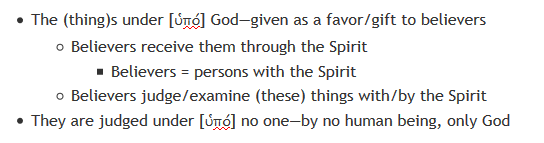
There are several points to consider in the second half of the verse. First, we should note the connecting particle i%na (“[so] that”), indicating purpose—we received the Spirit from God so that we might see, etc. The verb form ei)dw=men (from ei&dw, “see”) is a rare occurrence of a perfect subjunctive; there are only 10 occurrences in the New Testament (apart from several participial forms), and always with the verb ei&dw (Mark 2:10 par; 1 Cor 13:2; 14:11, etc). Rendered literally, the phrase would be “so that we might have seen…”, but this is misleading in English; the (intensive or consummative) force of the phrase is perhaps better translated, “so that we might surely/truly see…”. In Greek idiom, to “see” (esp. with the verb ei&dw) essentially means to know (i.e. perceive, recognize). And what is it that we might come to see/know?—this is expressed in the final phrase of the verse: “the (thing)s given as a favor to us under God”. The verb xari/zomai is derived from the noun xa/ri$ (“favor”) and means “give/grant/do (something) as a favor”. It is relatively frequent in the Pauline letters (16 of the 23 occurrences in the NT), though the noun xa/ri$ (typically translated “grace”, or, more accurately, “gift”) is much more common. The preposition u(po/ (“under”) means that the things given as a favor to believers are under God’s control and come through his guidance and generosity. Note the important parallel with verse 10:

    • “the deep (thing)s of God” (ta\ ba/qh tou= qeou=)
    • “the (thing)s under God” (ta\ u(po\ tou= qeou=)

In a locative sense, u(po/ indicates “beneath”, making the connection with the “deeps/depths” of God more obvious. There is no way in English to translate the plural literally without adding in a word like “thing”—”the (thing)s…”—and yet it is perhaps not entirely appropriate to the Greek idiom. We should perhaps understand the formal expression in a collective, comprehensive sense—i.e., “(all) the depths of God”, “(every)thing under God” (cf. ta\ pa/nta, “all [thing]s” in v. 10a). In terms of Paul’s thought here, it also would not be inappropriate to combine the expressions—”all the deep (thing)s under God”—to summarize what it is that God, through the Spirit, gives to us as a favor (or gift). We might outline this as follows:

This analysis also allows us to draw several additional conclusions regarding the interpretation of verse 6a (cf. the previous daily notes):

    • The “wisdom” is not limited to the Gospel message, but ought to be understood more comprehensively as “all the (deep) things under God”.
    • It is dependent upon our having received the (Holy) Spirit
    • Through the Spirit we are able to know and experience this wisdom

It will be possible to expand upon these points as we proceed through vv. 13-16 in the upcoming notes.

August 24: 1 Corinthians 2:10

[This series of notes is on 1 Corinthians 1:18-2:16; the previous day’s note dealt with 2:6]

1 Corinthians 2:10

“And (yet) to us God has uncovered (this) through the Spirit—for the Spirit searches out all (thing)s, and (even) the deep(est thing)s of God.”

The statement in verse 10 is the culmination of the line of argument in vv. 6ff. It may be helpful to outline the thematic (and logical) development:

  • There is a wisdom spoken to the believers who are “complete”—it is different from the wisdom of this Age and its rulers/leaders (who have no effect for believers and will be without power in the Age to Come) [v. 6]
    • instead (“but/rather”, a)lla), this wisdom (of God) is spoken in a secret hidden away from the world [v. 7a]
      • which [h%n] God established (“marked out”) before the beginning of this Age, for the honor/glory of believers [v. 7b], and
      • which [h%n] none of the rulers/leaders of this Age knew (or understood) [v. 8]
        —demonstrated by the fact that they put Jesus Christ (“the Lord of honor/glory”) to death
        • instead (“but/rather”, a)lla), this secret was prepared beforehand, only to be revealed for “those who love God” [v. 9, citing Scripture]
          • and (de) God has revealed this to us (believers) through the Spirit [v. 10]

The thrust of this argument is clear: the wisdom of God has been kept secret, hidden away from the world, and is only revealed now to believers through the Spirit. The emphasis on the Spirit (of God) here is vital to Paul’s discussion. With regard to a correct interpretation of verse 6a (cf. the previous note), it is possible to make at least one firm conclusion—the wisdom spoken to the “complete” comes by way of the Spirit. No other source of “wisdom” is possible. Based on the context of vv. 6ff, we may assume that apostles and ministers (such as Paul), are the immediate (proximate) source, as chosen/inspired preachers and teachers, to communicate this wisdom. The wording in v. 6 (“we speak…”) is slightly ambiguous—it could refer to (a) Paul primarily, (b) Paul and his fellow ministers, or (c) believers generally. Probably the first person plural should be understood as inclusive of all three points of reference, in the order given here: Paul (founding Apostle)–Ministers–Believers.

It is significant that the work of the Spirit essentially reverses the process established by God—the (secret) wisdom is, first:

    • hidden from [a)pokekrumme/nhn] the world [v. 7], and then
    • the cover is removed from [a)peka/luyen] it [v. 10], revealing it to believers

The first verb (a)pokru/ptw, “hide [away] from”) is a passive perfect (participle) form, indicating action which began at a point (in time) and the force or effect of which continues into the present. It is an example of the “divine passive”, with God as the one performing the action (unstated). As a participle it modifies the noun “wisdom” (sofi/a), emphasizing its character as hidden/secret wisdom; this is especially clear from the precise Greek syntax and word order:

    • wisdom of God
      —in (a) secret
    • hidden from (the world)

The second verb (a)pokalu/ptw, “take/remove the cover from”, i.e. “uncover”) is a simple aorist indicative form with God as the subject. The aorist would suggest a past action performed by God (through the Spirit); there are several possibilities for a specific point of reference here:

    • The resurrection and exaltation of Jesus
    • The preaching/communication of the Gospel
    • The receipt of the Spirit by believers (associated with the baptism ritual)
    • Post-conversion work/manifestation of the Spirit to believers

The second of these—the proclamation of the Gospel (by Paul and his fellow ministers)—best fits the context. This allows us to draw a second conclusion regarding the interpretation of v. 6a: the revelation of the (secret) wisdom of God is fundamentally tied to the proclamation of the Gospel. However, I believe we will gain additional insight by a careful consideration of the last half of verse 10, which describes more generally the work of the Spirit:

“…for the Spirit searches out all (thing)s, and (even) the deep(est thing)s of God”

Two phrases are combined, the second of which builds on the first:

    • “for the Spirit searches out [e)rauna=|] all things [pa/nta]
      • even the deep things [ta\ ba/qh] of God

The essential activity of the Spirit is described by the verb e)reuna/w, which means to search out (or after) something. The searching of God’s Spirit is all-powerful and all-inclusive—it searches out all things. The second phrase narrows this to “the deep things” of God. The idea is that the Spirit, in its searching, travels (steps) all the way to the “depths” of God himself, in a manner (somewhat) similar to the functioning of the human “spirit” (v. 11). By inference, we may draw a third conclusion in relation to verse 6a: the hidden wisdom of God relates to the very depths (the deepest parts) of God’s own being. It is an extraordinary thought (and claim) that the Spirit might communicate to believers the deepest wisdom of God himself. Perhaps this suggests something of what Paul means when he states that such wisdom is spoken to “the ones (who are) complete” (in this regard, see esp. the famous words of Jesus in Matt 5:48). For a more immediate exposition (and explanation), in the context of this passage, we now turn to verse 12, to be discussed in the next daily note.

Commentators have had difficulty identifying the Scripture Paul cites in verse 9. The citation formula (“as it has been written”) clearly indicates that he regards it as coming from the Scriptures, yet it does not quite correspond with anything in the books of the Old Testament as they have come down to us. There are two possibilities:

  1. He freely quotes or alludes to parts of a number of passages, combining them in a creative fashion. Perhaps the most likely passages would be Isa 52:15; 64:4; 65:17; Jer 3:16; Sirach 1:10. New Testament authors frequently cite or allude to the Scriptures very loosely, adapting them freely—either from memory, or intentionally in order to fit the circumstances in which they are writing.
  2. Paul is quoting from a book otherwise unknown or lost to us today. Origen (Commentary on Matthew 5:29) states that it comes from an “Apocalypse of Elijah”, but it is impossible to verify this one way or the other. It is also found in the Ascension of Isaiah 8:11, but that work has been heavily Christianized and probably is simply citing 1 Cor 2:9.

The first option is much more likely; probably Isaiah 64:4 is most directly in Paul’s mind.

August 7: 2 Corinthians 3:1-6

This is the first of three notes on 2 Corinthians 3:1-18, which I am dividing into three portions:

2 Corinthians 3:1-6 [verse 6]

Throughout chapters 1-7, Paul is dealing primarily with his role as an apostle and, in particular, with his relationship to the believers in Corinth. At various points there are suggestions of opposition to Paul, including the situation referenced in 2:1-11, regarding which he had sent an earlier “painful letter” (vv. 5, 9). Specific (but unidentified) opponents are addressed far more directly (and harshly) in chapters 10-13. The context of chs. 10-13 suggests that at least some of these opponents are Jewish Christians (11:21ff), as in Galatians (cf. also Phil 3:2ff and Col 2:11ff, 16-18), and this may inform the rhetorical approach in 2 Cor 3 as well.

The theme in verse 1-6 involves “letters of commendation”; the word sustatiko/$ is derived from suni/sthmi/sunista/w (“stand [together] with”), in the sense of placing things together (and presenting them) in front of someone. As a technical term, it came to be applied to letters a person carried, introducing him/her to another group or in a place where he/she was not known. In the ancient world, which lacked modern-day high-speed communication, such practice was necessary to establish a person’s identity and credentials; it also could serve as a source of authority and legitimacy. Naturally enough, the more impressive or prestigious the letter of recommendation, the more influence it provided; even today, the right letter of recommendation still carries tremendous weight for prospective employers, and so forth. It is possible that Paul’s opponents included visiting “apostles” who possessed such letters and credentials. In vv. 1-6, he argues that neither he nor his colleagues require written letters recommending them to the believers of Corinth, since they are already well known—that is to say, this written authentication is already there in the hearts of the believers, having been written by the very Spirit of God (v. 4). He is referring primarily to the work of preaching the Gospel, which the Corinthian believers accepted; as a result they themselves become “the epistle of Christ”, under the service/ministry of Paul and his fellow missionaries.

It is interesting the way that this image leads Paul so readily to the dualistic juxtaposition contrasting the old and new covenants, in terms of “the written (word/letter) [to\ gra/mma]” and “the Spirit [to\ pneu=ma]”. See how this contrast in made, twice, in vv. 1-3 and 4-6:

    • Commendatory letters for apostles—believers under their ministry
      • written in the heart
        • contrast with being written in tablets of stone (v. 3)
    • Confidence for apostles before God—ministers of a new covenant
      • of the Spirit
        • contrast with the written word (v. 6)

When examining verses 7-11, it will be necessary to consider just why Paul makes this connection here between his apostolic ministry and the old covenant established with Israel. For the time being, we should focus upon the formulation in verse 6, where, after identifying himself (and his colleagues) as “servants/ministers of a new covenant“, Paul adds:

“…not of (the) written (word), but of (the) Spirit; for the written (word) kills off, but the Spirit makes alive”

To someone unfamiliar with Galatians and Romans, this would be a striking declaration, especially his statement that the “written (word) kills”—that is, the Law, specifically in its written form, brings death. Paul explains and expounds this idea in Romans 5-7 (note, in particular, Rom 7:7ff); even so, it must have been rather shocking to believers at the time—as it still is for many today. For the particular identification of the Law with the written word (gra/mma), see Rom 2:27, 29; 7:6, and note also Col 2:14. In Rom 2:27-29 and 7:6 there is the same contrast between the Spirit and the written word.

How are we to understand this stark distinction between the written word and the Spirit? On the surface, it would seem to raise question as to the authority and role of Scripture itself. But one must be cautious about proceeding in this direction; Paul is referring primarily to the written record of the Law (in the Pentateuch), which is also, secondarily, expounded and declared in the Prophets (and Psalms)—this accords squarely with Jewish and early Christian tradition. It is noteworthy how rarely Paul cites the Old Testament Scriptures for the purpose of instruction; his usage is limited mainly to (prophetic) support of the Gospel—and his particular exposition and application of the Gospel. To this must be added his remarkable teaching regarding the fundamental purpose of the Law—which is to bring knowledge and awareness of sin (Rom 3:20), that is to say, it makes fully manifest the reality that human beings are enslaved under the power of sin (Gal 3:19ff, also Rom 7:7ff). Without a recognition of God’s saving work in Christ, even those scrupulously observing the commands of the Law (and studying Scripture) remain fully in bondage under sin. In this sense, the Law leads to death, not life (Rom 7:9-11ff). This Paul will explain again in more detail, continuing with verses 7-11, which I will discuss in the next daily note.