November 9: Colossians 1:17

Transition: Col 1:17-18a

The two couplets of vv. 17-18a sit between the two stanzas of the hymn, and should be treated as a distinct unit. This unit also represents, arguably, the most distinctively Pauline portion of the Christ-hymn. If, as many commentators believe, Paul adapted an existing hymn, it seems likely that these couplets were included as his own addition to the composition. The lines are certainly transitional, with the first couplet (v. 17) continuing the thematic focus of the first stanza (the first creation), and the second (v. 18a) anticipating that of the second stanza (the new creation).

Colossians 1:17

kai\ au)to/$ e)stin pro\ pa/ntwn
kai\ ta\ pa/nta e)n au)tw=| sune/sthken
“and he is before all (thing)s,
and all (thing)s have stood together in him”

The initial conjunction kai/ of the first line marks the transitional character of these couplets, as noted above. The pronoun au)to/$ (“he”) is emphatic, and relates to the relative pronoun (o%$) that begins each stanza of the hymn. Indeed the phrase au)to/$ e)stin (“he is”) is precisely parallel to the opening of each stanza (o%$ e)stin, “who is”). It thus continues the Christological focus of the hymn, as a declaration of who Jesus (the Son) is.

The adjective pa=$ (“all”), as a substantive (collective) plural (i.e., “all [the] things”), was used earlier in v. 16 (cf. also the adjective in v. 15b). It also happens to represent an important part of the Pauline vocabulary, as he frequently uses the substantive adjective in a comprehensive, collective sense, though less commonly in a cosmological context, as here (see esp. 1 Cor 15:24-28). The reference here is to all things (everything) in the universe, with particular emphasis on all intelligent living beings (human beings, etc). The adjective is used in both lines of the couplet, giving double emphasis to the idea of Jesus’ place in relation to all of creation.

This relationship is indicated by two prepositional phrases: “he is before [pro/]” in the first line, and “(is) in him [e)n au)tw=|]” in the second. There is a semantic ambiguity with the first preposition, pro/, “before”, which can be understood in either a temporal or positional-relational sense. A temporal meaning is certainly possible, especially given the repeated use of pro/ in the LXX of Prov 8:22ff, which shares the theme of the pre-existence of divine Wisdom and its role in creation. However, it is worth noting that the preposition does not occur in any of the prominent pre-existence passages of the New Testament (such as the Johannine Prologue; cp. the comparable use of pri/n in Jn 8:58). In 1 Cor 2:7, Paul uses the preposition in a temporal sense, and in a context similar to that of the hymn (cf. also Eph 1:4).

The parallelism with the second couplet strongly suggests that a positional-relational meaning of pro/ is in view, given the parallel with the idea of Jesus as the “head” (kefalh/). That is to say, Jesus holds the chief place, the ruling and governing position, over all creation, and is thus “before” all things in that sense. In point of fact, the hymn emphasizes both the temporal and positional-relational aspects—that is, the pre-existence of Jesus the Son (with his role in creation) and his ruling position over the cosmos.

The verb in the second line is suni/sthmi, “stand together, (trans.) set together”. It is a distinctly Pauline term, as 14 of the 16 occurrences in the New Testament are in Paul’s letters (2 Corinthians, Romans, Galatians, and here in Colossians). Paul tends to use the verb in a general, transitive sense— “set/place together”, i.e., “establish, confirm” (Rom 3:5; 5:8; Gal 2:18); the specialized sense in 2 Corinthians, involving the question of ministers bearing letters of confirmation or recommendation (3:1; 4:2, et al), follows the technical use of the verb in Rom 16:1. Here in the hymn is the only Pauline use of the verb in a cosmological-philosophical sense, akin to the way Philo of Alexandria, for example, uses it (Who Is the Heir of the Divine Things §58), in reference to the Logos (lo/go$) as the governing power of God by which all things in the universe are “held together” (sune/sthke). The Logos is similarly described as a “bond”, the binding force, that holds the cosmos together (Who Is the Heir §23, cf. On Flight and Finding §112, Barth/Blanke, pp. 204-5).

As previously noted, this Logos-theology was influenced by Hellenistic Jewish Wisdom-tradition, associating Wisdom with the creation and existence/sustenance of the world, that stretches back to the famous passage in Prov 8:22-31. In Wisdom 1:7, the Wisdom of God is said to be that which holds all things together (sune/xon ta\ pa/nta); while in Sirach 43:26, it is stated that all things lay (bound) together (su/geitai ta\ pa/nta) in the Word (Lo/go$) of God. The Sirach passage is actually quite close to Col 1:17 with the phrase e)n lo/gw| (“in the Logos”), comparable to e)n au)tw=| (“in him”, i.e. in Christ). The wording in 2 Peter 3:5 is even closer, when it speaks of the heavens and earth “having stood together [sunestw=sa] in the Word of God [e)n tw=| tou= qeou= lo/gw|]”. There can be no doubt that similar concepts and phraseology underlie the wording of v. 17 in the hymn as well.

While the expression “in him” (e)n au)tw=|) may refer primarily to the creation and existence of the cosmos, it carries a deeper meaning as used by Paul, given the importance of the expression “in Christ” (e)n Xristw=|, with variations) in his letters, where it occurs dozens of times. The principal concept is of believers being united—with God and with one another—in the person of Jesus Christ. This occurs both symbolically (through the baptism ritual, etc) and essentially, through the presence of the Spirit. Paul may well have expected his readers to make the association, and the transition, readily from the cosmos being bound together in Christ to the idea of believers being bound together in him. In any case, this is precisely the transition that occurs in the hymn, beginning with the second intervening couplet (v. 18a). We will examine this second couplet in our next daily note.

References above marked “Barth/Blanke” are to Markus Barth and Helmut Blanke, Colossians, transl. by Astrid B. Beck, Anchor Bible [AB] vol. 34B (1994).

November 4: Colossians 1:16a

Colossians 1:16a

o%ti e)n au)tw=| e)kti/sqe ta\ pa/nta
e)n toi=$ ou)ranoi=$ kai\ e)pi\ th=$ gh=$
ta\ o)rata\ kai\ ta\ a)o/rata

“(for it is) that in him were founded all the (thing)s,
in the heavens and upon the earth,
the (thing)s seeable and (thing)s unseeable…”

The complex clause of verse 16 is subordinate to v. 15, and epexegetical. It further explains what it means to say that Jesus is the “likeness/image of God”, and also the “first-born” of all that has been created; indeed, it gives us the reason why it is right to speak of Jesus this way. The conjunctive particle o%ti, is explicative, with causal force—i.e., “(for it is) that…”.

There is a clear and carefully constructed symmetry to this statement in v. 16, with a framework governed by prepositional expressions which relate back to the initial relative pronoun. These prepositional phrases enclose the remainder of the verse, so that we may outline the structure of vv. 15-16 as follows:

    • “who is [o%$ e)stin]…”
      • “in him [e)n au)tw=|]…”
        …….
      • “through him [di’ au)tou=]
        and unto him [ei)$ au)to/n]…”

The three expressions, utilizing three different prepositions, are: “in [e)n] him…through [di/a] him and unto [ei)$] him”. This is similar to triadic formulae with a cosmological-existential orientation in contemporary Greek philosophy (cf. the Areopagus speech by Paul, Acts 17:28). The particular triad here is comparable to that used by certain Stoic philosophers and authors, one of the most notable being Marcus Aurelius, in his Contemplations (4.23). Closer in time and religious background to our hymn is the Hellenistic Jewish philosopher-commentator Philo of Alexandria (cf. On the Cherubim 125). The entire subject has been documented in E. Norden’s classic study Agnostos Theos (1913), esp. pp. 240-50, and cf. also M. Robinson, “A Formal Analysis of Colossians,” 1:15-20, Journal of Biblical Literature [JBL] 76 (1957), p. 276; R. M. Grant, “Causation and ‘the Ancient World View,'” JBL 83 (1964), p. 35 (Barth/Blanke, p, 197).

Here, the three expressions are not presented as a simple triad; rather, they are divided into two parts, involving two parallel statements:

“in him all (thing)s were founded…
all (thing)s have been founded through him and unto him“

Both of these statements involve the verb kti/zw, related to the noun kti/si$ in v. 15. The verb has the basic meaning “found, establish, build”, and here clearly refers to the founding (i.e. creation) of the cosmos by God. The passive form of the verb is an example of the so-called “divine passive” (passivum divinum), with God as the implied subject—i.e., “…were founded (by God)”. The initial occurrence here is an aorist form, the second a perfect form; the aorist typically is used for an event or action which occurred in the past, while the perfect often refers to a past action or condition which continues into the present.

As previously noted, Paul uses the noun kti/si$ (and the verb kti/zw) in two ways: (1) in reference to the original creation of the universe (and human beings) by God, and (2) for the new creation, realized (presently) by believers in Christ. The new creation is patterned after the original (first) creation. When looking at the structure of the hymn as a whole, it becomes clear that the two stanzas relate to these two aspects (or stages) of God’s work of creation; moreover, the same dual-aspect is present in the intervening pair of couplets of v. 17. That the first creation is in view here in vv. 15-16 is confirmed by two other factors: (a) the aorist passive e)kti/sqh, as something done by God in the past, and (b) the substantive adjective ta\ pa/nta (“all things”), as a short-hand for the (current) created order.

Paul frequently uses the substantive plural of pa=$ (“all”), in a general and comprehensive sense (“all things”), though less frequently in a cosmological context (cf. 1 Cor 15:28; 2 Cor 5:18). Here the reference is to ‘everything in the cosmos’, especially ‘every living, intelligent being’, as the central phrases of v. 16 make clear. The first two (of the four) central phrases are:

“in the heavens and upon the earth,
the seeable (thing)s and the unseeable (thing)s”

“Heaven and earth” is a conventional shorthand for referring to the cosmos (the world/universe) as a whole, and ultimately relates back to the basic bipartate (geocentric) cosmology of the ancient Near East. Even by the mid-1st century, in the Greco-Roman world, when a somewhat more sophisticated geocentric cosmology had developed, “heaven and earth” still served as a simple shorthand for the universe. The adjective a)o/rato$ was used in v. 15, in reference to God as “unseeable”, unable to be seen by human beings; other divine/heavenly beings (Angels, etc) are similarly understood as ‘invisible’, unable to be seen by humans in ordinary circumstances. The adjective o(rato/$, without the privative prefix a)-, naturally represents the opposite: what is visible and can be seen normally by human beings (with their eyes). Divine/heavenly beings tend to be located in “the heavens”, while human beings are on “the earth”; thus, the two phrases are generally synonymous, and in parallel, for a comprehensive description of the cosmos—esp. the inhabitants of the cosmos.

What does it mean to say that the cosmos and its inhabitants were created “in” Jesus (e)n au)tw=|, “in him”)? The contemporary Roman philosopher Seneca provides an explanation of the (Stoic) existential-cosmological triad (cf. above), and the various prepositions used (Epistle 65.8, cf. Barth/Blanke, p. 197-8). In this context, the preposition e)n (“in”) refers to the pattern or model used (by God) in creation. The closest New Testament parallel is in the Prologue of the Gospel of John (1:4): “in him was life” (e)n au)tw=| zwh\ h@n)—a parallel that would even be closer if the prior two words were included in the phrase, i.e. “that which has come to be in him was life”, but the precise reading (and punctuation) of vv. 3-4 remains in dispute. In any case, the expression “in him” in that passage is clearly related to the creation of the universe (“all things came to be”, “that which has come to be”), just as it is here in Colossians.

This will be discussed further in the next daily note, as we continue the study of v. 16.

References above marked “Barth/Blanke” are to Markus Barth and Helmut Blanke, Colossians, transl. by Astrid B. Beck, Anchor Bible [AB] 34B (1994).

July 13: Ephesians 4:1-6

Ephesians 4:1-6

The same theme of Christian unity in the first half of Ephesians (chaps. 1-3) continues in the second half (chaps. 4-6), but with the theological emphasis giving way to the practical. The theological (and Christological) exposition concludes with the praise declaration of 3:20-21, which itself recapitulates the message of chaps. 1-3, through the unifying expressions “in the e)kklhsi/a” and “in (the) Anointed Yeshua” —that is to say, God’s presence and power is manifest among believers (the e)kklhsi/a, those “called out” to assemble as one), who are united together “in Christ”. The central point of unity in all this is the Spirit, as discussed in the previous notes on 2:18-22.

Chapter 4 is written with the message of chaps. 1-3 clearly in view; here is how Paul (or the author) begins:

“(So) then, I call you alongside—I, (the one) held bound in (the) Lord—(urging you) to walk about (in a way that is) brought (in balance with) the calling with which you were called”

The ethical orientation is clear enough, repeating a line of instruction that was widespread among early Christians—to the effect that believers should live and behave in a manner that reflects their identity as holy ones, united with God in Jesus Christ. Such instruction is largely traditional, and doubtless has its origins in the baptism ritual. As baptism symbolized the death of the old, and the beginning of new life in Christ, characterized by the holiness of the Spirit, so believers should continue to live in a like manner. Here the point of reference extends beyond baptism to the calling (klh=si$) of believers, related to the noun e)kklhsi/a in 3:21 (cf. above). God “calls out” his people (believers) to gather together in the bond of the Spirit—a process that begins with the moment a person comes to trust in Jesus, and continues throughout one’s life. The verb peripate/w (“walk about”) is the idiom signifying a person’s daily activity and behavior.

Verse 2 describes the character of this walk, utilizing a simple ‘virtue-list’ format—the Christian attributes (of humility, meekness, and patient endurance) all encompassed under the fundamental principle of love (a)ga/ph). The goal of the believer’s faithful walk is expressed in verse 3:

“…making haste to keep watch (over) the oneness [e(no/th$] of the Spirit, in the bond of peace (we hold) together”

The term e(no/th$ literally means “oneness”, and the expression e(no/th$ tou= pneu/mato$ (“oneness of the Spirit”) effectively summarizes the theme of believers’ unity in the Spirit. The author (Paul) speaks in v. 1 of his being held bound as a prisoner (a de/smio$); now he plays on this terminology to affirm the common bond (desmo/$) believers share in the Spirit—this bond holds us together (su/n, i.e. su/ndesmo$). It is also a bond of peace (ei)rh/nh); on this theme of peace in Christ, cf. 2:14-17 and the prior note on 2:18-22. The ethical instruction of vv. 1ff is framed here in terms of “keeping watch” over (vb thre/w) or guarding this bond we share in the Spirit. As indicated in verse 30, it is possible for believers to bring sorrow (vb lupe/w) to the Spirit through their conduct or attitude. A Spirit-guided life does not happen automatically, but requires faithful attention and devotion from each believer.

This “oneness” or unity of the Spirit is expounded further in verse 4:

“…one [e%n] body and one [e%n] Spirit, even as you also were called in (the) single [mi/a] hope of your calling”

The hope (e)lpi/$) of the believer is the ultimate salvation one will experience after death (or at the end-time), when the new life we experience now, in the Spirit, will transform our entire person and being. The term is fundamentally eschatological for early Christians, and refers primarily to the resurrection that will take place at the future return of Jesus. The presence and work of the Spirit represents the “realized” aspect of this eschatological hope for believers—i.e., it is realized now, in the present, but will be fulfilled and made complete in the future.

The body (sw=ma) that we share in common (“one body”) must be understood in terms of our union with Christ—in Christ all believers form a single body, the “body of Christ”. This is very much a Pauline theme, drawn from the theological principle of being united with Christ’s body—participating in his death and resurrection (cf. Rom 6:6ff; 7:4; 8:10; 1 Cor 10:16; 11:24ff; 15:44-49; 2 Cor 4:10; Gal 2:19-20; 6:17; Phil 3:21; Col 1:22). From this thought developed the ecclesiological principle of believers, collectively, forming Christ’s ‘body’ —Rom 12:4-5; 1 Cor 10:17; 12:12-27ff; Col 1:18, 24. The two principles are closely connected, and go hand in hand, as the juxtaposition in 1 Cor 10:16-17 and Col 1:18-22 makes clear; they are also both realized for believers in the Spirit (rather than sacramentally or through ecclesiastical organization). That is also why “one body” and “one Spirit” occur in tandem here—the expressions are inseparable.

This exposition on unity continues in verses 5-6:

“…one [ei!$] Lord, a single [mi/a] trust, one [e%n] dunking,
one [ei!$] God and Father of all (thing)s—the (One who is) above all (thing)s, and through all (thing)s, and in all (thing)s.”

If verse 4 begins with unity viewed from the standpoint of the bond believers share together in the Spirit, it expands outward in vv. 5-6 based on the identification of the Spirit as both the Spirit of God and the Spirit of Christ. Verse 5 makes clear that the “one Spirit” refers to the “one Lord” (ei!$ ku/rio$), and, in this instance, the term ku/rio$ (“Lord”) unquestionably means Jesus Christ. Our unity is thus “in Christ” (a popular Pauline expression), and the realization of this union with him is two-fold, through (a) our trust in him, and (b) the symbolism of the baptism ritual.

For the Christian, however, union with Jesus (the Son) also means union with God the Father, whose nature as Creator and Sovereign Lord encompasses “all things”. The plural form of pa=$ (“all”) is not neuter, but a masculine form, which could be understood as “all people”; however, the cosmic sense of “all things” is to be preferred, supported by the context that follows in vv. 8-9 (cp. Col 1:15-17ff; 1 Cor 15:27-28). The expression “one God”, of course, is a statement of (absolute) monotheism, which early Christians inherited from the Old Testament and Jewish tradition.

July 12: Ephesians 2:18-22 (continued)

Ephesians 2:18-22, continued

Having discussed verses 18-22 in the wider context of vv. 11ff (and chaps. 1-3) in the previous note, today we will examine them in more detail. Verse 18 marks the climax of the exposition in this section, declaring that the unity of believers—Jews and Gentiles—is realized through the Spirit:

“…that through him the both (of us), in one Spirit, hold the way leading toward the Father.”
or, in a somewhat more literal rendering:
“…that through him we hold the way leading toward (Him)—the both (of us), in one Spirit—toward the Father”

To state the matter with more precision, the unity is realized through Jesus Christ, and in the Spirit. As I have mentioned repeatedly, from the Pauline standpoint, the Spirit means both the Spirit of God and the Spirit of Christ, and to be “in the Spirit” is the same as being “in Christ”. This reality of being “in the Spirit” also means that we hold, in and among us, the way “leading toward” the Father (cp. John 14:6).

In verse 19, the imagery shifts to that of a house (oi@ko$), utilizing the motif of a building—a constructed dwelling—as an illustration of this unity in the Spirit. Paul (or the author) continues alluding to the idea of the separation between Jews and Gentiles, prior to the saving work of Jesus, with the traditional contrast between the Israelite people and others (non-Israelites) who simply dwell among them. The common Hebrew term for the latter is rG@, with the comparable Greek word being pa/roiko$ (one who “houses [i.e. dwells] alonside”). This word is used in v. 19 along with ce/no$ (“foreigner, stranger”), and is contrasted with sumpoli/th$, one who lives “together with” other citizens/natives of the same city. Here is how this is phrased:

“So then, (now) no longer are you foreigners and (one)s housing alongside, but you are (resident)s together (in the) city of the holy (one)s, and (the) house-hold [oi)kei=o$] of God” (v. 19)

Believers are citizens of one city, and even belong to a single household. It is the city and house of God, residency shared by all the “holy ones” (a%gioi), both in heaven and on earth.

“(the) house (hav)ing been built upon the (foundation) set (down) of the apo/stoloi and the profh/tai, (the stone) at the top corner being (the) Anointed Yeshua himself” (v. 20)

The compound verb e)poikodome/w encapsulates the idea of a house (oi@ko$) being built upon (e)pi/) a foundation. This foundation (qeme/lio$) is literally something “set down” on the ground, at the base, in preparation of building. It is identified by the pairing “apostles and prophets” —those “se(n)t forth” (a)po/stoloi) and the “foretellers” (profh/tai), the latter term either in the sense of speaking something beforehand or speaking it before (in front of) an audience. The latter meaning more properly captures the sense of the corresponding Hebrew term ayb!n`, i.e. one functioning as a spokesperson for God, who declares His word and will to the people.

Traditionally, this pairing of apostles and prophets has been understood in terms of the unity of the new and old covenants, respectively. To be sure, early Christians held widely to the belief that the Gospel of Christ was foretold by the Old Testament prophets, and also that the inspired ministers of the Gospel functioned in a manner comparable to the Prophets of old. Paul affirms this correspondence a number of times in his letters (e.g., Rom 1:2; 16:26; 1 Thess 2:15), however it seems rather out of place to read it into the passage here. The same pairing of apostles/prophets in 3:5 rather confirms that the reference is to Christian prophets—and the pairing signifies the leading Christian ministers who possess the spiritual gifts of apostleship and prophecy. Apostles and prophets have the highest place in the ministry list in 4:11, as also in 1 Cor 12:28-29.

The apostles were the missionaries who played a leading role in the proclamation of the Gospel in a particular territory, and in the founding and maintenance of local congregations. The prophets were the primary teachers and preachers within the congregation, those who proclaimed the word and will of God to others through inspired revelation. Here it is said that such ministers serve as the foundation for all other believers, presumably in the practical sense that they are the ones, primarily, who proclaimed the Gospel message for congregations in their formative stage. This tends to contradict the illustrative language Paul uses in 1 Corinthians 3, but follows the traditional imagery associated with the Twelve (Matt 16:18f; Gal 2:2, 6-9, etc).

Verse 20 does, however, agree with Paul in 1 Cor 3:10-11, in affirming that Christ is the true foundation of the house/building of God. The adjective used here is a)krogoniai=o$, meaning something like “at the top corner”. Elsewhere it occurs only in the citation of Isa 28:16 in 1 Pet 2:6, where the Scripture quotation makes very much the same point (cf. also the citation of Psalm 118:22 and Isa 8:14 in vv. 7-8; cp. Mark 12:10-11 par). More than simply a reference to the foundation stone of a building, the motif seems to locate the Christ-stone as central to the entire edifice, and may more properly allude to the keystone used to top an arch (cf. Barth, p. 318, citing earlier studies by J. Jeremias).

“in whom all (the) building [oi)kodomh/], being joined (close) together, grows into (the) holy shrine [na/o$] in (the) Lord” (v. 21)

Here the “house” is specifically identified as the shrine (na/o$), i.e. Temple sanctuary, of God. This follows the longstanding tradition of referring to the Temple as the house (tyB@) of God. The term oi)kodomh/ refers specifically to the edifice or structure of a house. Paul makes use of such a Temple-motif in his letters, most notably in 1 Cor 3:16-17; cf. also 1 Cor 6:19; 2 Cor 6:16, and cp. the context of 1 Cor 9:13. Long before the Jerusalem Temple was actually destroyed, early Christians had already begun reinterpreting and “spiritualizing” the Temple, identifying believers in Christ—collectively and individually—as the true dwelling-place of God. We find the same emphasis, for example, in the book of Revelation (3:12; 21:22, etc), and a strong argument can be made that the entire line of thought has its origins in the Gospel traditions in which Jesus identifies himself with the Temple building (Matt 12:6; John 2:19, cp. Mk 14:58 par). A marked anti-Temple tendency can be detected, for example, in Stephen’s speech (Acts 7:41-50, cf. 6:13-14), and this attitude towards the sacrificial ritual of the Temple cultus generally pervades early Christianity. At the same time, the Temple itself continued to serve as a positive symbol—not for the ritual of the old covenant, but as a metaphor depicting the presence of God’s Spirit in and among believers.

The “in whom” (e)n w!|) at the beginning of the verse refers to Jesus Christ (“[the] Anointed Yeshua”) at the close of v. 20. Similarly, the same expression (“in whom”, e)n w!|) begins verse 22, and refers to “(the) Lord” at the end of v. 21. Syntactically, v. 22 is subordinate to v. 21, but in reality these are parallel statements, referring to believers as those being “in Christ” (= “in the Lord”). Even so, we should keep in mind that the term ku/rio$ (“Lord”) had a dual-usage in early Christianity, and could refer to God the Father or Jesus, interchangeably.

“in whom you also are built together into a (place) for God to put down house, in (the) Spirit.” (v. 22)

The “you also” (kai\ u(mei=$) applies to the audience of the letter as Gentile believers, alluding again to the key emphasis throughout these chapters on Jewish-Gentile unity for believers in Christ. The use of the term katoikhth/rion brings out the aspect of the Temple sanctuary as the place where God “puts down (his) house”, i.e. where he dwells. The verse (and the entire pericope) concludes with the expression “in the Spirit”, which is clearly parallel with the “in whom” (i.e. in Christ / in the Lord) at the start of vv. 21 and 22. It functions as a comprehensive reference, even if its immediate place in the syntax of the verse is somewhat ambiguous. It can be understood four different ways, according to four points of reference:

    • “you”, i.e. believers as those who are “in the Spirit”
    • “God”, that God dwells in/among believers “in the Spirit”
    • house/building—believers make up this building, but it exists and has its substance/reality “in the Spirit”
    • “built…in the Spirit”, it refers to primarily to the process of building/growth

It is difficult to isolate and give preference to just one of these aspects, but I would tend to focus on the first two as the most consistent with early Christian and Pauline tradition. That it is God’s Spirit that dwells in believers is certainly made clear by Paul in 1 Cor 3:16-17 and 6:19, and may be the intended point here as well, given the proximity of the expression “in the Spirit” to katoikhth/rion tou= qeou= (“a [place] for God to put down house”, i.e. “dwelling-place of God”). However, the overall theme of chapter 2 relates to the unity of believers, and that this is realized “in the Spirit”; it is perhaps best to view these concluding words here along the same lines—as the source, basis, and fundamental reality of Christian unity.

References above marked “Barth” are to Markus Barth, Ephesians 1-3, Anchor Bible [AB] vol. 34 (1974).

January 11: Baptism (Rom 6:3-4; Col 2:12)

Baptism: Union with Christ and Participation in His Death

The unique contribution made by Paul to the early Christian understanding of baptism was his emphasis on the believer’s participation in the death (and resurrection) of Jesus. Elsewhere, he makes use of the simple symbolism of washing (vb lou/w), i.e., the earlier/original idea of a cleansing of sin, referring to the waters that (symbolically) wash away a person’s sins—1 Cor 6:11; also Eph 5:26; Titus 3:5. However, when it comes to the distinctly Christian development of the dunking/washing ritual (baptism)—(1) being performed “in the name of Jesus”, and (2) the association with the Holy Spirit (cf. the previous two notes)—Paul gave to these elements of the ritual a greater theological depth and significance. He did this primarily through his emphasis on the participatory aspect; that is to say, baptism symbolized the believer’s union with Jesus Christ, and, with it, a participation in Jesus’ own death.

Romans 6:3-4

This was very much a theological emphasis of Paul’s, even when there was no particular reference to baptism—see, most notably, Galatians 2:19-21 (also 5:24; 6:14). The central idea is that, through trust and union with Jesus, we die to sin (and its power). This goes a step beyond the traditional religious requirement of repenting from one’s sins; it means that the believer in Christ is actually dead to the power of sin. For Paul, it is the sacrificial death of Jesus that accomplishes this, freeing humankind from bondage to sin. This is the central tenet of Pauline soteriology, best and most fully expounded in chapters 5-8 of Romans; and it is in Romans 6:1-11 that Paul draws upon the baptism ritual to illustrate how believers have died to sin (and so must think and act accordingly). The ethical, paraenetic thrust of the passage is clear from the rhetorical question posed in verse 1 (“Shall we remain upon sin…?”), and which Paul answers himself in verse 2: “May it not come to be so! We, the (one)s who died away to sin, how shall we yet live in it?”. This leads to the argument based on the significance of Christian baptism:

“Or, are you without knowledge that, we, as (many) as were dunked [e)bapti/sqhmen] into (the) Anointed Yeshua, we were dunked into his death? So we were buried together with him through the dunking [ba/ptisma] into the death, (so) that, just as (the) Anointed (One) was raised out of the dead through the honor/splendor of the Father, so also we should walk about in newness of life.” (vv. 3-4)

The concluding exhortation in v. 4 is part of the ethical instruction Paul is giving in these verses, but it, in turn, is based on a key theological and Christological point: we should “walk in newness of life” because we are united with both Jesus’ death and his resurrection:

“For if we have come to be planted together in the likeness of his death, (it cannot be) other (that that) we will also be (in the likeness) of his standing up (out of the dead)…. And, if we died away with (the) Anointed, we trust that we also will live together with him, having seen [i.e. known] that (the) Anointed (One), (hav)ing been raised out of the dead, does not die away any longer, (and) Death no longer acts as Lord (over) him.” (vv. 5, 8-9)

This idea of baptism symbolizing our participation in Jesus’ death and resurrection does not appear to be part of the earliest Christian understanding of the dunking ritual (based on the evidence in the book of Acts, as discussed in the previous notes). How, then, did Paul come to emphasize and develop this particular aspect? Several factors seem to be involved. First, it is a natural development of the ritual action—i.e., stepping down into the water represents death, while emerging again indicates the beginning of new life. And, even though this symbolic dimension was, it seems, not part of either the Johannine dunkings or the earliest Christian baptisms, it is known from contemporary initiation rituals (in the mystery cults, etc). Tertullian specifically notes the similarities (On Baptism 5.1), and, indeed, it is to be expected that early Christians (and perhaps as early as Paul) would come to interpret baptism in a corresponding way.

Second, the ritual meal (the Lord’s Supper) specifically signified a participation of believers in Jesus’ death, and it would be natural for the baptism ritual to take on a similar significance. Unfortunately, we have precious little detail in the New Testament on how the earliest Christians viewed the Lord’s Supper, but the Gospel tradition, attested in multiple sources (Mark 14:22-25 par; 1 Cor 12:23-26ff; cf. also John 6:51-58), suggests that the ritual would have carried this meaning from the earliest times.

Third, it is a natural development of the fundamental belief that believers are united with Jesus. This union means that we are also joined with him in his death, and all that was accomplished in it. Note how Paul has developed the traditional idea of being baptized “into [ei)$] the name of Jesus” (cf. the earlier note), and the expression which would have signified that a person belonged to Jesus, as his trusting follower. Now, however, in Rom 6:3, Paul speaks simply of being baptized “into [ei)$] the Anointed Yeshua” —that is, into the person of Jesus himself. This is essentially equivalent with idea of being “in [e)n] Christ”, an expression (and theological statement) used repeatedly by Paul (8:1-2; 12:5; 1 Cor 1:30, et al), including here at the close of the passage (v. 11).

Finally, though sometimes overlooked, we have the Gospel tradition of the saying of Jesus whereby he refers to his suffering and death as a “dunking” (i.e. baptism, ba/ptisma); there are two ‘versions’ of this saying:

“Are you able to drink (of) the (same) drinking cup that I drink (from)? or to be dunked [baptisqh=nai] (with) the (same) dunking [ba/ptisma] that I am dunked [bapti/zomai]?…” (Mark 10:38f)
“And I hold a dunking [ba/ptisma] (that I am) to be dunked [baptisqh=nai] (with), and I am held (tight) together until the (time when) it should be completed!” (Luke 12:50)

The Markan version, with its pairing of the cup and the “dunking”, effectively establishes both Christian rituals—Lord’s Supper and Baptism—as being fundamentally tied to the disciple’s participation in Jesus death.

Colossians 2:12

The participatory aspect of baptism is stated again in Colossians 2:12, and in similar ethical, exhortational context—cf. verse 6: “So, as you received the Anointed Yeshua, the Lord, alongside, you must walk about in him [e)n au)tw=|]…”. This is the familiar Pauline idea of being “in Christ”, and is repeated in verses 10-11:

“…and you are in him [e)n au)tw=|] having been made full, (in the one) who is the head of all chief (rule) and authority, in whom [e)n w!|] also you were cut around [i.e. circumcised]—a cutting round [i.e. circumcision] done without hands, in the sinking out (away) from the body of the flesh, in the cutting round of (the) Anointed—”

The statement regarding baptism follows:

“(hav)ing been buried together with him in the dunking [ba/ptisma], in whom [e)n w!|] also you were raised together, through the trust (you have) of the (power) of God working in (it), the (One hav)ing raised him out of the dead” (v. 12)

This is precisely the same dying and rising with Christ theme expressed in Rom 6:3-4, stated more concisely in context of the framing concept of being “in Christ”. What is notable here is the way that Paul (accepting the genuine authorship of Colossians) blends baptism together with the motif of circumcision, suggesting that the ritual dunking holds a similar place for believers (in the New Covenant) as circumcision did for Israel (in the Old Covenant). This is the only place in the New Testament where such a parallel is drawn; however, the comparison here is perhaps better understood in terms of the nature and significance of the ritual action—that is, of cutting away the flesh. It very much fits the Pauline idea of the believer as a new creation, having set aside the old nature of things that had been in bondage under sin; indeed, this is the aspect Paul emphasizes here, when he refers to the ‘putting off’ (lit. sinking out away from, a)pe/kdusi$) the “body of the flesh”, as a snake would shed its skin. The same point is made in verse 13, uniting even more closely the motifs of baptism and circumcision:

“and you, being dead [in] the (moment)s of falling alongside, and in the (outer) edge of enclosure of the flesh, he (has) made you alive together with him, (hav)ing shown favor to you…”

I have translated the noun a)krobusti/a quite literally as “(outer) edge of enclosure”, rendered more commonly (and correctly) as “foreskin” (i.e. of the male genital organ). The paraptw/mata are the failings or sins (lit. “[moment]s of falling alongside”) of the believer, especially those committed while still under bondage to the power of sin. The “foreskin” signifies the outermost part of this old condition, and thus that which is most dead. Through trust in Jesus, and symbolized by the baptism ritual, this ‘old nature’ is cut off and put away—the believer dies to the old and comes alive again to the new.

This symbolic dimension of baptism is more frequently expressed with clothing imagery—i.e., of removing an old garment and “putting on” one that is new. This will be discussed in the next daily note, as we explore Paul’s understanding of the role of the Spirit in the baptism ritual.

“…Spirit and Life”: 1 John 4:13

1 John 4:13

As I discussed in the previous notes, in chapters 4-5 of 1 John, the theme of trust/faith in Jesus takes on greater prominence, though still interconnected with the theme of love among believers which was emphasized in chapters 2-3. These represent the two aspects of the two-fold command defined and presented by the author in 3:23-24. According to the author, only those who confess the proper belief in Jesus, and who demonstrate proper love, can be considered true believers. The act/behavior indicates the underlying reality (cf. 3:10). Consider how this is expressed here in chapter 4:

    • 4:1-6: Trust in Jesus—confession of proper belief in his identity, indicating that we are of/from God
    • 4:7-12: Love for one another—demonstration that we follow his (and God the Father’s) example
    • 4:13-21: Trust and Love together—we abide in God and God abides in us

The two themes are unified in vv. 13-21, as indicated by the opening words:

“In this we know that we remain in Him and He in us, (in) that He has given us His Spirit.” (v. 13)

Properly speaking, here God (the Father) is the one who gives us the Spirit (“his Spirit”), and yet elsewhere in the Johannine writings it is stated that Jesus (the Son) is the one who gives the Spirit (Jn 3:34; 7:37-39; 15:26; 16:7; 20:22). This is part of the essential theological viewpoint in these writings: the Father gives to the Son (Jesus), and the Son, in turn, gives to believers. Here it is said that the Spirit allows us to know—that is, to recognize and be aware—of God’s abiding presence in us. In this sense, the Spirit both testifies and teaches, according to Jesus’ words in 14:26; 15:26; 16:8-15. The knowledge believers receive is an intimate awareness and understanding of both God the Father and his Son Jesus Christ (Jn 17:3). The author essentially repeats here what he stated previously in 3:24 (cf. the earlier note on this verse).

The verb me/nw (“remain, abide”) is an important Johannine keyword, occurring 40 times in the Gospel and 27 in the Letters—more than half of all the occurrences (118) in the New Testament. It has tremendous theological significance (and symbolism), even when apparently being used in an ‘ordinary’ sense in the Gospel narrative (e.g., 1:38-39). It is perhaps the single most important word which summarizes the believer’s identity in Christ; it is both (a) reciprocal, and (b) establishes us in the chain of relationship Father–Son–Believers:

    • Jesus (the Son) abides in us, and we in him, and as a result:
    • We abide in the Father and, and the Father in us
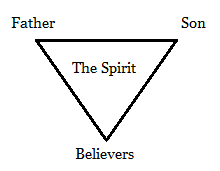
    • Father and Son both abide (together) in us through the presence of the Spirit
      This unifying presence (of the Spirit) may be illustrated by the simple diagram:

An important aspect of the verb me/nw is idea of remaining—this relationship between Father, Son and Believer, through the Spirit, remains and continues “into the Age”. The traditional eschatological image of divine/eternal Life, which the righteous are though to receive following the Judgment, is “realized” and experienced by believers now, in the present, and will continue on into eternity. This is a fundamental aspect of Johannine thought, expressed many times by Jesus in the Gospel Discourses.

It is interesting to consider how this Christian identity, marked by the twin themes of trust/faith and love, is presented throughout this section. I offer the following (chiastic) outline:

    • Trust: Confession of Jesus’ identity—the Son of God, sent by the Father (vv. 14-15
      —God’s love for us—sending his Son to us (v. 16a, also v. 14)
      ——His love abides/remains in us, completing/perfecting us (vv. 16b-18)
      —God’s love for us—we follow his (and the Son’s) example (v. 19)
    • Love: Demonstration of love for one another [among believers] (vv. 20-21)

The “command” (e)ntolh/) given to us by God is here defined primarily by the second aspect, love—both God’s love for us and our love for one another. This is a uniquely Johannine expression of the great “Love command” in early Christian and Gospel tradition. In this regard, it is worth emphasizing again the distinctive use (and meaning) of the word e)ntolh/ in the Gospel and Letters of John, which is best understood by the literal (fundamental) meaning as something given to us (i.e. laid on us) to complete. Here this “completion” has a dual meaning—not only our completion of the duty/mission to love one another, but of God’s love being completed in us. This is at the heart of the passage, in vv. 16b-18 (cf. above):

    • “In this our love has been made complete [tetelei/wtai]…” (v. 17)
    • “…complete [telei/a] love casts out fear…the (one) fearing has not been made complete [tetelei/wtai] in love.” (v. 18)

Note the precise parallelism:

    • our love has been made complete
    • we have been made complete in love

This is the truest and deepest sense of the word e)ntolh/.

August 30: 1 Cor 2:16 (continued)

[This series of notes is on 1 Corinthians 1:18-2:16]

1 Corinthians 2:16

In yesterday’s note, I looked at the first part of this verse, the citation from Isa 40:13 (LXX); today I will examine the second part, with Paul’s concluding declaration:

“…and (yet) we hold the mind of (the) Anointed {Christ}”

There are four components to this statement, beginning with the (emphatic) pronoun h(mei=$ (“we”), to be discussed below. The remaining three elements are:

    • de/ (“and/but”)—a conjunctive particle with an adversative sense, establishing a contrast with what is stated in the quotation of Isa 40:13. There the rhetorical question (“who knows/knew the mind of God?”) carries the obvious (implied) answer of “no one”. For the relation of the context of Isa 40:12-13 with 1 Cor 2:10ff, cf. my discussion in the previous note. Paul’s declaration may be (re)formulated as: “Of course, no one knows (or can have known) the mind of the Lord (God) Himself, and yet we do hold the mind of the Lord (Christ)!”
    • nou=$ xristou= (“[the] mind of [the] Anointed”)—as I indicated in the prior note, many witnesses read “mind of [the] Lord [kuri/ou]”; if original, then Paul is certainly making use of the wordplay involving ku/rio$, which can be understood as “the Lord (YHWH)” or “the Lord (Jesus Christ)”, interchangeably, by early Christians. The expression “mind of Christ” does not occur elsewhere in the New Testament (nor “mind of Jesus”, or anything similar). Perhaps the closest we come is in Philippians 2:5: “This (work)ing of (the) mind must (be) in you which also (was) in (the) Anointed Yeshua {Jesus Christ}”; though here Paul uses the verb frone/w rather than the noun nou=$. For more on this verse, cf. below. There are a number of points of contact between 1 Cor 1:18-2:16 and Romans 7-8, especially 8:26-27, which has the parallel expression “mind [fro/nhma] of the Spirit”.
    • e&xomen (“we hold”)—the verb e&xw is often translated more generally as “have”, i.e. “hold (in one’s possession)”; however, here it seems useful to retain the more concrete and fundamental sense of holding something. This preserves contact with the basic context of Isa 40:12-13, with its concept of measuring—it is impossible to contain the Spirit/Mind of the Lord in a measuring-vessel, etc, and yet we hold the mind of the Lord (Christ) within (and among) us. That this occurs through the presence and work of the Spirit is confirmed both by the overall context of 1 Cor 2:10ff as well as the parallel expressions mentioned above:
      • “the mind [nou=$] of Christ” (v. 16)
      • “the working of (the) mind [frone/w]…which was in Christ Jesus” (Phil 2:5)
      • “the mind [fro/nhma] of the Spirit” (Rom 8:27)

Paul’s argument in Phil 2:1-5ff is similar to 1 Cor 1:18-2:16, in several important respects:

Finally, something must be said regarding the use of the pronoun “we” (h(mei=$) in v. 16. Often there is a certain ambiguity regarding Paul’s use of the 1st person plural in his letters; it can be understood three ways:

    • As a (rhetorical) reference to Paul himself, essentially = “I”
    • As a (collective) reference to Paul and his fellow ministers
    • Collectively, and generally, of (all) believers

So, when Paul says “we have the mind of Christ”, he could be saying:

    • “I have the mind of Christ” (cf. 7:40, etc), in which case it brings us back to the start of his argument and the autobiographical aspect of 1:14-17; 2:1-5
    • “We (the inspired apostles, etc) have the mind of Christ”, which generally fits the context of 2:1-7 and 3:4ff
    • “We (all believers) have the mind of Christ”

The overall emphasis of 1:18-4:21, in my view, decisively favors the latter interpretation. Recall that the initial emphasis in the narratio (1:11-17) was that believers should not be relying on the status and gifts/abilities of prominent ministers (such as Paul and Apollos, etc), but should rather be trusting in (a) Christ and the message of the Gospel, and (b) the presence and work of the Spirit—these two being closely connected. What follows in 3:1 only confirms this view, as Paul laments the fact that is not able to speak to the Corinthians as ones who are “complete” (2:6)—they are not thinking and acting according to their true identity (in Christ), as those who are “spiritual” (i.e. who have the Spirit). However, it is possible that there is a progression or development in 2:1-16, which I would chart as follows:

    • “I came to you” (vv. 1-5)—Paul himself, as the founding apostle, proclaiming the Gospel message (“the secret of God”)
    • “We speak…” (vv. 6-9)—Paul and his fellow ministers, those who first preached the Gospel among the Corinthians and worked to establish congregations, etc
    • “To us…revealed…” (vv. 10-12)—transitional, emphasizing the work of God and the giving of the Spirit to believers
    • “We speak these things…” (vv. 13-15)—Believers as ministers, those gifted to speak and interpret the “deep things of God”, especially apostles, prophets and teachers, etc
    • “We hold the mind of God” (v. 16)—All believers, united with Christ, who have received the Spirit of God (and Christ)

The progression is from the (initial) proclamation of the Gospel of Christ (vv. 1-2) to the unity of believers in Christ (v. 16). This point will be touched on further in the next daily note.

“Gnosis” in the NT: 2 Cor 2:14

2 Corinthians 2:14

In treating the subject of knowledge (gnw=si$, gnœsis) in the New Testament, two related verses in 2 Corinthians are especially important—2 Cor 2:14 and 4:6—expressing Paul’s view of the matter quite succinctly and effectively. These two verses happen to form an inclusio, framing the section 2:14-4:6, being the first and last sentences, respectively. This can be seen clearly by an outline of the section:

    • 2:14-17: Paul and his fellow ministers who proclaim the Gospel—the knowledge of God in Christ
      • 3:1-6: Contrast between the old covenant (on tablets of stone) and new covenant (in the heart)—the letter vs. the Spirit
        —vv. 4-6: Ministers of the New Covenant
      • 3:7-18: Contrast between the veiled face of Moses and the unveiled face of believers in the Spirit
        —vv. 12-18: Ministers of the New Covenant (par. with Moses)
    • 4:1-6: The ministry of proclaiming the Gospel—the knowledge of God in Christ

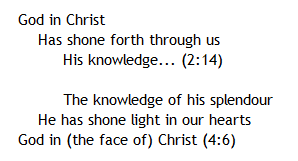
The chiastic structure of this section becomes even more obvious when comparing 2:14-17 with 4:1-6:

Thus these two verses perfectly enclose the section, and should be studied together. I begin in today’s note with 2:14. Interestingly, this verse itself has a chiastic symmetry. The opening phrase is: “To God be thanks for (his) favor… [tw=| de\ qew=| xa/ri$ tw=|…]”. The second definite article defines (and explains) the favor (xa/ri$) which God has shown. This, in the remainder of the verse, may be presented as a chiasm:

    • every time [pa/ntote, i.e. always]
      • leading us in procession [qriambeu/onti h(ma=$]
        • in Christ [e)n Xristw=|]
        • the smell of the knowledge of Him [th\n o)smh\n th=$ gnw/sew$ au)tou=]
      • shining forth [i.e. making manifest] through us [fanerou=nti di’ h(mw=n]
    • in every place [e)n panti\ to/pw=]

These elements—the words and phrases—require some closer examination. First, the expressions using forms of pa=$ (“all, every”), which occur frequently in Paul’s letters:

(a) pa/ntote, “every [pa=$] (time) when [to/te]”, “always, whenever, etc.”—27 of 41 NT occurrences
(b) e)n panti\ to/pw|, “in every [pa=$] place, in all place(s)”, “everywhere”—cf. also in 1 Cor 1:2; 1 Thess 1:8; and 1 Tim 2:8

These expressions encapsulate the completeness and universal reach of God’s action—temporal and spatial—covering every aspect of human existence. Specifically, here it relates to every aspect of the ministry of Paul and his fellow missionaries. The second pair of phrases are governed by two participles with predicate pronoun (“us”). The two verbs involved are:

    • qriambeu/w (thriambeúœ), which refers primarily to a military triumph (as by the Roman forces), and often in the specific sense of a triumphal procession following victory, in which captives and the spoils of battle would be displayed. There is some uncertainty as to the precise sense of Paul’s image here; it could be (a) that God leads Paul and other ministers in triumph, with the spread of the Gospel, etc. For similar military imagery along these lines, see e.g. 10:4-5. The other possibility is (b) that God leads Paul and the other ministers in procession as captives—i.e. they themselves have been made captive to the Gospel. Paul occasionally uses the term “slave” (dou=lo$) to refer to himself (and others) as ministers of Christ and the Gospel (Rom 1:1; Gal 1:10; Phil 1:1, etc), and it is probably this latter sense that is meant in context here. The only other occurrence in the New Testament is Col 2:15, where a military victory, performed by God through the death (crucifixion) of Jesus, is properly meant.
    • fanero/w (phaneróœ), related to fw=$ (phœ¡s), “light” and the principal verbs fa/w [obs.], fai/nw (“shine [as] light”), meaning “shine forth”, often in the figurative sense of “appear, make apparent, (make) manifest”. It is found frequently in the Pauline letters (22 of 49 occurrences), and also in the Gospel and First letter of John (18 times). This verb will be discussed further in Part 3 of the series “Gnosis and the New Testament”, dealing with the topic of revelation.

Finally the words in the third (inner) pair of expressions:

    • “in Christ” (e)n Xristw=|)—a well known expression, found frequently in Paul’s writings, and almost exclusive to him in the New Testament. Typically it refers to the general status of believers, reflecting (a) our faith/trust in Christ, and (b) our union with him, through the Spirit, and symbolized in the rite of Baptism. However, here there is the specific sense of the status of Paul and his fellow apostles and missionaries as ministers of Christ and the Gospel. God leads them in procession in Christ—which, based on the interpretation given above, could be clarified as in captivity to Christ. For something of this sense, cf. also Rom 16:3, 9; Philem 23, etc. As captives, they are specifically required to speak (i.e. proclaim the Gospel)—cf. further in verse 17, and 12:19.
    • “the smell of the knowledge of Him” (h( o)smh\ th=$ gnw/sew$ au)tou=)—a genitive chain with three terms, each of which are treated below; a parallel genitive chain, even more extended, is used at a similar point in 4:6 (cf. the next study):
      • o)smh/ (osm¢¡), “smell”, either pleasant or foul. Here a pleasing aroma or fragrance is meant, as indicated by the use of eu)wdi/a (“good scent”) in verse 15. The combination of o)smh/ and eu)wdi/a strongly suggests the fragrance of the sacrificial offerings (cf. Lev 1:9, 13, 17; 2:2, etc. [LXX]). Here the “sacrifice” as such is the proclamation of the Gospel, and the role of Paul and his fellow ministers in this activity—for the parallel between Christian ministers and Moses (and the Priesthood), cf. the illustration in chapter 3. Paul plays again on the ambiguity of o)smh/ is verse 16—a good smell of life to the ones being saved (through the Gospel), but a stench of death for the ones perishing. The otherwise mixed metaphor of sight and smell indicates that the verb fanero/w is used more or less in the general sense of “appear, make manifest”.
      • gnw=si$ (gnœ¡sis), “knowledge”. For Paul’s use of gnw=si$, cf. Part 1 of the series “Gnosis and the New Testament”. The genitive construct makes clear that the smell is “the smell of knowledge“. If the sacrificial allusion is accepted (cf. above), then the orientation has shifted notably—instead of being directed toward God, the sacrifice is intended for human beings, to bring the knowledge of God to them. This is important when considering possible gnostic elements in the New Testament, and will be discussed further in that series.
      • au)tou=, “of him, his”—I have rendered the genitive relationship literally (“knowledge of him [i.e. God]”), though itself it is ambiguous; it could be subjective (God’s own knowledge) or objective (knowledge about/regarding God). Certainly the latter is meant here, though the two aspects can never be separated entirely, especially with regard to God’s (fore)knowledge of believers.

What is particularly significant about this pair of expressions is the way they must be taken to inform each other: the sacrificial “smell of the knowledge of (God)” comes about entirely “in Christ”.

August 21 (2): 1 Corinthians 1:30

[This series of notes is on 1 Corinthians 1:18-2:16; the previous note dealt with 1:27-28]

1 Corinthians 1:30

“And you are out of him [i.e. God] in (the) Anointed Yeshua, who was caused to be wisdom for us from God, (as well as) justice and holiness and loosing from (sin)…”

The argument by example running through vv. 26-28 (cf. the prior note) culminates in vv. 29-30; actually it is verse 29 which completes vv. 27-28:

“….how that [i.e. so that] all flesh should not boast in the sight of God.”

In some ways verse 30 is parallel to vv. 26-28, where the reference is to God calling and gathering out of the mass of humankind those who will come to believe in Christ. There the emphasis was on the relatively insignificant and ignoble status of believers (according to the values and ideals of the world); here, it is specifically on believers’ identity in Christ [e)n Xristw=|]:

“And you are out of [e)c, i.e. from] him in (the) Anointed Yeshua {Christ Jesus}…”

Let us consider the general parallel found in vv. 26-31:

    • Believers called out of the world—contrast with worldly position and values (vv. 27-28)
      • Human beings (“all flesh”), i.e. the world, may not boast before God (v. 29)
    • Believers come to be born from (lit. out of) God—in Christ (v. 30)
      • Only the one “in the Lord” may boast (before God) (v. 31)

Verses 29 and 31 use the verb kauxa/omai, which, like the related au)xe/w, fundamentally refers to giving a loud or bold utterance (declaration); it corresponds generally with “(to) boast” in English. This verb, along with the related nouns kau/xhma (“[a] boast”) and kauxh/si$ (“boasting”), was a favorite of Paul’s—35 of the 37 occurrences are found in the (undisputed) Pauline letters (+ Eph 2:9). It is hard, based on a superficial reading of the letters in translation, to appreciate precisely what Paul means by his use of this word-group and why it was so significant for him. Part of the problem lies in the translation “boast(ing)”. While this is perhaps the best English approximation for the kaux- word-group, it is rather misleading. In modern English, boasting almost always has a negative meaning, often referring to a pompous or arrogant and self-serving demeanor. While kauxa/omai sometimes carries this sense as well, it also has a much wider (and more general) range of meaning, as indicated above. Moreover, Paul typically has a very specific context in mind—that of human beings standing before God (at the final Judgment).

This eschatological emphasis is only one part of the Old Testament (LXX) and Jewish background of the term; two other themes had more immediate religious application: (a) the ritual/cultic aspect of humbling oneself before God (in approaching the sanctuary, etc), and (b) the ethical/moral aspect, expressed especially in Wisdom traditions, as a warning against self-glorification. The Scripture Paul cites in v. 31 (also in 2 Cor 10:17) is Jeremiah 9:24, the conclusion of a lament by the prophet in chapters 8-9 anticipating the coming destruction of Jerusalem. Jer 9:23-26 is also transitional to the warning in chapter 10 (“do not learn the way of the nations”, v. 2); verses 23-24 [Heb 22-23] may be rendered as follows:

“Thus says YHWH:
‘The wise (man) should not shout (for) himself [lL@h^t=y]] in his wisdom,
and the strong (man) not shout (for) himself in his strength,
and the wealthy (man) not shout (for) himself in his wealth;
for (only) in this should the (one) shouting (for) himself (so) shout—
(that) he gives attention (to me) and knows me:
that I am YHWH,
doing kindness, judgment [i.e. justice], and righteousness in the earth—
for in these (thing)s I feel delight’
—utterance of YHWH”

The portion in bold represents substantially what Paul cites; we may compare the Greek (LXX) version:

“but (only) in this [e)n tou/tw|] must the (one) shouting/boasting [o( kauxw/meno$] (so) shout/boast [kauxa/sqw]:
to put together [i.e. comprehend] and know that I am (the) Lord [ku/rio$]…”

Paul’s quotation is actually an abridgment, indicated by the words in italics above:

“the (one) shouting/boasting must (only) shout/boast in (the) Lord”
o( kauxw/meno$ e)n kuri/w| kauxa/sqw

The Greek imperative (and Hebrew jussive) form is somewhat difficult to render in English, usually being translated “let…(not) boast” (“the one boasting, let him boast in the Lord”). The Greek verb kauxa/omai (in the middle voice) covers much the same range of meaning as the Hebrew ll^h* (in the Hithpael/reflexive stem)—”shout/declare for oneself”, i.e. “praise oneself, boast”. The context of Jeremiah 9:23-24 is altogether fitting for Paul’s purpose in 1 Cor 1:18-2:16, in several respects:

    • The contrast between worldly values and those of God himself
    • The emphasis on wisdom and understanding (note also the reference to “strength”)
    • The basic setting/background of Judgment

Interestingly, both here and in 2 Cor 10:17, Paul has omitted the portion (in the LXX) “to comprehend and understand that I am (the)…”. The first verb in the original Hebrew (lk^c*) emphasizes not so much a person’s understanding as it does giving attention and consideration to something (i.e. paying attention). In Greek, the corresponding verb (suni/hmi) literally means “set/put (things) together”, i.e. so as to comprehend and understand. Paul easily could have retained this emphasis within a Christian context; however, his condensing (and adaptation) of the verse has a significant effect:

    • It shifts the focus from religious devotion and knowledge of God to God himself (i.e. “the Lord”)
    • It allows a bit of wordplay since, from a Christian standpoint, “in the Lord [e)n kuri/w|]” can be understood as “in Christ [e)n xristw=|]”, a favorite expression of Paul’s

Returning to the eschatological orientation of Paul’s discussion, if we (temporarily) disrupt the syntax and take together verses 29-31, it results in a significant chiasm:

    • Judgment: The world (“all flesh”) unable to boast before God (v. 29)
      —Believers (born) of God (i.e. sons/children of God) in Christ (v. 30)
    • Judgment: Only those “in the Lord” may boast before God (v. 31)

This serves as an excellent, concise summary of Pauline theology and soteriology.

A final point to consider is the structure of verse 30:

    • V. 30a—Relationship of believers to God in Christ (“and you are…in Christ Jesus”)
    • V. 30b—Relationship of Christ to believers (“who was caused to be…for us”)

The passive form (e)genh/qh) of gi/nomai (“come to be, become”) is another example of the “divine passive”—i.e. “God caused him to be”. Four nouns are used to describe what Jesus has become for us; the first of these (sofi/a, “wisdom”) is given emphasis: “who was caused to be wisdom for us from God”. This is another way of saying what Paul already stated in verse 24: that Jesus Christ himself is “the power of God and the wisdom of God“. Just as the wisdom of God was personified in Old Testament and Jewish Wisdom tradition (cf. throughout Proverbs and the book of Wisdom, esp. Prov 8; Wisd 6:12-25; 7:22-8:21; 10:1ff), so now God’s wisdom is manifest and embodied in the person of Christ. It is possible that the three nouns which follow in v. 30 are parallel with the “power of God” in v. 24, perhaps in the sense of the power to effect salvation (Rom 1:16). In any case, they may be included with “wisdom” in the conceptual structure of v. 30b: “who came to be wisdom and…for us from God”. These three nouns may be noted briefly:

  • dikaiosu/nh (dikaiosy¡n¢), “justice/righteousness”—the dikaio- word-group is especially important in Paul’s thought, central to his understanding of how believers relate to God through the person and work of Christ. Through the death and resurrection of Christ, believers are “made right” (or “made/declared just”) before God, apart from any moral/religious act (i.e. observance of the Old Testament Law [Torah]), only through trust in Christ. The noun dikaiosu/nh is virtually a theme word of Romans, occurring more than 30 times in that letter alone (more than a third of all occurrences in the New Testament). Often, as here, the noun connotes (or represents) the action of God (marked by the related verb dikaio/w) as well—God has made us right/just before him in Christ.
  • a(giasmo/$ (hagiasmós), “holiness”—related to the adjective a%gio$ (“holy, sacred”), but more properly to the derived verb a(gia/zw (“make holy, treat as holy”), which sometimes denotes the idea of purification (“make pure, clease”). The noun a(giasmo/$ refers to the resultant state or condition of someone/something which has been “made holy”, but also to the process and action (i.e. by God). Most of the occurrences (8 of 10) are in the Pauline letters (cf. Rom 6:19, 21; 1 Thess 4:3-4, 7; 2 Thess 2:13). It is often translated “sanctification”, but this term has come to have such a specialized technical meaning in many systems of theology that is probably better to avoid using it in translating the NT.
  • a)polu/trwsi$ (apoly¡trœsis), “loosing from (bondage)”—this noun, from the compound verb a)polutro/w, refers to the act of “loosing” (i.e. freeing) someone from bondage, captivity, slavery, etc. The related noun lu/tron usually indicates the payment made to free such a person (i.e. “ransom, redemption [price]”). Again, 8 of the 10 occurrences of a)polu/trwsi$ in the New Testament are from the Pauline letters (Rom 3:24; 8:23; Col 1:14, etc). In Paul’s thought, the specific context is bondage to sin, from which God has freed us through the death and resurrection of Christ. Secondarily, believers are also freed from the (Old Testament) Law, being no longer bound (required) to observe it; however, this point is not emphasized much in 1 Corinthians (compared with Galatians and Romans [cf. also 2 Cor 3]).

July 31: 2 Corinthians 5:21

In today’s note I will be looking at Romans 8:3-4 in comparison with 2 Corinthians 5:21. These two passages connect the incarnation of Christ with God’s work of salvation for humankind. From the beginning, Christians understood the sacrificial and salvific character of Jesus’ death, and that he was God’s unique representative; but here, in these two letters, perhaps for the first time, we find a developed doctrine blending soteriology with Christology. As 2 Corinthians was likely written before Romans, I will begin with 2 Cor 5:21.

2 Corinthians 5:21

“the (one) not knowing sin, He [i.e. God] made (to be) sin over us [i.e. for our sake], (so) that we might come to be (the) justice/righteousness of God in him”

The context of this passage (2 Cor 5:11-21) is similar to that of Phil 2:1-11—an appeal for peace and unity among believers is connected with the example of God’s sacrificial and saving work in Christ. Here in 2 Corinthians, the emphasis is on reconciliation—katallagh/, vb. katalla/ssw, to make things different, mutually, between two parties. In vv. 18-19, Paul makes two statements:

    • God is “the (One) making (things) different [katalla/canto$] (for) us with Himself through [dia/] (the) Anointed” (v. 18)
    • God “was [h@n] in [e)n] (the) Anointed, making (things) different [katalla/sswn] (for the) world with Himself” (v. 19)

In both instances, a participial form of the verb is used: the first in the aorist (indicating a past action), the second in the present. In verse 18, it is “us” (believers) for whom the situation has been changed with God; in verse 19, it is the entire world. This particular work of reconciliation is glossed and interpreted by Paul as “not counting for them (the instances of) their falling alongside [paraptw/mata]”, i.e., not reckoning their sins and failures, understood as violations/transgressions of the Law, especially in its moral/ethical aspect. We also see, in each statement regarding God’s work of reconciliation in/through Christ, a corresponding declaration of the work of reconciliation God intends for believers (focused primarily in the apostolic ministry):

    • “…and (also) giving to us the service [diakoni/a] of making (things) different [i.e. reconciliation, katallagh/]” (v. 18)
    • “…and (also) placing in us the word/account [lo/go$] of making (things) different [i.e. reconciliation]” (v. 19)

It may be helpful to examine each element of verse 21:

to\n mh\ gno/nta (“the [one] not knowing”)—i.e. Jesus Christ; here the verb know (ginw/skw) probably should be understood in the sense of familiarity.

a(marti/an (“sin”)—The expression mh\ gno/nta a(marti/an is sometimes translated as “knowing no sin“; but the negative particle relates primarily to the verb, and thus the emphasis is on “not knowing sin”. Paul doubtless would affirm something corresponding to the later orthodox belief regarding the sinlessness of Christ; however, when referring to specific sins or misdeeds, he typically uses the words para/ptwma (cf. in v. 19), para/basi$, or a(marti/a in the plural. The use of the singular here could indicate the idea of sin in the more general, abstract sense; or, as often in Romans especially, of sin as a power. To describe Jesus as “the one not knowing sin” probably means, for Paul, that he was the only person who was not enslaved under the power of sin, i.e. did not know Sin has his master. The word a(marti/a fundamentally means a failure—in the conventional Israelite/Jewish religious sense, this would be a failure to observe the commands and regulations of the Law (Torah), and, in particular, moral failure. In English, the word is normally rendered as “sin”; it is generally synonymous with the corresponding afj in Hebrew.

u(pe\r u(ma=$ (“over us”)—The preposition u(pe/r literally means “over”, but often in the metaphorical sense of “on behalf of, for the sake of”, etc. What God did through Christ was done “over us”, covering us, and it was done for our sake.

e)poi/hsen (“he made”)—God is the implied subject, with “the one not knowing sin” (Christ) as the object, i.e. God made Christ to be (like/as) sin. How should we understand this “making”? I have previously suggested three possibilities:

    • he was made into the form of (sinful) human “flesh” (Rom 8:3, cf. below); the idea of incarnation, cf. Gal 4:4; Phil 2:7
    • he was made like unto the (enslaving) power of sin, in order to conquer and destroy it (cf. Rom 8:2-3; Gal 3:13-14)
    • he was made into a sin-offering; note the similar double meaning of afj in Hebrew, which can be used both for sin and the offering made on behalf of sin

i%na (“that”)—the particle here introduces a final clause, indicating either purpose or result (or both), i.e. “so that…”

genw/meqa (“we might come to be”)—the common existential verb indicating becoming, i.e. the purpose and result of God’s work is that we (believers) will come to be something new. The aorist subjunctive form could here could also be rendered: “that we should come to be…”

dikaiosu/nh qeou= (“[the] justice/righteousness of God”)—Paul’s use of this expression is familiar from Romans, where it appears numerous times (Rom 1:17; 3:5, 21-22; 10:3, also 3:25-26; 6:13, etc). More than half of the instances of the noun dikaiosu/nh come from the undisputed Pauline letters (34 times in Romans). I have discussed dikaiosu/nh (and the dikaio- word-group) extensively in the articles on “Paul’s View of the Law” (note also the article on Justification). Where this particular expression is used in Romans, it should be taken fundamentally as a characteristic or attribute of God Himself, but which is expressed primarily in the person and work of Christ.

e)n au)tw=| (“in him”)—that is, “in Christ”, e)n Xristw=| being a favorite Pauline expression, indicating the union (and unity) of believers with Christ (and with God through Christ). Here it should also be understood as the focus of our becoming the “justice/righteousness of God”—it takes place in Christ. Elsewhere, Paul refers to Jesus as the very embodiment of justice/righteousness. The parallel in 1 Cor 1:30 is especially noteworthy:

1 Cor 1:30: he came to be the justice/righteousness from God for us
2 Cor 5:21: we come to be the justice/righteousness of God in him

The interplay reflected in these two verses is fascinating indeed!

What does it mean precisely, that believers should “become” or “come to be” the justice/righteousness of God? I will leave this question until I have discussed Romans 8:3-4, which I will do in the next daily note.