August 4: John 6:63 (4)

John 6:63, continued

The Christological emphasis of the question by Jesus in v. 62 was discussed in the previous note. In the narrative context, the question serves as a challenge to Jesus’ disciples in the moment—as to whether they would continue to trust in him—but also is a promise of what they would see (and come to understand) in the future (much like the earlier Son of Man saying in 1:51). The difficulty surrounding Jesus’ words in the Discourse primarily involves his claim of a heavenly origin—i.e., that he has come down (lit. “stepped down”, vb katabai/nw) from heaven. Fundamentally, then, verse 62 entails a Christological point—viz., the disciples can trust that the Son (Jesus) came down from heaven, because they will see him going back up (vb a)nabai/nw, “step up”) to heaven.

Before proceeding, it is worth mentioning briefly the specific wording used in v. 62. The expression “the Son of Man” (o( ui(o\$ tou= a)nqrw/pou) and the verb a)nabai/nw (“step up”), used in the special Johannine theological sense, have already been discussed. The verb qewre/w is one of several sight/seeing verbs used by the Gospel writer—again in the special theological/Christological sense of seeing = knowing = trust in Jesus that leads to knowledge/vision of God. The specific verb qewre/w denotes looking closely at something (vb qea/omai)—i.e., being an observer or spectator (qewro/$). The idea, then, is that the disciples will observe the “stepping up” of the Son of Man (i.e., Jesus), much like the promise of vision in the Son of Man saying of 1:51. The verb occurs 24 times in the Gospel (out of 58 NT occurrences), making it something of a Johannine keyword; for other instances with a clear theological/Christological significance, cf. 6:40; 12:45; 14:17, 19; 16:10, 16-17ff; 17:24.

What is that they will observe? The verb a)nabai/nw, in the special Johannine theological sense (and usage), refers to the exaltation of the Son (by God the Father); elsewhere in the Gospel, this is expressed by the verb u(yo/w (“lift high”), where it is specifically used in Son of Man sayings with a comparable meaning and significance to that of 6:62—cf. 3:14; 8:28; 12:32, 34. The “stepping up” by the Son is thus a result of his being “raised/lifted high” by the Father. This ascent, within the context of the Johannine narrative, involves a process—viz., of Jesus’ death, resurrection, and return to the Father. The disciples of Jesus will, in different ways, observe this process. And, when they see him “stepping up” to God the Father, then they will truly understand and know that he has “stepped down” to earth from heaven.

The heavenly origin of the Son is also indicated here by the phrase “(the place) where [o%pou] he was [h@n] at the first [to\ pro/teron]”. The imperfect form of the verb of being (h@n, “he was”) has special significance in the Gospel of John, due to its repeated use in the Prologue (1:1-2, 4, 8-10, 15 [par 30]), where it refers to the eternal pre-existence of the Son (and Logos). Particularly in 1:1-2, the Son’s presence with the Father in heaven is clearly indicated. Jesus’ return to the Father’s presence (in heaven) is alluded to at a number of points in the Gospel (esp. in the Last Discourse), being stated most clearly in 14:28; 16:10, 28, and 17:5, 11, 13, 24. The expression to\ pro/teron (“the first”) is comparable to the use of a)rxh/ (“first, beginning”) in 1:1-2; 8:25; 1 Jn 1:1; 2:13-14; cf. also prw=to$ in 1:15, 30. Again, these terms have Christological significance, in reference to the pre-existence and deity of Jesus (as the Son of God).

Jesus’ statement in v. 63 follows after the Son of Man saying (question) in v. 62, and thus should be understood in light of the Christological emphasis of v. 62. But how, exactly, does v. 63 relate to v. 62? If the question, as both a promise and a challenge, involves seeing the exaltation (“stepping up”) of Jesus (the Son of Man), then it would stand to reason that the statement in v. 63 should be read in this immediate context:

“The Spirit is the (thing) making (a)live, the flesh does not benefit anything! (and) the utterances which I have spoken to you are Spirit and are Life.”

The initial contrast, between the Spirit and the flesh (sa/rc), would then relate to the seeing of the exalted Son of Man—that is, one sees it through the Spirit, not through the ordinary eyes of the flesh. But how does one “see” through the Spirit? This is indicated by Jesus in the earlier Nicodemus Discourse:

“if one does not come to be (born) from above, he is not able to see [i)dei=n] the kingdom of God” (3:3)

As is clear from what follows in vv. 5-8, birth “from above” (which is also a new/second birth, via the dual-meaning of a&nwqen) means the same as birth “out of the Spirit” (e)c pneu/mato$). Elsewhere in the Johannine writings (esp. 1 John), the idiom is “coming to be (born) out of God [e)k qeou=]” (1:13, etc); but since God is Spirit (4:24), the two expressions are essentially equivalent—i.e., “out of God” = “out of the Spirit”. Once a person is born of the Spirit, he/she is able to see God and the things of God (“kingdom of God”); but it is spiritual, rather than physical, sight. Cf. the symbolism of the chapter 9 healing miracle, with the thematic motif of Jesus Christ as light (by which one sees, 1:4-9; 3:19-21; 8:12; 9:5; 11:9-10; 12:35-36, 46; 1 Jn 1:5ff; 2:8ff).

The emphasis in 6:63 is on the Spirit giving life; however, in the Gospel of John, light and life are closely connected—with the light of Jesus Christ leading to eternal life for those who trust in him (1:4; 3:19ff [in the context of vv. 15-17]; 8:12; 11:9-10 [in the narrative context of resurrection/life]). Similarly, in the Bread of Life Discourse, those who “eat” Jesus (meaning trusting in him) will have eternal life (6:27, 33, 40, 47, 51-54, 58); this is the significance of the expression “bread of life” (vv. 35, 48) and “living bread” (v. 51). The Father gives this Divine/eternal Life to the Son, and the Son, in turn, gives it to believers (v. 57; cf. also 5:25-26; 14:19).

The development of these Christological themes in the Bread of Life Discourse is complex, and vv. 62-63 represent the climax of this development. In the next daily note, we will continue with the current discussion, looking at some of the Christological aspects of verse 63 in more detail.

March 17: Romans 8:10

This note on Romans 8:10, is supplemental to the discussion on Rom 8:1-17ff in the series “Spiritualism and the New Testament”. It largely reproduces an earlier note included in the series “Paul’s View of the Law”.

Romans 8:10

Verse 10 cannot be separated from the context of verses 9-11, which form the culmination of the exhortation in 8:1-11, regarding the conflict between the Spirit and the flesh. The announcement of freedom from the Law in vv. 1-4 means that the believer must rely upon the Spirit for guidance—Paul characterizes believers as “the ones walking about according to the Spirit” (cf. Gal 5:16, 25). Deliverance from sin also means that believers are no longer under its enslaving power, and now have the freedom and ability to follow the will of God; however, the flesh remains as a source of struggle and conflict.

This is the emphasis in verses 5-11, which correspond in many ways to the exhortation in Gal 5:16-25. According to Paul’s anthropology, the flesh itself remains opposed to the “Law of God” (vv. 7-8). The main argument in verses 9-11 is that believers are, and should be, guided and influenced by the Spirit, and not the flesh:

“But you are not in (the) flesh [e)n sarki/] but in (the) Spirit [e)n pneu/mati]…”

The preposition e)n here has the specific sense of “in the power of” —in a manner similar to the expression “in Christ” (e)n Xristw=|). However, this is only one aspect of union with Christ and the Spirit; in the rest of vv. 9-11, the focus shifts from believers “in the Spirit” to the Spirit “in believers”. In other words, the power which guides and controls believers is based on the presence of the Spirit in them. Living, thinking, and walking “according to the flesh” is not, and should not be, characteristic of believers. This is reflected in the conditional clause which follows in v. 9a:

“…if indeed [ei&per] the Spirit of God houses [i.e. dwells] in you [e)n u(mi=n]”

The particle ei&per is somewhat difficult to translate; literally, it would be something like “if (indeed) about (this)”, with the sense that “if (indeed) it is so that…”. It indicates a condition, but one that is generally assumed to be true: “if it is so (as indeed it is!)”, i.e. “since (it is so that)”. For true believers in Christ, the condition would be true: the Spirit dwells in them. A series of sentences follow in vv. 9b-11, each beginning with the conditional particle ei) (“if”) and the coordinating particle de/:

V. 9b: “But if [ei) de\] any (one) does not hold the Spirit of God, that (one) is not of him.”
V. 10: “But if [ei) de\] (the) Anointed is in you…”
V. 11: “But if [ei) de\] the Spirit of the (one) raising Yeshua out of the dead houses [i.e. dwells] in you…”

The first (9b) is a negative condition: “if any one does not have [lit. hold] the Spirit of God”. Most likely the genitive au)tou= (“of him”) means “of Christ”, belonging to Christ—i.e. a true Christian has the Spirit of God. The last two sentences have positive conditions, and the two are closely related, connecting Christ with the Spirit of God:

    • V. 10— “the Anointed is in you [e)n u(mi=n]”
    • V. 11— “the Spirit of (God)… dwells in you [e)n u(mi=n]”

In each instance, the apodosis, indicating the fulfillment or result of the condition (“then…”), involves the theme of life vs. death. I begin with the last verse (v. 11):

    • “If the Spirit of the (one) raising Yeshua out of the dead houses [i.e. dwells] in you, (then)…
      • …the (one) raising (the) Anointed out of the dead also will make alive your dying [i.e. mortal] bodies through his Spirit housing [i.e. dwelling] in you”

The reference here is to the bodily resurrection of the end-time, which represents the culmination and completion of salvation for believers, according to early Christian thought. Note the repetitive symmetry to this sentence:

the Spirit of the one raising Jesus from the dead dwells in you
——will make alive your dying bodies
the one raising Christ from the dead…through his Spirit dwelling in you

This brings us to verse 10:

    • “If (the) Anointed (is) in you, (then)…
      • …the body (is) dead through sin, but the Spirit is life through justice/righteousness”

Here the apodosis is expressed by way of a me\n…de/ construction:

    • me\n (on the one hand)—the body is dead through sin
    • de\ (on the other hand)—the Spirit is life through justice/righteousness

If verse 11 referred to bodily resurrection at the end, verse 10 refers to a dynamic that is already realized in believers presently. It still involves life and death, but not one following the other (as in the resurrection); rather, the two exist at the same time, side by side—the body is dead, the Spirit is life. This anthropological dualism is typical of Paul’s thought; however, it is interesting to note that he has here shifted away slightly from the flesh/Spirit conflict emphasized in vv. 1-8. The “flesh” (sa/rc) relates to the impulse toward sin, the “body” (sw=ma) to death itself. It may be helpful to consider the anthropological terms Paul makes use of in Romans:

    • sw=ma (“body”)—that is, the physical (human) body, which is subject to death (“dying/mortal”, Rom 6:12; 8:11), according to the primeval judgment narrated in Gen 3:3-4, 19, 22-23. In Rom 7:24, Paul refers to it as “the body of death” (cf. also Rom 4:19). For believers, the redemption of the body, i.e. the loosing it from the bondage of death, is the final, culminating event of salvation—the resurrection (Rom 8:23).
    • ta\ me/lh (“the [bodily] parts”)—the different components (limbs, organs, etc) of the physical body, which should be understood two ways: (1) the sensory/sensual aspect of the body, which is affected and influenced by the impulse (e)piqumi/a) to sin, and (2) the means by which human beings act and work in the body. The first of these is expressed in Rom 7:5ff, 23—it is specifically in the bodily members that sin dwells and works. The second is indicated in Rom 6:13ff, as well perhaps by expression “the practices/deeds of the body” in Rom 8:13.
    • sa/rc (“flesh”)—a wide-ranging word and concept in Paul’s thought, it refers principally to the physical/material aspect of human nature (the body and its parts), but also within the specific context of sin. The “flesh” indicates human nature as enslaved under the power of sin (throughout Rom 7:7-25 and 8:1-11ff [cf. above]). Believers in Christ are freed from the enslaving power of sin, but can still be affected, in various ways, by the flesh and the impulse to sin which resides in it (Rom 8:1-11, and see esp. Gal 5:16-25).
    • nou=$ (“mind”)—according to Rom 7:13-25 (esp. vv. 23-25), the mind, representing intellectual, volitional and ethical aspects of human nature, is not enslaved by the power of sin the same way that the flesh is. Though it can come to be dominated entirely by wickedness (cf. Rom 1:28), in Rom 7 (where Paul likely is speaking for devout Jews and Gentiles), the mind is torn, wanting to obey the will (or Law) of God, but ultimately overcome by the power of sin in the flesh. For believers, the “mind” is to be renewed (Rom 12:2), through “walking in the Spirit” (not according to the flesh or the things of the world), so that we may be transformed more and more into the likeness of God in Christ (cf. 2 Cor 3:18).
    • o( e&sw a&nqrwpo$ (“the inner man”)—Paul uses this expression in Rom 7:22, contrasting it with the “(bodily) parts”; it is best, I think, to understand it as representing a human being in the exercise of the mind, as opposed to following the (sinful) impulse of the flesh. That it is largely synonymous with the “mind” (nou=$) for Paul is indicated by his use of the expression in 2 Cor 4:16, compared with Rom 12:2. For believers, it reflects that aspect of the person which recognizes the will of God and experiences the work of the Spirit (cf. Eph 3:16).
    • pneu=ma (“spirit”)—it should be noted that Paul rarely applies this word to ordinary human nature; it is reserved for believers in Christ, and there it refers, not to the human “spirit”, but to the Spirit (of God and Christ), i.e. the Holy Spirit. However, at the inmost “spiritual” level, believers are united with the Spirit (cf. above) and it becomes the guiding power and aspect of the person.

With regard to Rom 8:10, it is interesting to observe that, after the phrase “the body is dead”, Paul does not say “the Spirit is alive”, but rather, “the Spirit is life“, using the noun zw/h. This is because it is not a precise parallel—as indicated, above, pneu=ma is not the human “spirit” but the Spirit of God (and Christ); as such, it is not alive, it is Life itself. What then, does it mean that the Spirit is life “through justice/righteousness”? Here again, it is not an exact formal parallel:

    • dia\ a(marti/an (“through sin”)—the power and work of sin results in death for the body
    • dia\ dikaiosu/nh (“through justice/righteousness”)—the power and work of God’s justice/righteousness (in Christ) results in the believer experiencing the life that the Spirit brings

Some commentators would say that Paul does mean pneu=ma in v. 10 as the human “spirit”. I disagree completely. While this, admittedly, would allow for a more natural parallel, it contrasts entirely with Paul’s use of the word throughout Romans. The whole emphasis in 8:1ff is on the Spirit of God (and Christ), not the human “spirit”.

December 18: John 1:4-5

John 1:4-5

Verses 4 and 5 are interrelated, combining in their lines the themes of life (zwh/) and light (fw=$). Both of these themes, apart from their value each as a natural religious (and theological) metaphor, are specifically associated with the divine Wisdom in Old Testament and Jewish tradition. Verse 4 emphasizes life, while verse 5 focuses on the theme of light.

Life (zwh/), verse 4

“In him was life,
and th(is) life was the light of men”

There are many references to life in the Wisdom literature, associated with the Wisdom of God. These tend to emphasize natural life (i.e., long life) as much as the divine/eternal life, but there is a clear association between Wisdom and the life-giving power of God. Of the many verses that could be cited, see Prov 3:16, 18; 4:13, 22-23; 8:32-35; 13:14; 15:24; 16:22; Sirach 4:12f; Wisdom 6:18-19; Baruch 3:14; 4:1.

The term lo/go$, and the Logos-concept, blends the idea of Wisdom together with the Word of God. YHWH spoke the universe into existence through His life-giving Word (Gen 1:1ff), the same Word which spoke the Torah to Moses, the oracles to the Prophets, and wisdom for the righteous. The term “instruction” similarly encompasses both aspects—word and wisdom—and, indeed, the Instruction (Torah) came to be personified in Jewish tradition, much like the Word and Wisdom of God. The Old Testament basis for this, associating the Torah with the life-giving Word of YHWH, can be seen in passages such as the Song of Moses (Deut 32:47), the great Psalm 119 (vv. 17, 25, 107), and other references as well. Baruch 4:1 is a good example of how closely the personified Torah and Wisdom were connected in Jewish thought.

Here in the Prologue, eternal life, the life of God is said to be “in” (e)n) the Logos. This goes well beyond the idea that God created all things through the Logos (thus giving them life), as expressed in verse 3. In verse 4, the focus is on the life that God Himself possesses, and which the Logos shares. This is the special (theological) meaning of the noun zwh/ as it is used throughout the Johannine writings. The noun occurs 36 times in the Gospel and 13 more in the Letters; if we add in the 17 occurrences in the book of Revelation (counting it as a Johannine work), that comes to nearly half of all the New Testament occurrences of the word (66 out of 135). Clearly “life” is an important keyword in the Johannine writings, and the way it is introduced here in the Prologue is significant indeed.

The second line of the verse (“and the life was the light of men”) is a bit more difficult to explain. Again, it would be easy to interpret this in a natural sense—i.e., the wisdom of God that enlightens human beings (esp. the righteous). This is certainly a fundamental theme of Wisdom literature, as there are many passages which associate Wisdom (and, similarly the Word and Torah of God) with light—cf. Psalm 36:9; 119:105, 130; Prov 4:18; 6:23; Eccl 2:13; Wisdom 7:10, 26ff; 18:4; Sirach 32:16; Baruch 3:14; 4:1-2.

However, it must be emphasized here that, just as zwh/ refers to the life of God (i.e., divine/eternal Life), so also fw=$ in the Gospel of John refers to divine Light—the light of God that is manifest in the person of Jesus (the Son). It is another way that Jesus is identified with the Logos—the Word and Wisdom of God—in the Prologue (cf. the prior note on v. 2).

Light (fw=$), verse 5

“and the light shines in the darkness,
and the darkness did not take it down.”

While the term “light” (fw=$) was introduced in verse 4, it is featured here in v. 5, establishing the important dualistic contrast between light and darkness (skoti/a). This light-vs-darkness contrast is natural, and occurs quite frequently as a religious and ethical motif in many traditions worldwide. It is used by a number of New Testament authors (and speakers), but is particularly prominent in the Johannine writings, being featured at several important points in the discourses: at the climax of the Nicodemus discourse (3:19), as part of the Light-theme in the Tabernacles discourses (8:12), the entire chapter 9 episode (healing the blind man, see v. 4), and at the conclusion of the first half of the Gospel (the ‘Book of Signs’, 12:35, 46; cp. 11:10). There also several key allusions within the traditional narrative, which take on added meaning in a Johannine context (cf. 3:2; 6:17; 13:30; 19:39; 20:1; 21:3). The “world” (ko/smo$) is dominated by darkness, while light belongs to the domain of God the Father, Jesus the Son, and those who trust in him.

The verbs used here in verse 5 are worth noting. The first, fai/nw, means “shine”. It is, of course, a natural verb to use in reference to light; however, like the related noun fw=$, it has special meaning as part of the Johannine vocabulary. Admittedly, the verb fai/nw occurs just three times (here, and in 5:35; 1 Jn 2:8); but when we combine these with the 29 occurrences of fw=$ (23 in the Gospel, 6 in the Letters), along with the related verb fanero/w (“make [to] shine forth”), an extensive thematic portrait emerges. Jesus, the Son and Logos of God, possesses the divine Light of God, and, in his own person and work, makes this Light “shine forth” to others.

The second verb, in the second line of v. 5, is katalamba/nw, which literally means “take down”. It can be understood in a negative, positive, or neutral sense; the parallel in 12:35 strongly suggests a negative meaning here—i.e., of a person who attempts to take someone down, with hostile or evil intent. The opposition of darkness to light means that darkness will attempt to “take down” (i.e., bring down, cover over, extinguish) the light. This dualism is fundamental to the Johannine theology and Christian worldview, as noted above. The world is opposed to God the Father—and thus also is hostile to Jesus the Son, and to the believers who trust in him. This thematic emphasis runs through all the Discourses, and is developed in a number of important ways.

Elsewhere, in the Johannine Letters, the same dualism is present. Jesus is the “true light” of God that has shone forth in the darkness of the world (cf. 1 Jn 1:5-7ff; 2:8-11). Light and darkness are fundamentally opposed and cannot co-exist. Ultimately, the light of God dispels the darkness completely.

In concluding our study on this part of the Prologue, it is worth presenting again verses 3-5 as a poetic unit:

“All (thing)s came to be through him,
and apart (from) him came to be
not even one (thing) that has come to be.
In him was life,
and th(is) life was the light of men;
and the light shines in the darkness,
and the darkness did not take it down.”

A pair of 3-line (tricolon) sub-units surround the central declaration “in him was life”. The first three lines (v. 3) refer to the original creation of the world, while the last three lines (in v. 4) describe the origins of the new creation that is introduced through the person and work of Jesus (identified with the Logos). Like the eternal Wisdom and Word of God, the Son brings life and light to all things. In particular, it is to the chosen ones (believers), who are able to experience the divine Life and Light in a way that the world simply cannot. Since the world has come to be dominated by darkness, it is only the believers, currently living in the world, who are able to embrace the light.

December 17: John 1:3-4 (continued)

John 1:3-4, continued

In the previous note, we looked at the two different ways of dividing verses 3-4, involving the words o^ ge/gonen (“[that] which has come to be”). These words come at the end of v. 3 (according to the traditional verse-division), but many commentators consider them to belong with verse 4, providing the opening words for that verse:

“(That) which came to be [o^ ge/gonen] in him was life”

To do so, however, creates certain difficulties for interpretation. What, exactly does this statement mean? In the previous note, I offered a possible explanation, or line of interpretation, suggesting that it is a reference to the new creation (i.e., believers in Christ), in contrast to the first/original creation referenced in v. 3. While such an explanation would be consonant with Johannine theology (cf. vv. 12-13; 3:3-8), the actual syntax of the clause in v. 4 seems to argue against it. Life is the subject (not believers), and so, based on the Johannine understanding of the noun zwh/, it is the divine/eternal life itself that “came to be” in the Logos.

There are several passages in the Gospel where it is stated that the Father gave life to the Son (who, in turn, gives it to believers). We see this most notably in the chapter 5 discourse (vv. 21ff, 26), but it is implied elsewhere in the discourses (cf. 3:34-36; 6:27ff; 10:28; 12:49-50; 17:2-3). While this idea is very much part of the Johannine theology, it does not seem to fit to context here in v. 4. There is a relatively sharp distinction between the use of the verb of being (ei)mi) and the verb of becoming (gi/nomai). In the Prologue, the verb of being is used of God (i.e., divine being), while the verb of becoming is used for created beings. Thus, by reading the words o^ ge/gonen as part of v. 4, the verse is apparently made to say that the divine life which the Logos (and Jesus, the Son) possesses has “come to be” (that is, was created by God). One can well understand why those who held an Arian view of Jesus, would cite the verse (read in this way) in support of their Christology, since it would seem to suggest that the pre-existent Son was created.

Keeping the words o^ ge/gonen as part of verse 3 removes this complication, and preserves a clear distinction between the eternal being of God (vv. 1-2, 4) and created being (v. 3). For this reason, among the others cited in the previous note, I would argue strongly for the traditional verse division, and will thus assume it as the correct approach for the remainder of these notes. Following the traditional division, we can render vv. 3-4 as:

“All (thing)s came to be through him,
and apart (from) him came to be
not even one (thing) that has come to be.
In him was life,
and th(is) life was the light of men.”

The poetry may appear to be rather uneven in this arrangement; however, the structure becomes more properly balanced, both rhythmically and thematically, when one includes v. 5.

Verse 3 refers to creation—specifically to created beings—which all came into existence, by God, through the Logos. Verse 4, by contrast, refers to the divine being, the creative power, which the Logos possesses. Creation takes place through (dia/) the Logos, but eternal life is experienced in (e)n) the Logos.  Verse 4 is comprised of two distinct, but related, statements:

    • “In him was life” (e)n au)tw=| zwh\ h@n)
    • “the life was the light of men” (h( zwh\ h@n to\ fw=$ tw=n a)nqrw/pwn)

The use of the verb of being (ei)mi) echoes the wording of vv. 1-2, with the same imperfect form (h@n, “he/it was“); it thus refers to the divine being and existence of the Logos, and the relation of the Logos to God. As previously noted, the noun zwh/ (“life”) occurs frequently in the Gospel of John (36 times, more than a quarter of all NT occurrences), and always refers to the life that God possesses—that is, to the divine and eternal life. The Logos possesses this same life, and is thus able to give it to others; since Jesus the Son is identified with the Logos of God (v. 2), the life (and life-giving power) belongs to him (3:34-36; 5:21ff; 10:28; 11:25; 14:6, etc).

We will examine this thematic keyword, zwh/ (“life”), in a bit more detail in the next daily note, as we include verse 5 as part of our study.

December 16: John 1:3-4

John 1:3-4

The two clauses of verse 3 are clear and straightforward, both in terms of form and meaning. As discussed in the previous note, together they provide an emphatic declaration regard the role of the Logos in God’s creation of the universe:

“All (thing)s came to be through him,
and apart (from) him not even one thing came to be”

Difficulties arise, however, when we come to the last two words of verse 3 (as it is traditionally divided): o^ ge/gonen (“that which has come to be”)—a neuter relative pronoun followed by a perfect form of the verb of becoming (gi/nomai). Do these words belong with what precedes them (in v. 3), or with what follows (in v. 4)? Scholarly opinion is rather evenly divided on the matter, with some commentators (e.g., Metzger, pp. 167-8) preferring the former, and others (e.g., Brown, pp. 6-7) opting for the latter.

There are two principal arguments adduced in favor of reading o^ ge/gonen as part of v. 4:

    • It establishes a clearer (poetic) rhythm to the lines, and also preserves the so-called “staircase” parallelism that is said to be typical of Johannine style.
    • It seems to have been the view of the pre-Nicene Christian writers (who discuss the verse); a shift in favor of reading the words with v. 3, it is said, was prompted by a reaction against an Arian interpretation of the passage (when the words are read as part of v. 4).

I find the opposing arguments to be rather stronger (cf. Metzger, p. 168):

    • The Johannine predilection for beginning a sentence or clause with the preposition e)n + a demonstrative pronoun (e.g., Jn 13:35; 15:8; 16:26; 1 Jn 2:3-5; 3:10, 16, 19, 24; 4:2)
    • The theological parallels in 5:26, 39; 6:53, etc
    • The precise meaning of v. 4, when the words o^ ge/gonen are included, is, in the view of many commentators, rather obscure; on the other hand, the meaning of the verse, when the words are kept as part of the prior v. 3, seems quite clear, and requires no special pleading.

To illustrate the situation, let us compare the two approaches to handling vv. 3-4, in translation:

    • First—according to the traditional division (the words as part of v. 3):
      “All (thing)s came to be through him,
      and apart (from) him came to be
      not even one (thing) that has come to be.
      In him was life,
      and th(is) life was the light of men.”
    • Second—reading the words as part of v.4:
      “All (thing)s came to be through him,
      and apart (from) him not even one (thing) came to be.
      (That) which has come to be in him was life,
      and th(is) life was the light of men.”

Admittedly, there is a certain poetic consistency in the second option that the first lacks. However, this is a rather subjective assessment, and it presumes that the author—whether of the Prologue or an underlying hymn (or both)—intended such a consistency. Moreover, it ignores a different sort of balance that is achieved, with the first approach, when all three verses of the section (vv. 3-5) are included:

“All (thing)s came to be through him,
and apart (from) him came to be
not even one (thing) that has come to be.
In him was life,
and th(is) life was the light of men;
and the light shines in the darkness,
and the darkness did not take it down.”

Note here how two triplets (three-line structures) surround a central declaration, balancing natural life (i.e., created existence) and eternal life.

But, perhaps most decisive against reading the words o^ ge/gonen as part of verse 4 is establishing exactly what the verse would then mean. For the sake of the argument, let us consider the possibility that this is the correct approach; verse 4 would then read:

“(That) which has come to be in him was life”
o^ ge/gonen e)n au)tw=| zwh\ h@n

At first glance, in the context of creation, we might assume that this statement means that the Logos gave (and still gives) life (i.e., existence) to all things. However, in the Johannine writings, the noun zwh/ essentially never refers to life in the ordinary (natural) sense, but, rather, to the life that God possesses—i.e., eternal life. Given this emphasis, the clause would have to be understood rather differently—as a contrast with ordinary creation. In other words, verse 3 refers to the role of the Logos in the creation of the universe (i.e., the first creation), while verse 4 focuses on the new creation of believers in Christ. According to this view, the phrase “that which has come to be in him” means those (believers) who are “in Christ”, those who were born into him “from above” (3:3-8, and cp. with vv. 12-13 in the Prologue), by the Spirit, as a ‘new creation’.

While this explanation certainly would concur with the Johannine theology, we must ask if it appropriate at this point in the Gospel Prologue. More to the point, does the wording of the statement, as given above, accurately and truly express this theology? We shall attempt to examine the matter in more detail in the next daily note.

References marked “Brown” are to Raymond E. Brown, S.S., The Gospel According to John I-XII, Anchor Bible [AB] vol. 29 (1966).
Those marked “Metzger” are to Bruce M. Metzger in A Textual Commentary on the Greek New Testament, Second Edition (Deutsche Bibelgesellschaft/United Bible Societies: 1971, 1994).

“…Spirit and Life” (concluded): The Book of Revelation

The Book of Revelation

We have reached the end of this series based on Jesus’ words in John 6:63: “The utterances [i.e. words] which I have spoken to you are Spirit and are Life”. The notes in this series have focused on the use of the words “spirit” (pneu=ma) and “life” (zwh/), especially in the Johannine writings—the Gospel and Letters of John. The Book of Revelation is usually regarded as a Johannine work as well, derived from the same general church environment, timeframe and setting. Many commentators feel that the Johannine congregations were centered around Ephesus, and that certainly fits the book of Revelation; the letters in chaps. 2-3 are addressed to Christians in Asia Minor, beginning with Ephesus. Of course, tradition attributes the Gospel, Letters, and the book of Revelation to John the apostle, but authorship is indicated only in the book of Revelation. Even so, it is far from certain that the “John” in Rev 1:1, 9 is John the apostle.

Most scholars believe that the author of the book of Revelation is not the same person as either the Gospel writer or the author of the letters. While certain ideas and expressions are similar between the works, the language and style of the book of Revelation is markedly different. As we shall see, even the sense of the words pneu=ma (“spirit”) and zwh/ (“life”) has a different orientation and emphasis than in the Gospel or Letters. Let us begin with the word pneu=ma. Apart from several occurrences of the plural, which refer to “unclean/evil spirits” (16:13-14; 18:2), it is always the Spirit of God which is in view, much as we find in the other Johannine writings. However, it is used in two distinctive ways which differ markedly from the Gospel and Letters: (1) references to “seven Spirits” of God, and (2) the prophetic role and work of the Spirit.

“Spirit” in the Book of Revelation

Four times in the book (1:4; 3:1; 4:5; 5:6), we read of “seven Spirits”, an idea that is unique to the book of Revelation among the New Testament writings. Christians have variously sought to associate this number seven with the Holy Spirit, often in terms of seven “gifts” or “attributes”, such as the traits listed in Isa 11:2-3. However, it would seem that these seven “Spirits” should be considered as distinct from the Holy Spirit, and identified instead with heavenly beings (i.e. “angels”). The evidence for this is:

    • Psalm 104:4 refers to God’s Messengers (“angels”) as “Spirits” and also as “flames of fire” (much like the seven Spirits in 4:5)
    • These “Spirits” are located in heaven, surrounding the throne of God, similar to the fiery/heavenly beings in Isa 6:1ff and Ezek 1:4-28, as well as the “living creatures” elsewhere in the book of Revelation. The image seems to be drawn most directly from Zech 4:2, 10, where the the seven lamps are said to function as God’s “eyes” (Rev 5:6, messengers sent out into the world). The idea of seven angels surrounding God’s throne generally follows Jewish tradition (cf. Tobit 12:15; 1 Enoch 20:1-7, etc).
    • These “Spirits” are treated as distinct from Jesus Christ in a way that would be most unusual if it were meant to refer to the Holy Spirit (cf. 1:4)
    • They are clearly connected with the “seven congregations” of chaps. 2-3, each of which has a Messenger (“Angel”) associated with it. In Israelite/Jewish tradition, certain heavenly Messengers were assigned to particular nations, groups or individuals (for protection, etc). This interpretation is more or less made explicit in 2:20.

In the remainder of the book, pneu=ma specifically refers to the activity and role of the Spirit (of God) in prophecy—the revealing of God’s word and will, to be communicated to God’s people (believers) by a chosen representative. This is expressed several different ways:

1. e)n pneu/mati (“in the Spirit”). This expression occurs first in Rev 1:10, which sets the scene for the prophetic visions described in the book:

“I came to be in the Spirit in/on the lordly day [i.e. Lord’s day], and I heard behind me a great voice…”

This is the basis of the visionary experience which comes to the prophet “John”; it reflects the older, traditional aspect of the prophetic figure being “in the Spirit” (Ezek 3:12; Luke 2:27, etc). Even among Christians, who experience the Spirit in a new way—as the permanent, abiding presence of Christ (and God the Father)—certain believers could still be gifted and inspired specially as prophets (cf. below).

The next occurrence of the expression is in 4:2, where the prophetic inspiration now takes the form of a heavenly vision—i.e., the ability to see things in heaven, a ‘spiritual’ dimension above (cf. Ezek 8:3-4; 11:5). There are numerous accounts in Jewish tradition of visionary travels through the heavenly realms (e.g., the Enoch literature, the Ascension of Isaiah, etc). Paul may have experienced something of this sort, according to his statement in 2 Cor 12:1-4. The remaining two occurrences take place later in the book, where the seer states that the heavenly Messenger “led me away in the Spirit” (17:3; 21:10). In each instance, he is transported into a visionary landscape (desert, high mountain), to a symbolic and undefined ‘spiritual’ location, similar to those in many mystical and ascetic religious experiences.

2. The Spirit speaks to/through the visionary. This is the core manifestation and dynamic of the prophetic experience. Through the prophet, the Spirit (of God) speaks to the wider Community. This takes place in the “letters” to the seven congregations in chaps. 2-3, each of which concludes with a common refrain:

“The one holding [i.e. possessing] an ear must hear what the Spirit says to the congregations” (2:7, 11, 17, 29; 3:6, 13, 22)

The first phrase follows wording used by Jesus (Mark 4:9 par, etc), especially in relation to his making known “secrets” to his followers, through the use of parables, etc. In speaking to these congregations, the Spirit essentially represents the risen Jesus, communicating his words to the believers in Asia Minor. As in other portions of the New Testament, prophecy is viewed as the work of the Spirit, in a uniquely Christian sense. There are two aspects to the fundamental meaning of the word profhtei/a (lit. speaking before):

    • The Spirit presents God’s message (His word and will) before the people (that is, to them, in front of them), through the inspired believer (prophet) as a spokesperson
    • He also announces things beforehand (i.e., foretells), indicated here by the eschatological orientation of the book

There is a specific association with prophecy in two additional passages:

    • 19:10—the expression “the Spirit of foretelling [i.e. prophecy]”, where the Spirit expressly conveys the word of the risen Jesus to the people; here the Spirit is identified as “the witness of Jesus”. This is also an important aspect of the Johannine view of the Spirit in the Gospel and Letters.
    • 22:6—the expression “the spirits of the foretellers [i.e. prophets]”; this refers to the (human) spirit of the prophet which is touched and inspired by the Spirit of God. In this way, the gifted believer, when speaking, is governed by the Spirit. Cf. 1 Cor 14:32, and also note 1 Jn 4:1-3.

3. The Spirit speaks directly. Twice in the book of Revelation we find the Spirit speaking directly, responding to a heavenly voice. In 14:13, the response echoes a command to write (v. 12); this solemn refrain is appropriate to the context of believers who are put to death for their faithfulness to Jesus. In 22:17, at the close of the book, it follows the announcement of Jesus’ imminent coming (vv. 7, 12). The Spirit responds along with the “Bride” (believers collectively), as well as “the one who hears” (i.e. hears the visions of the book read out). This reflects the work of the Spirit in and among believers, witnessing together with them (cf. John 15:26-27).

“Spirit” and “Life”

At several points in the book of Revelation, both the words “spirit” and “life” are used in the general sense of ordinary physical/biological (human) life. This life is given by God (11:11, cf. Gen 2:7; and note also 8:9; 16:3), and it plays on the dual meaning of pneu=ma as both “breath” and “spirit”. It is particularly associated with the idea of resurrection (2:8; 20:4-5), as we see also in the Gospel of John (5:19-29; chap. 11). Only here it is the traditional, eschatological understanding of resurrection, rather than the spiritual sense of “realized” eschatology which dominates the Gospel. The giving of “life” is also presented as part of the false/evil work performed by the forces of ‘antichrist’, in imitation of God’s work of creation (13:15).

“Life” in the Book of Revelation

The words zwh/ (“life”) and the related verb za/w (“live”) are used primarily in three different senses in the book of Revelation:

1. Traditional references to God as “living” (7:2) or as “the one who lives (forever)” (4:9-10; 10:6; cf. Dan 4:34; 12:7; Sirach 18:1, etc). Particularly important in this regard is the fact that Jesus identifies himself with this Divine title/attribute in 1:17-18; the declaration takes the form of an “I Am” saying similar to those we see throughout the Gospel of John:

“I am [e)gw/ ei)mi] the first and the last, and the living one [o( zw=n]…”

However, this is not necessarily an absolute statement of deity; it relates specifically to the resurrection and the risen Jesus:

“…I came to be dead, and see! I am living [zw=n ei)mi] into the Ages of the Ages, and I hold the keys of death and of Hades” (v. 18b)

2. Repeated references to “living (creature)s” (zw=|a) in heaven (i.e. heavenly beings) surrounding the throne of God (cf. Ezek 1:4-10ff)—4:6-7; 5:6, 8, 11, 14; 6:1, 3, 5-7; 7:11; 14:3; 15:7; 19:4. These are parallel, in certain respects, to the “seven Spirits” which surround the throne (cf. above). This Old Testament motif follows ancient Near Eastern religious imagery and iconography; it was revived in Jewish eschatological and apocalyptic tradition in the first centuries B.C./A.D.

3. There are a series of expressions with the genitive zwh=$ (“…of life”). Here we are closest to the meaning of the word zwh/ in the Gospel and Letters of John—as the divine/eternal Life which believers come to possess through faith in Christ and the presence of the Spirit. In the Gospel, we find similar expressions: “Bread of Life”, “Light of Life”, etc. In the book of Revelation, these are as follows:

a. “Paper-roll of Life” (h( bi/blo$ th=$ zwh=$, or to\ bibli/on th=$ zwh=$)—3:5; 13:8; 17:8; 20:12, 15; 21:27. The words bi/blo$ (bíblos) and bibli/on (biblíon) have essentially the same meaning. They are typically translated as “book”, but this is often somewhat misleading, especially in the current context. More properly, it refers to a paper (papyrus) roll or scroll; and here it is simply a roll on which names are recorded—the names of those persons (believers) who will come to inherit the divine/eternal Life. This is tied to the ancient (Near Eastern) scene of Judgment, envisioned as occurring after death. Jewish tradition came to apply it within an eschatological setting—i.e., of the Judgment which will take place at the end time. The specific image used in the book of Revelation has an Old Testament background (Exod 32:32; Psalm 69:28; Isa 4:3; Dan 12:1), which continued and developed in Jewish tradition (4Q524; Jubilees 30:22; 1 Enoch 108:3, etc), and into early Christianity (Luke 10:20; Phil 3:20; 4:3).

The concept draws upon Greco-Roman practice as well—lists of registered citizens, who receive the rights and benefits of citizenship. For believers in Christ, this is a heavenly citizenship in the “New Jerusalem” (chaps. 21-22). Sinning can cause a person’s name to be “wiped out” (erased) from the roll (3:5); however, the names of (true) believers have been inscribed from before the time of creation (17:8). These believers belong to the Lamb (Jesus Christ, 13:8) and have been destined to inherit Life. Even so, according to the view of the book of Revelation, this is not absolutely unconditional; rather, only the believers who endure faithfully to the end will receive the promised Life.

b. “Tree of Life” (to\ cu/lon th=$ zwh=$)—2:7; 22:2, 14, 19. The expression relates to an ancient Near Eastern religious and mythological image with parallels in many cultures worldwide. Here it derives primarily from Old Testament tradition, with the setting of the “garden of God” (Gen 2:9; 3:22ff; cf. also Ezek 28:13ff; 31:9; Isa 51:3). Conceivably, there could also be an allusion to Greco-Roman tree-shrines, since, at many points in the book of Revelation, true worship of God is contrasted with false/evil pagan (Greco-Roman) practices. There is a close eschatological association with the “Water of Life” motif (cf. below); both are part of the Paradise-Garden landscape utilized in closing visions of chap. 21-22, and were also preserved in Christian thought through Jewish wisdom traditions (Prov 3:18; 11:30; 13:12; 15:4; 2 Esdras 2:12; 8:52). The reward for believers is to eat of the fruit from the Tree, which also provides life-giving healing through its leaves (20:2, taken from Psalm 1:3).

c. “Water of Life” (to\ u%dwr th=$ zwh=$)—21:6; 22:1, 17. There is a similar expression, “living water” (cf. 7:17), which, in the Old Testament originally referred to naturally flowing water (from a stream or spring), but which came to be applied in a symbolic, spiritual sense (Song 4:5; Jer 2:13; 17:13; cf. Isa 49:10, etc). Such expressions are used by Jesus in the Gospel of John (4:10-11, 14; 7:38), which I have discussed in earlier notes in this series; there, water is primarily used as a symbol of the Spirit (cf. also Jn 3:3-8; 19:30, 34).

d. “Crown/Wreath of Life” (o( ste/fano$ th=$ zwh=$)—2:10 (cf. also 3:11; 4:4, 10). A circular wreath (ste/fano$), given as a sign of honor, was especially common in Greco-Roman culture. It was given to victors in athletic events and other competitions, for military service and triumphs, as well as for important public/civic service (see Koester, pp. 277-8 for a summary of examples from Classical literature). The primary association is that of victory (6:2). For believers in Christ, the honor (‘glory’) relates to faithfulness and endurance (against sin, evil, and apostasy [falling away]) during the time of testing and persecution. Paul uses much the same motif in 1 Cor 9:25, and alludes to it also in 1 Thess 2:19; Phil 4:1. The specific expression (“crown/wreath of Life”) is found in the letter of James (1:12), and 1 Peter 5:4 has “crown/wreath of honor [do/ca] without (any) fading” which is very close in meaning.

This study in the book of Revelation concludes the current series and also provides an introduction for the next (already being posted on this site), which deals with the subject of eschatology and prophecy in the New Testament. Parallel to the articles in this series, a running set of daily notes will work through the book of Revelation in more detail, focusing specifically on the background of the visionary language and symbolism in the book, as it would have been understood by the author and his original audience. I hope that you will join me for this exciting study.

References marked “Koester” above are to Craig R. Koester, Revelation, Anchor Bible [AB] Vol. 38A (Yale: 2014). This is a most valuable modern critical treatment of the book, with many relevant citations from Classical works.

“…Spirit and Life”: 1 John 5:20

1 John 5:20

This is the last note in this series dealing with First John. It treats what may be regarded as the final word of the letter (verse 21 functioning as a coda), though the declaration in 5:20 is actually part of a sequence of three statements, each beginning with the expression oi&damen o%ti (“we have seen that…”), and each dealing with the idea of being born of God:

    • V. 18: “We have seen [oi&damen] that every (one) having come to be (born) out of God…”
    • V. 19: “We have seen [oi&damen] that we are out of God…”
    • V. 20: “And we have seen [oi&damen] that the Son of God reached (us)…”

The verb ei&dw means both “see” and “know” (i.e. perceive, recognize), and is interchangeable with ginw/skw (“know”); especially in the Johannine writings there is a close (theological) relationship between “seeing” and “knowing”. The way the verb is used here in vv. 18-20, it has two levels of meaning:

    1. What believers have known and recognized from the beginning (1:1ff), ever since they first heard the Gospel message of Jesus, and experienced his presence through the Spirit.
    2. What the author has established for his audience throughout the letter.

The rhetorical thrust (“we have seen…”) essentially includes the readers into the author’s own sphere—the implication being that they will certainly agree with him and confirm, in their own hearts and minds, the truth of what he has said to them in the letter.

I have discussed verse 18 extensively in the three previous notes (July 5, 8, and 9). It uses the expression genna/w (“come to be [born]”) + e)k [tou=] qeou= (“out of [i.e. from] God”)—an expression which was used repeatedly in both the Johannine Gospel and First Letter (Jn 1:13 [also 3:3-8]; 1 Jn 2:29; 3:9; 4:7; 5:1, 4). The verb genna/w, used in this symbolic sense of a (spiritual) “birth” from God, always applies to believers; it is thus worth revisiting briefly the text-critical question surrounding the second occurrence of the verb in v. 18. The phrase involved is:

a)ll’ o( gennhqei\$ e)k tou= qeou= threi= au)to/n
“but the (one) coming to be (born) out of God keeps watch (over) him”

It is also possible to read the last word as au(to/n or e(auto/n (as in some MSS), in which case the subject of the phrase is definitely the believer:

“but the (one) coming to be (born) out of God [i.e. the believer] keeps watch (over) himself“

In other manuscripts, the reading is not a verbal participle (gennhqei/$), but the related noun ge/nnhsi$ (“[a] coming to be [born]”, i.e. “birth”), which would mean that it is the spiritual “birth” from God itself which protects the believer. This reading, while making good sense, is almost certainly not original, but was likely introduced as a way of explaining the text. In my view, contrary to a number of commentators, the expression o( gennhqei/$ most probably refers to Jesus. The Johannine fondness for wordplay and dual-meaning makes this all the more likely. It may also relate to the idea expressed in 3:9, which is otherwise very close in form and thought to 5:18, where it is stated that “His [i.e. God’s] seed remains/abides in him [i.e. the believer]”. The “seed” (spe/rma) is best understood as the living and abiding presence of Jesus (God’s Son), through the Spirit. This would seem to be confirmed again by what follows here in verse 20. A thematic outline may help establish the connection:

    • Verse 18—The relation of the believer (the one born of God) to Jesus (the one born of God); this relationship (and identity) protects and preserves the believer from sin.
    • Verse 19—The contrast between this identity of the believer (born of God) and “the world” which is dominated by sin and evil—i.e., what we are, and what we are not.
    • Verse 20—The nature of this identity of the believer, and our relationship to Jesus (as the Son of God).

Let us examine verse 20 more closely:

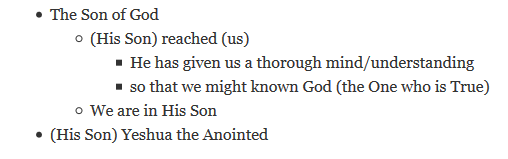
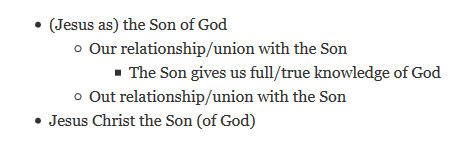
“And we have seen that the Son of God reached (us) and has given to us a thorough mind [dia/noia], (so) that we might know the (One who is) true, and (indeed) we are in the (One who is) true—in His Son, Yeshua (the) Anointed. This is the true God and (the) Life of the Age.”

The principal statement is bracketed by references to Jesus as God’s Son; this is vital to an understanding of the verse, as it governs the structure of the statement, which I outline here as a chiasm:

This outline may be summarized:

This is very nearly a perfect epitome of Johannine theology, conforming to everything we find in both the Gospel and the First Letter. Somewhat more difficult is the concluding statement of the verse:

ou!to/$ e)stin o( a)lhqino\$ qeo\$ kai\ zwh\ ai)w/nio$
“This is the True God and (the) Life of the Age [i.e. eternal Life].”

Particularly problematic is the relation of the demonstrative pronoun ou!to$ (“this”) to the previous sentence, as well as the predicate statement which follows. There are several possibilities:

    • The pronoun identifies the substantive o( a)lhqino/$ (“the true [one], the [one who is] true”) as God the Father—i.e., “this (one) is the true God“—who is also “the Life of the Age”.
    • It identifies “the One who is True” as God the Father (the True God), and His Son (Jesus) as “the Life of the Age”.
    • It identifies Jesus as both “the True God” and “the Life of the Age”.
    • It summarizes the entire Gospel message about both God the Father and Jesus (the Son)—i.e., “this is (the message of) the True God and Eternal Life”.

Sound arguments can be made for each of these four interpretations, and I find it almost impossible to make a conclusive choice. Most likely, based on Johannine usage, the expression “the Life of the Age” should be understood in relation to Jesus; he is identified as “(the) Life”, and the immediate source of Life for believers, in numerous places (Jn 1:4; 5:26; 11:25; 14:6; 1 Jn 1:1-2; 5:11-12, etc). Yet it is also entirely appropriate to refer to the Gospel message as “Life” in a similar way (cf. Jn 6:63; 12:50; 17:3; 20:31). The opening words of 1 John (1:1-2) seem to play on both of these meanings of “the Life”, and it is likely that a similar dual-meaning is present in the closing words of the letter as well.

Many commentators question whether Jesus would have been identified directly as “the true God”. While there is no doubt that, in both the Gospel and First Letter, the essential deity of Jesus (including his pre-existence and union with the Father) is clearly expressed, his identification as o( qeo/$ (“the [one true] God”) is less certain. Note, for example, the careful wording in John 1:1c (qeo/$ without the definite article). I have discussed the famous textual question in Jn 1:18 on a number of occasions (cf. the most recent treatment). As the textual evidence between qeo/$ (“God”) and ui(o/$ (“Son”) is rather evenly divided, one cannot simply read qeo/$ without futher ado. Even so, most manuscripts also read qeo/$ without the definite article in verse 18, for whatever that might signify (and it remains much disputed).

Syntactically, in 5:20, it is worth noting that the most proximate reference for ou!to$ would be Jesus, as the phrase “…His Son Yeshua the Anointed” immediately precedes the demonstrative pronoun. However, this is by no means a certain indicator of the pronominal relationship; consider the example of 2 John 7:

“…the ones not giving common account of [i.e. confessing] Yeshua (as hav)ing come in the flesh. This [ou!to/$] is the (one speaking) false(ly) and the (one who is) against the Anointed [i.e. ‘antichrist’]!”

Clearly, in this case, ou!to$ refers back to “the ones not confessing Jesus…” rather than to “Jesus”. Based on this syntax, ou!to$ in 1 Jn 5:20 would more likely refer back to “the One who is True” (i.e. God the Father), rather than to Jesus. At the same time, the syntax in 2 Jn 7 would suggest that both the pronoun and the two expressions (“the True God” and “the Life of the Age”) refer to a single subject, in which case, Jesus is the more probable subject.

Despite the many difficulties in deciding between the options listed above, I am inclined to favoring the second and fourth, or, perhaps, some combination of the two:

    • The two expressions “the True God” and “the Life of the Age” relate back to the two subjects—God the Father (“the One who is True”) and Jesus Christ (His Son), respectively.
    • As the concluding declaration of the letter, the pronoun ou!to$ also effectively summarizes the entire content of the letter; parallel with the opening words (1:1-2), it refers to the Gospel message, of what (the true) God has done for us through his Son Jesus, which leads to eternal Life for those who believe.

“…Spirit and Life”: 1 John 5:16-18 (continued)

1 John 5:16-18 (continued)

In the previous note, I discussed the opening declaration in verse 18, along with the various (and seemingly contradictory) statements in the letter to the effect that Christians both do commit sin and do not (indeed, cannot) commit sin. There is no simple answer or solution to this difficulty, but I have sought to analyze it carefully, based on the overall language and ideas expressed throughout the letter. However, before proceeding to a more precise interpretation, it is necessary to examine the distinction in vv. 16-18 regarding sin that is “toward death” (pro\$ qa/naton) and sin which is not so. Here again are verses 16-17 in translation:

“If any (one) should see his brother sinning sin (that is) not toward death [mh\ pro\$ qa/naton], he will ask and (God) will give him life—(that is,) the (one)s not sinning toward death. There is sin toward death, and about that (sin) I do not say that he should make (such a) request. All injustice is sin, and (yet) there is sin (which is) not toward death.”

Sin which is “toward death”

The simplest explanation of the expression “toward death” (pro\$ qa/naton) is something which leads toward death or results in it (cf. John 11:4). The underlying idea is presumably legal, particularly as expressed in the Old Testament Law (Torah). Certain violations of law—i.e. serious crimes against society or religious transgressions—specifically result in death for the offender (Exod 21:12ff; Num 18:22, et al). Some commentators understand the idea of the transgressor being “cut off”, at least in certain passages, as referring to a punishment by God of death. Naturally, in such legal and religious-cultural settings, certain sins result in death (or a sentence of death) while others do not. How might this apply to the situation in 1 John? A number of interpretations have been offered by commentators over the years; these include:

    • The distinction involves especially serious or egregious sins—religious and/or ethical violations—in the basic sense indicated above.
    • It reflects something akin to the thought in James 1:14-15, of sinful behavior which is cultivated and allowed to grow, leading to “death”; this would perhaps relate to the interpretation that the present tense of the verb a(marta/nw in 3:6, 9; 5:18, etc, refers to continual, habitual sinning, rather than occasional failings by the believer.
    • The distinction involves ‘ordinary’ sinning (i.e. moral lapses, etc) vs. more serious sins (i.e. “blasphemy”) against God’s own person, perhaps in a specific theological/Christological sense.
    • It relates to the “unforgivable sin” (i.e. against the Holy Spirit) of which Jesus speaks in Mark 8:38 par.

The first option certainly fits the fundamental religious/ethical background which presumably underlies the expression. Indeed, early Christians preserved the basic idea of especially serious (and blatant) sins which no true believer ever should, or would, commit. There are a number of examples of such “vice lists” in the New Testament, which are generally in accord with both Jewish and Greco-Roman standards of decency and morality—e.g., Rom 1:29-31; 1 Cor 6:9-10; Gal 5:22-23. In Rom 1:32, Paul specifically declares that those who commit such gross transgressions are “deserving of death“. This draws upon traditional Israelite and Jewish religious thought, as expressed in the Torah (cf. above). He similarly states (again using traditional language) that those engaged in such behavior will certainly not “inherit the kingdom of God” (1 Cor 6:10; Gal 5:21).

The problem with this view is that such traditional ethical instruction is really not to be found in the letter. Only in 2:15-17 do we see anything of the sort, and, even there, the emphasis is more generally on the character of “the world” rather than on specific types of sin. The closing statement of the letter (5:21) appears, at first glance, to be a traditional warning against (pagan, Greco-Roman) idolatry; yet, based on the overall orientation of the letter, it is likely that the warning should be understood as a coded statement, referring to the false views of those described in 2:18-25 and 4:1-6, etc, symbolically as idol-worship. So, this leaves us with two options: (1) in 5:16-18 the author is referring to something (types of serious immorality, etc) not otherwise emphasized in the letter, or (2) the sin that is “toward death” relates to something other than violation of traditional religious and moral behavior. In my view, the latter is more likely and fitting with the rhetorical thrust of the letter. If so, then it would also eliminate the second interpretation cited above. As I argued in the previous note, the use of the present tense of a(marta/nw does not necessarily indicate continual/habitual sinning, but more properly the simple distinction between past and present sins.

I would suggest that the third and fourth views listed above are rather closer to the mark, though the dynamic must be understood in terms of Johannine thought (i.e. that of the Letters and Gospel). Jesus’ specific saying regarding the “unforgivable sin” (against the Holy Spirit) is foreign to 1 John, though it may provide a loose parallel in the way that early Christians may have understood certain “sins” as directed specifically against the person of Christ and/or the Spirit.

It is useful at this point to consider the statement made by the author in verse 17:

“All sin is injustice [a)diki/a], and (yet) there is sin which is not toward death.”

The noun a)diki/a literally refers to something which is “without justice, without right(eous)ness”; we might say that it is “lacking right-ness”. This blanket statement refers to “all sin” (pa=sa a(marti/a). At the same time, it would seem that the author agrees with the general assessment in James 1:14-15 that all sin eventually leads to death (on this point, cf. below). What, then, is the sin which is, or leads, “toward death”? Let us look at the key references to “death” (qa/nato$) in the Johannine Gospel and First Letter, specifically with those which relate to the believer (rather than the sacrificial death of Jesus):

    • Jn 5:24—the person hearing Jesus’ word, and trusting in him (and the One who sent him), holds the “Life of the Age” (eternal life) and “has stepped across out of death (and) into Life”. Humankind in the world is dominated by sin and darkness, and is on a path which leads to (ultimate) death in the end-time Judgment. Only those who trust in Jesus have Life, and are transferred out of this realm (and path) leading to death.
    • Jn 8:51-52—here we find a slightly different formulation of the same idea: that the person (believer) who keeps/guards Jesus’ word will never “see/taste death”. The motifs of “hearing” and “keeping” Jesus’ word are two aspects of the principal idea of trusting in Jesus (and in God the Father).
    • 1 Jn 3:14 reflects both of these declarations by Jesus, defining them specifically in terms of love for one’s fellow believer:
      “We have seen [i.e. known] that we have stepped across out of death (and) into Life, (in) that [i.e. because] we love the brothers; the (one) not loving remains in death.”

We have discussed previously how, in Johannine thought, the entirety of the Christian life is summarized by just two “commandments” (e)ntolai/); actually, it is better understood as a single, two-fold duty: (1) trust in Jesus and (2) love for fellow believers (following Jesus’ own example). This may be deduced from evidence all throughout the Gospel and Letters, and is stated precisely in 3:23-24. Every true believer observes (keeps) this two-fold command; by contrast, the one who violates it is not a true believer. This background provides what I consider the best avenue for interpreting 5:16-18, which I would summarize as follows:

    • Believers may sin at various times, but they do not (and cannot) sin in the sense of violating the two-fold command which is fundamental to one’s Christian identity.
    • “False” believers, such as the “antichrists” who separated from the Johannine congregations, may claim to be true Christians, but they are not, since they violate the two-fold command—i.e., they do not have proper trust in Jesus, and/or do not demonstrate true love. As non-believers (belonging to “the world”), who thus act in a manner “against the Anointed” (i.e. ‘anti-christ’), they do not possess Life, and remain on the path leading toward death.
    • It is thus these false/non-believers who sin “toward death”; true believers cannot sin in this way.

From what we read in the letter (and also in 2 John 7-11), it is clear that those who separated from the Johannine congregations, holding (and proclaiming) a false view of Jesus, were exerting some measure of influence in the various churches. This setting informs the warnings in 1 Jn 4:1ff and 2 Jn 8ff—i.e., the need for believers to be on guard and to “test” the “spirits” of those speaking about Jesus.

Life and Death in 1 Jn 5:16

Another difficulty in the interpretation of vv. 16-18 is the way “life” (zwh/) and “death” (qa/nato$) relate in this passage. The syntax of verse 16 is actually rather ambiguous; I translate it here without any explanatory gloss:

“If any one should see his brother sinning sin not toward death, he will ask and he will give him life…”

We must first determine the point of reference for the subject/object of the phrase in italics—who gives and who receives life? There are three options:

    • The person (believer) making the request is the one who gives life to the believer who is sinning
    • God gives life to the sinning believer
    • God gives life to the one making the request

I would say, with most commentators, that the second option is to be preferred, though it is possible that the phrase expresses the idea that the believer’s request effectively results in (God) giving life to the one sinning. How should we understand “life” here? Throughout the Gospel and Letters of John, the word zwh/ virtually always refers to the (eternal) Life possessed by God, and which God, through Jesus (and the Spirit), gives to believers. Yet, if believers already possess this Life, and are not sinning “toward death” (cf. above), in what sense is the believer given “life” here? I note several possibilities:

    • Here, in fact, the reference is to the danger of physical death as a result of sin
    • The language simply reflects the basic distinction of sin and evil as the opposite of life (i.e. death), in a general sense
    • Sin puts the believer (temporarily) out of union with God and Christ (i.e. “death”); only after confession/admission of sin and forgiveness/cleansing is this union (“life”) restored
    • The forgiveness provided to the sinning believer is part of the same life-giving power of God which Christ possesses; this is inherent both in the saving work of his sacrificial death (“blood”), and through the (priestly) intercession he performs on our behalf (1:7-9; 2:1-2). Since Jesus himself is Life (Jn 1:4; 11:25; 14:6; 1 Jn 1:1-2, and cf. the upcoming note on 5:20), he gives life in all that he says and does.

The last option is the one best in keeping with Johannine thought, and, I should say, is to be preferred. In the next note, I will be reviewing aspects of this overall study (on 5:16-18, etc), and will attempt to bring the strands together into a more concise and definite interpretation.

“…Spirit and Life”: 1 John 5:16-18

1 John 5:16-18

“If any (one) should see his brother sinning sin (that is) not toward death [mh\ pro\$ qa/naton], he will ask and (God) will give him life—(that is,) the (one)s not sinning toward death. There is sin toward death, and about that (sin) I do not say that he should make (such a) request.”

Verses 16-18 are among the most notoriously difficult in all the New Testament to interpret. They have challenged commentators and theologians for centuries. We must presume that the language and point of reference would have been more readily understandable to the original audience than for us today. At this distance removed, it is virtually impossible to establish the context and background of the passage with any certainty. There are two points which have been especially difficult to understand:

    1. The statement in verse 18, to the effect that believers (those “born of God”) do not sin, when elsewhere it is recognized that believers do sin (v. 16, etc)
    2. The distinction between sin that is “toward death [pro\$ qa/naton]” and sin that is not so.

The latter is especially significant since the reference to “death” (qa/nato$) would seem to relate to the giving of “life” (zwh/) mentioned in verse 16. However, since both points above are important for an understanding of the statement(s) in verse 16, it is necessary to discuss each of them in some detail. It will be helpful, I think, to begin with first point—the statement in verse 18.

1 John 5:18

“We have seen [i.e. known] that every (one) having come to be (born) out of God does not sin [ou)x a(marta/nei]…”

I have intentionally stopped after the first clause, since it is this particular statement which has proven difficult to interpret, from a theological standpoint. First, the perfect participle (with the article)—o( gegennhme/no$, “the one having come to be born” (i.e. born “…out of God“)—is used by the author as a descriptive title for believers (also in 3:9). The verb genna/w (“come to be [born]”) is used repeatedly this way (2:29; 3:9; 4:7; 5:1, 4; cf. also Jn 1:13; 3:3-8). This statement essentially repeats the earlier declarations in 3:9—

“Every (one) having come to be (born) out of God does not do/make sin [i.e. act sinfully]…”

and also in the prior v. 6:

“Every (one) remaining in him does not sin…”

At the same time, it is quite clear that believers in Christ do sin (1:8-10; 2:1-2, etc). How is this evidence to be reconciled? There are several possibilities:

    • The statements in 3:9 & 5:18 reflect prescriptive, rather than descriptive, language—i.e., expressing how things ought to be, the ideal, rather than how things actually are.
    • The present tense of the verb a(marta/nw in 3:6-9 and 5:18 specifically indicates a practice of sinning—i.e. continual or habitual. According to this interpretation, true believers do sin, but do not continually sin.
    • The “sinlessness” of believers expressed in 3:6, 9 and 5:18 reflects the essential reality of our union with Christ, but not necessarily the daily life and practice of practice of believers, which entails the regular dynamic of both sin and forgiveness.

There are, perhaps, elements of truth in all three of these interpretive approaches. The first option is the simplest, but, in my view, is something of an artificial (modern) distinction. Probably the majority of commentators (and translators) adopt the second option, but, again, there is little clear indication of such a distinction in the text itself. The use of the present tense of a(marta/nw scarcely need be limited to the idea of repeated or continual sin; much more likely is a simple distinction between past sins (cleansed upon coming to faith in Jesus) and present sins committed during the time now that one is a believer.

In my view, the third option above best fits the thought (and theology) of the letter, and is likely to be closest to the mark. Note, in particular, the way that the “sinlessness” is worded and qualified:

    • “the one having come to be born of God…”
    • “the one remaining/abiding in him…”

To understand this better, let us examine the context of each of the statements in 3:6, 9, and 5:18.

1 Jn 3:6. The statement is: “Every one remaining in him does not sin”. This is contrasted with the parallel statement in v. 6b: “every one sinning has not looked upon [i.e. seen] him and has not known him”. The combination of these statements would suggest that, if a believer commits sin, then he/she has not seen/known Christ, and (thus) is not a true believer. However, that is not quite the logic of the verse; consider the structure of it, outlined as follows:

    • The one remaining in Christ [i.e. the believer]
      —does not sin [i.e. characteristic of the believer]
      —the one who does sin (“sinning”) [i.e. characteristic of the unbeliever]
    • The one who has not seen/known Christ [i.e. the non-believer]

The thrust of the statement is the kind of dualistic contrast so common in Johannine thought and expression—seeing/not-seeing, knowing/not-knowing, believer/non-believer. How, then, should we regard the similar contrast between not-sinning and sinning? This is made more clear when we look at the prior statements in vv. 3-5, working backward:

    • “in him [i.e. Jesus Christ] there is not (any) sin” (v. 5b)
      —this is a fundamental statement of Jesus’ sinlessness; the “sinlessness” of believers must be understood first, and primarily, through this.
    • “and you have seen/known that that (one) [i.e. Jesus] was made to shine forth [i.e. revealed], (so) that he might take up [i.e. take away] sin” (v. 5a)
      —a central aspect of Jesus’ mission and work on earth, esp. his sacrificial death, was to “take away” sin (cf. Jn 1:29, etc); it is through this work of Jesus that we (believers) are cleansed from sin (1 Jn 1:7).
    • “The one doing sin does/acts without law [a)nomi/a], and sin is (being/acting) without law [a)nomi/a]” (v. 4)
      —on the surface, this seems simply to reflect the traditional principle that “sin” entails the violation of religious and ethical standards (“law”, “commandments”); however, the Gospel and Letters of John understand and interpret the “commandments” (e)ntolai/) for believers in a distinctive way (cf. especially the two-fold ‘commandment’ in 1 Jn 3:23-24). If “sin” is defined as being “without the commandments” then, here in the letter, this essentially means being without (real) trust in Jesus and without (true) love.
    • “Every one holding this hope upon him makes himself pure, even as that one [i.e. Jesus] is pure.” (v. 3)
      —this statement focuses more on the attitude and behavior of believers, with the expression “makes himself pure” (a(gni/zei e(auto\n); it functions as an exhortation for believers to live and act according to their true identity (in Christ). Paul does much the same thing when he exhorts his readers, e.g., “If we live in/by the Spirit, we should also ‘walk in line’ in/by the Spirit” (Gal 5:25).
    • “Loved (one)s, (even) now we are offspring [i.e. children] of God, but it is not yet made to shine forth [i.e. revealed] what we will be…” (v. 2)
      —this declaration is vital to an understanding of the author’s perspective here in the letter; it reflects the two aspects of a “realized” and “future” eschatology, applying it to our identity as believers (“children of God”). Already now, in the present, we are “born of God”, yet this will not be experienced fully for us until the end time. Thus, while we partake of the sinlessness of Christ, we do not act sinlessly at every point of our lives on earth.

1 Jn 3:9. At first glance, throughout verses 2-6ff, the author seems to be speaking generally about “sin”, and it is easy to insert a conventional religious and ethical sense of the word, as though he were simply summarizing traditional immorality such as we see in the Pauline “vice lists” (Rom 1:29-31; 1 Cor 6:9-10; Gal 5:19-21, etc). Yet, a careful reading of the letter itself indicates that this really is not what he is describing. Indeed, apart from 2:15-17 and (possibly) 5:21, there is very little evidence of traditional ethical teaching in the letter. Which is not to say that the Johannine congregations were careless about such things; however, the emphasis in the letter is specifically on the two-fold “commandment” for believers stated in 3:23-24, etc—of (proper) trust in Jesus and (true) love for fellow believers. We must keep in mind the rhetorical background of the letter, which is directed against the would-be believers (“antichrists”) who have separated from the Johannine congregations. The author views them as breaking both of these “commandments”, and are thus sinning in a fundamental way that the remainder of the faithful are not.

In verse 10, the author begins transitioning his discussion toward the two-fold commandment, beginning with the duty to love one another, according to Jesus’ own example (Jn 13:34-35, etc). This is prefaced by the dualistic contrast of righteousness/sin and God vs. Devil, sharpening and intensifying the line of rhetoric. These characterize true believers, against those who are not (e.g. the Johannine separatists):

    • “the one doing justice/righteousness” vs. “the one doing sin” (vv. 7-8a)
    • “(the works of God)” vs. “the works of the Devil” (v. 8b)
    • “the one born out of God” vs. “the one (born) out of the Devil” (vv. 8a, 9a)

It is thus not merely a question of committing (or not committing) particular sins, but of attributes and qualities characterizing two different “groups” of human beings (and supposed Christians). Again, it is the purity and sinlessness of Jesus himself, the Son of God, by which we come to be made pure and ‘without sin’—i.e. “born of God”, “offspring of God”. The essence and character of this fundamental identity is clearly expressed in verse 7:

“the (one) doing justice is just, even as that (one) [i.e. Jesus] is just”

Doing justice does not make a person just; quite the reverse—the believer’s “just-ness” in Christ results in his/her acting justly. Note how this is expressed in verse 9; it will be useful to look at each component in the verse:

    • “Every (one) having come to be (born) out of God does not do sin”
      • “(in) that [i.e. because] His seed remains in him”
      • “and he is not able to sin”
        • “(in) that [i.e. because] he has come to be (born) out of God”

This is one of the most elliptical statements in the letter:

    • “the one having come to be born out of God”
      —”he does not sin”
      ——”His seed remains in him”
      —”he is not able to sin”
    • “he has come to be born out of God”

Central to the “sinlessness” of believers is the essential reality that God’s seed (spe/rma) remains/abides [me/nei] in us. We may fairly interpret this “seed” as the living/abiding Spirit of His Son (which is also His own Spirit). Just as there is no sin in the Son, even so there is no sin abiding/remaining in us.

This brings us again to the statement in 1 Jn 5:18; let us now examine the verse in its entirety:

“We have seen that every (one) having come to be (born) out of God does not sin, but (rather) the (one) coming to be (born) out of God keeps watch (over) him, and the evil does not attach (itself) to him.”

The difficulty of the wording (and meaning) is reflected by several key variant readings, which I discussed briefly in an earlier Saturday Series study. The main question is whether the second occurrence of the verb genna/w (aorist pass. participle, gennhqei/$) refers to Jesus, as the Son of God, or the believer as child/offspring of God. Commentators and textual critics are divided on this question, which involves three different major variants, two involving the object pronoun, and one involving the form of the verb:

    • o( gennhqei\$ e)k tou= qeou= threi= au)to/n
      “the (one) coming to be (born) out of God keeps watch (over) him”
    • o( gennhqei\$ e)k tou= qeou= threi= e(auto/n
      “the (one) coming to be (born) out of God keeps watch (over) himself”
    • o( ge/nnhsi$ e)k tou= qeou= threi= au)to/n
      “the coming to be (born) [i.e. birth] out of God keeps watch (over) him”

It would seem that the first reading best explains the rise of the other two, and, in my view, is more likely to be original. Though the verb genna/w, used in a symbolic or spiritual sense, otherwise always applies to the believer rather than Jesus (Jn 18:37 refers more properly to his physical/human birth), the emphasis in the letter on Jesus on the Son of God, and on that as the basis for our being “born of God”/”offspring of God”, makes it highly likely that the author is playing on such a dual-meaning here. This would also seem to be confirmed by 3:9 (cf. above), which speaks of God’s “seed” (i.e. son/offspring) abiding in the believer. It is this seed, this “offspring” born of God, which guards believers, keeping and protecting us from evil.

This detailed study should, I think, shed some light on the author’s thought and mode of expression. Still, it does not entirely explain the statement at the beginning of verse 18. A clearer understanding requires that we now turn to the second interpretive difficulty highlighted above—namely, the meaning of the expression “sin(ning) toward death” in vv. 16-18. This will be discussed in the next note.

“…Spirit and Life”: 1 John 5:11-13

1 John 5:11-13

Verses 9-12 represents the final section in the body of the letter, with vv. 11-12 as the concluding statement. This section builds upon what was stated in vv. 6-8 (cf. the previous notes), particularly the idea that the Spirit gives witness (“the one giving witness”, vb. marture/w) regarding Jesus Christ and the true/correct understanding of him. This witness (marturi/a) by the Spirit is closely related to the humanity of Jesus, both his birth/life as a real human being, and the reality (and importance) of his physical death. As we have discussed, this point of Christology appears to have been emphasized especially by the author, against a “docetic” view of Jesus, such as was apparently held by the “antichrists” who separated from the Johannine congregations.

In verse 9, this witness by the Spirit is identified as God’s own witness—

“(and it is) that this is the witness [marturi/a] that God has given (as a) witness about His Son” (v. 9b)

a witness which is greater than any human witness we might receive (9a). This contrast may be intended to distinguish the mainstream Johannine congregations (who accept the witness of God’s Spirit and hold a correct view of Jesus) from the separatists who give testimony (about Jesus) which is not from God. Verse 10 sets the witness of God (his Spirit) specifically in the context of trust in Jesus—this is the point of separation, the dualistic contrast between those who trust/believe (correctly) and those who do not:

“The (one) trusting in the Son of God holds [e&xei] th(is) witness in himself, (but) the (one) not trusting God has made Him (to be) a false (speak)er, (in) that [i.e. because] he has not trusted in the witness which God has given (as a) witness about His Son.”

The witness which a (true) believer has, or holds, in him/herself is best understood as the Spirit, according to the prior statements in vv. 6-8. As I discussed in the previous note, the three-fold witness reflects two aspects of Jesus’ human life (“water” and “blood”), given sacrificially on our behalf, communicated to us (believers) through the presence of the Spirit. Believers possess (“hold”) this life through the Spirit. This identification is made more clear by the statement which follows in verse 11:

“And this is the witness: that God gave to us (the) Life of the Age, and (that) th(is) Life is in His Son.”

As I have discussed at length in earlier notes, the expression “Life of the Age” (zwh/ ai)w/nio$) originally had an eschatological connotation (i.e. the divine/heavenly life which the righteous would enter/inherit in the Age to Come), but was applied by Christians—especially in the Johannine writings—to the divine/eternal/spiritual Life which believers hold even now (in the present) in Christ. This re-interpretation is indicated even here in this verse, by the way that the expression “Life of the Age” is so easily treated as equivalent to “Life” (in Christ, “in His Son”). The dualistic contrast in verse 10 is repeated in the concluding v. 12:

“The (one) holding the Son holds Life, (but) the (one) not holding the Son does not hold Life.”

The highly expressive (and symbolic) thought expressed in the Johannine writings is indicated in these verses, by the different objects which believers are said to “hold” (vb. e&xw):

    • the witness of God (v. 10) = the witness of the Spirit (vv. 6-8)
    • the Son (of God) (v. 12a)
    • (divine/eternal) Life (v. 12b)

These are all more or less interchangeable in Johannine thought, and are best represented by the Spirit, which is the presence of God (the Father) and Jesus (the Son) in the believer. This life-giving power and presence is realized spiritually, through the Spirit.

Verse 13

In terms of the structure of the letter, it is best to treat vv. 13-21 as the conclusion. That this sections begins with verse 13 is confirmed by the close parallel with John 20:31, the conclusion of the Gospel proper. It is worth comparing the two statements (note the portions in italics):

“And these (thing)s I have written (so) that you would trust that Yeshua is the Anointed (One), the Son of God, and that, trusting, you would hold Life in his name.” (Jn 20:31)

“These (thing)s I wrote to you, to the (one)s trusting in the name of the Son of God, (so) that you would have seen [i.e. known] that you hold (the) Life of the Age.” (1 Jn 5:13)

The wording and thought is so similar that the two statements were either the work of the same person, or one was written after the pattern of the other (or after a common pattern). It effectively repeats the theme and points made in the previous verses, and makes it clear that they relate to the main purpose of the letter. This purpose is indicated by the perfect subjunctive form of the verb ei&dw (“see, perceive, know”)—ei)dh=te, “you would/might have seen”. Here the perfect tense, or aspect, is best understood as an intensive, reflecting either a particular result, or a current state/condition (i.e., of those the author is addressing)—i.e., “would/might surely come to see/know”. The same verb form is used by Jesus in the Synoptic tradition (Mark 2:10 par):

“(so) that you might (surely) come to see [i.e. know] that the Son of Man holds [e&xei] authority to release [i.e. forgive] sins upon earth…”

Interestingly, there is a formal similarity in the object of knowledge in both passages:

    • “that you hold Life…”
    • “that the Son of man holds authority to release sin…”

As we shall see (in the next note), the motifs of sin, forgiveness, and life, all appear in the subsequent verses 14-17. How do the remaining verses of the conclusion relate to this statement in verse 13? I would divide the section as follows:

    • Opening statement—assurance to believers of the Life they have in Christ (v. 13)
    • Instruction: Prayer for the forgiveness of sin (vv. 14-17)
      —On the effectiveness of prayer/request to God (vv. 14-15)
      —The purpose/result of prayer: Life and Death in relation to sin (vv. 16-17)
    • Exhortation: Protection from sin for the true believer (vv. 18-19)
    • Closing statement—assurance to believers of the Life they have in Christ (v. 20)
    • Concluding warning [coded statement?] (v. 21)

Most of the New Testament letters contain a teaching/exhortation section toward the end of the letter; sometimes this is built into the epistolary conclusion, as is the case in 1 John. This will be discussed briefly in the next note.