“…Spirit and Life”: 1 John 3:14-15

1 John 3:14-15

Verse 11 of chapter 3 begins a new section of the letter, which continues on through verse 24. The theme is clear from the initial statement in verse 11:

“(And it is) that this is the message which you heard from the beginning: that we should love (each) other.”

In 2:8, the author treats the directive to love as a new command (cf. John 13:34), while here he describes it as something which believers have heard “from the beginning”. This builds on the play between “old” and “new” in 2:7ff—the two-fold command to trust in Jesus and to love one another (3:23-24) is both old and new. This may be understood in many ways; certainly for the early (Jewish) believers, faith in Christ and love for one’s neighbor could be viewed as a fulfillment of the Old Law (Torah), cf. Romans 10:4; 13:10, etc. It is also something which believers have been taught from the very beginning (i.e. since they first heard the Gospel message). Yet, it continues to be restated and presented anew in the life of each community and to each generation of believers. The very thrust of 2:7-11, and again here in 3:11-24, suggests that there may have been Christians who were not truly living out the directive to love. Indeed, this would appear to be at the heart of the author’s polemic in the letter (which takes on prominence in 4:1ff), marking those who have separated from the Community as being without the proper love (for the Community).

The rivalry between the world and believers in Jesus, as also between “true” and “false” believers, is indicated clearly by verses 12-13, where the ancient example of Cain and Abel is introduced. Here is an illustration of someone hating his brother—just the opposite of love. This hate leads to murder, and the author, along the lines of Jesus’ teaching in the Antitheses of the Sermon on the Mount (Matt 5:21-26), equates hate with murder/manslaughter, even if no actual killing occurs. This hatred of one’s brother is further equated with the world’s hatred of believers (v. 13). In verses 14-15, this conflict is defined in terms of the dualistic contrast between life (zwh/) and death (qa/nato$):

“We have seen [i.e. known] that we have stepped across, out of death (and) into life, (in) that we love the brothers; the (one) not loving remains in death.” (v. 14)

The verb metabai/nw specifically means “step across”, with the preposition meta/ indicating a change of place or position (lit. within [a boundary]), i.e. from one point to the next—in this case from death to life. The same language and imagery is found in the Johannine discourses of Jesus (Jn 5:24):

“Amen, amen, I relate to you that the (one) hearing my word/account [lo/go$], and trusting in the (one) sending me, holds (the) Life of the Age [i.e. eternal life] and does not come into (the) Judgment, but has stepped across out of death (and) into Life.”

This fits the motif of resurrection—of the dead hearing the voice of the Son (of God)—in John 5:19-29. In vv. 24-25, the end-time resurrection is given a new interpretation (i.e. “realized” eschatology) for believers in Christ, and it is this spiritual sense of resurrection that we find also in First John. The “Life of the Age” is defined more generally as “Life”, i.e. in Christ, and in the Spirit. The opposite of 3:14 is stated in verse 15, continuing the dualistic contrast (Abel/Cain, love/hate, life/death):

“Every one hating his brother is a man-killer [a)nqrwpokto/no$], and we have seen [i.e. known] that every man-killer does not hold [i.e. have] the Life of the Age remaining [i.e. abiding] in him.”

This statement follows the fundamental ethnical-religious principle that a murderer (who in the law would be put to death) will surely not pass through the Judgment and inherit eternal life (cf. Exod 20:13; Num 35:16ff; Matt 5:21ff; Rom 1:29ff; 1 Cor 6:9-10; Gal 5:19-21, etc). Hatred toward one’s brother (i.e. toward a fellow believer) is regarded as the equivalent of murder or manslaughter. We must understand that, for the author, “hating” (vb. mise/w) does necessarily require the kind of overt ill-feeling and hostility usually associated with the word. It is better defined here as the absence/opposite of the true love which believers ought to have toward one another. The nature of this love is clear from verse 16 (following Jesus’ words in 13:14-15, 34-35; 15:12-17)—it entails following Jesus’ own example of sacrificial love, laying down one’s own life for another.

Moreover, it is clear that, the one who fails to love violates the fundamental ‘command’ of Christ (and God the Father), and is thus sinning. And, according the theology in the letter, any one who sins this way has not been “born of God”, and possesses neither the living Word nor the Spirit of God. The significance of this for the remainder of the letter is indicated by verses 23-24, where the command to love is linked to the command to trust in Jesus—i.e. the two-fold command which governs all true believers. This will be discussed further, in the next note.

“…Spirit and Life”: 1 John 2:25

1 John 2:25

In the previous note on 1 John 1:1-2, we examined the use of the expression a)p’ a)rxh=$ (“from the beginning”) in the opening words, noting the parallels with the Prologue to the Gospel (John 1:1ff). I pointed out that the “word” (lo/go$) in the first verse of the Letter (the expression “the Word of Life” [o( lo/go$ th=$ zwh=$]) is to be understood and carrying a dual meaning:

    1. the Living Word of God (identified with Jesus), and
    2. the word/account of Jesus (i.e. the Gospel message).

It so happens that there is a similar double-meaning to the expression “from the beginning [a)p’ a)rxh=$]”, which occurs seven more times in the letter (2:7, 13-14, 24 [twice]; 3:8, 11), and twice more in 2 John 5-6. The word a)rxh/ (“beginning, first, leading”) does not appear in the Johannine letters apart from this expression.

In 2:7, which begins a section of exhortation and instruction (vv. 7-17), the author says:

“Loved (one)s, (it is) not (about something) new laid on (you) to complete (that) I write to you, but (about something) old laid on (you) to complete, which you hold from the beginning [a)p’ a)rxh=$]—th(is) ‘old’ (charge) laid on (you) to complete is the word [lo/go$] which you heard.”

He goes on to write:

“(But) again, I (do) write to you (about) a new (charge) laid on (you) to complete—which is true in him and in you—(in) that the darkness is leading [i.e. passing] along and the true Light already shines.” (v. 8)

I have translated the word e)ntolh/ here in an excessively literal manner, according to its fundamental meaning, rather than with the customary “command(ment)”, which can be quite misleading in the context of the Johannine writings. We are not dealing with a specific set of religious or ethical “commands”—certainly not of the Old Testament Law (Torah), nor even a collection of Jesus’ teaching such as we find in the Sermon on the Mount. A careful reading of both the Gospel and the Letters makes clear that there are really only two commands as such: (1) trust in Jesus as the Anointed One and divine Son sent by God, and (2) love for one another, following Jesus’ example. The author states this specifically in 3:23-24.

Moreover, it is clear from vv. 9ff, that the new ‘command’ in 2:8 is the command to love one another, which Jesus gave to his disciples in Jn 13:34-35. What, then, is the old ‘command’? As the author identifies this in v. 7 with “that which you hold/held from the beginning”, we must conclude that it is essentially equivalent to the first ‘command’ in 3:23—namely, trust in Jesus Christ as God’s Son. Both of these ‘commands’—trust in Jesus and love for fellow believers—are the tests by which the author (and, we must assume, the communities/churches he represents) defines one’s identity as a true Christian. The emphasis in 2:7ff suggests that there may have been Christians in the Johannine churches, or known to them, who demonstrated a true faith in Christ but were perhaps not exhibiting true love. At any rate, this is the thrust of the exhortation (and warning) in 2:9-11.

We see, then, that in 2:7ff, the expression “from the beginning” refers not to eternity and the beginning of Creation (as in John 1:1), but rather to the beginning of believers’ trust in Jesus, and subsequent new/spiritual “birth” as children of God. In particular, the context is of the word (lo/go$) heard from the beginning, which I take to mean primarily the Gospel message (i.e. truth about Jesus), but also the presence and work of the Spirit which teaches believers the truth, and continues Jesus’ own work. In 2:13-14, this is defined in terms of knowledge of God the Father (and Jesus the Son):

“…you have known the (one) from the beginning…

This is probably best understood as “the (one who is) from the beginning”, returning to the context of John 1:1ff and 1 John 1:1-2. It is also likely that there is some wordplay involved; at least the syntax here is slightly ambiguous. What is clear, however, from the remainder of the letter, is that true knowledge is more or less synonymous with proper/correct belief in Jesus (cf. John 17:3, etc)—i.e. just what is meant in saying that he is the Anointed One (Messiah) and Son of God.

When we turn to 2:24-25, we find the author once again reflecting the language and thought of the discourses of Jesus from the Gospel (note esp. the use of the verb me/nw, “remain, abide”):

“(That) which you heard from the beginning, you must (let/have) it remain [mene/tw] in you. If (that) which you heard from the beginning should remain [mei/nh|] in you, (then) you also will remain in the Son and in the Father.” (v. 24)

The exact reference of “that which you heard from the beginning” is again somewhat ambiguous. Primarily, it refers to the Gospel message (i.e. the truth) about Jesus; yet, the use of me/nw indicates something deeper as well—the abiding presence of Jesus (the Living Word), both through the Spirit and also the love which fills and works in the believer. The association with the Spirit (as the abiding presence of Christ) is confirmed by what follows in vv. 26-27, referring to the “anointing” (xri/sma) which remains/abides in the true believer.

The author concludes the thought from v. 24 in verse 25:

“And this is the message which he presented as a message [i.e. announced] to us: the Life of the Age.”

The noun e)paggeli/a is rather difficult to translate literally in English. The fundamental meaning of the verb a)gge/llw is “give a message, report, declare”. The prefixed preposition e)pi/ is an intensive, emphasizing a message/report about something or upon a subject, etc. Used in the sense of a declaration, it can refer specifically to something one offers or promises to do. The latter connotation typically applies to the noun e)paggeli/a in the New Testament, and is often translated as “promise”. Again, it is wise to translate as literally as possible, preserving the fundamental meaning, recognizing that it can be understood here on two levels: (1) the message of the Gospel (about Jesus) given to us, and (2) what God has declared or promised to us. With regard to the latter, it is important to note that the noun e)paggeli/a (with the verb e)page/llw) is specifically associated with the Spirit in a number of passages, including Luke 24:49; Acts 1:4; 2:33ff; Gal 3:14ff; Eph 1:13; cf. also Rom 9:8; Gal 4:23ff.

On the one hand, according to the traditional background of the expression “Life of the Age”, verse 25 simply asserts the (eschatological) promise of eternal life for the believer. However, as we have seen in the earlier notes in this series, the discourses of Jesus (and the Gospel as a whole), reflect a “realized” eschatology—believers experience the reality of the divine/eternal Life already in the present, through trust in Jesus and the presence of the Spirit. The author of the Letter certainly shares this basic outlook, and expresses it in his use of “Life” and “Life of the Age” elsewhere in the letter, such as in 3:14-15, the passage we will examine in the next note.

“…Spirit and Life”: 1 John 1:1-2

The Johannine Letters (1 John)

In this series, we now turn to the Letters of John, to see how the words “Spirit” (pneu=ma) and “Life” (zwh/) are used in these other Johannine writings. Many commentators believe that both the Gospel and the Letters (esp. the First Letter) may be written by the same author. Tradition does ascribe them to the same person (John the Apostle), though technically the works are anonymous. At the very least, it is clear that the Gospel and First Letter draw upon similar language and imagery, sharing the same basic theological (and Christological) point of view. Critical commentators have typically explained this by way of a Johannine Community or “School”. Both tradition and internal factors have led many scholars to see these writings (along with the book of Revelation) as being the product of distinct Christian communities in Asia Minor (centered around Ephesus).

An especially complex critical issue lies in the fact that the Johannine discourses (indicated as being spoken by Jesus) and the Letters of John (esp. 1 John) are often so close in thought and wording. Many passages in 1 John could have been lifted right out of the discourses. This raises the question as to the Gospel writer’s role in the creation/composition of the discourses. Most critical scholars would view the discourses as largely the product of the author, while traditional-conservative commentators, naturally enough, are more inclined to seem them as reflecting the actual words of Jesus (with some amount of translation and editing allowed). The situation is akin to that of the Sermon-Speeches in the book of Acts—though they are said to be spoken by different persons (and even in different languages?), much of the actual (Greek) language and wording seems to reflect that of the author of Luke-Acts. For more on this latter question, see my earlier series on the Speeches of Acts.

The words pneu=ma (“spirit”) and zwh/ (“life”) occur only in the First Letter, thus the discussion will generally be limited to that writing. The second and third Letters will be referenced only to give supplemental information, or to help clarify an idea or expression in 1 John. The relevant passages to be discussed are:

1 John 1:1-2

The first two occurrences of the word zwh/ (“life”) come from the introductory sentence of the Letter (vv. 1-3a), which, as even a casual reading should make clear, is similar in thought and expression to the opening of the Gospel Prologue (1:1-4ff). This is only confirmed by a study of the Greek words and phrases involved. Consider the opening words of the letter:

“That which was from the beginning…”
o^ h@n a)p’ a)rxh=$

A comparison with John 1:1 suggests that here the demonstrative pronoun o%$ refers to the “Word” (lo/go$) indicated in the opening of the Prologue:

“In the beginning was the Word…”
e)n a)rxh=| h@n o( lo/go$

The combination of the word a)rxh/ (“beginning”), reflecting Genesis 1:1 [LXX], with the verb of being (ei)mi, the spec. form h@n, “was”), makes it likely that the author of the letter had the Gospel Prologue (or a similar tradition) in mind. The distinctive use of the verb of being in the Prologue (and elsewhere in the Gospel) is theological—referring to God as source of all being and existence.

However, the fact that a neuter form of the demonstrative pronoun (o%) appears at the start of 1 John, indicates that the reference is more generalized and comprehensive—i.e. “(all) that which…”—that is to say, both to the Living Word (Lo/go$) of God, identified with Jesus, and to the “word” or account (lo/go$) of Jesus (i.e. the Gospel message). This dual-meaning of lo/go$ appears a number of times in the letter, beginning here in v. 1 (cf. below).

Before proceeding to examine several key words and phrases, here is the opening sentence of vv. 1-3a in translation:

“(That) which was from the beginning, which we have heard, which our eyes have seen (clearly), which we have looked (upon), and (which) our hands have felt, about the word of Life—and th(is) Life was made to shine forth, and we have seen (it clearly) and give witness and give up as a message to you the Life of the Age(s) which was toward the Father and made to shine forth to us—(that) which we have seen (clearly) and have heard, we also give up as a message to you, (so) that you also might also hold common (bond) with us.”

Despite the repetitiveness in much of this statement (preserved accurately above), the basic idea is clear enough, and it is fully in accord with the outlook of the Gospel writer; note the conceptual structure:

    • The Word which was from the beginning (i.e. with God the Father)
    • This Word was made to shine forth to us (in the person of Jesus)
    • (1) We have seen/heard/felt this (incarnate) Word
      (2) and we, in turn, give witness about it to others
    • This witness is the word of the (Gospel) message

At the very center of this statement is the expression “Word of Life” (o( lo/go$ th=$ zwh=$), which, as I indicated above, has a dual-meaning: (a) Jesus as the Living Word of God (and source of Life), and (b) the message (word/account) regarding Jesus, which will lead to Life for those who trust in him. In the Gospel, the noun zwh/ virtually always refers to the Life which God possesses (i.e. divine, eternal Life), and which is given to believers through Jesus. Just as God the Father’s word and voice gives life to all things (Gen 1:3ff; cf. also Psalm 119:25, 107, etc), so that of the Son (Jesus) gives this same life (Jn 1:3-4; 5:24-29; 6:63; 11:43, etc).

Verse 2 is essentially a parenthesis which explains this Life; there appears to be a loose chiastic structure to its logic:

    • This Life (i.e. the divine/eternal Life)
      —Manifest to us (in the person of Jesus)
      ——We have seen it
      ——We give witness/message of it
      —Manifest to us (through Jesus’ gift)
    • The Life which was with [lit. toward] God

The closing reference to Life uses the expression “Life of the Age”, which appears repeatedly in the Gospel, and which I have discussed at length in earlier notes. It typically refers to the Life given by Jesus to believers, which is also identified numerous times in the Gospel with the Spirit. This same association may be intended here, though the actual word pneu=ma does not occur until chapter 3 of the letter.

If there were any doubt regarding the connection between John 1:1-3 and vv. 1-3 here in the letter, there is added confirmation in the fact that in verses 5ff light is introduced as a thematic motif, just as it is in vv. 4-5ff of the Gospel Prologue. The theme includes the same dualistic light vs. darkness contrast. This may help to explain the interesting use of the preposition pro/$ in Jn 1:1-2 and 1 Jn 1:2. It is typically translated “with”—i.e. the Word was with God—but properly it indicates direction or location, i.e. of motion toward something, or facing toward (i.e. before, in front of) something. Presumably the latter is intended here—the Living Word facing toward God the Father. This would seem to be confirmed by the close association with light-imagery and use of the verb fanero/w (“shine [forth]”). Christ the Son and Living Word of God faces the Father and is (perfect) reflection of the Father’s Light, etc. That same Light is then made to shine forth to believers.

“…Spirit and Life” (continued): Acts and the Pauline Letters

Having examined all of the relevant passages in the Gospel of John, before proceeding to the Johannine Letters, it will be useful to look at some of the key references to the Spirit and Life in the remaining New Testament writings.

I have already discussed the passages in the Synoptic Gospels and the book of Acts, dealing with the Holy Spirit, in an earlier series of notes on “The Holy Spirit in the Gospel Tradition” (the articles “The Spirit in Luke-Acts” cover the Acts references).

Life (zwh/) in Luke-Acts

There are five occurrences of the noun zwh/ in the Gospel of Luke, along with nine of the related verb za/w (“live”). Most of these are derived from the wider Synoptic tradition, such as the use of the expression zwh/ ai)w/nio$ (“Life of the Age”) in 10:25 (+ the verb za/w in v. 28); 18:18, 30. In these episodes, a devout/religious person asks Jesus “What should I do to receive the lot of [i.e. inherit] (the) Life of the Age?”—that is, to inherit the divine/heavenly (eternal) life given to the righteous in the Age to Come (after the Judgment). In the first episode, Jesus elicits from the man the answer of the two-fold “Great Commandment” (Deut 6:5 + Lev 19:18), which came to be understood in early Christian terms as the so-called Love-command (Rom 13:8-10; Gal 5:14; James 2:8; cf. also John 13:34-35; 15:9-13; 1 Cor 12:31b-14:1a, etc). In the second episode, Jesus emphasizes the need to follow him, and, in the process, give up the worldly things valued in this life. The only other occurrence of zwh/ in something like the sense of “eternal life” is the saying in 12:15, and in a similar context—i.e., the “life” of a person does not come out of an abundance of (material) possessions.

The verb za/w also refers to “eternal life” in Lk 10:28; we may also note the traditional citation of Deut 8:3 in the Temptation scene: “it is not upon bread alone that man will live” (Lk 4:4)—i.e., one “lives” through the life-giving Word of God. The discourses of Jesus in John develop this idea, as we have seen, especially in the Bread of Life discourse of chapter 6 (and the key-verse of this series, 6:63). A similar idea is expressed in the Lukan version of the saying in 20:38: “But he is not God of the dead, but of the living, for all live in/by him”. The giving of new (spiritual) life to persons lost or “dead” in sin, so familiar in the Johannine discourses, also appears at the conclusion of the Prodigal Son parable: “…this brother of yours was dead and came alive (again), and had ruined [i.e. lost] (himself) and was found!” (15:32).

Of course, the verb is also used of the actual resurrection of Jesus, as in 24:5, 23; Acts 1:3; 25:19 (on the symbolic/spiritual idea of resurrection, cf. John 5:21-24ff; 11:21-27), and similarly of physical raising of persons from the dead in the book of Acts (9:41 etc).

An interesting use of the verb is in Acts 7:38, where Stephen, in his sermon-speech, refers to the words given by God to Moses as “living sayings/declarations” (lo/gia zw=nta), the idea being that words spoken by the living God are themselves living. The concept of God as the source of life is expressed twice by Paul in sermon-speeches, delivered in a non-Jewish (Greco-Roman) setting—of the one true living God (14:15), and cf. especially the famous philosophical formula cited in 17:28: “for in Him we live and move and have being [e)sme/n]”.

“Life” in the Pauline Letters and Theology

Paul uses the verb za/w (“live, have life”) frequently in his letters (more than 50 times in the undisputed letters). Sometimes it is meant in the ordinary sense of human life (and/or daily living), but quite often it denotes divine/eternal or spiritual Life.

Paul also makes use of the verb zwopoie/w (“make [a]live”)—7 of the 11 occurrences in the New Testament are found in his letters (cf. also John 5:21 [twice]; 6:63; 1 Pet 3:18):

    • Rom 4:17; 8:11—where the reference is specifically to the life-giving (and resurrection) power of God
    • 1 Cor 15:22, 36, 45—the life-giving power of Jesus, specifically through his resurrection (on the last reference, cf. below)
    • 2 Cor 3:6—the life-giving power of the Spirit (Spirit/Law [“Letter”] contrast), cf. also Gal 3:21

The noun zwh/ (“life”) is somewhat less common, occurring 28 times in the undisputed letters (with 9 more in Ephesians and the Pastorals). The specific expression “Life of the Age” (zwh/ ai)w/nio$) occurs five times—Rom 2:7; 5:21; 6:22-23; Gal 6:8 (cf. also 1 Tim 1:16; 6:12; Tit 1:2; 3:7)—usually in a strongly ethical context (but note the emphasis on the “favor” [xa/ri$] of God in Rom 5:21; 6:23).

The remaining Pauline passage which are particularly relevant may summarized as follows:

“Life” in the other New Testament Writings

Before continuing on to look at the references to the Spirit in the Pauline letters, it is worth surveying briefly other occurrences of the noun zwh/ and verb za/w in the rest of the New Testament (excluding the Johannine letters and book of Revelation):

Hebrews
    • The basic idea of eternal life (in the sense of always living) is applied variously to the figure of Melchizedek (as a type/figure of Jesus) in 7:3, 8, 16, 25
    • The figure of God as living (cf. above), along with his Word as living—3:12; 4:12; 9:14; 10:31; 12:22
    • Of the sacrificial (priestly) work of Jesus, which leads to Life—10:20 (“living way”)
    • One lives through trust in Jesus—10:38 (citing Hab 2:4, cf. above)
James
    • The expression “crown of life” as a motif for eternal Life (1:12)
1 Peter
    • Life through (the death and resurrection of) Jesus—1:3 (“living hope”); 2:24
    • Participation/union of believers with Jesus, i.e. we are “living” as he is “living”—2:4-5
    • The living (and life-giving) Word of God—1:23
    • Life comes to believers through the favor [xa/ri$] of God—3:7 (“favor of life”)
    • Believers live “in the Spirit”—3:18 (vb. zwopoie/w); 4:6
2 Peter & Jude

August 2: Romans 8:10

Today’s note is on Romans 8:10, supplemental to the discussion on Rom 8:1-39 in the series on “Paul’s View of the Law in Romans”.

Romans 8:10

Verse 10 cannot be separated from the context of verses 9-11, which form the culmination of the exhortation in 8:1-11, regarding the conflict between the Spirit and the flesh. The announcement of freedom from the Law in vv. 1-4 means that the believer must rely upon the Spirit for guidance—Paul characterizes believers as “the ones walking about according to the Spirit” (cf. Gal 5:16, 25). Deliverance from sin also means that believers are no longer under its enslaving power, and now have the freedom and ability to follow the will of God; however, the flesh remains as a source of struggle and conflict. This is the emphasis in verses 5-11, which correspond in many ways to the exhortation in Gal 5:16-25. According to Paul’s anthropology, the flesh itself remains opposed to the “Law of God” (vv. 7-8). The main argument in verses 9-11 is that believers are, and should be, guided and influenced by the Spirit, and not the flesh:

“But you are not in (the) flesh [e)n sarki/] but in (the) Spirit [e)n pneu/mati]…”

The preposition e)n here has the specific sense of “in the power of”—in a manner similar to the expression “in Christ” (e)n Xristw=|). However, this is only one aspect of union with Christ and the Spirit; in the rest of vv. 9-11, the focus shifts from believers “in the Spirit” to the Spirit “in believers”. In other words, the power which guides and controls believers is based on the presence of the Spirit in them. Living, thinking, and walking “according to the flesh” is not, and should not be, characteristic of believers. This is reflected in the conditional clause which follows in v. 9a:

“…if indeed [ei&per] the Spirit of God houses [i.e. dwells] in you [e)n u(mi=n]”

The particle ei&per is somewhat difficult to translate; literally, it would be something like “if (indeed) about (this)”, with the sense that “if (indeed) it is so that…”. It indicates a condition, but one that is generally assumed to be true: “if it is so (as indeed it is!)”, i.e. “since (it is so that)”. For true believers in Christ, the condition would be true: the Spirit dwells in them. A series of sentences follow in vv. 9b-11, each beginning with the conditional particle ei) (“if”) and the coordinating particle de/:

V. 9b: “But if [ei) de\] any (one) does not hold the Spirit of God, that (one) is not of him.”
V. 10: “But if [ei) de\] (the) Anointed is in you…”
V. 11: “But if [ei) de\] the Spirit of the (one) raising Yeshua out of the dead houses [i.e. dwells] in you…”

The first (9b) is a negative condition: “if any one does not have [lit. hold] the Spirit of God”. Most likely the genitive au)tou= (“of him”) means “of Christ”, belonging to Christ—i.e. a true Christian has the Spirit of God. The last two sentences have positive conditions, and the two are closely related, connecting Christ with the Spirit of God:

    • V. 10—”the Anointed is in you [e)n u(mi=n]”
    • V. 11—”the Spirit of (God)… dwells in you [e)n u(mi=n]”

In each instance, the apodosis, indicating the fulfillment or result of the condition (“then…”), involves the theme of life vs. death. I begin with the last verse (v. 11):

    • “If the Spirit of the (one) raising Yeshua out of the dead houses [i.e. dwells] in you, (then)…
      • …the (one) raising (the) Anointed out of the dead also will make alive your dying [i.e. mortal] bodies through his Spirit housing [i.e. dwelling] in you”

The reference here is to the bodily resurrection of the end-time, which represents the culmination and completion of salvation for believers, according to early Christian thought. Note the repetitive symmetry to this sentence:

the Spirit of the one raising Jesus from the dead dwells in you
——will make alive your dying bodies
the one raising Christ from the dead…through his Spirit dwelling in you

This brings us to verse 10:

    • “If (the) Anointed (is) in you, (then)…
      • …the body (is) dead through sin, but the Spirit is life through justice/righteousness”

Here the apodosis is expressed by way of a me\n…de/ construction:

    • me\n (on the one hand)—the body is dead through sin
    • de\ (on the other hand)—the Spirit is life through justice/righteousness

If verse 11 referred to bodily resurrection at the end, verse 10 refers to a dynamic that is already realized in believers presently. It still involves life and death, but not one following the other (as in the resurrection); rather, the two exist at the same time, side by side—the body is dead, the Spirit is life. This anthropological dualism is typical of Paul’s thought; however, it is interesting to note that he has here shifted away slightly from the flesh/Spirit conflict emphasized in vv. 1-8. The “flesh” (sa/rc) relates to the impulse toward sin, the “body” (sw=ma) to death itself. It may be helpful to consider the anthropological terms Paul makes use of in Romans:

    • sw=ma (“body”)—that is, the physical (human) body, which is subject to death (“dying/mortal”, Rom 6:12; 8:11), according to the primeval judgment narrated in Gen 3:3-4, 19, 22-23. In Rom 7:24, Paul refers to it as “the body of death” (cf. also Rom 4:19). For believers, the redemption of the body, i.e. the loosing it from the bondage of death, is the final, culminating event of salvation—the resurrection (Rom 8:23).
    • ta\ me/lh (“the [bodily] parts”)—the different components (limbs, organs, etc) of the physical body, which should be understood two ways: (1) the sensory/sensual aspect of the body, which is affected and influenced by the impulse (e)piqumi/a) to sin, and (2) the means by which human beings act and work in the body. The first of these is expressed in Rom 7:5ff, 23—it is specifically in the bodily members that sin dwells and works. The second is indicated in Rom 6:13ff, as well perhaps by expression “the practices/deeds of the body” in Rom 8:13.
    • sa/rc (“flesh”)—a wide-ranging word and concept in Paul’s thought, it refers principally to the physical/material aspect of human nature (the body and its parts), but also within the specific context of sin. The “flesh” indicates human nature as enslaved under the power of sin (throughout Rom 7:7-25 and 8:1-11ff [cf. above]). Believers in Christ are freed from the enslaving power of sin, but can still be affected, in various ways, by the flesh and the impulse to sin which resides in it (Rom 8:1-11, and see esp. Gal 5:16-25).
    • nou=$ (“mind”)—according to Rom 7:13-25 (esp. vv. 23-25), the mind, representing intellectual, volitional and ethical aspects of human nature, is not enslaved by the power of sin the same way that the flesh is. Though it can come to be dominated entirely by wickedness (cf. Rom 1:28), in Rom 7 (where Paul likely is speaking for devout Jews and Gentiles), the mind is torn, wanting to obey the will (or Law) of God, but ultimately overcome by the power of sin in the flesh. For believers, the “mind” is to be renewed (Rom 12:2), through “walking in the Spirit” (not according to the flesh or the things of the world), so that we may be transformed more and more into the likeness of God in Christ (cf. 2 Cor 3:18).
    • o( e&sw a&nqrwpo$ (“the inner man”)—Paul uses this expression in Rom 7:22, contrasting it with the “(bodily) parts”; it is best, I think, to understand it as representing a human being in the exercise of the mind, as opposed to following the (sinful) impulse of the flesh. That it is largely synonymous with the “mind” (nou=$) for Paul is indicated by his use of the expression in 2 Cor 4:16, compared with Rom 12:2. For believers, it reflects that aspect of the person which recognizes the will of God and experiences the work of the Spirit (cf. Eph 3:16).
    • pneu=ma (“spirit”)—it should be noted that Paul rarely applies this word to ordinary human nature; it is reserved for believers in Christ, and there it refers, not to the human “spirit”, but to the Spirit (of God and Christ), i.e. the Holy Spirit. However, at the inmost “spiritual” level, believers are united with the Spirit (cf. above) and it becomes the guiding power and aspect of the person.

With regard to Rom 8:10, it is interesting to observe that, after the phrase “the body is dead”, Paul does not say “the Spirit is alive”, but rather, “the Spirit is life“, using the noun zw/h. This is because it is not a precise parallel—as indicated, above, pneu=ma is not the human “spirit” but the Spirit of God (and Christ); as such, it is not alive, it is Life itself. What then, does it mean that the Spirit is life “through justice/righteousness”? Here again, it is not an exact formal parallel:

    • dia\ a(marti/an (“through sin”)—the power and work of sin results in death for the body
    • dia\ dikaiosu/nh (“through justice/righteousness”)—the power and work of God’s justice/righteousness (in Christ) results in the believer experiencing the life that the Spirit brings

Some commentators would say that Paul does mean pneu=ma in v. 10 as the human “spirit”. I disagree completely. While this, admittedly, would allow for a more natural parallel, it contrasts entirely with Paul’s use of the word throughout Romans. The whole emphasis in 8:1ff is on the Spirit of God (and Christ), not the human “spirit”.

“…Spirit and Life”: John 17:3-4

John 17:2-3

Today’s note comes from the great prayer-discourse (chap. 17) which concludes the “Last Discourse” (for more on this passage, cf. the current “Prayer Notes” series). At the beginning of this section (vv. 2-3), we find the most precise definition of the expression “Life of the Age [zwh/ ai)w/nio$]” (i.e. eternal life) in the Gospel. It also happens to be one of the most “gnostic”-sounding statements in the New Testament; indeed, I discus this aspect of the passage at length in the series “Gnosis and the New Testament” (soon to be posted here. Here are verses 1b-2 in translation:

“Father, the hour has come—give honor to your Son (so) that your Son might give honor to you, even as you gave him authority [e)cousi/a] o(ver) all flesh, (so) that, (for) all (person)s, whom(ever) you have given to him, he should give to them (the) Life of the Age.”

This repeats the idea, expressed at numerous points in the earlier discourses, that the Father gives Life to the Son, and the Son, in turn, gives Life to believers. For the background of the specific expression “Life of the Age”, cf. the earlier notes in this series, as well as the notes on Jn 11:20-27. Verse 2 also expresses the idea that believers (elect/chosen ones) have been given to the Son by the Father (vv. 6ff). The definition of “Life of the Age” comes in verse 3:

“And this is the Life of the Age: that they should know you, the only true God, and the (one) whom you se(n)t forth, Yeshua (the) Anointed.”

This formulation, specifically referring to “Yeshua the Anointed [i.e. Jesus Christ]”, sounds very much like an early Christian credal statement; and, in fact, many critical commentators view it as a product of the Gospel writer, rather than a self-referential statement by Jesus himself. It is certainly possible to view verse 3 as a parenthetical comment by the writer—indeed, one can read verse 4 directly after v. 2 without any real disruption or loss of meaning. However one views the composition of verse 3, the value and significance of it as a definition of “the Life of the Age” is clear—and it is defined in terms of knowledge:

    1. of the only true God (i.e., God the Father, YHWH):
      “they should know you, the only true God”
    2. of the one sent forth by God (Jesus–Yeshua the Anointed):
      “(they should know) the (one) whom you sent forth…”

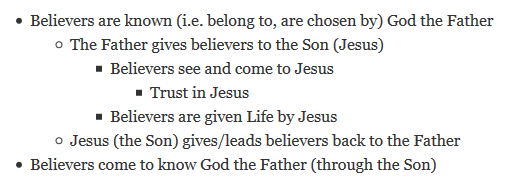
In terms of obtaining this knowledge, and thus possessing (“holding”) eternal Life, the order has to be reversed (cf. 1:18; 14:6-11, etc):

    1. One sees/knows Jesus (the Son)—i.e. recognizes and trusts in him
    2. One sees/knows God the Father through the Son

The theological framework of the Gospel of John can be outlined in more detail:

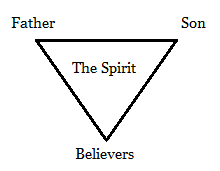
Thus the emphasis on knowledge in 17:3 can be misleading, if we think of it in terms of ordinary human knowledge and perception. Rather, in the Gospel of John, and much of the New Testament elsewhere, a deeper kind of theological and spiritual understanding is meant—centered on trust in Jesus and the presence of both the Son (Jesus) and the Father through the Holy Spirit. The Spirit is not mentioned directly in the prayer-discourse of chapter 17, but it can be inferred from the theme of unity (esp. verses 20-24) and the triadic relationship of Father-Son-Believer(s):

Mention should be made of the specific title xristo/$ (“Anointed [One]”). Though the Johannine portrait of Jesus goes far beyond the traditional Jewish conception(s) of the Anointed One (Messiah), it retains the title and the fundamental identification of Jesus with the Messianic figure-types—Prophet, Davidic Ruler, and also “Son of Man” (on these, cf. the series “Yeshua the Anointed”). The association of the titles “Anointed One” and “Son of God” goes back to the early Gospel traditions (in the Baptism and Passion/crucifixion scenes, etc), and, while the latter title (i.e. Jesus as God’s Son) dominates the Gospel of John, the former is certainly not forgotten. True knowledge of Jesus—the knowledge which is the same as Life—includes recognition that he is the Anointed One of God. The closing words of the Gospel proper give unmistakable expression to this fact:

“These (thing)s have been written (so) that you might trust that Yeshua is the Anointed One, the Son of God, and that, trusting, you would hold Life in his name.” (20:31)

“…Spirit and Life”: John 14:6, 9

John 14:6, 19

Today’s note will examine two statements by Jesus in the great “Last Discourse”, set in the narrative on the night of the Last Supper (13:31-16:33 + chap. 17). The entire discourse-scene is extremely complex, bringing in and developing themes which occurred throughout the earlier discourses. Two of these involve “Spirit” (pneu=ma) and “Life” (zwh/)—the very two motifs (cf. Jn 6:63) which are the focus of this series. The latter dominated the first half of the Gospel (chapters 1-12 [32 times]); by comparison, zwh/ appears just four times in the remainder of the book (14:6; 17:2-3; 20:31). It has been suggested that the reason for this is that the Life promised by Jesus, through trust in him, is now coming to fruition as his Passion draws near. A better explanation is simply that there is considerably less teaching by Jesus in chapters 13-20, and it is of a different character—given only to his closest disciples in order to prepare them for his upcoming death and departure (back to the Father). For this reason, the coming of the Spirit takes on greater emphasis and importance in the Last Discourse.

John 14:6

I have discussed the famous saying of Jesus in 14:6 in an earlier pair of notes (on vv. 4-7), and will not reproduce that entire study here. Instead, I wish to focus primarily on Jesus’ use of the word “life” (zwh/) in this saying, in connection to the overall context of the passage, which has to do with Jesus’ departure, introduced in 13:33:

“(My dear) offspring [i.e. children], (it is) yet (only) a little (while that) I am with you—you will seek (for) me, and even as I said to the Yehudeans {Jews}, ‘(the) place where I lead (myself) under, you are not able to come (there)’, and (so) I say (this) to you now.”

This refers back to statements by Jesus during the Sukkoth discourse-scene in chapters 7-8 (7:33-36; 8:21-22), statements made to the “Jews”—that is, the (Jewish) people, as opposed to Jesus’ (Jewish) disciples (i.e. believers). It is now in the Last Discourse that Jesus is speaking directly (and only) to his true disciples (Judas having departed in 13:30). Yet, even his disciples had difficulty understanding this statement, much as the people did earlier. Peter is the first to ask—

“Lord, where [pou=] do you lead (yourself) under?” (13:36a)

to which Jesus responds with a similar statement as in v. 33, but with an important difference:

“The place where I lead (myself) under, you are not able to follow me now [nu=n], but you will follow later [u%steron]” (v. 36b)

To the people, Jesus used the word come, but to Peter he says follow, indicating the role of the disciple who follows his master (and the master’s example). Also, it is only now, at the present moment, that Peter (and the other disciples) are not able to follow Jesus; the promise is that they will be able to follow later on. There is a strong sense throughout the Last Discourse that the disciples are only just beginning to realize the truth about who Jesus is, and to understand the full meaning of his words (the motif of misunderstanding is prominent in all of the Johannine discourses).

Picking up from the tradition of the prediction of Peter’s denial (13:37-38), the exchange which follows in 14:1ff returns to the theme of Jesus’ departure, which now is made more clear—he is going away, back to the Father:

“In my Father’s house there are many (place)s to stay… I am traveling (there) to make ready a place for you” (v. 2)

Readers can find confusing these references to Jesus’ departure, which seem to blend together two distinct contexts (from the standpoint of the traditional Gospel narrative)—(1) his death, and (2) his ascension to heaven. In 13:33ff, Jesus is apparently speaking of his upcoming death, but now, in 14:1ff, the context seems to be his “ascension” to the Father in heaven. These two aspects are interrelated, and have been interwoven throughout the Gospel of John; both are contained in the initial statement by Jesus in 13:31, through use of the verb doca/zw (“give [or regard with] honor/esteem”). The ambiguity of these aspects continues through the Last Discourse, adding poignancy to the exchange between Jesus and Thomas in vv. 4-7:

(Jesus): “And the place where I lead (myself) under, you see [i.e. know] the way (there)”
(Thomas): “Lord, we have not seen where you lead (yourself) under; how are we able to have seen the way (there)?”
(Jesus): “I am [e)gw/ ei)mi] the way and the truth and the life—no one comes toward the Father, if not [i.e. except] through me…”

In the Gospel of John, seeing and knowing are essentially synonymous—”seeing” Jesus means “knowing” (i.e. recognizing) him. The motif of misunderstanding here in the discourse involves the idea of the way (o%do$). Thomas is thinking of a conventional (physical) path leading to a location, but the true meaning of Jesus’ statement is spiritual—it is not a way up through the clouds to heaven, but the path that leads directly to God the Father through the person of Jesus (the Son). This is made clear by Jesus’ use of the preposition dia/ (“through”), which is often obscured in translation. The way to the Father leads through Jesus. The theological context of the Johannine discourses suggests two main aspects to this way, or path:

    1. it is found through trust in Jesus
    2. it is realized through the presence of the Spirit

It is possible that both aspects are incorporated into the statement in verse 6:

    • “and the truth [a)lh/qeia]”—i.e. trust in Jesus as the Son sent by the Father, who is Truth
    • “and the life [zwh/]”—i.e. the Spirit, given by Jesus to the believer

Ultimately, Jesus identifies himself with all three terms—Way, Truth, and Life—a triad which can be variously interpreted. Does the Way lead to Truth and Life, or does it lead to Truth which then results in Life? Or are the terms meant to be synonymous—i.e. Way = Truth = Life? A strong argument can be made that Truth and Life are to be regarded as essentially synonymous, given the close associations between “Spirit/Life” and “Spirit/Truth”—and that the Spirit is the unifying idea. This would seem to be confirmed by the references to the Spirit which follow throughout chapters 14-16.

John 14:19

The basic message of vv. 1-7ff is restated in vv. 18-21:

    • Jesus’ departure: “I will not leave you abandoned…” (v. 18)
    • Inability of people to come: “(It is) yet a little (while), and (then) the world will no longer see/observe me…” (v. 19)
    • The disciples will see/follow him: “I come toward you… you (do) see/observe me…” (vv. 18-19)
    • Jesus leads the way to the Father: “…you will know that I am in the Father, and you are in me, and I am in you” (v. 20)

In verse 19, the disciples’ seeing Jesus is entirely different that the sight/observance by the “world”; it means trust in him—i.e. disciples are believers. They know/see the truth, which is manifest in the person of Jesus (1:14, 17; 5:33; 8:32, etc). With regard to life (zwh/), Jesus is more specific:

“…in that [i.e. because] I live [zw=], you also will live [zh/sete]”

This reflects the statement in 5:26, of the divine/eternal Life which Jesus possesses (given to him by the Father), and which he, in turn, gives to believers. This theme was prominent in the Lazarus scene in chapter 11 (cf. especially vv. 20-27), and in the earlier discourses as well. That the Life which Jesus gives is to be identified with the Spirit, is relatively clear from a number of passages, as has been discussed in prior notes, and more or less stated explicitly in 3:34. If there were any doubt that the Spirit is in view here in 14:19, one need only look to the preceding verses 15-17, where we find the first specific reference to the Spirit in the Last Discourse. This will be discussed in the next note.

“…Spirit and Life”: John 12:50 (continued)

John 12:50, continued

In the previous note, I discussed the context of Jn 12:50, the concluding verse (and statement by Jesus) in chapters 2-12 of the Gospel. Today I wish to examine the verse more closely, especially the statement in the first half:

“And I have seen [i.e. known] that his e)ntolh/ is (the) Life of the Age.”

There are three components to this statement, which will be discussed in turn.

kai oi@da o%ti (“and I have seen that”)

Throughout the Gospel of John the motif of seeing has been of great importance. It plays on the dual-meaning, especially, of the verb ei&dw (“see”), which can also mean “know”—i.e., seeing in the sense of being aware, perceiving, recognizing, etc. It generally carries this meaning in the perfect tense, as here (oi@da, “I have seen/known”). Given the theological (and Christological) importance of seeing in the Gospel of John, Jesus is almost certainly referring here to something more than general understanding or awareness. Rather, it relates to his identity as the Son, who has a close, intimate relationship to the Father, and who, as a faithful son, watches and listens carefully to his father. Repeatedly in the Johannine discourses, Jesus states that he says and does only what he has heard and seen from the Father (cf. 3:32; 5:19, 30; 6:46; 8:26, 38; 14:24; 15:15). Similarly, the one who sees/hears Jesus (the Son), also sees/hears the Father (5:37; 14:7, 9, etc)—just as Jesus gives to the believer what he has received from the Father (3:35; 5:26, etc). In the Gospel of John, seeing Jesus is essentially the same as trusting him (9:37ff; 12:45; 14:17), and this differs entirely from ordinary sight or perception (6:36). The conjunctive particle o%ti (“that”) indicates specifically what it is that Jesus has seen.

h( e)ntolh/ au)tou= (“his [charge laid] on [me] to complete”)

The noun e)ntolh/ is a relatively popular Johannine word. In addition to 11 occurrences in the Gospel, it is found 18 times in the Letters; and, if we include two others in the (Johannine) book of Revelation, that makes 31 total—nearly half of all occurrences (68) in the New Testament. The word is often translated “commandment”, but that can be somewhat misleading; I discussed the fundamental meaning of the noun in the previous note. Despite Paul’s frequent reference to the Old Testament Law (Torah, Gk. no/mo$), he does not often use the noun e)ntolh/; it occurs only 9 times in the undisputed letters (6 of which are in Rom 7:8-13; also 1 Cor 7:19; 14:37). In these passages, Paul seems to be using it in a somewhat broader sense (i.e. “the Law of God”, “the e)ntolh/ of God”), rather than restricting it to the specific (written) commands of the Torah as such, though the latter is certainly included in the usage. The semantic range of the word in the (Synoptic) sayings of Jesus is similar (note the expression “the e)ntolh/ of God” in Mk 7:8-9 par).

The Johannine use of the word is complicated by two factors—it can be used either:

In none of these references does e)ntolh/ refer to the commands of the Torah as such, though there is less certainty on this point when we examine the occurrences in the Letters (esp. 1 John). Let us consider the second factor mentioned above.

1. Between God the Father and Jesus (the Son)—This is the context of the usage in 10:18 and here in 12:49-50, and in both instances it is the singular form. As I discussed in the previous note, e)ntolh/ here should not be understood in the traditional sense of a religious or ethical “commandment”, but as a duty or mission given to Jesus (by the Father) to accomplish. In 10:18, this clearly refers to his sacrificial death (and resurrection), confirmed by Jesus’ final words on the cross in 19:30 (“it has been completed [tete/lestai]”, cf. also v. 28). The emphasis in 12:49-50 is on the words Jesus has been given by the Father to speak (i.e. what he is to say). In 14:31, the related verb e)nte/llomai is used of Jesus’ mission in a comprehensive sense, as a reflection of the love between Father and Son.

2. Between Jesus and Believers—Here we find both the singular and plural of e)ntolh/, apparently used interchangeably (as also in 1 John). This should caution us against identifying e)ntolh/ with any specific “commandment” given by Jesus, as though the e)ntolai/ represented a collection of commands similar to the Old Testament written Law (Torah). I believe there are three ways e)ntolh/ should be understood in this context:

    • as synonymous with Jesus’ word—i.e., whatever he says/speaks
    • as representative of all that he teaches believers, who would follow his example (just as Jesus follows that of the Father)
    • as epitomized by the command for believers to love one another (i.e. the so-called “Love-command”)

Even in the case of the “Love-command” (13:34-35, etc), the closest we come to a specific “commandment” (i.e., “you should love [each] other”), this should be understood not so much as an ethical injunction, but as a sign that believers are following the example of Jesus (“all will know that you are my disciples”).

zwh/ ai)w/nio$ e)stin (“is [the] Life of the Age”)

I have discussed the expression “Life of the Age” (i.e. eternal life) at length in prior notes, and will not go over that again here, except to mention that, in the context of the Johannine discourses, the reference is to the Life (zwh/) which God possesses and of which He is the source. What does it mean to say that the e)ntolh/ of God the Father is [e)stin] Life? There are a number of possibilities, but they are reduced considerably if we remember that here e)ntolh/ means specifically the charge [i.e. mission] given to Jesus to complete.

    • Qualitative—it describes the nature and character of Jesus’ mission from the Father
    • Significative—Jesus’ mission means or signifies Life
    • Resultative—Jesus’ mission results in Life for believers

All three are valid ways of interpreting the statement, and perhaps are best seen as three aspects of a single truth.

“…Spirit and Life”: John 12:50

John 12:50

Today’s note involves the final, concluding verse to the first half of the Gospel of John (1:19-12:50). It belongs to the last discourse of Jesus in this section. The discourse, properly speaking, spans verses 20-36a of chapter 12. Verses 36b-43 serve as the narrative conclusion, both to the discourse-scene of chap. 12, as well as chapters 2-12 as a whole. In verse 36 it is stated that Jesus “…going away, hid (himself) from them”. In the narrative context, this means that Jesus has left the public scene in Jerusalem, away from the people. Though some did come to believe in him, the majority did not, as vv. 37-43 make clear. With Jesus having thus departed, the words in vv. 44-50 are lacking any definite historical-narrative setting. They are detached, and function in the narrative as a climactic statement (and summary) of Jesus’ teaching, with a number of themes and motifs from the earlier discourses (chaps. 3-10) being reprised and restated. Verses 44-50 may be divided into two portions, which I outline here as a chiasm:

    • Trusting in Jesus = trusting the One who sent him (v. 44)
      —Seeing Jesus, who is the Light (vv. 45-46)
      —Hearing Jesus’ words, which brings salvation from Judgment (vv. 47-48)
    • God the Father sent Jesus—trusting in him is Life (vv. 49-50)

The motifs of seeing and hearing, both frequent in the Gospel, serve as two different ways of expressing the idea of trusting in Jesus. In reference to hearing Jesus—that is, hearing his words or voice—the noun e)ntolh/ is introduced in verse 49. This word is often translated as “commandment”, which can be somewhat misleading. However, it does preserve the basic association with the Old Testament Law (Torah). The language Jesus uses relates back to the covenantal language of the Torah, especially in the book of Deuteronomy (e.g., 31:19ff; 32:46-47)—”If any (one) should hear my utterances [i.e. words] and would not guard/keep them…” (v. 47a). The failure to keep/guard Jesus’ words is effectively the same as failure (by Israel) to keep the commands and precepts of the Torah, thus violating the covenant (agreement) with God. Such failure is presented as evidence against the person in the time of Judgment:

“The one setting me aside [i.e. rejecting me] and not receiving my utterances [i.e. words] has the one judging him: the word/account [lo/go$] which I have spoken—that will judge him in the last day.” (v. 48)

This brings us to verse 49, where Jesus gives us more detail about the word[s] which he speaks:

“(For it is) that I did not speak out of myself, but the (one) sending me, the Father, he has given me an e)ntolh/—what I should say and what I should speak.”

The closing words in verse 50 repeat this statement: “Therefore the (thing)s which I spoke, even as the Father has said to me, so I spoke”. It is important to consider the syntax and context here carefully, to avoid misunderstanding about the meaning and significance of the word e)ntolh/. Jesus says, “the Father…has given me an e)ntolh/—what I should say and what I should speak”. The Greek noun e)ntolh/ (entol¢¡) is derived from the verb e)nte/llomai (entéllomai), and fundamentally refers to something (a duty, etc) given (placed on) a person to complete, sometimes in the technical sense of a “commission”. When we use the word commandment this tends to be understood as a religious or ethical injunction, but that is not really the meaning here; rather, we should render e)ntolh/ in its basic meaning: “the Father has given me a (charge/duty) laid on (me) to complete…”. This relates to the mission and purpose for which Jesus was sent (into the world) by the Father. As the Son, Jesus imitates and repeats what he sees and hears the Father saying and doing—a theme which runs throughout the Johannine discourses. Ultimately the task given by Jesus to accomplish is his sacrificial death, as is strikingly clear in his final words on the cross: “it has been completed [tete/lestai]” (19:30, cf. also v. 28).

Here in 12:47-50, however, the emphasis is on Jesus’ words—using both the plural r(h/mata (“utterances”, i.e. spoken words, vv. 47-48) and the singular lo/go$ (“account”, i.e. his gathered words, v. 48b). Both terms appear frequently (and more or less interchangeably) in the Gospel. Jesus himself is identified with the Living and eternal Word (Lo/go$) of God in the Prologue (vv. 1-4ff), and we must always keep this theological/Christological aspect in mind when reading about Jesus’ “words” elsewhere in the Gospel. A person’s response to Jesus’ words is essentially a response to Jesus himself (and to God the Father who sent him). This is expressed two ways in vv. 47-48, as we have seen:

    • hearing (vb. a)kou/w) him and keeping/guarding (vb. fula/ssw) his words (v. 47)
    • receiving (lamba/nwn) his words (v. 48)

The motifs of hearing and receiving are essentially parallel:

    • hearing—i.e. both listening and responding (obeying/accepting)
      —keeping (watch) over / guarding
    • receiving—i.e. taking in and accepting

This does not refer simply to obeying something Jesus tells his disciples to do, but involves the broader (and deeper) sense of accepting who Jesus is and what he says. I mentioned the allusions to the book of Deuteronomy in 12:44-50, and this includes the famous passage in 18:15-19, which relates to a coming Prophet (cf. Jn 1:21, 25; 6:14; 7:40) who will essentially fill Moses’ role. The words of this Prophet hold the same authority and weight as the Instruction (Torah) given by God through Moses (vv. 18-19). It is said that God will raise up this Prophet, and early Christians saw Jesus as filling the divinely appointed (and anointed, i.e. Messianic) role (Acts 3:22-23). This also reflects the fundamental meaning of the word e)ntolh/, as I discussed above.

Finally, we must consider Jesus’ statement in verse 50a:

“And I have seen [i.e. known] that His e)ntolh/ is (the) Life of the Age.”

The precise meaning of this statement requires special examination, which I will do in the next note.

“…Spirit and Life”: John 10:10, 28; 12:25

Not long ago (May 21, 2020) we celebrated the ascension of Jesus—i.e. 40 days after Easter, based on the information in Acts 1:3ff. The “ascension” of Jesus is referred to differently in the Gospels and Acts, and can be understood several ways, based upon the particular narrative under consideration. Most Christians have the scene in Acts 1:9-11 in mind, but there are other references to Jesus’ ascension/departure from the disciples in Luke 24:50-51 [MT] and the “long ending” of Mark (16:19), and, because of the differences in the narrative location and setting, it is not entirely clear if these passages are supposed to refer to the same event as Acts 1:9-11. The situation is further complicated by mention of an ‘ascension’ by Jesus in John 20:17. I have discussed these matters in a prior article.

The earliest Christians, in their preaching and proclamation of the Gospel, did not refer to specifically to the Ascension as such, but rather, the resurrection of Jesus was connected closely to his exaltation by the Father, to a place in Heaven at the Father’s right hand. The emphasis is not so much on Jesus’ actual departure from earth, as to his position in glory in Heaven following the resurrection. The Gospel of John preserves this early view, but it is expanded and developed in the discourses of Jesus in several ways:

    1. The motif of the Son’s ascent is set parallel to his descent—i.e. his coming to earth (as a human being). This ascent/descent theme appears numerous times throughout the Gospel and is related to the dualistic imagery of above/below, etc. The motif is expressed primarily through use of the related verbs a)nabai/nw (“step up”) and katabai/nw (“step down”)—Jesus (the Son) has stepped down (descended) from heaven, and again steps up (ascends) back to the Father in heaven.
    2. There is a strong emphasis on the Son’s return to the Father—he was sent (into the world) by the Father, and returns back to Him.
    3. In the Last Discourse (chaps. 14-17), the theme of Jesus’ departure becomes prominent, though it had been introduced earlier in the Gospel as well (6:62; 7:33-34; 8:21-22ff). It has a two-fold meaning, referring to: (1) Jesus’ death, and (2) his ultimate return to the Father.

Of all the New Testament writings, it is in John that the death, resurrection and ‘ascension’ of Jesus are most thoroughly combined—and by Jesus himself, in the great discourses which make up the core of the Gospel. One of the ways this is expressed is by the verb u(yo/w (“raise/lift high”). In 3:14 and 8:28, Jesus refers to himself being “lifting high”, with the title “Son of Man”; while in 12:32, he makes the same essential declaration, but with the personal pronoun:

“And I, if I am lifted high out of the earth, I will drag all (person)s toward myself”

In 3:14, it is the death of Jesus (i.e. lifted up on the cross) which is most clearly in view, as also in 8:28; however, the same verb in 12:32 seems rather to refer to Jesus’ exaltation. He speaks of being “lifted high out of the earth“. This can refer concretely to being raised out of the tomb, but also, more properly, in the sense of his departure from earth. Just as the Father sent him into the world, so also he will be going out of it. Both aspects are likely in view here in this reference.

This series of notes is dealing with the themes of Life (zwh/) and the Spirit (pneu=ma). The theme of life in connection with resurrection features prominently in the Lazarus episode of chapter 11, especially the dialogue between Jesus and Martha in vv. 20-27. However, I have discussed these verses at length in an earlier series, and so will not be addressing them here. Instead, I wish to consider briefly three verses from the surrounding chapters (10 and 12) where Jesus makes use of the word zwh/ (“life”).

John 10:10

This is part of the “Good Shepherd” parable-discourse in chapter 10. It is here in this discourse that the sacrificial death of Jesus comes more clearly into view. The structure generally follows the Johannine discourse format and may be outlined simply as follows:

    • Saying (parable) of Jesus (vv. 1-5)
    • Reaction by the people indicating a lack of understanding (v. 6)
    • Exposition by Jesus, which may be divided into three parts (each beginning with an “I am” declaration):
      • Jesus as the door/gate of the sheepfold (vv. 7-10): “I am…”
      • Jesus as the herdsman of the sheep (vv. 11-13): “I am…”
      • What Jesus as herdsman does for the sheep (vv. 14-18): “I am…”
    • Narrative conclusion [reaction by the people] (vv. 19-21)

Verse 10 concludes the first expository section (on Jesus as the door or entrance [qu/ra] to the sheepfold). It is only the shepherd, with charge over the sheep, who opens and closes this door; thus this verse provides the transition to the next section, in which Jesus is no longer the door, but the shepherd. Only the shepherd is able to open/close the door, and, when it is closed, any other person who enters presumably does so only to steal or harm the sheep. This effectively distinguishes the shepherd from all other persons. Jesus makes this contrast clear in verse 10:

“The (one) stealing does not come if not [i.e. except] that he might steal and slaughter and bring to ruin; (but) I came that they [i.e. the sheep] might hold life, and might hold (it) over (and) above (all else)”

This involves the familiar expression “hold life”, using the verb e&xw (“hold”); elsewhere in the Gospel, as we have seen, this life is often specified as “the Life of the Age” (i.e. eternal life). The role of herdsman is to protect the sheep (from harm) and to guide them where they can find life-giving sustenance. In both respects he is saving/preserving their lives—the sheep have/hold life under his care.

John 10:28

This verse is from the second half of chapter 10 (vv. 22-39), which comprises a second discourse, but one which shares important themes with vv. 1-21, and it is possible to read the passages in tandem as part of a single discourse-scene. Verses 25-30 reprise the “Good Shepherd” illustration—but here there is a more definite contrast between those sheep who belong to the shepherd and those who do not. For the religious leaders and others who are unable (or refuse) to accept Jesus, he designates them as those who are not part of his flock (vv. 25-26). By contrast, those who do trust in him are part of the flock:

“My sheep hear my voice and I know them, and they follow me, and I give them (the) Life of the Age, and no, they should not (ever) come to ruin into the Age, and no one will seize them out of my hand.” (vv. 27-28)

This motif, of Jesus giving to believers the “Life of the Age” (i.e. eternal life), occurred in the earlier discourses, as has been discussed in prior notes. In the context of the Johannine discourses, this Life which Jesus gives is to be identified primarily with the Spirit (cf. 3:34-35; 4:10ff, 24; 6:27ff, 63; 7:37-39). This is an important theological development of the traditional expression “life of the Age”, as we have discussed. That this Life is connected with the very presence and power of God is clear from vv. 28f, where God (the Father) is the ultimate source of this life (and its preservation/protection) for believers:

“My Father, who has given (them) to me, is greater than all, and no one is able [i.e. has power] to seize (anything) out of the Father’s hand.” (v. 29)

For the chain of relationship between Father and Son, see especially 3:34-35 and 5:26. This will become a central theme in the Last Discourse, in particular the great prayer-discourse of chapter 17.

John 12:25

The theme of Jesus’ sacrificial death, so central to the Good Shepherd discourse (10:11-18)—the laying down of his soul/life and taking it up again—takes on even greater significance as we approach the start of the Passion narrative. In the Gospel of John, the (triumphal) entry of Jesus into Jerusalem is narrated in 12:12-19; Jerusalem is the setting, from verse 20 on, into the beginning of the Passion (chap. 13). There is an interesting parallel here between 12:20-36a (set in Jerusalem) and the Synoptic tradition at the transition point between the end of Jesus’ Galilean ministry and the beginning of the journey to Jerusalem. Consider the following points of similarity:

Indeed, the saying of Jesus in 12:25 is close in thought to the Synoptic saying in Mk 8:35 par:

“For whoever would wish to save his soul will bring it to ruin, but whoever will bring his soul to ruin for my sake and (for) the good message [i.e. Gospel] will save it.” (Mk)
“The one loving his soul brings it to ruin, and the one hating his soul in this world will watch/guard it into (the) Life of the Age.” (Jn)

However one would explain the development of the sayings of Jesus in the Gospel tradition (on this, cf. my recent series “Jesus and the Gospel Tradition”), there can be no doubt that the Johannine version of this traditional saying—this particular form of it—has certain elements which are distinctive to the Fourth Gospel. We may note the use of the articular participle, so frequent in John, to describe the disciple (believer)—”the (one) …ing”—as well as his opposite. Even more important are the qualifying expressions which enhance the point of contrast:

    • “in this world”—with the use of ko/smo$ (“world-order, world”)
    • “into the Life of the Age”—for this expression, cf. the previous notes of this series

The believer is one who “hates” his soul [i.e. his human life] insofar as it is in the world—that is, in the current age and world-order dominated by sin and darkness. The non-believer, by contrast, loves the darkness (3:19), and thus loves his life in the darkness. The contrast to the world and its darkness is the Life and Light of God found in the person of Jesus. This aspect of (eternal) Life will be discussed further in the next daily note, on 12:50.