“…Spirit and Life”: John 8:12

John 8:12

As discussed in the previous note (on 7:37-39), the festival of Sukkoth (Booths/Tabernacles) is the setting for a complex discourse-scene that appears to span the entirety of chapters 7-8 (excluding 7:53-8:11). Jn 8:12-59 is the second half of this discourse scene. It is actually made up of three sections, each of which follows the Johannine discourse format, beginning with a saying (declaration) by Jesus, followed by the people’s reaction, and an exposition from Jesus in response. In these three sections, Jesus is engaged in debate/dispute with the religious authorities (Pharisees), as in the chapter 5 discourse. Indeed, 8:12-59 is parallel to 5:30-47, sharing the central themes of Jesus’ words as a witness to his identity, and of his relationship to God the Father. The line of argument in 8:13-18 is quite similar to that of 5:30-47. Each of the three sections concludes with an important declaration by Jesus regarding his relationship to the Father; note the following outline:

    • Part 1—vv. 12-20
      • Narrative introduction: “Then Yeshua again spoke…”
      • Saying of Jesus (v. 12)
      • Reaction by the Jewish leaders (v. 13)
      • Exposition by Jesus (vv. 14-18)
      • Statement on his relationship to the Father (v. 19, picking up from v. 18)
      • Narrative conclusion (v. 20)
    • Part 2—vv. 21-30
      • Narrative introduction: “Then he again said to them…”
      • Saying of Jesus (v. 21)
      • Reaction by the Jewish leaders/people (v. 22)
      • Exposition by Jesus (vv. 23-27)
      • Statement on his relationship to the Father (vv. 28-29, picking up from v. 27)
      • Narrative conclusion (v. 30)
    • Part 3—vv. 31-59
      • Narrative introduction: “Then Yeshua said to the Jews trusting in him…”
      • Saying of Jesus (vv. 31b-32)
      • Reaction by the Jewish leaders/people (v. 33)
      • Exposition by Jesus (vv. 34-48)
      • Statement on his relationship to the Father (vv. 49-56, picking up from v. 48)
      • Concluding “I Am” declaration (vv. 57-58)
      • Narrative conclusion (v. 59)

Note here the way that the discourse-episode begins with Jesus in dispute with the Pharisees, and gradually widens to include other “Jews”, at least some of whom begin to trust in him (v. 31). At the literary level, and perhaps at the historical level as well, these three discourses fit together as a running dialogue, building with dramatic tension, until the climactic moments of vv. 31-59.

Today I will be discussing the saying of Jesus which begins this second half of the Sukkoth discourse scene, verse 12:

“I am [e)gw/ ei)mi] the light of the world—the (one) following me should not (ever) walk about in darkness, but will hold the light of life.”

This saying is similar in form to the “I am” declarations in the Bread of Life discourse: “I am the Bread of Life…” (6:35, also v. 48), “I am the Living Bread…” (6:51, also v. 41). It begins with a fundamental “I am” statement in which Jesus identifies himself with the true/living form of some image from the natural world or from daily life—indicating that this “living” form comes from God. The statement is then followed by a promise for the one who receives/accepts this “living” form, which is defined as trusting in, or coming to, Jesus. Both aspects are included here in the defining participle following (a)kolouqw=n)—”the one following” = “the one trusting”. The essential promise “he will hold the Light of Life” is precisely parallel to the statement “he will hold the Life of the Age [i.e. eternal life]”, introduced in 3:15-16 and repeated throughout the Gospel (3:36; 5:24, 40; 6:40, etc). Thus the expression “Light of Life” is largely synonymous with the “Life of the Age”, the eternal/divine Life which the righteous were thought to inherit at the end time, and which believers in Jesus possess already in the present.

It is worth examining each of the expressions Jesus uses here.

“Light of the World” (o( fw=$ tou= ko/smou)

In an earlier note, we examined the similar expression “Life of the World”, which was used by Jesus specifically in connection with his sacrificial death: “the bread which I will give is my flesh, (given) over the life of the world“. The basic concept involved reaches back to the Prologue, covering the role of Jesus (the Living Word) in Creation, as well as his coming into the world (i.e. the Incarnation). In verse 9 we read:

“(This) was the true Light, which gives light to every man, coming into the world”
which can also be read as:
“The true Light, which gives light to every man, was coming into the world”

In verses 10ff the Word (and Light) is described as being “in the world…and (yet) the world did not know him”; a more concrete reference to Jesus’ life in the world as a human being comes in vv. 14ff. This idea is repeated in 3:19-21, again using the motif of light, and introducing even more clearly the dualistic contrast of light vs. darkness:

“…the Light has come into the world, and (yet) men [i.e. people in the world] loved the darkness rather than the Light, for their works were evil” (v. 19)

Light features repeatedly in the Gospel, both the specific noun fw=$ (23 times), as well as the related verb fwti/zw (“give light”), and words derived from fai/nw (“shine [light]”). The expression “light of the world” appears again in 9:5, and cf. also 11:9; 12:46. In Matthew 5:14 it is Jesus’ disciples (believers) who are called the “light of the world”, much as they are referred to by the title “sons of light” in 12:36 (cf. also Lk 16:8; 1 Thess 5:5; Eph 5:8).

“Light of Life” (o( fw=$ th=$ zwh=$)

The background for this expression may be found in the Old Testament, in passages such as Job 33:30 (also v. 28) and Psalm 56:13. Ultimately, the association of light with life is fundamental to human experience and religious expression. Even without a modern scientific understanding, ancient peoples intuitively recognized the life-giving quality of light (from the sun’s rays, etc). The introduction of light represents the first stage of creation in the Genesis account, and precedes the formation of life. Light is typically associated with Deity in nearly all religions, and certainly is so in the Old Testament Scriptures—cf. Psalm 18:28; 27:1; 36:9; 43:3; Isa 2:5, et al. It often refers specifically to the manifestation of God—his Presence and action—to his people, especially in the live-giving (and preserving) salvation which he brings (Exod 10:23; 13:21 [the pillar of fire], etc; Psalm 97:11; Isa 9:2; 30:26; 42:6; 60:1ff, et al).

As mentioned above, Light and Life are related in the Johannine Prologue, again in connection both with the presence of God and the work of creation (vv. 4-9). Note the fundamental statement in verse 4:

“In him [i.e. the Word] was Life, and th(is) Life was the Light of men”

On the surface, it may seem that the author, in using the expression “the light of men”, is referring to knowledge and understanding (i.e. illuminating reason) in a general sense. This would fit the context of Creation, but the overall theological context of the Gospel, in which “life” (zwh/) virtually always refers to the divine/eternal Life of God, suggests something deeper. This, too, should be understood by the use of the expression “the Light of Life” in 8:12, with its parallel to “the Life of the Age [i.e. eternal life]”, as discussed above.

The association with the Sukkoth festival

Along with the symbolic use of water (cf. the previous note), light also features in the traditional ceremonies associated with the Sukkoth festival, as described in the Mishnah tractate Sukkah (5:2ff). On the first night of the festival, a ceremonial lighting of four golden candlesticks took place. The parallel with the drawing of water, and the ceremonial libation offering, on the morning of each day, suggests that the lighting might have taken place similarly on each evening. Note the parallelism in relation to the two central statements by Jesus in the Sukkoth discourse-scene:

    • Water
      • Ceremonial drawing of water in a golden pitcher and offering in the Temple
      • Jn 7:37-38—Jesus identifies himself as the source of life-giving water (“Living Water”)
    • Light
      • Ceremonial lighting of four golden candlesticks in the Temple court
      • Jn 8:12—Jesus identifies himself as the source of the “Light of Life”

Both of these motifs are also found in Zech 14:7-8, which also has a Sukkoth setting, and may be in view here in the discourse (cf. the previous note):

    • A day in which there will be light in the evening (v. 7)
    • On that day living waters will flow out of Jerusalem (v. 8)

The motif of light in the night-time relates to the contrast between light and darkness, for which there is a strong background in the Old Testament. In many of these passages the idea is that God (His presence) gives light to people within the darkness (cf. Exod 13:21; Job 12:22; Psalm 112:4; 139:11-12; Prov 4:18; Isa 9:2; 42:16; 58:8ff; 60:1ff, etc). The light/darkness contrast is a prominent part of the dualistic language and imagery in the Gospel of John, and appears here in verse 12: “the one following me should not (ever) walk in darkness, but will hold the Light of Life”. The same idea is expressed in 12:35, 46, and see also the the First Letter of John, 1:5-7; 2:8-11.

Light and the Spirit?

Unlike the symbolism of water, there is not as much of a direct connection between light and the Spirit, though it certainly can be inferred as part of Johannine theology; consider:

    • “God is Spirit [pneu=ma o( qeo/$]” (Jn 4:24)
    • “God is Light [o( qeo/$ fw=$ e)stin]” (1 Jn 1:5)

Nevertheless, light, as such, is not as common a symbol for the Spirit—fire is much more relevant and specific in this regard. In Old Testament tradition, the light of God is often connected with wisdom and the Law (Torah), as, for example, in Psalm 119:105, 130; Prov 4:18; 6:23, etc. Indeed, in the Qumran text 1QS, both the wisdom and Law of God are described by the very expression “light of life” (3:6-7), which is provided to the members of the Community through instruction and the interpretation of Scripture. It is possible that ancient Wisdom traditions, and those related to the Torah, also underlie the imagery of the Prologue of John (vv. 4ff)—i.e. God’s Word and Light is present in the world, seeking to find a dwelling place among human beings, but they do not receive it (i.e. the Wisdom of God). Jesus, of course, is the living personification of the Wisdom and Word (Torah) of God.
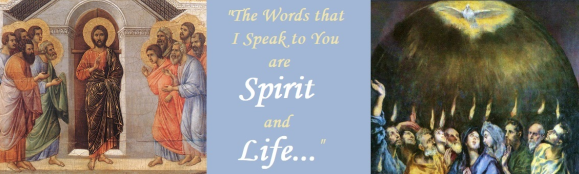
“…Spirit and Life”: John 6:63, 68

John 6:63, 68

These next two verses to be discussed are related, in some way, to the preceding Bread of Life discourse (vv. 22-59), though the precise relationship has proven difficult for commentators to determine. Verse 59 effectively serves as a conclusion to the discourse; and yet, without any other reference point, it would seem that verse 60 is referring back to the discourse (or a portion of it). The wording remains somewhat ambiguous:

“Then many out of his learners [i.e. disciples], (hav)ing heard, said, ‘This account [i.e. word/saying] is harsh [sklhro/$]—who is able to hear it?'”

There are two possibilities:

    • Verses 60ff are part of the same historical tradition, occurring in the aftermath of the discourse (as recorded in vv. 22-59)
    • The Gospel writer has joined to the discourse an entirely separate tradition, using the discourse, in the literary context of the narrative, as a way of demonstrating an example of Jesus’ teaching—i.e., the kinds of things he said which resulted in the sort of response described in vv. 60ff.

Most critical commentators would choose the second option, and there is much to be said in favor of it. In this particular instance, the view taken affects how one interprets the discourse—especially the eucharistic language and imagery in vv. 51-58. But, let us continue with the Jesus’ response to the disciples’ reaction:

“Does this trip you up? Then if you should look (and behold) the Son of Man stepping up (back to) where he was (at) the first(, what then)? The Spirit is the (thing) making (a)live, the flesh does not benefit anything! (and) the utterances [i.e. words] which I have spoken to you are Spirit and Life.” (vv. 61b-63)

The logical connection and flow of these statements is rather difficult, and may possibly reflect separate sayings which have been brought together. The basic idea behind vv. 61b-62, as we have it, is relatively clear. If the disciples find Jesus’ teaching difficult (while he is present with them), how will they respond when he has left them and returned to the Father? The Christological language in v. 62 has, I think, led some commentators down the wrong track, as though Jesus were suggesting that it would be more difficult for the disciples to behold Jesus’ ascension in glory. Much more likely here is a foreshadowing of the kind of discussion Jesus will have with his (close) disciples in the Last Discourse, where he speaks at length of his departure and return to the Father. The mention of the Spirit in v. 63 would seem to confirm this. His statement here regarding the Spirit may be seen as preparatory for the later Discourse. Let us examine verse 63 in more detail.

Verse 63

Whether or not this verse ultimately derives from separate sayings, there certainly are two distinct statements being made by Jesus:

    1. “The Spirit is the (thing) making (a)live, the flesh does not benefit anything”
    2. “The utterances [i.e. words] which I have spoken to you are Spirit and Life”

The first statement provides a clear contrast—between the Spirit (pneu=ma) and the flesh (sa/rc). Such a dualistic contrast is familiar from Paul’s letters, where he uses it repeatedly—cf. especially Romans 8:4-6ff; Gal 3:3; 4:29; 5:16-17; 6:8; Phil 3:3. It is much less common in the Johannine writings, but may be found in Jn 3:6 (cf. the prior note), and a negative connotation to the term “flesh”, as something contrary or inferior to God, is present in 8:15 and 1 John 2:16. Usually, this negative aspect is expressed by “(the) world” (ko/smo$). Here, in verse 63, the contrast is especially pronounced—not only does the flesh not give life, but it offers no benefit at all! This harsh statement must be understood properly, in terms of the comparison of the flesh with the Spirit. Compared with the Spirit, which gives everything (Life), the flesh offers nothing.

A difficult point of interpretation is whether (or in what sense) this statement should be applied to the Bread of Life discourse, and the apparent eucharistic allusions in vv. 51-58. I have addressed this question in an earlier Saturday series study.

The second statement provides the theme for this series of notes: “The utterances which I have spoken to you are Spirit and Life”. Again, there is some difficulty of interpretation here; consider the possible ways this may be understood:

    • Spirit and (divine, eternal) Life are conveyed to believers through Jesus’ words
    • This giving of “Spirit and Life” is parallel to the eucharistic (symbolic) act of eating/drinking the flesh/blood of Jesus—two aspects of the same basic idea
    • Jesus’ spoken words, i.e. his teaching, reflect part (or an aspect) of the Spirit (and Life) which he gives to believers
    • Trust in Jesus, through his words, will result in believers obtaining the Spirit and (eternal) Life

In my view, the statement is fundamentally Christological. Since Jesus is the Son (of God) sent by the Father, and since God the Father (who is Spirit, 4:24) gives the Spirit to Jesus, to say that Jesus gives the Spirit (3:34) to believers means that he conveys to believers everything that the Father is. This involves both the work, and the very presence, of Jesus—wherever he is, and whatever he does (or speaks), the Spirit of God is made manifest to those who trust in him. Jesus’ utterances are not merely the sayings and teachings recorded in the Gospel, but a manifestation of the life-giving, creative power, given to him by the Father. This interpretation will, I believe, be confirmed as we explore the remainder of the relevant passages in the Gospel (and First Letter) of John.

Verse 68

Jesus’ statements in vv. 61-63 are part of a larger narrative section; and here, beginning with verse 64, there is greater likelihood that a separate historical tradition has been joined—one which has important parallels with the Synoptic Tradition. Verses 64-71 deal specifically with the Twelve disciples, and the transition to this in v. 64 appears rather abruptly. The key saying by Jesus comes in verse 65:

“Through this [i.e. for this reason] I have said to you that no one is able to come toward me if it were not given to him out of [i.e. from] the Father”

In the narrative context, this relates back to vv. 37-40, and especially vv. 44-45, of the discourse, though it is also possible that similar sayings by Jesus were given (and circulated) separately, to the same effect. At any rate, this motif of election—of the disciples (believers) being given to Jesus by God the Father—starts to come into greater prominence at this point in the Gospel. As if in response to this declaration, we read that “many of his learners [i.e. disciples] went away, into the (place)s in the back, and no longer walked about with him”. This takes things a step further from the grumbling reaction in vv. 60-61; now many disciples drew back and no longer followed Jesus closely. What comes next in the narrative serves as a parallel, of sorts, with the confession of Peter in the Synoptic Tradition—note:

    • A direct and personal question (challenge) by Jesus to his close disciples:
      “And who do you count/consider me to be?” (Mk 8:30a par)
      “You do not also wish to lead (yourselves) under [i.e. go back/away] (do you)?” (Jn 6:67)
    • To which Peter is the one who responds with a declaration of faith:
      “You are the Anointed One (of God)” (Mk 8:30b par)
      “…we have trusted and have known that you are the Holy One of God” (Jn 6:68b)

Just prior to this confession, in John’s account, Peter makes the following statement, in answer to Jesus’ question:

“Lord, to whom will we go away? You hold (the) utterances of (the) Life of the Age” (v. 68a)

The last portion is made up of four Greek words which should now be familiar to you in studying the Gospel throughout this series:

  • r(h/mata “utterances”, i.e. spoken words, as in v. 63 (above)—cf. also 3:34; 5:47; 8:47; 10:21; 12:47-48; 14:7; 17:8.
  • zwh=$ “of Life”—the two words being in a genitival relationship, “utterances of life”, as in “bread of life” (vv. 35, 48), “light of life” (8:12), “resurrection of life” (5:29). This divine, eternal Life characterizes Jesus’ utterances—they belong to Life.
  • ai)wni/ou “of the Age”—the latest of many such occurrences of this adjective in the expression zwh/ ai)w/nio$ (“Life of the Age”). It reflects the idea of the divine, blessed Life which the righteous were though to inherit (and share with God) at the end-time, following the resurrection and Judgment. In the Johannine discourses, it tends to be used in the sense of the Life which believers in Jesus possess (“hold”) now, in the present, through trust in him—i.e. “realized” eschatology. The expression is typically translated as “eternal life”.
  • e&xei$ “you hold”—as indicated above, Jesus repeatedly states that those who trust in him hold eternal life. Peter here is expressing the belief that this Life comes from Jesus, who holds it, having himself received it from God the Father (cf. 5:26, etc).

While this language certainly reflects that of the Johannine discourses, it is interesting to see the way that it has developed here out of a core historical tradition, related to the calling of the Twelve and the betrayal of Judas. This framework has been chosen and utilized by the Gospel writer as a way to emphasize Jesus’ teaching on faith and discipleship, much as the tradition of Judas’ betrayal at the Last Supper has been used in the Gospel of Luke to introduce teaching of Jesus (cf. Lk 22:21-30). In the Johannine narrative, Judas has a special place in the “Last Supper” scene—his departure marks the moment when “the devil” has left, and only Jesus’ true disciples remain (13:2, 21-30; cp. 6:64, 70-71). It is at this point that the great Last Discourse can begin (13:31ff).

June 14 (1): John 6:51; Luke 22:19f

John 6:51; Luke 22:19f

Today, in commemoration of Corpus Christi (originally for Memorial Day), I wish to return to the declaration by Jesus in John 6:51, part of the great Bread of Life discourse (cf. the previous note and the earlier Saturday Series discussion), especially as it relates to the institution of the Lord’s Supper (Eucharist). Here is verse 51, with the main points for comparison given in italics:

“I am the Living Bread th(at) is stepping [i.e. coming] down out of heaven—if any one should eat out of this bread, he will live into the Age; and the bread which I will give is even my flesh, (given) over the life of the world.”

The form of the words of institution (in the Synoptic tradition), closest to the language here, is found in the Gospel of Luke:

“And taking bread (and) giving (thanks to God) for (his) favor, broke (it) and gave (it) to them, saying: ‘This is my body th(at is) being given over you—do this unto my remembrance’.” (Lk 22:19)

The last phrase is unique to the Lukan version, but Paul has similar wording in 1 Cor 11:23-25, except that the phrase “do this unto my remembrance” is applied to both the bread and the cup.

It is interesting to consider the differences in the object of the preposition (u(pe/r, “over”) between the Lukan and parallel Synoptic versions, as well as here in Jn 6:51:

    • “over you [pl.]” [u(pe\r u(mw=n] (Lk 22:19-20, applied to both bread and cup)
    • “over many” [u(pe\r pollw=n] (Mk 14:24, par Matt 26:28, applied only to the cup)
    • “over the life of the world” [u(pe\r th=$ tou= ko/smou zwh=$] (Jn 6:51, applied to bread)

The Lukan version is straightforward—Jesus is referring to his disciples (believers). The references in Mark/Matt and John 6:51 are more difficult. Who are the “many” in Mk 14:24 par? There is a similar expression in Mk 10:45 (par Matt 20:28), in which Jesus says:

“For the Son of Man also did not come to be served, but to serve, and to give his soul [i.e. life] in exchange for (the) many [a)nti\ pollw=n], as a means of loosing (them from bondage).”

In both passages, Jesus is almost certainly alluding to Isaiah 53:11-12:

    • “by his knowledge my [righteous] Servant will cause righteousness (to be established) for the many [<yB!r^l*]” (v. 11)
    • “…and he carried/lifted the sin of (the) many [<yB!r^]” (v. 12b)

There is strong sacrificial language used in Isa 53:10-12, including the offering for sin/guilt (<v*a*, v. 10), which relates to the suffering and/or death of the Servant. This made the passage an obvious Scripture to apply to the sacrificial death of Jesus, an association which was recognized already by the earliest Christians (Acts 8:30-35, etc). However, there is some question whether “(the) many” should be understood in the generic sense (i.e. many people), or in a specific religious sense, as the assembly (of God’s people). While Christians typically read the passage in the former sense, an increasing number of commentators feel that it is really the latter which is in view. The same would apply to the use of <yB!r^(h*) in Daniel 11:33; 12:3.

The basis for this specific denotation of the word <yB!r^ is found in the texts associated with the Qumran Community, where the the word is used repeatedly as a title for the Community, especially in the Damascus Document (CD) 13-15 and the “Community Rule” (1QS) 6-8. The members of that Community viewed themselves as the Elect of Israel, the ones remaining faithful to the ancient covenant, who will see (and play a central role in) the coming Messianic Age. The Anointed One(s) will deliver and lead the Community. This involves a decidedly sectarian identity of the people of God—not the entire Israelite/Jewish population, but only a portion, the elect who, when assembled together in the Community, represent “the Many”. There is a clear application and development of the “remnant” image from the Prophets.

It is possible that a similar background of thought applies to the earliest Christians and Jesus’ own use of the expression “(the) many” in Mk 10:45; 14:24 par (cf. also Rom 5:15-19; Heb 9:28). In other words, he is not saying that he gives his body/life for people generally “many people”, but for “the Many” who are his followers. Certainly the fundamental idea of the covenant (diaqh/kh) God established with Israel is present in the Last Supper scene. While it is described as a new covenant (cf. Jer 31:31ff), the basic imagery is derived from the sacrificial ritual by which the covenant between God and Israel was established (Exod 24:4-8). There is thus a dual meaning to the preposition u(pe/r (“over”):

    • the concrete sense of blood being poured (or sprinkled) over the altar and on the people
    • the more abstract meaning “on behalf of”, “for (the sake of)”

If “the many” designates the disciples of Jesus as the new covenant Community within Israel, then it corresponds with the the plural pronoun (“you”) in the Lukan version (22:19-20):

“this is my body th(at is) being given over you“
“this cup (is) the new covenant [diaqh/kh] in my blood being poured out over you“

What of the expression in Jn 6:51, “over the life of the world”? We are accustomed to seeing this in the more general (universalist) sense—i.e., Jesus died on behalf of all people in the world. This would seem to be supported by 3:16-17 (cf. also 4:42; 12:47), in which the desire is expressed that the world (i.e. the people in it) should not be destroyed, but saved. Yet, elsewhere in the Gospel, there is a strong negative connotation (and denotation) to the word ko/smo$ (“world”), where it more literally signifies the world order—the current order and arrangement of things, dominated and governed by sin and darkness. The imagery is fundamentally dualistic—the “world” is opposed to God and his Spirit, to Jesus and his disciples (believers). The basic Johannine construct may be summarized as follows:

    • The “world” has rejected God’s Word and is dominated by sin and darkness
    • God sends Jesus (the Son and Living Word) into the world, to bring light, truth, etc, and salvation to it—that is, to believers—the elect who are in the world, but do not belong to it
    • Jesus (the Son) returns to God the Father and will bring believers with him—he has called them out of the world

The work of Jesus in the world is centered upon his self-sacrificial act—laying down his life, giving his (human) life for the sake of the world. Yet we must be careful to preserve his distinctive wording in 6:51 (and earlier in v. 33):

    • “for the Bread of Life is th(at which is) stepping [i.e. coming] down out of heaven and giving Life to the world” (v. 33)
    • “and the Bread which I will give is even my flesh (given) over the life of the world” (v. 51)

There is here a parallel to Creation, as expressed in the Prologue: Jesus (the Living Word) brings light and life to the world, but those who belong to the darkness do not receive the light—only those who belong to the light are able to receive it. Thus, we should probably not read the expression “life of the world”, as ‘for the sake of the world’, but, rather, in the more precise theological sense found in the Johannine discourses, etc—of Jesus as “the Life of the world”. This would be almost exactly parallel with the expression “Light of the world” in 8:12, which I will be discussing in an upcoming note. We also find the expression “Light of Life” in that same verse. This Light (and Life) is found in Jesus’ own person (in the world), and believers come to hold this Light/Life (in the world).

I would conclude this note with the one element which is unique to the Lukan (and Pauline) version of the words of institution of the Lord’s Supper. While it is stated that Jesus gives his body and blood “over you”—that is, over believers—who are also “the many” whom God has called out of the world, an additional directive is given to us (who are believers):

“do this [i.e. this same thing] unto my remembrance [ei)$ th\n e)mh\n a)na/mnhsin]”

We are thus called to repeat Jesus’ action as a memorial, in memory of what he has done. This should be understood on two levels. First, in terms of repeating the ritual/symbolic act—i.e. the consecrated “Lord’s Supper”. This is certainly how Paul understands it in 1 Cor 11. However, second, and even more important: we are to follow Jesus’ own example of self-sacrifice, on behalf of others (and esp. our fellow believers)—not as a mere repetition of ritual, but as a way of life and thought. This comes through abundantly clear in the foot-washing scene in the Gospel of John (Jn 13:4-17), which effectively takes the place of the Lord’s Supper institution in the narrative. As expressed by the love command (13:34-35), it also becomes the central theme of the great Last Discourse (chaps. 14-16, and the prayer-discourse of chap. 17).

“The fine (shep)herd sets (down) his soul over the sheep…and I set (down) my soul over the sheep”
(Jn 10:11, 14)

(Peter): “I will set (down) my soul over you”
(Jesus): “Will you (indeed) set (down) your soul over me?”
(Jn 13:37-38)

“No one holds greater love than this—that one should set (down) his soul over his dear (friend)s”
(Jn 15:13)

“…Spirit and Life”: John 6:27ff

John 6:27-58

The motif of “life” (zwh/) is especially prominent in the great “Bread of Life” discourse in chapter 6. This discourse is similar to that of chapter 5 (cf. the previous notes), in being centered on a miracle story—in this case, the Miraculous Feeding episode, which is also found in the Synoptic Tradition (Mk 6:30-44 par, cf. also 8:1-10 par). I have discussed the Bread of Life discourse in a number of prior notes and articles, most recently as part of the series “Jesus and the Gospel Tradition” (cf. the relevant notes). The discourse, in the context of the chapter as a whole, is quite complex; I would outline it as follows:

  • Narrative Introduction—the Feeding Miracle Episode:
    • Narrative setting (vv. 1-4)
    • Tradition: The Feeding Miracle (vv. 5-14)
    • Transitional statement (v. 15)
    • Associated Tradition: The Walking on Water (vv. 16-21)
  • Introduction to the Discourse (vv. 22-24)
  • Part 1—The Bread from Heaven [Passover/Manna theme] (vv. 25-34)
    • Encounter scene—Question from the crowd (vv. 25-26)
    • Saying of Jesus (v. 27)
    • Initial reaction by the people (v. 28)
    • Exposition (second saying) by Jesus (v. 29)
    • Reaction by the people (vv. 30-31)
    • Exposition by Jesus (vv. 32-33)
    • Concluding/transitional response by the people (v. 34)
  • Part 2—The Bread of Life [exposition of Bread from Heaven theme] (vv. 35-50)
    • Saying of Jesus (v. 35), with exposition (vv. 36-40)
    • Reaction by the people (vv. 41-42)
    • Exposition by Jesus (vv. 43-50)
  • Part 3—The Living Bread [exposition of Bread of Life theme] (vv. 51-58)
    • Saying of Jesus (v. 51)
    • Reaction by the people (v. 52)
    • Exposition by Jesus (vv. 53-58)
  • Narrative Conclusion (v. 59)

There are thus three separate divisions to the discourse proper (vv. 25-58), each of which follows the basic discourse format: saying (by Jesus)–reaction (by the people)–exposition (by Jesus). In each instance, the exposition builds upon the central saying (vv. 27, 35, 51), explaining the true meaning of Jesus’ words. The word zwh/ (“life”), along with related verb za/w (“live”), occurs repeatedly throughout these verses; these references may be grouped as follows:

    • The expression “Bread of Life“, in two forms:
      “bread of Life” o( a&rto$ th=$ zwh=$ (vv. 35, 48)
      “living bread” o( a&rto$ o( zwh=n (v. 51)
    • The expression “Life of the Age” (vv. 27, 40*, 47*, 53-54*, also v. 68*)
      the asterisk indicates that the expression involves the verb e&xw (“hold, have”)
      —i.e. “hold the Life of the Age”
    • The noun “Life” without modification:
      —giving Life to/for the world (v. 33)
      —over the life of the world (v. 51)
    • The verb “Live” (participle “Living“):
      —will live into the Age (v. 51, 58)
      —Living Father…I live…that one will live (v. 57)

All told, there are 13 occurrences over a span of 32 verses—quite a high number. The expression “Bread of Life” (once “Living Bread”) features in the second and third sayings of Jesus, both of which relate back to the first saying (in verse 27):

“Do not work for the food th(at is) going to ruin, but (for) food th(at is) remaining into (the) Life of the Age, which the Son of Man will give to you—for God the Father has set (his) seal (on) this (person).”

Jesus begins from the context of the feeding miracle—the eating of bread-loaves by the people—to establish a contrast between ordinary bread (which perishes) and the bread (or “food”, brw=si$) which the Son of Man (Jesus) gives. This is precisely parallel to the contrast between ordinary water and the “living water” which Jesus gives (4:7-15ff)—one involves eating, the other drinking. During this portion of the discourse, the motif shifts to another kind of “bread” provided miraculously to the people—the manna of ancient Israelite and Old Testament tradition (Exod 16:31ff; Num 11:6ff; Deut 8:3, etc). This manna is referred to as “bread from heaven” in Exod 16:4; Psalm 105:40; Neh 9:15—some combination of these may be intended by the general Scripture citation in v. 31 (“He gave them bread out of heaven to eat”). This reference, given by the people in their reaction to Jesus’ statement(s), almost certainly should be seen as relating to the Passover setting of the feeding miracle (v. 4). The people’s reaction should be understood according to the context of the following points in the saying/exposition by Jesus:

    • Jesus’ identification with the Son of Man who gives eternal food/bread
    • The divine/heavenly source of this—”God the Father set (his) seal”
    • Obtaining this food involves doing (working) the “work of God” (as in the gathering of the manna by the Israelites)
    • Jesus defines this “work” more precisely in v. 29b:
      “…that you would trust in th(e one) whom that (One) [i.e. God the Father] se(n)t forth”

The reaction by the people in vv. 30-31 is thus similar to the question by the Samaritan woman in 4:12. It also touches upon the contrast between Jesus and Moses (the Torah/Scriptures) in 5:39ff. The wording of verse 31 is significant:

“Our fathers ate manna in the desolate (land), even as it has been written…”

One can envision an implied question/challenge along the lines of 4:12—i.e., “you are not greater than Moses, through whom God gave us this food to eat, are you?” Jesus makes the contrast definite in v. 32:

“Amen, amen, I say to you, (it was) not Moshe (who) has given to you the ‘bread out of heaven’, but my Father gives you the true bread out of heaven.”

This bread coming down from heaven is said to “give Life to the world” (v. 33). Jesus has gone a step beyond the discourse with the Samaritan woman; now, rather than being simply one who gives Life, Jesus identifies himself (the “Son of Man”) with that very Life itself. This is clear enough from the saying which begins the second portion of the discourse:

“I am [e)gw/ ei)mi] the Bread of Life; the one coming toward me should not (ever) hunger, and the one trusting in me will not (ever) thirst.”

The blending of hunger and thirst (eating and drinking) suggests that Jesus (and/or the Gospel writer) has the earlier “living water” discourse in mind, though the specific image of bread would seem to apply only to eating. The “I am” declaration is repeated in verse 48 (“I am the Bread of Life”), where it is connected back to the manna tradition (“Bread out of Heaven”). In the intervening exposition, Jesus makes absolutely clear that eating this “Bread of Life” means trusting in him:

    • “every one looking (closely) at the Son and trusting [pisteu/wn] in him holds (the) Life of the Age” (v. 40)
    • “the one trusting [pisteu/wn] in me holds (the) Life of the Age” (v. 47)

As in the earlier discourses, the expression “Life of the Age” (i.e. eternal life) is primarily eschatological, referring to the life which the righteous (believers) will come to possess in the end-time, following the resurrection (v. 40b, etc). Within the context of the Johannine discourses, however, this is blended with a “realized” eschatology for believers in Jesus—they experience in the present the very Life which the righteous are thought to inherit at the end-time. This is the main significance of the expression “holds the Life of the Age”—i.e. the believer already possesses it now.

The third portion of the discourse runs parallel to the second, and begins with a parallel saying by Jesus:

“I am [e)gw/ ei)mi] the Living Bread th(at is) stepping down out of Heaven; and if any one should eat out of this Bread, he will live into the Age…” (v. 51)

If the second portion of the discourse expounds the theme of the first (“Bread from Heaven”), the third portion also expounds the theme of the second (“Bread of Life”). Now, it is designated as “living Bread” (similar to the “living water” of 4:10ff), and the spiritual significance of the exposition is deepened by the introduction of eucharistic language and motifs. I have discussed this controversial aspect of the discourse at length in prior notes (cf. especially the earlier Saturday Series discussion). The eucharistic association is established already in the second half of the verse 51 saying:

“…and the Bread which I will give is my flesh, over [u(pe/r] the life of the world”

One need not look any further than words of institution (of the Lord’s Supper) in the Gospel tradition:

    • Mark 14:22-24:
      “this is my body…this is my blood…th(at is) being poured out over [u(pe/r] many”
    • Luke 22:19-20 [MT]:
      “this is my body given over [u(pe/r] you…”

If there were any doubt as to an apparent eucharistic allusion here, verses 53-54 make it all but certain:

“Amen, amen, I say to you, if you would not eat the flesh of the Son of Man and drink his blood, you do not hold Life in yourself. (But) the one chomping my flesh and drinking my blood holds (the) Life of the Age, and I will stand him up in the last day.”

It is interesting to consider the three aspects of (eternal) Life present in this statement:

    • Life which the believer holds in him/herself—i.e. through the essential presence of Jesus (his “flesh” and “blood”)
    • The Life of the Age which the believer holds (now, in the present)—”realized” eschatology
    • The Life which the believer will possess at the end time, following the Resurrection—traditional (future) eschatology

While the last two aspects have been present in the prior discourses (in chaps. 3-5), the first aspect is new to the Gospel here, though it has been implied, to some extent, both in the prologue and, perhaps, in verses 5-8 of chapter 3. It refers to the essential unity between the believer and Jesus, and this is a theme which will be developed considerably as one proceeds through the Gospel.

“…Spirit and Life”: John 5:24, 39-40

John 5:24, 39-40

Today I will be continuing in the chapter 5 discourse (cf. the previous note on vv. 21-29), focusing specifically on two statements by Jesus—in verse 24 and 39-40, respectively. These come from key points in the two divisions of the exposition (vv. 19-47)—the first division (vv. 19-29) focuses on the living-giving work which the Son performs, while the second (vv. 30-47) emphasizes the testimony which bears witness to the Son’s work and his identity in relation to God the Father. The statements in vv. 24 and 39-40 are, in many ways, central to these sections. I begin with the first:

Verse 24

“Amen, amen, I say to you, that the (one) hearing my word [lo/go$], and trusting in the (One) sending me, holds (the) Life of the Age [e&xei zwh\n ai)w/nion] and does not come into (the) Judgment, but has stepped with(in) [i.e. over/across], out of death (and) into Life [ei)$ th\n zwh/n].”

The centrality of this statement is indicated by the parallel with v. 25—marking the beginning and end of the two portions of the section (vv. 19-24, 25-29). This parallelism is indicated by:

    • The use of the “Amen, amen, I say to you…” formula at the start
    • The motif of hearing the word/voice of Jesus:
      “the one hearing my word (v. 24)”
      “the dead will hear the voice of the Son of God” (v. 25)
    • The result of hearing is life:
      “the one hearing…holds Life…(and) has come…into Life” (v. 24)
      “…and the ones hearing will live” (v. 25)

This will be depicted in dramatic form in the Lazarus episode, when Jesus calls out to Lazarus (in the tomb) and he hears the voice and lives again (11:43-44). It was also foreshadowed in the healing miracle from chapter 4, when the official’s son is healed (and rescued from death) at the very moment Jesus’ voice uttered the word “your son lives” (vv. 50-53). This life giving miracle is connected with trust in Jesus (v. 50b), even as Jesus declared more clearly to Martha in 11:25-26 (cf. also v. 40).

Returning to the statement by Jesus in 5:24, it deftly blends both aspects of future and “realized” eschatology (cf. the discussion on this in the previous note):

    • the one hearing and trusting…
      • holds the Life of the Age [i.e. eternal life]—in the present (“realized”)
      • does not come into the Judgment—in the future
    • …has stepped (across) out of death and into Life

The final (perfect) verb form, “has stepped…”, indicates a past action or condition which continues into the present. Here, by extension, it also signifies a present condition (“holding Life”) which continues into the future. While the dualistic construct (trusting vs. not trusting) is not especially emphasized here, it is implied in the repeated references to Judgment (vv. 22ff, 27, 29)—if the one trusting Jesus does not come into the Judgment, then, by implication, the everyone not trusting does come into Judgment.

Verses 39-40

It is interesting to consider how this Judgment theme is picked up from the first section (ending with v. 29) into the next (v. 30). The judgment which Jesus brings (already in the present) is based upon the testimony which bears witness about him. In order for such testimony to be valid in a judicial setting (i.e. court of law), it must be confirmed by at least two witnesses (cf. Deut 19:15ff, etc). Jesus refers to four distinct sources of testimony:

    • John the Baptist (vv. 33-35)
    • Jesus’ own works (i.e. miracles)—identified as having been given to him by the Father (v. 36)
    • God the Father—his Word, which abides [in the believer] (vv. 37-38)
    • God’s Word as manifest in the Writings [i.e. Scriptures, esp. the Torah] (vv. 39-40, cf. also vv. 45-47)

These four sources of testimony all bear witness to Jesus—both to the truth of his words/works and his identity (as the Son sent by the Father). The one who fails (or refuses) to trust in him has essentially rejected this testimony—and these witnesses will, in turn, testify against that person in the Judgment. Since Jesus is addressing his opponents in this discourse—persons who, it can be assumed, are to be identified as the supposed experts in Scripture, the Law (Torah) and related religious matters (cp. the Pharisees in chap. 9 and similar Synoptic scenes)—it is fitting that the Scriptures are set in the climactic position. These experts in the Scriptures have failed (and/or refused) to accept their own testimony regarding Jesus. There is thus a kind of irony in the rebuke offered by Jesus in vv. 39-40:

“You search the Writings, (in) that [i.e. because] you consider (yourselves) to hold (the) Life of the Age in them, and they are the (writing)s giving witness about me, and (yet) you do not wish to come toward me (so) that you might hold Life.”

I have discussed the context (and interpretation) of this statement in an earlier Saturday Series study, and will not repeat that here. It is not an exhortation to study Scripture, but rather a stern rebuke—and a word of judgment against the opponents of Jesus. The logic of this statement is clear enough:

    • you think that you hold life in [i.e. through study of] the Scriptures
      —the Scriptures give witness about me
      —(but) you do not wish to come toward me
    • (yet it is only by coming to me) that you will (actually) hold life

The underlying message is that, while the Scripture bear witness about Jesus, they are not the source of Life—it is only through the person and work of Jesus (the Son) that one receives Life (from the Father). The Father gives Life to the Son, and the Son, in turn, gives it to those who trust in him. While the plural noun grafai/ (“writings”) may be taken as referring to the Old Testament Scriptures as a whole, the primary reference is to the Law (Torah), as contained in the books attributed to Moses (i.e. the Pentateuch, Genesis–Deuteronomy). This is clear enough from what follows in vv. 41-47, especially the statement of judgment in verses 45-47:

“the one bringing public (accusation) against you is Moshe {Moses}, (the one) in who you have placed (your) hope. For if you trusted Moshe, you would (have) trusted (in) me—for that (one) wrote about me. And if you do not trust in that (man)’s writings, how will you trust in my utterances [i.e. words]?”

I.e., their lack of trust in Jesus actually means that they do not really trust in the Scriptures (the Torah). The same sort of comparison (and contrast)—Moses/Torah vs. Jesus—appears at a number of points in the Gospel, beginning with the Prologue (1:11, 17-18). For the relationship between Jesus and the Law (Torah) in the Gospel of John, see my article in the series “The Law and the New Testament”. The contrast between Jesus and the Torah—or, better put, Jesus as the true fulfillment of the Torah—features prominently in the next Johannine discourse, the great “Bread of Life” discourse, which I will be examining in the next note.

“…Spirit and Life”: John 5:21-29

John 5:21-29

The next references to “Life” (zwh/) in the Gospel of John are from the chapter 5 discourse—specifically in the portion of Jesus’ exposition covering verses 19-29. I offered an outline and summary of this discourse in an earlier Saturday Series discussion (on v. 39); for this study today, it is important to consider the structure of the exposition by Jesus:

    • Verses 19-29: Jesus (the Son) does the work of the Father, exemplified by the ability to raise the dead (the ultimate work of giving new life). This section also may be divided into two parts:
      (1) Resurrection (i.e. new life) in the present for believers—”realized” eschatology (vv. 19-24)
      (2) Resurrection at the end time for those who believe—traditional (future) eschatology (vv. 25-29)
    • Verses 30-47: Testimony that Jesus comes from the Father and does the Father’s work

The references to “life” come from the first division, dealing with the theme of resurrection—a theme that will be illustrated dramatically in the Lazarus episode of chapter 11. Here in the discourse, however, the reference is not to a specific resurrection miracle, but to the resurrection which was expected to occur at the end-time, in the context of the final Judgment by God upon humankind. Such a belief in an end-time resurrection, appears to have been fairly common and widespread by the time of Jesus, so much so that it was worth noting when certain individuals or groups (such as the Sadducees) denied it. For the most part, this resurrection was reserved for the righteous; though, by the first century A.D., belief in a resurrection of both the righteous and wicked, prior to the Judgment, is attested. Jesus refers to this more general concept of the resurrection in verse 29 (cf. below).

As indicated by the outline above, the two sections dealing with the resurrection are parallel—the first (vv. 19-24) largely from the standpoint of “realized” eschatology, the second (vv. 25-29) primarily in terms of traditional (future) eschatology. This distinction can be seen from a comparison of both sections, and is confirmed by the expressions used in verses 25 and 28:

    • “an hour comes…” (v. 28) [future eschatology]
    • “an hour comes and now is…” (v. 25) [realized eschatology]

This exact distinction was seen earlier in the chapter 4 discourse (cf. the previous note): “an hour comes” (v. 21), “an hour comes and now is” (v. 23).

There are two points of parallelism which I want to examine here today. The first is found in verses 21 and 26:

    • “For just as [w%sper] the Father raises the dead and makes (them) live [zw|opoiei=]
      • so also [ou%tw$ kai] the Son makes (a)live [zw|opoiei=] th(ose) whom he wishes” (v. 21)
    • “For just as [w%sper] the Father holds life [e&xei zwh/n] in Himself,
      • so also [ou%tw$ kai] he gave to the Son to hold life [zwh\n e&xein] in himself” (v. 26)

Both statements utilize a nearly identical formulation, emphasizing that the Son (Jesus) does exactly what the Father does. The first statement in v. 21 focuses on the life-giving work of raising the dead (resurrection); the second (v. 26) is centered on the very Life (and life-giving power) which God “holds”. It is clearly emphasized that this Life is given by the Father to the Son—and the Son, in turn, gives it to those (i.e. believers) whom he wishes. In the previous note, we discussed that this “Life” (zwh/) which Jesus gives is essentially to be identified with the Spirit (3:34, and the “living water” [u%dwr zw=n] exposition in 4:10-26). The blending of traditional (future) and “realized” eschatology, found in 4:21-24, is expounded upon here in 5:19-29. The division between these eschatological viewpoints is perhaps not as neat as the outline of vv. 19-47 (above) might suggest. The two modes of expression are inter-related and overlap—what believers will experience in the future, they already “realize” through trust in Jesus in the present. This brings up the second main parallel in these sections (vv. 25 and 28):

    • “an hour comes [e&rxetai w%ra], and now is, when the dead will hear the voice of the Son of God and the (one)s hearing will live” (v. 25)
    • “an hour comes [e&rxetai w%ra] in which all the (one)s in the memorial(-tomb)s will hear his voice, and will come out…into…life” (vv. 28-29a)

The specific reference to “the memorial(-tomb)s” in the latter statement points to the traditional (future) eschatology—i.e. of the resurrection at the end-time. Yet, such a resurrection would take place, in the present, in the Lazarus episode (chap. 11). In the dialogue between Jesus and Martha in that episode (only partially a discourse), Martha expressed the traditional eschatological viewpoint (v. 24), which Jesus corrects (vv. 25-26):

    • Martha: “I see [i.e. know] that he will stand up (again) in the standing up [i.e. resurrection] in the last day”
    • Jesus: “I am [e)gw/ ei)mi] the standing up [i.e. resurrection] and the life; the (one) trusting in me…”

Resurrection (and the Life which comes as a result) is to be found in the person and presence of Jesus. This is also the emphasis in 5:19-29, though there is in the discourse a more precise and detailed exposition of the relationship between the God the Father and the Son (Jesus). The Father is the ultimate source of the Life which the Son gives to believers. In this regard, we may include a third parallel between the two sections of the exposition, expressed in verses 24 and 29:

    • “he [i.e. the believer] does not come into (the) Judgment, but has stepped with(in) [i.e. across/over], out of death (and) into Life” (v. 24)
    • “they will come out—the (one)s doing good (thing)s into a standing up of Life, and the (one)s practicing bad (thing)s into a standing up of Judgment” (v. 29)

Here the parallelism is not so exact in terms of formulation, but remains close conceptually, with common vocabulary, especially in the contrast between Life and Judgment—the believer does not come into the Judgment, for he/she has already stepped over from death into Life through trust in Jesus. This idea will be discussed further in the next note, when we look at verse 24 in connection with vv. 39-40.

“…Spirit and Life”: John 4:10-14

John 4:10-14

Having discussed the use of zwh/ (“life”) in the discourses of chapter 3, we now turn to the discourse of Jesus with the Samaritan woman in chapter 4. This draws upon an encounter episode (or tradition), like that involving Nicodemus in 3:1-21. The dialogue format of the chapter 4 discourse is more complex, with considerably more interaction between Jesus and the Samaritan woman. We may outline the passage as follows:

    • Narrative setting (vv. 1-6a, with vv. 1-3 providing the transition from 3:22-36)
    • Historical tradition—encounter episode (vv. 6b-9) established between Jesus and the Samaritans (esp. the Samaritan woman at the well)
    • Discourse #1—Jesus and the Woman
      • Central saying by Jesus (v. 10)
      • Reaction by the Woman (vv. 11-12)
      • Exposition by Jesus (vv. 13-14)
      • Reaction by the Woman (v. 15)
      • Exposition by Jesus—Messianic dialogue (vv. 16-26)
    • Historical tradition (continued)—encounter episode developed between Jesus and the Samaritans (vv. 27-30)
    • Discourse #2—Jesus and the Disciples
      • Central saying by Jesus (v. 32)
      • Reaction by the Disciples (v. 33)
      • Exposition by Jesus (vv. 34-38)
    • Narrative conclusion (vv. 39-42)

Thus we may say that there are two (parallel) mini-discourses which comprise the larger narrative. The parallelism is obvious enough from the opening verses:

    • Jesus asks the woman for something to drink (v. 7)
      • He states that he has “living water” (v. 10)
    • The disciples ask Jesus to eat something (v. 31)
      • He states that he has “food to eat which you have not seen” (v. 32)

Today, we are interested in the first discourse (with the Samaritan woman)—the main saying by Jesus (v. 10), the woman’s reaction (vv. 11-12), and exposition by Jesus (vv. 13-14). Here is the central saying, following upon Jesus’ initial request for something to drink (“Give me to drink”, v. 7):

“If you had seen [i.e. known] the gift of God, and who is the (one) saying to you, ‘Give me to drink’, you would (have) asked him, and he would (have) given to you living water [u%dwr zw=n].” (v. 10)

Twice the verb di/dwmi (“give”) is used, along with the related noun dwrea/[n] (“gift”). This is important to keep in mind, with reference to the repeated use of the same verb (di/dwmi) in chapter 3 (vv. 16, 27, 34-35, cf. the previous note). Comparison with 3:34-35 is helpful for an understanding of the saying in v. 10:

    • (God) the Father “has given” into the Son’s hand (3:35)
      — “the gift of God” (4:10a)
    • The Son “gives the Spirit” (3:34)
      — “he would give you living water” (4:10b)

This strongly indicates an association between the Spirit and “living water”. However, the reaction of the woman in vv. 11-12 makes it clear that she has not understood this, but rather takes the idiom “living water” in its traditional sense—i.e. as running water (from a river or spring), contrasted to the water stored in a well or pond (Hebrew <yY]j^ <y]m^, Lev 14:5-6, 50-52; 15:13; Num 19:17; Song 4:15). Already in Jer 17:13, this idiom has been applied in a symbolic sense, referring to the life which comes from God, who is the source of life. Moreover, flowing (i.e. “living”) water was used frequently, in an ethical (and spiritual) sense, in Wisdom literature, and/or in relation to the Torah within Jewish tradition—cf. Prov 13:14; 18:4; Sirach 24:21-29; CD 19:34, etc. There are reasonably close parallels to Jesus’ language and imagery e.g., in Isa 55:3 and Sir 24:21.

The Samaritan woman’s reaction, and the misunderstanding which marks it (a typical element of the Johannine discourses), is expressed in verse 11:

“(My) lord, you hold no (pail for) taking up (water), and the well is deep—(from) where, then, (would) you hold this ‘living water’?”

In verse 6a, the word phgh/ was used, referring to a (flowing) spring or fountain of water; by contrast, here in verse 11, the word is fre/ar, a pit or cistern dug into the ground. The idea is certainly that of a well dug deep into the ground which taps into the spring/fountain of water. From the woman’s standpoint, she knows only of the well (fre/ar); if there is a spring of flowing (i.e. “living”) water, it lies deep below, and she has no way of accessing it. This is the basis of her question to Jesus, wondering how he, from were he is sitting (at the well), could possibly have access to “living water”. The question in verse 12 may have been intended in a light-hearted or joking manner, asking whether Jesus was “greater than our father Ya’qob {Jacob} who gave us th(is) well”. For the Gospel writer, however, it is a prescient question, forshadowing the exposition of Jesus which follows, beginning with verses 13-14:

“Every one drinking out of this water [i.e. from the well] will thirst again; but whoever should drink out of the water which I will give him will not (ever) thirst into the Age, but (rather) the water which I will give him will come to be in him a spring/fountain [phgh/] of water leaping (up) into (the) Life of the Age.”

We find again the use of the word phgh/ (also in v. 6, cf. above), referring to a spring/fountain which is the source of flowing (i.e. “living”) water. Only now it has been internalized, given a spiritual interpretation (and application). For the person (believer) to whom Jesus gives this water, it comes to be in [e)n] him—that is, inside or within—as a perennial spring (phgh/) constantly providing water. It is no longer a question of drinking water to quench thirst, but of having no thirst at all, because of the living water coming up from within. This “leaping” up (vb. a%llomai) of the living water begins now, in the present, and continues on into the Age to Come (ei)$ to\n ai)w=na); moreover, it is identified with the expression “Life of the Age” (ei)$ zwh\n ai)w/nion) which we encountered in chapter 3 (cf. the previous note), and which is typically translated as “eternal life”.

As discussed above, the “living water” which Jesus gives is to be identified with the Spirit. The statement in 3:34, along with other passages in the Gospel, allows us to assume this. But it also is confirmed by what follows in this very discourse, within the dialogue-exposition of vv. 16-26—especially the central exposition by Jesus in vv. 21-24. I will be discussing this in the next note.

“…Spirit and Life”: John 3:15-16, 34-36

John 3:15-16, 34-36

The explanation by Jesus in Jn 3:5-8 (of the central saying in verse 3) is followed by a second, more detailed exposition in verses 10-21. It is introduced by a second question from Nicodemus, again indicating his lack of understanding: “How are these (thing)s able to come to be?” (v. 9). Thus the exposition which follows builds upon the previous discussion in vv. 3-8, dealing with idea of being born “from above” (i.e. from God, “out of the Spirit”). This setting of vv. 10-21 in the context of the discourse is vital to any proper interpretation. The exposition is divided into two parts:

    • Vv. 10-15—The testimony of the Son of Man
    • Vv. 16-21—The witness and work of the Son of God

Two important motifs are introduced in the first section, appearing together in verse 12:

“If I said to you th(ing)s upon [i.e. about] (the) earth and you do not trust, how will you trust if I say to you th(ing)s upon [i.e. about] Heaven?”

The two motifs are: (1) the idea of trusting (vb. pisteu/w) and (2) the contrast between heaven and earth, i.e. above vs. below. This latter motif relates back to the central saying (and theme) from verse 3—of being born from above (a&nwqen). Verses 13-15 introduce the figure of the “Son of Man”, as used by Jesus in the Gospel Tradition, according to two important aspects:

    • The Son of Man as a heavenly/divine figure who will appear on earth (at the end time) to attend/oversee the Judgment
    • “Son of Man” as a self-designation by Jesus

Both aspects are combined together here, and are related to the two key motifs identified above. There is a definite progression to the line of thought in vv. 13-15:

  • The Son of Man (Jesus) is the one who has come down out of heaven (i.e. from above) [v. 13]
    • He will be “lifted high” [v. 14]—an expression of ascent (i.e. back to heaven), parallel to his descent (from heaven), understood as a comprehensive symbol entailing three aspects:
      (a) Jesus’ death—lifted up on the cross (the immediate reference to Num 21:9)
      (b) His resurrection, rising from the dead
      (c) His return to God (in Heaven)
      • Trust in him, in the entire context of his person and work (vv. 13-14), leads to Life [v. 15]—i.e. being born from above (v. 3)

As indicated above, there is a shift from Jesus as “Son of Man” to his identity as the “Son of God” (vv. 16-21)—a title which encapsulates two concepts: (1) Jesus’ relationship to the Father (as an only Son), and (2) Jesus as the one sent by the Father as His perfect representative (i.e. a “Son”). Verses 15-16 serve as the hinge joining the two sections (vv. 10-15, 16-21)—”Son of Man” and “Son of God”. The verses contain parallel statements involving the motifs of “trust” and “life” (zwh/). This parallelism can be seen by comparing the formula used in vv. 15 and 16b respectively:

    • “(so) that every one trusting in him might hold (the) Life of the Age” (v. 15)
      “(so) that every one trusting him should not (come to) ruin, but might hold (the) Life of the Age” (v. 16b)

Centered in between these statements is the famous declaration of v. 16a:

“For God loved the world this (way)—so (that) he even gave his only (born) Son…”

I discussed the background of the expression “Life of the Age” (zwh\ ai)w/nio$) in the earlier notes on Jn 11:20-27. It is an eschatological idiom, referring to the blessed (divine) life which the righteous will inherit at the end-time, in the Age to Come. However, this eschatological meaning was transformed in Christianity—and in the Gospel of John, especially—so that it also refers to the life which believers possess in the present, through union with Christ. This is often described as “realized” eschatology. It should be pointed out, however, that the use of the subjunctive in 3:15-16 (“might hold, should [come to] hold”) retains much of the original eschatological (future) orientation of the expression. The end-time Judgment features prominently in vv. 16-21, but it has been reinterpreted entirely in terms of faith (trust) in Jesus. The “realized” aspect of this eschatological theme is clear enough:

“The one trusting in him is not judged; but the one not trusting has already been judged, (in) that he has not trusted in the name of the only (born) Son of God” (v. 18)

More nuanced (but equally clear) is the concluding exposition beginning in verse 19:

“And this is the Judgment: that the Light has come into the world and the men [i.e. all those in the world] loved the darkness rather (than) the Light…”

In other words, Judgment is realized already (in the present) when a person comes to the Light (Jesus) and/or does not come to it (because he/she prefers darkness).

John 3:34-36

The motifs of “Spirit” (pneu=ma) and “Life” (zwh/) occur together in the closing verses of chapter 3—part of a separate discourse (vv. 22-36) involving John the Baptist (rather than Jesus), but one which has a number of features in common with that of vv. 1-21. In particular, the exposition by Jesus in vv. 10-21 runs parallel, in certain respects, with the exposition (by the Baptist [?]) in vv. 31-36. I have outlined the common elements in an earlier (Saturday Series) discussion. For the purposes of this particular series of notes, the following parallels are of special importance:

    • V. 34: Jesus, as the one sent by God, speaks the words of God—this word/speaking is connected with the giving of the Spirit
      —In vv. 5-8ff, being born “out of the Spirit” is related to trust in the testimony of Jesus, as the one sent by God (vv. 11-12ff, 16ff)
    • V. 36: Trust in the Son (Jesus) results in the believer possessing Life; by contrast, the one failing to trust (lit. being unpersuaded) will not see Life, but will endure the Judgment (“the anger of God remains on him”)
      —Vv. 15-16 is a precise parallel to v. 36a; while vv. 18ff more properly relates to v. 36 as a whole.

In particular, verses 35 and 36a, taken together, result in a formulation close to that of v. 16 (common words/expressions in italics):

    • “The Father loves the Son and has given all [pa=$]… the one trusting in the Son holds Life of the Age…” (vv. 35-36a)
    • “God loved…he gave his only Son, so that every [pa=$] one trusting in him…should hold Life of the Age” (v. 16)

It is interesting to consider the different ways that the verb give (di/dwmi) is used in these two discourses of chapter 3:

    • God (the Father) has given all things/people [spec. the Elect/Believers] to the Son (v. 35, cf. also v. 27)
    • God gave his Son to the world [i.e. humankind, spec. the Elect/Believers] (v. 16)
    • The Son (Jesus) gives the Spirit [to Believers] (v. 34)

The idea of Jesus giving the Spirit to believers will take on greater prominence later in the Gospel, in the Last Discourse (and following). I discussed the interesting expression “not out of measure” (ou) e)k me/trou)—i.e., “for (it is) not out of measure (that) he gives the Spirit”—in the previously mentioned discussion on v. 34.

“…Spirit and Life”: John 1:4

As discussed in the introduction, this series of word study notes deals with the key thematic motifs of Spirit (pneu=ma) and Life (zwh/), as joined together in the statement by Jesus in Jn 6:63: “the utterances [i.e. words] that I speak to you are Spirit and Life”.

These notes will begin with the Johannine writings, as both terms have special significance in these works. The noun zwh/ occurs 36 times in the Gospels (compared with 16 in the Synoptics combined). There are 13 further occurrences in the First Letter; if we include references (16) in the book of Revelation (considered as a Johannine work), there are 65 total, nearly half of all occurrences (135) in the New Testament. The primary verb za/w (“live”), from which zwh/ is derived, is also frequent in the Gospel of John (17 out of 140 in the NT), especially used as verbal adjective or substantive. The verb zwopoie/w (“make [a]live”) also occurs twice in the Gospel.

The noun pneu=ma (“breath, spirit”) is more common in the New Testament, often in reference to the Spirit of God (or Holy Spirit). It occurs 24 times in the Gospel of John, and in all but 2 (or 3) instances, the reference is to the Spirit of God; the specific expression “Holy Spirit” appears three times (1:33; 14:26; 20:22). Thus the Spirit is more prominent in John than the other Gospels (though Luke is relatively close), and evinces a marked development of the early Gospel Tradition. The Johannine Discourses of Jesus are extremely complex literary pieces, reflecting a level of theological and Christological expression (and interpretation), though they certainly derive from authentic sayings and teachings of Jesus. For a survey of the evidence from the Synoptic Gospels, cf. the Introduction.

I begin with the first relevant passage in the Gospel of John, from the initial section of the Prologue (1:1-18).

John 1:4

An analysis of this verse is complicated because there is a variant reading involved. It is not a textual variant per se—rather, it is reflected more in the way that verses 3 and 4 are punctuated. In order to see this in context, I begin with verse 1 (note that for the sake of simplicity, I translate lo/go$ conventionally as “Word”):

“In the beginning was [h@n] the Word, and the Word was [h@n] toward God, and the Word was [h@n] God. This (One) was [h@n] in the beginning toward God.” (vv. 1-2)

The first two verses are governed by a four-fold use of the verb of being (ei)mi), in the imperfect active (indicative) form h@n (“he was…”). There are three components in verse 1, each characterized by an h@n phrase:

    • in the beginning was the Word
    • the Word was toward [pro/$] God [qeo/$ w/definite article]
    • the Word was God [qeo/$ w/out definite article]

Verse 2 restates the first two phrases: “This (One) was in the beginning | toward [pro/$] God”. The preposition pro/$ likely reflects the idea of facing God (or even moving toward him), suggesting that the Word is in close proximity (and intimacy) with God. What is most important is to realize how the verb of being (h@n, “was…”) characterizes the divine, eternal Being and Existence. In standard theological parlance, we might say that this relates to the inner life of the Godhead.

This brings us to verses 3 and 4, which can be understood (and translated) several ways. The crux lies in the last two words of verse 3 (o^ ge/gonen), indicated by italics below:

    • Translation (punctuation) #1:
      “All (thing)s came to be through him, and apart from him not even one (thing) came to be (of) that which has come to be. In him was life…”
    • Translation (punctuation) #2:
      “All (thing)s came to be through him, and apart from him not even one (thing) came to be. That which has come to be in him was life…”

Many commentators prefer the latter punctuation, citing a number of key early Church Fathers in support of it (cf. R. E. Brown, Gospel According to John, Anchor Bible [AB] vol. 29, pp. 6-7). Those who favor it also note the supposed “staircase” parallelism of the poetic lines, whereby the start of one line picks up where the previous line leaves off—i.e. “…came to be” // “that which has come to be…” However, in my view, this is incorrect. The strongest argument against punctuation #2 (above) is the specific use (and meaning) of the verb gi/nomai in the context of the Johannine Prologue (and elsewhere in the Gospel). The verb of being (ei)mi) governs verses 1-2, while gi/nomai, a verb of becoming (“come to be, become”) governs v. 3. The verb gi/nomai in the Prologue refers to creation—i.e., that which comes to be (in contrast to God, who Is), especially creatures (human beings) who come to be born. Punctuation #1 above preserves this distinction accurately:

“All (thing)s came to be [e)ge/neto] through him, and apart from him not even one (thing) came to be [e)ge/neto] (of) that which has come to be [ge/gonen].”

The three-fold use of gi/nomai parallels the three-fold use of ei)mi (h@n) in verse 1. In conventional theological parlance, verse 1 deals with the life/existence of the Godhead, while verse 3 deals with creation (and the central role of Word in the process of creation). According to this interpretation, verse 4 has a clear and simple symmetry:

“In him was [h@n] life, and the life was [h@n] the light of men”

The dual use of the verb of being (ei)mi [h@n]) marks a return to a focus on the divine Being/Existence emphasized in vv. 1-2:

    • “in him [i.e the Divine Word] was Life”
    • “th(is Divine) Life was the Light…”

Here there is definitely a kind of step-parallelism:

    • In him was Life
      • Life was the Light of men

This first occurrence of the noun zwh/ in the Gospel of John is significant in the way that it defines the term, not in the traditional sense of the blessed life to be inherited by the righteous at the end-time, but as the life which God possesses (in Himself). This reflects a more profound sense of what might be referred to as “eternal life”—not as everlasting life, but as divine life, the life which is in God. The two halves of verse 4 are virtually a summary of the Johannine Gospel message:

    • The Word (i.e. Jesus, the Son) shares the Life of God and holds it in himself (cf. 5:26, etc)
    • This Life is communicated to human beings in the world (i.e. believers) through/by the Son (Jesus, who is also the [living] Word)

The sense of verse 4, in my opinion, becomes quite confused if one adopts the second punctuation (#2) cited above: “That which has come to be in him was life…”. First it mixes together the verbs gi/nomai and h@n in a way that is most difficult to interpret. What exactly does this statement mean? The difficulty is reflected by the fact that there are two distinct ways of interpreting this reading:

    • “That which has come to be in him was life…” or
    • “That which as come to be was life in him“

The first phrasing suggest that Life (zwh/) was the thing which “came to be” in the Word. The second phrasing allows for the idea that something which “came to be” in the Word was given life, or was identified with Life. In either instance, there is a strange mixing of Creation with the Divine Life which is not at all clear. Admittedly, within the thought and theology of the Gospel, believers come to be “in” Christ, united with him (and God the Father), but this idea does not seem to be in view at this point in the Prologue. Rather, it is introduced in vv. 12-13, only after it is stated that the Word was [h@n] “in the world” (e)n tw=| ko/smw|) [v. 10]. This a foreshadowing of the incarnation, of the Word coming to be born as a human being (vv. 14ff).

What does it mean to say that the Life (h( zwh/) was “the Light of men”? As in the case of the noun zwh/, the word “light” (fw=$) has a special significance in the Gospel of John. It does not typically refer to ordinary light (except in a symbolic sense), nor of human reason, etc as “light, enlightenment”; rather, it relates specifically to the knowledge and awareness of God the Father (and his Truth, etc) which is revealed and manifest in the person and work of Jesus. The Life which Jesus (the Son and Word) possesses is communicated to human beings (believers), bringing Light to them. While this is almost certainly the sense of verse 4, many commentators recognize that the Johannine Prologue likely draws upon ancient Wisdom traditions. In this regard, the “light of men” could be understood in a more general sense—i.e. God and the Divine Word as the source of enlightening wisdom. However, such Wisdom traditions are sublimated in the Prologue as we have it, having been reinterpreted from a Christological viewpoint. We will see further examples of this as we continue through the remaining passages in the Gospel dealing with the motifs of “Life” and “Spirit”.

“…Spirit and Life”

For the next few weeks, in celebration of Pentecost, I will be presenting a series of word study notes based on Jesus’ statement in John 6:63:

“the utterances [i.e. words] that I speak to you are Spirit and Life“

This involves two key words (and concepts) in the New Testament—pneu=ma (“Spirit”) and zwh/ (“Life”). Because these have such an important place in the Johannine writings, those works (especially the Gospel and First Letter) will be my primary focus. However, I will be examining key passages in the remainder of the New Testament as well.

Before proceeding, it will be helpful to define both of these Greek words.

pneu=ma

The fundamental meaning of pneu=ma (pneúma), derived from the verb pne/w (pnéœ), is that of blowing. This is usually understood either (1) of the wind (a natural phenomenon), or (2) of breath (a personal/physiological phenomenon). In ancient thought, of course, these were often combined, especially in the mythological/cosmological sense of wind as the breath of God. For human beings, the life-animating principle, divinely bestowed, was often identified with the breath. Thus pneu=ma came to be used in reference to this inward life-force—the “soul” or “spirit”. When speaking of God (or deity), the source of life given to human beings could likewise be understood as the “breath” or “spirit”—i.e. the life-giving Spirit of God.

zwh/

The noun zwh/ (zœ¢¡) is somewhat easier to explain, being derived from za/w (záœ), a primary verb meaning “live”. Thus zwh/ fundamentally means “life”—usually in the sense of natural, physical/biological life. Again, since God represents the source of life, zwh/ could also be used to refer to the life possessed by God (or the Gods, in a polytheistic worldview). This divine life can be understood both in a qualitative and quantitative sense—both aspects are combined in the expression “eternal life”. Often, the divine life is contrasted with that of mortal beings, thus hinging on the idea of deathlessness (i.e. “without death”, a)qa/nato$). In ancient thought, the righteous or deserving among humans, either after death or following a final Judgment, could come to possess and share in the blessed life of (the) God(s).

The Synoptic Gospels

I begin this study with a survey of passages from the Synoptic Gospels, which include sayings of Jesus which are central to the early Gospel Tradition—thus reflecting one of the earliest (if not the earliest) layers of Christian thought. To someone who has not analyzed the evidence carefully, it may come as a surprise how rarely both words zwh/ (“life”) and pneu=ma (“Spirit”) occur in the Synoptics, especially if we combine together the parallel passages. Admittedly the word pneu=ma itself is found relatively frequently, but often in the sense of a human “spirit” or of other “spirit”-beings (i.e. daimons, “demons”). Passages where the reference is clearly to the Spirit of God (or “Holy Spirit”) are far fewer. Let us survey these.

Pneu=ma in the core Synoptic Tradition

By this is meant the “Triple”-tradition, shared (generally) by all three Synoptics, and usually best represented by the Gospel of Mark. There are just six occurrences of pneu=ma (as “Spirit”) in Mark:

  • Three times in the context of the Baptism of Jesus:
    • The saying of John the Baptist:
      “I dunked [i.e. baptized] you in water, but he will dunk you in the holy Spirit” (Mk 1:8, par Matt 3:11 & Lk 3:16 [both add “and fire”])
    • The Baptism scene:
      “…stepping up out of the water he saw the heavens being split, and the Spirit as a dove stepping [i.e. coming] down unto him” (Mk 1:10; par Matt 3:16 [“Spirit of God”] and Lk 3:22 [“Holy Spirit”])
    • After the Baptism:
      “And straightway [i.e. immediately] the Spirit casts him out into the desolate (land)” (Mk 1:12; cp. Matt 4:1; Lk 4:1)
  • The saying regarding the “sin against the Holy Spirit”:
    “All (thing)s will be released [i.e. forgiven] for the sons of men, the sins and the insults, however they might give insult; but whoever should give insult unto the holy Spirit, he does not have release [i.e. forgiveness] into the Age…” (Mk 3:28-29; cp. Matt 12:31-32; Lk 12:10)
  • In Mark 12:36 (par Matt 22:43), Jesus mentions the Holy Spirit as the source of David’s inspiration in the composition of Ps 110:1ff.
  • Mark 13:11 (par Matt 10:20; cp. Lk 12:12)—as part of the eschatological teaching given by Jesus to his disciples, he refers to the Holy Spirit:
    “…whatever shall be given to you in that hour, this you shall speak—for you are not the (one)s speaking, but (rather) the holy Spirit“

It is only in the last of these (Mk 13:11), part of specific teaching by Jesus to his disciples, that something like the early Christian concept of the Holy Spirit appears to be in view. The sense of the “Holy Spirit” in the famous saying in Mk 3:28-29 is much more difficult to determine.

Pneu=ma in the “Q” material and the Gospel of Matthew

(References marked with an asterisk might be considered part of the so-called “Q” material, shared by Matthew and Luke [but not found in Mark])

    • In the Matthean Infancy narrative, the Holy Spirit is mentioned as the source of the supernatural (virginal) conception of Jesus—Matt 1:18, 20 (on the Lukan parallels, cf. below).
    • Matt 12:18—part of a citation of Isa 42:1-3, a (Messianic) prophecy applied to Jesus (“I will set my Spirit upon him…”)
    • *The saying of Jesus in Matt 12:28: “but if in [i.e. with/by] the Spirit of God I cast out the daimons, then the kingdom of God has (already) arrived upon you”. The parallel saying in Luke 11:20 reads “finger of God” instead of “Spirit of God”.
    • *The saying regarding the “sin against the Holy Spirit” in Matt 12:31-32 and Lk 12:10 differs in certain respects from the Markan parallel, and may be derived from the “Q” tradition.
    • Matt 28:20—The famous statement by Jesus, part of the closing “Great Commission” refers to the Holy Spirit in something like a Trinitarian sense. Here it seems to reflect (or at least anticipate) early Christian thought and understanding regarding the relationship between the Spirit and Jesus.
Pneu=ma in Luke

The Gospel of Luke contains noticeably more references to the Spirit, representing a key theme and motif that continues on in the book of Acts. This will be discussed in a separate note in this series. Here it is necessary to survey the key Gospel references unique to Luke:

    • In the Infancy Narrative, John the Baptist, Mary, Elizabeth, Zechariah and Simeon are said to be “filled with the Spirit”, or that the Spirit is (or will be) upon them, that they are “in the Spirit”, etc.—Lk 1:15, 35, 41, 67; 2:25-27. This reflects both the traditional idea of Prophetic inspiration, as well as a foreshadowing of the role of the Spirit among Christians (e.g., in the book of Acts). In reference to the conception of Jesus (cf. Matt 1:18, 20), “the Holy Spirit” is parallel (and synonymous) with “the Power of the Highest” (Lk 1:35).
    • Luke has expanded the basic Synoptic tradition from Mark 1:12 (par Matt 4:1), describing in more precise terms, the relation between the Spirit and Jesus at the beginning of his ministry (before and after the Temptation scene):
      Lk 4:1: “And Yeshua, full of the holy Spirit, turned back from the Yarden, and was led in the Spirit in the desolate (land)”
      Lk 4:14: “And Yeshua turned back in the power of the Spirit into the Galîl…”
    • As part of this narrative recording the beginning of Jesus’ ministry (in Galilee), there is the citation of Isa 61:1 in Lk 4:18: “The Spirit of the Lord is upon me…” This a fundamental passage regarding Jesus’ identity as the Messiah (“Anointed One”), both at the historical level, and in the Gospel of Luke.
    • This same aspect of Jesus’ relationship to the Spirit is reflected in the introduction to his saying in Lk 10:21:
      “In that hour he leapt (for joy) [in] the holy Spirit and said…”
    • The Lukan version of the saying in 11:13 (cp. Matt 12:34):
      “if you…have known (enough) to give good gifts to your offspring, how much more will the Father out of Heaven give the holy Spirit to the (one)s asking him?”
    • Mention should also be made of Lk 24:49, which, though the word pneu=ma is not used, clearly refers to the Holy Spirit. On “Power” as a kind of synonym for the Spirit, cf. Lk 1:35.

Thus, even without considering the evidence from the book of Acts, it is clear that there has been a degree of development in the Gospel Luke, giving greater emphasis to the (Holy) Spirit, both in relation to believers and to Jesus himself.

Zwh/ (“Life”) in the Synoptic Gospels

It is somewhat surprising that the word zwh/ occurs just 16 times in the Synoptic Gospels (compared with 36 in the Gospel of John). If we exclude the Synoptic parallels as such, the actual number of distinct occurrences is even smaller. Found in the sayings of Jesus, they involve certain idiomatic expressions, generally with an eschatological orientation:

Only twice (in Luke 12:15 and 16:25) is zwh/ used in the normal sense of an ordinary human life (or life-time). In all the other occurrences cited above, it can more properly be understood as eternal life—that is, the divine life which the righteous will come to possess (or enter) at the end-time (following the Judgment). This is important, as it indicates the background to the term as it came to be used regularly by early Christians. If we accept the fundamental authenticity (and historicity) of the sayings of Jesus in the Synoptics, we would have to recognize that the early Christian usage has been shaped and influenced in important ways by Jesus’ own teaching.

For more on references to the Holy Spirit in the Synoptic Gospels, consult the notes in the recent series “The Holy Spirit in the Gospel Tradition”.