March 19: Mark 9:2-10 par

Mark 9:2-10 (par Matt 17:1-9; Luke 9:28-36 )

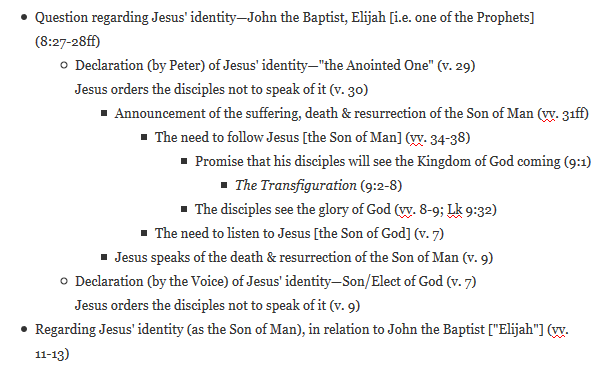
The Transfiguration—from the Latin translation (transfiguratus) of the Greek (metamorfw/qh, “he was trans-formed”) in Mark 9:2—is one of the more famous episodes in the Gospels. It is part of the “Triple Tradition” (i.e., occurs in all three Synoptic Gospels: Mark 9:2-10; Matthew 17:1-9; Luke 9:28-36), and is to be found at the same point in the narrative framework: following Peter’s Confession, and in between the two pronouncements by Jesus of his upcoming betrayal and death (Mark 8:31; 9:31-32 par.); however only in the Lukan account, is it connected directly with the Passion (Luke 9:31, but see also the question concerning Elijah, Mark 9:11-13 par).

Still, the entire episode remains enigmatic; it has been, and continues to be, interpreted any number of ways. Particularly curious are the presence of Moses and Elijah (Peter apparently recognizes them without any explanation), “speaking with” (sullalou=nte$) Jesus (only Luke mentions their discussion, see below). The two Old Testament figures are commonly thought to represent the Law and the Prophets, with Jesus in the middle as a kind of fulfillment of the Scriptures. However, in the original context of the Gospels—and at the historical level—I think it is more likely that Moses and Elijah both represent prophetic figures. Jesus as a Prophet (or as the eschatological, coming Prophet) was an important concept during the time of his own ministry and in the earliest Christian period. That there was widespread (‘messianic’) expectation of an eschatological Prophet is confirmed by numerous passages in intertestamental Jewish literature (1 Maccabees 14:41, CD 6), the Qumran scrolls (1QS 9, 4Q175 [Testimonia], etc), and the New Testament (see esp. John 1:21, 25; [4:19, 25]; 6:14; 7:40; Acts 3:22-23; 7:37). There were key Old Testament passages in this regard—(1) Deuteronomy 18:15ff (cf. Exodus 20:21 in the Samaritan Pentateuch), which speaks of a “prophet like Moses” who is to come; and (2) Malachi 3:1; 4:5 [MT 3:22], where a Messenger preceding the coming of the great Day of the Lord is mentioned, along with Elijah (cf. Sirach 48:10; Sibylline Oracles 2:187-189; Mark 9:11-13 par; Matthew 11:4; Luke 1:17; 9:8; John 1:21, 25; [Rev 11:1-13]). One might also mention a third prophetic paradigm from the Old Testament: the “Servant of the Lord” from the book of Isaiah (esp. Isa 61, which Jesus specifically applies to himself [Luke 4:17-21]); a text from Qumran (4Q521) describes an Elijah-like Messianic figure in language drawn from Isa 61 and Psalm 146. (For more on this subject, cf. especially Parts 2 and 3 of the series “Yeshua the Anointed”)

Of course, the climax of the Transfiguration scene is the Divine Voice (Mark 9:7; Matthew 17:5; Luke 9:35), speaking out of the cloud. It seems to come in response to Peter’s desire to build three “tents” (in imitation of the Sukkot, Feast of Booths); after the Voice has spoken, the cloud, along with Moses and Elijah, has vanished. I would like to examine briefly this verse, from two vantage points: one, text-critical, and the other, source-critical (or historical-critical).

1. Text-Critical: Luke 9:35 differs notably from the parallel text in Matthew and Mark—instead of the articular adjective o( a)gaphto/$ (“[the one] loved”), it reads the articular (passive) participle o( e)klelegme/no$ (“[the one] chosen”). This is almost certainly the original reading, found in Ë45, 75 a B L C (579) 892 1241 pc, and in a range of Latin, Syriac (syrs, hmg) and Coptic manuscripts. In numerous MSS it was harmonized to the text of Mark (A C* W f13 33 ª et al) or Matthew (C3 D Y pc), but not the other way around; in a few MSS we also find the more common adjective e)klekto/$ used instead. By all accounts, the reading o( e)klelegme/no$ is more unusual (and difficult—lectio difficilior potior); it is hard to imagine how it could have come about if the reading common to Matthew/Mark were original, whereas a scribal tendency to harmonize with the “easier” reading in the other two Gospels is quite natural. Literally, e)kle/gw/e)kle/gomai should be translated “gather out [of/from]” (le/gw in its original, primary sense of “gather, collect”), and was used quite often in the LXX, normally translating the Hebrew rjb (“choose, chosen”); and, as such, often with real theological significance—’anointed’ kings and priests, David, the city of Jerusalem, the “Servant of the Lord”, etc., were all chosen by God. Jesus, then, as o( e)klelegme/no$, is “the one [being] gathered out” from all other beings. It is perhaps easy to see how such a title might make scribes and commentators in the early Church uncomfortable: the text could have been modified for doctrinal reasons, in order to avoid an “adoptionistic” view of Christ.  However, it would be dangerous to read later Christological concerns very far into Luke’s account: more vital to him, surely, are the Old Testament parallels: just like the people Israel, David, Jerusalem, and the Prophets, so Jesus was chosen by God.

2. Source-Critical: In studying any one of the Synoptic Gospels, it is always worth holding up the common passages for comparison, to look carefully at the differences between them. Here, for example, is the best text in each Gospel for the Divine Voice:

Mark 9:7:
ou(to/$ e)stin o( ui(o\$ mou o( a)gaphto/$
“This is my (be)loved son”
Matthew 17:5b:
ou(to/$ e)stin o( ui(o/$ mou o( a)gaphto/$, e)n w!| eu)do/khsa
“This is my (be)loved son, in whom I have good regard”
Luke 9:35:
ou(to/$ e)stin o( ui(o/$ mou o( e)klelegme/no$
“This is my son the (one I have) gathered out [i.e. chosen]”
or, “This is my son the Chosen (One)”

In each Gospel, the voice concludes, a)kou/ete au)tou= (Lk. reverses the two words), “hear him!” The question of the text of Luke 9:35 was examined above. But what of the relationship between the three Gospels here? The common critical theory—that Matthew and Luke each made use of Mark as a written source—encounters difficulties in the Transfiguration scene, as both Evangelists (Luke, in particular) use very different language in places and include numerous details not found in Mark’s account. This means, at the very least, that Matthew and Luke are drawing from other traditions (or their own inspired creativity), in telling the story. Luke, especially, seems to apply an extra layer of symbolism, drawn from the Old Testament, at key points in the narrative (on this again, see below). In Mark (and Matthew), the Divine Voice speaks much as it did at the climax of Jesus’ baptism, and Matthew may be intentionally drawing a closer connection (in Matthew the two pronouncements are identical). Is it possible to determine the text at the historical level? One might view Mark’s version as “original”, to which the other Evangelists have added details. From a traditional-conservative position, one may be tempted to combine all three, in which case the Voice would have said something like: “This is my (be)loved son, the Chosen one, in whom I have (good) pleasure”. However, there is really no basis for such a conflate reading, beyond a pious desire to avoid discrepancy. Instead, should we not consider that, at the level of the inspired received text, the Voice speaks all three ways?

Old Testament parallels in Luke:

In conclusion, I would like to note several details, unique to Luke’s account of the Transfiguration, which seem to be the result of specific Old Testament symbolism applied to the traditional text.

  1. Jesus’ Face (Luke 9:29):
    Instead of stating that Jesus metamorfw/qh (“was trans-formed”), Luke indicates that the ei@do$ [“sight” i.e., appearance] of his face [prosw/pon] was e%tero$ [“other, different”, i.e. altered]. Matthew also mentions Jesus’ face (one of several minor agreements between Matthew and Luke, against Mark); however, here, especially, a reference to the glorification (LXX dedo/castai) of Moses (Exodus 34:29-33) seems to be in mind. Luke also refers twice in this context to “splendor” [do/ca], once referring to the appearance of Moses and Elijah (v. 31). Also, as Moses speaks (LXX e)la/lhsen) to the (chosen) representatives of Israel (34:31), so he speaks with (sunela/loun) Jesus.
  2. The Conversation (Luke 9:31):
    Luke records something of the nature of the conversation Jesus has with Moses and Elijah, that they recounted [i.e. spoke of] th\n e&codon au)tou= h^n h&mellen plhrou=n e)n Ierousalh/m (“…his way out [i.e. departure], which he was about to [ful]fill in Jerusalem”). The Greek word e&codo$ (éxodos, lit. “way out [of/from]”) unmistakenly references the “Exodus” of the Israelites, under Moses, out of Egypt and into the Promised Land.
  3. The Cloud (Luke 9:34-35):
    All three Gospels mention the cloud (nefh/lh), and the Divine Voice issuing out of it, as well as the cloud overshadowing (e)piskia/zw) them; but only Luke mentions the unusual detail: e)fobh/qhsan de\ e)n tw=| ei)selqei=n au)tou\$ ei)$ th\n nefe/lhn, “and they were afraid in their coming into the cloud”—apparently the disciples (with Jesus) enter into the cloud. This would seem to be an echo of Exodus 19:20, where God calls Moses up onto the mountain to the “thick cloud” (LXX nefe/lh, v. 16) where God Himself is; see also 1 Corinthians 10:1-2, in reference to the “pillar of cloud”. The image of believers “entering into” the dark cloud of God’s Presence, proved to be a powerful symbol in Christian mystical tradition (cf. Gregory of Nyssa, Life of Moses II:162-169; Pseudo-Dionysius’ Mystical Theology §1ff; and many other references).

The archetypal imagery of the Transfiguration was particularly prominent in the mystical tradition of the Greek Church. Especially noteworthy is an episode in the Hesychast controversy of the 14th century. “Hesychasm” (from h(suxi/a, “quiet, stillness, silence”) was a characteristic term applied to mystic-ascetic monks and hermits in the Eastern Church, reflecting a life of contemplation and unceasing prayer [“prayer of the heart”], with the ultimate goal of union with God and qe/wsi$ (“deification”, i.e., man becoming like God, cf. John 1:12-13 and Athanasius’ famous axiom, On the Incarnation 54.3). Part of this mystical contemplation involved a special vision of the Divine “Light”—not the essence of God, but his “energy” (e)ne/rgeia)—an uncreated, “hypostatic” light, synonymous with the Glory of Christ (as manifested especially during the Transfiguration [traditionally on Mt. Tabor]), and sometimes referred to as the “Taboric light”. Famously, Barlaam of Calabria and Gregory of Akindynos opposed the possibility of such a transcendent vision, while the Hesychast position was powerfully defended by Gregory Palamas in his Triads.

Jesus and the Gospel Tradition: The Galilean Period, Pt 2 (Lk 4:16-30)

In the previous note I looked at the tradition of Jesus’ visit to his hometown (Nazareth) in Mark 6:1-6a. Matthew’s version (13:53-58) differs only slightly from that of Mark. Luke’s account, as I have already mentioned, has a number of details unique to his version, though it almost certainly is describing the same (historical) event and tradition. These differences I will be discussing today. Before proceeding, it is worth pointing out that neither Mark nor Matthew actually mentioned the name of the town, simply referring to it as Jesus’ patri/$ (patrís), “father(‘s) land”, i.e. the territory of his home town. We may assume that the Gospel writers both understood it to be Nazareth, based on earlier data they recorded (Mk 1:9; Matt 2:13; 4:13), but, in all likelihood, the original tradition as passed down did not include the name of the town. Luke specifically refers to it by name (4:16), and he has good reasons for doing so, as we shall see.

Luke 4:16-30

(See also my earlier study on this passage)

Let us first note the elements and details which are unique to Luke’s version of the episode, and which he most likely has added to the core Synoptic narrative. We may take these to be (authentic) historical traditions, and, if so, they would be considered part of the so-called “L” material (traditions found only in Luke). The significant additions are as follows:

    • A different narrative introduction (v. 16)
    • The detail of Jesus standing up to read a passage from the Prophets (v. 17)
    • The quotation of Isaiah 61:1, with Jesus’ explanation (vv. 18-21)
    • The proverb cited by Jesus in v. 23
    • The Scriptural examples involving the Prophets Elijah and Elisha (vv. 25-27)
    • The violent reaction by the people, with intent to do harm to Jesus (vv. 28-29f)

The core Synoptic tradition, as found in Mk 6:1-6a (cf. the previous note), can still be glimpsed by combining together vv. 14-15 (with 16), 22, 24, and (very loosely) 28, 30. Beyond the added details listed above, consider how the author has (apparently) modified the core tradition:

    • The details emphasized in verse 16 (cp. Mk 6:1-2a par):
      (a) The name of the town (Nazareth)
      (b) That it was the place where Jesus was nourished (i.e. raised, brought up)
      (c) That he was used to attending local Synagogues on the Sabbath (and teaching there)
    • A different formulation of the people’s reaction—that is, the summary of their words/thoughts (v. 22 / Mk 6:2-3 par)
    • A different version of Jesus’ saying (v. 24 / Mk 6:4)
    • The episode apparently ends with a rather different (more violent) result to Jesus’ visit (vv. 28-30)

Each of these will be examined briefly, going verse by verse.

Verse 16—The Lukan details mentioned above all relate to the distinctive purpose of the episode within the context of the Gospel narrative. Two major literary and thematic elements are clearly at work:

    • The reference to Nazareth as the place where Jesus was brought up (as a child) points back to the Infancy Narrative of chapters 1-2, especially 2:40-52, which share certain motifs and language with 4:16ff. I have discussed these in an earlier note on this passage.
    • This episode illustrates the summary of Jesus’ (Galilean) ministry in verses 14-15—in particular, that of his teaching in the synagogues. The Synoptic tradition introduces the ministry of Jesus with a different episode (cf. Mark 1:21-28 par [this follows in Lk 4:31-37]). Note the way that both the initial Markan and Lukan episodes illustrate the two aspects of Jesus’ ministry:
      (1) Teaching/preaching (with a synagogue setting)—Mk 1:21-22, 27; Lk 4:14-16, 22
      (2) Working miracles—Mk 1:23-27; Lk 4:14a, 23-27

Verses 17-21—The quotation of Isaiah 61:1 is a tradition unique to Luke’s account. In verse 21, Jesus states that this prophecy has been fulfilled at the moment of his reading it. In other words, Jesus identifies himself with the Anointed herald/prophet figure of Isa 61:1ff, just as he does elsewhere, in the traditional “Q” material (Lk 7:22 / Matt 11:5). Luke’s inclusion of this reference probably offers the best explanation for his location of the Nazareth episode, set at the very beginning of Jesus’ ministry. This can be explained on three levels:

    • A connection with the Baptism scene, with the descent of the Spirit upon Jesus (3:22). This is to be understood as the moment when the Spirit came upon him and he was anointed by God (Isa 61:1 / 4:18).
    • A connection with the preceding Temptation scene (4:1-13) which is framed by important references to the presence/activity of the Spirit (vv. 1, 14). In other words, this also shows how Jesus has been ‘anointed’ by the Spirit of God.
    • Jesus’ identity as the Anointed One (Messiah), which serves as a principal theme of the Lukan account of Jesus’ Galilean ministry (4:1–9:20). However, in this period he is not identified as the royal Messiah from the line of David, but as the Anointed herald/prophet of Isaiah 61. Matthew (4:12-17) introduces Jesus’ Galilean ministry with a different Messianic prophecy (Isa 9:1-2), one more in keeping with the Davidic figure-type.

Verse 22—Here it is worth comparing Luke’s account of the crowds reaction with that of Mark. Consider first the initial description of their reaction:

“and many hearing (him) were laid out (flat) [i.e. amazed], saying ‘From where (did) these things (come) to this (man), and what (is) th(is) wisdom…’?” (Mk 6:2)

“and all witnessed (about) him and wondered upon [i.e. at] the words of favor traveling out of his mouth” (Lk 4:22a)

The idea is roughly the same, but with a different emphasis. In Mark, the people recognize the two aspects of Jesus’ ministry—the wisdom (of his teaching) and his powerful deeds (miracles). In Luke’s account, it seems that they are responding to his gifts as a speaker, fulfilling a traditional religious role—that of reading the Scripture and offering a (pleasant) word of exhortation. It would seem that, while they may have recognized the Messianic significance of Isa 61:1ff, they certainly did not understand the implication of Jesus’ declaration in v. 21—that he was the Anointed One of the prophecy. Mark’s version may contain something of this idea as well, in the statement that the people of Nazareth were “tripped up” (the vb. skandali/zw) by Jesus (v. 3, cf. Lk 7:23 par)

The second part of the people’s reaction is even more significant. In Mark (6:3) the people find it hard to explain Jesus’ words and deeds, since they know all of his family—his mother, brothers, and sisters—as ‘ordinary’ people in the area. Luke has simplified this statement greatly, highlighting just one family member of Jesus:

“Is this not the son of Yoseph {Joseph}?”

This is reasonably close to the words in Matt 13:55: “Is this not the son of the craftsman [i.e. carpenter]?”, as well as being virtually identical to those in Jn 6:42. However, for Luke the reference to Joseph (as Jesus’ human father) has special importance, as can be seen clearly from two earlier passages:

    • The episode of the child Jesus in the Temple, in which Joseph as Jesus’ (human/legal) father is contrasted with God as his (true) Father (2:48-49)
    • The genealogy of Jesus (3:23-38), which begins “the son, as it was thought, of Joseph…” (v. 23), and ends “…the (son) of God” (v. 38). The implication, again, is that God is Jesus’ true Father (1:32, 35; 3:22b).

With these allusions in mind, it becomes apparent what the author is emphasizing here in this scene. The people of Nazareth are still thinking of Jesus as the ordinary, human/legal son of Joseph, and do not at all recognize him as the Anointed One and Son of God.

Verses 23-24—In Luke’s version, the Synoptic saying is preceded by an additional proverb (in v. 23). It functions as a provocative challenge to the townspeople. At this point, Luke does not mention the people taking offense at Jesus (cp. Mark 6:3); rather, Jesus seems to be taking the initiative in provoking them. The proverb brings to light the miracles performed by Jesus and plays upon the Synoptic tradition in Mk 6:5 par—that he was unable to perform many miracles in his home town (because of the people’s lack of faith). The proverb itself is relatively common, with parallels known from the Greco-Roman and Near Eastern world. However, in Luke, joined as it is with the saying of v. 24, it effectively creates a dual contrasting statement (physician/prophet). This, in fact, is how the saying has been preserved in at least one line of tradition, as recorded in the Oxyrhynchus Papyrus 1 and the Gospel of Thomas (§31)—i.e. “a prophet is not… and a physician does not…”. The Lukan form of the saying in v. 24 also differs from the version in Mark/Matthew:

“A foreteller [i.e. prophet] is not without honor, if not [i.e. except] in his father(‘s) land and among his relatives and in his (own) house” (Mk 6:4)

“Not one foreteller [i.e. prophet] is accepted in his father(‘s) land” (Lk 4:24)

Most likely, Luke’s version represents an abridgment and/or simplification of the Synoptic tradition. Again, it serves a distinct purpose in the Lukan context—it makes more direct the identification of Jesus as a prophet.

Verses 25-27—The prophetic association becomes even clearer with the references to Elijah and Elisha (1 Kings 17:8-16; 2 Kings 5:1-19) and the miracles they worked. Jesus effectively is identifying himself with a prophet like Elijah/Elisha, a connection which appears a number of times in the Gospel tradition. For more on this, see parts 2 and 3 of my earlier series “Yeshua the Anointed”.

Verses 28-30—Luke, quite in contrast with the narrative in Mark/Matthew, records an openly hostile, violent reaction to Jesus, provoked, it would seem, by Jesus’ own words in vv. 23-27. There is nothing quite like this in the core synoptic narrative, which ends rather uneventfully, with a laconic statement that Jesus was unable to perform many miracles in his home town, and that he marveled at the people’s lack of faith (Mk 6:5-6a). This is the only point at which the Lukan account really does not fit the Synoptic outline of the episode in Mark/Matthew. It does, however, fulfill two important themes within the narrative context of Luke’s Gospel:

    • It prefigures the opposition/violence that Jesus, as the Anointed One and Son of God, would face from the people, and serves as a parallel to the close of the Galilean period, and the Passion references which follow (9:21-22, 31, 43b-45, 51).
    • It also looks back to the Infancy Narrative, and the oracle by Simeon in 2:34-35, illustrating the opposition predicted by him most vividly.

Quite possibly, the original (historical) tradition contained more of this element of opposition to Jesus, but that it was not preserved in the Synoptic account of Mark/Matthew, retained (if at all) only in the statement at the end of Mk 6:3. If so, then Luke has developed and enhanced this aspect of the tradition.

John 6:42

Finally, it is worth noting, that, although the Gospel of John does not have anything corresponding to the Nazareth episode of the Synoptics, it does include at least one similar tradition—Jn 6:42, forming part of the great Bread of Life discourse in 6:22-59. As in the Synoptic episode under discussion, verse 42 reflects the people’s reaction to statements by Jesus regarding his identity. In Luke 4:16-30, he identifies himself with the Anointed (Messianic) herald/prophet of Isaiah 61:1ff (v. 21), and, by implication, as also being the Son of God (vv. 22ff, cf. above). In the discourse of John 6:22-59, Jesus draws upon different Scriptures—the Exodus traditions, especially that of the manna (as “bread from heaven”)—and identifies himself as the true Bread that comes down from heaven. This is expressed in verse 42 by one of the famous “I Am” declarations in John—”I am the bread th(at is) coming down [lit. stepping down] out of Heaven” (cf. also vv. 32-33, 35, 38, 48, 50-51, 58). In the Johannine context, this certainly refers to Jesus as the eternal (pre-existent) Son of God who has come (down) into the world to bring Life to those who would believe. Here Jesus’ sonship (in relation to God the Father) is understood at a much deeper level than in the Gospel of Luke. However, the basic contrast expressed is the same. The people recognize Jesus only at the ordinary, human level, and are troubled/offended by his words:

“Is this not Yeshua, the son of Yoseph, of whom we have seen [i.e. known] his father and (his) mother? (So) now how (can) he say that ‘I have stepped down out of heaven?'”

The italicized portion is quite similar to the words of the people of Nazareth in Mark 6:3 par; indeed, the first phrase—”is this not…the son of Joseph?”—is virtually identical with Luke 4:22b. And, to be sure, John expresses the same aspect of opposition and misunderstanding among the people as Luke does. They view Jesus merely as the son of Joseph, when, in fact, his true identity is as the (eternal) Son of God the Father (Jn 6:27, 32, 37, 40, 44, 46, 57, etc).

Jesus and the Gospel Tradition: The Galilean Period, Pt 1 (Acts 1:6-26)

Acts 1:6-26 (and Matt 19:28 par)

The previous note dealt with the association of the Twelve and the coming of the Kingdom of God, in the context of Matthew 19:28 par (Lk 22:28-30) and the tradition in Acts 1:6ff. I pointed out that there is good reason to think that the number twelve and its symbolism—related to the twelve tribes of Israel—was introduced and applied by Jesus himself. The apparent authenticity (on objective grounds) of the Matt 19:28 saying would confirm this. It is not entirely clear whether the idea is of a concrete earthly kingdom, or a heavenly one. The Synoptic narrative context of Matt 19:28, as it reads in Mark (10:28-31), indicates a contrast between earthly sacrifice/suffering for Jesus’ sake (now) and eternal/heavenly reward (in the future). This contrast seems to have been a common emphasis in Jesus’ teaching, such as we see in the parables and, especially, in the Sermon on the Mount (Matt 5:3-12; 6:1ff, 19-21; Lk 6:20-26, etc). Matthew’s version of the episode (19:27-30) has a different emphasis, but it would seem that a heavenly context is still implied; the use of the word paliggenhsi/a suggests a time following the resurrection. The parallel in Lk 18:28-30 is somewhat ambiguous, as is the context of 22:28-30 (cf. verse 18).

The problem is that traditional Israelite and Jewish eschatology variously envisioned the coming Kingdom (of God) in earthly and heavenly aspects, drawing upon imagery from both. This is also true in terms of Messianic expectation. Sometimes the establishment of the Kingdom was seen to follow the end-time Judgment and the Resurrection, in other instances a period of (Messianic) rule on earth is envisioned. Certain eschatological schemes combine both aspects, as we see, for example, in the book of Revelation. Paul says very little in his letters regarding a future Kingdom on earth; the imminent, expected return of Jesus seems to coincide with the resurrection (1 Thess 4:14-17), after which believers will remain with him (in heaven). On the other hand, in 1 Cor 6:2, Paul states that believers will play a role in the Judgment of the world, expressing an idea generally similar to the saying of Jesus in Matt 19:28 par. Presumably, this ruling/judging position is thought to take place in heaven, since he also says that believers will judge the Angels (v. 3).

Jesus’ own teaching in this regard is not entirely clear, at least as it has been preserved in the Gospel Tradition. However, following the resurrection (and ascension) of Jesus, early Christians had no choice but to believe that the coming of the Kingdom, in its full sense, in heaven and/or on earth (cf. Matt 6:10), was reserved for the time of Jesus’ future return. In the interim—however brief or long it may be—the Kingdom was realized (on earth) in two primary ways: (1) by the presence of the Spirit in and among believers, and (2) through the missionary work of early Christians, spreading the new faith (from Jerusalem) into the wider world. This is certainly the understanding expressed by the author of Luke-Acts; and, if we take the text at face value, it was also the true purpose and intention of Jesus.

In the prior note, I looked briefly at the question asked of Jesus by the disciples (i.e. the Twelve) in Acts 1:6. Their question indicates that they were thinking in traditional eschatological terms about the coming of the Kingdom—as a socio-political (and religious) entity on earth, headed by Jesus as God’s Anointed representative (i.e. a royal Messiah). By extension, it might have been thought that they (the Twelve) would be ruling this Kingdom as well (cf. again the context of Lk 22:28-30). Jesus does not answer their question directly, and so leaves open, perhaps, the possibility of such an earthly (Messianic) regime in the future; however, his response must be deemed an implicit rejection of their very way of thinking. He deftly redirects the entire thrust of the question (verse 7), and then effectively gives them their answer: instead of expecting the return of an Israelite Kingdom like that of David long ago, the disciples will usher a different kind of Kingdom, involving—(a) the coming of the Spirit in power, and (b) their witness and proclamation of the Gospel message (verse 8).

The Restoration of Israel (Acts 1:12-26)

The disciples’ question (1:6) involved the idea of the restoration of the Kingdom to Israel. The author of Acts, doubtless following the (historical) traditions which he inherited, has built upon this theme, which is central to the narrative which follows in the remainder of chapters 1-2. I have discussed this at length in a set of notes (for Pentecost, soon to be posted on this site), and will only provide an outline of that study here.

The theme of the “Restoration of Israel” can be glimpsed already in verses 12-14:

  • The disciples “return (or turn back) into Jerusalem”, v. 12. On the surface this is a simple description; however, consider the language in light of the implied motif of the “restoration” of Israel:
    a) The dispersed Israelites will return to the land, and to Jerusalem
    b) The restoration of Israel is often tied to repentance (turning back)
  • The Twelve disciples are gathered together in Jerusalem, in one place (upper room), v. 13. This is a seminal image of the twelve tribes gathered together again.
  • The initial words of v. 14 contain a number of related motifs, expressing the unity of believers together:
    ou!toi (“these”—the twelve, along with the other disciples)
    pa/nte$ (“all”—that is, all of them, together)
    h@san proskarterou=nte$ (“were being strong” [sense of “endurance”, “patience”] “toward” their purpose/goal)
    o(moqumado\n (“with one impulse”—a key phrase that occurs throughout Acts, cf. 2:46; 4:24, et al.
    th=| proseuxh=| (“in prayer”)

Does this not seem a beautiful, concise image of what one might call the “kingdom of God” on earth?

The Reconstitution of the Twelve (1:15-26)

As stated above, most likely the Twelve were chosen (by Jesus) in part to represent the tribes of Israel; and, as such, their unity (and the unity of their mission work) similarly reflects the coming together of Israel (the true Israel). Consider, for example, the basic Gospel tradition of the sending out of the Twelve in Mark 6:6b-13 par. It is possible too, at least in early Christian tradition, that the twelve baskets in the miraculous feeding came to be thought of as symbolic of Israel re-gathered, as well as an image of Church unity (see Didache 9:4 on the Eucharist).

So here, in Acts, the choosing of a twelfth apostle, to take the place of Judas Iscariot, takes on great significance. According to the logic of the narrative, Israel (the Twelve tribes) cannot be restored until the Twelve are reconstituted. Note the possible (even likely) symbolism in the parenthetical notice in Acts 1:15, where the number of disciples gathered together in the house is (about) 120—that is, 12 x 10. There would seem to be a symbolic association of these 120 disciples with a unified/restored Israel.

The Pentecost Narrative (2:1-13ff)

This symbolism continues into the Pentecost scene in chapter 2. Note the following (chiastic outline):

  • The unity of the disciples (together in one place and/or for one purpose—e)pi\ to\ au)to/), verse 1.
    • The house/place of gathering is filled (e)plh/rwsen) with the Spirit, verse 2.
      • Appearance of tongues (glwssai) of fire upon each individual disciple (~120), verse 3
      • The disciples (each) begin to speak in other tongues (glwssai), verse 4
    • The disciples are all filled (e)plh/sqhsan) with the Holy Spirit, verse 4
  • The unity of the crowd—devout Jews (from all nations) in Jerusalem come together in one place, verse 5ff

The way this scene builds upon the prior events of chapter 1 can be illustrated by expanding the outline:

  • The disciples have returned (turned back) to Jerusalem
    • The Twelve have been reconstituted and are gathered together (in Jerusalem) in one place
      • Jews from all nations (the Dispersion) also are gathered together in Jerusalem
    • They again hear the voice (word of God) in the languages of the nations, spoken by the Twelve and other disciples (echo of the Sinai theophany)
  • The disciples go out from Jerusalem into the nations (even to the Gentiles)

This emphasizes more clearly the theme of the “restoration of Israel”, according to the eschatological imagery of the later Old Testament prophets and Judaism, which involves two related themes:

    1. The return of Israelites (Jews) from exile among the nations—this return is to the Promised Land, and, in particular, to Judah and Jerusalem.
    2. The Nations (Gentiles) come to Judah and Jerusalem, bringing tribute and/or worshiping the true God there.

The restoration of Israel in terms of a “regathering” of Israelites and Jews from the surrounding nations was expressed numerous times already in the Old Testament Prophets, especially the latter half of the book of Isaiah; this eschatological expectation was extended to include those of the nations (Gentiles) who come to Jerusalem and join the people of Israel—e.g., Isa 49:5ff; 56:1-8; 60:1-14; 66:18-24; Micah 4:2-5 (Isa 2:3-4). Cf. Sanders, p. 79. This theme became part of subsequent Israelite/Jewish eschatology and Messianic thought (Baruch 4-5; 2 Macc 1:27ff; Ps Sol 11, 17, etc), sometimes expressed specifically in relation to the regathering of the twelve tribes—Sirach 36:11; 48:10; Ps Sol 17:28-31ff; 1QM 2:2ff; 11QTemple 18:14-16; T. Sanh. 13:10; and also note the motif in Revelation 7:1-8; 14:1-3ff (cf. Sanders, pp. 96-7).

Revelation 21:12-14ff

Finally, the connection between the Twelve Apostles and the Twelve Tribes of Israel is presented in the book of Revelation, but in a very different manner from the saying of Jesus in Matt 19:28. It is part of the great vision of the new (heavenly) Jerusalem in 21:1-22:5, which serves as the climax of the book. The gates and walls of the city are described in 21:12-14ff, drawing upon the description in Ezek 48:30-35. Here we find:

    • Twelve gates, named after the Twelve Tribes—that is, the names of the tribes were inscribed on them (v. 12b). The Qumran community drew upon the same tradition (11QTemple 39-41; 4Q365a frag. 2 col. 2; 4Q554). The names on the gates commemorate the heritage of Israel as the people of God.
    • Twelve foundation stones for the city walls, named after the Twelve Apostles (v. 14). The image of Christ and the apostles as “foundation (stone)s” is found several times in the New Testament (1 Cor 3:11; Eph 2:20). There is also a similar idea expressed by the Qumran community, for the leaders of the community (esp. the twelve men of the Council), cf. 1QS 8:1-6; 11:8; 4Q154 frag. 1, col. 1). In the famous declaration of Jesus in Matt 16:17-19, Peter and the Twelve are depicted as stones which make up the foundation of the Church. Cf. Koester, p. 815.

Thus the New Jerusalem—that is, the heavenly/spiritual Jerusalem of the New Covenant (Gal 4:24-26)—honors the heritage and legacy of both Israel (representing the Old Covenant), and the Apostles (representing the beginning of the New). However, there is no idea here of the Apostles ruling—God alone (with Christ) is on the Throne (21:5).

References above marked “Sanders” are to E. P. Sanders, Jesus and Judaism (Fortress Press: 1985). Those marked “Koester” are to Craig R. Koester, Revelation, Anchor Bible [AB] Vol. 38a (Yale: 2014).

Jesus and the Gospel Tradition: The Galilean Period, Pt 1 (Matt 19:28; Acts 1:6ff)

In the previous note, I discussed the saying of Jesus in Matthew 19:28, with the parallel (or similar) saying in Luke 22:28-30, and the connection between the Twelve Disciples and the Twelve Tribes of Israel. There has been some question, among critical commentators, as to whether this particular association goes back to Jesus’ own words, reflecting something of his original purpose in designating the Twelve. On entirely objective grounds, there is reasonably strong evidence that it does. I would point to the following arguments:

    • An emphasis on the twelve tribes of Israel does not appear to have been especially prominent in early Christianity, all the more so as the faith spread into the Greco-Roman (Gentile) world. The few references in the New Testament come clearly from an (early) Jewish Christian context (Acts 26:7; James 1:1; cf. also Rom 11:1; Phil 3:5) or draw upon Old Testament tradition (Rev 7:4-8). The parallel in Rev 21:12ff will be discussed in the next note.
    • The very exclusiveness indicated by the association—Disciples/Israel—suggests a time-frame prior to the Gentile mission (i.e. prior to c. 45-50 A.D.). An early Christian formulation would likely reflect the inclusion of the Gentiles, taking it into account in some way.
    • The tradition regarding the Twelve is extremely early, being attested in multiple strands of tradition. This indicates that it was already firmly established well before 50 A.D.
    • The version of the saying in Matt 19:28 takes no account whatever of Judas’ betrayal, as the parallel in Luke clearly does (cf. also Jn 6:67-71). If the Lukan version of this saying has been modified in its context, eliminating the specific reference to twelve disciples (in light of Judas’ betrayal), then the earlier form would be reflected in Matthew’s version. Indeed, it is likely that Christians from a slightly later period would have qualified or explained the saying in some way, so as to factor in the situation regarding Judas.

Another sign of authenticity has to do with the emphasis on the coming Kingdom (of God). The concrete eschatological aspect of the Kingdom, so prominent in Jesus’ teaching in the Gospels, tends to disappear in early Christianity, being re-interpreted as a spiritual phenomenon (i.e. ‘realized’ eschatology)—the presence of God (and Christ) in and among believers, through the Holy Spirit. The imagery of Matt 19:28 par, on the other hand, preserves the idea of a real kingdom, with seats of rule—being specifically connected with the kingdom of Israel.

Commentators continue to debate the significance of Jesus’ preaching and teaching regarding the Kingdom (Mk 1:15 par, et al). On the one hand, many critical scholars hold that the historical Jesus believed that an end-time Messianic kingdom, in the socio-political (and religious) sense, was about to be ushered in by God, and that he would play the leading role in that process. According to this view, early Christians were forced to re-imagine and reinterpret Jesus’ words, as referring to the presence/work of the Spirit now, with the return of Jesus, establishing the Kingdom of God on earth in full, still reserved for a future moment. On the other side, traditional-conservative commentators would argue that Jesus intended this ‘Christian’ sense of the Kingdom from the first. The Gospel of Luke, along with the book of Acts, represents the only portion of the Gospel Tradition that deals with this question directly, in three passages: 17:20-21, 19:11ff, and Acts 1:6ff.

Luke 17:20-21 is part of a short collection of eschatological teaching (vv. 22-37ff) by Jesus, which the saying(s) of vv. 20-21 introduces, centered on the specific theme of the coming of the Kingdom of God. According to the narrative, certain Pharisees ask Jesus regarding “when the kingdom of God (would) come” (v. 20a). Jesus’ answer states that the Kingdom of God comes in a way that cannot be observed by human beings outwardly, at a particular moment or place (vv. 20b-21a). His response concludes with the famous declaration in v. 21b: “the kingdom of God is inside (of) you”. I have discussed this difficult statement at some length in an earlier note; commentators still debate the meaning, but at least three aspects may be emphasized: (1) the coming of the Kingdom will be hidden or invisible to people at large, (2) its coming/presence will be realized inwardly, and (3) it is to be understood as the presence of God/Christ among his people.

Luke 19:11 serves as the narrative setting of the parable by Jesus in vv. 12-27; it addresses the central question of the Kingdom even more precisely, stating that his reason for speaking the parable was:

“…through [i.e. because of] his being near Yerushalaim and their thinking that the kingdom of God was about (to come) along instantly to shine forth up(on them)”

At least some of Jesus’ followers thought that his arrival in Jerusalem (as the Anointed One) would usher in the Kingdom of God upon earth, in the socio-political and religious sense defined by the eschatological (and Messianic) expectation of the time. Certainly, people hailed Jesus as a Ruler from the line of David (i.e. a royal Messiah) during his entry into Jerusalem, according to the Gospel tradition (Mk 11:8-10 par). The Fourth Gospel even refers to the intent of some people to force Jesus into such a role and “make him king” (Jn 6:15). However, the parable in Lk 19:12ff makes clear that the well-born young noble (i.e. the Messiah), before he comes to exert his authority as ruler, will first go away into a “far-off country” for a time. This certainly reflects (or anticipates) the idea of Jesus’ death, resurrection and departure (to heaven) prior to his (subsequent) return. Note how, in the parable, the nobleman goes away for the purpose of “receiving a kingdom”—presumably this is to be understood in terms of Jesus’ receiving it (from the Father) upon his resurrection and exaltation to the “right hand” of God. When he returns, it will be as King and Judge.

Acts 1:6ff is the most important of the passages mentioned above, as in it Jesus answers a question from the disciples that is directly to the point:

“Then, the (disciple)s, (on) coming together, questioned him saying, ‘Lord, (is it) in this time that you (will) set down the kingdom to Yisrael from (where it was before)?'” (v. 6)

The disciples appear to understand the coming Kingdom according to the conventional/traditional Jewish eschatology of the time—as a socio-political (and religious) entity, like the Davidic kingdom of old, centered at Jerusalem. I have translated the verb a)pokaqi/sthmi here quite literally, i.e. to set/place down something from where, or in what condition, it was before. In simpler translation, we might say, “re-establish, restore”, etc; in other words, they are asking Jesus if he will restore the kingdom to Israel, like it was in the time of David. For more on the background of this aspect of the Kingdom, see Part 5 of my earlier series “Yeshua the Anointed”, as well as the supplemental study on Acts 1:3. In the next note, I will be exploring in some detail the way the author (trad. Luke) develops the theme of verses 6ff through the remainder of chapters 1-2 and as a key motif for the book as a whole.

Yeshua the Anointed: Supplemental note on the Son of Man Sayings

There is nearly unanimous agreement among scholars that the expression “the Son of Man” ([o(] ui(o\$ [tou=] a)nqrw/pou) in the Gospels, derives from its use (originally in Aramaic) by Jesus himself. All but a handful of the 80+ occurrences of “Son of Man” are from Jesus’ own words in the Gospels. By contrast, the expression only appears four times elsewhere in the New Testament, and only once as a title for Jesus (Acts 7:55-56, which is a reflection of Gospel tradition [Lk 22:69 par]). It is equally rare in the earliest extra-canonical Christian writings, the so-called Apostolic Fathers (c. 90-160 A.D.)—Ignatius, Ephesians 20:2; Epistle of Barnabas 12:10. In both of these passages “son of man” is understood in something like its generic sense (“human being”) to emphasize the human nature of Jesus—Ignatius stresses Jesus’ dual-nature (“…the [son] of Man and son of God”), while ‘Barnabas’, on the other hand, stresses that Jesus was not simply a human being (“see again Jesus: not son of man, but [rather] son of God”). We find “Son of Man” a bit more frequently in subsequent writings of the early Church, but usually in the context of commenting on, or attempting to explain, the use of the expression in the Gospels (or in Daniel 7). The most noteworthy occurrences in the 2nd century, are in the apologetic works of Justin Martyr—Dialogue with Trypho §§31, 32, 76, 79, 100, 126; and the First Apology §51.

All of this to say that the expression is found so frequently in the sayings of Jesus, and then virtually disappears from early Christian tradition—this makes the authenticity of its use in the sayings secure. However, when it comes to the eschatological Son of Man sayings by Jesus, where he appears to identify himself as a divine/heavenly figure who will appear at the end-time Judgment, critical scholars tend to be a bit more cautious and skeptical. The authenticity of these sayings (as we have them in the Gospels) has been questioned, generally on the basis of two factors:

    1. They have been “Christianized” to varying degrees—that is to say, a number of the sayings have been tied in contextually to believers’ faith in, and confession of, Jesus (e.g. Luke 6:22; 9:26 [Mk 8:38]; 12:8). For critical scholars, this indicates that, at the very least, the sayings have been colored or modified in light of early Christian belief and practice.
    2. Jesus never specifically identifies himself as the “Son of Man”—this only occurs once in the Gospel tradition (in Matthew’s version of the first Passion prediction, Matt 16:21), and may be attributed to the author/narrator rather than Jesus. According to the view of a number of commentators, in the eschatological sayings, Jesus is referring to a separate divine/heavenly figure (“the Son of Man”, cf. Dan 7:13-14ff; 1 Enoch 37-71), and not to himself. In early Christian tradition, references to this figure were then interpreted as referring to Jesus and his end-time (second) coming, as we see in Matt 24:3.

With regard to the first point, the extent of the “Christianization” of these sayings certainly can be debated. If we consider the core sayings in the Synoptic tradition—Mark 8:38; 13:26; 14:62 and parallels—there is really very little evidence for this. The saying in Mark 8:34 has a more obvious “Christian” context, but, since the sayings in 8:34-9:1 have likely been appended together as part of the earliest Tradition, and need not have been uttered by Jesus in sequence on a single occasion, it is questionable whether one should equate it with the (original) context of v. 38. The same may be said for the narrative framework of chapter 13 (the Olivet or “Eschatological” Discourse), which is best understood as a collection of sayings, which may have been uttered by Jesus on different occasions, combined together on the basis of a common theme and subject—i.e. eschatological teaching and sayings by Jesus. Verses 9-13 are a prophecy of the persecution early believers will experience, and the “false Messiahs (or Christs)” in vv. 21-22 are connected with people claiming to be Christ (i.e. Jesus) in v. 6; however, only Matthew’s version of this discourse specifically connects the coming of the Son of Man (Mk 13:26 par) with the future/second coming of Jesus (Matt 24:3). In none of the Synoptics is the Son of Man saying itself modified or glossed, nor do we see any sign of this in Mark 14:62 par.

It is interesting to consider that Luke’s Gospel, apparently written for a wider Greco-Roman (Gentile) audience, and which occasionally translates or simplifies elements of the Gospel tradition into more conventional Greek language, never does this with the Son of Man sayings, even though the expression “the Son of Man” (o( ui(o\$ tou= a)nqrw/pou), as Jesus uses it, would have sounded strange indeed to Greeks unfamiliar with the Semitic idiom. Luke has considerably more eschatological sayings than Mark—in addition to the three core Synoptic sayings (cf. above), there are those in Lk 12:40; 17:22, 24, 26, 30; 18:8; 21:36 (and cf. the parallels in Matt 24:27, 37, 39, 44). Not once, however, does the author narrate or explain the saying in such a way as to clarify that the coming of the Son of Man means the coming of Jesus himself. While early Christians may have assumed or understood this automatically, some in Luke’s intended audience likely would not have. That the Son of Man sayings were left ‘unexplained’ indicates that they were so deeply rooted and fixed in the Gospel tradition, the author simply could not alter them.

This brings us to the second point—that in these Son of Man sayings Jesus originally was not referring to himself, but a separate heavenly figure (“the Son of Man”). There are several problems with this view:

(a) There is little, if any, formal difference between the eschatological Son of Man sayings and those elsewhere in the Gospel tradition (i.e. Mark 2:10, 28 par; Luke 7:34; 9:58 par, etc), in which it is generally admitted that Jesus is referring to himself, perhaps using “son of man” idiomatically as a substitute for the pronoun “I”. Even in the context of the Passion, and the predictions (Mark 8:31; 9:31; 10:33 par) which critical scholars might regard as ex eventu prophecies produced by early Christians, there is little doubt that “the Son of Man” refers to Jesus himself. It is natural to assume that the eschatological sayings also are meant as a self-reference. If there was any intended distinction between the usage in these sayings, it has become completely confused in the Gospel tradition. In fact, there is some indication that Jesus’ use of the expression actually was confusing to some in his audience, if we accept the detail recorded in John 12:34.

(b) There is no clear evidence that the expectation of an end-time figure called “the Son of Man” was widespread or common at the time of Jesus; indeed, the situation is quite the opposite. As I indicated in Part 10, there is only one surviving document, likely contemporary with (or prior) to the time of Jesus, which describes a specific divine/heavenly being called “the Son of Man”—the so-called Similitudes of Enoch (1 Enoch 37-71). This “Son of Man”, also identified as “the Righteous One”, “the Elect/Chosen One” and also “the Anointed One” (i.e. Messiah), will serve as Judge over the nations at the end-time. This figure, like the “Son of Man” in Mark 8:38; 13:26; 14:62, is clearly inspired by, and derived from, Daniel 7; however, the Similitudes do not specifically emphasize his glorious appearance on earth at the end-time. There is little reason to think that Jesus was referring to common and popular image, though educated and devout Jews certainly would have recognized an allusion to Daniel 7:13-14. Turning again to John 12:34, we see that Jesus’ audience seems to understand “the Anointed One” (i.e. Messiah/Christ), presumably in terms of an end-time Davidic Ruler (cf. Parts 6–8), but they are noticeably less clear about the Son of Man (“…who is this ‘Son of Man’?”).

(c) If we combine the arguments of (a&b), along with the fact that there is little sign that any of the eschatological Son of Man sayings has been altered or glossed for the sake of clarity or as part of a Christological interpretation (cf. above), then there appears to be little reason to treat those sayings differently from Jesus’ use of the expression “the Son of Man” elsewhere. Even in the textual transmission, there is surprisingly little evidence for substantive variant readings involving the expression “Son of Man” (i.e., using a more familiar title “Lord”, “Christ”, “Son of God”, or even the pronoun “I”), one notable example being found in John 9:35 (“Son of Man” vs “Son of God”).

If, then, we accept the general authenticity of the Son of Man sayings by Jesus, and that they have been preserved with very little modification or alteration, it becomes necessary to step back and consider how the eschatological sayings fit within the overall use of the expression. I have already discussed this in prior notes and articles, but I will summarize the points here:

  • As a Hebrew/Aramaic idiom, the expression “son of man” simply refers to a human being or to the human condition. The poetic and formal usage in the Old Testament typically is related to the idea of human limitation (or weakness) and mortality, especially compared with the divine/heavenly nature of God and his Messengers (Angels).
  • Subsequently in Hebrew and Aramaic, this generic sense of the expression—i.e., a(ny) human being—merged into the specific use of the idiom as a self-reference, a substitute or circumlocution for the pronouns “I” or “you”. However, it is still debated whether, or to what extent, it was commonly used this way in the time of Jesus.
  • In many of the sayings, Jesus appears to use “son of man” as a self-reference, but in terms of his identity as a human being. Within the Synoptic tradition, see especially, Mark 2:10, 28 par; Luke 9:58 par.
  • This identification with human beings (and the human condition) also has a distinct soteriological emphasis in a number of sayings, both in the Synoptics and John—cf. Mark 10:45 par; Luke 19:10; John 3:13; 9:35.
  • He also identifies specifically with human weakness, suffering and death, expressed in the Gospel tradition in the context of his Passion (suffering/death) and subsequent resurrection—esp. the Passion predictions (Mark 8:31; 9:31; 10:33-34 par), also Mark 9:9, 12; 14:21, 41 par; Matt 12:40; 26:2; Lk 22:48; 24:7, and cf. in the Gospel of John (Jn 3:14; 6:27, 33; 12:23, 34; 13:31).
  • Finally, he identifies himself with the “one like a son of man” (i.e. resembling a human being) in Daniel 7:13-14, as a divine/heavenly figure who will appear as God’s representative at the end-time Judgment—Mark 8:38; 13:26; 14:62 par, etc. Jesus draws on tradition and imagery (from Daniel 7) similar to that found in the Similitudes of Enoch (probably contemporary with Jesus’ time). In the Gospel and early Christian tradition, this Son of Man reference blends together with the idea of Jesus’ resurrection and exaltation to the right hand of God in heaven (Mark 14:62 par; Acts 7:55-56 etc). This exaltation motif is expressed somewhat differently in the Gospel of John, as a return, stepping (back) up into heaven to be with the Father—Jn 3:13; 6:27-52; 12:23; 13:31.

Yeshua the Anointed: Supplemental study on Dan 7:13-14

Daniel 7:13-14

Dan 7:13-14, which would prove to be enormously influential on eschatological and Messianic thought, both in Judaism and in early Christianity, itself holds a central place in chapter 7 of the book of Daniel (for the structure of the chapter, cf. below). It is part of the heavenly Throne-vision in vv. 9-12, similar to other such visions in the Old Testament and Jewish tradition—1 Kings 22:19ff; Isaiah 6; Ezekiel 1; 3:22-24; 10:1, cf. also 1 Enoch 14:18-23; 60:2; 90:20, etc (Collins, p. 300). The throne is said to have wheels, and thus is to be understood as a chariot-throne, which draws upon ancient Near Eastern mythic imagery, associated with heavenly/celestial phenomena—i.e. the fiery chariot of the sun, etc—and the divine powers which control them. For chariot imagery related to God and Heaven in the Old Testament, cf. 2 Kings 23:11; Psalm 68:17; 104:3; Isa 66:15; Jer 4:13; Ezek 1:15-21; 10:2. The idea of God’s chariot-throne would play an especially important role among the Jewish visionary mystics of the Merkabah/Hekhalot tradition.

Interestingly the text of verse 9 reads “the thrones [pl. /w`s*r=k*] were set [lit. thrown, i.e. into place]”, and there is some question as to the use of the plural here. It probably should be taken as indicative of the setting—the heavenly Council or Court. In ancient Near Eastern (Canaanite) tradition, the high deity °E~l (generally identified with YHWH in the Old Testament) presides over the Council of the gods; in the context of Israelite monotheism, the “gods” (°¢lîm/°§lœhîm) are created heavenly beings (i.e. Angels) who sit in the Council—Psalm 82:1; 89:7; Job 1:6, etc. For an elaborate description of the Angels surrounding the chariot-throne of God, cf. the so-called “Songs of the Sabbath Sacrifice” (4Q400-407, 11Q17) from Qumran, esp. 4Q405 frags. 20, 23 (11Q17 cols. 7-10); and in early Christian tradition, note Matt 25:31, as well as the (Christian?) corollary of human beings on the thrones surrounding God/Christ (Matt 19:28; Rev 4:2ff; 20:4). Cf. Collins, p. 301.

On the throne is seated the /ym!oy qyT!u^ (±attîq yômîn), usually translated as “(the) Ancient of Days”, with the adjective qyT!u^ understood (on the basis of its cognates in Hebrew) as “advanced”, either in the sense of age or of prominence and wealth (majesty, etc). This image is likely drawn from the mythic-religious tradition of depicting the high God °E~l as an elderly patriarch (with long white/grey beard), though here it has been adapted to traditional Israelite visionary images of the glory of God (El / YHWH)—Exod 24:9-11; 1 Kings 22:19ff; Isa 6:1-5; Ezek 1. Verse 9b-10a vividly depicts the divine figure seated on his fiery chariot-throne, with countless multitudes (of heavenly beings) serving him. The vision scene in 1 Enoch 14:15-23 provides an interesting comparison.

From verses 11-12 it is clear that the Heavenly Council is also the Court, with God ruling as Judge (Psalm 82, etc). Judgment is brought against the Beasts of the earlier part of the vision (vv. 2-8, cf. below)—a sentence of death is pronounced and executed against one Beast (the fourth), while the others are stripped of their kingdoms but allowed to live for a time. It is in this context that verses 13-14 must be understood:

“and, see!—with the clouds of the Heaven(s), (one) like a son of man [vn`a$ rb^K=]…”

This figure comes near and approaches the “Ancient of Days”, and is given authority/rule (/f*l=v*), honor/glory (rq*y+), and (a) kingdom (Wkl=m^), so that “all the peoples, nations and tongues [i.e. languages] would serve him”. The question as to the identity of this “(one) like a son of man” has long vexed commentators, leading to a variety of interpretations, some more plausible than others. In terms of the original context of the vision in the book of Daniel, I would suggest three basic possibilities regarding this figure:

    1. Symbolic—he represents the Kingdom of God or the people of God (and their dominion)
    2. Real, but archetypal—i.e. he is the heavenly archetype of humankind (“son of man”), specifically the righteous/holy ones (people of God)
    3. Real, and personal—he is a real heavenly being, an Angel such as Michael who represents the people of God, supporting and protecting them, etc.

Sound arguments can be made for each of these:

1. The symbolic view is supported by the structure of the passage (chapter 7) itself, where the “(one) like a son of man”, and the kingdom he receives, is set parallel with the people of God (and they kingdom they receive), cf. below. Also, this figure resembling a human being is clearly meant as a contrast with the four “beasts” of vv. 2-8; since they are taken to represent four earthly kingdoms (in their savagery and violence), it is logical that the human being likewise represents the kingdom of the people of God.

2. The same parallelism could just as well be interpreted in an archetypal sense—that the heavenly “son of man” is the type/pattern for the righteous/holy ones on earth. This certainly seems to be the way that Daniel 7 was expounded and interpreted in the Similitudes of Enoch (1 Enoch 37-71, early 1st-century A.D.?), and also, to some extent, by the Qumran community (cf. below).

3. It is the third view, however, which seems best to fit the immediate context and thought-patterns in the book of Daniel. Angels are prominent in the second half of the book, and are generally depicted in human terms (Dan 8:15; 9:21; 10:5; 12:5-7; cf. also 3:25), as they often are elsewhere in the Old Testament (Gen 18:2; Josh 5:13; Judg 13:6, 8, 16; Ezek 8:2; 9-10; Zech 1:8; 2:5, cf. Collins, pp. 306-7). A specific identification with the chief Angel (Archangel) Michael is possible, given his comparable role and position in Dan 12:1 (cf. also 10:13, 21). The “(one) like a son of man” should probably be understood as a real heavenly being, at least similar to an (arch)Angel such as Michael. This does not eliminate the parallelism or corollary with the people of God, as is clear enough by the evidence from Qumran (on this, cf. below).

Before proceeding, it may be helpful to examine the structure of Daniel 7 in outline form:

  • V. 1: Narrative introduction/setting
  • Vv. 2-14: The Vision of the Four Beasts
    —The Four Beasts (vv. 2-8)
    —The Ancient of Days who presides in Judgment over the Beasts (vv. 9-12)
    —The Son of Man who receives the everlasting kingdom/dominion (vv. 13-14)
  • Vv. 15-27: The Interpretation of the Vision
    —Basic outline/explanation: Four Kingdoms (vv. 15-18)
    —The Kingdom of the Fourth Beast (vv. 19-25)
    —Judgment and the Kingdom of the People of God (vv. 26-27)
  • V. 28: Conclusion

Verses 13-14 and 26-27 are clearly parallel in several respects:

    • Judgment in the Heavenly Court (vv. 9-12, 26)
      • Kingdom taken away from the Beast(s)
    • Everlasting Kingdom/Dominion
      • Given to the “one like a son of man” (vv. 13-14)
      • Given to the “people of the Holy Ones of the Most High” (v. 27)

Interestingly, we find the same basic paradigm, it would seem, in the Pseudo-Daniel (Aramaic) text 4Q246 from Qumran, which was certainly influenced by Daniel 7.

An important point lies in the way that heavenly and human beings are united in the term “holy ones” (Heb. <yvdwq, Aram. /yvydq). Although a few instances are uncertain or disputed, the majority of occurrences of the plural “holy ones” in the Old Testament would seem to refer to heavenly beings (i.e. Angels)—Deut 33:2; Psalm 89:5, 7; Job 5:1; 15:15; Dan 4:17; Zech 14:5, and cf. also the LXX of Exod 15:11. The only clear instances where “holy ones” refer to human beings (on earth) are in Deut 33:3 (cf. the par with verse 2); Psalm 16:3; 34:10. Especially significant is the usage in the Qumran texts, which in many ways are close to the eschatological/apocalyptic imagery and thought-world of Daniel, and, indeed, were certainly influenced by the book. The Qumran Community saw itself as connected with the Angels—the holy/righteous ones on earth, corresponding to the Holy Ones in Heaven; this was a key aspect of their self-understanding, in particular, of their eschatological role and identity. Indeed, they referred to themselves as “congregation of the holy ones”, and in 1QM 10:10; 12:7; 1QH 11:11-12 we find the very expression (“people of the holy ones”) as in Dan 7:27; note also the variant formula “holy ones of the people” (1QM 6:6; 16:1). On the relation between the Community and the Angels, and their inter-connection, cf. especially in the War Scroll (1QM 12:7, etc), passages in the Rule documents (1QSa 2:8-9; 1QSb 3:25-26; 4:23-25), and in the Hymns (1QH 3:21-22; 4:24-25; 11:11-12). For these and other references, cf. Collins pp.

In the Similitudes of Enoch (1 En 37-71), which may well be contemporary with Jesus and the earliest Gospel tradition, there is an equally clear, and (in some ways) even more precise correspondence between the holy/righteous ones on earth and in heaven—1 Enoch 39:5; 47:2; 51:4, etc. It is indicated that their true nature and position will be revealed at the end-time Judgment (1 En 38:4-5). The Son of Man is their ideal/archetypal heavenly representative (the Righteous One, the Elect One); in the concluding chapters 70-71, we see how Enoch himself, as the first human being to be raised to heavenly status, is identified with this Son of Man, apparently merging/assimilating with him in some way.

What of the traditional interpretation of the “one like a son of man” with the Messiah in Jewish thought? Apart from the possible example of 4Q246 from Qumran, this association does not seem to have been clearly formed until the 1st century A.D. In the Similitudes of Enoch, the Son of Man figure, certainly inspired by Daniel 7, is specifically called “(the) Anointed One” (1 En 48:10; 52:4); cf. also the context in 2/4 Esdras 13 (late 1st-century A.D.). The Messianic interpretation came to be the dominant view in Rabbinic literature (b. Sanh. 89a; Num. Rabbah 13:14, et al); even the plural “thrones” in Dan 7:9 could be understood in this light (one throne for God, one for the Messiah), as traditionally expressed by R. Akiba (b. Chag. 14a; b. Sanh. 38b). For early Christians, of course, the Messianic interpretation was applied to the person of Jesus—first in terms of his exaltation to the right hand of God in heaven (from whence he will come at the end-time Judgment), and subsequently, in terms of his pre-existent deity. According to either strand of tradition and belief, his divine/heavenly status and position was superior to that of the Angels, just as the “one like a son of man” would seem to hold a special and exalted place in the context of Daniel 7. The identification of Jesus with this divine/heavenly figure appears to go back to the (authentic) early layers of Gospel tradition, and the Son of Man sayings by Jesus himself (for more on this, see in Part 10, and the additional supplemental note).

References marked “Collins” above are to John J. Collins’ commentary on Daniel in the Hermeneia series (Fortress Press: 1993), esp. pages 299-323.

Yeshua the Anointed, Part 10: The Son of Man

In this part I will be looking at the Messianic figure-type of Heavenly Judge and Redeemer, most commonly expressed in terms of the title “Son of Man”. Because of its importance within Gospel Tradition (the Sayings of Jesus), it is best to start with an examination of how this title is used in the Gospels.

Background and Use in Gospel Tradition

I have already discussed many of the Son of Man sayings of Jesus in Luke (and John) in some detail in a recent series of Easter season notes (soon to be posted here), and so will only describe them (and their Synoptic parallels) in summary form.

The expression “son of man” in Hebrew (<d*a* /B# ben °¹d¹m, occasionally vona$ /B# ben °§nôš) and Aramaic (vn`a$ rB^ bar °§n¹š, with later variants avn rb, vn rb [also <da rb]) simply means human being—one belonging to the human race or possessing human characteristics. In the Old Testament (poetry) it is typically set parallel to “man” (<d*a*), often to convey specifically the idea of human mortality or its limited and imperfect nature (in contrast to God)—cf. Num 23:19; Job 16:21; 25:6; 35:8; Psalm 8:4; 80:17; 144:3; 146:3; Isa 51:12; 56:2; Jer 50:40; 51:43. In Ezekiel (more than 90 times) and Daniel (Dan 8:17), it is used when the divine/heavenly being addresses the visionary prophet—in formal English idiom, something like “(as for) you, O mortal…” Finally, there is the unique occurrence in Daniel 7:13, where it refers to a divine/heavenly figure who resembles a human being (“like a son of man [vn`a$ rb^K=]”). I have discussed the interpretation of this famous reference in a supplemental note; given the overall context of the book of Daniel, most likely it originally referred to a heavenly being or Messenger (Angel) who represents the people of God, similar to the role Michael plays elsewhere in the book.

Outside of Daniel, the expression “son of man” is rare in Jewish writings of the intertestamental period, and is never used as the title of a distinct eschatological or Messianic figure. In the Qumran texts, there are only a few occurrences of the expression (1QS 11:20; 1QH 4:30 [Hebrew]; 1QapGen 21:13; 11QtgJob 9:9; 26:2f [Aramaic, citing the OT]) in the general sense of “human being, humankind” (cf. also Testament of Joseph 2:5). It is somewhat surprising that there are no clear references to the “Son of Man” of Daniel 7:13ff in the writings from Qumran, given the Community’s eschatological/apocalyptic orientation and their apparent interest in the book of Daniel, including a number of texts clearly influenced by it (esp. the so-called “Pseudo-Daniel” works 4Q242-246). As far as I am aware, there are no direct citations or allusions to Dan 7:13 in the extant Qumran scrolls and fragments, though this may simply be an accident of survival. The Aramaic text 4Q246 certainly was influenced by Daniel 7, especially in the way that the “everlasting kingdom” of the people of God follows the violent kingdoms of the nations (Assyria, et al). If the parallel between the (Messianic) King who arises (col. 1, lines 7ff) and the people of God that arises (col 2, lines 4ff) is meant to echo the parallel between the heavenly figure of Dan 7:13 and the people of God (7:22, 27), then that would be an indication that the “Son of Man” in Daniel was being interpreted in a eschatological and Messianic sense. However, based on the limited evidence that survives, it would seem that this specific concept of “the Son of Man” had not developed or become widely known prior to the 1st century A.D.

Of the 86 occurrences of “Son of Man” ([o(] ui(o\$ [tou=] a)nqrw/pou), in the New Testament, all but 4 are found in the Gospels, and virtually all of them from the words of Jesus. Indeed, “Son of Man” is never used as a title of Jesus in the New Testament, apart from Acts 7:56 which is a direct reflection of Gospel tradition (Lk 22:69 par). In Rev 1:13; 14:14, it is used of Jesus, but as a literal quotation of the expression in Dan 7:13 (“one like a son of man”). The striking absence of “Son of Man” as a title for Jesus in early Christian tradition must be noted, in contrast to the frequency with which Jesus used it. Generally speaking, Jesus uses it as a way to refer to himself, as a kind of substitute or circumlocution for the pronoun “I” (i.e. “this human being”), though in the context of his sayings, the expression often connotes more than this. In the core Synoptic tradition (as represent by the Gospel of Mark), the Son of Man sayings can be divided into three categories:

    • Those which emphasize the authority a human being (specifically Jesus) has over fundamental religious matters (forgiveness of sin, the Sabbath)—Mark 2:10, 28.
    • Those which refer to Jesus’ Passion, i.e. his suffering and death (and resurrection)—Mark 8:31; 9:9, 12, 31; 10:33; 14:21, 41 (note also Mk 10:45).
    • Those which identify Jesus as a divine/heavenly figure who will appear at the end-time Judgment—Mark 8:38; 13:26-27; 14:62. The idea of the Son of Man “coming in glory” or “with the clouds of heaven” indicates rather clearly a reference to Daniel 7:13ff.

When we turn to the material shared by Matthew/Luke (so-called “Q”), or unique to Matthew or Luke, we find a bit more diversity in the Son of Man sayings, but also a larger number with an eschatological emphasis. I categorize the sayings as follows:

(For the Son of Man sayings in the Gospel of John, see my easter season note)

Given the way that the Sayings of this last group, emphasizing the Son of Man as a divine/heavenly figure associated with the glory of God, draw upon Scriptural passages such as Daniel 7:13ff and Psalm 110:1 (especially the core Synoptic saying of Mark 14:62 par), scholars have at times questioned their authenticity. I have addressed this issue in a supplemental note, and will only add here that the specific use of “Son of Man” in such a context very much has the mark of authenticity. Early believers, seeking to emphasize the exalted position or deity of Jesus, would, I think, have been inclined to gloss “Son of Man” with a more familiar title such as “Anointed” (Messiah/Christ), “Son of God” or simply “I” to clarify that it is Jesus who is coming (again) at the end-time. Such interpretive modification of the Son of Man sayings is extremely rare in the New Testament and its textual tradition. On objective grounds, we may be reasonably confident that Jesus did, in fact, identify himself with a divine/heavenly figure who will appear at the end-time Judgment, and who is largely patterned after the “Son of Man” in Daniel 7:13-14.

Son of Man in Contemporary Jewish Tradition

If we look at the Jewish writings (which have survived) from the first centuries B.C., there are only two which use the expression “Son of Man” in a sense similar to that used by Jesus in his eschatological sayings (cf. above); these are—the Similitudes of Enoch and the deutero-canonical 2/4 Esdras.

The Similitudes of Enoch (1 Enoch 37-71)

Though they are included in the Book of Enoch as it has come down to us (in the Ethiopic version[s], etc), the Similitudes do not appear to be part of the Book of Enoch as known and used at Qumran (in the 2nd-1st centuries B.C.). For at least a portion of their history, the Qumran Community regarded the Book of Enoch essentially as authoritative Scripture, preserving numerous copies (more survive than for many canonical OT books); however 1 Enoch 37-71 is not attested in these scrolls. Because of this, many scholars have concluded that the Similitudes had not yet been composed as a specific literary document by the turn of the era. The Son of Man passages were often thought to indicate Christian influence (cf. J. T. Milik’s edition and commentary, The Books of Enoch), but this is not necessarily the case, and the majority opinion today would date it sometime in the 1st-centuries B.C./A.D. Scholars such as J. H. Charlesworth (Qumran-Messianism, pp. 40-41) and J. J. Collins (Daniel, p. 79) have suggested a date corresponding roughly to the reign of Herod (37-4 B.C.) or in the early 1st century A.D.

The title “Son of Man” (Ethiopic walda sabe° etc) occurs around twenty times in the Similitudes, beginning with 1 En 46:1-4ff where Enoch has a vision of the Head/Ancient of Days, clearly patterned after Daniel 7:9-14. When Enoch asks who this One “like a human being” might be, he is told:

“This is the Son of Man, to whom belongs righteousness, and with whom righteousness dwells. And he will open all the hidden storerooms; for the Lord of the Spirits has chosen him (46:3)… He shall depose the kings from their thrones and kingdoms. For they do not extol and glorify him, and neither do they obey him, the source of their kingship” (46:5) [OTP 1:34]

The Son of Man in the Similitudes is a heavenly, pre-existent being (46:2; 48:2), the embodiment of righteousness and kingship, whom God has chosen, and whose identity has been hidden from the kings and nations of earth (62:7). Only to the righteous and chosen ones of God is he revealed (in particular, to Enoch). This same heavenly being is called by the titles Righteous One, Elect/Chosen One, as well as “Anointed One” (48:10; 52:4). Even though the Son of Man is connected with Kingship and called “Anointed One”, there is no real indication that he fulfills the role or figure-type of Davidic Ruler (cf. Parts 6 and 7). He does serve as (eschatological) Judge over the nations and will establish the rule of the elect/righteous ones (i.e. the people of God), as the Messiah-King does, for example, in Psalms of Solomon 17-18 and 2 Baruch; however, in the Similitudes, this seems to derive more from the themes and imagery of Daniel 7 etc, rather than the tradition of the covenant/promise to David.

For the idea of Enoch being exalted to the position of the Son of Man in chapters 70-71, cf. below.

2/4 Esdras (4 Ezra)

This deutero-canonical text is known as “4 Esdras” according to Catholic/Vulgate tradition, and as “2 Esdras” in most Protestant English Bibles (to add to the confusion, most scholars now refer to it as “4 Ezra” [specifically chapters 3-14]). It is typically dated to the late 1st-century A.D., but there is not much evidence of Christian adaptation. The vision of the Eagle and the Lion in 2 Esdras 11-12 is clearly influenced by Daniel 7—the text and author say as much in the interpretation of the vision (12:7-39, cf. vv. 11ff). In 12:31ff, the Lion is identified as the “Anointed One” (i.e. Messiah) “whom the Most High has kept until the end of days”. This generally matches the idea in the Similitudes of Enoch, that has kept the Son of Man (the Righteous/Elect/Anointed One) hidden from the world until the time of Judgment. However, unlike the Son of Man in Enoch, the “Anointed One” in 2/4 Esdras is clearly identified as one “who will arise from the posterity of David”.

In chapter 13, there is a similar vision (vv. 1-13) of “something like the figure of a man” that rises out of the sea who will make war against the people of earth (using language and imagery from Isa 11:1-4). In the interpretation of the vision which follows (13:21-56), this one “like a man” is clearly a Messianic figure just as the lion of chs. 11-12—”whom the Most High has been keeping for many ages, who will himself deliver his creation”. This again appears to be a heavenly figure much like the Son of Man in the Similitudes of Enoch, who will appear to subdue and judge the nations, establishing the Kingdom/Rule of God on earth for the faithful remnant. Thus we find in 2/4 Esdras a combination two Messianic figure types—Anointed Ruler from the line of David, and heavenly “Son of Man”—just as we see in the case of Jesus in early Gospel/Christian tradition. Interestingly, this “man” is also referred to by God as “my Son” (13:32, 37, 52). Translations above are from OTP 1:550-2.

A Heavenly Redeemer Figure

There are a number of instances in Messianic thought of the period which suggest the figure of a Heavenly Redeemer and/or Judge, but which do not involve the title “Son of Man” nor refer specifically to Daniel 7. In the Qumran texts, the Messengers of God (Angels) play an important role in relation to the Community, which generally viewed itself as the holy/righteous ones on earth, corresponding to the “Holy Ones” in Heaven—the earthly and heavenly Communities were connected and interrelated. It is therefore no surprise to find this same parallel expressed vividly in eschatological terms, during the final end time battle: the “sons of Light”, i.e. the Qumran Community, led by the “Prince of the Congregation”, would be supported by Angelic armies led by the “Prince of Light” (1QM IX.15; XII-XIII; XVII). The chief Angel Michael, especially, was referred to as “prince” and protector of God’s people in Daniel 12:1 (cf. 10:13, 21), and comes to appear frequently in many subsequent Jewish writings (1 Enoch, 2 Enoch, Testament of Abraham, 3 Baruch, etc). He is mentioned in several texts from Qumran (1QM 17:6-8; 4Q529 [6Q23]), and is often thought to be the same as the “Prince of Light” (1QS 3:22-23; 1QM 13, etc). Revelation 12:7ff draws upon a tradition similar to that of the Qumran War Scroll, where Michael and the Angels make war against the forces of darkness/wickedness.

Many scholars have held that “Melchizedek” in the Qumran text 11QMelch[izedek] (11Q13), who functions in the role of end-time Judge and Redeemer for the people of God, is a heavenly/angelic figure, based primarily on the application of Psalm 82:1-2 in the text (cf. the discussion in Part 9). Some have also thought that the king called “Son of God / Son of the Most High” in 4Q246 may also be an angel such as Michael, due to the apparent parallel with the “Son of Man” figure in Daniel 7:13-14ff.

Outside of the Qumran scrolls, we might cite the angelic figure of “Eremiel” in the Apocalypse of Zephaniah 6:11-15 (1st century B.C./A.D.?), and also the Testament (Assumption) of Moses 10:1-3ff, where a “Messenger” appears to subdue the enemies of God’s people at the time that His Kingdom “will appear throughout all His creation”.

The Exaltation of Jesus

When speaking of Jesus as a divine/heavenly figure who will appear in glory at the end-time, this can be understood two ways in Christian tradition, in terms of: (1) his exaltation to the right hand of God following the resurrection, or (2) his pre-existent deity. By all accounts, the earliest strands of Christian tradition associated Jesus’ divine/heavenly status specifically with the resurrection, evidenced by: (a) the entire Synoptic Gospel tradition, (b) early Gospel preaching preserved in the book of Acts, and (c) early kerygmatic elements in the letters of Paul, etc. This idea is especially prominent in the Gospel proclamation (kerygma) of the early sermon-speeches recorded in the book of Acts, where Jesus’ resurrection is often connected with his being exalted to the right hand of God in heaven (Acts 2:24-25, 32-33ff; 3:15-21; 5:30-31; 10:40, 42; 13:30-39). The image of Jesus at the right of God is well-established in early Christian tradition (Rom 8:34; Col 3:1; Eph 1:20; 1 Pet 3:22; Heb 1:3, 13; 8:1; 10:12; 12:2), almost certainly influenced by Psalm 110:1 (cf. Acts 2:33ff; Heb 1:13). In Acts 7:55-56, Jesus is specifically identified with the Son of Man of Dan 7:13-14, according to sayings of Jesus in Synoptic Tradition (Mark 13:26-27; 14:62 par).

The idea of a human being exalted to heavenly/divine status is attested in several Jewish writing of the period, prior to, or contemporary with, the time of Jesus. I cite here the most notable and relevant examples:

  • 4Q427, 471b, 491—In these fragmentary texts from Qumran, the author/speaker makes bold declarations such as “[to] my [glor]y no one compares…[my] office is among the gods [<yla]!” (4Q427 frag. 7 i.11), “for I have sat on a [thron]e in the heavens, and there is no one [ ]…. I am reckoned with the gods [<yla] and my abode is in the holy congregation” (4Q491 frag. 11 i.12-14). Commentators have been divided as to whether the speaker is an angel (such as Michael), or a human being, who in some manner claims to have achieved heavenly status so as to be counted among the °¢lîm (“gods”, i.e. heavenly beings, Angels). Most scholars consider 4Q427 to be part of the Thanksgiving Hymns (Hœdâyôt [1QH]), a number of which are often thought to have been composed by the “Teacher of Righteousness”, a leading figure of the Community whose position, it would seem, will ultimately be fulfilled by a future/eschatological Teacher. There are a number of general parallels between this Teacher-figure at Qumran and Jesus, and the Teacher may have achieved a special, exalted status by the time of his death (and thereafter). Cf. Martin J. Abegg, “Who Ascended to Heaven?…” (Eschatology, pp. 61-63).
  • 1 Enoch 70-71—As noted above, in the Similitudes of Enoch (1 En 37-71, early 1st-century A.D.?), Enoch is shown several visions involving the “Son of Man”, a pre-existent and heavenly figure who will appear as Judge over the nations at the end-time. However, in chapters 70-71, Enoch himself is raised/elevated into heaven (cf. Gen 5:24), and appears to be identified with the Son of Man in some way. In 70:1, we read that the “living name” of the Son of Man (i.e. Enoch) was “raised up before that Son of Man and to the Lord…”. Then in 71:14 an Angel greets Enoch, addressing him “You, Son of Man, who are born in righteousness and upon whom righteousness has dwelt…”. The entire passage is difficult, but the Son of Man figure would seem to represent, in part at least, a kind of heavenly archetype (“Righteous One”) for the righteous ones on earth; Enoch, as the first of the righteous on earth to be raised into heaven, achieves a union or assimilation into the heavenly archetype.
  • 2 Enoch 71-72—As a child Melchizedek is taken up into Heaven by the angel Michael, where he will remain until the end time. In some ways, this is parallel to the dynamic between Enoch and the Son of Man (cf. above). See also the identification of Enoch with the angel “Metatron” in the later 3 (Hebrew) Enoch.

Within a generation after the resurrection of Jesus (before 60 A.D.), as the result of further thought, reflection (and revelation), Christians came to understand his divine/heavenly status somewhat differently—in terms of pre-existent deity. Probably the earliest evidence for this belief is the Christ-hymn in Philippians 2:6-11 (cf. also Col 1:15-20). It is attested in more developed form (and exalted language) in the Prologue of John (Jn 1:1-18) and is expressed throughout the Fourth Gospel (c. 70-90 A.D.?). The Letter to the Hebrews carefully combines the pre-existent deity of the Son with the (earlier) idea of Jesus’ exaltation following his death (cf. Heb 1:1-4; 2:5-18; 5:5-10, etc).

References above marked “OTP” are to The Old Testament Pseudepigrapha (2 vols.), ed. by James H. Charlesworth (Anchor Bible Reference Library [ABRL] 1983, 1985)
Those marked “Qumran-Messianism” are to Qumran-Messianism: Studies on Messianic Expectations in the Dead Sea Scrolls, ed. by James H. Charlesworth, Hermann Lichtenberger, and Gebern S. Oegema (Mohr Siebeck: 1998).
Those marked “Daniel” are to the Commentary on Daniel by John J. Collins in the Hermeneia series (Fortress Press: 1993).
Those marked “Eschatology” are to Eschatology, Messianism, and the Dead Sea Scrolls, ed. by Craig A. Evans and Peter W. Flint (Eerdmans: 1997).

Jesus and the Gospel Tradition: The Baptism, Pt 4 (Lk 9:28-36 etc)

This note follows up on the prior discussion, regarding the Transfiguration scene (Mk 9:2-13 par), and its parallels with the Baptism of Jesus. Here I will be focusing on the meaning and significance of the episode, especially as presented in the Gospel of Luke. This will include a comparison of the variant readings in Lk 9:35, compared with those in John 1:34.

Interpretation of the Transfiguration scene

As I mentioned in the prior note, the Transfiguration begins the second half of the Synoptic narrative, much as the Baptism scene begins the first. The Baptism of Jesus marks the start of his ministry (in Galilee), while the Transfiguration marks the beginning of his Passion (i.e. in Judea/Jerusalem) and precedes his journey to Jerusalem. The parallels between the Baptism and Transfiguration (cf. the list in previous note) have to be understood in terms of these differing contexts within the narrative. Consider the following points:

1. The connection with John the Baptist and questions regarding the identity of the Messiah

This has been a central theme in our study of the Baptism of Jesus in the Gospel tradition (discussed in detail in the prior notes). John the Baptist, of course, features prominently in the Baptism narrative, which opens with a description of John and his ministry, including the central association with the Isaiah 40:3ff prophecy (Mark 1:2-6 par). His presence in the Transfiguration scene is limited to the (separate?) tradition which appears at the end (Mk 9:11-13). It is generally assumed that Jesus is speaking of John in his reference to “Elijah” (cp. Matt 11:14), drawing a parallel between the Baptist’s mistreatment/arrest and his own (i.e. of the “Son of Man”, 8:31; 9:12, etc). Note the framing structure surrounding 8:27-9:13, forming an inclusio:

The question regarding the identity of “the Anointed One” (i.e. Messiah) is given more prominence and clarity in Luke’s account of the Baptism (3:15; cp. John 1:19-27).

2. The heavenly declaration corrects/clarifies the Messianic identification

This is implicit by the phenomena attending Jesus at his baptism, especially the descent of the Spirit upon him; Luke brings out the Messianic association more directly, in the subsequent scene at Nazareth, where Jesus identifies himself with the “Anointed” figure of Isa 61:1ff (Lk 4:17-21, cf. also 7:22). This makes clear in what sense Jesus is the Messiah (3:15) and the “one [who is] coming” (3:16; 7:19 par). The heavenly declaration at the Baptism adds to this by identifying Jesus as God’s Son (3:22 par), drawing upon the image of the king (i.e. the Davidic ruler) as “Son of God” (the variant reading in Lk quotes [the Messianic] Psalm 2:7). Similarly, prior to the Transfiguration, Peter declares Jesus to be “the Anointed One (Messiah) [of God]” (Mk 8:27 / Lk 9:2). The exchange between Peter and Jesus which follows (Mk 8:31-33 par, but omitted by Luke) suggests that Peter had in mind the Messianic figure-type of the Davidic ruler (cf. Parts 6–8 of the series “Yeshua the Anointed”), which would not have been compatible with the idea that Jesus must suffer and be put to death. It was Peter who also responds to the Transfiguration, without truly understanding the significance of what he sees (Mk 9:5-6 par, cf. below). Again, as at the Baptism, the heavenly voice declares Jesus to be the “Son of God”—but here, it would seem, not in the traditional Messianic sense, but hinting at something greater, tied to the death and resurrection of Jesus (Mk 8:31; 9:9, 12-13 par), which will lead to his exaltation to the right hand of God (Mk 14:62 par; Acts 2:32-35; 13:30-35 [citing Ps 2:7], etc).

3. The presence of Moses and Elijah—Jesus as a Prophet figure, specially chosen/anointed by God

That Jesus was seen as a Messiah of the Prophet figure-type seems clear enough from the Baptism scene, attested by different strands of tradition (Mk 1:7-8 par; Lk 3:15ff; 4:14-30; Jn 1:19-27), as well as the entirety of the period of his Galilean ministry, as recorded in the Synoptic narrative. Principally, he fulfilled the role of Spirit-endowed, miracle working Prophet (like Elijah), identified more specifically with the anointed herald of Isa 61:1ff. It has been popular to interpret the presence of Moses and Elijah in the Transfiguration scene as representing “the Law and the Prophets” which Jesus was fulfilling (Matt 5:17; Lk 16:16; 24:27, 44; Jn 1:45, etc). However, this does not seem to be correct. To begin with, Elijah is an odd choice to represent the Prophetic Scriptures (Isaiah would make more sense, cf. Jn 12:39-41). More importantly, Moses and Elijah each represent distinct Prophet-figures; and, in the original context of the Gospels, it is almost certain that Jesus, in the period of his Galilean ministry especially, was also seen as an Anointed Prophet. I would suggest that in the Transfiguration scene the significance of Moses and Elijah is two-fold:

    1. It identifies Jesus as a Messianic Prophet (like Moses and Elijah), marking the conclusion of his Galilean ministry in which this role was primarily being fulfilled, but also pointing to his eschatological role inaugurating a new era for the people of God. It is no coincidence that, in Jewish tradition by the time of Jesus, Moses and Elijah were seen as prophetic figures who would appear at the end-time, as a fulfillment of specific prophecies (Deut 18:15-20; Mal 3:1ff; 4:5-6).
    2. Moses and Elijah each experienced a theophany—manifestation of God’s presence—upon the holy mountain (Sinai/Horeb); similarly, Jesus (and his disciples) on this mountain experience the appearance of the cloud of God’s presence and the divine Voice from heaven. This theophany, in relation to Jesus, is of a different sort, reflecting his divine Sonship. For more on this, cf. below.
4. The Transfiguration scene prefigures the coming Passion—the death and resurrection of the Son of Man

This is clear from the position of the Transfiguration scene in the Synoptic narrative, as noted above. It marks the conclusion of Jesus’ Galilean ministry, and the beginning of his Passion—the upcoming journey to Jerusalem (Mk 10; Lk 9:51–18:34), and the events which would take place there. Luke’s account of the Transfiguration brings out this aspect more clearly (cf. below).

The Transfiguration in Luke 9:28-36

Note the following details or characteristics of the Lukan version, and its place in the specific context of the Gospel narrative:

  • Luke has given special prominence to Jesus’ role as a Messianic, Spirit-endowed Prophet in the period of his Galilean ministry (4:14–9:22); this gives greater significance to the presence of Moses and Elijah in the Transfiguration scene (see above).
  • Peter’s confession in Luke (9:20) reads “You are the Anointed One of God” which is parallel to the unique form of the heavenly declaration in the Lukan version of the Transfiguration “This is the Son of God, the Elect/Chosen (One)“. On this, see below.
  • Luke’s version of the Transfiguration brings out more clearly the association with Moses and the Exodus—especially the traditions regarding the cloud of God’s presence (9:29, 31a, 34-35, cf. Exod 13:21-22; 19:9, 16ff; 24:15-16ff; 33:9-10; 34:5; 40:34-38). In particular, note v. 34 which alludes to Moses entering the cloud (Exod 24:18, cf. also 33:9).
  • This also enhances the idea of the Transfiguration as a theophany, in which Jesus and his disciples experience the presence of God and see his glory/splendor (vv. 31-32, cf. also v. 27). In this context, the altered appearance of Jesus (v. 29) probably is meant to echo the tradition regarding Moses changed appearance in Exod 34:29-35.
  • Luke ties the Transfiguration more directly to the coming death and resurrection of Jesus in Jerusalem, in two respects:
    (1) by the detail he includes in v. 31, using the word e&codo$ (exodos, “way out”, i.e. “exodus”), and
    (2) its relation to the journey to Jerusalem which follows, and which features so prominently in the structure of the Lukan narrative (9:51-18:34)

The textual question in Luke 9:35 and John 1:34

Finally, mention should be made again of the textual variants for the heavenly declaration in Luke 9:35. The majority text (including A C* W 33, etc) follows the version in Mark (9:7):

“This is my Son, the (one who is) loved”
ou!to/$ e)stin o( ui(o/$ mou o( a)gaphto/$

However, many of the earliest/best manuscripts (Ë45,75 a B L, etc) instead read:

“This is my Son, the (one) gathered out [i.e. elect/chosen]”
ou!to/$ e)stin o( ui(o/$ mou o( e)klelegme/no$

Most commentators prefer this as the original reading, considering it much more likely, considering scribal tendencies, that the passage would be harmonized with Mark than the other way around. As it happens, there is a similar textual variant related to the declaration of Jesus’ identity at the Baptism, in John 1:34. The Baptist’s statement, in the vast majority of manuscripts and witnesses (including Ë66) reads—

“…this is the Son of God”
ou!to/$ e)stin o( ui(o\$ tou= qeou=

which, of course, is quite similar to the voice at the Transfiguration in the Synoptic tradition (cf. also the Matthean version of the Baptism, Matt 3:17). However, in a number of witnesses (Ë5,106vid a* b e ff2* etc) the reading is:

“…this is the (One) gathered out [i.e. Elect/Chosen] of [i.e. by] God”
ou!to/$ e)stin o( e)klekto/$ tou= qeou=

A few MSS have the longer (conflate) reading “…the elect/chosen Son of God”, which is surprisingly close to the heavenly voice in the Lukan version of the Transfiguration (according to many of the best MSS, cf. above). The adjective e)klekto/$ is closely related to the participle e)klelegme/no$ (both from the verb e)kle/gomai, “gather out of/from”), and has essentially the same meaning (“selected, elect, chosen”, etc). The adjective normally refers (in the plural) to believers (as the elect/chosen ones) in the New Testament, but the singular is used of Jesus (also as a title) in Luke 23:35; a few manuscripts likewise read the adjective, instead of the participle, in Lk 9:35. In the two Lukan references, and in Jn 1:34 v.l., the title “Elect/Chosen One” almost certainly must be understood in a Messianic context. The Lukan usage in 9:35, if original, suggests a parallel with the adjective a)gaphto/$ (“[the one] loved [i.e by God]”)—the one chosen by God is loved by God, and vice versa. It also indicates that the title “Son of God” should not be understood here in terms of later orthodox Christology (nor even the developed Christology of the Fourth Gospel). The immediate narrative context of the Gospel has rather a different, two-fold emphasis:

    • Jesus is the Son of God in a Messianic sense, according to the interpretation of Psalm 2:7 etc in Jewish and early Christian tradition (cf. Lk 1:32, 35, etc), and
    • The declaration points to the death, resurrection (and exaltation) of Jesus, by which he is considered to be God’s Son (and Anointed One) in a very special sense (Acts 13:33, etc). The Johannine idea of Jesus’ Sonship—i.e. as the pre-existent, eternal Son of the Father, plays little (if any) role in the Synoptic narrative, and represents a somewhat later development in the Gospel tradition.
The title “Elect/Chosen One of God” (ah*l*a$ ryj!B=) is found in an Aramaic text from Qumran (4Q534). It survives only as a fragmentary piece, so it is nearly impossible to determine the precise context, but it appears to be related in some way to the ancient Enoch traditions, most familiar as expressed in the work known as 1 Enoch. Column 1 lines 10-11 reads: “in that [i.e. because] he is the chosen (one) of God, his being born [i.e. his birth] and the spirit [jwr] of his life-breath [<vn] {…} his thinking/reckoning [pl. i.e., plans] will be to the distant age (to come) [i.e. for ever]…”. It may perhaps be debated to what extent the title “Elect/Chosen One” is Messianic (cp. Isa 42:1; Ps 89:3; 106:23); however, in the so-called Similitudes of Enoch (chap. 37-71), often dated roughly to the time of Jesus (early-mid 1st cent. A.D.), we find a heavenly figure (much like Jesus) who is variously given the titles “Son of Man”, “Anointed One” and “Elect/Chosen One”. All three of these titles appear together, in the context of the Transfiguration scene, in Luke 9 (vv. 20, 22, 26, 35 v.l., 44).

Jesus and the Gospel Tradition: The Baptism, Pt 3 (Jn 1:19-27 etc)

This note will examine what is perhaps the final stage of development regarding the Baptism of Jesus in the Gospel Tradition—the theme of Jesus’ identity as the Anointed One (and Son of God) in the Gospel of John. I have already discussed this to some extent in the earlier notes, but here I will be highlighting how this particular theme, or aspect, of the Tradition has been developed. To review the structure of the Gospel, chapter 1 is made up of five sections—(1) the Prologue (vv. 1-18), and (2) a sequence of four episodes, narrated as four “days”, during which the focus shifts from John the Baptist to Jesus (cf. Jn 3:30):

    • 1:19-28—The testimony of John the Baptist regarding his own identity
    • 1:29-34—The testimony of John regarding the identity of Jesus
    • 1:35-42—Disciples follow/encounter Jesus as the result of John’s witness
    • 1:43-51—Disciples follow/encounter Jesus as the result of his (and other disciples’) witness

I begin with the two references to John the Baptist in the Prologue:

JOHn 1:6-9

Here in the Prologue the lo/go$ (Logos, “Word”) of God is referred to as the “true Light” (to\ fw=$ to\ a)lhqino/n, vv. 5, 9), which, in the context of the Fourth Gospel, clearly refers to the divine nature and origin of Jesus, and to the primary purpose of his appearance (incarnation) on earth (vv. 5, 12, 14, 18, etc)—to reveal (make known, “shine forth”) God the Father to humankind (the elect/believers). In vv. 6-8 the statement is made specifically that John (the Baptist) was not the Light, but only came to be a witness to the Light. It is sometimes thought by commentators that this reference, taken together with the remainder of the narrative in chapter 1, as well as the episode in 3:22-23ff, indicates that there were followers of the Baptist who believed strongly that he was the Messiah (cf. Lk 3:15).

JOHn 1:15, 30

Here in verse 15 (and repeated in v. 30) we have the saying by the Baptist (cp. Mk 1:7 par [cf. the earlier note]), which, it would seem, has been given a unique Christological interpretation in its context in the Gospel of John. This interpretation is based on a distinctly Johannine use of the three verbs appearing in sequence—e)rxomai (“come”), gi/nomai (“come to be, become”), and ei)mi (vb. of being, “am/is/was”, etc). It clearly points to Jesus’ identity as the pre-existent Son of God (vv. 14, 18, 34). For a detailed exposition, cf. the discussion in my earlier note (previously referenced).

When we turn to the next four sections (or “days”), the first “day” is the most significant in terms of Jesus’ identity as the Anointed One (Messiah), in comparison with John.

John 1:19-27

The narrative structure of this episode consists of an exchange (dialogue form) between the Baptist and a deputation of religious leaders (Scribes, Levites, Pharisees), from Jerusalem, who have come to ask him “Who are you?” (v. 19). This question specifically relates to three eschatological/Messianic figures:

  • “The Anointed One” (o( xristo/$, v. 20)—It is worth noting that this is not asked of John, but, apparently, the statement comes from the Baptist’s initiative (perhaps anticipating the purpose of their question):
    “And he gave account as one [i.e. confessed], and did not deny (it)—indeed he gave account as one (saying) that ‘I am not the Anointed (One)’.”
  • “Elijah” (Eliyyah[û], Gk. Hli/a$, v. 21a)
  • “The Prophet” (o( profh/th$, v. 21b)—most likely a reference to the “Prophet like Moses” (Deut 18:15-20) who, in Jewish (eschatological) tradition, was expected to appear at/before the end-time.

John denies being each of these last two (Prophetic) figures, in response to the question, “What then? Are you…?” It is significant that John denies being “Elijah”, since this identification came to be so well-established among early Christians and, as we have seen, is attested in the Gospel (Synoptic) tradition. According to Mark 9:13 par (and Matt 11:14), it would seem that Jesus himself identified John as the “Elijah (who is) to come”. While, in the Fourth Gospel at least, John the Baptist denies being any of these Messianic figures, he does identify himself as the herald (the “voice”) of Isaiah 40:3ff, which, of course, is also the primary Scripture associated with him in the Gospel Tradition (Mk 1:3 par).

It is worth considering just what is meant here in this passage by o( xristo/$ (“the Anointed One”, i.e. Messiah). For many early Christians, at least at the time the Gospels were written (c. 60-90 A.D.), the primary association would be with the traditional figure of the coming Ruler, from the line of David, who would judge/subdue the nations and bring about the deliverance/restoration of Israel. Yet, it is hard to see how the Baptist could have been viewed in this light, if we accept the historical portrait of him in the Gospels (and Josephus). There are two other possibilities:

    1. The “Anointed One” here refers to a different Prophetic figure, possibly the one anointed by God in Isa 61:1ff, or the Messenger of the Lord in Mal 3:1ff. Both roles seem to have been applied to Jesus, either at the historical level (during his ministry), or in the earliest strands of Gospel tradition. In this case, there would still be three Messianic figures mentioned in the passage.
    2. It refers to a Messianic end-time (Prophet) figure more generally, whether the type of Elijah, Moses, or something else. According to this view, the figures of “Elijah” and “The Prophet” would only represent two specific Messianic figure types, while John denies being this Messiah in any sense.

If we accept the historicity of the scene, then it seems to me that the latter option is perhaps more likely; while, at the same time, the Gospel writer (and/or his readers) may have understood it as referring to three distinct figures, among which “the Anointed One” could have still meant the traditional Davidic Ruler type. It is also interesting that these Messianic figures are connected, in the mind of the questioners, with John’s baptizing ministry (v. 25). At first glance, this may appear somewhat strange, until we realize that John himself seems to have cast his ministry in eschatological and prophetic terms (as discussed in the prior notes). A version of the Baptist’s traditional sayings (cp. Mk 1:7-8 par) are included here, in the context of the narrative, at this point (vv. 26-27). One unique detail in the Johannine version should be pointed out—the following phrase from v. 26:

“…in your midst stands one whom you do not see [i.e. know]”

Here the historical tradition is given added significance from the standpoint of Johannine theology—that of people (believers) seeing/knowing Christ (as the [true] Light, etc).

John 1:29-51

The next three “days” each contain important declarations regarding Jesus’ identity, as well as a central narrative episode in which people encounter Jesus—the narrative being marked by a distinctive (Johannine) use of the verbs e&rxomai (“come”) and me/nw (“remain”), as well the motif of seeing/knowing:

Day 1 (1:29-34):

Declaration 1—”See! the Lamb of God…” (v. 29)

    • Jesus coming toward John (vv. 29-30)
    • John came to baptize (Jesus) (vv. 31, 33)

[The Baptism of Jesus, as described by John]

    • The Spirit stepping down (i.e. coming down) and remaining on Jesus (vv. 32-33)
    • Before this, John had not seen/known Jesus (i.e. recognized his identity) (vv. 31, 33)

Declaration 2—”This is the Son of God” (v. 34)
[Note: Some MSS read “this is the Elect/Chosen (One) of God”; on this, cf. the next daily note]

Day 2 (1:35-42):

Declaration 1—See! the Lamb of God!” (v. 36, repeating v. 29)

    • Jesus passing by—two of John’s disciples leave him to follow Jesus (v. 37)

[Disciples/Believers encountering Jesus]

    • Disciples ask Jesus: “Where do you remain/abide?” (v. 38)
    • Jesus responds to them: “Come and see” (v. 39)
      —They came and saw and remained with him

Declaration 2—”We have found the Messiah!” (v. 41)

Day 3 (1:43-51):

Declaration 1—”We have found the one of whom Moses and the Prophets wrote!” (v. 45, step-parallel with v. 41)

    • Disciples encourage others to follow Jesus (vv. 44-45), according to Jesus’ own example (v. 43)
    • “Come and see” (v. 46)

[Disciples/Believers encountering Jesus]

    • Disciple asks Jesus: “From where do you know me?” (v. 48a)
    • Jesus responds to him: “I saw you…before he called you” (v. 48b)

Declaration 2—”You are the Son of God…the King of Israel!” (v. 49)

The declaration by Nathanael shows that, at the level of the early traditional material, we still find the identification of Jesus as the Anointed One or Messiah (“King of Israel”, i.e. the Davidic Ruler figure-type) and Son of God (in a Messianic sense). However, elsewhere in the narrative, it is clear that the identification has moved beyond this, to a deeper Christological interpretation—of Jesus as the One sent by God, of divine origin, even the pre-existent Son of God. This, of course, is the portrait we find in the Fourth Gospel, from the Prologue all the way to its very end (20:31).

Mention should also be made here of the concluding visionary statement (a declaration by Jesus) in verse 51: “You will see…”. I have discussed this verse at some length in an earlier study (cf. also the Saturday Series discussion), but it is worth pointing out several clear parallels with the Baptism scene from Gospel tradition:

    • The heaven opening up [vb. a)noi/gw, compare Mk 1:10 par]
    • The descent of a heavenly/divine presence—Messengers (i.e. Angels) of God, vs. the (holy) Spirit of God (cf. verses 32-33 and the Synoptic par)
    • The use of the verb katabai/nw (“step down”, i.e. “come down”)
    • The Messengers/Spirit coming down upon [e)pi/] Jesus [Mk uses ei)$ “unto”]
    • Jesus is identified as a Messianic and/or Divine figure (“Son of God”)—these are effectively blended together in the figure “Son of Man”, as found in the sayings of Jesus throughout the Gospel tradition

Jesus and the Gospel Tradition: The Baptism, Pt 3 (Lk 3:15; 4:14-21ff)

This note continues the study of the Baptism of Jesus as developed in the Gospel Tradition, by looking at the theme of Jesus’ identity as the Anointed One (in comparison with John the Baptist), here within the Gospel of Luke.

There are three distinctive Lukan contributions to the Gospel tradition at this point:

    1. The addition of 3:15
    2. The specific emphasis on the Spirit and the heavenly voice in the Baptism narrative (3:21-22), and
    3. The episode with which the beginning of Jesus’ ministry is narrated (4:14-21ff)

Luke 3:15

The Lukan Baptism narrative (on the ministry of John the Baptist) contains the following information in verse 15:

“And (with) the people looking toward receiving (something) [i.e. being in expectation], and all (the people) gathering (it) through their hearts about th(is) Yohanan {John}—(if) not in some (way) [i.e. whether] he might be the Anointed One [o( xristo/$]…”

This leads into the Baptist’s sayings of vv. 16-17 (par Mark 1:7-8; Matt 3:11-12), which, in Luke’s version, are a direct response to the people’s reaction in v. 15. The detail in this verse is not found in the other Synoptic Gospels, but its general authenticity is perhaps confirmed by a comparison with Jn 1:19-27 (to be discussed in the next note). At any rate, it would not be at all surprising if such a unique, prophetic figure as John might be taken as an Anointed One of God (i.e. Messiah). However, it seems most unlikely that the traditional Messianic figure-type of the Davidic Ruler is in view here—it is hard to see how anyone would consider the Baptist in that light, based on the description of him and his ministry in the Gospels (however, cp. Jn 1:20ff). It is far more probable that the people thought he could be a Messianic Prophet figure—especially according to the type of Elijah, who would appear at the end-time before the Judgment. The main point to note is that John here deflects attention away from his Prophetic/Messianic role to that of the “one who is coming”, the one greater than he (i.e. Jesus).

Luke 3:21-22—The Baptism

I have already discussed the way that the Gospel writer has adapted the Synoptic narrative of Jesus’ baptism, in an earlier note. Today, I wish to look briefly at two specific points of emphasis which relate to the Lukan portrait of Jesus’ identity (as the Anointed One of God).

(1) The Descent of the Spirit (v. 22a)

Several details are worth noting. First, Luke’s description seems to give added emphasis to the descent of the Spirit as a concrete, visual event (note the words in italics):

“…and the holy Spirit stepping down [i.e. coming down] in bodily appearance as a dove upon him…”

Second, the word order joins the descent of the Spirit and the heavenly voice into an enclosed symmetry, connecting them in an artistic manner:

    • and stepping down
      —the Holy Spirit…upon him
      —and a voice out of heaven
    • coming to be

Third, after the baptism, the role of the Spirit and its relationship to Jesus is given much more prominence in the Lukan narrative (note the words in italics):

    • 4:1—”And Yeshua, full of the holy Spirit, turned back from the Yarden {Jordan} (river) and was led in the Spirit in(to) the desolate (land)” (cp. Mk 1:12; Matt 4:1)
    • 4:14—”And Yeshua turned back [i.e. returned from the desert] in the power of the Spirit into the Galîl {Galilee}”

Finally, the use of Isa 61:1ff (in 4:17ff, cf. below) indicates that Jesus has been, in some sense, anointed by the Spirit, which almost certainly should be understood as having taken place at the Baptism.

(2) The Voice from Heaven (v. 22b)

I have already mentioned (in a prior note) how the Lukan syntax of vv. 21-22 has the effect of making the declaration by the heavenly voice the climactic focal point of the scene, in a distinctive way. Two additional points should be mentioned here:

(a) The idea of Jesus as the Son of God—how this is developed in Luke-Acts. Consider:

    • It is introduced in the Infancy narrative, at the Angelic announcement of his birth to Mary (1:32, 35)
    • The idea is implied in the scene of the child Jesus in the Temple—God as his (true) Father, contrasted with Joseph as his (human/legal) father (2:48-49)
    • The genealogy of Jesus (3:23-38), which directly follows the baptism (and the declaration of the heavenly voice), is included as a creative (literary) device to emphasize Jesus’ true identity as the “Son of God” (i.e. rather than the human son of Joseph)
    • The title “Son of God” plays a key role in the Temptation scene which follows (4:3, 9)
    • His identity as Joseph’s (human/legal) son is brought up again in the subsequent scene at Nazareth (4:22)
    • He is declared “Son of God” by demons during the first miracles of his public ministry (4:41, cf. also v. 34)

(b) The variant reading of the heavenly declaration—in the Beza MS [D], as well as in certain Latin MSS and writings of the early Church Fathers, instead of the traditional Synoptic version (identical with Mk 1:11), the voice from heaven cites Psalm 2:7 [LXX]:

ui(o/$ mou ei@ su/ e)gw\ sh/meron gege/nnhka/ se
“You are my Son—today I have caused you to be (born)”

I have discussed this reading (which some scholars consider to be original) in an earlier note. It certainly makes a Messianic association with the title “Son of God” more definite (cf. Acts 4:25-27; 13:32-33ff; Heb 1:5; 5:5).

Luke 4:14-21—The Episode at Nazareth

I will be discussing this episode in more detail at a later point in this series (when studying the Galilean ministry of Jesus in the Gospel Tradition); here I will simply point out several details which relate back to the earlier chapters and the identity of Jesus as the Anointed One and Son of God:

    • The unique presence and power of the Spirit on/in Jesus as he begins his ministry (v. 14, cf. also v. 1)
    • The quotation from Isa 61:1, as read by Jesus in the narrative (vv. 17-19)—this refers to an anointing by God, and the presence of the Spirit upon this (prophetic) figure. Jesus’ comment in v. 21 would indicate that he is identifying himself with this Anointed One.
    • The crowd’s reaction in v. 22 plays on the idea of Jesus’ sonship—that he is the human/legal son of Joseph. In the Lukan context, this implies that the people have missed the essence of the Scripture and what Jesus has said. Rather than recognizing him as the Anointed One (and Son of God), they continue to see him in the ordinary sense as the son of Joseph and Mary. Luke has already introduced this contrast earlier in in chapters 2 and 3—the child Jesus in the Temple (esp. 2:48-49), and the genealogy of Jesus (esp. the framing verses 23 and 38).
    • In his response to the people’s reaction, Jesus identifies himself as a Prophet (v. 24, see also Mk 6:4 par).
    • The illustrations he gives in vv. 25-27 suggest that he may be specifically identifying himself as a Prophet in the manner of Elijah. The reference to working miracles (like Elijah and Elisha) is probably what is in view here, especially in light of the Isa 61:1 citation (cf. the parallel in Mk 6:5 and the reference in Lk 7:22-23).

These points of emphasis relate back to the Baptism narrative, in that they serve to identify Jesus as the Anointed One (Messiah), not of the Davidic ruler type, but as a Prophetic figure (i.e. “the one [who is] coming”), drawing upon two Messianic motifs: (1) Elijah, as a miracle-working Prophet, and (2) the one anointed by the Spirit of God in Isa 61:1ff. The connection here with Jesus as the Son of God is much less prominent, but I would argue that it still underlies the scene.