The Incarnation and the Birth of Jesus in Paul: Overview

This article introduces a new series to be presented this Christmas season, in which we will examine the possible references to the birth of Jesus in the Letters of Paul. At the same time, we will explore evidence for the idea of the incarnation of Jesus as the (pre-existent) Son of God. The two topics belong together, at least from the orthodox standpoint, since the incarnation of the Son is usually understood in terms of his birth as a human being (Jesus).

At the outset, it should be stated that there are no direct references to the birth of Jesus in Paul’s letters. What we have, instead, are a handful of indirect references or allusions to his birth. All of these will be examined and discussed, in some detail.

A consideration of the evidence for the doctrine of the incarnation (in at least a rudimentary form) is intriguing, as it likely would represent the oldest such testimony (that survives) among the earliest Christians. We might even speculate as to the pioneering role Paul may have played in the establishment and development of the belief. The references in his letters, written sometime around (or just prior to) 60 A.D., can fairly be regarded as the earliest testimony to a revolutionary shift that took place within the Christology of first-century believers, in which a predominantly exaltation-Christology was supplemented (and, to some extent, supplanted) by a pre-existence-Christology. This point will be discussed below (and at various points throughout this series).

The doctrine of the incarnation of Christ (as the Son of God) is evidenced in the New Testament primarily from the Gospel of John and the book of Hebrews. The classic reference, of course, is Jn 1:14 (from the ‘Prologue’, vv. 1-18)—a verse which I discussed extensively in a series last Christmas season. Scholars tend to date both of these writings rather late (c. 90); there is a general consensus for this dating of the Gospel, while a greater divergence of opinion exists regarding the date of Hebrews. In any case, what is striking is the lack of any such reference to the incarnation-concept elsewhere in the New Testament—that is, apart from the letters of Paul. I find virtually no indication of it in any of the Synoptic Gospels, nor in the book of Acts. This is rather surprising, particularly with regard to the Gospels of Matthew and Luke, since they are typically dated rather late by scholars (c. 80 A.D., or later). There is not the slightest indication of any pre-existence Christology in the record of the early Christian preaching in Acts, nor does the author (of Luke-Acts) adapt any of the material to fit such a belief.

Thus, apart from (and prior to) Hebrews and the Johannine Gospel, Paul’s letters provide us with virtually the only other surviving evidence of a pre-existence Christology—and, with it, the idea of an incarnation of the pre-existent Son of God—among early Christians of the first-century. This evidence dates from c. 55-60 A.D., which could be as much as 30 years earlier than that of John and Hebrews. Such a striking gap in time raises the distinct possibility that Paul was among the first (perhaps even the first) Christian preacher and author to express the idea of the incarnation—and to set it within an established Christological context.

In proceeding with this study, I will be following two basic lines of evidence. The first involves occurrences of the verb of becoming (gi/nomai) used in theologically (and Christologically) significant contexts where it could refer to the incarnation and/or the birth of Jesus. The second involves specific references to the sonship of Jesus, along with the corollary theme of God the Father sending His Son (Jesus) to earth. Interestingly, both of these types of Christological idiom are also prominent—and much more so—in the Johannine writings (Gospel and Letters). This raises the possibility, which is being discussed more frequently these days among New Testament scholars, that the Johannine author(s) may have been influenced, in varying decrees, by Paul’s theology and mode/manner of expression. Some of the specific parallels will be discussed in the articles of this series (cf. also at many points in last season’s series “The Word Became Flesh…”).

A. Use of the Verb gi/nomai

We begin with Paul’s use of the verb of becoming (gi/nomai, “become, come to be”). The Johannine Gospel famously makes regular use of this verb (along with the related genna/w), imbuing it with profound theological significance (and importance). In general, the verb(s) of becoming are applied to human beings (esp. believers)—that is, as created beings, who then “come to be (born)” as the offspring (te/kna, i.e., children) of God. It is the verb genna/w which is particularly used to convey this idea of coming to be born. The Johannine Prologue (1:1-18) is instructive for how it distinguishes the verb of being (ei)mi, which applies almost exclusively to God), and the verb of becoming (gi/nomai, which applies to created [human] beings). But then, in verse 14, the verb of becoming is used specifically of the pre-existent Word (Logos) of God:

“And the Word became [e)ge/neto] flesh and put down his tent [i.e. dwelt] among us, and we looked at his splendor, splendor as an only (Son) alongside (the) Father, full of (His) favor and truth.”

This idea of becoming a human being (“flesh”) certainly implies a human birth, even if the verse does not explicitly say so. It is strongly implied from the immediate context (vv. 12-13), with the parallel Johannine idea of believers in Christ “coming to be born” (vb genna/w). The same incarnational use of gi/nomai follows in vv. 15 (and the parallel in v. 30). Then much later on, toward the close of the Gospel, the birth of the Son (as a human being) is referenced more clearly, using the verb genna/w:

“I have come to be (born) [gege/nnhmai] unto this [i.e. for this purpose], and unto this I have come into the world—that I should give witness to the truth; every (one) being of the truth hears my voice.” (18:37)

In between, throughout the Gospel, there are other implicit allusions to the Son’s human birth, usually through the idiom of his coming, and of his being sent by the Father, as well as through the Johannine (use) of the specific expression “the son of man” (on which, see my recent study series).

Possible allusions in 1 Thessalonians?

In Paul’s earliest surviving writing[s] (1 [and 2] Thessalonians), he uses the verb gi/nomai extensively, especially in chapters 1-2. He applies it to himself (and his fellow missionaries), referencing the way in which he (and the Gospel proclamation) “came to be” among the Thessalonians—1:5-7; 2:1, 5, 7-8, 10, 14; 3:4-5. There is no direct Christological application here in these references; however, Paul may be alluding, in a seminal way, to the idea that the apostolic mission (proclaiming the Gospel) is patterned after the incarnation of Christ. This pattern/example motif is certainly present in 1:5-7 (cp. 1 Cor 4:16; 11:1), and the overall emphasis is on faithfulness in the midst of suffering. The idea that, through suffering (for the sake of the Gospel), believers participate in the sufferings of Christ (cf. 2:7-8ff, 14), is something that would be developed by Paul in his later writings. Insofar as the suffering (and death) of Christ is rooted in his humanity, it can be seen as a basic way of referring to the incarnation of the Son. And, indeed, as we shall see, Paul’s rudimentary incarnation-references do focus on the suffering/death of Jesus.

There is, however, in the Thessalonian letter(s), no hint of a pre-existence Christology. The only reference to the Divine/heavenly status of the Son (1 Thess 1:5) indicates an exaltation Christology—viz., the Son’s position in heaven is following (and as a result of) his resurrection from the dead and exaltation (to God’s right hand in heaven).

1 Corinthians 1:30

Probably the earliest Pauline use of gi/nomai, in a distinctly Christological context, is 1 Corinthians 1:30—a verse which I have discussed in a recent series of notes (cf. the note on vv. 30-31). Significantly, as in many of the Johannine passages (cf. above), the “becoming” of Christ is tied to the ‘coming to be’ (viz., as the children of God) of believers:

“But of [e)k] Him, you are in (the) Anointed Yeshua, who came to be [e)genh/qh] (the) wisdom for us from God—also right(eous)ness, and (the means of) being made holy, and (the) loosing from (bondage)…”

As believers, we now belong to God, having been chosen by Him; we have been “gathered out of” the world, and do not belong to it any longer. In the Johannine writings, this use of the preposition e)k (“out of [e)k] Him,” that is, out of God) would specifically connote the idea of being God’s offspring (te/kna, i.e., children, cf. the discussion above). Paul similarly refers to believers as God’s te/kna (and also His ui(oi, “sons”), but here it is best to understand the prepositional expression primarily in terms of belonging to God. The preposition e)k can also emphasize that it is because of God—i.e., His act and initiative—that we are in Christ.

Based on the context of the passage (and of 1 Cor 1:18-4:21 as a whole), the Christological point of reference here is not to Jesus’ birth, but to his death (and subsequent resurrection). Indeed, much of the focus here is upon the cross as the aspect of the Gospel that is being emphasized. In the developed theology of Paul’s letters (e.g., 1-2 Corinthians, Galatians, Romans, Colossians), the union of believers “in Christ” fundamentally involves a participation in his death (and resurrection). And, indeed, the idea of “belonging” expressed here in v. 30 implies a sense of union—viz., we are united with God—a union that is realized by being united with Jesus Christ. Paul expresses this here by his regular idiom “in Christ [Jesus]” (e)n Xristw=| [Ihsou=]); we as believers are “in Christ”, united with him, through the presence of the Spirit (and symbolized by the ritual of baptism).

At this point in the letter, Paul simply states the Christological principle, by way of a shorthand expression, without expounding its significance in detail. He does, however, include the fundamental idea that Jesus, through his death and resurrection, has become wisdom (that is, the true, Divine wisdom) for us. Elsewhere in his writings (e.g., 2 Cor 3:18; 4:4; Col 1:15ff), Paul draws upon a rudimentary pre-existence Christology in identifying Jesus with the Divine Wisdom (a point that will be discussed in the subsequent articles of this series); here, however, the focus is on the death (and resurrection) of Jesus—that is, the earlier exaltation Christology.

A passive form of the verb of becoming (gi/nomai) is used here—e)genh/qh (“he came to be”, i.e., “he was made to become”); this should be understood as an example of the Divine passive, in which God is the implied actor. It was God (the Father) who made Jesus Christ to become the manifestation of Divine Wisdom for us, through his death on the cross (and subsequent) resurrection. Here, Paul’s focus is specifically on Jesus’ death, rather than his resurrection, as a manifestation of God’s Wisdom.

In addition to wisdom (sofi/a), Paul states that Jesus “became” three other things for us:

    • dikaiosu/nh— “rightness” (or “righteousness”), that is, the means by which we are “made right” before God, so that things are made right for us with God. The noun dikaiosu/nh (along with the entire dikaio– word-group) is a key component of Paul’s theological vocabulary.
    • a(giasmo/$— “holiness”, but in the specific sense of the act and/or condition of being made holy (vb a(gia/zw); it is best understood here in terms of Jesus (and his death) as the means by which we are made holy (by God). This is another key theological term for Paul, though it does not occur all that often in his letters (see esp. Rom 6:19, 22); typically, it is associated with the work of the Spirit (2 Thess 2:13), while the practical (ethical/moral) consequences are emphasized in 1 Thess 4:3-7.
    • a)polu/trwsi$— “loosing from (bondage)”; the ‘bondage’ Paul has in mind is humankind’s bondage to the power of sin and evil that dominates the world in this current Age (cf. Paul’s exposition in Romans 5-8). Jesus Christ is the means by which we are set free from this bondage, through our trust and union with him. This is another key Pauline term (cf. Rom 3:24; 8:23); seven of the ten NT occurrences are in the Pauline letters.

Thus, we can see that, though gi/nomai in 1 Cor 1:30 does not refer, in any meaningful way, to the birth of Jesus, it does suggest certain aspects of Paul’s view of the incarnation. In particular, Paul here summarizes important theological implications and effects of the sacrificial death (and resurrection) of Jesus—points which elsewhere serve as contextual components for his incarnation-references. Even so, there is nothing in v. 30 (or in the wider section/division of 1 Corinthians as a whole) which would not be compatible with the earlier exaltation-Christology, or which would require a pre-existence-Christology.

The Chronology of the Pauline Letters

The time-frame of the Corinthian correspondence, in relation to other letters of Paul (i.e., Galatians, Romans, Philippians, Colossians), is worth noting. While some commentators would date Galatians quite early (49-50), making it perhaps the earliest of Paul’s surviving letters, a time of composition in the mid-late 50’s seems more plausible. A date of 54 A.D. (or 53-54) is perhaps the earliest feasible time for the writing of Galatians, and is accepted by many scholars (cf. the chronology outlined by Fitzmyer, pp. 139-41). I tend to think that it might have been written a bit later (perhaps 57), closer in proximity of time to 2 Corinthians and Romans, with which it shares much in terms of subject matter and rhetorical-polemic style, etc.

As for 1 Corinthians, 16:8 indicates that it was written from Ephesus, which indicates a point sometime within the period of 54-57. Fitzmyer (p. 140) suggests the the first (lost) letter to Corinth was written in 56, while 1 Corinthians followed in the spring of 57 (prior to Pentecost); 2 Corinthians then would have been written later in that same year. Other commentators place the time of composition somewhat earlier, with 1 Corinthians being written in spring of 54 or 55 (cf. Thiselton, pp. 29-32). Paul’s letter to the Romans was almost certainly written after 1-2 Corinthians, sometime between 55-58, the latter end being more likely (Fitzmyer suggests 57-58, between the autumn and spring). The dating of Philippians and Colossians is more difficult, and there are many commentators who would regard Colossians as pseudonymous, and thus written (most likely) after Paul’s death. Assuming Pauline authorship for both letters, some time around 60 A.D. (or a few years thereafter) seems probable; if either or both of the letters was written from Paul’s imprisonment in Rome, then it would require a date of 61-62 (possibly 63, at the latest).

For the purposes of this study, I am treating the Corinthian references before the Galatian, even though it is possible that Galatians was written prior to the Corinthian correspondence. In the first main article of this series, we will be examining three references in 2 Corinthians where either the verb gi/nomai is used, or otherwise the idea of Christ “becoming” (in an incarnational sense) is present: 3:7, 5:21, and 8:9.

References above marked “Fitzmyer” are to Joseph A. Fitzmyer, S.J., The Acts of the Apostles, Anchor Bible [AB] Vol. 31 (1998)—cf., in particular, his chronological outline in pp. 139-41.
Those marked “Thiselton” are to Anthony C. Thiselton, The First Epistle to the Corinthians, The New International Greek Testament Commentary [NIGTC] (Eerdmans: 2000).

Notes on Prayer: Thy Kingdom Come (Rom 14:17; 1 Cor 4:20)

“May your Kingdom come!”
e)lqe/tw h( basilei/a sou

In the previous two studies (1, 2), we explored the two main categories of Kingdom-references in the Pauline letters. It now remains to examine a pair of verses—Romans 14:17 and 1 Corinthians 4:20—in which Paul offers us a definition of the Kingdom of God. As 1 Cor 4:20 is the earlier (and simpler) of these statements, we will discuss it first.

1 Corinthians 4:20

“For the kingdom of God (is) not (manifest) in word(s), but in power.”

This declaration occurs at the end of the first main division (1:18-4:21) of the letter. In it, Paul deals most directly with the issue introduced in 1:10ff—viz., the partisan/sectarian divisions that have cropped up among the Corinthian Christians, and the way that this contradicts the ideal of unity among believers in Christ. In 1:18-2:16, this conflict is addressed in terms of a stark (dualistic) contrast between the wisdom (sofi/a) of the world and the Wisdom of God. In so doing, Paul plays on two contrasting senses of the noun lo/go$ (“account, word”). In the context of ordinary human wisdom, the term lo/go$ is used in something of a negative, pejorative sense—i.e., ’empty’ words, even when expressed through great learning and eloquence (1:17; 2:1, 4, 13). The point of contrast is with the Wisdom of God, which is manifest through the Spirit of God (2:4, 10ff). In this context, lo/go$ has a two-fold meaning: (1) the proclamation (kerygma) of the Gospel of Christ (1:18, and implied in 2:1, 4), and (2) words communicated to believers through the Spirit (2:13).

Thus, there is the contrast of words of human learning (and eloquence) vs. words from God, communicated through the Spirit. It is in this frame of reference that Paul uses the noun du/nami$ (“power”). The contrast is most explicit in 2:5:

“…(so) that your trust should not be in (the) wisdom of men, but in (the) power of God.”

This statement informs the Kingdom-declaration in 4:20, being similar both in form and emphasis.

It is clear that Paul essentially identifies wisdom (sofi/a) and power (du/nami$), at least as the terms apply to God. By contrast, human/worldly wisdom is fundamentally devoid of power—at least, in the sense that the noun du/nami$ is being used. Human wisdom (and the words by which it is expressed) does not have the ability to give life, or to transform hearts and minds, the way that God’s Wisdom can. The two aspects of the noun lo/go$, mentioned above, are applicable to this identification of Divine wisdom and power:

    • The power of the Wisdom manifest in the proclamation of the Gospel (1:18, cf. Rom 1:16)
    • The power of the Wisdom manifest in the presence and activity of the Spirit, communicated through “(word)s of the Spirit” (2:4-5, cf. verse 13)

There are two further qualifications related to Paul’s use of du/nami$ in this section: (1) God’s Wisdom/Power is manifested in the person of Jesus Christ (1:24), and (2) an emphasis on the minister’s role in communicating the Wisdom/Power through the proclamation of the Gospel (2:4).

The points and principles stated in 1:18-2:16 are further expounded by Paul in chapters 3-4, applying them to the practical situation of the Corinthians congregations. At the conclusion of these chapters (4:19-21), Paul returns to the use of the keywords lo/go$ and du/nami$. In vv. 19-20, lo/go$ is used again in the negative/pejorative sense elucidated above—viz., in reference to words of human wisdom that are devoid of any real power. Paul makes a pointed application to the Corinthians in verse 19, by the phrase “the word(s) [lo/go$] of th(ose) having become ‘puffed up'”. This implies a certain arrogance and sense of self-importance among some in the Corinthian Community, likely tied (at least in part) to their giftedness in human wisdom (i.e., learning, eloquence, rhetorical skill). Paul contrasts this with the power of God, suggesting that he, as an apostolic minister, will play a role in facilitating a specific demonstration of this power (v. 21, compare 2:4).

The power (du/nami$) to which Paul refers must be understood in terms of the Spirit, as the discussion above indicates. There is an authoritative, transformative character to the Spirit’s manifestation among believers; where the Spirit is present and active, all things are “searched out”, examined, and discerned (cf. 2:10, 14-15), which includes exposure of sin and the conviction of one’s conscience, and even (when necessary) a measure of (Divine) judgment and punishment. Believers play a vital role in this process, all the more so those believers who are “complete” (2:6).

This analysis allows us to confirm that the “power” mentioned in the Kingdom-definition in 4:20 must be understood, principally, as a reference to the Spirit of God. There is no verb present in v. 20, and must be inferred (and added in translation). Several options are possible:

    • “the Kingdom of God does not consist in word(s), but in power”
    • “the Kingdom of God is not based on word(s), but on power”
    • “the Kingdom of God is not manifested in word(s), but in power”

I have opted for the last of these in my translation above, since the term power implies a manifestation of strength/ability, and Paul’s use of the word—both in chaps. 1-4 and elsewhere—seems to indicate an emphasis on active manifestation.

Romans 14:17

“For the kingdom of God is not food and drink, but right(eous)ness and peace and gladness in (the) holy Spirit.”

This statement is formally similar to that in 1 Cor 4:20. Both utilize the explanatory conjunction ga/r (“for…”), and contrast what the Kingdom of God is not with what it is (ou)…a)lla/, “not…but [rather]…”). The verb is implicit in 1 Cor 4:20 (see the translation options above); here in Rom 14:17 it is the verb of being (e)stin, “it is”). It may be advisable to gloss the verb in a manner similar to that suggested above: “is (consisting of)”.

The noun pair “food and drink”, in context (chap. 14), refers to people who observe dietary restrictions (presumably of a religious nature), and, conversely, those who do not. Paul’s main point is that believers should not be judged (by others) with regard to their approach to food/drink. In particular, even though believers in Christ are free to eat/drink whatever they wish, some may choose (for various reasons) to follow certain dietary restrictions; compare Paul’s discussion in 1 Corinthians 8-10. Whether a believer chooses to ignore all such restrictions, or to observe (some of) them, should have no impact on our unity as believers—and should not define our fellowship or how we relate to one another. For the Kingdom of God is not about such things. The same may be said with regard to many other cultural-religious issues and situations.

What, then, is the Kingdom of God all about? How does Paul define it? “The Kingdom of God is…right(eous)ness, peace, and gladness in (the) Holy Spirit”. The Spirit was implied in the definition of 1 Cor 4:20 (see above); here it is explicitly mentioned. We may thus infer that Paul understands “the Kingdom of God” fundamentally in terms of the presence and activity of the Spirit. In 1 Cor 4:20, it is the aspect of the Spirit’s power that is emphasized. Here, it is the result and effect of the Spirit’s power that is primarily in view. A trio of characteristic nouns are used to express this:

    • dikaiosu/nh—This word occurs extensively in the Pauline Letters (58 out of 92 NT occurrences), and especially in Romans (34 times). It has the basic meaning “rightness” (i.e., what is right); in a legal-judical setting, it can specifically mean “justice”, while, in a religious-ethical context, it can mean “righteousness”. Paul utilizes this range of meaning, and often the term (and the dikaio– word-group as a whole) applies to the relationship between human beings and God. Things are “made right” for believers.
    • ei)rh/nh—The noun means “peace”, either in the sense of (i) tranquility, (ii) safety and good health/welfare, or (iii) in the context of a cessation of conflict/hostility. All three aspects can apply to Paul’s use of the term, but in Romans the focus is on the restoration of the bond/relationship between human beings and God (i.e., “peace with God”, 5:1).
    • xara/ (“gladness, joy”)—The meaning of the term is straightforward.

All three of these things are experienced by believers “in the Holy Spirit”; this expression is parallel, and generally synonymous, with the more common “in (Jesus) Christ”. As believers, we are united with Christ (and with each other), i.e., “in Christ”, through the presence of the Spirit. Note, again, how both Christ and the Spirit are identified by Paul with the power (and the Wisdom) of God; cf. the discussion on 1 Cor 4:20 above.

There is “rightness” (dikaiosu/nh) for believers in the Spirit. Our union with Christ means that things have been “made right” for us with God, and we experience the reality (and blessings) of this through the Spirit. Also, the Spirit guides us with regard to “what is right”; on this, see especially Galatians 5:5ff, 16-25.

Secondly, we experience peace (ei)rh/nh) in the Spirit. The bond of relationship with God having been restored, there is now safety and security for us. Our trust also allows to be ‘at peace’ in all circumstances. Moreover, there is health and wholeness (i.e., holiness) for us through the presence of the holy Spirit of God.

Finally, there is gladness and joy (xara/) in the Spirit. In many respects, our experience of joy is the result of the “rightness” and “peace” we have (with God) in the Spirit. There is also, however, an essential (and numinous) sense of sheer delight that comes through the presence of the Spirit of God (and Christ) in and among us.

The statement by Paul in Romans 15:13 can serve as a supplement to the Kingdom-definition in 14:17, as it utilizes some of the same terminology. It takes the form of an exhortational blessing by Paul:

“And may the God of th(is) hope fill you with all gladness [xara/] and peace [ei)rh/nh] in (your) trusting, unto the over-abounding of you in th(is) hope, in (the) power of (the) holy Spirit.”

Here two of the aforementioned characteristics (“gladness/joy” and “peace”) are experienced “in (our) trusting”. This expression is parallel with “in (the) holy Spirit”, and the two expressions are linked together. Our identity as believers (i.e., trusting) in Christ is inseparable from our union with Christ (“in Christ,” “in the Spirit”). Another parallel expression here is “in the hope” —i.e., the future hope (of salvation, resurrection, and glory) we have in Christ. Paul asks that God guide the Roman believers into this hope, filling them (on the way) with an abundant experience of the Spirit’s presence (and activity). Finally, there is the parallel expression “in (the) power of (the) holy Spirit”. This connects back to the statement in 14:17, but also with 1 Cor 4:20 (cf. above), and the identification of the Kingdom of God with both the power of God and the Spirit of God.

In the next study, we will turn to the remaining Kingdom-references of the New Testament, looking first at the Kingdom-theme in Hebrews, comparing it with several other passages (in James, 2 Peter, and also the Pauline Pastoral Letters).

Notes on Prayer: Thy Kingdom Come (1 Cor 6:9-10, etc)

“May your Kingdom come!”
e)lqe/tw h( basilei/a sou

We have thoroughly examined the Kingdom-petition of the Lord’s Prayer (Matt 6:10a; Lk 11:2c) in the context of the Lukan and Matthean Gospels, as well as the Synoptic Tradition as a whole. It now remains to explore the early Christian understanding (and expectation) of the “coming of the Kingdom” as it is represented in the rest of the New Testament. We begin with the Pauline Letters, and, in particular, those letters where the genuine authorship of Paul is undisputed (or reasonably well established on objective grounds).

In surveying the material, we find that there are three main categories of Kingdom-references in Paul’s letters:

    1. As a key (eschatological) component of traditional ethical-religious instruction, utilizing the motif of “inheriting” the Kingdom.
    2. References dealing with the (new) religious identity of believers in Christ, indicating that they/we are the ones who belong to the Kingdom (and thus will enter/inherit it [category 1]); these passages also tend to emphasize Jesus Christ’s rule over the Kingdom.
    3. Finally, there are two instances (1 Cor 4:20; Rom 14:17) where Paul offers a definition of the Kingdom of God.

The two references in the last category are of special importance, and will be examined in detail in an upcoming study. Here, however, we will address the first two categories, which are, indeed, related (as we shall see). Our study will be oriented around the references in 1 Corinthians.

1. The Kingdom-theme in Paul’s ethical-religious instruction (1 Cor 6:9-10; 15:50, etc)

In our studies on the Gospel passages, we saw how, in his teaching on the Kingdom, Jesus on a number of occasions utilized the twin motifs of entering (vb ei)se/rxomai, “come in[to]”) and inheriting (vb klhronome/w, “receive a distributed portion [as one’s lot]”) the Kingdom. The first motif (entering) occurs in Mark 9:47; 10:15 [par Matt 18:3; Lk 18:17], 23-25 [par Matt 19:23-24; Lk 18:24-25]; Matt 5:20; 7:21; 23:13; cf. also John 3:5 (to be discussed) and Acts 14:22. The second motif (inheriting) is less common, but occurs in Matt 25:34, along with the parallel of inheriting (eternal) life (Mark 10:17 par; Matt 19:29). The idiom of “entering life” is likewise parallel to that of “entering the Kingdom”, as is clear from a comparison of Mk 9:43, 45 with v. 47; also between Matt 19:17 and vv. 23-24.

The language ultimately derives from Old Testament and Jewish tradition. The historical motif of God’s people (Israel) entering/inheriting the land—that is, the Promised Land of Canaan—came to be interpreted more broadly, in a spiritual (and eschatological) way. Among the examples in the Psalms, see 25:13; 37:9ff [11, 22, 29, 34]; 69:36; see also Isa 57:13. The inheritance motif came to feature prominently in Wisdom tradition—e.g., Sirach 4:13, 16; 9:6; 15:6; 37:26; 41:6; Tobit 4:12; 1 Macc 2:56-57; 4 Macc 18:3; 1 Enoch 5:7; 40:9; 2 Enoch 50:3.

As would be expected in Wisdom literature, there is a strong ethical aspect to these references. Only those among God’s people who remain faithful and righteous, avoiding sin and immorality, will inherit life. It is this line of tradition which informs Paul’s use of the motif, which is highly traditional. We find a notable example in 1 Corinthians 6:9-10:

“…have you not seen that (those) without right(eous)ness [a&dikoi] will not receive (the) kingdom of God as (their) lot?”

Paul here defines sin and immorality in a privative sense—that is, as a lack, being without something, indicated by the privative prefix a)-. Certain people are lacking “rightness” (i.e., righteousness, denoted by the dik- word-group); their thought and behavior is not upright, not in accordance with the holiness and right(eous)ness of God. The conduct of the true people of God will reflect that of God Himself. Paul lists out some basic examples of this “lack of rightness” in vv. 9b-10, utilizing a Greco-Roman (and Jewish) ‘vice-list’ format—a format that is used on a number of occasions in the Pauline letters (cf. Rom 1:29-31; 13:13; 1 Cor 5:10f; 2 Cor 12:20f; Gal 5:19-23 [see below]; Col 3:5, 8; 2 Tim 3:2-5; Eph 4:31; 5:3f; 1 Tim 1:9f). Paul presumably derived the format from Hellenistic-Jewish models, though examples can be found in non-Hellenistic writings as well (cf. 1QS 4:3-11).

None of the people who do such things shall “inherit the Kingdom” (v. 10); the implication is that believers in Christ must not do any of these things either. Paul uses the vice-list as an exhortation for Christians, but also as a warning (with eschatological consequences), raising the possibility that Christians who do not remain faithful might lose their inheritance.

Another key example of this language is Galatians 5:21 (cp. Eph 5:5), part of an extended ‘vice-list’ (vv. 19-23) summarized as “the works of the flesh” (ta\ e&rga th=$ sarko/$). Such “works” are specifically contrasted with the “fruit” of the Spirit. Given Paul’s primary message in Galatians regarding the Law (i.e., the Torah regulations and requirements)—viz., that believers in Christ are free from it, no longer bound by it—his ethical instruction in 5:1-6:10 is of special importance. If believers are no longer governed by the Torah regulations, etc, then how does one maintain righteousness and moral/ethical purity? The answer is that the believer in Christ is now guided by the Spirit, internally, rather than by an external law-code. And yet, it is still to be expected that the conduct of believers will be holy and upright—for the Spirit surely will not guide us into immorality and wickedness. The believer, even though free from bondage to the power of sin, still must grapple with impulses toward sin that reside in “the flesh” (i.e., one’s human nature). Thus Paul repeatedly emphasizes this conflict between the Spirit and “the flesh”.

Interestingly, Paul does not limit the inheritance-motif to matters of morality (and the avoidance of sin). He also applies it in at least two other contexts. First, in Gal 4:30, we find the clear implication that the person who relies upon fulfilling the Torah regulations (viz., righteousness according to the old covenant), apart from trust in Christ (and the presence/guidance of the Spirit), will not inherit the Kingdom. This is part of Paul’s wider teaching on the Law/Torah in Galatians (cf. 3:18); on the specific illustration in 4:21-31, see my earlier article in the series “Paul’s View of the Law” (also the article in the series “Spiritualism and the New Testament”). The inheritance belongs to the faithful believer in Christ; this point will be discussed at length in the next study.

Secondly, in 1 Cor 15:50, Paul states that “flesh” itself cannot inherit the Kingdom of God. Here, the term sa/rc (“flesh”) is used to refer to human nature in a more general way, without focusing on the impulse/tendency toward sin. The pairing “flesh and blood” designates the created (and physical/material) nature of human beings. But the created human being, in its “flesh and blood”, is unable to enter/inherit the Kingdom; only that which is spiritual (i.e., of the Spirit) can do so. Thus, the believer must be transformed accordingly. While we already possess the Spirit, being united with Christ (and God the Father) through the Spirit, our “flesh and blood” has not yet been transformed by the Spirit. This will only take place at the end-time resurrection (the theme of chapter 15), when we will experience the same kind of transformation that Jesus himself underwent with his own resurrection. Because we are spiritually united with Jesus Christ, through the Spirit, we participate in his death and resurrection. This means we will come to share in the power of his resurrection, realizing it in much the same way as he did.

The relationship of the two resurrections is expounded in vv. 42-49 (cf. also Rom 6:4-5ff; 8:9-11, 18-19ff, 29-30). As Paul declares in v. 45, Jesus, at his resurrection, “…came to be (made) into a life-making [i.e. life-giving] Spirit”, which must entail a union with God’s own Spirit (cf. 6:17). The same kind of transformation awaits believers in Christ as well. Our glorious future transformation is patterned after Jesus’ own.

In the next study, we will turn our attention to the second category of Kingdom-references in the Pauline letters.


Saturday Studies: 1 Corinthians 1:10-17

During much of the Spring and Summer, the Saturday Series studies have focused on the theme of religious conflict within the early Christian communities, and the effect such conflict had in shaping the thought and mode/manner of expression of early believers. Over a number of studies, we examined the main conflict addressed in the Johannine Letters, and explored the important ways in which the author adapted the established Johannine tradition and theology in order to combat the “antichrist” opponents who were seen as the source of the controversy. Now, during the Fall months, we will be turning to the Pauline Letters, studying the various controversies addressed by Paul, and the ways in which the Pauline theology and tradition was shaped and adapted in response to these conflicts.

1 Corinthians 1:10-17

The introductory section of First Corinthians (1:10-17) is a good place to begin, as it effectively summarizes the tension experienced in the early Christian Community between: (a) the ideal of unity, and (b) the practical difficulties involved in realizing this unity within distinct and diverse communities of believers. The ideal of Christian unity pervades much of the New Testament, including the writings of Paul. Already it was suggested in the epistolary prescript (1:1-3) and exordium (vv. 4-9)—being clearly implied, in anticipation of the main body of the letter that follows. These opening sections in 1 Corinthians are quite typical, and yet they sufficiently establish the main theme of the letter, even without explicitly addressing the question of Christian unity. The implicit emphasis on unity is perhaps clearest in vv. 4-6, where the theme is framed by the familiar Pauline theological language of being “in Christ” (v. 4-5), and of Christ being “in believers” (“in you”, v. 6). These represent the two sides, or aspects, of believers’ union with Christ. The exordium closes (v. 9) with an exhortation for the Corinthians, to act and live according to their identity—as believers who “were called into (the) common-bond of God’s Son [lit. His Son] Yeshua (the) Anointed”. This unity and “common-bond” (koinœnía) in Christ is further confirmed by identifying Jesus Christ as “our Lord” —we, as believers, are all united together in Christ; and we should thus conduct ourselves in a way that reflects this unity.

Verse 9 provides the transition to the principal exhortation—and appeal—to the Corinthians in verse 10. This appeal may be defined as the main proposition (propositio) of the letter; it is stated by Paul as follows:

“And (so) I call you alongside, brothers, through the name of our Lord Yeshua (the) Anointed, that you should all give account of the same (thing), and (that) there should not be among you (any) splits, but (instead) you should be fit together, in the same mind(-set) and in the same (way of) knowing.”

The appeal is based on the unity emphasized in v. 4-9 (see above), by referring to the name of “our Lord” Jesus Christ. The “name” of Jesus Christ reflects this unity—generally, in that it refers to our Christian identity, but also specifically, in reference to our spiritual union in Christ that is symbolized by the ritual of baptism (see below, on vv. 13-17). On the conceptual (and ritual) formula of being baptized “in the name” of Jesus, cf. Matt 28:19; Acts 2:38; 8:12ff; 10:48; 19:5.

The appeal (“I call you alongside”) made by Paul in the propositio (v. 10) is actually comprised of three related, interlocking appeals:

    • “that you should all give account of the same (thing)”
      The verb légœ could be translated generally as “say”; however, it is perhaps better here to understand it in a confessional sense—that is, regarding what we say publicly, together as Christians, based on our unifying trust in Jesus Christ. The object of our speaking is, in Greek, tó autó—a substantive neuter pronoun (with definite article), used intensively; the basic meaning is “the same (thing)”. That is, the things we as believers say, when together as a community, should reflect our unity in Christ.
    • “(that) there should not be among you (any) splits”
      Any “split” (schísma, from which comes the word “schism” in English) in the Community obviously disrupts and breaks from the ideal of unity; see below on vv. 11-12ff.
    • “(instead) you should be fit together, in the same mind(-set) and in the same (way of) knowing”
      The opposite of a “split” in the Community is that the Community would be “fit together”; indeed, Paul treats this as a fundamental characteristic of the Christian Community. He does this by utilizing a verbal adjective ([passive] participle), of a verb (katartízœ) that essentially means “(be) fit together (completely)”. This refers to the unity of the Community of believers, and it can be understood either in terms of (i) maintaining unity, or of (ii) restoring unity. It becomes clear that Paul primarily has the latter in mind; indeed, the verb katartízœ can be used in the specific context of repairing something that has been torn (e.g., Mark 1:19). Here our unity is to be reflected by how we think, as expressed by the parallel terms noús (“mind”, or “mind-set”) and gnœ¡m¢ (“[way of] knowing”).

The propositio has a certain chiastic framework:

    • Unity of believers in speaking
      • There should be no “splits” among believers
    • Unity of believers in thinking

In verses 11-17, Paul emphasizes that this ideal of Christian unity is currently not being realized among the Corinthians:

“it has been made clear to me about you…that there are quarrels among you” (v. 11)

The noun éris (here rendered “quarrel”) could be translated a number of different ways, as it carries the connotations of “contentiousness, rivalry, discord, strife”, etc. In any case, such quarreling/strife among the Corinthians is an indication that there are “splits” in the Community. The nature of these splits is clarified in verse 12:

“Now I say this (in) that [i.e. because] each (one) of you says: ‘I am of Paulus’, and ‘I am of Apollos’, and ‘I am of Kefa’, and ‘I am of (the) Anointed (One) [i.e. Christ]’.”

The first three names—Paul, Apollos, and Kefa (or Cephas [= Peter])—represent prominent ministers, apostolic missionaries who would have exercised a significant influence (in different ways) over the Christians of Corinth. By saying “I am of {such-and-such}”, an individual Christian is identifying him/herself with a particular minister, rather than focusing on the Community as a whole. The declaration “I am of Christ” would seem to preserve the proper focus on unity; however, here Paul treats it as a similar sectarian identification. Perhaps the claim is meant specifically in contrast to “I am of Paul”, etc—emphasizing allegiance to Christ rather than to any human minister; however well-intentioned this might be, the result of such a contrast is to create yet another sect/group that is distinct from the Community as a whole. Paul rightly asks:

“Has the Anointed (One) been divided into portions [vb merízœ]?” (v. 13)

The focus on the human minister, in this regard, is completely misplaced; Paul uses himself as the example:

“Was Paulus put to the stake [i.e. crucified] over you? or were you dunked [i.e. baptized] in the name of Paulus?”

Paul’s own positive influence (as an apostolic missionary) has had a certain negative effect on the Corinthians, becoming a source of divisive “splits” within the Community. The mention of baptism is particularly significant in this regard (vv. 14-17, see above). It is a concrete ritual, administered by missionaries and Christian leaders (such as Paul), and yet its importance lies in what it symbolizes—namely, our union with Jesus Christ. Paul emphasizes this on a number of occasions, most notably in Romans 6:3, where the distinctive Pauline emphasis on believers’ participation in the death and resurrection of Jesus is brought out as a key consequence of our union with Christ. The theme of unity is more directly associated with baptism in 1 Cor 12:13 and Gal 3:27. The missionary or leader who administers the baptism rite is subordinate to the rite itself—in terms of what it symbolizes. However important and beneficial the role of the minister may be, it can never take priority over the Community as a whole.

In the next study, we will examine several points of controversy/conflict that Paul addresses in 1 Corinthians, considering, in particular, how he adapts and applies the underlying theology, etc, of the tradition in order to deal with the controversy in question. At the same time, I will be continuing this study on 1 Cor 1:10-17, in a series of daily notes, covering 1:18-2:16ff.


“The Word Became Flesh…”: New Testament Christology, part 3

John 1:14 and New Testament Christology, continued

We now turn to the final part of this final division of our study (on John 1:14):

    • The Sonship of Jesus in the Synoptic Gospels (and Acts) [Part 1]
    • The influence of Wisdom tradition on early Christology [Part 2]
    • The specific idea of the Divine pre-existence of Jesus Christ [Part 3]

The Divine Pre-existence of Jesus Christ

Nearly all commentators recognize that the Gospel of John contains a strong pre-existence Christology—identifying Jesus Christ as the pre-existent Son of God. In the Prologue, he is identified as the incarnate Logos; however, in vv. 14-18, the Gospel writer transitions from the Logos concept to the Son concept that dominates the remainder of the Gospel.

In Part 1, I discussed the exaltation Christology that tended to define the Sonship of Jesus in the early Christian Tradition. By the year 60 A.D., a pre-existence Christology had begun to take hold in Christian thought, developing in a number of ways. Believers came to understand that Jesus must have been God’s Son even prior to his earthly life and ministry. However, in my view, there is very little clear evidence for such a pre-existence Christology much before 60 A.D. It is virtually absent from the Synoptic Gospels and the book of Acts, and notably absent from the early Gospel preaching recorded in Acts. Some commentators would see a pre-existence Christology in the Synoptic Son of Man sayings (cf. Hamerton-Kelly, pp. 22-102), but this is questionable at best.

1. The Pauline Letters

By all accounts, the earliest evidence for the idea of the Divine pre-existence of Jesus is found in Paul’s letters, but it is far from a dominant or prominent theme. Perhaps the earliest Pauline reference where this idea of pre-existence is indicated is 1 Corinthians 8:6:

“…one God, the Father, out of whom all (thing)s (came to be), and we unto Him; and one Lord, Yeshua (the) Anointed, through [dia/] whom all (thing)s (came to be), and we through him.”

A role is assigned to Jesus Christ in creation—both the original creation (of “all things”), and the new creation (of “we” as believers). There is no verb specified, but it would seem appropriate to fill in the verb of becoming (gi/nomai), which would make this statement by Paul nearly identical with the Johannine Gospel Prologue (1:3): “all (thing)s came to be [e)ge/neto] through [di/a] him”.

Like the Johannine Prologue, Paul may be drawing here upon Old Testament and Jewish Wisdom tradition, which assigned to the Divine Wisdom (personified) a pre-existent place and involvement in the Creation (Prov 8:22-31). In some Hellenistic Jewish circles, the idea of God creating the universe by his word (Gen 1:3ff) was interpreted in light of the philosophical implications of the term lo/go$. Philo of Alexandria blended together the Wisdom and Logos (Word) conceptions (cf. the earlier supplemental article), as did the Hellenistic-Jewish Book of Wisdom, and it would seem that the author of the Johannine Prologue did much the same, identifying the pre-existent Word/Wisdom of God with the person of Jesus. Given the Wisdom-emphasis in 1 Corinthians 1:18-2:16, and the specific wording by Paul in 1:24, he may have similarly identified Jesus with the pre-existent Wisdom.

Also of interest is Paul’s interpretation of the Exodus traditions (spec. Exod 17:1-6 and Num 20:7-11 [cf. Psalm 78:15-16]) in 1 Cor 10:1-10. In verse 4, Paul identifies Jesus Christ as the Rock from which water flowed, and which (according to tradition) followed the Israelites all during their journeys: “and the Rock was [h@n] the Anointed (One)”. If Paul understands this in a literal-historical sense, rather than an allegorical-typological sense, then it would clearly attest to a belief in Jesus’ (Divine) pre-existence. Again, Paul may be influenced by Jewish Wisdom tradition in this regard; in On Allegorical Interpretation II.86, Philo interprets the Rock as representing both the Wisdom and the Word (Logos) of God (cf. also III.162, and The Worse Attacks the Better §§115, 118; Hamerton-Kelly, p. 132).

Occasionally, Paul makes a statement such as in 1 Cor 15:47, which could imply a heavenly origin for Christ (“the second man [i.e. Christ] is out of heaven”), much as in the Johannine Gospel; however, it could just as easily be understood in terms of an exaltation Christology—indeed, the context of Jesus’ resurrection in chap. 15 suggests that this is the case (see esp. verse 45, i.e., the exalted Jesus “became” a live-giving Spirit). Much clearer as evidence for belief in Jesus’ pre-existence is the wording in 2 Corinthians 4:4, where Jesus Christ is declared to be “the image [ei)kw/n] of God”. This also could be understood from the standpoint of an exaltation Christology; however, the parallel statement in Col 1:15 makes it all but certain that Paul has Divine pre-existence in mind. This is confirmed by the evidence of further influence of Wisdom-theology in shaping Paul’s manner of expression; compare, for example, the wording in Col 1:15 and 2 Cor 3:18 with Wisdom 7:26.

In Galatians 4:4, and again in Romans 8:3, Paul refers to God “sending His Son”, using language which resembles that of John 3:16-17. Now, in the Johannine Gospel it is clearly understood that God the Father has sent His Son from heaven, and that the Son has Divine pre-existence. It is not as clear, in these references, that Paul holds the same view. However, it is probably the best way to understand his view of Jesus’ Sonship. Particularly in Gal 4:4, the wording seems to indicate that Jesus was God’s Son prior to his human birth (compare Rom 1:3).

Probably the most famous Pauline passage evincing a belief in Jesus’ pre-existence is the ‘Christ-hymn’ of Philippians 2:6-11. I have discussed this passage at length in an earlier series of notes. There I addressed the possibility that Paul may have adapted an earlier hymn, incorporating it into his letter. If so, then the hymn, with its balancing of pre-existence (vv. 6-8) and exaltation (vv. 9-11) Christologies, would have been written some time earlier than Philippians itself (i.e., before c. 60 A.D.). It is conceivable that this Christ-hymn predates the Pauline references in Corinthians and Galatians (mid/late-50s). Even if Paul did not compose the hymn proper, he certainly affirmed the Christology it contains; this is confirmed by the references already mentioned above, but also, it would seem, by 2 Cor 8:9, which probably alludes to something like the ‘kenosis’ idea of Phil 2:6-8:

“…for you [i.e. your sake], (though) being rich, he became poor”

Almost certainly, Paul is not speaking here in socio-economic terms; rather, “rich” and “poor” are to be understood figuratively, for Jesus’ Divine status and his incarnate human state (after he “emptied” himself), respectively.

The Pauline authorship of Ephesians and the Pastoral Letters remains disputed. Even if one regards any (or all) of these letters as pseudonymous, they unquestionably reflect Pauline thought and tradition. While there is a strong predestination emphasis in Ephesians, I do not find any clear references which would require a belief in Jesus’ pre-existence, and could not be explained just as well in terms of an exaltation Christology; but cf. the references discussed by Hamerton-Kelly, pp. 178-187. Much the same holds true for the Pastoral Letters (cf. the predestination emphasis in 2 Tim 1:9-10; Titus 1:2). However, the ‘Christ-hymn’ in 1 Tim 3:16 (treated in earlier notes) may, like Phil 2:6-11 and the other Pauline references discussed above, assume the incarnation of a pre-existent Christ; at the very least, the implication is that something Divine (from God) was made to “shine forth” (i.e., appear, made manifest) in human flesh, in the person of Jesus.

2. The Remainder of the New Testament

I do not find any references to the pre-existence of Christ in the letters of James, 2 Peter, or Jude, although mention should be made of Jude 5. If one excepts the majority text reading, then the author is attributing the Exodus of Israel to the guidance of Jesus (presumably, a reference to the pre-existent Christ’s presence in earlier history, cp. 1 Cor 10:4 [see above]); however, a strong argument can be made for the minority reading “[the] Lord”, with God/YHWH as the likely referent.

1 Peter 1:20 is an interesting case study. It clearly refers to Jesus as having been “known beforehand” (vb proginw/skw) by God, even before the creation of the cosmos. But does this refer to Divine pre-existence, in the way we typically understand it? After all, the verb proginw/skw is just as easily applied to believers (Rom 8:29)—being known by God beforehand, even before the creation (cf. Eph 1:4; Rev 13:8; 17:8). It is certainly possible that Peter (or the author) held a belief in Jesus’ pre-existence, but this is not clearly expressed in the letter; however, cf. the references discussed by Hamerton-Kelly, pp. 258-62.

The situation surrounding 1 Peter 1:20 seems to apply to many different references in the book of Revelation. The exalted and Divine status of Jesus is expressed throughout the book, to the point where titles of God (the Father) can be applied equally, without qualification, to Christ (the Son). For example, the declarative “I am” title “I am the Alpha and the Omega” (1:8; 21:6) is spoken by Jesus in 22:13. The title certainly implies Divine pre-existence, as the qualifying existential phrase-title “the (One) being, and the (One who) was, and the (One) coming” (cf. also 1:4; 4:8; 11:17; 16:5) indicates. Jesus qualifies his Divine title differently in 22:13: “…the beginning and the end”, without applying the three-fold existential title (unless Jesus is also identified as the speaker in 1:8).

The author of the book of Revelation (and/or John as the seer) probably held a belief in the Divine pre-existence of Jesus; yet, on the whole, this is not emphasized in the book. There is, however, a strong pre-existence aspect to the entire range of eschatological symbolism and imagery of the visions. By this I mean that one may identify heavenly archetypes which are manifested (on earth) at the end time. One notes the many references to things or persons “coming down” from heaven, which echoes the Christological language of the Johannine Gospel (esp. the repeated use of the verb katabai/nw, “step down”), referring to Son’s heavenly origin. If the book of Revelation is regarded as a product of the same Johannine churches which produced the Gospel and Letters, then it is all but certain that the author and readers would have held a definite pre-existence Christology.

The Letter to the Hebrews

The introduction (exordium) of Hebrews (1:1-4) clearly evinces a pre-existence Christology, to match that of the Gospel of John and the ‘Christ-hymns’ of Phil 2:6-11 and Col 1:15-20 (see above). Indeed, it would appear that the author is utilizing a comparable ‘Christ-hymn’ in his prologue; at the very least, vv. 2b-4 possess a verse-structure and elements consonant with the other Christ-hymns found in the New Testament. The Divine pre-existence of the Son (Jesus) is indicated in vv. 2b-3a, to be balanced with an expression of the older exaltation Christology in vv. 3b-4. For more on this passage, see my earlier set of notes, along with the recent note on 2:10ff.

This pairing of pre-existence and exaltation corresponds with the thematic structure of Phil 2:6-8, 9-11. Yet chapter 1 of Hebrews definitely is emphasizing Jesus’ Divine pre-existence, as the author’s use of the Scripture chain (catena) in vv. 5-14 indicates. In particular, the quotation of Psalm 102:25-27 in vv. 10-12 is meant to allude to the Son’s role in the Creation (cp. verse 2). Psalm 2:7 [also 2 Sam 7:14] and 110:1 (vv. 5, 13) are references which had previously been given a Messianic interpretation, and then applied to Jesus by early Christians. However, originally Psalm 2:7 and 110:1 were applied in the context of the resurrection (see the discussion in Part 1), whereas here in Hebrews they seem to be understood in terms of the Son’s Divine pre-existence (however, note the exaltation-context of Ps 2:7 & 110:1ff in 5:5-6).

Interestingly, though there is a strong pre-existence emphasis in chapter 1, this aspect of the author’s Christology does not appear to be particularly prominent in the remainder of his work. The superiority of the Son continues to be argued and demonstrated, drawing upon a range of Old Testament traditions, yet the focus tends to be on Jesus’ earthly mission—especially his sacrificial death. This is particularly so for the central line of argument, whereby Jesus fulfills the sacrificial apparatus of the old covenant, which had been administered by the priestly officials. Indeed, Jesus is identified as the great High Priest, who fulfills the sacrifices of the old covenant and ushers in the new covenant. This is the great theme of chapters 5-10. But, of particular interest for us here is the author’s use of the figure of Melchizedek in chapter 7 (introduced in 5:6ff, and again in 6:19-20).

The main significance of Melchizedek (cf. the original historical tradition in Gen 14:18ff) for the author of Hebrews, as it is for the author of Psalm 110, is that it demonstrates a person can be a (high) priest of God without being a descendant of Aaron and the Levites. This is the point of the summary in vv. 1-10. Yet, as the argument continues in vv. 11-26, it would seem that the author imbues the figure of Melchizedek with a deeper significance. There is an indication that Melchizedek possessed a certain Divine power and perfection (v. 16, 26ff). Moreover, the implication is that Melchizedek has an eternal existence (already suggested in verse 3), which makes him the ideal archetype for the Priesthood of the Son of God.

There is some contemporary Jewish precedent for such an exalted view of Melchizedek. For example, Philo treats Melchizedek as a symbol of the Divine Logos in On Allegorical Interpretation III.82. However, it is more likely the author of Hebrews has something like the view of the Qumran text 11QMelchizedek in mind. In this fragmentary text, Melchizedek is identified as a heavenly Redeemer-figure who will appear at the end-time, to rescue God’s people and defeat the forces of wickedness. Possibly he is to be equated with the angel Michael; but, in any case, this text provides evidence that, at least in some Jewish circles, Melchizedek was treated as a heavenly/angelic figure. Probably the author of Hebrew shared this general view, which made the application of the figure (and the reference in Psalm 110:4) to the person of Jesus all the more appropriate. As the pre-existent Son of God, Jesus is a heavenly being much like Melchizedek, though, as the Son, he is far superior.

In spite of these aspects of the figure of Melchizedek, it should be noted that the idea of Jesus’ pre-existence is not particularly emphasized by the author in chapter 7. Rather, it is the exaltation of Jesus, following his sacrificial death (and resurrection), that is primarily in view. For more on the Messianic and Christological aspects of the author’s use of Melchizedek, cf. the supplemental article in the series “Yeshua the Anointed”.

References above marked “Hamerton-Kelly” are to R. G. Hamerton-Kelly, Pre-Existence, Wisdom, and the Son of Man: A Study of the Idea of Pre-Existence in the New Testament, Society for New Testament Studies Monograph Series, vol. 21 (Cambridge: 1973).

“The Word Became Flesh…”: New Testament Christology, part 2

John 1:14 and New Testament Christology, continued

This final division of our study (on John 1:14) is presented in three parts:

    • The Sonship of Jesus in the Synoptic Gospels (and Acts) [Part 1]
    • The influence of Wisdom tradition on early Christology [Part 2]
    • The specific idea of the Divine pre-existence of Jesus Christ [Part 3]

We turn now to Part 2:

The influence of Wisdom tradition on early Christology

In the earlier exegesis of John 1:14, we examined how the Gospel Prologue, and its underlying Logos-poem, draws heavily on Old Testament and Jewish Wisdom tradition. The main Scriptural passage is Proverbs 8:22-31, in which Wisdom (Heb hm*k=j*) is personified as a Divine entity that was present with God (YHWH) at the beginning of Creation (vv. 22-26), and who worked alongside Him in the creation process (vv. 27-30). The passage concludes with a reference (v. 31) implying Wisdom’s desire to dwell among human beings on earth.

The line of Wisdom-tradition expressed in this famous Scripture passage was developed by subsequent generations of Jewish authors and expositors. Most notable, from a New Testament standpoint, are certain key Hellenistic Jewish authors, writing in Greek, who expressed this Wisdom-theology in the language and idiom of Greek philosophy. The deutero-canonical Book of Wisdom is a prime example, as are the writings of Philo of Alexandria (a contemporary of early Christians in the mid-first century). Philo, in particular, subsumes the Hellenistic Jewish concept of Divine Wisdom (sofi/a) under the philosophical-theological use of the term lo/go$. On Philo’s use of lo/go$, and its parallels with the Johannine Prologue, cf. my recent article (in the “Ancient Parallels” feature).

As I have discussed, there is wide agreement, among commentators on the Johannine writings, that the Gospel Prologue draws upon Hellenistic Jewish Wisdom tradition, under the term lo/go$, much in the manner that Philo does. The emphasis, in the Genesis Creation account, on God creating through the spoken word (1:3ff), also greatly facilitated this development. It is attested by Philo, and also is found in the Book of Wisdom—note, for example, the close (synonymous) parallel, between creation through the Divine Word (lo/go$) and Wisdom (so/fia) in 9:1-2. Thus the Logos/Wisdom connection with creation, expressed in the Prologue (vv. 1-5), was well-established when the Gospel (and the Logos-poem of the Prologue) was composed.

At least as important for the Prologue was the idea of the Divine Wisdom seeking to find a dwelling place among human beings (and especially God’s people Israel) on earth. The key references—esp. Prov 8:31; Wisd 7:27-28; 9:10; Sirach 24:7-8ff; 1 Enoch 42:1-2—have been discussed. In particular, the emphasis in 1 Enoch 42:2, on the failure of Wisdom to find a welcome place among human beings, is close to what we find in vv. 10-11 of the Prologue. The rejection of God’s Wisdom by the majority of people is a familiar motif in Wisdom tradition (cf. Sirach 15:7; Baruch 3:12, etc).

Thus, from the standpoint of the theology of the Prologue, Jesus is to be identified with the pre-existent Word/Wisdom of God—indeed, this Word/Wisdom (Logos) became incarnate in the person of Jesus (1:14), so as to dwell among human beings in an entirely new (and unprecedented) way.

While this Wisdom background of the Johannine Prologue (and Gospel) has long been recognized by commentators, there has come to be an increasing awareness, among New Testament scholars in recent decades, of a similar, and more general, Wisdom influence on early Christology. Here we will examine briefly the evidence for this, to see how the Johannine Christology, identifying Jesus with the pre-existent Wisdom of God, relates to the wider Christology of the New Testament. Our study will focus on two areas: (1) the Synoptic Tradition, particularly the Gospels of Matthew and Luke, and (2) the Pauline Letters, especially the references in 1 Corinthians 1-3 and Colossians 1:15-20.

1. The Synoptic Tradition (Matthew-Luke)

It was widely recognized, by the first believers and those who heard Jesus speak, that he possessed great wisdom (sofi/a). This is specifically emphasized in one tradition—the episode in the synagogue at Nazareth (Mk 6:1-6 par)—where the people react with wonder at Jesus’ teaching: “From where (did) these (thing)s (come) to this (man)? and what (is) th(is) wisdom given to this (man)?” (6:2 [par Matt 13:54]; cp. 1:22 par). The implication is that Jesus has been gifted by a special wisdom from God.

The Lukan Infancy narrative also emphasizes the wisdom possessed by Jesus, referencing it, more generally, in the summary narrative statements of 2:40 and 52. Elsewhere in Luke-Acts, wisdom is specifically associated with the Spirit of God, indicating its Divine origin and inspired character (Lk 21:15; Acts 6:3, 10).

Particularly notable are several references in Matthew and Luke (part of the so-called “Q” material). First, at the close of the section Lk 7:18-35 (par Matt 11:1-19), we have the declaration by Jesus:

“And (yet) Wisdom is proven to be right from her offspring.” (v. 35)

The Matthean version (11:19c) differs in reading “her works,” instead of “her offspring”. Verse 35 may represent a separate wisdom-saying by Jesus; however, in the context of vv. 18-35 (esp. vv. 31-34), emphasizing the rejection of both Jesus and John the Baptist by the majority of people, the saying implies that Jesus and the Baptist are both “offspring” of Wisdom—that is, of Divine Wisdom personified (as in Prov 8:22-31, cf. above). The Matthean version implies, specifically, that they are doing the “works” of Wisdom—especially, viz., in their teaching/preaching. The rejection of Wisdom’s “offspring” (Jesus) should be viewed as part of the rejection of Divine Wisdom itself. The motif of the “offspring” of Wisdom relates to the feminine personification of Wisdom (the Hebrew word hm*k=j* and Greek sofi/a both being grammatically feminine)—Wisdom is like a woman who gives birth to children.

This begins to resemble the idea in the Lukan Infancy narrative (1:35), of Jesus coming to be born as a result of the coming of the Spirit of God upon Mary, his mother. In a somewhat similar manner, Jesus is identified as God’s Son when the Spirit comes down upon him at the Baptism (3:21 par; cf. the discussion in Part 1). The Messianic motif of the coming of the Spirit upon the anointed/chosen one of God (Isa 42:1; 61:1), the “child” of God (pai=$, Isa 42:1 LXX), is a vital traditional source for the Baptism scene in the Gospels. In Isa 11:1-2ff, a similar Messianic passage, wisdom and the Spirit of God are closely connected (v. 2), so that one can fairly assume that Jesus, in the Gospel portrait, was fully endued with the wisdom of God when the Spirit came upon him.

Wisdom 7:27-28 suggests the possibility that this Gospel Christology involves, in at least a rudimentary way, the idea that the pre-existent Wisdom of God (vv. 25-26) came to dwell in the person of Jesus. He and John the Baptist both could be identified as among the holy ones, the chosen prophets and “friends of God”, in whom Wisdom came to reside (v. 27f) and work.

A second Q-passage is Luke 11:49-51 (par Matt 23:34-36), which begins:

“For this (reason), the Wisdom of God said: ‘I will send forth to them foretellers [i.e. prophets] and (those) sent forth from (me), and (some) of them they will kill off and pursue…'” (v. 49)

The context of this saying is the lament in vv. 46-48ff, condemning the religious teachers/leaders of the time, identifying them with those in past generations who persecuted and killed the representatives of God, the prophets. The implication is that Jesus is one of these messengers of God, a true teacher who proclaims the word of God to the people. Here, in the Lukan version, which probably reflects the ‘original’ version of the Q tradition, the inspired prophets are “sent forth” by the Wisdom of God—the Divine Wisdom being again personified. Interestingly, in the Matthean version (23:34), by omitting the Wisdom reference, the Gospel writer effectively makes Jesus the speaker of the statement spoken by Wisdom: “For this reason, see, I send forth to you…”. The implication may well be that Jesus himself represents the Divine Wisdom.

In a third Q tradition (Lk 11:29-32, par Matt 12:38-42), Jesus is identified as possessing wisdom far greater than that of Solomon (v. 31), just as his preaching is greater than that of Jonah (v. 32). This Wisdom-reference is connected with a Son of Man saying; in various ways, the title “Son of Man”, as applied by Jesus (to himself) in the Gospel Tradition, identifies Jesus with the exalted/heavenly figure of Daniel 7:13-14. In the Gospel of John, as we have seen, the Son of Man sayings are understood in the special Johannine theological sense of the pre-existent Son’s heavenly origin. Some scholars would see a similar theological significance in the Synoptic Son of Man sayings, but I find little or no evidence for this: some of the Synoptic sayings relate to the exaltation of Jesus, and of the (subsequent) end-time appearance of this exalted figure, but do not particularly indicate pre-existence.

It has been argued that the Gospel of Matthew evinces a Wisdom Christology that identifies Jesus as both the Wisdom and Word (i.e. the Torah) of God, in an incarnate manner that resembles, in certain respects, the view of Jesus in the Gospel of John. I find this line of argument to be overstated, but there are several Matthean passages that are worth mentioning. First, there is 11:25-30, which contains Q material (vv. 25-27, par Lk 10:21-22), to which was added the sayings in vv. 28-30. These verses have a strong Wisdom orientation, utilizing wording that suggests Jesus may be identified himself with the Wisdom of God (personified); note, for example the similar motifs and parallels of wording in Sirach 51:23-26ff. The call for people to come and learn from him resembles the call of Wisdom in, e.g., Prov 1:20ff; 8:1ff, etc.

The citation of Psalm 78:2 by Jesus in Matt 13:35 could be taken as implying that he is to be identified with the pre-existent Wisdom of Prov 8:22-31. See, similarly in this context, the statements in vv. 11 and 16-17; these verses represent traditional material (Synoptic/Markan and “Q”), but the Matthean presentation suggests a theological (and Christological) development of the tradition.

In the Matthean “Sermon on the Mount”, rooted at least partly in Q-material, there is a similar kind of theological development, in which Jesus’ interpretation of the Torah carries an authority which matches that of the Torah itself—cf. the sayings in 5:17-20, and throughout the Antitheses of vv. 21-48. For more on these passages, see the notes and articles in the series “Jesus and the Law”. The implication is (or may be) that Jesus, in his person, embodies the very Word (and Wisdom) of God.

2. The Pauline Letters

Paul refers to wisdom, using the word sofi/a, more often than any other New Testament author. However, these references tend to be concentrated in two main sections: (a) 1 Corinthians 1-3, and (b) in and around the ‘Christ-hymn’ of Colossians 1:15-20.

I have discussed these passages extensively in prior notes and articles (cf. the notes on 1 Cor 1:17-2:16, and the article in the series “Spiritualism and the New Testament”, along with the notes on Col 1:15-20), so I will deal with them in only a summary fashion here. The Colossians Christ-hymn will also be touched upon in Part 3.

In 1 Corinthians 1:18-2:16, Paul, in expounding the main proposition of 1:17, develops the theme of the fundamental contrast between human/worldly wisdom and the wisdom of God. The Gospel, however foolish it may seem (in its emphasis on the cross), represents the Divine Wisdom, in contrast with the wisdom prized and valued by the world. The statement in verse 24 goes beyond this thought, seemingly identifying Jesus himself with the Divine Wisdom; this, however, can be misleading, since the context of v. 23 clearly indicates that the focus remains on the crucifixion of Jesus:

“But we proclaim (the) Anointed (One) having been put to the stake [i.e. crucified]—for (the) Yehudeans something (that) trips (them) up, and for (the) nations something foolish, but for the (one)s (who are) called, both Yehudeans and Greeks, (it is the) Anointed (One), (the) power of God and (the) wisdom of God” (vv. 23-24)

The further statement in v. 30 seems even to echo the Johannine idea of the incarnation of the pre-existent Wisdom:

“Out of [i.e. from] Him you are in (the) Anointed Yeshua, who was made to become [e)genh/qh] wisdom for us from God, and (also for us) righteousness, (the ability to) be made holy, and (the) loosing from (bondage)”

The same verb of becoming (gi/nomai) is used here as in Jn 1:14, yet the orientation is different: in Jn 1:14, the pre-existent Wisdom becomes a human being (in the person of Jesus), while here it is Jesus who becomes (lit. is made to become) the Wisdom of God. He “becomes” the Divine Wisdom through his death—painful and humiliating—on the cross. Certainly the resurrection (exaltation) of Jesus is also understood here, though the exaltation does not occur without first the experience of the low point of death. This is the profound paradox of Christian faith—exaltation through shameful suffering and death—in which the Wisdom of God is manifest.

Paul’s line of argument shifts in 2:6, as he begins to speak of wisdom that is discussed among those who are “complete”. The precise nature of this wisdom continues to be debated among commentators. Does it refer to something other than (or beyond) the Gospel of the cross of Christ? I have discussed the subject in the aforementioned article (in the series “Spiritualism and the New Testament”), focusing on verses 10-15. This Wisdom is clearly related to the presence and activity of the Spirit. Note the relative lack of reference to the Spirit in 1:18-2:5ff (only in 2:4), compared to density of references in vv. 10-16. Believers receive the Spirit through trust in Jesus, and come to participate (spiritually) in the death and resurrection of Jesus, becoming united with him. The Wisdom manifest in his death thus becomes open to us, and, through the Spirit, we are able to delve the depths of the Divine Wisdom.

In my view, this Wisdom emphasis in 1 Corinthians is far removed from the Wisdom Christology of the Gospel of John. Much closer to the Johannine Christology are the references in Colossians, which demonstrate that such a Wisdom Christology was not foreign to Paul. The key reference is in 2:2-3, where we find the identification of Jesus himself with the “secret [musth/rion] of God” —

“in whom are all the treasures of wisdom and knowledge hidden away.” (v. 3)

This statement goes beyond what we find in 1 Corinthians 1-3; the emphasis is not on the death of Jesus, but on his very person. The ‘Christ-hymn’ earlier in 1:15-20 is most significant in this regard (cf. my earlier series of notes), beginning with the opening declaration in verse 15, in which it is stated that the Son of God (Jesus) is the one—

“who is (the) image [ei)kw/n] of the unseen God…”

This philosophical-theological use of the term ei)kw/n occurs also in 2 Cor 3:18 and 4:4; the wording in these indisputably Pauline verses is almost certainly influenced by Hellenistic Jewish Wisdom tradition, such as we find in Philo and the Book of Wisdom—note, in particular, the wording of Wisd 7:26:

“For she is a shining forth [a)pau/gasma, i.e. reflection] of eternal light,
a looking-glass [e&soptron, i.e. mirror] of the spotless working of God,
and (the) image [ei)kw/n] of His goodness.”

The phrase in Col 1:15b is clearly drawn from the tradition of the (personified) pre-existent Wisdom (of Prov 8:22-31, etc). What follows in 1:16-20 is a pre-existence Christology that resembles, in many ways that of the Johannine Gospel Prologue. Note the following parallels:

This passage will be discussed a bit further, in connection with the Christ-hymn of Phil 2:6-11, in Part 3.


Spiritualism and the New Testament: Paul: 2 Corinthians 3

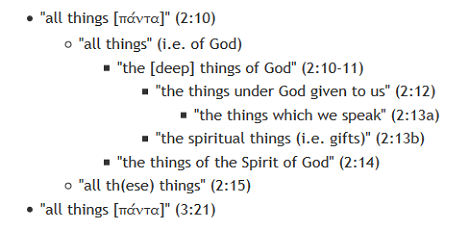
The first Pauline passage we examined was 1 Corinthians 2:10-15, within the wider context of 1:18-2:16 (extending into 3:1-3)—cf. the article and the supplemental series of exegetical notes. Paul emphasizes the role of the Spirit instructing believers in the wisdom of God; indeed, this wisdom is fundamentally spiritual in character. A key statement is the climactic declaration in verse 16: “but we hold (the) mind of (the) Anointed”. To this may be added the statement in v. 15: “the (one) with the Spirit judges all ([th]ese) things, and (yet) he is judged under no one” — “these things” referring to “the (thing)s of the Spirit” (ta\ tou= pneu/mato$).

Given the spiritualistic tenor and emphasis to Paul’s discussion, one might readily ask what is the place of the human teacher, as well as the role of external sources of religious (and moral) authority. The reason why Paul writes to the Corinthians as he does, is because, on the whole, they are not yet spiritually mature (“complete”), often thinking and behaving like one who does not possess the Spirit (3:1-3). But how would he write to them if they were mature? Would there be any need for him to write to them at all? Presumably, there would be more opportunity for exploring and expounding the “deep things of God” (2:10), but what would his role be, in this regard, if the people to whom he was writing were themselves being fully guided and instructed by the Spirit?

It is an interesting question to ponder. In general, it is fair to say that Paul’s spiritualism, to judge by the evidence from 1 Corinthians, was tempered by two main considerations:

    1. the manifestation of the Spirit within the confines of the Community, through specific ‘spiritual gifts‘ given to specific individuals.
    2. the unique role (and authority) of the apostle—that is, the missionary, sent and commissioned by Christ himself, who (first) proclaimed the Gospel in a region and helped to found the first congregations.

According to the first principle, expounded and applied in some detail by Paul in chapters 12-14, an individual believer would not rely wholly on the inner guidance and instruction of the Spirit; rather, one must also experience the Spirit as manifest within the Community, through the distinct spiritual gifts given to the various members.

The second principle—the role and place of the founding apostle—is given special attention by Paul in 2 Corinthians. One passage, in particular, relates the apostolic ministry to the wider experience of the Spirit’s presence and work among believers. As such, a careful examination of it should allow us to gain a better sense of Paul’s spiritualism, especially in relation to other (external) aspects of Christian ministry.

2 Corinthians 3

The passage under examination is the “new covenant” section in 2 Corinthians—3:1-18, the central portion of the wider section of 2:14-4:6. It is rather typical of Paul’s unique (and inspired) manner of expression, that the powerful theological component to his line of argument in this passage is not even central to the main point he is making. Indeed, here in 2:14-4:6 the focus is on Paul’s role and position as an apostle, in relation to the Corinthian congregations (i.e., the second of the two themes outlined above). The theological and expository excursus in 3:1-18 is simply a natural byproduct of Paul’s understanding of the Gospel and the nature of the Christian ministry. I will be exploring the passage, from a critical and rhetorical standpoint, in the Saturday Series studies during the remainder of January and February.

I will also be devoting detailed notes (a series of daily notes) to an exposition of the passage. But let us begin here with a focus on Paul’s references to the Spirit, and how they relate to the “new covenant” theme of the section. Let us begin with his statement in verse 3 (picking up from v. 2, in italics):

“you are our e)pistolh/…being made to shine forth [fanerou/menoi] that you are (the) e)pistolh/ of (the) Anointed, being served under [i.e. by] us, (and) having been written not with black (ink), but with (the) Spirit of (the) living God, not on (the) flat surfaces of stones, but on (the) flat surfaces of hearts (of) flesh.”

Paul here makes a stark contrast between ordinary (physical/material) written letters and spiritual ones (for more, see the note on verses 2-3). This sort of dualistic language (and imagery) is typical of Paul’s spiritualism. But it is interesting to consider the way that this is introduced here.

The theme in verse 1-6 involves “letters of commendation”, the word sustatiko/$ being derived from suni/sthmi/sunista/w (“stand [together] with”), in the sense of placing things together (and presenting them) in front of someone. As a technical term, it came to be applied to letters a person carried, introducing him/her to another group or in a place where he/she was not known. The noun e)pistolh/ (epistol¢¡, i.e. ‘epistle’), which I left untranslated above, is derived from e)piste/llw (“set [forth] upon” a person, i.e. send to someone), related to a)poste/llw (i.e., send from someone). Here the e)pistolh/ refers ostensibly to a letter of introduction/recommendation. The point is that Paul and his fellow-missionaries, who preached the Gospel to the Corinthians, do not require any customary letter of introduction—the effect of the Gospel in their hearts is proof enough of his place as an apostle with them! It is a letter of Christ himself, whom Paul serves as a minister, written with the Spirit of the living God.

The expression “living God” (in Greek, qeo$ zw=n) derives from Old Testament usage (e.g. Deut 5:26; Josh 3:10; 1 Samuel 17:26, 36, etc). The inclusion of the modifying verbal adjective is primarily emphatic (cf. Matt 16:16; 26:63, etc), however it also refers to the life-giving power of God’s Spirit (cf. Gal 5:25; 6:8; Rom 8:1-11), and thus is central to the spiritualistic emphasis in Paul’s thought—the living Spirit being contrasted with the dead material thing. There is also implicit the traditional sense of the Spirit as the active manifestation of God among His people. In particular, we should draw attention to the metaphor of the “finger of God”, and the idea that the tablets of the Law (Torah) were written with the finger of God (Exod 24:12; 31:18; 34:1; Deut 9:10f). One is immediately reminded of the saying of Jesus in Luke 11:20 (discussed previously):

“But if (it is) in [i.e. with] the finger of God (that) I cast out the daimons, then the kingdom of God (has already) arrived upon you!”

The Matthean version (12:28) reads “Spirit of God”, instead of “finger of God”, evidence that the two expressions were essentially seen as synonymous. Almost certainly, Paul has this same correspondence in mind—i.e., the Spirit of God writes on the hearts of believers just as the finger of God wrote on the stone tablets. This establishes the thematic contrast of “letter vs. Spirit”, old/new covenant, that runs through the remainder of chapter 3.

It is interesting the way that the initial metaphor in v. 3 leads Paul so readily to the dualistic juxtaposition contrasting the old and new covenants, in terms of “the written (word/letter) [to\ gra/mma]” and “the Spirit [to\ pneu=ma]”. See how this contrast in made, twice, in vv. 1-3 and 4-6:

    • Commendatory letters for apostles—believers under their ministry
      • written in the heart
        • contrast with being written in tablets of stone (v. 3)
    • Confidence for apostles before God—ministers of a new covenant
      • of the Spirit
        • contrast with the written word (v. 6)

Paul specifically refers to himself (and others) as “servants of (the) new diaqh/kh” (v. 6). The noun diaqh/kh literally signifies the “setting through” of things (into an arranged order); in English idiom we would say “putting things in order”, i.e., in terms of a legal will/testament or other contractual agreement. In the LXX and New Testament, it typically is used in place of the Hebrew tyr!B=, which means a binding agreement; both Hebrew and Greek terms tend to be translated as “covenant”. The word diaqh/kh is relative rare in the Pauline letters, occurring 8 times, in Corinthians, Galatians, and Romans (+ once in Ephesians). Paul’s use of it is entirely traditional; apart from references to the Old Testament and Israelite history (Rom 9:4; 11:27; Gal 3:15, 17; 4:24), we have his citation of the Lord’s Supper tradition (1 Cor 11:25; cf. Luke 22:20 and Mk 14:24 v.l.).

As in the Lord’s Supper tradition, Paul here uses the expression kainh\ diaqh/kh (i.e. “new covenant”), terminology which goes back to Prophetic tradition (in the 6th/5th centuries B.C.) regarding the restoration of Israel in the New Age (Jer 31:31-34; cf. also 32:40; Ezek 11:19; 18:31; 34:25ff; 36:26; 37:26). Jesus, in his own way, was alluding to this in the Last Supper tradition, but it received much more precise exposition among early Christians in the period c. 30-60 A.D. The specific motif of the “pouring out” of the Spirit upon God’s people was part of the traditional restoration-theme. In previous notes, on the “Spirit of God in the Old Testament”, I discussed at length the role of the Spirit in the key restoration-prophecies of the exilic and post-exilic periods (in Joel, Deutero-Isaiah, Jeremiah, Ezekiel, and Zechariah).

In the remainder of chapters 3 (vv. 7-18) Paul embarks on an exposition of the difference between the old and new covenants. He draws upon the Moses narratives and traditions in the book of Exodus; in particular, Paul takes a midrashic interpretive approach to Exodus 34:29-35, which describes Moses’ return from Mount Sinai carrying the two tablets of the Covenant.

This contrast between the old and new covenants is centered on the idea of “glory” (do/ca). Paul makes use of a series of qal wa-homer arguments—a traditional (Jewish) principle of interpretation, which argues from the lesser to the greater: if something is true in this (lesser) case, then how much more is it to be so regarded in the (greater) case. According to this mode of argument (a fortiori), Paul is working from the basic assumption that the new covenant is superior to the old covenant which God established with Israel at Sinai. The first two arguments (in vv. 7-9) involve the diakoni/a (“service, ministry”), that is, the administration of the covenant—in the case of the old covenant this began with Moses (and Aaron) and continued through the established priesthood and ritual apparatus (Temple, sacrificial offerings, purity regulations, etc), as well as through teaching and tradition. Note the contrast:

    • Vv. 7-8: service/ministry of death [h( diakoni/a tou= qana/tou]
      • service/ministry of the Spirit [h( diakoni/a tou= pneu/mato$]
    • Vers. 9: service/ministry of judgment against [h( diakoni/a th=$ katakri/sew$]
      • service/ministry of justice/righteousness [h( diakoni/a th=$ dikaiosu/nh$]

The characterization of the old covenant as “the ministry of death” is striking; for the uniquely Pauline view on the relationship between the Law, sin and death, read carefully Romans 5-7 (cf. the articles on 5:12-21 and 7:7-25 in the series “Paul’s View of the Law”), and note also in Gal 3:10-14, 19-22; 1 Cor 15:56. In vv. 7-8 here, the qal wa-homer argument is:

“If the ministry of death came to be in (such) esteem [do/ca]… how will the ministry of the Spirit not (even) more be in esteem?”

The old covenant came to have glory/esteem (perfect of the verb doca/zw), but now it has come to have no glory/esteem (again, with the perfect of doca/zw). It is hard to imagine a more antinomian statement by Paul—the old covenant, with its written Law, now has no glory. However, he makes clear that this is true only in one respect: because the glory of the new covenant goes so far beyond it (the verb u(perba/llw means to throw or cast something over/beyond, i.e. past a particular distance or measure). This is an important principle for understanding Paul’s apparently negative statements regarding the Law—its binding force has come to an end because of Christ. Indeed, the old covenant has come to an end, he makes this clear in verse 11, using the verb katarge/w—literally to “make (something) cease working”, i.e. render inactive, ineffective, often in the technical (legal) sense of “nullify, invalidate, make void”, etc. The second verb is me/nw, “remain (in place), abide”. The contrast is clear enough: the old covenant ceases to be in effect, the new covenant remains and lasts; one is temporary, the other permanent.

The new covenant (kainh\ diaqh/kh) is governed by the Spirit (vv. 6-8), and not by the Torah; indeed, the Spirit takes the place of the Torah. This reflects, in my view, a clear spiritualistic tendency in Paul’s thought. However, the emphasis in 2 Cor 3:1-18 is on Paul and his fellow missionaries as ministers of this new covenant. In this light, in verses 12-18, he continues his contrast of old vs. new covenant, utilizing the motif of the covering (ka/lumma) that Moses kept over his face (cf. Exod 34:29-35) when he met with the people after speaking to God.

In the initial period of the old covenant, the people were wholly dependent on Moses as the prophet or spokesperson (ayb!n`) who communicated the word and will of God to them. Apostles and missionaries such as Paul served a similar role in the new covenant, but with a major difference: the communication of the Gospel of Christ took place without any covering, the ‘veil’ having been removed. The implication of this is that the people (i.e. believers) now are able to experience the presence and glory of God directly, without any intermediary. This is due to the fact that, with the communication (and acceptance) of the Gospel, believers receive the very Spirit of God. Paul’s wording in verse 16 is striking (and rather controversial) in this regard:

“But whenever (one) would turn about toward the Lord, the covering is taken (up from) around (him).”

This removal of the covering (symbolized by the veil of Moses) has two aspects in its meaning:

    • people are able to experience the full revelation of God, and
    • it signifies that the old covenant (of Moses and the Torah) has come to an end (cf. Rom 10:4)

The latter aspect means that believers in Christ are freed from the old covenant and its Torah, and this freedom (e)leuqeri/a) is due to our contact with the Spirit of God:

“And the Lord is the Spirit, and that which (is) of the Spirit of (the) Lord, (is) freedom [e)leuqeri/a].” (v. 17)

Insofar as we turn to God’s Spirit, we have complete freedom—meaning, in this context, primarily, freedom from the Law (Torah). Here the expression “Spirit of the Lord” presumably means the Spirit of God, though Paul does, on occasion, also use the expression “Spirit of Christ” (see the discussion at the beginning of the previous article). There can be no doubt, however, that the idea of turning to the Spirit of the Lord entails acceptance of the Gospel, and of conforming our lives to the presence of Christ dwelling in us.

This latter point is emphasized especially in the famous concluding words to this section (v. 18). Given the overall focus of the passage, one might expect Paul to end with another reference to the role of apostles—persons called to represent Christ and preach the Gospel—and yet, following the association of the Spirit and freedom in verse 17, he moves in an entirely different (and rather spiritualistic) direction: “but we all…” The glory of the old covenant was associated with a special person—Moses—who was set apart to represent God for the people; only he spoke directly with God, and the glory shone only from his face. How different is the new covenant, where every believer in Christ beholds the glory of the Lord, and is transformed, in a permanent manner, far greater than the transfiguration that Moses experienced. The true apostle and missionary does not emphasize his (or her) own abilities and accomplishments—ultimately the new covenant is administered and shared by all believers together.

This may be related to what I have referred to as the “democratization” of the Spirit in the New Age of Israel’s restoration—the idea that God’s Spirit (and the prophetic spirit) would come upon all people, the nation as a whole, rather than upon specific chosen/gifted individuals. This was reflected most notably, for early Christians, by the citation of Joel 2:28-29 in Peter’s Pentecost speech (Acts 2:17-18). The reference to Moses, here in our passage, brings to mind the tradition in Numbers 11:16-30 (discussed in an earlier note), in which seventy elders were allowed to share in the prophetic spirit—the Spirit of YHWH—that had been upon Moses exclusively. For believers in Christ, the inclusivity extends even further—to all of God’s people, essentially fulfilling the very wish, expressed by Moses himself:

“…who would (not) give (that) all (the) people of YHWH (would be) <ya!yb!n+ [i.e. prophets], (and) that YHWH would give His spirit [j^Wr] upon them!” (Num 11:29)

Spiritualism and the New Testament: Paul: 1 Corinthians 2:10-15

This study on Spiritualism and the New Testament (cf. the Introduction and article defining the term “Spiritualism”) will be divided into two main sections, corresponding to the Pauline and Johannine writings, respectively. We begin with the Pauline Letters.

The Letters of Paul

Paul wrote extensively on the Spirit, and doubtless he played a significant role in shaping first-century Christian views on the subject. Paul inherited early Christian traditions and beliefs regarding the Spirit, but, in his own way, he also developed these, presenting them within a deeper and more systematic framework. Before proceeding to the first passage of our study, let us first conduct a brief survey of several key beliefs which Paul shared, we may assume, with many other believers in the mid-first century (c. 50 A.D.).

    • The coming of the Spirit upon believers marks the fulfillment of the exilic/post-exilic prophetic oracles regarding the pouring out of God’s Spirit on His people in the New Age (of Israel’s restoration).
    • Believers receive the Spirit in connection with the ritual of baptism, which parallels the tradition of Jesus’ own baptism (Mk 1:8, 10 par).
    • The Spirit is communicated (by God) through the person of the exalted Jesus.
    • The exaltation of Jesus (to heaven, at God’s right hand), following his resurrection, gave to him a Divine status and position that enabled Jesus to share in God’s own Spirit. For more on this, cf. below.
    • Thus, when believers receive the Spirit of God, they/we are also receiving the Spirit of Christ. Through the Spirit, the exalted Jesus is manifest and present in (and among) believers.
    • Upon receiving the Spirit, believers are enabled to function as prophets, communicating the word and will of God, accompanied by other special abilities and ‘gifts’ (including speaking in ‘tongues’ and the working of miracles).

Because of the number of Paul’s letters that are available to us, we have a clearer understanding of these early beliefs. For example, Paul is the only New Testament author who offers any kind of an explanation of how Jesus came to share the Spirit of God (as his own Spirit). We can obtain a glimpse of this Christological point by combining Paul’s words in 1 Cor 15:45 (in the context of his discussion on the resurrection in chap. 15) with the declaration in 6:17. And, on this point, we may note the way that Paul can refer to the (Holy) Spirit as the Spirit of God and the Spirit of Christ (or of Jesus) interchangeably (see esp. Rom 8:9).

1 Corinthians 2:10-15

In the section 1:18-2:16, Paul contrasts worldly wisdom with the wisdom of God. The Gospel proclamation centered on the painful and humiliating death (by crucifixion) of Jesus, embodies, rather paradoxically, the wisdom of God. And yet, Paul speaks in vv. 6-15, of a wisdom that is spoken among those believers who are complete (te/leio$). In describing this wisdom, Paul’s exposition seems to have a spiritualist emphasis. The key verses are 10-15; however, before examining them in detail, it is necessary to give careful consideration to how Paul leads into that discussion. Let us begin with verse 6.

1 Corinthians 2:6

“And (yet) we (do) speak wisdom among the (one)s (who are) complete, and (it is) wisdom not of this Age, and not of the chief (ruler)s of this Age th(at are) being made inactive…”

This statement introduces a new section, building upon vv. 1-5 (see my earlier note). In verse 5, Paul contrasts human/worldly wisdom (“the wisdom of men”) with the power of God; now, here in verse 6, he returns to the earlier contrast between two different kinds of wisdom. The conjunction de/, translated “and” above (first two instances), has adversative force, and could just as well be rendered “but”. In contrast with worldly wisdom:

    • Believers (and esp. Christian ministers) do speak/use wisdom, but
      • It is altogether different from the wisdom of the world and its rulers

There have been longstanding questions regarding the precise identity of both this “wisdom” (sofi/a) and the ones who are “complete” (te/leio$). In a prior note, I outlined some of the more common suggestions offered by commentators; here they are listed again for reference, with no priority indicated by the numbering:

    1. The basic Gospel message (wisdom) is given to all believers, but a more advanced (esoteric?) Christian wisdom (teaching, etc) is offered for those who are “complete”—mature and committed in the faith sufficiently to receive it.
    2. Paul is simply making a rhetorical contrast. There is only one wisdom—that of the person of Christ and his death/resurrection. The “complete” believers are able to recognize this and do not need to seek after any other “wisdom”.
    3. He is distinguishing between the Gospel proclamation and the teaching/instruction, etc., which builds upon the basic message, interpreting and applying it for believers as they grow in faith. For the “complete” this includes a wide range of “wisdom” —ways of thinking/reasoning, use of argument, illustration, allegory/parable, (creative) interpretations of Scripture, etc.
    4. Paul himself evinces certain gnostic/mystic tendencies whereby there are envisioned levels or layers in the Gospel—i.e. the basic proclamation and belief regarding the person and work of Christ—as in the Scriptures, the deepest of which involve the most profound expressions of God’s wisdom. Only the “complete” are able to realize this, and to be able to communicate something of it to the wider community.
    5. Paul is responding to gnostic/mystic tendencies among believers in Corinth. Here, as a kind of rhetorical approach, he is drawing upon their own thinking and sensibilities, trying to bring their focus back to the centrality of the Gospel and a proper understanding of the work of the Spirit. As such, the apparent distinctions he makes are somewhat artificial, perhaps running parallel to the (actual) divisions among the Corinthians themselves.
    6. The wisdom for the “complete” reflects a deep understanding of, and participation in, the work of the Spirit. Believers who are completely guided by the Spirit need no other instruction. Paul is essentially expounding this thought in vv. 9-16, only to make (painfully) clear to the Corinthians how far they still are from the ideal.

I have discussed the passage, running through 3:1-3, in considerable detail in earlier notes, a portion of which I am reproducing (especially those on 2:10-15) as part of this series. I have indicated certain conclusions which may be drawn from the text, that help clarify what Paul means here in 2:6. I list these as bullet points:

    • The wisdom spoken to the “complete” comes by way of the Spirit. No other source of “wisdom” is possible.
    • The revelation of the (secret) wisdom of God is fundamentally tied to the proclamation of the Gospel.
    • The hidden wisdom of God relates to the very depths (the deepest parts) of God’s own being.
    • The “wisdom” is not limited to the Gospel message, but ought to be understood more comprehensively as “all the (deep) things under God”.
    • It is dependent upon our having received the (Holy) Spirit
    • Through the Spirit we are able to know and experience this wisdom
    • It is “taught” by the Spirit to believers, and is to be communicated (“spoken”) to others in turn.
    • The ones who are “complete” essentially = the ones who “have the Spirit”
    • The ones who are “complete” are defined, in a negative sense by the opposite—those who think and act in a “fleshly” manner are “incomplete”.

From these points, the spiritualistic tendency in Paul’s thought seems clear enough. That is to say, the wisdom of God is manifest fundamentally, and principally, through the presence of the Spirit in and among believers. But let us look more closely at the wisdom Paul has in mind. I would isolate three primary aspects:

    • It is based on the proclamation of the Gospel, i.e. of the person and work of Christ
    • It includes all that the Spirit communicates to believers, which they receive as a gift to be shared/communicated to others
    • It extends to the working and guidance of the Spirit (= the “mind of God/Christ”) in all things

With regard to those who are complete, this can be defined even more simply:

    • They are those believers who consistently think and act under the guidance of the Spirit; this must be distinguished on two levels:
      • The reality of having/holding the Spirit (in us)
      • The ideal of living out this identity—i.e., “walking in/by the Spirit” (cf. Gal 5:16, 18, 25)

The very fact that Paul, like Jesus himself, exhorts believers to be “complete”, means that it is not automatically realized through faith in Christ and receiving the Spirit; rather, it reflects a process of growth and development which, in most instances, will take place over a lifetime. This, however, does not change the force and urgency of the exhortation. Jesus’ own exhortation (Matt 5:48) to his followers essentially takes the form of a promise—if you live according to the teaching (i.e. in 5:21-47, etc), “you will be complete [te/leio$], as your heavenly Father is complete”.

In Gal 5:16ff, Paul expounds upon this idea, now in a decidedly Christian sense, with the force of an imperative; note the sequence of phrases, with its central (conditional) premise:

    • “Walk about in the Spirit…” (v. 16)
      — “If you are led in the Spirit…” (v. 18)
      — “If (indeed) we live by the Spirit…” (v. 25a)
    • “We should step in line in the Spirit” (v. 25b)

The statement in Gal 5:16 reflects the very issue Paul is dealing with in 1 Corinthians, and the lament he expresses in 1 Cor 3:1-3:

“Walk about in the Spirit, and you should not complete [tele/shte, related to te/leio$] the impulse of the flesh”
“We speak wisdom among the (one)s (who are) complete… “
“And (yet) I was not able to speak to you as (one)s (who are) of the Spirit, but as (one)s (who are) of the flesh”

Is it possible that Paul, in some sense, does have a more precise and sharp division in mind, i.e. between the “complete” and the ‘incomplete’ —two distinct groups or categories of believers? While this would seem to contradict much of his own argument in 1:18ff, it is conceivable that he is playing off of the very “divisions” which exist among the Corinthians. Certainly, it has been suggested from the distinction he makes in 3:2 between “milk” (ga/la) and “(solid) food” (brw=ma)—the Corinthians are behaving as immature “infants” (v. 1), and cannot be treated (i.e. spoken to) as mature adults. There are several possibilities for understanding this distinction:

    • “Milk” is the simple Gospel message, while the solid “Food” represents deeper (Christian) teaching and instruction
    • The difference is between the basic ‘facts’ of the Gospel, and its deeper meaning
    • Similarly, it is between the Gospel message and how it is (effectively) applied and lived out by believers in the Christian Community
    • It rather reflects a difference in the way believers respond—as immature infants or mature adults
    • It is simply a rhetorical image, drawn from the idea of the Corinthians as “infants”, and should not be pressed further

Something may be said for each of these interpretations, except perhaps the first. Insofar as it reflects a substantive distinction in Paul’s mind, the third and fourth best fit the overall context of the passage.

Finally, I would like to bring out a particular point of emphasis that is sometimes overlooked in this passage. When Paul speaks of the wisdom of God in terms of “the (deep) things” of God, he couches this within the general expression “all things” (pa/nta). In my view, this should be understood in an absolute comprehensive sense. Note how this is framed conceptually in chapters 2 & 3:

The wisdom of God encompasses “all things”, as Paul makes clear in 3:21-23, where he establishes a (hierarchical) chain of relationship, presented in reverse order— “all things” (pa/nta), he says:

belong to you (pl., believers), and you in turn
belong to Christ, who in turn
belongs to God the Father

If we allow ourselves to be guided by the Spirit and the mind of God/Christ, then we are free to study and examine all things (cf. 2:10, 15), and this itself becomes an integral expression of the “wisdom of God” which we speak.

This analysis of the thrust of 2:6-16 (extending to 3:1-3) provides the framework for our detailed study of 2:10-15, which contain the key references to the Spirit. For this study, see the first note, on v. 10.

Notes on Prayer: Colossians 1:3; 4:2-3, etc

We conclude our series of studies on the references to prayer in the Pauline letters with a survey of the remaining letters—beginning with Philemon and Colossians, and then turning to consider the references in the disputed letters of Ephesians and 1 Timothy.

Philemon 4-6, 22

The letter to Philemon was, of course, written to an individual rather to the collective believers of a city or territory. Even so, the references to prayer follow the same pattern of the other letters addressed to congregations. The references occur in the introduction (thanksgiving) and closing (exhortation) sections of the letter-body, and are framed specifically in terms of the relationship between Paul and his audience. The prayer references in the thanksgiving (vv. 4-7) could have easily been lifted right out of one of the other Pauline letters.

“I give thanks to my God for (His) good favor, always making mention of you in my (time)s of speaking out toward (Him) [proseuxai/], hearing of your love and trust which you hold toward the Lord Yeshua and (directed) to all the holy (one)s, so that the communication of your trust might come to be working in (the) knowledge about every good (thing) that (is) in you for (the sake of the) Anointed…” (vv. 4-6)

Several of the features here we have seen repeatedly:

    • Paul refers to making mention of the believers (here, Philemon) to God regularly during his times in prayer
    • He gives thanks because of their faithfulness in response to the Gospel (as it has been reported to him)—trusting in Jesus, demonstrating love, growing in faith and virtue and understanding
    • He expresses the wish that they continue to remain faithful

But Paul’s prayers are only one side of the relationship that he holds (as an apostle) with the congregations—they are also asked to pray for him. And so Paul would request this of Philemon as well, just as he does at the close of the letter:

“…but also make ready for me a place (of lodging) for the stranger, for I hope that, through your speaking out toward (God) [proseuxai/], I shall be given to you as a favor (from God).” (v. 22)

The middle-passive verb xari/zomai means “show favor, give (something) as a favor”; in the passive, it refers to the gift or favor itself. It is related to the verb eu)xariste/w in v. 4, which, in a religious context, refers to the favor shown by God, and the gratitude or thanks that we show to Him (in response) for this favor. Here, the favor God will show, through the cooperation of Philemon in his prayers, is to allow Paul the opportunity to visit him.

Colossians 1:3, 9

The prayer references in Colossians follow the same Pauline pattern. The first references occur in the introduction (exordium), which may be divided into two sections—the first containing the thanksgiving (1:3-8), and the second, Paul’s exhortational prayer-wish for the Colossian believers (1:9-14). The opening reference to prayer in the thanksgiving (v. 3) is virtually identical to the statement in Philemon 4 (cf. above). Notably, the statement in Colossians is given in the first-person plural: “We give thanks to God for (His) good favor…always over you, speaking out toward (Him) [proseuxo/menoi]”. In Colossians, Paul gives particular emphasis to his co-workers and fellow missionaries, and so the plural here is significant (cf. verse 7, and further below).

As is typical for Paul, his thanksgiving effectively takes the form of praise for the faithfulness of the believers he is addressing. Specific mention is made of their trust and love, remaining firm in the truth of the Gospel (vv. 4-5), as also of their growth in virtue and understanding (vv. 6-7), and of unity in the Spirit.

The second prayer-reference in the introduction, correspondingly, comes at the opening of the exhortational prayer-wish in vv. 9ff:

“Through [i.e. because of] this we also, from the day on which we heard (this), do not cease speaking out toward (God) [proseuxo/menoi] over you…” (v. 9a)

Paul’s wish (as a prayer to God) is for the Colossians to continue in faith and virtue, growing further in spiritual knowledge and understanding, etc.:

“…and asking (Him) that you would be filled (with) the knowledge about His will, in all spiritual wisdom and understanding” (v. 9b)

The remainder of the prayer-wish—also to be characterized as an intercessory request—is phrased in the typical manner of early Christian ethical instruction and exhortation, of which there certainly are a number of Pauline examples:

“…(for you) to walk about (in a manner) up to a level (worthy) of the Lord, into everything (that is) pleasing (to Him), bearing fruit in every good work, and growing in the knowledge of God, being (em)powered in all power, according to the might of His splendor…” (vv. 10-11a)

Also typical of Paul, is the eschatological aspect of this exhortation—a theme that is developed throughout the letter—but nuanced here with a strong dualistic Christological emphasis:

“…(the Father), (hav)ing made us fit for the portion of the lot of the holy (one)s in the light, (and) who rescued us out of the power [e)cousi/a] of darkness and made (us) stand over into the kingdom of His (be)loved Son—in whom we hold the loosing from (bondage), the putting away of sins” (vv. 12-14)

On the Christological hymn (‘Christ hymn’) that follows in vv. 15-20, cf. my earlier series of notes.

Colossians 4:2-3, 12

The Pauline pattern continues with the prayer-references in the closing (exhortation) section of the letter (4:2-6). Typically, in these sections Paul emphasizes the other side of the prayer relationship between himself and the congregations—namely, that they should regularly be praying for him. He leads into this with a general exhortation for the Colossians to remain firm in prayer:

“In speaking out toward (God) [proseuxh/], you must be firm toward (it), keeping awake in it with thanks for (His) good favor” (v. 2)

The verb proskartere/w (“be firm/strong toward [something]”) is a key word characterizing the unity of believers in the early chapters of Acts (1:14; 2:42, 46; 6:4; 8:13; 10:7). Paul also uses it in Romans (12:12; 13:6), and the prayer context of its use in 12:12 is comparable to what we find here. The noun eu)xaristi/a corresponds to the related verb eu)xariste/w in 1:3 (cf. above), emphasizing again the relationship between prayer and the favor God shows to us. As Paul makes clear, there are two aspects to this relationship: (1) we give thanks for the favor God has shown, and (2) we ask that He will continue to show us favor, and that we will act in a manner that is worthy of His favor.

The prayer-emphasis shifts in verse 3:

“…at the same time, also speaking out toward (God) over us, that God would open up for us a door for the account [lo/go$], to speak the secret [musth/rion] of the Anointed, through which I have been bound”

The prayers believers are to make on his behalf typically relate specifically to his missionary work, defined in terms of preaching the Gospel. Here, two key terms are used, in a technical sense, for the Gospel:

    • lo/go$, “account,” that is, a spoken account, shorthand for the expression the “account of God” (Acts 4:31; 6:2, et al)—viz., the account of what God has done through the person of Jesus.
    • musth/rion, “secret” —on this usage, cf. the recent discussion on Rom 16:25-26, as well as my earlier word study series. The Gospel of Christ is a “secret,” hidden throughout all the ages past, and revealed only now, at the present time, through the kerygma (proclamation) by the prophets and apostles of the early Christian mission.

This is a regular theme in Paul’s prayer-references—that believers work together with him (and his fellow missionaries), through their prayers. We have seen repeatedly in our studies the importance of praying for the needs of others, rather than simply for our own needs. It is a key New Testament principle that such selfless and sacrificial prayer is assured of being answered by God.

As in the introduction (cf. above), Paul uses the first-person plural. Sometimes he does this in his letters as a rhetorical device, but here he is specifically including his fellow missionaries and co-workers with him. In the closing that follows in vv. 7-17, Paul mentions ten different persons, among them Epaphras in vv. 12-13. He was mentioned earlier in 1:7, and also in Philemon 23 (both in the context of the prayer-references, cf. above). Epaphras apparently was an apostolic missionary in his own right, and one who would have had much more frequent contact with the congregations of the region. Paul refers to him much as he does to himself, as a “slave” (dou=lo$) of Jesus Christ (Rom 1:1; Gal 1:10; Phil 1:1). In 1:7 the word is su/ndoulo$ (“slave together with [me/us]”), while in Philem 23 he is called “one taken captive [lit. at spearpoint] together with (me)” (sunaixma/lwto$), i.e. “co-prisoner, fellow prisoner”.

Like Paul, Epaphras’ role as an apostolic missionary led him to pray frequently (and fervently) for the believers of that area. Paul describes this here in v. 12 as “struggling over you in his speaking out toward (G0d) [proseuxai/]”. The verb is a)gwni/zomai (“struggle”), used, viz., in athletic competitions; it is something of a Pauline term, as 6 of the 8 NT occurrences are in the Pauline letters (elsewhere, 1 Cor 9:25; Col 1:29; 1 Tim 4:10; 6:12; 2 Tim 4:7). The occurrences of the substantive (verbal noun), a)gw/n, used in a similar context, should also be noted—1 Thess 2:2; Phil 1:30; Col 2:1; 1 Tim 6:12; 2 Tim 4:7. In Paul’s usage, the verb alludes to believers (esp. missionaries) laboring—and enduring suffering—for the sake of the Gospel.


Saturday Series: Galatians 1:1-5

The Saturday Series studies this Fall will focus on the area of Rhetorical Criticism, a specialized field of Biblical Criticism, in which a Scripture passage (or book) is examined from the standpoint of rhetorical analysis—that is, a study of how the message is communicated by word (spoken or written), particularly the art of persuasion and the techniques and arguments used.

Rhetorical Criticism is a relatively new field of Biblical Criticism, introduced and applied primarily to the New Testament Scriptures, in light of Classical Greco-Roman rhetoric. To be sure, rhetorical analysis can be applied to any book or passage, but for the most part it has been the reserve of New Testament scholars, and its application has yielded many valuable insights.

In particular, study of the New Testament letters—and especially the letters of Paul—has benefited greatly from application of rhetorical analysis, as part of an examination of the epistolary form and techniques used by the author. Rhetoric is perhaps more commonly understood in terms of oral speech, but many of the techniques relate nearly as well to literary communication of a message, especially when presented in an epistle or letter.

As a way of introducing the methods and techniques of rhetorical criticism, we will take an inductive approach, working from Paul’s letter to the Galatians, which happens to possess one of the clearest rhetorical structures of any New Testament book. Paul is trying to communicate a very particular (and important) message in this letter, and he effectively uses a number of rhetorical techniques to achieve his goal. Despite the self-effacing tone Paul adopts at times (e.g., 2 Cor 11:6), he was quite well-versed and adept in classical rhetorical techniques, and did not hesitate to apply them in an effort to persuade his audience (his protestation in 1 Cor 1:17; 2:1ff notwithstanding).

Epistolary Prescript (Galatians 1:1-5)

The technical term for the opening of the letter (here 1:1-5) is the epistolary prescript. The openings of Paul’s letters tend to follow the standard framework of Greco-Roman letters, though not infrequently he adapts this in small but important ways. In the case of Galatians, the adaptations to the epistolary prescript are rhetorically charged—meaning that he includes here, in the opening of the letter, in seed-form, key lines of argument that will be developed in the following sections.

The standard elements of the prescript (opening) are: identification of the author(s) (superscriptio, vv. 1-2a), identification of the addressee(s) (adscriptio, v. 2b), and the greeting (salutatio, vv. 3-5); here the greeting includes a doxology (v. 5). Paul’s rhetorical adaptations occur in the superscriptio and salutatio (greeting, vv. 3-4). Let us look at each of these.

“Paulus, an apostolos, not from men and not through a man, but through Yeshua (the) Anointed, and God (the) Father, the (One hav)ing raised him out of (the) dead, and all the brothers with me…” (vv. 1-2a)

Paul often begins his letters by identifying himself as an apóstolos (lit. “[one] set forth”, i.e. sent forth); we typically transliterate this word in English as apostle. Occasionally he qualifies this by including an expression or short phrase, such as “called through (the) will of God” (1 Cor 1:1; cp. Rom 1:1; 2 Cor 1:1; Col 1:1). Here in Galatians, however, he has included a much more expansive insertion (in green above); this insertion can be divided into three parts:

    • “not from men and not through a man” —i.e., the source of his apostolic commission (and authority) is not human
    • “but through Yeshua (the) Anointed and God (the) Father” —i.e., identifying Jesus Christ and God the Father as the source of his commission
    • “the (One hav)ing raised him out of (the) dead” —further identifying God the Father in terms of the resurrection of Jesus

The middle element essentially echoes the phrase “called through the will of God” (see above). It is the first and third elements which relate to two key components of Paul’s rhetoric in Galatians: (1) his apostolic authority, and (2) the Gospel that he proclaims (as an apostle).

1. His Apostolic Authority. Paul as an apostle, that is, one who is set forth as a special emissary and representative (of Christ). This will be a central theme in establishing the argument of the letter—Paul’s role and authority as an apostle to the Gentiles. Note how he qualifies the term “apostle” in verse 1— “not from men and not through a man, but through Yeshua (the) Anointed and God (the) Father”. In other words, his apostolic authority comes directly from Jesus Christ and God the Father. It does not come from a human being (“from [apo] men”), nor was it established through a human intermediary (“through [dia] a man”).

There appears to have been some controversy around Paul’s identification as an apostle, since he was not an eyewitness to the resurrection of Jesus, nor was he commissioned by Jesus personally (prior to Jesus’ ascension)—see Acts 1:21-22. We can sense this tension at various points in his letters (1 Cor 4:9; 9:1ff; 15:9), and Paul’s opponents may have emphasized the illegitimacy of his apostleship (see esp. the polemic in 2 Cor 11:5ff). In Galatians Paul similarly defends his apostleship.

2. The Gospel he proclaims. Consider also how his apostleship is connected to the Gospel message here in v. 1 with the concluding formula “…the (One) raising him [i.e. Jesus] out of the dead”. The nature of the Gospel that Paul proclaims, as an apostle, is very much at issue in Galatians, since he argues throughout that the Jewish Christians who have been influencing the Galatian congregations essentially proclaim a different Gospel.

Turning to the greeting or salutation (salutatio), the standard Pauline greeting occurs in verse 3:

“Favor [i.e. grace] to you and peace from God our Father and (the) Lord Yeshua (the) Anointed”

As in verse 1, God the Father and Jesus Christ are mentioned together.

Verse 4 applies to Jesus a more extensive Gospel formula than we saw in verse 1; indeed, it functions as a kind of summary of the Gospel proclamation (kerygma):

“…the (One) giving himself over our sins, that he might take us out of the standing evil Age, according to the will of our God and Father”.

This is important, since a proper definition and understanding of the Gospel (“good message”) is likewise central to the argument of Galatians, as we will see.

These expansive insertions within the framework of the epistolary prescript are a bit unusual, and reflect the importance (and urgency) of the issue that Paul is addressing here. They anticipate the forceful rhetoric that he will use throughout the letter.

In next week’s study, we will turn to the next section of Galatians, the introduction (exordium) in 1:6-11.