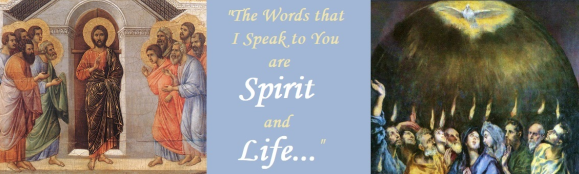
February 21: 2 Corinthians 4:3-6

[These notes are part of the series “Spiritualism and the New Testament”; the previous note continued the discussion on verse 18; for an overview of the passage, cf. the main article.]

2 Corinthians 4:3-6

Returning from the discourse in 3:7-18 to his main line of argument, Paul picks up at 4:1-2 from where he left off (in 3:6a). He returns to his primary discussion of the apostolic ministry, and of his relationship (as an apostle) to the Corinthian believers. He defends the boldness with which he speaks, and of his personal integrity as a minister. Unlike some of his apostolic rivals (so it is implied), Paul claims to preach the Gospel openly and honestly, not promoting himself (and his own interests), but rather working always in the service of God and for the good of those to whom he ministers (v. 5).

In verse 3, however, he folds back into the discussion some of the key themes and motifs introduced in the discourse. He utilizes again the motif of the “covering” (ka/lumma, vb kalu/ptw) from the Moses tradition (Exod 34:29-35); previously, it was applied to the Israelite/Jewish people, those who remained self-bound under the old covenant, not realizing that the old covenant has come to an end in the person of Christ. Now, he extends the metaphor to all people, adapting it to the earlier language of 2:15:

“But if, indeed, our good message is covered [kekalumme/non], it is covered in/among the (one)s perishing [a)pollume/noi$]” (4:3)

The “covering” motif is thus applied now to everyone who is unwilling (or unable) to accept the Gospel of Christ. All of humankind is under bondage to the power of sin (and death)—a point Paul expounds in some detail in Romans—and, thus, they are perishing. Only through acceptance of the Gospel and trusting in Jesus Christ, are people saved from perishing. This bondage is implied by Paul’s reference in verse 4 to “the god of this age” (o( qeo\$ tou= ai)w=no$)—cf. also 1 Cor 2:6ff; Gal 1:4; cp. John 12:31; 14:30; 1 Jn 5:19. The language reflects the eschatological dualism of early Christians, which was typical of the period and similar, in many respects, to what we find in the Qumran texts.

Unbelievers are literally those “without trust” (a&pisto$); God has allowed them to remain “blinded” by the world’s covering, the purpose of which is:

“…(so) as not to beam (forth) the (en)lightenment of the good message of the splendor of the Anointed…”

This simply means that the covering (that blinds the unbelievers) does not allow them to see the shining light of the Gospel. Three different words are used here related to the specific idiom of seeing (cf. the discussion on 3:18 in the previous two notes):

    • au)ga/zw—this verb denotes rays of (sun)light (sing. au)gh/) beaming forth, sometimes referring specifically to the sunrise at dawn (i.e., light shining through the darkness); the verb au)ge/w refers more simply to the shining of light, while au)ga/zw includes the idea of the illumination that comes from the radiating light, allowing people to see clearly.
    • fwtismo/$—derived from fw=$ (“light”) and the verb fwti/zw (“give light”), this noun refers specifically to the “illumination” that comes from the light; the translation “enlightenment” is accurate enough, and conveys the important noetic aspect of the light/seeing motif.
    • do/ca—in the context of the Sinai theophany and the Moses tradition, this noun (properly, “esteem, honor”) is best rendered “splendor,” or (more commonly) “glory,” as also in 3:18 (cp. its use in vv. 7-11); the Divine splendor is often understood (and visualized) in terms of a shining aura of brilliant light.

Paul uses a chain of genitives, but the main expression is “the (en)lightenment of the good message” (to\ fwtismo\$ tou= eu)agge/liou)—that is to say, the Gospel brings light (vb au)ga/zw) and enlightenment (fwtismo/$) to the person who receives it. The qualifying genitives that follow (“of the splendor of the Anointed”) can be understood two ways: (1) as a simple objective genitive (or genitive of content), referring to the content of the Gospel; or (2) as what we might call a genitive of destination. In the first instance, the Gospel message is fundamentally about the splendor of Christ—his death and resurrection, exaltation, and divine status/position as Son of God, etc. In the second instance, the Gospel leads the believer to the splendor of Christ (cp. the expression “way of salvation,” etc).

Both ways of reading the expression are valid; however, the idea of removing the covering, along with the tradition of Moses entering the Tent of Meeting (or the rock on mount Sinai) to encounter God, strongly suggests that, upon receiving the Gospel, believers are led/brought into an encounter with the “splendor of God,” which we experience through the “splendor of Christ.”

Indeed, Paul goes on to declare that the Anointed (Christ) is “(the) image [ei)kw/n] of God”, much as he does in Colossians 1:15 (cf. also Romans 8:29). This helps to explain what he means by the expression “the same image” in 3:18 (cf. the previous notes). As the very “image” of God, it stands to reason that Christ would display the same glory. This is expounded in more detail, further developing the light motif (and its association with Jesus), in verse 6:

“For (it is) God, the (One hav)ing said ‘Out of (the) darkness light shall shine,’ who shone (light) in our hearts toward (the en)lightenment of the knowledge of the splendor of God in (the) face of [Yeshua] (the) Anointed.”

To the three light-terms listed above, Paul here adds the verb la/mpw (“shine”), which has more or less the same meaning as au)ga/zw above. Indeed, the two constructions are similar, with comparable chains of genitives. Here in verse 6, the noun gnw=si$ (“knowledge”) holds the same place as eu)agge/lion (“good message,” Gospel) in v. 4. Because of this, many commentators would treat gnw=si$ here as synonymous with eu)agge/lion. In my view, this is incorrect. The parallelism in v. 6 is meant to convey a deeper level of meaning, which may be illustrated as follows:

    • Through the minister (as God’s) servant
      • the Gospel shines forth [vb au)ga/zw] light
        • which leads the believer =>
          • to the splendor of Christ
    • Through the action of God Himself
      • the Knowledge shines forth [la/mpw] light
        • which leads the believer =>
          • to the splendor of God

This Knowledge (gnw=si$) goes beyond the Gospel message, to the believer’s encounter with the image/face of Christ within, in the ‘heart’, at the level of the Spirit. This relates to the question posed in the previous note: how do believers “see” God, when the encounter takes place spiritually, inwardly and invisibly, through Spirit? A key to the answer is found in two details Paul introduces here at the conclusion of the passage: (1) the word gnw=si$ (“knowledge”), and (2) the motif of the “face” (pro/swpon). I will discuss the significance of these in the next daily note.

January 3: Isaiah 9:1-2

Isaiah 9:1-2 [2-3]

Verses 1-6 [2-7] comprise a prophetic poem that brings the section 6:1-9:6 to a close. On the introductory verse in 8:23 [9:1], cf. the previous note; this verse establishes the context for the poem, framing it as a message of hope for the conquered Northern Kingdom of Israel.

Verse 1 [2]

“The people walking in darkness
have seen a great light;
(for those) sitting in a land of death’s shadow
a light has shone upon them.”

The poem begins with a pair of 3-beat (3+3) couplets, which are clearly in parallel (synonymous parallelism). The darkness/light motif was established in the introductory verse (8:23 [9:1], cf. the previous note), as well as at the conclusion of the prior oracle (8:22). In this respect, 8:23 is transitional between the oracle in 8:19-22 and the poem in 9:1ff. In the poem, the darkness of the earlier judgment-oracle gives way to a new message of hope. The people “walking in darkness,” based on the context of the section (and specified in 8:23), are the people of the Northern Kingdom of Israel. Parts of Israel were annexed by Assyria, following the conquests of 734-732 B.C., and turned into Assyrian provinces. A ‘remnant’ of this kingdom persisted for another decade, until the fall of Samaria in 722/721.

The dual motif of “walking” (vb El^h*) and “sitting” (bv^y`, i.e. dwelling, remaining) in darkness is all too appropriate as a figurative description of the Israelite survivors and exiles. In the second couplet, the general image of “darkness” (Ev#j)) is described even more dramatically (and tragically) as “death’s shadow” (“shadow of death,” tw#m*l=x^). The contrast with darkness, naturally enough, is light (roa). Light shines (vb Hg^n`) on this devastated people, bringing hope of salvation and restoration. This Isaian light-theme (2:5; 10:17; 13:10; 26:19; 30:26, etc) will be developed further in the Deutero- (and Trito-)Isaian poems, applying the message of the 8th century oracles to the situation of Judah’s exile (and eventual return) in the 6th century—cf. 42:6, 16; 49:6; 51:4; 58:8ff; 60:1-3ff, 19-20, etc.

Verse 2 [3]

“You multiplied the(ir) rejoicing,
you made great the(ir) joy—
they have joy before you,
as (the) joy in the harvest,
as when (men) circle (in joy)
in their dividing (the) plunder!”

Textual Note: With most commentators, I read hl*yG!h^ (“the rejoicing”) in line 1, rather than MT (also in 1QIsaa) al) yoGh^ (“the nation / not…”).

The meter in verse 3 shifts, from a pair of 3-beat couplets, to a trio of 2-beat (2+2) couplets.

The light that shines upon the people produces an experience of joy. Two parallel roots are used to express this. The first (lines 1 and 5) is lyG], which literally means “to (move in a) circle”, i.e., to dance and circle around joyfully. The second (lines 2-4) is jm^c*, which refers more generally to a feeling of gladness and joy. Two illustrative images are then used to depict the joy that these people feel: (a) the joy experienced with the coming of the harvest, and (b) the military imagery of victorious soldiers rejoicing when they receive a share of booty/plunder (ll^v*) after the battle.

The perfect tenses of the verb refer to the coming restoration as some which has already taken place; this is not uncommon in Old Testament prophecy, but should be distinguished from use of the precative perfect, more common in the Psalms, where one expresses what one wishes (or expects) to happen as though it has already occurred.

December 21: John 1:9

John 1:9

“He was the true Light, that which gives light (to) all men, coming into the world.”

The opinion of critical commentators is divided as to whether verse 9 of the Prologue should be considered as part of the excursus in vv. 6-8 (discussed in the previous note), or as an integral part of the underlying hymn. In my view, the former it to be preferred. I would include v. 9 as the climactic point of the statement in vv. 6ff, perhaps best rendered as an epexegetical clause rather than an independent sentence:

“There came to be a man, having been se(n)t forth from alongside God, (and the) name (given) to him (was) Yohanan. This (one) came unto [i.e. to be] a witness, (so) that he should give witness about the Light, (so) that all might trust through him. That (one) was not the Light, but (came so) that he might give witness about the Light—(he who) was the true Light, which gives light (to) every man, coming into the world.”

It is possible to read to\ fw=$ (“the light”) in v. 9 as the true subject, but I think it preferable to treat it as a nominative predicate (which still functions as the subject = the Logos). There are three component phrases to the statement in verse 9, and each of these should be examined.

1. h@n to\ fw=$ to\ a)lhqino/n (“[he who] was the true light”)

As I interpret this phrase, the subject is implicit, related to the clause in v. 8 and its final words to\ fw=$ (“the light”). As part of the comparison between John the Baptist and Jesus, built into vv. 6-9, it is clearly stated that John was not (ou)k h@n) the Light—which means that Jesus was (h@n) the Light. This continues the distinctive use of the verb of being (ei)mi) in the Prologue, where it is reserved for God. By definition, a human being (“man”) like John the Baptist cannot be in the way that God (or the Logos) is. Here, of course, the Prologue assumes the Gospel narrative, regarding the way that John the Baptist gave witness to Jesus (1:19ff, 29-34, 35ff; 3:22-30[ff]). Early Christians would understand vv. 6-8 as alluding to this, and so the rather abrupt syntactical transition, between verse 8 and 9, causes no real problem for the development of the thought. John gave witness to Jesus, the light, who was, indeed, the true Light (of God).

The adjective a)lhqino/$ (“true”) is very much a Johannine keyword, along with the related adjective a)lhqh/$ and noun a)lh/qeia (“truth”). The noun a)lh/qeia occurs 25 times in the Gospel and another 20 in the Letters of John; the adjective a)lhqh/$ occurs 14 times in the Gospel and 3 in the Letters, while a)lhqino/$ is used 9 times in the Gospel and 4 in the Letters. Taken together, these three words occur 85 times in the Gospel and Letters (more than half of all NT occurrences [163]). The adjective a)lhqino/$ is even more distinctively Johannine; apart from the 23 occurrences in the Gospel and Letters, it occurs 10 times in the book of Revelation (often considered a Johannine writing), and just 5 times elsewhere in the New Testament.

As an adjective, a)lhqino/$ is used as a divine characteristic, as the statements in 17:3 and 1 Jn 5:20 make clear. Thus, when used in an illustrative context—e.g., “true light”, “true bread” (6:32), “true vine” (15:1)—the illustrations are meant to convey a sense of the divine substance that underlies the metaphor. Such an expository purpose is central to the form and function of the Discourses of Jesus in the Gospel of John, whereby Jesus, through the discourse process, explains the true/deeper meaning of his words. The specific light-metaphor occurs several more times in the Gospel, at key points in the narrative—3:19-21; 8:12; 9:5ff; 11:9-10; 12:35-36, 46—including at least one “I Am” (e)gw/ ei)mi) statement by Jesus (8:12; 9:5). In all of these passages, Jesus clearly identifies himself as the “true light”, the Light of God. The expression “the true light” occurs again in 1 John 2:8, echoing the language and thought of the Prologue: “…the darkness leads (the way) along [i.e. passes by], and the true Light now shines”.

2. o^ fwti/zei pa/nta a&qrwpon (“which gives light [to] every man”)

This phrase essentially restates the thought expressed in verse 4b, where it was declared that the life (i.e., the Divine Life) in the Logos also “was the Light of men” (h@n to\ fw=$ tw=n a)nqrw/pwn). The only real difference here is that humankind is treated individually (“every man”) rather than collectively (“[all] men”). As previously discussed, this “light” is not the natural light of reason or intelligence, but the Light of God Himself. The pre-existent Logos possesses this same Divine Light, and it is through the Logos that God gives this Light to human beings. The verb fwti/zw is an active (transitive) verb derived from the root word fw=$ (“light”); the principal meaning is thus “give light”. Both noun and verb are fundamental to the Johannine theological vocabulary, and so their introduction here in the Prologue, as I indicated previously, is of some significance.

3. e)rxo/menon ei)$ to\n ko/smon (“coming into the world”)

It is not entirely clear whether the participle e)rxo/menon (“coming”) refers to the effective subject fw=$ (“light” = the Logos) or the object in the preceding phrase (“man”). Grammatically, the participle could be parsed as either nominative or accusative. If it modifies the object “man”, then the verse would read “…every man coming into the world”. However, in my view, the context overwhelmingly favors reading e)rxo/menon in the nominative case, referring back to “the true light”. It is thus the Light, represented by the Logos of God, that is “coming into the world”. This statement foreshadows what follows in verses 10-11ff, which we will begin discussing in the next daily note.

As a concluding thought, it is worth pointing out the traditional Messianic association with light. In particular, there are several passages in the book of Isaiah, which came to be interpreted in a Messianic sense, where the motif of light is prominent—cf. especially, 9:2ff; 42:6; and 60:1-2ff. The Deutero-Isaian passages seem to have influenced the hymns in the Lukan Infancy narrative (1:78-79; 2:32), where the light-motif is applied to Jesus as the Messiah. Matthew similarly cites Isa 9:2 to mark the beginning of Jesus’ public ministry (4:14-16).

December 20: John 1:6-8

John 1:6-8

The lines referring to John the Baptist (vv. 6-8, 15) are considered by many commentators to be secondary additions to the Christ-hymn which otherwise forms the core of the Johannine Prologue. Their inclusion is seen as either the work of an editor (to the initial version of the Gospel), or by the Gospel writer himself (to an existing hymn). The verses are prosaic and explanatory, generally lacking the poetic rhythm and style that characterizes the rest of the Prologue (examined in the previous notes on vv. 1-5). Functionally, their purpose in the Prologue is two-fold:

First, they serve to connect the Prologue with the opening sections of the Gospel narrative, in which John the Baptist is featured (1:19-35ff, also 3:22-30ff). This is especially important if the Gospel is adapting an existing Christ-hymn, which likely would have made no mention of the Baptist.

Second, they introduce an important theme of the opening sections—the relationship between John and Jesus, with emphasis on the superiority of Jesus and his definitive identity as the Anointed One (Messiah). This theme is not unique to the Gospel of John, but was part of the early Christian and Gospel tradition. In the Synoptic tradition (as in the Gospel of John), the Gospel narrative begins with the appearance of John the Baptist, along with a summary of his preaching and baptizing ministry. The central event of this tradition is the baptism of Jesus (Mk 1:9-11 par, cp. Jn 1:29-34), but it relates to important questions regarding the relationship between John and Jesus, questions which were of Messianic significance. As the Gospels themselves make clear, there were at least some Jews at the time who considered that John the Baptist might be the Messiah (Lk  3:15ff; Jn 1:19-23ff; cf. Mk 6:14-16 par; 8:28 par). Early Christians would have had no motivation to record these details if they did not stem from authentic tradition.

In speaking of the “Anointed One” (Messiah), it is important to keep in mind that there were a number of Messianic figure-types within Jewish thought in the first centuries B.C./A.D. The royal Messiah (i.e., the Davidic ruler figure-type) is the most familiar, but there were other figure-types, including several Messianic Prophet types. The two main prophetic types were based on the figures of Elijah and Moses, respectively; in addition, we have the anointed herald figure of Isa 61:1ff, echoed in a number of other (Deutero-)Isaian passages (such as 40:1-5). It is hard to see how people at the time could have viewed John as the Davidic Messiah, if the Gospel portrait of him and his ministry is accurate. However, he certainly might have been considered to be a Messianic Prophet, either of the Elijah, Moses, or Isaian herald type. Early Christian tradition ultimately came to interpret John as the “Elijah” who would ‘prepare the way’ for Jesus as the true Messiah, and this already is reflected at several points in the Synoptic narrative.

However, in the Fourth Gospel (1:19-23), John denies being this figure at all—any form of the Messianic Prophet, apart from a fulfillment of the herald figure of Isa 40:3ff. The implication is that Jesus is the Messianic Prophet (both the Moses and Elijah types), and much of the early Gospel tradition seems to evince the same belief. Indeed, during Jesus’ Galilean ministry, he appears to fulfill the role of “Elijah” (and note his identification with both Moses and Elijah in the Transfiguration scene), though the Anointed Herald of Isaiah 61 provides a closer fit for his ministry as it is described in the Synoptic narrative. Jesus identifies himself with the Isaian figure-type in at least two different strands of tradition (Matt 11:4-5 par [Q], and Lk 4:16-21ff). For more on this subject, cf. Parts 2 and 3 of the series “Yeshua the Anointed”, along with the series “Jesus and the Gospel Tradition” (articles on the Baptism of Jesus).

In the earliest tradition, the “Anointed One” (Messiah) mentioned in Jn 1:20ff most likely referred to a Messianic Prophet, as noted above. However, by the time that the Gospel of John was written, Christians almost certainly would have understood the term in its more customary sense of the Davidic Ruler type. In any case, by the end of the New Testament period, the concept of Messiah (= Christ) had broadened among early Christians to encompass most, if not all, of the Messianic figure-types—with all of them being applied to the person of Jesus. This is unquestionably how Johannine Christians of the late-1st century would have understood the matter, reflecting the clear belief that Jesus was the Messiah, in every sense. For a full discussion, cf. the articles in the series “Yeshua the Anointed”.

But the Gospel of John goes even further than this, as the opening lines of the Prologue make clear. Not only is Jesus to be identified as the Messiah, but with the pre-existent Word and Wisdom of God as well.

Let us briefly examine verses 6-8 in more detail.

“There came to be a man, having been se(n)t forth from alongside God, (and the) name (given) to him (was) Yohanan. This (one) came unto [i.e. to be] a witness, (so) that he should give witness about the Light, (so) that all might trust through him. That (one) was not the Light, but (came so) that he might give witness about the Light.”

The first thing to note is the way that these verses continue the distinction (in the Prologue) between the verb of being (ei)mi) and becoming (gi/nomai). The verb of becoming is used for created beings, while the verb of being is reserved for God. Therefore, in speaking of John the Baptist, gi/nomai is used: “There came to be [e)ge/neto] a man…” —that is, a certain human being came to be born and live on earth. The verb of being (ei)mi, imperfect h@n, “was”) is used in verse 8, but only by way of negation: “that (one) [i.e. John] was not [ou)k h@n]…”. In Johannine theological terminology, this means that the Baptist was simply a human being, unlike Jesus, who has/had divine existence as the Logos.

Note also other parallels in terminology, as if the comparison (between John and Jesus) was being introduced here in linguistic terms:

    • John was “sent forth” from God, even as Jesus (the Son) was sent—cp. 3:17, 34, etc (same vb a)poste/llw)
    • John was sent from “alongside” (para/) God (meaning the command came from God), while the Son had his pre-existent dwelling “alongside” God, being truly sent from Him (v. 14, 17:5, etc; in vv. 1-2 the preposition is pro/$ [“toward”], rather than para/, but with much the same meaning)
    • John is identified as the one sent by God with the designation “this one” (ou!to$), using the demonstrative pronoun, much as Jesus (“this one”) is identified with the Logos in v. 2.
    • “All things” in the universe come into being “through” Jesus the Logos (“through him,” di’ au)tou=), while “all (people)” were able to trust in Jesus (as the Messiah) through the witness of John (“through him”).

The most important point of comparison is that, while John functioned as a light (cf. 5:35, where he is called a ‘lamp’ [lu/xno$] that shines light), but he is not the light (to\ fw=$)—that is, the Light of God, which Jesus, the pre-existent Word/Wisdom of God possesses. John’s light is secondary, since he merely functions as a witness (marturi/a, vb marture/w) to the Light. Jesus also is a witness to the Light, but in a different way, since he manifests and embodies the Divine Light in his very person. This light-motif, or characteristic, will be discussed further in the next daily note (on verse 9).

December 18: John 1:4-5

John 1:4-5

Verses 4 and 5 are interrelated, combining in their lines the themes of life (zwh/) and light (fw=$). Both of these themes, apart from their value each as a natural religious (and theological) metaphor, are specifically associated with the divine Wisdom in Old Testament and Jewish tradition. Verse 4 emphasizes life, while verse 5 focuses on the theme of light.

Life (zwh/), verse 4

“In him was life,
and th(is) life was the light of men”

There are many references to life in the Wisdom literature, associated with the Wisdom of God. These tend to emphasize natural life (i.e., long life) as much as the divine/eternal life, but there is a clear association between Wisdom and the life-giving power of God. Of the many verses that could be cited, see Prov 3:16, 18; 4:13, 22-23; 8:32-35; 13:14; 15:24; 16:22; Sirach 4:12f; Wisdom 6:18-19; Baruch 3:14; 4:1.

The term lo/go$, and the Logos-concept, blends the idea of Wisdom together with the Word of God. YHWH spoke the universe into existence through His life-giving Word (Gen 1:1ff), the same Word which spoke the Torah to Moses, the oracles to the Prophets, and wisdom for the righteous. The term “instruction” similarly encompasses both aspects—word and wisdom—and, indeed, the Instruction (Torah) came to be personified in Jewish tradition, much like the Word and Wisdom of God. The Old Testament basis for this, associating the Torah with the life-giving Word of YHWH, can be seen in passages such as the Song of Moses (Deut 32:47), the great Psalm 119 (vv. 17, 25, 107), and other references as well. Baruch 4:1 is a good example of how closely the personified Torah and Wisdom were connected in Jewish thought.

Here in the Prologue, eternal life, the life of God is said to be “in” (e)n) the Logos. This goes well beyond the idea that God created all things through the Logos (thus giving them life), as expressed in verse 3. In verse 4, the focus is on the life that God Himself possesses, and which the Logos shares. This is the special (theological) meaning of the noun zwh/ as it is used throughout the Johannine writings. The noun occurs 36 times in the Gospel and 13 more in the Letters; if we add in the 17 occurrences in the book of Revelation (counting it as a Johannine work), that comes to nearly half of all the New Testament occurrences of the word (66 out of 135). Clearly “life” is an important keyword in the Johannine writings, and the way it is introduced here in the Prologue is significant indeed.

The second line of the verse (“and the life was the light of men”) is a bit more difficult to explain. Again, it would be easy to interpret this in a natural sense—i.e., the wisdom of God that enlightens human beings (esp. the righteous). This is certainly a fundamental theme of Wisdom literature, as there are many passages which associate Wisdom (and, similarly the Word and Torah of God) with light—cf. Psalm 36:9; 119:105, 130; Prov 4:18; 6:23; Eccl 2:13; Wisdom 7:10, 26ff; 18:4; Sirach 32:16; Baruch 3:14; 4:1-2.

However, it must be emphasized here that, just as zwh/ refers to the life of God (i.e., divine/eternal Life), so also fw=$ in the Gospel of John refers to divine Light—the light of God that is manifest in the person of Jesus (the Son). It is another way that Jesus is identified with the Logos—the Word and Wisdom of God—in the Prologue (cf. the prior note on v. 2).

Light (fw=$), verse 5

“and the light shines in the darkness,
and the darkness did not take it down.”

While the term “light” (fw=$) was introduced in verse 4, it is featured here in v. 5, establishing the important dualistic contrast between light and darkness (skoti/a). This light-vs-darkness contrast is natural, and occurs quite frequently as a religious and ethical motif in many traditions worldwide. It is used by a number of New Testament authors (and speakers), but is particularly prominent in the Johannine writings, being featured at several important points in the discourses: at the climax of the Nicodemus discourse (3:19), as part of the Light-theme in the Tabernacles discourses (8:12), the entire chapter 9 episode (healing the blind man, see v. 4), and at the conclusion of the first half of the Gospel (the ‘Book of Signs’, 12:35, 46; cp. 11:10). There also several key allusions within the traditional narrative, which take on added meaning in a Johannine context (cf. 3:2; 6:17; 13:30; 19:39; 20:1; 21:3). The “world” (ko/smo$) is dominated by darkness, while light belongs to the domain of God the Father, Jesus the Son, and those who trust in him.

The verbs used here in verse 5 are worth noting. The first, fai/nw, means “shine”. It is, of course, a natural verb to use in reference to light; however, like the related noun fw=$, it has special meaning as part of the Johannine vocabulary. Admittedly, the verb fai/nw occurs just three times (here, and in 5:35; 1 Jn 2:8); but when we combine these with the 29 occurrences of fw=$ (23 in the Gospel, 6 in the Letters), along with the related verb fanero/w (“make [to] shine forth”), an extensive thematic portrait emerges. Jesus, the Son and Logos of God, possesses the divine Light of God, and, in his own person and work, makes this Light “shine forth” to others.

The second verb, in the second line of v. 5, is katalamba/nw, which literally means “take down”. It can be understood in a negative, positive, or neutral sense; the parallel in 12:35 strongly suggests a negative meaning here—i.e., of a person who attempts to take someone down, with hostile or evil intent. The opposition of darkness to light means that darkness will attempt to “take down” (i.e., bring down, cover over, extinguish) the light. This dualism is fundamental to the Johannine theology and Christian worldview, as noted above. The world is opposed to God the Father—and thus also is hostile to Jesus the Son, and to the believers who trust in him. This thematic emphasis runs through all the Discourses, and is developed in a number of important ways.

Elsewhere, in the Johannine Letters, the same dualism is present. Jesus is the “true light” of God that has shone forth in the darkness of the world (cf. 1 Jn 1:5-7ff; 2:8-11). Light and darkness are fundamentally opposed and cannot co-exist. Ultimately, the light of God dispels the darkness completely.

In concluding our study on this part of the Prologue, it is worth presenting again verses 3-5 as a poetic unit:

“All (thing)s came to be through him,
and apart (from) him came to be
not even one (thing) that has come to be.
In him was life,
and th(is) life was the light of men;
and the light shines in the darkness,
and the darkness did not take it down.”

A pair of 3-line (tricolon) sub-units surround the central declaration “in him was life”. The first three lines (v. 3) refer to the original creation of the world, while the last three lines (in v. 4) describe the origins of the new creation that is introduced through the person and work of Jesus (identified with the Logos). Like the eternal Wisdom and Word of God, the Son brings life and light to all things. In particular, it is to the chosen ones (believers), who are able to experience the divine Life and Light in a way that the world simply cannot. Since the world has come to be dominated by darkness, it is only the believers, currently living in the world, who are able to embrace the light.

February 14: Revelation 22:3b-5

Revelation 22:3b-4

“And the ruling-seat of God and of the Lamb will be in her, and His slaves will perform service for Him” (v. 3b)

In the first part of this section (vv. 1-3a, cf. the previous note), the imagery from the Genesis Creation narratives (chaps. 2-3) was applied to the “new Jerusalem” as a way of capturing the specific idea of a new Creation (21:1). The old order of Creation, bound as it was under a ‘curse’ by God (Gen 3:16-19), is no more, and, as a result, the curse has been removed (v. 3a). The remainder of the section (vv. 3b-5) summarizes the new situation for humankind (believers) in the holy city. It is possible to view verse 3 as a chiasm, reflecting this change (from old to new):

    • There will no longer be anything of the curse (on humankind)
      • The Divine Presence: The throne of God and the Lamb is in the city
    • Humankind (believers) will serve God, ruling alongside Him

Moreover, there is a formal contrast indicated by the Greek, speaking to how the manner of existence has changed:

    • The curse will not be [ou)k e)stin] any longer
    • The throne of God and the Lamb will be [e)stin] in her

The curse of the old Creation was marked the removal of human beings from God’s Presence (Gen 3:22-24), but in the new Creation they have returned and have direct access to God (vv. 4-5, below). The rendering of dou=loi as “slaves” can be misleading, due to the associations of the word “slave” in English with oppression and suffering. Many translators prefer “servant”, especially when used in the context of believers (who certainly are not being oppressed by God); however, “slave” is the more accurate translation of dou=lo$. Here, the idea is that of one who performs (obligatory or hired) service for a superior, using the verb latreu/w. When God is the object (of the service), this verb can refer to priests performing their required duties. The only other occurrence of the verb in the book of Revelation is in the vision of chapter 7 (v. 15), of the multitude of believers gathered around the throne of God in heaven; the meaning (and context) here is the same. The noun dou=lo$ is used repeatedly of believers in the book of Revelation (1:1; 7:3; 19:2, etc), even as it occurs similarly throughout the New Testament; sometimes it refers specifically to Christians as ministers—missionaries and preachers, etc—who are performing special service for God.

“…and they will look with (open) eyes at His face, and His name (is) upon the (space) between their eyes.” (v. 4)

To see God directly, with our eyes, is the supreme goal for humankind, and it is only realized (for believers) in the New Age. The impossibility of such a visionary experience in the old Creation, the current Age, is noted at many points, in the Old Testament, Jewish tradition, and in the New Testament—cf. Exod 33:20-23; John 1:18; 6:46, etc. Indeed, to see the face of God meant death to the person, and the “face of God” was frequently used as an idiom for the manifestation of divine Judgment (e.g., Rev 6:16). At the same time, it could reflect the positive aspect of experiencing blessings from God, as in the traditional priestly benediction (Num 6:25-26). The hope of a blessed afterlife, dwelling with God in heaven, gave to the idiom a distinctive eschatological emphasis (Psalm 17:15; Matt 5:8; Heb 12:14; 2/4 Esdras 7:98, etc). In the New Testament, the clearest references to the eschatological hope of a direct vision of God, seeing Him face-to-face, are in 1 Cor 13:12 and 1 John 3:2. Here, the hope is depicted as being fulfilled for believers in the “new Jerusalem”.

Believers are able to see God because they/we belong to Him, and this is indicated specifically by the motif of God’s name being written on the forehead (lit. space “between the eyes”). It is almost as though our vision is enabled by this mark between our eyes. The motif has been used repeatedly in the book of Revelation. Believers have the name of God (and of Christ, the Lamb) written or stamped on their forehead (7:3; 9:4; 14:1); by contrast, the wicked (non-believers) bear the name/mark of the evil Sea-creature (servant of the Dragon/Satan), 13:16; 14:9; 20:4; cf. also 17:5. The name on the forehead corresponds to the names that are written down on the citizen-roll of the “new Jerusalem”, i.e. the “scroll of Life” (13:8; 17:8; 21:27). Thus, believers truly belong to the holy city where God Himself dwells.

Revelation 22:5

“And there will not be night any longer, and they hold no business with [i.e. have no need for] (the) light of a lamp and (the) light of (the) sun, (in) that [i.e. because] the Lord God (Himself) will give light upon them, and they will rule as king(s) into the Ages of Ages.”

The statement in verse 5b essentially repeats that of 21:23-25, in the description of the “new Jerusalem” (the city proper, cf. the earlier note). Here, the focus has shifted from the city to the people (believers); instead of the divine Light of God illuminating the city, here it shines on God’s people. This merely demonstrates the nature and meaning of the symbolism itself—the “new Jerusalem” is not a city per se, but represents the people of God. The reference to both a “lamp” (lu/xno$) and the sun is an allusion to 21:23, where God is the ultimate source of light (i.e. the sun), and Jesus Christ (the Lamb) is the ‘lamp’ that illuminates/radiates this same light. For a similar idea, expressed more in Christological terms, cf. Hebrews 1:3; Col 1:15; 2 Cor 4:6.

While believers are called “slaves” who serve God, they/we are also said to “rule as king(s)” (vb basileu/w), together with God and Christ. This reflects the earlier visionary scene of 20:4-6 (cf. the earlier note, and my separate study on the “Thousand Years”). Elsewhere in the book, the verb is used of the exalted Jesus (the Lamb), or of God Himself. The same wording occurs in 11:15:

“The kingdoms of the world came to be of [i.e. belonging to] our Lord and His Anointed, and He will rule as king into the Ages of Ages.”

As the exalted Jesus rules alongside God the Father, so believers now rule alongside them both together. This image (and that in 20:4-6) may be influenced by (Daniel 7:18), with the (eschatological) promise that God’s people—the “holy ones of the Most High” —will receive the Kingdom and possess it forever.

This image has an empty alt attribute; its file name is 2019EschatologyNT_header1a.png

February 9: Revelation 21:22-23

Revelation 21:22-27

Having depicted the heavenly city of the “new Jerusalem” generally, and its walls (gate-ways and foundations) in particular, the vision proceeds to describe life within the city, in two respects: (1) its dependence on the presence of God Himself (and of Christ the Lamb), and (2) its relation to the ‘outside world’ (the nations). This section may be divided into three parts:

    • The presence of God and Christ takes the place of outward, earthly forms (vv. 22-23)
    • The surrounding nations are drawn to this eternal Light (vv. 24-26)
    • Who and what is allowed into the City (vv. 27)
Revelation 21:22-23

When compared to ordinary human cities, the situation in the “new Jerusalem” is very different, in that the presence of God (and Christ) takes the place of outward, earthly forms. This is symbolized two ways—one religious (the Temple), and the other natural (light).

“And I did not see (any) shrine [i.e. Temple/sanctuary] in her, for the Lord God the All-mighty is her shrine, (as) also (is) the Lamb.” (v. 22)

The Jerusalem Temple sanctuary (nao/$) plays a key role in the book of Revelation at several points. This, of course, is symbolic, and no real conclusions can be made regarding the date of the book, based on these references—i.e., whether it was written before or after the destruction of the Temple (70 A.D.). Early Christians were perfectly capable of making important use of the Temple, figuratively, long after the physical building-complex in Jerusalem had been destroyed. The Christian use of the Temple as a symbol preceded its destruction by several decades, going back to Jesus’ own words and the early Gospel Tradition (on the relationship between Jesus and the Temple, cf. my earlier article in the series “The Law and the New Testament”). A tendency to spiritualize the Temple is found throughout the New Testament. Already Jesus and the earliest believers appear to have relativized the importance of the Temple (and its cultus), envisioning a different purpose for its (symbolic) space (cf. my article on the Temple in Luke-Acts). Earlier in this series, I discussed the significance of the Temple in Jewish eschatology and Messianism.

Of special importance was the early Christian tendency to identify the Temple with the person of Jesus himself (Matt 12:6; Mark 15:38 par; John 2:19ff [cf. Mk 14:58 par]; Eph 2:20); by extension, Paul especially identified believers—individually and collectively (the ‘body of Christ’)—with the Temple building (1 Cor 3:16-17; 6:19; 2 Cor 6:16; Eph 2:21-22). The book of Revelation clearly recognizes this same sort of symbolism (3:12, etc), while retaining a more concrete sense of the Jerusalem Temple as an actual sanctuary. Let us briefly survey the visionary passages which feature the idea of the Temple sanctuary (nao/$):

    • As part of the vision(s) of chapter 7, believers who have come through the period of distress now have an exalted position before the throne of God and “give service to Him day and night in His shrine” (7:15). Clearly this is a heavenly sanctuary, centered around the very presence of God.
    • In 11:1ff, the Jerusalem Temple (its sanctuary and altar) serves symbolically to distinguish faithful believers from the rest of the wicked city (possessed by the nations). The earthly Jerusalem is called the “great city” (v. 8), a label otherwise reserved in Revelation for the wicked “Babylon” (and/or Rome). I discuss the parallels with chapter 21 (the measuring of the city, etc) in a prior note.
    • In 11:19, we read specifically of “the shrine of God th(at is) in heaven”; again the very presence of God is indicated (symbolized traditionally by the golden box [ark] of the Covenant). It is from this heavenly sanctuary that the great Judgment (and the messages regarding it) issues forth.
    • Along this line, voices and Messengers are heard/seen coming from out of the heavenly sanctuary, where God resides—14:15, 17; 15:5-8; 16:1, 17.

Thus, in all but one instance, the sanctuary (nao/$) refers to God’s presence in heaven. Now that God Himself resides directly with his people, i.e. in the “new Jerusalem”, there is certainly no longer any need for a Temple-building as such. Even the idea of a heavenly sanctuary seems to have disappeared, indicating a level of closeness and union, between God and His people, that transcends even the earlier throne-vision scenes in the book. There is also a clear contrast with the scene in 11:1ff:

    • Ch. 11—Believers exist in the world, living in the wicked “great city” (earthly Jerusalem). The faithful are separated from the world only by the space of the sanctuary (understood figuratively), where they gather around the ‘altar’, i.e. in the presence of God.
    • Ch. 21—Believers are no longer limited to the space of the sanctuary, for now the entire city is pure and holy, and there can be nothing wicked in it any longer.

In this regard, the vision in chapter 21 is quite different from similar depictions of a future/glorious Jerusalem, both in the Old Testament and subsequently in Jewish eschatology. The Temple—envisioned as a real, if idealized, building—features prominently in Ezekiel’s great vision (chaps. 40-48), as also in Zech 14:16-21, and other prophetic passages. Of other eschatological references, we may note Tobit 14:5; 1 Enoch 91:13; 2 Baruch 32:4 (cf. Koester, p. 820, and my earlier article). The Qumran Community certainly expected the Temple to be at the center of the New Age, whether in terms of a restoration/transformation of the existing building, or as a new (heavenly) Temple which God will build (or send) in its place—cf. the Temple scroll [11Q19] 29:8-10; 11Q18 frs. 19, 20; 2Q24 fr. 4 l. 3; 4Q400-405.

“And the city held no occasion of [i.e. need for] (the) sun, and not the moon (either), that they would shine forth in her, for the splendor [do/ca] of God gave light (to) her, and her lamp is the Lamb.” (v. 23)

There was also no need in this city for any natural light—that is, coming from the natural sources of the sun and moon. While the vision may genuinely understand the absence of sun and moon as an authentic cosmological detail in the New Age, it would be a mistake for us to make too much of this. The ancient cosmology of the first-century Near East, including the place of the sun and moon in it, is radically different from our expanded view of the universe today. What is most important here is the idea of the sun and moon as the primary sources of natural light. Instead, believers in the “new Jerusalem” rely on supernatural heavenly/divine Light that comes from the very presence of God and Christ.

This motif derives largely from Isaiah 60:19 (also vv. 1-2); as we shall see, a number of details here in verses 22-27 stem from the oracle in Isaiah 60. Of all the elements or features of the natural world, light was chosen, due to its primary religious and theological significance (which hardly needs to be demonstrated), as well as the way in which it marks the beginning of the original creation (Gen 1:3). Since God was the source of the first (created) light, His manifest presence provides an even greater, and truer, source of pure light. Jesus is also identified with light-imagery, especially in the Johannine tradition (Jn 1:4-9; 3:19-21; 8:12; 9:5; 11:9-10; 12:35-36, 46; 1 Jn 1:5, 7; 2:8-10), where the imagery goes beyond the traditional Messianic associations (Matt 4:16; Luke 1:79; 2:32, etc). The specification here of Jesus as a “lamp”, as opposed to God as the true source of the light, suggests a Christological ‘subordination’ that would make many Christians uncomfortable; however, it generally reflects early Christian thought on the matter, though perhaps formulated not as precisely as we might like. The exalted Jesus rules alongside God the Father, sharing the same authority and power, but he still receives this from the Father. This, too, is a key point of Johannine theology, which Jesus himself declares repeatedly throughout the Gospel Discourses.

In the next daily note, we will explore the next part of this visionary description, of the relation of the city’s Divine Light to the surrounding nations. This presence of the “nations” in the vision raises certain difficulties of interpretation, as we shall see.

This image has an empty alt attribute; its file name is 2019EschatologyNT_header1a.png

“Gnosis” in the NT: 2 Cor 4:6

This is the second of a pair of daily notes dealing with Paul’s use of the word gnw=si$ (gnœ¡sis, “knowledge”) in 2 Corinthians 2:14 and 4:6. The prior study discussed 2:14; here I will address 4:6. For the overall structure and context of the section 2:14-4:6, cf. the previous note.

2 Corinthians 4:6

“—(in) that (it is) God, the one saying ‘out of (the) darkness light [fw=$] shall (shine as a) beam [la/myei]’, who has shone a beam [e&lamyen] (of light) in our hearts, toward the lighting [fwtismo/$] of the knowledge of the honor/splendor of God in (the) face of [Yeshua] (the) Anointed.”

This climactic statement must be read both in terms of the section 2:14-4:6 as a whole, but also within the smaller structure of 4:1-6 (itself parallel with 2:14-17):

    • v. 1: Paul and his fellow missionaries have received this duty of service (diakoni/a) through the mercy of God, just as they were made slaves/captives of Christ through the favor (xa/ri$) of God (cf. 2:14a); note the specific use of dou=lo$ (“slave”) further in 4:5.
    • v. 2: As ministers of the Gospel they shine/manifest the truth to people everywhere (“in the sight of God”), just as they shine/manifest the scent of God’s knowledge everywhere (2:14b); here the verb fanero/w takes on more the literal sense of shining (in the darkness).
    • vv. 3-4: The Gospel gives light to those being saved, while the ones perishing remain blinded in darkness; similarly the contrast between the Gospel as pleasant fragrance (of life) to the one group, but a stench (of death) to the other (2:15)
    • v. 5 formally returns to the theme of v. 1 (and 2:14a), leading into verse 6:
      “For we did not proclaim ourselves, but Yeshua (the) Anointed (the) Lord, and ourselves as your slaves through Yeshua—”
      The word ku/rio$ is best understood as a predicate—i.e. Yeshua (the) Anointed (who is the) Lord, as (our) Lord, etc.

The specific relationship of Jesus to God the Father, implicit in verse 5, is given greater clarity in vv. 3-4; here the nature of the Gospel is stated in dramatic fashion:

“…to cast (as) a ray the light of the good message [i.e. Gospel] of the honor/splendor of (the) Anointed, who is (the) image [ei)kw/n] of God” (v. 4b)

The language Paul uses here is important for the way it brings together all the imagery of 2:14ff, before repeating it again in v. 6. The various words relating to light, as applied to the Gospel, are here stated explicitly—”the light [fwtismo/$] of the good message [eu)agge/lion]”. The Gospel itself conveys the do/ca (dóxa) of Christ. The full significance of this word (do/ca) is extremely difficult to render into English. Fundamentally, as related to God, it has the meaning “consider/regard (worthy of honor)”, “esteem, honor,” etc. However, it also connotes the nature and character of God which makes him worthy of honor. Typically it is translated flatly as “glory”; however, I tend to avoid this rendering, and, in such a context as 2 Cor 4:4 and 6, find something like “splendor” much preferable. While this splendor, honor or “weight” (i.e. the corresponding Hebrew term dobK*) is ultimately ineffable, it is often depicted or described in terms of light. Paul certainly draws upon this traditional imagery throughout 2:14-4:6, and especially in chapter 3 where he uses the episode of the shining (and veiling) of Moses’ face (Exod 34:29-35) to compare (and contrast) the Old Covenant with the New (3:7-18). The splendor (do/ca) of the Old Covenant, symbolized by the shining of Moses’ face, has passed away, eclipsed by the far greater splendor of the New Covenant in Christ. Believers, including, in particular, Paul and other ministers of the Gospel, are able to gaze upon this splendor without any veil or intermediary, through the presence of the Spirit (v. 17). This splendor is that of Christ’s face, which, in turn, is a (perfect) reflection of the face of God—described by Paul in v. 4 as the image (ei)kw/n) of God. Note the parallelism:

    • The face of Moses, along with the faces of the people (veiled)
      —The face of Christ (the veil is removed)
    • The face of believers, including ministers of the Gospel (unveiled)

This analysis will help us ourselves to see more clearly what Paul is finally stating in 4:6. He moves beyond the Exodus narrative to the very account of Creation—Gen 1:2-3 being paraphrased very loosely in Greek:

“…God, the one saying, ‘out of (the) darkness light shall (shine as a) beam'”
cp. “…darkness was over the deep…and God said, ‘Light shall come to be!'” (LXX)

The original act of creation God has now reproduced (as a ‘new creation’) for believers in Christ:

“…(he) has shone a beam (of light) into our hearts”

Both phrases use the same verb la/mpw (lámpœ), cognate with the English word lamp, which is derived from it. There is a clear parallelism of vocabulary joining the two creative acts:

    • fw=$ (“light”)
      —la/myei (“shall shine”)
      —e&lamyen (“he has shone”)
    • fwtismo$ (“light, lighting, [en]lightening”)

The latter word fwtismo/$ refers more properly to the act of shining light, or, perhaps, the means and/or source of light. In Christian (Pauline) conception, this source/means of light is to be identified with the Spirit, sometimes referred to as the (living) word of God, but also with the proclamation of the Gospel. Once a person receives the Gospel, it comes to abide in them as a living word through the presence and work of the Spirit; it is also the word (and Spirit) of Christ—the presence of Christ in the believer. This is powerfully summarized in the genitive chain that concludes verse 6:

“…toward the light(ing) of the knowledge of the splendor of God in the face of [Yeshua] (the) Anointed.”

The preposition pro/$ (“toward”) indicates purpose, i.e. the purpose of the proclamation of the Gospel. The four-part genitive chain represents an extremely exalted manner of description, which is found quite often in Ephesians, but rather less common in the undisputed Pauline letters. Most translations obscure this construction, but the chain of relationship it expresses is worth retaining in English:

    • the shining of light [fwtismo/$] reveals and leads to —>
      • knowledge [gnw=si$], which specifically makes known —>
        • the honor/splendor [do/ca] which belongs to, and reveals the nature/character of —>
          • God, that is, the Father (YHWH)—his splendor is manifest and expressed —>
            • in the face [pro/swpon] of the Anointed (Christ)

Ultimately, the light is identified with the “face” of Christ—that is, his presence made manifest to believers (through the Spirit). The Gospel is the means by which the elect (believers) first come to know and experience his presence.

“…Spirit and Life”: John 8:12

John 8:12

As discussed in the previous note (on 7:37-39), the festival of Sukkoth (Booths/Tabernacles) is the setting for a complex discourse-scene that appears to span the entirety of chapters 7-8 (excluding 7:53-8:11). Jn 8:12-59 is the second half of this discourse scene. It is actually made up of three sections, each of which follows the Johannine discourse format, beginning with a saying (declaration) by Jesus, followed by the people’s reaction, and an exposition from Jesus in response. In these three sections, Jesus is engaged in debate/dispute with the religious authorities (Pharisees), as in the chapter 5 discourse. Indeed, 8:12-59 is parallel to 5:30-47, sharing the central themes of Jesus’ words as a witness to his identity, and of his relationship to God the Father. The line of argument in 8:13-18 is quite similar to that of 5:30-47. Each of the three sections concludes with an important declaration by Jesus regarding his relationship to the Father; note the following outline:

    • Part 1—vv. 12-20
      • Narrative introduction: “Then Yeshua again spoke…”
      • Saying of Jesus (v. 12)
      • Reaction by the Jewish leaders (v. 13)
      • Exposition by Jesus (vv. 14-18)
      • Statement on his relationship to the Father (v. 19, picking up from v. 18)
      • Narrative conclusion (v. 20)
    • Part 2—vv. 21-30
      • Narrative introduction: “Then he again said to them…”
      • Saying of Jesus (v. 21)
      • Reaction by the Jewish leaders/people (v. 22)
      • Exposition by Jesus (vv. 23-27)
      • Statement on his relationship to the Father (vv. 28-29, picking up from v. 27)
      • Narrative conclusion (v. 30)
    • Part 3—vv. 31-59
      • Narrative introduction: “Then Yeshua said to the Jews trusting in him…”
      • Saying of Jesus (vv. 31b-32)
      • Reaction by the Jewish leaders/people (v. 33)
      • Exposition by Jesus (vv. 34-48)
      • Statement on his relationship to the Father (vv. 49-56, picking up from v. 48)
      • Concluding “I Am” declaration (vv. 57-58)
      • Narrative conclusion (v. 59)

Note here the way that the discourse-episode begins with Jesus in dispute with the Pharisees, and gradually widens to include other “Jews”, at least some of whom begin to trust in him (v. 31). At the literary level, and perhaps at the historical level as well, these three discourses fit together as a running dialogue, building with dramatic tension, until the climactic moments of vv. 31-59.

Today I will be discussing the saying of Jesus which begins this second half of the Sukkoth discourse scene, verse 12:

“I am [e)gw/ ei)mi] the light of the world—the (one) following me should not (ever) walk about in darkness, but will hold the light of life.”

This saying is similar in form to the “I am” declarations in the Bread of Life discourse: “I am the Bread of Life…” (6:35, also v. 48), “I am the Living Bread…” (6:51, also v. 41). It begins with a fundamental “I am” statement in which Jesus identifies himself with the true/living form of some image from the natural world or from daily life—indicating that this “living” form comes from God. The statement is then followed by a promise for the one who receives/accepts this “living” form, which is defined as trusting in, or coming to, Jesus. Both aspects are included here in the defining participle following (a)kolouqw=n)—”the one following” = “the one trusting”. The essential promise “he will hold the Light of Life” is precisely parallel to the statement “he will hold the Life of the Age [i.e. eternal life]”, introduced in 3:15-16 and repeated throughout the Gospel (3:36; 5:24, 40; 6:40, etc). Thus the expression “Light of Life” is largely synonymous with the “Life of the Age”, the eternal/divine Life which the righteous were thought to inherit at the end time, and which believers in Jesus possess already in the present.

It is worth examining each of the expressions Jesus uses here.

“Light of the World” (o( fw=$ tou= ko/smou)

In an earlier note, we examined the similar expression “Life of the World”, which was used by Jesus specifically in connection with his sacrificial death: “the bread which I will give is my flesh, (given) over the life of the world“. The basic concept involved reaches back to the Prologue, covering the role of Jesus (the Living Word) in Creation, as well as his coming into the world (i.e. the Incarnation). In verse 9 we read:

“(This) was the true Light, which gives light to every man, coming into the world”
which can also be read as:
“The true Light, which gives light to every man, was coming into the world”

In verses 10ff the Word (and Light) is described as being “in the world…and (yet) the world did not know him”; a more concrete reference to Jesus’ life in the world as a human being comes in vv. 14ff. This idea is repeated in 3:19-21, again using the motif of light, and introducing even more clearly the dualistic contrast of light vs. darkness:

“…the Light has come into the world, and (yet) men [i.e. people in the world] loved the darkness rather than the Light, for their works were evil” (v. 19)

Light features repeatedly in the Gospel, both the specific noun fw=$ (23 times), as well as the related verb fwti/zw (“give light”), and words derived from fai/nw (“shine [light]”). The expression “light of the world” appears again in 9:5, and cf. also 11:9; 12:46. In Matthew 5:14 it is Jesus’ disciples (believers) who are called the “light of the world”, much as they are referred to by the title “sons of light” in 12:36 (cf. also Lk 16:8; 1 Thess 5:5; Eph 5:8).

“Light of Life” (o( fw=$ th=$ zwh=$)

The background for this expression may be found in the Old Testament, in passages such as Job 33:30 (also v. 28) and Psalm 56:13. Ultimately, the association of light with life is fundamental to human experience and religious expression. Even without a modern scientific understanding, ancient peoples intuitively recognized the life-giving quality of light (from the sun’s rays, etc). The introduction of light represents the first stage of creation in the Genesis account, and precedes the formation of life. Light is typically associated with Deity in nearly all religions, and certainly is so in the Old Testament Scriptures—cf. Psalm 18:28; 27:1; 36:9; 43:3; Isa 2:5, et al. It often refers specifically to the manifestation of God—his Presence and action—to his people, especially in the live-giving (and preserving) salvation which he brings (Exod 10:23; 13:21 [the pillar of fire], etc; Psalm 97:11; Isa 9:2; 30:26; 42:6; 60:1ff, et al).

As mentioned above, Light and Life are related in the Johannine Prologue, again in connection both with the presence of God and the work of creation (vv. 4-9). Note the fundamental statement in verse 4:

“In him [i.e. the Word] was Life, and th(is) Life was the Light of men”

On the surface, it may seem that the author, in using the expression “the light of men”, is referring to knowledge and understanding (i.e. illuminating reason) in a general sense. This would fit the context of Creation, but the overall theological context of the Gospel, in which “life” (zwh/) virtually always refers to the divine/eternal Life of God, suggests something deeper. This, too, should be understood by the use of the expression “the Light of Life” in 8:12, with its parallel to “the Life of the Age [i.e. eternal life]”, as discussed above.

The association with the Sukkoth festival

Along with the symbolic use of water (cf. the previous note), light also features in the traditional ceremonies associated with the Sukkoth festival, as described in the Mishnah tractate Sukkah (5:2ff). On the first night of the festival, a ceremonial lighting of four golden candlesticks took place. The parallel with the drawing of water, and the ceremonial libation offering, on the morning of each day, suggests that the lighting might have taken place similarly on each evening. Note the parallelism in relation to the two central statements by Jesus in the Sukkoth discourse-scene:

    • Water
      • Ceremonial drawing of water in a golden pitcher and offering in the Temple
      • Jn 7:37-38—Jesus identifies himself as the source of life-giving water (“Living Water”)
    • Light
      • Ceremonial lighting of four golden candlesticks in the Temple court
      • Jn 8:12—Jesus identifies himself as the source of the “Light of Life”

Both of these motifs are also found in Zech 14:7-8, which also has a Sukkoth setting, and may be in view here in the discourse (cf. the previous note):

    • A day in which there will be light in the evening (v. 7)
    • On that day living waters will flow out of Jerusalem (v. 8)

The motif of light in the night-time relates to the contrast between light and darkness, for which there is a strong background in the Old Testament. In many of these passages the idea is that God (His presence) gives light to people within the darkness (cf. Exod 13:21; Job 12:22; Psalm 112:4; 139:11-12; Prov 4:18; Isa 9:2; 42:16; 58:8ff; 60:1ff, etc). The light/darkness contrast is a prominent part of the dualistic language and imagery in the Gospel of John, and appears here in verse 12: “the one following me should not (ever) walk in darkness, but will hold the Light of Life”. The same idea is expressed in 12:35, 46, and see also the the First Letter of John, 1:5-7; 2:8-11.

Light and the Spirit?

Unlike the symbolism of water, there is not as much of a direct connection between light and the Spirit, though it certainly can be inferred as part of Johannine theology; consider:

    • “God is Spirit [pneu=ma o( qeo/$]” (Jn 4:24)
    • “God is Light [o( qeo/$ fw=$ e)stin]” (1 Jn 1:5)

Nevertheless, light, as such, is not as common a symbol for the Spirit—fire is much more relevant and specific in this regard. In Old Testament tradition, the light of God is often connected with wisdom and the Law (Torah), as, for example, in Psalm 119:105, 130; Prov 4:18; 6:23, etc. Indeed, in the Qumran text 1QS, both the wisdom and Law of God are described by the very expression “light of life” (3:6-7), which is provided to the members of the Community through instruction and the interpretation of Scripture. It is possible that ancient Wisdom traditions, and those related to the Torah, also underlie the imagery of the Prologue of John (vv. 4ff)—i.e. God’s Word and Light is present in the world, seeking to find a dwelling place among human beings, but they do not receive it (i.e. the Wisdom of God). Jesus, of course, is the living personification of the Wisdom and Word (Torah) of God.

Birth of the Son of God: Epiphany

Today, January 6, traditionally called Epiphany, was the date associated with Jesus’ birth in the Eastern Church by the late-3rd century, corresponding to December 25th in the West. During the 4th century, a kind of ‘cultural exchange’ took place, whereby each Tradition adopted the date of the other—in the West, Jan 6 came to be associated with the visit of the Magi (Matt 2:1-12), and with Jesus’ baptism in the East. The Greek word e)pifa/neia (epipháneia) is derived from e)pifai/nw (epiphaínœ)—”shine forth upon”, i.e., upon earth (or upon us)—often in the sense of the manifestation or (sudden) appearance of someone (in Greek usage, this could include the appearance of a deity). The root meaning clearly relates to the shining of light; and, it is in this context that I wish to examine light associated with the “Birth of the Son of God”—briefly, according to three aspects:

  1. Jesus as light
  2. Light imagery in the Infancy narratives, principally the star of Matt 2:1-12
  3. Believers as light (“sons of light”)

1. Jesus as Light

In Old Testament tradition, God (YHWH) is often associated with light; of the many references, see Gen 1:3ff; Psalm 13:3; 18:28; 27:1; 36:9; 43:3; 56:13; 89:15; 90:8; 97:11; 104:2; 112:4; 118:27; Prov 29:13; Isa 2:5; 9:2; 42:6; 51:4; 58:8; 60:1, 19-20; Mic 7:8-9; Hab 3:4; Dan 2:22; as well as light as a component of various theophanies (e.g., Exod 13:21; 24:9-10ff; Ezek 1:4ff; Dan 7:9-10). It can also appear in an eschatological context, of the “Day of YHWH” (Zech 14:6-7, also Isa 10:17; 30:26).

Sometimes it is specifically the word or message of God that brings light (Psalm 119:105, 130; Prov 6:23; Hos 6:5), or connected in terms of salvation God brings (Psalm 27:1; 43:3; 44:3; Isa 9:2; 58:8ff, etc). There are several important (Deutero-)Isaian references which came to be understood in a Messianic sense: Isa 9:2; 42:6; 49:6; 60:1ff, including within the New Testament (Matt 4:15-16), and even the Lukan Infancy narrative itself (connected with Jesus’ birth)—Lk 1:78-79; 2:32 (below).

Apart from the narrative scenes involving light (such as the Transfiguration and Resurrection [Matt 17:2; 28:3 par], Acts 9:3 etc, which parallel OT theophany accounts, cf. above), Jesus himself is identified with light in the New Testament, primarily in the Gospel and Letters of John—Jn 1:4-9; 3:19-21; 5:35; 8:12; 9:5; 11:9-10; 12:35-36, 46; 1 Jn 2:8ff. On the eschatological imagery in Rev 21:23-24; 22:5, see below.

2. Light in the Infancy narrative—the Star of Matt 2:1-12

The main image of light associated with the birth of Jesus, is the famous “Star of Bethlehem” in Matt 2:1-12 (see vv. 2, 7, 9-10). The wording of these references is worth noting:

V. 2: “Where is the (one) produced [i.e. born] (as) King of the Jews? For we saw [ei&domen] his star [au)tou= to\n a)ste/ra] in the rising up [e)n th=| a)natolh=|] and came to kiss toward him [i.e. worship, give homage to him]”

V. 7: “Then Herod, calling the Magoi privately, sought (to know) exactly alongside [i.e. from] them the time of the star’s shining (forth) [tou= fainome/nou a)ste/ro$]”

V. 9: “…and see [i)dou/]!—the star [o( a)sth/r] which they saw [ei@don] in the rising up [e)n th=| a)natolh=|] led (the way) before them until, coming, it stood [e)sta/qh] over above where the child was”

V. 10: “And seeing [i)do/nte$] the star [to\n a)ste/ra], they were extremely glad (with) great gladness”

As discussed in a previous note, in the ancient world, according to tradition (and/or superstition) a star or other celestial phenomena were often thought to accompany (and mark) the birth of great persons, such as a king or ruler. For a 1st-century A.D. belief that a world-ruler would arise from the Jews, cf. Josephus, Jewish War VI.310-12, and Tacitus, Histories V.13. In all likelihood, this latter idea stems from Messianic expectation of the period—that is, for an end-time king from the line of David who would restore the kingdom to Israel (cf. Acts 1:6ff; Luke 2:25, 38, etc). For the 1st-century B.C.—prior to the time of Jesus himself—our best information comes from the Qumran texts (the Dead Sea Scrolls). Among the Old Testament passages which were given a Messianic interpretation, one of the most prominent was Balaam’s oracle in Numbers 24:15-19, especially the parallel couplet of verse 17:

la@r*c=Y]m! fb#v@ <q*w+ / bq)u&Y~m! bk*oK Er^D*
“a star will march from Ya’aqob / and a staff/branch will stand up from Yisrael”

Both the verbs Er^D* (“walk, tread”) and <Wq (“stand, rise”) in context would seem to indicate dominion or rule. The noun fb#v@ is the branch or stick (i.e. “staff, scepter”) which a ruler wields. In the Greek (the LXX) this verse is rendered as:

a)natalei= a&stron e)c Iakwb / kai\ a)nasth/setai a&nqrwpo$ e)c Israhl
“a star will rise up out of Ya’aqob / and a man will stand up out of Yisrael”

The peculiar use of “man” (a&nqrwpo$) in place of fb#v@ (“staff”) in the LXX could conceivably be an interpretive gloss, i.e. on the “star”, to specify that a (human) ruler is meant, as in the Aramaic Targums. We find a quasi-Messianic interpretation of Num 24:17 in the Damascus Document (CD 7 [MS A]), where the “star” and “staff” seem to refer to separate figures. There is a relatively clear “Messianic” allusion (connected to Isa 11:1-5) in 1QSb 5:27, and it is also cited in an eschatological context in 4Q175 and 1QM 11:6-7. That Num 24:17 was understood in a definite Messianic sense by the early 2nd-century is indicated by its use in the Testament of Judah 24:1-6 and by the revolutionary leader Simeon bar-Kosiba who was called bar-Kokhba (“son of the Star”).

Interestingly, Num 24:17 is not used in reference to Jesus in the New Testament, apart from a possible allusion to it here in Matt 2:1-12. I have discussed this possibility in a note last Christmas season. Apart from the common reference to a star, consider the linguistic parallels (marked by italics in the quotations of vv. 2, 7, 9-10 above):

  • Repeated references to seeing (Greek ei&dw) the star—Num 24:17 beings by Balaam declaring “I see him…” (LXX “I will show/point [to] him”); Balaam was a seer whose “eyes were open” (vv. 15, 16)
  • In Num 24:17, the star “will rise up” (a)natalei=, from a)nate/llw); the Magi saw the star in the “rising up” (related noun a)natolh/), which sometimes is meant in the directional sense of “east” (i.e. the sun’s rising), but here probably should be rendered literally—they followed the star from the time of its rising.
  • There is (perhaps) a faint echo in the star standing (“it stood” [e)sta/qh]) where the child was (v. 9); in Num 24:17, the staff (or man in LXX) stands (up) (Greek a)nasth/setai).
  • In both Matt 2 and the LXX, the star is identified specifically with a man (or a male child)—”his star” (Mat 2:2, cf. also v. 9 “…where the child was”)
  • It should also be pointed out that, in Jewish tradition at least as early as Philo (Life of Moses I.276), and thus contemporary with the New Testament, Balaam was referred to as a magos (ma/go$, plur. ma/goi [“Magi”]).

There are two other passages, in the Lukan Infancy narratives, which utilize similar light imagery:

Luke 1:78-79

These are the last lines of the “Song of Zechariah” (the Benedictus); to preserve the immediate context, I include verse 77:

“…77to give knowledge of salvation to his people,
in (the) release [i.e. forgiveness] of their sins
78through the inner-organs of (the) mercy of our God,
in which a rising-up [a)natolh/] out of (the) height will look upon us,
79to shine (forth) upon [e)pifa=nai] the (one)s sitting in darkness and (the) shadow of death,
to put our feet down straight into (the) way of peace”

Note the use of a)natolh/ (“rising up”) and the verb e)pifai/nw (“shine [forth]”), similar to that in Matt 2:2, 7 (above) and Isa 60:1-2 LXX (also mentioned above). The specific meaning of a)natolh/ here is not entirely certain, but it would seem to refer to the sun or a great light generally. Though verses 76ff relate primarily to the child John (uttered by his father), vv. 78-79 evince a Messianic application or interpretation of the (Deutero-)Isaian verses Isa 60:1-2; 42:6-7; 9:2 (also perhaps Mal 4:2 [3:20]), and, in context, clearly refer to Jesus.

Luke 2:32

This is the concluding couplet of the brief “Song of Simeon” (the Nunc Dimittis, vv. 29-32). As with Lk 1:78-79, the canticle draws upon the language and imagery of several (Deutero-)Isaian passages—namely, Isa 40:5; 42:6; 46:13; 49:6; 52:9-10 (cf. above). Simeon’s prophetic oracle identifies the child Jesus with salvation—”my eyes saw [ei@don] your salvation, which you [i.e. God] prepared according to the face [i.e. before] all the peoples” (vv. 30-31). On the use of ei&dw (“see”) in Matt 2:2ff and Balaam seeing the future figure (Num 24:15-17), cf. above. At the start of v. 32, this salvation is described as light (fw=$), followed (and qualified) by two purpose phrases governed by the preposition ei)$ (“into/unto”):

  • “uncovering [a)poka/luyin] of the nations” [i.e. Gentiles]
  • “esteem [do/can] of your people Israel”

The light does two things: (1) it shines upon the people (from the nations) who are in darkness (cf. Lk 1:79), and (2) it gives glory to God’s people Israel. In the Lukan context, this esteem/glory (do/ca) involves the joining of the Gentiles with the people (lao/$, sing.) of God to form “the peoples” (laoi/, plur.), v. 31. For a similar idea in Luke-Acts, see esp. Acts 26:18, 23.

3. Believers as light (“sons of light”)

Already in the Old Testament, light is associated with the righteous: Psalm 37:6; 97:11; 112:4; Prov 4:18; 13:9; Isa 10:17; 60:3; Est 8:16; Job 33:30, including also the idea of walking in light (Psalm 56:13; 89:15; Isa 2:5; 50:10-11; Job 22:28; 29:3). This symbolism carries over into the New Testament and early Christian tradition, where believers in Christ as identified with light—cf. Matt 5:14-16; 6:22-23 [par Lk 8:16-17; 11:33-36]; Acts 13:47 (citing Isa 49:6); Rom 13:12; 2 Cor 4:6; Phil 2:15; Col 1:12; Eph 5:8-9; 1 Pet 2:9, sometimes as part of an ethical (dualistic) contrast between light and darkness (2 Cor 6:14, etc). Believers are urged (and expected) to walk in the light (Jn 8:12; 11:9-10; 12:35; Rom 13:13; Eph 5:8; 1 Jn 1:6-7; cf. 2:11)—compare the Pauline idea of walking in the Spirit (Gal 5:16-25).

Four times in the New Testament, believers are described as “sons of light” (including once “children of light”):

  • Luke 16:8—”…the sons of this Age are intelligent/thoughtful over [i.e. more than] the sons of light [tou\$ ui(ou\$ tou= fw=to$]…”
  • John 12:36—”as you hold the light, trust into the light, so that you might come to be sons of light [ui(oi\ fwto/$]”
  • 1 Thess 5:5—”for you are all sons of light [ui(oi\ fwto/$] and sons of (the) day [ui(oi\ h(me/ra$]; we are not of (the) night and not of darkness”
  • Eph 5:8—”for then (previously) you were darkness, but now light—(so) walk about as offspring [i.e. children] of light [te/kna fwto/$]”

The expression “sons of light” (Heb. roa yn@B= b§nê °ôr, Aram. ar*hon+ yn@B= b§nê n§hôr¹°) is known from the Qumran texts (1QS 1:9; 2:16; 3:13, 24-25; 1QM 1:1, 3, 9, 11, 13; 1QFlor [174] frag 1 vv. 8-9; 1QCatena [177] frag 11-10 v. 7, 12-13 v. 11; 4Q544 frag 3 v. 1; 4Q548 frag 1 vv. 9-10ff), and so was presumably already part of traditional Jewish religious language adopted by the New Testament writers. In Semitic idiom,  “sons of…” often indicates belonging to a particular group, especially among those who possess a certain attribute or characteristic. In the Qumran texts, strong dualistic imagery is used—the contrast with “sons of darkness, sons of Belial”—and it was the faithful Community that saw itself as “sons of light” (par. “sons of justice”, ” sons of truth”, “sons of heaven”, etc), just as for early Christians the expression would relate to faithful believers. Within the New Testament, sonship for believers is metaphorical and spiritual, depending on our union with Christ (through the Spirit)—I have already discussed the idea of believers as “sons of God” in prior notes, and will do so again, in more detail, in an upcoming note.

It is in the Gospel of John that we find the (reciprocal) relationship between Christ (the Son) and believers (the “sons”) defined and described in terms of light:

  • John 1:4-9—Jesus as the true (Divine) Light (cf. 1 Jn 1:5) coming into the world [e)rxo/menon ei)$ to\n ko/smon] (v. 9)
  • John 3:19-21—Light has come into the world [e)lh/luqen ei)$ to\n ko/smon], but people love darkness rather than light (contrast of light vs. darkness established, cf. John 1:5)
  • John 8:12 (and 9:5)—Jesus: “I am the Light of the world [tou= ko/smou]”—believers following Jesus will walk in light, not darkness (1 Jn 1:7; 2:8-10), and will have “the light of life”
  • John 11:9-10; 12:35-36—the emphasis is on believers walking in light, with the contrast between light vs. darkness; note the context of Jesus’ death and resurrection/exaltation: the Son (of Man) being lifted high
    Jn 12:36 is the climactic reference: “that you may come to be [ge/nhsqe] sons of light”—see the similar use of gi/nomai in Jn 1:12-13 (“he gave them authority to come to be [gene/sqai] offspring/children of God”)
  • In John 12:46 Jesus again identifies himself as the Light that has come into the world

In Revelation 21:23-24; 22:5, we see is a final (Johannine) image of believers in the Holy City, with allusions to Isa 60:3, 5, 11, 19-20—”the Lord God gives light upon them” (22:5).

Conclusion: The Baptism of Jesus

In Eastern Tradition, the baptism of Jesus (commemorated Jan 6) involves an interesting (and beautiful) light motif:

According to at least one strand of early tradition, when Jesus was in the river, at the descent of the Spirit, a great light appeared in the water. This detail was part of the 2nd-century Diatessaron (Gospel harmony) of Tatian, according to commentators Isho’dad and Dionysius Barsalibi (9th and 12th centuries), and is found in two Latin manuscripts (at Matt 3:15), as well as being mentioned by Justin Martyr (Dialogue with Trypho §88) in the mid/late-2nd century (cf. also Epiphanius’ Panarion 30.13.7). The baptismal tradition of the Eastern (Syrian) Churches expresses the idea that, during Jesus’ baptism, he left something of his glory and presence in the water—at the spiritual/mystical level—which believers then receive when they are baptized. Even though he does not mention it in his Commentary on the Diatessaron, Ephrem the Syrian makes much of this image, drawing upon the parallel between the glory lost by Adam that is restored to humankind through Christ. He mentions it several times in his Hymns on the Nativity, in connection with Jesus’ birth (e.g. Hymn 1.43, 16.11, 22.39, 23.13, also the Ps-Ephrem Epiphany Hymn 4.19-20, 12.1, etc). In stanzas 21-22 of Nativity Hymn 6, Ephrem juxtaposes the light of the star at Jesus’ birth (cf. above) with the light at Jesus’ baptism:

…the star of light cried out in the air, “Behold the King’s Son!”
The sky was opened, the water sparkled;
the dove hovered over; the voice of the Father,
more weighty than thunder said,
“This is My Beloved”…
(translation Kathleen E. McVey, Ephrem the Syrian: Hymns [Paulist Press:1989])